The
effect of
the
mortality cycle
in two
competitive plants:
Is
Sasa
really advantageous
to
competitior?
ササは本当に強いのか
?
Sungrim
Seirin
Lee (Okayama University) 李聖林*(岡山大学大学院環境学研究科)Tetsuya Akita(Yokohama National University) 秋田鉄也 (横浜国立大学環境情報学府)
Takashi Kawaguchi (RitsumeikanUniversity) 川口喬 (立命館大学理工学研究科)
Ryo Hironaga (Kyoto University) 広永良 (京都大学生態研究センター)
Abstract 植物は季節や環境変動、簿命などによって様々な死亡サイクルを持つ。例えば、 60年以 上の寿禽を持つといわれるササは、死期が近づくと一斉に開花結実して一斉に枯死する竹の一 種である。ササは、生態系の遷移を著しく遅\langle し、環境を均一化させることで生物の多様性を 大きく下げる。ササが優占になると、被覆により樹木の実生や藁本植物の生育が妨げられる。 このように、ササが競争に非常に強いのは、その一斉死の特徴が原因の一つであると雷われて いる。ササだけではなく、植物の様々な死亡サイクルが生息地や栄養分、光などを巡り競争す る植物の共存に大きな影響を与えるに違いない。ここでは、まず、死亡サイクルが競争する2 つの植物に与える影響を同じ死亡周期をもつ場合とそうでない場合について罐論する。また、 ササ刈りと同時に競争種も一定に減らすことがササの持続的生存を助ける可能性とササの一斉 死が必ずしも競争に有利ではないことを考える。
1
Introduction
In the forest community, theinteractions of plants andcanopy givean effect tothe community structure and dynamics of forest. Plants coexist with competing to dominate over the open spacefor reproduction and seeding, and obtain wateror nutrition. Such acoexistence with the competition is affectedbyenvironmental orhereditary elements such asseasonal variations, life
span and so
on.
The seasonal effect between two competitive plant species has been studied in many lit-eratures ([5], [9], [10]), and has been considered to be important to study the dynamics and
coexistence ofplants. On the other hand, the life span of plants can be considered as the
ele-mentdeterminingthecommunity structure offorest in along-timescale. Thelfespanofplants
hasmuch to do withthe deathrateoftheplants. Thedeathrate ofpopulationisaffectedbythe life span of each individual as well as the enviroIlUlental elements such as seasonal variations.
For example, the dominanceandsimultaneousdeath of Sasa, the dwarfbamboo,h&sagreat
influenceon the regeneration of beech in Japan ([7], [8]). Sasais amonocarpic plantand asort
ofbamboo distributed widely inJapan. It isflowersthen die simultaneously in awide
area
afterrhizomatous vegetative reproduction during a long period. It is reported that the life span of
Sasa is grater than 60 years ([1], [15]). Sasa maintains low death rate for a long time and has
onepeak ofhigh death rate bysimultaneous death,
In this paper, weconsider the effect of the mortality cycle for two competitive plants. Cli-maticchanges orsimultaneouswitheringcanvary the deathratesofplants. Whateffect is given bythemortality cycletocompetitiveplants? Whichmortality$cvclc\backslash$is the mostadvantageousto
competition? Through mathematical analysis and numerical$simulatio\iota ls$, we proposetheanswer about the $q\uparrow\lambda est,i\dot{\iota}$)$1lS$ above.
Finally, we discuss the effect for humans to mow Sasa. Sasa is usually known as a very
strong plant for competition because other plants almost cannot invade
an
area
whereSasa
hasalready spreadout. People of the past in Japan often
mows
Sasa in order to keep the woods forlivelihood. We show the effect that humans mow Sasa, which can make Sasa be stronger when
it competes against the canopy tree of long periodic death rate or the weeds of short periodic
death rate.
2
Model
The model that
we
consider here is givenas
follows.$\frac{d}{dt}S=e_{1}S-d_{1}(t)S-a_{1}S^{2}-b_{1}WS$,
$\frac{d}{dt}W=e_{2}W-d_{2}(t)W-a_{2}W^{2}-b_{2}SW$
(1)
where
$d_{1}(t)= \gamma_{1}[\frac{1+\sin(2\pi t/T_{1})}{2}]^{\beta_{1}}$
,
$d_{2}(t)= \gamma_{2}[\frac{1+\sin(2\pi t/T_{2})}{2}]^{\beta_{2}}$.
Here, $S(t)$ and $W(t)$ denote the densities of competing plants. $e_{i}$ and $a_{i}(i=1,2)$
are
thereproductive increase rates and intra-specific competition rates of each plant-species. $b_{1}$ and $b_{2}$
are
inter-specific competition rates.$d_{i}(t)(i=1,2)$
are
the death rates of the $T_{1}$-periodicfunctions of time. $T;(i=1,2)$ are the period of death rate which imply the longevity of
S-species and W-species, respectively. $\gamma_{i}(i=1,2)$ are the maximum values ofdeath rates. The
parameters$\beta_{i}(i=1,2)$ determine thepatternsof distributions ofdeath rates. Forexample, if$\beta_{1}$
issufficiently large, then the death of the plant $S$ is considered to
occur
simultaneously. Figure 1 shows the graphs of the death rate dependedon
$\beta_{i}$ with $\gamma_{i}=1$ and $T_{i}=10(i=1,2)$.
Notehere that all of parameters in the system (1)
are
positive values. Inwhat follows, let$[d_{i}]= \frac{\gamma_{i}}{T_{i}}\int_{0}^{T_{1}}[\frac{1+\sin(2\pi t/T_{i})}{2}]^{\beta}:dt$
denotes the average of$d_{i}(t)(i=1,2)$
.
3
The effect of the
mortality cycle
in two
competitive
plants
In the system (1),
we
have the solutions $E_{0}=(0,0),$ $E_{S}=(\overline{S}, 0)$, and $E_{W}=(0,\overline{W})$.
Here $\overline{S}$is the $T_{1}$-periodic solution ofthe periodic logistic equation;
$\frac{d}{dt}S=(e_{1}-d_{1}(t))S-a_{1}S^{2}$,
provided $e_{1}>[d_{1}]$
,
and $\overline{W}$is the $T_{2}$-periodic solutionof the periodic logistic equation;
$\frac{d}{dt}W=(e_{2}-d_{2}(t))W-a_{2}W^{2}$
provided $e_{2}>[d_{2}]$ ([3]).
The system (1)has
a
positiveperiodic solution$E_{*}=(S_{*}, W_{*})$ provided$e_{1}>[d_{1}]$ and$e_{2}>[d_{2}]$([2]). From Theorem 2 and Theorem4 of [4],
we
have the following results.Proposition 1 $E_{0}$ is stable
if
$e_{1}<[d_{1}]$ and $e_{2}<[d_{2}]$.
$E_{0}$ is unstableif
$e_{1}>[d_{1}]$or
$e_{2}>[d_{2}]$.
Proposition 2 Supposethat$e_{1}>[d_{1}]$
.
The periodic solution$E_{S}$ islocallyasymptoticallystableif
and onlyif
$[d_{2}]>e_{2}-[b_{2}\overline{S}]$
.
(2) and is unstableif
$[d_{2}]<e_{2}-[b_{2}\overline{S}]$Proposition 3 Suppose that$e_{2}>[d_{2}]$
.
Theperiodicsolution$E_{W}$ is locally asymptoticallystableif
and onlyif
$[d_{1}]>e_{1}-[b_{1}\overline{W}]$ (3) andis unstable
if
$[d_{1}]<e_{1}-[b_{1}\overline{W}]$.
Proposition 4 Suppose that$e_{1}>[d_{1}]$ and $e_{2}>[d_{2}]$
,
thefolloutng conditionsare
satisfied.
$a_{1}>b_{1}$ and $a_{2}>b_{2}$
.
Then the positive periodic solution$E_{*}$ is locally uniformly stable.
Proposition 4 implies that the two species can coexist if the intra-specific competition ofthe
species is
severer
than the inter-specific competition.W-species (S-species) cannot succeed ininvading ifthe condition (2) (the condition (3)) is
satisfied.
Proposition 2 and Proposition
3
show that the greater the average of death rate of the invasive species is, the moreadvantageous the resident species is. Onthe other hand, the lesser the average of death rate of the invasive species is, the easier theinvasion is.First,
we
$veri\phi$theeffect ofthe parameter$\beta_{i}$withnumericalsimulations where$T_{1}=T_{2}=30$.
The parameter vdues of the figures 2, 3,
4
are
given by $e_{1}=3,e_{2}=2,a_{1}=2,a_{2}=1,\gamma_{1}=$1.5,$\gamma_{2}=1,$$b_{1}=1.5,b_{2}=1$ and
th
$=1$.
The figures 2, 3,
4
show that S-species cannot invade the habitat of W-species with$\beta_{1}=1$,
but S-species
can
coexist with W-species when $\beta_{1}$ becomes large. However, if$\beta_{1}$ is sufficientlylarge, the two species cannot coexist at the
same
time. S-species alwayscan
persist but W-species appears only periodically.Remark 1 In Figure 2, W-species is advantageous to compete againstS-species when$\beta_{1}=\$
.
However, S-species becomes
more
advantageous than W-species when $\beta_{2}$ is large enough. Thedeath rate
of
Sasa has the valu$e$of
$\beta_{i}$ large enough. Thus, a plantof
small $\beta_{i}$ which has thesame
period utth Sasa isdifcult
to invadean
area where Sasa has already spread out. Sasa is advantageous to plants which has thesame
period withitself.
Figure2: Thecaseof$\beta_{1}=1$
.
The Figure3:
The case of $\beta_{1}=10$.
$Fi_{1}re4$: The case of$\beta_{1}=300$
.
dotted lineandthesolidline denote The twospecies cancoexist allthe Thetwospeciescancoexist but not
the densities of S-species and W- time. always. W-speciesappearsonlype
species respectively. S-species van- riodically.
ishesastimegoesby.
Inwhatfollows,
we
comsider theeffect
ofthe period ofdeath rates, $T_{i}$ with numericalsimula-tions. We choose the parameter values
as
$e_{1}=3,$ $e_{2}=2,$ $a_{1}=2,$ $a_{2}=1,\gamma_{1}=1.5,\gamma_{2}=1,b_{1}=1$and $b_{2}=1$
.
We also choose $T_{1}=30,$$\beta_{1}=100$ in $d_{1}(t)$, and $\beta_{2}=1$ in$d_{2}(t)$.
Letus
consider the two cases; $T_{2}=10$ and $T_{2}=200$.
Note herethat$\frac{1}{mT_{i}}\int_{0}^{mT}:d_{i}(t)dt=\frac{1}{T_{i}}\int_{0}^{T_{i}}d_{1}(t)dt$,
$m$ : natural number.
Thus, we have the
same
average
ofdeath rates$d_{2}(t),$ $[d_{2}]=0.5$, for $T_{2}=10$ and $T_{2}=200$.
Theaverage
of death rates $d_{1}(t)$ isgiven by $[d_{1}]=0.085$.
First, let us consider the corresponding averaged system of the system (1) as follows:
$\frac{d}{dt}S(t)=(e_{1}-[d_{1}])S-a_{1}S^{2}-b_{1}WS$,
$\frac{d}{dt}W(t)=(e_{2}-[d_{2}])W-a_{2}W^{2}-b_{2}SW$
(4)
Thesystem (4) is the well-known Lotka-Volterrasystem ([13]), and the twospecies
can
coexist, and the equilibrium of the coexistence is globally asymptotically stable when $a_{2}(e_{1}-[d_{1}])$ –$b_{1}(e_{2}-[d_{2}])>0$ and $a_{1}(e_{2}-[d_{2}])-b_{2}(e_{1}-[d_{1}])>0$
.
This condition holds when $a_{1}>b_{1}$ and$a_{2}>b_{2}$
,
that is, the intra-specific competition is stronger than the inter-specific competition.Now, the numericalsimulation results
are
given by the following figures 5,6,7.$*=$ $S(t)$ $\vee-\aleph’$
.
名...
$W(t)$.
$-$ $-$ $-$ $\sim_{ti}$渦 $-$ $-$ $-$Figure 5: The case of average Figure6: Thecaseoftheperiodic Figure 7: Thecaseof theperiodic
deathratesystem. The two species system (1). $T_{1}=30,$$\beta_{1}=100,T_{2}=$ $8y_{8}tem(1)$
.
$T_{1}=30,$ $\beta_{1}=10,T_{2}=$ coexist, but W-species maintains 10 and $\beta_{2}=1$.
Two species can 200and $\beta_{2}=1$.
W-species has theverysmall density astime goes to. coexist. period that it goes toextinction.
InFigure 5, the twospecies coexist, but W-species almost dies out and remains only slightly
as
timegoes
to infinity whenwe
choosethe deathrateas
the averageofit. InFigure 6, however, the periodic death rate makes W-species coexist with S-species and have greater density thanthat of Figure 5. We give the greater period $T_{2}$ of W-species in Figure 7 than that ofFigure 6.
Then, Figure 7 shows that two specie
can
coexist but not always. W-species hasa period where it goes to extinct.Remark 2 When the two species have the
same
periodsof
death rates, the smaller$\beta_{i}$ isadvan-tageous to compete because the average
of
death rate becomes smaller (Figure 1 and Figure 2). However, Figure 6 shows thatW-species can have the higher density than thatof
thecase
of
the average death rate when it has a properperiod $T_{2}$ (here $T_{2}=30$) when$\beta_{2}$ is greater than$\beta_{1}$.
If
$T_{2}$ is large enough, then W-species is
more
disadvantageous to competition than thatof
thecase
of
$T_{2}=30$ because it has $a$ extinct period. Even though W-species has thesame
average deathrate in Figure
6
and Figure 7, the longerperiod gives the disadvantagefor
competition. Remark 3 For the averaged system (4),we
have the followingproperties $(/13J)$:(i) Either the equilibrium $(0, (e_{2}-[d_{2}])/a_{2})$
or
the equilibrium $((e_{1}-[d_{1}])/a_{1},0)$ is globallyasymptotically stable
if
$\{a_{2}(e_{1}-[d_{1}])-b_{1}(e_{2}-[d_{2}])\}\{a_{1}(e_{2}-[d_{2}])-b_{2}(e_{1}-[d_{1}])\}<0$,
(ii) A positiveinterior equilibrium enists
if
$\{a_{2}(e_{1}-[d_{1}])-b_{1}(e_{2}-[d_{2}])\}\{a_{1}(e_{2}-[d_{2}])-b_{2}(e_{1}-$ $[d_{1}])\}>0$,
andit is unstableif
$a_{2}(e_{1}-[d_{1}])-b_{1}(e_{2}-[d_{2}])<0$ and$a_{1}(e_{2}-[d_{2}])-b_{2}(e_{1}-[d_{1}])<0$.
However,
we
should notice thata
nontrevialpositiveperiodic solutioncan
exist in the system(1)
even
if
$\{a_{2}(e_{1}-[d_{1}])-b_{1}(e_{2}-[d_{2}])\}\{a_{1}(e_{2}-[d_{2}])-b_{2}(e_{1}-[d_{1}])\}<0$ issatisfied.
Moreover, $a$nontrivialpositive periodic solution
can
exist in the caseof
either$a_{2}(e_{1}-[d_{1}])-b_{1}(e_{2}-[d_{2}])<0$or
$a_{1}(e_{2}-[d_{2}])-b_{2}(e_{1}-[d_{1}])<0([12J)$.
That is, the periodic death rate maycause
the two species to coexisteven
if
the comsponding averaged system wotddforce
eitherof
the two speciesto extinction.
4
Sasa is
really advantageous
to
competitor ?
Sasa flowers then die simultaneously after rhizomatous vegetative reproduction during greater
than
60
years. It is reported that understory bamboo abundance influence long-term stand structure and development ofcanopytree by suppressing three recruitment ([14]). Thus Sasa isusually considered to bevery strong to compete.
The dynamicsofSasahave been studiedin many papers ([6], [7], [8], [11], [14]), especially
as
a
lattice-structured model ([6]) andan
individual based model ([7]). In Japan, Sasa produces ainhibiting effect
on
the regeneration ofbeech and hasa veryharmful effecton
the sustainability of beech stand, which dependson
the longevity of Sasa ([6], [8]). In this section, we discussthedynamicsofSasa with
a
deterministicmodel ofordinarydifferential equationsby numerical simulations.First,letusnote that $[d_{i}]$is
a
non-increasingfunctionfor$\beta_{i}$because$(1/2)+(1/2)\sin(2\pi t/T_{1})\leqq$1. Thus, $[d_{i}]$ becomes small when$\beta_{i}$becomes large. InSection3,
we
also haveknown thatstabil-ity results depend on the average deathrates of the two species. A plant which dies simultane-ously such
as
Sasa hasa
sufficiently large $\beta_{i}$,
andthuswe
can
considerSasa to be advantageousto compete. However,
we
showthatthe simultaneous death ofSasa is not decisivecause
for the advantage ofSasabynumerical simulations.In what follows, $S(t)$ denotes the densityof
Sasa
inthesystem (1). Notethat Sasa maintains low death rate fora
longtime and hasone
peak of high death rate by simultaneous death. Letus
choosea
properthe parameter values which implies the life pattern ofSasaas
follows:$e_{1}=3$, $\gamma_{1}=3$
,
$a_{1}=1$,
$\beta_{1}=50$.
(5)Here,
we
set the life span ofSasa
at60
years, that is, $T_{1}=60$.
We alsoconsider the two kinds of competitive plants agaimst Sasa; A canopy three of a long longevity anda
weed ofa
shorta similar time can have a high death rate in the end of the time of longevity. Thus, we set
$T_{2}=300$ years and $\beta_{2}=15$ in the case of canopy tree. In the case of
some
weeds of shortlongevity, we choose $T_{2}=1$ year and $\beta_{1}=1$. The other parameter values
are
given by$e_{2}=3$, $\gamma_{2}=1$, $a_{2}=1.5$, $b_{1}$(canopy) $=1.44$
,
$b_{1}$(weed) $=1.67$, $b_{2}=0.5$.
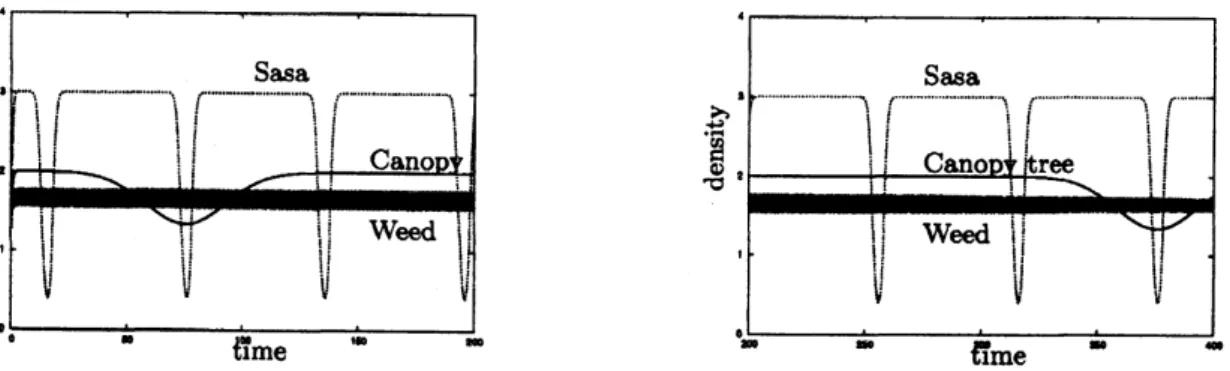
(6)The time variationsof thedensitiesof the three species without acompetitor aregiven byFigure 8.
Figure
8:
Dynamics of Sasa, Canopythreeand Weed withoutacompetitor. The left and right figures describethe density’svariation of eachspecies from$0$year to200yearsand from200yearsto400years, respectively. The
weeds have very smallperturbations.
Now,
we
consider the effect that humansmow
Sasaas
well as the competitive plants of it. We suppose that the mowing by humanI is done constantly, and thus the decreasing rates bymowing of Sasa and the competitive plant
are
given by constants. The model discussed here isas follows:
$\frac{d}{dt}S(t)=(e_{1}-d_{1}(t)-a_{1}S-b_{1}W)S-c_{1}S$,
$\frac{d}{dt}W(t)=(e_{2}-d_{2}(t)-a_{2}W-b_{2}S)W-c_{2}W$,
(7)
where $q(i=1,2)$
are
the decreasing rates for humans tomow
Sasa
and W-species.Let
us
choose the values of $c_{1}$ and $c_{2}$ as0.7
and 1.2, respectively. Then, the simulationresults, Figure 9 and Figure 10, show that Sasa
can
still exist if humansmow
the competitorsas
well as Sasa, and it is advantageous to the competitors because the densities’ variations of thecompetitorsare
determined by the period of Sasa.Figure
9:
The case that Sasa competes to Figure10:
The case that Sasa competes toNow, let
us
remove
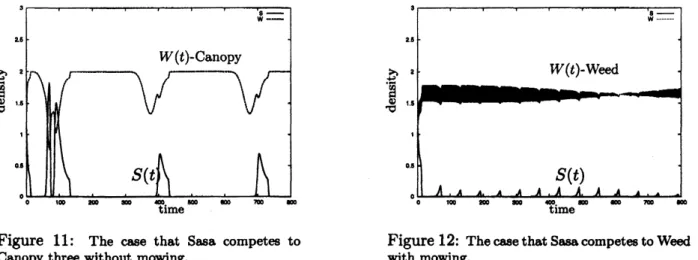
the effect by mowing in the system (7). We choose the same parameter values above, (5) and (6). And we choose $c_{i}=0(i=1,2)$. Then the numerical results are givenby the figures 11, 12.
Figure 11: The case that Sasa competes to Figure 12: Thecasethat Sasa competestoWeed
Canopy threewithoutmowing. with mowing.
Figure 11 and Figure
12
show thatSasa
is disadvantageous to the two competitor,canopy
three and weed. As
a
results, the effect that humansmow
Sasacan
make Sasa to be stronger tocompete against the canopy three oflong periodic deathrate and the weed ofshort periodic death rate.Remark 4 The average death rates
of
Sasa, canopy threeandweedare
given by$[d_{sasa}]=0.239$,
$[d_{\infty n\varphi y}]=$0.145
and $[d_{weed}]=0.5$,
respectivdy. When Sasa competes urith canopy three, theproperty (i)
of
Remark3
issatisfied for
the parameter values chosen in Figure 11. In thecase
thatSasa competes with weed, theproperty (ii)
of
Remark3issatisfied
for
the parameter values chosen in Figure 12. The simulation resultsof
Figure 11 and Figure 12 show that a nontrivialpositiveperiodic solutionexists in the system(1)
even
if
thecorresponding averaged systemwouldfonce
eitherof
the two species to extinction.References
[1] J. J. N. Campbell, Bamboo floweringpattem: A global viewwith special
reference
to EastAsia, J. Am. Bamboo Soc., 6 (1985)
17-35.
[2] J. M. Cushing, Stable limit cydes
of
time dependent multispecies interactions, Math.Bioscience, 31 (1976)
259-273.
[3] J. M. Cushing, Stable positive periodic solutions
of
the time-dependent logistic equation underpossible hereditary influences, J. Anal. Appl., 60 No. 3 (1977)747-754.
[4] J. M. Cushing, Two species competition in a periodic environment, J. Math. Bio., 10 (1980)
385-400.
[5]
J.
M. Cushing, PeriodicLotka-Voltem
competition equations,J. Math.
Bio., 24 (1986)381-403.
[6] K. Kawano and Y. Iwasa, A
lattice-structured
moddfor
beechforest
dynamics: theeffect
of
understorydwarf
bamboo,
Ecological Modeling, 66 (1993)261-275.
[7] T. Kubo and H. Ida, Sustainability
of
an
isolatedbeech-dwarf
bamboo stand: analysis.of
forest
dynamics utth individual based model, Ecological Modeling, 111 (1998)223-235.
[8] T. Nakashizuka, Regeneration
of
Beech (fagus crenata)after
the simultaneous deathof
undergroutng
dwarf
bamboo (Sasa kurilensis) Ecol. $R\epsilon s,$ $3$ (1988)21-35.
[9] T. Namba, Competitive co-existence in aseasonallyfluctuating $en\dot{w}ronment$ J.theor.Biol,
111 (1984)
369-386.
[10] T. Nambdaand
S.
Takahashi, Competitive coesistence ina
seasonally fluctuatingenviron-ment II. Multiple stable states and invasion suocess, Theoretical Population Biology, 44
(1993)
374-402.
[11] A. Makita, Y. Konno, N. Fujita, K. Takada and E. Hmabata, Recovery
of
a
Sasa tsuboiana populationafter
mass
flowerin9
and death Ecol. Research, 8 (1993)215-224.
[12] P. de MottoniandA. Schiaffino, Competition system withpenodic
coefficients:
Ageometric approach J. Math. Bio, 11 (1981)319-335.
[13] N. Shigesada and K. Kawasaki, “Biological Invasions: Theory and Practice,”Oxford
uni-versity press,
1997.
[14] A. H. Taylor, H. Jinyan and Z. ShiQiang, Canopy three development and$unde y vwth$
bam-boo dynamics in old-grvwth
Abies-Betula
forests
in southwestem China: $a$ 12-yearstudy,Forest Ecology and Management,
200
(2004)347-360.
[15] K. Ueda, On theflowenng and deaath
of
bamboos and the$p$roper treatment. (II) Relationbetween the