Efficient Transmission of Information
on
the Quantum Network
量子ネットワーク上での効率的な情報の伝送
MASAHITO
HAYASHII
KAZUOIWAMA2
HARUMICHINISHIMURA2
RUDY
RAYMOND2
SHIGERUYAMASHITA3
林正人 岩間 -雄 西村治道 ルディーレイモンド 山下茂
iERATO-SORST
Quantum Computation and Information Project,Japan Science and Technology Agency
ERATO-SORST 量子情報システムアーキテクチャ
masah$i\mathrm{t}\mathrm{o}\mathrm{O}\mathrm{q}\mathrm{c}i.\mathrm{j}\mathrm{s}\mathrm{t}$
.
go.jp2Graduate
School ofInformatics, Kyoto University 京都大学情報学研究科{iwama,
hnishimura,$\mathrm{r}\mathrm{a}\mathrm{y}\mathrm{m}\mathrm{o}\mathrm{n}\mathrm{d}$}
$\mathrm{Q}\mathrm{k}\mathrm{u}i\mathrm{s}$.
kyoto-u.$\mathrm{a}\mathrm{c}$.jp3Graduate
School ofInformation Science, Nara Institute ofScienceand Technology奈良先端科学技術大学情報科学
$\mathrm{g}\epsilon \mathrm{r}\mathrm{Q}i\mathrm{s}$
.
naist.jpAbstract. Since quantum information is continuous, its handling is sometimes surprisingly
harder than the classical counterpart. A typical example is cloning; making a copy of digital
information is straightforward but it is not possible exactly for quantum information. The
question in this paper is whether or not quantum network coding is possible. Its classical
counterpart is another good example to show that digital information flow
can
be done muchmore efficiently than conventional (say, liquid) flow.
Our
answer
tothe question is similar to thecaseof cloning, namely, it isshownthat quantumnetwork coding is possible ifapproximation is allowed, by using
a
simple network model calledButterfly. In this network, thereare two flow paths, $s_{1}$ to$t_{1}$ and $s_{2}$ to $t_{2}$
,
which sharesa
singlebottleneck channelofcapacity
one.
In the classical case,we can
send two bits simultaneously,one
for each path, in spite of the bottleneck. Our results for quantum network codinginclude:(i) We can send any quantum state $|\psi_{1}\rangle$ from $s_{1}$ to $t_{1}$ and $|\psi_{2}\rangle$ from s2 to $t_{2}$ simultaneously
withafidelity strictlygreater than 1/2. (ii) If
one
of $|\psi_{\mathrm{k}}\rangle$ and $|\psi_{2}\rangle$ is classical, thenthe fidelitycan
beimproved to 2/3. (iii) Similar improvementis also possible if $\mathrm{C}\mathrm{b}_{\mathrm{i}}\rangle$ and $1\mathrm{C}\mathrm{b}2\rangle$ arerestrictedto only a finite number of (previously known) states. This allows
us
to design an interestingprotocol whichcan sendtwo classical bits from$s_{1}$ to $t_{1}$ (similarlyfrom $s_{2}$ to$t_{2}$) but onlyoneof
them should be recovered.
1
Introduction
Coding is obviously one of the most important techniques for information processing, and is
used for many different purposes including cryptography,
error
correction, data compression,etc. Recently it has been shown that coding is also useful to effectively achieve larger channel
capacitythan
can
beachievedby simple routing. Thetechniqueis basedon acompletelydifferentidea from data compression and has been known as network coding since its introduction by
Ahlswede, Cai, Li and Yeung [2]. It has been quite popular as a mutual interest oftheoretical
computer science and information theory (seee.g., [14. 16, 17, 18] for recent developments).
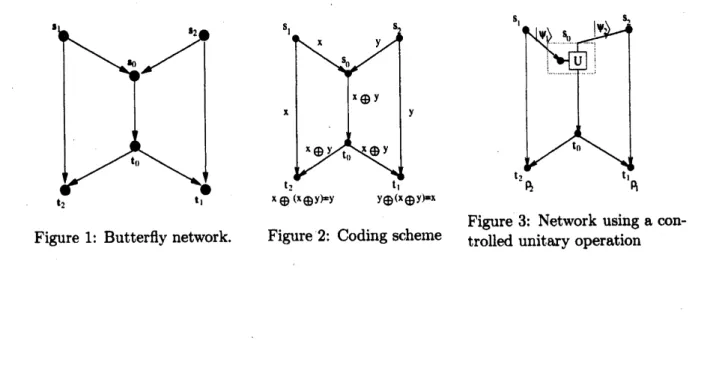
Network codingis nicely explained by usingtheso-called Butterfly networkas shown in Fig.
1. The capacity of each directed linkis all
one
and there aretwo source-sink pairs $s_{1}$ to$t_{1}$ andamount of flow in both paths isbounded by one, say, 1/2 for each. Interestingly, this max-flow
$\min$-cut theorem no longer applies for “digital information flow.” As shown in Fig. 2, we can
transmit two bits, $x$ and $y$, on the two paths simultaneously. Tricks hereare (at least) twofold:
The first one is the EX-OR (Exclusive-OR) operation at node $s_{0}$
.
Onecan see
that the bit $y$is encoded by using$x$
as
a key which is sent directly from $s_{1}$ to $t_{2}$, and viseversa.
The secondtrickiseven moreimportant; at node$t_{0}$ wecanmake anexactcopy of one-bit information from
$s_{0}$
.
The main objective of this paper is to develop similar, but approximated network coding
for quantum channels and quantum information. (It turns out that exact transmission is not
possible, which
one
intuitively expects by the continuous nature of quantum information, theno-cloning theorem [23] etc.) For given two quantum states $|\psi_{1}\rangle$ at $s_{1}$ and $|\psi_{2}\rangle$ at $s_{2}$,
our
taskisto transmit themto $t_{1}$ and $t_{2}$ simultaneously and output as$\rho_{1}$ and$\rho_{2}$, respectively. Our goal
is to aake $\rho_{1}$ and $\rho_{2}$ as similar to the original $|\psi_{1}\rangle$ and $|\psi_{2}\rangle$ as possible, respectively (we
use
bold fonts for 2 $\mathrm{x}2$ and $4\cross 4$ density matrices for exposition). Everychannel capacity remains
one
and any physically implementable operation is allowed at each node.The key
seems
to be whether wecan
find tricks similar to the above classical case. For thesecond one, wemay be able to
use
the approximatedcloningbyBu\v{z}ekandHillery [9], butfor thefirst one, there is noobvious way ofencodinga quantum statebya quantumstate. Consider, for
example, a simple extension of the classical operation at node $s_{0}$ byusing a controlled unitary
transform $U$ asillustrated in Fig. 3. (Note that classical EX-OR is realized by setting $U=X$
“bit-flip.”) Then, for any $U$
,
there is a quantum state $|\phi\rangle$ (actually an eigenvector of $U$) suchthat $|\phi\rangle$ and $U|\phi\rangle$ are identical (up to a global phase). Namely, if $|\psi_{2}\rangle$ $=|\phi\rangle$, then$\rho_{1}=|\phi\rangle$ $(\phi|$
at $t_{1}$ does not change for $|\psi_{1}\rangle$ $=|0\rangle$ and $|\psi_{1}\rangle$ $=|1\rangle$
.
Since $|0\rangle$ and $|1\rangle$ areorthogonal, thismeanseither $|0\rangle$ and$\rho_{1}$ or $|1\rangle$ and$\rho_{1}$
are
completely dissimilaror
their fidelity is at most 1/2. Recallthat
our measure
for the transmissionqualityis the worst-case fidelity.Our Contribution. In this paper, wegivea protocol such that for any quantum states $|\mathrm{t}\mathrm{h}_{\mathrm{i}}\rangle$
at $s_{1}$ and $|\psi_{2}\rangle$ at$s_{2},$ $F(|\psi_{1}\rangle,\rho_{1})$and$F(|\psi_{2}),\rho_{2})$ areboth strictly greater than1/2 (Theorem3.1),
where $F$ is the fidelity. The idea is discretization of (continuous) quantum states. Namely, the
quantum state from $s_{2}$ is changed into classical three bits which are used as akey to “encode”
the state from $s_{1}$ at node $s_{0}$ and “decode” it at node $t_{1}$
.
At node $t_{2}$, we recover the key bitsby comparing the state from $s_{1}$ and its encoded
one
from $t_{0}$.
For thaee purposes, we need theabove approximatedcloning,and whatwecall “three-dimensional (3D)measurement” thatgives
us which basis the current quantum state is close to. Moreover; we use “approximated group
Figure3: Network usinga
operations” for encodingquantumstates and the Bell measurement for their comparison.
Note that the present value of $F(|\psi_{1}\rangle,\rho_{1})$ and $F(|\psi_{2}\rangle,\rho_{2})$ is only slightly better than 1/2
(some 1/2+1/100) in general. However, ifweimposesome restriction, the value becomes much
better. For example, if $1\mathrm{t}\mathrm{h}_{1}\rangle$ is a classical state (i.e. either $|0\rangle$ or $|1\rangle$), then the fidelity becomes
2/3 (Theorem 4.1). Similar improvement is also possible if $|\psi_{1}\rangle$ and $|\psi_{2}\rangle$ are restricted to only
a finite number of (previously known) states, especially if they are so called quantum random
access
codingstates [3]. Byusingthis, we candesign aninteresting protocol whichcan
send twoclassical bits from $s_{1}$ to $t_{1}$ (similarly twobits from s2 to $t_{2}$) but only
one
ofthem, determinedby adversary, should be recovered. It is shownthat the
success
probability for this protocol is$1/2+\sqrt{2}/16$ (Theorem 4.2), but classically the
success
probability for any protocol is at most1/2.
Related Work. The study of coding methods
on
quantum information and computationhas been deeply explored for
error
correction of quantum computation (since [22]) and datacompressionofquantum
sources
(since [21]). Recallthat their techniquesare
duplicationofdata(error correction) andaverage-case analysis (data compression). Those standard approaches do
not
seem
to helpin thecore
ofour
problem.More tricky applications of quantum mechanism arequantum teleportation [5], superdense
coding [6], and a variety of quantum cryptosystems including the BB84 key distribution $[4_{\mathrm{J}}^{1}$
.
Probablymost related one to this paper is the random access codingby Ambainis, Nayak,
Ta-shma, and Vazirani [3], which allows usto encode two
or
more classical bits into onequbit anddecode it to
recover
anyoneof thesourcebits. Ourthird protocol is a realizationofthis schemeon
the Butterflynetwork.Different fromthe
classical
world, the quantum mechanics prohibitsus
fromexactmanipu-lation of
some
fundamental operationssuch ascloningaqubit [23], deletingone oftwo copiesofa qubit [20], and the universal NOT ofa qubit (on the Bloch sphere) [8]. However, since these
operations
are
so basic ones, itwas
natural that their approximated or probabilistic versionswere
investigated. For instance, Bu\v{z}ekand Hillery [9] found a quantum cloning machine whichproduces two copies of any unknown original state with fidelity 5/6, which was shown to be
optimal [7]. Our approximated approachreflects the policy of these studies
on
manipulations ofunknown quantum states.
Inthis paper, weomit all the proofs ofour results. See [15] for the details.
2
Formal
Setting
Our model
as
a quantum circuit is shown in Fig. 4. The informationsources
at nodes $s_{1}$ and$s_{2}$ are pure one-qubit states $|\psi_{1}\rangle$ and $|\psi_{2}\rangle$
.
(It turns out, however, that the result does notchange for mixed states because of the joint concavity of the fidelity [19].) Any node does not
have prior entanglement with other nodes. At every node, a physically allowable operation,
i.e., trace-preserving completely positive map (TP-CP map), is done, and each edge can send
only
one
qubit. They are implemented by unitary operations with additional ancillae and bydiscardingall qubits except for theoutput qubits $[1, 19]$
.
Our goal istosend $|\mathrm{t}\mathrm{h}_{1}\rangle$ tonode$t_{1}$and $|\psi_{2}\rangle$ to node$t_{2}$aswell
as
possible. The quality of dataat node$t_{j}$ is measuredby the fidelity between the original state
$|\psi_{j}\rangle$ andthe state$\rho_{j}$ output at
node $t_{j}$ bythe protocol. Here, thefidelity between two quantum states$\rho$ and
$\sigma$
are
definedas
$F(\sigma,\rho)=(\mathrm{n}\sqrt{\rho^{1/2}\sigma\rho^{1/2}})^{2}$
as
in [7, 11, 12]. (Theothercommon
definition is Tr$\sqrt{\rho^{1/2}\sigma\rho^{1/2}}.$) InFigure 4: Quantum circuit for coding on the Butterfly network
$\mathrm{D}\mathrm{u}\iota\iota \mathrm{e}\mathrm{r}\mathrm{u}\mathrm{y}\iota\iota \mathrm{e}\iota \mathrm{W}\mathrm{U}1^{-}\mathrm{K}$
Figure5: Protocol $XQQ$
.
$\mathrm{s}\mathrm{i}\mathrm{m}\mathrm{p}\mathrm{l}\mathrm{i}\mathrm{f}.\gamma$thedescription, for a pure state $|\psi\rangle\langle$$\psi|$ weoftenusethe vector representation $|\psi$) $.$) We
calltheminimum of$F(|\psi_{j}\rangle,\rho_{j})$
over
all one-qubit states $|\psi_{j}\rangle$ the fidelity at node$t_{j}$.
Note that aprotocolwhich achieves afidelity of1/2 trivially exists (i.e., the onewhich outputs completely
mixed states at $t_{1}$ and$t_{2}$ regardless of the input.) So, the question is whether
we
can achievea
fidelity strictly better than 1/2.
3
Main
Result
In thissection we state the following main theorem.
Theorem S.l There exists a quantum protocol whose
fidelities
at nodes $t_{1}$ and $t_{2}$ are 1/2+200/19683 and 1/2+180/19683, respectively.
3.1
Overview of the Protocol
Fig. 5 illustrates
our
protocol, Protocol for Crossing Two Qubits $(XQQ)$.
As expected, theapproximated cloning is used at nodes $s_{1},$ $s_{2}$ and $t_{0}$
.
At node $s_{0}$,
we
first apply the $3\mathrm{D}$ measurement to the state of one-qubit system$Q_{3}$ and
obtain three classical bits $r_{1}r_{2}r_{3}$
.
Their different eight values suggest which part of the Blochsphere thestate of$Q_{3}$ sits in. These eight values
are
then used to chooseone ofeight operations,the approximated group operations, toencode the state of $Q_{2}$
.
Theseeight operations includeidentity $I$, bit-flip$X$, phase-flip $Z,$ $\mathrm{b}\mathrm{i}\mathrm{t}+\mathrm{p}\mathrm{h}\mathrm{a}\mathrm{s}$ -flip $\mathrm{Y}$
,
and their combination with the universalNOT [10] denoted by Inv. Here, we need to be careful since Inv is not physically allowable.
Actually, therefore, we
use
its approximationInv’
$= \frac{1}{3}\mathrm{I}\mathrm{n}\mathrm{v}+\frac{I}{3}$, which turnsout to be physicallyallowable. At node $t_{1}$, we apply the reverse operations of these eight operations (actually the
same asthe original ones) forthe decoding purpose.
At node $t_{2;}$ we
recover
the three bits $r_{1}r_{2}r_{3}$ (actually the corresponding quantum state forthe output state) bycomparing$Q_{1}$ and $Q_{6}$
.
This should be possible since $Q_{2}(\approx Q_{1})$is encodedinto $Q_{5}(\approx Q_{6})$ by using$r_{1}r_{2}r_{3}$ as akeybut its implementation is not obvious. It isshown that
for thispurpose, we
can
use
the Bell measurement together with the fact that $Q_{1}$ and $Q_{2}$are
4
Protocols
for
Restricted Problems
4.1
Protocol
$XQC$We first consider the
case
whereone
of thesources
(say, node $s_{2}$) receives a classical bit $b$.
Noticethat, in this case, the fidelity at node $t_{2}$ equalstothe probability that $b$canberecovered
successfully at $t_{2}$
.
See
Fig. 6 for the protocol $XQC$.
Theo$nm\mathit{4}\cdot 1XQC$ achieves a fidelity
of
2/3 at both $t_{1}$ and$t_{2}$.
As before
we
use
cloning at $s_{1}$ and $s_{2}$ but there is no shrink at 82 this time. At $\epsilon_{0}$, thestate
on
$Q_{2}$ is bit-flipped iff$b=1$.
Then, the decoding process is rather straightforward: at $t_{1}$the state is flipped back iff $b=1$, while at $t_{2}$ the quantum states received from $s_{1}$ and
to
are
compared to retrieve $b$by an appropriate measurement. As mentioned inSec. 1, this protocol
would not work if perfect cloning
were
possible (and were used) at node $s_{1}$.
The approximatedcloning at $s_{1}$ creates
some
entanglement between $Q_{1}$ and $Q_{2}$ (and between$Q_{1}$ and $Q_{6}$), which
is essential for the performance of$XQC$
.
4.2
Protocol
$X2C2C$We next consider the
case
that bothsources are
restricted to beone
ofthe four $(2, 1, \cos^{2}\pi/8)-$quantumrandom
access
(QRA) coding states [3], where $(m,n,p)$-QRA coding is the coding of$m$ bits to$n$ qubitssuchthat anyonebitchosen from the$m$ bits isrecovered with probability$p$
.
In this case, we
can
send them with high fidelity (at least 3/4) from $s_{1}$ to $t_{1}$ and from $s_{2}$ to $t_{2}$by combiningthe measurement in the basis $B_{x}$ at the sources and the classical network coding
scheme for the Butterfly network.
As an application. we can consider a more interesting problem where each
source
receivestwo classical bits, namely, $x_{1}x_{2}\in\{0,1\}^{2}$ at $s_{1}$, and $y_{1}y_{2}\in\{0,1\}^{2}$ at $s_{2}$
.
At node $t_{1}$,we
output oneclassical bit
Out1
and similarlyOut2
at $t_{2}$.
Now an adversarychooses two numbers$i_{1},$$i_{2}\in\{1,2\}$
.
Our protocolcan use
the information of$i_{1}$ only at node$t_{1}$ and that of$i_{2}$ only at $t_{2}$
.
Our goal is to maximize$F(x_{i_{1}}, \mathrm{O}\mathrm{u}\mathrm{t}^{1})$ and $p(y_{i},, \mathrm{O}\mathrm{u}\mathrm{t}^{2})$, where $F(x_{i_{1}}, \mathrm{O}\mathrm{u}\mathrm{t}^{1})$ turnsout to be
the probability that $x_{i_{1}}=\mathrm{O}\mathrm{u}\mathrm{t}^{1}$and similarly for $F(y_{i},, \mathrm{O}\mathrm{u}\mathrm{t}^{2})$
.
Fig.7
illustrates $X2C2C$.
Theorem
4.2
$X2C2C$ achieves a fidelityof
$1/2+\sqrt{2}/16$ at both $t_{1}$ and$t_{2}$.
By contrast, any classical protocolcannot achieve
a
success
probability greater than 1/2 forthefollowing
reason:
Let fix$y_{1}=y_{2}=0$.
Then the path from$s_{1}$ to$t_{1}$ isobviouslyequivalent tothe $(2, 1, p)$-classical random access coding, wherethe success probability$P$ is at most 1/2 [3].
References
[1] D.Aharonov, A. Kitaev, and N. Nisan. Quantumcircuitswithmixedstates. Proc. 30th
ACMSTOC, pp. 20-30, 1998.
[2] R. Ahlswede, N. Cai, S.-Y. R. Li, and R. W. Yeung. Network information flow. IEEE
$2\}\mathrm{u}$nsactions on
Information
Theory46 (2000) 1204-1216.[3] A. Ambainis, A. Nayak, A. Ta\prime shma, and U. Vazirani. Dense quantum coding and
Figure 6: Protocol XQC
Figure
7:
ProtocolX2C2C
[4] C. H. Bennett and G. Brassard. Quantum cryptography: public key distribution and
coin tossing. Proc. IEEE International
Conference
on
Computers. Systems and SignalProcessing, pp. 175-179, 1984.
[5] C. H.Bennett, G. Brassard, C. Cr\’epeau,R. Jozsa, A. Peres, and W. K. Wootters.
Tele-porting an unknown quantum states via dual classical and $\mathrm{E}\mathrm{i}\mathrm{n}\mathrm{s}\mathrm{t}\mathrm{e}\mathrm{i}\mathrm{n}-\mathrm{P}\mathrm{o}\mathrm{d}\mathrm{o}\mathrm{l}\mathrm{s}\mathrm{k}\mathrm{y}$-Rosen
channels. Phys. Rev. Lett. 70 (1993) 1895-1899.
[6] C. H. Bennett and S. J.
Wies.ner.
Communicationviaone- and two-particle operatorson
Einstein-Podolsky-Rosen states. Phys. Rev. Lett. 69 (1992)2881-2884.
[7] D. Bru8, D. P. DiVinoenzo, A. Ekert, C. A. Fuchs. C. Macchiavello, and J. A. Smolin.
Optimaluniversaland state-dependent quantum cloning. Phys. Rev. A57(1998)
2368-2378.
[8] D. Bru8,M. Cinchetti, G. M.D’Ariano, andC. Macchiavello. Phase-covariant quantum
cloning. Phys. Rev. A 62 (2000) 012302.
[9] V. Bu\v{z}ek and M. Hillery. Quantum copying: Beyond the no-cloning theorem. Phys.
Rev. A 54 (1996) 1844-1852.
[10] V. Bu\v{z}ek, M. Hillery, and R. F. Werner. Optimal manipulation with qubits: universal
NOT gate. Phys. Rev. A 60 (1999)
2626-2629.
[11] H. Fan, K. Matsumoto, X.-B. Wang, and H. Imai. Phase-covariant quantum cloning.
J. Phys. A: Math. Gen. 35 (2002) 7415-7423.
[12] N.Gisin and S. Massar. Optimal quantum cloningmachines. Phys. Rev. Leu. 79 (1997)
2153-2156.
[13] N. Gisin and S. Popescu. Spin flips and quantum information for antiparallel spins.
Phys. Rev. Lett. 83 (1999)
432-435
[14] N. J. Harvey, D. R. Karger, and K. Murota. Deterministic networkcoding by matrix
completion. Proc. 16th $ACM$-SIAMSODA, pp. 489-498, 2005.
[15] M. Hayashi, K. Iwama, H. Nishimura, R. Raymond, and S. Yamashita. Quantum
[16] S. Jaggi, P. Sanders, P. A. Chou, M. Effros, S. Egner, K. Jain, L. M. G. M. Tolhuizen.
Polynomial time algorithms for multicast network code construction. IEEE $7\mathcal{I}\gamma ansac-$
tions on
Information
Theory 51 (2005)1973-1982.
[17] A. R. Lehman and E. Lehman. Complexity classification of network information flow
problems. Proc. 15th $ACM$-SIAMSODA, pp. 142-150, 2004.
[18] A. R. Lehman and E. Lehman. Network coding: does the model need tuning? Prvc.
16th $ACM$-SIAMSODA, pp. 499-504, 2005.
[19] M. A.Nielsen, I. L. Chuang, QuantumComputation and QuantumInformation,
Cam-bridge, 2000.
[20] A. K. Pati andS. L. Braunstein. Impossibilityofdeleting
an
unknown quantum state.Nature404 (2000)
164-165.
[21] B. Schumacher. Quantumcoding. Phys. Rev. A 51 (1995)
2738-2747.
[22] P. Shor. Scheme for reducing decoherence in quantum computer memory. Phys. Rev.
A 52 (1995)
2493-2496.
[23] W. K. Wootters and W. H. Zurek. A single quantum cannot be cloned. Nature 299