Probabilistic
Construction
of
Solutions
To
Some
Integral Equations
Isamu
D\^okuDepartment of Mathematics,
Saitama
UniversitySaitama, 338-8570 Japan
\S 1.
Notations and assumptionsFor simplicity, let $D_{0}:=\mathbb{R}^{3}\backslash \{0\}$, and
we
put $\mathbb{R}_{+}:=[0, \infty$). For every$\alpha,$$\beta\in \mathbb{C}^{3}$, we
use
thesymbol $\alpha\cdot\beta$ for the inner product, and we define$e_{x}$ $:=x/|x|$
for every $x\in D_{0}$. In this article we consider the following deterministic nonlinear
integral equation:
$e^{\lambda t|x|^{2}}u(t, x)=u_{0}(x)+ \frac{\lambda}{2}\int_{0}^{t}dse^{\lambdas|x|^{2}}\int p(s, x, y;u)n(x, y)dy$
$+ \frac{\lambda}{2}\int_{0}^{t}e^{\lambda s|x|^{2}}f(s, x)d_{\mathcal{S}}$, for $\forall(t, x)\in \mathbb{R}_{+}\cross D_{0}$. (1)
Here$u\equiv u(t, x)$ is an unknownfunction: $\mathbb{R}_{+}\cross D_{0}arrow \mathbb{C}^{3},$ $\lambda>0$, and$u_{0}:D_{0}arrow \mathbb{C}^{3}$
is theinitial data such that $u(t, x)|_{t=0}=u_{0}(x)$
.
Moreover, $f(t, x)$ : $\mathbb{R}_{+}\cross D_{0}arrow \mathbb{C}^{3}$is.a
given function satisfying $f(t, x)/|x|^{2}=:\tilde{f}\in L^{1}(\mathbb{R}_{+})$. The integrand$p$ in (1) is given by
$p(l, x, y;u)=u(x, y)\cdot e_{x}\{u(t, x-y)-e_{x}(u(t, x-y)\cdot e_{x}$ (2)
On the other hand, we consider aMarkov kernel $K$ : $D_{0}arrow D_{0}\cross D_{0}$
.
Actually, forevery $z\in D_{0},$ $K_{z}(dx, dy)$ lies in the space $\mathcal{P}(D_{0}\cross D_{0})$ of all probability measures
on aproduct space $D_{0}\cross D_{0}$. When thekernel $k$ is given by $k(x, y)=i|x|^{-2}n(x, y)$,
then we define $K_{z}$
as
a Markov kernel satisfying that for any positive measurablefunction $h=h(x, y)$ on $D_{0}\cross D_{0},$
$\iint h(x, y)K_{z}(dx, dy)=\int h(x, z-x)k(x, z)dx$ (3)
Moreover, we
assume
that for every measurable functions $f,$$g>0$ on $\mathbb{R}^{+},$$\int h(|z|)v(dz)\int g(|x|)K_{z}(dx, dy)=\int g(|z|)\nu(dz)\int h(|y|)K_{z}(dx, dy)$ (4)
\S 2.
Main resultIn this section
we
shall stateour
main result, which asserts the existence anduniqueness of solutions to the nonlinear integral equation (1). As
a
matter offact, the solution $u(t, x)$
can
be expressedas
the expectation ofa
star-productfunctional, which is nothing but a probabilistic solution constructed by making
use of thebelow-mentioned branchingparticle systems and branching models. Let
$M_{\star}( \omega)=\prod\star[x_{m}^{-}]^{-}-m^{1}.m_{3}[u_{0}, f](\omega)$, (5)
be
a
probabilistic representation in terms of tree-based star-product functionalwith weight $(u_{0}, f)$
.
For the details of the definition,see
the succeeding sections.Onthe other hand, $M_{*}^{\langle U,F\rangle}(\omega)$ denotes the corresponding$*$-productfunctionalwith
weight $(U, F)$
.
In fact,as
to beseen
in what follows, ina
similarmanner
as
thecase
ofa
star-product functionalwe
can
construct $a(U, F)$-weighted $tree-$based $*-$product functional $M_{*}^{\langle U,F\rangle}(\omega)$, which is indexed by the nodes $(x_{m})$ ofa binarytree.
Herewe suppose that $U=U(x)$ $($resp. $F=F(t, x))$ is a non-negative measurable
function on $D_{0}$ (resp. $\mathbb{R}_{+}\cross D_{0}$) respectively, and also that $F$ x) $\in L^{1}(\mathbb{R}_{+})$
for each $x$
.
Indeed, in construction of the $*$-product functional, the product inquestion is taken
as
ordinary multiplication $*$ insteadof the star-product $\star$ in thedefinition of star-product functional.
$T$heorem 1. Suppose that $|u_{0}(x)|\leq U(x)$
for
$\forall x$ and $|\tilde{f}(t, x)|\leq F(t, x)$for
$\forall t,$$x$, and also that
for
some
$T>0$ ( $T>>1$ sufficiently large),$E_{T,x}[M_{*}^{\langle U,F\rangle}]<\infty$, ae.
$-x$ (6)
Thenthere exists $a(u_{0}, f)$-weighted tree-based star$\star$-product
functional
$M_{\star}^{\langle u_{0},f\rangle}(\omega)$,indexed by a set
of
node labels accordingly to the tree structure whicha
binarycrit-ical branching process $Z^{K_{x}}(t)$ determines. Furthermore, the
function
$u(t, x)=E_{t,x}[M_{\star}^{\langle uo,f\rangle}]$ (7)
$give\mathcal{S}$ a unique solution to the integral equation (1). Here $E_{t,x}$ denotes the
expecta-tion with respect to a probability
measure
$P_{t,x}$ as the time-reversed lawof
$Z^{K_{x}}(t)$.\S 3.
Branching modelInthis section
we
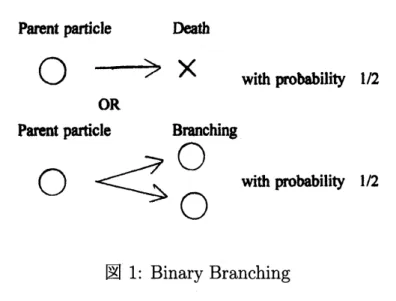
consider a continuous time binary critical branchingprocess$Z^{K_{x}}(t)$
on
$D_{0}$, whose branching rate is given by a parameter $\lambda|x|^{2}$, whosebranch-ing mechanism is binary with equi-probability, and whose descendant branchbranch-ing
$PaIe\mathfrak{n}t$ particle Death
$O$ $arrow$ $\cross$
with probability 1/2 OR
1/2
図1: Binary Branching
notice of the tree structure which the process $Z^{K_{x}}(t)$ determines,
we
denote thespace of marked trees
$\omega=(t, (t_{m}), (x_{m}), (\eta_{m}), m\in \mathcal{V})$ (8)
by $\Omega$. Furthermore, we write the
time-reversed law of $Z^{K_{x}}(t)$ being
a
probabilitymeasure on $\Omega$ as
$P_{t,x}\in \mathcal{P}(\Omega)$. Here $t$ denotes the birth time of common ancestor,
and theparticle$x_{m}$ dieswhen $\eta_{m}=0$, whileit generates two descendants$x_{m1},$$x_{m2}$
when $\eta_{m}=1$
.
On the other hand,$\mathcal{V}=\bigcup_{p\geq 0}\{1, 2\}^{\ell}$
is a set of all labels, namely, finite sequences of symbols with length $\ell$, which
describe thewholetree structure given. For$\omega\in\Omega$ we denote by$\mathcal{N}(\omega)$ the totality
of nodes being branching points of tree, and let $N_{+}(\omega)$ be the set of all nodes $m$
being a member of $\mathcal{V}\backslash \mathcal{N}(\omega)$, whose direct predecessor lies in $\mathcal{N}(\omega)$ and which
satisfies the condition $t_{m}(\omega)>0$, and let $N_{-}(\omega)$ be the
same
set as describedabove, but satisfying $t_{m}(\omega)\leq 0$
.
Finallywe put$N(\omega)=N_{+}(\omega)\cup N_{-}(\omega)$. (9)
\S 4.
Star-product functional and $*$-product functionalIn what follows we shall intoduce a tree-based star-product functional in
order to construct a probabilistic solution to the class of integral equations (1).
onto its orthogonal part of the $z$ component in $\mathbb{C}^{3}$
, and we define a $\star$-product of
$\beta,$
$\gamma$ for $z\in D_{0}$ as
$\beta\star_{1z]}\gamma=-i(\beta\cdot e_{z})Proj^{z}(\gamma)$. (10)
We shall define $\Theta^{m}(\omega)$ for each $\omega\in\Omega$realized as follows. When $m\in N_{+}(\omega)$, then
$\Theta^{m}(\omega)=\tilde{f}(t_{m}(\omega), x_{m}(\omega))$, while $\Theta^{m}(\omega)=u_{0}(x_{\mathfrak{m}}(\omega))$ if $m\in N_{-}(\omega)$. Then
we
define
$\Xi_{m_{2}^{1}.m_{3}}^{rn}(\omega)\equiv\Xi_{m_{2}^{1},m_{3}}^{m}[u_{0}, f](\omega):=\Theta^{m_{2}}(\omega)\star_{[x_{m_{1}}]}\Theta^{m_{3}}(\omega)$, (11) where as for the product order in the star-product $\star$, when we write $m\prec m’$ lexicographically with respect to the natural order $\prec$, the term $\Theta^{m}$ labelled by $m$
necessarily occupies the left-hand side and the other $\Theta^{m’}$
labelled by $m’$ occupies the right-hand side by all means. And besides,
as
abuse ofnotation we write$-m,\emptyset m\equiv_{-,\emptyset[u_{0}}, f](\omega):=\Theta^{m}(\omega)$, (12)
especially when $m\in \mathcal{V}$ is a label of single terminal point in the restricted tree structure in question.
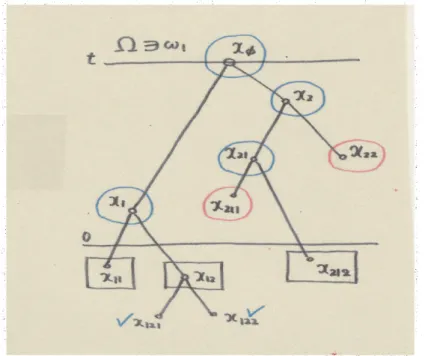
図 2: Example: A realized Tree
Under these circumstances, we considerarandom quantity which obtained by executing the star-product $\star$ inductively at each node in$\mathcal{N}(\omega)$, and we call it a
tree-based $\star$-product functional, and we express it symbolically as
where $m_{1}\in \mathcal{N}(\omega)$ and $m_{2},$$m_{3}\in N(\omega)$, and by the symbol $\prod\star$ (as a product relative to the star-product) we mean that the star-products $\star$’s should be suc-ceedingly executed in a lexicographical manner with respect to $X_{m}^{-}$ such that $\tilde{m}\in$
$\mathcal{N}(\omega)\cap\{|\tilde{m}|=\ell-1\}$ when $|m_{1}|=\ell.$
Example 1. Now letussupposethat atree structure$\omega_{1}(\in\Omega)$ has beenrealized
here (see Figure 2).
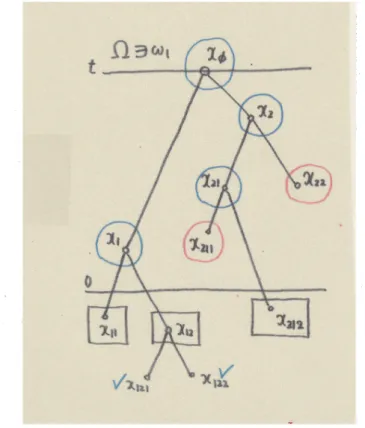
図3: Classification ofNodes
Next
we
shall classify those nodes in the realized tree $\omega_{1}$. As a matter of fact, asto those two particles located at $x_{11}$ and $x_{12}$ with nodes of the level $|m|=\ell=2$ accompanied by the pivoting node $x_{1}$, we can construct
$-11,121$
byastar-product $u_{0}(x_{11}(\omega_{1}))\star_{[X_{1}]}u_{0}(x_{12}(\omega_{1}))$ inaccordance withthe rule, because both $m_{1}=11$ and $m_{2}=12lie$ in $N_{-}(\omega)$. As to the node $x_{21}$, how to construct $—(\omega_{1})$is thealmostsamething
as
described above. In fact,it goessimilarlybecause$x_{211}$ lies in $N_{+}(\omega_{1})$ and $x_{212}$ lies in $N_{-}(\omega_{1})$. Accordingto the rule, it follows that
hence $\Xi_{211,212}^{21}(\omega_{1})$ is given by $\tilde{f}(t_{211}(\omega_{1}), x_{211}(\omega_{1}))\star_{[x_{21}]}u_{0}(x_{212}(\omega_{1}))$,
see
Figure 3.Consequently,
we
obtain finally$M_{\star}^{\langle u0f\rangle}(\omega_{1})=\cdot(u_{0}(x_{11})\star_{[x_{1}]}u_{0}(x_{12}))\star_{[x_{\phi}]}$
$\{(u(x_{212}))\star_{[x_{2}]}\tilde{f}(t_{22}, x_{22})\}$
.
(14)口
\S 5.
Outline of proof: tree-based star-product functionalas a
solutionIn this section we are first going to construct $a(U, F)$-weighted tree-based
$*$-product functional $M_{*}^{\langle U,F\rangle}(\omega)$,
which is indexed by the nodes $(x_{m})$ of
a
binarytree. Here recall that $U=U(x)$ $($resp. $F=F(t, x))$ is
a
non-negative measurablefunction
on
$D_{0}$ (resp. $\mathbb{R}_{+}\cross D_{0}$) respectively, and also that $F$ $x$) $\in L^{1}(\mathbb{R}_{+})$for each $x$. Moreover, in construction of the functional, the product is taken
as
ordinary multiplication $*$ instead of the star-product $\star.$
In what follows we shall give
an
outline of the proofof Theorem 1. We need thefollowing technical lemma, which plays an essential role in the proof.
Lemma 2. For$0\leq t\leq T$ and$x\in D_{0}$, the
function
$V(t, x)=E_{t,x}[M_{*}^{\langle U,F\rangle}(\omega)]$satisfies
$e^{\lambda t|x|^{2}}V(t, x)=U(x)+ \int_{0}^{t}ds\frac{\lambda|x|^{2}}{2}e^{\lambda s|x|^{2}}\{F(s, x)+\int V(s, y)V(s, z)K_{x}(dy, dz)\}.$
(15)
As
a
matter of fact, the mapping : $[0, T]\ni t\mapsto e^{\lambda|x|^{2}}tV(t, x)\in\overline{\mathbb{R}}_{+}$ isnon-decreasing,
so
that, it proves to be that$E_{t,x}[M_{*}^{\langle U,F\rangle}(\omega)]<\infty$ (16)
holds for$\forall t\in[0, T]$ and $x\in E_{c}$, where $E_{c}$ is
a
measurableseton
which the validityof$E_{t,x}[M_{*}^{\langle U,F\rangle}]<\infty$ maybe kept. Another important aspect for the proof consists
in establishment of the following $M_{*}$-control inequality. That is to say, we have
$|M_{\star}^{\langle u0,f\rangle}(\omega)|\leq|M_{*}^{\langle U,F\rangle}(\omega)|$ (17)
because of the validity ofa simple inequality
$|w\star_{[x]}v|\leq|w|\cdot|v|$ for $w,$$v\in \mathbb{C}^{3}$ and $x\in D_{0}.$
On the other hand, it is derived that the space of solutions to (1) is formed by the
condition
A similar discussion
as
above leads to$u(t, x)=E_{t,x}[M_{\star}^{\langle u_{0},f\rangle}( \omega)]=e^{-\lambda t|x|^{2}}u_{0}(x)+\int_{0}^{t}ds\lambda|x|^{2}e^{-\lambda(t-s)|x|^{2}}\cross$
$\cross\frac{1}{2}\{\tilde{f}(s, x)+\iint E_{s,x_{1}}[M_{\star}]\star_{[x]}E_{s,x_{2}}[M_{\star}]K_{x}(dx_{1}, dx_{2})\}$ . (18)
Finallywe
can
deduce that $u(t, x)=E_{t,x}[M_{\star}^{\langle u0,f\rangle}(\omega)]$ satisfies the integral equation(1), and this $u(t, x)$ is
a
solution lying in the space $\mathcal{D}$.
Actually, $\mathcal{D}$is a space of
all functions $\varphi$ : $\mathbb{R}_{+}\cross D_{0}arrow \mathbb{C}^{3}$, being continuous in $t$ and measurable such that
$\int_{0}^{\infty}d_{\mathcal{S}}\int|p(s, x, y;\varphi)|K_{x}(dy, dz)<\infty$, ae. $-x.$
Acknowledgements
This work is supported in part by Japan MEXT Grant-in-Aids SR(C) 24540114
and also by ISM Coop. Res. Program: 2011-CRP-50I0.
References
[1] Aldous, D. The continuum randomtree I.
&
III. Ann. Probab. 19 (1991), 1-28;ibid. 21 (1993), 248-289.
[2] Aldous, D. Tree-based models for random distribution of
mass.
J. Stat. Phys.73
(1993), 625-641.[3] Aldous, D. and Pitman, J. Tree-valued Markov chains derived from
Galton-Watson processes. Ann. Inst. Henri Poicar\’e 34 (1998),
637-686.
[4] Aldous, D. and Pitman, J. Inhomogeneous continuum random trees and the
entrance boundary of the additive coalescent. Probab. Theory Relat. Fields
118 (2000), 455-482.
[5] Chauvin, B., Klein, T., Marckert, J.-F. and Rouault, A. Martingales and profile
of binary search trees. Electr. J. Probab. 10 (2005), 420-435.
[6] Drmota, M. Random $\mathcal{I}\succ ees$
.
Springer, Wien, 2009.[7] Evans, S.N. Probability and Real Trees. Lecture Notes in Math. vol.1920,
Springer, Berlin, 2008.
[8] Harris, T.E. The Theory
of
Branching Processes. Springer, Berlin, 1963.[9] Le Gall, J.-F. Random trees and applications. Probab. Survey. 2 (2005), 245-311.