FitzHugh-Nagumo 方程式に現れる微細パターンについて
東京大学大学院数理科学研究科 大下承民 (Yoshihito Oshita)
Graduate School of Mathematical Sciences, University ofTokyo
1
Introduction
FitzHugh-Nagumo equation was introduced as a reduced equation of Hodgkin-Huxley model, which describespropagation of signals alonga
nerve
axon.
Ithas turned out to be related to the theory ofthe pattern formation in mathematical biology andwave propagation in excitable media. Refer to [2, 3, 5, 6, 7, 8]. FitzHugh-Nagumo equation is a system of reaction-diffusion equation consisting of two unknown func-tions $u$ and $v$ representing concentrations of activator and inhibitor respectively, and
typically of the form
$u_{t}=\epsilon^{2}\Delta u$ $+f(u)-\kappa v,$
$(E- 1)_{\epsilon}$ in $El$ $\mathrm{x}\mathbb{R}_{+}$
$\tau v_{t}=D\Delta v+u-m-\gamma v,$
with the homogeneous Neumann boundary condition
on
90, where $\Omega\subset \mathbb{R}^{N}$ isa
bounded domain; $f(u)=-\mathrm{I}\mathrm{I}\mathrm{f}(\mathrm{u})$ ($W\in C^{2}(\mathbb{R})$ is a double-well potential which has
global minima exactly at $\mathrm{f}1$, and $W(\pm 1)=0)$ isa bistable nonlinearity; $m\in(-1, +1)$
is a constant; $\kappa$,$\tau$,$D$ and $\mathrm{y}$ are positive constants and $\epsilon$ is a positive parameter.
Throughout this survey we always impose the homogeneous Neumann boundary
con-dition. We study the parameter scaling $\epsilon$ $arrow$p 0 in $(E- 1)_{\epsilon}$.
We also study the followingscaling.
$u_{t}=\epsilon^{2}\Delta u+$ $\mathrm{j}(u)$
$- \frac{\epsilon}{\mu}v$,
(E-1)$\cdot$ in 0 $\mathrm{x}\mathbb{R}_{+}$
$\tau v_{t}=D\Delta v+-$$u-m-\gamma v,$
where $\mu$,$\tau$,$D$ and $\mathrm{y}$ are positive constants and $\epsilon(arrow 0)$ is apositive parameter. In
addition,
we
study another scaling, that is, $u_{t}=\epsilon^{2}\Delta u+$ $\mathrm{j}(\mathrm{t}\mathrm{z})$$- \frac{\epsilon}{\mu}v$,
$(E-3)_{\epsilon,D}$ in $\Omega\cross \mathbb{R}_{+}$
83
where $\mu$, $\mathrm{r}$ and
$\mathrm{y}$ are positive constants and $\epsilon(arrow 0)$ and $D(arrow\infty)$
are
positiveparame-ters. Stationarysolutions of$(E- 1)_{\epsilon}$
are
functions $u$, $?\mathrm{J}$which satisfy thefollowing systemof elliptic equations
(1) $\epsilon^{2}\Delta u+f(u)-\kappa v$ $=0,$ in Q.
$D\Delta v+u-m-\gamma v=0,$
Similarly the stationary solutions of $(E- 2)_{\epsilon}$ and $(E- 3)_{\epsilon,D}$ solve
(2) $\epsilon^{2}\Delta u+f(u)-$
$\mathit{7}$
$v=0,$
in $\Omega$
.
$D\Delta v+-$$u-m-\gamma v=0,$
Note that these equations
are
independent of the constant $\tau$.
It is easy to see that if $u$,$v$ solves (1), then $u$ is a critical point ofthe functional $I_{\epsilon}$ defined by$I_{\epsilon}[u]= \int_{\Omega}\frac{\epsilon^{l}}{2}|\nabla u|^{2}+W(u)+\frac{D\kappa}{2}|\nabla(T(u-m))|^{2}+\frac{\kappa\gamma}{2}\{T(u-m)\}^{2}dx$, $u\in H^{1}.(\Omega)$,
where $T=(-D\Delta+\gamma)^{-1}$ is the Green operator of $-Di^{\mathit{5}}$ $+\gamma$ with the homogeneous
Neumann boundary condition. We remark that if $\tau=0$
were
satisfied, the activatorof $(E- 1)_{\epsilon}$, $u(\cdot, t)$ would be the gradient flow of
$I_{\epsilon}$
.
However since$\tau>0,$ the activator $u(\cdot, t)$ of$(E- 1)_{\epsilon}$ is different from a gradient flow of
$I_{\epsilon}$
.
In case of $(E- 2)_{\epsilon}$and $(E-3)_{\epsilon,D}$,
we deal with the functionate $J_{\epsilon}$ and $J_{\epsilon}$
,$D$ respectively defined as follows:
$J_{\epsilon(,D)}[u]= \int_{\Omega}\frac{\epsilon^{l}}{2}|$Vu$|^{2}+$
W{u)
$+ \frac{D\epsilon}{2\mu}|\nabla(7(u-m))|^{2}+\frac{\epsilon\gamma}{2\mu}\{T(u-m)\}^{2}dx$.
(Note that the operator $T$ depends
on
$D.$) It is easy tosee
that the family of the $\mathrm{f}$nc-tionals $I_{\epsilon}$ and
$J_{\epsilon(,D)}$ admit a global minimizer for each parameter. We
are
concerned with the asymptotic behavior of such minimizers for each parameter-scalings stated above. (For the stability, refer to [13].)
The homogenization problemswith twolengthscales have been studiedrecently (refer to [1, 4, 9]$)$
.
Also refer to [10, 12, 15] for the problem relatedto diblock copolymer. We
assume
that $f$ has polynomial growth at infinity and has threezeros:
-1,$a$,1
2
Statement of Main
Results
To state thefirstresult,
we use
the notionofYbungmeasure, ausefultoolforstudyinga
sequence of functions which is oscillating and not convergent. We use the Youngmeasure
which is a map ffom $\Omega$ to the set of all probabilitymeasures
on R. A usualfunction $u(x)$ corresponds to the family of Dirac
measures
$\delta_{u(x)}$.
The fundamentaltheorem for Young
measure
states the sufficient condition for relative compactness of asequence of Youngmeasures
in an appropriate topology. We can get the limit Youngmeasure
instead of the limit function. (Refer to [14].) In order to state the main result, define the constant$c_{o}= \frac{\sqrt{2}}{\int_{-1}^{1}\sqrt{W(s)}ds}$
and the set of all admissible functions in the limiting problem which
we
will obtain later,$\mathcal{G}(\Omega)=$
{tz
$\in BV(\Omega);.|\mathrm{t}\mathrm{z}(x)|=1$ for almost all $x\in\Omega$},
$\mathcal{M}(\Omega)=$
{tz
$\in \mathcal{G}$; $\langle u)_{0}=m$}.
Here $\langle\cdot\rangle_{\Omega}$ denotes the average on $\Omega$
.
Weuse
the following notation: Pq(G) denotes theperimeter of$G\subset\Omega$ with respect to $\Omega$
.
Theorem 2.1. The following statements hold:
(i) For any$\epsilon$ $>0,$ there exists a stable stationary solution $(u_{\epsilon}, v_{\epsilon})$
of
$(E- 1)_{\epsilon}$ such thatfor
any sequence $\epsilon_{n}arrow 0,$ $u_{\epsilon_{n}}$ is not convergent in $L^{1}(\Omega)$ andgenerates Youngmeasure
$\nu=(\nu_{x})_{x\in\Omega}$ with $\nu_{x}=\frac{1-m}{2}\delta_{-1}+\ovalbox{\tt\small REJECT} 12$$\delta_{1}$for
almost all$x\in\Omega$.
(ii) For any sequence $\epsilon_{n}arrow 0,$ there exists a subsequence $\epsilon_{k}=\epsilon_{n_{k}}$ and stable
station-ary solutions $(u_{k}, v_{k})$
of
$(E- 2)_{\text{\’{e}}_{k}}$ such that$u_{k}$ converges strongly in $L^{1}(\Omega)$ to a solutionof
$(P)^{\mu}$ $\min_{u\in \mathcal{G}}B^{\mu}(u)$, $B^{\mu}(u)= \frac{2}{c_{0}}P_{\Omega}(\{u=1\})+\frac{1}{2\mu}\int_{\Omega}(u-m)T(u-m)dx$
.
(iii) For any sequence$\epsilon_{n}arrow 0$,$D_{n}arrow\infty$, there $e$$\dot{m}t$ subsequences
$\epsilon_{k}=\epsilon_{n_{k}}$,$D_{k}=D_{n_{k}}$
85
property that $u_{k}$ converges strongly in $L^{1}(\Omega)$ to a solution
of
$(\overline{P})^{\mu}$
$\min_{u\in \mathcal{G}}\tilde{B}(u)$, $\overline{B}(u)=\frac{2}{c_{0}}P_{\Omega}(\{u=1\})+\frac{1}{2\mu\gamma}|\Omega|(\langle u\rangle-m)^{2}$
.
Note that the solutions in Theorem 2.1 (i) do not have a limit. In fact, from the result of [11], for $(E- 1)_{\epsilon}$, any stationary solutions which has asmooth surface
as a
limit
must be unstable. In Theorem 2.1, we obtained the two limiting problems, $(P)^{\mu}$ and
$(\tilde{P})^{\mu}$, which
are
the geometricminimization problem with a parameter dependence, and determine thelocation of interiorboundary layers. The next theorem
concerns
the asymptotic behavior of solutions of the two problems $(P)^{\mu}$ and $(\tilde{P})^{\mu}$as
$72arrow 0.$
Theorem 2.2. The following statements hold: (i) Let $u^{\mathrm{j}}$
be a solution
of
$(P)^{\mu}$.
Thenfor
any sequence$\mu_{k}arrow$p 0, $u^{\mu}$ generates the
same
Youngmeasure
$\nu$ as in Theorem 2.1 (i).(ii) Let $u$\overline P be a solution
of
$(\tilde{P})^{\mu}$. Thenfor
any sequence
$\mu_{n}arrow 0,$ there exists $a$subsequence $\mu_{k}=\mu_{n_{k}}$ such that $\overline{u}^{\mu k}$ converges
strongly in $L^{1}(\Omega)$ to a solution $u$’
of
$\min_{u\in\Lambda 4}7’ \mathrm{g}(\{u=1\})$,
and generates the Young
measure
$\nu=(\nu_{x})_{x\in\Omega}$ with $\nu_{x}=\delta_{u^{*}(x)}$for
almost all $x\in\Omega$.
Note that for the problem $(P)^{\mu}$, we obtained a similar result as Theorem 2.1 (i),
which corresponds to the case $\epsilon$
$=\mu\kappa$
.
We see thatwe can
construct a sequence ofsolutions for $(E- 2)_{\epsilon}$ which converges to
a
pattern with anarbitrary large perimeter if
we
choose sufficiently small $\mu$.
In the next Theorem,
we
derive the geometric interfaceequation associated with the solutions of$(P)^{\mu}$ and $(\tilde{P})^{\mu}$.
Weuse
the followingnotations: We take the sign of
mean
curvature such thatprincipalcurvature of thesphereis negativewhen the normal vector points to the center, $\partial’$ denotes therelative boundary with respect to $\Omega$
.
Theorem 2.3. The
follow
$.ng$ statements hold:(i) For
fixed
$\mu>0,$ let $u$ be a solutionof
$(P)^{\mu}$ and $\Gamma=\partial’\{u=1\}$.
Assume that $\Gamma$is smooth in a neighborhood $U$
of
a point$x_{o}\in\Gamma$. Then there holds$\mu H=c_{o}T(u-m)$,
on
$\Gamma\cap U,$where $H$ denotes the mean $cu$ vature
of
$\Gamma$ (when the normal vector pointsfrom
$\{u=$(ii) For
fixed
$\mu>0,$ let $\overline{u}$ be a solutionof
$(P)^{\mu}$ and $\Gamma=\partial’\{\overline{u}=1\}$.
Assume that $\Gamma^{1}$is smooth in a neighborhood $\overline{U}$
of
a point$\overline{x}_{o}\in\overline{\Gamma}\sim$ Then there holds$\mu H=\frac{c_{o}}{\gamma}$$(\langle\overline{u}\rangle-772)$ ,
on
$\tilde{\Gamma}\cap\overline{U}$,where $H$ denotes the mean curvature
of
$\Gamma$ (when the normal vector pointsfrom
$\{\overline{u}=$$-1\}$ to $\{\overline{u}=1\})$
.
Theorem 2.3 (ii) implies that solutions of $(P)^{\mu}$ typically involve apartition of$\Omega_{-}$into
regions separated by surfaces of a constant mean curvature. In [3], they obtained a
limiting free boundary problem from an Allen-Cahn equation with a nonlocal term,
which arises as a limit of
a
reaction-diffusion system. Then wesee
that any surface which corresponds to stationary solutions of the motion law obtained in [3] has also aconstant
mean
curvature.3
Remarks
on
Two
Dimensional
Problems
$u\in \mathcal{G}(\Omega)$ is called planar if $?\mathrm{j}$ $=$ $u(x_{1}$,
. .
.
’$x_{N})$, $(x_{1}$,
. . .
’$x_{N})\in\Omega$ depends only on $x_{1}$.
Proposition 3.1. Let $N=2$ and $\Omega=(0,1)^{2}$.
Then there exists a constant $m\in$(-1,1), sufficiently close to -1, and a sequence $\mu_{k}" \mathrm{p}$ $0$ such that ever$ry$ solution $u^{\mu k}$
of
$(P)^{\mu k}$ is not planar.Wethinktypical interfaces for solutionsof$(P)^{\mu}$ shouldbelines
or
circles when$N=2.$We believe that, for sufficiently close to 1, and $\mu$ small, an interface approximated by
a circle of a small radius, centered
near
the pointson
the boundary, which have the maximum mean curvature, should arise as in Cahn-Hilliard theory.Figure 1 Typical Patterns; the black part is the region $u\sim 1$ and the white
part is the region $u\sim-1$. (i) the left picture is the case $m<0;(\mathrm{i}\mathrm{i})$ the central
87
We cannot expect that the minimizers of$I_{\xi \mathrm{j}}$ are precisely periodicin two dimensional arbitrary domain unlike the
one
dimensional case. However the Youngmeasure
gen-erated by the global minimizers is constant in $x\in$ D. (See, Theorem 2.1 (i).) This
suggests that the energy of global minimizers distribute somewhat uniformly. Then if the minimizers
are
not planar, what do they look like? In fact, non-planarminimizers which have hexagonal structures are observed (see Figure 1). We would like to give amathematical account of this hexagonal pattern selection drawn in Figure 2.
Figure 2 hexagon structure
Since the formal discussion suggests that we should study the pattern of the order
$\epsilon^{1/3}$,
we use the followingscaling and transform$\mathrm{e}\mathrm{d}$ $\mathrm{f}$
nctions
$\hat{\epsilon}=\epsilon^{2/3}$
,$y= \frac{x}{\epsilon^{1/3}}$,
$u(x)=U(y)$,$v(x)=$
\epsilon 273V(y),
$-D\Delta V+\gamma\hat{\epsilon}V=U-m.$
Now let $U$,$V$ be extended to the whole $\mathbb{R}^{N}$ i
$\mathrm{n}$ a symmetric and periodic way with
a periodic unit domain Y. Then if $\{y;\hat{\epsilon}y\in\Omega\}$ is packed with a finite number of
translated $\mathrm{Y}$, we
have
$\epsilon^{-2/3}|\Omega|^{-1}I_{\text{\’{e}}}[u]=$
$\frac{1}{|\mathrm{Y}|}\int_{\mathrm{Y}}\frac{\hat{\epsilon}}{2}|\nabla U|^{2}+\frac{W(U)}{\hat{\epsilon}}+\frac{(\langle U\rangle_{\mathrm{Y}}-m)^{2}}{2\gamma\hat{\epsilon}}+\frac{D\kappa}{2}|\nabla V|^{2}+\frac{\kappa\gamma\hat{\epsilon}}{2}(V-\langle V\rangle_{\mathrm{Y}})^{2}dy$
.
By using this rescaling argument and the Modica-Mortola theorem,
we are
led to the following reduced energy density:By using this rescaling argument and the Modica-Mortola theorem,
we are
led to the following reduced energy density:if$U$, $V$
are
$\mathrm{Y}$-periodicfunctions such that $W(U)=0$, $\langle U\rangle_{Y}=m$ and $-D\Delta V=U-m.$Then
we
get$I_{\epsilon}[u]\sim|\Omega|\mathcal{E}[U]\epsilon^{2/3}$
.
Note that the isoperimetric constant, the minimum of the perimeter with
a
volumeconstraint, is achieved if and only if the interface is the sphere. Now consider the
dimension $N=2$ and define the periodic circular patterr4
as
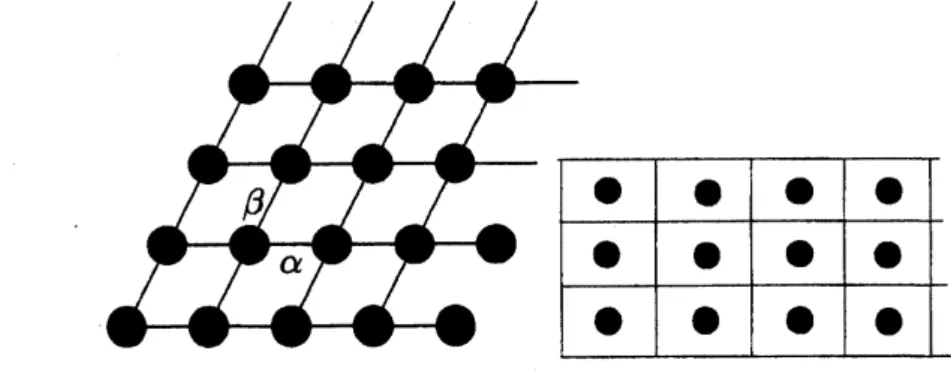
follows. Let $\alpha$,$\beta$ betwo complex numbers with ${\rm Im}( \beta\oint\alpha)>0$, and $\mathrm{C}$ $=\mathbb{Z}\alpha+\mathbb{Z}\beta$ be a lattice in the
complex plane. Then let $U_{\Sigma}$ : $\mathbb{R}^{2}arrow\{\pm 1\}$ be a function satisfying $U_{\Sigma}(x_{1}, x_{2})=1$
if dist$(x_{1}+ix_{2}, \Sigma)$ $\leq r$ and $U_{\Sigma}(x_{1}, x_{2})=-1$ if $\mathrm{d}\mathrm{i}\mathrm{s}\mathrm{t}$(
$x_{1}+$ ix2 $\Sigma$)
$>r,$ with
a
con-st ot $r>0$ being determined by (U)$\rangle_{Y}=m.$ We
assume
that $r< \min\{|\alpha|, |\beta|\}$,which
can
be satisfied for a certain $\mathrm{E}$ if and only if $m\in$ $(-1, \sqrt{3}\pi/3-1)$.
Let$\mathrm{Y}_{\Sigma}=$
{
($x_{1}$,$x_{2}$); there exist $s$,$t\in(0,1)$ such that $x_{1}+ix2=s\alpha+t\beta$}
bea
unit ofpar-allelogram. See Figure 3.
Figure 3 Periodic Circular Patterns $U_{\Sigma}$
One can show that the energy density for the triangle pattern (Figure 4) is larger
than the hexagonal pattern (Figure 2).
$\epsilon\epsilon$
We will showthat the energy density defined above achieves the minimum when I i$\mathrm{s}$
ahexagonalstructure. Thenwe willobtainthe upper bound for the$\min I_{\epsilon}$ for arbitrary
domains by hexagonal structures, making a close study ofthe
error
byan.
Proposition 3.2 (X. Chen&
Y. Oshita). The following statements hold:(1) For I $=$ Za$+\mathbb{Z}\beta$, $\zeta=\beta/\alpha$, ${\rm Im}(\zeta)>0,$
$\mathcal{E}[U_{\Sigma}]=\frac{2}{c_{o}}\sqrt{\frac{2\pi(1+m)}{|\mathrm{Y}_{\Sigma}|}}+\frac{\kappa(1+m)^{2}[R(\zeta)+c_{1}(m)]|\mathrm{Y}_{\Sigma}|}{2D}$,
where
$R( \zeta)=-\frac{1}{2\pi}\log|$$\mathrm{i}$ $q^{1/12} \prod_{n=1}^{\infty}(1-q^{n})^{2}|$ , $q=e^{2\mathrm{w}}i($
and
$c_{1}(m)=\mathit{7}$ $(1+$ $\mathrm{j}$ $-\log(2\pi(1+7\mathrm{r}\mathrm{z}))$
)
(2) The minimum
of
$\mathcal{E}[U_{\Sigma}]$ among allpossible per iodic circular patterns is$\mathcal{E}^{*}=3(1+m)(c_{o})^{-2/3}D^{-1/3}[\pi\kappa(c_{1}(m)+R(\zeta^{*}))]^{1/3}$ , $\zeta^{*}=e^{i\pi/3}$,
which is attained when ) is equal to the lattice $\mathbb{Z}\alpha^{*}+\mathbb{Z}\beta’$,
$|\mathrm{c}\mathrm{z}$’$|=|$
d’
$|=2\pi^{1/6}3^{-1/4}(1+m)^{-1/2}D^{1/3}[c_{o}\kappa(c_{1}(m)+R(\zeta^{*}))]^{-1/3}$, $\frac{\beta^{*}}{\alpha}*=\zeta^{*}$.(3) Let $\Omega\subset \mathbb{R}^{2}$ be a bounded
domain with the smooth boundary $\partial\Omega$. Then
$\min$ $I_{\epsilon}[u]\leq|\Omega|\epsilon^{2/3}[\mathcal{E}^{*}+O(\epsilon^{1/3}|\log\epsilon|)]$, $u\in H^{1}(\Omega)$
$\mathcal{E}^{*}=3(1+m)(c_{o})^{-2/3}D^{-1/3}[\pi\kappa(c_{1}(m)+R(\zeta’))]^{1/3}$, $\zeta^{*}=e^{i\pi/3}$,
which is attained when $\Sigma$ is equal to the lattice
$\mathbb{Z}\alpha^{*}+\mathbb{Z}\beta^{*}$,
$|\alpha’|=|\beta’|=2\pi^{1/6}3^{-1/4}(1+m)^{-1/2}D^{1/3}[c_{o}\kappa(c_{1}(m)+R(\zeta^{*}))]^{-1/3}$ , $\frac{\beta^{*}}{\alpha}*=\zeta^{*}$.
(3) Let $\Omega\subset \mathbb{R}^{2}$ $6e$ a bounded
domain with the smooth boundary $\partial\Omega$. Then
$\min_{u\in H^{1}(\Omega)}I_{\epsilon}[u]\leq|\Omega|\epsilon^{2/3}[\mathcal{E}^{*}+O(\epsilon^{1/3}|\log\epsilon|)]$ ,
as
$\epsilon$ $arrow 0.$References
[1] G. Alberti and S. Miiller. A new approach to variational problems with multiple
scales. Comm. Pure Appl. Math., Vol. 54, pp. 761-825,
2001.
[2] X. Chen.
Generation
and propagation of interfaces in reaction-diffusion systems. Trans. Amer, Math. Soc, Vol. 334, pp. 877-913, 1992.[3] X. Chen, D. Hilhorst, and E. Logak. Asymptotic behavior of solutions of an
allen-cahn equation with a nonlocal term. Nonlinear Anal. $TMA$., Vol. 28, pp.
1283-1298, 1997.
[4] R. Choksi. Scaling laws in microphase separation of diblock copolymers. J. Non-linear Sci., Vol. 11, No. 3, pp. 223-236, 2001.
[5] $\mathrm{G}.\mathrm{B}$
.
Ermentrout, $\mathrm{S}.\mathrm{P}$.
Hastings, and $\mathrm{W}.\mathrm{C}$. Troy. Large amplitude stationarywaves
in an excitable lateral-inhibitory medium. SIAM. J. Appl. Math., Vol. 44, No. 6, pp. 1133-1149,1984.
[6] P. C. Fife. Dynamics
for
inter$mal$ layers anddiffusive
interfaces.
CCMS-NSFRegional Conf. Ser. in Appl. Math. SIAM, Philadelphia, 1988.
[7] P. C. Fife and L. Hsiao. The generation and propagation of internal layers. Non-linear Analysis, Vol. 12, pp. 19-41, 1988.
[8] $\mathrm{G}.\mathrm{A}$
.
Klaasen and $\mathrm{W}.\mathrm{C}$. Troy. Stationarywave
solutions of a system ofreaction-diffusion equations derived from the FitzHugh-Nagumo equations. Siam. J. Appl.
Math., Vol. 44, pp. 96-110, 1984.
[9] S. Miiller. Singular perturbations as a selection criterion for periodic minimizing sequences. Calc. $Var$
.
PartialDifferential
Equations, Vol. 1, No. 2, pp. 169-204,1993.
[10] Y. Nishiura and I. Ohnishi. Some mathematical aspects of the micrO-phase sepa-ration in diblock copolymers. Phys. $D$, Vol. 84, pp. 31-39, 1995.
[11] Y. Nishiura and H. Suzuki. Noexistence of higher dimensional stable turing pat-terns in the singular limit. Siam. J. Math. Anal, Vol. 29, pp. 1087-1105, 1998.
[12] I. Ohnishi,Y. Nishiura, M. Imai, and Y. Matsushita. Analytical solutiondescribing the phase separation driven by a free energy functional containing a long-range interaction term. Chaos, Vol. 9, pp. 329-341, 1999.
[13] Y. Oshita. On stable stationary solutions and mesoscopic patterns for FitzHugh-Nagumo equations inhigher dimensions. J.
Differential
Equations, Vol. 188, No. 1, pp. 110-134, 2003.[14] P. Pedregal. Parametrized Measures and Variational Principles, Progress in Non-linear Partial
Differential
Equations. Birkh\"auser, 1997.[15] X. Ren and J. Wei. Concentrically layeredenergy equilibriaofthe didiblock
copoly-mer
problem. Func. $Jnl$of
Applied Math., Vol. 13, pp. 479-496, 2002.[4] R. Choksi. Scaling laws in microphase separation of diblock copolymers. J. Non-linear Sci., Vol. 11, No. 3, pp. 223-236, 2001.
[5] $\mathrm{G}.\mathrm{B}$
.
Ermentrout, $\mathrm{S}.\mathrm{P}$.
Hastings, and $\mathrm{W}.\mathrm{C}$. Troy. Large amplitude stationarywaves
in an excitable lateral-inhibitory medium. SIAM. J. Appl. Math., Vol. 44, No. 6, pp. 1133-1149,1984.
[6] P. C. Fife. Dynamics
for
internal layers anddiffusive
interfaces.
CCMS-NSFRegional Conf. Ser. in Appl. Math. SIAM, Philadelphia, 1988.
[7] P. C. Fife and L. Hsiao. The generation and propagation of internal layers. Non-linear Analysis, Vol. 12, pp. 19-41, 1988.
[8] $\mathrm{G}.\mathrm{A}$
.
Klaasen and $\mathrm{W}.\mathrm{C}$. Troy. Stationarywave
solutions of a system ofreaction-diffusion equations derived from the FitzHugh-Nagumo equations. Siam. J. Appl.
Math., Vol. 44, pp. 96-110, 1984.
[9] S. M\"uller. Singular perturbations as aselection criterion for periodic minimizing
sequences. Calc. $Var$
.
PartialDifferential
Equations, Vol. 1, No. 2, pp. 169-204,1993.
[10] Y. Nishiura and I. Ohnishi. Some mathematical aspects of the micrO-phase sepa-ration in diblock copolymers. Phys. $D$, Vol. 84, pp. 31-39, 1995.
[11] Y. Nishiura and H. Suzuki. Noexistence of higher dimensional stable turing pat-terns in the singular limit. Siam. J. Math. Anal, Vol. 29, pp. 1087-1105,1998. [12] I. Ohnishi,Y. Nishiura, M. Imai, and Y. Matsushita. Analytical solutiondescribing
the phase separation driven by affee energy functional containing a long-range interaction term. Chaos, Vol. 9, pp. 329-341, 1999.
[13] Y. Oshita. On stable stationary solutions and mesoscopic patterns for FitzHugh-Nagumo equations inhigher dimensions. J.
Differential
Equations, Vol. 188, No. 1, pp. 110-134, 2003.[14] P. Pedregal. Parametrized Measures and Variational Principles, Progress in Non-linear Partial
Differential
Equations. Birkh\"auser, 1997.[15] X. Ren and J. Wei. Concentrically layeredenergy equilibriaofthe didiblock