On the addition
formula
for
the tropical
Hesse pencil
Atsushi
NOBE
Department ofMathematics, Faculty
of
Education,Chiba
University,1-33
Yayoi-choInage-ku,
Chiba
263-8522, JapanAbstract
Wegive the addition formula for the tropical Hesse pencil, which is thetropicalization
of the Hesse pencil parametrized by the level-three thetafunctions, via those for the
ultra-discrete theta functions. The ultraultra-discrete theta functions arereduced from thelevel-three
theta functions through the procedure ofultradiscretization by choosing their parameters
appropriately. The parametrization of the level-threethetafunctions firstlyintroduced in
[3] givesanexplicit correspondencebetween the amoeba of the real partofthe Hesse cubic
curve and the tropical Hesse curve. Moreover, through theparametrization, we obtain the
subtraction-free forms of the addition formulae for the level-three theta functions, which
lead totheaddition formula for thetropicalHesse pencilin terms oftheultradiscretization.
Usingtheparametrization, the tropical counterpartoftheHesseconfiguration isalso given.
1
Introduction
In recentpapers [4, 3],the author and his collaborators study several solvable chaotic dynamical
systems given by piecewise linear maps. The maps
are
arising $hom$ the duplication formulaefor tropical elliptic pencils and
are
directly connected with those for elliptic pencilsover
$\mathbb{C}$ interms ofthe procedureofultradiscretization. The general solutions to the dynamical systems
are
concretelyconstructedbyusingthe ultradiscrete theta functions which parametrize the tropical
ellipticpencils. Each ultradiscrete theta function
can
beobtainedas
the ultradiscretization ofthetheta function whichparametrizes the elliptic pencil
over
$\mathbb{C}$.
In particular, in [3], we introducethelevel-three thetafunctions$\theta_{0}(z, \tau),$$\theta_{1}(z, \tau)$,and$\theta_{2}(z, \tau)$parametrizing the Hesse cubic
curve
and the series oftheirfunctional relations called the addition formulae. A specialization ofthe
variables in the addition formulae induces the duplication formula for the Hesse pencil, which
gives the solvable chaotic dynamical system. Applying the procedure ofultradiscretization to
the level-three theta functions, we systematically obtain both the piecewise linear dynamical
system possessing chaotic property and its general solution. In this process, parametrization
of the level-three theta functions with positive numbers $\epsilon$ and $K$, one of which, $\epsilon$, vanishes
in the limiting procedure, plays
an
important role. The dynamical system thus obtainedcan
naturally be regarded
as
theone
arising from the duplication of points on the tropical Hessepencil. Thus, via the duplication formula for the level-three theta functions,
we
can
connectthe solvable dynamical system arising from the Hesse pencil with that ffom the tropical Hesse
pencil.
Inthispaper, wegive theaddition formulaforthepoints
on
the member of the tropical Hessepencil. The formula is obtained fromthat for the Hesse pencil
over
$\mathbb{C}$ upon application of theprocedure ofultradiscretizationtothe level-three thetafunctions. In contrast to the duplication
formula, the addition formula is a combination of the ultradiscrete analogues of those for the
Hesse pencil. Sinceit is known that the addition of points
on
atropical ellipticpencilgives theultradiscrete QRT system [7],we
can
construct both chaotic and integrable dynamical systems2
Tropical
Hesse
pencil
2.1
Hesse
pencilTheHessepencil is aone-dimensional linear systemof plane cubic
curves
in$\mathbb{P}^{2}(\mathbb{C})$ given by$t_{0}(x_{0}^{3}+x_{1}^{3}+x_{2}^{3})+t_{1}x_{0}x_{1}x_{2}=0$,
where $(x_{0}, x_{1}, x_{2})$ isthe homogeneous coordinateof$\mathbb{P}^{2}(\mathbb{C})$ and theparameter $(t_{0}, t_{1})$ ranges over $\mathbb{P}^{1}(\mathbb{C})[1,6]$
.
Thecurve
consisting ofthe pencil is called the Hesse cubiccurve
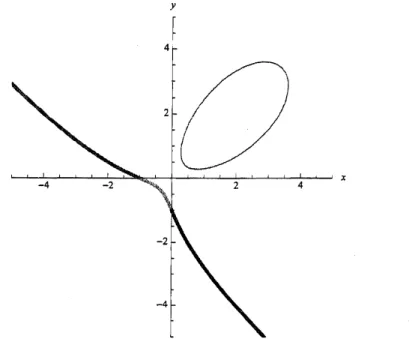
(see figure 1).$y$
Figure 1: The real part ofthe Hesse cubic curve.
Each member of the pencil is denoted by $E_{t_{0},t_{1}}$ and the pencil itselfby $\{E_{t_{0},t_{1}}\}_{(t_{0},t_{1})\in \mathbb{P}^{1}(\mathbb{C})}$
.
The nine base points of the pencil aregiven as follows
$p_{0}=(0,1, -1)$ $p_{1}=(0,1, -\zeta_{3})$ $p_{2}=(0,1, -\zeta_{3}^{2})$
$p_{3}=(1,0, -1)$ $p_{4}=(1,0, -\zeta_{3}^{2})$ $p_{5}=(1,0, -\zeta_{3})$
$p_{6}=(1, -1,0)$ $p_{7}=(1, -\zeta_{3},0)$ $p_{8}=(1, -\zeta_{3}^{2},0)$,
where$\zeta_{3}$ denotes the primitive third root of1.
Any smooth curve in the pencil has the nine base points as its inflection points, and hence
they
are
intheHesseconfiguration [1, 8]. TheHesseconfiguration is anarrangement of 9 pointsand 12lines in the projective plane $\mathbb{P}^{2}(\mathbb{C})$ which satisfies the following twoconditions;
.
eachline passes through three ofthe 9 points and.
each point lieson
four of the 12lines.Once an elliptic
curve
is given then its 9 inflection points and 12 inflectionlinesi
realize theHesse configuration. In particular, all non-singular members in the $Hess$ pencil have the 9
inflectionpoints$p_{0},p_{1},$ $\cdots,p_{8}$ andthe 12 inflection linesin common, henceeachofthem hasthe
uniquerealizationof the Hesse configuration. Note that the 12 inflectionlinesaretheirreducible
components of the singular members$E_{0,1},$ $E_{1,-3},$ $E_{1,-3\zeta_{3}}$, and $E_{1,-\zeta_{3}^{2}}$ ofthe pencilgiven below
$\frac{(see(1-4))}{1A1inepasses}$
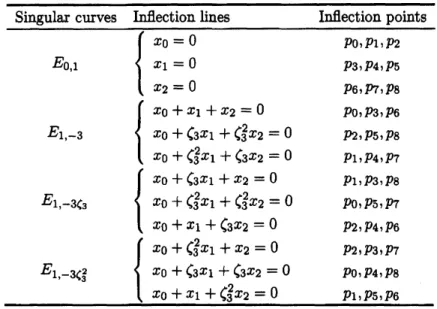
Table 1: Theinflection lines attd the inflection points in the
Hesse
configuration.$\frac{Singu1arcurvesIfflectionlinesInflectionpoints}{E_{0,1}\{\begin{array}{l}x_{0}=0p_{0},p_{1},p_{2}x_{1}=0p_{3},p_{4},p_{5}x_{2}=0p_{6},p_{7},p_{8}\end{array}}$
$E_{1,-3}$ $\{\begin{array}{ll}x_{0}+x_{1}+x_{2}=0 p_{0},p_{3},p_{6}x_{0}+\zeta_{3}x_{1}+\zeta_{3}^{2}x_{2}=0 p_{2},p_{5},p_{8}\end{array}$
$E_{1,-3\zeta_{3}}$ $\{\begin{array}{ll}x_{0}+\zeta_{3}x_{1}+x_{2}=0 p_{1},p_{3},p_{8}x0+\zeta_{3}^{2}x_{1}+\zeta_{32}^{2_{X}}=0 p_{0},p_{5},p_{7}\end{array}$
$x_{0}+\zeta_{3}^{2}x_{1}+x_{2}=0$ $p_{2},p_{3},p_{7}$ $x_{0}+\zeta_{3}^{2}x_{1}+\zeta_{3}x_{2}=0$ $p_{1},p_{4},p_{7}$
$x0+x_{1}+\zeta_{3}x_{2}=0$ $p_{2},p_{4},p_{6}$
$E_{1,-3\zeta_{3}^{2}}$ $\{x_{0}+x_{1}+\zeta_{3}^{2}x_{2}=0$$x0+\zeta_{3}x_{1}+\zeta_{3}x_{2}=0$ $p0,p_{4},p_{8}$ $p_{1},p_{5},p_{6}$
The
WeierstraB
form of the Hesse cubiccurve
isgivenas
foUows$x_{1}^{!2}x_{2}’=x_{0}^{J3}+A(t_{0}, t_{1})x_{0}’x_{2}^{\prime 2}+B(t_{0}, t_{1})x_{2}^{l3}$,
where $(x_{0}’, x_{1}’, x_{2}’)\in \mathbb{P}^{2}(\mathbb{C})$ is the homogeneous coordinate of$\mathbb{P}^{2}(\mathbb{C}),$ $(t_{0}, t_{1})=(u_{0},6u_{1})$, and
$A(t_{0}, t_{1})=12u_{1}(u_{0}^{3}-u_{1}^{3})$
$B(t_{0}, t_{1})=2(u_{0}^{6}-20u_{0}^{3}u_{1}^{3}-8u_{1}^{6})$
.
The transformation ${}^{t}(x_{0},$$x_{1},$$x_{2})\mapsto{}^{t}(x_{0}’,$$x_{1}’,$$x_{2}’)$, form theHessefomto the WeierstraS3 form, is
givenby the linear map
$(-2\sqrt{6}it_{0}(27t_{0}^{3}9t_{0}t_{1}^{2}54t_{0}+t_{1}^{3})$ $2\sqrt{6}it_{0}(27t_{0}^{3}9t_{0}t_{1}^{2}54t_{0}+t_{1}^{3})$ $108t_{0}^{3}+t_{1}^{3}-18t_{1}0)$
.
The discriminant ofthe Weierstrai3cubic
curve
is$\Delta=4A^{3}+27B^{2}=2^{2}3^{3}u_{0}^{3}(u_{0}^{3}+2^{3}u_{1}^{3})$
.
Thus we
see
that the singular memberof theHessepencil is describedby$(t_{0}, t_{1})=(0,1),$ $(1, -3),$ $(1, -3\zeta_{3}),$ $(1, -3\zeta_{3}^{2})$,
or explicitly glven by the umions of threelines:
$E_{0,1}$ : $x_{0}x_{1}x_{2}=0$ (1)
$E_{1,-3}$ : $(x_{0}+x_{1}+x_{2})(x_{0}+\zeta_{3}x_{1}+\zeta i^{2_{X_{2}}})(+\alpha_{X)=0}$ (2)
$E_{1,-3\zeta_{3}}$ : $(x_{0}+\zeta_{3}x_{1}+x_{2})(x_{0}+\zeta_{3}^{2}x_{1}+\zeta_{3}^{2}x_{2})(x_{0}+x_{1}+\zeta_{3^{X}2})=0$ (3)
$E_{1,-3\zeta_{3}^{2}}$ : $(x_{0}+\zeta_{3}^{2}x_{1}+x_{2})(x_{0}+\zeta_{3}x_{1}+\zeta_{3}x_{2})(x_{0}+x_{1}+\zeta_{3}^{2}x_{2})=0$
.
(4)Note that each singular member has multiplicity three. Table 1 shows the inflection lines and
2.2
TropicalizationLet
us
consider tropicalization ofthe Hesse pencil, For the defining polynomial of the Hessecubic
curve
$f(x_{0}, x_{1}, x_{2};t_{0}, t_{1})$ $:=t_{0}(x_{0}^{3}+x_{1}^{3}+x_{2}^{3})+t_{1}x0x_{1}x_{2}$,
weapply the procedure of tropicalization. Atfirst, replacethe addition$+$and the multiplication
$\cross$ with the tropical addition $\oplus$ and the tropical multiplication $\otimes$ respectively; then we obtain
the tropical polynomial
$f(\overline{x}0,\tilde{x}_{1},\tilde{x}_{2};\tilde{t}_{0},\tilde{t}_{1})$ $:=\tilde{t}_{0}\otimes(\tilde{x}_{0}^{\otimes 3}\oplus\tilde{x}_{1}^{\otimes 3}\oplus\tilde{x}_{2}^{\otimes 3})\oplus\tilde{t}_{1}\otimes\tilde{x}_{0}\otimes\tilde{x}_{1}\otimes\tilde{x}_{2}$
.
In order to distinguish tropical variables form original ones, we ornament them with$\sim$
The
tropical operations $\oplus$and $\otimes$ aredefined as follows
$a \oplus b=\max(a, b)$ $a\otimes b=a+b$ for$a,$$b\in T:=$ RU$\{-\infty\}$,
where $T$is thetropical semi-field. Thus thetropical polynomial$f(\tilde{x}0,\tilde{X}_{1},\tilde{X}2;\tilde{t}_{0},\tilde{t}_{1})$ reduces to
$\tilde{f}(\tilde{x}0,\tilde{x}_{1},\tilde{x}_{2};\tilde{t}_{0},\tilde{t}_{1})=\max(\tilde{t}_{0}+3\tilde{x}0,\tilde{t}_{0}+3\tilde{x}_{1},\tilde{t}_{0}+3\tilde{x}_{2},\tilde{t}_{1}+\tilde{x}_{0}+\tilde{x}_{1}+\overline{x}_{2})$
.
Noting
$a\oplus(-\infty)=a$ $a\otimes 0=a$ $a\otimes(-a)=0$,
we
see
that-oo and$0$are theunitsofaddition and multiplicationin$T$respectively. Wefind theelement $-a$ as the inverse of$a$ with respect to the multiplication, however, there is no inverse
of$a$ with respect to the addition.
Definition 1 (See definition 1.1 in [5]) The tropical projective space $\mathbb{P}^{n,trop}$ consists of the
classes of $(n+1)$-tuples $(x_{0}, \cdots, x_{n})\in T^{n+1}$ such that not all ofthem
are
equal to $-$oo withrespect to the followingequivalencerelation $\sim$;
$(x_{0}, \cdots, x_{n})\sim(y_{0}, \cdots , y_{n})$ $\Leftrightarrow$ $x_{i}=y_{i}=\lambda$ for$i=0,$
$\ldots,$$n$and
$\lambda\in \mathbb{R}$,
wherewe assume $x_{0}\otimes\cdots\otimes x_{n}\neq-\infty$and $y_{0}\otimes\cdots\otimes y_{n}\neq-$oo.
Under the identification $(x_{1}, \ldots, x_{n})\in \mathbb{R}^{n}$ with $(0, x_{1}, \ldots, x_{n})\in \mathbb{P}^{n,trop}$ the real space $\mathbb{R}^{n}$ is
contained in $\mathbb{P}^{n,trop}$
.
Thuswe
have an embedding $\iota_{n}:\mathbb{R}^{n}\subset \mathbb{P}^{n,trop}$.
Also we have $n+1$ affinecharts $T^{n}arrow \mathbb{P}^{n,trop}$, given by the (tropical) ratio with the j-th coordinate.
Let $(t_{0}, t_{1})$ be a point in $\mathbb{P}^{1,trop}$
.
Then $\tilde{f}$ can be regarded as a function $f:\mathbb{P}^{2,trop}arrow$ T.The tropical Hesse
curve
is the set ofpoints such that the function $f$ is not differentiable. Wedenote the tropical Hesse
curve
by $C_{\overline{t}_{0},\overline{t}_{1}}$.
Upon introduction ofthe inhomogeneous coordinate$(X :=\tilde{x}_{1}-\tilde{x}_{0}, Y:=\tilde{x}_{2}-\tilde{x}_{0})\in \mathbb{P}^{2,trop}$ and $K$ $:=\tilde{t}_{1}-\tilde{t}_{0}\in \mathbb{P}^{1,trop}$ the tropical Hesse curve is
denotedby $C_{K}$ and is given by thetropicalpolynomial
$F(X, Y;K)$ $:= \max(3X, 3Y, 0, K+X+Y)$
.
Figure2 shows the tropical Hesse curves. The one-dimensional linear system $\{C_{K}\}_{K\in P^{1,trop}}$
consistingofthetropicalHesse curvesis called the tropical Hesse pencil. The complement ofthe
tentacles,i.e., the finitepart,of$C_{K}$ isdenoted by$\overline{C}_{K}$. Wedenote the vertices whosecoordinates
are
$(K, K),$ $(-K, 0)$, and $(0, -K)$ by $V_{1},$ $V_{2}$, and $V_{3}$, respectively. Also denote theedges $\overline{V_{1}V_{2}}$, $\overline{V_{1}V_{2}}$, and$\overline{V_{1}V_{2}}$by$E_{1},$ $E_{2}$, and $E_{3}$, respectively.$Y$
Figure2: Several members of the tropical Hesse pencil. The
ones
drawn withsolid linesare
theregular membersand theone with brokenline is the singular member for $K=0$
.
Each member $C_{K}$ of the tropical Hesse pencil for generic choice of $K\in \mathbb{P}^{1,trop}$ has genus
one, thereforeit
can
be regardedas
a
tropicalellipticpencil. Singularcurves
appearonlyforthechoice oftheparameter
as
$K=\infty$or
$K\leq 0$.
For$K=\infty$,or
equivalentlyfor $(\tilde{t}_{0},\tilde{t}_{1})=(-$oo,$0)$,the tropical polynomial $f(\overline{x}_{0},\tilde{x}_{1},\tilde{x}_{2};\tilde{t}_{0},\tilde{t}_{1})$ reduces to
$f(\tilde{x}_{0},\tilde{x}_{1},\tilde{x}_{2};-\infty, 0)=\tilde{x}_{0}\otimes\tilde{x}_{1}\otimes\tilde{x}_{2}=\tilde{x}_{0}+\tilde{x}_{1}+\tilde{x}_{2}$
.
(5)This
can
not bedifferentiated2
at theboundary of$\mathbb{P}^{2,tr\varphi}$, thereforethecurve
$C_{K}$reducesto the
union of threetropical lines which compose the boundary of$\mathbb{P}^{2,trop}$:
$C_{\infty}$ : $\{\tilde{x}_{0}=-\infty\}\cup\{\tilde{x}_{1}=-oo\}\cup\{\tilde{x}_{2}=-oo\}$
.
(6)Sincethe defining polynomial of the singular
curve
$E_{0,1}$ is$f(x_{0}, x_{1}, x_{2};0,1)=x_{0}x_{1}x_{2)}$ (7)
the tropical polynomial (5)
can
be regardedas
thetropicalizationof(7). Therefore, thesingularcurve
$C_{\infty}$ is the tropical counterpart of$E_{0,1}$.
Ontheother hand, for$K\leq 0$, orequivalently for$\tilde{t}_{0}\geq\tilde{t}_{1},$ $F(X, Y;K)$ reduces to
$F(X, Y;K)=3\max(X, Y, 0)$, (8)
orequivalently $f(\tilde{x}_{0},\tilde{x}_{1},\tilde{x}_{2};\tilde{t}_{0},\tilde{t}_{1})$ to
$\tilde{f}(\tilde{X}_{0},\tilde{X}_{1},\tilde{X}2;\tilde{t}_{0},\tilde{t}_{1})=(\tilde{x}_{0}\oplus\overline{x}_{1}\oplus\tilde{x}_{2})^{\otimes 3}=3\max(\tilde{x}_{0},\tilde{x}_{1},\tilde{x}_{2})$
.
(9)2Forexample,for fixed$\tilde{x}_{1},\tilde{x}_{2}\in T$and$h>0$,thedifference
$\{\overline{f}(-\infty+h,\tilde{x}_{1},\overline{x}_{2};-\infty, 0)-\tilde{f}(-oo, \tilde{x}_{1},\tilde{x}_{2};-oo, 0)\}/h$
The tropical
curve
given by (8) is clearly independentof$K$.
Hence we take $C_{0}$ as therepresen-tative of the singular
curves
$C_{K}$ for$K\leq 0$.
Thecurve
$C_{0}$ isa
triple tropical line whose onlyvertex is
on
the origin (seefigure2). The tropical polynomial (9)can
be regardedas thetropi-calization ofthepolynomials in (2), (3), and (4), whichgive the singular
curves
$E_{1,-3},$ $E_{1,-3\zeta_{3}}$,and $E_{1,-3\zeta_{3}^{2}}$, respectively. Thus the curve $C_{0}$ is regarded
as
the tropical counterpart of$E_{1,-3}$, $E_{1,-3\zeta_{3}}$, and $E_{1,-3\zeta_{3}^{2}}$.
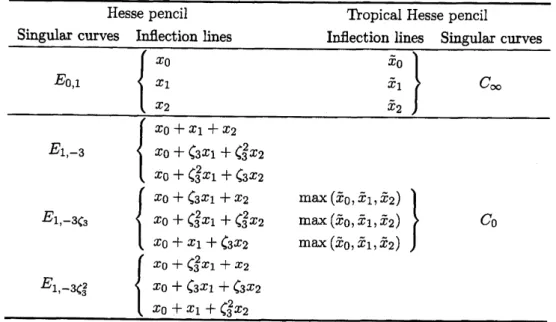
Table2 showsthe correspondence betweenthe definingpolynomialsofthesingularmembers of the Hessepencil and their tropical counterparts.
Table 2: The correspondence between the defining polynomials of the singular members of the
Hessepencil and their tropical counterparts.
Hesse pencil TkopicalHessepencil
Singular
curves
Inflectionlines Inflection lines Singularcurves
$E_{0,1}$ $\{\begin{array}{ll}x_{0} \tilde{x}_{0}x_{1} \overline{x}_{1}x_{2} \tilde{x}_{2}\end{array}\}$ $C_{\infty}$
$\overline{E_{1,-3}\{\begin{array}{l}x_{0}+x_{1}+x_{2}xo+\zeta_{3}x_{1}+\zeta_{3}^{2}x_{2}x_{0}+\zeta_{3}^{2}x_{1}+\zeta_{3}x_{2}\end{array}}$
$E_{1,-3\zeta_{3}}$ $\{\begin{array}{ll}xo+\zeta_{3}x_{1}+x_{2} \max(\tilde{x}_{0},\tilde{x}_{1},\tilde{x}_{2})x_{0}+\zeta_{3}^{2}x_{1}+\zeta_{3}^{2}x_{2} \max(\tilde{x}_{0},\overline{x}_{1,2}\tilde{x})x_{0}+x_{1}+\zeta_{3}x_{2} \max(\tilde{x}_{0},\tilde{x}_{1},\tilde{x}_{2})\end{array}\}$ $C_{0}$
$x0+\zeta_{3}x_{1}+\zeta_{3}x_{2}$
$\underline{E_{1,-3\zeta_{3}^{2}}\{\begin{array}{l}x_{0}+\zeta_{3}^{2}x_{1}+x_{2}x_{0}+x_{1}+\zeta_{3}^{2}x_{2}\end{array}}$
Vigeland showed that atropical elliptic
curve
has an additivegroup structurein analogy toan elliptic
curve
[9]. The group structureis induced from that ofthe Jacobian ofthe tropicalelliptic curve, which is isomorphic to $S^{1}$, to its complement ofthe tentaclesvia the
Abel-Jacobi
map. Therefore wehave the group isomorphism
$\overline{C}_{K}\simeq C_{K}/\simarrow J(C_{K})\simeq S^{1}$,
where $\sim$ is
an
equivalence relation called the linearequivalence [9]. In thefollowing, we givean
explicitformula for the additionof pointsonthetropicalHesse curveviathe ultradiscretization
ofthose for thelevel-three theta functions.
3
Level-three theta
functions
3.1
Definition
The level-three theta functions $\theta_{0}(z, \tau),$ $\theta_{1}(z, \tau)$, and $\theta_{2}(z, \tau)$
are
defined by using the thetafunction$\theta_{(a,b)}(z, \tau)$ with characteristics:
where $z\in \mathbb{C}$and$\tau\in \mathbb{H}$ $:=\{\tau\in \mathbb{C}|{\rm Im}\tau>0\}$
.
Fix $\tau\in$IHI. For simplicity,
we
abbreviate $\theta_{k}(z,\tau)$ and $\theta_{k}(0, \tau)$as
$\theta_{k}(z)$ and $\theta_{k}$ for $k=0,1,2$,respectively. The level-three thetafunctions havethequasiperiodicity [3]
$\theta_{k}(z+1)=-\theta_{k}(z)$ (10)
$\theta_{k}(z+\tau)=-e^{3\pi i\tau}e^{-6\pi iz}\theta_{k}(z)$ (11)
for $k=0,1,2$
.
Let $L_{\tau}$ $:=(-\tau)Z+(3\tau+1)Z$bea
lattice inC.
Noting$(\begin{array}{ll}-l 30 l\end{array})=(\begin{array}{ll}-l 30 l\end{array})$
wehave
an
isomorphism$L_{\tau}\simeq \mathbb{C}/Z+\tau Z$.
Letus
denote theaxes
in the$directions-\tau$ and$3\tau+1$$’$ ’ $’\backslash$’ $\backslash s$ $’$ ’ $\backslash$ $\nu’$ $O$
Figure 3: The
zeros
of$\theta_{k}(z, \tau)$ for $k=0,1,2$ in the fundamental domain.by$a$ and $b$respectively (see figure 3).
3.2
Addition formulae
Theorem 1 For
a
fixed $\tau\in$ IE, the level-three theta functions $\theta_{0}(z, \tau),$ $\theta_{1}(z, \tau)$, and $\theta_{2}(z, \tau)$satisfy thefollowing 9 functional relations calledthe additionformulae [3]
$\theta_{0}^{2}\theta_{0}(z+w)\theta_{0}(z-w)=\theta_{1}(z)\theta_{2}(z)\theta_{2}(w)^{2}-\theta_{0}(z)^{2}\theta_{0}(w)\theta_{1}(w)$ (12a) $\theta_{0}^{2}\theta_{1}(z+w)\theta_{0}(z-w)=\theta_{0}(z)\theta_{1}(z)\theta_{1}(w)^{2}-\theta_{2}(z)^{2}\theta_{0}(w)\theta_{2}(w)$ (12b) $\theta_{0}^{2}\theta_{2}(z+w)\theta_{0}(z-w)=\theta_{0}(z)\theta_{2}(z)\theta_{0}(w)^{2}-\theta_{1}(z)^{2}\theta_{1}(w)\theta_{2}(w)$ (12c) $\theta_{0}^{2}\theta_{0}(z+w)\theta_{1}(z-w)=\theta_{0}(z)\theta_{1}(z)\theta_{0}(w)^{2}-\theta_{2}(z)^{2}\theta_{1}(w)\theta_{2}(w)$ (13a) $\theta_{0}^{2}\theta_{1}(z+w)\theta_{1}(z-w)=\theta_{0}(z)\theta_{2}(z)\theta_{2}(w)^{2}-\theta_{1}(z)^{2}\theta_{0}(w)\theta_{1}(w)$ (13b) $\theta_{0}^{2}\theta_{2}(z+w)\theta_{1}(z-w)=\theta_{1}(z)\theta_{2}(z)\theta_{1}(w)^{2}-\theta_{0}(z)^{2}\theta_{0}(w)\theta_{2}(w)$ (13c) $\theta_{0}^{2}\theta_{0}(z+w)\theta_{2}(z-w)=\theta_{0}(z)\theta_{2}(z)\theta_{1}(w)^{2}-\theta_{1}(z)^{2}\theta_{0}(w)\theta_{2}(w)$ (14a) $\theta_{0}^{2}\theta_{1}(z+w)\theta_{2}(z-w)=\theta_{1}(z)\theta_{2}(z)\theta_{0}(w)^{2}-\theta_{0}(z)^{2}\theta_{1}(w)\theta_{2}(w)$ (14b) $\theta_{0}^{2}\theta_{2}(z+w)\theta_{2}(z-w)=\theta_{0}(z)\theta_{1}(z)\theta_{2}(w)^{2}-\theta_{2}(z)^{2}\theta_{0}(w)\theta_{1}(w)$ , (14c) where$z,$$w\in$C.
It follows from theorem 1 that
we
have [3]$\theta_{2}’(\theta_{0}(z)^{3}+\theta_{1}(z)^{3}+\theta_{2}(z)^{3})+6\theta_{0}’\theta_{0}(z)\theta_{1}(z)\theta_{2}(z)=0$
.
(15)Consider amap $\varphi$ : $\mathbb{C}arrow \mathbb{P}^{2}(\mathbb{C})$,
$\varphi:z\mapsto(\theta_{2}(z), \theta_{0}(z), \theta_{1}(z))$
.
This induces amap $hom$ the complex torus$\mathbb{C}/L_{\tau}$ totheHesse cubic
curve
$E_{\theta_{2}’,6\theta_{0}’}$ due to (10),
(11), and (15). This mapisknowntogive
an
isomorphism$\mathbb{C}/L_{\tau}\simeq E_{\theta_{2}’,6\theta_{0}’}$.
Thus the level-threethetafunctions parametrize the Hesse cubic curve.
Considering $(12a-12c)$, the point $(\theta_{2}(z+w), \theta_{0}(z+w), \theta_{1}(z+w))$ is computed
as
follows$(\theta_{2}(z+w), \theta_{0}(z+w), \theta_{1}(z+w))=(\theta_{0}(z)\theta_{2}(z)\theta_{0}(w)^{2}-\theta_{1}(z)^{2}\theta_{1}(w)\theta_{2}(w)$, $\theta_{1}(z)\theta_{2}(z)\theta_{2}(w)^{2}-\theta_{0}(z)^{2}\theta_{0}(w)\theta_{1}(w)$ ,
$\theta_{0}(z)\theta_{1}(z)\theta_{1}(w)^{2}-\theta_{2}(z)^{2}\theta_{0}(w)\theta_{2}(w))$ (16)
except for $z,$$w\in \mathbb{C}/L_{\tau}$ satisfying $\theta_{0}(z-w)=0$
.
Similarly, considering $(13a-13c)$ and $(14a-$$14c)$,
we
obtain the following$(\theta_{2}(z+w), \theta_{0}(z+w), \theta_{1}(z+w))=(\theta_{1}(z)\theta_{2}(z)\theta_{1}(w)^{2}-\theta_{0}(z)^{2}\theta_{0}(w)\theta_{2}(w)$ , $\theta_{0}(z)\theta_{1}(z)\theta_{0}(w)^{2}-\theta_{2}(z)^{2}\theta_{1}(w)\theta_{2}(w)$,
$\theta_{0}(z)\theta_{2}(z)\theta_{2}(w)^{2}-\theta_{1}(z)^{2}\theta_{0}(w)\theta_{1}(w))$ (17) $(\theta_{2}(z+w), \theta_{0}(z+w), \theta_{1}(z+w))=(\theta_{0}(z)\theta_{1}(z)\theta_{2}(w)^{2}-\theta_{2}(z)^{2}\theta_{0}(w)\theta_{1}(w)$ ,
$\theta_{0}(z)\theta_{2}(z)\theta_{1}(w)^{2}-\theta_{1}(z)^{2}\theta_{0}(w)\theta_{2}(w)$,
$\theta_{1}(z)\theta_{2}(z)\theta_{0}(w)^{2}-\theta_{0}(z)^{2}\theta_{1}(w)\theta_{2}(w))$ (18)
exceptfor $z,$$w\in \mathbb{C}/L_{\tau}$ satisfying $\theta_{1}(z-w)=0$ and$\theta_{2}(z-w)=0$, respectively. Sincethe
zeros
of$\theta_{0}(z),$ $\theta_{1}(z)$, and $\theta_{2}(z)$
never
coincide with eachother, at least two of the additionformulae(16–18)canbe definedforany$z,$$w\in \mathbb{C}/L_{\tau}$
.
Moreover, by using the relation (15),we
canprovethat thethree formulae(16-18)
are
essentially thesame
where theyaredefined simultaneously.Thus theaddition formulaforthe Hesse cubic
curve
is uniquely definedon
$\mathbb{C}/L_{\tau}$.
The isomorphism $\varphi$ : $\mathbb{C}/L_{\tau}arrow E_{\theta_{2}’,6\theta_{0}^{l}}$ induces the additive group structure on $E_{\theta_{2}’,6\theta_{0}’}$ from
$\mathbb{C}/L_{\tau}$ throughthe addition formulae for the level-three theta functions. The relation (19) (see
below) implies
$\varphi:0\mapsto(\theta_{2}, \theta_{0}, \theta_{1})=(0,1, -1)=p_{0}$
.
Thus
we
obtain the addition formulae for the Hesse cubiccurve
$(E_{\theta_{2}’,6\theta_{\acute{0}}},p_{0})$ equipped with theunit ofaddition$p_{0}$
.
Theorem 2 Let the unit of addition
on
the Hesse cubiccurve
$E_{\theta_{2}’,6\theta_{0}’}$ be$p0=(0,1, -1)$.
Let $(x_{0}, x_{1}, x_{2})$ and $(x_{0}’, x_{1}’, x_{2}’)$ be points on$E_{\theta_{2}’,6\theta_{0}’}$.
Then the addition $(x_{0}, x_{1}, x_{2})+(x_{0}’, x_{1}’, x_{2}’)$ ofthepoints aregiven
as
follows$(x_{0}, x_{1}, x_{2})+(x_{0}’, x_{1}’, x_{2}’)=(x_{1}x_{2}x_{2}^{;2}-x_{0}^{2}x_{0}’x_{1}’, x_{0}x_{1}x_{1^{2}}’-x_{2}^{2}x_{0}’x_{2}’, x_{0}x_{2}x_{0^{2}}’-x_{1}^{2}x_{1}’x_{2}’)$ $=(x_{0}x_{1}x_{0^{2}}’-x_{2}^{2}x_{1}^{l}x_{2}’, x_{0}x_{2}x_{2}^{\prime 2}-x_{1}^{2}x_{0}’x_{1}’, x_{1}x_{2}x_{1^{2}}’-x_{0}^{2}x_{0}’x_{2}’)$
We
can
easilysee
that the following property holds$\theta_{0}=-\theta_{1}$ $\theta_{2}=0$ (19)
$\theta_{k}(Z+\frac{\tau}{3})5^{\pi i\tau}$ (20)
$\theta_{k}(Z+\frac{1}{3})=e^{2\pi i(_{F^{-}\delta}^{k1})_{\theta_{k}(z)}}$
.
(21)The relations (19–21) imply that
we can
take the following representatives $z_{0k,k1k2}z,$$z$ of thezeros
of$\theta_{k}(z)$ in $\mathbb{C}/L_{\tau}$ for $k=0,1,2$ (seefigure3)$(\begin{array}{lll}z_{20} z_{21} z22z_{00} z_{01} zo2z_{10} z_{11} z_{12}\end{array})=(\begin{array}{lll}0 \tau+51 2\tau+\frac{2}{3}-5\tau \frac{2\tau}{3}+51 \frac{5\tau}{3}+\frac{2}{3}-T F^{+}5\tau 1 T+F4\tau 2\end{array})$
.
These nine
zeros
are
mappedinto the nine inflection points on$E_{\theta_{2}’,6\theta_{\acute{0}}}$ by$\varphi$, respectively:$z_{20}$ $z_{21}$ $z_{22}$ $p0$ $p_{1}$ $p_{2}$
$\varphi$ :
$z_{10}z_{00}$ $z_{11}z_{01}$ $z_{12}z_{02}$ $p_{6}p_{3}$ $p_{7}p_{4}$ $p_{8}p_{5}$
.
(22)4
Addition formula for
the tropical
Hesse
pencil
4.1
Parametrization
of the complextorus
In [3], weapplytheprocedureofultradiscretization to the level-threetheta functions, and obtain
piecewise linear functions which parametrize the complement of the tentacles of the tropical
Hesse
curve.
We recall the result here.Let $K$ and$\epsilon$ be positivenumbers. Let
us
fix$\tau$as
follows$\tau=-\frac{3K}{9K+2\pi i\epsilon}$
.
(23)For thischoice of$\tau$, a point $z\in \mathbb{C}/L_{\tau}$ iswritten
as
follows$z=(-\tau)a+(3\tau+1)b$
$= \frac{3Ka}{9K+2\pi i\epsilon}+\frac{2\pi i\epsilon b}{9K+2\pi i\epsilon}$, (24)
where$0\leq a,$$b<1$
.
Introducingsuch a new variable$u\in \mathbb{R}$that$a= \frac{u}{3K}(1+\xi_{\epsilon}^{2})$ ,
where$\xi_{\epsilon}=2\pi\epsilon/9K,$ (24) reduces to
$z= \frac{(1-i\xi_{\epsilon})u}{9K}+\frac{i\xi_{\epsilon}b}{1+i\xi_{\epsilon}}$
.
(25)Since $0\leq a<1$, wehave
Ifwe take the limit $\epsilonarrow 0$ then
we
have$\tauarrow-\frac{1}{3}$, $\xi_{\epsilon}arrow 0$, and $z arrow\frac{u}{9K}$
.
Hence weobtain
$z_{20}$ $z_{21}$ $z_{22}$ $0$ $0$ $0$
$z_{10}z_{00}$ $z_{11}z_{01}$ $z_{12}z_{02}$ $arrow$
$\frac{\frac{1}{29}}{9}$ $\frac{\frac{1}{29}}{9}$ $\frac{1}{\frac 29,9}$
$(\epsilonarrow 0)$
.
In termsof the variable $u$,
we
put the limit ofzeros
$z_{kj}(k,j=0,1,2)$as
follows$u_{2}$ $:= \lim_{\epsilonarrow 0}9Kz_{20}=\lim_{\epsilonarrow 0}9Kz_{21}=\lim_{earrow 0}9Kz_{22}=0$ (27)
$u_{0}:= \lim_{\epsilonarrow 0}9Kz_{00}=\lim_{\epsilonarrow 0}9Kz_{01}=\lim_{\epsilonarrow 0}9Kz_{02}=K$ (28)
$u_{1}$ $:=!_{arrow 0}^{im9Kz_{10}}= \lim_{\epsilonarrow 0}9Kz_{11}=\lim_{\epsilonarrow 0}9Kz_{12}=2K$
.
(29)Let usconsider aline $l_{\epsilon}$ in $\mathbb{C}$ along with the a-axis
$l_{\epsilon}= \{\frac{(1-i\xi_{\epsilon})u}{9K}|u\in \mathbb{R}\}$
.
Then the circle $l_{\epsilon}/\tau Z$is contained in the complex torus $\mathbb{C}/L_{\tau}$
.
We define thetropicalJacobian$J(C_{K})$ of thetropical Hesse
curve
$C_{K}$as
follows$\lim_{\epsilonarrow 0}l_{\epsilon}/\tau Z\simeq \mathbb{R}/3KZ=\{u\in \mathbb{R}|0\leq u<3K\}=:J(C_{K})$
.
Proposition 1 Let $\tau$ be
as
in (23). Then thecomplextorus $\mathbb{C}/L_{\tau}$convergesinto $J(C_{K})$ inthelimit $\epsilonarrow 0$ with respectto theHausdorffmetric.
(Proof) Let the point $z\in \mathbb{C}/L_{\tau}$be
as
in (25). Then$\inf_{v\in J(C_{K})}d(9Kz, J(C_{K}))\leq d(9Kz, u)$
$=|-iu+ \frac{9Kib}{1+i\xi_{\epsilon}}|\xi_{\epsilon}$
$<M\epsilon$
forsome $M>0$. Similarly, for sufficiently small $\epsilon>0$, it follows form (26) that wehave
$v< \frac{3K}{1+\xi_{\epsilon}}$
for any$v\in J(C_{K})$, and hence
we can
take such $z$ that$z= \frac{(1-i\xi_{\epsilon})v}{9K}+\frac{i\xi_{\epsilon}b}{1+i\xi_{\epsilon}}$
.
Thus we have
$\inf_{z\in \mathbb{C}/L_{\tau}}d(\mathbb{C}/L_{\tau}, v)\leq d((1-i\xi_{\epsilon})v+\frac{9Ki\xi_{\epsilon}b}{1+i\xi_{\epsilon}},$$v)$
$=|-iv+ \frac{9Kib}{1+i\xi_{\epsilon}}|\xi_{\epsilon}$
$<M’\epsilon$
.
4.2
Ultradiscretization
Now we show that the points on the a-axis in the complex torus $\mathbb{C}/L_{\tau}$ correspond to that
on
the real part oftheHesse cubic
curve.
Proposition 2 Let $\tau$be
as
in (23). Then $\varphi$ mapsthe points on the circle $l_{\epsilon}/\tau Z$into $E_{\theta_{2}’,6\theta_{0}’}\cap$$\mathbb{P}^{2}(\mathbb{R})$, the real part ofthe Hesse cubic
curve.
(Proof) By using the formula concerning the modular transformation of the level-three
theta functions (see proposition 4.3 in [3]),we have
$\theta_{k}(z, \tau)=e^{\frac{-9\pi 1z^{2}}{3\tau+1}}(3\tau+1)^{-}\tau_{e}\tau^{\underline{j}}\theta_{(_{3^{-}8’ l}^{k73})}1\pi(\frac{3z}{3\tau+1’}\frac{3\tau}{3\tau+1})\cdot$
Since $z$ isassumed to be on $l_{\epsilon}/\tau Z$, we
can
put $z$ beas
in (25) with $b=0$.
Then weobtain$\theta_{(\frac{k}{3}-\epsilon,z)}73(\frac{3z}{3\tau+1},$$\frac{3\tau}{3\tau+1})=(-1)^{k}i^{u^{2}}eR$
$\cross\sum_{n\in Z}\exp[(n+\frac{k}{3}-\frac{7}{6})\frac{3\xi_{e}^{2}}{\epsilon}u-\frac{9K}{2\epsilon}(\frac{u-(k+1)K}{3K}-n+\frac{3}{2})^{2}](-1)^{n}$
.
(30)The imaginarypart ofthe functions $\theta_{0}(z,\tau),$ $\theta_{1}(z, \tau)$, and $\theta_{2}(z, \tau)$ appear only in the following
common factor
$e \frac{-9\pi z^{2}}{3\tau+1}(3\tau+1)^{-}ze^{\frac{\pi t}{4}}i1$
.
Therefore,
we
have $\varphi(z)\in E_{\theta_{2}’,6\theta_{0}’}\cap \mathbb{P}^{2}(\mathbb{R})$.
$\blacksquare$There exist three
zeros
$z_{20},$ $z_{00}$, and$z_{10}$of the level-three theta functionson
$l_{\epsilon}/\tau Z$(seefigure3$)$
.
Thesezeros
divide$l_{\epsilon}/\tau Z$ into three open intervalsdenoted by$d_{1},$ $d_{2}$, and $d_{3}$:$d_{j}:= \{-\tau a\in \mathbb{C}/L_{\tau}|\frac{j-1}{3}<a<\frac{j}{3}\}$
$= \{\frac{(1-i\xi_{\epsilon})}{9K}u\in \mathbb{C}/L_{\tau}|\frac{(j-1)K}{1+\xi_{\text{\’{e}}}^{2}}<u<\frac{jK}{1+\xi_{\epsilon}^{2}}\}$ $(j=1,2,3)$
.
Noticing (22), wehave
$\varphi(z_{20})=p_{0}=(\infty, \infty)$, $\varphi(z_{00})=p_{3}=(0, -1)$, $\varphi(z_{10})=p_{6}=(-1,0)$
in the inhomogeneous coordinate $(x :=x_{1}/x_{0}, y :=x_{2}/x_{0})$ of$\mathbb{P}^{2}(\mathbb{C})$, and hence
we
obtain thefollowing (seefigure 1)
$\varphi(d_{1})=\{(x, y)\in E_{\theta_{2}’,w_{0}}\cap \mathbb{P}^{2}(\mathbb{R})|x>0,$ $y<0\}$ (31) $\varphi(d_{2})=\{(x, y)\in E_{\theta_{2}’,6\theta_{\acute{0}}}\cap \mathbb{P}^{2}(\mathbb{R})|x<0,$ $y<0\}$ (32) $\varphi(d_{3})=\{(x, y)\in E_{\theta_{2}’,6\theta_{0}’}\cap \mathbb{P}^{2}(\mathbb{R})|x<0,$ $y>0\}$
.
(33)We define the open subsets$D_{1},$ $D_{2}$, and$D_{3}$ of $J(C_{K})$
as
follows$D_{j}$ $:= \lim_{\epsilonarrow 0}d_{j}=\{u\in J(C_{K})|(j-1)K<u<jK\}$ $(j=1,2,3)$
.
Then wehave$J(C_{K})= \bigcup_{j=0}^{2}(D_{j+1}\cup u_{j})$, where$uk\equiv(k+1)K(mod 3)$ is the limiting pointof
Next weconsider the amoeba of the real part of$E_{\theta_{2}’,6\theta_{0}’}$ which is defined
as
the set ofpoints $(\epsilon\log|x|, \epsilon\log|y|)$ satisfying$(x, y)\in E_{\theta_{2}’,6\theta_{\acute{0}}}\cap \mathbb{P}^{2}(\mathbb{R})$. Let $z$ beapointon
theopenset $d_{1}\cup d_{2}\cup d_{3}$.
Then wehave $\theta_{k}(z)\neq 0$for$k=0,1,2$
.
Since $(x, y)=\varphi(z)=(\theta_{0}(z)/\theta_{2}(z), \theta_{1}(z)/\theta_{2}(z))$, wehave(see (30))
$\epsilon\log|x|=\epsilon\log|\frac{\theta_{0}(z)}{\theta_{2}(z)}|$
$= \epsilon\log|\frac{\sum_{n\in Z}\exp[(n-\frac{7}{6})\frac{3\xi_{\epsilon}^{2}}{\epsilon}u-\frac{9K}{2\epsilon}(\frac{u-K}{3K}-n+\frac{3}{2})^{2}](-1)^{n}}{\sum_{n\in Z}\exp[(n-\frac{1}{2})\frac{3\xi_{\epsilon}^{2}}{\epsilon}u-\frac{9K}{2\epsilon}(\frac{u-3K}{3K}-n+\frac{3}{2})^{2}](-1)^{n}}|$
and
$\epsilon\log|y|=\epsilon\log|\frac{\theta_{1}(z)}{\theta_{2}(z)}|$
$= \epsilon\log|\frac{\sum_{n\in Z}\exp[(n-\frac{5}{6})\frac{3\xi_{\epsilon}^{2}}{\epsilon}u-\frac{9K}{2\epsilon}(\frac{u-2K}{3K}-n+\frac{3}{2})^{2}](-1)^{n}}{\sum_{n\in Z}\exp[(n-\frac{1}{2})\frac{3\xi_{\epsilon}^{2}}{\epsilon}u-\frac{9K}{2\epsilon}(\frac{u-3K}{3K}-n+\frac{3}{2})^{2}](-1)^{n}}|$
.
Define thepiecewise linearfunctions
$\tilde{c}(u):=-\frac{9K}{2}\{((\frac{u-K}{3K}-\frac{1}{2}))\}^{2}+\frac{9K}{2}\{$ $(( \frac{u-3K}{3K}-\frac{1}{2}))\}^{2}$
$\tilde{s}(u):=-\frac{9K}{2}\{((\frac{u-2K}{3K}-\frac{1}{2}))\}^{2}+\frac{9K}{2}\{$$(( \frac{u-3K}{3K}-\frac{1}{2}))\}^{2}$
where thefunction $($( )$)$ :$\mathbb{R}arrow[0,1)$ is defined as follows
$((u))=u-$Floor$(u)$.
Also definethe subset $R\subset \mathbb{R}$
$R:= \bigcup_{j=1}^{3}\{a\in \mathbb{R}|\frac{j-1}{3}<a<\frac{j}{3}\}$
.
Then weobtain thefollowing proposition.
Proposition 3 Let $\tau$be as in (23). Assume $a\in R$
.
Then thefunctions$\epsilon\log|\frac{\theta_{0}(-a\tau)}{\theta_{2}(-a\tau)}|$ and $\epsilon\log|\frac{\theta_{1}(-a\tau)}{\theta_{2}(-a\tau)}|$ (34)
uniformly converge into
$\tilde{c}(3Ka)$ and $\tilde{s}(3Ka)$ (35)
(Proof) By proposition 2, $\varphi(z)$ is
a
pointon
the real part of $E_{\theta_{2}’,6\theta_{0}’}$ for $z\in\{-a\tau|0\leq$$a<1\}$
.
Let $\delta$ bean
arbitrary positive number less than 1/6. Thenwe
can
take $a$ $SatIS\mathfrak{h}ring$ $j/3+\delta\leq a\leq(j+1)/3-\delta$ for any $j\in\{0,1,2\}$.
For this choice of $a$,we
have $-a\tau\in d_{j}$,and hence $\theta_{k}(-a\tau)(k=0,1,2)$ does not vanish. Thus
we
can
define the functions (34)on
thecompact set
$R_{\delta}:= \bigcup_{j=1}^{3}\{a\in \mathbb{R}|\frac{j-1}{3}+\delta\leq a\leq\frac{j}{3}-\delta\}$
.
Ifwe take $a$
as
above, thenwe
have$jK+3K\delta\leq 3Ka\leq(j+1)K-3K\delta$, and hence $3Ka$ iscontained in $D_{j}$ becauseof the assumption $0<\delta<1/6$
.
Thus the functions (35)can
also bedefined
on
$R_{\delta}$.
We canestimate $\theta_{0}(-a\tau)$
as
follows. Put$m=n-n_{0}(u)$, $n_{0}(u)=$ Floor $( \frac{u-K}{3K})+2$
.
Then we have $\sum_{n\in Z}\exp[(n-\frac{7}{6})\frac{3\xi_{\epsilon}^{2}}{\epsilon}u]\exp[-\frac{9K}{2\epsilon}(\frac{u-K}{3K}-n+\frac{3}{2})^{2}](-1)^{n}$ $= \sum_{m\in Z}\exp[(m+n_{0}(u)-\frac{7}{6})\frac{3\xi_{\epsilon}^{2}}{\epsilon}u]\exp[-\frac{9K}{2\epsilon}\{((\frac{u-K}{3K}))-m-\frac{1}{2}\}^{2}](-1)^{m+no(u)}$ $= \exp[-\frac{9K}{2\epsilon}\{((\frac{u-K}{3K}))-\frac{1}{2}\}^{2}+(n_{0}(u)-\frac{7}{6})\frac{3\xi_{\epsilon}^{2}}{\epsilon}u](-1)^{no(u)}$ $\cross\sum_{m\in Z}\exp[-\frac{9K}{2\epsilon}\{m+1-2((\frac{u-K}{3K}))-\frac{2\xi_{\epsilon}^{2}}{3K}u\}m](-1)^{m}$
.
for $m>>0$Noting$u\in D_{1}\cup D_{2}\cup D_{3}$, for sufficientlysmall $\epsilon$, we have
$- \frac{9K}{2\epsilon}\{m+1-2((\frac{u-K}{3K}))-\frac{2\xi_{\epsilon}^{2}}{3K}u\}<0$
for $m<<0$
.
$- \frac{9K}{2\epsilon}\{m+1-2((\frac{u-K}{3K}))-\frac{2\xi_{\epsilon}^{2}}{3K}u\}>0$
exceptfor finite $m\in$ Z.
Hence, for any$u\in D_{1}\cup D_{2}\cup D_{3}$, there exists such$0<r<1$ that $\exp[-\frac{9K}{2\epsilon}\{m+1-2((\frac{u-K}{3K}))-\frac{2\xi_{\epsilon}^{2}}{3K}u\}m]<r^{|m|}$
Therefore, wehave
$\epsilon\log|\theta_{0}(-a\tau)|=-\frac{9K}{2}\{((\frac{u-K}{3K}))-\frac{1}{2}\}^{2}+o(1)$
.
Similarly, for$\theta_{2}(-a\tau)$, we have
$\epsilon\log|\theta_{2}(-a\tau)|=-\frac{9K}{2}\{((\frac{u-3K}{3K}))-\frac{1}{2}\}^{2}+o(1)$
.
Thus the function$\epsilon\log|\theta_{0}(-a\tau)/\theta_{2}(-a\tau)|$ uniformly converges into $\tilde{c}(3Ka)$ in the limit $\epsilonarrow 0$
The piecewise linearfunctions $\tilde{c}$ and $\tilde{s}$
are
definedon
$\bigcup_{j=1}^{3}D_{j}=J(C_{K})\backslash \{u_{0}, u_{1}, u_{2}\}$
.
Ifweextend them to be continuous functions
on
$J(C_{K})$ then their valueson
the points $u_{2},$ $u_{0},$$u_{1}$are
uniquely determinedas follows
$\tilde{c}(u_{2})=K$ $\tilde{c}(u_{0})=-K$ $\tilde{c}(u_{1})=0$
$\tilde{s}(u_{2})=K$ $\tilde{s}(u_{0})=0$ $\tilde{s}(u_{1})=-K.$ (36)
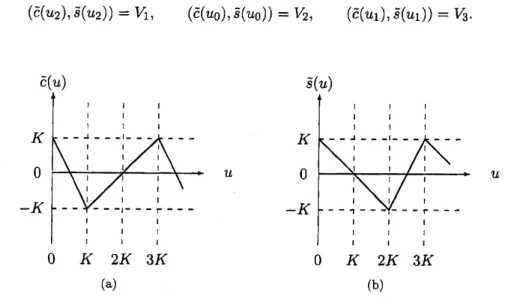
The extended continuouspiecewise linear functions
are
also denoted by$\tilde{c}$and $\tilde{s}$ (seefiguues4(a) and $4(b))$.
Note that thepoints $u_{2},$ $u_{0},$$u_{1}$are
mapped into the vertices of$\overline{C}_{K}$:$(\tilde{c}(u_{2}),\tilde{s}(u_{2}))=V_{1}$, $(\tilde{c}(u_{0}),\tilde{s}(u_{0}))=V_{2}$, $(\tilde{c}(u_{1}),\tilde{s}(u_{1}))=V_{3}$
.
$\overline{c}(u)$ $u$ $0$ $K$ $2K$ $3K$ (a) $\tilde{s}(u)$ $u$ $0$ $K$ $2K$ $3K$ (b)
Figure4: (a) $\tilde{c}:J(C_{K})arrow \mathbb{R}$
.
(b) $\tilde{s}:J(C_{K})arrow \mathbb{R}$.
Let us introduce a map$\tilde{\varphi}$ : $J(C_{K})arrow \mathbb{R}^{2}\subset \mathbb{P}^{2,trop}$,
$\tilde{\varphi}$ : $u(\tilde{c}(u),\tilde{s}(u))$
.
(37) This map inducesan
isomorphism $J(C_{K})\simeq\overline{C}_{K}$.
Therefore, we have$\{(\tilde{c}(u),\tilde{s}(u))\in \mathbb{R}^{2}|u\in J(C_{K})\}=\overline{C}_{K}$
.
Thusweobtain thepiecewiselinear functions$\tilde{c}(u)$ and$\tilde{s}(u)$ which parametrize the tropicalHesse
pencil. Since $\tilde{\varphi}(0)=(\tilde{c}(0),\tilde{s}(0))=V_{1}$, the additive group structure of $(\overline{C}_{K}, V_{1})$, equipped with
the unitofaddition$V_{1}$, is induced fromthat of $J(C_{K})=\mathbb{R}/3KZ$via the groupisomorphism$\tilde{\varphi}$
.
We denotethe addition
on
thetropical Hessecurve
by $\cup:\overline{C}_{K}\cross\overline{C}_{K}arrow\overline{C}_{K}$.
It iseasy to see that
we
have$\overline{\varphi}(D_{1})=\{(X, Y)\in\overline{C}_{K}\subset \mathbb{P}^{2,tr\varphi}|Y>0, Y>X\}=E_{1}^{o}$ (38)
$\tilde{\varphi}(D_{2})=\{(X, Y)\in\overline{C}_{K}\subset \mathbb{P}^{2,trop}|X<0, Y<0\}=E_{2}^{o}$ (39) $\tilde{\varphi}(D_{3})=\{(X, Y)\in\overline{C}_{K}\subset \mathbb{P}^{2,trop}|X>0, Y<X\}=E_{3}^{o}$, (40)
where$E_{j}^{O}$ $:=E_{j}\backslash \{V_{j}, V_{j+1}\}$ stands for the interior of$E_{j}$
.
Let $Log:\mathbb{R}^{2}arrow \mathbb{R}^{2}$ be the map
Let the amoeba of the real partof$E_{\theta_{2}’},w_{0}$ be
$A_{\epsilon}:=\{({\rm Log}\circ\varphi)(z)$ $z \in\bigcup_{j=1}^{3}d_{j}\}$
It follows fromproposition 3 that
we
have the commutative diagram$l_{\epsilon}/\tau Z\backslash \{z_{20}, z_{00}, z_{10}\}arrow^{\epsilonarrow 0}\mathbb{R}/3KZ\backslash \{uu,u_{1}\}$
$Logo\varphi\downarrow$ $\downarrow\overline{\varphi}$
$A_{\epsilon}$
$arrow^{carrow 0}$
$\overline{C}_{K}\backslash \{V_{1}, V_{2}, V_{3}\}$
.
4.3
IbopicalHesse configuration
Now
we
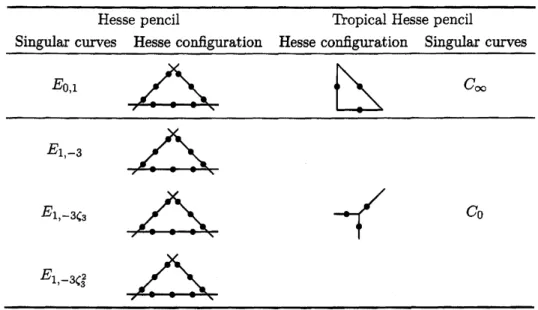
considerthe tropical counterpart of theHesseconfiguration. Rememberthat theHesseconfiguration consists of the 9 inflection points$p0,p_{1},$$\cdots,p_{8}$ and the 12 inflectionslines, which
compose the singular members $E_{0,1},$ $E_{1,-3},$ $E_{1,-3\zeta_{3}}$, and$E_{1,-3\zeta_{3}^{2}}$ of the pencil (see table 1).
Fix$\tau$
as
in (23). We considera
map$\eta:E_{\theta_{2}’,6\theta_{0}’}arrow\overline{C}_{K}$so
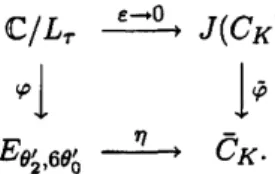
defined that the diagramcommute:$\mathbb{C}/L_{\tau}arrow^{\text{\’{e}}arrow 0}J(C_{K})$
$\varphi\downarrow$ $\downarrow\overline{\varphi}$
$E_{\theta_{2}’,6\theta_{0}’}arrow^{\eta}$ $\overline{C}_{K}$
.
Theinflectionpoints of$E_{\theta_{2}’,6\theta_{\acute{0}}}$
are
mapped into the vertices of $\overline{C}_{K}$ by$\eta$
as
follows $\eta:p_{0},$ $p_{1},$$p_{2}^{\underline{\varphi^{-1}}}z_{20},$
$z_{21},$
$z_{22}arrow u_{2}V_{1}\epsilonarrow 0\underline{\tilde{\varphi}}$
$\eta:p_{3},$ $p_{4},$
$p_{5}^{\underline{\varphi^{-1}}}z_{00},$
$z_{01},$
$z_{02^{arrow u_{0}V_{2}}}^{\text{\’{e}}arrow 0\underline{\tilde{\varphi}}}$
$\eta:p_{6},$ $p_{7}$, $ps$
$\underline{\varphi^{-1}}z_{10},$
$z_{11},$
$z_{12^{arrow u_{1}V_{3}}}^{\epsilonarrow 0\underline{\tilde{\varphi}}}$
.
Thusthe tropical counterparts of theHesseconfiguration consistsof theverticesof$\overline{C}_{K}$ and the
lines passing through them. Moreover, the lines passing through the vertices should
compose
the singular members of the tropical Hesse pencil.
Table 2 showsthatthere exist two singular members$C_{0}$ and$C_{\infty}$ inthe tropical Hesse pencil.
The member$C_{0}$ isatripletropical lin$e$defined by (9). Each of the threepoints$V_{1},$ $V_{2}$, and $V_{3}$is
clearlyoneach ofthe three tentacles of$C_{0}$
.
On theother hand, the singular member$C_{\infty}$ is theboundaryof$\mathbb{P}^{2,tr\varphi}$
defined by (5) (see (6)). Sincethepoints $V_{1},$ $V_{2}$, and $V_{3}$ arecontained inside
of$\mathbb{P}^{2,tr\varphi}$, it looks that they are not on $C_{\infty}$. However, noticing the linear equivalence relation $\sim$, which identifies all points on a tentacle, and the fact
a
tentacle to intersecta
boundary of$\mathbb{P}^{2,tr\varphi}$, wecanconclude
thatall thepoints$V_{1},$ $V_{2}$,and $V_{3}$ arecontained in$C_{\infty}$
.
Thusthe tropicalcounterpart of the Hesse configurationconsists of three points and four lmes which $SatiS\mathfrak{h}r$the
following two conditions;
$\bullet$ each line passes throughat least
one
ofthe three points and.
each point lieson
two ofthe four lines.Table 3: The correspondence between the Hesse configuration and its tropical counterpart.
Hessepencil TYopicalHesse pencil
Singular
curves
Hesse configuration Hesse configuration Singularcurves
$E_{0,1}$ $C_{\infty}$
$E_{1,-3}$
$E_{1,-3\zeta_{3}}$ $C_{0}$
$E_{1,-3\zeta_{3}^{2}}$
4.4
Ultradiscrete
elliptic functions
Now we construct the addition formula for the points onthe tropical Hesse curve viathe
ultra-discretizationof that for the Hesse cubic
curve3.
Forthispurpose, weintroduceelliptic functionsdefined bythe ratios of the level-three theta functions:
$c(z):= \frac{\theta_{0}(z,\tau)}{\theta_{2}(z,\tau)}$ $s(z):= \frac{\theta_{1}(z,\tau)}{\theta_{2}(z,\tau)}$
.
It canbe easilychecked that the following holds
$c(z+1)=c(z)$ $c(z+\tau)=c(z)$
$s(z+1)=s(z)$ $s(z+\tau)=s(z)$
.
Therefore $c(z)$ and $s(z)$
are
elliptic functions which have the double periodicity withrespect tothe translations $zarrow z+1$ and $zarrow z+\tau$
.
In proposition 3, weshow that the followingholds for any $z=-a\tau\in d_{j}(j=1,2,3)$
$\lim_{\epsilonarrow 0}$elog$c(z)=\tilde{c}(u)$ and $\lim_{\epsilonarrow 0}\epsilon\log s(z)=\tilde{s}(u)$,
where$u=3Ka\in D_{j}$ and$\tau$ is assumed to be
as
in (23). Therefore, we call$\tilde{c}$and $\tilde{s}$ultradiscrete
ellipticfunctions. Notethat $\tilde{c}(u)$ and$\tilde{s}(u)$ havesingle periodicity withrespect tothe translation
$uarrow u+3K$ (see figures 4(a) and $4(b)$).
The addition formulae for the elliptic functions $c(z)$ and $s(z)$
are
immediately follow $hom$that forthe level-three thetafunctions (16), (17), and (18):
$c(z+w)= \frac{s(z)-c(z)^{2}c(w)s(w)}{c(z)c(w)^{2}-s(z)^{2}s(w)}$ (41a) $s(z+w)= \frac{c(z)s(z)s(w)^{2}-c(w)}{c(z)c(w)^{2}-s(z)^{2}s(w)}$ (41b)
$c(z+w)= \frac{c(z)s(z)c(w)^{2}-s(w)}{s(z)s(w)^{2}-c(z)^{2}c(w)}$ $s(z+w)= \frac{c(z)-s(z)^{2}c(w)s(w)}{s(z)s(w)^{2}-c(z)^{2}c(w)}$ (42a) (42b) $c(z+w)= \frac{c(z)s(w)^{2}-s(z)^{2}c(w)}{c(z)s(z)-c(w)s(w)}$ (43a) $s(z+w)= \frac{s(z)c(w)^{2}-c(z)^{2}s(w)}{c(z)s(z)-c(w)s(w)}$
.
(43b)4.5
Addition
formula
Fix$\tau$
as
in (23). Assume $z$ and $w$ to be pointson
$l_{\epsilon}/\tau \mathbb{Z}$; thenwecan
put themas
follows $z= \frac{(1-i\xi_{\epsilon})u}{9K}$ and $w= \frac{(1-i\xi_{\epsilon})v}{9K}$,where $u,$$v\in J(C_{K})$
.
Letus consider (41a). Byproposition 2,the ellipticfunctions $c$and $s$ arerealvalued forthis
choiceof$\tau$and $z,$ $w$. At first,
assume
$z,$ $w\in d_{1}$.
Note thatthe followingholds (see (31))$c(z),$$c(w)>0$, $s(z),$$s(w)<0$
.
Then wehave $s(z)=-|s(z)|$ $c(z)c(w)^{2}=|c(z)c(w)^{2}|$ $-c(z)^{2}c(w)s(w)=|c(z)^{2}c(w)s(w)|$ $-s(z)^{2}s(w)=|s(z)^{2}s(w)|$.
It follows that the denominatoroftheright hand side of(4la) is alwayspositive, while thesign
of the numerator is indeterminate, i.e., it depends
on
the values of $z$ and $w$.
The left handside of (41a) has the same sign
as
the numerator ofthe right hand side. Thuswe
obtain thesubtraction-free formof (4la)
$(|c(z)c(w)^{2}|+|s(z)^{2}s(w)|)|c(z+w)|+|s(z)|=|c(z)^{2}c(w)s(w)|$
if$|c(z)^{2}c(w)s(w)|>|s(z)|$
or
$(|c(z)c(w)^{2}|+|s(z)^{2}s(w)|)|c(z+w)|+|c(z)^{2}c(w)s(w)|=|s(z)|$
if $|c(z)^{2}c(w)s(w)|<|s(z)|$
.
Therefore, byproposition3, weobtain$\tilde{c}(u+v)=\max(\tilde{s}(u), 2\tilde{c}(u)+\tilde{c}(v)+\tilde{s}(v))-\max(\tilde{c}(u)+2\tilde{c}(v), 2\tilde{s}(u)+\tilde{s}(v))$ (44)
except for $u,$$v$ satisfying $u+v=K^{4}$ in the limit $\epsilonarrow 0$
.
Since theboth hand sides of (44)are
continuousfunctions, (44)holds
even
for$u,$$v$satisfying$u+v=K$.
Noting(38),we see
that (44)holds for$u,$$v$such that both $(\tilde{c}(u),\tilde{s}(u))$ and $(\tilde{c}(v),\tilde{s}(v))$arein$E_{1}^{o}$, orequivalently, for$u,$ $v\in D_{1}$
.
Next,
assume
$z\in d_{1}$ and $w\in d_{2}$.
Thenwe have (see (31) and (32))$c(z)>0$, $c(w),$ $s(z),$$s(w)<0$
.
The denominator of the right hand side of (4la) is always positive and the numerator is
al-ways negative. The left hand side of (41a) has the negative sign as well. Thus
we
obtain thesubtraction-free form
$(|c(z)c(w)^{2}|+|s(z)^{2}s(w)|)|c(z+w)|=|s(z)|+|c(z)^{2}c(w)s(w)|$
.
Taking the limit $\epsilonarrow 0$, we obtain (44) which holds for
$u,$$v$ such that $(\tilde{c}(u),\tilde{s}(u))\in E_{1}^{o}$ and
$(\tilde{c}(v),\tilde{s}(v))\in E_{2}^{o}$, orequivalently, for $u\in D_{1}$ and $v\in D_{2}$
.
Thus we observe that (44) is the candidate of the addition formula for the tropical Hesse
curve.
However, ifweassume
$z\in d_{1}$ and $w\in d_{3}$ then (44) does not hold. Actually, we have(see (31) and (33))
$c(z),$$s(w)>0$, $c(w),$$s(z)<0$
.
Inthis case, both the denominator and the numerator of (41a) have indeterminate sign. More
precisely, we have
$s(z)=-|s(z)|$
$c(z)c(w)^{2}=|c(z)c(w)^{2}|$
Thesubtraction-free form is
$-c(z)^{2}c(w)s(w)=|c(z)^{2}c(w)s(w)|$ $-s(z)^{2}s(w)=-|s(z)^{2}s(w)|$
.
$|c(z)c(w)^{2}||c(z+w)|+|s(z)|=|s(z)^{2}s(w)||c(z+w)|+|c(z)^{2}c(w)s(w)|$
or
$|c(z)c(w)^{2}||c(z+w)|+|c(z)^{2}c(w)s(w)|=|s(z)^{2}s(w)||c(z+w)|+|s(z)|$.
We then obtain the following in thelimit $\epsilonarrow 0$
$\max(\tilde{c}(u)+2\tilde{c}(v)+\tilde{c}(u+v),\tilde{s}(u))=\max(2\tilde{s}(u)+\tilde{s}(v)+\tilde{c}(u+v), 2\tilde{c}(u)+\tilde{c}(v)+\tilde{s}(v))$
.
(45)In general, the valueof$\tilde{c}(u+v)$
can
notbedetermineduniquelyfromthoseof$\tilde{c}(u),\tilde{c}(v),\tilde{s}(u)$, and$\tilde{s}(v)$ in terms of(45). Thusweseethat the
case
when$z\in d_{1}$and$w\in d_{3}$ theaddition formulafortheultradiscreteellipticfunctionscannotbe reducedfrom (41a) through theultradiscretization.
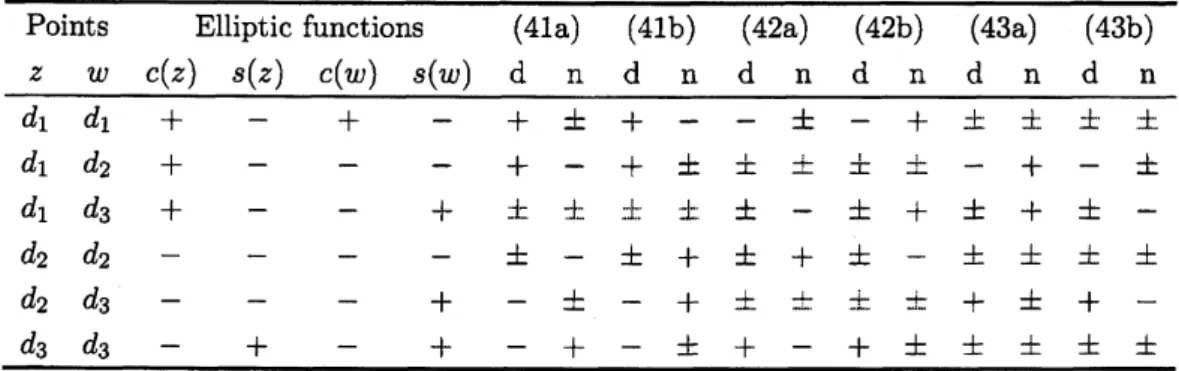
Table 4: The signs appearing in $(4la-43b)$
.
The denominator and the numerator of the righthand sideofeach equation
are
denoted by $d$“ and $n$” respectively. The symbol $\pm$ stands forindeterminate sign.
$\overline{Points}$
Elliptic functions(41a) (41b) (42a) (42b) (43a) (43b)$\frac{zwc(z)s(z)c(w)s(w)dndndndndndn}{d_{1}d_{2}+---+-+\pm\pm\underline{arrow}\pm\pm-+-\cdot\pm d_{1}d_{1}+-+-+\pm+--\pm-+\downarrow-\pm\perp-\}}$
$d_{1}$ $d_{3}$ $+$ $-$ $-$ $+$ $:4_{\wedge}\wedge$ $\dotplus_{\sim}$ 4.$\cdot$
.$\cdot$ $\downarrow\sim$ $\pm$ $-$ $\pm$ $+$ $\pm$ $+$ $\pm$ $-$
$d_{2}$ $d_{2}$ $-$ $-$ $-$ $-$ $\pm$ $-$ $\pm$ $+$ $\pm$ $+$ $\pm$ $-$ $\pm$ $\pm$ $\pm$ $\pm$
$d_{2}$ $d_{3}$ $-$ $-$ $-$ $+$ $-$ $\pm$ $-$ $+$ $\pm$ $\pm$ & $+$ $+$ $\pm$ $+$ $-$
Thisfactsuggests that if both the denominator and thenumeratorhave indeterminate signs
then ordinary procedure of ultradiscretization
can
not be $applied^{5}$; otherwise,we
can
apply itto the additionformulae $(4la-43b)$
.
We summarize the signs of the equations $(4la-43b)$ forthechoice of$z$ and$w$intable 4. From table4, weobserve thatwe canapplyordinary procedure
ofultradiscretization to $(4la-43b)$ except for the following
case
$z,$$w\in d_{j}$ $(j=1,2,3)$ $\Rightarrow$ (43a) and (43b)
$z\in d_{j},$$w\in d_{j+1}$ $(j=1,2,3)$ $\Rightarrow$ (42a) and (42b)
$z\in d_{j},$$w\in d_{j+2}$ $(j=1,2,3)$ $\Rightarrow$ (41a) and (41b),
where the subscripts
are
reduced modulo3.Thus
we
have the following theorem.Theorem 3 Assume $u\in\overline{D_{j}}$for
a
fixed$j=1,2,3$ , where $\overline{D_{j}}$is the closure of $D_{j}$.
Then theultradiscrete elliptic functions $\tilde{c}$ and $\tilde{s}$ satisfy thefollowing additionformulae
$\tilde{c}(u+v)=\max(\tilde{s}(u), 2\tilde{c}(u)+\tilde{c}(v)+\tilde{s}(v))-\max(\tilde{c}(u)+2\overline{c}(v), 2\tilde{s}(u)+\tilde{s}(v))$ (46a)
$\tilde{s}(u+v)=\max(\tilde{c}(u)+\tilde{s}(u)+2\tilde{s}(v),\tilde{c}(v))-\max(\tilde{c}(u)+2\tilde{c}(v), 2\tilde{s}(u)+\tilde{s}(v))$ , (46b)
ifand only if$v\in\overline{D_{j}\cup D_{j+1}}$,
or
$\tilde{c}(u+v)=\max(\tilde{c}(u)+\tilde{s}(u)+2\tilde{c}(v),\tilde{s}(v))-\max(\tilde{s}(u)+2\tilde{s}(v), 2\tilde{c}(u)+\tilde{c}(v))$ (47a)
$\tilde{s}(u+v)=\max(\tilde{c}(u), 2\tilde{s}(u)+\tilde{c}(v)+\tilde{s}(v))-\max(\tilde{s}(u)+2\tilde{s}(v), 2\tilde{c}(u)+\overline{c}(v))$, (47b)
ifand only if$v\in D_{j}\cup D_{j+2}$, or
$\tilde{c}(u+v)=\max(\tilde{c}(u)+2\tilde{s}(v), 2\tilde{s}(u)+\overline{c}(v))-\max(\tilde{c}(u)+\tilde{s}(u),\tilde{c}(v)+\tilde{s}(v))$ (48a)
$\tilde{s}(u+v)=\max(\tilde{s}(u)+2\tilde{c}(v), 2\tilde{c}(u)+\tilde{s}(v))-\max(\tilde{c}(u)+\tilde{s}(u),\tilde{c}(v)+\tilde{s}(v))$, (48b)
if and only if$v\in\overline{D_{j+1}\cup D_{j+2}}$, where the subscripts
are
reduced modulo 3.(Proof) The “ if“ part
can
be shown by using such limiting procedureas
demonstratedabove. For the boundary values ofthe closures, $u_{0},$ $u_{1}$, and $u_{2}$, the formulae
can
be shown bydirect calculation. By substituting appropriate values, say$u\in D_{1}$ and $v\in D_{3}$, into (46a), then
we
find that the equationdoesnot hold. Ina
similar manner,we
can
prove the “only if“ partfor all
cases.
$\blacksquare$Itimmediately follows theadditionformula for the pointson thetropical Hesse
curve
$C_{K}$.
Corollary 1 Let $P=(X, Y)$ be a point on
an
edge $E_{j}$ of the tropical Hessecurve
$C_{K}$ for afixed$j=1,2,3$
.
Then the point $P|dQ=(x\omega X’, Y\cup Y’)$ is given bythe following additionformulae
$X^{\ovalbox{\tt\small REJECT}} \theta X’=\max(Y,$$2X+X’+ Y’)-\max(X+2X’,$$2Y+Y’)$ (49a)
$Y \omega Y’=\max(X+Y+2Y’,$$X’)- \max(X+2X’,$$2Y+Y’)$ , (49b)
ifand only if$Q=(X’, Y’)\in E_{j}\cup E_{j+1}$, or
$X \cup X’=\max(X+Y+2X’, Y^{l})-\max(Y+2Y’, 2X+X’)$ (50a)
$Y \omega Y’=\max(X, 2Y+X’+Y’)-\max(Y+2Y’, 2X+X’)$, (50b)
if and only if$Q\in E_{j}\cup E_{j+2}$,
or
$X \cup X’=\max(X+2Y’, 2Y+X’)-\max(X+Y, X’+Y’)$ (51a)
$Y\oplus Y’=\max(Y+2X’, 2X+Y’)-\max(X+Y,X’+Y’)$, (51b)
ifandonly if$Q\in E_{j+1}\cup E_{j+2}$, where the subscripts
are
reduced modulo 3.5
Conclusion
We give the addition formula $(49a-5lb)$ for the tropical Hesse pencil via the ultradiscretization
ofthat $(12a-14c)$ for thelevel-threethetafunctions. Each pair $(49a, 49b),$ $(50a, 50b)$, or $(51a$, $51b)$ holdsexcept for
an
edge of the curve, while those $(12a-12c),$ $(13a-13c)$, or $(14a-14c)$holds except forthreeof the9zerosofthe theta functions on$\mathbb{C}/L_{\tau}$
.
In the tropicalcase, two ofthethreepairs
are
essentially thesame
whereboth of themare
defined. Therefore, the additionformulauniquelydetermines the additivegroup structure ofthe tropicalHesse pencil in analogy
to theoriginal (non-tropical) case.
In [3], we construct the solvable chaotic dynamical system via the duplication formula for
the tropical Hesse pencil. The ultradiscrete QRT map $P=(X, Y)\mapsto\overline{P}=P$ffl$T=(X, Y)–$
can
similarly be constructed by using the addition $\Theta$ of the tropical Hesse pencil. For example, if
wechoose $V_{3}$
as
$T$then, by using corollary 1,we
obtain the linear map:$\overline{X}=-X+Y$
$\overline{Y}=-Y+\overline{X}$
.
Thismap is periodic with period three foranyinitialvalue because$V_{3}$ isthethree-torsionpoint
of the pencil. This reflects the correspondence $\eta$ : $p_{6},p_{7},p_{8}\mapsto V_{3}$ , where $p_{6},$ $p_{7}$, and $p_{8}$
are
thethree-torsion points of the Hesse pencil. Thuswe
can
construct bothchaotic and integrabledynamical systems by using the group structureofthe tropicalHesse pencil.
Acknowledgment
The author would like to express his sincere thanks to Professor Kenji Kajiwara for fruitful
discussion. This work
was
partially supported by grants-in-aid for scientific research, Japansociety for the promotion ofscience (JSPS) 19740086 and22740100.
References
[1] Artebani M and Dolgachev I “The Hesse pencil of plane cubic curves” Preprint
arXiv:math$/0611590v3$ (2006)
[2] Isojima S, MurataM, Nobe A and Satsuma J “Soliton-antisoliton collision in the
ultradis-crete modified KdVequation” Phys. Lett. A 357 (2006) 31-35
[3] Kajiwara K, Kaneko M, Nobe A and Tsuda T ”Ultradiscretization of a solvable
two-dimensional chaotic map associatedwith theHessecubic curve” KyushuJ. Math. 63 (2009)
315-338
[4] Kajiwara K, Nobe A and TsudaT ”Ultradiscretization of solvable one-dimensional chaotic
maps” J. Phys. A: Math. Theor. 41 (2008) 395202
[5] MikhalkinGandZharkovI “Tropicalcurves, theirJacobians andtheta functions” Preprint
$arXiv:math/0612267vl$ (2006)
[6] Nakamura I “Plane cubic curves–from Hesse to Mumford-,‘ Sugaku June (2001) 17-34
(in Japanese)
[7] Nobe A “Ultradiscrete QRT maps and tropical elliptic curves” J. Phys. A: Math. Theor.
[8] Shaub HC and Schoonmaker HE “The Hessian configuration and its relation
to
thegroup
of order 216” Am. Math. Mon. 38 (1931)
38&393
[9] VigelandMD “Thegrouplawon