第 55 卷 第 1 期
2020 年 2 月
JOURNAL OF SOUTHWEST JIAOTONG UNIVERSITY
Vol. 55 No. 1
Feb. 2020
ISSN: 0258-2724 DOI:10.35741/issn.0258-2724.55.1.27
Research article Education
S
USTAINABILITY
C
ONCEPT
I
MPLEMENTATION IN
H
IGHER
E
DUCATION
I
NSTITUTIONS OF
I
NDONESIA
印度尼西亚高等教育机构中的可持续性概念实施
Eddy Jusuf a, Aldrin Herwany b, Putu Sukma Kurniawan c, Ardi Gunardi a, * a Universitas Pasundan
Bandung, Jawa Barat, Indonesia, [email protected]
b
Universitas Padjadjaran Bandung, Indonesia
c Universitas Pendidikan Ganesha
Udayana Street No.11 Singaraja - Bali 81116, Indonesia
Abstract
The concept of sustainability has been widely implemented in various organizations. This research aims to develop a theory of implementing the concept of sustainability in non-business organizations, namely, institutes of higher education of Indonesia. The methods used in this research are literature review and content analysis of reports of universities that have implemented the concept of sustainability within their organizations. This research consists of two main parts in which the first part focuses on drafting concepts for implementing sustainability in higher education institutions, and the second part discusses ways to establish a sustainable university. The results of this research will aid in compiling and developing our motive. The resulting concept will consist of three main stages and it can be used as a guideline for universities that will implement the concept of sustainability. This research will frame the policy that can be applied to form a sustainable university and identify obstacles and challenges for the same.
Keywords: Higher Education Institution, Sustainability Concept, Sustainable University
摘要 可持续性的概念已在各个组织中广泛实施。这项研究旨在发展一种在非商业组织(即印度尼 西亚的高等教育机构)中实施可持续性概念的理论。本研究中使用的方法是文献综述和对在其组 织内实施可持续性概念的大学的报告进行内容分析。这项研究包括两个主要部分,其中第一部分 侧重于起草在高等教育机构中实现可持续性的概念,第二部分讨论建立可持续性大学的方法。这 项研究的结果将有助于汇编和发展我们的动机。由此产生的概念将包括三个主要阶段,并且可以 用作实施可持续性概念的大学的指南。这项研究将制定可用于组建可持续发展大学的政策,并为 此确定障碍和挑战。
关键词: 高等教育机构,可持续发展理念,可持续大学
I. I
NTRODUCTIONThe concept of sustainability can be simply defined the creation of a balance among an organization’s economic, social, and environmental performance. Sustainability has been widely implemented in various companies across several industries, specifically those that include activities involving a potential risk to the social and environmental community. Organizations use the concept of sustainability as a guideline to conduct their business activities in a manner that minimizes such negative impacts. Caldwell [1] investigated whether it would be possible for a social community to implement the concept of sustainability in its social activities. The concept of sustainability must be implemented based on an awareness of the social community’s ability to establish a good relationship with ecology and the environment. Salas-Zapata and Ortiz-Muñoz [2] explained that the concept of sustainability can be organized as (1) a set of criteria, (2) vision or goals, (3) objects, and (4) approaches. The implementation of sustainable approaches must be designed to achieve the expected goals. The concept of sustainability can be used by the management of an organization to align its organizational culture with the sustainable principles. Isil and Hernke [3] argued that sustainability is based on the concept of triple bottom lines, which requires an organization to find a balance in financial, social, and environmental performance. Balancing these performances is indicative of an organization’s efforts to benefit the organization, while also striving to create benefits for the social and environmental communities.
Efforts to promote sustainability have been carried out by many organizations, mainly by non-profit organizations that are closely related to sustainability issues. Frame and Newton [4] examined the promotion sustainability in social communities by using social marketing. Their research explained that the distribution of printed advertisements containing information about air pollution and environmental degradation is the social community’s expression of concern with the application of sustainable principles. The research suggested that the social community will become more concerned with the issue of sustainability when they are exposed to information about the negative impacts of business activities on the social community and the environment. The promotion of sustainability
in social communities can be carried out by higher education institutions or universities, and the role of universities can be very important to the effective promotion of sustainability principles. Alshuwaikhat et al. [5] argued that public universities have a very important role in educating the social community about sustainability.
The concept of sustainability and the idea of applying it to organizations was developed by academics in the university setting. Lozano et al. [6] suggested that internal stakeholders of the universities, such as university leaders and staff, have a very important role to play in the implementation of sustainability principles within the university. University leaders and staff members must collectively agree that sustainability is an important concept that must be owned by future generations, and the application of sustainability strategies in the future can be expanded beyond higher education institutions. Larsson and Grönlund [7] discussed the application of e-Governance, which is based on the concept of sustainability. Their research showed that its implementation can be applied to various types of organizations and all organizations can apply it internally. For a university to promote the application of the sustainability concept to the social community, it must implement sustainable practices in the internal activities of the university. Berchin et al. [8] identified strategies that can be used to promote and implement the concept of sustainability in a university. Their research found that support from the government, the availability of facilities and infrastructure, and organizational culture are the main factors that can help promote the concept of sustainability within universities. Čiegis and Gineitienė [9] investigated the role of universities in the promotion of sustainability in social communities, and indicated that it should be integrated with university functions, namely the education and research functions. The university management must also have a strong commitment and vision in implementing the concept of sustainability, especially in university operations to build an organizational culture based on the concept of sustainability [9].
Higher education institutions in Indonesia have not fully implemented the concept of sustainability in the universities' internal business processes. This fact is based on data that indicates that the concept of sustainability is not
prevalent in universities in Indonesia. The data shows that not many universities in Indonesia have released a sustainability report. A sustainability report can be interpreted as a report that contains comprehensive information about financial performance and non-financial performance of a university related to sustainability efforts. If a university has implemented sustainable practices in the university's internal activities, then releasing a university sustainability report is an outcome of the implementation process. Some previous literature has discussed the challenges and difficulties in implementing the concept of sustainability in organizations. Research from Mathiyazhagan et al. [10] discusses the challenges of applying green concepts to the manufacturing industry and this research found that company management had difficulty adjusting to the company's operations in accordance with the concept of sustainability. Based on this research it can be seen that the challenge in implementing the concept of sustainability is in adjusting the organization’s capability to address sustainability. Research from Ávila et al. [11] found that problems in implementing sustainable practices within universities could stem from a lack of commitment from university leaders and a lack of support from policy makers. The initiative in conducting this research is based on the results of research conducted by Adams [12] that found that the application of sustainability in higher education institutions still lags behind other sectors. The results of this research are a severe blow to higher education institutions where universities should be a pioneer in the implementation of sustainability. This problem also occurs in the implementation of sustainability in higher education institutions in Indonesia. Some reasons for not implementing sustainable practices at universities in Indonesia are (1) the concept of sustainability is believed to be only implemented in profit-based organizations, and that non-profit organizations cannot implement sustainable practices, (2) there is no framework that can be used by university management for implementing sustainable practices, and (3) there is an absence of standards or policies that require universities to implement sustainable practices in their internal activities. These challenges or problems must be overcome. Dagiliūtė et al. [13] argues that the role of universities is very important in the community to provide an understanding of the importance of sustainability.
Previous research has attempted to discuss the possibility and adoption of sustainable practices in the internal activities of the university. Research from Alshuwaikhat et al. [5] tried to do a sustainability performance assessment of higher education institutions. Research from Zhao and Zou [14] has compiled a concept of the green campus implemented at Tsinghua University. In other research, Shuqin et al. [15] performed an assessment of the implementation of the concept of sustainability at universities in China. This research attempted to narrow this gap in the literature as no previous research has been aimed at developing concepts to implement sustainability in accordance with the characteristics of Indonesian universities. This research aims to develop a concept that can be used by university management to implement sustainability in higher-education institutions. The application of the concept of sustainability at universities in Indonesia has not been very popular, and this research encourages Indonesian universities to adopt and implement the concept of sustainability. The output of this research aims to provide a new understanding that, basically, universities in Indonesia have sufficient resources to implement sustainability and that this implementation process will produce a sustainable-university concept. In the future, the concept of a sustainable university must be part of a university’s long-term plan, in addition to raising the awareness of all stakeholders. In addition, this research intends to address the concerns identified in research conducted by Adams [12] and to help university management implement the concept of sustainability within organizations.
II. L
ITERATURER
EVIEWA. Benefits of Applying the Concept of Sustainability to the University
Implementation of the concept of sustainability in higher-education institutions can provide great benefits. The concept of sustainability can be developed as an approach by university management for implementing university policies and programs. University policies and programs that are be based on the concept of sustainability and its impact will be felt by the wider social community in the long run. Universities that have implemented the concept of sustainability have improved the internal business processes of the university and the programs and policies planned by the university can accommodate the interests of all university stakeholders. In the concept of
legitimacy theory and stakeholder theory, universities that accommodate all the interests of university stakeholders will be able to establish good connections and will get strong legitimacy regarding the policies to be implemented by the university. This will also be related to the university's reputation in the context of social performance and environmental performance. Some previous research has discussed the benefits of the concept of sustainability in the context of organizational reputation. Hasan & Yun [16] discusses organizational social performance with improved organizational reputation and the results of this research indicate that organizational social performance is positively correlated with improving organizational reputation. University management can use improved social performance as a strategy to improve the reputation of the university from the viewpoint of university stakeholders.
Furthermore, the benefit of applying the concept of sustainability in universities is to improve the quality of education and research related to the concept of sustainability. University management must realize that future generations must gain an understanding that the concept of sustainability is very important to learn and the research that will be carried out must seek to develop the application of the concept of sustainability in the wider social community. Dmochowski et al. [17] investigated the integration of the concept of sustainability in the university curriculum and found that this integration process has resulted in changes in students' perspectives on the concept of sustainability. This research has produced a framework that can be used by teaching staff to integrate the concept of sustainability in the university curriculum. Another benefit of applying the concept of sustainability within the university is in a form of a balanced in between financial performance, social performance, and environmental performance of the university. This balance is very important so that the university management can shift their view that the financial performance of the university is not the only aim for them to be achieved. The characteristics of universities are different from the characteristics of public companies and it is fitting for university management to realize that universities have a role to support social communities and environmental preservation. Disterheft et al. [18] developed an integrated approach to implementing the concept of environmental sustainability within the university. The results of this research indicate that higher
education institution organizations have the ability and sufficient resources to improve environmental performance.
B. Previous Research on the Implementation of the Concept of Sustainability at the University
Previous research has studied the possibility of adopting the concept of sustainability in public universities. Research from Alshuwaikhat et al. [5] conducted an assessment of the implementation of the concept of sustainability in higher education institutions in Saudi Arabia. This research found that the concept of sustainability has not been widely implemented in the university's internal activities and that more effort is needed to implement the concept of sustainability, especially in the fields of education and research. Blackburn [19] revealed the practice of applying the concept of sustainability to universities. In his research, Blackburn [19] also discussed the challenges and obstacles faced by university management in implementing the concept of sustainability. Research from An et al. [20] discusses the development of sustainability reporting conducted by universities in New Zealand. This research found that sustainability reporting trends have not been carried out by university management and the majority of information disclosed in university sustainability reports is information about the university's social performance. Research from Zhao & Zou [14] aims to develop the concept of green campus at Tsinghua University. Research by Zhao & Zou [14] found that the concept of a green campus at Tsinghua University was based on the dream of the university to become a world class university and form a sustainable society. The concept of green university applied at Tsinghua University contains three elements, namely green education, green research, and green campus. Research from Awuzie & Emuze [21] examines the process of promoting the concept of sustainability at universities in South Africa. The results of this research found that the promotion of the concept of sustainability must be in line with the education and research policies of the university and support from the government is needed so that the promotion process can be successful. Research from Shuqin et al. [15] developed a concept to evaluate the application of the concept of sustainability to universities. The results of this research develop an evaluation method that consists of five components, namely organizational and management components, energy and resource savings, environmental
awareness, organizational culture, and social impact.
III. M
ETHODSThis research is a conceptual research that aims to develop concepts to implement the concept of sustainability in higher education institutions. This research uses the literature review method by looking at previous literature that discusses the concept of sustainability in higher education institutions. This research adopts the method conducted by Ceulemans et al. [22] which uses literature review to make discussions about the development of sustainability reporting at higher education institutions. This research is also based on the method used in Findler et al. [23] who used the literature review method to identify the impact of applying the concept of sustainability in universities and research from Lozano et al. [24] which examines the university's commitment in implementing the concept of sustainability.
This research consists of two main parts. The first part of this research is aimed at developing a framework or concept to assist university management in implementing the concept of sustainability within higher education institutions. This stage uses the literature review method and it is hoped that the resulting framework will be used by various types of higher education institutions with different characteristics. The second part of this research is aimed at discussing how to form a sustainable university, especially for universities in Indonesia. At this stage the content analysis method is carried out to analyze the university reports that have applied the concept of sustainability (especially the university sustainability report) and identify what needs to be done and prepared for towards a sustainable university. Using the content analysis method, this research analyzes the University of Indonesia's sustainability report in 2018. Universitas Indonesia in 2018 has issued a sustainability report and this sustainability report data can be used as a reference in discussing the sustainable university concept.
IV. R
ESULTS ANDD
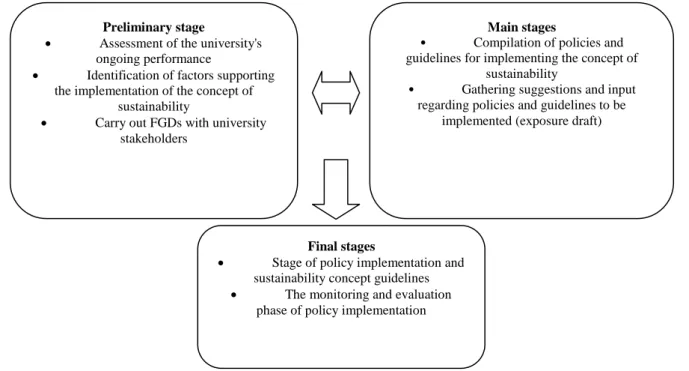
ISCUSSIONAt this stage, this research compiles a concept to implement the concept of sustainability. In general, there are three stages to implementing the concept of sustainability. The stages are preliminary stages, main stages, and final stages. The processes contained in the preliminary stage are:
1. assessment of the university's sustainability performance;
2. identification of factors supporting the implementation of the concept of sustainability;
3. carry out focus group discussions with university stakeholders. The core stages include:
1. the formulation of policies and guidelines for implementing the concept of sustainability;
2. collection of suggestions or feedback on policies and guidelines to be implemented. The final stage covers the stage of implementing policies and guiding the concept of sustainability and the monitoring and evaluation stage.
A. University Sustainability Performance Assessment
The university's sustainability performance assessment process is important to find out whether an organization can apply the concept of sustainability in the university's internal business processes. The assessment of university sustainability performance can be used as a basis for evaluation in the context of implementing the concept of sustainability in higher education institutions. There are several previous studies that compile the concept of performance appraisal for higher education institutions. Lozano [25] developed a concept called the GASU (Graphical Assessment of Sustainability in Universities) method and there is also the STARS system (Sustainability Tracking, Assessment & Rating System) method developed by AASHE (The Association for the Advancement of Sustainability in Higher Education).
Lozano [25] stated that the GASU indicators will provide a systematic assessment process and the results can be used as a basis for preparing a university sustainability report. In general, the sustainability performance assessment indicators of GASU have 5 performance measures, namely (1) profile, (2) economic, (3) environmental, (4) social, and (5) educational. The next measurement of sustainability performance used in this research is the STARS System performance measurement developed by AASHE. Performance measurement with the STARTS System focuses on measuring sustainability performance at higher education institutions. The performance measurement indicators on the STARS System are intended to carry out sustainability performance assessments for organizations in the education sector. Another method is the STARS System and in general, there are five categories of sustainability performance measurement, namely (1) academics (AC), (2) engagement (EN), (3) operations (OP), (4) planning and administration (PA), and (5) innovation and leadership (IN). The academics
category explains indicators of sustainability in the context of the education and teaching process at the university. The engagement category describes indicators of sustainability in the context of the university's relations with students and the relationship of the university with its social community. The operations category describes sustainability indicators in the context of university operations and the planning and administration category explains indicators in the context of university planning and administration. The innovation and leadership category explains the indicators of sustainability in the context of innovation and public leadership carried out by the university. Some of these categories will be further divided into several sub-categories that will show the indicators of university sustainability performance. The results of the analysis of the GASU method and the STARS System method will produce measurements of the sustainability performance of a university. Research from Richardson & Kachler [26] creates two measurement groups of university sustainability performance. The first group is high performance where this group is a university that has high sustainability performance. Universities in this group will tend to report sustainability performance through university sustainability reports. The second group is low performance where this group are universities that have low sustainability performance. Richardson & Kachler [26] hypothesize that based on the theory of legitimacy, universities in this group will continue to report sustainability performance with the aim of minimizing negative reactions from university stakeholder groups and covering up low performance by reporting false information on university sustainability reports. B. Identification of Supporting Factors for
Implementing the Concept of Sustainability The next stage is to identify supporting factors that will facilitate the university to implement the concept of sustainability. Identification of these supporting factors can come from internal factors of the university and external factors of the university. One of the supporting factors of the internal university is organizational culture. Organizational culture is a habit that is believed and carried out by every part in the organization. Research from Adams et al. [27] explains that university culture is the main factor that supports the implementation of the concept of sustainability within the university. University leaders must be committed in supporting the organizational culture that implements the concept of sustainability. Commitment from
university management is one of the supporting factors for the implementation process and will affect the prevailing organizational culture within the university. Ávila et al. [28] argues that support from senior leaders within the university can increase the commitment of university leaders to implement the concept of sustainability. Another supporting factor from internal universities is the support of students. Research from Dagiliūtė et al. [13] shows that students are important parties who can help to implement the concept of sustainability within the university. The management can identify supporting factors in terms of facilities and infrastructure, which universities require to implement the concept of sustainability. In terms of external factors, university management can identify university stakeholder groups who have the opportunity to support the implementation of the concept of sustainability. Therefore, support from stakeholder groups is very important as a stakeholder engagement process as well as leadership of university management.
C. To Carry Out a Focus Group Discussion with University Stakeholders
University stakeholders play a very important role in the process of implementing the concept of sustainability in the internal activities of higher education. Accordingly, the university stakeholder group can be defined as a group from both internal and external factors of the university, which are associated with the university and will be affected by the university’s decisions. In general, university stakeholders can be classified into two groups: (1) stakeholders from internal universities and (2) stakeholder groups from external universities. Internal university stakeholders include students, employees and teaching staff. The latter comprise the government or ministries, regional governments, communities and non-profit organizations. This process reflects the stakeholder engagement process where the university invites all stakeholders to discuss a policy to be implemented. The process of stakeholder engagement is very important as a means of unifying the vision and mission of the university and its stakeholders. Brusca et al. [29] state that the participation of university stakeholders in the stakeholder engagement process is a fundamental factor for the implementation of the concept of sustainability in universities. In the context of legitimacy theory, the stakeholder engagement process is also intended so that the policies and programs to be implemented by the university can get legitimacy
and support from all university stakeholders. The process of stakeholder engagement also reflects the strength of the social network and organizational leadership in place at the university. Susandy & Prasetyo [30] argue that the concept of social networks and organizational leadership is the strength of the university that can be used to establish relationships with university stakeholders. Focus group discussion activities will help university management to build social networks with university stakeholders and the leadership form of university management.
D. Compilation of Policies and Guidelines for Implementing the Concept of Sustainability The next stage after the engagement process is the process of developing policies and guidelines for implementing the concept of sustainability. University management can use the results of focus group discussions as a foundation for developing policies and guidelines for implementing a sustainability strategy. Factors supporting the implementation of sustainability strategies must also be considered in developing policies and programs. In general, those policies and guidelines can be related to a university’s financial performance, social performance, and environmental performance. These policies and guidelines must be specific and adjusted to the university’s resources. These policies and guidelines can be specific to each department and faculty or can be generally applied across the university. These policies and guidelines should ideally contain steps for procedures focused on rewards and penalties. In formulating these policies and guidelines, university leaders should discuss with faculty leaders and head of departments in order to accommodate their suggestions. This needs to be done considering that each department and faculty has different characteristics and ability of resources that are not the same.
E. Acceptance of Feedback Regarding Policies and Guidelines to be Implemented
The next stage is the stage of socialization regarding the draft policies and guidelines that will be implemented. This stage is the stage of gathering advice and input related to policies and guidelines on the concept of sustainability that will be implemented within the university. At this stage, university leaders can disseminate draft policies and guidelines to all university internal and external stakeholders. Each stakeholder group will examine the contents of the draft policy and guidelines and will identify which
points of the policy can be revised. Provision of advice and input will be closely related to the characteristics and the interests of each stakeholder group. The university management must be able to accommodate the suggestions and input from each stakeholder group and this step is needed so that in the future all university stakeholders have the same perspective on the policies and guidelines to be implemented. F. Policy Implementation Stage and
Sustainability Concept Guidelines
This stage is substantial because this stage is the process of implementing the policies and guidelines for the concept of sustainability that have been prepared. This implementation phase should be done in stages and can be started from the level of study programs and faculties. The process of this stage can also be carried out directly in all parts of the university, but it must first be ensured that the university has all the supporting infrastructure for the implementation process. One of the supporting infrastructures is that the university has a part in the university's organizational structure that focuses on the application of the concept of sustainability. Some universities abroad have a section or organ in the organizational structure that focuses on sustainability issues and this part of the organization has an important role to accelerate the process of implementing the concept of sustainability. This implementation stage be fully supported by the university's stakeholder groups. Disterheft et al. [18] stated that a participatory approach from all stakeholder groups is needed so that the process of implementing the concept of sustainability can be successful.
G. Monitoring and Evaluation Stage of Policy Implementation
The final stage in the concept of implementing the concept of sustainability at the university is the monitoring and evaluation stage. This stage is needed to see the progress of the implementation process and identify obstacles and challenges when implementing the concept of sustainability. University management can form a team that is tasked with conducting monitoring and evaluation activities. This monitoring and evaluation stage can be carried out simultaneously with the implementation stages. The university can collect data on the obstacles faced in implementing policies and guidelines as well as what needs to be improved in the contents of the policies and programs that have been prepared.
H. Concepts for Implementing Sustainability Concepts at Universities
Based on the points discussed in the previous section, this research aims to develop a guideline that can help universities implement the concept of sustainability. The initial stage for implementing the concept of sustainability at universities focuses on conducting sustainability performance assessments to see whether or not a university has adequate sustainability performance. This stage also consists of identifying supporting factors from both internal and external universities that can help the university management to implement the concept of sustainability. To improve the stakeholder engagement process, focus group discussion (FGD) activity is also carried out with university stakeholders at this stage. This FGD activity aims to gather advice and input from internal and external stakeholders of the university in relation to the implementation process. These suggestions and input are very important because the process of implementing sustainability will have direct and indirect impacts on university stakeholders.
The next stage in the implementation process is the main stage. The first step in this stage is the process of formulating policies and guidelines for implementing sustainability. This step must consider the advice and input that university stakeholders have given. After this stage is completed and policies and guidelines are
produced, the exposure draft of the policies and guidelines is submitted to the university stakeholders to get advice and input. This process is needed to ensure that all parties, including both university management and university stakeholders, have the same viewpoint on the contents of the guidelines and policies to be implemented.
The final stage of implementing sustainability includes two sub-stages: (1) the implementation of policies and agreed-upon sustainability concept guidelines and (2) monitoring and evaluation. The implementation stage can be carried out at the fastest for three months and can be done in phases, for example, starting at the level of study programs and faculties. If the implementation stage is considered to have run well, the implementation process can be carried out in all parts of the university. The monitoring and evaluation stage can be done simultaneously with the implementation stage to get an overview of the implementation process and to identify things that need to be improved. Gradually, this framework can help universities achieve green campus criteria.
Dagiliūtė et al. [13] utilizes the categories of green campus, for universities that implement sustainability, and non-green campus, for universities that have not implemented sustainability.
Figure 1. The framework of implementing the concept of sustainability at universities
I. Toward a Sustainable University
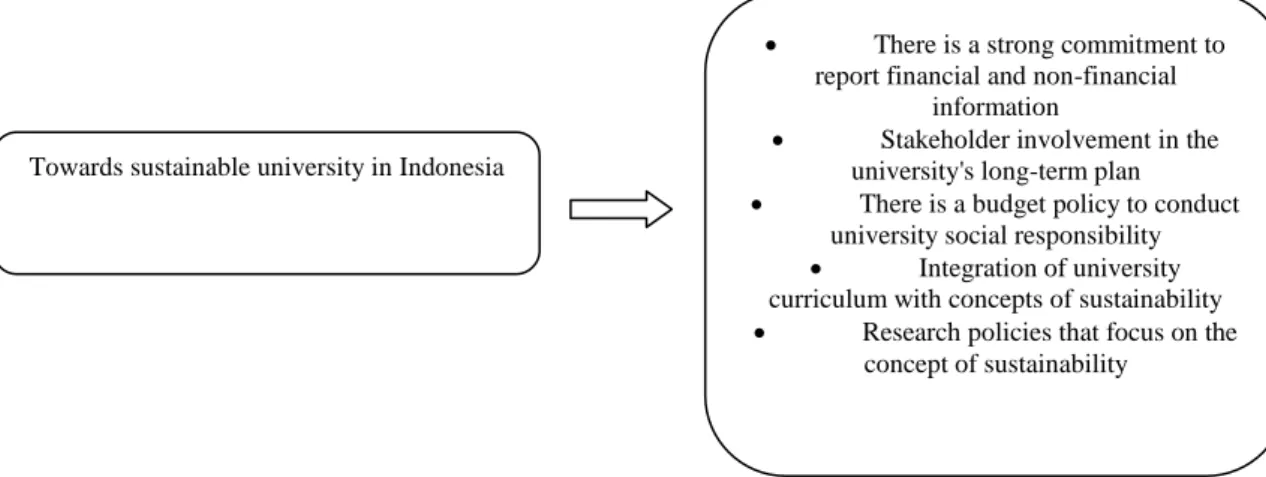
The aim of this study is to argue that the evolution of universities in Indonesia must include a move toward sustainability. A
sustainable university has implemented sustainability comprehensively. Some previous research has attempted to develop criteria for a sustainable university. Lozano [31] argues that a Preliminary stage
Assessment of the university's
ongoing performance
Identification of factors supporting
the implementation of the concept of sustainability
Carry out FGDs with university
stakeholders
Main stages
• Compilation of policies and
guidelines for implementing the concept of sustainability
• Gathering suggestions and input
regarding policies and guidelines to be implemented (exposure draft)
Final stages
Stage of policy implementation and
sustainability concept guidelines
The monitoring and evaluation
strong commitment from university management to disclose comprehensive information can help universities achieve a good level of sustainability. The existence of transparency and accountability between university management and university stakeholders is one of the characteristics of sustainable universities. Another feature is the involvement of university stakeholders in the preparation of long-term university plans and university programs. The existence of this engagement process indicates that university management is committed to accommodating the interests of all university stakeholders. Dragomir [32] states that stakeholders can provide useful advice and input in an organization’s long-term plans, especially those relating to sustainability. Another characteristic of a sustainable university is budgeting for community service activities and corporate social responsibility activities (or in this context, university social responsibility). The existence of a budget for social activities indicates that university management has a high concern for improving societal issues.
A sustainable university can also be achieved by integrating the concepts of sustainability into the university curriculum. Research from Botes et al. [33] examined whether the accounting curriculum in colleges in New Zealand sufficiently integrated sustainability-related concepts. This study found that the discussion of sustainability in the curriculum was not too large and that in the future it was necessary to improve curriculum development. University management
and teaching staff play a necessary role in integrating sustainability into the curriculum.”. Universities can also achieve sustainable university criteria by developing research policies that focus on topics about sustainability. By developing and supporting policies toward research that focuses on developing sustainability, the university will help promote sustainability in the academic community. This process will make research topics on sustainability more favored and produce discussions that will help the application and implementation of sustainability. Ávila et al. [11] have identified research topics that have been widely studied in recent years in reputable international journals. This research found that the topics of environmental management, ecology, and environmental science were the most researched topics of sustainability. A final requirement for a sustainable university is assessment and evaluation by university stakeholders. This assessment and evaluation is needed to determine whether the sustainability goals of the university have been achieved. Nejati and Nejati [34] provide a new understanding of evaluating a university’s sustainability from the perspective of students. They explained that there were four indicators that showed success in achieving a sustainable university: (1) the impact on the social community, (2) commitment and monitoring of the implementation of sustainability, (3) waste treatment and energy use, and (4) land use and planning.
Figure 2. Towards a sustainable university in Indonesia
J. University Sustainability Reporting Trends in Indonesia
This section discusses the development of sustainability reporting conducted by universities in Indonesia. Using the content analysis method, this research analyzes the University of Indonesia's sustainability report released in 2018. In general, the information presented in the University of Indonesia's sustainability report in
2018 is in accordance with the principles of sustainability. The structure of the contents of the sustainability report consists of two main parts, namely the vision, mission, and objectives in the context of sustainability of the Universities of Indonesia and the aspects of sustainability that are of concern to the university.
The principles of sustainability manifested in the goals of the University of Indonesia are
Towards sustainable university in Indonesia
There is a strong commitment to
report financial and non-financial information
Stakeholder involvement in the
university's long-term plan
There is a budget policy to conduct
university social responsibility
Integration of university
curriculum with concepts of sustainability
Research policies that focus on the
appropriate in the context of sustainability, although they do not cover many aspects. The aim of the university is more emphasized on developing education for students and supporting the social community. At first, it can be seen that the University of Indonesia is more inclined to put a good social performance on the university's goals. In the sustainability aspects that are of concern to the university, the university establishes six main aspects, namely infrastructure, energy, waste, water use, transportation and education. In the infrastructure aspect, the university releases information that focuses on the location and use of the land. In this aspect the university has released information on land use for green open space and campus forests. The University owns 22% of the land for campus forests and this is information that reflects the university's commitment to the university's environmental performance. On information about energy aspects, the university focuses on three things, namely the use of renewable energy, energy savings, and smart and green building. The University has shown that the university is committed in reducing electricity usage and this reduction has reached 6.9% since 2017. To achieve this decline, the university has prepared efforts to use renewable energy sources such as solar panels, fuel cells, and wind power. The University has presented information about commitments to build green and smart building. A total of 25% of all buildings in the University of Indonesia have green and smart building concepts. In the context of waste treatment, the university has presented information on the processing of organic and inorganic waste, waste treatment methods, and policies for reducing the use of paper and plastic. The interesting thing is that all the results of the processing of organic waste have been turned into compost and the results are submitted to the university of Indonesia Trash Bank. From the information presented, it can be concluded that university management has a high commitment in environmental performance. In the context of the use of water resources, the university has presented information on water conservation programs, water treatment programs, and water saving programs. The information presented shows that 80% of faculties within the university already have policies for water conservation programs and programs for water treatment have been prepared for each unit within the university. In the context of the transportation sector, the university has implemented several policies to support the implementation of the concept of sustainability. The University has added locations
for parking vehicles to 7% of the university's total land area and the provided 15 units of bus to accommodate trips to and from the university. The university has added land for pedestrianism and a policy on zero emission vehicles has been implemented within the university. In the context of education and research, the university has fully supported the integration of the concept of sustainability in education and research programs at universities. The university revealed information that 59 student activity units had to do with the implementation of the concept of sustainability and the university had held 198 activities related to the concept of sustainability. In its publication performance, the university has published 300 researches related to the context of sustainability. The university management has a high commitment to include the concept of sustainability in the university curriculum where 22% of the courses offered have links to material on environment and sustainability and 27% of the total university research funding is given to research that discusses the concept of sustainability. If identification can be made, then the information presented in the University of Indonesia's sustainability report can be seen in Table 1.
Table 1.
Material Information in the sustainability report of the University of Indonesia (UI)
Disclosed sustainability aspects Material information Infrastructure aspects
- Information on the area of green open space
- Information about land area for campus forests
- Information about campus main setting - Information on the number of students
and staff at the university
Energy aspects - Information on the use of renewable
energy
- Information about energy saving efforts - Information about green and smart
building
Waste aspect - Information about processing organic
waste and inorganic waste - Information about treating hazardous
waste
- Information on paper and plastic reduction policies Water use
aspects
- Information about water conservation programs
- Information about water treatment policies and programs - Information on efforts to save water
Disclosed sustainability aspects Material information Transportation aspects
- Information about the area of parking lots at the university
- Information about shuttle buses for public transportation - Information about a pedestrian path
- Information on the zero emission vehicle policy
Educational aspects and research activities
- Information about student activity units and activities carried out in accordance
with the concept of sustainability - Information about the total courses
integrated with the concept of sustainability
- Information about the total research funding provided for research that discusses the concept of sustainability
The results of the content analysis from this research managed to identify some of the drawbacks in the University of Indonesia's sustainability report which can be used as a basis for improving future sustainability reports. Some of these drawbacks are:
1) The university's sustainability report has not been mentioned using standards or guidelines for preparing sustainability reports. Universities can use GRI standards or guidelines in the future so that the information presented in the sustainability report can be more comprehensive and in accordance with the interests of university stakeholders.
2) The university has not presented information on environmental costs in the university’s sustainability report. Environmental costs are costs incurred by the university to maintain the university’s environmental performance at an optimal stage. Research from Michael & Elser [35] has developed an accounting model for calculating waste management costs, and the university can use the results of this research as a basis for determining the environmental costs of the university.
3) The preparation of sustainability reports does not involve many roles from stakeholders or there is no stakeholder engagement process. This process is very important so that the university’s sustainability report accommodates the interests of university stakeholders. Ceulemans et al. [22] states that the process of preparing a university sustainability report in the future must involve a more comprehensive stakeholder engagement process.
4) The University of Indonesia’s sustainability report does not have a statement of conformity with the standards of the independent examiner. When looking at sustainability reports produced from public companies, the report has been
examined by an independent examiner in the context of compliance with applicable standards and guidelines. The results of the inspection by the independent examiner are very important to ensure that the information presented in the sustainability report is in accordance with reality and ensures the information presented is credible and can be accounted for. The audit process or examination of an organization’s sustainability report is very important to be done to guarantee the accuracy of the information presented [36]. Edgley et al. [37] states that the concept of information materiality can be brought into the audit concept of organizational sustainability reports and this is a development in the context of the examination of reports containing financial information and non-financial information.
5) In terms of report content, the university has not provided comprehensive information for each aspect. Each aspect is only explained briefly and does not reflect actual conditions within the university. This resulted in the stakeholders not getting comprehensive information about the university's sustainability performance. University of Indonesia is a university that has very high resources to implement the principle of sustainability and it is appropriate that the information presented in the university's sustainability report must be comprehensive and complete. Richardson & Kachler [26] states that universities that have sufficient resources to carry out the principle of sustainability are likely to disclose complete information in the university's sustainability report. This process will not only help stakeholders in the decision making process, but also to enhance the university's reputation in the academic network.
It must be recognized that Universitas Indonesia is a pioneer in the preparation of sustainability reports for public universities in Indonesia. Although the sustainability report produced is not a comprehensive one, nonetheless this is a good process to promote the preparation of sustainability reports for other universities in Indonesia. This process will also help to promote the application of the concept of sustainability to universities in Indonesia. In the future, if more universities in Indonesia release university sustainability reports, it can be ensured that the university's commitment to the implementation of the concept of sustainability has increased. The impact is that universities in Indonesia will be more likely to attain sustainable universities, and in a broader context, will help to accelerate the formation of sustainable society.
K. Obstacles and Challenges Towards Attaining Sustainable University in Indonesia
Achieving the concept of sustainable university has to be the future goal in managing universities in Indonesia. By achieving a sustainable university, the presence of the university will have a greater impact on the social community. To achieve the concept of sustainable university, the current readiness of the university and what must be prepared in the future should carefully being taken into account. It must be realized and understood that there are obstacles and challenges to forming a sustainable university in Indonesia. This research has identified several obstacles and challenges towards sustainable universities in Indonesia.
1) Poor understanding of the benefits of implementing the concept of sustainability. So far, the concept of sustainability is only understood to be applicable to profit oriented organizations. The application of the concept of sustainability in universities is very important to help achieve higher education for sustainable development (HESD). Research by Disterheft et al. [18] explained that the main objective of applying the concept of sustainability in higher education institutions is to achieve higher education for sustainable development so that the benefits of higher education institutions operation can be felt by the wider community. Wals [38] argues that the concept of higher education for sustainable development will be achieved if the university integrates the concept of sustainability in the fields of education, research, university operations, and in community service activities.
2) The absence of commitment and support for the application of the concept of sustainability from the university leaders. The university management does not have the commitment and support to apply the concept of sustainability to university activities. Commitment and support in implementing the concept of sustainability has not been included in the vision and mission of the university or the programs derived from university policy. Lozano et al. [24] states that the commitment of university leaders to implement the concept of sustainability is a major factor, hence the adoption and implementation process will be successful. This commitment can be demonstrated through university policies and programs that support the application of the concept of sustainability.
3) Lack of standards and guidelines for implementing the concept of sustainability in higher education institutions. The higher education environment in Indonesia does not
have a generally accepted standards and guidelines for applying the concept of sustainability. Some universities already have their own guidelines that fit the characteristics of the university. In the future, the process of preparing standards and guidelines for implementing the concept of sustainability must be included in the long-term plan. Sustainability issues have now become a serious discussion and it is time for higher education institutions to take a role in this sustainability context. Sudana [39] states that by integrating the concept of sustainability into standards or guidelines, specifically accounting policies, a guideline that has sustainability values (such as sustainability accounting) can be attained.
4) Implementation of sustainability concept is not included in the university’s long-term plans. The university can help to promote the understanding of the concept of sustainability a necessity for future generations. Implementation of the concept of sustainability for the long term can be done by incorporating sustainability concept materials into the university curriculum. This integration process ensures that students will get a better understanding of the concept of sustainability and why the concept of sustainability must be implemented in the future. Ramos et al. [40] explained that curriculum development in universities that integrate the concept of sustainability can be an appropriate medium for teaching the concept of sustainability to future generations. Curriculum development with the integration of the concept of sustainability will facilitate the university’s efforts to form a sustainable society.
5) There is no policy that universities must compile and report financial and non-financial information through a university sustainability report. The university sustainability report is a comprehensive report that contains the economic, social and environmental performance of a university. Research by An et al. [20] found that universities are organizations that have high capability to make a sustainability report. The university management can use the university's sustainability report as a means to establish good communication with all university stakeholders. Research by Dienes et al. [41] explained that internal organizational is one of the supporting factors so that the organization reports its sustainability report, and this effort must also be supported by the stakeholders in a form of requests for information about the organization's sustainability. Brusca et al. [29] argue that sustainability reports can inform changes that occur within university organizations, and this
type of information is fundamental for university stakeholders in the context of decision-making.
V. C
ONCLUSIONThis research aims to develop a concept for the process of implementing the sustainability in higher education institutions in Indonesia. This concept can be used by a university’s management team as a basis or guideline for implementing the concept of sustainability. In general, the concept for implementing the concept of sustainability in higher education institutions includes three main steps, namely the preliminary stage, the core stage, and the final stage. Each of these stages consists of several interrelated processes. The main purpose of the implementation of the concept of implementation is to form a sustainable university.
Based on the results of this research, this research can provide advice to several parties: A. University Management
The university management must realize that the application of the concept of sustainability is very important for the improvement of internal processes in the university. The university management must understand that the concept of sustainability will be part of the university's long-term plan. Higher education institutions need to take a holistic role concerning sustainability issues. Many steps and programs can be taken by university management to achieve a sustainable university. By achieving a sustainable university the university will provide great benefits not only to stakeholders but also to the larger social community.
B. University Stakeholders
University stakeholders have a very important role in helping the university to apply the concept of sustainability. University stakeholders can provide advice and input related to the implementation process and help the university management to reduce obstacles and challenges in the implementation process. University stakeholders have the right to obtain information about the university's long-term plans and policies. Stakeholders must realize that a stakeholder engagement process or mechanism is a process that aims to supervise and monitor university management, and this process aims to ensure that university programs and policies are in line with the main objectives of the university. C. Policy Makers
This research has identified that one of the obstacles and challenges in the process of
implementing the concept of sustainability in universities is that there are no standards or guidelines for implementing the concept of sustainability in universities. The existence of these standards or guidelines is needed so that university management has comprehensive guidelines for the process of adopting and implementing the concept of sustainability. Furthermore, the Sustainability Accounting Standards Board (SASB), an organization focused on developing sustainable accounting, has developed guidelines and standards for the implementation of sustainable accounting in higher education institutions. In the future, the implementation of the concept of sustainability cannot only be applied within the higher education environment: Public sector organizations will be able to the concept of sustainability. When the concept of sustainability can be widely implemented, policies and standards as supporting infrastructures are necessary.
R
EFERENCES[1]
CALDWELL,
L.K.
(1998)
The
Concept
of
Sustainability:
A
Critical
Approach. In: LEMONS, J., WESTRA, L.,
and GOODLAND, R. (eds.) Ecological
Sustainability and Integrity: Concepts and
Approaches. Environmental Science and
Technology Library, Vol. 13. Dordrecht:
Springer, pp. 1-15.
[2]
SALAS-ZAPATA,
W.
A.
and
ORTIZ-MUÑOZ, S.M. (2019) Analysis of
meanings of the concept of sustainability.
Sustainable Development, 27 (1), pp.
153-161.
[3]
ISIL, O. and HERNKE, M.T. (2017)
The Triple Bottom Line: A Critical Review
from
a
Transdisciplinary
Perspective.
Business Strategy and the Environment, 26
(8), pp. 1235-1251.
[4]
FRAME, B. and NEWTON, B.
(2007) Promoting sustainability through
social marketing: Examples from New
Zealand. International Journal of Consumer
Studies, 31 (6), pp. 571-581.
[5]
ALSHUWAIKHAT, H.M., ADENLE,
Y.A., and SAGHIR, B. (2016) Sustainability
assessment of higher education institutions in
Saudi Arabia. Sustainability, 8 (8), 750.
[6]
LOZANO,
R.,
LUKMAN,
R.,
LAMBRECHTS, W. (2013) Declarations for
sustainability in higher education: becoming
better leaders, through addressing the
university system. Journal of Cleaner
Production, 48, pp. 10-19.
[7]
LARSSON, H. and GRÖNLUND, Å.
(2014) Future-oriented eGovernance: The
sustainability concept in eGov research, and
ways forward. Government Information
Quarterly, 31 (1), pp. 137-149.
[8]
BERCHIN, I.I., GRANDO, V. dos S.,
MARCON, G.A., CORSEUIL, L., and
GUERRA, J.B.S.O. de A. (2017) Strategies
to promote sustainability in higher education
institutions: A case study of a federal
institute of higher education in Brazil.
International Journal of Sustainability in
Higher Education, 18 (7), pp. 1018-1038.
[9]ČIEGIS, R. and GINEITIENĖ, D.
(2006) The Role of Universities in Promoting
Sustainability. Engineering Economics, 3
(48), pp. 56-62.
[10]
MATHIYAZHAGAN,
K.,
SENGUPTA, S., and MATHIVATHANAN,
D. (2019) Challenges for implementing green
concept in sustainable manufacturing: a
systematic review. OPSEARCH, 56, pp.
32-72.
[11]
ÁVILA, L.V., FACCO, A.L.R.,
BENTO, M.H. dos S., ARIGONY, M.M.,
OBREGON, S.L., and TREVISAN, M.
(2018) Sustainability and education for
sustainability: An analysis of publications
from the last decade. Environmental Quality
Management, 27 (3), pp. 107-118.
[12]
ADAMS, C.A. (2013) Sustainability
reporting and performance management in
universities.
Sustainability
Accounting,
Management and Policy Journal, 4 (3), pp.
384-392.
[13]
DAGILIŪTĖ, R., LIOBIKIENĖ, G.,
and MINELGAITĖ, A. (2018) Sustainability
at universities: Students’ perceptions from
Green and Non-Green universities. Journal
of Cleaner Production, 181, pp. 473-482.
[14]ZHAO, W. and ZOU, Y. (2015)
Green university initiatives in China: A case
of
Tsinghua
University.
International
Journal
of
Sustainability
in
Higher
Education, 16 (4), pp. 491-506.
[15]
SHUQIN,
C.,
MINYAN,
L.,
HONGWEI, T., XIAOYU, L., and JIAN, G.
(2019) Assessing sustainability on Chinese
university campuses: Development of a
campus sustainability evaluation system and
its application with a case study. Journal of
Building Engineering, 24, 100747.
[16]
HASAN, R. and YUN, T.M. (2017)
Theoretical Linkage between Corporate
Social
Responsibility
and
Corporate
Reputation.
Indonesian
Journal
of
Sustainability Accounting and Management,
1 (2), pp. 80-89.
[17]
DMOCHOWSKI, J.E., GAROFALO,
D., FISHER, S., GREENE, A., and
GAMBOGI,
D.
(2016)
Integrating
sustainability
across
the
university
curriculum.
International
Journal
of
Sustainability in Higher Education, 17 (5),
pp. 652-670.
[18]
DISTERHEFT, A., CAEIRO, S.,
AZEITEIRO, U.M., and FILHO, W.L.
(2015) Sustainable universities - a study of
critical success factors for participatory
approaches. Journal of Cleaner Production,
106, pp. 11-21.
[19]
BLACKBURN, W.R. (2016) The
Practice of Sustainability at Colleges and
Universities. Environmental Law Reporter, 5,
pp. 10394-10415.
[20]
AN, Y., DAVEY, H., HARUN, H.,
AN, Y., DAVEY, H., and HARUN, H.
(2017) Sustainability Reporting at a New
Zealand Public University: A Longitudinal
Analysis. Sustainability, 9 (9), 1529.
[21]
AWUZIE, B. and EMUZE, F. (2017)
Promoting
sustainable
development
implementation
in
higher
education:
Universities in South Africa. International
Journal
of
Sustainability
in
Higher
Education, 18 (7), pp. 1176-1190.
[22]
CEULEMANS, K., MOLDEREZ, I.,
and
VAN
LIEDEKERKE,
L.
(2015)
Sustainability reporting in higher education:
a comprehensive review of the recent
literature and paths for further research.
Journal of Cleaner Production, 106, pp.
127-143.
[23]