Intimacy
as
Aesthetics
Morphology and Modifications
by
Vincent Ruijters
美学としてのインティマシー
解体論と変形
ヴィンセント・ライタス
Tokyo University of the Arts 東京藝術大学大学院
Faculty of Fine Arts 博士後期課程
Department of Intermedia Art 美術研究科
Doctorate Program 先端芸術表現領域
TOKYO, 2020
Primary supervisor Kazuhiko Hachiya 主査 八谷和彦
Dissertation supervisor Toshiharu Ito 論文第一副査 伊藤俊治
Artwork supervisor Motohiko Odani 作品第一副査 小谷元彦
Secondary supervisor Yuko Hasegawa 副査 長谷川祐子
iii
©Copyright by Vincent Ruijters 2020
All Rights Reserved
Abstract
This study contains a model which describes the ways in which intimacy manifests itself within art. Its purpose is to further deepen our understanding of the ways in which intimacy manifests itself within art and extending its existing lexicon and typological framework. Through this model the particularities of intimacy experienced through art opposed to intimacy as it is experienced in daily life are specified. The latter is defined as a natural concept that consists of subordinate concepts: intimate behavior and intimate experience. The characteristics of intimate relationships include Affection, Trust and Cohesiveness. Other factors include Nonverbal Behaviour, Physical Setting and Mood. Self-disclosure, proximity and exclusivity are defined as variables of intimate interactions. When these elements are present inside an artwork, they become part of the artwork’s art schemata. This allows these elements of intimacy to be able to become subject to the communicational modes of fiction, metaphor, fantasy, simulation, play and falsification. How these communicational modes affect the elements of intimacy are particular to aesthetic intimacy. The particularities include Fictional Self-Disclosure, Vicarious Intimacy, Role Played Relationships, Surrogate Intimacy, Public Exclusivity Paradox and Dissonant Intimacy. Artworks concerning intimacy can be categorized to three types of intimate artworks: Records, Reflectors and Facilitators. The elements of intimacy and the particular elements of aesthetic intimacy are used as ‘building blocks’ in order to create an aesthetic experience through four artworks of the author. The artworks that are a product of the research are named Breathing IN/EX-terior, Dynamics of Mass Connectivity, Untitled (Swing) and Breathing Paper. Dynamics of Mass Connectivity comprises the most relevant element of intimate aesthetics: Intimate Dissonance. In this piece, Intimate Dissonance is not only a part of the aesthetics but also refers to the Intimate Dissonance that develops through the use of social media in contemporary society.
論⽂の要旨
背景 近現代における美術史のなかで「インティマシー(親密さ、関係性)」が作品のテーマの一 部となっていった。「アンティミスム」iというのは美術用語で室内、静物、日常風俗など 親しみ深い (アンティーム) 題材を描く画風である。印象派にもみられるが、特に 19 世紀末 から 20 世紀初めに,ナビ派、P.ボナール、É.ビュイヤールなどの制作傾向をさすために用 いられた。第二次世界大戦後にマルセル・デュシャンは芸術作品を「アーティスト」、「芸 術作品」、「鑑賞者」という3つの要素の交渉の形式である「芸術係数」という概念(Art Coefficient)だと考え始めたii。90年代には、キュレーターであり美術批評家のニコラ・ ブリオーが「関係性の美学」iiiという用語を作り出し、「芸術係数」はもはや物質に限定さ れないと訴え、芸術とは社会交換と同じ素材でできているとも述べた。彼の作り上げた新し いジャンルは現代美術の新しい傾向に対して応答するものであり、彼は、関係性を審美的次 元で考える美学理論を描き出した。このように鑑賞者や関係性が作品の重要な要素になった ことで、美術作品におけるインティマシー性の構造が複雑になっていったのだが、本稿では それを分析し、制作に反映させるための手法を探る。目的 本研究の研究課題は下記である。 1.芸術作品に通底するインティマシーはどのような現れ方があるか? 2.インティマシーは創作過程と作品体験にどのような役割があるか? 研究課題を検討する上で、本研究は下記の目的を持っている。 本論文ではブリオーが紹介した、ある特定の関係による美学的な現象を分析する 「関係性の美学」的アプローチを採用する。それはつまり、インティメイト(親 密)な関係の美学である。私はインティマシーの審美的現象を探求し、美術作品か ら得られるインティマシーの特異性を定義し、分類する。 その結果を使い、美術作品におけるインティマシーの現象学的なモデルを作り上げ ることを本稿では目的としている。また、この研究は理論的側面を構築していくだ けでなく、そうした理論の解釈を交えながら、詩的で五感に訴えかける芸術制作に 反映し、概念的文脈を作品制作に発展させていくことも二次的に意図している。
方法 美術作品におけるインティマシーを分析するために、まずは通常の人間関係におけ る一般的なインティマシーの発生を定義する必要がある。そのために、心理学と現 象学の文献を参照する。 その後、美術作品から得られるインティマシーと比較を し、美術作品が持つインティマシーの特異性、固有性を定義し、また分類する。そ の分類と定義による具体的な現代美術作品の分析から、芸術作品に通底するインテ ィマシーの現象学的なモデルを作り上げることを試みる。そのモデルをもとにし て、自身でインティマシーがテーマになっている新作を作り、「美術作品から得られ るインティマシー」の特異性を実証したい。 研究範囲 本研究はインティマシーを定義、または分類するために、心理学、現象学の文献を 使っている。しかし、本研究の主な研究範囲はあくまでも美学とする。美学の分野 の中で、本研究は1990年から2019年の間に作られたインスタレーション作 品、パフォーマンス・アート、参加型芸術を中心に考証をおこなう。 研究の意義 本研究の結果で作品から得られるインティマシーの類型学的なフレームワーク とレ キシコンができる。そのフレームワークとレキシコンは美学と批評の分野で作品か ら得られるインティマシー性についてディスカッション、分析、説明できるツール となることを目標とする。
本文
第―部
第1章 インティマシー性の定義
美術作品から得られるインティマシーをさぐる前に、まず人間同士におけるインティマシー を定義する。そのために、心理学と現象学の分野からの研究結果を援用する。
1992年北米アメリカにおける「The Phenomenology of Intimacy」(Register, L.M., Henley, T.B.)という現象学研究の実験において、インティマシーを感じる経験の根本的な 要素は何であるのかを探る研究がなされた。その研究ではボランティア 11 人に対し、次の 課題が出された。「本実験はインティマシー経験を研究する目的で行われる。インティマシ ーを感じた経験をできるかぎり細かく、はっきり説明してください」。研究者はボランティ アが書いた結果を分析し、有意義なステートメントを抽出した。その後、そのステートメン トを分析し、主題を削減することでインティマシー経験の構造体を作った。 研究結果により、インティマシー経験の根本的な要素は①非言語的コミュニケーション (Non verbal communication)②プレゼンス (Presence)③時間 (Time)④境界 (Boundary)⑤身体 (Body)⑥運命と驚き (Destiny and Surprise)⑦変形 (Transformation)で構成されるとした。iv 「The Psychology of Intimacy」(Prager, K.J.,1995)においては、様々なインティマシーに 関する心理学的な研究がまとめられている。この本の目的は人間同士のインティマシーを心 理学的のアプローチで定義したり分類したりすることにある。この本の心理学の研究による と、インティマシーの主なパラメータは「自己開示」(self-disclosure)となっている。また、 愛情(affection)vvi、信頼(trust)vii、結束(cohesiveness)の程度によって、人間同士の関係性によ るインティマシーが強くなるとされる。また、インティマシーという現象は3つのタイプに 分類されると結論づけられている。その3つとはインティメイト体験(intimate experience)、インティメイト行動(intimate behavior)、インティメイト関係性(intimate relationship)viiiである。ix 上記のように人間同士における通常のインティマシーの基礎研究は現象学と心理学の分野で なされているが、その研究結果と美術作品におけるインティマシーの現れ方の違いを分析す ることにより、美術固有のインティマシー性が明らかになると考える。
第2章 作品から得られるインティマシーの特異性 人間関係におけるインティマシーと美術作品から得られるインティマシーの差分を探る。第 1章で書いた人間同士におけるインティマシーと、美術作品から得られるインティマシーを 比較することで、作品から得られるインティマシーの特異性を定義することを試みる。ここ では現代美術作品を分析することによって、いくつかの特異性を確認した。美術作品に固有 な特異性は、筆者が類型として定義し命名した。 2−1:ベートソンによる遊び、精神分裂病、ダブルバインドについての理論 遊び(play)のコンテクストで、行動(そしてそれにともなうメッセージ)はその行動 が固有のひとつだけの意思表示ではない場合もある。例えば遊び(play)のメタメッセ ージでは例えば攻撃的なしぐさをしたとしても直接の攻撃意図ではなく、「こんな 風にして遊ぼう」である。つまり、遊び(play)の行動のメタメッセージは行動の固有 的なメッセージより高い抽象化のレベルに存在する。これは、脅し、メタファー、 ユーモア、儀礼、ファンタジー、詩、フィクション、シミュレーション、改ざんな ど同じプレイ(play)カテゴリーに属するコミュニケーションモードにも当てはまる。 ベートソン(1955)xによると、人間はあるメッセージをプレイ(play)カテゴリ ーとプレイ(play)ではないカテゴリーの区別をつけるため、心理的枠組という概念を 使用している。 心理的枠組はメタコミュニケーションのレベルに存在している。メッセージは明示 的または暗黙的に心理的枠組を定義して、相手に心理的枠組の中に含んでいるメッ セージが理解できるようサインを出す。心理的枠組の形は多くある。例えば非言語 的(例:皮肉な表情)、口調(例:抑揚)、視覚的(例:句読点)または物理的な もの(例:絵画のフレーム)などである。メッセージの心理的枠組を読み取る、ま たはメッセージの心理的枠組を定義するのは「フレーミング」という。xi ベートソンにより、統合失調症患者は自分の中の、あるいは自己と他者との間の コミュニケーションモードを区別する能力が弱い。つまり、統合失調症患者は自分 のメッセージ、または他者のメタメッセージをうまくフレーミングできず、そのま まストレートに解釈してしまう。しかしベートソンによれば、誰しも多かれ少なか
2−2:スキーマとフレーミング スキーマは認知心理学者が使用している特別な種類の心理学的な現象である。 Robert L. Solso(2003) はスキーマを次のように定義する。「スキーマは、知識を表 現するためのメンタルフレームワークの一部である。この用語は人間がある組織で 相互に関連する概念の配列をどのように表現するか、説明するために使われている。 スキーマは日常的な体験を構造化する、または理解するためのコンテクストを提供 する。スキーマはアート、科学、文学、音楽、歴史などの表現の方法にも当てはま る。」。 個々人の美術に関する知識と個人的な世界観は、我々がギャラリーや美術館を訪れ、 作品を見る時に発生する「アートスキーマ」に影響を与えられ、作品鑑賞体験にも 影響を与える。 個人のスキーマを通して作品の印象は変わるが、同時に一般のアートスキーマを通 して作品を一般化し、説明することも出来る。 この研究の目的のために、スキーマの使用と心理学的枠組の使用を結びつける。作 品を通したインティマシー体験は作品のアートスキーマの中にある複数のメッセー ジの結果である。その複数のメッセージ(あるいは要素)はインティマシー体験を 形成すると仮定する。 それらの要素は前述した心理学から引き出したインティマシーの特徴も含んでいる。 例えばインティメイトな行動、理解の認識、ポジティブな感情が作品のアートスキ ーマの中にある複数メッセージ(あるいは要素)の一部にもなる。 それらのインティマシーの要素が少なくとも 1 つなければ、美術作品を通してイン ティマシーを体験することは不可能であると仮定する。 その要素が美術作品のアートスキーマの一部であるという前提の上で、他の要素= フィクション、メタファー、ファンタジー、シミュレーション、遊び(play)、改ざん (falsification)などの要素はコミュニケーションモードの対象になることができる。通 常、日常的な人間関係におけるインティメイトを構成する関係には誠実さ、透明性
などの前提に基づいている。そのため、日常的な状況におけるインティメイト関係 の場合、上記のようなコミュニケーションモードは往々にしてインティメイト関係 に負の効果(negative effect)を与える。 上記の論理から、これらのコミュニケーションモードが美術作品においては、どの ようにインティマシーの要素に変形するかをインティマシーの美学として個別化す る。個別化したものを定義すると、「フィクショナル自己開示」、「追体験なイン ティマシー」、「ロールプレイド関係」、「不協和的なインティマシー」、「代理 的なインティマシー」、「公開的な排他性のパラドックス」である。それらのイン ティマシーの美学の特徴は次の通りである。 2−3:フィクショナル自己開示 人間関係における通常のインティメイト関係での自己開示は通常はリアルな自己開示であ る。しかし美術作品おいてはフィクショナルな自己開示である場合もある。 2−4:追体験なインティマシー 追体験なインティマシーとは、芸術作品によってアーティストやフィクショナルの存在と共 感しインティマシーが発生する体験である。 2−5:ロールプレイド関係 これらは、一種の演劇化した関係である。 芸術的な文脈の中では、そうでなければ不自然 な相互作用が起こるために、アーティストまたは参加者が関係性を演技する。 アーティス トと参加者がアートワークのフレーム設定に準拠するには、このような役割的な関係が必要 になることがある。 2−6:不協和的なインティマシー 不協和的なインティマシーでは、そのなかでのインティマシーの経験またはインティマシー のインタラクションは認知的不協和xiiと同じような心理的緊張を生み出す。不協和的なイン ティマシーは、鑑賞者が芸術作品を再解釈する、作品が提示または期待されるものの背後に あるより深い(より抽象的な)意味を見つけるための動機付けに誘導するための戦略として この手法をアーティストが使用する場合がある。この場合、鑑賞者は作品の 1 つまたは複 数の要素の再解釈は、知覚される不協和に起因する心理的緊張を解決しようと試みることか ら生まれる。仮説としては、不協和的なインティマシーから生じるこの心理的緊張状態は、
いると想像する。この場合、このメッセージはアートワークの知覚を通じて受信されるメッ セージである。 2−7:代理的なインティマシー 人間同士におけるインティマシーと違い、フィクションの存在、あるいは存在しないもので あってもインティマシーが発生する。そのようなインティマシーは「代理的なインティマシ ー」として定義した。 2−8:公開的な排他性のパラドックス 公開的な排他性のパラドックスとは、排他性のないインティマシーである。 観客がインテ ィメイトな関係を確立したり、観客との親密感を呼び起こしたりするアートを公に展示する のは、公開的なインティマシーである。通常の人間関係においてはインティマシーは排他的 な状況で強く働くが、美術においては公開である事が多い。
第二部
第1章 インティマシーの変数 この研究では、インティマシーとその基本変数の形態を考察する。 この形態学は、ペータ ー・スローターダイクのインティマシーの現象学的モデルxiiiから大いにインスピレーション を受けている。 インティマシーは 3 つの変数に分けることができる。また、 この変数は、 人間関係のインティマシー、および作品のインティマシーに適用される。 1−1:自己開示 この変数は、どのくらい自分自身を被験者に公開しているかを示す。 高い自己開示は高い インティマシーを意味し、低い開示は低いインティマシーを意味する。 1−2:距離感 インティマシーは、しばしば近さ[closeness]と同義である。 近さは、自分と対象との距 離を指す。 距離感[proximity]が低いことは、インティマシーの度合いが高いことを意味 する。 距離感が高いことは、インティマシーの度合いが低いことを意味する。1−3:排他性 排他性の変数は、他の 3 つの変数の値を対象に、どの程度排他的であるかを示す。 高い排 他性は高いインティマシーを意味し、低い排他性は低い親密性を意味する。 第2章 インティメイト・アートの役割 2−1:記録 私たちのインティメイトな社会的相互交流のバーチャルな記録(すなわちデジタル写真)と 身体的記録を作成することは、主観的記憶への依存から私たちを解放するだけでなく、ある 記録の場合には、他人がそれらの中にどのように含まれているか 、それらがどのように他 のものの中に含まれているかを示す。 写真による記録は私たちの共通記憶であり、私たち のインティマシーの証人である。 さらに、記録の外部性は、他のものが自分の中にどのよ うに内包されているかの配列、反映、理解を可能にする。 芸術作品としてのインティメイ トな記録は、過度の[ハイパー]主観的、自己尋問的、象徴的である。 2−2:ファシリテーター ファシリテーターは、複数の個人間のインティマシーを促進するツールや環境である。芸術 作品はインティメイトな審美的浸透の触媒として機能する。 また、芸術の素材が社会的交 流から成立している場合は、最もこのカテゴリーに当てはまるだろう。 芸術作品の物質性 とメディア性は、シンプルにインティマシーを促進する。 2−3:リフレクター リフレクターは、芸術作品の社会的背景の中で、スタンスを反映したり、インティマシーに 関する立場を採用したりする。 つまり、自尊心の鏡とそれが存在する場所と言えるだろ う。リフレクターは感情を超えてインティマシーを社会・文化的に明示する存在である。
第三部
3−1 第二部までの研究を理論的基盤とし、実際に著者が制作した作品について解説を試 みる。これらの作品は、2019 年 4 月 4 日から 5 月 12 日まで東京の駒込倉庫ギャ ラリーで開催された個展「Breathing IN / EX-terior」で展示された。このセクシ ョンでは、作品について解説し、本研究が芸術作品の創造的プロセスにどのように3−2:Breathing IN/EX-terior 作品解説 《Breathing IN/EX-terior》は、大きな布によるインスタレーション作品である。この布の構 造体は、展示空間に設置されている送風機によって、鑑賞者の動きとインタラクティブに作 用し、揺れ動く。布のテクスチャやマテリアリティ、風や照明のプログラミングによって、 本作は鑑賞者を包み込むような柔らかい体験、すなわち作家の追求する「インティマシー (親密性)」を生み出す。また、会場全体を構造化した本作品は、作家の呼吸音とも同期さ れている。こうした布、風、音、光のコンビネーションにより、鑑賞者は展示空間にありな がら、作家の体内に潜り込んでしまったかのような感覚に陥ることとなる。 研究結果から使ったモデル 本作はファシリテーターの役割でもあり、リフレクターの役割がある。距離感が主な変数で ある。作品のインティメイト特徴は身体、非言語的なコミュニケーション、追体験なインテ ィマシー、プレゼンス(presence)である。
3−3:Dynamics of Mass Connectivity
作品解説
《Dynamics of Mass Connectivity》は、3 面モニターのインタラクティブ・ インスタレーシ ョンである。1 つの支柱を中心として 3 面に別々のモニターがついて回転しており、国内外 在住の作家と親しい人物がビデオ通話している様子が映し 出されている。鑑賞者が作品に 近づくに従って、このモニターの回転速度は上昇し、モニターに映し出されている人の顔は 徐々に判別不可能になる。また、3 画面の多言語による声は重なり、ポリフォニーとなるこ とで、それぞれが何を話 しているのかを聞き取ることができなくなる。本作では、情報テ クノロジーに よって媒介されるコミュニケーションの過剰によって、親密な会話ですら逆 説的 にノイズ化し不在化していく様相が示されている。 研究結果から使ったモデル 本作はリフレクターの役割でもあり、記録の役割がある。主な変数は自己開示、排他性、距 離感である。特徴は不協和的なインティマシーであることである。作品との距離が短くなる と当初は画面から感じた信頼性が徐々に恐怖に変化する。この作品では、距離感は、アート オブジェクトと訪問者の間の相互作用における重要な変数である。ビデオ会話はモニタを挟 んだ両端の仲間の「近さ」を象徴している。鑑賞者が作品に近づくと、作品を通しての不協 和的なインティマシーの体感が強くなる。最初ビデオ会話はフレンドリーでインティメイト だが徐々に不気味で混雑的なカオスの形へと変貌していく。この一連の出来事は、ソーシャ ルメディアが私たちの生活に与える影響でたびたび発生する不協和的なインティマシーのメ タファーである。
3−4:Untitled(Swing) 作品解説 《Untitled (Swing) 》は、ブランコ型のインタラクティブ作品である。このブランコの座面 部分は、剃刀の刃で覆われている。天井部分には蛍光灯がついており、鑑賞者が作品の前を 通ると、この蛍光灯が点灯し、この剃刀の鋭利な刃を照らし出す。そして蛍光灯の点灯と同 時に、「モスキート」と呼ばれる高周波の不快音が空間に響く。モスキート音は主に若年層 にのみ聞こえる不快音であり、国内でも若者を公園などの公共空間から排除するために夜間 に使用されるケースがある。作家は東京での生活の中で実際にこのモスキートをしばしば体 験してきたことから、本来開かれた、誰でも使える空間であるはずの公共空間が逆説的に 「敵対性」を生み出していくことに着目し、こうした状況を「不協和的なインティマシー」 と定義した。刃に覆われた子供用のブランコ、明滅する蛍光灯、高周波音といった「冷た い」要素によって構成される本インスタレーションは、「公共」と「私」の敵対的な関係 を、しばしば「温かい」意味合いで肯定的に用いられる「インティマシー」という正反対の 観点を通して見つめることで、私達をとりまく包摂と排除の間を揺れ動く複雑な境界の再考 をうながす。 研究結果から使ったモデル 本作はリフレクターという役割がある。距離感は主な変数になる。特徴は不協和的なインテ ィマシーである。距離感が短くなると信頼が転じて恐怖に変わっていく。
3−5:Breathing Paper 作品解説 《Breathing Paper》は、作家が日本に拠点を移してからスケッチブックに書き溜めている メモ書き、スケッチ、テキスト、詩などのドローイングやコラージュ、日々の生活を写し取 ったスナップといった作家の「私」の集積といえるオブジェを、洗濯物用ハンガーに吊るし た作品である。この作品は風によりゆるやかに回転しつつ、中央に吊るされている電球の光 によって、作家の影を投影する。キッチュで脆弱な印象を与えながらも、吊るされたドロー イングには「私」と公共の関係を図式化しようとする理論的分析が含まれており、繰り返さ れる国内の日々の生活を客観的に観察しようとする作家のプラクティスが、ハンガーのぎこ ちない回転の中に内包されている。そして作品の構造上、回転の動力源となる「風」を受け ているのはまさにそうした脆いドローイング群であるため、風の身体感覚と日々の私生活の 「インティメイト」な循環運動が、システマチックでありながらどこか有機的な構造体とし て提示される。 研究結果から使ったモデル 本作は記録という役割がある。主な変数は自己開示と排他性である。主な特徴は時間性と体 験なインティマシーである。
結論
インティマシーの基本的な特徴は愛情(affection)、信頼(trust)、結束(cohesiveness)で ある。その他には非言語的行動(nonverbal behaviour)、物理的環境(physical setting)、 気分(mood)もインティメイトな関係に影響を与える基本構成要素となる。さらに、 自己開示、距離感と排他性はインティメイト体験に強い影響を与えるインティメイ ト相互交流の変数である。このインティマシーの基本的な特徴と要素は美術作品を 通してインティメイト体験を作るのに使用される。これらの要素が少なくとも 1 つ は作品中に存在しなければ、美術作品を通してインティメイト体験を作ることは不 可能である。 研究課題 1「芸術作品に通底するインティマシーはどのような現れ方があるか」で 設定した問いに対する結論は下記になる。 インティメイトを構成する基本構成要素(上記)が美術作品のアートスキーマの一 部であるという前提の上で、作品のインティメイト要素は、より高度でメタな、フ ィクション、メタファー、ファンタジー、シミュレーション、遊び(play)、改ざん (falsification)などのコミュニケーションモードの対象になることができる。一方で日 常的な状況におけるインティメイトを構成する状態では通常は誠実さ、透明性など の前提に基づいている。そのため、日常的な状況における真剣なインティメイト関 係の場合、それらのコミュニケーションモードはインティメイト関係に負の効果を 与える。そのため、上記の論理から、それらのコミュニケーションモードが美術作 品のアートスキーマに使いやすいが、日常的な状況における真剣なインティメイト 関係に合わない。つまり、それらのコミュニケーションモードは美術館を通してイ ンティマシーの特徴と言える。 上記の論理から、それらのコミュニケーションモードが美術作品においては、どの ようにインティマシーの要素に変形するかをインティマシーの美学として個別化し た。個別化したものを定義すると「フィクショナル自己開示」、「追体験なインテ
ィマシー」、「ロールプレイド関係」、「不協和的なインティマシー」、「代理的 なインティマシー」、「公開的な排他性のパラドックス」となる。 特に日常的なインティメイト相互交流とインティメイト関係はそのままでアートの コンテクストに移し替える(transpose)美術作品の場合は、それらのインティマシーの 美学の特徴が適用される。このような作品は主に鑑賞者およびアーティストが物理 的な空間で相互交流するパフォーマンスアートやリレーショナルアートで顕著であ る。 そのようなシチュエーションの場合、心理学的なインティマシーのルールが適用さ れるが、鑑賞者のアートスキーマが場の状況に影響を与える。そのため、インティ マシーの美学の特徴が「自然的」に発生することが可能になる(例:ロールプレイ ドインティマシー、フィクショナル自己開示等)。20世紀後半に美学のインティ マシーはパフォーマンスアートとリレーショナルアートの台頭の影響で、深い変化 が起こった。20世紀の前半までの表現美術とは対照的に、それらのアートフォー ムには一方向の表現だけではなくテーマをシミュレーションし、ベートソンの言う、 プレイ(play)カテゴリーのコミュニケーションモードとインタラクションが作品 の一部となったのがその理由だ。これにより、ロールプレイドインティマシー、代 理的インティマシーと「ファシリテーター」というインティメイトアート類型が現 れた。 インティマシーの要素と美術作品から得られるインティマシーの特異性を実際の作 品として構成するために、本研究を理論的基礎として、4つの作品を制作し、本研 究の物理的・感覚的な発現として2019年4月4日∼5月12日「ヴィンセン ト・ライタス個展:呼吸する内/外 [英:Breathing IN/EX-terior]」(駒込倉庫 Komagome SOKO、東京)で発表を行った。 本 研 究 の 結 果 と な っ た 4 つ の 作 品 の タ イ ト ル は 《 Breathing IN/EX-terior 》 、 《Dynamics of Mass Connectivity》、《Untitled (Swing)》、《Breathing Paper》である。 個人的に一番重要な美学的なインティマシーの要素は「不協和的なインティマシー」
マシー」を主なインティマシーの要素とするため、この意味では《Dynamics of Mass Connectivity 》 が 一 番 重 要 な 作 品 と 言 う こ と も で き る 。 《 Dynamics of Mass Connectivity》には不協和的なインティマシーが美学的な面だけではなく、現代に生 きる私達が不意に直面する、SNS の使用を通して現れる不協和的なインティマシー、 複雑なアイデンティティから発生する不協和的なインティマシーなども参照してい る 。 研究課題 2「インティマシーは創作過程と作品体験にどのような役割があるか?」 への結論は下記になる。 インティマシーは「アーティスト」、「芸術作品」、「鑑賞者」という3つの要素 のお互いの審美的浸透に影響を与える。インティマシーは、鑑賞者をオーソドック スな「鑑賞」から「感情的な参加」へと誘う方法である。インティマシーを適用す ることで、鑑賞者の内的プライベート空間や感情的な空間へ作品がアクセスするこ とが可能になる。この内的プライベート空間や感情的な空間の中にインティマシー のパラメーターが含まれている(愛情(affection)、信頼(trust)、結束(cohesiveness)な ど)。 逆にアーティストが鑑賞者を自分の内的プライベート空間や感情的な空間へアクセ スさせるためにインティマシーを使用する場合もある(例:Breathing IN/EX-terior)。 一方で「不協和的なインティマシー」は、鑑賞者を深い思考へと誘う方法である。 この思考はインティマシーの持つ性質と関係がある思考である。不協和的なインテ ィマシーは、鑑賞者が芸術作品を再解釈する、また提示されるものの背後にあるよ り深い(より抽象的な)意味を見つける動機付けをするための戦略としてアーティ ストによって使用される(例:Dynamics of Mass Connectivity)。インティマシーは このように知的な、あるいは感情的な参加を引き付ける磁石のように機能する。
参考文献など
i Intimism. (1998). In Encyclopædia Britannica. Retrieved from
https://www.britannica.com/art/Intimism
ii Duchamp, M., 1956. The Creative Act. Aspen 5+6.
iii Bourriaud, N., 1998. Relational Aesthetics. Les Presse Du Reel, Dijon.
iv M. Register, L., B.Henley, T., 1992. The Phenomenology of Intimacy. Journal of Social
and Personal Relationships 9, 467–481. https://doi.org/10.1177/0265407592094001
v Hendrick, C., & Hendrick, S. (1986). A theory of method of love. Journal of Personality and
Social Psychology, 50, 392–402.
vi Sternberg, R. J., & Grajek, S. (1984). The nature of love. Journal of Personality and Social
Psychology, 47, 312–329.
vii Helgeson, V. S., Shaver, P., & Dyer, M. (1987). Prototypes of intimacy and distance in
same-sex and opposite-sex relationships. Journal of Social and Personal Relationships, 4, 195–233.
viii Hinde, R. A. (1981). The bases of a science of interpersonal relationships. In S. Duck & R.
Gilmour (Eds.), Personal Relationships (pp. 1–22). London: Academic Press.
ix Prager, K.J., 1995. The Psychology of Intimacy, 1 edition. ed. The Guilford Press, New
York.
x Bateson, G. (1955). A theory of play and fantasy. Psychiatric Research Reports, 2, 39–51. xi Bateson, G. (1972). Steps to an Ecology of Mind: Collected Essays in Anthropology,
Psychiatry, Evolution, and Epistemology by Gregory Bateson. University of Chicago Press.
xii Solso, R. L. (2003). The psychology of art and the evolution of the conscious brain.
Preface
This dissertation Intimacy as Aesthetics: Morphology and Modifications serves to shape the development of four artworks as to make theoretical contribution to the field of aesthetics. It has been written to fulfil the graduation requirements of the doctorate program of the Department of Intermedia Art at Tokyo University of the Arts.
The theme of intimacy has been a red line through my art practice. This PhD study will be an effort to deepen my understanding of the ways in which intimacy manifests itself within contemporary art.
I would like to express my gratitude to my supervisors Kazuhiko Hachiya, Toshiharu Ito, Yuko Hasegawa and Motohiko Odani (Tokyo University of the Arts) for their support.
Furthermore, I would like to thank the people who have supported me in the realization of the artworks and exhibitions that are the physical outcome of this research: Seiha Kurosawa, Atsuhiro Miyake, Hideki Umezawa, Daisuke Omiya, Jinwoong Kim, René te Riele, Yoshihiro Kawasaki, Sophie Arni, Maarten Ruijters, Yishu Hang, Pio Bujak and Hiromasa Sugawara. Lastly, I want to convey my appreciation to Arts Council Tokyo and Embassy of The Netherlands in Japan for enabling me to realize the exhibition and artworks.
Vincent Ruijters
Table of Contents
ABSTRACT ... II
論⽂の要旨 ... III
PREFACE ... II
TABLE OF CONTENTS ... III
INTRODUCTION ... 1 RESEARCH DESIGN ... 6 SCOPE ... 11
SECTION 1: AESTHETICAL INTIMACY AND ITS PARTICULARITIES ... 12
1.1 DEFINITIONOFINTIMACY ... 12 1.1.1INTIMATE BEHAVIOR AND EXPERIENCE ... 13 1.1.2ELEMENTS IN INTIMATE RELATIONSHIPS ... 14 1.2 THEPARTICULARITIESOFINTIMACYEXPERIENCEDTHROUGHART ... 16 1.2.1BATESON’S THEORY ON PLAY,SCHIZOPHRENIA AND THE DOUBLE BIND ... 17 1.2.2SCHEMATA,FRAMING AND DISSONANCE OF AESTHETIC INTIMACY ... 24 1.2.3FICTIONAL SELF-DISCLOSURE ... 27 1.2.4VICARIOUS INTIMACY ... 27 1.2.5ROLE PLAYED RELATIONSHIPS ... 28 1.2.6DISSONANT INTIMACY ... 32 1.2.7SURROGATE INTIMACY ... 34 1.2.8PUBLIC EXCLUSIVITY PARADOX ... 35
SECTION 2: INTIMACY IN CONTEMPORARY ART ... 36
2.1 VARIABLESOFINTIMACY ... 36 2.1.1SELF-DISCLOSURE ... 42 2.1.2PROXIMITY ... 44 2.1.3EXCLUSIVITY ... 52 2.2 TYPESOFINTIMATEART ... 59 2.2.1RECORDS ... 59 2.2.2FACILITATORS ... 62 2.2.3REFLECTORS ... 66
SECTION 3: RESEARCH BASED ART PRACTICE ... 71
3.1 MOTIVATION ... 71 3.2 BREATHING IN/EX-TERIOR ... 72 3.3 DYNAMICS OF MASS CONNECTIVITY ... 75 3.4 UNTITLED (SWING) ... 80 3.5 BREATHING PAPER ... 84 CONCLUSION ... 88 DISCUSSION AND FUTURE PROSPECTS ... 94 L F ... 96
Introduction
Through my ongoing practice in the field of media art, the works around me as well as my own works made me feel increasingly disconnected from the emotional and personal side of what art meant to me when I was still making expressionist drawings. This motivated me to rediscover this lost sense of intimacy and search for a new way to bring it back into my art. It was necessary for me to look beyond media art, the field that I was familiar with, and expand into the field of contemporary art. In order to crystalize my findings into something more than inspiration, something that is a structured and sharable form of knowledge, I decided to devote this PhD study to it. This PhD study will be an effort to deepen my—and hopefully also other people’s—understanding of the way’s intimacy manifests itself within contemporary art.
The theme of intimacy has a long history in art. For example, the Ancient Greeks, Hindus and Christians have produced artworks that visually expressed the theme of intimacy in the form of painting or sculpture. Often this was done in the form of an image depicting direct intimacy occurring between lovers or between mother and child.
Out of the vast array of expressions of intimacy within art which occurred before the dawn of modern art, there is one particular movement I would like to point out. In the late 19th and
early 20th century there was an artistic movement called ‘intimism’: a painting movement
diverged from impressionism. This movement showed an indirect and subtle approach to the depiction of intimacy. It involved the depiction of the domestic interior as the subject matter. It was most notably practiced by the French painters Édouard Vuillard and Pierre Bonnard. To convey the warmth, comfort and quiet isolation of interior scenes, Bonnard and Vuillard used the Impressionists broken-color technique of capturing the light and atmosphere of the ephemeral moment. But what made them differ from made them divergent from the impressionists is that, instead of deriving their colors from precise observation of the visual world, these painters exaggerated and distorted natural color to express mood (“Encyclopædia Britannica,” 1998).
The intimists allowed the viewer personal and close-up views into the bedrooms of their homes. In terms of privacy, such an exclusive point of view would be allowed exclusively for family members or lovers of those strangers. The view is disclosed to the viewer who is signified as an intimate of those depicted in the painting. An example of such an intimist painting is Femme Fouillant Dans un Placard1 by F. Valloton (See: Figure 2). This can be deducted by the way
those portrayed are ignoring the point of view and go about their daily business. But the fact is̶that in this voyeuristic situation̶the viewer is an imposter and the exclusivity a farce, for the painting is on display to the public.
Figure 1. Intimacy of mundane household interiors and everyday activities. From Femme Fouillant Dans un Placard, by F. Valloton, 1901, retrieved from https:commons.wikimedia.org/. In the public domain.
The indirect, hidden and psychological way of addressing intimacy through the depiction of domestic interior is a style that can also be found in the way intimacy is addressed to in contemporary art.
As art went through radical changes since the 20th century, so did the way in which intimacy manifested itself within art. One thing that had a significant impact was that artists started including the observer as part of the artwork.
In 1921 a series of Dada manifestations involved the city’s public. These events had political themes and sought for the audience to engage in discussion.
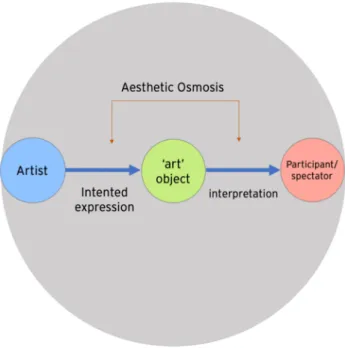
Duchamp started seeing the artwork beyond a mere presence in space. In 1949 Duchamp participated at the so called The Western Round Table on Modern Art. At this conference the participants included prominent thinkers and creatives such as Duchamp but also the anthropologist and sociologist Gregory Bateson, who is also a key figure in the theoretical framework of this study. At this conference Duchamp shared his ideas on treating the spectator as an active component in an artwork and incorporating the notion of transference into the phenomenology of the creative act and art observation (MacAgy et al., 1949). These ideas he developed and published in 1956 in his famous essay The Creative Act. In this essay he stated that he saw the artwork as something open to dialogue and discussion; a form of inter-human negotiation containing three factors: the artist, the artwork and the spectator (see: Figure 2). Duchamp considered the creative act as a phenomenon that is comparable to the transference from the artist to the spectator in a form of an esthetic osmosis taking place through the inert matter (Duchamp, 1956). In other words, the artist puts his expression into the art object and through the art object this expression arrives at the spectator. Duchamp called the area where these three factors—artist, spectator and inert matter—overlap the ‘art coefficient’ through which ‘aesthetic osmosis’ takes place. The ‘overlap’ is dependent on how much interpretation of the spectator overlaps the original intent and expression behind the artwork. What is significant about Duchamp’s way of looking at art is that he considers the spectator as an active component in the creative act. This is different from the traditional way of thinking of his predecessors, who viewed the artist and the artwork as the only active components and the spectator as a passive component; a mere guest who observes the artwork.
Figure 2 : Art Coefficient Diagram
Around this period in various places around the world art started emerging which sought the active engagement of the spectator. The spectator turned into the participant. In 1957 The French writer, theorist and filmmaker Guy Debord formed the Situationist International with other artists. They produced ‘constructed situations’, that were participatory events using experimental behavior in which the audience was an active participant. Around the same time in the United States ‘Happenings’ started emerging, that were events in which the audience would play an active role and therefore became participants. These Happenings where events that were held at a specific time and place only once. The organizers were the artists who provided the participants with instructions, sort of ‘scripts’, containing the rules on how to participate and behave during the Happening. In the nineties with the emergence of Relational Art, not only did the audience become participant, but the scope of the substance of art expanded to include people and their relations. To the curator and art critic Nicolas Bourriaud¾who coined the term Relational Art¾the fabric of the art coefficient was no longer limited to matter. Bourriaud (1998) stated that art is made of the same material as the social exchanges. His new coined genre in art was a reaction to a tendency within contemporary art and drew an aesthetical theory from it that recognizes the aesthetical dimension of relationships (Bourriaud, 1998).The relational context of the ‘art coefficient’ had expanded. From aesthetic osmosis taking place only between the artist and the spectator through the inert
spectators, or directly between the artist and the spectator without a material artwork necessarily playing a role in the process. Relations and social interaction where included into the aesthetic phenomena of art. These works include events such as the artist inviting participants to dinner at his house and cooking for them; considering the conversations and social exchange to be the center of the artwork. In addition to this, the development of computer-based interactivity in the nineties made it possible to let the art object actively respond to the participant’s interactions. Thereby it was made possible to include behavior and interaction of the participant into the narrative that forms the meaning of the artwork without needing multiple participants. Participant-participant interaction can also be participant-art object interaction
These developments had an impact on the way intimacy manifested itself within art. In the time of the Intimists and the time before that, Intimacy was something that was represented and expressed through the creation of art objects such as paintings and sculptures. Or through theater, in which case intimacy is still something that is felt through observation. Since the advent of participatory and interactive art, the intimate relations, intimate experiences and intimate interactions of our social life can be simulated inside the context of an artwork. Now not only formal (visual) aesthetic qualities of an artwork govern how we experience the intimacy of an artwork, but also the psychological and social aspects of how we actively engage with the artwork and its participants are form the building blocks that make up the intimate experience of an artwork.
The primary aim of this study is to find the aesthetic morphology of intimacy in art. That includes the impact and changes that participatory, contemporary and interactive art have made on the way intimacy manifests itself in art. The term “morphology” was initially applied in biology i.e. to, living forms. Paintings, poems, symphonies have different forms; the systematic analysis, comparison and classification of such forms are tasks for aesthetic morphology. Aesthetic morphology describes and compares components used in the arts. These components can range from psychological components to material and visual components (Rieser, 1974). By stating that this study aims to find the aesthetic morphology of intimacy in art, its goal is to find the components that produce intimacy in contemporary art. This will result in a model that can deepen our understanding of the ways in which intimacy
manifests itself within art and extending its existing lexicon and typological framework. Through this model I also aim to specify the particularities of intimacy experienced through art opposed to the basic concept of intimacy as it is experienced in daily life through interpersonal relationships. This study aims to produce an aesthetic morphology of intimacy in art that can be used by art critics, aesthetic theorists, artists and curators to analyze, classify and recognize intimacy and its components and various forms as it occurs in art.
The secondary aim of this study is to develop a conceptual framework for the creation of artworks that aim to produce intimate experiences, intimate interactions or intimate relationships. This is aimed towards art practitioners seeking for a theoretical basis or inspiration that can help them in the process of creating intimacy related art. Or otherwise in the phase of post-production, as a way to articulate and give a theoretical structure and background to their intimacy related artwork. These ‘art practitioners’ include myself. I will use this study to create a series of artworks. These artworks will become the physical synthesis and assessment of the theory. However, these artworks will not be intended as a direct translation of the theory but rather as a poetic interpretation of it.
Research Design
In order to fulfill the aim of this dissertation I have formulated the following research questions:
1. In which ways does intimacy manifest itself within artworks?
2. what kind of roles and functions does intimacy have in the experience of artworks?
The dissertation has three sections, which are divided in chapters.
In order to find the ways in which intimacy manifests itself within artworks, it is first necessary to take a step back and start with defining the basic concept—as it occurs as a social and psychological phenomenon between two individuals in daily life situations. In Chapter 1.1 DEFINITION OF INTIMACY this is achieved by collecting and summarizing research results
classifications that make up and influence the basic concept of intimacy are summed up and function as a ground that allows us to distinguish its difference from intimacy in an aesthetical context. In this chapter, the major source I will be referring to is the book The Psychology of Intimacy by Karen Prager. This chapter can be seen as a summary of this book, written in such a way that it can be easily transferred into an aesthetical context.
In Chapter 1.2 THE PARTICULARITIES OF INTIMACY EXPERIENCED THROUGH ART psychological essays by Gregory Bateson and excerpts from The Psychology of Art and the Evolution of the Conscious Brain by Robert Solso are analysed. The theories that are analysed regard those on ‘play’, the double bind, psychological frames and art schemata. They describe how communicational modes of fiction, metaphor, fantasy, simulation, play and falsification occur in communication and behaviour. These communicational modes are accepted and engrained within art production and appreciation. They also influence and modify the elements and characteristics of intimate experience, behaviour and relations defined in the previous chapter.
Through the synthesis of these theories, a conceptual framework is produced. Using this conceptual framework, a number of intimate phenomena particular to art are theorised based on how the previously mentioned communicational modes—which occur in art—modify and fictionalize ‘everyday’ intimate phenomena.
From this point the study shifts its focus from the field of psychology, which was for the sole purpose of creating an adequate conceptual framework, to the field of aesthetics. The intimate phenomena particular to art are defined and described throughout Chapter 1.2.3 to Chapter 1.2.8. The phenomena are named as follows: Fictional Self-Disclosure, Vicarious Intimacy, Role-Played Relationships, Dissonant Intimacy, Surrogate Intimacy and Public Intimacy Paradox. In Chapter 1.2.5 Role Played Relationships, the game theory by Roger Caillois from his book Man, Play and Games is added to the argument stating the fictional nature of intimate interactions, experiences and relationships occurring within art. Caillois’ theory is mostly coherent with Bateson’s and Solso’s theory and applicable to certain types of art.
To show how these phenomena have appeared in art, a contextual and formal analysis is executed. Artworks in which these phenomena appear are reviewed and analysed. The artworks that are chosen are made between 1990 and 2020. These works are mostly classified as— although not limited to—performance art, participatory art and installation art. To provide a foundation for the analyses the following types of data are collected: artist interviews, exhibition catalogues, artist statements, art criticism literature, exhibition reviews and statements by curators who have curated the artworks exhibition. Also throughout the following SECTION 2: INTIMACY IN CONTEMPORARY ART, this method is continuously used to keep the theory grounded within the scope of art and its historical setting that this study concerns. Its function is also to keep the theory from remaining a mere abstraction by providing concrete examples to illustrate how the theory manifests itself in art.
Chapter 2.1: VARIABLES OF INTIMACY continues to focus on research question 1 ‘In which ways does intimacy manifest itself within artworks?’. Three basic variables that influence or steer the intimate experience of an artwork are defined: self-disclosure, proximity and exclusivity. This selection is based on their usability in the creating an artwork that intends to trigger intimate experiences or facilitate the formation or enhancement of intimate relationships. The chapter consists of three sub-chapters that each describe one variable. Throughout the sub-chapters the contextual and formal analysis method previously described is used to show how each variable manifests itself within art.
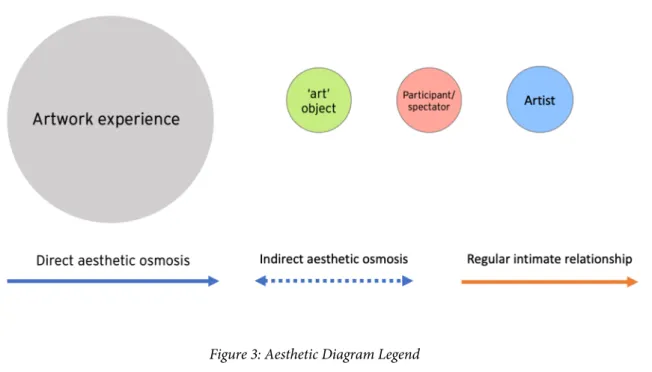
Accompanying the analyses’, a diagram is developed and used which is coined the ‘aesthetic diagram’. The function of this diagram is to further organize, understand and explain the manifestation of these variables within art. Furthermore, the diagrams are meant to make it easier to identify reoccurring patterns and clarify structures of the way in which intimacy manifests itself within art.
Chapter 2.2: TYPES OF INTIMATE ART aims to define three types of intimate art: Records, Facilitators and Reflectors. It identifies three basic structures that can fulfill the role or function of an artwork concerning intimacy. The types and their short description are as follows: 1) Records: intimacy is recorded; 2) Facilitator: Intimacy facilitates, or intimacy is facilitated; 3) Intimacy is reflected upon, or intimacy reflects.
In the final 0 RESEARCH BASED ART PRACTICE, the elements of intimacy, particular elements of aesthetic intimacy and variables of intimacy are used as ‘building blocks’ in order to create four artworks that aim to deliver an intimate aesthetic experience. For the purpose of this study, the works have two main functions: to function as a physical manifestation of the theory and to physically synthesize the elements of the theory into singular works. It also functions as assessment of the theory through practice.
The artworks that are a product of the research are named Breathing IN/EX-terior, Dynamics of Mass Connectivity, Untitled (Swing) and Breathing Paper. Each artwork is described in a separate subchapter that contains a formal description of the artwork and an explanation of its concept. This follows an analyses of the artwork describing how the theory produced in SECTION 1: and SECTION 2: is reflected in the artwork and its creative process. It also explains how certain artworks, that were used for analysis in the first two sections of the dissertation, inspired the work. Each artwork chapter also includes photo registrations of the artwork, situated in the space it was exhibited. In addition to the artworks functioning as an extension and assessment of the theory of this study, SECTION 3: also functions as an extensive means of documentation of the artworks.
I’d like to emphasize that the last section is deliberately named ‘Research-based art practice’, not ‘Practice-based art research’. There are PhD dissertations from Art University PhD candidates who choose to place their art practice at the center of their study and having the practice itself providing the base for their theory production. For technical PhD dissertations, for example studies that concern the technical development and innovation of a certain crafting technique, this might be a productive and fruitful approach (Malins & Gray, 1995, p.5). However, this is a different case for PhD dissertations combining the production of their artwork with research, in which the research functions as the conceptual base and framework of their resulting artwork. Involving the art practice and its results from the start of the dissertation might lead to a dissertation in which, as it progresses, the theory production becomes so entangled with the uniqueness and particularity of that researcher/artist’s artwork, that it prevents the reader of the dissertation from being able to extract a clear and usable body of knowledge from it. This style of writing might be natural for an artist because the creative process and the theory development are written in a chronological order. Nonetheless, I believe
the purpose of a dissertation is to develop a body of knowledge that is transferable and clear. Continuously entangling art practice and theory throughout the progression of the dissertation does not promote clarity and transferability. Furthermore, I do not think that visual or physical art itself can be the base theory and argument of a dissertation. However, I think it can follow and extend it. When one believes visual or physical art itself can be the base theory and argument of a dissertation than the true meaning and purpose of writing a dissertation in the first place has to be re-examined. The purpose of writing itself has to be reexamined when one believes it can be replaced by art.
From the definition of practice-based research the problematics can be deduced.
“Practice-based Research is an original investigation undertaken in order to gain new
knowledge partly by means of practice and the outcomes of that practice. Claims of originality and contribution to knowledge may be demonstrated through creative outcomes which may include artefacts such as images, music, designs, models, digital media or other outcomes such as performances and exhibitions. Whilst the significance and context of the claims are described in words, a full understanding can only be obtained with direct reference to those outcomes.”
(Candy, 2006, p.3)
What this basically says is that the theory produced can only be understood when the work of art is accessible. The dissertation is not autonomous, and the knowledge produced fractioned. This approach calls for a new and all-inclusive structure and paradigm, instead of forcing to extend the existing structure and paradigm of the PhD dissertation.
Therefore, for the sake of producing a clear and transferable body of knowledge which can exist to some extent autonomously from the artworks that it produced, I have devoted the first two sections of my dissertation only to the theoretical framework and theory production. I have chosen to take exemplary artworks that are known by art historians, artist and curators to illustrate how the theory manifests itself within art and to strengthen my theory by showing that it applies beyond my individual practice. The first two sections of this dissertation will
most likely be of most theoretical value to researchers and professionals in the field of the arts and aesthetics who have no particular interest in my own works of art.
Scope
In order to specify the particular aspects of intimacy experienced through art, it is at first necessary to define the basic concept of intimacy as it is experienced in daily life through interpersonal relationships. In order to do so I will draw from research results within the field of psychology and sociology.
However, this study is not targeted towards the field of psychology nor does it aim to develop a psychological theory. It mainly concerns two fields: aesthetics and art practice. Its relation to aesthetics is established by the theory concerning to analyze certain aspects of the aesthetic experience: namely how intimacy manifests itself in the aesthetic experience. It is also targeted towards practicing artists, to provide them clues on how they can design and conceptualize artworks that concern intimacy. Additionally, the theory produced in this study can be used by practicing artists as well as critics and curators as a lexicon and typological framework through which the manifestation of intimacy within art can be discussed, reviewed, analysed and described.
The discussion and analysis in the main body of this study focusses primarily on art made between 1990 and 2020(the current date of writing). These artworks are mostly classified as— although not limited to—performance art, participatory art and installation art. Thus, the theory produced in this study is mainly applicable to describe artworks within this scope and perhaps less applicable outside these art genres and their historical timeframe. This is also the case for the usability of the theory for art practice. The theory is mainly targeted towards the production of artworks of the described scope and is most likely less practically useful outside this scope.
The artworks that are used as examples to show how intimacy manifests itself within art are also thoroughly discussed and analyzed in Bourriaud’s Relational Aesthetics. This is also the case for a number of books and essay’s by British art historian and art critic Claire Bishop.
These books include Participation: Documents of contemporary art (2006), Artificial Hells: Participatory Art and the Politics of Spectatorship (2012) and the essay Antagonism and Relational Aesthetics (2004). These writings are also part of a wider discussion that criticizes its contents, for example the open letters Contingent Factors: A Response to Claire Bishop’s “Antagonism and Relational Aesthetics” by artists Liam Gillick in Letters and Responses (2006).
With this study, I do not intend to contribute, react or participate to these theories or the discussion involved. In Relational Aesthetics, Bourriaud investigated the relational aspect of participatory art and contemporary works in a broad sense. British art historian and art critic Claire Bishop thoroughly elaborated the socio-political and historical aspects of participatory art in the works mentioned before. This study does not share this focus, instead it focuses only on the way intimacy manifests itself in contemporary art (including relational art) and participatory art.
SECTION 1:
AESTHETICAL INTIMACY
AND ITS PARTICULARITIES
1.1 DEFINITION OF INTIMACY
Before getting deeper into intimacy as it occurs in the experience of art, I will first define the basic concept of intimacy. With this, I mean intimacy that occurs between two individuals in daily life situations. This is necessary because the basic concept will function as a ground that allows us to distinguish its difference from intimacy in an aesthetical context. Through such comparison it is possible to define the particularities of intimacy through art.
The basic concept of intimacy I will mainly draw from psychological theory. In this chapter, the major source I will be referring to, is the book The Psychology of Intimacy by Karen Prager. This chapter can be seen as a summary of this book, written in such a way that it can be easily
Prager (1995) argues there is no single definition of intimacy that can be found in theoretical, research or clinical literature. Therefore, a definition that can meaningfully encompass existing definitions ̶ while illuminating the linkages between existing theoretical perspectives ̶ is more suitable. Intimacy overlaps with concepts such as love, closeness, self-disclosure, support, bonding, attachment and sexuality. A good definition should enable to distinguish it from, for example, love, while recognising the overlapping nature of the concept of intimacy (Prager, 1995, pp.13).
According to Helgeson et al. (1987) intimacy is a natural concept, which means its boundaries that separate category members from non-members are fuzzy. (Helgeson, Shaver, & Dyer, 1987). Natural concepts are structured in such a way that some examples of the concept are more central (e.g., a central example of intimacy is a mutually supportive heart-to-heart talk between to adolescent girls) while others are more peripheral (e.g., two preschool girls having fun playing together in the sandbox). What characterizes peripheral members is the disagreement that comes up regarding their membership in the category. Because this uncertainty regarding membership is inherent, intimacy and other natural categories have been called fuzzy concepts (Prager, 1995, pp.14). Peripheral examples can be qualified for membership in two related categories equally. Each category can blend into adjacent ones. Take for example the category of love, which could blend into categories of liking, lust, friendship, affection or passion (Buss, 1988, pp. 100-118)
1.1.1 Intimate Behavior and Experience
Prager (1995) calls to approach intimacy as a superordinate concept in which its essential features are defined instead of the boundaries around it, thus working around the problematics of the fuzzy boundaries of its category members. She suggests that the superordinate concept of intimacy is divided into two basic concepts: intimate interactions and intimate relationships. Hinde’s (1981) distinction of these concepts is as follows: intimate interactions are dialogues between people and do not require the presence of a relationship to occur (Hinde, 1981). However, intimate relationships require a series of interactions between two individuals known to each other. In the case of a relationship interaction is affected by past interactions and is likely to influence future ones. Intimate interaction on the other hand is defined as a set of dyadic behaviour between people that exists within a clearly designated space-and-time framework. Once this set of dyadic behaviour has ended, so has the interaction. Intimate
relationships exist in a broader and more abstract space-and-time framework of which the beginning and ending is more difficult to pin down. The subordinate levels of intimate relationships are for example: romantic partners, friends, parents and children. Intimate interaction is broken down into two subordinate levels: intimate experience and intimate behaviour. Intimate experiences are understood as feelings and perceptions that people have because of their intimate interactions. These include perceptions of understanding and positive feelings such as warmth and attraction. Negative feelings are not included for they are considered not to cause intimate experiences. Intimate behaviour can be verbal (e.g., self-disclosure) or nonverbal (e.g., affectionate touch). It is understood as ‘sharing what is personal’ which̶in the case of verbal intimate sharing̶means revealing the verbal disclosure of personal facts, private material and verbal expression of emotion that reveals information about oneself. Sympathetic responsiveness is also an important verbal intimate behaviour. In case of nonverbal expression, it can include a shared meaningful glance, shared silence, an affectionate touch, shared emotional expression (i.e. crying or laughter) and shared sexuality.
1.1.2 Elements in Intimate Relationships
According to Prager (1995), intimate relationships are defined by the presence of relational intimacy. Relational intimacy refers to the presence of ongoing, frequent intimate interactions between the relationship partners. Relational intimacy in time, develops into an intimate relationship. The characteristics of relationships that are necessary for sustaining relational intimacy are treated as defining features of intimate relationships. These characteristics can be seen as by-products of intimate interaction that contribute to sustaining relational intimacy.
Intimacy and Affection
Intimacy and affection are associated in personal relationships. This has been addressed through empirical research and in literature. (Hendrick & Hendrick, 1986; Sternberg & Grajek, 1984). Because intimate interactions involve people having positive feelings for each other, intimate relationships that evolve from intimate interactions should include some affection between partners. In some intimate relationships the partners feel affection for each other but do not engage in intimate interactions (i.e. long-distance relationships). On the other hand, there is no such thing as an intimate relationship in which there is no affection between