Muroran Institute of Technology
Muroran-IT Academic Resources Archive
See also Muroran-IT Academic Resources Archive Copyright Policy
Title
Numerical Study on Characteristics of Stress in Ω-Shaped
Tubular Bellows
Author(s)
AMBARITA, Himsar; DAIMARUYA, Masashi; FUJIKI,
Hiroyuki
Citation
室蘭工業大学紀要 Vol.62, pp.47-53, 2013
Issue Date
2013-03-18
URL
http://hdl.handle.net/10258/2056
Rights
* Department of Mechanical Engineering, University of Sumatera Utara, Indonesia.
** Graduate School of Engineering, Muroran Institute of Technology, Japan
1 INTRODUCTION
Tubular bellows is a mechanical device for absorbing energy or displacement in structures. It is widely used to deal with vibrations, thermal expansion, and the angular, radial, and axial displacements of components. It has been used for a long time in many engineering applications, therefore, numerous papers dealt with bellows have found in literatures. Many design formula of bellows can be found in ASME code(1). And the most comprehensive and widely
accepted text on bellows design is the Standards of
Expansion Joint Manufactures Association, EJMA(2).
The study on characteristics of stress can be found in the following papers. Shaikh et al.(3) have performed an
experimental work to analyze failure of an AM 350 steel bellows. It is shown that the exposure of bellows to a marine atmosphere during a storage period of 13 years is suspected to have caused the pitting. Browman et al.(4) have determined dynamic characteristics of
bellows by manipulating certain parameters of beam finite elements of a commercial software. It is reported that, in comparison with the semi-analytical, their method has potential of considering axial, bending, and torsion degrees of freedom simultaneously, and the rest of the system, also modeled by beam or shell finite elements. The procedure was also verified by experimental results. Li (5) has investigated the effect of
the elliptic degree of -shaped bellows toroid on its
Numerical Study on Characteristics of Stress in -Shaped
Tubular Bellows
Himsar AMBARITA*, Masashi DAIMARUYA** and Hiroyuki FUJIKI**
(Received 7 April 2012, Accepted 17 January 2013)
Tubular bellows is a mechanical device for absorbing energy or displacement in structures. It is widely used to deal with vibrations, thermal expansion, and the angular, radial, and axial displacements of components. In the present study, the characteristics of stress in -shaped tubular bellows are studied numerically. An -shaped of tubular bellows available in market is subjected to internal pressure and deflection loads. The stresses are compared with the conventional U-shaped bellows. Elastic analyses of a two-dimensional, axisymmetric model with structural solid elements were carried out. A full convolution of each bellow was modeled. The dimensions of the bellows are as follows: ri64mm, r077mm,q11.5 mm, and thickness t0.45mm. The bellows are made of SUS321 with properties of E193 GPa and 0.3. The numerical results show good agrement with analytical results. The distributions of axial stresses are plotted for each bellows. It was concluded that the most destructive stress in bellows was meridional bending stress. The meridional bending stress in -shaped of tubular bellows are lower than the U-shaped ones but higher than in toroidal bellows.
- 48 -
Himsar AMBARITA, Masashi DAIMARUYA and Hiroyuki FUJIKI
- 48 -
stresses. The calculated stress results of -shaped bellows with elliptic toroid correspond to experiments. The elliptic degree of -shaped toroid affects the magnitude of internal pressure-induced stress and axial deflection-induced stress. Especially, it produces a great effect on the pressure-induced stress. In order to keep the bellows strength and maintain its fatigue life, the toroid elliptic degree should be reduced greatly in manufacturing process, for example, at least lower than 15%. Becht(6) evaluated the EJMA stress calculationsfor unreinforced bellows. Parametric analyses were conducted using linier axisymmetric shell elements. The analyses were carried out using commercial code finite element analysis. The prediction of meridional bending stress due to internal pressure and axial displacement were found to be accurate. However, prediction of membrane stress was found to deviate significantly from the finite element results.
Some recent works focused on manufacturing process of bellows are also found. Faraji et al(7)
reported evaluation of effective parameters in metal bellows forming process. The FEM commercial code LS-DYNA has been used and the results were compared with experiments. Faraji et al. (5) used a
commercial FEM code ABAQUS Explicit to simulate manufacturing process of metal bellows. The objective is to find the optimum design parameters. Kang et al. (6)
proposed the forming process of various shape of tubular bellows using a single-step hydroforming process. The conventional manufacturing of metallic tubular bellows consists of four-step process: deep drawing, ironing, tube bulging, and folding. In their study a single step tube hydroforming combined with controlling of internal pressure and axial feeding was proposed.
Those reviewed papers show that there are needs for rigorous analysis and forming parameters of bellows. It is stated that the -shaped bellows have much better ability to endure high internal pressure than common U-shaped bellows. Their reliability and economy are remarkable in higher internal pressure situation(5). As a
note, there are two types of -shaped bellows are usually found, toroidal bellows and conventional -shaped bellows. However, in literatures only design equations for toroidal bellows are found. In this paper the characteristics of stress of conventional -shaped of bellows will be analysed numerically. The resulted stresses will be compared with those of conventional U-shaped bellows and toroidal bellows.
2 METHOD
Geometry of a considered bellows is depicted in Fig. 1. In general, it is a tubular with inside diameter of
b
D and consists of several convolutions. In the figure, four convolutions are shown and the bellows pitch isq. The shape of the bellows convolution can be divided into conventional U-shaped, -shaped, and toroidal
bellows. These shapes are depicted in Fig. 2. In the present work, single ply bellows are only considered. According to EJMA(2), there are five design
equations usually used in bellows. They are circumferential membrane stress due to internal pressure (S2), meridional membrane stress due to
internal pressure (S3), meridional bending stress due to
internal pressure (S4), meridional membrane stress due
to deflection (S5), and meridional bending stress due to
deflection (S6). These design equations will be used in
this paper.
2.1 Design equations for U-shaped bellows
The bellows circumferential stress due to internal pressure ( P ) is calculated based on equilibrium considerations. The equation for bellows circumferential membrane stress is:
q w t PD S m / 2 571 . 0 1 2 2 (1)
whereDmis mean diameter of bellows convolutions. It is defined as Dm Dbwt. q t b D w
Fig. 1 Geometry of Bellows
The bellows meridional membrane stress due to internal pressure is calculated based on the component of pressure in axial direction acting on the convolution divided by the metal area of root and crown. It is calculated by the following equation:
t Pw S
2
3 (2)
The bellows meridional bending stress due to internal pressure (S4) is calculated by:
p C t w P S4 2 2 (3)
The bellows meridional membrane stress (S5) and
meridional bending stress (S6) due to deflection ( e )
are calculated by the following equations, respectively:
f b C w e t E S 2 2 52 (4) d b C w e t E S 2 2 6 3 5 (5)
whereC ,p C , and f C are the factors to calculate d S , 4 5
S and S , respectively. They are provided as diagram 6
and table in EJMA(2). And
b
E is Modulus of Elasticity of the bellows.
2.2 Design equations for toroidal bellows
For toroidal bellows, meridional membrane stress due to pressure is calculated by:
r D r D t r P S m m 2 3 (6)
Here r is mean radius of toroidal bellows convolution and D is the median diameter of bellows convolution. m
Membrane stress of the bellows due to deflection is calculated by: 1 3 2 5 34.5r B e t E S b (7)
The bellows meridional bending due to deflection is calculated by: 2 2 6 34.3r B e t E S b (8) 1
B and B are factors provided in appendix I of 2
EJMA(2).
2.3 Numerical simulation
In this study, ANSYS code is used to carry out numerical simulation. Structural solid element 8-node Plane183 is employed. Elastic analyses were carried out on a full convolution of the bellows with axysimmetric model. The computational domain is divided into 10 elements in thickness and 500 elements in length. The proper number elements test was performed, where 800 elements in length was tested.
The results showed essentially the same. Therefore, the model with elements 10500 is used in all analyses.
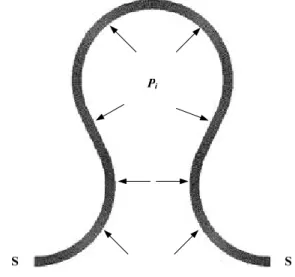
In the present analyses, a conventional -shaped bellows available in market with nominal diameter 125A is picked to be analyzed (9). The bellows inside
diameter is 128 mm with outside diameter of 154 mm, thickness of 0.45 mm, pitch of 11.5 mm, and height is 12.5 mm. The bellows material is made of stainless steel SUS 321 with the modulus of elasticity of 193 GPa and poisson's ratio of 0.3. The model of -shaped bellows and its constraints are presented in Fig. 3. In the present work, the internal pressure (P ) and axial i deflection are only considered. In Fig. 3, the constraints due to internal pressure are only presented. For toroidal bellows the radius of the toroidal convolution is assumed to be r 5.5 mm.
Fig. 3 A convolution computational model and its constraints
3 RESULTS AND DISCUSSIONS
3.1 Numerical validations
In order to validate the present numerical method a comparison test is performed. Since, solid element is used, the stress resulted from FEM is a local stress. However, the design equations result in averaged stress. Thus, the FEM stresses shown in comparison are the linearized one. The meridional membrane stress and meridional bending stress due to internal pressure of U-shaped bellows and toroidal bellows were calculated. The applied internal pressures are 1 MPa, 1.5 MPa, and 2 MPa, respectively. The results are presented in Table 1. In the table, the results from analytical solutions by EJMA equations are also presented. The comparisons show a good agreement.
The meridional membrane stress and meridional bending stress due to axial deflections are presented in Table 2. The applied axial deflections are 0.5 mm, 0.75 mm, and 1 mm, respectively. In the table, the results from analytical solution by EJMA equations are also The bellows meridional membrane stress due to
internal pressure is calculated based on the component of pressure in axial direction acting on the convolution divided by the metal area of root and crown. It is calculated by the following equation:
t Pw S
2
3 (2)
The bellows meridional bending stress due to internal pressure (S4) is calculated by:
p C t w P S 2 4 2 (3)
The bellows meridional membrane stress (S5) and
meridional bending stress (S6) due to deflection ( e )
are calculated by the following equations, respectively:
f b C w e t E S 2 2 52 (4) d b C w e t E S 2 2 6 3 5 (5)
whereC ,p C , and f C are the factors to calculate d S , 4 5
S and S , respectively. They are provided as diagram 6
and table in EJMA(2). And
b
E is Modulus of Elasticity of the bellows.
2.2 Design equations for toroidal bellows
For toroidal bellows, meridional membrane stress due to pressure is calculated by:
r D r D t r P S m m 2 3 (6)
Here r is mean radius of toroidal bellows convolution and D is the median diameter of bellows convolution. m
Membrane stress of the bellows due to deflection is calculated by: 1 3 2 5 34.5r B e t E S b (7)
The bellows meridional bending due to deflection is calculated by: 2 2 6 34.3r B e t E S b (8) 1
B and B are factors provided in appendix I of 2
EJMA(2).
2.3 Numerical simulation
In this study, ANSYS code is used to carry out numerical simulation. Structural solid element 8-node Plane183 is employed. Elastic analyses were carried out on a full convolution of the bellows with axysimmetric model. The computational domain is divided into 10 elements in thickness and 500 elements in length. The proper number elements test was performed, where 800 elements in length was tested.
The results showed essentially the same. Therefore, the model with elements 10500 is used in all analyses.
In the present analyses, a conventional -shaped bellows available in market with nominal diameter 125A is picked to be analyzed (9). The bellows inside
diameter is 128 mm with outside diameter of 154 mm, thickness of 0.45 mm, pitch of 11.5 mm, and height is 12.5 mm. The bellows material is made of stainless steel SUS 321 with the modulus of elasticity of 193 GPa and poisson's ratio of 0.3. The model of -shaped bellows and its constraints are presented in Fig. 3. In the present work, the internal pressure (P ) and axial i deflection are only considered. In Fig. 3, the constraints due to internal pressure are only presented. For toroidal bellows the radius of the toroidal convolution is assumed to be r 5.5 mm.
Fig. 3 A convolution computational model and its constraints
3 RESULTS AND DISCUSSIONS
3.1 Numerical validations
In order to validate the present numerical method a comparison test is performed. Since, solid element is used, the stress resulted from FEM is a local stress. However, the design equations result in averaged stress. Thus, the FEM stresses shown in comparison are the linearized one. The meridional membrane stress and meridional bending stress due to internal pressure of U-shaped bellows and toroidal bellows were calculated. The applied internal pressures are 1 MPa, 1.5 MPa, and 2 MPa, respectively. The results are presented in Table 1. In the table, the results from analytical solutions by EJMA equations are also presented. The comparisons show a good agreement.
The meridional membrane stress and meridional bending stress due to axial deflections are presented in Table 2. The applied axial deflections are 0.5 mm, 0.75 mm, and 1 mm, respectively. In the table, the results from analytical solution by EJMA equations are also
- 50 -
Himsar AMBARITA, Masashi DAIMARUYA and Hiroyuki FUJIKI
- 50 -
presented. The comparisons for U-shaped bellows show a good agreement. However, for toroidal bellows the analytical solutions show a significant discrepancy. The discrepancy caused by the factors B and 1 B 2provided by EJMA(2). Thus, further study need to be
performed to evaluate those factors. This is beyond the objective of the present paper.
In general, the present numerical method show good agreement with results by EJMA equations, except for the toroidal bellows. Therefore, the method can be used to evaluate the characteristics of stress distributions in -shaped bellows.
Table 1 Analytic and FEM stresses due to internal pressure
Type of
Bellows Stress Internal Pressure [MPa] 1 1.5 2
U- shaped bellows 3 S (Eq. (2)) 13.889 20.833 27.778 3 S (FEM) 13.032 19.572 26.137 Ratio 0.938 0.939 0.94 4 S (Eq.(3)) 251.00 376.50 502.01 4 S (FEM) 241.91 360.33 477.7 Ratio 0.964 0.957 0.952 Toroidal bellows 3 S (Eq.(6)) 12.733 19.099 25.466 3 S (FEM) 13.596 20.366 27.128 Ratio 1.068 1.066 1.065 Table 2 Analytic and FEM stresses due to deflection
Type of
Bellows Stress 0.5 0.75 1. Axial Deflection [mm]
U- shaped bellows 5 S (Eq. (4)) 3.252 4.877 6.503 5 S (FEM) 3.389 5.169 7.02 Ratio 1.042 1.059 1.079 6 S (Eq. (5)) 265.66 398.49 531.32 6 S (FEM) 239.49 357.85 476.05 Ratio 0.901 0.898 0.896 Toroidal bellows 5 S (Eq. (7)) 7.239 10.858 14.477 5 S (FEM) 3.686 5.481 7.254 Ratio 0.509 0.505 0.501 6 S (Eq. (8)) 250.97 376.45 501.94 6 S (FEM) 172.65 254.41 333.71 Ratio 0.688 0.677 0.665
3.2 Comparison of design stresses of all bellows The present numerical method are now used to evaluate characteristics of stress for all bellows. The first comparison is meridional membrane stress due to internal pressure. The applied internal pressures are 1 MPa, 1.5 MPa, and 2 MPa, respectively. The results are presented in Fig. 4. The figure shows that meridional membrane stress in -shaped bellows is lower than in toroidal bellows, but same value as U-shaped bellows.
Fig. 4 Meridional membrane stresses due to internal pressure
The comparisons of meridional bending stress of all considered bellows due to internal pressure are presented in Fig. 5. The figure shows that meridional bending stresses are higher than meridional membrane stresses. This suggests that meridional bending stress is more destructive than meridional membrane stress. The meridional bending stress of -shaped bellows is lower than U-shaped bellows, but it is higher than toroidal bellows.
Fig. 5 Meridional bending stresses due to internal pressure
The comparisons of meridional membrane stress of all considered bellows due to axial deflection are
presented in Fig. 6. The applied axial deflections are 0.5 mm, 0.75 mm, and 1 mm, respectively. The figure shows that meridional membrane stress in -shaped bellows is lower than in toroidal and U-shaped bellows.
Fig. 6 Meridional membrane stresses due to axial deflection
The comparisons of meridional bending stress of all bellows due to axial deflection are presented in Fig. 7. Here, the meridional bending stresses are higher than meridional membrane stresses. This also suggests that meridional bending stress is more destructive than meridional membrane stress. The figure shows that meridional bending stress of -shaped bellows is lower than U-shaped bellows, but it is higher than toroidal bellows.
Fig. 7 Meridional bending stresses due to axial deflection
Those comparisons reveal that the most destructive stress in bellows due to internal pressure and axial deflection is meridional bending stress. Furthermore, for both internal pressure and axial deflections the meridional bending stress of -shaped
bellows is lower than U-shaped bellows, but it is higher than toroidal bellows. Thus, -shaped bellows is expected to have longer operational life than U-shaped bellows.
3.3 Stress distributions due to internal pressure 1 MN MX -585.748-461.734-337.719-213.704-89.689834.3248158.339282.354406.369530.383 DEC 15 2011 10:27:57 NODAL SOLUTION STEP=1 SUB =10 TIME=10 SY (AVG) RSYS=0 DMX =.116869 SMN =-585.748 SMX =530.383
Fig. 8 Axial Stress distribution of U-shaped bellows due to internal pressure of 2 MPa
1 MN MX -447.933-364.452-280.97 -197.489-114.007-30.525652.956 136.438 219.919 303.401 DEC 15 2011 11:22:27 NODAL SOLUTION STEP=1 SUB =10 TIME=10 SY (AVG) RSYS=0 DMX =.075672 SMN =-447.933 SMX =303.401
Fig. 9 Axial Stress distribution of toroidal bellows due to internal pressure of 2 MPa
1 MN MX -481.397-380.618-279.839-179.06-78.280522.4987 123.278224.057324.836425.616 DEC 15 2011 11:27:03 NODAL SOLUTION STEP=1 SUB =10 TIME=10 SY (AVG) RSYS=0 DMX =.112977 SMN =-481.397 SMX =425.616
Fig. 10 Axial Stress distribution on -shaped bellows due to internal pressure of 2 MPa
presented in Fig. 6. The applied axial deflections are 0.5 mm, 0.75 mm, and 1 mm, respectively. The figure shows that meridional membrane stress in -shaped bellows is lower than in toroidal and U-shaped bellows.
Fig. 6 Meridional membrane stresses due to axial deflection
The comparisons of meridional bending stress of all bellows due to axial deflection are presented in Fig. 7. Here, the meridional bending stresses are higher than meridional membrane stresses. This also suggests that meridional bending stress is more destructive than meridional membrane stress. The figure shows that meridional bending stress of -shaped bellows is lower than U-shaped bellows, but it is higher than toroidal bellows.
Fig. 7 Meridional bending stresses due to axial deflection
Those comparisons reveal that the most destructive stress in bellows due to internal pressure and axial deflection is meridional bending stress. Furthermore, for both internal pressure and axial deflections the meridional bending stress of -shaped
bellows is lower than U-shaped bellows, but it is higher than toroidal bellows. Thus, -shaped bellows is expected to have longer operational life than U-shaped bellows.
3.3 Stress distributions due to internal pressure 1 MN MX -585.748-461.734-337.719-213.704-89.689834.3248158.339282.354406.369530.383 DEC 15 2011 10:27:57 NODAL SOLUTION STEP=1 SUB =10 TIME=10 SY (AVG) RSYS=0 DMX =.116869 SMN =-585.748 SMX =530.383
Fig. 8 Axial Stress distribution of U-shaped bellows due to internal pressure of 2 MPa
1 MN MX -447.933-364.452-280.97 -197.489-114.007-30.525652.956 136.438 219.919 303.401 DEC 15 2011 11:22:27 NODAL SOLUTION STEP=1 SUB =10 TIME=10 SY (AVG) RSYS=0 DMX =.075672 SMN =-447.933 SMX =303.401
Fig. 9 Axial Stress distribution of toroidal bellows due to internal pressure of 2 MPa
1 MN MX -481.397-380.618-279.839-179.06-78.280522.4987 123.278224.057324.836425.616 DEC 15 2011 11:27:03 NODAL SOLUTION STEP=1 SUB =10 TIME=10 SY (AVG) RSYS=0 DMX =.112977 SMN =-481.397 SMX =425.616
Fig. 10 Axial Stress distribution on -shaped bellows due to internal pressure of 2 MPa
- 52 -
Himsar AMBARITA, Masashi DAIMARUYA and Hiroyuki FUJIKI
- 52 -
The axial stress distributions in the bellows due to internal pressure of 2 MPa for U-shaped, -shaped, and toroidal bellows are presented in Fig. 8, Fig. 9, and Fig. 10, respectively. It can be said that U-shaped and -shaped bellows show the similar distribution but they are different from toroidal bellows. In the U-shaped and -shaped bellows, the maximum axial stress takes place on the crown part. In the toroidal one, it takes places on the root part.3.4 Stress distributions due to axial deflection
The axial stress distributions in the bellows due to axial deflection of 1 mm for U-shaped, -shaped, and toroidal bellows are presented in Fig. 11, Fig. 12, and Fig. 13, respectively. Those figures show that there is no significant different from all bellows.
1 MN MX -479.476-365.436-251.397-137.358-23.319 90.7201 204.759 318.798 432.838 546.877 DEC 15 2011 11:41:38 NODAL SOLUTION STEP=1 SUB =10 TIME=10 SY (AVG) RSYS=0 DMX =1.00208 SMN =-479.476 SMX =546.877
Fig. 11 Axial Stress distribution on U-shaped bellows due to axial deflection of 1 mm
1 MN MX -364.453-278.687-192.921-107.156-21.389964.3758150.142235.907321.673407.439 DEC 15 2011 11:56:10 NODAL SOLUTION STEP=1 SUB =10 TIME=10 SY (AVG) RSYS=0 DMX =1.00863 SMN =-364.453 SMX =407.439
Fig. 12 Axial Stress distribution on toroidal bellows due to axial deflection of 1 mm
1 MN MX -444.014-339.707-235.4 -131.093-26.786277.5207181.828286.135390.441494.748 DEC 15 2011 11:52:45 NODAL SOLUTION STEP=1 SUB =10 TIME=10 SY (AVG) RSYS=0 DMX =1.00185 SMN =-444.014 SMX =494.748
Fig. 13 Axial Stress distribution on -shaped bellows due to axial deflection of 1 mm
4 CONCLUSSIONS
The numerical study on characteristics of stress in -shaped bellows has been performed. The design stresses and distributions are compared with U-shaped and toroidal bellows. The main conclusion is that the most destructive stress in bellows due to internal pressure and axial deflection is meridional bending stress. Furthermore, for both internal pressure and axial deflections the meridional bending stress of -shaped bellows is lower than U-shaped bellows, but it is higher than toroidal bellows. Thus, -shaped bellows is expected to have longer operational life in comparison with U-shaped bellows.
REFERENCE
(1) ASME, ASME Boiler and Pressure Vessel Code-Section VIII, Division 1, Appendix 26 – Pressure Vessel and Heat Exchanger Joints, New York, 2000. (2) EJMA, Standards of Expansion Joint Manufacturers
Association, ninth edition, New York, 2008.
(3) Shaikh, H. George, G., and Khatak, H.S., Failure analysis of an AM 350 steel bellows, Engineering Failure Analysis, Vol 8, (2001), p571-576.
(4) Broman, G.I., Jonsson, A.P., and Hermann, M.P., Determining dynamic characteristics of bellows by manipulated beam finite elements of commercial software, International Journal of Pressure Vessels and Piping, No. 77, (2000), p445-453.
(5) Li, T., Effect of the elliptic degree of -shaped bellows toroid on its stresses, International Journal of Pressure Vessels and Piping 75, (1998), p951-954.
(6) Faraji, Gh., Mashhadi, M.,M., and Norouzifard, V., Evaluation of effective parameters in metal bellows forming process, Journal of Materials Processing Technology, No 209, (2009), p3431-3437.
(7) Faraji Gh., Besharati, M.K., Mosavi, M., and Kashanizadeh, H., Experimental and finite element analysis of parameters in manufacturing of metal bellows, Int. Journal of Manufacturing Technology, No 38, (2008), p641-648.
(8) Kang, B.H., Lee, M.Y, Shon, S.M., and Moon, Y.H., Forming various shapes of tubular bellows using a single-step hydroforming process, Journal of Materials
Processing Technology, No 194, (2007), p1-6
(9) TOFLE, Expansion Joints, Company Profile, TOFLE Co. Inc., OSAKA, 2011
Processing Technology, No 194, (2007), p1-6
(9) TOFLE, Expansion Joints, Company Profile, TOFLE Co. Inc., OSAKA, 2011