Too many cheers and not enough independence :
media control through government
advertisements in an Indian state
著者
Minato Kazuki
権利
Copyrights 2020 by author(s)
journal or
publication title
IDE Discussion Paper
volume
784
year
2020-04
INSTITUTE OF DEVELOPING ECONOMIES
IDE Discussion Papers are preliminary materials circulated to stimulate discussions and critical comments
Kazuki MINATO*
April 2020
Keywords: Media control, Government advertisements, Corruption, India, Bihar
* Research Fellow, South Asia Study Group, Area Studies Center, IDE ([email protected])
IDE DISCUSSION PAPER No. 784
Too Many Cheers and Not Enough
Independence: Media Control
through Government Advertisements
in an Indian State
Abstract
In marked contrast to his frequent political flip-flops, Bihar Chief Minister Nitish Kumar has been quite consistent in his control of the media. This paper shows both qualitatively and quantitatively that the Nitish Kumar government has taken advantage of government advertisements and exerted enormous pressure on the media to report on the government’s version of the truth. Our analysis indicates that the state government has had the upper hand because the media lacks private commercial advertisements from local businesses. However, the chief minister also depends on government advertisements to survive, given that he lacks solid constituencies and effective party machinery.
The Institute of Developing Economies (IDE) is a semigovernmental, nonpartisan, nonprofit research institute, founded in 1958. The Institute merged with the Japan External Trade Organization (JETRO) on July 1, 1998. The Institute conducts basic and comprehensive studies on economic and related affairs in all developing countries and regions, including Asia, the Middle East, Africa, Latin America, Oceania, and Eastern Europe.
The views expressed in this publication are those of the author(s). Publication does not imply endorsement by the Institute of Developing Economies of any of the views expressed within.
INSTITUTE OF DEVELOPING ECONOMIES (IDE), JETRO 3-2-2, WAKABA, MIHAMA-KU, CHIBA-SHI
CHIBA 261-8545, JAPAN
©2020 by author(s)
1
Too Many Cheers and Not Enough Independence:
Media Control through Government Advertisements in an Indian State
Kazuki Minato*
Abstract
In marked contrast to his frequent political flip-flops, Bihar Chief Minister Nitish Kumar has been quite consistent in his control of the media. This paper shows both qualitatively and quantitatively that the Nitish Kumar government has taken advantage of government advertisements and exerted enormous pressure on the media to report on the government’s version of the truth. Our analysis indicates that the state government has had the upper hand because the media lacks private commercial advertisements from local businesses. However, the chief minister also depends on government advertisements to survive, given that he lacks solid constituencies and effective party machinery.
Keywords: Media control, Government advertisements, Corruption, India, Bihar
* Institute of Developing Economies (IDE-JETRO), 3-2-2 Wakaba, Mihama-ku, Chiba
261-8545, Japan.
2
Nitish Kumar came to power in the politically unstable state of Bihar in November 2005, and has remained there for nearly 15 years (with a 9-month interruption). His tenure as Chief Minister of Bihar is quite remarkable, given that a large majority of chief ministers in India tend to not hold office for so long. This is even more notable given that he is neither an heir to a political dynasty, a politician from a dominant caste group, nor a leader of national parties such as the Bharatiya Janata Party (BJP) and the Congress Party. There is no doubt that without considerable political skills, he would not have persisted in his office.
Nitish Kumar’s great political sense lies in the fact that during his tenure of office, he has often shrewdly flip-flopped on major issues according to political circumstances. For example, his government at first eagerly promoted liquor sales to increase revenue from excise duties (Government of Bihar 2007: 218) before reversing and promising prohibition during a campaign for the State Assembly elections in 2015. After returning to power, despite an estimated annual loss of Rs 4,000 crore on excise revenue, his government enacted the Bihar Prohibition and Excise Act to make Bihar a dry state in 2016. It was commonly perceived that Nitish played the prohibition card to woo women voters across caste lines in the elections and thereafter1.
It is also worth remembering that, while his party—the Janata Dal (United) [JD(U)]—has stayed in power in Bihar since November 2005, it has changed sides no less than three times. In June 2013, the JD(U) cut ties with the BJP, its longtime ally, because Narendra Modi was likely to be nominated as the BJP’s prime ministerial candidate for the 2014 Lok Sabha elections. In 2015, after the debacle of the general elections, the JD(U) joined with its archrivals, Lalu Prasad Yadav’s Rashtriya Janata Dal and the Congress Party, and the so-called Mahagathbandhan (Grand Alliance) won the State Assembly elections against the BJP and its allies. However, within 2 years Nitish had deserted the alliance and returned to the BJP to form a new coalition government. In the course of the political juggling, he has successfully retained the office of chief minister, except for the period between May 2014 and February 2015.
The recent controversy over the Citizenship Amendment Act is another example. An editorial in The Hindu accused Nitish Kumar of “trying to run with the hare and hunt with the hounds” because he “impelled his party to support the Citizenship Amendment
1 In July 2018, the Bihar Prohibition and Excise Act was amended, and some of its
draconian provisions were diluted, including the arrest of all adult members of a family of an offender (section 32), enhanced punishment after previous conviction (section 53), and imposition of a collective fine on a group of people (section 64), among others.
2
Bill in Parliament and later called for a national debate on the issue.” It also made a scathing remark about his party’s “amorphous politics” not only in this particular case but in general, “Opportunism is easily forgiven, and often celebrated as pragmatism in politics, and the JD(U) has mastered it to perfection. The party has always been little more than a personal fiefdom of the Bihar Chief Minister…” (Hindu 2020). In other words, opportunism is an integral part of his political survival strategy.
Whereas inconsistency is deeply embedded in the political behavior of Nitish Kumar and his one-man party, his regime has shown great consistency in one particular area since its inception: control of the media, especially via government advertisements.
The Making of “Editor-in-Chief of Bihar”
The Press Council of India (PCI) is a statutory body “for the purpose of preserving the freedom of the Press and of maintaining the standards of newspapers and news agencies in India” (Press Council Act, 1978). It consists of a chairperson, by convention a retired judge of the Supreme Court of India, and 28 other members who represent the press, the two houses of parliament and, the cultural, literal and legal fields.
In 2013, the PCI released a 20-page report titled Pressure on Media in Bihar. The PCI report accused the Nitish Kumar government of unannounced censorship of the media in Bihar, comparing the situation to the Emergency (Press Council of India 2013: 6). Based on the findings of a three-member subcommittee, it illustrated that the state government had taken advantage of government advertisements as a means to pressure a wide range of media outlets. Specifically, it argued that in exchange for advertising buys, the media flattered the chief minister and shied away from publishing reports critical of the government. In line with this claim, the PCI report received little press coverage, as we will discuss later.
A handful of news reports, all of which appeared in non-mainstream media, have corroborated the allegations of the PCI report (Hoot 2010, Jha 2012, Ray 2019). They briefly documented cases in which the government stopped advertising in newspapers that carried negative stories. In much the same vein, a PCI report on “paid news” quoted the late Prabhash Joshi, a noted Hindi journalist: “Every newspaper has made a calculation as to how much it would lose financially if it ever invited the ire of a chief minister. Some time ago I had been to Patna and happened to meet a newspaper owner during my visit there. He asked me to persuade (Bihar Chief Minister) Shri Nitish Kumar to help him by placing state government advertisements in his newspaper that had incurred a loss of Rs 73 lakh that month” (Press Council of India 2010: 22). Hence,
3
in the sense that the chief minister has enormous influence on news content, it seems quite reasonable to call him the “Editor-in-Chief of Bihar” (Jha 2012).
During his tenure in office, the state government has become more organized and systematic in terms of abusing advertisements. It promulgated the Bihar Advertisement Policy 2008 and then replaced it with the Bihar Advertisement Policy 2016, centralizing the advertising and payment system2. Of central importance in this context is the Information and Public Relations Department (IPRD), Government of Bihar, via which all government advertisements pass for approval. The IPRD responsibility is to “publicize the classified advertisement, tender, information & other content … in the form of advertisements on Akashwani [All India Radio], Television, Newspaper/Magazine, Electronic Media, Internet etc.” and “ensure centralized monitoring and make payment for it” (Bihar Advertisement Policy 2016).
Figure 1 presents the state government’s spending on advertisements and the actual expenditure of the IPRD. Government spending on advertisements was constant at around Rs 5 crore before Nitish Kumar came to power, but the state government has increased its spending on advertisements since 2007-08, amounting to Rs 133.5 crore in 2018-19. Between 2006-07 and 2018-19, government spending on advertisements has grown nearly 25-fold, and its average annual growth rate was more than 30%. These numbers are quite staggering even after taking into account inflation. Accordingly, the IPRD’s expenditure has also grown exponentially over the past decade or so, although it accounted for just 0.12% of total expenditure in 2018-19.
(Figure 1)
However, there is a crucial external factor that has helped the state government’s carrot and stick approach. Bihar is still an economically backward state, and private commercial advertisements from local businesses are scarce. Moreover, most advertisements published in the Bihar edition are received from larger cities (e.g., Delhi, Mumbai, Kolkata, etc.). Thus, the media industry in Bihar (including the local editions of major newspapers) has depended heavily on state government advertisements for revenue. The situation seems to have worsened, considering that the press has suffered from declining readership and some national dailies have shut down local editions and bureau offices. In fact, The Telegraph launched the Patna edition in 2010, but it was closed in December 2016. According to Newslaundry (2018b), the Nitish government
4
gave fewer advertisements to The Telegraph because of its critical attitude toward the government.
Sources had different answers to questions about what percentage of their bureaus’ total revenue came from state government advertisements, ranging from 30% to more than 50%. However, all of them agreed that the advertisements were financially important. For example, one of the local journalists I interviewed characterized state government advertisements as “oxygen to survive” for the media3.
A Reciprocal Relationship through Government Advertisement
In this section, we focus on one specific episode to illustrate the relationship between the media and the state government. This case is quite notorious among local journalists presumably because a senior journalist was ultimately forced to leave Bihar4.
Dainik Jagran has been the most widely read newspaper in India, according to the
Indian Readership Survey (IRS). In a recent round of the survey (IRS Q3 2019), the Hindi-language daily maintained its leading position in the market, recording an average issue readership (i.e., the number of readers who have read the paper the previous day) of 1.75 crores. Dainik Jagran, which “was gung-ho about understanding its reader, be it an adult or child” (Ninan 2007: 200), launched a regular supplement called Junior
Jagran in its various editions across North India. This Hindi-English bilingual tabloid is
targeted at the teenage segment, especially young readers who are inclined to read English newspapers rather than vernacular ones for academic and career needs. Although Junior Jagran is written and edited mainly by the National Bureau, some pages are allotted to each edition and their contents are localized5.
On 22 January 2010, the Patna edition of Junior Jagran carried a biographical profile of Karpoori Thakur (1924-1988), a prominent figure in Bihar politics. Thakur, who was himself from a lower-caste background (a Nai community), was popularly identified as a leader of backward classes in Bihar. In the 1970s, he became the state’s chief minister to lead non-Congress governments twice, although both of his stints were short-lived (Kohli 1991, Singh 2015). Obviously, the Junior Jagran article titled “Profile: Karpoori Thakur” would be expected to serve its educational purposes, considering that it was
3 Interview with local journalist A (Patna, 22 February 2016).
4 This section draws upon information from a dozen local informants, especially local
journalist B, who was well-informed about the case discussed below.
5 Neyazi (2011: 76-77) points out the contribution of supplements to the localization of
5
written in English and dealt with the important historical figure. However, this was not the case. It was in fact an extremely bad example to young readers because the “author” of this article, who had a poor command of English, simply copy-pasted the Wikipedia page on Karpoori Thakur word for word, including several punctuation errors. To make matters worse, the person in charge of the Patna edition of Junior Jagran did not check this shoddy work and allowed it to be published.
Shortly after its publication, the biographical sketch caused serious trouble for Dainik
Jagran. However, this was not because the article plagiarized the Wikipedia entry, but
because it contained some descriptions of Karpoori Thakur that would be quite offensive to those who were close to him. For example, it mentioned a rape allegation against him: “There are many stories of his colourful life like [Ram Manohar] Lohia. In 1979, Premlata Rai, a 35-year old schoolteacher from Kathmandu, also accused Thakur of raping her while he was hiding in Nepal during the Emergency. She also complained that she was wrongfully confined when she visited Patna.” Moreover, the political legacy of Karpoori Thakur as a leader of lower castes was illustrated as follows: “He was a mentor to the prominent Bihari leaders such as Lalu Prasad Yadav, Ram Vilas Paswan, and Nitish Kumar. Most of the gunda [gangster] type of leaders of Bihar are treating him as their mentor.” Incidentally, the Wikipedia page on Karpoori Thakur has been edited many times, and the current version differs significantly from the one that the “author” of the Junior Jagran article plagiarized. For some reason, the quotations above do not appear on the page at the time of this writing6.
Meanwhile, a girl in Samastipur district came across Karpoori Thakur’s biographical profile in Junior Jagran. She was a great-granddaughter of the former chief minister and, unsurprisingly, reported on the article to her grandfather, Ram Nath Thakur. He is a son of Karpoori Thakur and was then a JD(U) Member of Legislative Assembly that represented the Samastipur Assembly constituency. It was a remarkable coincidence that Ram Nath Thakur was the minister of the Information and Public Relations Department (IPRD) in the Nitish Kumar government at a time when “Profile: Karpoori Thakur” appeared in Junior Jagran. Allegedly insulted by this article, he took advantage of his position as the IPRD minister and decreased the number of Bihar government advertisements appearing in Dainik Jagran.
6 At https://en.wikipedia.org/w/index.php?title=Karpoori_Thakur&action=history, see
the revision history of the Wikipedia page on Karpoori Thakur. Dated 30 November 2009 was the last version of the Wikipedia entry before the biographical sketch appeared in Junior Jagran on 21 January 2010. It is available at https://en.wikipedia.org/w/index.php?title=Karpoori_Thakur&oldid=328762549.
6
It is worth adding that although Ram Nath Thakur was not very powerful as an individual politician, he had the ministerial position and made such an arbitrary decision. About 10 months after this incident, the incumbent MLA and cabinet minister lost his seat to an unknown first-time candidate of the Rashtriya Janata Dal in the State Assembly elections, whereas the ruling JD(U)-BJP alliance won a landslide victory, gaining 206 of 243 seats (JD(U) 115, BJP 91). Several local journalists I interviewed agreed that Ram Nath Thakur had neither political influence nor followers, and that his only political asset was being a son of Karpoori Thakur. However, this was a great asset because major political parties still competed for Karpoori Thakur’s legacy to appeal to lower caste communities in Bihar (Hindu 2015). It therefore seemed likely that Ram Nath Thakur had gained the ministerial berth because of his family background. Similarly, it could also explain the fact that even after losing his seat in the Assembly election, he was nominated by the JD(U) as its Rajya Sabha candidate and became a Member of Parliament in April 2014.
More importantly, this was supposedly not a typical case where the government abuses advertisement to make the media pliable. In fact, it was somewhat more complicated because, as one of my informants said, “It was the state government that surrendered to Dainik Jagran. It was not the other way around.”7 On 12 February, 3 weeks after the Junior Jagran article was published, Dainik Jagran broke a story about a large-scale scam on the front page. This lead story alleged that senior officers of the chief minister’s secretariat as well as a JD(U) politician had been involved in corruption related to the contract of manufacturing and supplying liquor. It also charged that there had been a deliberate cover-up by the state government:
In this matter, the Excise minister [Jamshed Ashraf] had already written a letter to the chief secretary. Moreover, he wrote a 9-page letter to the chief minister regarding no action taken about Rs 500 crore scam that had been flourishing over the past 4 years in the Excise Department. He had demanded a thorough enquiry by the Vigilance Department or principal accountant general. The state government is involved in a big conspiracy by covering up the matter by just transferring the excise commissioner on the notice of the Excise minister.
By exposing the corruption scandal, the management of Dainik Jagran hit back at the state government, which had considerably decreased its number of advertisements over
7
a period of weeks. This bold decision paid off. Soon after the story was released, Ram Nath Thakur contacted Dainik Jagran on Nitish Kumar’s orders to “sort out differences”. Within a few days after the two parties made a deal, state government advertisements to the Hindi newspaper picked up and returned to the level before the trouble over the Junior Jagran article. Meanwhile, following the initial revelation of the scandal, Dainik Jagran made no further investigation into it and even published an article that attempted “damage control” for the state government8.
In fact, this was not the end of the story. In November 2010, shortly after the ruling JD(U)-BJP swept back into power in the State Assembly elections, a senior journalist of
Dainik Jagran whose name appeared in the byline of the liquor scam article was
transferred from Patna to Lucknow and then to New Delhi. An informant who was familiar with this incident said that if Nitish Kumar had not come back to power, this journalist would have not been transferred9. It is quite obvious that the management of Dainik Jagran had to pledge allegiance to Nitish Kumar, considering that he was likely
to remain Chief Minister of Bihar and “Editor-in-Chief of Bihar” over the next 5 years.
Quantitative Analysis of Government Advertisement
The narrative presented in the last section clearly illustrates that the relationship between the government and the media was reciprocal rather than unilateral. It is based on interviews with a dozen local informants but it can be confirmed empirically using data on government advertisements10.
Figure 2 compares the quantity of state government advertisements in the Patna edition of Dainik Jagran with that of Hindustan, the Hindustan Times’ sister publication and the most-read newspaper in Bihar11. Moreover, Table 1 makes a comparison
8 Interview with local journalist B (Patna, 27 December 2019).
9 Interview with local journalist B (Patna, 2 August 2018 and 27 December 2019). 10 To collect the data used in the current and next sections, I accessed the newspaper
collection held at the Gandhi Museum in Patna. It has the Patna edition of major newspapers, including Hindustan, Dainik Jagran, The Times of India, and the
Hindustan Times.
11 According to the Indian Readership Survey (IRS Q3 2019), the average issue
readership of Hindustan and Dainik Jagran in Bihar was 4.3 lakhs and 3.2 lakhs, respectively. Dainik Bhaskar (1.8 lakhs) and Prabhat Khabar (1.8 lakhs), both of which are Hindi dailies, followed them. However, another survey conducted in 2018 obtained a different result: Hindustan was at the top, but Dainik Bhaskar pushed Dainik Jagran to the third position in the state. It also showed that no English newspapers figured in the top four most-read dailies in the state (Newslaundry 2018a).
8
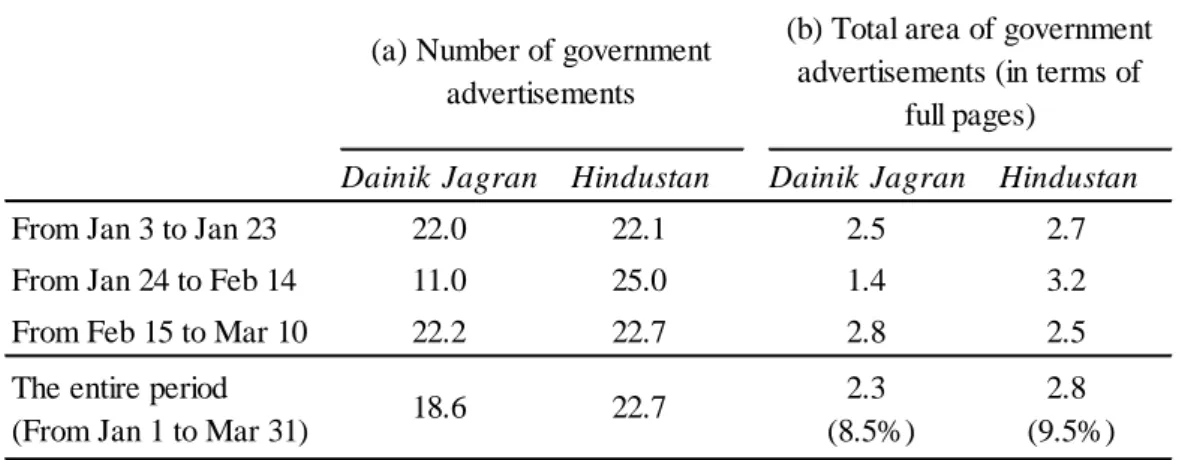
between Dainik Jagran and Hindustan over a couple of 3-week periods, including one between 24 January and 14 February in 2010, during which the state government allegedly decreased its number of advertisements to Dainik Jagran. To measure the quantity of government advertisements in the newspapers, we use two metrics: (a) the number of government advertisements (regardless of size), and (b) the total area of government advertisements (in terms of full pages).
(Figure 2)
(Table 1)
Comparing the leading Hindi dailies of the state can help us understand quantitatively the significance of Ram Nath Thakur’s decision to decrease the quantity of government advertisements in Dainik Jagran. This is because even though Dainik Jagran is alleged to have suffered from this arbitrary decision for about 3 weeks following the Junior
Jagran article, the same was not the case with Hindustan. Thus, the quantity of
government advertisements in Hindustan could give us a good sense of what the situation for Dainik Jagran would have been like if the state government had not decreased the quantity of government advertisements in Dainik Jagran.
Figure 2 shows that although the quantity of government advertisements had been highly volatile, it had changed in a quite similar manner in Dainik Jagran and
Hindustan, except from the end of January to the middle of February in 2010. During
this period alone, Dainik Jagran had a consistently smaller quantity of government advertisements than Hindustan. Moreover, the timing at which the quantity of government advertisements diverged and then converged was also in line with the above-mentioned story. It is also clear from Table 1 that in contrast to Dainik Jagran,
Hindustan had slightly more advertisements from January 24 to February 14 than before
and after that period. On an average day, both newspapers carried more than 20 government advertisements, amounting to nearly 3 pages. During the 3 months from 1 January to 31 March 2010, the daily average number of pages was 27.7 and 29.5 in
Dainik Jagran and Hindustan, respectively. This means that state government
advertisements usually accounted for about 10% of total pages in the dailies. Had it not been for the Junior Jagran article, the percentage of government advertisements in
Dainik Jagran would have likely been as high as that in Hindustan.
In sum, the sudden divergence between the two Hindi dailies in the quantity of state government advertisements could be attributed to Ram Nath Thakur’s decision to
9
decrease the quantity of government advertisements in Dainik Jagran. At the same time, it is also worth noting that the state government did not completely discontinue advertisements in Dainik Jagran. A Patna-based journalist pointed out that in general, the state government decreases rather than halts advertisements to the media when it has a critical report. He explained that by doing so, the government tries to camouflage its pressure on the media and avoid creating a bad impression12. This observation is quite convincing, considering that Nitish Kumar is “a very sophisticated politician” and “a master of political subtlety.”13 On the contrary, however, all the informants except for
this journalist said, referring to not only this case but others, “the state government
stopped advertisements” for certain period of time.
Media Coverage and the Government’s Version of the Truth
If something inconvenient happens to the government, does the media report on it? If so, how does it deal with bad news for the government? These questions are relevant to understanding to what extent the media houses are under pressure and how they handle it. To shed light on these points, we analyze both qualitatively and quantitatively how the local editions of leading newspapers (two Hindi and two English dailies) covered three important incidents.
The first case is the liquor scam, which we examined above. On 12 February 2010,
Dainik Jagran reported on the allegation of the Rs 500 crore scam, which was based on
a 9-page letter that Jamshed Ashraf, the Excise and Prohibition Minister, handed over to Nitish Kumar. The Chief Minister categorically denied all the accusations raised and, a week after the initial report of Dainik Jagran, Jamshed Ashraf was fired from the post for his “irresponsible behavior” (i.e., leaking the secret letter to the media and levelling false allegations). In the end, although the opposition demanded investigation of the Central Bureau of Investigation (CBI), the state government was swift to close the case, concluding that it found no irregularities.
The second case is the release of the PCI report, which we briefly mentioned in the first section. In February 2012, during the lecture at Patna University, PCI Chairman Justice Markandey Katju accused Nitish of manipulating the media for his own benefit. He also announced that the PCI would constitute a fact-finding team to probe the matter. A year later, some of the members raised a series of technical issues to hinder its release
12 Interview with local journalist C (Patna, 31 August 2019). 13 Interview with local journalist A (Patna, 14 February 2017).
10
at the last minute but the report compiled by the fact-finding team was leaked before the PCI officially approved it14. On 13 February 2013, a web portal called the Bihar Times
reported on the leaked document earlier than the major newspapers (Bihar Times 2013). The Bihar Times has never received government advertisements due to its critical stance on the state government15. Nitish claimed that the PCI report was utterly baseless and
biased. He also attacked Katju and even suggested that the leak of the report was politically motivated. Members of the ruling parties also questioned the legitimacy of the “draft report” which was yet to be approved by the PCI.
The third case is the Srijan scam, in which government funds worth Rs 1,500 crore were diverted to the accounts of an non-governmental organization based in Bhagalpur district, Srijan Sahyog Mahila Samiti, from 2007 to 2014. Srijan was founded by Manorama Devi and managed by her son Amit Kumar and daughter-in-law Priya Kumar after her death in 2016. The scam had not come to light until August 2017, when it was detected by the district magistrate. On 9 August, Chief Minister Nitish Kumar made public the alleged embezzlement of the funds, and the state government later ordered a CBI probe into the case. Notwithstanding the scale of the scam, although the “small fish” (managers and employees of banks, lower-level government officials, etc.) were caught immediately, neither senior bureaucrats nor politicians have been arrested so far. More surprisingly, an arrest warrant was issued for Amit and Priya soon after the scam became publicly known, but the two remain at large.
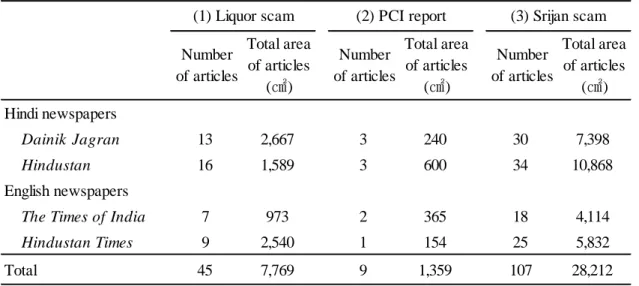
Table 2 shows the extent of media coverage of these three cases in the four major newspapers using two measures: the number of related articles and their total area. The data covers 2 weeks from the day after the news was publicly released. A couple of points are clear from Table 2 and the collection of newspaper articles on which it is based.
(Table 2)
First, there was very little press coverage of the PCI report. In total, the four newspapers carried only nine articles related to the PCI report. Among them, one article was placed on the front page and the others were relegated to inside pages. Moreover, these articles focused largely on claims made by the government and rarely referred to
14 Interview with the late Arun Kumar, who worked for The Times of India (Begusarai,
31 October 2013). He was an 11th term member of the PCI and part of the three-member subcommittee.
11
the report itself, as their headlines clearly indicate. They include “Report about media suppression in Bihar doesn’t get clearance” (Dainik Jagran, 19 February), “Katju, don’t try to be a Congress agent: Sanjay Jha” (Hindustan, 19 February), “Justice Katju has dialed wrong number, says Nitish” (Hindustan Times, 21 February), among others. Thus, it seems that the major dailies tried to downplay the news and minimize damage to the state government.
In fact, it is also suspected that they attempted to divert public attention from the PCI report by mixing it up with another issue. A couple of days after the PCI report was leaked, Katju contributed an essay to the Hindu arguing strongly that Narendra Modi was not a suitable candidate for Prime Minister (Katju 2013). This naturally provoked severe criticism from the BJP, and Arun Jaitely (Leader of the Opposition in the Rajya Sabha at that time) and Katju had a heated exchange. Interestingly, in the Patna editions of the major newspapers, the war of words over Modi was covered slightly better than the PCI report in terms of both the number of articles (ten to nine) and the total area of articles (1,712 cm2 to 1,359 cm2). This is selection bias in news coverage, considering the relative importance of the two issues for readers in Bihar.
It is also worth mentioning that the major newspapers did not conduct their own investigations into the serious allegations against the state government, let alone launch campaigns. The Srijan scam received so much press coverage that all of the dailies reported on the case every day for 2 weeks, but their reporting relied solely on sources affiliated with the police and the CBI. This would have been fine if the CBI probe had been exhaustive. However, one Patna-based journalist said that the CBI probe on the Srijan scam was “sloppy”, and another local journalist who had delved into the case said that the CBI was “so hostile” to him16. They suspected that the CBI protected politicians of the ruling parties and senior government officials who were involved in the Rs 1,500 crore corruption, which echoed what some articles suggested (Deccan Herald 2018,
Telegraph 2018). Moreover, Sagar (2020a, 2020b) pointed out that the CBI protected
politicians and IAS officers involved in another case related to a shelter home in Muzaffarpur, Bihar. Incidentally, Brajesh Thakur, the main culprit of this scandal, owned a dubious newspaper and kept receiving government advertisements (Ray 2019).
Comparing media reports on the Srijan scam with those on the fodder scam under the Rashtriya Janata Dal government, veteran journalists pointed out that despite pressure from the government, the press exposed corruption and ran ahead of the CBI in the
12
fodder scam case17. Accordingly, it is clear that the leading newspapers only scratched the surface of the Srijan scam. Presumably, this was not only because the CBI was under political pressure but because the media played it safe to avoid provoking the ire of the chief minister. In a similar vein, neither did they carry out investigation into the liquor scam.
These observations together strongly suggest that if something inconvenient happened to the state government, the media would report on it only to the extent that it never insulted the powers that be, especially the “Editor-in-Chief of Bihar”. Otherwise, it would lose revenue from government advertisements. More specifically, to minimize damage to the government, the media was most likely to either play down the bad news for the government, just scratch the surface with no investigation, or even propagate the government’s version of the truth. Moreover, the case of the PCI report vindicates a number of critical comments on the Indian press, quoted in Auletta (2012): “In India, the print media doesn’t write about itself” (Sevanti Ninan), and self-criticism in the established press is “almost like an omertà” (Jonathan Shainin).
Conclusion
This paper has shown both qualitatively and quantitatively that the Nitish Kumar government has taken advantage of government advertisements and exerted enormous pressure on the media to report on the government’s version of the truth. In Bihar, private commercial advertisements from local businesses are scarce, and the media depends heavily on government advertisements for revenue. It is against this backdrop that the media has shrewdly avoided important issues that are inconvenient to the powers that be and, thus kept people in the dark. Nevertheless, although the government has had the upper hand, it is not only the media in the state but also the chief minister who has needed government advertisements for survival. He needs advertisements to overcome his political weakness, especially lack of solid constituencies and effective party machinery to mobilize popular support.
This paper focuses exclusively on the case of Bihar under the Nitish Kumar government, but it is commonly perceived that the central and state governments abuse advertisements across India. In June 2019, for example, it was reported that the Modi government cut off advertisements to at least three major newspaper groups in
17 Interviews with local journalist D (Patna, 31 August 2019) and Ajay Kumar (Patna,
13
retaliation for unfavorable reports (Reuters 2019)18. For the past few years, moreover, Kashmir has become the focus of attention in this regard (Dev 2019, Mir 2019, Raafi 2019). This serious threat to the Indian democracy is expected to grow further, given the commercialization of the media, linkages between politics, business and the media, and declining newspaper readership (Auletta 2012, Dev 2018, Guha Thakurta 2012).
REFERENCES
Auletta, Ken (2012): “Citizens Jain: Why India’s Newspaper Industry is Thriving,” The
New Yorker, 8 October, pp 52-61.
Bajpai, Punya Prasun (2018): “Exclusive: Punya Prasun Bajpai Reveals the Story behind His Exit from ABP News,” The Wire, 6 August,
https://thewire.in/media/punya-prasun-bajpai-abp-news-narendra-modi.
Bihar Times (2013): “Press Council Report Compares Media Censorship in Nitish’s
Bihar with Emergency,” 13 February,
http://www.bihartimes.in/Newsbihar/2013/Feb/newsbihar13Feb1.html.
Deccan Herald (2018): “Did Asthana Scuttle CBI Probe to Save Nitish?” 30 October,
https://www.deccanherald.com/national/did-asthana-scuttle-srijan-700653.html. Dev, Atul (2018): “Same Old News: History Repeating at Shobhana Bhartia’s
Hindustan Times,” The Caravan, Vol 10, Issue 12, pp 28-51.
_______ (2019): “How the Indian Media Covered Kashmir,” The Caravan, Vol 11, Issue 12, pp 60-73.
Government of Bihar (2007): Economic Survey 2006-07, Patna: Government of Bihar, http://finance.bih.nic.in/Reports/ESR-2006-07-EN.pdf.
Guha Thakurta, Paranjoy (2012): Media Ethics: Truth, Fairness, and Objectivity (Second Expanded Edition), New Delhi: Oxford University Press.
Hindu (2015): “Battle for Karpoori Thakur's Legacy on in Bihar,” The Hindu, 24
January,
https://www.thehindu.com/news/national/other-states/battle-for-karpoori-thakurs-le gacy-on-in-bihar/article6818866.ece.
_____ (2020): “Amorphous Politics: On Rumblings in the JD(U),” 25 January,
https://www.thehindu.com/opinion/editorial/amorphous-politics-on-rumblings-in-th e-jdu/article30646482.ece.
Hoot (2010): “Nitish Kumar’s ‘Bihar Shining’ Campaign,” 4 December,
14
http://asu.thehoot.org/media-watch/media-practice/nitish-kumar-s-bihar-shining- campaign-4455.
Jha, Dhirendra K (2012): “Editor-in-Chief of Bihar,” Open, 14 April, https://openthemagazine.com/features/india/editor-in-chief-of-bihar/.
Katju, Markandey (2013): “All the Perfumes of Arabia,” The Hindu, 15 February, https://www.thehindu.com/opinion/op-ed/All-the-perfumes-of-
Arabia/article12345641.ece.
Kohli, Atul (1991): Democracy and Discontent: India’s Growing Crisis of Governability, New York: Cambridge University Press.
Kumar, Ravish (2019): “Bad News,” Re-Forming India: The Nation Today, Niraja Gopal Jayal (ed), New Delhi: Penguin Books.
Mir, Hilal (2019): “As Fear of War Grips Kashmir, Its Largest English Daily Will No Longer Get State Ads,” Scroll.in, 3 March,
https://scroll.in/article/915112/kashmirs-largest-english-daily-will-no-longer-get-sta te-ads-is-this-linked-to-jamaat-e-islami-ban.
Newslaundry (2018a): “Circulation Battles in Bihar: Dainik Bhaskar Inches Close to the
Top,” 27 August,
https://www.newslaundry.com/2018/08/27/circulation-battles-in-bihar-dainik-bhask ar-inches-close-to-the-top.
_____ (2018b): “The Closure of The Telegraph’s Bihar Edition Points to a Very Real Crisis in Journalism,” 18 December,
https://www.newslaundry.com/2018/12/18/the-closure-of-the-telegraphs-bihar-editi on-points-to-a-very-real-crisis-in-journalism.
Neyazi, Taberez Ahmed (2011): “Politics after Vernacularisation: Hindi Media and Indian Democracy,” Economic & Political Weekly, Vol 46, No 10, pp 75-82.
Ninan, Sevanti (2007): Headlines from the Heartland: Reinventing the Hindi Public
Sphere, New Delhi: Sage.
Press Council of India (2010): Sub-Committee Report on Paid News, New Delhi: Press Council of India.
_______ (2013): Sub-Committee Report on ‘Pressure on Media’ in Bihar, New Delhi: Press Council of India.
Raafi, Muhammad (2019): “Govt’s Ad Ban on Kashmir Dailies Seen as Yet Another Attempt at Media Coercion,” The Wire, 10 March,
https://thewire.in/media/kashmir-media-ad-ban-blank-front-pages.
Ray, Umesh Kumar (2019): “In 5 Years, Bihar’s Nitish Kumar Government Spent Close to Rs 500 Crore on Ads,” The Wire, 13 May,
15
https://thewire.in/government/bihar-nitish-kumar-government-ads.
Reuters (2019): “Modi Government Freezes Ads Placed in Three Indian Newspaper
Groups,” 28 June,
https://www.reuters.com/article/us-india-media/modi-government-freezes-ads-place d-in-three-indian-newspaper-groups-idUSKCN1TT1RG.
Sagar (2020a): “How the CBI Protected Politicians and Officials in the Muzaffarpur Shelter-home Case,” The Caravan (online), 20 January,
https://caravanmagazine.in/crime/muzaffarpur-shelter-home-case-cbi-sexual-assault -bihar-court-verdict.
_______ (2020b): “Muzaffarpur Shelter-home Case: How the CBI Ignored Crucial Leads from the Bihar Police,” The Caravan (online), 28 January,
https://caravanmagazine.in/crime/muzaffarpur-shelter-home-case-verdict-sentence-cbi-bihar-police-sexual-assault.
Singh, Jagpal (2015): “Karpoori Thakur: A Socialist Leader in the Hindi Belt,”
Economic & Political Weekly, Vol 50, No 3, pp 54-59.
Telegraph (2018): “Is There a CBI Hand in Srijan Probe’s Pace?” 25 October,
https://www.telegraphindia.com/states/bihar/is-there-a-cbi-hand-in-srijan-probes-pa ce/cid/1672527.
16
Sources : Actual expenditure of the Information and Public Relations Department is from
the website of the Finance Department, Government of Bihar (http://finance.bih.nic.in/). Government spending on advertisements is from Hoot (2010), Jha (2012) and Ray (2019), which are based on information obtained by filing Right to Information applications.
Figure 1: Government spending on advertisements and expenditure of the Information and Public Relations Department (Rs. crores)
0 50 100 150 200 S p e n d in g o n a d v e rt is e m e n ts (R s . c ro re s
) Government spending on advertisements Actual expenditure of the IPRD
17
Figure 2: The quantity of government advertisements in Dainik Jagran and Hindustan
(a) Number of government advertisements
(b) Total area of government advertisements (in terms of full pages)
Source : Data collected by the author on the state government's advertisement in the Patna edition
of the two newspapers.
Note : Some issues were not found in the newspaper collection that the author accessed. For Dainik Jagran , issues March 1, 2, 12 and 24 were missing. For Hindustan, issues February 27,
and March 1 and 2 were missing. Neither of the newspapers relaesed an issue on January 27 because that was the day after Republic Day. The figure does not include these dates, for which at least one of the newspapers was missing.
0 3 6 9 Dainik Jagran Hindustan 0 20 40 60 Dainik Jagran Hindustan
18
Dainik Jagran Hindustan Dainik Jagran Hindustan
From Jan 3 to Jan 23 22.0 22.1 2.5 2.7 From Jan 24 to Feb 14 11.0 25.0 1.4 3.2 From Feb 15 to Mar 10 22.2 22.7 2.8 2.5 The entire period 2.3 2.8 (From Jan 1 to Mar 31) (8.5%) (9.5%)
Note : See Figure 1. The numbers in parentheses are average shares of government advertisements in the newspapers over the 3 months.
Table 1: Government advertisements during different 3-week periods
(a) Number of government advertisements
(b) Total area of government advertisements (in terms of
full pages)
18.6 22.7
Source : Data collected by the author on state government advertisement in the Patna edition of the two newspapers.
19
Hindi newspapers
Dainik Jagran 13 2,667 3 240 30 7,398
Hindustan 16 1,589 3 600 34 10,868
English newspapers
The Times of India 7 973 2 365 18 4,114
Hindustan Times 9 2,540 1 154 25 5,832
Total 45 7,769 9 1,359 107 28,212 Table 2: Media coverage of unfavorable events to the state government
Source : Data collected by the author on newspaper articles in the Patna edition of the four newspapers. Note : The data cover the 2 weeks following the day after the news came out, namely, from 13 to 26 February 2010 for the liquor scam, from 13 to 26 February 2013 for the PCI report, and from 10 to 24 August 2017 for the Srijan scam. None of the newspapers was issued on 16 August 2017 because it was the day after Independence Day. Instead, 24 August was added.
(1) Liquor scam (3) Srijan scam Number of articles Total area of articles (㎠) Number of articles Total area of articles (㎠) (2) PCI report Number of articles Total area of articles (㎠)