Chapter 4 ICT Manpower Development
権利
Copyrights 日本貿易振興機構(ジェトロ)アジア
経済研究所 / Institute of Developing
Economies, Japan External Trade Organization
(IDE-JETRO) http://www.ide.go.jp
シリーズタイトル(英
)
ASEDP
シリーズ番号
66
journal or
publication title
Human Resource Development Toward A
Knowledge-Based Economy: The Case of Thailand
page range
133-177
year
2003
Chapter 4
ICT MANPOWER DEVELOPMENT
Somchai Suksiriserekul
1. OVERVIEW OF THE ICT SITUATION AND DIFFUSION IN THAILAND
1.1 Market Value of ICT
The market value of ICT in Thailand has rapidly recovered from a drastic drop due to the economic crisis that began in 1997. The growth rate of the market value resumed and reached a peak of 67 percent in 2001. It is estimated that the market value will total 83 billion baht in 2003. (Table1.1). The International Data Corporation predicts that the Thai ICT market value will expand, on average, by 16.6 percent during 2001-2006. Hardware will take the largest share of the market value at 58 percent, followed by services (24 percent) and software (18 percent).
Table 1.1: Market Value of ICT in Thailand in 1997-2003
Year Value Growth rate
(million baht) (%) 1997 42,646 -1998 25,953 -39 1999 35,137 35 2000 40,413 15 2001 67,660 67 2002 73,754 9 2003 83,093 13 (estimated)
Sources: Association of the Thai Computer Industry and International Data Corporation (Thailand)
A large share of hardware will be sustained in the near future due to a low-cost portable computer project initiated by the NECTEC. Under a cooperation agreement between NECTEC and local computer manufacturers, portable computers priced less than 20,000 baht are available, in particular to people and local governments in rural areas. Such a project can indeed serve the Government’s objective of making computers accessible to all.
A rising market value of software is a result of the campaign against the use of pirated software. It would drastically increase if the anti-piracy law were strictly enforced. The IT private sector proposed to the National Information Technology Committee that it support the ICT industry in raising the market value of computer software from 20 billion baht in 2001 to 90 billion baht in 2006. This would be possible with an increase of 50,000 IT-competent persons in that period. However, such a proposal is not widely endorsed as there are many constraints, such as few training centres available, in achieving the target in the Thai economy.
The public sector is a major purchaser of ICT products. This is a result of the information-technology policy in the public-sector reform and the e-government policy. It is believed that SMEs will take a larger share of the ICT market value due to the Government’s huge financial support to SMEs. 1.2 Current ICT Diffusion and Application
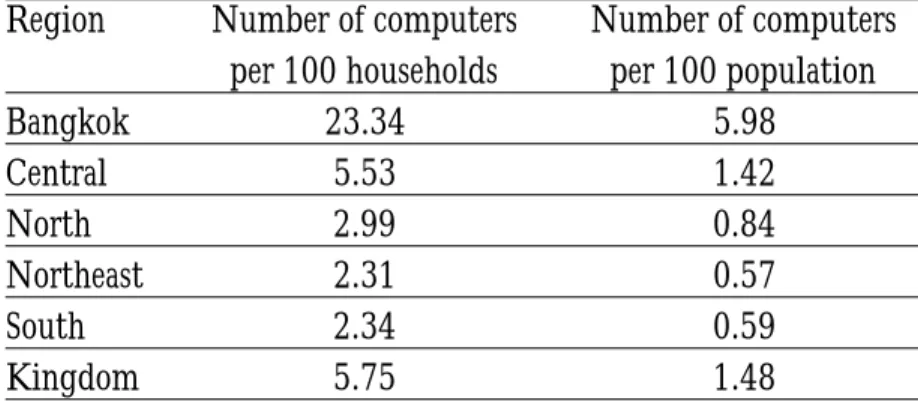
A National Statistics Office (NSO) survey in 2001 indicates that on average, every 100 households possess 5.75 computers. In terms of the population, the computer availability is 1.48 computers per 100 people. Table 1.2 presents the distribution of households owning computers in different regions. The majority of households with computers are in Bangkok. The proportion of households having computers in Bangkok is four times as many as that in the central region and ten times more than that in the other regions.
Table 1.2: Proportion of Households and Population with Computers in Thailand in 2001
Region Number of computers Number of computers
per 100 households per 100 population
Bangkok 23.34 5.98 Central 5.53 1.42 North 2.99 0.84 Northeast 2.31 0.57 South 2.34 0.59 Kingdom 5.75 1.48
Source: The National Statistics Office (2001)
The NSO survey also includes use of the Internet. The total number of Internet users in Thailand was 3.5 million in 2001. The user rate is 5.64 persons per 100 people. The highest rate is found in Bangkok (16 persons per 100 people), followed by the central region (5.85), the South (4.72), the North (4.57) and the Northeast (2.64). The number of people living in Bangkok who are connected to the Internet is three to six times larger than in other areas. In comparison with computer possession, more people can access the Internet and the gap in Internet utilization is smaller. This means that the availability of computers is not an obstacle in accessing the Internet. This is in part due to the Government’s ICT policy in making the Internet accessible to the public. Through the Internet, ICT diffusion can be evenly expanded in Thailand.
The NSO report also characterizes Internet users. The majority of the users (66 percent) are young (aged 15-29); average age is 22 years. A third of the users have a university Bachelor’s degree. Employed persons and students are the two major groups classified by the users’ work status. Private employees (46.2 percent) access the Internet more than public employees (28.8 percent) and home Internet users (9.7 percent). The Internet accessibility is biased to the young, educated and working population. A poor Internet diffusion makes the middle and older age groups, poorly educated persons and the unemployed become ICT-disadvantaged groups.
1.3 ICT Professional Classification in Thailand
There are two major surveys of ICT workers in Thailand. The first was conducted by Durungawarol et al. in 1993. It reports finding 22,450 ICT workers. Three quarters of them were employed in the private sector. The rest were more or less evenly divided between the public sector and state enterprises (Table 1.3). The second survey was conducted by Puntasen et al. in 2001. By then, it seemed clear that the ICT revolution had brought about a considerable rise in the number of ICT workers. A total of 77,816 ICT employees were found, representing an increase of 350 percent in eight years. The private sector and state enterprises had a declining growth rate, whereas the public sector had a rising rate.
Table 1.3: ICT Workers in Thailand in 1993 and 2001 Sector Year 1993* 2001** Public 2,960 (13%) 19,647 (25%) State enterprises 2,733 (12%) 6,925 (9%) Private 16,757 (75%) 51,244 (66%) Total 22,450 (100%) 77,816 (100%)
Sources: * Durungawarol et al. (1995) and ** Puntasen et al. (2001)
A breakdown of ICT personnel by job classification is shown in Figure 1.1. The majority of the ICT professionals are software personnel. This reflects a rapid growth in the software industry. Service and support personnel is the second largest group, though it slightly declined in total numbers between the two survey periods. Similar findings were found of hardware and management personnel.
Figure 1.1: ICT Personnel by Job Classification in 1993 and 2001
Sources: Adapted from Durungawarol et al. (1995) and Puntasen et al. (2001)
Most of the ICT workforce holds a university Bachelor’s degree. The increase of Bachelor’s degree graduates went from 56.31 percent in 1993 to 70.87 percent in 2001. This is a result of more academic institutions offering IT courses with Bachelor’s degrees. Therefore, workers and students with diploma certificates can readily go onto graduate study, hence a remarkable drop in the share of workers with diploma certificates in 2001 (17 percent). However, workers with a postgraduate degree in the two surveys changes only by 2 percent.
The majority of the ICT personnel (38.04 percent) have a limited period of work experience of one to three years. It is followed by those with four to six years of experience (22.07 percent) and those with more than ten years (16.12 percent). Thailand’s ICT industry didn’t really begin establishing itself until 1993, which explains the limited experience rates of personnel. A young age group (25-34 years) dominates the ICT workforce. The second largest age group ranges between 35 and 44 years old. As the ICT industry requires creativity, devotion and effort, younger people are more likely to be attracted.
A large number of ICT personnel work in the services sector (34.2 percent). The public sector employs 25.2 percent of the total ICT workers. ICT firms hire one fifth of them. The service and the public sectors are two leaders in developing themselves by means of ICT. In comparison, ICT hardly makes its way into the agriculture sector.
The earnings of ICT personnel in 2001 were based on years of work experience, educational attainment and gender (Table1.4). Higher levels of education and longer periods of work experience contribute to higher income earnings. The gap in income broadens between workers with a Bachelor’s degree and those with a diploma certificate, even when work experience rises. Females earn a little higher income than males in the first five years of working. The reverse is true for the rest of their working life (based on the calculation in Table 1.4). This is due to the effect of a longer period of males’ working life in this occupation. Also, it might be explained by a discrimination against females who are hardly promoted to higher-paying positions.
Table 1.4: Estimated Income Earnings of ICT Personnel with Respect to Years of Experience, Educational Attainment and Gender, in 2001
unit: baht per month Years of Diploma Bachelor’s degree Post-graduate Female Male experience 1 9,951 12,322 15,078 12,528 11,877 2 10,413 13,291 16,249 13,487 12,931 3 10,897 14,337 17,511 14,520 14,079 4 11,404 15,466 18,872 15,631 15,329 5 11,934 16,683 20,337 16,827 16,689 6 12,489 17,995 21,917 18,115 18,170 7 13,070 19,412 23,619 19,502 19,783 8 13,677 20,939 25,454 20,994 21,539 9 14,313 22,587 27,431 22,601 23,450 10 14,978 24,364 29,561 24,331 25,531 11 15,675 26,281 31,857 26,193 27,797 12 16,403 28,350 34,332 28,198 30,264 13 17,166 30,580 36,998 30,356 32,950 14 17,964 32,987 39,872 32,679 35,874 15 18,799 35,583 42,969 35,180 39,058 16 19,673 38,383 46,306 37,873 42,524
Table 1.4: Estimated Income Earnings of ICT Personnel with Respect to Years of Experience, Educational Attainment and Gender, in 2001 (continued)
unit: baht per month Years of Diploma Bachelor’s degree Post-graduate Female Male experience 17 20,587 41,403 49,903 40,772 46,298 18 21,544 44,661 53,779 43,892 50,407 19 22,546 48,176 57,956 47,252 54,881 20 23,594 51,967 62,457 50,868 59,752 21 24,691 56,056 67,308 54,761 65,054 22 25,838 60,467 72,536 58,953 70,828 23 27,039 65,225 78,170 63,465 77,114 24 28,296 70,358 84,241 68,322 83,958 25 29,612 75,895 90,784 73,551 91,409 26 30,988 81,867 97,835 79,181 99,521 27 32,429 88,309 105,434 85,241 108,354 28 33,936 95,258 113,623 91,765 117,970 29 35,514 102,754 112,449 98,788 128,440 30 37,165 110,840 131,959 106,349 139,839
Source: Puntasen et al. (2001)
2. ESTIMATE OF THE DEMAND FOR ICT MANPOWER 2.1 Estimate of the Demand for ICT in the Past
Durungwarol et al. (1995) were the first to estimate the demand for ICT manpower in Thailand using relevant data collected in 1993. According to their experience, no such estimation methods are perfect. Weaknesses of an estimation method can be taken into account and rectified by another. Therefore, their forecast is a result of combining the demand-pull and the supply-push methods. The former determines the manpower demand depending upon the expansion of the economy. It is appropriate for a short-term prediction (one to two years), as technology and production structures do not alter significantly. The method is unable to incorporate rapid changes incurred by ongoing ICT advancements. The latter derives the manpower requirement from the desirable growth and direction of the economy. It can reflect a longer-term prediction as a result of interventions and
measures launched to achieve the economic targets set by policy makers. Though it can deal with the unforeseen effects of ICT progressiveness, the predicted result is not founded on the actual condition and capacity of the economy.
Three major steps were taken in forecasting the ICT-manpower demand for the period 1996-2001:
1. A “country modelling approach” was employed to match a foreign economy taking the lead in the ICT development for Thailand. A desirable course of the future development is selected on the basis of a similar ratio of capital to labour in different periods.
2. A “manpower requirement approach” was used to estimate the number of workers in the ICT sector. It consists of two related conditions. The proportion of the workers with demanded skills (Lij) is constant to all the workers (Li) in the ICT sector.
And the total employment in the ICT industry varies directly with the value added of the industry (Vi). It is necessary to realize these two conditions from a foreign economy identified in the previous step. The multiplication of the two figures gives rise to an appropriate ratio of the workers demanded to the industrial value. By multiplying the predicted industrial value added in Thailand to the ratio, the demand for the workers can be obtained. The procedure described in this step can be specified in the following formula:
where Lij = the demand for workers with certain skills Li = the demand for all workers in the ICT industry Vi = the value added of the ICT industry
3. The estimated results are further refined by means of experts’ opinions. The study by Durungwarol et al. study finds that the ratio of capital to labour in Singapore in 1980-1984 resembles that in Thailand in 1986-1990. This means that the Thai ICT industry lagged behind Singapore by six years. To estimate the future demand for ICT workers, two scenarios are applied: One is that Thailand becomes a centre of ICT development in Southeast Asia. The other is that Thailand becomes a centre of ICT production in Southeast Asia. In the second scenario, the computation is based on the value added of the electronics industry, including electrical appliances.
Figures 2.1 and 2.2 present the estimated demand for ICT workers in 1994-2001. More ICT workers would be demanded in a case of Thailand being a centre of ICT development in the region. The rate of the increase in the demand enabling Thailand to lead regional ICT development declines from 15.5 percent in 1995 to 11.5 percent in 2001. But the demand to sustain the regional ICT production grows more or less 12-13 percent over the same period. A significant difference between the two scenarios rests upon the educational attainment of workers. A move toward Thailand becoming the centre of the regional ICT development requires more workers with a Bachelor’s degree. That is, workers with a Bachelor’s degree, a higher diploma certificate and a lower diploma certificate are needed in a proportion of 1:0.5:0.1. On the other hand, the opposite is true in making Thailand the centre of the regional ICT production. The proportion becomes 1:1.5:5. It reflects the fact that workers with higher skills and better education are indispensable for striving for the centre of the regional ICT development.
Figure 2.1: Estimated Demand for ICT Manpower in 1994-2001, Based on a Scenario That Thailand Becomes a Centre of ICT Development in Southeast Asia
Source: Durungwarol et al. (1995)
Figure 2.2: Estimated Demand for ICT Manpower in 1994-2001, Based on a Scenario That Thailand Becomes a Centre of ICT Production in Southeast Asia
2.2 Estimate of the Demand for ICT Manpower in 2002-2006
Puntasen et al. (2001) obviously separate the demand estimation based on actual data of the employment from that based on scenarios of the desirable economic growth. Their study starts by distinguishing the ICT employment into public and private categories. The ICT employment in the public sector is affected by two contrasting policies: On one hand, the Government has long contained and reduced the size of the public employees. On the other, policies on reforming and modernizing the bureaucratic system by means of the ICT investment require more ICT employees. As a result, the proportion of ICT workers to the total public workforce keeps rising. It is assumed that the proportion increases from 8.5 per 1,000 employees in 2002 to 9.2 in 2006. The demand for ICT workers in the public sector then goes up from 20,032 persons in 2002 to 21,649 in 2006.
The estimation of the demand in the public sector consists of three steps: First, a model of the demand for labour is used to measure some major economic variables on the demand for labour in the Thai economy. The model is specified as follows:
ln(EM)t = a+bln(Yt) + cln(Wt) + dln(Rt) + eln(Ot)
where ln = natural logarithm
EM = employees demanded
Y = natural income at constant price
W = real wage rate
R = real interest rate
O = oil price
a = a constant
b - e = coefficients
t = year t
The equation is calculated by the least-square regression method with the data collected between 1987 and 2000. In the step second, four independent variables are given values for the period 2002-2006: Oil price is constant at US$28 per barrel over the period; real interest rate is 8.25 percent; real wage rate remains equal to marginal productivity (the marginal productivity of the
agriculture sector and the rest is 0.5 and 2.5); and national income expands at a rate of 4 percent per annum.
In the final step, employment in the ICT sector is computed by multiplying the share of ICT employment in the total employment to the result obtained in the previous step. Considering the different growth rates of ICT in various economic sectors, the estimation is made for three sectors with different growth rates of demand for ICT labour: The primary sector consisting of agriculture, fishery, mining and quarrying is assumed to employ 4 more ICT persons per 10,000 each year. The growth rate for the secondary sector, which includes manufacturing, public utility and construction, is 8 per 10,000. The ICT employment in the tertiary sector, covering most services such as money and banking, wholesale-retail trading, real estate, transportation and communications, IT, medical and personal services, demands 16 additional ICT workers for every 10,000 employees annually.
Table 2.1 presents the total demand as well as the demand in each sector. A total of 92,091 ICT workers are demanded in 2002 and 156,546 in 2006. Not only does the tertiary sector take the largest share, but it also gains the highest increasing growth rate. Over that same period, the share in the public sector is on the decline with a maximum fall of 9 percent.
Table 2.1: Estimated Demand for ICT Manpower in 2002-2006, Classified by Economic Sector
Economic sector Year
2002 2003 2004 2005 2006 Primary sector1) 1,277 1,461 1,642 1,819 1,991 Secondary sector2) 17,246 20,919 24,743 28,734 32,855 Tertiary sector3) 53,536 64,187 75,460 87,368 100,060 Public sector 20,032 20,425 20,825 21,233 21,640 Total 92,091 106,992 122,670 139,154 156,546
Notes: 1) Primary sector involves agriculture, fishery, mining and quarrying. 2) Secondary sector involves manufacturing, public utility and construction.
3) Tertiary sector involves money and banking, wholesale-retail trading, real estate, transportation and communication, IT services, medical and personal services.
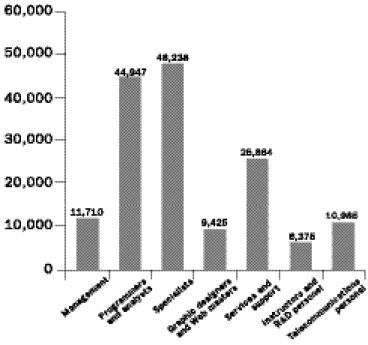
The demand according to major ICT jobs in 2006 is analyzed by supplementary information obtained from survey (Figure 2.3). Specialists will be in great demand (48,238 persons), followed by programmers and analysts (44,947) and then services and support personnel (25,864).
Figure 2.3: Estimated Demand for ICT Manpower in 2006 by Job Classification
Source: Puntasen et al. (2001)
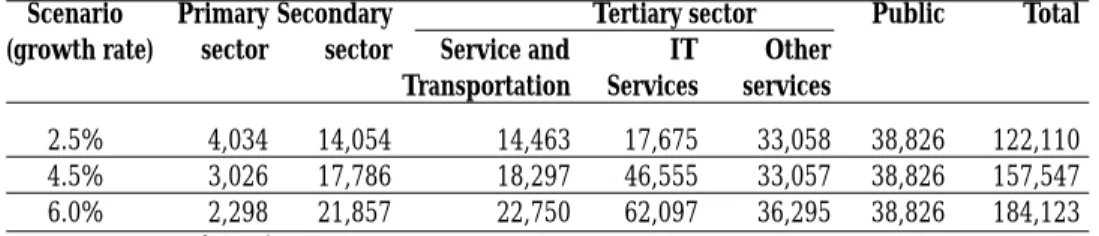
The study by Puntasen et al. offers three scenarios representing desirable and possible courses of the Thai economy: According to the Ninth National Economic and Social Development Plan, a sufficiency economy becomes a principal development strategy. It plays down ICT and lowers the economic growth to 2.5 percent per year. But the current Government favours ICT and supports building a knowledge-based economy. In this case, the economy can expand at a rate of 6 percent per year. It is also likely that a compromise between the two brings about an economic growth of 4.5 percent per year. Table 2.2 shows the demand in 2006 for the three different scenarios. A sufficiency economy needs a minimum of 122,110 ICT workers. The demand in a KBE amounts to 184,123. A moderate economy, the baseline scenario of the study, requires a total of 157,547 ICT workers.
Table 2.2: Demand for ICT Workers in 2006 for Three Scenarios
Scenario Primary Secondary Tertiary sector Public Total (growth rate) sector sector Service and IT Other
Transportation Services services
2.5% 4,034 14,054 14,463 17,675 33,058 38,826 122,110
4.5% 3,026 17,786 18,297 46,555 33,057 38,826 157,547
6.0% 2,298 21,857 22,750 62,097 36,295 38,826 184,123
Source: Puntasen et al. (2001)
2.3 Factors Affecting the Estimated Demand for ICT Manpower
The two demand studies reviewed here are highly concerned with quantitative analysis. It is possible that some factors not taken into account in the forecast exercises could cause the actual demand for ICT workforce in the future to deviate from the estimated. This section discusses the susceptibility of the forecast demand to four crucial factors. These factors are identified and their impacts assessed on the future demand by the ICT experts in the study by Puntasen et al. (2001).
1. More ICT public projects are added to strengthen the ICT policies. The Government aims to install Internet access in every sub-district by 2005. Financial support is made available for getting the “One Tambon One Product” commodities transacted through e-commerce. The tourism industry is encouraged to use the e-tourism strategy to raise its added value and efficiency. A huge investment is granted to improve the information system of the public health sector to support the implementation of the universal coverage of health insurance. All of these projects lead to a higher demand for ICT workers and hence, the estimated demand is likely to be understated.
2. ICT undergoes an accelerating rate of change. Innovations happen in a short length of time so that existing skills become obsolete very q u i c k l y. Therefore, the skills rather than the number of ICT workers are of importance. The estimated demand does not reflect skills needed.
3. The models predicting the future demand does not take account of external factors, such as competitiveness with other countries and trade liberalization in the ICT sector. The competitiveness issue is elaborated in detail in Section 6. A flow of external impacts undoubtedly does more harm than good to the ICT employment in Thailand. Eventually, they diminish the demand for Thai ICT workers.
4. With public debts in Thailand amounting to 70 percent of GDP, it is difficult for the Government to make a substantial investment in ICT projects as claimed. A cut in the Government’s ICT spending and purchases can certainly lower the demand for ICT workers in the private sector. The predicted demand could be over-estimated.
As the effects owing to the four factors are formidable to quantity, the consideration can only point to the uncertainty inherent in the estimated demand. Since it is unlikely that all four factors occur simultaneously, the actual demand will fluctuate over time.
3. THE SUPPLY OF ICT MANPOWER 3.1 The Supply of ICT Manpower in the Past
There are four key types of public academic institutes responsible for offering ICT courses and degrees. First, universities, both private and public ones under the supervision of the Ministry of University Affairs, provide mainly Bachelor’s degrees and post-graduate degrees. They offer the following six ICT-related areas of study: computer engineering, applied computer, electronics, telecommunications, information technology and statistics.
Second, Rajamangala Institute of Technology, a public institution under the supervision of the Ministry of Education, includes 12 campuses in Bangkok and 22 campuses in other provinces. It renders higher diploma certificates and Bachelor’s degrees. Its four ICT-related training courses include computer engineering, applied computer, electronics and information technology.
Third, Rajabhat Institute is a public institution under the Ministry of Education with a large number of campuses situated in almost every province
in Thailand. Electronics, computer studies and computer management are available, leading to a higher diploma certificate for two years of study and a bachelor's degree for four years of study.
Finally, the Department of Vocational Education offers two ICT-related courses: electronics and applied computer. To earn a higher diploma certificate and a bachelor’s degree requires two and four years of study, respectively.
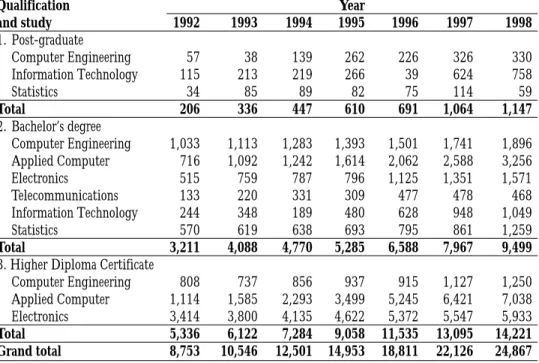
The total number of graduates in ICT-related studies from the four sources between 1992 and 1998 is shown in Table 3.1. The number of graduates with all sorts of qualifications rose steadily from 8,753 in 1992 to 24,867 in 1998. Graduates with higher diploma certificate take the largest share (about 60 percent), followed by those with a Bachelor’s degree (37 percent) and those with a post-graduate degree (3 percent). It should be noted that graduates with ICT-related qualifications from private colleges are excluded. The reason for this is that their numbers are small relative to the total each year. More importantly, their skills are of poor quality compared with those graduated from the four established institutions.
Table 3.1: Number of Graduates with ICT-Related Studies and Qualifications Between 1992 and 1998
Qualification Year and study 1992 1993 1994 1995 1996 1997 1998 1. Post-graduate Computer Engineering 57 38 139 262 226 326 330 Information Technology 115 213 219 266 39 624 758 Statistics 34 85 89 82 75 114 59 Total 206 336 447 610 691 1,064 1,147 2. Bachelor’s degree Computer Engineering 1,033 1,113 1,283 1,393 1,501 1,741 1,896 Applied Computer 716 1,092 1,242 1,614 2,062 2,588 3,256 Electronics 515 759 787 796 1,125 1,351 1,571 Telecommunications 133 220 331 309 477 478 468 Information Technology 244 348 189 480 628 948 1,049 Statistics 570 619 638 693 795 861 1,259 Total 3,211 4,088 4,770 5,285 6,588 7,967 9,499
3. Higher Diploma Certificate
Computer Engineering 808 737 856 937 915 1,127 1,250
Applied Computer 1,114 1,585 2,293 3,499 5,245 6,421 7,038
Electronics 3,414 3,800 4,135 4,622 5,372 5,547 5,933
Total 5,336 6,122 7,284 9,058 11,535 13,095 14,221 Grand total 8,753 10,546 12,501 14,953 18,811 22,126 24,867
3.2 Estimation of the Supply of ICT Manpower in 2002-2006
Puntasen et al. (2001) estimate the number of graduates with ICT-related qualifications entering the labour market. The estimation method consists of three major steps: First, the association between the total number of graduates from lower and upper secondary schools and national income is analyzed by means of least-square regression. The expected national income in 2002-2006 is employed to predict the total number of the future graduates.
Second, the number is adjusted with those going on to further study. The transition rate of lower secondary students to higher education levels is assumed to be 46 percent for vocational education and 53 percent for general education while that of upper secondary students to higher education levels is 60 percent. The figures obtained from this step are the number of graduates with a Bachelor’s degree or a higher diploma certificate.
Third, the number of graduates in science and technology (S&T) studies is obtained by multiplying the ratio of the S&T graduates to the total graduates by the predicted number of all graduates. The ratio is supposed to be 0.275: 1. The number of graduates in ICT-related studies is realized in the similar man-ner. The ratio of 0.29 ICT-related graduates to one S&T graduate is multiplied to the total S&T graduates predicted in 2002. Higher ratios are utilized for each successive year to take into account the plans of most academic institutions to offer more ICT courses over the period. The ratio in 2006 will be 0.4 ICT-related graduates to one S&T graduate.
Table 3.2 presents the estimated number of graduates with ICT qualification entering the labour market in 2002-2006. The number of graduates with a Bachelor’s degree increases from 100,552 in 2002 to 186,431 in 2006, while those with a higher diploma certificate increases from 128,062 to 255,690. Although numerical difference between the two types of graduates increases over time, their proportion remains unchanged.
Table 3.2: Predicted Number of Graduates with ICT Qualification in 2002-2006
Year Higher diploma Bachelor's degree Total Certificate and higher
2002 128,062 100,552 228,614
2003 154,839 118,551 273,390
2004 184,733 138,614 323,347
2005 218,229 161,136 379,365
2006 255,690 186,431 442,121
Source: Puntasen et al. (2001)
3.3 Factors Affecting the Estimated Supply of ICT Manpower
The number of ICT-related graduates is not a supply of effective ICT manpower. This is because graduates, as well as existing workers, can leave the ICT workforce for a variety of reasons. Some ICT employees and graduates quit their working life due to death, immigrating to foreign countries, becoming housewives or househusbands. Some choose to work in non-ICT sectors. Their ICT skills are of no use. Some have inadequate or poor ICT skills so that they cannot secure ICT positions as wanted. In other words, their skills are obsolete or incompatible with the rapidly changing needs of the ICT market. Though they are retained in the ICT sector, their jobs are almost unrelated to their skills. All of these cases are no longer considered a supply of ICT workers and thus have to be subtracted from the estimated number of graduates.
Puntasen et al. (2001) assign the share of each group. A combination of ICT workers leaving the ICT sector accounts for 10 percent of the total supply. Those unable to use their ICT skills amount to 20 percent. Table 3.3 indicates the supply of ICT workers with a Bachelor’s degree after being adjusted with these factors. The effective supply increases from 70,386 in 2002 to 130,502 in 2006.
Table 3.3: The Effective Supply of ICT Workers with a Bachelor’s Degree in 2002-2006
Year Not adjusted Adjusted down Adjusted down by by 10% another 20% 2002 100,552 90,497 70,386 2003 118,551 106,696 82,986 2004 138,614 124,753 97,030 2005 161,136 145,022 112,795 2006 186,431 167,788 130,502
Source: Puntasen et al. (2001)
The productive supply can be higher through on-the-job training. It has an effect only on the last group. Their skills become updated by additional appropriate training. A survey of 192 firms in Puntasen et al. (2001) points out that 47.9 percent of the firms in the sample provide ICT training to their employees in order to make their skills usable. Each trainee acquires two to three training sessions a year. Programmers and specialists take the largest shares of the training opportunity (Table 3.4). Most training sessions last three months (36.7 percent) or one week (35.2 percent). The remaining 28.1 percent are those lasting between one week and three months. Training investment by employers is aimed at young employees (four to five years of experience) (Table 3.5).
Table 3.4: Shares of Training Opportunities by Job Classification
Job classification Percent
Management 2.3
Programmer 37.9
Specialist 37.4
Web & graphic designer 6.5
Service and support 4.7
Telecommunications 6.1
Others 5.2
Total 100.0
Table 3.5: Percentage of Training Opportunities Classified by Years of Experience in Major ICT Jobs
Years of experience (%)
Job Before starting After working After working Total the job for 1-5 year more than
5 years
Management 0.0 25.0 75.0 100.0
Programmer 8.5 59.3 32.2 100.0
Specialist 12.7 68.3 19.0 100.0
Web & graphic designer 18.2 72.7 9.1 100.0
Service and support 0.0 87.5 12.5 100.0
Telecommunications 0.0 85.7 14.3 100.0
Others 14.3 42.9 42.8 100.0
Average 10.9 62.6 26.5 100.0
Source: Puntasen et al. (2001)
The training can keep in the supply of existing workers and newcomers with ICT skills that are compatible with the market demand. It is difficult to evaluate the number of ICT workers saved due to the training. It is suggestive of the underestimation of the supply forecast on the condition of the huge investment being made for ICT skills training.
4. AN ANALYSIS OF THE MISMATCH BETWEEN THE DEMAND FOR AND THE SUPPLY OF ICT MANPOWER
4.1 The Shortage of ICT Manpower
The demand and supply estimations in the two previous sections determine the balance of ICT employment. Table 4.1 indicates that a deficit of qualified ICT workers has long taken place. If the trend continues, there will be a shortage of 26,044 workers in 2006. An increase in the number of graduates with a Bachelor’s degree is the only way to alleviate the scarcity. Although recognizing their responsibility for the generation of more ICT qualified workers, academic institutions currently play a passive role.
Table 4.1: Comparison Between the Demand and Supply of ICT Manpower in 1994-2006
Year Demand Supply Balance
(+ = surplus, - = deficit) 1994 32,544* 12,501 -20,043 1995 37,217* 14,953 -22,264 1996 42,293* 18,811 -23,482 1997 47,692* 22,126 -25,566 1998 53,517* 24,867 -28,650 1999 59,928* N.A. N.A. 2000 67,072* N.A. N.A. 2001 74,640* N.A. N.A. 2002 92,091 70,386** -21,705 2003 106,992 82,986** -24,006 2004 122,670 97,030** -25,640 2005 139,154 112,795** -26,359 2006 156,546 130,502** -26,044
Notes: * An average of the estimated demand from two scenarios. ** The supply of workers with a bachelor’s degree and higher. N.A. = not available
Sources: Durungawarol et al. (1995) and Puntasen et al. (2001)
In a meeting with the National Information Technology Committee in August 2001, leading ICT business owners suggested several measures that respond to the shortage of ICT qualified manpower. They explained that additional ICT workers needed to overcome the shortage are viewed in three categories: The first group consists of those with high and sophisticated ICT skills. Courses providing such skills are available at post-graduate levels of universities with high standards. To make the best use of learning, the private sector should participate in designing appropriate curricula for the courses offered by domestic universities. Since few domestic universities can offer such courses and since the learning process is usually time-consuming, foreigners with those skills should be imported to fill job vacancies. To facilitate them, there could be a temporary relaxing of immigration rules and regulations. Foreign ICT experts would be expected to transfer skills to Thai colleagues. After the former leave Thailand, the latter can be competent substitutes.
The second group involves those with moderate and advance ICT skills. Normally, most domestic universities can produce graduates with such skills at the Bachelor’s degree level. Their desirable characteristics are up-to-date with
modern and changing ICT and compatible with the needs of the current market. As the number and capacity of domestic universities available are fixed, the number of ICT workers in this group is kept constant.
The last group involves those with basic and general ICT skills. Such skills can be trained in a short period. The most appropriate trainees are graduates in non-ICT studies with at least a Bachelor’s degree. The businessmen suggested that a dual programme practiced in India can be applicable to Thailand. That is, non-ICT students can learn ICT courses in evening classes. After graduation, they are skilled ICT workers. This approach can save the training duration and reduce the burden of the employers having to arrange their own training.
The NITC and businessmen arrived at the conclusion that within five years (by 2006), the extra numbers within the three groups to keep up with the great demand will be around 50,000 people. It can be divided into 10,000 for the first group, 15,000 for the second and 25,000 for the last. The key to implementing the proposals is the availability and capability of instructors in ICT courses at domestic universities. The lack of able instructors persists because universities lose them to the business sector. Adjusting university salaries to compete against the private sector is a solution to the problem. The instructors can become efficient with their teaching time and effort by developing courseware. The availability of courseware not only lowers the demand for the instructors but also increases their income earnings. A major obstacle in implementing this idea involves the issue of intellectual property rights over the courseware between the instructors and the funding agency, as well as the protection of rights violation by third parties.
4.2 The Skills Shortage of ICT Manpower
Improvement of skills on a regular basis is widely considered as the way to address the shortage of skills due to the rapid advancements in ICT. Basically, it is a matter of individual firms and organizations as the direct beneficiaries of the action. Motivations initiated by the Government can facilitate skills enhancement across the board. One of the benefits accruing to all of them is to ease off the rapid turnover of workers with demanded skills.
It is recommended that the incentive should include tax reductions to firms providing skills training and the availability of appropriate infrastructure, such as a software park to lower the training expenditure.
The skills shortage partly arises from the limitation of the ICT courses available in domestic academic institutions. Thai universities offer too few courses to perform new ICT tasks. For example, there are six ICT-related studies offered by domestic universities (see Section 3) whereas there are at least 22 core ICT jobs in Thai firms and organizations (Table 4.2). The developments in ICT undoubtedly create new tasks, causing the gap between the two to widen unless correspondent courses emerge. It is vital for academic institutions to keep in touch with the expanding ICT job classifications and expected performance.
Table 4.2: List of 22 Core ICT Jobs in Thai Firms and Organizations 1. IT strategic planner 2. IT project manager 3. Server programmer 4. Client programmer 5. Web programmer 6. System analyst 7. System administrator
8. Data communications specialist 9. Database specialist
10. IT security specialist 11. Quality assurance specialist
12. Information systems audit specialist 13. Systems software support specialist 14. Distributed system specialist 15. System integration specialist 16. Graphic designer
17. Web designer and Webmaster
18. Telecommunications network technical management 19. Telecommunications traffic engineer
20. Telecommunications protocol engineer 21. Telecommunications network designer
Some ICT businesspeople believe that skills improvement can be achieved if the Government stops importing computer programs from abroad and starts purchasing them from domestic software firms. The Government’s software procurement spending each year is worthy of local ICT firms’ investment in skills enhancement training.
The private sector is proposing the creation of an information system on ICT manpower in Thailand. The system requires cooperation between the public and private sectors. Profiles of ICT workers are useful in analyzing and planning the investment in skills improvement projects by both sectors. Therefore, the training investment is worthwhile in producing appropriate and desirable skills to targeted ICT persons. Moreover, available and accessible information makes the pay comparable to the performance. Hence, the parity of the payment can stop the brain-drain from the public sector to the private one, as well as the rapid turnover within the private sector.
4.3 Strategies to Alleviate the ICT Manpower Shortage
Sripaipan et al. (1997) surveyed 15 large ICT companies. Most firms rated high on the personnel problem, especially the recruitment of able persons. It is difficult to retain employees because of higher salaries offered elsewhere. Some companies offer training as an incentive. Almost all firms faced a shortage of skilled ICT staff.
Most computer hardware firms are joint ventures with foreign companies. Their human resources development is based on a combination of sending their staff to train in the foreign companies’ headquarters, inviting trainers from overseas to train Thai staff and organizing seminars and study-tours abroad. On the contrary, the majority of computer software firms are Thai owned. Trainings is their only means to improving the skills of their staff. They depend heavily on academic institutions to train their staff. Few firms can afford such an incentive as paying for training overseas. Therefore, the shortage of skilled workers is more often found in computer software companies than in hardware ones.
Public universities are unlikely to be responsive to the shortage of the ICT manpower. They are restricted by rules and regulations. More importantly, it takes time to get approval to launch a new course. The bureaucracy reform allows public universities to opt out of the bureaucratic system. They can become autonomous universities, which gives them more flexibility in their planning and operations, including offering new ICT courses. However, the number of public universities deciding to opt out is small so far. Those planning to do so are encountering resistance. All in all, public universities cannot be held accountable for the shortages of the qualified ICT manpower in the near future.
5. THE GOVERNMENT POLICIES TOWARD ICT MANPOWER DEVELOPMENT
5.1 The National ICT Policy
T h a i l a n d ’s first national ICT policy (IT-2000) materialized in 1996. It contained strategies and approaches to developing and promoting the availability, utilization and production of ICT in Thailand during 1996-2000. The plan specified three major tasks to accomplish:
1. An investment in ICT infrastructure aims at allocating ICT services evenly to every part of the country, in particular to remote rural areas. The existing long distance telephone service is a key to the infrastructure building. The success of this task can close the gap of the digital divide.
2. An investment in ICT education accelerates the rise in ICT skills among the Thai labour force. It can generate more knowledge workers in various occupations.
3. An investment in ICT for good governance in the public sector encourages public agencies to use ICT in improving their service delivery and productivity.
Although the first national ICT policy failed to produce tangible results, it stimulated the high- and middle-income groups’ interest in the ICT issue. Two factors are responsible for the failure of the policy: First, the economic
crisis in 1997 forced the Government to abandon a number of ICT-investment projects. Second, the policy played down the role of the private sector. The potential of the private sector, therefore, was not fully exploited.
The second national ICT policy was drawn up by the National Information Technology Committee. The ICT master plan, covering the period of 2002-2006, targets improvement in ICT infrastructure to support the industry and commerce sectors, the increase in transparency and efficiency in the public sectors and the preparation for Thailand to enter the KBE. It relies on the following seven crucial strategies:
1. The ICT industry will develop into a leading entity in the region. 2. ICT will be used to improve the quality of life of Thai people. 3. Research and development of ICT must be reformed.
4. ICT literacy of Thai people will be enhanced as a means of competition with other countries. (It should be noted that this strategy is in common with that of the new education reform).
5. Entrepreneurs will be adequately equipped with ICT in order to extend their foreign market.
6. Small and medium enterprises will be encouraged to use ICT in their production and marketing practices.
7. The public sector will use ICT in the management and service provision.
All of these strategies require an adequate number of qualified ICT persons. A crucial note is that it is necessary to adapt ICT that has been developed abroad to be compatible with the Thai economic and social settings. These challenges have not been addressed in the plan at all.
The Ninth National Economic and Social Development Plan outlines the development and application of ICT during 2002-2006. At the macro level, ICT is utilized to support economic stabilization and enhance international competitiveness. At the micro level, ICT is employed to restructure industries and promote the quality of life. Industries can raise their production efficiency, the quality of goods and services and the share of local contents (including local knowledge and wisdom). The quality of life improves as a result of a more equitable accessibility to ICT and the adaptation of ICT to comply with the Thai way of living.
5.2 The Policy on ICT Supply-Side Management
Infrastructure is fundamental to expansion in the ICT sector. During the past five years, the private and public sectors together have invested hundreds of billions of baht in a variety of ICT infrastructure projects. There are three types of ICT infrastructure underlying the ICT manpower development:
1) Information networks are important to skills enhancement and knowledge dissemination. Specific networks are available to maximize their utilization. For instance, the Government has established GINet for the public sector, ThaiSARN for academics, SchoolNet for schools and EDI for international traders. The Government aims to achieve a universal networking service at an affordable price. That ultimate goal will no doubt contribute to a lower cost of ICT manpower development.
2) Apart from doing basic research for the commercial sector and experimenting with pilot projects, public research institutions are one of the major ICT-manpower development sources for private industries. At the moment, NECTEC is the only one; it was set up to meet these objectives in the ICT sector. In view of its importance, the Government is considering creating a National Interactive Multimedia Institute to be a specialized ICT research house.
3) A software park provides facilities and environment needed to support private ICT firms to operate efficiently. It is suggested that the software park can better serve the ICT human resources development by offering more services from the availability of the information centre, a centre for testing and inspecting software, a centre for testing telecommunications and so on. A further step is to create a virtual software park in order to provide services needed via the Internet. The Government plans to establish Thailand’s Information Technology Zone (ITZ), a joint project by the public and private sectors, in Chiang Mai. It will be surrounded by a science park, a software park, Chiang Mai University, a new airport and a new government complex. It will play a vital role in developing ICT manpower in the North.
Financial incentives offered by the Government have been a major instrument to induce the private sector to develop the quality of their workers. The incentives are divided into four categories:
1) Direct and indirect taxes are exempted to activities related to skills development and training. The exemption involves a certain amount of tax-free corporate income, higher depreciation rates on equipment and instruments, lower tariffs for imported items and so on. Such measures prevail for ten years and are applied indiscriminately to every sector, including ICT.
2) Long-term loans with low interest rate are made available to private S&T firms in facilitating technology transfers, as well as in improving research and development activities. It is so unpopular that during 1987-1995, NSTDA, one of the three principal loan makers, lent only 63.4 million baht to 18 firms.
3) Subsidies in subtle forms. No private firms are subsidized in terms of cash directly from the Government in strengthening their employees’ skills. Instead, a limited number of grants and scholarships are offered to qualified workers in both private and public organizations on a competitive basis for a variety of ICT courses in domestic and foreign academic institutions. In addition, the Government allows private firms to exchange researchers with public agencies to help them in R&D activities for a brief period, free of charge.
4) The Board of Investment extends its promotional privileges to cover technology transfers and skills formation and development. Since the benefit packages are originally designed for the manufacturing sector, ICT firms cannot fully take advantage of them.
In the ICT businessmen’s point of view, existing assistance is inadequate. They ask for more help that is specific to their needs, such as making the tax-deductible rate for expenditure spent on ICT training higher compared to expenditures on other activities. Public agencies should not develop their own computer software programs, but should purchase them from local firms. ICT experts in public universities should be allowed and encouraged to work as consultants to private firms. The Government’s ICT organizations should not compete with private firms to provide ICT services without taking account of
the full costs. More grants and scholarships should be made publicly available. And they should cover more activities, such as seminars and study tours. 5.3 The ICT Education Policy on Human Resources Development For the first time, the ICT policy on education development is explicitly included in the 1999 National Education Act. That law binds the Government to use ICT as a principal means of providing education. There are seven commitments specified in the Act:
1) The State shall distribute frequencies, signal transmission devices and other infrastructure necessary for radio broadcasting, television, telecommunications radio and other media of communication for use in provision of formal, non-formal and informal education and enhancement of religious, artistic and cultural affairs as necessary. 2) The State shall promote and support the production and refinement of
textbooks, reference books, academic books, publications, materials and other technologies for education through acceleration of production capacity; provision of financial subsidy for production and incentives for producers; and development of educational technologies. In so doing, fair competition shall be ensured.
3) Steps shall be taken for personnel development for both producers and users of technologies for education so that they shall have the knowledge, capabilities and skills required for the production and utilization of appropriate, high-quality and efficient technologies. 4) Students shall have the right to develop their capabilities for
utilization of educational technologies as soon as feasible so that they shall have sufficient knowledge and skills in using these technologies for acquiring knowledge themselves on a continuous lifelong basis. 5) The State shall promote research and development and production and
refinement of technologies for education, as well as following-up, checking and evaluating their use to ensure cost-effective and appropriate application to the learning processes of the Thai people.
6) Financial resources shall be mobilized for the establishment of the Technology for Education Development Fund. These resources shall include state subsidies, concession fees and profits from enterprises relating to mass media and information and communications technologies from all sectors concerned, namely, state sector, private sector and other public organizations. Special tariffs shall be charged for the application of these technologies for human and social development. The criteria and procedures for distribution of the Fund for the production, research and development of technologies for education shall be as prescribed in the ministerial regulations.
7) The State shall establish a central unit responsible for proposing policies, plans, promotion and coordination of research, development and utilization of technologies for education, including matters relating to evaluation of the quality and efficiency of the production and application of the technologies for education.
The Office of Information Technology Administration for Educational Development, a division under the former Ministry of University Affairs, is responsible for implementing these tasks in higher education. It plans ICT development through the National Education Network (EdNet). The following are its five major goals:
1) ICT infrastructure development plan
2) Library and learning centre development plan 3) Courseware development plan
4) Human resources development plan
5) International research collaboration development plan
In its human resources development plan, a total of 1,140 persons are required to manage the whole system of EdNet. Training is its principal strategy in developing skills to operate the network. It aims at training 3,000 people for network operation and maintenance and 1,600 people for multimedia courseware production in 2005. The targets achieved can significantly contribute to the supply of qualified ICT workers.
However, reservations are made about putting the Act into practice in general. Suksiriserekul (2002) points out that according to the initial assessment of the Office of Education Reform, six factors are indispensable to a successful implementation of the Act. They involve the full support of the political decision-making bodies, the urgency of enacting relevant laws, the awareness and wide participation of every party in the Thai society, a well preparedness of the implementation, the support of administrators at all levels and the availability of independent monitoring and evaluation organizations. It is required that the Act must be implemented by August 2002. The current Government has shown no sign of eagerly carrying out the Act after that date. For instance, at the time of this writing, the “Technology for Education Development Fund” had not been formed. The inaction in the education reform eventually will become a major obstacle in developing ICT-related human resources.
6. THE INTERNATIONAL COMPETITIVENESS OF THAILAND’S ICT IN THE GLOBAL ECONOMY
6.1 International Competitiveness of Thailand's Computers and Accessories
Thailand has expanded its international transactions on computers and accessories. The value of exports and imports has risen over time (Table 6.1). The balance of trade reached its peak of 236 billion baht in 1998 as a result of the substantial devaluation of the Thai currency. Table 6.2 indicates that Singapore and the United States are Thailand's major export markets, accounting for 42 percent of the total exports in 2001. Thailand imports computers and accessories from four major countries: the United States, China, Malaysia and the Philippines. Their combined shares amounted to 60 percent of total imports in 2001 (Table 6.3).
Table 6.1: Values of Thailand’s Exports and Imports for Computers and Accessories
unit: million baht
Year Export value Import value The trade balance
1996 167,673.9 72,169.2 95,504.7 1997 220,302.7 95,293.4 125,009.3 1998 320,525.6 83,986.6 236,539.0 1999 304,982.2 92,419.2 212,563.0 2000 348,117.4 147,612.0 200,505.4 2001 351,797.3 167,630.6 184,166.7 2002 157,981.2 78,717.2 79,264.0 (Jan-June)
Although Thailand can compete with other countries in exporting ICT products, its competitiveness keeps declining. Table 6.4 shows Thailand’s Revealed Comparative Advantage (RCA) Index on ICT. In 1999, the values ranged between 1.52 and 3.69 in five major markets. Major competitors include Korea, Philippines, Malaysia, Singapore and Taiwan. Since the competition depends heavily on advances in the relevant technology, most countries attempt to have an edge on their competitiveness by developing skills of their manpower and raising the production efficiency.
Table 6.4: Thailand’s Revealed Comparative Advantage Index in Major Foreign Information and Communications Technology
Markets
Foreign ICT Market Year
1996 1997 1998 1999 United States 2.28 2.35 2.56 2.65 Singapore 3.96 3.39 3.11 NA Netherlands 3.75 2.95 1.95 1.96 Japan 2.16 2.01 1.75 1.52 Taiwan 4.90 4.98 4.62 3.69
Notes: 1) NA = “not available”
2) RCA is computed by the following formula:
the export value of ICT products from Thailand to that foreign market the total export value from Thailand to that foreign market the export value of ICT products of the world to that foreign market
the total export value of the world to that foreign market Source: Aussanasuwannakul (2000)
An important factor underlying Thailand’s competitiveness involves the low cost and the use of a higher proportion of local content in the production process. Aussanasuwannakul (2000) estimated the cost structure for the production of computers and accessories in 1999. Raw materials accounted for 57 percent of the total cost. The share of labour costs, depreciation and overhead costs were 14 percent, 14 percent and 15 percent, respectively.
Aussanasuwannakul (2000) identified factors contributing to the competitiveness of Thailand’s computer hardware. Thailand’s world market shares are influenced by GDP per capita of importing countries, the previous year’s world market shares and Thailand’s own economic condition. That is, a rise in the market share is associated with a higher GDP per capita of importing countries, a growing market share of the previous year and a prosperous Thai economy.
An assessment on the competitiveness of Thailand’s local ICT firms by the Institute of Developing Economies and Japan External Trade Organization (IDE-JETRO) (2001) indicates that more foreign investment in ICT industry in Thailand is a result of the expanding domestic demand. An increasing intensity in competition between the local and the foreign firms leads the latter into becoming major producers and suppliers. The domination is fuelled by lower import duties on ICT commodities. Local firms thus take on the ICT service and support activities instead.
6.2 Factors Affecting Thailand’s ICT Competitiveness in the Future The United Nations Economic and Social Committee for Asia and Pacific (ESCAP) (1999) states that a country's competitiveness is no longer determined by the size of capital, land, labour, natural resources and portable technology. The openness and trade liberalization of an economy allow major factors of production and relevant endowment to move in and out swiftly without barriers. Thus, the factors underlying the competitiveness in the future include social and economic institutions as well as governance of a country. It can be concluded that ICT competitiveness can be influenced by the following conditions in an economy:
• Trade liberalization of ICT commodities • Existence of ICT-related laws and enforcement
• Government policy and promotional intervention in the ICT sector • Quantity and quality of ICT manpower
• Research and development in the ICT sector • ICT infrastructure
T h a i l a n d ’s competitiveness should benefit from the adoption the Information Technology Agreement in 1997. Such trade liberalization lowers considerably the effective rate of protection of ICT products. But Thailand has forgone the higher competitiveness due to the unavailability of ICT-related laws. Laws on digital signature, data protection and electronic funds transfer are in the process of being drafted. The legality of written documents, evidential value, documents of title and documents of negotiability is not seriously considered. The Government’s policy and support to the ICT sector is limited. As well, as pointed out in previous sections, Thailand will face a shortage of qualified ICT workers. Research and development in the ICT sector, which is elaborated on in greater detail in the next section, are performed on a limited scale. Apart from the insufficiency of ICT infrastructure mentioned in the previous section, an expensive Internet connection and a regular value-added tax rate imposed on e-commerce transactions weaken foreign investments in the infrastructure. In addition, the widespread violation of computer software property rights is evident. It is noted that the punishment for the violation is mild and the enforcement is relaxed. These undesirable conditions are conducive to the loss of Thailand's ICT competitiveness in future.
6.3 An Empirical Evaluation of Thai ICT Firms’ Competitiveness
Suksiriserekul (2000) surveyed Thai ICT businesses to measure their competitiveness with foreign counterparts. Half the sample involved computer hardware producers. Seventy-two percent of all the businesses are owned by Thais or by a majority of Thai shareholders. A third are large companies with annual revenue of more than 100 million baht; another third have revenue ranging from 10 million baht to 99 million baht; the remaining are small firms with less than 1 million baht.
The survey noted that the factors responsible for the competitiveness include the efficiency of staff, the low cost of doing business, appropriate technology acquisition, annual sales, profit and market share. The competitiveness can increase by improving the skills of the employees, more financial investment and better infrastructure. In tackling the undesirable
conditions affecting the competitiveness, priority was given to research and development enhancement. It is followed by a greater supply of qualified ICT workers, a supportive government policy, improvement of infrastructure, the availability of crucial ICT-related laws and the protection of software property rights.
Strategies used by most ICT companies to have an edge over their competitors are to train their employees to keep up with advances in ICT and new sales techniques. Also, some firms ask for more support from the Government.
7. ISSUES AND PROSPECTS
7.1 ICT Strategies for Thailand’s Knowledge-Based Economy
The National Information Technology Committee Secretariat (2001) defines a knowledge-based economy as one that depends heavily on the application of information and knowledge in the production and distribution of goods and services. The rise in the economic growth and productivity can be enhanced by the advancement of information and knowledge through an extensive investment in research and development, a promotion of education and human resources development and an appropriate change in management approach.
A KBE differs from the old economy in several aspects: It leads to higher productivity. It causes substantial changes and high volatility. Innovation emerges in the organizational structure. Cooperation between different sectors of society, both the public and private, becomes closer and rapid. Information and knowledge play an important role in creating wealth and securing employment. A transition from the old economy to the KBE was at issue during a conference of Asia-Pacific Economic Cooperation (APEC) in Beijing in May 2001. The meeting, entitled “New Economy New Strategy: Cooperation and Innovation to Building Human Capacity for Common Property”, was attended by high-ranking officials and academic and private sector individuals to determine the appropriate direction for human resources development in preparation for entering the KBE. The Thai participants left the meeting with two vital conclusions for developing human resources to support the KBE:
1. As globalization has an immense influence on the development and growth of a KBE, a country needs to strengthen its human resources capacity to encounter uncertainties and unforeseen challenges. Cooperation between member countries is a key to stem the troubles. 2. Human resources are fundamental to keep pace with the development
of a KBE. Educational opportunity and general training for all in a society is essential to improve human resources compatible with changes in a KBE.
Thailand’s preparation for entering the KBE is based on a master plan, covering the first period of 2002-2006. The plan focuses on five major sectors. Coverage and implementation in each sector can be summarized as follows:
1. Information technology in the education sector (e-education) generates information and knowledge to support students’ learning, hence meeting the “student-centred learning” approach. Also, it is supposed to raise Thailand’s competitiveness to compete with other nations. The objectives of e-education can be accomplished by pursuing three tasks:
i. Narrowing the digital divide. It can be made possible by improving ICT-related infrastructure and making computer hardware adequate. Information and knowledge should be made available to all people.
ii. Improving the quality and applicability of information content
and knowledge. Local and national information and knowledge should be improved toward harmony in a common understanding and better living of everyone in the society.
iii. Using science and technology as a vehicle for the generation of new
knowledge. The application of science and technology increases value added to some existing goods and services, and new knowledge can assist in acquiring technology transfers from abroad smoothly and efficiently.
2. Information technology in the society sector (e-society) aims at using information and knowledge to develop society, employment, quality of life, culture and environment. Four strategies are employed to attain the goal:
i. Making digital opportunity available to different groups in the society, especially those in rural areas and disadvantaged groups. Obstacles to the digital opportunity can be overcome by means of decentralization, active participation and civil society.
ii. Establishing a knowledge society with the aid of local wisdom and
application of science and technology. Its evolution is holistic.
iii. Utilizing information and knowledge generated by local
communities, coupled with outside information and knowledge, to enhance quality of life. Selected development approaches to quality of life should be sustainable.
iv. Promoting social networking between economically advantaged
and disadvantaged groups to help society become more caring and sharing. Information and knowledge are likely to broaden people’s views and concepts so as to accept the diversification of norms and culture.
3. Information technology in the commerce sector (e-commerce) supports economic and business transactions via all kinds of electronic means. They include the transactions between suppliers and consumers, between suppliers and between the public sector and entrepreneurs, and between the public agencies and citizens. Five measures are launched to facilitate the trading involved:
i. The Government declares e-commerce as a national trade strategy. It is incorporated into the national economic and social development.
ii. The expansion of e-commerce is encouraged by the Government’s
support. Suppliers and consumers are motivated to promote it through an indirect incentive provided by the public sector. Serious attention is paid to the issues of trust and confidence of using e-commerce.
iii. Entrepreneurs are equipped with e-commerce in raising their
international competitiveness. The focus is on small and medium enterprises.
iv. Some rules and regulations are exempted and abolished to
liberalize e-commerce. The Government turns its attention to fair trade and consumer protection issues.
v. A database regarding e-commerce is developed in cooperation between the public and private sectors. Studies are undertaken to determine suitable choices to safeguard Thailand’s own interest in the world and regional trade negotiations on this matter.
4. Information technology in the industry sector (e-industry) strengthens the production process. Information and knowledge are important inputs to enhance their competitiveness. It requires four main aspects:
i. A national exchange centre for manufacturing commodities is set up. Its functions include the data and information dissemination to all entrepreneurs, online trading and exchange in raw materials and finished products and a matchmaker for potential buyers and sellers. Moreover, a supply-chain management is employed to operate it efficiently.
ii. The smart factory concept is introduced to control the production
process and some logistic tasks.
iii. A market intelligence unit is established. It can facilitate the
transactions between buyers and sellers concerning orders, delivery, after-sales services, warrantees, exports and imports. Also, it can offer examinations of commodity standards and original sources of imported products.
iv. Research and development activities based on the practical
information and data of industries are encouraged. The Government supports industries with promising performance in enlarging their products and marketing.