V. R. F.
Series
[文書の重要な部分を引用して読者の注意を引いたり このスペ スを使 て注目ポイントを強調したりしましょう この
No.504
Oct. 2019
日本貿易振興機構 アジア経済研究所
INSTITUTE OF DEVELOPING ECONOMIES, JAPAN EXTERNAL TRADE ORGANIZATIONThe Political Economy of Chinese and
Japanese Infrastructure Regime:
A Case Study of Indonesia (Preliminary Analysis)
Visiting Research Fellow Monograph Series
This series aim at disseminating the results of research done by Visiting Research Fellows at the Institute of Developing Economies.
However, no part of this paper may be quoted without the permission of the author, since some of the results may be preliminary.
Further, the findings, interpretations and conclusions expressed in this paper are entirely those of the author(s). Paper does not imply endorsement by the Institute of Developing Economies of any of the facts, figures, and views expressed. The Institute of Developing Economies does not guarantee the accuracy of the date included in this paper and accepts no responsibility whatsoever for any consequence of their use.
Acknowledgement
The past five months have been exceptionally rewarding. My deepest gratitude will first go to my counterpart, Mr. Kawamura Koichi, for his selfless time, dedicated guidance and generous support through the entire process. I have benefited greatly from discussions with Indonesian study group at the IDE-JETRO, including Dr. Sato Yuri, Dr. Hamada Miki, Mr. Higashikata Takayuki, Dr. Michida Etsuyo, Mr. Takahashi Muneo, and Ms. Taniguchi Yukiko. Their genuine intellectual curiosity and rigour have been truly inspirational to this young-ish academic. They welcome me into an intellectual community that enabled me to broaden my horizon and I cannot count the number of times I got constructive feedback. I am greatly indebted to Dr. Sato Yuri who opened doors, provided welcomed support and encouragement at critical points.
In particular, I also would like to thank Mr. Isono Ikumo, Mr. Kumagai Satoru, Dr. Aoki-Okabe Maki, Dr. Eto Naoko, Dr. Kawakami Momoko, Dr. Ren Zhe, Dr. Sato Yukihito, Dr. Darwisheh Housam, and Mr. Sato Hiroshi. I cannot count the number of times I had conversation with them that greatly enriched my knowledge. I am also grateful to IDE librarians with a seemingly boundless passion to help me locate the information and source materials I need. A special mention is reserved to Ms. Ishikawa Yumiko for her dedicated time and efforts in processing my application and to the VRF supporting team who has assisted me with all manners of issues. Most importantly, Imai-san and Taninami-san have helped me keep my sanity in the final days by assisting with seminar preparation and even technical issues like EMS service!
Outside the IDE, I would like to acknowledge Prof. Honna Jun, Dr Hirono Miwa, and Prof. Khoo Bhoo Teik as well as seniors and good friends from the Embassy of Republic of Indonesia. In the course of my fieldwork in Japan, many people – too many to mention here – went out their way to help me develop my research. I am indebted to the JICA and JBIC representative, bureaucrats, journalists, businessmen, development practitioners, academia, and many others, who gave up their time to be interviewed for this project. I am grateful to Chinese colleagues for their supports which allowed me to successfully pursue my research. Further, as I promised my respondents anonymity, I unfortunately cannot name all those people who opened their minds and occasionally their hearts for this newbie. Thank you for your information and support. But none bears any responsibility for the view I present, which are my own best judgments from the various sources I have seen.
fieldwork, and perhaps more importantly, for their friendship. I am indebted to all my friends in Japan who enhanced my stay in Japan. Fieldwork with karaoke, yakiniku,
onsen made me becoming more productive, cheers for such enjoyable moment! I
apologize to numerous other colleagues who could not be mentioned in name at the moment.
I am also thankful for the support of my supervisors at the Asia Research Center, Murdoch University: Dr. Jacqui Baker, Prof. Garry Rodan, and Prof. Kanishka Jayasuriya. Their tireless commitment to this project has been reassuring during very difficult times. Their attentions to detail and critical mind have reshaped my fieldwork content better than it otherwise would have been. For this, I am beyond grateful.
Table of contents
Acknowledgement ... i
Table of contents ... iii
List of Figures ... iii
Abstract: ... iv
1. Introduction ... 1
1.1 Filling the gap ... 1
1.2 Addressing Infrastructure Regime ... 6
2. Alignment of Interests: Informalization and Institutionalization ... 8
2.1 Japan: From ‘informalization’ to ‘re-institutionalization’ ... 9
2.2 China: Fragmentation and ‘de-institutionalization’ ... 24
3. Rationalization and Remaking the Narrative ... 32
3.1 Japan: Rationalization and infrastructure ... 32
3.2 China : An uneven integration of capital ... 40
4. The Politics of Public Private Partnership and Challenges Ahead ... 51
5. Conclusion ... 58
References ... 59
The Author ... 74
List of Major Works ... 74
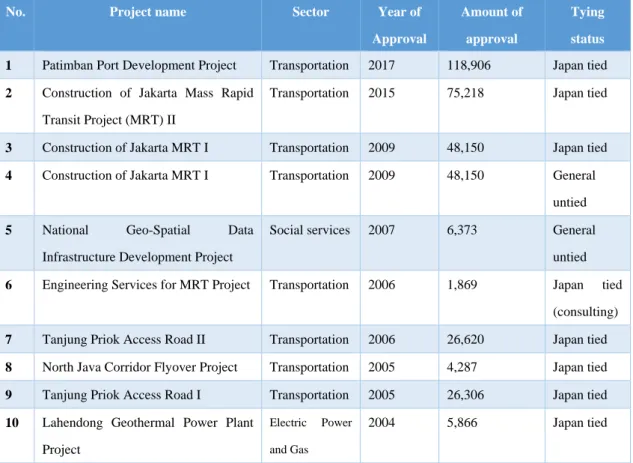
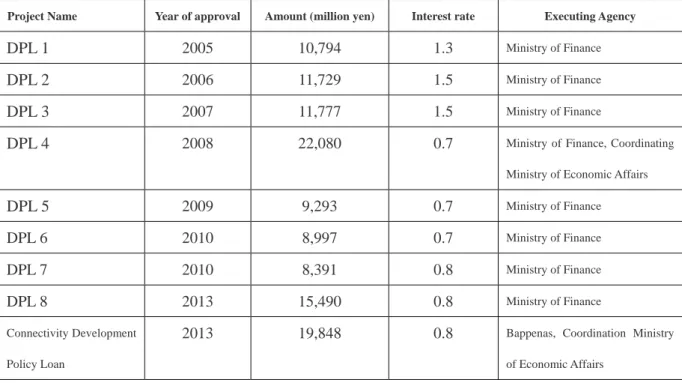
List of Figures Page Table 1: Japan’s STEP Loan in Indonesia 38 Table 2: Japan’s Development Policy Loan for Indonesia 39 Diagram 1: MP3EI Infrastructure Project 55
THE POLITICAL ECONOMY OF CHINESE AND JAPANESE INFRASTRUCTURE REGIME: A CASE STUDY OF INDONESIA (Preliminary Analysis)
Abstract:
Ever since the so-called rise of China has started and particularly after Japan has lost a key Indonesian high-speed railway to China, Sino-Japanese relations have been increasingly posited on a geo-economic rivalry between both states. As a result, perspective on Chinese and Japanese infrastructure investment tends to place the state at the center of explanations and be guided more by what infrastructure projects are imagined to leverage, than what Southeast Asian countries have influenced. Taking issues from existing studies which have overly coalesced the discussion around geopolitical standpoint and norm-based approach, this study brings fresh framings of the political economy of Chinese and Japanese infrastructure regime in Southeast Asia. By using the case study of Indonesia, this study compares the pattern of agenda setting and political settlement that China and Japan have pursued to accommodate state transformation pertaining to the infrastructure development in Indonesia. It also unfolds the ‘localized’ process of infrastructure regime that has implicated different levels of playing field which Japan and China have encountered in the country. The study puts forward the challenges and prospects for policy engagement by analyzing initiatives, such as Japan’s ODA-based projects, Indonesian government’s master plan MP3EI, China’s Belt and Road Initaitive (BRI), Japan’s Partnership Quality Initiative (PQI), and Indonesia’s proposed PPP (Public Private Partnership) scheme. Offering a unique perspective on the linkage of power configuration and infrastructure regime, this study finds that Chinese infrastructure regime reflects a continuous trial and error in linking capital accumulation with infrastructure agenda due to an uneven expansion of sub-national entities and companies to the infrastructure market. This has led to “de-institutionalization” of policy formulation and implementation in order to accommodate fragmented interests in Indonesia. Whereas, Japanese infrastructure regime demonstrates how infrastructure projects have been historically narrated and intertwined with the rationalization of economy as well as adjusted with the political constellation and economic structure in Indonesia. Such adjustment resulted political settlement that invariably upgraded informalization into “institutionalization” so as to narrow coalitional interests and maintain centralization of authority in a well-coordinated manner.
1. Introduction
1.1 Filling the gap
Arvind Subramanian, in Eclipse: Living in the Shadow of China’s Economic
Dominance (2011), once predicted that China is going to be a ‘peculiar kind of
superpower’, one whose attraction is more materialistic than heartfelt, “It won’t have the soft power the United State has – people wanting to come, people wanting to live, people wanting to emulate it…That soft power is lacking, but that will not impede China” (p.211). Indeed, over the past decade, Southeast Asian countries, that are “geographically close but psychologically distant” have been nevertheless increasingly swayed by China’s peculiar soft power (Lam, 2015, p.100) Albeit suspiciously welcomed, China’s infrastructure modalities, either in the form of concessional loan or investment, has made tremendous inroads in financing large-scale infrastructure projects. More tellingly, while still a confusing concept to some in OECD countries, Xi Jinping’s Belt and Road Initiative (BRI) has seamlessly pave way for China-led infrastructure package.
Especially significant is, the great wall of money has not only fueled an unprecedented need for the infrastructure development, but has also subsequently reshaped the geopolitical realities in which Japan has been greatly challenged (Copper, 2016; Dreyer, 2006; Shimomura & Ohashi, 2013). In 2015, a shocking event of when Japan lost out to China on a five billion dollar deal of the Jakarta-Bandung High Speed Railway (HSR) has further underscored China’s rapidly growing importance as a global player in infrastructure development and financial diplomacy. Soon, Tokyo announced the Partnership for Quality Infrastructure (PQI), readily dispensing U$ 110 billion funding package as counter-actions to retain its influence in infrastructure-financing in the region (Japanese METI, 2016, May 23) Diffusing specific ideals for the importance of ‘quality over quantity’, Japan is seemingly confident of its posturing so as to strike a point of difference with China’s risky infrastructure projects.
dynamic and have devoted a good deal of attention of it. Much ink has been spilled on two prongs. First, on the definitional side, this camp attempts to underpin the difference between China, an emerging partner (non-DAC member) and Japan as a long-standing development partner (DAC member) in the aspect of infrastructure financing, specifically pertaining to rules, norms, and governance. In light of OECD-defined ‘best practice’, China has been criticized on many fronts while in contrast, Japan’s approach has been largely legitimated. Some critics argue that China’s different principles and development philosophy than DAC’s, has hindered existing rules, undermined governance standard, and had negative local economic and political consequences, such as ‘debt trap’, environmental degradation, imported Chinese labor, and natural resources exploitation in an ‘unequal infrastructure for resources’ scheme (Green, 2019; Hodge, 2018). Furthermore, its weakly regulated overseas investment and emphasis on non-intervention often resulted simply irresponsible buck-passing in poorly-governed developing countries. While remain intact in pioneering DAC norms-based arguments, some scholars throw lights on the issue in a different way. Kratz & Pavlićević (2018) argue that both Japan and China have altered their approaches to overseas infrastructure development projects due to the stronger bargaining power of host country. This is also related with what Yoon (2018) argues about ‘host country’s outside options’. Outside option is defined as a best alternative for a party during negotiations, should that party withdraw unilaterally from those negotiations. In this sense, insofar as players can use outside options to gain leverage by threatening to walk away (Binmore, Avner, & Sutton, 1989), both China and Japan are prompted to improve their aid or investment approach so as to be the most credible option. For example, in what Kratz & Pavlićević (2018) coin as ‘Japan leveling down’, the Japanese government loosen its strict policies by exempting a government guarantee in providing yen loans to sub-sovereign entities of developing countries with several conditions after the failure in the Indonesian project in 2015. On the other side, the ‘leveling up’ China began to reassess its performance by putting more emphasis on safety, environmental protection, and local benefits.
Second camp dominated by international relations scholars is largely guided by geostrategic approach. The BRI is viewed, in the account of realism, as a mix of
geopolitics and geo-economics objectives in which China marshals its economic power for strategic objective and weave neighboring countries’ security and economic needs into a Sino-centric network (Beeson, 2018; Vien, Yan, & Blackburn, 2015). As Harris & Blackwill (2016) put it, “The use of economic instruments to promote and defend national interests and to produce beneficial geopolitical results and the effects of other nations’ economic actions on a country’s geopolitical goals.” Norris’ proposed economic statecraft concept (2016) offers the representative assessment. BRI regarded as economic statecraft provides more room for Beijing to deliberately manipulate international economic activities to capitalize on, reinforce, or reduce the associated strategic externalities. Two factors in particular speak to the geopolitical logic of the BRI. First, BRI routes conspicuously bypass the maritime checkpoints along with China-led projects like China-Pakistan Economic Corridor, Kunming-Singapore Railway, and East-West Corridor that being a case in point. Given China’s enormous financial power and infrastructure construction capabilities meet the growing needs of regional countries for infrastructure development, China may increasingly bolster its political clout (David Arase, 2015; Johnson, 2016; Suehiro, 2017). Second, while Western and Japanese investors are largely private, China’s largest companies are SOEs that often involved in controversial and highly risky projects. This background often leads to the assumption that China’s economic logic is subordinate to its strategic interest, as Ren, Liang, and Zheng (2010) depict, “How their state cultivates an ideology of ‘national pride’ in SOEs, making them usually unintentionally indulge national missions in conducting overseas strategies.”
Likewise, Japan’s PQI is characterized by Tokyo’s strategic orientation to win over Southeast Asian countries in exchange for enhancing their security and strategic cooperation with Japan. The ambition was seen in Japan’s new aid strategy announced in 2018 in which Prime Minister Abe incorporated Japan’s ‘high-quality’ infrastructure aid into the ‘Free and Open Indo-Pacific Strategy’ which was announced in 2016. Infrastructure aid is used as a tool to cultivate partnership with recipients, who share with Japan “a grievance” towards the ‘China’s threat’, particularly over lingering maritime and territorial issues (Jain, 2016; Jain & Horimoto, 2016). Additionally, this camp posits that the use of aid is to eclipse Beijing over its long-term infrastructure
plan and strategic influence. Acknowledging Cambodia’s contentious position in maintaining ASEAN unity on the South China Sea issue, Abe Shinzo has repeatedly tried to change Cambodia’s position through infrastructure support commitment (Yoshimatsu, 2017). When Then Sein government decided to reduce Myanmar’s overdependence on China, Abe government quickly provided the country with yen loans for various infrastructure projects, including roads, power plants, ports, and special economic zone (Kraisoraphong, 2017).
This camp also attempts to find the linkage between geopolitical interests and economic interests. In the case of Japan, many view that the connectivity idea and the high-quality infrastructure are aimed to maintain its dominant regional position in infrastructure development and are largely driven by imperative to return to the old path of exporting industrial products and physical infrastructure as part of its effort to revive the stagnant economy (Yang, 2017; Yoshimatsu, 2018). In a similar vein, the nature of mercantilist has also been apparent in China’s infrastructure modalities. BRI and concessional loans are often portrayed as Beijing’s predatory attempt to kill two birds with one stone – addressing overcapacity at home and advancing its diplomatic clout (Huong, 2018; Johnston & Rudyak, 2017). Like the mercantilism of yore, Chinese infrastructure loan is aimed at and results in the accumulation of foreign exchanges reserves, which at once, converting its industrial overcapacity into a huge trade surplus (Wang, 2017) . It is possible because of the omnipresence of “Chinese bundled of aid, trade, and investment” (Weissenbach, 2011, p.253) in which host countries are required to spend loans by buying infrastructure material from Chinese market and subsequently open up a new channel for transferring resources of both aid and trade. In short, infrastructure associated with both PQI and BRI, has both ‘business ends’ on one side and ‘power play end’ on the other side. It is appropriated to achieve either or both of these aims.
These studies have certainly enriched our knowledge of Chinese and Japanese backed infrastructure development in the region. However, and without wishing to downplay the contribution of these works – should we be surprised by these conclusions? Problematic is, the dominant literature fails to grasp the overall picture of political spectrum of infrastructure modalities led by China and Japan, as the apparent
interpretation, ruefully, is that Southeast Asian voices are muted. In fact, Southeast Asian’ path to infrastructure development is not necessarily a blank canvas on which Japan or China can easily and unilaterally push forward their money so as to gain influence and dictate the regional agenda. Infrastructure development in Southeast Asia has been invariably entangled in a politically-difficult situation. Infrastructure, be it loan project or investment project, is central to a multi-dimensional process whereby multiple forms of power interact and reshape the policy, if not unintended outcomes. It thus gives leeway for such process of contestation, negotiation, and compromises within ‘multiple rule of game’ in multiple site of institution and actors (see Jayasuriya, 2015; Tubilewicz & Jayasuriya, 2015). For instance in Myanmar, why Japan’s apparently stricter-aid conditions have superseded China’s less prescriptive approach and why have been many large-scale projects such as Mytsone Dam postponed? (see Kirchherr, J. Charles, & Walton, 2017; Lamb & Dao, 2017; Sein, Li, & Zhu, 2016; Summers & Summers, 2016). Similarly, in Vietnam, in the face of escalating tensions over defense issue, Vietnamese government nevertheless inked agreement with Chinese contractors that accounted for up to 90 per cent of EPC (Engineering, Procurement, and Construction) contracts for energy infrastructure as of 2012 (see Le, 2017). Indonesia also provides a good case in point to illustrate the overwhelming contradictive outcomes. Although Japan had committed to feasibility studies for the project from 2009, the Indonesian government tuned down a Japanese bid in favor of China - regardless last-minute efforts by Abe and his delegation to provide a better offer than China (see Harding, Chilkoti, & Mitchell, 2015; Yoshimatsu, 2017, 2018). Clearly, the surprising event reminds us of other unexplored aspect of infrastructure development. The main point is that, what concerned Japan the most is not Beijing’s rising influence across the country per se. Rather, it is how Chinese entry to the ‘infrastructure market’ has been coalesced into an increasing variety of new political actors and policy entrepreneurs in the recipient state. For example, the state transformation in Indonesia rendered infrastructure policy and decision making a complex process played out among multiple actors of different kinds; something that Japan never encountered before the democratization and decentralization. Both of policy-making and the implementation are contingent upon structural features and
operational mechanism of political system where infrastructure modalities are played out. Certainly, the existing literatures fail to capture such crucial political nature of infrastructure modalities.
1.2 Addressing Infrastructure Regime
Against the background, this paper aims to challenge such intellectual boundaries and brought fresh framings of how have Chinese and Japanese playing field in the infrastructure domain been reshaped and played out. Such dynamics can be captured in the political economy of Chinese and Japanese infrastructure regime. As this study puts emphasis on the interstate and intrastate relations, in particular bringing host countries into the frame, the concept of infrastructure regime is presented in a multilevel perspective, that reflects political choices and institutional arrangements that structure multiple forms of power and the organization of a system of provision including resource distribution, social practices, and technologies. The key aspect of the infrastructure regime is the progressive alignment of the daily tasks of many actors; its relative stability on socio-political configurations and economic trends; and how it integrates incremental change around infrastructure development due to state transformation. China and Japan do not race from the same starting line nor run under similar political structures. Both stepped into such geographically uneven and contradictory set of historically process of regional development in a different phase of time. However, similar point they share is that their infrastructure regimes have invariably been accompanied by a complex dialectical process that is shaped by interactions among different levels of groups and interests at the regional and national level (see Hameiri & Jones, 2018; Jayasuriya, 2015). Infrastructures rendered by China and Japan as hallmark of bilateral cooperation, have a dual character. On the one hand, they are truly a vital part of every projects contributing for economic growth and development. On the other hand, they are localized and continuously fixed as an “expression of the politics of everyday experience” and infused with a complex set of
political relationship (see Elias & Rethel, 2016).
Thus, research questions raised in the study are: (1) What are the pattern of agenda setting and political settlement that Chinese and Japanese pursued to accommodate such complex power relations pertaining to infrastructure development in Southeast Asia? (2) How have different levels of playing field affected Japan and China’s approach in the face of infrastructure development ‘localization’? Arguments developed in this study are not constrained by the imposition of a rigid framework, as the purpose of this article is to open a fresh research agenda and seeks to achieve two objectives. First, it is to provide a contextual overview of the way in which China’s and Japan’s encounter with either internal political process or host countries’ political transformation affected the infrastructure modalities and policy. Second, it does not entirely deny the existence of strategic interests and geopolitical competition, but to offer a more realistic picture, of constraints on the policy options of national states, to domestic institutions, state capacities and objectives, and to ultimately come to a clearer understanding of the conditions under which Chinese and Japanese infrastructure regime can be played out by various scale of interests and power.
The author acknowledges that national differences and diversity in Southeast Asia. But given the size, strategic importance, and diversity within Indonesia itself, regional perspectives are more likely to be mirrored. The present study offers numerous within- and cross-case opportunities both to assess our expectations in the context of mixed or uneven performances and to avoid the small N-problem common in studies of single cases. Only focusing on specific country, can we really delve into the real dynamics of political and economic forces involved in the ‘localization’. In so doing, it draws on official data, secondary literature in recent years, interviews across Japan, China, and Indonesia. One caveat: data from Chinese ministry (i.e. Ministry of Commerce ‘MOFCOM’, Ministry of Foreign Affairs, ‘MOFA’) and Japanese officials (i.e. Ministry of Economy, Trade, and Industry, ‘METI’; Japan International Cooperation Agencies, ‘JICA’; Overseas Economic Cooperation Fund, ‘OECF’, the Japan Bank of International Cooperation, ‘JBIC’ ) are not cited in equal proportions. This is not an intentional manipulation by the author, but simply a reflection of the fact that Japan has more frequently published Official Development Assistance (ODA) and
investment-related documents.
2. Alignment of Interests: Informalization and Institutionalization
Despite four years have passed since Japan lost to China over the controversial Jakarta-Bandung High Speed Railway project, discussions regarding Sino-Japanese relations in the region remain centered on the distinct notion of power and rivalry. Many studies have been published in recent years tend to focus on how Japan counteracts Beijing’s hallmark project by promoting ‘quality’ infrastructure projects (i.e Dadabaev, 2018; Mattlin & Gaens, 2018; Zhao, 2019). However, very few studies, if any, have attempted to compare Chinese and Japanese ‘daily interactions’ and encounters with host countries’ various groups and interests. Often, studies that intended to compare China’s and Japan’s engagement with Indonesia, particularly in the infrastructure development, have been overshadowed by the analysis of Indonesian independent foreign policy and its pragmatism in “cherry-picking” between China and Japan (i.e Fitriani, 2018; Pattiradjawane, 2016). Those few studies that intend to pay attention to power relations involving China and Japan in domestic levels fail to delve into Indonesian case further due to overwhelming perception that the basis of comparison is almost non-existent. Nevertheless, the fact that two countries tapped into Indonesia under different set of historically process and of political spectrum should not constrain scholars to make an empirically-grounded comparison of Indonesian interactions with the most important countries in the region: China and Japan.
As mentioned in the introduction section, China and Japan stepped into Indonesia under a different set of historically process of regional development and of political constellation. This has dynamized Chinese and Japanese infrastructure regime in Indonesia to reach an outcome that reflects contradictory process, if not unconscious, of conflicts, negotiations, and compromises between diverse groups. Infrastructure regime entails a playing field, rife with adaptation, learning process, and negotiation. Large-scale infrastructure projects and policy associated with the regime cannot be readily understood in a purely physical or material fashion. Instead, they imply an output of political contestation, coalitions, and new alliances in the trajectory of economic development. The state has been basically divided across bureaucratic, capital
forces, different levels of government, where infrastructure can be on the one hand lucrative industry for them to expand capital, uphold incentive, or maintain rent-seeking (Hutchison et.al , 2014). It can liberate the private interests from a range of collective social demands or even giving leeway for expanding capital should they are useful in securing particular national economic or political objectives (Robison, 2009, p.16). Nor is it any exaggeration to say that vast and growing army of consultants have also been the beneficiaries of trends to outsource policy and technical fixes to complex regional infrastructure roadmap. Neither it is wrong to say that infrastructure has been such an open-ended terms in which real implementation reveals new mechanism of resource distribution, including nationalistic policy, and to some extent create new production activity as well as deepening capital network (Hout & Robison, 2009). Clearly, Indonesia epitomizes such dynamics. The level of Indonesia’s connection with and penetration by China and Japan pose nuances and features of projects these states plan and negotiate that would be elaborated and compared in the following section.
2.1 Japan: From ʻinformalizationʼ to ʻre-institutionalizationʼ
Japan has played a leading role in Indonesian infrastructure development that can be traced to its ODA contribution on 20 percent of the toll road construction around greater Jakarta, port development, the development of five airports, including Bali, Surabaya, Jakarta, Palembang, and Kertajati International Airport, as well as Jakarta’s long-awaited first subway (MRT). It has also secured full-scale technology transfer mechanism, knowledge on the water resource management through mega-power plants, three large-scale multipurpose dams (known as Karangkates, Kali Konto, and Riam Kanan), and Brantas River Basin Development Project (JICA, 2018a). However, stressing such long-term structural dimension and Japanese embeddedness in Indonesia’s developmental trajectory, Japanese infrastructure regime has never been one-dimensional result of clearly bounded, intended, top-down practices. State transformation in Indonesia has invariably influenced power constellations by consciously or unconsciously providing power resources to certain group in society, while closing economic and political opportunities for others.
During the New Order era, the idea of infrastructure was subsumed under a vision of development that became known as the ‘Development Trilogy’, consisting of Stability, Growth, and Equity. In a nutshell, Japanese economic cooperation (keizaikyoryoku) with Indonesia was promoted in line with the national policy emphasized by Indonesian government. Infrastructure projects were identified and policy was formulated in accordance with Indonesia’s five-year development plan (Rencana Pembangunan Lima Tahun / Repelita) (JICA, 2010a; Shiraishi, 1997). For major recipients of yen loans, including Indonesia, OECF and JICA had always carried out studies of macroeconomic conditions and of various sectors of Indonesia based on the Repelita. The information was used to analyze development issues and identify the priority of projects through policy dialogue.
Although it looked simple, the Repelita contained powerful idea, which more than anything else, implied the New Order’s pragmatic and ideological standard against which all economic policies could be measured. Indonesian state institutions tended to adopt a Repelita-based infrastructure development, but actually keep functioning according to different forms of social logics. Key elites, social forces, institution, and conditions mixed in different ways that accounted for the great disparity in state practices. The intermingling of Japan’s politics and such power constellations has led to the process of engagement of different sets of actors while Soeharto remained the sole locus of political power. Both informalization and institutionalization of competing interests coexisted and accordingly added nuances to the Japan-led infrastructure regime.
The infrastructure regime stemmed not from a mere adjustment to the Repelita, but also from the political settlement reached among important camps in Indonesia. First, technocrats group. This group was in charge of development, thrived in the state of political demobilization, whose expertise had a significant impact on broad economic policies, above all monetary policies and major allocation of resources. During the early phase of Repelita, technocrats like Ali Wardhana, Radius Prawiro, Widjojo Nitisastro, Emil Salim, and other ministerial technocrats able to proceed with their reforms – such as trade, privatization, investment, and importantly to pledge support for the National Development Planning Agency (Bappenas). The principal power that Bappenas had,
unlike planning units in other countries, was the budgetary allocation power, while the Ministry of Finance (MoF) was responsible for the allocation of routine expenditure (Amir, 2012; Prawiro, 1998). This kind of configuration thus had a great impact on its effectiveness in national planning and development project coordination as well as implementation. With this authority in hand, Bappenas had been able to exercise a stronger power in coordinating the ministries (considering the chairman of Bappenas also doubled as the Coordinating Minister of Economic Affairs) and other institutions to formulate project proposals and activities in accordance with the national plan. One of institutionalized forms of such project proposal is “master plan” – that has been a key pillar of Japanese infrastructure regime in Indonesia. The master plan approach has been adopted in sectoral projects under the Indonesia-Japan cooperation. Many cooperation projects were identified not based on individual project planning, but on the master plan from the viewpoint of long-term perspective and inter-sectoral coordination (JICA, 2010a). Master plan was communicated at different levels, but most conventionally through the channels of line ministries, mainly Bappenas. In the initial stage, cooperation to Bappenas started when Dr. Saburo Okita was assigned as an advisor to Bappenas in preparing five-year development plans at the national level. A stress was laid on how to work out frameworks for development plan and further generated numerous master plans for specific projects (Ichimura, 2015).
However, practices that circumvent technocratic, top-down reform have always played a significant role in implementation processes of large-scale, planned projects. Underlying informal practices counter-balance the shortcomings of the technocratically- abstract formal system. The more schematic and simplified the formal order, the more failure-prone it is and the more it is in need of informal ‘rescue measures’ in order to function at all, just as addressed by Scott (1998:51), non-conformist practices thus may evolved as indispensable functional conditions for the formal system. Indeed, early years of Bappenas reflected the ‘informalization’ of power relations. The Bappenas was originally founded by Soekarno in 1952 under the name of the National Development Council (Dewan Perancang National ‘Depernas’) The immediate task was to formulate Indonesia’s first five-year plan, namely the development plan for 1956-1960 (Pauker, 1962). However, it did not function well due to lack of expertise in development
planning and project implementation. Under Soeharto, Bappenas had the task to design and implement the five-year development plans as well as to draft annual program. In many cases, puro-fai (project-finding) mission played a significant role in shaping Bappenas’ function. Japanese private sectors even drafted the project proposals on behalf of the local government agencies to apply for ODA. Efforts undertaken to initiate a project, pushing the project for selection, establishing connections with influential bureaucrats and politicians, and other investment in social functions were then connected to dango practices (taking turns winning the project). It became a race to get the credits and investment among various Japanese consultants, trading firms (sogo
sosha) and contractors (Söderberg, 1996, 2001). Pacific Consultant International and
Nippon Koei are examples of Japanese engineering consulting firms who have been receiving consultant contracts in Indonesia continuously to date. These Japanese consultant firms also maintain their joint venture offices in Indonesia (JICA, 2005).
These informal measures somewhat provided necessary conditions for further institutionalization of power relations and enabling transfer of knowledge. Brantas River project exemplified methodological ability to capture the shift in power reflections and resources allocation. During the early decade of development (1960-1970), the project provided an ‘outward’ monopoly to Japanese state and non-state actors, including, Nippon Koei, Japanese consultant company. However, this company was also supported by two main subnational Indonesian agencies: Indonesian Ministry of Public Works and Indonesia State Electricity Company (PLN). Over 40 years, this project has developed an informal network dominated by private and state interests. The project originally generated resistance from local groups, due to unequal distribution of power and resource allocation. The resulting Brantas River Basin Development Executing Office (Brantas Office), is an example of a new mode of water resources governance, not only in the Brantas basin, but also in Indonesia, known as the “one river one plan one management” (see Fujimoto, 2013) The new mode of water governance promoted integrated development of infrastructure and management of water resources and simultaneously illustrated shifts in authority and attempts to institutionalize competing interests. Stipulated in the Indonesia’s second long term 25-year development plan (1994-2019), authority and responsibility for water allocation
and irrigation management was to be transferred gradually to the district and provincial levels, while national government remain the key authority in water resource related functions, particularly in macro and program planning and budgeting with JICA (Bhat, Ramu, & Kemper, 2005). These kinds of ‘formal’ institutional fixes pursued through Japanese infrastructural aid are still limited in China-led projects where rule and practice are more ad hoc and somewhat generates conflicting agenda.
Second key camp is military network and powerful elites. Indonesia’s political economy under technocrats might have helped the country to formulate development plan and get loan assistance, yet it is somewhat less grounded to treat all ODA projects as an apolitical expression of rational choices, technocratic options, and market process. In particular cases, they had relatively little influence on or control over the political and bureaucratic processes that enabled the implementation of contracts, licenses, and other micro-economic details. As coined by Moertopo, (1973:40), “technocrats have been used as a political means to legitimize the bypassing of representative and competitive politics in the name of preventing market distortions against the demands of vested interest.” Sometimes, political camouflage and the omnipresence of “technocrats in shadow” during the project formulation were unavoidable. Some projects realized were rooted from the informal negotiation that quite aloof from the technocrats’ presence. In turn, some powerful generals worth their salt had leverage over large-scale infrastructure projects. Of the many groups within the strongest elite in Indonesia, the “Soeharto group” appeared to be most powerful, whose members occupied all the key positions in the country and greatly involved in the patronage-ridden network. Roughly, they were divided into the “finance generals”, “the money spinner”, the “political generals” who worked closely each other (see Borsuk & Chng, 2014; Schwarz, 2000; Vatikiotis, 1993). The most powerful “finance generals” were Alamsjah Ratu Prawiranegara, Sudjono Humardani, Suryo Wiryohadiputro, and Sofjar. Ibnu Sutowo was often tagged as money spinner, because of his remarkable contributions to the government’s coffers (at least before the state oil company, Pertamina, reached the nadir under his management) (Robison, 1986). Meanwhile, the most powerful of the political generals were Ali Murtopo and Benny Moerdani. Vital to the early period of the New Order and how the patronage worked were these generals (Borsuk & Chng, 2014)
One of large-scale projects emanated from the alignment of interests with this group is the controversial Asahan project in which Japanese government prepared “a package deal” for Japanese company. Under a Master Agreement for Asahan Hydroelectric and Aluminium Project, Japanese government reportedly prepared grant and loan for 12 Japanese investors for equity participation totalling 411 billion Yen. Such large-scale project was facilitated by the influential “Indonesia lobby in Japan” including Nakajima Shinzaburo (businessmen), Kimura Takeo (a conservative politician and head of Cabinet Secretariat), and Fukuda Takeo (Ministry of Finance) who closely connected with Soedjono Humardani. He is known as the spiritual guru of Soeharto as well as “military entrepreneur”, his position as a presidential adviser, without a formal ministerial role, placed him in an advantageous location from which to become involved not only in domestic affairs, but in international ones as well, in bids to achieve economic stabilization and development. This indirectly claimed by Soedjono, “the idea to establish an alternate channel for oil exports to Japan, was raised around the end of 1971, when I went to Tokyo and talked with Fukuda, as well as Tanaka” (as cited in Malley, 1989, p.57). Loan pledged after ad-hoc consultation between the government of Japan and Indonesia, has been provided for relatively large projects, including energy infrastructure (OECF, 1992, p. 140). Relatedly, during four years from 1973 to 1976, Japan offered 110 billion yen loan in total to Indonesia Pertamina that was headed by Ibnu Sutowo for developing and/or rehabilitating 40 oil and gas projects (CIA, 1984; Nishihara, 1976; Shiraishi, 1997).
Accordingly, the third camp is well-connected ethnic Chinese conglomerates. Powerful business conglomerates, in particular ethnic Chinese, partnering with Japanese trading companies, often took part in wielding its economic power to get the government to push for specific loan requests (Doner, 1997; Peter J Katzenstein & Rouse, 1993). Well-connected Chinese conglomerates represented business groups such as Astra, Panin, Sofyan Wanandi, Nyo Han Siang (Bankers Club Indonesia), Prayogo Pangestu, Arief Husni, Salim and Bob Hassan. Japan OECF played a critical role in the forestry project and associated infrastructure such as electricity and transport facilities that were connected with ethnic Chinese big business. While loan information remained confidential, more than 70 percent of OECF general forestry project loans went to
Indonesia and trading companies likely received OECF loans during the period of 1963 to 1981 (Dauvergne, 1997). In addition, although business alliance intertwining ethnic Chinese business and Japanese multinationals had no direct influence in formulating a broader infrastructure cooperation master plan, very often industrial projects these alliances set up continuously reshaped the content of infrastructure roadmap. For example, the yen loan has been directed for economic infrastructure in areas where Japanese investment reached economic viability. The alliance became the enabling factor to link the infrastructure development with the aid trinity (sanmiitai) that would be explain in more detail in the following section.
Next camp consisted of nationalist and social-oriented economics, engineering-trained bureaucrats, and pribumi businessmen. The surge in oil prices from 1973 saw the replacement of market forms of regulation with the code of conduct at Soeharto’s personal discretion. It catapulted a core group of Chinese and some generals to wealth and prominence as the collusion produced important joint ventures between the Chinese and both Japanese and American multinationals (Robison, 1986). Undeniably, the imposition of the compulsory use of local partners for foreign investors, control by the state of all contracts for infrastructure projects, lucrative initiatives in oil and mineral extraction and the state's control over credit, benefited the large Chinese corporations, who faced no competition from foreign or pribumi capital (Chua, 2008). Speaking in a similar vein several months later, Mohammad Sadli (1974:18), the first Chairman of BKPM stated:
“In the mind of the political public in Jakarta, the honeymoon with foreign investment and foreign aid is apparently over. The economic progress of the last five years has produced the not so palatable social by-product of conspicuous consumption, a widening gap between the rich and poor, charges of corruption, etc. Since foreign aid and foreign investment have been important elements in the policies of the government, these are now blamed for accentuating the distortions. The criticism is unfair but the mood is there….and the mood in Jakarta is also present in other capital cities in Asia.”
Following the Malari affairs1, what have been proven is that the emergence of this group – nationalist economics, pribumi businessmen, and engineering-trained bureaucrats – as the dominant force that began to reshape government investment policies that were used to take side on ethnic Chinese. Oil wealth and the increasing influence of the economic nationalist paved the way for more affirmative action in the early 1980s. Accordingly, several presidential decrees – the Kepres 14 in 1979 which was amended and reissued as the Kepres 14A and Kepres 10 in 1980 – gave the ‘weak economic group’, a code phrase for indigenous businessmen, a set of priority in obtaining certain government contracts (Schwarz, 2000). Consequently, the Kepres 10 in 1980 paved the way further for the group to have more bargaining powers. For big government projects reiterated in the regulation, a new team was set up to decide on project allocations. Team 10, as it would be known, was headed by Sudharmono, the powerful state secretary, and from 1983, chairman of the ruling party Golkar. In 1983, Sudharmono’s protégé Ginanjar Kartasasmita was appointed as the Vice Chairman of Team 10 (Chua, 2008; Winters, 1996). The recipient of Team 10’s beneficence had salient characteristics, among others, they were selected for their political and personal proximity to powerful officials in the presidential palace, Sudharmono and Ginanjar, the office of state secretary (Setneg) as well as for their instrumental value, such as securing support in geographical areas or among social groups where the Soeharto regime felt insecure – in which the larger pribumis became active (Schwarz, 2000). Among others, the prominent pribumi businessmen comprised Aburizal Bakrie, Fadel Muhammad, Iman Taufik, Jusuf and Ahmad Kalla, Fahmi Idris, Suryo Palo, Bambang Rachmadi, Agus Kartasasmita, Abdul Latief, Hashim Djojohadikusumo, and Subagio Wiryoatmodjo. Two important political vehicles for them to get the government-related contracts were the Association of Young Indonesian Businessmen (HIPMI) and the
1 While the New Order government has put more weight on Japan in aims to facilitate the government’s stability and
development-oriented domestic policy, in mid-January 1972, both government were tremendously shaken by the urban violence, as the so-called Malari affairs, that broke out in Jakarta during Japanese Prime Minister Tanaka Kakuei’s visit. Much of the public protest had based on anti-Japanese sentiment as the Japanese economic expansion have come to symbolize a whole variety of economic grievances, of particular notes when Japanese have partnered with ethnic Chinese businessmen at the expense of local indigenous Indonesian businessmen.
Indonesian Chamber of Commerce and Industry (KADIN) that were closely allied with the economic nationalist camp. They had ensconced in a cocoon of their main cabinet patron, Ginanjar Kartasasmita, who had assumed the portfolio of Minister of Mines and Energy in March 1988 (Rosser, 2002).
Ginanjar Kartasasmita a nationalist figure who gave the strong advocate of indigenous business and a long-time protégé of Soeharto, was educated in Japan and regarded as the bridge (kakehashi) between Indonesia and Japan (Kartasasmita, 2013, p.466). In 1993, the triumph of the engineers over the first camp, technocrats, culminated when Soeharto set up a new Cabinet. A number of ministerial position used to be filled by Widjojo’s porteges, were transferred to other groups, most notably the nationalist-engineers. The hardest hit for the technocrats was they had lost positions in Bappenas, a strategic post exclusively retained by the economists for years (Amir, 2012). This position was occupied by Ginandjar whose previous positions were Chairman of Investment Coordinating Body (BKPM) and the Minister of Mines and Energy. Ginandjar was somewhat receptive to the trickle-down mechanism that in the economists’ perspective would presumably distribute wealth evenly in Indonesian society. He envisioned cooperation between private sector and government for infrastructure projects and put in a lot of efforts on the development of coal-power generating plants in which Japanese private sectors were involved, such as Paiton in East Java that is often referred to as the first and largest of private projects; Tanjung Jati in Central Java; and Cilegon in West Java (Wells & Ahmed, 2006). Ginandjar also initiated the development of large-scale geothermal power plants that unfortunately many were delayed by the 1998 crisis. Business representatives and policy makers I have spoken to in Japan and Indonesia, reminisced how Ginandjar acted as a ‘balancer’ between the very rational technocrats and irrational military figures and elites, in order to ensure the smooth transition of the project plan to the implementation., Ginandjar (2013:102) also admitted how he maintained policy dialogue with Japanese counterpart, “…I sought the advice of foreign business communities such as the Jakarta Japan Club and the American Chamber of Commerce in Indonesia. They gave me valuable input. Based on their inputs as well as from our own Indonesian Chamber of Commerce and Industry (KADIN) and sectoral business associations, we formulated investment
policies that were business-friendly but that also encapsulated our agenda promoting domestic industry and small and medium enterprises”.
A seamless web of competing interest has simply converted into such a policy network or linkage between industry, bureaucrats, political elites and other interests group under a big umbrella of Soeharto’s development doctrine. Ultimately, this constellation had forged alliances to promote the success of projects as well as to respond to the wider effects of alliances on overall developmental trajectories. This provided technical solutions to tackle ‘time inconsistencies’ – the embeddedness of economic action in social structures with Soeharto as the highest authority in policy making. In time of crisis, Soeharto would have the technocrats group to consult with and turn to nationalist and engineering-based bureaucrats group once he want to reconsolidate the power. Consequently, both institutionalization and informalization enabled Japanese infrastructure regime to work simply as “cohesive force”, starting from the planning, implementation, to the evaluation from the viewpoint of long-term perspective and inter-sectoral coordination. On the one hand, JICA formulated a master plan covering the specific field of infrastructure in accordance with the target set in the Repelita and the METI’s White Paper, while OECF also listed priority projects and analyzed measures for financing. Later, each project listed in the master plan was implemented by means of existing scheme. On the other hand, Japanese private sector can also first identify the project and then develop it in coordination with various other public as well as private sector interests (Kinoshita, 1986). While JICA provided technical cooperation for EPC scheme, at the end of coordination stage, private sectors would take in charge of their respective sector. To some extent, these firms also assisted Indonesia in mounting a financial package for the implementation of a project, identifying which components would be eligible for JICA or OECF financing. The firms may assist in pulling together financing for big infrastructure projects through partnerships with banks or other firms, or both (see Indonesia Country Assistance Study Group, 1999; The Government of Japan, 2004). For example, the 6th Five Year National Development Plan (1994-1998) attached importance on the port development with due attention to the regional development of Eastern Indonesia to redress the regional economic disparity. Thus, in 1994, the Indonesian Government formulated an
integrated master plan for sea transportation, namely the Study on Integrated Modernization Plan for Sea Transportation in Eastern Indonesia Vol. I assisted by JICA which comprehensively guides the development of 17 transit ports and 85 small ports in Eastern Indonesian up to the year 2005 (JICA, 1994). Considering the urgency of the development need, Kupang and Bitung were placed in the First Package category and built with use of Japanese Yen loan, amounting 5,250 million yen of OECF loan package in 1996. In addition, the developments of ferry terminals consisting of 8 maritime routes (including 6 routes in eastern Indonesia) were developed by ODA loan based on the examination result of ‘National Ferry Network Development Master Plan’ conducted in 1992 (JICA, 2010b)
The infrastructure regime is never static. After the reformasi, Indonesia has become the world’s third largest democracy. The process of democratization reaffirmed and amplified the position of subnational groups and elites, producing a new set of conditions for the “politics of development” which has added nuances to the infrastructure development in Indonesia. Repelita-based master plan has lost relevance at power relations in Indonesia. There is no final arbiter of policy, while change in the preference of a decision maker occurs between an initial policy promise and a policy decision that takes place later, as Adam Schwarz suggests, “the president’s own ‘unstructured, ad hoc style’” (Schwarz, 2016). Infrastructure regime during the Soeharto era was simply nurtured by the political settlement – how Japan unified the process of capital accumulation and of policy formulation in infrastructure development by maintaining “equilibrium of interests” with those aforementioned camps. In contrast, Indonesia’s democratization over the past two decades has entailed a much more complex power relations. Institutionally, it becomes complex, fragmented, if not contradictory. There is a shared sense of disillusionment with current political developments, consensus that decentralization does not necessarily bring local democratization (Heryanto & Hadiz, 2005, p.262) nor regional autonomy politics is aloof from constant power struggles among local elites and levels of government (Hadiz, 2003) and greater opportunity for corruption and mismanagement of funds (Aspinall & Kilinken, 2010). Social divisions along ethnic and religious lines, labor and markets, vested political interests of different scale of actors are no longer suppressed as they had
been under Soeharto regime, which thus have a wide scope to intervene in the policy-making and leverage development activities.
Having said that, it is impossible without carefully understanding tensions originating inside the state’s boundaries – how to adept with the socio-political dimension of state capture in which old and new political formations coexist, how conflict-ridden infrastructure development is narrated, and how different levels of interests are mediated in Indonesia. Political challenges resulting from the democratization is twofold – Bappenas and decentralization. During Soeharto’s administration, Bappenas, whose key figures had strong connection with Japan, was a powerful superagency with combined authority over development budget, planning, and foreign aid mobilization. At times, the chairman of Bappenas also doubled as the Coordinating Minister of Economic Affairs. Yet, now it tells different story in Indonesia (Lindsey & Butt, 2018). Followed by the State Development Planning System Law (Law No.25/2004), the new system transferred all the budgeting functions to Ministry of Finance (MoF) and had Bappenas specialize in planning and evaluation (Government of Indonesia, 2004) . Overlapping authorities between Coordinating Ministry of Maritime Affairs and the Economic Affairs; Indonesia SOEs “crowding out” infrastructure sectors; the ever-changing regulations; have added complexities further.
What become more problematic is, the conflicting nature of liberalization and nationalism has been so apparent in Indonesian infrastructure development. On the one hand, the traditional principle of public interest is that the public nature of infrastructure. Article 33 of the 1945 Constitution of the Republic of Indonesia has often been used as a political means to impede further liberalization. One of paragraphs reiterates that sectors of production that are important for the country and affect the life of the people shall be under the powers of the State. The Article has invoked public perception that infrastructure must be built by government (referring to state-owned utilities providing the infrastructure services), provided at subsidized prices, and come with an economic focus on self-reliance. On the other hand, government alone could not fix infrastructure deficit and thus the financing should come to permit majority foreign equity stakes in infrastructure sectors. As an example, during Jokowi’s first five-year term, infrastructure projects comprising 15 airports, 1000 km of new toll roads, more than
3000 km of railways, 24 seaports, and 35,000 megawatts worth of power plants are expected to cost a total of 4,800 trillion rupiah (U$ 355 billion). However, state budget can only fund less than half of the total costs (Salna, 2018). As such, what tends to happen is that populist-and nationalist-ridden infrastructure policy become pitted against outward-oriented one.
There has to be a financing distribution mechanism that stops people from holding the government hostage over critical infrastructure projects. Particularly since the Yudhoyono’s administration, the PPP (Public Private Partnership) has been introduced as a scheme for the infrastructure investment recovery. Presidential Regulation No. 67/2005 was put in force to set out the platform for the national PPP scheme. The Presidential Regulation, coupled with the Ministry of Finance Regulation No. 38/2006, provide government support for the undertakings of infrastructure development by the private sector. Three government organizations were also established to promote the PPP scheme, comprising the “National Committee on Acceleration of Infrastructure Provision” (KKPPI), “Risk Management Committee on Infrastructure Provision” (RMCIP), and “Risk Management Unit” (RMU). Main tasks of the KKPPI are to set up the framework of Public Service Obligation (PSO), act as liaison between PSO and PPP, and to establish compliances of PSO and PPP (ERIA, 2015; Kim et al, 2018).
What has been implicated to Japanese infrastructure regime is that, many projects suspended due to the crisis were subsumed under the scheme of PPP. However, it could not be easily adjusted both politically and economically due to several reasons. First, Bappenas, despite functioning as the promoter of PPP, has limited role. Before the reform and decentralization started, majority infrastructure projects were executed either by central, or by direct appointment to SOEs and/or private firms and Regional Planning Agencies (Bappeda) followed the direction. Now the various Bappeda operating on lower tiers of government do not any longer primarily report to Bappenas but to their respective local authorities (see Government of Indonesia, 2004). Second, decentralization – diverse popular movements and local claimants to state power. Decentralization has led to greater transformation occurring in intra-state that significantly defined policy. On sub-national government level, though there are
proposals currently that at least 20 percent of their expenditure should be investment, there have been drawbacks in the realization of expenditure. It is important to note that sub-national government is not obliged to follow central government rules for PPPs (Ray & Ing, 2016). Infrastructure now, can be a crucial factor causing and enabling the resistance of sub-national groups against subjection under centralized state authority, or forging cooperation between sub-national groups with centralized state authority, depending upon political context. The group does not always match with central’s vision of development and designated projects. These local actors and interest groups found ways to informally evade imposed reforms and infrastructure roadmap; rendering most of the supposed successes of roadmap an illusion. These factors have led to the major limitation in which implementation has been very uneven, both horizontally across different parts of the central government and vertically between the central and subnational government levels. With projects unable to be carried out without a multitude of approvals and issuance of licenses across different levels of government points to a key shortcoming of central government institutional reforms. As such, the institutionalization of infrastructure deals through a “master plan”, just as done by JICA or OECF together with the Bappenas in the past, does not necessarily conclude a project contract.
In respond to such power fragmentation, what we have been witnessing is that there have been considerable changes in Japanese approach for infrastructure development in Indonesia. Reflected in JICA’s works, Japan rather priorities specific program so as to ‘unify’ fragmented interests among sub-national government before particular project is assessed. Over the past two decades, there have been numerous programs carried out by JICA to make decentralization work, for example, the South Sulawesi Regional Development Program, the North-East Indonesia Regional Development Program, and so forth. That is to say, aside from large-scale project funded by JICA’s STEP loan that will be elaborated in the following section, Japan-Indonesia infrastructure cooperation has been subjected to ‘intangible services’ and policy-based, such as preparatory survey for the PPP scheme, Project for PPP Network Enhancement, Project on Capacity Development for Trade-related Administration, preparation for renewable energy projects (see JICA, 2017, 2018). It
seems that Japanese agencies and private sectors tend to look for ‘contractual perspective’ amidst ad-hoc governmentality in Indonesia. There has been an attempt to promote formal and legal dimension of relationship that binds the government and private partner together while together with Japanese agencies enforce partnership-focused perspective that mainly emphasizes the social dimension of the relationship, characterized with mutual commitment and trust.
Worth noting, throughout democracy period, the most apparent re-institutionalization of infrastructure development alongside Japan’s involvement is the Jabodetabek MPA strategic plan, while JICA has carried out the Master Plan Study for Establishing Priority Area for Investment and Industry in Jabodetabek Area in the Republic of Indonesia since May 2011 (CMEA, 2012; Fukuda Yasuo, 2014; JICA, 2012). The MPA has been regarded as a derivative of the development policy of Yudhoyono’s administration, namely the Master Plan for the Acceleration and Expansion of Indonesian Economic Development (MP3EI) and the 2009-2014 Medium-Term National Development Plan (RPJMN). The RPJMN plan has two key factors, namely acceleration and expansion of Indonesian development to boosting value added of the prime economic sectors, developing infrastructure and energy supply, as well as the development of human resources and science and technology. The MP3EI itself is not intended to replace the RPJMN, rather functions as a complementary working document for the above-mentioned development plans. Eight main programs and 22 main economic activities have been identified. In addition, six economic corridors are identified as growth centers and are expected to boost economic development throughout the nation. Investors and business can therefore clearly choose their desire sectors and preferred regions according to their business interest and specialization in accordance with the key economic drivers of the six corridors (Bappenas, 2011). In 2012, the Jabodetabek MPA was approved by the Steering Committee and Technical Committee. The committee consisted of the governments of both countries and relevant organizations. Approximately 1 trillion yen out of 3.4 trillion yen for the MPA was expected to come from international monetary cooperation, including Japan’s ODA. The MPA framework included the North-South line by the Jakarta Mass Rapid Transit (MRT) System which is the first subway in Indonesia, the
Java-Sumatra Interconnection Transmission Line, Cilamaya Port (later replaced by Patimban Port), and the Jabodetabek Railway Capacity Enhancement Project and other Fast Track Projects that were expected to utilize PPP mechanism (JICA, 2012).
The way the utilization of ODA as well as of PPP scheme narrated within the MPA has utterly reshaped the Japanese infrastructure regime whereby trust has been promoted and interests at the national level were harmonized and coordinated. On the one hand, considering the lack of coherent strategy for planning and implementation during the first period of Yudhoyono’s administration (2004-2009), the use of ODA and cherry-picking specific projects allowed central government as well as Japan to narrow competing interests and maintain coordination between the Ministry of Finance and the Bappenas. On the other side, the MPA cashed in on the role of intergovernmental cooperation to bring conclusion contracts for suspended PPP projects that inherently depended on governmental support. The MPA thus enabled structural inclusion of private sectors to ‘bootstrapping’ the highly risky PPP scheme for specific sectors that have been deregulated and backed by off-take purchaser. To offer an example, one of Fast Track Projects listed in the MPA is the Central Java Coal-Fired Power Plant that is the first PPP project based on an Indonesian Presidential Decree. The 2,000 MW power plant has been billed as the largest project of its kind in Southeast Asia and cost approximately U$ 4 billion largely financed by the JBIC. J-Power and Itochu are major players in the projects and will operate as an independent power purchaser (IPP) with the Indonesian State Electricity Company (PLN) as off-taker. Batang project is originally part of the 10 model projects identified in the 2006 Infrastructure Summit and signed on 6 October 2011. This implies that this project is the only project to date that has passed through PPP cycle specified in terms of the Presidential Regulation No.67 of 2005, No.13 of 2010 and No.56 of 2011 (Amindoni, 2016a; Koji & Hiroshi, 2017).
2.2 China: Fragmentation and ʻde-institutionalizationʼ
Throughout much of the history of Sino-Indonesian relations, the relationship between Beijing and Jakarta has been fragile and prone to sudden changes. Vehemently
anti-imperialist and pro-non-alignment, Chinese and Indonesian foreign policies were largely compatible throughout much of the late-1950s and 1960s. However, following the ascension of President Suharto, relations collapsed and would only slowly improve up until his fall (Sukma, 1999). Since the dawn of the Reformasi era, relations have significantly improved, particularly as Indonesia looked for financial assistance. Interestingly, unlike Japan, the economic cooperation has its roots from multilateral-based relations instead of bilateral relations. In 1997, within the framework of IMF, China provided financial assistance to a number of Southeast Asian countries, including Indonesia in the form of credit and loans. It offered US$500 million to the International Monetary Fund’s US$43 billion bailout package, as well as providing US$200 million in export credits to help Indonesia rebound its economy (Fitriani, 2018; Sukma, 2009). Furthermore, at the second ASEAN+3 Summit in 1998, Vice President Hu Jintao proposed a meeting of deputy finance ministers and central bank vice-governors of ASEAN members together with Japan, China, and South Korea. This proposal led to an ASEAN+3 finance ministers’ meeting in Hanoi in March 1999, that later was institutionalized as the Chiang Mai Initiative (CMI) in May 2000 (China MoFA, 1998; Ku, 2006).
Although the ASEAN-led regional cooperation has led Indonesia to pursue a deeper bilateral relations with China, infrastructure cooperation – either in the form of concessional loan or investment – had never been institutionalized and been published in a detailed plan. The seemingly-formalization of Indonesia-China infrastructure cooperation has its roots from the first Indonesia-China Energy Forum, that was established in Bali in September 2002, during which six MoU worth hundreds of millions of dollars of cooperation in oil, mining, and power sectors were established. On the surface, the forum has led to a growing number of Chinese companies searching for energy-investment opportunities in Indonesia (“China, Indonesia Hold First Energy Forum,” 2002; “China, Indonesia sign MoU on energy cooperation,” 2006). In 2002, China National Offshore Oil Corporation (CNOOC) bought a Spanish oil company’s assets in Indonesian oil fields at a price of U$850 million, which made it become Indonesia’s largest offshore oil producer (Dhume, 2002). In April 2004, Sinopec purchased American Devon Energy’s oil and gas assets in Indonesia as its foray into the
Indonesian energy exploration and development market (IEA, 2014). By 2008, it controlled over 33 gas fields and 85 offshore facilities, and produced crude oil from 420 wells. One of the biggest deals also included the sale of natural gas to the Chinese province of Fujian in 2002, with agreed sales prices of US$2.4 per ton for 20 years (Zhao & Sambodo, 2018).
Furthermore, under the administration of then President Yudhoyono, the relationship was upgraded to a Strategic Partnership in 2005, which saw enhancements in economic, cultural, and security ties. The relationship was upgraded again to Comprehensive Strategic Partnership in 2013 (Xiao, 2018). Accordingly, President Jokowi, known with his ambitious Global Maritime Fulcrum (GMF) program, has been striving to materialize the Comprehensive Strategic Partnership into more concrete outcomes particularly in the maritime infrastructure sector. Jokowi’s administration has also been considering a new platform of Sino-Indonesian Maritime Partnership based on two strategies – Xi Jinping’s BRI and Jokowi’s GMF – that deemed highly complementary to each other (Qiu, 2019) .
According to an article written by van der Eng (2017), although China is not the largest donor in Indonesia, the Chinese aid still accounted for 86 completed contracted projects in Indonesia, or an average of US$ 2.5 billion in aid per year. Referring to Bank Indonesia (2018) statistics, the country’s debts to China have more doubled under Jokowi. Excluding loans from Hong Kong, they amounted to $ 16.7 billion in the mid-2018, 110.5 per cent more than when Jokowi took oath at the end of 2014. Many pundits, including van der Eng (2017) interpreted this figure as the outcome of Jokowi’s pragmatic policy towards China. In fact, many projects carried out during Jokowi’s administration were emanated from a broader bilateral framework under Yudhoyono’s administration that has been played out by different levels of government and business entities. On the one hand, in terms of foreign policy, a Strategic Partnership inked during Yudhoyono administration, were perceived as Yudhoyono’s hedging strategy – preferred stronger ties to the United State without undermining relations with China. However, in real practices, the bilateral cooperation framework as well as the China-Indonesia Energy Forum that has been held many times, have been opening up a ‘playing field’ for political and economic forces in Indonesia to speed up capital