Ant fauna of Tanega-shima Island, the northern
Ryukyus (Hymenoptera, Formicidae)
著者
YAMANE Seiki, HARADA Yutaka, YANO Masami
journal or
publication title
南海研紀要
volume
6
number
1
page range
166-173
URL
http://hdl.handle.net/10232/15667
166 Mem. Kagoshima Univ. Res. Center S. Pac, Vol.6, No. I, 1985
Ant fauna of Tanega-shima Island,
the northern Ryukyus
(Hymenoptera, Formicidae)
Seiki Yamane*, Yutaka Harada* and Masami Yano*
Recent zoogeographic studies have centered on the species - area relation, species turnover and equilibrium, faunal similarity between neighbouring regions (islands) expressed quantitatively, etc. (MacArthur & Wilson, 1967 ; Kimoto, 1982). In this respect Tanega-shima is an interesting island for two reasons. First, it is situated close to Yaku-shima which has a similar area (447.42 km2 vs 500.59 km2), but is dominated by mountains (the highest peak is 1935 m alt.), while Tanega-shima is a typical low-island (Mezaki, 1980). Thus, a thorough investigation of the fauna of these islands may help answer the question of whether habitat diversity rather than area itself definitely affects the animal species number or not. Second, Tanega-shima may represent a transitional faunal zone between warm-temperate and subtropical regions.
The insect fauna of this island, however, has so far received little attention. In
1982 we collected ants at two localities on this island, including seashores, hill slopes, and the highest point (282 m alt.) on the island. The results were compared with those for neighbouring islands and mainland Japan (Kagoshima-ken-hondo). In this short paper we describe and discuss the ant fauna of Tanega-shima, and habitat preference in some species.
Before going further we thank Mr. Kiyonori Tomiyama (Kagoshima Univ.) for his help in collecting ants, and Mr. Mamoru Terayama (Tokyo Univ.) for his help both in identifying ant species and for various suggestions.
Survey areas
Collections were made at Makikawa (30° 37' 15"N, 130° 58' 20"E) on the west
coast of Nakatane-cho on 3-5 May, 1984, and at Hamada (30° 26' 30"N, 130° 58' 30"E) on the east coast of Minamitane-cho on 31 July-2 August, 1984 (Fig. 1). In Makikawa,
the survey was carried out along a road for about 3.5 km from the seashore to the
highest point on the island (282 m alt.) and included open lands and forests. In Hamada, the seashore and its associated vegetation was chiefly surveyed. In both areas ants were collected by close inspections of ground surface, by digging soil, and by
Mem. Kagoshima Univ. Res. Center S. Pac, Vol. 6, No. 1, 1985 167 dissecting fallen tree trunks and branches. Tullgren apparatus was not used so that some small species might have been missed.
Results and Discussions
1. Species number and composition
A total of 33 ant species were collected during the two survey periods on Tanega-shima (Table 1). This figure corresponds to approximately half the number of
0, Naka 0.88
<7
y^ Amami
8 o$ 0.73 Tane * Makikawa * HamadaFig. 1. Map of the region discussed, with Nomura-Simpson's Coefficients between the "islands".
168 Yamane et al. : Ants of Tanega-shima
Table 1. Ant species collected from Tanega-shima, and their distribution in its neighbourings.
Tanega-shima Yaku- Nakano- Amami-
Kagoshima-Species
Makikawa Hamada shima shima oshima ken-hondo
PONERINAE 1. Brachyponera chinensis O 2. Taehymesopus pilosior 3. Hypoponera spec. 4. Odontomachus inonticola Q o o o o o o o o o o o o o o o o MYRMICINAE 5. Aphaenogaster osimensis 6. Aphaenogaster spec. 7. Messor aciculatus 8. Pheidole fervens 9. Pheidole indica 10. Pheidole nodus I I. Pheidole pieli 12. Triglyphothrix lanuginosa 13. Tetramorium bicarinatum 14. Tetramorium nipponense 15. Monomorium minutum 16. Monomorium nipponense 17. Oiigomyrmex sauteri 18. Vollenhovia emeryi 19. Vollenhovia spec. 20. Pristomyrmex pungens 21. Cardiocondyla spec. 22. Crematogaster lahoriosa 23. Crematogaster osakensis DOLICHODERINAE 24. Iridomyrmex glaber 25. Technomyrmex albipes 26. Tapinoma melanocephalum FORMICINAE 27. Paratrechina sakurae 28. Paratrechina flavipes 29. Paratrechina bourbonica 30. Lasius niger 31. Tormica spec. 32. Camponotus tokioensis 33. Camponotus nipponicus o o o o o o o o o o o o o- o o o o o o o o o o o o o o o o o o o o o o o o o o o o o o o o o o o o o o o o o o o o o o o o o o o o o o o o o o o o o o o o o o o o o o o o o o o o o o o o o o o o o o o o o o o o o o o o o o o o o o o o o o o o o o o o o 0 o o o o o o o
Mem. Kagoshima Univ. Res. Center S. Pac, Vol.6. No. 1, 1985 169
species known from Yaku-shima (63 species : Terayama & Yamane, 1984 ; Terayama,
personal communication). Since these two islands have similar areas (Table 2), other factors may be responsible for the notable difference in species number between them.
First, Yaku-shima has been more intensively surveyed than Tanega-shima. Okadome (1973) listed 13 species chiefly based on the materials gathered by himself and K. Yamagishi in 1970-71. (Terayama made an intensive collection in 1981 along a
climbing road from seashore to mountain top (1850 m alt.), and a supplementary
survey in 1984 recorded a total of 47 species. Yamane also made two intensive
collections at various altitudes and confirmed 39 species (Terayama & Yamane, 1984).
On the other hand, Tanega-shima has been surveyed only twice (present study). Thus,
the difference in collection effort may be partly responsible for the smaller species
number for Tanega-shima.
A second possible factor is the more diverse habitat on Yaku-shima ; "natural"
forests are relatively preserved, and high mountains dominate. Comparing the species
compositions on Tanega-shima and Yaku-shima, it is obvious that most of the species collected on the former also inhabit Yaku-shima, while all the species collected above 500 m alt. alone on Yaku-shima were lacking on Tanega-shima (for a similar situation in cerambycid fauna, see Mori, 1984). This fact cannot be explained by the less
intensive surveys on Tanega-shima, and indicates a strong relationship between the
high elevation and its associated vegetation and the variety of ant fauna of Yaku-shima. Though other species will undoubtedly be found in the future on Tanega-shima, we can safely conclude that, in the present case, habitat diversity is an important factor determining species number.
To express faunal relations between Tanega-shima and its adjacent islands, Nomura-Simpson's Coefficients (NSC) were calculated. NSC is given in the following equation (Kimoto, 1982) :
NSC = c/nt «! < n2
(«, and n2 are total numbers of species found in the areas 1 and 2, respectively, and c is the number of species found in both areas.)
Table 3 shows NSCs between several areas near Tanega-shima, calculated mainly based upon the lists for Kagoshima-ken-hondo (Terayama, 1983 ; personal communi cation), Yaku-shima (Terayama & Yamane, 1984), Tanega-shima (present study ;
Table 1), and Nakano-shima and Amami-oshima (Abe, 1977; Terayama, personal
communication). Tanega-shima has the closest faunal relation with Yaku-shima and
Kagoshima-ken -hondo. This means that these three areas have many lowland species
in common, and that Tanega-shima is inhabited by lowland species alone. Thus,
though NSC between Tanega-shima and Yaku-shima is notably large (0.88), there are
about 20 mountain (temperate-zone) species that are found only on Yaku-shima. Ant
fauna of Nakano-shima, a small island belonging to the Tokara group, mainly consists of subtropical elements ; NSC between this island and Tanega-shima is quite small (0.
170 Yamane et al. : Ants of Tanega-shima
Table 2. Area and ant species number in the region discussed
Island nanle a r e a species number
Kagoshima-ken-hon do ca.6700 km2 78
Amami-oshima 718.74 71
Yaku-shima 500.59 63
Tanega-shima 447.42 33
Nakano-shima 27.50 26
Table 3. Nomura-Simpson's Coefficients between the five "islands".
Amami-oshima 0.88 Nakano-shima 0.43 0.58 Yaku-shima 0.73 0.54 0.88 Tanega-shima 0.46 0.62 0.83 0.85 Kagoshima-ken-hondo
54). It is very impressive to compare NSC between Tanega-shima and Amami-oshima with that between Yaku-shima and Amami-oshima (0.73 vs. 0.43). This difference may be due to (1) high proportion of mountain species on Yaku-shima, and (2) almost complete lack of them on Tanega-shima. In conclusion the ant fauna of Tanega-shima may well be understood as a mixture of temperate and subtropical lowland species.
2. Habitat preference
Ants were collected at 13 sites in Makikawa, and 7 in Hamada. These sites were
classified into the following : (A) seashore, (B) devastated ground (often with sparse herbs), (C) Cryptomeria plantation, (D) secondary forest (broad-leaved and evergreen), and (E) forest along stream, in Makikawa ; and (a) seashore, (b) devastated ground, (c) shrubbery, (d) Pinus forest near coast, and (e) secondary forest (broad-leaved and
evergreen) in Hamada. Though the number of collection sites and collection effort
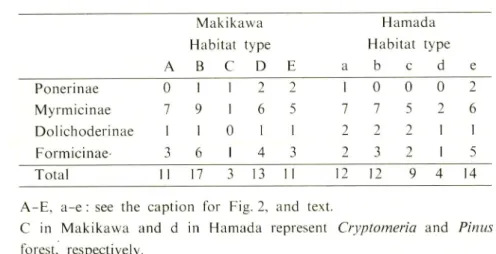
varied slightly among habitat types, it is obvious from Table 4 that ant fauna was poorest in Cryptomeria and Pinus forests (plantations), and that other habitat types harboured similar numbers of ant species.
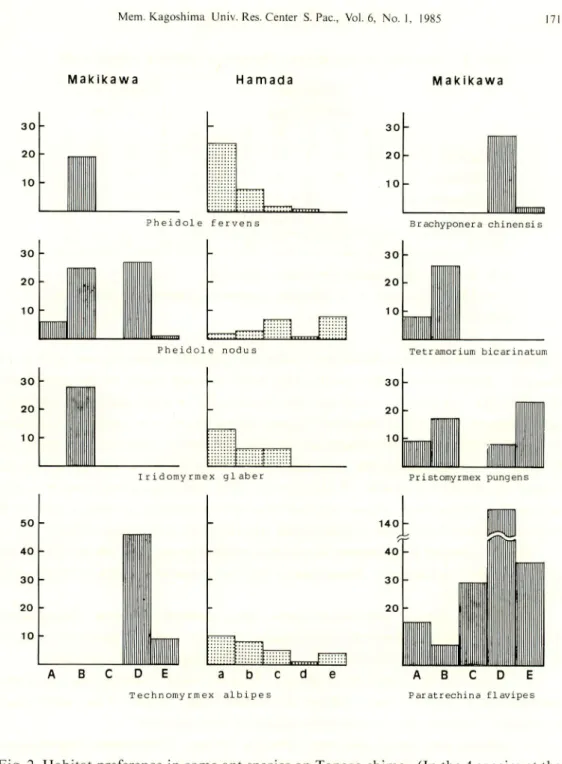
Some species were found to be restricted mainly to open sites, while others to broad-leaved forests (Fig. 2). For example, Ponerinae were largely collected from dark and wet forest floors ; most individuals of Brachyponera chinensis were found from the litter layer of secondary forests. In Dolichoderinae, Technomyrmex albipes was
Mem. Kagoshima Univ. Res. Center S. Pac, Vol.6, No. 1. 1985 171 3 0 20 10 -50 40 30 20 10 Makikawa Hamada 1.'.'.'.'. ".liuiirra P h e i d o l e f e r v e n s Iridoinyrmex glaber •• 11111 ri-J- 1 A B C D E a b c d e Technomy rmex albipes
3 0 20 1 0 -Makikawa 3rachyponera chinensis 3 0 20 1 0 -3 0 20 10 Tetramorium bicarinatum Pristomyrmex pungens A B C D E Paratrechina flavipes
Fig. 2. Habitat preference in some ant species on Tanega-shima. (In the 4 species at the right, data are presented for Makikawa alone.) A : seashore, B : devastated ground, C : Cryptomeria plantation, D : secondary forest, E : forest along stream, a : seashore, b : devastated ground, c : shruberry, d : Pinus forest, e : secondary forest. (See also text.)
172 Yamane et al. : Ants of Tanega-shima
Table 4. Numbers of ant species collected in different habitat types
Makik;i w a F lama da
Halbitat type Habitat type
A B C D E a b c d e Ponerinae 0 1 1 2 2 1 0 0 0 2 Myrmicinae 7 9 1 6 5 7 7 5 2 6 Dolichoderinae 1 1 0 1 1 2 2 2 1 1 Formicinae- 3 6 1 4 3 2 3 2 1 5 Total 11 17 3 13 11 12 12 9 4 14
A-E, a-e : see the caption for Fig. 2, and text.
C in Makikawa and d in Hamada represent Cryptomeria and Pinus forest, respectively.
typically a forest dweller in Makikawa, while it was found in rather diverse habitats in Hamada. Iridomyrmex glaber, on the other hand, was not found on the dark forest
floors at all. A similar situation was encountered in two species of Pheidole
(Myrmicinae) : Ph. nodus inhabited various habitat types from seashore to hilltop
including forests, while Ph. fervens was largely confined to open sites, especially in Makikawa. A third species, Ph. pieli, was found only in forests. Two Aphaenogaster species coexisted on a seashore of Makikawa ; these species were restricted to a very narrow zone along the coastline, and two other species found in mountain regions of Yaku-shima were lacking on Tanega-shima (cf. Terayama & Yamane, 1984).
Species collected in the present survey may roughly be grouped into the following types in babitat preference. Some species are not included because of their poor representation.
A. Species mainly inhabiting forests: Brachyponera chinensis, Hypoponera spec, Odontomachus monticola (Ponerinae); Pheidole pieli, Vollenhovia emeryi,
Crematogaster laboriosa (Myrmicinae) ; Camponotus nipponicus (Formicinae). B. Species inhabiting diverse habitats: Pheidole nodus, Pristomyrmex pungens (Myrmicinae); Technomyrmex albipes (Dolichoderinae); Paratrechina bourbonica,
P. flavipes, Formica spec, Camponotus tokioensis (Formicinae).
C. Species inhabiting open sites : Pheidole fervens, Tetramorium bicarinatum, Monomorium minutum, Cardiocondyla spec. (Myrmicinae) ; Iridomyrmex glaber
(Dolichoderinae).
D. Species inhabiting seashores: Aphaenogaster osimensis, A. spec. (Myrmicinae) ; Tapinoma melanocephalum (Dolichoderinae).
References
Mem. Kagoshima Univ. Res. Center S. Pac, Vol.6, No. I. 1985 173
Amami-oshima. Ecol. Stud. Nat. Cons. Ryukyu Is., 3: 93-102.
Kimoto, S. 1982. Zoogeography and ecology of the Ryukyu Archipelago with special reference to leaf beetles (Coleoptera : Chrysomelidae). Entom. Gener., 8 : 51-58. MacArthur, R. H. & Wilson, E. O. 1967. The Theory of Island Biogeography. Princeton
Univ. Press, Princeton, xi + 203 pp.
Mezaki, S. 1980. Parallel zonation of high and low islands in the Ryukyu island arc. Ryukyu-retto no Chishitsugakuteki Kenkyu, 5: 91-101. (In Japanese with
English summary.)
Mori, I. 1984. Tanega-shima no kamikiri-mushi. Satsuma, 33 : 106-126. (In Japanese.) Okadome, T. 1973. The Insect Fauna of Yakushima Island, South Japan. Yaku-cho
Educational Committee, 179pp, 6 pis. (In Japanese.)
Terayama, M. 1983. Kagoshima-ken-hondo no ari. Kanagawa-chuho, 69: 13-24. (In
Japanese.)
Terayama, M. & Yamane, Sk. 1984. Ants of Yaku-shima Island, the northern Ryukyus, with reference to their altitudinal distribution (Insecta : Hymenoptera). Cons.
Rep. Yaku-shima Wildness Area, Kyushu, Japan, pp. 643-667. Nat. Cons.
Bureau, Env. Agency, Japan. (In Japanese with English summary.)