日本で増加する英語能力試験
イアン・ウィリアム・ウォーナー
English Language Proficiency Testing in Japan
Ian William Warner
Abstract
English language proficiency - above all speaking and discussing skills - are becoming more necessary and
important in Japanese commerce and society at large, in part as a result of Japanese government policy. Concurrent
with this trend, and perhaps partly because of it, not only the number of Japanese persons wanting to take English
language proficiency tests but also the number of English language proficiency tests themselves are increasing. This
brief survey article examines what English language proficiency tests are currently available in Japan, how they vary
in crucial respects, and how - and to what extents - they are currently being utilized by individuals and institutions. It
then briefly considers whether further increases in the total number of such tests are likely and whether that would be
a positive, negative, ‘gray’ or neutral phenomenon.
Key words :English Language Proficiency Test, English Language Testing
キーワード :英語能力試験、英語外部試験
吉備国際大学外国語学部
〒700-0931 岡山県岡山市北区奥田西町5番5号
School of Foreign Language Studies, Kibi International University 5-5, Okuda Nishi-cho, Okayama-shi, Kita-ku, Okayama-ken, Japan (700-0931)
吉備国際大学研究紀要 (人文・社会科学系) 第25号,113−124,2015
1.
English Language Proficiency Tests in Japan
(1) Market size
As ‘globalization’ and ‘internationalization’ have become key themes for educational institutions and larger business entities in Japan, the demand for and emphasis on effective foreign language skills has grown. Concurrent with this trend, and perhaps partly because of it, the Japanese foreign language proficiency testing market has expanded. According to a report compiled by the Yano Research Institute released in September 2014, the foreign language learning market in FY2013 was estimated to be worth just under 809 billion yen per annum. This was a 3.1% increase over the figure for FY2012. A further rise of 2.1% to 825.9 billion yen per annum has been forecast for FY2014. Demand for language proficiency testing has also been rising. The market for language proficiency testing services in FY2013 was said to be worth 205 billion yen per annum, and is expected to have reached 210 billion yen per annum in FY2014.
(2) Major English language proficiency tests
There are currently six major tests available in Japan that are intended to measure general English language proficiency, namely the ‘Test of English for International Communication’ (TOEIC), the ‘EIKEN test in Practical English Proficiency’ (EIKEN), the ‘Test of English as a Foreign Language’ (TOEFL iBT), the ‘International English Language Testing System’ (IELTS), the ‘United Nations Association of Japan’s six-level Test of English’ (UNATE) and the Cambridge English Language Assessment ‘Proficiency (CPE)’ (hereafter cited as ‘CPE’) language test. At least two additional tests, quite newly developed, may in time need to be added to this list: i) the ‘Test of English for Academic Purposes’ (TEAP) developed by Sophia University in conjunction
with the Eiken Foundation of Japan and ii) the ‘Global Test of English Communication’ (GTEC) developed by Benesse Group with some funding support provided by the Government of Japan’s Ministry of Education, Science, Sports and Culture (MEXT).
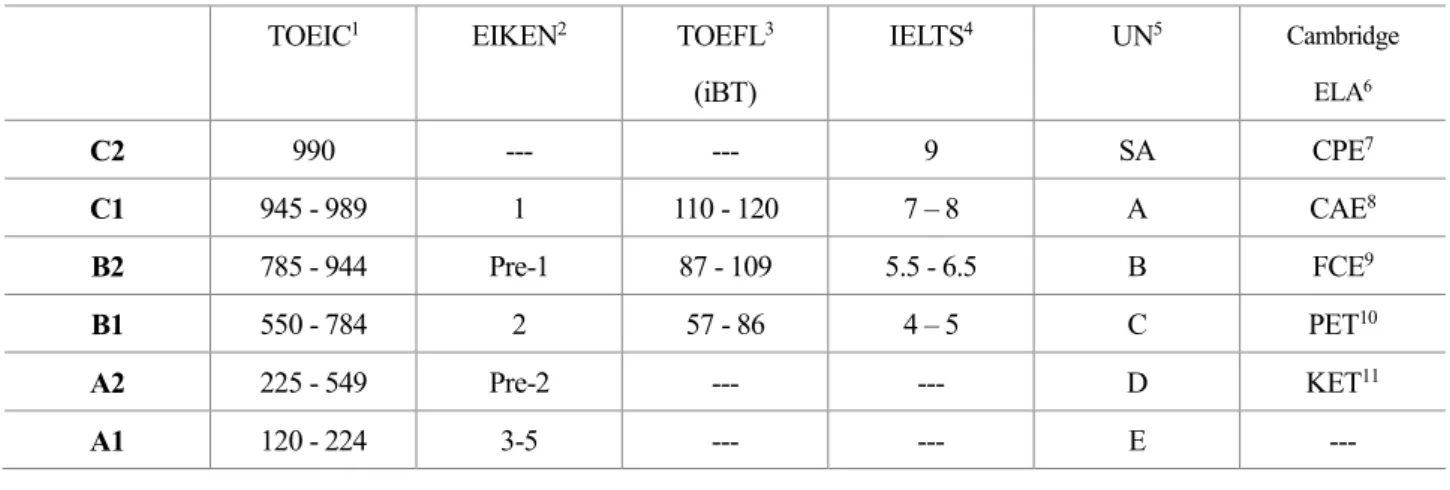
Table 1 compares the aforementioned six major tests using the Common European Framework of Reference for Languages (CEFR) ‘European Scale of Language Proficiency’ as yardstick. As the table shows, these tests overlap in terms of content and thus likely demographic / customer base and can therefore safety be seen as amounting to rival products. More importantly, when viewed and grouped together collectively, they can justifiably be said to well cater for an examinee population with wide variance in current English language proficiency levels.
(3) Numbers of English language proficiency tests taken per annum
The number of major English language proficiency tests taken in Japan per annum has been rising steadily. For TOEIC, the number of proficiency tests taken in Japan in 2013 (counting both the Institute for International Business Communication’s (IIBC) Secure Program (SP) tests and Institutional Program (IP) tests arranged directly by educational institutions, corporations and other organizations) was 2.361 million, compared with 2.304 million in 20121. The number of EIKEN foundation ‘EIKEN’ tests taken in Japan has similarly been rising. In 2013, 2.356 million ‘EIKEN’ tests were taken, up from 2.319 million in 20122.
1 This data was taken from:
http://www.toeic.or.jp/toeic/about/data.html [Accessed: Dec. 30th, 2014]
2 This data was taken from:
http://www.eiken.or.jp/eiken/en/eiken-tests/stats/ [Accessed: Dec. 30th, 2014]
The number of ‘IELTS’ proficiency tests taken in Japan has also risen significantly since the Eiken Foundation of Japan assumed joint responsibility for administering it (in Japan only) in partnership with one of its main owners, the British Council, a U.K. government funded education and culture provider-promoter. 24,000 ‘IELTS’ tests were taken in 2013, a figure 3.5 times higher than the official total recorded for 20093.
While the numbers of ‘TOEFL iBT’ and certainly ‘CPE’ and ‘UNATE’ proficiency tests taken in Japan are doubtless modest in comparison and unfortunately not presently disclosed by their respective testing bodies, it is likely that their administering parent organizations have similarly recorded increases in overall sales of these proficiency tests over the last 5 years.
(4) Test content
Although these various English language proficiency tests seem on the face of it to offer a fairly high degree of cross-compatibility and an examinee’s performance for all of them can likely be legitimately inferred / predicted with some confidence using actual test data obtained from just one or two of them, it is vital to recognize that they each adopt significantly different approaches to measuring test takers’ overall English language proficiency and differ markedly regarding structure (e.g. the number and nature of levels, length of components and / or overall duration). The comprehensive ‘TOEFL iBT’, and ‘IELTS’ proficiency tests assess not only Reading and Listening abilities, but also Speaking and Writing capacities and allocate maximum marks equally among each, in a balanced manner. In contrast, the ‘CPE’ and ‘EIKEN 1st Grade’ and ‘Pre-1st Grade’
3 This data was taken from:
http://www.eiken.or.jp/ielts/merit/situation/ [Accessed: Dec. 30th, 2014]
proficiency tests also measure all four skills, but assign greater emphasis and marks to Reading and Listening. In the case of the most demanding (i.e. CEFR C2 level) of Cambridge English Language Assessment tests, namely the ‘CPE’, Reading is allocated a maximum of 40% of available marks compared to a maximum of 20% each for Listening, Writing and Speaking. The ‘UNATE SA’ and ‘UNATE A’ proficiency tests currently measure Reading, Writing and Speaking capabilities, but not Listening capability. The main ‘TOEIC’ proficiency test measures only Reading and Listening abilities and cannot therefore be said to constitute a fully comprehensive test in its own right. For assessment of Writing and Speaking proficiency, entirely separate if complimentary ‘TOEIC SW’ proficiency tests must be taken (in succession, on a single date) and these almost certainly have much lower product recognition profiles and end-user uptakes compared to the much better known main ‘TOEIC’ proficiency test.
The most precise and truly informative results are surely most likely to be forthcoming when all four skills are measured and then evaluated / weighted equally regardless of the relative importance one chooses then assign to each of them. However, as it is more difficult and time consuming to gauge Writing and Speaking proficiencies with the necessary degree of objective rigor, tests that attempt to do so tend to be more expensive - and lengthy - to design, sit, mark and otherwise administer. Probably in part for this very reason, the ‘TOEFL iBT’, ‘IELTS’ and ‘CPE’ tests have been relatively expensive propositions for a long time or throughout their histories and, as of December 2014, cost a hefty US$230 (if taken in Japan), Y25,380 and Y25,725 respectively, whereas the fee for the less wide-ranging ‘UNATE SA’, Eiken 1st grade and main ‘TOEIC’ is Y10,500, Y8,400 and Y5,725 respectively.
(5) Other, secondary English language proficiency tests Developed in the USA at San Diego State University and the until recently affiliated International Testing Services Center (ITSC) for persons aged 16 and over, the ‘General Test of English Proficiency’ (G-TELP) could perhaps gain some traction and a higher profile in the coming years in North America and / or elsewhere, although it is presently fairly obscure and may give some the impression of being both at least as complex in terms of structure and assessment as its better known peers and, arguably, still to some extent an experimental ‘work in progress’. Bolstered by separate Writing (G-TELP GWT) and Speaking (G-TELP GST) components, the core G-TELP proficiency test comprises 5 task-based tests for different capability levels. Four of these five tests are presently available in Japan. The lowest 4 levels (Levels 5 to 2) cover grammar, Listening, Reading and Vocabulary proficiency while the highest level (Level 1) covers Listening, Reading and Vocabulary proficiency. However, the primary emphasis moves from Listening skills at the lowest level to Reading skills at the highest. The 60-minute duration Level 1 test assesses “Authentic English in Complex Communication” (Listening) and “Authentic Modified English in Normal Communication” (Reading). Level 2 (90-minute duration) assesses “Authentic Modified English in Normal Communication”. Level 3 (80-minutes duration) assesses “Modified English in Simple Communication”. Level 4 (60 minute duration) assesses “Basic English in Simple Communication”. The 45-minute duration entry-level test (Level 5) - which should not be mistaken for or conflated with an entirely distinct ‘Junior G-TELP’ that is intended to measure young students aged between 7 and 14 years old - assesses “Basic Classroom English” capability. For each of these ‘G-TELP’ tests, proficiency is determined by comparing examinee performance with ‘G-TELP’ test descriptors drawn up to regulate grading of observed performance. Heavy use
of multiple-choice formats is said to aid grading accuracy and reliability. As mentioned above, separate ‘G-TELP’ tests have been developed for Writing proficiency (i.e. The 60- minute duration ‘G-TELP GWT’) and Speaking (oral) proficiency (i.e. The 40-minute duration ‘G-TELP GST’). For both of these tests, there are 3 levels: basic, intermediate and advanced. For the ‘G-TELP GST’ Speaking test, examinees must attempt to gain mastery regarding 4 basic tasks, 4 intermediate tasks and 3 advanced tasks. For the ‘G-TELP GWT’ Writing test, examinees are required to construct a paragraph, compose a letter, compose a formal letter, describe a situation and finally write an essay. ITSC Group, the ‘G-TELP’s’ current owner-controller and promoter, contends that its ‘G-TELP’ portfolio can capture an unusually large and informative volume of data on Listening, Reading, Vocabulary, and Grammar test performance that is ideal for advanced diagnostic purposes. This, the ITSC claims, allows test takers to receive quantitatively and qualitatively superior feedback reports about their respective test performance strengths and weaknesses. According to G-TELP Japan, 100 universities in Japan (an accumulated total) have to date used ‘G-TELP’ to determine student English language proficiency at least for aptitude-level screening, streaming and progress assessment purposes. Conceivably in part due to Japan’s MEXT having made the teaching of English language compulsory on a nation-wide basis for the final two years of public elementary school education, demand for English tests for children has also been rising. High profile tests of this kind include the Japan Association for the Promotion of English for Children (JAPEC) ‘English Test for Children’, the United Nations Association’s ‘Test of English (Junior Test)’, and Cambridge English Language Assessment’s ‘Young Learners’ trio of tests.
Various additional English language proficiency tests for ‘business’ applications and specific professionalized sectors
such as accounting, law, commercial aviation and various forms of medical practice also exist. Currently leading examples include those marketed and administered by Cambridge English Language Assessment and the International Testing Services Center (ITSC). These specialized and custom products may increase in number, significance and popularity in the years to come but fall outside the scope of this survey owing to time constraints and the fact that currently, they constitute peripheral tests not generally considered to be of great salience vis-à-vis the overall English language proficiency testing market.
2. Use of External English Tests at Academic
Institutions in Japan
(1) Use of external English language proficiency tests for entrance examinations
A MEXT expert panel that discussed English education in Japanese public schools on September 26th, 20144 concluded by affirming that English language education should aim to develop all four communicative skills in unison. The panel also held that university entrance examinations should likewise assess all four skills. Yet currently, the ‘National Center Test for University Admissions’ allocates a full 80 percent of available marks to Reading skills and the remaining 20 percent solely to Listening skills. Furthermore, most universities in Japan currently have their own individual entrance examinations, the great majority of which are similarly unbalanced with too much weight tending to be assigned
4 MEXT Expert Panel Report on Improvement and Enhancement of English Language Education [Online] Available from:
http://www.mext.go.jp/b_menu/shingi/chousa/shotou/102/ho ukoku/1352460.htm [Accessed: Dec. 30th, 2014]
to Reading (including grammar and translation) proficiency assessment. Therefore, the same MEXT expert panel recommended that more Japanese universities begin to utilize external examinations in order to enhance the scope and overall precision of their English language proficiency testing. In that connection, according to the Council on International Education Exchange (CIEE) Japan, 219 universities in Japan were making some use of the ‘TOEFL iBT’ in connection with entrance examinations in 20125. However, their utilization of the ‘TOEFL iBT’ was limited, being largely confined to Admissions Office (AO) examinations and / or the assessment of transfer student admissions, etc., rather than being deployed widely for general entrance examination purposes. Quite the contrary. According to the same CIEE report, no national / public universities used the ‘TOEFL iBT’ as a core part of its general entrance exam. While eleven private universities were found to be making some use of the ‘TOEFL iBT’ as a part of their general entrance examinations, most if not all did so only in secondary, rudimentary ways. This is almost certainly in large part due to the comparative difficulty as well as lengthy duration - and substantial cost (even for institutions) - of this test. As noted, TOEFL iBT is an expensive and advanced test that is simply too hard for all but a small minority of high school graduates already in possession of demonstrably superior English skills.
The number of universities that make use of the somewhat less demanding ‘TOEIC’ proficiency test in their entrance examination process has also been rising.
5 International Education Exchange (CIEE) Japan TOEFL iBT score usage report 2012 [Online] Available from: http://www.cieej.or.jp/toefl/toefl/score_report2012.pdf [Accessed: Dec. 30th, 2014]
According to the Institute for International Business Communication (IIBC), 336 universities in Japan had in one way or another included the ‘TOEIC’ in their entrance examination processes by 2013, compared to 290 in 2012. However, as with the ‘TOEFL iBT’, ‘TOEIC’ use is also limited for like reasons. In both cases, colleges and universities may merely provide student applicants with the opportunity to voluntarily specify ‘TOEFL’ and ‘TOEIC’ scores on entrance application forms and during interviews.
So the main factors that serve to discourage or prevent universities from fully embracing such otherwise leading external proficiency tests for their entrance exams appear to be as follows: i) test content is simply too advanced for the majority of Japanese high school students; ii) test content is not suitable for other reasons; and iii) the accuracy and comparability of tests cannot be assured because they have not been designed in accord with Item Response Theory (IRT). (The ‘TOEFL iBT’ is reportedly IRT compliant but the TOEIC may well not be. Please see below).
iii) Students’ English language proficiency levels If the proficiency test is too difficult or too easy, results will be insufficiently informative and meaningful even if they permit ‘realistic’ rankings of examinee proficiency. According to in-house ‘TOEIC’ data analysis, the average ‘TOEIC’ score of high school students in Japan was 511 in 2013. Therefore, if an external test of English language proficiency is to be used for a university entrance examination test, it should be a fairly easy one targeted at the A2 level on the aforementioned CEFR ‘European Scale of Language Proficiency’.
iii) Test content
The purpose of any chosen university entrance test is to determine whether candidates are likely to be capable of at least satisfactory study performance at the examining
university. Therefore, the chosen entrance test must be able to test English language proficiency vis-à-vis ‘academic purposes’. Yet the ‘TOEIC’ is intended to evaluate test takers’ English language proficiency in a more general or, in fact, somewhat business-oriented contexts, and so lacks adequate ‘academic purpose’ related English language content.
iii) Reliability of test scores
For the ‘TOEFL iBT’ and ‘IELTS’ tests, IRT is applied in a ‘rigorous’ effort to increase the probability of test score accuracy and continuity across time and space. IRT is said to ensure to an acceptable extent that if any two people with the same level of English language proficiency take an IRT compatible test, they should both score the same total number of points and be graded identically. However, for the regular ‘TOEIC’ test, it is not clear whether IRT is applied or not, while the current ‘EIKEN’ test seems to make no use of IRT whatsoever. 1) Newer tests: ‘TEAP’
A largely paper-based ‘Test of English for Academic Purposes’ (TEAP) is being developed in Japan by staff at Tokyo’s Sophia University in collaboration with the Eiken Foundation of Japan. Launched only in July 2014, the fledgling, home-grown ‘TEAP’s’ most important characteristic is that it has been developed from the outset specifically for university entrance examination use in Japan and so has been designed to measure how well Japanese student applicants can comprehend and produce English as a second language in ways “appropriate to university-level education.” The ‘TEAP’ has been adopted as a part of Sophia University’s own 2015 entrance examination and will reportedly be employed by Rikkyo (St. Paul’s) University in 2016. One main benefit of ‘TEAP’ as far as university student applicants are concerned is that they can take this test multiple times since they only need to
achieve a stipulated minimum pass mark prior to application. This is clearly a far more agreeable and possibly fairer proposition than subjecting prospective students to conventional one-off university examinations. On the other hand, the ‘TEAP’ might not yet be optimally employed at Sophia University since, as just touched on, it is being used essentially only as a pass or fail test, so excellent students of English who obtain very high ‘TEAP’ scores will not gain any university entrance related advantage - points wise - over those who just manage to score the minimum number of marks necessary to pass the test.
2) Newer tests: ‘GTEC’
Benesse Group has also co-developed an indigenous Japanese English language test which it has christened the ‘Global Test of English Communication’ (GTEC).6 There are two variants of this test, namely the internet-based ‘GTEC CBT’ for adults (of 175-minutes duration) and the paper-based ‘GTEC for Students’ for junior-high and high school students. The more demanding ‘GTEC CBT’ variant measures English for academic purposes while the ‘GTEC for Students’ variant measures general English comprehension. While the Y12,600 ‘GTEC CBT’ may be somewhat less academically oriented than the ‘TEAP’, it is a single level test that measures all four skills (i.e. Reading, Listening, Writing and Speaking equally (in terms of points allocated) and targets A2 to B2 / C1 (CEFR) level candidates. The maximum obtainable score is 1,400 points (i.e. a maximum of 350 points for each of the 4 skills). The ‘GTEC CBT’ Reading test lasts for 55 minutes and its Listening test lasts for 35 minutes. Its
6 Benesse Holdings Inc. GTEC CBT [Online]. Available from: http://www.benesse-gtec.com/cbt/ [Accessed: Dec. 30th, 2014]
Writing test lasts for 65 minutes and its Speaking tests lasts for approximately 20 minutes.
The ‘GTEC for Students’ variant measures only Reading, Listening and Writing. Three separate versions of the ‘GTEC for Students’ variantare offered in order to cover varying ability levels. ‘GTEC for Students’ levels (in ascending order) are titled ‘Core’ (70-minutes duration), ‘Basic’ (90-minutes duration) and ’Advanced’ (90-minutes duration). For the ‘Core’ test, 32 minutes are assigned to Reading, 18 minutes to Listening and 20 minutes to writing. For the ‘Basic’ and ‘Advanced’ tests, 45 minutes are assigned to Reading, 25 minutes to Listening and 20 minutes to Writing. The maximum obtainable score is 440 points for the ‘Core’ test, 660 points for the ‘Basic’ test and 810 points for the ‘Advanced’ test. The ‘GTEC for Students’ variant targets A1 to B1-2 (CEFR) level candidates and is therefore appropriate for the more able of high school graduate and fresh university level under-graduate students.
Both variants the ‘GTEC’ test can be taken in all of Japan’s prefectures on (Benesse-owned) Berlitz language center premises. The ‘GTEC for Students’ variant can alternatively be taken at schools which makes it more readily accessible to students living in remote locations. Like the ‘TOEFL iBT’ and ‘IELTS’ tests, both ‘GTEC’ variants make use of the aforementioned IRT to ensure grading validity and consistency, etc. According to the official Benesse Group website, a number of well known public and private sector Japanese universities are planning to experiment with the academic English ‘GTEC CBT’ variant for entrance examination purposes from 2015 onwards and around 60,000 high school students at over 1,000 high schools sat the ‘GTEC for Students’ variant during 2013.
universities frequently use external English tests as part of their overall entrance examination.
(2) Taking of external English language tests to gain credits for English language courses at universities in Japan:
External English language proficiency tests are more often taken in order to gain credits for English language courses of study at universities. In other words, students who study English language at university are increasingly able to take external tests instead of - or perhaps in addition to - bespoke in-house examinations created by teaching staff, providing doing so is in-line with syllabus briefs, etc which now often encourage such. According to CIEE Japan, 162 universities in Japan issued students with English language credits on the basis of TOEFL iBT scores in 2012. Likewise, according to the IIBC, 360 universities in Japan issued credits on the basis of proven ‘TOEIC’ scores in 2013.
3.Possible Grounds for Concern
Two main areas of concern may be appreciable. The first is test pricing. The second is test multiplication / multiplicity resulting in excessive overlap and duplication. Prices for these tests are presumably decided only after taking into careful account numerous practical and commercial considerations. Be that as it may, public demand for English language proficiency tests - above all for the most expensive such as ‘TOEFL iBT’ - arguably might be higher if per test charges were lower. Test price surely affects the total number of actual persons who opt to sit and re-sit tests and the total number of times in any given period they choose to do so. If test prices are relatively low and easily affordable, tests are likely to be taken more frequently by eager, well-motivated individuals. If, on the contrary, test prices are relatively high and less affordable, the opposite
dynamic is to be expected. Therefore, could it be that test performance is in practice somewhat affected by - and thus dependent on - test price, given that greater familiarity with actual tests and test conditions is likely prone to improve (if only marginally) overall examinee test performance? Whether this is indeed the case may remain an open question but it is perhaps up to the testing organizations to dispel such a seemingly plausible assumption if they wish to defend relatively high testing fees or raise charges further.
As regards test multiplication and duplication, some degree of consumer choice regarding test product selection is doubtless very desirable for obvious, conventional reasons to do with monopoly etc, but there is surely some potential risk that too many competing tests could come to frustrate and inhibit the fundamental objective of testing, namely accurate determination of the extent of knowledge and skill acquisition / retention vis-à-vis as large a test population as possible. Unless the results of all major English language proficiency tests can be reliably, easily and quickly compared with one another and matched, regardless of their country of origin etc, confusion will supplant clarity and transparency. In short, ‘too many’ major test products all competing against one another increase the chances of measurement ‘chaos’. The greater the international stature and employment of a few widely known and dominant tests, the better. So long as a handful of premier tests are sufficiently comprehensive and internally sound in terms of design and deployment, there are perhaps no compelling objections to them collectively remaining standard, default resources since they will perform their assigned function(s) well enough and can be improved upon and updated as and when necessary and desirable. It is surely far wiser to try to improve current tests than to allow or contribute to an excessive proliferation of new ones. Ideally, improved testing knowhow should at the appropriate time, and with great care, be incorporated into existing tests even if that necessitates their expansion or
radical re-design, not used as the basis and rationale for the creation of challenger products. Excessive profusion of tests - especially those developed and deployed in only one or a small number of countries and developed expressly for specific first-language speakers could, over time, do as much - or actually more - harm than good. One objection to the design, development and introduction of additional English language proficiency tests (especially those tailored to the needs of nation-specific examinees) might be that such products will almost certainly have markedly lower levels of even long-term international utilization and recognition compared to the more ‘global’ of established tests they are intended to compliment or supersede. This scenario in no way precludes the possibility that such new national or regional tests might, in their own quite small home and niche markets, become successful to the point where they erode or eliminate the market share of perhaps superior and / or more international and thus beneficial tests such as ‘TOEFL iBT’, ‘IELTS’ and ‘TOEIC’. New test products might present viable and perhaps even lucrative business opportunities for savvy developers and - if known or thought to be easier than established, multi-country tests such as ‘TOEFL iBT’, ‘IELTS’ and ‘TOEIC’ - may also be welcomed by those doubtful of their or their student’s ability to score well on the latter. That said, these new tests will more likely than not be viewed at least in the short and medium term by many individuals and institutions inside and especially outside their country of origin as unfamiliar, complicating, possibly inferior and consequently unnecessary ‘distractions’ that draw examinees away from focusing on the most demanding and / or internationally familiar and prestigious, and thus still ultimately most important tests. If such new and perhaps easier tests acquire sufficient standing and kudos within, for example, Japan and come to be seen as easier but nevertheless still legitimate functional alternatives to the ‘TOEIC’, ‘TOEFL iBT’ and / or ‘IELTS’ for domestic
purposes, they could cause large numbers of Japanese examinees to at least delay if not permanently shun attempting the latter and in so doing actually arrest / retard the pace and / or degree of their overall English language knowledge acquisition. Proficiency tests, after all, are educational in their own right.
In this age of advanced and in many ways accelerating ‘globalization’, it has surely never been more desirable and preferable to have a very small number of internationally designed, developed, administered and recognized tests of English language proficiency. However, this goal conceivably becomes harder to realize if more organizations introduce more tests and do so in part only on a regional or country-specific basis. Though quite possibly commendable in principal, attempts to simplify and consolidate on an international basis rather than further diversify an already crowded proficiency certification universe must also contend with the fact that overall foreign language proficiencies vary - for whatever sets of reasons - between countries. Statistically speaking, some nationalities find such tests to be harder than others and / or consciously consider them to be such. That said, different variants of a single ‘test’ can of course always be offered to accommodate different proficiently levels. Ultimately, if a test such as the ‘TOEFL iBT’ is not seen to be overly demanding in a majority of countries, it most certainly should not be ‘dumbed-down’ or replaced by easier alternatives anywhere, including in countries where below average percentages of those who attempt it score highly. Instead, it ought be left alone or extended ‘downward’ to better engage and accommodate less advanced students of English. The ‘TOEIC Bridge’ test appears to be a good example of just this kind of common-sense initiative.
4.Conclusion
This paper has briefly surveyed the major English Language proficiency tests currently available in Japan along with a few secondary ones. As outlined, there are currently six major English tests. They are intended for employment with what is probably an appropriately broad arrange of English learners. Each of these proficiency tests has their own strengths and weaknesses. No one test appears to constitute any authentic ‘gold standard’ that brings into question the need for the others even though the ‘TOEFL iBT’ seems to come closest to doing so in some respects, at least for advanced examinees, despite its challenging nature. Excellent marks in any one of the (frequently updated) tests that measure all 4 skills is surely a sufficiency reliable indication of excellent, all-round general non-native English language proficiency, even if the test in question focuses more heavily on just one or two of those skills and accordingly assigns marks disproportionally. At present, perfectionists interested in determining a non-native speaker’s English language proficiency in the most scrupulous, painstaking and exhaustive of ways feasible can, naturally, demand that persons take two or three of these proficiency tests in succession within a designated short period of time. Suffice it to say that a person emerging from such a process with exemplary ‘IELTS’ or ‘CPE’ as well as ‘TOEFL iBT’ and ‘TOEIC’ scores can soundly be considered to have excellent all-round English aptitude, skills and capabilities.
Some English language proficiency tests are clearly far better known and more widely used than others. On the other hand, currently fairly obscure tests (newly developed or otherwise) and / or as yet be to be developed tests could perhaps gain popularity in the years ahead if intensively enough promoted over long periods by their backers and other interested patrons and / or competitively priced. With the numbers of English students and consequent
demand for proficiency test success higher than ever before, times have, presumably, never been better for test consumers and providers alike, in substantial part because of ongoing technological revolutions in the computing and telecommunications sectors. Test takers have increasingly good access to a fairly broad range of maturing tests and related study materials and the more established of these tests have a larger and still growing market and enjoy better brand recognition than hitherto. If English learners familiarize themselves adequately with the characteristics of each test and spend time to carefully choose which of them is best to use at any given stage, they can be rightly confident that they will benefit substantially from their use. Whatever their current shortcomings and deficiencies, these proficiency tests are the best we have at present and can and should be used with confidence by students and educators alike to measure student progress and tutor effectiveness.
Two definite if still fairly embryonic trends are observable in that these external English language tests are beginning to be used more both for university entrance examinations and / or for English language course student credit accrual. Universities in Japan must ensure that they use these tests carefully and only with appropriate examinee populations. Only then will the full benefits accrue for both exam. candidates and examining institutions.
The prospect of new English language proficiency tests coming to challenge and compete with established ones is real but there is no certainty that this will happen any time soon. To reiterate, any such development could in any case be a double-edge sword or worse. The best case scenario is that it would help bring about an improved overall proficiency test market since new test products would i) serve to force established test organizations to improve and / or lower the price of their flagship products and / or ii) themselves eclipse the latter, owing to their own superior quality if not necessarily greater affordability. The worst case
scenario might be that new proficiency tests would be inferior to, or no better than, established ones and either just clutter and confuse the proficiency test market or degrade it by reducing demand for the best, more established tests and thereby jeopardize their viability or kill them off entirely. As stated above, some ‘healthy’ degree of consumer choice regarding test product selection is doubtless preferable to monopoly domination by just one single test and / or testing organization but there is surely some potential risk of excessive diversification. Unless the results of all major English language proficiency tests can be reliably, easily and quickly compared with one another and matched, regardless of their country of origin etc, confusion will supplant clarity. While these major English Language proficiency tests are unlikely to disappear or undergo any fundamental
transformations in the short to medium term, they will continue to need regular updating, tweaking and modification. As has been well understood for an extended period, ongoing advances in computing and information technologies will likely carry on affecting, altering and facilitating the ways these proficiency tests are designed, accessed, evaluated and promoted. The major English language proficiency tests appear likely to remain dominant and to continue to be sat by increasingly large numbers of test takers in coming years. That said, sector-wide proficiency test marketing and pricing strategies may, through the next decade, help determine - perhaps to a greater degree than hitherto - the extent to which new, similarly and lower priced alternatives are developed and then gain consumer recognition, interest and loyalty.
References
Benesse Holdings Inc. GTEC CBT [Online]. Available from: http://www.benesse-gtec.com/cbt/ [Accessed: Dec. 30th, 2014] Educational Testing Service (ETS) Compare TOEFL scores: Take the Guess work out of Comparing Scores - With Score Comparison Tools From the Marker of the TOEFL Test
Online version available from: https://www.ets.org/toefl/institutions/scores/compare/ [Accessed: Jan. 2nd, 2015]
ETS Mapping the TOEIC and TOEIC Bridge Tests on the Common European Framework of Reference for Language
Online version available from: https://www.ets.org/s/toeic/pdf/toeic_cef_mapping_flyer.pdf [Accessed: Dec 28th, 2014] International Education Exchange (CIEE) Japan TOEFL iBT score usage report 2012 [Online]
Available from: http://www.cieej.or.jp/toefl/toefl/score_report2012.pdf [Accessed: Dec. 30th, 2014]
MEXT Expert Panel Report Improvement and Enhancement of English Language Education [Online] Available from: http://www.mext.go.jp/b_menu/shingi/chousa/shotou/102/houkoku/1352460.htm [Accessed: Dec 30th, 2014]
Yano Research Institute Ltd. Language Business Market in Japan: Key Research Findings 2014 [Online]. Available from: https://www.yanoresearch.com/press/press.php/001295 [Accessed: Nov 24th, 2014]
Yasukochi Tetsuya Is Introduction of External English Test Good or Bad? Will University Entrance Examination Change? in: Toyo Keizai Online March 6, 2014 Available from: http://toyokeizai.net/articles/-/30613 [Accessed: Nov. 24th, 2014]
Appendix
Table 1. Comparison Table based on the Common European Framework of Reference for Languages (CEFR) European Scale of Language Proficiency
TOEIC1 EIKEN2 TOEFL3
(iBT) IELTS4 UN5 Cambridge ELA6 C2 990 --- --- 9 SA CPE7 C1 945 - 989 1 110 - 120 7 – 8 A CAE8 B2 785 - 944 Pre-1 87 - 109 5.5 - 6.5 B FCE9 B1 550 - 784 2 57 - 86 4 – 5 C PET10 A2 225 - 549 Pre-2 --- --- D KET11 A1 120 - 224 3-5 --- --- E
1 Listening and reading scores combined. This data was based on the survey conducted by Educational Testing Service (ETS). “Mapping the TOEIC and TOEIC Bridge Tests on the Common European Framework of Reference for Language”
Online version available from: https://www.ets.org/s/toeic/pdf/toeic_cef_mapping_flyer.pdf [Accessed: 28/12/2014] 2 This data was obtained from http://stepeiken.org/comparison-table [Accessed: 28/12/2014]
3 This data was based on the survey conducted by ETS. Compare TOEFL scores: Take the Guess work out of Comparing Scores --- With Score Comparison Tools From the Marker of the TOEFL Test
Online version available from: https://www.ets.org/toefl/institutions/scores/compare/ [Accessed: 02/01/2015] 4 This data was obtained from http://www.ielts.org/researchers/common_european_framework.aspx [Accessed: 28/12/2014]
5 This scale was estimated by myself from the information acquired from http://www.kokureneiken.jp/about/index.html [Accessed: Dec 28th 2014]
6 This data was obtained from http://www.cambridgeenglish.org/cefr/ [Accessed: 02/01/2015] 7 Cambridge English - Proficiency (CPE) - very advanced
8 Cambridge English - Advanced (CAE) - advanced 9 Cambridge English - First (FCE) - upper intermediate level 10 Cambridge English - Preliminary (PET) - intermediate level 11 Cambridge English - Key (KET) - basic level