Original Paper
80 Introduction
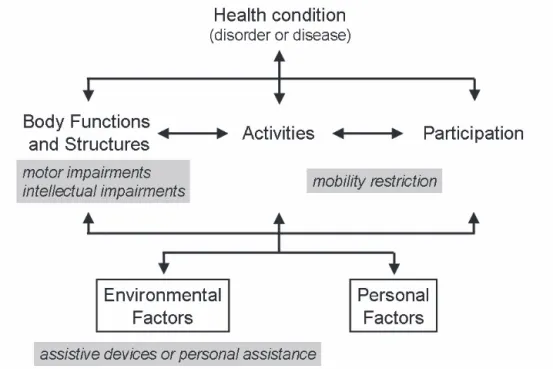
The International Classification of Diseases (ICD) [1] has been created by the World Health Organization (WHO) to classify diseases and other health problems. However, especially in chronic disabling conditions, it is essential to document the impact of health status on the functioning of the person and to change the focus from disease to the consequences of disease as a result of associations with contextual factors [2]. In 2001, WHO issued the International Classification of Functioning, Disability and Health (ICF) [3] as the revised version of the first International Classification of Impairments, Disabilities and Handicaps (ICIDH). Functioning is described as the dynamic interaction among the following four components: body functions and structures, activities and participation, environmental factors, and personal factors (Fig. 1). Each component is subdivided into domains that encompass physiological or anatomical systems, life areas, external influences such as physical, social and attitudinal aspects of environment, and internal influences
Abstract
The present study was conducted to clarify associations between motor and intellectual impairments and mobility restriction, and the impact of environmental factors on the mobility of children in residential institutions for children with motor impairments. Mobility restriction was assessed using the 1st and 4th qualifiers defined in the International Classification of Functioning, Disability and Health (ICF). Motor and intellectual impairments were characterized by gross motor function and intelligent quotient, respectively. The relationship between mobility restriction and the two impairments was examined using Spearman’s rank correlation analysis. The 1st and 4th qualifiers in mobility were moderately correlated to both motor and intellectual impairments. The correlation coefficient for the 1st qualifier was somewhat smaller than that for the 4th qualifier. The Wilcoxon signed-rank test indicated that the 1st qualifier was significantly smaller than the 4th qualifier in mobility (p<0.001). The present results suggest that mobility restriction is influenced not only by motor impairments, but also by intellectual impairments. The contextual assistances are considered to play an important role in reducing the impact of motor and intellectual impairments and improving mobility.
(Accepted Nov. 7, 2011)
Key words: mobility restriction, motor impairment, intellectual impairment, environmental factor, ICF
Takehiko MITA
*, Fumiaki MIKAMI
**, Ko ODA
***and Kitoku OKADA
****Associations between Mobility Restriction and Motor and Intellectual Impairments,
and the Impact of Environmental Factors in Children with Disabilities
*
Doctoral Program in Health Informatics, Graduate School of Health and Welfare Services Administration, Kawasaki University of Medical Welfare, Kurashiki, Okayama 701-0193, JapanE-Mail: [email protected]
**
Department of Health Informatics, Faculty of Health and Welfare Services Administration, Kawasaki University of Medical Welfare***
Asahigawasou Ryoiku Center Ryouikuen Kita-ku, Okayama 703-8555, JapanTakehiko Mita, Fumiaki Mikami, Ko Oda and Kitoku Okada 81
attributed to the person [2].
The one-level classification in activities and participation component includes nine chapters (e.g. communication, mobility, and self-care), while that in body functions consists of eight chapters (e.g. mental function, sensory function and pain, and neuromuscloskeletal and movement related functions) [3]. In particular, mobility is one of the most fundamental components of activities and participation in daily living and social life. It has been suggested that mobility restriction is associated with types of cerebral palsy, epilepsy and intellectual impairments as well as motor impairments [4-7]. In addition, environmental factors are considered to provide an important impact on mobility restriction [8-10].
Fig. 1 Interactions between components of ICF
The Child Welfare Act of Japan states that residential institutions for children with motor impairments should aim to care for individuals with motor impairments and to improve their knowledge and skills in order to enable independent living [11]. According to the act, since admission to residential institutions is limited to children with motor impairments, children with intellectual impairments are excluded. However, actual members of residential institutions for children with motor impairments have consisted not only of children with motor impairments legally defined, but also children with different types of impairments such as intellectual impairments and severe motor and intellectual impairments [12]. In contrast, the constituent members with different impairments in the present residential institution seem to be appropriate for this survey study since they lived in similar residential and environmental settings.
The present study aimed to examine whether motor and intellectual impairments and environmental factors influenced mobility restriction of children in the residential institution for children with motor impairments. Furthermore, the assessment was performed based on the 1st and 4th performance qualifiers defined in the ICF to clarify impact of environmental factors.
Methods
1. Subjects and data collection
14 Figure 1
The present study used the survey data collected as part of the Health Labor Sciences Research by The Ministry of Health Labor and Welfare entitled “Medical and health care for children with severe motor and intellectual disabilities in residential institutions for children with motor impairments”. The subjects were 343 children from 20 residential institutions for children with motor impairments (187 males and 156 females), who neither suffered from pediatric orthopedic diseases nor had undergone surgical operation in the preceding 3 months. The age ranged from 7 to 17 years (12.4 ± 3.08 years; mean ± SD). Interviews and observations for data collection were carried out by medical doctors, therapists and daily life care staffs who knew and were familiar with the subjects. In order to protect personal information, date of birth in the survey data was transferred into a corresponding chronological age, and the processed data then were used for the statistical analysis. The research was approved by the Ethics Committee in Kawasaki University of Medical Welfare (No. 216).
2. Measures and analysis
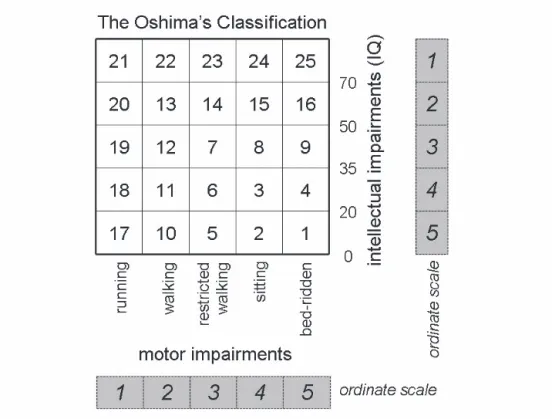
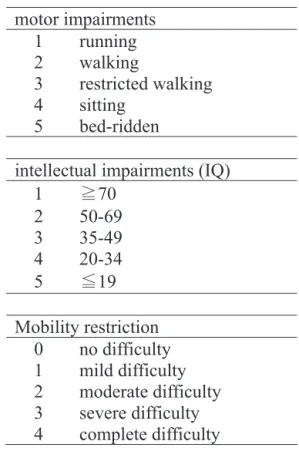
According to Oshima’s Classification [13], motor and intellectual impairments were characterized by gross motor function (posture, walking and running) and intelligent quotient, respectively (Fig. 2). The severity of both impairments was categorized into 5 ordinate scales (1 to 5) (Table 1). Mobility was assessed by the 1st and the 4th qualifiers defined in the ICF [3]. The 1st qualifier (also referred to as performance qualifier) describes what a child does in his or her current environment or daily settings. Since the current environment always includes the overall social context, the 1st qualifier is indicative of performance in actual context and is understood as involvement in a life situation or the lived experience of a child. In the present study, the environmental factors were limited to assistive devices or personal assistance. The 4th qualifier describes current performance without assistive devices or personal assistance. Both qualifiers were also categorized into 5 ordinate scales (0 to 4) (Table 1). The ordinate scale score increases with extent of difficulty. Thus, differences between the 1st and the 4th qualifier reflect the effect of environmental assistances.
Fig. 2 Oshima’s Classification and ordinate scale of two impairments Figure 2
Takehiko Mita, Fumiaki Mikami, Ko Oda and Kitoku Okada 83
Table 1 Ordinate scale of motor and intellectual impairments, and mobility restriction
Statistical analysis was performed using SPSS 17.0. The descriptive statistics of motor and intellectual impairments and the 1st and 4th qualifier in mobility were calculated (the 25th percentile, median and the 75th percentile). Relationships between each impairment and mobility were examined with Spearman’s rank correlation coefficient. In order to determine the effect of assistances on mobility, differences between the 1st and 4th qualifier were statistically tested using Wilcoxon signed-rank test. The criterion of significance was set at p<0.05.
Results
The descriptive statistics of motor and intellectual impairments, and the 1st and 4th qualifier in mobility are presented with a box-and-whisker plot in Fig. 3. The median of motor impairments was 4.0 with the 25th percentile of 3.0 and the 75th percentile of 5.0 (Fig. 3 (A)). The median of intellectual impairments was 3.0; the 25th and 75th percentile was 2.0 and 5.0, respectively.
Figure 3 (B) shows that the median of the 1st qualifier in mobility was 1.0, while that of the 4th qualifier was 2.0. There was a significant difference between these values (p<0.001; Wilcoxon signed-rank test).
12
Table 1 Ordinate scale of motor and intellectual impairments, and mobility restriction
motor impairments
1
running
2
walking
3
restricted walking
4
sitting
5
bed-ridden
intellectual impairments (IQ)
1
≧
70
2
50-69
3
35-49
4
20-34
5
≦
19
Mobility restriction
0
no difficulty
1
mild difficulty
2
moderate difficulty
3
severe difficulty
4
complete difficulty
Fig. 3 Box-and-whisker plot of motor and intellectual impairment score (A), and two qualifiers in mobility (B) Table 2 shows the Spearman’s rank correlation coefficient between the two impairments and the two qualifiers in mobility. Both the two qualifiers in mobility were moderately correlated not only to motor impairments, but also to intellectual impairments. The correlation between mobility and motor impairments was higher than that between mobility and intellectual impairments (motor impairments: 0.53 and 0.65, intellectual impairments: 0.42 and 0.49). In addition, the correlation coefficient for the 1st qualifier was smaller than that for the 4th qualifier in both impairments (1st qualifier: 0.53 and 0.42, 4th qualifier: 0.65 and 0.49).
Table 2 Spearman’s rank correlation coefficient
Discussion
Beckung et al. [4] investigated the association between several restrictions (e.g. mobility, education and social relation) and different impairments (e.g. gross motor function, fine motor function, intelligent quotient, visual impairment, epilepsy and hydrocephalus) using multiple regression analysis. The results
16
13
Table 2 Spearman’s rank correlation coefficient
motor impairments
intellectual impairments
1
stqualifier
0.53
0.42
mobility
restriction 4
thqualifier
0.65
0.49
Takehiko Mita, Fumiaki Mikami, Ko Oda and Kitoku Okada 85
showed that gross motor function was the most important prognostic factor for mobility restriction, and that fine motor function and intelligent quotient also contributed significantly. Similarly, Morris et al. [7] found that mobility was significantly related to gross motor function, followed by fine motor function and intellectual impairments. Hammal et al. [5] reported that the four impairments (type of cerebral palsy, intelligent quotient, presence of seizures and walking impairment) remained significant with regard to mobility restriction. The present study was focused on relationships between mobility restriction and motor and intellectual impairments using the two qualifiers defined in the ICF. Here, motor and intellectual impairments were characterized by posture/walking function and intelligent quotient, respectively. The posture/walking function in the present study is considered to correspond to gross motor function in the previous reports referred above. A moderate correlation between the restriction and the impairments was estimated by the Spearman’s rank correlation analysis (Table 2). The extent of correlation to motor impairments was higher than that to intellectual impairments in both the two qualifiers. Thus the present results are considered to confirm and support the above previous findings [4, 5, 7].
In addition, the present results show new findings on the impact of environmental factors on mobility as follows. Namely, the environmental factors in the ICF consist of the following five chapters: (1) products and technology (assistive devices), (2) natural environment and human-made changes to environment (physical settings), (3) support and relationships (personal assistance), (4) attitude, and (5) service, system and politics (legal environment) [3]. Furthermore, Tieman et al. [10] reported mobility of children with cerebral palsy in terms of capacity (what a child can do in controlled environmental settings) and performance (what a child does in daily settings). Capacity was examined in a clinical setting without environmental distracters (e.g. noise, other people and physical obstacles), and it may correspond to the 2nd or 3rd qualifiers defined in the ICF [3]. Performance (i.e. the 1st qualifier) was assessed on the basis of activity outcomes in the home, at school and in the outdoors or community. The results provided evidence that children with cerebral palsy with similar capacity demonstrated differences in performance across different settings. The difference between capacity and performance seems to be indicative of the impact of physical settings.
The present results demonstrated that the 1st qualifier in mobility was significantly smaller (indicating less difficulty) than the 4th qualifier (p<0.001). The 1st and 4th qualifiers represent current performance in actual context with and without assistive devices and personal assistance, respectively. The difference between the 1st and 4th qualifier reflects the effect of the contextual assistances. In addition, the correlation coefficient between mobility and both motor and intellectual impairments was somewhat lower when assessed by the 1st qualifier than that by the 4th qualifier. Mobility restriction is more affected by motor and intellectual impairments when contextual assistances are excluded. Thus, assistive devices and personal assistance are considered to play an important role in reducing mobility restriction. The environmental factors in the ICF include physical setting, attitude and legal environment in addition to assistive devices and personal assistance. It is essential that further investigation is conducted on the impact of these contextual factors on mobility restriction in order to gain a clearer understanding of how they are related.
Acknowledgements
We are grateful to staff in residential institutions for children with motor impairments for their help with collecting the survey data. A part of this study was supported by Grants-in-Aid for Scientific Research, Grant-in-Aid for Young Scientists (C) 22700265, The Ministry of Education, Culture, Sports, Science and Technology, The KAWASAKI Foundation for Medical Science & Medical Welfare, and Wesco Scientific Promotion Foundation.
References
1. World Health Organization: International Classification of Diseases and Related Health Problems.10th Version.
Geneva, World Health Organization, 1992.
2. Battaglia M, Russo E, Bolla A, Chiusso A, Bertelli S, Pellegri A, Borri G, Martinuzzi A: International classification of functioning, disability and health in a cohort of children with cognitive, motor, and complex disabilities. Dev Med Child Neurol 46: 98-106, 2004.
3. World Health Organization: International Classification of Functioning, Disabilities, and Health. Geneva, World Health Organization, 2001.
4. Beckung E, Hagberg G: Neuroimpairments, activity limitations, and participation restrictions in children with cerebral palsy. Dev Med Child Neurol 44: 309-316, 2002.
5. Hammal D, Jarvis SN, Colver AF: Participation of children with cerebral palsy is influenced by where they live.
Dev Med Child Neurol 46: 292-298, 2004.
6. Ostensjø S, Carlberg EB, Vøllestad NK: Motor impairments in young children with cerebral palsy: relationship to gross motor function and everyday activities. Dev Med Child Neurol 46: 580-589, 2004.
7. Morris C, Kurinezuk JJ, Fitzpatrick R, Rosenbaum PL: Do the abilities of children with cerebral palsy explain their activities and participation? Dev Med Child Neurol 48: 954-961, 2006.
8. Haley SM, Coster WJ, Blenda-Sundberg K: Measuring physical disablement: the contextual challenge. Phys
Ther 74: 443-451, 1994.
9. Young NL, Williams JI, Yoshida KK, Bombardier C, Wright JG: The context of measuring disability: does it matter whether capability or performance is measured? J Clin Epidemiol 49: 1097-1101, 1996.
10. Tieman BL, Palisano RJ, Gracely EJ, Rosenbaum PL: Gross motor capability and performance of mobility in children with cerebral palsy: a comparison across home, school, and outdoors/community settings. Phys Ther 84: 419-429, 2004.
11. Editorial Committee of Six Child Welfare Acts (ed.): Six Child Welfare Acts (2010 Version). Tokyo, Chuohoki Shuppan, 2009 (in Japanese).
12. Mikami F, Mita T, Oda K, Mita K, Okada K, Egusa Y: Functioning and disabilities of patients in Japanese institutions for children with physical disabilities I. Categorization of disabilities based on Oshima’s classification and assessment of activities of daily living using JASPER ADL Ver. 3.2. JSMID 36: 157-167, 2011 (in Japanese).
13. Hiramoto A: Diagnosis and assessment, in Manuals of Severe Motor and Intellectual Disabilities, edited by Okada K, Suemitsu S, Suzuki Y, Tokyo, Ishiyaku Shuppan, 2005, pp18-27 (in Japanese).