JAIST Repository
https://dspace.jaist.ac.jp/
Title The inductive and modal proof theory of Aumann's
theorem on rationality
Author(s) Vestergaard, Rene; Lescanne, Pierre; Ono,
Hiroakira
Citation
Research report (School of Information Science, Japan Advanced Institute of Science and
Technology), IS-RR-2006-009: 1-17
Issue Date 2006-07-07
Type Technical Report
Text version publisher
URL http://hdl.handle.net/10119/8411
Rights
Description リサーチレポート(北陸先端科学技術大学院大学情報
The Inductive
and Modal
Proof Theory
of
Aumann's
Theorem
on Rationality
Rene Vestergaard
JAIST, Japan
Pierre Lescanne
ENS, Lyon, France IS-RR-2006-009
July 7, 2006
Hiroakira Ono
Abstract
Aumann's Theorem on Rationality is a well-know but also contentious result in economics. It pertains to sequential game theory and says that "common knowledge of rationality leads to backwards-induction equilibria" .1 We present a formalist analysis of the result in a meta-theory with primitive support for proof and definition by induction. The analysis shows in part that validity of the result can be reduced to a so-called modal axiom T. Complementing the particular axiom T of Aumann's set-up, we propose an alternative axiom that results in "decidable (local) rationality leads to backwards-induction equilibria". Aumann's result follows from ours but not vice versa and the two axioms T appear to be independent. Our development has been verified in full detail and fully transparently in the Coq proof assistant.
The first part of the article is written as a brief overview of the theory behind formal, inductive, and proof-theoretic reasoning in a mechanised proof assistant, such as Coq. It is our contention that such tools go well with sequential game theory and we advocate more wide-spread usage.
1The result is part of Aumann's research program on the benefits of sustained involvement in conflict resolution for which
1 Introduction
Aumann's Theorem on Rationality is stated in [2] and is further discussed, e.g., in [9, 18, 21]. It says that if it is "established wisdom" among the players in a sequential game that they behave rationally then the considered strategy profile is a backwards-induction Nash equilibrium [15, 16, 19, 20]. The existing presen-tations are by pen-and-paper and are model-theoretic in nature; they differ in how they express "established wisdom" : as the common knowledge modality [2] or a refinement there-of [18] . The result is not uniformly considered to hold [9, 21].
1.1 Our Contribution
We undertake a formal(ist) development and analysis of Aumann's result. To rule out the possibility of omissions and to guarantee transparency, everything has been verified in the Coq proof assistant [5]. Coq is an LCF-style interactive theorem prover, implying that proofs are first-class objects that have been constructed by and can be used for computational reasoning over inductive structures. Our approach is proof-theoretic, rather than model-theoretic, and allows us to analyse aspects of the result that do not appear to have been addressed so far. This concerns specific parts of the axiomatic requirements on "wisdom" and rationality and we are ultimately lead to consider the question of decidability of the decisions that the players are supposed to be rational in making according to Aumann's set-up.
The novel aspect of our formal development that contributes most to the already-established under-standing of the problem is our use of inductive defi-nitions and reasoning. While the common-knowledge modality and its refinements are defined as least fixed-points and, thus, are inductively structured, we take advantage of a more basic notion of induc-tive structure that typically does not exist model-theoretically, namely of the games themselves [23].
Using induction, the proof of our main result is a mere couple of handfuls of basic and formal steps.2
2To be exact, the proof is 11 possibly-parallel steps or 14 atomic steps, see Figure 8.
1.2 This Article
Our approach is based on the idea of treating the in-tuitive form of sequential games, i.e., trees, as formal objects in their own right. Abstractly speaking, Au-mann's theorem says that it is the case for all trees that if one particular (composed) property, Al(P(t)), holds of a tree, t, then so does another one, Q(t). Moreover, P and Q are defined as the conjunctions of properties p(n) and q(n) for each node, n, and Al distributes over conjunction.
t ll-I(P(t))= AI(p(n) A P(ti) A P(t,.)) = AI(p(n)) n M(P(tl)) n AI(P(tr)) ti tr. Q(t)= q(n) n Q(ti) A Q(tr)
We first observe that proving that M(P(t)) implies Q(t) can proceed by induction over the tree structure of t: in a proof by induction, we have that Al(P(ti)) implies Q(ti) and 11I(P(tr.)) implies Q(ti.) by induction hypotheses, irrespective of the nature of Al, P, and Q, and the real proof burden is therefore to show that Al (p(n)) implies q(n).3 Proof by induction works particularly well when the involved properties are compositional, as above.
In Section 2, we review the use of type theory to do inductive proofs. In Section 4, we specify all the notions that are required for Aumann's result and briefly review the relevant game theory. In Section 5, we address the original form of Aumann's theorem from an inductive perspective, which sets the stage for Section 7, where we present two different proofs of our modified form of the result. In Section 8, we prove the original Aumann's Theorem on Rationality.
2 Formalism
Our formalisation takes place in type theory and we now review the basic principles. The main product of this section is a gradually built-up provability re-lation that essentially suffices for our formalisation. The section is neither a tutorial nor a foundational contribution of this paper. For that, refer, e.g., to [5].
3We will show in Section 5 that trying to prove that AI(p(n) A P(t,) A P(tr)) implies q(n) in this particular case boils down to proving that AI (p(n)) implies q(n).
2.1 The Formal Language
Underlying our formalism is a higher-order language that comprises modal predicates with function and
relation symbols. Modalities are not usually primi-tive to type theory but they can be defined on top basically in the same manner that we define them, as we shall see. We treat modalities primitively to be faithful to existing presentations of Aumann's result. Definition 1 (Symbols and Modalities)
• V, ranged over by x, are variable names. • ;F, ranged over by f , are function symbols.
• R., ranged over by r, are relation symbols.
• .M, ranged over by rn, are modalities. All sets are disjoint; V U .F is ranged over by n.
Function and relation symbols are non-logical and will be user-definable according to a general inductive scheme that is guaranteed to preserve consistency, see Sections 2.5 and 2.8. Modalities affect the logical meaning of formulas and will be defined on a case-by-case basis, see Section 2.4. Terms, to be defined next, serve the dual role of representing predicates and denoting values. In fact, a predicate is a term that denotes a propositional value, as we shall see. Definition 2 (Terms)
TV I .F 1 TT
Let t range over T. Definition 3 (Formulas) P ::= PAP I PVP I PDP I F T 11Z(T, T) M(P)
Let p range over P; write for p D F and T for —F. Examples of formulas are T D F, xV 'x, with x E V, and using function and relation symbols that we de-fine later, Succ t and LessEq(Zero, Succ t). Needless to say, and as implied, not all formulas are provable.
2.2 Well-Sortedness
Before addressing provability, we make terms and for-mulas well-sorted. We do it relative to a set of user-defined base sorts and the constant EPROP; EPROP is the sort of propositional values, i.e., the subset of our formulas that are candidates for being proved. Definition 4 (Sorts) Let U be a set of user-defined base sorts.
SU EPROP I S S
Let s range over S.
Definition 5 (Well-Sortedness) Let 0 range over pairs (At, 0f), where At ranges over finite functions from V U .F to S and 0 f ranges over finite functions from R, to S x S;4 let G range over {A, V, D}. Define >t, well-sortedness for terms, and D f, well-sortedness for formulas, as follows.
At Dt, t f : Sa ' Sr At Dt to : Sa --- if At (n) = s Lt>ttfta:SrAt, Dtn:s O D f p A Dt t1 : s 1 0 Dt t2 : 32 --- Zf Of (r) _ (S1,52) 0 Df m(p)0 Df r(t1,t2) A>fp1 ADfp2ODtt:EPROP ADfp1®p2ODfF A
The sorting contexts, 0, list arities and sorts of the various symbols and variables we are allowed to use. The rules above say, for example, that F is a well-sorted formula in any sorting context: 0 >f F. The lower-right rule says that a term that is EPROP-sorted may be used as a formula, i.e., it is a predicate.
2.3 Propositional Provability
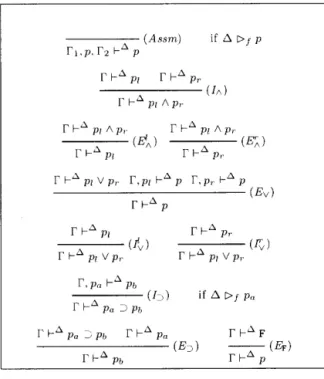
We now begin to incrementally define our provability relation. The first component is propositional logic. Definition 6 Let F range over lists of formulas, P,
and let 0 be as defined in Definition 5. The propo-sitional part of our provability relation, HA, is given in Figure 1. We write e for empty F and we say that p is a HA-theorem if e HA p.
'Formally
--- (Assm) if v >f p Fi,p. F2 HA p F HA F F- pr --- (In) F HA pi A pr F F- pi A pr F HA pi A pr ---(4) ---(En)
F F-A TitT I-A pr
F HA PI V pr T,pl F p F, Pr F-A P FF-Api F F- p 4,) F HA pr (Ev) F PiVpr T, pa ~ Pb (ID) --- (Irv) FHApiVpr FF-Apa F HA Pa J Pb 3 Ph F H pa (E3) ifA>1pa F F Pb FHA F (EF) F HA p 1. Propositional provability --- (TK„ ) FF-AKa(p) 3p E F-1 p --- (Genic „) E h1 Ka (p)
F HA (Ka (Pi 3 P2)) 9 Ka(pi) 3 Ka (p2) (KK„)
Fig. 2. The knowledge modality , Ka(—), for agent a
F CG(p)3pAEG(CG(p)) EH1po DpAEG (PO )
(Fix)
--- (Least) EFpo9CG(p)
Fig.
Fig.
Rule (IA), for example, says that we can prove a conjunction in some contexts, F, 0, by proving each conjunct in the same contexts. Rule (ID) says that we can prove an implication by proving the conclu-sion and then discharging the assumption. The rules for the connectives come in introduction, elimination pairs, except for F, which we cannot introduce, and they are entirely standard (but see Section 6). W note that the side-conditions in the figure serve 1 guarantee that the considered formulas are built ex-clusively from EPROP-sorted entities. An example a propositional proof is as follows.
3. The common-knowledge modality, CG(-)
Proposition Proof
7 E I– T, for any A.
--- (Assm) F FA F
EHF F(h)
2.4 Epistemic Provability
Aumann's result involves statements about the knowledge of the considered group of agents. For-mally, this is done with so-called epistemic logic [10] . The basis of epistemic logic is the modality Ka that is intended to capture that "agent a knows that", while two derived modalities address the situations of sev-eral agents sharing knowledge and of shared knowl-edge of shared knowlknowl-edge ad infinitum.
Id Definition 6 (cont'd) Let I be the no-where
fined 0 and let G be some group (read: finite set) of
to agents. The knowledge modality, Ka(—), for agent
a is defined in Figure 2 and the common-knowledge
of modality, CG(_), is defined in Figure 3, with the
shared-knowledge modality, EG(—), defined thus:
E (p)A
Ka
(P)
aEG
Rule (Genic) is called knowledge generalisation
and it coincides with the usual modal necessitation
rule. The rule implies that agents are able to pick up
any bit of knowledge as long as it is provable. The
more generally E(p) hold for any n E N, where Ec is n-iterated EG. In other words, we can and do de-fine CG(p) as the least fixed point of the following equation [14].
x a pAEG(x).
The equation should be read to say that, e.g., CG(p) holds if and only if p holds and CG(p) is shared knowledge. A solution to an equation of the form x = F(x) is called a fixed point of F. More precisely, the rules in Figure 3 ultimately stipulate that CG(p) is the least fixed point of the function x H pAEG(x), where equality is logical equivalence, <=>, and "least" is taken w.r.t. the order induced by implication: a proposition pi is less than a proposition p2 if p2 D pi.
F H P Zero F 1—o'T:IVat (P x) ID P (Succ x) F P n
if At(Zero) = Nat, Ot (n) = Nat, At (Succ) =
(sIndP,«f)
Nat Nat
With this, we note that CG satisfies the same prop-erties as Ka; the proofs are verified elsewhere [14]. Lemma 8
FH'p
(Tc) (Genc)
Fig. 4. Structural induction over Nat for P
that no constructor may take an argument that, in the simplest case, takes the constructed domain as an argument: (Nat — Nat)— Nat is forbidden, for example, because of the left-most Nat.
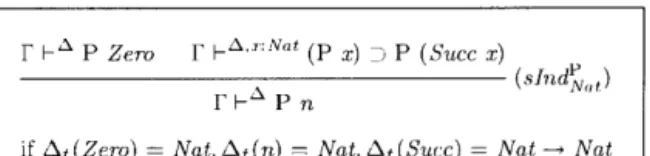
By construction, an algebraic structure defined in the style of Nat comes equipped with a (sound) proof principle called structural induction, which, in the case of Nat, is weak number induction, see Figure 4.
Definition 6 (cont'd) For Inductively defined sorts, include structural induction rules, see Fig-ure 4 in the case of Nat, in the provability relation. We note that A, x: Nat means that At is ex-tended with x of sort Nat; F, A are assumed not to reference x. In general, A is similarly extended with (fresh) variables for the local parts of all cases. We also note that it is implicit in Figure 4 that At Dt P : Nat —* EPROP and that structural induction should be thought of as concluding `dn : Nat . P n, although we have suppressed univer-sal quantification in the presentation. Structural induction says that a predicate, P, will hold for all elements in an inductively defined set if all the considered constructors preserve the prop-erty. Informally, structural induction is sound because, e.g., all Nats i) are finite in size and ii) have an outermost constructor, implying that any Nat is covered by the premises in an effective manner.
FF- CG(p) DP eH'CG(p)
r h(CG(pi D P2)) D CG(Pi) D CG(p2)(KC)
2.5 Inductively Defined Sorts
The sorts and symbols that index our formalism are used to define objects-of-interest inductively [1, 22]. An inductive definition amounts to a least fixed-point construction, which implies that all defined objects are well-founded. For example, the natural numbers can be inductively defined as either zero or the suc-cessor of another natural number.
Nat ::= Zero Succ(Nat)
The definition introduces the new sort Nat as well as the (nullary) function symbol Zero of sort Nat and the (unary) function symbol Succ of sort Nat —> Nat. The type-theoretic way of guaranteing well-definedness is to require that all recursive oc-currences of the defined sort are non-negative in the types of the listed constructors, i.e., of the introduced function symbols [1]. Informally speaking, this means
Another example of an inductive definition is bi-nary trees.
bTree ::= nil bTree • bTree
The informal version of structural bTree-induction reads as follows.
FHAPo --- (comp) F p
if J p= po and A >f p Fig. 5. Computational reasoning
P(nil) P(bTi) A P(bT2) D P(bTi • bT2)
F H LessEq(t, t) F HA LessEq(ti, t2)
(rInd, „sEgl ) if At Dr . t : Nat
F H LessEq(ti, Succ(t2))
if At (LessEq) = (Nat, Nat) (rindr essEg2 )
VbT E bTree . P(bT)
2.6 Structural-Recursive Functions One way to define a predicate is as a function into EPROP, as we saw above. If such a function were to be undefined for any (sort-correct) argument, our theory could be subject to an inconsistency. The reason is that propositions and types, and provabil-ity and type inhabitation coincide [11]. Fortunately, a close cousin of structural induction amounts to a schema by which we can define total, computable functions and we accept as well-defined any func-tion symbol that has been defined by case-splitting on an inductive structure provided all recursive calls are made with a case-given sub-structure of the prin-cipal argument. This is called structural recursion. In order to decide whether a natural is even, we can therefore define the following function by cases, using a recursive call on n in the Succ-case.
IsEven(Zero) = T
IsEven(Succ(n)) = -'IsEven(n)
Informally, IsEven, i) is functional, i.e., is a relation that is not one-to-many, because the case-splitting is non-overlapping, ii) is computable because all re-cursive calls are made on a sub-structure of a well-founded element (in Nat), and iii) is total (on Nat) because the case-splitting also is exhaustive. If we at-tempt to prove (IsEven Zero) we would like to succeed because it computes to the provable T. To accomplish this formally, we add the following conditional rule to our unfolding type theory.
Definition 6 (cont'd) Let the computational rea-soning rule be as given in Figure 5, with doing
normalisation" (i.e., exhaustive definition unfolding)
Fig. 6. Ad hoc rule induction for LessEq
of structural-recursive functions relative to any out-ermost constructors, e.g., Zero, in their arguments. Note that p in Figure 5 can be a t, by definition, i.e., it can be a predicate. Note also that the 1 p = po side-condition is decidable because it involves structural recursion, only. I.e., it is decidable whether occur-rences of the (comp)-rule are correct.5 For suitable A, we thus have the desired result because, in fact, J (IsEven(Zero)) = T. ---(Assm) F F EI-°T(1D) --- ( comp) E H° IsEven(Zero) 2.7 Relations
An alternative and more general way of defining pred-icates is to use an ad hoc inductive form. In this pre-sentation, we reserve the form for (binary) relations.
LessEq(ti, t2) LessEq(t, t) LessEq(ti, Succ(t2)) Because we only consider relations, which always and implicitly are of EPROP sort when supplied with well-sorted arguments, the definitions translate di-rectly into new proof rules of the formalism.
5The difference between a side-condition and a premise of
a rule is that an occurrence of the latter is equipped with a
proof, namely the tree that ends there, while side-conditions
Definition 6 (cont'd) For relation symbols, add the defining rules as proof rules, see Figure 6, in the
case of LessEq.
Proving that, e.g., LessEq holds using rules such as those in Figure 6 is called rule induction. The free form of the involved rules does not prescribe well-foundedness in general, which is why we treat them
"internally" in the proof system
, rather than "ex-ternally" in the term language the way we did for structural-recursively defined predicates. Having the rules "internally" guarantees that any use of them will be in a well-founded proof tree.
2.8 Meta-Theory
Although we will not attempt to prove consistency of the outlined type theory, we will now discuss the per-tinent issues. For the interested reader, we note that our formalism has been constructed to be a subset, e.g., of the calculus of inductive constructions [4, 17].
Theorem 9 E VA F, for any reasonable6 0.
Informally, we have consistency because the propo-sitional part, see Figure 1, is consistent in its own right; the modal part, see Figures 2 and 3, conser-vatively extends the propositional part; structural induction, see Figure 4, is sound by construction as discussed; computational reasoning, see Figure 5, amounts to complicated ways of expressing already-provable properties; and rule induction, see Figure 6, is a conservative extension to the theory, because it involves novel symbols, like in the case of modalities. Abstractly speaking, formal consistency arguments for extensible type theories typically proceed by the formulation of a more powerful type theory that al-lows (in a non-extended way) for the definition of functions that sends the various types of definitions we have discussed to their associated proof principles. Consistency of the extensible framework therefore fol-lows from the fixed one.
6Reasonable , e.g.. means obeying the constraints of depen-dent typing [4, 17].
3 Reasoning with Coq
The previous section is a generic description of the underlying theory of a number of formal proof as-sistants (that, moreover, is implementable in many more). As it happens, the present development has been undertaken in Coq [5] and the vernacular we use reflects this. However, the use of Coq is not an essen-tial requirement. Still, and as we show in this section, Coq can directly accommodate Section 2. First, we indicate that we use Coq's Set for our U.
Definition U := Set.
Secondly, we can inductively define the new sort Nat with Coq notation that makes the sorts clear. Inductive Nat : U :=
Zero : Nat -Succ : Nat --> Nat.
As mentioned earlier, this inserts Nat into U and makes Zero and Succ available as function symbols in 0 (with the indicated sorts). Behind the scenes, it also makes available structural induction and recur-sion for Nat. In the (Coq-)definition below, the key-word Fixpoint indicates that we are trying to define yet another function symbol, IsEven, that will take argument n : Nat. In order to establish that IsEven is well-defined, we indicate that we justify the defini-tion by structural recursion on n: {struct n}. This implies that we are allowed to call IsEven on nO in the Succ-case of the case-splitting on n.
Proposition 10 IsEven, defined below, is a total, computable function on Nat.
Fixpoint IsEven (n : Nat) { struct n} : Prop := match n with
— Zero True
— Succ nO (IsEven nO) end.
Following this brief introduction to Coq syntax, we note that we leave a number of the things discussed in Section 2 to Coq, in particular universal quantifica-tion, and management of the contexts, F, A and their use in well-sorting. We also let Coq create structural and rule induction principles for us, as well as the
necessary arguments for enabling definition by struc-tural recursion (through Fixpoint). Finally, we rely on Coq for terms and computational reasoning. For the rest, and for transparency, we use Coq's object level, as we shall see next.
4 Formalisation
We will now formally define all the concepts that are relevant to the statement of Aumann's theorem, be-ginning with the modal and propositional part of the language of formulas that Aumann's theorem is ex-pressed in, see Definition 3. The game theory part follows [23] . The language of formulas is indexed by some set of agents, G (with equality), for the temic modality K; we implicitly assume that the epis-temic modality C is with respect to all of G.
Coq-Formalism 11 (Formulas) Variable G : U.
Variable agentEq : G — G —* bool.
Axiom agentEqual : V a, (agentEq a a) = true. Inductive eProp : U :=-
— eTrue : eProp Neg : eProp —> eProp
Imp : eProp eProp —> eProp — And : eProp eProp ---> eProp — Or : eProp —> eProp —> eProp — K : G —* eProp —> eProp
C : eProp —> eProp.
For convenience, we shall use short-hand notation for a particular combination of logical connectives, as well as allowing ourselves to use standard-looking in-fix forms of some of the connectives.
Coq-Formalism 12 (Notation)
Definition nKn (a: G) (P: eProp) := Neg (K a (Neg P)). Infix "---->" := Imp (right associativity, at level 85). Infix "riri" := And (left associativity, at level 50). Infix "vv" := Or (left associativity, at level 50).
Instructions like (right associativity, at level 85) are on-the-fly defined parsing-directives that disam-biguate, e.g., A ----> B = C to mean A---> (B--->
C): the number indicates the priority for the applica-tion of such rules. Suffice it to say that the parsing-directives above facilitate the standard short-hands.
4.1 Basics of Game Theory
Our interest in games is how they are being played and how they end with players either winning, los-ing, or making even, relative to some notion of pay-off. We first formalise end-situations by introduc-ing the followintroduc-ing primitive sort, function symbol (for less-than-or-equal-to on the payoff values), and short-hand name for a composed sort.
Coq-Formalism 13 (Basics) Variable payoff : U.
Variable eLeq : payoff —> payoff --> eProp. Definition payoffs := G —> payoff.
For the playing part, we note that Aumann's theorem pertains to sequential games in which players choose between their available options in some play-specific order. For convenience and readability, we shall re-strict attention to cases where an agent always has exactly two options.
Coq-Formalism 14 Inductive choice : U := — lchoice
rchoice.
This is not a limitation because Aumann's theorem is equivalent whether stated for the binary case or the case where an agent can have one or more op-tions available to him. It is worth noting that while choice is defined Inductively, it is inductive in the triv-ial sense of being defined point-wise: choice is the two-point set consisting of constants (read: nullary function symbols) lchoice and rchoice.
4.2 Strategies, Inductively
To state and prove Aumann's theorem, we need only consider strategies, i.e., games in which each player has decided (up-front, if you wish) how to choose whenever it is his turn. Sequential games (in exten-sive form, as considered by Aumann et al) are trees
where the internal nodes formalise the options avail-able to the player-at-turn at that particular juncture and where reaching a leaf marks the end of a play of the game. In other words, in order to formalise (binary) strategies, we simply re-use the definition of (binary) trees given in Section 2.5 and, in addi-tion, annotate leafs with payoff functions and internal nodes with the relevant agent owner and his strategy-determining choice.
Coq-Formalism 15 (Binary Strategies) Inductive strategy : U :=
— sLeaf : payoffs —* strategy sNode : G
—> choice
—> strategy strategy —* strategy.
The structural induction principle for strategy essen-tially coincides with bTree's because the extra an-notations do not affect the structure of the defined objects.
P(sLeaf po) P(si) A P(s2) I> P(sNode a c sl s2) Vs E strategy. P(s)
Structural strategy-induction is used in and, in fact. carries most of our proofs.
4.3 Payoffs, Recursively
The payoffs induced by the indicated choices in a strategy can be computed by structurally-recursively calling a function on the chosen sub-strategy in inter-nal nodes and, ultimately, returning the encountered payoff function.
Coq-Formalism 16 (Induced Pay-offs)
Fixpoint stratPO (s:strategy) {struct s} : payoffs :_ match s with
(sLeaf po) =po (sNode a c sl sr) match c with — lchoice (stratPO sl) — rchoice ' (stratPO sr) end end.
Proposition 17 stratPO is a total,
function.
Proof By construction.
computable
4.4 Equilibrium Predicate
A Nash equilibrium is a strategy in which no agent can change one or more of his choices to generate a better overall result for himself, in the sense of stratPO. Aumann's theorem predicts that common knowledge of rational decision-making results in a particular kind of Nash equilibrium [15, 16], called backwards induction (in stand-alone form, due to [19, 20]). Backwards induction is characterised by locally-enforced optimality of decisions, i.e., we can define a predicate for backwards induction by struc-tural recursion.
Coq-Formalism 18
Fixpoint eBI (s:strategy) {struct s} : eProp match s with
— (sLeaf po) = eTrue — (sNode a c sl sr)
(eBI sl) &'€ (eBI sr) ff match c with
— lchoice = eLeq ((stratPO sr) a) ((stratPO sl) a) — rchoice = eLeq ((stratPO sl) a) ((stratPO sr) a)
end
end.
The defined function takes a strategy and, with-out fail, produces a propositional conjunction saying whether the strategy is a backwards induction
equi-librium point.
Proposition 19 eBI is a total, computable predi-cate (i.e., function into eProp).
Proof By construction. ^
In the game (i.e., strategy without choices) below on the left, there is one backwards induction equilib-rium: al and a2 both chooses left and gets payoffs
1 and 0, respectively. The game has two Nash equi-libria (i.e., strategies where no-one single-handedly can do better), as the overall outcome does not de-pend on a2's choice. In the game on the right, only
al choosing left and a2 choosing right is either kind of equilibrium point. If a2 chooses left, al would go right but then a2 would go back to the right, and al would go back left. In other words, equilibria are not about universal optimality and the example nicely motivates the moniker "non-cooperative" to describe game theory based on Nash equilibria.
alal
1, 0 a21,
0 a2
0,1 0, 07,5 0,10
In [23], we prove by the same means used here that all sequential games have a backwards induc-tion equilibrium and that these are all Nash equilib-rium points, i.e., we Coq-verify an inductive proof of Kuhn's theorem [12] .
4.5 Rationality Predicate
Aumann defines rationality informally as follows [2] . "Rationality of a player means ... that no
matter where he finds himself at which
vertex he will not knowingly continue
with a strategy that yields him less than he
could have gotten with a different strategy." In Aumann's formalism, the actual definition is Rev; ntzEsi (--,Ki[h'As; ti) > (s)]), [2, eq. (3)].
Stripping off the outermost intersection leaves us with having to consider the following big
conjunc-tion, where our p is Aumann's hq (s). Coq-Formalism 20
Fixpoint Comp_nKns (a:G) (s:strategy) { struct s} : eProp match s with
(sLeaf po) = nKn a (eLeq (po a) p) (sNode a' c sl sr) if (agentEq a a') then (Comp_nKns a sl p) E (Comp_nKns a sr p) else match c with
— lchoice = (Comp_nKns rchoice (Comp_nKns (p:payoff) aslp) a sr p) end. end
Proposition 21 Comp_nKns is a total, putable predicate.
Proof By construction.
The idea is that we recursively call the fu along all paths that the agent, a, could 0 handedly) have decided to take inside the cons strategy, s: when we reach a sub-node owned we pursue both options but when we reach node owned by another agent, we respect his
nction along all paths that the agent, a, could (single-handedly) idered strategy, s: when we reach a sub-node owned by a, we pursue both options but when we reach a
hoice.
Any leaf we reach is used to create a conjunct saying that the agent does not know that the payoff he gets there is better than the one he originally decided he should go for. Full rationality is the big conjunction of Comp_nKns-results over all nodes owned by all agents, i.e., over all nodes in a strategy tree.
Coq-Formalism 22
Fixpoint eRat (s:strategy) {struct s} : eProp := match s with
— (sLeaf po) = eTrue (sNode a c sl sr)
(eRat sl) 1E (eRat sr)
(Comp_nKns a s ((stratPO s) a)) end.
Proposition 23 eRat is a total, computable predi-cate.
Proof By construction. ^
This completes our formal(-ist) presentation of the framework that Aumann's theorem pertains to.
5 A First Formalist Analysis
As mentioned, Aumann's theorem states that it is the case for all strategies that if there is common knowl-edge that everybody behaves rationally in a given strategy, then that strategy is a backwards induction equilibrium point.
5.1 An Example
Aumann's theorem is universally quantified over strategies. This means, for example, that the im-plication must hold for any strategy that is just a node with two leafs directly below it and the agent has chosen, say, the left branch.
a
P1 P2
Applying eRat to this example returns the following.
eTrue && eTrue && (nKn a (eLeq p1 pl)) && (nKn a (eLeq 132 1)1)) Analogously, we get the following by applying eBI.
eTrue && eTrue && (eLeq P2 pi)
By the usual rules for conjunction, the occurrences of eTrue are superfluous and (our intention is that) eLeq P1 P1 will hold, too. In other words, Aumann's the-orem mandates that the following implication must
be provable.
C ((nKn a eTrue) && (nKn a (eLeq p2 pi)))(1)
> eLeq p2 P1 C distributes over conjunction and we are done if ei-ther C (nKn a eTrue) is eFalse, in which case the theorem would be trivial because that conjunct is
present for any node, or the following is provable. C (nKn a (eLeq p2 p1)) ----> eLeq p2 pi (2) As we have axiom T for C, see Lemma 8, axiom T for nKn would give us (2).
5.2 Subtleties of Various Axioms T We have axiom T for K: (TK,, ), see Figure 2, includ-ing for negated properties.
K a (Not p) ----> Not p(3)
We recall that nKn is not-K-not and that not stands for "implies eFalse"
K a (Not p) ---> p ----> eFalse
--- (dec-TnK,„ F eDec(p) (—p) 9 p
Fig. 7. Axiom decidable-T for nKn
As we may freely swap the order of left-hand sides of >, (TK„) thus implies:
p ---->nKnap
In other words, if we add axiom T for nKrn, we col-lapse nKn because the axiom is nothing but the op-posite of the preceding implication.
(T0Kn„) (p <---> nKn a p)
This is clearly not desirable in general as nKn is thought to have roughly the meaning of "to believe” .7 The question we are faced with in (2) is whether the C-modality qualifies nKn enough to accept axiom T for the combined modality. If we use the interpretation that nKn is belief, or even absence of doubt, it is difficult to see how common knowledge of that fact can impact on p but interpretations are, of course, of little technical relevance. Technically speaking, we have found no compelling proof-theoretic argument either for or against axiom T for C-compose-nKn.
We note, instead, that (2) holds trivially if it, in fact, is the case that eLeq 132 1)1 holds. Conversely, nKn a (eLeq p2 p1) cannot be allowed to hold if Not (eLeq p2 p1) can be established independently be-cause that would allow us to conclude that also eLeq 132 131 holds, which would leave our formalism incon-sistent. Consequently, we propose as a general prin-ciple that axiom T holds for nKn in case the property we are considering is decidable, i.e., if we definitely know whether it holds or not.
Definition 24 Let eDec be a predicate expressing decidability; let axiom decidable-T for nKri be as de-fined in Figure 7.
7Actually, nKn is slightly stronger than the usual belief modality. B, i.e., nKn(p) ---> B(p)• B is typically defined like K except without axiom T: K(p) <=> B(p)Ap. Our development also works with B instead of nKn.
We shall see in Section 6 that the resulting the-ory is, in fact, consistent. Informally, the axiom asks agents to not believe in propositions that it is within their power to decide to be refutable. This basically means that agents may not believe F.
5.3 The Inductive Insight
The example-based analysis above is complete in an interesting sense, as hinted to in Section 1.2. The issue is the exact details of the rationality predicate, see Coq-Formalism 22. For bigger strategy trees both eRat and eBI will produce bigger conjunctions than the ones considered above. However, eRat's will grow in two dimensions while eBI's will grow only in one. In the case of eRat, specifically, we will get more con-juncts both from eRat itself and from Comp_nKns. What Section 1.2 tells us is that most of the latter ones are superfluous. Indeed, what we call the "in-ductive insight" is that it is likely to (and actually does) suffice for the rationality predicate to have the same structure as the eBI predicate. We call this version local rationality.
Coq-Formalism 25
Fixpoint eLRat (s:strategy) {struct s} : eProp :_ match s with
(sLeaf po) = eTrue — (sNode a c sl sr)
(eLRat sl) f (eLRat sr) ll match c with
— lchoice nKn a (eLeq ((stratPO sr) a) ((stratPO sl) a)) — rchoice nKn a (eLeq ((stratPO sl) a)
((stratPO sr) a)) end
end.
Applying eLRat to the example at the beginning of this section gives.
eTrue && eTrue && (nKn a (eLeq p2 pi)) More precisely, eLRat will always produce exactly one conjunct involving nKn for each node; it will be applied to the comparison of the induced payoffs in the left and right sub-strategies. In the case of eRat,
nKn will be applied to the chosen payoff in any node compared with any conceivable alternative within the agent's reach, including the locally-determined one considered by eLRat.
V s : strategy, (eRat s ---> eLRat s). We will return to this point in Section 8.
6
(Constructive)
Decidability
We note that the propositional part of our provability relation, see Figure 1, does not include reductio ad absurdum, below, but merely ex falso quod libet, (EF). F, ~p H~ F
(ERAA) F~~
pF
This means that we are considering a constructive logic, specifically intuitionistic logic, rather than full classical logic. See Appendix A for an account of why the former is constructive while the latter is
not.
All intuitionistically provable formulas are natu-rally also classically provable but not vice versa. In-terestingly, though it is outside the scope of this ar-ticle, we note that two mappings exist such that a formula is provable in one system if and only if the translated version is provable in the other system. While it therefore may seem like there is little dif-ference between classical and intuitionistic logic, we shall take advantage of the constructive nature of the latter by noting that a constructively provable dis-junction always has one of the disjuncts being prov-able. In other words, decidability can (and typically is) coded constructively as follows.
Coq-Formalism 26
Definition eDec (P: eProp) := P vv (Neg P).
The technical justification for this definition is given in Appendix A, Theorem 40. The advantage to us in using the stricter notion of intuitionistic provability is that decidability becomes simple to express and, sometimes, straightforward to prove. We are not aware of a similarly concise coding of
decidability either as a classical predicate or as a stand-alone modality. As it is, we can directly ad-dress our alternative version of Aumann's Theorem.
of proof principles they use in addition to structural induction and computational reasoning, see Figures 4 and 5.
First, however, we note that another way of read-ing classical logic's reductio ad absurdum is that it mandates -'--'p D p, for all p, which is not guaranteed intuitionistically. That said, the other implications involving (at least) double-negation do hold in intu-itionistic logic: p D and -'p --'-'-'p. The point is this: double-negation does hold intuitionistically for decidable p.
Proposition 27 F I-° p V (-'p) D D p. An interesting consequence is the following. Lemma 28 (dec-Tnxn„) is equivalent to
--- (-nKna,)
F F- K
a (-ip) . ~~p
Proof (dec-Tnxn„) follows from (-,- -nKna) ac-cording to Coq-Formalism 26 and Proposition 27. For the other direction, we first note that (3) im-plies -'-'p -,Ka('p) by contraposition. Secondly,
-'K
a (-'p) D -'-'p is itself equivalent to (dec-Tnxn„ ) because (p V -,p) D p is equivalent to -'-'p (by two reasonably direct arguments).^
In other words, adding axiom (dec-T1zxna) has the formal effect of mandating that nKn can only hold for propositions that are not explicitly refutable, which is the usual intuitionistic reading of double-negation. Moreover, adding the axiom is consistent with respect to the reading of nKn used by Aumann and with respect to intuitionistic logic. A consequence is that adding the axiom is logically consistent.
7 Decidable Local Rationality
In this section, we present two proofs that local ra-tionality implies backwards induction in the pres-ence of axiom (dec-Tnxni and without referpres-ence to the common-knowledge modality. The first proof is general and abstract, merely asserting that payoff-comparison is decidable, while the second one shows what happens when we have an actual decision proce-dure at hand. Both proofs list the rather limited set
7.1 Abstract Version
In order to define a provability relation in Coq, we invoke Coq's Prop-sort, which is different from our eProp but is constructed according to the same prin-ciples; implication in Prop is written —. The scheme we use is the one we accounted for in Section 2.7.
Coq-Formalism 29
Inductive eThm : eProp —* Prop := — e_id : V p : eProp, eThm (p---> p)
— prj_33 : V p1 p2 ql q2 rl r2 : eProp, (eThm (p1 ---> p2)) —> (eThm (ql ---> q2)) —> (eThm (r1 ---> r2)) —> (eThm (p1 9E ql rl p2 q2 r2)) — dec_ T_ nKn : V a : G, V p : eProp, eThm ((eDec p) = (nKn a p) = p) e_MP : V p q : eProp,
eThm (p---> q) —> eThm p --> eThm q. Notation "F- p" := (eThm p) (at level 85).
With this, we merely need to stipulate that our abstract pay-off ordering, see Coq-Formalism 13, is decidable and our inductive proof can proceed as de-scribed in Section 1.2.
Coq-Formalism 30
Axiom decOrd : V pol po2, F- (eDec ((eLeq pol) po2)). Theorem Dec_LRat_BI : V s , F- (eLRat s---> eBI s). Proof.
induction s.
simpl. apply e_id. simpl. apply prj_33. apply IHsl. apply IHs2.
induction c; (eapply e_MP ; [apply dec_ T_ nKn
apply decOrd]).
- (d, _T_„x„)
IHs; eDec (po2 < poi)
(11,•1• o/d) (,._MP)
- (de, _T_PK )
IHs, HA eDec (poi < P02)
IHs, H° (nKn a (po2 < po1)) = (po2 pa,) IHs; H°~ (nKn a (poi < po2)) (pot < po2)
IHs, H° (nKn a (po, < pa,)) = (po, < po,)
(d, ord) •(c _niP) (srpd), ( I) ---Q/ IHs,HeLRats,=eBIslIHs;feLRat 52 = eBI 52 (-1) (1,j33) Q/I eTrue e True (P._2d)
IHs, F-°/ eLRat (sNode a c si s2) eBI (sNode a a s1 52) eLRat (sLeaf p) eBI (sLeaf p)
F ° eLRat s = eBI s
(cm,ip)
Fig. 8. Graphical proof of Theorem Dec_LRat_BI detailed explanations in the text
Figure 8 contains a graphical presentation of the proof in the style of Section 2:
• 0 contains the Coq-Formalisms listed so far, as well as s of sort strategy;
• 0' extends A with s i , 52 of sort strategy, a of sort G, and c of sort choice;
• 0" extends 0 with p of sort payoffs; • c is short for the opposite choice of c; • poi is short for (stratPO si a);
• proof rules (comp) and (A), aka (Assm), are rowed from Coq via the tactics apply, simpl; • the proof rule (slnd') combines (slnd), cf.
ure 4, and (I-h), see Figure 1, and is borrowed
from Coq via the tactic induction;
• IHsi is short for IHsi, IHs2, which, in turn, is short for the induction hypotheses for strategy:
eLRat Si ---> eBI Si and eLRat s2 ---> eBI s2; • (sInd')e is structural induction over choice,
which is degenerately inductive and, hence, the
rule is not associated with induction hypotheses. The proof starts by invoking structural induction on strategies, creating two cases for us to consider: one for internal nodes and one for leaves. The first line
after invoking induction is for the leaf case. The com-mand simpl indicates that we do computational rea-soning, in order to unfold definitions, which leaves us with having to prove that eTrue implies eTrue. The node case starts again by defintion unfolding, which results in the three conjuncts from eLRat, i.e., (eLRat sl ), (eLRat s2), and the considered use of nKn on the payoff-comparison, implying the three conjuncts from eBI, i.e., (eBI sl ), (eBI s2), and the unqualified payoff-comparison. We then use our axiom prj_33 in order to consider the pointwise implications between the conjuncts one by one. The first two follow by induction hypotheses, as discussed. For the last, we induct on the choice made in the node, followed by dec_T_nKn applied to decOrd with e_MP, aka (ED).
7.2 Decision-Procedure Version
In this section, we consider the simple case of natu-ral numbers as payoffs. We saw in Section 2.7 that we can give an ad hoc definition of the less-than-or-equal-to relation on natural numbers, which sults in a rule-induction principle for proving the re-lationship. Alternatively, and because natural num-bers themselves are inductively defined (and, thus, well-founded), see Section 2.5, we have a structural-recursion principle that we can use to actually decide whether the relationship holds or not. First, we in-troduce a sort for the answers of the function. Coq-Formalism 31
Inductive eBool : U := eTrue : eBool — eFalse : eBool.
We then present our decision-procedure for less-than-or-equal-to on natural numbers.
Coq-Formalism 32
Fixpoint eLeqDP (n1 n2:Nat) { struct nl } : eBool := match nl,n2 with
— Zero , _ = eTrue
Succ nl a, Zero eFalse
Succ nl a, Succ n2a = eLeqDP nl a n2a end.
Proposition 33 eLeqDP is a total, computable function.
Proof By construction.^
With eTrue and eFalse defined separately, our new eProp imports them as propositional values that we definitely know what are and close them under the relevant logical connectives.
Coq-Formalism 34 Inductive eProp : Type :=
— decprop : eBool —* eProp
Imp : eProp ---* eProp —* eProp — And : eProp —> eProp -* eProp
nKn : eProp —* eProp.
Provability is defined basically as above, except that we no longer stipulate that axiom T for nKn call be applied to all decidable propositions. Instead, we require use of the sort eBool, which contains two constants and given one we will know which. Coq-Formalism 35
Inductive eThmO : eProp —> Prop := — dec_ T : V b : eBool,
eThmO (nKn (decprop b) ----> (decprop b)) — e_id : V p : eProp, eThmO (p ---> p) — prj_33 : V pl p2 ql q2 rl r2 : eProp, (eThmO (p1 ---> p2)) -(eThmO (q1 ---> q2)) —> (eThmO (rl ---> r2)) > (eThmO (p1 l ql h1E rl > p2 q2 r2)). Notation "Ho p" := (eThmO p) (at level 85).
With this, we can again prove that local rationality implies backwards induction.
Coq-Formalism 36
Theorem nat_LRat_BI : V s, Ho (eLRat s---> eBI s). Proof.
induction s.
simpl. apply e_id. simpl. apply prj_33.
apply IHsl. apply IHs2.
induction c; apply dec_ T. Qed.
The slight simplification in the proof comes from the fact that we do not need to use modus ponens, due to the direct nature of axiom T for nKn on eBools.
8 Aumann's Theorem
We now derive Aumann's original result by first prov-ing that eRat implies eLRat usprov-ing projections on con-junction. The needed proof principles are as follows.
Coq-Formalism 37
Inductive eThm' : eProp — Prop := — import : V p : eProp, Hp —f eThm'p — T_C : V p : eProp, eThm' (C p ----> p) — eId : V p : eProp, eThm' (p ---> p) prj_33' : V p1 p2 ql q2 rl r2 : eProp, (eThm' (p1 ---> p2)) —> (eThm' (ql ----> q2)) —> (eThm' (r1 ----> r2)) —> (eThm' (p1 hJhJ ql r1 > p2 q2 r2)) trans : d p q r : eProp, (eThm' (p = q)) —> (eThm' (q r))
(eThm' (p ---> r)) — pr j _ l : V pl pr : eProp, eThm' (pl &4 pr---> pl) prj_r : V pl pr : eProp, eThm' (pl P& pr---> pr). Notation "1-' p" :_ (eThm' p) (at level 85).
Coq-Formalism 38
Lemma Rat_is_LRat : V s , F-' (eRat s---> eLRat s).
Please see Appendix B for the details.
Aumann's result can now be arrived at by compos-ing the just-proved implication with our previously-established (and, thus, merely imported) result that
eLRat implies eBI followed by axiom T for C.
Coq-Formalism 39
Theorem Aumann_noC : V s , F-' (eRat s ---> eBI s). Proof.
intro. eapply trans. apply Rat_is_LRat.
apply import. apply Dec_LRat_BI. Qed.
Theorem Aumann : V s , F-' (C (eRat s) ---> eBI s). Proof. intro. eapply trans. apply T_ C. apply Aumann_noC. Qed. 9 Conclusion
We have presented in detail a fully transparent proof of Aumann's Theorem on Rationality. The proof has been verified in the Coq proof assistant and the sources are available at the homepage of the first author, http: //www. jaist .ac. jp/-vester/. Com-pared to existing mathematical approaches to the re-sult, the main clarifying and simplifying contribution of our proof is the use of structural induction over strategies. We abandoned the seemingly established
use of axiom T for the common-knowledge modal-ity composed with the not-knowledge-not modalmodal-ity, due to inconclusive proof-theoretic justification for it. Instead, we introduced an axiom, (dec-Tnxn~ ), that asks agents to not believe in propositions that it is within their power to decide to be refutable. The ax-iom is consistent with the fact that decidable propo-sitions enjoy double-negation in intuitionistic logic. We hope our formal development will have also non-formal, e.g., philosophical or sociological, relevance to interested parties.
Acknowledgements We thank Michael Norrish for comments on the manuscript.
A Intuitionistic Logic
Intuitionistic logic enjoys the disjunction property, i.e., it is the case that r F ° pl V pr implies either e F-° pl or r ~° pr [7, 8]. Indeed, the following strong version of the disjunction property holds. Theorem 40 (Feasible Disjunction [3]) There
is an algorithm that, given a proof of r I-° pi V pr according to the rules in Figure 1, produces a proof of e F-° pi or a proof of e I-° pr in polynomial time in the size of the original proof.
The given complexity bound extends to include the modalities we use [6], see Figures 2 and 3, but the complexity becomes non-feasible when including function and relation symbols, see Figures 4-6, al-though an algorithm still exists [3]. Classical logic, by contrast, includes, e.g., reductio ad absurdum, (EF AA) in place of ex falso quod libet, (Er).
F, -'p F-° F
(ERAA) F---F-°pF
Under (EF AA) pi V pr becomes equivalent to (~pr) D pr, which implies that p V -'p is a tautology, for any p (aka the law of excluded middle). In partic-ular, with At (x) = EPROP.
---(Assm) -,x F-° ~x
This means that we can prove classically that x V —ix is a theorem for any propositional variable but we cannot prove that either x or —ix is a theorem.
B Lemma Rat_is_LRat Coq-Formalism 41 Lemma nKns_is_nKn : V a p s, ' ((Comp_nKns a s p) > nKn a (eLeq ((stratPO s) a) p)). Proof. induction s.
simpl. apply eId'.
simpl. induction agentEq. induction c.
eapply trans. apply prj_l. apply IHsl. eapply trans. apply prj_r. apply IHs2. induction c. apply IHsl. apply IHs2. Qed.
Lemma Rat_is_LRat : V s , F- ' (eRat s---> eLRat s). Proof.
induction s. simpl. apply eld. simpl. apply prj_33'. apply IHsl. apply IHs2.
rewrite agentEqual. induction c.
eapply trans. apply prj_r. apply nKns_is_nKn.
eapply trans. apply prj_l. apply nKns_is_nKn. Qed.
References
[1] Peter Aczel. An introduction to inductive tions. In J. Barwise, editor, Handbook of
ematical Logic, volume 90 of Studies in Logic
and the Foundations of Mathematics, chapter
C.7, pages 739-782. North-Holland, Amsterdam,
1977.
[2] Robert J. Aumann. Backward induction and common knowledge of rationality. Games and
Economic Behavior, 8, 1995.
[3] Sam Buss and Grigori Mints. The complexity
of the disjunction and existential properties in intuitionistic logic. Annals of Pure and Applied
Logic, 99:93-104, 1999.
[4] Thierry Coquand and Gerard Huet. The lus of constructions. Information and
tion, 76(2/3):95-120, 1988.
[5] Gilles Dowek, Christine Paulin-Mohring, et al. Coq. http://coq.inria.fr/.
[6] Mauro Ferrari, Camillo Fiorentini, and Guido Fiorino. On the complexity of the disjunction
property in intuitionistic and modal logics. ACM Transactions on Computational Logic,
538, 2005.
[7] Gerhard Gentzen. Untersuchungen uber das logische Schliessen I, II. Mathematische
Zeitschrift, 39:176-210,405-431, 1935. tion appears pp. 68-131 in The Collected
pers of Gerhard Gentzen; North-Holland;
sterdam. Edited and introduced by M.E. Szabo. [8] Gerhard Gentzen. Investigations into
cal deduction. In M. E. Szabo, editor, The
Collected Papers of Gerhard Gentzen.
Holland, 1969.
[9] Joseph Y. Halpern. Substantive rationality and backward induction. Games and Economic
havior, 37:425-435, 2001.
[10] Jaakko Hintikka. Knowledge and Belief Cornell University Press, Ithaca, New York, 1962. [11] W. A. Howard. The formulae-as-types notion of
construction. In J. P. Seldin and J. R. Hindley,
editors, To H.B. Curry: Essays on Combinatory
Logic, Lambda-Calculus and Formalism, pages 470-490. Academic Press, 1980.
[12] Harold W. Kuhn. Extensive games and the lem of information. Contributions to the Theory
of Games II, 1953. Reprinted in [13] .
[13] Harold W. Kuhn, editor. Classics in Game ory. Princeton Uni. Press, 1997.
[14] Pierre Lescanne. Mechanizing epistemic logic with Coq. Research Report RR2004-27,
ENS de Lyon, 2004.
[15] John F. Nash. Equilibrium points in n-person games. Proceedings of the National Academy of
Sciences, 36, 1950. Reprinted in [13] .
[16] John F. Nash. Non-Cooperative Games. PhD thesis, Princeton University, 1950.
[17] Christine Paulin-Mohring. Inductive definitions
in the system Coq: Rules and properties. In M. Bezem and J. F. Groote, editors, Typed
Lambda Calculi and Applications, TLCA'93,
volume 664 of Lecture Notes in Computer
ence, pages 328-345. Springer-Verlag, 1993. [18] Dov Samet. Hypothetical knowledge and games
with perfect information. Games and Economic
Behavior, 17(2), 1996.
[19] Reinhard Selten. Spieltheoretische Behandlung eines Oligopolmodells mit Nachfragetragheit.
Zeitschrift Fir die desamte Staatswissenschaft,
121, 1965.
[20] Reinhard Selten. Reexamination of the ness concept for equilibrium points in extensive games. International Journal of Game Theory,
4, 1975. Reprinted in [13].
[21] Robert Stalnaker. Knowledge, belief and terfactual reasoning in games. Economics and
Philosophy, 12:133-162, 1996.
[22] The Coq Development Team. The Coq proof sistant reference manual, version 8.0. Technical
report, INRIA, 2004. Available at [5] .
[23] Rene Vestergaard. A constructive approach to sequential Nash equilibria. Information
ing Letters, 97:46-51, 2006.