Efficient
Augmentation to Construct
$(\sigma+1)$
-Edge-Connected Simple Graphs
Satoshi
Taoka and Toshimasa WatanabeGraduate School
of
Engineering, Hiroshima University1-4-1, Kagamiyama, Higashi-Hiroshima, 739-8527Japan
Phone : $+\mathit{8}\mathit{1}- \mathit{8}\mathit{2}\mathit{4}-\mathit{2}\mathit{4}-7\mathit{6}\mathit{6}\mathit{1}(\tau_{a}kano)$, -7666 (Taoka), -7662 (Watanabe)
$Facs\dot{i}mi\mathit{4}e$ :
+81-824-22-7028
$E$-mail:
{taoka,
$watanabe$}
$@\dot{i}nf_{onet_{S}}$. hiroshima-u.ac.jpAbstract: Theunweighted $k-edge-conneCt\dot{i}v\dot{i}ty$ augmentation problem ($k\mathrm{E}\mathrm{C}\mathrm{A}$for short) is
de-fined by ”Given a
$\sigma$-edge-connected graph $G=(V, E)$, find an edge set $E’$ of minimum
cardi-nalitysuch that $G’=(V, E\cup E’)$ is $(\sigma+\delta)$-edge-connected and $\sigma+\delta=k$”, where $E’$ is called
a solution to the problem. Let $k\mathrm{E}\mathrm{C}\mathrm{A}(\mathrm{s},\mathrm{s}\mathrm{A})$ denote$k\mathrm{E}\mathrm{C}\mathrm{A}$such that both $G$ and$G’$ aresimple.
The subject ofthe present paper is $(\sigma+1)\mathrm{E}\mathrm{C}\mathrm{A}(\mathrm{S},\mathrm{s}\mathrm{A})$ (or $k\mathrm{E}\mathrm{C}\mathrm{A}(\mathrm{s},\mathrm{s}\mathrm{A})$ with$k=\sigma+1$). Let
$\mathcal{M}$ beanymaximummatchingofacertain graph$R(G)$ whose vertex set $V_{R}$consists of vertices
representing all leaves of$G$. From $\mathcal{M}$ we obtain an edge set $E_{0}’$, with $|E_{0}’|=|\mathcal{M}|$, such that
each edge connects verticesin distinct leaves of$G$. Let $\mathcal{L}_{1}$ be the set of
lea.v
es to be created by adding $E_{0}’\mathrm{t}\mathrm{o}G$, and $\mathcal{K}_{1}$ the set ofremaining leaves of$G$.The main result is to propose two $o(\sigma^{2}|V|\log(|V|/\sigma)+|E|+|V_{R}|^{2})t$ time algorithms for
finding the following solutions: (1) an optimum solution if $G$ has at least $2\sigma+6$ leaves or if
$|\mathcal{L}_{1}|\leq|\mathcal{K}_{1}|$ and $G$ has less than $2\sigma+6$ leaves; (2) $\mathrm{a}\frac{3}{2}$-approximate solution if $|\mathcal{L}_{1}|>|\mathcal{K}_{1}|$ and
$G$ has less than $2\sigma+6$
.leaves.
Keywords: Edge-connectivity, minimum cuts, polynomial time algorithms, augmentation
problem, maximum matchings.
1 Introduction
The unweighted $k- edge- connect\dot{i}v\dot{i}ty$
augmenta-tion problem ($k\mathrm{E}\mathrm{C}\mathrm{A}$ for short) is described as
follows: ”Given a $\sigma$-edge-connected graph $G=$
(V,$E$),find an edge set $E’$ ofminimum
cardinal-ity such that $G’=(V, E\cup E’)$ is $(\sigma+\delta)$
-edge-connected and $\sigma+\delta=k.$ ” We often denote $G’$ as
$G+E’$, and$E’$iscalled a solution tothe problem.
Let $k\mathrm{E}\mathrm{C}\mathrm{A}(^{***},)$ denote $k\mathrm{E}\mathrm{C}\mathrm{A}$with the following
restriction (i) and (ii) on $G$ and $E’$, respectively:
(i) *is set to $S$ if $G$ is required to be simple,
and *is left to mean that $G$ may be a
multi-ple graph; (ii) ** is set to MA if creation of new
multiple edges in constructing $G’$ is allowed, and
is set to SA otherwise. In $k\mathrm{E}\mathrm{C}\mathrm{A}(*,\mathrm{s}\mathrm{A})$, if $G$ is
simple then so is $G’$, or if $G$ has multiple edges
then any multiple edge of $G’$ exists in $G$. As for
$k\mathrm{E}\mathrm{C}\mathrm{A},$ $k\mathrm{E}\mathrm{C}\mathrm{A}(^{*},\mathrm{M}\mathrm{A})$ has mainly been discussed so far. See [3,5, 7, 8, 12, 13,21-24] for the results.
It is natural for us to assume that $|V|\geq\sigma+2$
in $(\sigma+1)\mathrm{E}\mathrm{C}\mathrm{A}(\mathrm{s},\mathrm{S}\mathrm{A})$: in $(\sigma+1)\mathrm{E}\mathrm{C}\mathrm{A}(^{*},\mathrm{s}\mathrm{A})$,
we
may have $|V|\leq\sigma+1$.
As related results, $k\mathrm{E}\mathrm{C}\mathrm{A}(\mathrm{s},\mathrm{s}\mathrm{A})$ for $G$ having
no edges was first discussed in [6], where the
problem that is more general than $k\mathrm{E}\mathrm{C}\mathrm{A}(\mathrm{s},\mathrm{s}\mathrm{A})$ is considered. An $O(|V|+|E|)$ algorithm for
$2\mathrm{E}\mathrm{C}\mathrm{A}(\mathrm{s},\mathrm{s}\mathrm{A})$ canbe obtainedby slightly$\mathrm{m}\mathrm{o}\mathrm{d}\mathrm{i}6^{\Gamma-}$
ing the one given in [3] for $2\mathrm{E}\mathrm{C}\mathrm{A}(*,\mathrm{M}\mathrm{A})$. As for
$3\mathrm{E}\mathrm{C}\mathrm{A}(^{*,\mathrm{s}\mathrm{A}}),$$[24]$ proposed an$O(|V|+|E|)$ algo-rithmfor $3\mathrm{E}\mathrm{C}\mathrm{A}(*,\mathrm{M}\mathrm{A})$, and showedthat if$|V|\geq$
$4$ then this algorithm finds an optimum solution
to $3\mathrm{E}\mathrm{C}\mathrm{A}(^{*,\mathrm{s}\mathrm{A}})$. Concerning $(\sigma+1)\mathrm{E}\mathrm{C}\mathrm{A}(\mathrm{S},\mathrm{s}\mathrm{A})$ with $|V|\geq\sigma+2$ for $\sigma\in\{3,4\},$ $[15]$ proposed
an $O(|V|\log|V|+|E|)$ algorithm. Other related results have been reported in $[14, 16]$. T. Jord\’an showed in [10] that $k\mathrm{E}\mathrm{C}\mathrm{A}(\mathrm{s},\mathrm{s}\mathrm{A})$ is $\mathrm{N}\mathrm{P}$-hard in
general, and [2] proposed an $O(|V|^{4}).\mathrm{a}$lgorithm
for $k\mathrm{E}\mathrm{C}\mathrm{A}(\mathrm{S},\mathrm{s}\mathrm{A})$ for any fixed $k$.
The subject of the present paper is (a $+$
$1)\mathrm{E}\mathrm{C}\mathrm{A}(\mathrm{s},\mathrm{s}\mathrm{A})$, that is, $k\mathrm{E}\mathrm{C}\mathrm{A}(\mathrm{s},\mathrm{s}\mathrm{A})$ with $k=$
leaf-graph $R(G)$ whose vertex set $V_{R}$ consists of
vertices representing all leaves ofG. (The defini-tionof$R(G)$ is going tobe given later). Rom$\mathcal{M}$ we obtainacertain edge set $E_{0}’$, with $|E_{0}’|=|\mathcal{M}|$,
such that each edge connects vertices in distinct leaves of $G$
.
Let $\mathcal{L}_{1}$ be the set of leaves to becreated by adding $E_{0}’$ to $G$, and $\mathcal{K}_{1}$ the set of
remaining leaves of$G$
.
The main result of the paper is to propose two $O(\sigma^{2}|V|\log(|V|/\sigma)+|E|+|V_{R}|^{2})$ time
al-gorithms for finding the following solutions for
$(\sigma+1)\mathrm{E}\mathrm{C}\mathrm{A}(\mathrm{S},\mathrm{S}\mathrm{A})$:
(1) an optimumsolution if $G$ has at least $2\sigma+6$
leaves or if $|\mathcal{L}_{1}|\leq|\mathcal{K}_{1}|$ and $G$ has less than
$2\sigma+6$ leaves;
(2) $\mathrm{a}\frac{3}{2}$-approximatesolution if$|\mathcal{L}_{1}|>|\mathcal{K}_{1}|$ and$G$ has less than$2\sigma+6$ leaves.
A central concept in solving $k\mathrm{E}\mathrm{C}\mathrm{A}$ is a
t-edge-connected componentof$G$: a maximal set of
ver-tices such that $G$ has at least $t$ edge-disjoint
paths between any pair of vertices in the set
[23]. A t-edge-connected component whose
de-gree (the number of edges connecting vertices in
the set to those outside of it) is equal to the
edge-connectivity of $G$ is called a
leaf.
Although$(\sigma+1)\mathrm{E}\mathrm{c}\mathrm{A}(\mathrm{S},\mathrm{s}\mathrm{A})$ canbe solved almost similarly to general $k\mathrm{E}\mathrm{C}\mathrm{A}(^{*},\mathrm{M}\mathrm{A})$, the only difference is
that the augmenting step has to choose a pair of
leaves,each containinga vertex such thattheyare
not adjacentinG. (Suchapairof leaves is calleda
nonadjacentpair.) This requiresadditionofsome
other characteristics or processes in finding solu-tions bymeans of structural graphs: astructural
graph is introduced in [11], and is used as a
use-ful tool that reduces time complexityin findinga
solution to $k\mathrm{E}\mathrm{C}\mathrm{A}(^{*},\mathrm{M}\mathrm{A})$ in $[7, 13]$.
This paper adopts the operation, called
edge-interchange, infindingasolution,whereitwas
in-troduced in $[21, 22]$ in order to reduce time
com-plexity of [23]. A set of two nonadjacent pairs
of leaves is called a $D$-combination if they are
disjoint. The augmenting step in solving $(\sigma+$
$1)\mathrm{E}\mathrm{C}\mathrm{A}(\mathrm{s},\mathrm{s}\mathrm{A})$ repeats both choosing a
nonad-jacent pair of leaves and enlarging a $(\sigma+1)-$
edge-connected component by means of
edge-interchange (or an analogous operation). Hence obtaining an optimum solution requires finding a maximum set of nonadjacent pairs of leaves
such that any two members in the set form a
$\mathrm{D}$-combination and, therefore, this is reduced to
finding a maximum matching of the leaf-graph $R(G)$ of $G$. The point of $(\sigma+1)\mathrm{E}\mathrm{C}\mathrm{A}(\mathrm{S},\mathrm{s}\mathrm{A})$ is
that a solution $E’$ is closely related to a
maxi-mum matching $\mathcal{M}$ of$R(G)$.
The paper is organized as follows. Basic def-initions and several basic results on a-edge-connected componets and leaf-graphs are given
in Section 2. In Section 3, results on maximum matchings of leaf-graphs are briefly mentioned.
Edge-interchange operation is explained in
Sec-tion 4. Section 5 discusses $(\sigma+1)\mathrm{E}\mathrm{C}\mathrm{A}(\mathrm{s},\mathrm{s}\mathrm{A})$
when$G$has less than $2\sigma+6$ leaves,and Section6
considers $(\sigma+1)\mathrm{E}\mathrm{C}\mathrm{A}(\mathrm{S},\mathrm{s}\mathrm{A})$ when $G$has at least
$2\sigma+6$ leaves.
All proofs are omitted becase of space
limita-tion. Theearly version appeared in [19].
2 Preliminaries
2.1 Basic definitions
Technical terms not specified here can be iden-tified in [1,4, 9,20]. An undirected graph $G=$ $(V(G), E(G))$ consists of a finite and nonempty set of vertices $V(G)$ and afiniteset of undirected edges $E(G)$, where $V(G)$ and $E(G)$ are often de-noted as $V$ and $E$, respectively. An edge $e$
inci-dent upon two vertices $u,$$v$ in $G$ is denoted by
$e=(u, v)$ unless any confusion arises. We de-note $V(e)=\{u, v\}$, or generally $V(K)=\{u,$$v\in$
$V|(u, v)\in K\}$ for a subset $K\subseteq E$. For disjoint
sets$X,$ $X’\subset V$, wedenote (X,$X’;c$) $=\{(u, v)\in$ $E|u\in X$ and $v\in X’$
},
whereitisoftenwrittenas(X,$X’$) if$G$ isclear from the context. We denote
$d_{G}(X)=|(X, \overline{X}\cdot,G)|$. This is called the degree of $X$ (in $G$). We set $d_{G}(S)=0$if $S=\emptyset$. If$X=\{v\}$
then $d_{G}(\{v\})$ is denoted simply as $d_{G}(v)$ and is
the total number ofedges $(v, v’),$ $v’\neq v$, incident
upon $v$. We often denote $d_{G}(S)$ as $d(S)$ if $G$ is
clear from the context. A path between vertices
$u$ and $v$ is often called a $(u, v)$-pathand denoted by $P_{G}(u, v)$, and is oftenwritten as $P(u, v)$ if$G$
is clear from the context. For two vertices $u,$ $v$
of$G$, let $\lambda(u, v;^{c})$, or simply $\lambda(u, v)$, denote the
maximum number ofpairwiseedge-disjoint
p.aths
between$u$ and $v$.For a set$X\subseteq V$, let $G[X]$ denote thesubgraph
having $X$ as its vertex set and $\{(u, v)\in E|u,$$v\in$ $X\}$ as itsedge set. $G[X]$ is called the subgraphof
$G$ inducedby$X$ (or the induced subgraphof$G$by
$X)$. Deletion of $X\subseteq V$ from $G$ is to construct
$X=\{v\}$then we often denote$G-v$ forsimplicity. Deletion of $Q\subseteq E$ from $G$ defines a spanning
subgraph of$G$, denoted by $G-Q$, having$E-Q$
as its edgeset. If $Q=\{e\}$ then we denote $G-e$. For a set $E’$ ofedges such that $E’\cap E=\emptyset$, let $G+E’$ denote the graph (V,$E\cup E’$). If$E’=\{e\}$
then we denote $G+e$.
Let $K\subseteq E$ be any minimal set such that
$G-K$ has more components than G. $K$ is
called a separatorof$G$, or inparticular a (X,$Y$)$-$ separator if any vertex of $X$ and any one of
$\mathrm{Y}$ are disconnected in $G-K$. If $X=\{u\}$ or
$Y=\{v\}$ then it is denoted as a $(u, Y)$-separator
or a (X,$v$)-separator, respectively. A minimum
(X,$Y$)-separator$K$ of$G$ is a (X,$Y$)-separator of
minimum cardinality. Such $K$ is often called an
(X,$Y$)-cut oran $|K|$-cut.It is known that a$(u, v)-$
cut $K$ has $|K|=\lambda(u,.v;G)$. A minimum
separa-tor $K$ of$G$ is a separator of minimum
cardinal-ity among all separators of $G$, and $|K|$ is called
the edge-connectivity (denoted by $\sigma$) of $G$;
par-ticularly we call such $K\subseteq E$ a minimum cut (of
$G)$. $G$ is said tobe k-edge-connected if$\lambda(G)\geq k$.
A k-edge-connected component ($k- \mathrm{c}\mathrm{o}\mathrm{m}_{\mathrm{P}}\mathrm{o}.\mathrm{n}\mathrm{e}\mathrm{n}\mathrm{t}$, for
short) of$G$ is a subset $S\subseteq V\mathrm{s}\mathrm{a}\mathrm{t}\mathrm{i}_{\mathrm{S}}6\Gamma$ing the
fol-lowing (a) and (b): (a) $\lambda(u, v;G)\geq k$ for anypair
$u,$$v\in S;(\mathrm{b})S$ is a maximal set that satisfies
(a). Let $\Gamma_{G}(k)$ denote the set of all k-components
of $G$. In a graph $G$ with $\lambda(G)=\sigma$, a $(\sigma+1)-$
component $S$ with $d_{G}(S)=\sigma$ is called a
leaf
$(\sigma+1)$-componentof$G$ (or a leaf of$G$, for short).
It is known that $\lambda(G)\geq k$ if and only if$V$is a
k-component. Note that distinct $k$-components are
disjoint sets. Each 1-component is often called a
component.
Note that we assume that $|V|\geq\sigma+2$ in $(\sigma+$
$1)\mathrm{E}\mathrm{C}\mathrm{A}(\mathrm{S},\mathrm{s}\mathrm{A})$, the subject of the paper.’
A cactus is an undirected connected graph in
which any pairofcyclesshare at mostonevertex. A structural graph $F(G)$ of $G$ with $\lambda(G)=\sigma$ is
a representation of all minimum cuts of $G$ and
is introduced in [11]. We use the term ”nodes of
$F(G)$” to distinguish them from vertices of $G$.
$F(G)$ is an edge-weighted cactus of$O(|V|)$ nodes and edges suchthateachtreeedge(an edgewhich
is a bridge in $F(G))$ has weight $\lambda(G)$ and each
cycle edge (an edge included in any cycle) has
weight $\lambda(G)/2$. Let$F(G)$ beastructural graph of
$G$. Particularlyif$\sigma$isodd then$F(G)$ isa weighted
tree. (Examples of $G$ and $F(G)$ will be given in
Figs. 1 and 2.) Each vertex in $G$ maps to exactly
one nodein$F(G)$, and$F(G)$ may havesomeother
nodes, call empty nodes, to which no vertices of
$G$ are mapped. Let $\epsilon(G)\subseteq V(F(G))$ denote the
set of all empty nodes of $F(G)$. Note that any
minimum cut of$G$ is represented as either a tree
edge orapairof
two.cycle
edges in thesamecycle of$F(G)$, and vice versa. Let $\rho:Varrow V(F(G))-$$\epsilon(G)$ denote this mapping. We use the following
notations: $\rho(X)=\{\rho(v)|v\in X\}$ for $X\subseteq V$, and
$\rho^{-1}(Y)=\{v\in V|\rho(v)\in Y\}$ for $Y\subseteq V(F(G))$.
$\rho(\{v\})$ or $\rho^{-1}(\{v\})$ is written as $\rho(v)$ or $\rho^{-1}(v)$,
respectively, for notationalsimplicity. Foranycut
(X, $V(F(G))-x;F(G)$),ifsummation of weights
of all edges contained in the cut is equal to$\sigma$then
$(\rho^{-1}(X), V-\rho-1(x);G)$ is a a-cut of $G$
.
Notethat the cut of $F(G)$ consists of either one tree edge or apairof twocycle edgesin thesamecycle
of$F(G)$
.
Conversely,for any$\sigma$-cut (X,$V-X;G$),$F(G)$ hasat least one cut $(Y, V(F(G))-\mathrm{Y}$; in
whichsummation ofweight of alledgescontained
inthe cut is equal to $\sigma$, where $\mathrm{Y}$ is a node set of
$F(G)$ such that $\rho(X)=Y-\epsilon(G)$. Each $(\sigma+$
$1)- \mathrm{C}\mathrm{o}\mathrm{m}\mathrm{P}^{\mathrm{o}\mathrm{n}\mathrm{e}\mathrm{n}}\mathrm{t}S$ of $G$ is represented as a vertex
$\rho(S)\in V(F(G))-\epsilon(G)$ in $F(G)$, and, for any vertex $v\in V(F(c))-\epsilon(G),$ $\rho^{-1}(v)$ is a $(\sigma+1)-$
component of$G$. For $v\in V(F(G))$, ifsummation
of weights of all edges that are incident to $v$ in
$F(G)$ equals to $\sigma$, then $v$ is called a
leaf
node(that is a degree-l vertex in a tree or a degree-2
vertexin acycle). Notethat, forany leaf node$v$,
$\rho^{-1}(v)$ is a leaf of $G$, conversely, for anyleaf $L$of
$G,$ $\rho(L)$ is a leafnode of$F(G)$. It is shown that
$F(G)$ can be constructed in $O(|V||E|)$ time [11] or in $O(\sigma^{2}|V|\log(|V|/\sigma)+|E|)$ time [7].
Two edges $e_{1},$ $e_{2}$ are said to be independent if
and only if $V(e_{1})\cap V(e_{2})=\emptyset$, and a set $Q\subseteq E$
is called an independentset or a matching of$G$if
andonlyif anypairofedges in$Q$ areindependent.
Anindependent set of maximum cardinality in$G$
is called a maximum matchingof$G$.
Proposition 1. [$\mathit{5}J$ For distinct sets $X,$$Y\subset V$
of
any graph $G=(V, E)_{f}$$d(X)+d(Y)=d(X-Y)+d(Y-x)+$
$2|(V-X\cup Y, x\cap Y)|$, $d(X)+d(Y)=d(x. \cap Y)+d(X\cup Y)+$
$2|(X-Y, Y-X)|$. .
Let $\lceil x\rceil$ ($\lfloor x\rfloor$, respectively)denote the minimum
integer no smaller (themaximum onenogreater)
2.2 $\sigma$-Components and leaf-graphs
Let $\lambda(G)=\sigma>0$. Let $X_{1},$ $X_{2}$be distinct $(\sigma+1)-$
components of $G$
.
The pair $\{X_{1}, X_{2}\}$ are calledan adjacent pair (denoted as $x_{1x}x_{2}$) if any two
vertices $w\in X_{1}$ and $w’\in X_{2}$ are adjacent in $G$,
or called a nonadjacent pair (denoted as $x_{1\overline{\chi}}x_{2}$) otherwise. Let
$V_{C}=\{v|v$ represents anindividual
$(\sigma+1)$-component of$G$
}
and let $S(v)$ $\in$ $\Gamma_{G}(\sigma+ 1)$ denote the
one represented by $v$ $\in$ $V_{C}$
.
Let $C(G)$ $=$$(V_{C}, E_{C})$ be defined by $V_{C}$ and $E_{C}$ $=$
{
$(v,$$v’)|v,$$v^{J}\in V_{C}$ and $S(v)\overline{\chi}S(v;)$},
and it iscalled the component graph of $G$. Let $LF(G)=$
{X
$\in\Gamma_{G}(\sigma+1)|X$ is aleaf of$G$}
and $V_{R}=${
$v|v$ represents an individual leaf of$G$}
$\subseteq$ $V_{C}$.Let $\mathrm{Y}(v)$ denote the leaf $(\sigma+1)$-component
rep-resented by $v\in V_{R}$
.
Let $R(G)=(V_{R}, E_{R})$ be the subgraph of$C(G)$ defined by$E_{R}--\{(v, v’)\in$$E_{C}|v,$$v’\in V_{R}$ and $Y(v)\overline{\chi}Y(v’)\}$, and it is called
the leaf-graphof$G$.
..
Property 1. $R(G)$ is simple.
Let $Y_{i},$ $i=1,2,3,4$, be distinct leaves of$G$
.
Aset of two nonadjacent pairs $\{Y_{1}, Y_{2}\},$ $\{Y_{3}, Y_{4}\}$ is
called a $D$-combination ifthey are disjoint (that
is, $\{Y_{1}, \mathrm{Y}_{2}\}\cap\{Y_{3}, Y_{4}\}=\emptyset)$. In general, for $2t$
dis-tinct leaves$Y_{i},\dot{i}=1,$
$\ldots,$$2t$, of$G$with$t\geq 2$, aset
of $t$ nonadjacent pairs $\{Y_{1}, Y_{2}\},$
$\ldots,$$\{Y_{2t-1,2t}Y\}$
is called a $D$-set of $G$ if any two pairs of the
set form a $\mathrm{D}$-combination. Let $Y_{1}\chi\{Y_{23}, Y\}$
de-note that both $Y_{1x}Y_{2}$ and $Y_{1x}Y_{3}$ hold. A
D-combination $\{\{Y_{1}, Y_{2}\}, \{Y_{3}, Y_{4}\}\}$ is called an
I-combination (denoted as $\{Y_{1},$ $Y_{2}\}\angle\{Y3,$$Y4\}$) if
ei-ther $Y_{1x}\{Y_{3,4}Y\}$ or $Y_{2}\chi\{Y_{3,4}Y\}$ holds. If neither
$\{Y_{1}, Y_{2}\}\angle \mathrm{t}Y_{3,4}Y\}$ nor $\{Y_{3}, Y_{4}\}\angle\{Y1, Y2\}$ holds
then we denote $\{Y_{1}, Y_{2}\}f\{Y\mathrm{s}, Y4\}$.
We first show some basic results on $R(G)$ and leaves of$G$.
Proposition 2. Suppose that$G$ is simple. Then
either $|Y|=1$ or $|Y|\geq\sigma+2$
for
any$Y\in LF(G)$.Since each leaf $Y$ has $d_{G}(Y)=\sigma$, we obtain
the next proposition by Proposition 2.
Proposition 3. Suppose that $G$ is simple.
If
$\{Y_{1}, Y_{2}\}\subseteq LF(G)$ is an adjacent pairthen $|Y_{1}|=$
$|Y_{2}|=1$.
Proposition 4. $d_{R(G)}(v) \geq\max\{.|V_{R}|-(\sigma+$
1),$0$
} for
any $v\in V_{R}$.Fig.1. A simple graph $G$ with $\lambda(G)$ $=$ 3 and
$|LF(G)|=4$.
Fig.2. Astructural graph$F(G)$ of$G$inFig. 1,where all edge-weights are 3 and none of them are written. In thiscaseleaves$Y_{i}$ in$LF(G)$ of the graph$G$shown
in Fig. 1 are represented as nodes $v_{i}$ of$F(G)$ for $i=$
$1,$
$\ldots,$$5$: itmayhappenthat$G$hasa node to which no
correspondingleaf of$LF(G)$ exists.
2.3 Examples
Let $G=(V, E)$with $|V|\geq\sigma+2$ and $\lambda(G)=\sigma$be
any given simplegraph.Let OPT$(M)$ or $OP\tau(S)$
denote the cardinality ofanoptimum solution to
$(\sigma+1)\mathrm{E}\mathrm{C}\mathrm{A}(^{*},\mathrm{M}\mathrm{A})$ orto $(\sigma+1)\mathrm{E}\mathrm{C}\mathrm{A}(\mathrm{S},\mathrm{s}\mathrm{A})$ for$G$,
respectively. For $\sigma=3$, we give an example such
that $OP\tau(S)=OPT(M)+1$. For the graph $G$
with $|LF(G)|=4$ shown Fig. 1, $R(G)$ is given
in Fig. 3. The set of edges $\{(u1, u3), (u_{2}, u_{4})\}$
is an optimum solution to $4\mathrm{E}\mathrm{C}\mathrm{A}(*,\mathrm{M}\mathrm{A})$, while
$\{(u_{1}, u_{3}), (u_{2}, u_{8})_{1}(u_{3}, u_{7})\}$ is an optimum
solu-tion to $4\mathrm{E}\mathrm{C}\mathrm{A}(\mathrm{S},\mathrm{s}\mathrm{A})$ and, therefore, $OP\tau(S)=$
$3=oPT(M)+1$.
3 Maximum matchings
of
leaf-graphsOne of requirements in finding a solution to
$(\sigma+1)\mathrm{E}\mathrm{C}\mathrm{A}(\mathrm{s},\mathrm{s}\mathrm{A})$ or $(\sigma+1)\mathrm{E}\mathrm{C}\mathrm{A}(^{*,\mathrm{s}}\mathrm{A})$ with
$\sigma\geq 1$ is to obtain a largest $\mathrm{D}$-set. Hence, in this
section, the cardinalityof amaximum$\mathrm{D}$-set is
in-vestigated by considering a maximum matching $\mathcal{M}$ of$R(G)$.
Fig.3. Theleaf-graph$R(G)$ of$G$in Fig. 1.
Let $\mathcal{M}$ denoteany fixed maximummatchingof
$R(G)$ inthe following discussion unless otherwise
stated, where we assume that $\lambda(G)=\sigma\geq 1$.
Proposition 5. $|\mathcal{M}|$
satisfies
oneof
thefollow-ing (1)$-(\mathit{3})$.
(1) $If|V_{R}|\geq 2\sigma+1$ or
if
$\sigma$ is even and $|V_{R}|=2\sigma$then $|\mathcal{M}|=\lfloor|V_{R}|/2\rfloor$.
(2)
If
$\sigma$ is odd and $|V_{R}|=2\sigma$ then$\lfloor|V_{R}|/2|\rfloor-1\leq|\mathcal{M}|\leq\lfloor|V_{R}|/2\rfloor$.
(3) $If|V_{R}|\leq 2\sigma-1$ then
$\max\{0,\min\{|VR|-\sigma, \mathrm{L}|V_{R}|/2\rfloor\}\}\leq|\mathcal{M}|$
$\leq\lfloor|V_{R}|/2\rfloor$.
Corollary 1. Suppose that $|V_{R}|=2\sigma$ and a $=$
$2m+1$.
If
$|\mathcal{M}|=\lfloor|V_{R}|/2\rfloor-1$ then $G=(V, E)$is a complete bipartite graph with $V=X\cup Y$,
$X\cap Y=\emptyset,$ $|X|=|Y|=\sigma$ and $E=\{(x, y)|x\in$
$X,$$y\in Y\}$.
The relationship among $G,$ $C(G)$ and $R(G)$
shows the following proposition concerning $|V_{R}|$,
$|\mathcal{M}|$ and $|E’|$ of any optimum solution $E’$ to $(\sigma+1)\mathrm{E}\mathrm{C}\mathrm{A}(\mathrm{S},\mathrm{s}\mathrm{A})$.
Proposition 6. Let $E’$ be any solution to $G$ in
$(\sigma+1)ECA(S,sA)$ and$\mathcal{M}$ be a maximum match-ing
of
$R(G)$. Then$|V_{R}|-|\mathcal{M}|\leq|E’|$. (3.1)
4 Augmentation by edge-interchange
We explain an operation called edge-interchange
which was originally introduced in $[21, 22]$ for an efficient augmentation. It is also used in [14-18]. Let $LF(G)=\{Y_{1}, \ldots, Y_{q}\}(q=|LF(G)|)$ denote the class of all leaves of$G$ and choose $y_{i}\in Y_{i}$ as
the representative of$Y_{i}$. Let
$Y(G)=\{y_{i}|Y_{i}\in LF(G)\},$ $q\geq 2$, and$r=\lceil q/2\rceil$.
We caneasily prove the next proposition.
Proposition 7.
If
thereis a set$E’$of
edges, eachconnectingvertices
of
$G$, such that$E’\cap E=\emptyset$ and$V(E’)=Y(G)\subseteq S$
for
some $(\sigma+1)$-component$S$
of
$G+E’$, then $S=V$.Let $Y$stand for$Y(G)$ inthe rest of the section.
4.1 Attachments
We have $dc(Y_{i})=\sigma$ and $\lambda(y_{i}, y_{j}; c)=\sigma$ for any
$y_{i},$$y_{j}\in Y(\dot{i}\neq j)$. An edge set $F$ is called an attachment(for $G$) if and only if the following (1)
through (4) hold:
(1) $V(F)\subseteq Y$,
(2) $F\cap E(G)=\emptyset$,
(3) $V(e)\neq V(e’)(\forall e, e’\in F, e\neq e’)$, and
(4) if $q(=|LF(G)|)$ is odd then $F$ has at most
onepair$f,$ $f’$ such that $|V(f)\cap V(f’)|=1$; or
if$q$ is even then$F$ has no such pair.
Let $F$ be any attachment for $G$. For each $e=$
$(u, v)\in F,$ $G+F$ has a new $(\sigma+1)$-component,
denoted by $A(e, G+F)$, containing $V(e)$
.
We are going to show that we canfind a
min-imum attachment $Z(\sigma+1)=\{e_{1}, \ldots, e_{r}\}(r=$
$\lceil q/2\rceil)$ such that $\lambda(G+Z(\sigma+1))=\sigma+1$
.
Al-though there are two cases: $r=1$ and $r\geq 2$,
we discuss
orily
the latter case $\mathrm{i}\dot{\mathrm{n}}$the following.
(Note that if $r=1$ then we $\mathrm{i}.\mathrm{m}$
.mediately
obtainthe desired attachment $F.$)
4.2 Finding a minimum attachment
Suppose that there are an attachment $F$ for $G$
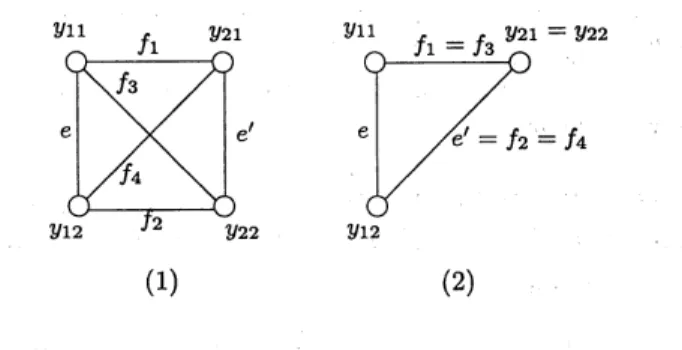
and vertices $y_{ij}\in Y-V(F),$ $1\leq\dot{i},$$j\leq 2$, where $y_{11},$ $y_{1}2,$$y_{2}1$ aredistinct, and if$y_{22}$is equal toone
ofthe other three then we assume that $y_{22}=y_{2}1$
(see Fig. 4). We usethe followingnotations:
(1) (2)
Fig. 4. The edges$e,$$e’$ and$f_{i},$ $1\leq i\leq 4:(1)y21\neq y22;(2)$
$y_{21}=y_{22}$.
$e’=\{$
$(y_{21}, y_{22})$ if$y_{21}\neq y_{22}$
$(y_{12}, y_{21})$ if$y_{21}=y_{2}2$,
$A(e)=A(e, L+\{e, e^{J}\}),$ $A(e’)=A(eL’,+\{e, e\}’)$,
$f_{1}=(y_{11}, y_{2}1),$ $f_{2}=(y_{12}, y_{2}2)$,
$\{f_{3}, f_{4}\}$ if$A(e)\cap A(e)\prime A(=f1)\cap A(f_{2})=\emptyset$
.
Clearly, $\{f, f’\}\cap E(L)=\emptyset$. Such a pair $f,$ $f’$
are called an augmenting pair (with respect to
$\{y11, y_{1}2, y_{2}1, y22\})$ of$L$.
$f_{3}=(y_{11}, y_{2}2),$ $f_{4}=(y_{12}, y_{2}1)$,
where we set $f_{1}=f_{3}$ and $e’=f_{2}=f_{4}$ if $y_{21}=$ $y_{22}$, and
$A(f_{i})=\{$$A(f_{i}, L+\{f_{1}, f_{2}\})$ if
$1\leq\dot{i}\leq 2$
$A(f_{i}, L+\{f_{3}, f_{4}\})$ if $3\leq i\leq 4$
.
Note that $e,$$e’,$ $f_{i}\not\in E(L),$$1\leq\dot{i}\leq 4$. We have the
following two cases.
Case I:$A(e)\cap A(e’)=\emptyset$; CaseII: $A(e)\cap A(e’)\neq$
$\emptyset$ (that is,
$A(e)=A(e’)$).
For CaseI, weare goingto show that thereare
two edges$f,$$f’,$with$V(f)\cup V(f’)=V(e)\cup V(e’)$,
such that
$A(e)\cup A(e’)\subseteq A(f, L+\{f, f’\})=A(f’, L+\{f, f’\})$. That is,wecanaddtwo edgessothat one $(\sigma+1)-$
component containing $A(e)\cup A(e’)$ may be
ob-tained. Finding and adding such a pair of edges
$f_{1}f’$ is called $edge-\dot{i}nterc.hange$
. (with $\mathrm{r}\mathrm{e}$
.spect
to$V(e_{1})\cup V(e_{2}))$.
Suppose that$A(e)\cap\dot{A}(e’|)=\emptyset$. Note that$y_{21}\neq$
$y_{22}$ in this case. Let$K$be anyfixed $(A(e), A(e’))-$ cut of$L+\{e, e’\}$, and let $B_{i},$ $1\leq\dot{i}\leq 2$, denote
the two sets of vertices in $L+\{e, e’\}$ such that
$B_{1}\cup B_{2}=V,$ $B_{2}=V-B_{1},$ $K=(B_{1},$$B_{2;}L+$
$\{e, e’\}),$ $A(e)\subseteq B_{1}$ and $A(e’)\subseteq B_{2}$
.
$|K|=\sigma=$$\lambda(y_{1}, y_{2};L’’)$ for any $y_{i}\in B_{i},$ $1\leq i\leq 2$, where
$L”$ denotes $L,$ $L+e,$ $L+e’$ or $L+\{e, e’\}$
.
$K$ isa $(y_{1}, y_{2})$-cut of$L$. Suppose that $f$ and $f’\mathrm{S}\mathrm{a}\mathrm{t}\mathrm{i}\mathrm{S}\mathfrak{g}r$
either (i) or (ii):
(i) $f=f_{1},$ $f’=f_{2}$, or (ii) $f=f_{3},$ $f’=f_{4}$, where $\{f, f’\}\cap E(L)=\emptyset$
.
The nextpropositionshows apropertyof edge-interchange.
Proposition 8.
If
$A(e)\cap A(e’)$ $=$ $A(f_{1})\cap$$A(f_{2})=\emptyset$ then $A(f_{3})\cap A(f_{4})\neq\emptyset$, that is,
$A(f_{3})=A(f_{4})$
.
Let $\{f, f’\}$ denote the followingpair of edges: $\{e, e’\}$ if$A(e)=A(e’)(\mathrm{t}\mathrm{h}\mathrm{e}$ casewith
$V(e)\cap V(e’)=\emptyset$ is included);
$\{f_{1}, f_{2}\}$ if$A(e)\cap A(e’)=\emptyset$ and $A(f_{1})=A(f_{2})$;
Corollary 2. Let$L’=L+\{f, f’\}$
for
anyaug-menting pair$f,$ $f’$
.
Then$L’-f’$ has no$\sigma$-cutsep-arating $V(f’)$
from
$V(f)$. That is, $\dot{i}fL’-f$’ has a$\sigma$-cut $K$ separating a vertex
of
$V(f’)$from
$V(f)$then $K$ separates the two vertices
of
$V(f’)$.Rom Corollary 2, other important properties
(Proposition 9-11) of edge-interchange are
ob-tained.
$A(f_{1},G+\{f1,f2\})$
$yy\mathrm{J}_{4}^{3}f2$ $y_{2}y_{1}\mathrm{f}^{f_{1}}$ $\circ\circ y_{6}y_{5}\}$
Fig. 5. The two $(\sigma+1)$-components $A(f_{1}, G+\{f_{1}, f_{2}\})$
and$A(g_{1}, G+\{g_{1}, g_{2}\})$ producedby twoaugmenting pairs
$\{fi, f_{2}\}$and$\{g_{1}, g_{2}\}$, respectively.
Proposition 9. Suppose that $G$ has six leaves
$Y_{i}\in LF(G)(1\leq\dot{i}\leq 6)$, and choose$y_{i}\in Y_{i}$ as a
representative
of
each$Y_{i}$. Suppose that $\{f_{1}, f_{2}\}$ isan augmenting pairwith respect to $\{y_{i}|1\leq\dot{i}\leq 4\}$
of
G.If
$A(f_{1}, G+\{f1, f_{2}\})$ is aleaf
then,for
each$\dot{i}\in\{1,2\}$, there is an augmenting pair $\{g_{1}, g_{2}\}$
with respect to $V(f_{i})\cup\{y_{5}, y_{6}\}$
of
$G$ such that$A(g_{1}, G+\{g_{1}, g_{2}\})$ is not a
leaf
(see Fig. 5).By Proposition 9, we obtainthe following
pro-cedure that is a modified version of the
proce-dure given in [15]. It finds a sequence of edges
$e_{1},$ $\ldots,$$e_{r}$ $(r=\lceil|LF(G)|/2\rceil\geq 1)$ by repeating edge-interchange operation, where handling the
case with $|LF(G)|=2$ is included. Note that
edges withwhichweareconcerned are those
con-nectingvertices belonging to distinct leaves. Ifan
edge $g$connects a vertex in a leaf$Y_{i}$ and another vertexin a leaf$Y_{j}(\dot{i}\neq j)$ then, for simplicity, we
Procedure $FIND_{-}EDGESi$
begin
1. $G_{1}arrow G;\piarrow LF(G);iarrow 1;E_{1}’arrow\emptyset$;
2. while $\pi\neq\emptyset$ do
begin
3. if $|\pi|=2$ then
4. $f_{i}arrow \mathrm{a}\mathrm{n}$edge connecting the two leaves
of $\pi;E_{i}’’arrow\{f_{i}\}$;
5. else if $|\pi|\leq 5$then
6. Find an augmenting pair $E_{i}’’=\{f_{i}, f_{i}’\}$
by Proposition 8;
7. $\mathrm{e}\mathrm{l}\mathrm{s}\mathrm{e}/*|\pi|\geq 6*/$
8. Find an augmenting pair $E_{i}’’=\{f_{i}, f_{i}’\}$
by Proposition 9;
9. $E_{i+1}’arrow E_{i}’\cup E_{i}^{J\prime};G_{i+1}arrow G_{i}+E_{i}’’$;
$\piarrow\pi-\{Y(v)|v\in V(E_{i}’’)\};\dot{i}arrow\dot{i}+1$;
end
(2)
If
$Y_{1x}Y_{2}then|\mathcal{M}|=0$, therearethree vertices $y_{i}\in Y_{i}(i=1,2),$ $x\in V-(Y_{1}\cup Y_{2})$ suchthat $E’=\{(y_{1}, x), (y_{2}, x)\}$ is a solution, and
$OP\tau(S)=2=OPT(M)+1$ .
Proposition 13.
If
$q=3$ and there exist two leaves$Y_{1},$ $Y_{2}$ with $Y_{1}\overline{\chi}Y_{2}$ then $|\mathcal{M}|=1$, there aredistinct edges $e_{1},$$e_{2}$ such that $E’=\{e_{1}, e_{2}\}$ is a
solution, and OPT$(S)=oPT(M)=2$ .
Next we considerthe remainingcasewhere$3\leq$
$q<2\sigma+6$
.
For each $e’=(x’, y^{;})\in$ At, we can choose two vertices$x\in Y(x’),$ $y\in Y(y’)$, and let$e=(x, y)$ be an edge, which is not includedin $E$
.
We fix such an edge $e$ for each $e’\in \mathcal{M}$, andlet $E_{0}’=\{e=(x, y)|(x’, y^{J})\in \mathcal{M}\}$
.
end; Proposition 14. $|E_{0}’|=|\mathcal{M}|$ and$E_{0}’\cap E=\emptyset$.
Proposition 10. $G_{i+1}$ has a
leaf
containing$A(f_{i}, c_{i+1})\dot{i}f$and only $\dot{i}f|LF(G_{i})|=5$just
after
the execution
of
Step 9 in FIND-EDGES.Note that executing Step 6 or Step 8 once
can be done in $O(|V_{R}|)$ by using a structural
graph $F(G)$, and we can construct $F(G)$ in
$O(\sigma^{2}|V|\log(|V|/\sigma)+|E|)$time (see [7]). The
de-tails are omitted here.
The next proposition holds for the edge set $E’$
produced by FIND-EDGES.
Proposition 11. Let $Z(\sigma+1)=\{e_{1}, \ldots, e_{r}\}$
$(r=\lfloor|LF(G)/2\rfloor)$ be given by FIND-EDGES.
Then$Z(\sigma+1)$ isa minimum attachment suchthat
$\lambda(G’)=\sigma+1$, where $G’=G+Z(\sigma+1)$.
Further-more the procedure runs in $O(\sigma^{2}|V|\log(|V|/\sigma)+$ $|E|+|V_{R}|^{2})$ time.
5 $(\sigma+1)\mathrm{E}\mathrm{C}\mathrm{A}(\mathrm{s},\mathrm{s}\mathrm{A})$ for $G$ having less than $2\sigma+6$ leaves
We denote $LF(G)=\{Y_{i}|1 \leq i\leq q\}(q=$
$|LF(G)|),$ $Y(G)$ $=$ $\{y_{1}, \ldots, y_{q}\}$ and $V_{R}$ $=$
$\{v_{1}, \ldots, v_{q}\}$, where each $y_{i}$ is represented as $v_{i}$
in $R(G)$. First we consider the case where $G$ has
twoor three leaves.
Proposition 12.
If
$q=2$ then the following (1)or (2) holds.
(1)
If
$Y_{1}\overline{\chi}Y_{2}$ then $|\mathcal{M}|=1$, there are two $vert_{\dot{i}C}es$$y_{i}\in Y_{i},$ $i=1,2$ , such that $E’=\{(y_{1}, y_{2})\}$ is
a solution, and OPT $(S)=OPT(M)=1$ .
Inthe rest of thissection,weconsider the graph
$G+E_{0}’$. First we define two sets $\mathcal{L}_{1}$ and $\mathcal{K}_{1}$ as
follows.
Let $G_{1}=G+E_{0}’$ and let $\mathcal{L}_{1}$ be the set of
new leaves of $G_{1}$ created by adding $E_{0}’$ to $G$
.
Clearly $|\mathcal{L}_{1}|\leq|\mathcal{M}|$. Let $\mathcal{K}_{1}=LF(G+E_{0}’)-\mathcal{L}_{1}$
$(\subseteq LF(G))$
.
Since $\mathcal{M}$ is a maximum matching of$R(G)$, Proposition 3 shows that each leaf in $\mathcal{K}_{1}$
consists of only one vertex and that the set of
vertices $\mathcal{K}_{1}’=\{x|\{x\}\in \mathcal{K}_{1}\}$ induces a complete
graph of$G$ and of$G+E_{0}’$.
We are going to propose an
$O(\sigma^{2}|V|\log(|V|/\sigma)+|E|+|V_{R}|^{2})$ time
algo-rithm such that it finds an optimum solution if $|\mathcal{L}_{1}|\leq|\mathcal{K}_{1}|$ and such that a $\frac{3}{2}$-approximate
solution if $|\mathcal{L}_{1}|$ $>$ $|\mathcal{K}_{1}|$. Note that we have
$|\mathcal{L}_{1}|\leq|\mathcal{K}_{1}|$ if $|\mathcal{M}|\leq\lfloor|V_{R}|/3\rfloor$.
Proposition 15. Let $\{y_{1}’\},$$\{y_{2}’\}\in \mathcal{K}_{1}(y_{1}’\neq y_{2}’)$
and $Y_{1},$$Y_{2}\in \mathcal{L}_{1}(Y_{1}\neq Y_{2}).$
If
$\{(y_{1}, y_{1}’), (y_{2}, y_{2}’)\}$is not an augmenting pair with $y_{1}$ $\in Y_{1}$ and
$y_{2}\in Y_{2}$ then there are$y_{3}\in Y_{1}$ and$y_{4}\in Y_{2}$ such
that$\{(y_{4}, y_{1}’), (y_{3}, y_{2}^{J})\}$ is an augmentingpairand $(y_{4}, y_{1})’,$ $(y_{3}, y_{2})’\not\in E$ (See Fig. 6).
We obtain the next propositionby Propositions
9 and 15.
Proposition 16. Assume that $|\mathcal{L}_{1}|$ $\geq$ $3$ and
$\downarrow \mathcal{K}_{1}|\geq 3$. Then there exists an augmenting pair
$\{f_{1}, f_{2}\}$ such that $f_{1}=(y_{1}, y_{1}’)\not\in E\cup E_{0}’,$ $f_{2}=$ $(y_{2}, y_{2})’\not\in E\cup E’0’\{\{y_{1}’\}, \{y’2\}\}\subseteq \mathcal{K}_{1}(y_{1}’\neq y_{2}^{;}),$ $\mathcal{L}_{1}$
begin
1. $G_{0}arrow G;\piarrow LF(G);E_{0}’arrow\emptyset;\rhoarrow\emptyset$;
2. Find an edge set $E_{0}’$ as in Proposition 14;
$G_{1}arrow G_{0}+E_{0}’$;
Determine $\mathcal{L}_{1}$ and $\mathcal{K}_{1;}iarrow 1$; 3. while $\mathcal{K}_{i}\neq\emptyset$do
begin
4. if $|\mathcal{L}_{i}|\geq 3$ and $|\mathcal{K}_{i}|\geq 3$ then
Find an augmenting pair $\{f, f’\}$
by Proposition 16; $E_{i}’’arrow\{f, f’\}$;
5. else if $|\mathcal{L}_{i}|\leq 2$ and $|\mathcal{L}_{i}|\leq|\mathcal{K}_{i}|$ then
Find an edge set $E_{i}’’$ by Proposition 17;
6. else
Find an edge set $E_{i}’’$ by Proposition 18;
7. Construct $\mathcal{K}_{i+1}$ and $\mathcal{L}_{i+1;}E_{i}’arrow E_{i-1}’\cup E_{i}’’$;
$G_{i+1}arrow G_{i}+E_{i}’’;\dot{i}arrow\dot{i}+1$;
end;
8. if$\lambda(G_{i})=\sigma \mathrm{t}\mathrm{h}\mathrm{e}\mathrm{n}/*\mathrm{t}\mathrm{h}\mathrm{e}$case with $|\mathcal{L}_{i}|\neq 0*/$
Find an edge set $E_{i}^{;\prime}$ by Proposition 18;
$E_{i+1}’arrow E_{i-1}’\cup E_{i}\prime J$;
end;
Fig.7. $A(f_{1}, G+\{f_{1}, f_{2}\})$ inthe proof of
Proposi-tion 16 Propositionoptimum solution19. $if|\mathcal{L}_{1}|\leq|\mathcal{K}_{1}|$FIND-EDGES2. produces an
and$A(f_{1}, G+\{f1, f_{2}\})$ is not a
leaf.
Furthermore$\mathcal{L}_{1}\cup \mathcal{K}_{1}-\{\{y_{1}’\}, \{y_{2}’\}\},$$Y_{1},$$Y_{2}\}$ is the set
of
allleaves in $G_{1}+\{f_{1}, f_{2}\}$. (See Fig. 7)
Next we are going to discuss the case where
$|\mathcal{L}_{1}|\leq 2$ or $|\mathcal{K}_{1}|\leq 2$.
Proposition 17. Suppose that $|\mathcal{L}_{1}|$ $\leq$ $2$ and
$|\mathcal{L}_{1}|$ $\leq$ $|\mathcal{K}_{1}|$. Then there exists a set $E_{2}’$ $=$
$\{f_{1}, \ldots, f_{|\mathcal{K}_{1}|}\}$ such that $\lambda(G_{1}+E_{2}’)\geq\sigma+1$ and $E_{2}’\cap(E\cup E’0)=\emptyset$.
It remains to consider the cases ($|\mathcal{L}_{1}|\geq 3$ and $|\mathcal{K}_{1}|\leq 2)$ and ($|\mathcal{L}_{1}|\leq 2$ and $|\mathcal{L}_{1}|>|\mathcal{K}_{1}|$), for
which the next proposition holds.
Proposition 18. Suppose thatone
of
thefollow-ing (1)$-(\mathit{3})$ holds: (1) $|\mathcal{L}_{1}|\geq 3$ and $|\mathcal{K}_{1}|\leq 2_{f}$. (2) $|\mathcal{L}_{1}|=2$ and $|\mathcal{K}_{1}|=1;(\mathit{3})|\mathcal{L}_{1}|=2$ and
$|\mathcal{K}_{1}|=0$. Let$q_{1}=|LF(G_{1})|$ and$r_{1}=\lceil_{2}^{L1}\rceil$. Then
there exists a set $E_{2}’’=\{f_{1}, \ldots, f_{r_{1}}\}$ such that
$\lambda(G_{1}+E_{2}’’)\geq\sigma+1$ and$E_{2}’’\cap(E\cup E_{0}’)=\emptyset$.
The discussion from Propositions 16 through
18 is summarized in the following procedure FIND-EDGES2.
Procedure FIND-EDGES2;
Proposition 20. FIND-EDGES2 gives a $\frac{3}{2}-$
approximate solution $\dot{i}f|\mathcal{L}_{1}|>|\mathcal{K}_{1}|$.
Remark 1. Let $\mathcal{M}$ be any maximum matching
of $R(G)$. If $| \mathcal{M}|\leq \mathrm{L}\frac{|LF(c)|}{3}\rfloor$ then $|\mathcal{L}_{1}|\leq|\mathcal{K}_{1}|$
and wecan find an optimum solution in
polyno-$\mathrm{m}|\mathcal{L}_{1}|\leq|\mathcal{K}_{1}\mathrm{i}\mathrm{a}1\mathrm{t}\mathrm{i}\mathrm{m}\mathrm{e}.\mathrm{I}\mathrm{f}\mathrm{L}\frac{|LF(c)|}{|\mathcal{L}_{1}^{3}|}\rfloor|\mathrm{o}\mathrm{r}><|\mathcal{M}|\mathcal{K}_{1}|$
.
$\mathrm{S}\mathrm{i}\mathrm{n}\mathrm{c}\mathrm{e}\mathrm{p}\mathrm{r}\mathrm{o}\mathrm{o}\mathrm{f}|\leq \mathrm{L}^{\frac{|LF(c)|}{\mathrm{t}\mathrm{h}\mathrm{e}2}}\rfloor \mathrm{t}\mathrm{h}\mathrm{e}\mathrm{n}\mathrm{f}\mathrm{o}$
$\mathrm{N}\mathrm{P}$-completeness of
$k\mathrm{E}\mathrm{C}\mathrm{A}(\mathrm{s},\mathrm{s}\mathrm{A})$ in [10] is given
for the case with $| \mathcal{M}|=\mathrm{L}\frac{|LF(c)|}{2}\rfloor$, we consider approximate solutions if $|\mathcal{L}_{1}|>|\mathcal{K}_{1}|$.
Theorem 1. Suppose that $|LF(c)|\leq 2\sigma+6$.
Then FIND-EDGES2 can
find
an optimum so-lution $\dot{i}f|\mathcal{L}_{1}|\leq|\mathcal{K}_{1}|$, or$a \frac{3}{2}$-approximate solution$\dot{i}f|\mathcal{L}_{1}|>|\mathcal{K}_{1}|$, in $O(\sigma^{2}|V|\log(|V|/\sigma)+|E|)$ time.
6 $(\sigma+1)\mathrm{E}\mathrm{C}\mathrm{A}(\mathrm{S},\mathrm{s}\mathrm{A})$ for $G$ having at
least $2\sigma+6$ leaves
In this case, Proposition 5(3) shows that any maximum matching $\mathcal{M}$ of $R(G)$ has $|\mathcal{M}|$ $=$
$\mathrm{L}\frac{|LF(G)|}{2}\rfloor$. First, some basic results on
nonadja-cent pairs and edge interchange operation are
Proposition 21. Suppose that there are a
non-adjacent pair
of
leaves $Y_{1},$$Y_{2}\in LF(G)$ and twovertices $y_{i}\in Y_{i},\dot{i}=1,2$, with $(y_{1}, y_{2})\not\in E$, such
that $G’=G+\{(y_{1}, y_{2})\}$ has a
leaf
$S$contain-ing $Y_{1}\cup Y_{2}$. Let $\mathcal{L}’=\{Y\subseteq S|Y\in\Gamma_{G}(\sigma+1)\}$,
$X=Y_{1}\cup Y_{2}$ and$Z= \bigcup_{Y\in LF}(G)-\{Y_{1,2}Y\}$Y. Then
$|(x, z_{;}c)|\leq\sigma-1\dot{i}f|\mathcal{L}’|\geq 3$.
The next proposition can be proved by using
Propositon 21.
Proposition 22. Suppose $\sigma\geq 3$ and let
A4’
$=$$\{(v2i-1, v2i)|1\leq\dot{i}\leq m\}\subseteq \mathcal{M}$
for
some$m\leq|\mathcal{M}|$,and put$Y_{j}=Y(v_{j})$
for
each$v_{j}\in V_{R}$.(1)
If
$|\mathcal{M}’|$ $\geq$ 2 and there are distinct in-dices $i,$ $j$ with 1 $\leq$ $i,$ $j$ $\leq$ $m$ such that$\{Y_{2i-1}, Y2i\}\mathrm{s}\{Y2j-1, Y_{2}j\}$ then (i) and $(\dot{i}i)$ hold.
(i) These leaves are partitioned into
a $D$-combination $\{\{L_{1}’, L_{2}’\}, \{L_{3}’, L_{4}’\}\}$
having
four
vertices $y_{t}$ $\in$ $L_{t}’$,$t$ $=$ 1,2,3,4, such that $G+$
$\{(y_{1}, y_{2}), (y_{3}, y_{4})\}$ has a $(\sigma+1)-$
component $S$ containing all $L_{t}’,$ $t=$
1, 2, 3,4.
$(\dot{i}\dot{i})$ The $(\sigma+1)$-component $S’$
of
$G+$$\{(y_{1}, y_{2})\}$ such that$L_{1}’\cup L_{2}’\subseteq S’$ isnot
a
leaf.
(2) $If|\mathcal{M}’|\geq\lceil\sigma/2\rceil+1$ andno suchpair
of
indices asin (1) existthen,for
each$(v_{2i-1}, v_{2i})\in \mathcal{M}’$,there are vertices $y_{2i-1}\in Y_{2i-1}$ and$y_{2i}\in Y_{2i}$
such that $G’=G+\{(y_{2i-}1, y2i)\}\dot{i}S$ a simple
graph having a $(\sigma+1)$-component$X$ which is
not a
leaf
and which contains $Y_{2i-1}\cup Y_{2i}$.Proposition 23. Suppose that there is a set
$\mathcal{M}’=\{(v2i-1, v2i)|1\leq i\leq m\}\subseteq$ A4
for
some$m$ with $\sigma+2\leq m\leq|\mathcal{M}|$, and put$Y_{i}=Y(v_{i})$
for
each$v_{i}\in V_{R}$. Then thereis an edge $(v_{2h12h}-, v)\in$
$\mathcal{M}’w\dot{i}th\{Y_{1}, Y_{2}\}f\{Y2h-1, Y2h\}$.
By combining Propositions 9, 22 and 23, we
obtain the following proposition.
Proposition 24. Suppose that there is a set
$\mathcal{M}’=\{f_{i}=(v_{2i-1}, v_{2i})|1\leq\dot{i}\leq m\}\subseteq \mathcal{M}$
for
some $m$ with $\sigma+3\leq m\leq|\mathcal{M}|$, and put$Y_{i}=Y(v_{i})$.
for
each $v_{i}\in V_{R}$. Then thereex-ists an augmenting pair $\{e_{1}’, e_{2}’\}$ with respect to
$Y_{1},$$Y_{2},$$Y_{2j}-1,$$Y_{2j}$ such that $G+\{e_{1}’, e_{2}^{J}\}$ is simple
and has no
leaf
$S$ with $Y_{1}\cup Y_{2}\cup Y_{2j-1}\cup Y_{2j}\subseteq S$,where $\{f_{1}, f_{j}\}\subseteq \mathcal{M}’$.
Based on Proposition 24, the next procedure FIND-EDGES3 is obtained.
Procedure $FIND_{-}EDGES\mathit{3},\cdot$
begin
1. $G_{1}arrow G;\piarrow LF(G);\dot{i}arrow 1;E_{0}’arrow\emptyset$;
2. while $\pi\neq\emptyset$ do begin
3. if $|\pi|\leq 3$ then
4. Find an edge set $E_{i}’’$ as $E’$
in Proposition 12(1) or 13;
5. else
$\mathrm{b}\mathrm{e}\mathrm{g}\mathrm{i}\mathrm{n}/*|\pi|\geq 4^{*}/$
6. Find amatching $\mathcal{M}’’=\{(v_{2-1}, v2)pp|$
$1\leq p\leq m\}$’ of $R(G_{i})$,
where if $|\pi|\leq 2\sigma+6$ then $m’arrow\lfloor\pi/2\rfloor$,
otherwise $m’arrow\sigma+3$;
7. if$|\pi|\leq 2\sigma+6$ then
begin
Choose $E_{s}’\subseteq E_{i}’$ with $|E_{s}’|=\sigma+3-m’$
appropriately;
$H$.
$\mathcal{M}’arrow \mathcal{M}’’\cup\{(v, w)\in E_{R}|$
$(v’, w^{;})\in E_{s}’’,$$v\in Y(v),$ $w’\in Y(w)\}$;
$/*\mathcal{M}’$ is a matching on $R(G)$ in the case.$*/$
end; else
$\mathcal{M}’arrow \mathcal{M}’’$;
8. Find an augmenting pair $E_{i}’’$ as $\{e_{1}’, e_{2}’\}$
in Proposition 24
by choosing $f_{1}\in \mathcal{M}’’$;
$/*\mathrm{N}\mathrm{o}\mathrm{t}\mathrm{e}$ that $|\mathcal{M}’|=\sigma+3$. $*/$ 9. if$f_{j}\in \mathcal{M}’-\mathcal{M}’’$ for $f_{j}$
of Proposition 24 then
$\mathrm{b}\mathrm{e}\mathrm{g}\mathrm{i}\mathrm{n}/*\mathrm{I}\mathrm{n}$ the casewith $|\pi|\leq 2\sigma+6*/$
$E_{i}’arrow E_{i}’-\{(y2j-1, y2j)\}$,
$G_{i}arrow G_{i}-\{(y2j-1, y_{2}j)\}$, where $y_{2j-1}\in Y_{2j-1}$
.
and $y_{2j}\in Y_{2j;}$end;
10. $E_{i+1}’arrow E_{i}’\cup E_{i}’’;G_{i+1}arrow G_{i}+E_{i}’’$;
$\piarrow\pi-\{Y(v)|v\in V(E_{i}’’)\};iarrow\dot{i}+1$;
end; end;
Proposition 25. Any set $E_{i}’$ finally obtained at the termination
of
FINDEDGES3 is a minimum attachment such that $\lambda(G’)=\sigma+1$, where $G’=$$G+E’$.
Theorem 2.
If
$G$ has at least$2\sigma+6$ leaves thenthe algorithm FIND-EDGES3 correctly
finds
asolution $E’$ to $(\sigma+1)ECA(s,sA)$
for
any given$G$ with $\lambda(G)=\sigma$ in $O(\sigma^{2}|V|\log(|V.|/\sigma)+|E|+$
7
ConcludingRemarks
The paper has proposed
(1) an $O(\sigma^{2}|V|\log(|V|/\sigma)+|E|+|V_{R}|^{2})$ time
al-gorithm for finding an optimumsolution if $G$
has at least $2\sigma+6$leaves or if$|\mathcal{L}_{1}|\leq|\mathcal{K}_{1}|$ and
$G$ has less than $2\sigma+6$ leaves,
(2) an $O(\sigma^{2}|V|\log(|V|/\sigma)+|E|)$ time one for a
$\frac{3}{2}$-approximate solution if $|\mathcal{L}_{1}|>|\mathcal{K}_{1}|$ and $G$
has less than$2\sigma+6$ leaves.
We can improve the first algorithm to an
$O(\sigma^{2}|V|\log(|V|/\sigma)+|E|)$ time one by devising
how to check whether or not $\{f_{1}, f_{2}\}$ is an
aug-menting pair, and whether or not $A(f_{1},$$G+$
$\{f_{1}, f_{2}\})$ is a leafin Proposition9.
Acknowledgments
The research of T.Watanabe is partly supported
by the Grant in Aid for Scientific Research on
Priority Areas of the Ministry ofEducation,
Sci-ence, Sports and Culture of$\mathrm{J}\mathrm{a}\mathrm{p}\mathrm{a}\mathrm{n}$
.$’$
.under Grant No.10205219.
References
1. A. V. AHO, J. E. HOPCROFT, AND J. D. ULLMAN, The Design and Analysis of Computer Algorithms, Addison-Wesley, Reading, MA, 1974.
2. J. BANG-JENSEN AND T. $\mathrm{j}\circ \mathrm{R}\mathrm{D}\acute{\mathrm{A}}\mathrm{N}.$
’ Edge-connectivity
augmentation preserving simplicity, SIAM J. Discrete Math., 11 (1998), pp.603-623.
3. K. P. ESWARAN AND R. E. TARJAN, Augmentation problems,SIAM J. Comput., 5 (1976),pp. 653-655.
4. S. EVEN, Graph Algorithms, Pitman, London, 1979.
5. A. FRANK, Augmenting graphs to meet edge
connec-tivity requirements, SIAM J. DiscreteMathematics, 5
(1992),pp. 25-53.
6. H. FRANKANDW. CHOU, Connectivityconsiderations in thedesignofsurvivablenetworks,IEEE Rans.
Cir-cuit Theory, CT-17(1970), pp. 486-490.
7. H. N. GABOW, Applications ofa poset$oep\dot{r}eSentaiion$
to edgeconnectivity and graphrigidity, in Proc. 32nd IEEE Symposium on Foundations of Computer Sci-ence, 1991, pp. 8i2-82l.
8. –, Efficient splitting offalgorithmsfor graphs, in
Proc. 26th ACM Symposium on Theory of Comput-ing, 1994, pp. 696-705.
9. T. C. HU, IntegerProgramming andNetwork Flows,
Addison-Wesley, Reading,Mass, 1969.
10. T. JORD\’AN, Two $NP$-complete
augmen-tation problems, Tech. Rep. PP-1997-08,
Odense University, Denmark, March 1997.
http:$//\mathrm{w}\mathrm{w}\mathrm{w}$.imada.ou.
dk/Research/Preprints/i-l.html.
11. A. V. KARZANOVAND E. A. TIMOFEEV, Efficient al-gorithmforfinding all minimal edge cuts ofa nonori-ented graph, Cybernetics, (1986), pp. 156-162. Trans-lated from Kibernetika, 2 (1986), 8-12.
12. H. NAGAMOCHI AND T. IBARAKI, Afasteredge
split-tingalgorithm in multigraphs and its application to the edge-connectinity augmentation problem, Tech. Rep.
94017, KyotoUniversity, 1994.
13. D. NAOR, D. GUSFIELD, AND C. MARTEL, Afast
al-gorithmforoptimallyincreasingthe edgeconnectivity,
SIAM J. Comput., 26 (1997),pp. 1139-1165.
14. D. TAKAFUJI, S. TAOKA, AND T. WATANABE, Simplicity-preserving augmentation to $\mathit{4}- ed_{\mathit{9}^{e}}$-connect
a graph, IPSJ SIG Notes,AL-33-5 (1993), pp. 33-40. 15. S. TAOKA, D. TAKAFUJI, AND T. WATANABE,
Simplicity-preserving augmentation of the
edge-connectivity ofa graph, Tech.Rep.of IEICE ofJapan,
COMP93-73 (1994), pp.49-56.
16. S. TAOKAANDT. WATANABE,Efficientalgorithmsfor the edge-connectivity augmentation problem ofgraphs withoutincreasing edge-multiplicity, IPSJ SIG Notes,
$\mathrm{A}\mathrm{L}_{-}42-1$ (1994),pp. 1-8.
17. –, Minimum augmentation to k-edge-connect specifiedvertices ofa graph,inLecture Notes in Com-puter Science $834(\mathrm{D}_{-\mathrm{Z}}$ du and X-S Zhang(Eds.):
Al-gorithms and Computation), SPringer-Verlag,Berlin,
1994, pp. 217-225. (Proc. 5th International Sympo-sium on Algorithms and ComPutation$(\mathrm{I}\mathrm{S}\mathrm{A}\mathrm{A}\mathrm{c}’ 94))$.
18. –, Smallest augmentation to k-edge-connect all specifiedvertices in a graph, IPSJSIGNotes,AL-38-3
(1994), pp. 17-24.
19. –, The $(\sigma+ 1)$-edge-connectivity augmentation
problem without creating multiple edges of a graph, in Lecture Notes in Computer Science 1872 (J. van
Leeuwen, et al. (Eds.): Theoretical Computer
Sci-ence), Springer-Verlag, Berlin, 2000, pp. 169-185.
(Proc. 1st International Conference FIIPTCS2000).
20. R. E. TARJAN, Data Structures and Network Algo,
rithms,CBMS-NSFRegionalConference Seriesin Ap-plied Mathematics, SIAM, Philadelphia, PA, 1983.
21. T. WATANABE,Anefficient wayforedge-connectivity
augmentation, Tec. Rep. $\mathrm{A}\mathrm{C}\mathrm{T}- 76- \mathrm{U}\mathrm{I}\mathrm{L}\mathrm{U}- \mathrm{E}\mathrm{N}\mathrm{G}_{-8}7_{-}$
2221, Coordinated ScienceLab., UniversityofIllinois
at Urbana, Urbana, IL 61801, April 1987. Also pre-sentedat Eighteenth Southeastern International Con-ferenceonCombinatorics,GraphTheory, Computing,
No.15, BocaRaton, FL, U.S.A., February1987. 22. –, A simple improvement on edge-connectimty
augmentation, Tech. Rep., IEICE ofJapan, CAS87-203 (1987), pp. 43-48.
23. T. WATANABEAND A. NAKAMURA, Edge-connectivity augmentation problems, J. $\mathrm{C}_{\mathrm{o}\mathrm{m}\mathrm{p}\mathrm{u}}\mathrm{t}.\cdot$ System Sci., 35 (1987), pp. 96-144.
24. T. WATANABE AND M. YAMAKADO, A linear time al-gorithmfor smallest augmentation to 3-edge-connect
a graph, IEICE Trans. Fundamentals ofJapan,E76-A