JAIST Repository
https://dspace.jaist.ac.jp/
Title
Supramolecular Nanostructured Assemblies of Different Types of Porphyrins with Fullerene Using TiO_2 Nanoparticles for Light Energy Conversion
Author(s) Hasobe, Taku; Hattori, Shigeki; Kamat, Prashant V.; Fukuzumi, Shunichi
Citation Tetrahedron, 62(9): 1937-1946 Issue Date 2006-02-27
Type Journal Article
Text version author
URL http://hdl.handle.net/10119/4950
Rights
NOTICE: This is the author's version of a work accepted for publication by Elsevier. Taku Hasobe, Shigeki Hattori, Prashant V. Kamat and Shunichi Fukuzumi, Tetrahedron, 62(9), 2006, 1937-1946,
http://dx.doi.org/10.1016/j.tet.2005.05.113 Description
Supramolecular nanostructured assemblies of different
types of porphyrins with fullerene using TiO
2nanoparticles for light energy conversion
Taku Hasobe,a,b Shigeki Hattori,a Prashant V. Kamat,*,b and Shunichi Fukuzumi*,a
Department of Material and Life Science, Graduate School of Engineering, Osaka University, SORST, Japan Science and Technology Agency, Suita, Osaka 565-0871, Japan Radiation Laboratory and Department of Chemical & Biomolecular Engineering, University of Notre Dame, Notre Dame, Indiana 46556, USA
a Osaka University, b University of Notre Dame
Abstract
TiO2 nanoparticles were modified with porphyrin derivatives, 5-[4-benzoic
acid]-10,15,20-tris[3,5-di-tert-butylphenyl]-21H,23H-porphyrin (Ar-H2P-COOH), 5-[4-benzoic acid]-10,20-tris[3,5-di-tert-butylphenyl]-21H,23H-porphyrin (H-H2P-COOH), and 5,10,15,20-tetra[4-benzoic acid]-21H,23H-porphyrin (H2P-4COOH). The porphyrin-modified TiO2
nanoparticles were deposited on nanostructured OTE/SnO2 electrode together with
nanoclusters of fullerene (C60) in acetonitrile/toluene (3:1, v/v) using an electrophoretic
deposition technique to afford the porphyrin-modified TiO2 composite electrode denoted as
OTE/SnO2/(porphyrin-modified TiO2 nanoparticle+C60)n. The porphyrin-modified TiO2
composite electrodes have efficient light absorbing properties in the visible region, exhibiting the photoactive response under visible light excitation using I3
-/I
redox couple. The incident photon to photocurrent efficiency (IPCE) values of supramolecular nanostructured electrodes of porphyrin-modified TiO2 nanoparticles with fullerene
[OTE/SnO2/(Ar-H2P-COO-TiO2+C60)n, OTE/SnO2/(H-H2P-COO-TiO2+C60)n and
OTE/SnO2/(H2P-4COO-TiO2+C60)n] are much larger than those of the reference systems of
porphyrin-modified TiO2 nanoparticles without C60 [OTE/SnO2/(Ar-H2P-COO-TiO2)n,
OTE/SnO2/(H-H2P-COO-TiO2)n and OTE/SnO2/(H2P-4COO-TiO2)n]. In particular, the
maximum IPCE value (41%) is obtained for OTE/SnO2/(H-H2P-COO-TiO2+C60)n under
the bias potential of 0.2 V vs. SCE. This indicates that the formation of supramolecular complexes between porphyrins and fullerene on TiO2 nanoparticles plays an important role
Introduction
Increasing attention has been attracted toward the solar energy to current conversion to develop inexpensive and efficient solar cells.1-6 The construction of such efficient
photovoltaic devices requires an enhanced light-harvesting efficiency of chromophore molecules throughout the solar spectrum together with a highly efficient conversion of the harvested light into electrical energy.1-6
Porphyrinoid chromophores have been involved in a number of important biological electron-transfer systems including the primary photochemical reactions of chlorophylls in the photosynthetic reaction centers.7 Rich and extensive absorption features of
porphyrinoid systems result in increased absorption cross-sections and an efficient use of the solar spectrum.8-10 In purple photosynthetic bacteria, visible light is thereby harvested
efficiently by the antenna complexes composed of a wheel-like array of chlorophylls.11
Since porphyrins contain an extensively conjugated two-dimensional p-system, they are suitable not only for synthetic light-harvesting systems, but also for efficient electron transfer, because the uptake or release of electrons results in minimal structural and solvation change upon electron transfer.12 In contrast with the two-dimensional porphyrin
p-system, fullerenes contain an extensively conjugated three-dimensional p system.13-15
Buckminsterfullerene (C60), for example, is described as having a closed-shell configuration
consisting of 30 bonding molecular orbitals with 60 p-electrons,13-15 which is also suitable
for the efficient electron-transfer reduction because of the minimal changes of structure and solvation associated with the electron transfer.16 Judging from the excellent light harvesting
properties of porphyrins and the efficient electron-transfer properties of both porphyrins and fullerenes, combination of porphyrins and fullerenes seems to be ideal for fulfilling an enhanced light-harvesting efficiency of chromophores throughout the solar spectrum and a highly efficient conversion of the harvested light into the photocurrent generation. In
addition, porphyrins are known to form supramolecular complexes with C60, which contain
closest contacts between one of the electron-rich 6:6 bonds of the guest fullerene and the geometric center of the host porphyrins.17-20
The strong interaction between porphyrins and fullerenes is likely to be a good driving force for the formation of supramolecular complexes between porphyrins and C60.
21
Self-assembled monolayers (SAMs) of fullerenes and porphyrins have thereby merited special attention as artificial photosynthetic materials and photonic molecular devices.22-24
However, such monolayer assemblies possess poor light-harvesting capability, affording only low values of the incident photon-to-photocurrent efficiency (IPCE). In addition, the synthetic difficulty has precluded practical application of such artificial photosynthetic model compounds to develop low-cost photovoltaic devices.
In order to overcome these problems, we have previously reported a simple and new approach to prepare composite clusters of porphyrins and fullerene in a mixture of polar and nonpolar solvents, which are assembled as multilayers on a nanostructured SnO2
electrode using an electrophoretic deposition technique.25
The photoelectrochemical properties of the composite systems of porphyrins and fullerene are superior to those of the single component system.25a
In particular, multi-porphyrin arrays such as porphyrin dendrimers and porphyrin-modified gold nanoclusters with fullerenes exhibit much improved photoelectrochemical properties as compared with the composite clusters of monomeric porphyrin and fullerene.26
On the other hand, assembly of dye-modified TiO2 nanoparticles on electrodes using
the electrophoretic deposition technique has also been reported to be useful for preparation of organic thin films to obtain good electron acceptor materials.3c,d,27,28
The electrophoretic deposition of dye-modified TiO2 nanoparticles on electrodes is an attractive method for
nanoparticles on electrodes using the electrophoretic deposition technique has yet to be applied to construct the supramolecular electrodes with C60.
We report herein a new type of organic solar cells based on composite nanoclusters of porphyrin-modified TiO2 nanoparticles and fullerene and the photoelectrochemical
properties, which are different depending on the type of porphyrins shown in Figure 1: 5-[4-benzoic acid]-10,15,20-tris[3,5-di-tert-butylphenyl]-21H,23H-porphyrin (Ar-H2 P-COOH), 5-[4-benzoic acid]-10,20-di[3,5-di-tert-butylphenyl]-21H,23H-porphyrin (H-H2 P-COOH), 5,10,15,20-tetra[4-benzoic acid]-21H,23H-porphyrin (H2P-4COOH). The porphyrin (H2P) moieties are modified with carboxylic acid group (Ar-H2P-COOH, H-H2P-COOH and H2P-4COOH in Figure 1) in order to be assembled on TiO2 nanoparticles
[denoted as Ar-H2P-COO-TiO2,H-H2P-COO-TiO2 and H2P-4COO-TiO2 in Figure 1, respectively].
Figure 1
The porphyrin-modified TiO2 nanoparticles and fullerene nanoclusters are deposited
as thin films on optically transparent electrode (OTE) of nanostructured SnO2 (OTE/SnO2)
using an electrophoretic method as shown in Scheme 1. We examined the photoelectrochemical properties of composite cluster system using porphyrin-modified TiO2 nanoparticles (Ar-H2P-COO-TiO2, H-H2P-COO-TiO2 and H2P-4COO-TiO2) and fullerene (C60) on OTE/SnO2 electrode [denoted as OTE/SnO2/(Ar-H2P-COO-TiO2+C60)n,
OTE/SnO2/(H-H2P-COO-TiO2+C60)n and OTE/SnO2/(H2P-4COO-TiO2+C60)n,
respectively] relative to the reference systems containing porphyrin-modified TiO2
nanoparticles without C60 [OTE/SnO2/(Ar-H2P-COO-TiO2)n, OTE/SnO2/(H-H2 P-COO-TiO2)n and OTE/SnO2/(H2P-4COO-TiO2)n]. The morphology and light energy conversion
properties including the mechanism of these composite cluster systems are described in full detail in this paper.
Scheme 1 e -Pt e -OTE I-/ I3
-OTE: Optically Transparent Electrode e
-h
n
Porphyrin C60 TiO2 Nanoparticle
e
-SnO2 e
-Experimental Section
General. Chemicals used in this study are of the best grade available, supplied by Tokyo Chemical Industries, Wako Pure Chemical, or Sigma Aldrich Co. 1
H NMR spectra were recorded on a JNM-AL300 (JEOL) instrument at 300 MHz. Matrix-assisted laser desorption/ionization (MALDI) time-of-flight (TOF) mass spectra were measured on a Kratos Compact MALDI I (Shimadzu). TiO2 nanoparticles (P25, d = 21 nm) were
Preparation of TiO2 nanoparticles modified with porphyrin moieties. TiO2
nanoparticles modified with porphyrin moieties (Ar-H2P-COO-TiO2, H-H2P-COO-TiO2 and H2P-4COO-TiO2) were prepared by immersing warmed TiO2 nanoparticles (80 ~
100 °C) in acetonitrile (10 mL) containing 3.0 ¥ 10-4
mol dm-3
of Ar-H2P-COOH, H-H2 P-COOHand H2P-4COOH for 12 h, respectively. After adsorbing Ar-H2P-COOH, H-H2 P-COOHand H2P-4COOH, TiO2 nanoparticles were filtered, and the subsequent washing
with acetonitrile and drying afforded Ar-H2P-COO-TiO2, H-H2P-COO-TiO2 and H2 P-4COO-TiO2, respectively. The dye molecules were completely desorbed from TiO2
nanoparticles into solution by immersing the dye-modified TiO2 nanoparticles in methanol
overnight. The amounts of Ar-H2P-COOH, H-H2P-COOHand H2P-4COOH adsorbed on TiO2 nanoparticles relative to the total weight were determined as 2.98 ¥ 10
-5
, 2.98 ¥ 10-5
, and 2.97 ¥ 10-5
mol/g, respectively.28
The molecular packing densities of porphyrins on TiO2 nanoparticles are approximately the same.
Electrophoretic deposition of composite clusters on electrode. C60 is soluble in
nonpolar solvents such as toluene. In mixed solvents (acetonitrile/toluene), however, they aggregate to form large size clusters with diameter of 100 nm - 300 nm.31
The C60 cluster
and TiO2 nanoparticles were electrophoretically deposited onto SnO2 films under an applied
potential as reported previously.28,31
Nanostructured SnO2 films were cast on an optically transparent electrode (OTE) by
using a dilute (1-2%) colloidal solution (Alfa Chemicals), followed by annealing of the dried film at 673 K. Details about the electrode preparation and its properties have been described elsewhere.32
These films are highly porous and electrochemically active to conduct charges across the film. The SnO2 film electrode (OTE/SnO2) and an OTE plate
were introduced in a 1 cm path length cuvette and were connected to positive and negative terminals of the power supply, respectively. A known amount (~2 mL) of C60,
porphyrin-modified TiO2 nanoparticles (Ar-H2P-COO-TiO2, H-H2P-COO-TiO2 and H2 P-4COO-TiO2), or the mixed cluster suspension in acetonitrile/toluene (3/1, v/v) immediately after the ultrasonication was transferred to a 1 cm cuvette in which two electrodes (viz., OTE/SnO2 and OTE) were kept at a distance of ~6 mm using a Teflon spacer. A dc voltage
(500 V) was applied between the two electrodes for 2 min using a Fluke 415 power supply. The deposition of the film can be visibly seen as the solution becomes colorless with simultaneous brown coloration of the SnO2/OTE electrode. The SnO2/OTE electrodes
coated with porphyrin-modified TiO2 nanoparticles (Ar-H2P-COO-TiO2, H-H2 P-COO-TiO2 and H2P-4COO-TiO2) and C60 clusters are referred to OTE/SnO2/(Ar-H2 P-COO-TiO2+C60)n, OTE/SnO2/(H-H2P-COO-TiO2+C60)n, and OTE/SnO2/(H2P-4COO-TiO2+C60)n,
respectively.
The UV-visible spectra were recorded on a Shimadzu 3101 spectrophotometer. Images were recorded using a Hitachi H600 transmission electron microscope. The morphology of the mesoporous electrodes was characterized by a scanning electron micrograph (SEM; JEOL, JSM-6700F).
Photoelectrochemical measurements. Photoelectrochemical measurements were performed using a standard three-compartment cell consisting of a working electrode and Pt wire gauze counter electrode and saturated calomel reference electrode (SCE). All photoelectrochemical measurements were performed in acetonitrile containing 0.5 mol dm-3
NaI and 0.01 mol dm-3
I2 with a Keithley model 617 programmable electrometer. A
collimated light beam from a 150 W Xenon lamp with a 400 nm cut-off filter was used for excitation of the composite cluster films cast on SnO2 electrodes. A Bausch and Lomb high intensity grating monochromator was introduced into the path of the excitation beam for selecting wavelength. A Princeton Applied Research (PAR) model 173 potentiostat and Model 175 universal programmer were used for recording I-V characteristics. The IPCE
values were calculated by normalizing the photocurrent values for incident light energy and intensity using eqn. (1),25
IPCE (%) = 100 ¥ 1240 ¥ Isc /(Win ¥ l ) (1)
where Isc is the short circuit photocurrent (A/cm 2
), Win is the incident light intensity (W/cm 2
), and l is the wavelength (nm).
Results and discussion
Preparation of the composite cluster films of porphyrin-modified TiO2 nanoparticles and C60. Porphyrins and C60 are soluble in nonpolar solvents such as
toluene, but much less soluble in polar solvents such as acetonitrile.25,26
By the proper choice of polar to nonpolar solvent, we can achieve a controlled aggregation in the form of the composite nanoclusters. Detailed information of composite nanoclusters of porphyrins and C60 has been described elsewhere.
25,31
TiO2 nanoparticles were electrophoretically
deposited onto the electrode in suspended solution.28
Upon subjecting the resultant cluster suspension to a high electric dc field (500 V for 2 min), mixed porphyrin-modified TiO2
nanoparticles (Ar-H2P-COO-TiO2, H-H2P-COO-TiO2 and H2P-4COO-TiO2) and fullerene clusters [(H2P-COO-TiO2+C60)n] were deposited onto an optically transparent electrode (OTE) of a nanostructured SnO2 electrode (OTE/SnO2), to afford the modified
electrode. As the deposition continues we can visually observe decoloration of the solution, accompanied by coloration of the electrode that is connected to positive terminal of the dc power supply. A mixed cluster suspension of porphyrin-modified TiO2 nanoparticles
total concentration range from 0.025 to 0.13 mmol dm-3
(molecular ratio of H2P:C60 = 1:5)
in acetonitrile/toluene (3/1, v/v). In this case, the mixed clusters were first prepared using different amounts of H2P on TiO2 nanoparticle and C60 to maintain their molar ratio as 1:5.
The absorption spectrum of OTE/SnO2/(H2P-4COO-TiO2+C60)n shows that incident light is
absorbed strongly in the visible and near-infrared regions (spectrum a in Figure 2). A broad absorption is observed in OTE/SnO2/(H2P-4COO-TiO2+C60)n in the visible region as
compared with the reference system without C60 [OTE/SnO2/(H2P-4COO-TiO2)n]. Such a
broad absorption property of OTE/SnO2/(H2P-COO-TiO2+C60)n may be ascribed to
charge-transfer (CT) absorption between porphyrins and C60. 25,26,33
Absorption properties of OTE/SnO2/(Ar-H2P-COO-TiO2+C60)n and OTE/SnO2/(H-H2P-COO-TiO2+C60)n are
similar to that of OTE/SnO2/(H2P-4COO-TiO2+C60)n.
Figure 2
Morphology of OTE/SnO2/(H-H2P-COO-TiO2+C60)n
.
Scanning electron micrograph (SEM) was used to examine the morphology of the OTE/SnO2/(H-H2 P-COO-TiO2+C60)n film as shown in Figure 3. The OTE/SnO2/(H-H2P-COO-TiO2+C60)n film iscomposed of closely packed clusters of about 20-200 nm size with a networked structure, which may result from a supramolecular CT interaction between H2P andC60 on TiO2
nanoparticles. In contrast with the OTE/SnO2/(H-H2P-COO-TiO2+C60)n film, the
OTE/SnO2/(C60)n film without porphyrin-modified TiO2 nanoparticles contain a large size
(100 – 300 nm) of nanoclusters as reported previously.28,31b
Based on these SEM images we can conclude that TiO2 nanoparticles play an important role in the cluster formation on the
Figure 3
Photoelectrochemical properties of the composite cluster films of porphyrin-modified TiO2 nanoparticles and C60 on OTE/SnO2 electrodes. The photoelectro-chemical performance was examined using the composite cluster films of porphyrin-modified TiO2 nanoparticles (Ar-H2P-COO-TiO2, H-H2P-COO-TiO2, and H2 P-4COO-TiO2) and C60 as a photoanode in a photoelectrochemical cell. Photocurrent measurements
were performed in acetonitrile containing NaI (0.5 mol dm-3
) and I2 (0.01 mol dm -3
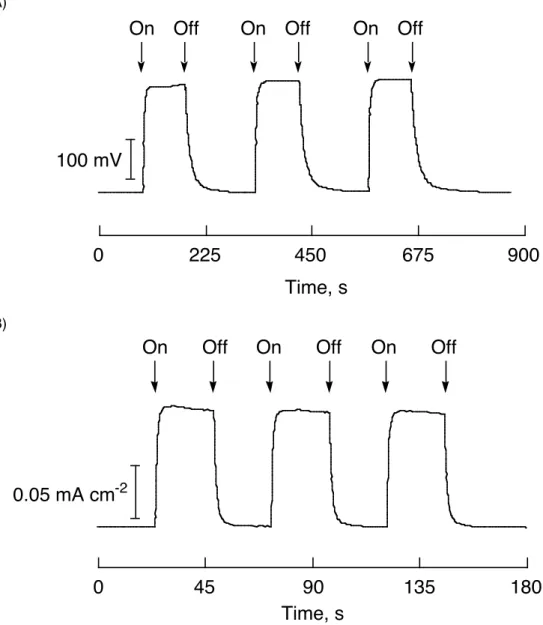
) as redox electrolyte and Pt gauge counter electrode. The photovoltage and photocurrent responses recorded following the excitation of OTE/SnO2/(H-H2P-COO-TiO2+C60)n
electrode the visible light region (l > 400 nm) are shown in Figure 4A and B, respectively. The photocurrent response is prompt, steady and reproducible during repeated on/off cycles of the visible light illumination. The short circuit photocurrent density (Isc) is 0.095
mA/cm2
, and open circuit voltage (Voc) is 240 mV were reproducibly obtained during these
measurements. Blank experiments conducted with OTE/SnO2 (i.e.,by excluding composite
clusters (H-H2P-COO-TiO2+C60)n) produced no detectable photocurrent under the similar
experimental conditions. These experiments confirmed the important role of (H-H2 P-COO-TiO2+C60)n assembly towards harvesting light energy and generating photocurrent
during the operation of a photoelectrochemical cell.
Figure 4
The charge separation in the OTE/SnO2/(H-H2P-COO-TiO2+C60)n electrode can be
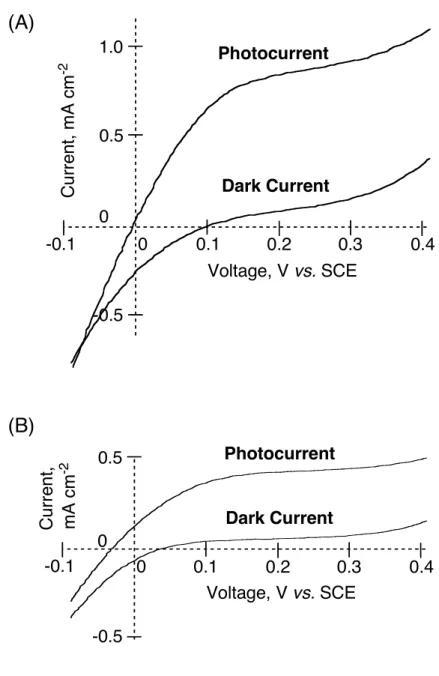
further modulated by the application of an electrochemical bias potential. Figure 5 shows
I-V characteristics of the OTE/SnO2/(H-H2P-COO-TiO2+C60)n and OTE/SnO2/(H-H2 P-COO-TiO2)n electrodes under the visible light illumination. The photocurrent increases as
the applied potential is scanned towards more positive potentials. Increased charge separation and the facile transport of charge carriers under a positive bias potential are responsible for enhanced photocurrent generation. The ratio of net photocurrent generation of OTE/SnO2/(H-H2P-COO-TiO2+C60)n at +0.2 V vs. SCE to that of OTE/SnO2/(H-H2 P-COO-TiO2+C60)n at 0 V vs. SCE (Figure 5A) is much larger than the case of
OTE/SnO2/(H-H2P-COO-TiO2)n (Figure 5B). This demonstrates that C60 works as an
electron acceptor in the supramolecular complex to enhance the photocurrent generation. At potentials greater than +0.4 V vs. SCE, the direct electrochemical oxidation of iodide interferes with the photocurrent measurement.
Figure 5
A series of photocurrent action spectra were recorded in order to evaluate the photoresponse of the composite clusters towards the photocurrent generation. First, we measured the photocurrent action spectra of OTE/SnO2/(Ar-H2P-COO-TiO2)n,
OTE/SnO2/(H-H2P-COO-TiO2)n and OTE/SnO2/(H2P-4COO-TiO2)n as shown in Figure 6.
Photocurrent generation is observed under no applied bias potential using a standard two-compartment cell consisting of a working electrode and Pt wire gauze counter electrode to attain 2~6% of maximum IPCE values (spectra a in Figure 6A, 6B and 6C, respectively). We also measured the photocurrent action spectra of OTE/SnO2/(Ar-H2P-COO-TiO2)n,
OTE/SnO2/(H-H2P-COO-TiO2)n and OTE/SnO2/(H2P-4COO-TiO2)n under an applied bias
potential of 0.2 V vs. SCE using a standard three-compartment cell as a working electrode along with Pt wire gauze counter electrode and saturated calomel reference electrode (SCE) (spectra b in Figure 6A, 6B and 6C, respectively). The maximum IPCE value (~20%) is obtained for OTE/SnO2/(H2P-4COO-TiO2)n, which is much larger than those of
OTE/SnO2/(Ar-H2P-COO-TiO2)n (~3.5%) and OTE/SnO2/(H-H2P-COO-TiO2)n (~6%).
This demonstrates that the difference in the IPCE values results from different electron injection properties from the excited state of porphyrins to the conduction band of TiO2
semiconductor nanocrystallites. From the structural point of view between porphyrin moieties and TiO2 nanoparticles, porphyrin moieties definitely lie on the TiO2 surface
because of four-point connection in the case of H2P-4COO-TiO2, whereas porphyrin moieties may stand on the TiO2 surface in the cases of OTE/SnO2/(Ar-H2P-COO-TiO2)n
and OTE/SnO2/(H-H2P-COO-TiO2)n as shown in Figure 1. The close distance between
porphyrins and TiO2 surface in H2P-4COO-TiO2 relative to that of Ar-H2P-COO-TiO2 or H-H2P-COO-TiO2 may result in an efficient electron transfer from the excited state of the porphyrin moiety of H2P-4COO-TiO2 to the conduction band of TiO2 semiconductor
nanocrystallites.
Figure 6
We have also measured the photocurrent action spectra of OTE/SnO2/(Ar-H2 P-COO-TiO2+C60)n, OTE/SnO2/(H-H2P-COO-TiO2+C60)n and OTE/SnO2/(H2P-4COO-TiO2+C60)n
in order to evaluate the effect of C60 on the IPCE values as shown in Figure 7. IPCE values
of these composite cluster systems under an applied bias potential of 0.2 V vs. SCE become larger than those under no applied potential, as observed for porphyrin-modified TiO2
nanoparticle films without C60 (Figure 6). The IPCE values of composite clusterelectrodes
(Figure 7A, B and C) also become larger than those of the individual systems [OTE/SnO2/(C60)n (Figure 7D) or OTE/SnO2/(porphyrin-modified TiO2 nanoparticle)n
(Figure 6)]. In particular, the maximum IPCE value of OTE/SnO2/(H-H2 P-COO-TiO2+C60)n under the bias of 0.2 V vs. SCE (~42%) is much larger than the sum of two
individual IPCE values (spectrum c in Figure 7B: ~12%) of OTE/SnO2/(H-H2 P-COO-TiO2)n (spectrum b in figure 6B) and OTE/SnO2/(C60)n (spectrum b in Figure 7D) with the
same concentrations of H2P and C60. This indicates that the interaction between H2P and C60 contributes significantly to an increase in the IPCE value.
Figure 7
We have further compared the action spectrum of OTE/SnO2/(H-H2 P-COO-TiO2+C60)n with those of OTE/SnO2/(Ar-H2P-COO-TiO2+C60)n and OTE/SnO2/(H2 P-4COO-TiO2+C60)n. It should be noted that the molecular packing densities of porphyrins
on TiO2 nanoparticles are approximately the same in OTE/SnO2/(H-H2P-COO-TiO2+C60)n,
OTE/SnO2/(Ar-H2P-COO-TiO2+C60)n and OTE/SnO2/(H2P-4COO-TiO2+C60)n (vide
supra). In the case of comparison between OTE/SnO2/(H-H2P-COO-TiO2+C60)n and
OTE/SnO2/(Ar-H2P-COO-TiO2+C60)n under the bias of 0.2 V vs. SCE, the IPCE value of
OTE/SnO2/(H-H2P-COO-TiO2+C60)n (spectrum b in Figure 7B)is much larger than that of
OTE/SnO2/(Ar-H2P-COO-TiO2+C60)n (spectrum b in Figure 7A). The absence of 3,5-di-tert-butylphenyl substituent at the 15-meso position of porphyrin ring in H-H2P-COO-TiO2 may enhance the interaction with C60, which can be inserted between two porphyrin rings of
the porphyrin assembly on TiO2 nanoparticles (Scheme 2), as compared with Ar-H2 P-COO-TiO2 in which the meso positions are fully substituted. The stronger interaction between the less bulky porphyrins and C60 leads to an increase in the IPCE value. Such a
sandwiched structure of C60 inserted between two porphyrin rings in Scheme 2 may be
impossible in the case of OTE/SnO2/(H2P-4COO-TiO2+C60)n because of the four-point
connection of the porphyrin ring onto the TiO2 surface. This may be the reason why the
SCE (spectrum b in Figure 7C) are smaller than those of OTE/SnO2/(H-H2P-COO-TiO2)n
(spectrum b in Figure 7B).34
Based on these results, we can conclude that three dimensional steric control between donor and acceptor moieties is a key factor for construction of efficient organic solar devices.
COO COO
TiO
2
Ar Ar Ar R R Ar: 3,5-di-tert-butylphenylR: 3,5-di-tert-butylphenyl (Ar-H2P-COO-TiO2) or H (H-H2P-COO-TiO2)
Scheme 2. Illustration of supramolecular assembly between porphyrins and C60 in
Power conversion efficiency. The power conversion efficiency (h) of the photoelectrochemical cell was determined by varying the load resistance with use of eqn. (2),25a
h = ff x Isc x Voc/Win (2)
where the fill factor (ff) is defined as ff = Pmax /(Voc ¥Isc); Pmax is the maximum power output
of the cell, Voc is the open circuit photovoltage, Isc is the short circuit photocurrent. A
decrease in the photovoltage accompanied by an increase in the photocurrent is observed with decreasing the load resistance as shown in Figure 8. The detailed characteristics of the
Figure 8
OTE/SnO2/(H-H2P-COO-TiO2)n, OTE/SnO2/(H-H2P-COO-TiO2+C60)n and
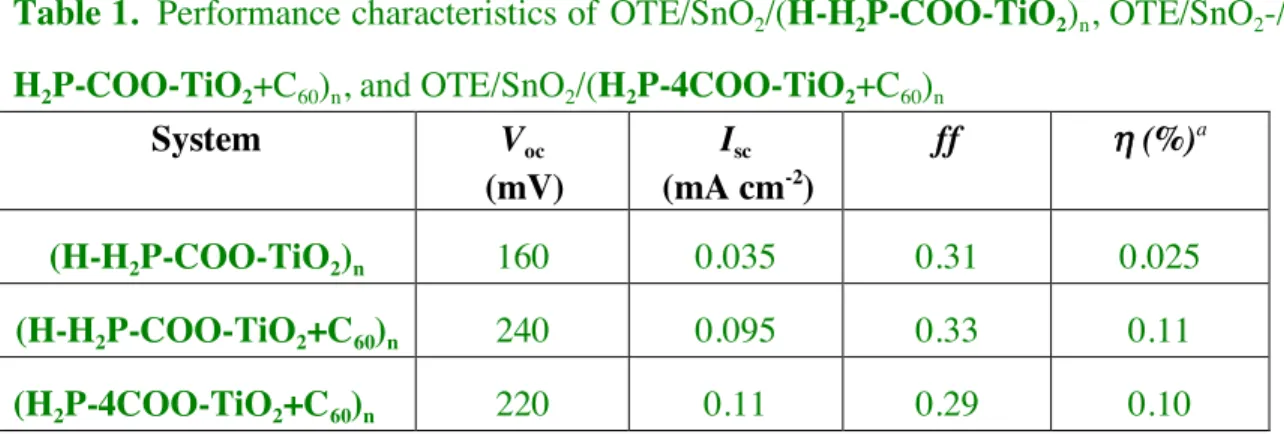
OTE/-SnO2/(H2P-4COO-TiO2+C60)n electrodes are summarized in Table 1. The Isc and Voc values
of OTE/SnO2/(H-H2P-COO-TiO2+C60)n are much larger than those of OTE/SnO2/(H-H2 P-COO-TiO2)n, leading to more than 4 times improvement of the h value (0.11%) as
compared with that of OTE/SnO2/(H-H2P-COO-TiO2)n (0.025%). Furthermore, the h
value of highly organized OTE/SnO2/(H-H2P-COO-TiO2+C60)n using TiO2 nanoparticles is
about 3 times larger than that of non-organized composite cluster system of porphyrin and fullerene without TiO2 nanoparticles, which was reported previously (~0.03%).
25a,26a,b
The h value of OTE/SnO2/(H2P-4COO-TiO2+C60)n (0.10%) is about the same as that of
OTE/SnO2/(H-H2P-COO-TiO2+C60)n (0.11%).
Photocurrent generation mechanism. The photocurrent generation mechanism in composite cluster systems of porphyrin and fullerene has previously been reported to be initiated by ultrafast electron transfer from the singlet excited state of porphyrin to C60 in
the femtosecond time domain.25,26
In the case of the reference systems without C60
[OTE/SnO2/(Ar-H2P-COO-TiO2)n, OTE/SnO2/(H-H2P-COO-TiO2)n, and OTE/SnO2
/-(H2P-4COO-TiO2)n], the photoexcitation of H2P moiety results in electron injection from the singlet excited state of the dye into the conduction band and/or trap states of TiO2
nanoparticles to produce the porphyrin radical cation (H2P •+
). The electrons collected on TiO2 nanoparticles are furthermore injected into SnO2 nanocrystallites (ECB = 0 V vs.
NHE)25a
to produce the photocurrent in the circuit. The resulting porphyrin radical cation (H2P
•+
) produced in the photoinduced electron injection to the conduction band of TiO2 is
reduced by electrolyte (I3
-/I-
= 0.5 V vs. NHE) in the multilayer film.25
At the counter electrode, the electron reduces the oxidized electrolyte (I3
-), leading to the photocurrent generation.
In the cases of OTE/SnO2/(H-H2P-COO-TiO2+C60)n, OTE/SnO2/(H-H2 P-COO-TiO2+C60)n and OTE/-SnO2/(H2P-4COO-TiO2+C60)n, not only TiO2 nanoparticles, but also
C60 molecules (C60/C60 •–
= -0.2 V vs. NHE)25a
act as an electron acceptor, leading to the enhancement of the photocurrent generation efficiency in composite cluster systems (porphyrin-modified TiO2 nanoparticle and C60) as compared with the systems without C60.
The major pathway contributing to the enhanced photocurrent generation is the intermolecular charge transfer between excited H2P and C60 within the supramolecular
complex to produce H2P •+
and C60 •–
. Photoinduced electron transfer from the porphyrin singlet excited state (1
H2P *
) to C60 is thermodynamically feasible as evident from the
oxidation potential of 1 H2P * (1 H2P * /H2P •+ = -0.7 V vs. NHE),25
which is more negative than the reduction potential of C60 (C60/ C60
•–
= -0.2 V vs. NHE).25a
transfer from the excited porphyrins to C60 has been well established by earlier studies. 16,26
C60 •–
is also generated from the interaction between excited C60 (C60 *
) and iodide ions present in the electrolyte. Collectively, these C60
•–
species accumulated in clusters transfer electrons to SnO2 nanocrystallites (ECB = 0 V vs. NHE),
25,31
to produce the current in the circuit. The regeneration of H2P (H2P/H2P
•+ = 1.2 V vs. NHE)25 is achieved by the triiodide/iodide couple (I3 – /I– = 0.5 V vs. NHE)25
present in the electrolyte system. The improvement of IPCE values under an applied bias potential of 0.2 V vs. SCE relative to the corresponding systems under no applied potential results from an increase of driving force of electron transfer from C60
•–
to SnO2 nanocrystallites using a standard
three-compartment cell.
Conclusion
We have successfully constructed supramolecular photovoltaic cells composed of molecular nanocluster assemblies of porphyrin and fullerene, which are well organized with TiO2 nanoparticles. The IPCE values of the composite cluster systems of porphyrins and
C60 with TiO2 nanoparticles [OTE/SnO2/(H-H2P-COO-TiO2+C60)n, OTE/SnO2/(H-H2 P-COO-TiO2+C60)n and OTE/-SnO2/(H2P-4COO-TiO2+C60)n] are improved as compared
with the reference systems [OTE/SnO2/(H-H2P-COO-TiO2)n, OTE/SnO2/(H-H2 P-COO-TiO2)n and OTE/-SnO2/(H2P-4COO-TiO2)n]. The largest h value is achieved in
OTE/SnO2/(H-H2P-COO-TiO2)n (0.11%) composed of the porphyrin-modified TiO2
nanoparticles and C60 clusters.
Acknowledgment
This work was partially supported by a Grant–in–Aid (No. 16205020) and by a COE program of Osaka University (Integrated Ecochemistry) from the Ministry of Education,
Culture, Sports, Science, and Technology, Japan. PVK acknowledges the support from the Office of Basic Energy Science of the U. S. Department of the Energy. TH acknowledges the support of Japan Society for the Promotion of Science Research Fellowship for Young Scientist. This is contribution No. NDRL 4605 from the Notre Dame Radiation Laboratory and from Osaka University. We are grateful to Dr. Yuji Wada, Osaka University, for helping preparation of TiO2 nanoparticles modified with dyes.
References and Notes
1. (a) O'Regan, B.; Grätzel, M. Nature 1991, 353, 737. (b) Bach, U.; Lupo, D.; Comte, P.; Moser, J. E.; Weissörtel, F.; Salbeck, J.; Spreitzer, H.; Grätzel, M. Nature 1998, 395, 583. (c) Hagfeldt, A.; Grätzel, M. Chem. Rev. 1995, 95, 49. (d) Hagfeldt, A.; Grätzel, M. Acc. Chem. Res. 2000, 33, 269.
2. (a) Velusamy, M.; Justin Thomas, K. R.; Lin, J. T.; Hsu, Y.-C.; Ho, K.-C. Org. Lett. 2005, 7, 1899. (b) Padinger, F.; Rittberger, R. S.; Sariciftci, N. S. Adv. Funct. Mater. 2003, 13, 85. (c) Schmidt-Mende, L.; Fechtenkötter, A.; Müllen, K.; Moons, E.; Friend, R. H.; MacKenzie, J. D. Science 2001, 293, 1119.
3. (a) Huynh, W. U.; Dittmer, J. J.; Alivisatos, A. P. Science 2002, 295, 2425. (b) Liu, J.; Tanaka, T.; Sivula, K.; Alivisatos, A. P.; Frechet, J. M. J. J. Am. Chem. Soc. 2004, 126, 6550. (c) Zhang, D.; Yoshida, T.; Minoura, H. Chem. Lett. 2002, 31, 874. (d) Zhang, D.; Yoshida, T.; Minoura, H. Adv. Mater. 2003, 15, 814.
4. (a) Bignozzi, C. A.; Argazzi, R.; Kleverlaan, C. J. Chem. Soc. Rev. 2000, 29, 87. (b) Liu, J.; Kadnikova, E. N.; Liu, Y.; McGehee, M. D.; Frechet, J. M. J. J. Am. Chem. Soc. 2004, 126, 9486. (c) Smith, Adam P.; Smith, Rachel R.; Taylor, Barney E.; Durstock, Michael F. Chem. Mater. 2004, 16, 4687.
5. (a) Yang, Fan; Shtein, Max; Forrest, Stephen R. Nature Mater. 4, 37. (b) Halls, J. J. M.; Walsh, C. A.; Greenham, N. C.; Marseglia, E. A.; Friend, R. H.; Moratti, S. C.; Holmes, A. B. Nature 1995, 376, 498.
6. (a) Wienk, M. M.; Kroon, J. M.; Verhees, W. J. H.; Knol, J.; Hummelen, J. C.; van Hal, P. A.; Janssen, R. A. J. Angew. Chem., Ind. Ed. 2003, 42, 3371. (b) Peumans, P.; Uchida, S.; Forrest, S. R. Nature 2003, 425, 158. (c) Eckert, J.-F.; Nicoud, J.-F.; Nierengarten, J.-F.; Liu, S.-G.; Echegoyen, L.; Barigelletti, F.; Armaroli, N.; Ouali, L.; Krasnikov, V.; Hadziioannou, G. J. Am. Chem. Soc. 2000, 122, 7467.
7. (a) Barber, J. Nature 1988, 333, 114. (b) The Photosynthetic Reaction Center; Deisenhofer, J., Norris, J. R., Eds.; Academic Press: San Diego, 1993. (c) Anoxygenic
Photosynthetic Bacteria; Blankenship, R. E.; Madigan, M. T.; Bauer, C. E., Eds.;
Kluwer Academic Publishing: Dordrecht, 1995.
8. (a) Gust, D.; Moore, T. A.; Moore, A. L. Acc. Chem. Res. 1993, 26, 198. (b) Gust, D.; Moore, T. A.; Moore, A. L. Acc. Chem. Res. 2001, 34, 40. (c) Gust, D.; Moore, T. A. In
The Porphyrin Handbook; Kadish, K. M., Smith, K. M., Guilard, R., Eds.; Academic
Press: San Diego, CA, 2000; Vol. 8, pp 153-190.
9. (a) Wagner, R. W.; Lindsey, J. S. Pure Appl. Chem. 1996, 68, 1373. (b) Sazanovich, I. V.; Kirmaier, C.; Hindin, E.; Bocian, D. F.; Linsey, J. S.; Holten, D. J. Am. Chem. Soc. 2004, 126, 2664. (c) Photoinduced Electron Transfer; Fox, M. A., Channon, M., Eds.; Elsevier: Amsterdam, 1988.
10. (a) Bar-Haim, A.; Klafter, J.; Kopelman, R. J. Am. Chem. Soc. 1997, 119, 6197. (b) Sadamoto, R.; Tomioka, N.; Aida, T. J. Am. Chem. Soc. 1996, 118, 3978. (c) Jiang, D.-L.; Aida, T. J. Am. Chem. Soc. 1998, 120, 10895. (d) Choi, M.-S.; Aida, T.; Yamazaki, T.; Yamazaki, I. Chem. Eur. J. 2002, 8, 2668. (e) Capitosti, G. J.; Guerrero, C. D.; Binkley, D. E., Jr.; Rajesh, C. S.; Modarelli, D. A. J. Org. Chem. 2003, 68, 247. (f)
Harth, E. M.; Hecht, S.; Helms, B.; Malmstrom, E. E.; Frechet, J. M. J.; Hawker, C. J. J.
Am. Chem. Soc. 2002, 124, 3926.
11. (a) McDermott, G.; Prince, S. M.; Freer, A. A.; Hawthornthwaite-Lawless, A. M.; Papiz, M. Z.; Cogdell, R. J.; Isaacs, N. W. Nature 1995, 374, 517. (b) Koepke, J.; Hu, X.; Muenke, C.; Schulten, K.; Michel, H. Structure 1996, 4, 581. (c) Pullerits, T.; Sundstrom, V. Acc. Chem. Res. 1996, 29, 381.
12. (a) Fukuzumi, S. In The Porphyrin Handbook, ed. Kadish, K. M., Smith, K. M., Guilard, R.; Academic Press: San Diego, 2000; Vol. 8, pp 115-152. (b) Fukuzumi, S.; Endo, Y.; Imahori, H. J. Am. Chem. Soc. 2002, 124, 10974.
13. Kroto, H. W.; Heath, J. R.; O’Brien, S. C.; Curl, R. F.; Smalley, R. E. Nature 1985, 318, 162.
14. (a) Haddon, R.C. Acc. Chem. Res. 1988, 21, 243. (b) Haddon, R.C. Science 1993, 261, 1545.
15. Echegoyen, L.; Echegoyen, L.E. Acc. Chem. Res. 1998, 31, 593.
16. (a) Fukuzumi, S.; Guldi, D. M. In Electron Transfer in Chemistry; Balzani, V. Ed.; Wiley-VCH: Weinheim, 2001; Vol. 2, pp 270-337. (b) Fukuzumi, S.; Imahori, H. In
Electron Transfer in Chemistry; Balzani, V. Ed.; Wiley-VCH: Weinheim, 2001; Vol. 2,
pp 927-975.
17. (a) Ishii, T.; Aizawa, N.; Yamashita, M.; Matsuzaka, H.; Kodama, T.; Kikuchi, K.; Ikemoto, I.; Iwasa, Y. J. Chem. Soc., Dalton Trans. 2000, 4407. (b) Diederich, F.; Gömez-Löpez, M. Chem. Soc. Rev. 1999, 28, 263.
18. (a) Boyd, P. D. W.; Reed, C. A. Acc. Chem. Res. 2005, 38, 235. (b) Boyd, P. D. W.; Hodgson, M. C.; Rickard, C. E. F.; Oliver, A. G.; Chaker, L.; Brothers, P. J.; Bolskar, R. D.; Tham, F. S.; Reed, C. A. J. Am. Chem. Soc. 1999, 121, 10487. (c) Sun, D.; Tham, F. S.; Reed, C. A.; Chaker, L.; Burgess, M.; Boyd, P. D. W. J. Am. Chem. Soc. 2000, 122,
10704. (d) Sun, D.; Tham, F. S.; Reed, C. A.; Chaker, L.; Boyd, P. D. W. J. Am. Chem.
Soc. 2002, 124, 6604.
19. (a) Olmstead, M. M.; Costa, D. A.; Maitra, K.; Noll, B. C.; Phillips, S. L.; Van Calcar, P. M.; Balch, A. L. J. Am. Chem. Soc. 1999, 121, 7090. (b) Olmstead, M. M.; de Bettencourt-Dias, A.; Duchamp, J. C.; Stevenson, S.; Marciu, D.; Dorn, H. C.; Balch, A. L. Angew. Chem., Int. Ed. 2001, 40, 1223.
20. (a) Zheng, J.-Y.; Tashiro, K.; Hirabayashi, Y.; Kinbara, K.; Saigo, K.; Aida, T.; Sakamoto, S.; Yamaguchi, K. Angew. Chem., Int. Ed. 2001, 40, 1857. (b) Eichhorn, D. M.; Yang, S.; Jarrell, W.; Baumann, T. F.; Beall, L. S.; White, A. J. P.; Williams, D. J.; Barrett, A. G. M.; Hoffman, B. M. J. Chem. Soc., Chem. Commun. 1995, 1703.
21. Wang, Y.-B.; Lin, Z. J. Am. Chem. Soc. 2003, 125, 6072.
22. (a) Caldwell, W. B.; Chen, K.; Mirkin, C. A.; Babinec, S. J. Langmuir 1993, 9, 1945. (b) Shon, Y.-S.; Kelly, K. F.; Halas, N. J.; Lee, T. R. Langmuir 1999, 15, 5329. (c) Hirayama, D.; Takimiya, K.; Aso, Y.; Otsubo, T.; Hasobe, T.; Yamada, H.; Imahori, H.; Fukuzumi, S.; Sakata, Y. J. Am. Chem. Soc. 2002, 124, 532.
23. (a) Lahav, M.; Gabriel, T.; Shipway, A. N.; Willner, I. J. Am. Chem. Soc. 1999, 121, 258. (b) Hutchison, J. E.; Postlethwaite, T. A.; Chen, C.-h.; Hathcock, K. W.; Ingram, R. S.; Ou, W.; Linton, R. W.; Murray, R. W.; Tyvoll, T. A.; Chng, L. L.; Collman, J. P.
Langmuir 1997, 13, 2143. (c) Gryko, D. T.; Zhao, F.; Yasseri, A. A.; Roth, K. M.;
Bocian, D. F.; Kuhr, W. G.; Lindsey, J. S. J. Org. Chem. 2000, 65, 7356.
24. (a) Imahori, H.; Norieda, H.; Yamada, H.; Nishimura, Y.; Yamazaki, I.; Sakata, Y.; Fukuzumi, S. J. Am. Chem. Soc. 2001, 123, 100. (b) Imahori, H.; Hasobe, T.; Yamada, H.; Nishimura, Y.; Yamazaki, I.; Fukuzumi, S. Langmuir 2001, 17, 4925. (c) Hasobe, T.; Imahori, H.; Ohkubo, K.; Yamada, H.; Sato, T.; Nishimura, Y.; Yamazaki, I.; Fukuzumi, S. J. Porphyrins Phthalocyanines 2003, 7, 296.
25. (a) Hasobe, T.; Imahori, H.; Fukuzumi, S.; Kamat, P. V. J. Phys. Chem. B 2003, 107, 12105. (b) Hasobe, T.; Imahori, H.; Fukuzumi, S.; Kamat, P. V. J. Mater. Chem. 2003,
13, 2515.
26. (a) Hasobe, T.; Imahori, H.; Kamat, P. V.; Fukuzumi, S. J. Am. Chem. Soc. 2003, 125, 14962. (b) Hasobe, T.; Kashiwagi, Y.; Absalom, M. A.; Sly, J.; Hosomizu, K.; Crossley, M. J.; Imahori, H.; Kamat, P. V.; Fukuzumi, S. Adv. Mater. 2004, 16, 975. (c) Hasobe, T.; Kamat, P. V.; Troiani, V.; Solladie, N.; Ahn, T. K.; Kim, S. K.; Kim, D.; Kongkanand, A.; Kuwabata, S.; Fukuzumi, S. J. Phys. Chem. B. 2005, 109, 19. (d) Hasobe, T.; Imahori, H.; Kamat, P. V.; Ahn, T. K.; Kim, S. K.; Kim, D.; Fujimoto, A.; Hirakawa, T.; Fukuzumi, S. J. Am. Chem. Soc. 2005, 127, 1216.
27. (a) Matsumoto, Y.; Noguchi, M.; Matsunaga, T.; Kamada, K.; Koinuma, M.; Yamada, S. Electrochemistry 2001, 69, 314. (b) Miyasaka, T.; Kijitori, Y.; Murakami, T. N.; Kimura, M.; Uegusa, S. Chem. Lett. 2002, 31, 1250. (c) Xu, D.; Xu, Y.; Chen, D.; Guo, G.; Gui, L.; Tang, Y. Adv. Mater. 2000, 12, 520.
28. Hasobe, H.; Hattori, S.; Kamat, P. V.; Wada, Y.; Fukuzumi, S. J. Mater. Chem. 2005, 15, 372 .
29. Hasobe, T.; Imahori, H.; Yamada, H.; Sato, T.; Ohkubo, K.; Fukuzumi, S. Nano Lett. 2003, 3, 409.
30. Yamada, H.; Imahori, H.; Nishimura, Y.; Yamazaki, I.; Ahn, T. K.; Kim, S. K.; Kim, D.; Fukuzumi, S. J. Am. Chem. Soc. 2003, 125, 9129.
31. (a) Kamat, P. V.; Barazzouk, S.; Thomas, K. G.; Hotchandani, S. J. Phys. Chem. B 2000, 104, 4014. (b) Barazzouk, S.; Hotchandani, S.; Kamat, P. V. Adv. Mater. 2001,
13, 1614.
33. Tkachenko, N. V.; Lemmetyinen, H.; Sonoda, J.; Ohkubo, K.; Sato, T.; Imahori, H.; Fukuzumi, S. J. Phys. Chem. A. 2003, 107, 8834.
34. The IPCE values in Figure 7C are particularly smaller than those in Figure 7B in the longer wavelength region because of the more unfavorable interaction between H2 P-4COO-TiO2 and C60 as compared with that between H-H2P-COO-TiO2 and C60.
Table 1. Performance characteristics of OTE/SnO2/(H-H2P-COO-TiO2)n,
OTE/SnO2-/(H-H2P-COO-TiO2+C60)n, and OTE/SnO2/(H2P-4COO-TiO2+C60)n
System Voc (mV) Isc (mA cm-2 ) ff h (%)a (H-H2P-COO-TiO2)n 160 0.035 0.31 0.025 (H-H2P-COO-TiO2+C60)n 240 0.095 0.33 0.11 (H2P-4COO-TiO2+C60)n 220 0.11 0.29 0.10 a Electrolyte: 0.5 mol dm-3
NaI and 0.01 mol dm-3
in acetonitrile; white light illumination (l > 400 nm); input power; 6.8 mW cm-2
Figure Captions
Figure 1. TiO2 nanoparticles modified with porphyrin dyes and the reference compounds
employed in this study.
Figure 2. (A) Absorption spectra of (a) OTE/SnO2/(H2P-4COO-TiO2+C60)n ([H2P] = 0.025 mmol dm-3
, [C60] = 0.13 mmol dm -3
), (b) OTE/SnO2/(H2P-4COO-TiO2)n ([H2P] = 0.025 mmol dm-3
), (c) H2P-4COOH in toluene/tert-butanol (v/v, 1/1) (10 mmol dm
-3
) and (d) C60 in toluene (15 mmol dm
-3
).
Figure 3. SEM (scanning electron micrograph) image of OTE/SnO2/(H-H2 P-COO-TiO2+C60)n ([H2P] = 0.025 mmol dm
-3
, [C60] = 0.13 mmol dm -3
).
Figure 4. (A) Photovoltage and (B) photocurrent generation at OTE/SnO2/(H-H2 P-COO-TiO2+C60)n ([H2P] = 0.025 mmol dm
-3
, [C60] = 0.13 mmol dm -3
) under illumination of white light (l > 400 nm); electrolyte: 0.5 mol dm-3
NaI and 0.01 mol dm-3
I2 in acetonitrile; input
power: 6.8 mW cm-2
.
Figure 5. I-V characteristics of (A) OTE/SnO2/(H-H2P-COO-TiO2+C60)n ([H2P] = 0.025 mmol dm-3
, [C60] = 0.13 mmol dm -3
) and (B) OTE/SnO2/(H-H2P-COO-TiO2)n ([H2P] = 0.025 mmol dm-3
) under illumination of white light (l > 400 nm); electrolyte: 0.5 mol dm-3
and NaI and 0.01 mol dm-3
and I2 in acetonitrile; input power: 27.8 mW cm -2
.
Figure 6. (A) Photocurrent action spectra of OTE/SnO2/(Ar-H2P-COO-TiO2)n ([H2P] = 0.025 mmol dm-3
) (a) with no applied bias potential and (b) at an applied bias potential of 0.2 V vs. SCE. (B) Photocurrent action spectra of OTE/SnO2/(H-H2P-COO-TiO2)n ([H2P] = 0.025 mmol dm-3
) (a) with no applied bias potential and (b) at an applied bias potential of 0.2 V vs. SCE. (C) Photocurrent action spectra of OTE/SnO2/(H2P-4COO-TiO2)n ([H2P] = 0.025 mmol dm-3
) (a) with no applied bias potential and (b) at an applied bias potential of 0.2 V vs. SCE. electrolyte: 0.5 mol dm-3
NaI and 0.01 mol dm-3
Figure 7. (A) Photocurrent action spectra of OTE/SnO2/(Ar-H2P-COO-TiO2+C60)n ([H2P] = 0.025 mmol dm-3
, [C60] = 0.13 mmol dm -3
) (a) with no applied bias potential and (b) at an applied bias potential of 0.2 V vs. SCE. (B) Photocurrent action spectra of OTE/SnO2
/(H-H2P-COO-TiO2+C60)n ([H2P] = 0.025 mmol dm
-3
, [C60] = 0.13 mmol dm -3
) (a) with no applied bias potential and (b) at an applied bias potential of 0.2 V vs. SCE. (c) Sum of two individual IPCE values of OTE/SnO2/(H-H2P-COO-TiO2)n (spectrum b in Figure 6B) and
OTE/SnO2/(C60)n (spectrum b in Figure 7D) at an applied bias potential of 0.2 V vs. SCE.
(C) Photocurrent action spectra of OTE/SnO2/(H2P-4COO-TiO2+C60)n ([H2P] = 0.025 mmol dm-3
, [C60] = 0.13 mmol dm -3
) (a) with no applied bias potential and (b) at an applied bias potential of 0.2 V vs. SCE. (D) Photocurrent action spectra of OTE/SnO2/(C60)n ( [C60]
= 0.13 mmol dm-3
) (a) with no applied bias potential and (b) at an applied bias potential of 0.2 V vs. SCE. electrolyte: 0.5 mol dm-3
NaI and 0.01 mol dm-3
I2 in acetonitrile.
Figure 8. Power characteristics of (a) OTE/SnO2/(H-H2P-COO-TiO2+C60)n ([H2P] = 0.025 mmol dm-3
, [C60] = 0.13 mmol dm -3
) and (b) OTE/SnO2/(H-H2P-COO-TiO2)n ([H2P] = 0.025 mmol dm-3
) under white light illumination (l > 400 nm); electrolyte: 0.5 mol dm-3
NaI and 0.01 mol dm-3
I2 in acetonitrile; input power: 6.8 mW cm -2
Figure 1 Ar-H2P-COOH NH N N HN COO H-H2P-COO-TiO2 NH N N HN H COO H-H2P-COOH NH N N HN NH N N HN COOH NH N N HN NH N N HN H COOH HN N N NH COOH COOH HOOC COOH H2P-4COOH H2P-4COO-TiO2 TiO2 COO N HN NH N COO COOCOO TiO2 NH N N HN COO NH N N HN COO TiO2 Ar-H2P-COO-TiO2
Figure 2 400 500 600 700 800 0 1 2 3 Wavelength, nm Absorbance a b c d
Figure 3
100 nm
Figure 4 0 45 90 135 180 0 225 450 675 900 Time, s Time, s (A) (B) 0.05 mA cm-2 100 mV
On Off On Off On Off
Figure 5
(A)
(B)
Photocurrent Dark Current 0.1 0.2 0.3 0.4 0 -0.1 0 0.5 1.0 C u rr e n t, m A c m -2 Voltage, V vs. SCE -0.5 0.1 0.2 0.3 0.4 0 -0.1 0 0.5 C u rr e n t, m A c m -2 Voltage, V vs. SCE -0.5 Photocurrent Dark CurrentFigure 6 400 500 600 700 0 2 4 6 8 IPCE, % Wavelength, nm 400 500 600 700 0 1 2 3 4 IPCE, % Wavelength, nm 400 500 600 700 0 5 10 15 25 IPCE, % Wavelength, nm 20 a b a b a b (A) (B) (C)
Figure 7 400 500 600 700 0 5 10 15 IPCE, % Wavelength, nm a b 400 500 600 700 0 10 20 30 40 IPCE, % Wavelength, nm a b 400 500 600 700 0 10 20 40 50 IPCE, % Wavelength, nm a b 30 500 600 700 0 2 4 6 8 IPCE, % Wavelength, nm a b 400 (A) (B) (C) (D) c
Figure 8 0 0.04 0.08 0.12 0 100 200 300 P h o to vo lta g e , m V Photocurrent, mA cm-2 a b