Doctoral Thesis
STUDY ON ORGANIC PIGMENTS
PREPARATION OF NOVEL AZO PIGMENTS AND CLARIFICATION
OF THE EMITTING STATE OF A UNIQUE FLUORESCENT PIGMENT
September 2015
OTANI Junji
Doctoral Thesis reviewed
by Ritsumeikan Universit
y
STUDY ON ORGANIC PIGMENTS
PREPARATION OF NOVEL AZO PIGMENTS AND CLARIFICATION
OF THE EMITTING STATE OF A UNIQUE FLUORESCENT PIGMENT
有機顔料の研究
新規アゾ顔料の合成ならびに興味深い蛍光顔料の発光状態の解明
September 2015
2015 年 9 月
OTANI Junji
大 谷 淳 司Principal Referee: Professor KIKUCHI Takeshi
主 査 : 菊 地 武 司 教 授
Holistic Abstract
The author of the present thesis has been engaged in fundamental research and development of organic pigments at several companies as a researcher. Of a variety of the subjects he studied, it was felt that some of the results were worth integrating as a scientific thesis. This thesis consists of the following contents: Syntheses and properties of four novel azo pigments, and study on the emitting state of a scientifically interesting compound.
Azo pigments have been widely used in our life as the colorants which have low to moderate durability. Firstly, the author has attempted drastic modification of chemical structures of azo pigments to explore potential of azo pigments. The two pigments out of the above four have an additional substituent in contrast to the conventional azo pigments used for the comparable counterparts on the chemical structures. The pigments synthesized exhibited red hues resembling those of the counterparts, and durability (photo- and heat-stability) of them was improved. The optical absorption spectra of the pigments in solution showed a hyperchromic effect but no bathochromic shift. Involvement of the substituent in the optical properties was studied using molecular orbital (MO) calculation with geometry optimization for a hydrazone tautomer, where the azo moiety of azo pigments, in general, has tautomerism between azo (-N=N-) and hydrazone (-NH-N=) linkages. It was concluded that the substituent hardly joined in the π-conjugation systems and was involved in the electron transitions. The other two pigments were obtained from newly designed starting compounds aiming at black hue in the category of azo pigments through extension of the π-conjugation systems. The crystal structures of the pigments were successfully solved from powder X-ray diffraction data combined with DFT calculations. The pigment molecules comprise hydrazone configurations, and are highly planar in the crystal structures, suggesting that the molecules have the broad π-conjugation systems as expected. The transition dipoles of the pigments were arranged with oblique fashion, probably inducing Davydov Splitting, which is advantageous for black hue as well as the extended π-conjugation systems. The present syntheses for the novel azo pigments suggest creation of new subclasses in the category of azo pigment.
Organic fluorescent pigments are important materials for colorants together with azo ones. Solid state is, in general, inconvenient for fluorescent emission because the cohesive forces usually provide non-fluorescent deactivation processes, and thus
solid-state-fluorescent materials are scientifically of great interest. The author opted for a solid-state-fluorescent compound and studied its emitting state because the compound is unique in its excellent and practical photostability. Fluorescent behavior of the compound in some organic solvents of various polarities was studied using MO calculation, steady state and time-resolved spectroscopy. The fluorescence spectra of the compound were broad and structureless associating with an excimer emission, but the emission was ascribable to the deactivation from the LUMO of an isolated molecule to the HOMO, i.e. not an excimer emission. The LUMO has a non-zero dipole moment formed through intramolecular charge transfer (ICT) while excitation from the HOMO whose dipole moment is almost zero. The solvent polarities varied largely the fluorescence quantum efficiencies and moderately the radiative rate constants, although the absorption maxima were insensitive to the solvent polarities. Discussion on these results concluded that the emitting state of the compound is influenced by a solvent-dependent non-radiative deactivation process, for which solvent-sensitive intersystem-crossing can be proposed.
In conclusion, the author prepared four novel azo pigments through drastic modification of chemical structures of azo pigments, and investigated their fundamental properties. The results indicate that azo pigment, which is a historically old category, yet has had potential for further expansion of its horizons. Regarding the category of organic fluorescent pigments, the author investigated a scientifically interesting organic solid-state-fluorescent compound in detail, and clarified its emitting state. The outcome of the present thesis will be useful information for research and development of functional colorants.
CONTNETS
Holistic Abstract
……… vChapter 1: General Introduction
1.1 Colorant: Pigments and dyes ……… 1 1.2 Applications of pigments ……… 2 1.3 Classification of pigments ……… 2 1.4 Organic pigments ……… 5 1.5 Azo pigments ……… 5 1.6 Fluorescent pigments ……… 7 1.7 Color mixing ……… 8
1.8 White and black pigments ……… 9 1.9 Scope of the thesis ……… 10
1.9.1 Purpose of the present study on organic pigments ……… 10 1.9.2 Synthesis of novel red azonaphtharylamide pigments ……… 10 1.9.3 Synthesis of novel black azo pigments ……… 11
1.9.4 Optical properties of a unique polycyclic fluorescent pigment ……… 11
Chapter 2: Synthesis and Properties of Azonaphtharylamide Pigments
Having Arylamide Groups at 2- and 7-Positions
2.1 Abstract ……… 13 2.2 Introduction ……… 13 2.3 Target materials ……… 15
2.4 Experimental ……… 15 2.4.1 Materials ……… 15 2.4.2 Instruments ……… 15
2.4.3 Synthesis of 3-hydroxy-N2,N7-diphenyl-naphthalene-2,7-dicarboxamide (2) ……… 15
2.4.4 Preparation of 2,5-dichloroaniline diazonium fluoroboric salt for 4-(2,5-dichlorophenyl)azo-3-hydroxy-N2,N7-diphenyl-naphthalene-2,7-di carboxamide (3a) and 4-(2,5-dichlorophenyl)azo-3-hydroxy-N-phenyl -naphthalene- 2-carboxamide (3b) ……… 16
2.4.5 Preparation of 2-methyl-5-nitroaniline diazonium fluoroboric salt for 4-(2-methly-5-nitrophenyl)azo-3-hydroxy-N2,N7-diphenyl-naphthalene-2, 7-dicarboxamide (4a) and 4-(2-methyl-5-nitrophenyl)azo-3-hydroxy-N- phenyl-naphthalene-2-carboxamide (4b) ……… 16 2.4.6 Synthesis of 4-(2,5-dichlorophenyl)azo-3-hydroxy-N2,N7-diphenyl- naphthalene-2,7-dicarboxamide (3a) ……… 17 2.4.7 Synthesis of 4-(2-methly-5-nitrophenyl)azo-3-hydroxy-N2,N7-diphenyl- naphthalene-2,7-dicarboxamide (4a) ……… 17 2.4.8 Synthesis of 4-(2,5-dichlorophenyl)azo-3-hydroxy-N-phenyl-naphthalene- 2-carboxamide (3b) ……… 18 2.4.9 Synthesis of 4-(2-methyl-5-nitrophenyl)azo-3-hydroxy-N-phenyl- naphthalene-2-carboxamide (4b) ……… 18 2.4.10 MO and CI calculations ……… 18 2.4.11 Evaluation of light-fastness of 3a to 4b ……… 19 2.5 Results and discussion ……… 20
2.5.1 Synthesis ……… 20
2.5.3 UV-vis absorption spectra of the pigments ……… 24
2.5.4 MO calculations for molecular geometry and electron transition ……… 24 2.5.5 Light-fastness of 3a and 4a ……… 28
2.6 Conclusion ……… 28
Chapter 3: Synthesis and Structure Determination from Powder X-ray
Diffraction Data of Black Azo (Hydrazone) Pigments
3.1 Abstract ……… 31 3.2 Introduction ……… 31 3.3 Experimental ……… 34 3.3.1 Materials ……… 34 3.3.2 Instruments ……… 34 3.3.3 Synthesis. of 1-amino-naphthalene-2-thiol ……… 34 3.3.4 Synthesis of 3-naphtho[1,2-d]thiazol-2-yl-naphthalen-2-ol ……… 35 3.3.5 Synthesis of 3,6-bis-naphtho[1,2-d]thiazol-2-yl-naphthalen-2-ol ……… 35 3.3.6 Synthesis of 1-(4-dimethylamino-phenylazo)-3-naphtho[1,2-d]thiazol-2- yl-naphthalen-2-ol (1) ……… 36 3.3.7 Synthesis of 1-(4-dimethylamino-phenylazo)-3,6-bis-naphtho[1,2-d]- thiazol-2-yl-naphthalen-2-ol (2) ……… 37
3.3.8 X-ray powder diffraction ……… 38 3.3.9 DFT calculation ……… 38
3.4 Results and discussion ……… 39
3.4.2 Structure determination from powder diffraction data ……… 39 3.5 Conclusion ……… 46
Chapter 4: Time-resolved Study of Intramolecular Charge Transfer
Fluorescence in 1,2,3,4-Tetrachloro-11H-isoindolo-[2,1-a]-benz-
imidazol-11-one
4.1 Abstract ……… 47 4.2 Introduction ……… 47 4.3 Experimental ……… 49
4.4 Results and discussion ……… 49 4.4.1 Fluorescence species ……… 49 4.4.2 Stokes’ shift ……… 52
4.4.3 Solvent-polarity dependent non-fluorescent mechanism ……… 58 4.5 Conclusion ……… 60
Chapter 5: Thesis Conclusion ……… 61
References ……… 63
Acknowledgements ……… 67
Chapter 1
General Introduction [1,2]
In this chapter, general information concerning pigments is concisely provided as preparation for the succeeding chapters. The following subjects are included: Definition of colorant, applications of pigments, classification of pigments, azo pigments, fluorescent pigments, and topics concerning hue. Finally, scope of the present thesis is summarized.
1.1 Colorant: Pigments and dyes
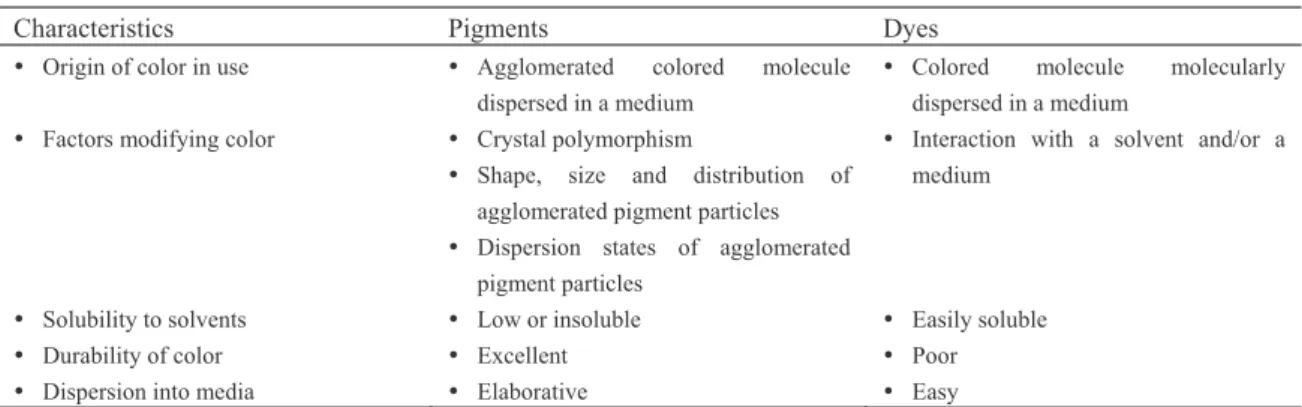
Colorant is a material that imparts color to materials. In general, colorant is largely classified into pigments and dyes. These classes of colorant are distinguished typically by solubility to solvents. Dyes are easily dissolved in solvents, water, for example. Dyes are therefore used in a molecularly dispersed condition in media, and the nature of dye molecules almost determines hue in the media. In contrast, pigments have low solubility to solvents or are almost insoluble. Pigments are used in a dispersed condition in media in which fine solid particles (agglomerates1) of the pigment molecules (aggregates2) are dispersed [1]. Optical properties originated from a single pigment molecule are modified by crystal polymorphism, if any, in the aggregate. Hue of the pigment is also altered through conditions of the agglomeration and dispersion in the media, and is therefore determined by the conditions of aggregation, agglomeration and dispersion of the pigment particles with their shape, size and distribution, rather than the nature of the isolated single molecule. A crystalline state, in general, is a condition energetically more stabilized and inert than a molecular state, and pigments are usually more durable than dyes, e.g., resistivity to light and heat better than those of dyes. Table 1 quickly compares pigments and dyes according to some characteristics including the properties described the above.
1 Agglomerate: A form of a (pigment) particle comprising jumbled single crystals or primary particles (aggregate) which consist of the single crystals of the pigment, separable by dispersion processes.
Table 1 General comparison between pigments and dyes
Characteristics Pigments Dyes
y Origin of color in use y Agglomerated colored molecule dispersed in a medium
y Colored molecule molecularly dispersed in a medium
y Factors modifying color y Crystal polymorphism
y Shape, size and distribution of agglomerated pigment particles y Dispersion states of agglomerated
pigment particles
y Interaction with a solvent and/or a medium
y Solubility to solvents y Low or insoluble y Easily soluble y Durability of color y Excellent y Poor y Dispersion into media y Elaborative y Easy
1.2 Applications of pigments
Reportedly, use of pigments by the human race dates from cave or body paintings drawn in pre-Christian Egypt, China, France or somewhere. Ever since, people have utilized pigments for the very simple purpose of giving color to personal or public belongings in order simply to enjoy life making it richer, safer, more joyful, distinguishable and less drab. In industry, applications of pigments are mostly three-fold, i.e., coloration for printing inks, coating paints, and plastics including synthetic fibers. In addition to the above principal applications, nowadays, pigments are utilized also for so-called “high-tech” applications such as photoconductors for electrophotography, color filters for liquid crystal displays, electro-luminescent diodes, ink-jet printing inks, and pigment-sensitized solar cells [3]. Pigments have been one of requisite materials in our life used for from conventional coloration to specific state-of-the-art applications.
1.3 Classification of pigments
Pigments are largely divided into inorganic and organic ones. Representative inorganic pigments derive originally from minerals, and include carbon black, titanium dioxide, iron oxides, zinc oxide, natural or synthesized oxides or salts of cadmium, cobalt, strontium, chromium, bismuth, molybdenum, vanadium etc. Organic pigments are the organic compounds which exhibit color, i.e., substances comprising atoms of carbon, oxygen, nitrogen etc. to partially or entirely constitute a chromophore. Relatively large π-conjugation system comprising these atoms can be a chromophore if the system has an optical absorption band in a visible wavelength region. Some of organic pigments contain metal ions for the purpose of insolubilization (formation of salts or metal complexes). Organic pigments are the majority in production and
application compared with inorganic pigments because use of the heavy metals contained in inorganic pigments, such as cadmium and chromium, tend to be avoided mainly due to environmental reasons [1].
Monoazo Yellow and Orange Disazo (diarylide) Yellow
Disazopyrazolone β-Naphthol
Azonaphtharylamide (Naphthol AS) Benzimidazolone
Disazo Condensation
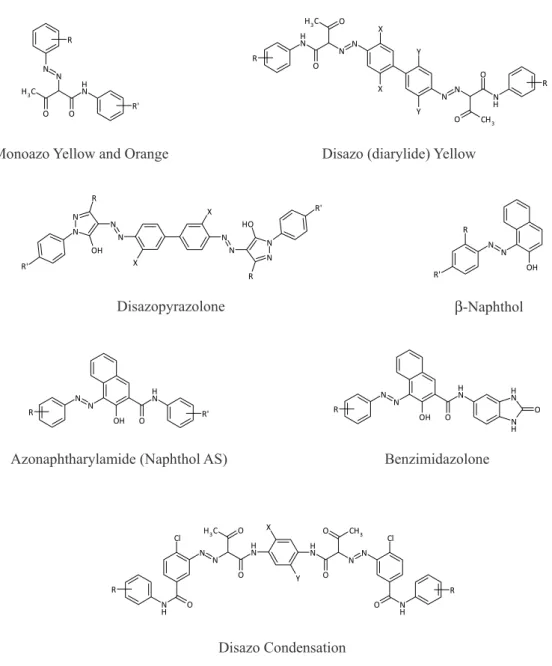
Figure 1 Chemical structures of some typical azo pigments. Subclasses depicted under each chemical structure are
the common names conventionally established in colorant industry. In the structures, R, R’, X and Y represent the substituents and are solely indicated without details such as concrete chemical groups and positions. Azo pigments
containing metals are excluded, e.g., lake (salt) and metal complex pigments.
N N C H3 O O N H R R' N H O N O C H3 N X X Y Y N N O CH3 N H O R R X N N N N O H R R' N N N N R OH R' X OH N N R R' OH N N O N H R R' OH N N O N H N H N H O R N H O N H O X Y O CH3 N N Cl O N H O C H3 N N Cl N H O R R
Copper Phthalocyanine Perylene
Diketopyrrolopyrrole Quinacridone
Perinone Quinacridone Quinone
Thioindigo Dioxazine
Aminoanthraquinone Indanthrone Flavanthrone
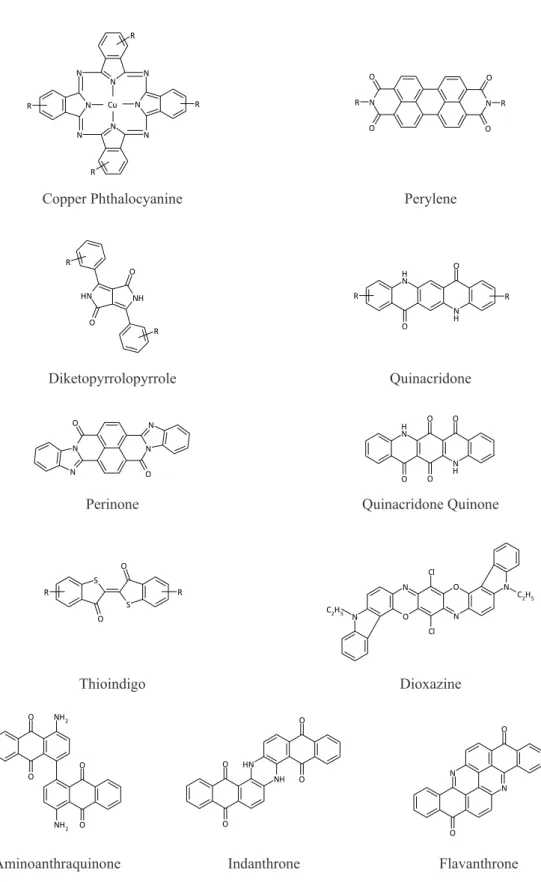
Figure 2 Chemical structures of some typical polycyclic pigments. Subclasses depicted under each chemical
structure are the common names conventionally used in colorant industry. In the structures, R represents the substituent and is solely indicated without details such as concrete chemical groups and positions.
N N N N N N N N R R R R Cu N N O O O O R R N H NH O O R R N H N H O O R R N N N N O O N H N H O O O O S S O O R R N N O N N O Cl Cl C2H5 C2H5 O O NH2 O O NH2 NH N H O O O O O N N O
1.4 Organic pigments
Organic pigments include natural and synthetic ones, and the latter dominates industry of production and application. Organic pigments are further subdivided into azo pigments having azo linkage (-N=N-)3 and polycyclic pigments. Both azo and polycyclic pigments constitute a variety of subclasses, and chemical structures of some of them are summarized in Figures 1 and 2 as the representative examples.
Azo pigments were developed in the second half of the nineteenth century. The pigments can be economically produced as described in the next section, and exhibit typically yellow, orange and red to brown colors. Some of azo pigments are known to exhibit photoconductivity, and have been commercially applied for organic photoconductors (OPC) of electrophotographic copying machines [3]. Polycyclic pigments consist of heteroaromatic systems, and include metal or metal-free phthalocyanines, perylenes, diketopyrrolopyrroles, quinacridones, perinone, thioindigos, aminoanthraquinone, dioxazine etc. (Figure 2). These are the common names conventionally used in colorant industry. Some of polycyclic pigments cover green and blue which are the hues commercially difficult to obtain by azo pigments. Apart from phthalocyanine pigments, most of polycyclic pigments are more costly than azo
pigments in production [1]. It has been known that specific crystal phases of copper
phthalocyanine or specific derivatives of perylene and diketopyrrolopyrrole show photoconductivity and other electronic properties. These are applicable for OPC and other electronic applications such as light-emitting diode and gas sensors [3-6].
In general, polycyclic pigments are more excellent than azo pigments in durability. Consequently, application fields where require extraordinary weatherability, e.g., coating paints for automobiles, tend to use polycyclic pigments, some of which, in this respect, are often grouped as “high-performance pigments” [7]; and the fields where require moderate durability, e.g., printing inks and plastics for stationery, tend to choose azo pigments, some of which, in contrast, often called as “mid- to low-performance pigments”.
1.5 Azo pigments
Azo pigments were developed after discovery of formation of a diazonium salt obtained from a primary amine in 1858 [2]. The pigments can be economically
3 Azo linkage can have the other linkage, hydrazone (-NH-N=), by a tautomerism, and the term “azo” has been conventionally used in colorant industry. Crystal structure analyses have revealed that many of the azo pigments analyzed to date exhibit “hydrazone” tautomer rather than “azo” tautomer.
produced through the standardized sequence of a diazonium salt formation from an aromatic amine and a subsequent reaction with a wide choice of a coupling component (Scheme 1). Various kinds of the coupling components mainly led development of a variety of azo pigments. In accordance with market demands for coloration, e.g., color variations and practical performances, lots of azo pigments were developed during the late 19th to middle 20th centuries. Accordingly, a variety of subclasses of azo pigments were formed; such as monoazo yellow, monoazo orange, disazo yellow, disazopyrazolone, β-naphthol, azonaphtharylamide, benzimidazolone, disazo condensation and so on (Figure 1). These are the common names conventionally established in colorant industry. The category of azo pigments includes those containing metals, i.e., lakes and metal complexes. Azo lakes are the metal salts made with
carboxylic and/or sulfonic acid part(s) in the structures, and azo metal complex pigments are those whose metals coordinate to the nitrogen atoms in the azo linkages as
the ligands.
Scheme 1 General synthetic procedure of azo pigment.
Of more than 150 red organic pigments which are commercially available and whose Color Index Generic Names and Constitution Numbers4 are given [1], azonaphtharylamide type pigments account for nearly one third of the 150, suggesting that this subclass has been one of the most important red pigments in colorant industry.
Those pigments are obtained by coupling substituted aryl diazonium salts with arylides of 2-hydroxy-3-naphthoic acid for the coupling components (“Naphtol AS” as the industrial common name). They provide a broad range of red colors from yellowish and medium to bluish red covering brown and violet shades. Although their solvent fastness
and migration resistance are only marginal, azonaphtharylamide type pigments have
been used mainly in printing inks and paints mostly as mid- to low-performance
pigments [1].
4 Color Index International (C.I. in abbreviation) is the reference database of colorant jointly made and maintained by the Society of Dyes and Colourists and the American Association of Textile Chemists and Colorists. The database includes the list of more than 6000 colorants (both dyes and pigments) with Color Index Generic Names based on the hues and Color Index Constitution Numbers
N N Ar Ar NH2 NaNO2 HX X R H Ar N N R + diazotization coupling
Fluoreceine Stilbene Coumarin
Rhodamine Perylene
Figure 3 Examples of typical fluorophores. The names of the compounds depicted under each chemical structure are
the common names conventionally used. In the structures, R, R’ and R” represent the substituent and are solely indicated without details such as concrete chemical groups and positions.
1.6 Fluorescent pigments
The category “fluorescent pigments” is often made for the classification of pigments besides the classes of inorganic and organic ones. Absorption, scattering and reflection of light are the principles that general inorganic and organic pigments exhibit colors, whereas emission of light is the fundamental and distinct principle for fluorescent pigments to exhibit colors. Fluorescent pigments include inorganic and organic ones.
Inorganic fluorescent pigments comprise host crystals of metal oxides or sulfides doped with other metals, e.g., SrAl2O4:Eu, Y2O3:Eu, ZnS:Ag, and ZnS:Cu etc. These
are used by dispersion typically in a transparent and colorless medium, plastic, for example. Organic fluorescent materials include derivatives of aromatic fluorophores such as fluorecein, stilbene, coumarin, rhodamines and perylenes (Figure 3). These organic compounds are essentially soluble, i.e., not pigment in terms of solubility, and are dissolved in a transparent medium because these molecules efficiently fluoresce in a molecularly dispersed state. The solid solutions thus prepared are then ground into fine particles for dispersion of paints, printing inks or plastics, like agglomerated pigment particles. Inorganic and organic fluorescent pigments in the media give off colors with a
O O H O COOH O O N N O R' R R R' R" X + N N O O O O R R
remarkable vivid brilliance due to their spontaneous emission upon excitation by light exposure or irradiation. The pigments are, therefore, applied for visibility purposes to attract attention such as decorative advertisements, dials for clocks, and the fields of safety, e.g., road markings, signs for traffic and emergency evacuation etc.
It should be noted here that, among various organic fluorescent compounds, there exist some molecules which can fluoresce even in the solid state, while intermolecular interactions work usually as cohesive forces for the molecules to be solid, and the interactions make the compounds be less- or non-fluorescent providing non-radiative deactivation paths. Such molecules are of great interest in terms of their emitting states. Solid-state-fluorescent compounds include metal complexes of hydroxyquinoline, derivatives of diketopyrrolopyrrole, hydroquinone, oxazoles, phenazine etc., and are applicable for organic light-emitting diodes or optical memories [8-10].
1.7 Color mixing
The most fundamental purpose of pigments is coloration, and the most essential functionality of pigments is therefore hue. A vast variety of hues (colors) can be created by mixing colors. There are two laws of color mixing, i.e., additive color mixing and subtracting color mixing [2].
Additive color mixing concerns light, and the three primary colors of light, i.e., red, green and blue (RGB) can synthesize any colors through transparently mixing two or more of the three colors as shown in the left of Figure 4. Lightness of the hue increases upon mixing since the amount of light is incremented through transmittance of the light. The equivalent mixture of the three colors produces white. Additive color mixing is used for producing full-color typically in liquid crystal displays through RGB color filters.
Subtractive color mixing concerns colorant, and the three primary colors of colorant, i.e., yellow, magenta and cyan (YMC) can provide also any colors through reflectionally mixing two or more of the three colors as shown in the right of Figure 4. Lightness of the hue decreases upon mixing since the amount of the light is decremented through absorption of the light. The equivalent mixture of the three colors produces black in contrast to additive color mixing. Subtractive color mixing is routinely used in colorful printings through full-color ink-jet printers, for example.
In principle, any kinds of colors can be obtained by using additive mixing or subtractive mixing. Nevertheless, most of commercially available ink-jet printers are equipped with an additional plurality of color inks besides YMC inks such as black,
light magenta and light cyan. Regarding liquid crystal displays, cyan and yellow color filters have been proposed in addition to the RGB filters to improve reproducibility of yellow, gold and pale blue [11]. The above additional colors are provided in pursuit of precise color reproducibility from original color images. Furthermore, processes of mixing the primary colors are not always easy to exactly reproduce intended hue with saturation. The three primary colors are hence never enough for coloration, and colorants exhibiting colors other than the three primary colors are therefore indispensable for various applications, e.g., colorant for black, white, orange, brown, purple etc.
Additive color mixing R: Red, G: Green, and B: Blue
Subtractive color mixing Y: Yellow, M: Magenta, and C: Cyan
Figure 4 Color mixing by three primary colors.5
1.8 White and black pigments
In general, pigments absorb light of specific wavelengths in visible light region, and we perceive the light which is not absorbed by the pigment as the color of the pigment. Ideally white pigment does not absorb any light of visible wavelength region. On the contrary, black pigment absorbs most of light in visible wavelength region. These colors are routinely used such as coating paints of automobile bodies, letter printings for books and newspapers. While white and black can be theoretically produced by additive and subtractive mixings, respectively, obtaining white and black by the mixings is however non-economical and unproductive. The two colors are neutral and monotonous but irreplaceable and distinct from other hues, and the pigments exhibiting white or black are the requisites.
Inorganic white pigments include titanium dioxide, zinc oxide, magnesium oxide, and barium sulfate. Of these, rutile-type titanium dioxide is most important as the principal white pigment. Derivatives of alkylenebismelamine are proposed as organic white pigments [12]. Hollow particles comprising polymers of various polymerization degrees for the shell are other examples of organic white pigments [13].
Black pigments include carbon black, graphite, iron (II) iron (III) oxide (magnetite), and composite oxides comprising copper and chromium, or copper, chromium and zinc. Some perylene derivatives are known for exhibiting black [14]. Of the above pigments, carbon black is predominant in terms of production cost and extraordinary stability, although carbon black contains by-products, benzpyrene, for example, which has been known for a carcinogen.
1.9 Scope of the thesis
1.9.1 Purpose of the present study on organic pigments
Organic pigments are useful and indispensable materials for our life. In particular, azo pigments have been widely used in their long history as synthetic organic pigments. Drastic modification in chemical structures of azo pigments would be useful for exploring potential of azo pigments. One of the purposes of the present study on organic pigments is to substantiate that drastic chemical modifications can provide novel azo pigments with some functionality.
Organic fluorescent pigments are one of the industrially important categories of pigments. The pigments which fluoresce in the solid state are particularly interesting from a scientific point of view. Another purpose of the present study is to investigate the emitting state of a solid-state-fluorescent pigment. The compound the author opted for is a polycyclic fluorescent pigment and is unique in terms of its practical photostability, while most of fluorescent compounds are usually not stable due to their relatively long life in the excited state.
1.9.2 Synthesis of novel red azonaphtharylamide pigments
Azonaphtharylamide pigments constitute a commercially important subclass in azo pigments. The pigments are obtained using coupling components derived from 3-hydroxy-2-naphthoic acid. Alteration of the above mono-carboxylic acid to a dicarboxylic acid has not been attempted and will lead exploration for a new subclass of
azo pigments. Chapter 2 of the present thesis describes synthesis of two novel red azonaphtharylamide-type pigments using a coupling component starting from 3-hydroxy-2,7-naphthalene dicarboxylic acid. Presence of 7-substituent distinguishes the pigments from conventional azonaphtharylamide pigments. The following properties of the 7-substituted pigments are studied comparing with those of the conventional 7-unsubstituted counterparts; optical absorption and influence of the 7-substituent upon optical absorption using molecular orbital (MO) calculation with geometry optimization for a hydrazone configuration.
1.9.3 Synthesis of novel black azo pigments
One of the most important black pigment in industry is carbon black. This pigment boasts of its extraordinary durability and economical production, while this is carcinogenic due to impurities contained through its production process. Electric conductivity is another issue of the pigment in the application for liquid crystal displays. These drawbacks mainly lead a demand for a new black pigment. In general, extension of a π-conjugation system provides narrowing of the HOMO-LUMO gap and increments the number of bonding and anti-boding π-electron molecular orbitals, thereby inducing red shift of optical absorption and hopefully band broadening in the visible light region. Chapter 3 of the present thesis describes that novel black pigments can be produced in the category of azo pigment through extension of a π-conjugation system. 3-Hydroxy-2-naphthoic acid and 3-hydroxy-2,7-naphthalene dicarboxylic acid are used for the starting materials. The crystal structures of the pigments obtained are solved by ab initio powder X-ray diffraction analysis with DFT calculation. The results show that the black is materialized by the flat and broad π-conjugation systems probably assisted by a specific intermolecular interaction Davydov splitting.
1.9.4 Optical properties of a unique polycyclic fluorescent pigment
Of some organic fluorescent pigments which can fluoresce in the solid state, 1,2,3,4-tetrachloro-11H-isoindolo-[2,1-a]-benzimidazol-11-one (TCIB) is known for a unique and distinct compound in terms of its excellent and practical photostability [15]. Chapter 4 of the thesis discusses fluorescent behavior of TCIB in some organic solvents of various polarities using MO calculation, steady state and time-resolved spectroscopy to clarify the emitting state.
Chapter 2
Synthesis and Properties of Azonaphtharylamide Pigments Having
Arylamide Groups at 2- and 7-Positions
2.1 Abstract
Two azonaphtharylamide pigments having arylamide groups at the 2- and 7-positions on the naphthol ring were synthesized and studied. Presence of the 7-substited amide group distinguishes the pigments from conventional azonaphtharylamide pigments derived from 3-hydroxy-2-naphthoic acid. The 7-substituent caused a hyperchromic effect but did not produce bathochromic shift in the optical absorption spectra in solution compared with the corresponding 7-unsubstituted counterparts. Molecular geometry optimizations through semi-empirical MO calculations showed that extent of the chromophore systems in the pigments with and without the 7-substituent is nearly the same, which is consistent with absence of the bathochromic shift. The MO calculations also showed that the MOs localized in 7-substituents are involved in the electronic transitions in the longest wavelength bands of the pigments, which is responsible for the hyperchromic effect. The 7-substituted pigments exhibited better resistivity to light and heat than the 7-unsubstituted ones.
2.2 Introduction
An important class of industrial azo pigments is synthesized using hydroxynaphthalene (β-naphthol) and its derivatives as a base for coupling components [1,2]. Of the derivatives, 3-hydroxy-2-naphthoic acid is one of the most important starting materials. The naphthalene ring of the naphthoic acid is a conjugated polyene and forms the central structure of the chromophore in the resultant pigments. The carboxylic acid at the 2-position has been utilized for the syntheses of a variety of coupling components through a simple amidation procedure. As a consequence of this, the industrially important subclasses of azo pigments, e.g., azonaphtharylamide-type and benzimidazolone-type, have been developed [1]. If an additional carboxylic acid is introduced to the naphthalene ring, further development of new azo pigments becomes possible. Synthesis of coupling components having amide groups at the 2- and 7-positions of the naphthol was, therefore, attempted to develop new azonaphtharylamide-type pigments. For this purpose, 3-hydroxy-2,7-naphthalene dicarboxylic acid 1, as shown in Figure 1, was employed as the starting compound. This compound enables introduction of the same or mutually different substituents at the 2- and 7-positions through double amidation, which will allow development of a new subclass of azo pigments. It is expected that the substituent at the 7 position may impart functionality to the pigments and improve their technical performance. The author engaged in development of some of the
pigments synthesized from 1 [16,17]. Here, synthesis and fundamental properties of two kinds of the azo pigments are reported. As the coupling component, 3-hydroxy-N2,N7 -diphenyl-naphthalene-2,7-dicarboxamide 2 (Figure 1) was used because of its structural simplicity. Concerning the properties of the pigments, the effect of the 7-substituents upon the optical properties and chemical stabilities were investigated.
1
2
3a 3b
4a 4b
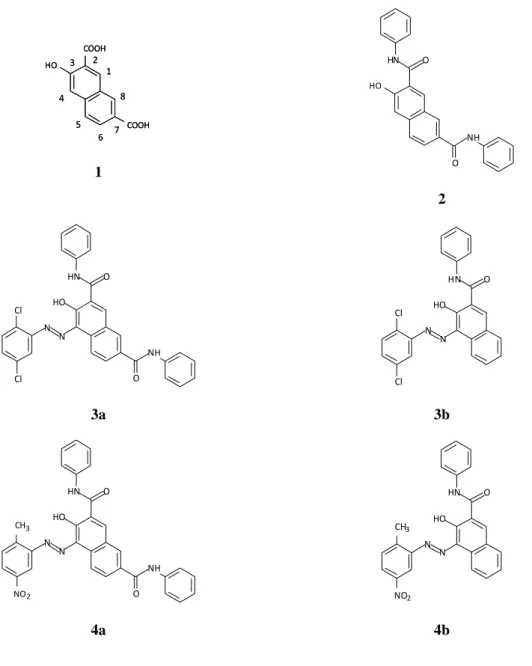
Figure 1 Chemical structures of starting compound 1, coupling component 2 derived from 1, azo pigments 3a
and 4a, which were synthesized from 2; and 3b (C. I. Pigment Red 2) and 4b (C. I. Pigment Red 22) used as reference. For easy comparison with 2, the structures of 3a, 3b, 4a and 4b are depicted in the hydroxy-azo
configurations, although they are believed to have the keto-hydrazone configurations.
1 2 3 4 5 6 7 8 COOH COOH HO 1 2 3 4 5 6 7 8 COOH COOH HO NH O N H O HO NH O O N H O H N N Cl Cl N N Cl Cl O H O N H NH O O N H O H N N CH3 NO2 N N O H O N H NO2 CH3
2.3 Target materials
Figure 1 summarizes all the chemical structures of the materials used in the present study. The starting material is 3-hydroxy-2,7-naphthalene dicarboxylic acid 1. 3-Hydroxy-N2,N7 -diphenylnaphthalene-2,7-dicarboxamide 2 is the coupling component (intermediate) synthesized form 1. The new 7-substituted azonaphtharylamide pigments having two arylamide substituents derived from 2 are 4-(2,5-dichlorophenyl)azo-3-hydroxy-N2,N7 -diphenylnaphthalene-2,7-dicarboxamide (3a) and 4-(2-methly-5-nitrophenyl)azo-3-hydroxy -N2,N7-diphenylnaphthalene-2,7-dicarboxamide (4a). Figure 1 shows also the counterparts of 3a and 4a, i.e., 4-(2,5-dichlorophenyl)azo -3-hydroxy-N-phenylnaphthalene-2-carboxamide (C.I. Pigment Red 2, 3b) and 4-(2-methyl-5-nitrophenyl)azo-3-hydroxy-N-phenylnaphthalene -2-carboxamide (C.I. Pigment Red 22, 4b); the 7-unsubstituted conventional azonaphtharyl -amide pigments having one arylamide substituent for comparison. As discussed later, a tautomerism can exist between the structures of azo (–N=N-) and hydrazone (–NH-N=) in 3a, 3b, 4a and 4b, and the structures of these pigment molecules are depicted in the azo configurations for easy comparison with 2, although they are believed to have the hydrazone configurations.
2.4 Experimental
2.4.1 Materials
All the chemicals were purchased from Tokyo Kasei Co., Ltd. except 3-hydroxy-2,7 -naphthalene dicarboxylic acid. The dicarboxylic acid was purchased from Wako Pure Chemical Industries. Solvent-soluble acrylic resin BR-87 was obtained from Mitsubishi Rayon Co., Ltd.
2.4.2 Instruments
Decomposition points were measured with Bruker TG-DTA2000SA. Mass spectra were taken on JEOL JMS-700 (EI-TOF MS) and Bruker Ultraflex TOF/TOF MS (MALDI-TOF MS). 1H and 13C NMR spectra were recorded on a JEOL JNM-ECS400 Spectrometer. UV-Vis absorption spectra were measured with HITACHI U-3310 Spectrophotometer. Powder X-ray diffraction patterns were evaluated with Rigaku MiniFlex600 (Cu Kα, 30kV/15mA). Light fastness of the pigments was evaluated with ASAHI Spectra Solar Simulator HAL-320.
2.4.3 Synthesis of 3-hydroxy-N2,N7-diphenyl-naphthalene-2,7-dicarboxamide (2)
with 80 g of toluene. Aniline (48.1 g, 0.52 mol) was dissolved in 125.0 g of toluene at room temperature. Phosphorus trichloride (11.8 g, 0.09 mol) was added dropwise to the aniline solution and the mixture was filtrated. The filtrate obtained was then poured into the slurry and the reaction mixture was kept at 110°C for 3 hours while stirring, and then filtrated. The white powder, 3-hydroxy-N2,N7-diphenyl-naphthalene-2,7-dicarboxamide, was washed with methanol. Yield was 29.0 g (84.2 mol% relative to 3-hydroxy-2,7-dicarboxylic acid); 1H NMR (400 MHz, DMSO-d6) δ 7.12 (t, 2H, J = 7.4 Hz), 7.16 (t, 2H, J = 7.4 Hz), 7.38 (t, 2H, J = 7.4 Hz), 7.40 (t, 2H, J = 7.4 Hz), 7.42 (s, 1H), 7.79 (d, 2H, J = 7.4 Hz), 7.83 (d, 2H, J = 7.4Hz), 7.90 (d, 1H, J = 7.6 Hz), 8.04 (dd, 1H, J = 7.6 Hz, 1.8 Hz), 8.61 (d, 1H, J = 1.8 Hz), 8.61 (s, 1H). 13C NMR (100 MHz, DMSO-d6) δ 110.36, 120.22, 120.25, 123.38, 123.52, 123.97, 125.72, 125.86, 126.34, 128.54, 128.73, 128.96, 129.90, 131.58, 136.93, 138.39, 139.16, 155.05, 165.02, 165.24.
2.4.4 Preparation of 2,5-dichloroaniline diazonium fluoroboric salt for
4-(2,5-dichlorophenyl)azo-3-hydroxy-N2,N7-diphenylnaphthalene-2,7-dicarboxamide (3a) and 4-(2,5-dichlorophenyl)azo-3-hydroxy-N-phenylnaphthalene-2-carboxamide (3b)
2,5-Dichloroaniline (12.5 g, 0.08 mol) was put into a flask (300 ml) with 62.5 g of water and acetic acid (4.6 g, 0.08 mol). 35% Hydrochloride (16.1 g, 0.15 mol) was added dropwise to the above mixture keeping at 50°C. 35% Hydrochloride (16.1 g, 0.15 mol) and 50.0 g of water was then further added at 45°C. After cooling the system below 0°C, 16% of aqueous solution of sodium nitrite (0.08 mol) was added dropwise to the system while stirring. After removal of insoluble substances and wash with 12.5 g of water, the intermediate was kept below 5°C, and 42% fluoroboric acid (30.4 g, 0.16 mol) was added dropwise, and then filtrated. The precipitate was washed with water and subsequently with isopropyl alcohol, and dried. White crystalline powder was obtained. The yield was 17.8 g (98.7%). The salt was used for following diazotization without identification.
2.4.5 Preparation of 2-metyl-5-nitoroaniline diazonium fluoroboric salt for 4-(2-methly-5 -nitrophenyl)azo-3-hydroxy-N2,N7-diphenylnaphthalene-2,7-dicarboxamide (4a) and 4-(2-methyl-5-nitrophenyl)azo-3-hydroxy-N-phenylnaphthalene-2-carboxamide (4b)
2-Methyl-5-nitroaniline (12.5 g, 0.08 mol) was put into a flask (300 ml) with 125.0 g of water and 25.7 g of 35% hydrochloride. 16% Sodium nitrite (39.0 g, 0.09 mol) was added dropwise to the above mixture keeping the system below 5°C. After removing insoluble substances, the intermediate was kept below 5°C, and 42% fluoroboric acid (32.4 g, 0.17 mol) was added dropwise, and then filtrated. The precipitate was washed with water, and subsequently isopropyl alcohol, and dried. White crystalline powder was obtained. The yield
2.4.6 Synthesis of 4-(2,5-dichlorophenyl)azo-3-hydroxy-N2,N7-diphenylnaphthalene-2,7- dicarboxamide (3a)
3-Hydroxy-N2,N7-diphenyl-naphthalene-2,7-dicarboxamide (3.0 g, 0.008 mol) was charged into a flask (100 ml) with N-methylpyrrolidone (NMP, 24.0 g) and sodium hydroxide (0.69 g, 0.017 mol). The mixture was stirred at 40°C and then cooled below 5°C. After 2,5-dichloroaniline diazonium fluoroboric salt (2.46 g, 0.009 mol) had been added to the flask while stirring and keeping the temperature below 5°C, the solution was stirred overnight at room temperature, and neutralization using acetic acid was performed. The red powder generated was filtrated and washed sequentially with acetone, methanol and water. Finally, the powder was dispersed in methanol, filtrated, and dried in an oven at 80°C. The powder thus obtained (2.6 g, 0.005 mol) was further treated in N,N-dimethylformamide (DMF, 20 g) at 120-130°C for 3 hours while stirring. The product was washed with DMF and methanol and dried in an oven at 80°C. Yellowish red 4-(2,5-dichlorophenyl)azo-3-hydroxy-N2,N7 -diphenylnaphthalene-2,7-dicarboxamide (2.2 g) was obtained as an extremely insoluble crystalline powder. Yield 50.5%; decomposition point 339°C; MALDI-TOF MS m/z 553.040 [M-H]- (100%), calcd for [C30H19Cl2N4O3]- 553.083.
2.4.7 Synthesis of 4-(2-methly-5-nitrophenyl)azo-3-hydroxy-N2,N7-diphenylnaphthalene- 2,7-dicarboxamide (4a)
3-Hydroxy-N2,N7-diphenyl-naphthalene-2,7-dicarboxamide (3.0 g, 0.008 mol) was charged into a flask (100 ml) with NMP (24.0 g) and sodium hydroxide (0.69 g, 0.017 mol). The mixture was stirred at 40°C and then cooled below 5°C. After 2-methyl-5-nitroaniline diazonium fluoroboric salt (2.36 g, 0.009 mol) had been added to the flask while stirring and keeping the temperature below 5°C, the solution was stirred overnight at room temperature, and neutralization using acetic acid was performed. The red powder generated was filtrated and washed sequentially with acetone, methanol and water. Finally, the powder was dispersed in methanol, filtrated, and dried in an oven at 80°C. The powder thus obtained (2.6 g, 0.005 mol) was further treated in DMF (20 g) at 120-130°C for 3 hours while stirring. The product was washed with DMF and methanol and dried in an oven at 80°C. Bluish red 4-(2-methly-5 -nitrophenyl)azo-3-hydroxy-N2,N7-diphenylnaphthalene-2,7-dicarboxamide (2.4g) was obtained as an extremely insoluble crystalline powder. Yield 56.1%; decomposition point 320°C; MALDI-TOF MS m/z 544.120 [M-H]- (100%), calcd for [C31H22N5O5]- 544.162.
The following syntheses of 3b and 4b were carried out to obtain chemically pure samples. Commercially available ones may contain additives such as dispersants.
2.4.8 Synthesis of 4-(2,5-dichlorophenyl)azo-3-hydroxy-N-phenyl-naphthalene-2- carboxamide (3b)
2-Hydroxy-3-naphthoic acid anilide (2.5 g, 0.010 mol) was charged into a flask (100 ml) with NMP (24.0 g) and sodium hydroxide (0.69 g, 0.017 mol). The mixture was stirred at 40°C and then cooled below 5°C. After 2,5-dichloroaniline diazonium fluoroboric salt (2.97 g, 0.011 mol) had been added to the flask while stirring and keeping the temperature below 5°C, the solution was stirred overnight at room temperature, and neutralization using acetic acid was performed. The red powder generated was filtrated and washed sequentially with acetone, methanol and water. Finally, the powder was dispersed in methanol, filtrated, and dried in an oven at 80°C. The powder thus obtained (2.6 g, 0.005 mol) was further treated in DMF (20 g) at 120-130°C for 3 hours while stirring. The product was washed with DMF and methanol and dried in an oven at 80°C. Yellowish red 4-(2,5-dichlorophenyl)azo-3-hydroxy-N-phenyl -naphthalene-2-carboxamide (2.5 g) was obtained. Yield 60.3%; decomposition point 305°C; EI-TOF MS m/z 435.0538, calcd for C23H15Cl2N3O2 435.0541.
2.4.9 Synthesis of 4-(2-methyl-5-nitrophenyl)azo-3-hydroxy-N-phenylnaphthalene-2- carboxamide (4b)
2-Hydroxy-3-naphthoic acid anilide (2.5 g, 0.001 mol) was charged into a flask (100 ml) with NMP (20.0 g) and sodium hydroxide (0.84 g, 0.021 mol). The mixture was stirred at 40°C and then cooled below 5°C. After 2-methyl-5-nitroaniline diazonium fluoroboric salt (2.86g, 0.011mol) had been added to the flask while stirring and keeping the temperature below 5°C, the solution was stirred overnight at room temperature, and neutralization using acetic acid was performed. The red powder generated was filtrated and washed sequentially with acetone, methanol and water. Finally, the powder was dispersed in methanol, filtrated, and dried in an oven at 80°C. The powder thus obtained (2.6 g, 0.005 mol) was further treated in DMF (20 g) at 120-130°C for 3 hours while stirring. The product was washed with DMF and methanol and dried in an oven at 80°C. Bluish red 4-(2-methyl-5-nitrophenyl)azo-3 -hydroxy-N-phenylnaphthalene-2-carboxamide (2.5g) was obtained. Yield 61.7%; decomposition point 310°C; EI-TOF MS m/z 426.1335, calcd for C24H18N4O4 426.1328.
2.4.10 MO and CI calculations
Semi-empirical MO calculation with the Hamiltonian, AM1, was employed in the present study, followed by singly excited configuration interaction calculations with the INDO/S method using 20 occupied and vacant orbitals. All calculations were done with SCIGRESS MO Compact (Fujitsu Ltd.). Each compound was modeled initially with the modeling
calculation with AM1.
2.4.11 Evaluation of light-fastness of 3a to 4b
The following materials were put in a 70 ml mayonnaise bottle: Pigment (0.12 g), zirconia beads (φ 0.3 mm, 3 g), solvent-soluble acrylic resin BR-87 (5.0 g), and ethyl acetate (2.4 g). The materials were mixed with a ball mill by rotating the bottle for 5 hours to disperse the pigment. The ink obtained was dropped on a slide glass and spin-coated (500 rpm) to form a transparent thin film. The films were placed in Solar Simulator HAL-320 (Xe-lamp, irradiation intensity 75mW/cm2 (400 to 1100 nm) to be irradiated for 48 hours in air.
Scheme 1 Syntheses of coupling component 2 and azo pigments 3a and 4a starting from
3-hydroxy-2,7-naphthalene dicarboxylic acid 1. Aniline 6, its fluoroboric salt 7 and the pigment structure are given in a general formula. RC1, RC2 and RC3 on 6, and RD1, RD2 and RD3 on 7 represent substituents available
including hydrogen (3a: RD1 = RD3 = Cl, and RC1 = RC2 = RC3 = RD2 = H; and 4a: RD1 = CH3, RD3 = NO2, and RC1
= RC2 = RC3 = RD2 = H). COOH COOH OH OH COCl COCl 1 2 3 4 5 6 7 8 1 5 PCl3 N N+ BF4 -RD 1 RD 2 RD 3 NH O O N H O H N N RD 1 RD 2 RD 3 RC 1 RC2 RC 3 RC1 RC2 RC3 N H O NH O OH RC 1 RC3 RC 1 RC3 RC2 R2 C NH2 RC1 RC3 RC2 7 2 3a or 4a 6
2.5 Results and discussion
2.5.1 Syntheses
Conventional 7-unsubstituted azonaphtharylamide pigments are divided into two groups in terms of the number of the amide group [1]. Group 1 contains a single amide group derived from 2-naphthoic acid, and Group 2 contains one or more additional amide groups (and/or sulfonamide groups) attached to the diazo component and/or 2-phenylcarboxamide. The pigments having a 7-substituent like 3a and 4a are the members of neither Group 1 nor Group 2 by the above definition due to presence of a 7-subtituent. Consequently, if the pigments derived from 2 demonstrate any advantages from technological and/or industrial point of view over the conventional azonaphtharylamide pigments, those pigments will create another new subclass of azo pigments.
Syntheses of coupling component 2 and pigments 3a and 4a are shown in Scheme 1. In the process, 3-hydroxy-2,7-naphthalene dicarboxylic acid 1 was allowed to react with phosphorus trichloride to give acid chloride 5, which was then amidated with aniline 6 to afford 2. This compound was allowed to react with aniline diazonium fluoroboric salt 7 to produce 3a or 4a. For the synthesis, fluoroboric salt 7 was used because it is chemically stable and convenient to handle compared with the conventional chloride and nitrate salts [18]. The crude pigments were heated in N,N-dimethylformamide at 120-130°C for 3 hours to promote crystal growth [19]. The pigments thus obtained were more insoluble than the counterparts (3b and 4b) in both polar and non-polar solvents. The pigments 3a and 4a in a powder state as obtained were yellowish and bluish red, respectively, resembling those of 3b and 4b.
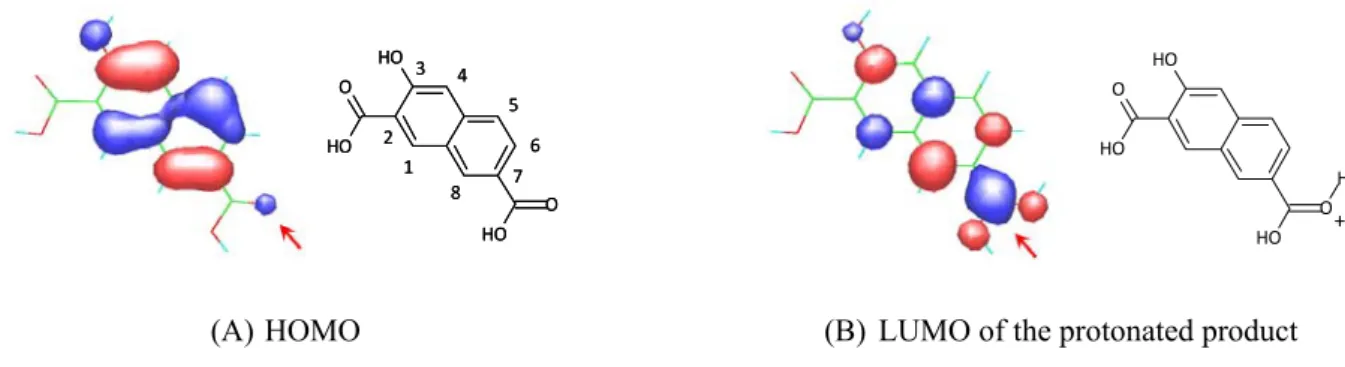
It is important to underline that the 7-position of diacid 1 can be selectively esterified in contrast to the 2-position. This selectivity is attributed to the fact that the HOMO of the diacid, as shown in Figure. 2 (A), extends its lobe on the 7-carbonyl’s oxygen atom, which attracts a proton from an acid catalyst; the HOMO does not extend on the 2-carbonyl’s oxygen atom. When the 7-carbonyl is protonated, as shown in Figure 2 (B), the LUMO of the protonated diacid has the prominent lobe on the 7-carbonyl’s carbon atom, which will be nucleophilically attacked by the oxygen atom of an alcohol. It is thus possible to introduce two mutually different functional groups into the 2- and 7-positions by dividing the amidation process into two steps (Scheme 2). The 7-carboxylic acid on 1 is first protected by an appropriate esterification to yield monoester 8 and then chloridized. Acid chloride 9 is 2-amidated with aniline derivative 10 in the first amidation step. Amidated ester 11 is then hydrolyzed (12) and subsequently chloridized. Acid chloride 13 is then 7-amidated with another aniline derivative 14. The above sequence will definitely facilitate extensive derivatization for a large variety of coupler structure 15. This has been in fact substantiated in a reference [20].
(A) HOMO (B) LUMO of the protonated product
Figure 2 MOs to demonstrate selective esterification at 7-carboxylic acid of 4. The corresponding chemical
structures are shown on the right side of each MO. (A) depicts the HOMO, indicating the lobe of the carbonyl’s oxygen atom to be protonated by an acid catalyst, and (B) the LUMO of 7-protonated 4, exhibiting
electrophilicity of the carbonyl’s carbon atom, as emphasized by the red arrows.
Scheme 2 Introduction of mutually different substituents to 2- and 7-positions of 1. The amidation sequence is
divided into the two steps utilizing selective esterification of 7-position of 1. Anilines 10 and 14 are given in a general formula. RC1 to RC6 on 10 and 14 indicate the substituents available including hydrogen.
1 2 3 4 5 6 7 8 O H O H O O O H 1 2 3 4 5 6 7 8 O H O H O O O H O H O O H O H O H + 1 2 3 2nd amidation 4 1st amidation 5 6 7 8 Chloridation Chloridation 9 1 Hydrolysis 13 8 12 10 11 14 15 Step 2 Esterification Step 1 COOH COOH HO HO COOH COOR RC 3 RC 2 RC1 NH2 COOR HO RC 1 RC 2 RC 3 RC 6 RC5 RC 4 NH2 HO RC 4 RC 5 RC 6 RC 1 RC 2 RC 3 COOR COCl HO COCl HO RC 1 RC2 RC 3 COOH HO RC 1 RC 2 RC 3 N H O NH O N H O O N H O N H 1 2 3 2nd amidation 4 1st amidation 5 6 7 8 Chloridation Chloridation 9 1 Hydrolysis 13 8 12 10 11 14 15 Step 2 Esterification Step 1 COOH COOH HO HO COOH COOR RC 3 RC 2 RC1 NH2 COOR HO RC 1 RC 2 RC 3 RC 6 RC5 RC 4 NH2 HO RC 4 RC 5 RC 6 RC 1 RC 2 RC 3 COOR COCl HO COCl HO RC 1 RC2 RC 3 COOH HO RC 1 RC 2 RC 3 N H O NH O N H O O N H O N H
2.5.2 Crystallinity of 3a and 4a
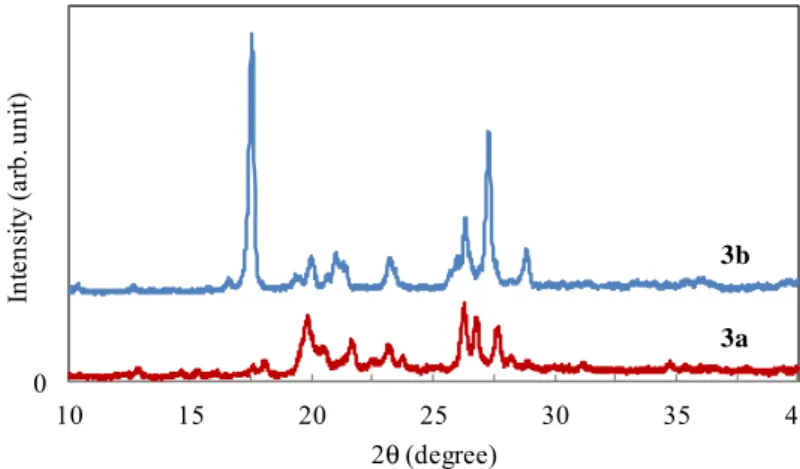
Powder X-ray diffraction patterns of 3a and 4a are shown in Figures 3 and 4, respectively, together with those of 3b and 4b. Although they were heat-processed for crystal growth as mentioned above, the diffraction bands of 3a and 4a are broader than those of 3b and 4b.
The sizes of the crystallites of 3a and 4a were estimated to be 14.8 and 8.8 nm, respectively, using Scherrer equation from the half maxima of the diffraction peaks at around 2θ = 27.5°. Similarly, the sizes of the crystallites of 3b and 4b were estimated to be 16.1 and 16.0 nm, respectively. These results may suggest that the 7-phenylcarboxamide substituent hindered the growth of the crystallites of 3a and 4a.
Figure 3 X-ray diffraction patterns of 3a and 3b which were heat-processed at 120-130°C in
N,N-dimethylformamide for 3 hours for crystal growth promotion.
Figure 4 X-ray diffraction patterns of 4a and 4b which were heat-processed at 120-130°C in
N,N-dimethylformamide for 3 hours for crystal growth promotion. 0 10 15 20 25 30 35 40 In te ns ity (a rb . u nit) 2θ (degree) 3a 3b 0 10 15 20 25 30 35 40 In te ns ity (a rb . u nit) 2θ (degree) 4a 4b
Figure 5 Optical absorption spectra of 3a and 3b in N-methylpyrrolidone.
Figure 6 Optical absorption spectra of 4a and 4b in N-methylpyrrolidone.
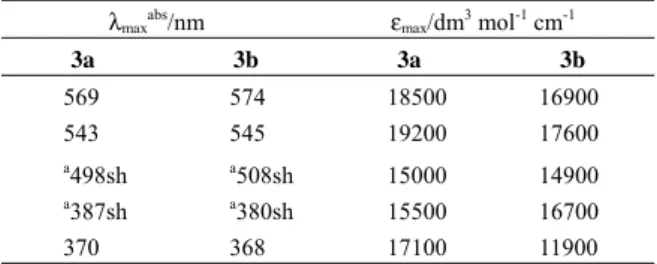
Table 1 Wavelengths of optical absorption maxima
and molar extinction coefficients of 3a and 3b in N-methylpyrrolidone.
Table 2 Wavelengths of optical absorption maxima
and molar extinction coefficients of 4a and 4b in N-methylpyrrolidone.
λmaxabs/nm εmax/dm3 mol-1 cm-1 λmaxabs/nm εmax/dm3 mol-1 cm-1
3a 3b 3a 3b 4a 4b 4a 4b 569 574 18500 16900 a569sh a578sh 14100 8600 543 545 19200 17600 533 524 15700 11700 a498sh a508sh 15000 14900 a501sh a498sh 15200 10900 a387sh a380sh 15500 16700 a407sh a382sh 10400 6700 370 368 17100 11900 389sh 364 14000 8300
a sh: shoulder absorption. a sh: shoulder absorption.
0 5000 10000 15000 20000 25000 350 400 450 500 550 600 650 700 750 M ol ar ex tin ct io n co ef fi ci en t Wavelength/nm ◯3a ×3b 0 5000 10000 15000 20000 25000 350 400 450 500 550 600 650 700 750 M ola r e xti nc tio n c oe ff ic ie nt Wavelength/nm ◯4a ×4b
2.5.3 UV-Vis absorption spectra of the pigments
Figures 5 and 6 show UV-Vis optical absorption spectra of 3a and 3b and of 4a and 4b, respectively, in N-methylpyrrolidone. The four compounds exhibit two broad and almost structureless bands: One from 470 to 580 nm and the other from 350 to 400 nm. Tables 1 and 2 summarize wavelengths of the absorption maxima and molar extinction coefficients of 3a and 4a, respectively, together with those of 3b and 4b. A bathochromic shift was not observed between 3a and 3b or between 4a and 4b. A hyperchromic effect of 3a and 4a was, however, clearly observed, particularly in the shorter wavelength region. The absence of a bathochromic shift suggests that extent of the chromophore systems of 3a and 4a are comparable with those of 3b and 4b, respectively, and that there is little involvement of the 7-substituent in the chromophore systems. This is consistent with the similarity of color tones in the powder samples. The hyperchromic effect observed will be discussed later.
3a 4a
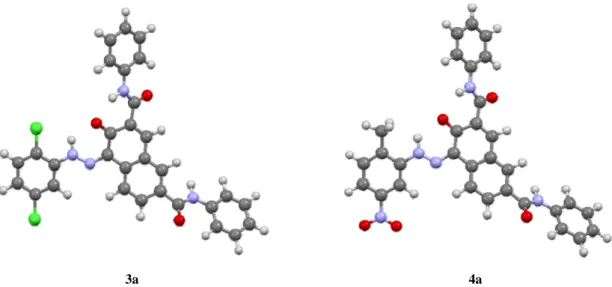
Figure 7 Optimized molecular geometries of 3a and 4a having keto-hydrazone configurations.
2.5.4 MO calculations for molecular geometry and electron transition
It has been shown that azonaphtharylamide pigments tend to adopt a keto-hydrazone form in solution and crystalline states [19,21,22]. A study on 1-phenylazo-2-naphthols also showed that the ketohydrazone form is energetically more stable than the hydroxyazo form based on results of crystal structure analyses and DFT calculations [23]. Therefore, the molecular geometry of 3a and 4a was optimized with a keto-hydrazone configuration using modeling software and by a semi-empirical molecular orbital (MO) calculation method. Figure 7 shows the optimized geometries, and Table 3 summarizes the dihedral angles between the least square planes of the naphthalene ring and the phenyl ring of the 2-, 4- or 7-position, where the
geometry optimization. Table 3 includes also the dihedral angles of those in 3b and 4b of the optimized structures with a keto-hydrazone configuration through the same calculation manner for comparison. These results indicate that both of the two phenyl rings attached to the naphthalene ring via the carboxamide groups are twisted relative to the naphthalene plane, while the phenyl ring attached to the naphthalene ring via the hydrazone group is less twisted to the naphthalene ring. The twist at the 2-position is more or less small compared with that at the 7-position in 3a and 4a.
Table 3 Dihedral angles between the least square planes of the naphthalene ring and the phenyl rings of 3a, 3b, 4a and 4b. The least square planes were calculated by using the atomic coordinates obtained in the geometry
optimization.
Position of a phenyl substituent (on a naphthalene ring)
Dihedral angle vs. naphthalene (degree )
3a 3b 4a 4b
4 17.5 15.9 21.1 14.0
2 29.4 27.6 28.0 27.2
7 30.3 − 31.2 −
Table 4Optical absorptionspectraof 3a and 4a in the ketohydrazone-form calculated by the semi-empirical MO
method and their band positions experimentally observed in N-methylpyrrolidone.
Compound Absorption
[nm] Oscillator strength CI component a Absorption band in N-methylpyrrolidone [nm] 3a 417.0 0.6034 HOMO Æ LUMO (58%) 470-580 353.7 0.2037 HOMO-3 Æ LUMO (36%)
310.8 0.2504 HOMO HOMO-3 Æ LUMO+1 (15%) Æ LUMO+1 (22%)
280.5 0.4110 HOMO-2 Æ LUMO (27%) 350-400 268.6 0.4759 HOMO Æ LUMO+1 (15%) HOMO Æ LUMO+2 (15%) HOMO-2 Æ LUMO (11%) 4a 414.0 0.5962 HOMO-1 Æ LUMO (50%) 470-580 355.4 0.2283 HOMO-3 Æ LUMO (47%)
309.7 0.2262 HOMO-6 Æ LUMO (17%) HOMO-1 Æ LUMO+2 (17%)
285.6 0.1256 HOMO-2 Æ LUMO (52%)
350-400 270.7 0.3100 HOMO-1 Æ LUMO+2 (25%)
269.3 0.4977 HOMO Æ LUMO+3 (25%)
The above geometry supports the possibility that the π-conjugation or chromophore system of 2a and 3a is analogous to that of 3b and 4b, and is constituted substantially with the naphthol ring, 2-phenylcarboxamide and 4-phenylhydrazone. Involvement of 7-phenylcarboxamide in the chromophore systems of 3a and 4a should be therefore much less compared with that of 2-phenylcarboxamide. If 3a and 4a form molecular crystals with no strong intermolecular interaction like other azonaphtharylamide pigments [19,21-26], their color properties originate in their isolated molecular structures and should be similar to those in solutions. The above chromophoric analogy should be responsible for the resemblance in the contours of the optical absorption spectra between 3a and 3b and between 4a and 4b.
The longest wavelength bands of 3a and 4a calculated by the semi-empirical MO method are summarized in Table 4. They appeared in higher energy regions than those of the experimentally observed bands. Such shifts toward higher energy regions are generally observed in semi-empirical calculations [27,28]. The computations indicate that the longest wavelength bands for 3a and 4a are due to π-π* transitions from the HOMO or orbitals close to it to the LUMO or orbitals close to it. The molecular orbitals involved in the transitions are shown in Figures 8 and 9 for 3a and 4a, respectively. These figures illustrate that the following orbitals contain electron localization on the 7-phenylcarboxamide group: (3a) HOMO-2, LUMO+1 and LUMO+2, and (4a) HOMO-2, HOMO-1, LUMO+2 and LUMO+3. Therefore, although the 7-substituent hardly contributes to extension of the chromophore system, the electron localization on the 7-substituent surely contributes to increment of transition probability, inducing the hyperchromic effect as observed with 3a and 4a.
LUMO LUMO+1 LUMO+2
HOMO-3 HOMO-2 HOMO
Figure 8 Molecular orbitals of 3a (keto-hydrazone form) involved in the transitions for longest wavelengths (see
LUMO LUMO+2 LUMO+3
HOMO-6 HOMO-3
HOMO-2 HOMO-1 HOMO
Figure 9 Molecular orbitals of 4a (keto-hydrazone form) involved in the transitions for longest wavelengths (see
Table 4 also).
Figure 10 Light fastness of 3a, 3b, 4a and 4b. The pigments were dispersed in acrylic films and irradiated with a
Xe-lamp (75 mW/cm2; 400 to 1100 nm). For each sample, the absorbance at the peak absorption wavelength is
plotted for irradiation periods of 24 and 48 h. The absorbance is normalized by the absorbance of the sample before photoirradiation. 0.00 0.25 0.50 0.75 1.00 0 24 48 A bs or ba nce ( no rm al ized ) Irradiation Time / h 3a 3b 4a 4b
2.5.5 Light-fastness of 3a and 4a
The durability of organic pigments, both azo and heterocyclic pigments, has been discussed in relation to intramolecular and/or intermolecular interactions, including hydrogen bonding, π-π stacking, and van der Waals contact. A strong intermolecular hydrogen bond binds diketopyrrolopyrrole or quinacridone molecules in their crystal structures, which is one of the important factors for imparting durability to these pigments [29,30]. Concerning conventional 7-unsubstituted azonaphtharylamide pigments, no strong intermolecular hydrogen bond network has been found. Alternatively, stabilization of the bifurcated intramolecular hydrogen bonds formed among the keto-hydrazone and 2-carboxamide groups has been proposed to explain the durability [19,21]. It has also been pointed out that increase in the number of amide groups tends to improve the technical performance of the azonaphtharylamide pigments, e.g., resistance to light, heat, solvent and/or migration [1,19,21], as experimentally demonstrated for the aforementioned Group 2 pigments.
Since 3a and 4a possess the two amide groups, these pigments are expected to outperform in durability 3b and 4b, which belong to conventional Group 1 pigments. It was therefore interesting to evaluate light fastness of 3a, 3b, 4a, and 4b. The pigments were dispersed in transparent films of an acrylic resin. Changes in the absorption spectra of the films in the visible light region were monitored while they were photo-irradiated at the intensity of 75 mW/cm2 (400 to 1100 nm) for 48 hours using a Xe lamp as the light source. Figure 10 shows the changes in the absorbance of the films at their absorption maxima. The maxima of the films at time 0 are normalized to unity in Figure 10. The results show that 3a and 4a have higher light fastness than 3b and 4b, as expected from the discussion on the number of the amide groups. Improved chemical stability of the pigments will also enhance their heat resistivity. This tendency was confirmed by the increase in the decomposition points of 3a and 4a compared with those of 3b and 4b, as shown in Table 5.
Table 5 Decompositionpoints of 3a, 3b, 4a and 4b evaluated by TG/DTA.
Compound 3a 3b 4a 4b
Decomposition point (°C) 339 305 320 310
2.6 Conclusion
Effect of a 7-substituent of two7-substituted azonaphtharylamide pigments was studied. The pigments were obtained using the coupling component, 3-hydroxy-N2,N7-diphenyl
Presence of 7-phenycarboxamide distinguishes the pigments from conventional azonaphtharylamide pigments derived from 3-hydroxy-2-naphthoic acid. The 7-substituted pigments exhibited higher insolubility, higher decomposition points, and relatively lower crystallinity than those of the 7-unsubstituted counterparts. The optical absorption spectra of the 7-substituted pigments in solution showed a hyperchromic effect and did not show a bathochromic shift compared with the 7-unsubstituted counterparts. Molecular geometry optimizations through semi-empirical MO calculations showed that extent of the chromophore system of the 7-substituted pigments is comparable with those of the counterparts, accounting for absence of the bathochromic shit. The calculations elucidated the hyperchromic effect, which is provided by involvement of the 7-substituent in the electronic transitions in the longest wavelength bands. The 7-substituted pigments demonstrated durability superior to that of the 7-unsubstituted ones. Consequently, the 7-substituted pigments are expected to create a new subclass of azonaphtharylamide pigments.
Chapter 3
Synthesis and Structure Determination from Powder X-ray Diffraction
Data of Black Azo (Hydrazone) Pigments
3.1 Abstract
Two novel black azo (hydrazone) pigments were synthesized starting from 3-hydroxy-2- naphthoic acid and 3-hydroxy-2,7-naphthalene dicarboxylic acid. The crystal structures of the pigments have been determined from powder X-ray diffraction data combined with DFT calculations. The DFT calculations suggested the molecules are in hydrazone forms but not in azo forms in both crystal structures. The two molecules are highly planar yielding a large π conjugation or chromophore system which allows the molecules to have a wide variety of electron transitions in the visible light range with a bathochromic shift. The arrangements of the transition dipoles in the crystal structures suggested that the Davydov splitting may occur by the excitonic interactions and it causes also the red absorption band shift in the crystalline state leading the characteristic black colors.
3.2 Introduction
Carbon black (CB) is industrially one of the most popular and important products as a black shade pigment. CB is inexpensive and useful boasting of its outstanding durability in various applications such as colorant for paints, printing inks and plastics, as well as a reinforcing component for rubber. CB has been applied also for liquid crystal display (LCD) panels as colorant for the black matrix which is indispensable to separate the color filter pixels of the three primary colors of light, i.e., red, green and blue, equipped on thin-film transistors. It has been, however, pointed out that benzpyrene and other impurities, which are the byproducts generated through the production processes of CB, can be carcinogenic and are unavoidably contained in CB for commercial products. Electric conductivity of CB has been another issue in the application for LCD panels, whereas electric insulation of the black matrix is required to ensure action performance of the transistors. There is therefore a demand for a new black pigment which can replace carbon black [31]. In this chapter, novel black azo pigments using naphthol couplers are discussed based on the conclusion of Chapter 2.
obtain black color. In case of organic aromatic materials, extension of a π-conjugation system provides: (1) Narrowing of the HOMO-LUMO gap (red shift of the optical absorption), and (2) increment of bonding and anti-bonding molecular orbitals, thereby hopefully inducing various electronic transitions between numbers of those molecular orbitals. The extension would be therefore useful for a strategy to design a black pigment.
In Chapter 2, two new red azonaphtharylamide pigments were studied, where the pigments possess phenyl groups at 2- and 7-positions of the naphthol ring connected via the secondary amide bridges. As a consequence of the discussion, it was concluded that the sizes of the chromophore of the pigments are almost equivalent to those of the conventional 7-unsubstituted counterparts and the 7-substituent can hardly join in the chromophore or π-conjugation system, while the 7-substituent can correlate to the electron transitions of the pigments. In conventional azonaphtharylamide pigments, i.e., 7-unsubstituted azonaphtharylamide ones, the secondary amide bridge binds the naphthol with 2-substituent. The amide bridge includes the nitrogen atom having the sp3 hybrid orbit, which fundamentally tends to form a tetrahedral structure. Crystal structure analyses for some conventional azonaphtharylamide pigments, however, have revealed that the nitrogen atom exists in a highly planar state, constituting a part of the π-conjugation system of a keto-hydrazone configuration [19,21,22,24]. In contrast, it is suggested that a tetrahedral structure or its modification derived from the sp3 nitrogen atom would be more or less preserved in the amide bridge at the 7-position leading poor planarity. Consequently, secondary amide is inconvenient for the 7-position to obtain black hue through extending the π-conjugation system. Alternatively, carbon-carbon bridge, for example, would be better than secondary amide to directly bind the naphthol with 7-substituent in extension of the π-conjugation system, although potential for rotation or torsion between them would remain.
Let us then discuss a substituent to be introduced on naphthol for materializing black color. Pigments belonging to the subclasses of azonaphtharylamide or benzimidazolone typically have unsubstituted or substituted phenyl group for the diazo component and unsubstituted or substituted phenyl or benzimidazolone group for the coupling components (naphthol). Those pigments exhibit mostly red, orange and brown to yellow hues, suggesting that black is unattainable as far as phenyl and benzimidazolone groups are used. On the other hand, benzothiazole have been employed in some azo disperse dyes [32]. Some of the dyes containing mono-substituted benzothiazole can be more bathochromic than their carbocyclic analogs [33]. Even smaller thiazole can be used for dark colored azo dyes [34]. These