Abstract
Malaysia s status as an upper middle income country (UMIC) in 1988 changed the trend of Japanese Official Development Assistance (ODA) to Malaysia. With a GDP of USD 1,870 million, Malaysia was listed as a UMIC and was now required to pay back the amount received within 15 to 17 years. Japan has also begun to reduce the amount of ODA given to Malaysia compared to the amount given to other Southeast Asian nations. Analysis shows that the decrease can be seen from 1986 to 1990 when Malaysia received a total amount of USD 795.25 million in ODA in comparison to Indonesia s USD3,866 million, the Philippines USD 2,403 million, Thailand s USD 1,831 million and Myanmar s USD 808.4 million. The three ministries directly involved in the disbursement of Japanese ODA, Gaimusho, MOF and MITI, all supported the decrease of ODA amount to Malaysia due to it reaching UMIC status as opposed to its neighbouring countries. The amount of loan given to Malaysia has seen no increase from 1985 to 1990. Japan loaned a total amount of JPY 21 million over the period of 5 years and this amount was the smallest amongst other Southeast Asian countries. This decrease in amount resulted in Malaysia not applying for a loan for the first year of the Sixth Malaysian Plan in the third quartile of 1990. This article is an analysis of the yen loans to Malaysia from 1969 to 2010. The researcher finds that the loans amounting to USD 1,242 million over the course of 44 years has left a significant positive impact in six corresponding sectors, namely gas and electricity, transport, social services, mining, agriculture and telecommunications.
Keywords: ODA, Socioeconomic, Impacts, Malaysia, Japan Introduction
Malaysia was listed with an UMIC status in the year 1988 which contributed to the change of Japanese ODA disbursement trend to Malaysia. As a result, Japan has begun to reduce the amount of ODA to Malaysia compared to other countries in the Southeast Asia region such as Indonesia, the Philippines and Thailand. Based on analysis, the amount of yen loans to Malaysia did not show any increment during the Fifth Malaysia Plan (1985 until 1990). Japan only lent JPY 21 million for the period of five years and it was the smallest
* Senior Lecturer, Strategic Studies & International Relations Programme, School of History, Politics & Strategic Studies, The National University of Malaysia, [email protected]
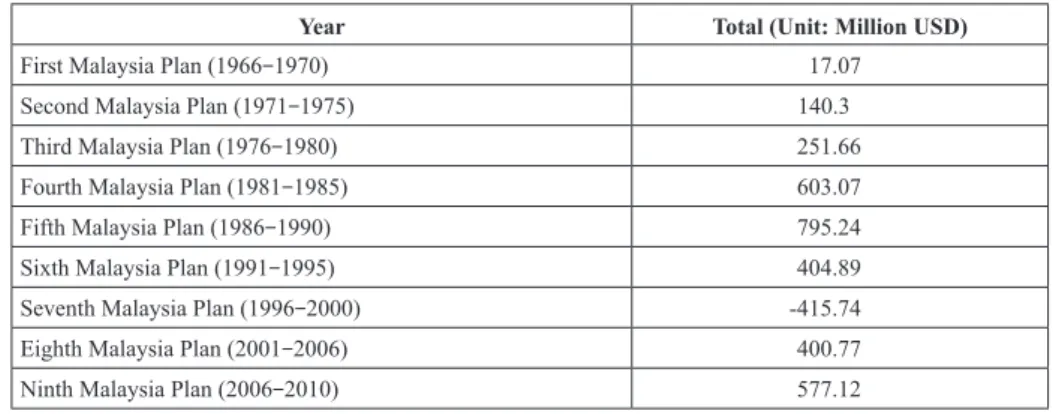
amount among any other recipient countries in Southeast Asia region. Due to the reduction of yen loan total, Malaysia did not apply a yen loan during the first year of Sixth Malaysia Plan in the third quarter in 1990. Although the amount of ODA to Malaysia started to be reduced, the total commitment of ODA consistency can be seen clearly from the First Malaysia Plan until the Ninth Malaysia Plan (Table 1). In 1966‒1970, USD 17.07 million was channelled and the amount increased to USD 140.3 million in 1971‒1975. The amount was rapidly increasing to USD 251.66 million, USD 603.07 million and USD 795.24 million for the period of 1976‒1980, 1981‒1985 and 1986‒1990. However, the amount decreased to USD 404.89 million in 1991‒1995 and USD 415.74 in 1996‒2000. This scenario occurred due to the government policy of reducing the infrastructure expenses for private sector in order to control public expenses aiming to sustain the excessive budget for the period of five years from 1993 until 1997. Meanwhile, public loan from other countries was also limited in order to reduce the risk of foreign exchange rate s inconsistency because the repayment of every loan will be paid in Ringgit. Hence, government took a rational step by not applying any yen loan for the said period. The loan total increased back to USD 400.77 million and USD 577.12 million for the period of 2001‒20015 and 2006‒2010.
Analysis results have found that disbursement orientation of ODA to Malaysia totalling USD 2,767.95 million over a period of 44 years was among the conducive aid in the 14 sectors such as energy, transportation, social services, mining, agriculture, fisheries and telecommunication. The harmonious relationship between Kuala Lumpur and Tokyo for about 44 years has enabled Malaysia to achieve socioeconomic modernisation which later allowed Malaysia to “graduate” from receiving ODA from Japan.1)
Table 1 Total amount of ODA from 1966–2010
Year Total (Unit: Million USD)
First Malaysia Plan (1966‒1970) 17.07
Second Malaysia Plan (1971‒1975) 140.3
Third Malaysia Plan (1976‒1980) 251.66
Fourth Malaysia Plan (1981‒1985) 603.07
Fifth Malaysia Plan (1986‒1990) 795.24
Sixth Malaysia Plan (1991‒1995) 404.89
Seventh Malaysia Plan (1996‒2000) -415.74
Eighth Malaysia Plan (2001‒2006) 400.77
Ninth Malaysia Plan (2006‒2010) 577.12
Sources: Modified from http://www.jica.jp/en/yen_loan and http://www.mofa.go.ip
1) Narongchai Akrasanee and Apichart Prasert, The Evolution of ASEAN-Japan Economic Cooperation, A
Foundation for East Asian Community; (ed. Japan Center for International Exchange), Tokyo: Japan Center for
International Exchange, p. 65. Izumi Ohno, Japanese Development Cooperation in a New Era: Recommendations for Network-Based Cooperation, GRIPS Discussion Paper 14‒15, National Graduate Institute for Policy Studies (GRIPS), Tokyo, Japan, p. 12, and http://www.mofa.go.jp/mofaj/gaiko/oda/shiryo/kuni/13_databook/pdfs/01-08.pdf.
Malaysia deserved to be “graduated” of receiving ODA from Japan due to the positive economic growth. ODA can be put as a development model because it creates a situation in which the investor and recipient countries are working together towards the advancement of socioeconomic development.2)
Gaimusho’s argument in Reviewed Issues on Malaysia s Development clarified a significant scenario in which Malaysia has achieved self-help level towards a take-off to the next socioeconomic development. By adapting the aid and other factors such as a steady administrative system, Malaysia s socioeconomic growth landscape showed a very significant achievement until it was listed among the 25 most competitive countries in the International Competitive Reports issued by World Economic Forum in the year 2012‒2013 and overtook a few new economic power countries such as China, Brazil and India. In addition, Malaysia was also listed in the second place after Singapore among the other countries in South East Asia region.
ODA Development in Malaysia
Malaysia has successfully attracted Japan s interest to channel the aid and strategic investment after Japan took into consideration factors such as political stability and security, conducive-environment for investment, friendly-business policies, liberal operating costs, productive workforce, raw materials, market opportunities and skilled labour.3) Aware of the benefits offered by Malaysia, Japan adopted the ODA as an instrument for
stimulating the domestic industry productivity at the micro and macro level.4) Meanwhile in Malaysia s context,
ODA that was channelled for 44 years became the conducive - financial source in assisting the provision of communication infrastructure towards an established socioeconomic growth.5 Japanese ODA development in
Malaysia can be analysed based on the amount of assistance that was channelled to support projects in the five year Malaysia development plans starting from the First Malaysia Plan 1966 to the Ninth Malaysia Plan 2010. Commitment of technical cooperation was the largest amount with a total of USD 1,440.35 million, followed by yen loan totalling USD 1,242.45 million, and grant aid was the smallest with a total of USD 97.21 million. Analysis results found that the human resource sector was the most dominant recipient for the technical cooperation commitment and grant aid, recording the amount of 24% and 58% for overall total of the assistance. Meanwhile, energy sector recorded a total of 1% assistance, making it the smallest recipient in those two categories. For the yen loan commitment, electric and gas sector recorded 51.7% of the assistance which made it the most dominant recipient, while the telecommunication sector was the smallest recipient totalling 0.8%. Analysis also shows the assistance which was first channelled back in 1969 has helped the modernisation process in Malaysia since the early stage of post-independence. The country s administrative
2) http://www.mofa.go.jp/mofaj/gaiko/oda/shiryo/kuni/13_databook/pdfs/01-08.pdf.
3) Narongchai Akrasanee and Apichart Prasert, “The Evolution of ASEAN-Japan Economic Cooperation,” A Foundation for East Asian Community; (ed. Japan Center for International Exchange), Tokyo: Japan Center for International Exchange, p. 65‒66.
4) Rui Faro Saraiva, Japanese Foreign Policy and Human Security in the Context of an Emerging New Global Order Journal of Conflict Transformation & Security Vol. 3, Issue. 1, p. 32‒33.
5) Hidekazu Tanaka, “International Cooperation and National Consensus Building, Quarterly Journal of Public
system was not firm during early post-independence due to the massive economic challenges and unbalanced economic status, but it gradually changed to become more competitive by adapting the assistance channelled such as ODA to socioeconomic projects. It is undeniable that the total commitment amount of USD 2,780.01 million during the 44 years period has fulfilled the financial resources to support 395 socioeconomic development projects which later changed the nation s development landscape.
Yen Loan to Malaysia
Yen loan is financial assistance scheme that is channelled with a low interest rate and a long repayment period of approximately 30 to 40 years. Yen loan also has the longest grace period which is 5 to 10 years with a mature period of approximately 15 to 40 years.6) The agency that is responsible for channelling the yen loan
is called JBIC.7)
With only one project totalling JPY 692 million that was implemented during the First Malaysia Plan, the total number of projects under the yen loan commitment rose to 6 projects totalling JPY 25.699 billion during Second Malaysia Plan and 17 projects totalling JPY 76.298 billion during the Third Malaysia Plan. Although the total amount of projects decreased to 13 during the Fourth Malaysia Plan, 14 projects during Fifth Malaysia Plan, 11 projects during Sixth Malaysia Plan and 10 projects during Seventh Malaysia Plan, the amount of yen loan channelled, conversely showed the increment to JPY 154.7 billion, JPY 158.402 billion, JPY 178.319 billion and JPY 233.32 billion. However, due to the nation s current economic growth, the loan amount was reduced to JPY 82.04 billion and JPY 7.644 billion during the Eighth Malaysia Plan and Ninth Malaysia Plan for one project.
Under the First Malaysia Plan, Japan channelled USD 8.72 million in the form of yen loan. Starting with only one transportation project together with the Public Works Department under the first yen loan commitment, the project became a pioneer for the implementation of upcoming transportation projects until the year 2010. Analysis found that from the overall total of Japanese ODA commitment to Malaysia until the end of fourth quarter in 2010, a total of 16 transportation projects worth JPY 119.689 billion were implemented and became the second most dominant sector after energy sector (electric and gas).
Under the Second Malaysia Plan, Japan channelled the total of JPY 25.699 billion (USD127.63 million) to Malaysia. Yen loan totalling JPY 36 billion was applied during Abdul Razak s visit to Japan on October 1971. Although at the early stage Japan only agreed to channel assistance totalling JPY36 billion to Malaysia, additional loan package with a total of JPY36 billion was channelled in order to support projects in the Second Malaysia Plan. Gift diplomacy package or omiyage gaikou was channelled during Prime Minister, Kakuei Tanaka s visit to Malaysia in January 1974. With the additional of JPY 36 billion, it made the overall total of yen loan commitment in the Second Malaysia Plan JPY 72 billion.
The gift diplomacy was seen as very significant because it was followed by the discussion regarding the mechanism on how to strengthen Malaysia-Japan bilateral relationship, discussion on the situation in Asia, regional cooperation, economic affairs and economic cooperation. In order to achieve the goal, 5 principles
6) http://www.jica.go.jp/english/our_work/types_of_assistance/oda_loans/standard/index.html.
were agreed upon. First, promoting better relationship with Malaysia and other Southeast Asia countries by sharing the peace and prosperity. Secondly, to respect the independence rights that are held by Malaysia and all the countries in the region. Third, promoting understanding between Malaysia and Japan. Fourth is assisting the economic development in Malaysia and other countries in the region without violating the economic rights freedom. Fifth is to respect the regional cooperation voluntarily between Malaysia and the involved countries. After the agreement to those 5 principles, Japan stated their readiness to positively cooperate in the effort of the nation development process and channelled the gift diplomacy and third yen loan to Malaysia in 1974. During the Second Malaysia Plan, few joint venture projects between Malaysia and Japan, mainly in the import substitution sector successfully contributed to the Malaysian economic competitiveness such as the sugar cane project in Perlis. Sugar production in a massive quantity led to the building of a sugar refinery factory worth JPY 2,997 billion and targeted as an import substitution project. According to a source published by Gaimusho in 1993, a total of 377 tons of sugar was imported by Malaysia in 1970 and the number is equal to 70% of refined sugar demand for a local market. As a consequence, it led to the government drafting a strategy to make the sugar refinery industry as a pioneer industry to promote the supply of sugar. The strategy successfully contributed a production of 62 thousand tons sugar in a year and it also lessened about 16% total amount of sugar imports in this nation since 1971.
In terms of energy resources, there was an annual increase of 9% between 1971 and 1975 compared to 1966 and 1970. Driven by the increment in population and the importance of energy resources industries to generate productivity in industrial sector, Japanese ODA was used to fund 3 energy projects in the Second Malaysia Plan. As shown in Table 2, three hydro-electric projects namely Temenggor I, II and III worth JPY22.093 billion were implemented under the yen loan commitment. Although the project was designed by consultants from Canada under the Canadian Assistance programme in 1967, yen loans were used to carry out civil works and purchases of project equipment. The project significantly succeeded in producing large-scale rock fill dams in Malaysia with a capacity of 260 MW which supplied enough energy from 1971 to 1975. Meanwhile, a total of JPY 609 million of yen loan was channelled to finance two infrastructure projects which were Temerloh s bridge and port projects in Johor during the Second Malaysia Plan. The bridge construction in 1973 was designed to overcome floods that hit Temerloh in 1971 and 1972.
ODA disbursement during the Third Malaysia Plan showed a very significant increment as much as 44.2% to JPY 76.298 billion (USD 214.93 million) in total. Among the factors that drew Japan s interest to continuously
Table 2 Yen Loan Projects 1971‒1975
Project Total (Billion Yen)
The Project of Plantation Refined Sugar Plant in Perlis The Temenggor Hydro-Electric Project I
The Temenggor Hydro-Electric Project (II) The Temenggor Hydro-Electric Project (III) The Johor Port Construction Project The Temerloh Bridge Project Total 2.997 13.300 4.091 4.702 0.290 0.319 25.699 Source: Modified and updated by researcher from http://www2.jica.go.jp/en/yen_loan
channelling the assistance was the continuation of the second stage in the implementation of the New Economic Policy (DEB) 8) by the government in order to acquire optimum productivity results in the industrial sector and its
potential to help the development of energy usage and the exploration of other resources in the nation. The fourth yen loan package totalling JPY 21 billion with an interest rate of 4% was channelled to Malaysia during Takeo Fukuda s visit to Malaysia in August 1977. The fourth yen loan package has two important criteria which are first, the assistance of JPY 21 billion continued until the 13th yen loan package, and second, the entire loan will be
channelled through the Overseas Economic Cooperation Fund (OECF), based on collective agreement between the OECF and the Export Import Bank (EXIM Bank). Malaysia then applied for a fifth loan totalling JPY 21 billion with 20 years repayment period when Prime Minister Hussein Onn visited Japan in August 1977 and the sixth yen loan worth JPY 21 billion was given in October 1979, under the same conditions. Therefore, the seventh yen loan totalling JPY 21 billion with a 25 year repayment period was applied during the fourth year in the Third Malaysia Plan in November 1980.9) Considering the total amount of assistance worth JPY 21 billion annually, Japanese ODA
has become a conducive-financial resource in funding 17 projects during the Third Malaysia Plan period. Starting from Fukuda s visit, bilateral relationship became stronger when he openly apologized for the cruelty portrayed by the Japanese army during the Second World War. He also stressed on Fukuda s doctrine that was introduced as Japan s commitment which aims to achieve peace and that Japan will never regain military power ever again. In addition, Fukuda s Doctrine also gave a new image to Japan and it became a catalyst in an attempt of building a good diplomatic relationship between Japan and the Association of Southeast Asian Nations (ASEAN).
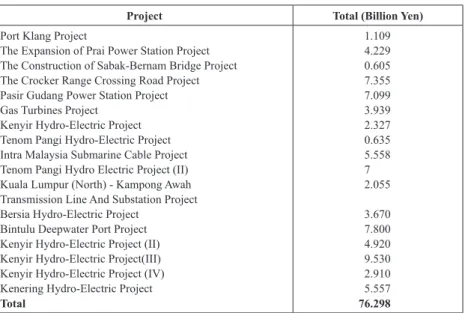
In total, 85.4% or USD 214.93 million of overall Japanese ODA was used to finance 17 projects under yen loan assistance during the Third Malaysia Plan (Table 3). The overall amount of yen loan channeled from 1976 until 1980 amounts to a total of JPY 76.298 billion, and it was found that that 77% or JPY 62.14 billion from the overall total was used to fund eight power plant projects which were Prai power station, Port Klang, Bintulu, Pasir Gudang, Bersia, Kenering, Kenyir and Tenom Pangi. Other than that, Japanese ODA was also utilized to purchase four units of gas turbine power stations for a few power stations plus to support the expansion of the Prai power station to increase its capacity from 90 MW to 240 MW.10)
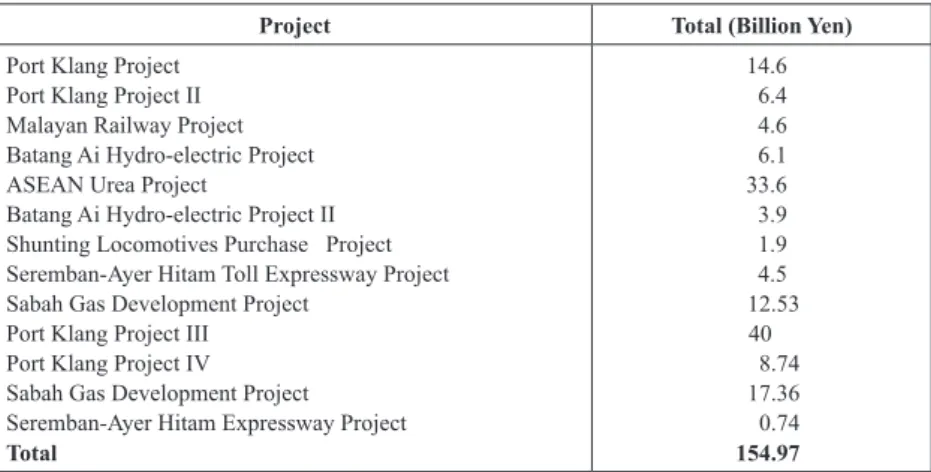
During the period of the Fourth Malaysia Plan, yen loan was still the conducive-financial resource with the implementation of 13 projects worth JPY 154.97 billion (USD 482.42 million). It was 80% of the overall commitment totalling USD 603.07 million which was channelled for the period of 1981–1985. The eighth yen loan package with an amount of JPY 21 billion was requested in September 1981. However, in order to increase capital flows to support the nation s development process, Dr. Mahathir took the initiative to visit Japan in 1983 to ask for consideration that more yen loans can be given to Malaysia. The initiative was successful when Japan agreed to channel additional yen loan package worth JPY 61 billion which is three times higher than the previous loan assistance. The additional package was divided into two parts; first was the ninth yen loan package totalling JPY 21 billion and second, a special yen loan amount JPY 40 billion. Meanwhile, the tenth and eleventh loan packages totalling JPY 21 billion were requested in January 1985 and April 1986 respectively. Due to a strong demand for energy resources, the Malaysian government allocated
8) http://pmr.penerangan.gov.my/index.php/ekonomi/1360-rancangan-malaysia-ketiga.html.
9) Junichi Yamada, Japanese Official Development Assistance in Southeast Asia, ISIS Kuala Lumpur, 1998. 10) http://studentsrepo.um.edu.my/711/7/BAB6.pdf.
additional funding for the country s energy sector. A total of JPY 48.5 billion was channelled into the Klang Port Power Station Project and another JPY 12.5 billion was used to finance the Sabah Gas Pipeline Project. As shown in the Table 4 below, a total of eight power station projects were successfully implemented under four fuel strategies and one of them was the Port Klang Power Station Project. The first phase of the project was executed on 15th May 1981 under the injection of the seventh yen loan package worth JPY 14.6 billion. The
project was designed to install two unit turbines (2×300 MW) with natural gas to replace fuel source in 1990. The second, third and fourth phases were implemented between 24th July 1981 and 20th April 1984. Although the
project was designed by a British consulting agency, it was funded by Japanese ODA. As can be seen in the Table 4 below, a total of 13 projects amounting to JPY 154.7 billion were financed by yen loan commitment. The power sector received the most dominant funding with the implementation of eight projects.
Under the Fifth Malaysia Plan, the government used the twelfth yen loan totalling JPY42 billion to finance the Peninsular Gas Development project in June 1986. The project was a government initiative to supply natural gas from the East Coast (Kerteh, Terengganu) to the West Coast of peninsular Malaysia with over 725 km length of pipeline installation. Significantly, the project not only supplied energy resources to power stations in Pasir Gudang, Port Dickson and Port Klang, but it also exported to Singapore and Thailand through a pipeline extension to those countries.
A year after the twelfth yen loan, Prime Minister, Noboru Takeshita announced a special yen loan stimulus package through the ASEAN-Japan Development Fund (AJDF).11) Loan amounting to USD 2 billion
11) http://www.aseansec.org.
Table 3 Yen Loan Projects 1976‒1980
Project Total (Billion Yen)
Port Klang Project
The Expansion of Prai Power Station Project The Construction of Sabak-Bernam Bridge Project The Crocker Range Crossing Road Project Pasir Gudang Power Station Project Gas Turbines Project
Kenyir Hydro-Electric Project Tenom Pangi Hydro-Electric Project Intra Malaysia Submarine Cable Project Tenom Pangi Hydro Electric Project (II) Kuala Lumpur (North) - Kampong Awah Transmission Line And Substation Project Bersia Hydro-Electric Project
Bintulu Deepwater Port Project Kenyir Hydro-Electric Project (II) Kenyir Hydro-Electric Project(III) Kenyir Hydro-Electric Project (IV) Kenering Hydro-Electric Project Total 1.109 4.229 0.605 7.355 7.099 3.939 2.327 0.635 5.558 7 2.055 3.670 7.800 4.920 9.530 2.910 5.557 76.298 Source: Modified and updated by researcher from http://www2.jica.go.jp/en/yen_loan
were allocated to promote agriculture, privatization, and Small and Medium Industries (SMIs) in ASEAN countries. Malaysia received an additional injection of JPY 36.7 billion (RM 700 million) through the AJDF package and all assistance were channelled to the Development Bank, Agricultural Bank and Industrial Bank. The establishment of these three banks as development financing institutions (IPP) was a rational government step designed to provide medium and long-term loan to finance entrepreneur in new industries such as Small and medium-sized enterprises (SMEs).
Japanese ODA disbursement trend started to show its changes since the thirteenth yen loan package after Malaysia was categorized as a country with UMIC status in 1988. However, due to the yen rate increment phenomena, Dr. Mahathir took an initiative to visit Tokyo and apply for more yen loans in October 1988. He requested two points for consideration to Japan which are first, the following yen loan should be amortized in the Malaysia ringgit and second, the exchange rate was to be fixed once the loan agreement was signed and loan transaction was made.12) However, Takeshita disagreed with the proposal since it would cause a change in
OECF s operational guidelines and rooting difficulties for ministries involved in the Japanese ODA program.13)
On the other hand, Takeshita agreed to channel the loan at an effective transaction rate, known as Loan Sector and Development Loan to Malaysia in July 1989.14) Seven months after the agreement was acquired, Japan
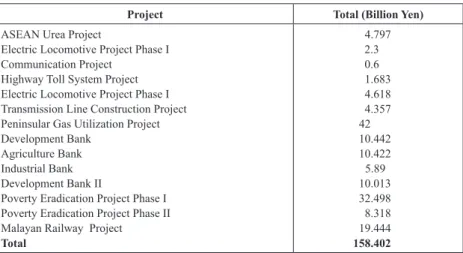
channelled the largest amount of loan packages in the history of ODA disbursement to Malaysia with an amount as much as JPY 62.9 billion under the thirteenth yen loan package in February 1990. As shown in Table 5, a total of JPY 158.402 billion yen loan was channelled during the Fifth Malaysia Plan to finance 14
Table 4 Yen Loan Projects Year of 1981‒1985
Project Total (Billion Yen)
Port Klang Project Port Klang Project II Malayan Railway Project Batang Ai Hydro-electric Project ASEAN Urea Project
Batang Ai Hydro-electric Project II Shunting Locomotives Purchase Project Seremban-Ayer Hitam Toll Expressway Project Sabah Gas Development Project
Port Klang Project III Port Klang Project IV Sabah Gas Development Project Seremban-Ayer Hitam Expressway Project Total 14.6 6.4 4.6 6.1 33.6 3.9 1.9 4.5 12.53 40 8.74 17.36 0.74 154.97 Source: Modified and updated by researcher from http://www2.jica.go.jp/en/yen_loan
12) Hugh Patrick, Legacies of Change: The Transformative Role of Japan s Official Development Assistance in its Economic Partnership with Southeast Asia, Discussion Paper No. 54, Discussion Paper Series APEC Study Center, Columbia University, p. 10.
13) http://www.jica.go.jp/malaysia. 14) http://www.jica.go.jp/malaysia.
development and infrastructure projects.
During the Sixth Malaysia Plan (1991‒1995) period, Japan channelled its fourteenth and fifteenth yen loan packages totalling JPY 62.9 billion and JPY 53.9 billion respectively in March 1992 and December 1992 (Table 6). However, due to the time consuming process in channelling aid within this period of time, Dr. Mahathir decided to stop applying for yen loans in August 1993.
Japan channelled a JPY 233.32 billion yen loan for ten projects during Seventh Malaysia Plan 1996‒2000 (Table 7). However, a crucial scenario happened in the ODA disbursement trend for a period between 1996 and 2000 when Japan channelled its largest aid in one fiscal year to Malaysia totalling JPY 119.247 billion in order to support three environmental conservation projects on 31st March 2000. Port Dickson Power Station Project II, Kenyir
Table 5 Yen Loan Projects 1986‒1990
Project Total (Billion Yen)
ASEAN Urea Project
Electric Locomotive Project Phase I Communication Project
Highway Toll System Project Electric Locomotive Project Phase I Transmission Line Construction Project Peninsular Gas Utilization Project Development Bank
Agriculture Bank Industrial Bank Development Bank II
Poverty Eradication Project Phase I Poverty Eradication Project Phase II Malayan Railway Project Total 4.797 2.3 0.6 1.683 4.618 4.357 42 10.442 10.422 5.89 10.013 32.498 8.318 19.444 158.402 Source: Modified and updated by researcher from http://www2.jica.go.jp/en/yen_loan
Table 6 Yen Loan Projects 1991‒1995
Project Total (Billion Yen)
Higher Education Loan Fund Project (HELP) Local Development Project(Poverty Eradication) Development Bank
Industrial Bank Development Bank II
Port Klang Power Station Project
Rehabilitation Of The Tenom Pangi Hydropower Project Federal Territory of Labuan Project
Hospital Universiti Kebangsaan Malaysia(HUKM) Port Klang Power Station Project II
Kuala Lumpur International Airport Project(KLIA) Total 5.493 10.949 4.660 4.660 4.660 31.966 0.543 3.7 10.215 39.95 61.518 178.319 Source: Modified and updated by researcher from http://www2.jica.go.jp/en/yen_loan
Hydroelectric Power Plant Project II and 13 Sewage Treatment Plants Project were the three projects that focused on improving the hygiene standard and minimized any negative impacts of electricity consumption on the environment. All three projects succeeded in achieving its environmental conservation target when 13 sewage treatment plants worth JPY 48.5 billion (RM 1.89 billion) were implemented under yen loan commitment.15) Analysis found that
the projects have benefited approximately 2.8 million people in urban and high density areas. Treatment process that adapts modern equipment from Japan was capable of processing polluted waste and managed to reduce 90% of environmental pollution.16) The projects consists of nine sewage treatment plants, four plants of sludge treatment
facilities and two non-physical projects namely administrative projects and consultancy services.
Meanwhile in the Eighth Malaysia Plan 2001‒2005 and Ninth Malaysia Plan 2006‒2010, only two projects under yen loan was executed which were the Pahang-Selangor Raw Water Transfer Project II worth JPY 82.04 billion and the educational HELP III project worth JPY 7.644 billion.
Based on above analysis, it was found that due to a lack of domestic capital, yen loan became a mechanism adapted to run socioeconomic projects that were arranged in line with the execution of development policy under Malaysia plan which at later time became a synergy to a steady development growth.
For instance, yen loan commitment worth JPY 917,113 billion (USD 1,241.45 million) that was channelled to Malaysia until the end of 2010 has succeeded in implementing 74 projects in 6 sectors which were 32 projects in electric and gas, 16 projects in transportation, 13 projects in social service, 10 projects in mining and manufacturing, 1 project in agriculture and fishery and 2 projects in telecommunication (Table 8). Implementation of those long term goal projects was seen to be leaving a dominant impact on nation s socioeconomic growth through various joint venture projects and the development of Japan s companies in Malaysia.
As shown in the Table 8 above, cumulative total of yen loan until the end of 2010 amounting to USD 1,241.45 million with an average of USD 128.05 million for each five year development plan of Malaysia. The commitment represented 44.7% from overall aid packages channelled for over 44 years and was used to
Table 7 Yen Loan Projects 1996‒2000
Project Total (Billion Yen)
Kenyir Hydroelectric Power Plant Project Port Dickson Power Station Rehabilitation Project II Sewerage Treatment Plant Project
Pahang-Selangor Raw Water Transfer Project HELP II
University Sarawak Construction Project Beris Dam Project
Port Klang Upgrading Project SME
Look East Policy (DPT) Total 16.994 53.764 48.489 1.093 5.285 18.549 9.737 49.087 16.296 14.026 233.32 Source: Modified and updated by researcher from http://www2.jica.go.jp/en/yen_loan
15) http://web6.bernama.com/client/iwk/news.php?id=375938. 16) http://web6.bernama.com/client/iwk/news.php?id=375938.
finance the cost of 74 projects in 6 main sectors namely electric and gas, transportation, telecommunication, social service, mining, manufacturing and agriculture. By considering the USD 1,241.45 million total of aid, the analysis found that the yen loan is among the most significant capital flow source to every project in the five year Malaysia development plan.
Starting with a first yen loan package17) totalling JPY 692 million channelled to Ministry of
Communication and Public Works to finance transportation projects from 27th January 1969, aid channelling
consistency can be seen until the second quarter in 2006. After financing HELP III project worth JPY 7.644 billion, Malaysia was officially graduated from receiving yen loan in 31st March 2006. However, Malaysia
was seen to receive back yen loan after JICA signed the ODA loan agreement for Malaysia-Japan International Institute of Technology (MJIIT) worth JPY 6.697 billion on 27th December 2011. A crucial scenario occurred
at this time when the assistance trend showed the changes after Gaimusho released a report Japanese ODA to Malaysia to review ODA disbursement trend. Based on current economic growth landscape and communication system infrastructure s development in Malaysia, Gaimusho decided to adapt the following ODA to 6 sectors to strengthen the Japan-Malaysia Economic Partnership Agreement (JMEPA), human resource development, energy resources usage, controlling of contagious diseases, maritime issues and violence.
Based on the Malaysia’s development, Japan decided to adapt the next assistance by focusing on more specific fields such as;
Promoting mutual benefits between Japan-Malaysia
(a) Japan-Malaysia Economic Partnership Agreement (JMEPA)
(b) To promote the professional exchange program between both countries. Intended to promote human resource development in Malaysia. Overcoming issues related to the modernisation process in Malaysia (a) Environments and energy
Overcoming regional challenges
17) http://www.jica.go.jp/malaysia/english/activities/past01.html.
Table 8 Yen Loan Project to Malaysia according to Sector in 1969‒2010
Sector Project Total Total (Billion Yen) Ratio (%)
Electric and gas 32 427,689 51.8
Transportation 16 119,473 14.4
Social Service 13 255,336 20.0
Mining and Manufacturing 10 98,015 11.8
Agriculture and Fishery 1 10,442 1.3
Telecommunication 2 6,158 0.7
Total 74 917,113 100.0
a) Maritime safety
b) Disasters prevention steps
c) Contagious diseases prevention steps such as bird flu (Avian flu) virus.18)
The continuous assistance shows that Malaysia is still significant in Japan s foreign economic policy.19)
Malaysia is located in the middle of the South East Asia region and this geostrategic factor gave great potential in offering investment chances in implementing joint-venture projects between these two countries.20) Malaysia
is supported by a market oriented economic system and pro-business policies created conducive business environment to Japanese investors for developing enterprise productivity in 20 involved sectors. The potential value of Malaysia was also debated by Gaimusho in two reports namely Reviewed Issues on Malaysia’s Development 21) and Assistance Strategy Policy to Malaysia 22) clarified that Malaysia is among the strategic
destinations of Japanese investors in developing relationship with other countries in this region and it made Malaysia a successful role model of ODA.
Assistance channelled is not only in a form of bilateral cooperation, but it is also intended to build cooperative networks as multidirectional partnership. In addition, it promotes the mutual importance as well. It also can be made as the best role model in creating future cooperation to build relationship as a global development partnership.
In Malaysia, our ODA staffs’ team conducted regular consultation with the Malaysian government. Through better strategic and effective activities, we are very confident the ODA effectiveness can be seen. When Japan-Malaysia Economic Partnership Agreement took effect in July 2006, a new cooperation frame was prepared to implement a comprehensive ODA cooperation in achieving continuous development synergy.23)
According to the analysis result shown in Table 8, energy sector (electric and gas) became the most dominant sector when it received assistance totalling JPY 427.689 billion. It was used to support 32 projects with a total ration as much as 51.7%. It was then followed by social service with 20%, transportation 14.4%, mining and manufacturing 11.8%, agriculture and fishery 1.3% and telecommunication 0.8%. Based on
18) http://www.my.emb-japan.go.jp/Japanese/bilateral/ODA_Malaysia2010.pdf, http://www.mofa.go.jp/mofaj/gaiko/oda/shiryo/kuni/11_databook/pdfs/01-08.pdf.
19) Narongchai Akrasanee and Apichart Prasert, The Evolution of ASEAN-Japan Economic Cooperation, A
Foundation for East Asian Community; (ed. Japan Center for International Exchange), Tokyo: Japan Center for
International Exchange, p. 65.
20) Charles J. Mc Millan, The Japanese Industrial System, Berlin: Walter de Gruyter & Co. 1994, p. 256. 21) http://www.mofa.go.jp/mofaj/gaiko/oda/shiryo/kuni/11_databook/pdfs/01-08.pdf.
22) http://www.mofa.go.jp/mofaj/gaiko/oda/seisaku/hoshin/pdfs/malaysia.pdf. 23) http://www.mofa.go.jp/mofaj/gaiko/oda/seisaku/hoshin/pdfs/malaysia.pdf.
analysis on projects total, loan total and overall assistance ratio, Graph 1 below shows overall yen loan commitment projects for each sector in the five year Malaysia development plan.
If the energy sector were to be questioned as the most dominant recipient in overall ODA total, few aspects need to be looked at such as National Energy Policy, National Industrial Policy and current economic growth, additional and operational foreign enterprises plus the total of direct foreign investment. Hence, it influenced government policy in diversifying national human resource. Research on few important aspects clarified few government mechanisms such as firstly an adequate, safe, effective energy resources supply through a renewable or non-renewable natural energy resources development. Second, encouraging the use of productive energy resources and reducing waste in industrial sectors. Third is minimising a negative impact on the environment in production and usage of energy resources in industrial sectors.
Since the industrial sector needs optimum energy total to operate technology machines for efficient products manufacturing, energy is one of the important components and impactful on the development of activity. In addition, an adequate total allocations is important for the operation of over 1,500 Japanese companies in 20 sectors. The nation surely learnt something due to the blackout tragedy in 1992 which stopped the nation s production for 48 hours. Joint ventures between the two countries via yen loan commitment in diversifying energy resources is very significant because rapid global economy led the nation to move even faster especially in industrial sector. To increase the industrial sector productivity, the earnings and distribution of optimum energy total is crucial in determining the directions of the sector. Meanwhile for Japan, which has the largest total of alliances in Malaysia, it is surely energy resources security that is among the aspects that need to be given critical attention because it influences its domestic economy.
Energy sector became the dominant recipient with a commitment totalling JPY 427.689 billion or 51.7% of overall assistance ratio. The implementation of 32 power plants projects under yen loan commitment gave the biggest impact to socioeconomic development because it managed to reduce dependency on oil resources as energy resources. Yen loan commitment in hydroelectric power plants and thermal projects such as Batang Ai Power Plant Station, Kenering Power Plant Station, Temenggor Power Plant Station, Pasir Gudang Power Plant Station, Prai Power Plant Station, Tuanku Jaafar Power Plant Station, Tenom Pangi Power Plant Station, Bersia Power Plant Station and Kenyir Power Plant Station are listed as the main projects in Malaysia. However, it needs to be informed that energy sector project is actually bigger if not receiving any ODA assistance.
Why is cooperation pattern in energy sector important for both countries? Assistance channelling process and investment s capital movement from Japan to developing countries including Malaysia through a model known as capital export is one of the factors that can explain the importance of the energy sector to Japan. Factors such as lack of raw material, market, labour, cost difference in manufacturing activity brought the ODA disbursement and Japanese capital movement to Malaysia. For researchers, capital flow happened from developed countries that owned big capital resources, and unfortunately lack of resources as stated above influenced cooperation pattern in energy sector. Significantly, assistance channelling from a developed country like Japan to a developing country like Malaysia has progressively integrated those countries in the Global Manufacturing Franchise (RPG). RPG is regarded as a benefit acquired through cooperation franchise via investment by foreign enterprises and Japan appeared to be the capital exporter since the mid 1970s.
The development of the manufacturing industry especially automobile and electric and electronic appliances brought changes to the energy usage pattern in Malaysia. The situation occurred due to the
0 2 4 6 8 10 12 14 RM1 RM2 RM3 RM4 RM5 RM6 RM7 RM8 RM9 0 1 2 3 4 RM1 RM2 RM3 RM4 RM5 RM6 RM7 RM8 RM9 0 1 2 3 4 5 6 7 RM1 RM2 RM3 RM4 RM5 RM6 RM7 RM8 RM9 0 1 2 3 4 RM1 RM2 RM3 RM4 RM5 RM6 RM7 RM8 RM9
Overall total for energy sector (electric and gas) 1971– 2000
Overall total for transportation sector 1966–1990
Overall total for social services sector 1986–2010
Overall total for mining and manufacturing sector 1971–2000 0 1 2 3 RM1 RM2 RM3 RM4 RM5 RM6 RM7 RM8 RM9 0 1 2 RM1 RM2 RM3 RM4 RM5 RM6 RM7 RM8 RM9
Overall total for telecommunication sector 1976–
1985
Overall total for agriculture and fishery sector 1986–1990 Graph 1 Overall Yen Loan Commitment Package Total for Each
Sector in Malaysia Five Year Development Plan.
importance of the energy sector in order to support operational process in every involved sector. Questions such as; can it be guaranteed that Japan will not face any problem if the energy resource support is not successful on over 1,500 enterprises in Malaysia? Will the failure be able to not influence Japanese domestic economy? These two questions were raised by the researcher in order to show how important that sector is to Japan to ensure every enterprise in Malaysia can operate as much as possible to fulfil every demand and global market because it will determine the Japanese economic growth projection.
Analysis on few yen loan projects to six involved sectors such as energy sector is very significant because it determined percentage ratio of loan for every national five year development plan. In order to acquire a more practical analysis result, yen loan percentage ratio from First Malaysia Plan until the Ninth Malaysia Plan is separated to allow an even clearer picture regarding the assistance channelling trend despite influencing every argument.
Energy Sector (Electric and Gas): Most Dominant Yen Loan Recipient
Malaysia that is rich with conventional and non-conventional energy sources is actively diversifying the usage by exploring energy production from any renewable resources. The conventional energy sources is not only vital in generating the energy sector in Malaysia, but it is also exported to outside countries such as Japan. Japan does not have promising geopolitics and geostrategic location that can ensure it is safe from any unwanted threats and tragedy. Japan was hit by the worst Tsunami in history back in 2011 that eventually caused it to be highly dependent on Liquefied Natural Gas (LNG) resources to replace nuclear technology capacity in generating energy resources. According to Ikeshita Joji s argument, a director of Japan External Trade Organization (JETRO), 34% of LNG Malaysia was estimated to be exported to Japan every year.24)
Starting from the first yen loan package worth JPY 22.093 billion during the Second Malaysia Plan, electric and gas sector became the most dominant sector that received ODA for 44 years. Until the end of the fourth quarter in 2000, Japan channelled JPY 427.689 billion to finance 32 electric and gas projects in Malaysia. The implementation of 32 power plant projects under yen loan commitment gave the biggest impact to socioeconomic development because it managed to reduce dependency on oil resources as energy resources. Based on a JICA report published in 2014, 53% of overall total energy produced by hydro and thermal power plant in 2010 is financed by Japanese ODA.
Analysis on the overall project in that sector found that it achieved its target in diversifying alternative energy resources usage by providing an optimum electric supply to industrial area in Peninsula Malaysia. Few implemented projects contributed to policy in promoting export by establishing several Free Trade Zones (FTZ) and hydroelectric factory in Johor, Prai and Port Klang from 1976 to 1980. For instance, Pasir Gudang Hydroelectric Station with a 240 MW capacity supplied energy resources to Johor in 1982, meanwhile Prai Hydroelectric Station started to supply energy sources to FTZ Prai and FTZ Bayan Lepas in Pulau Pinang in 1980 with 360 MW capacities. Similarly, for Port Klang Power Station Project in 1990, a yen loan was channelled to fund the project with the installation of two turbine units for a mixed fuel material (2 × 500 MW). It is efficient to burn natural gas and coal in order to produce energy sources. The project also reduces
the dependency on oil resource in generating the nation s electric sector. The project that started with 6 hydroelectric power stations in the Third and Fourth Malaysia Plan has contributed to the usage of alternative energy supply by burning coal for the nation s energy sources.
Based on Tenaga Nasional Berhad (TNB) information in 2010, electric supply from Port Klang Power Station accounted for approximately 6‒7% of the usage to in 1992‒2010. The information clarified one very significant scenario which is government strategy in adapting alternative source such as coal as fuel material. In addition, it achieved the target of providing optimum electric supplies to industrial area in Peninsula Malaysia. Reviewing the usage of coal from 10 years ago, statistics show the increment from 8.8% in 2000 to 21.85% in 2005 and increased to 36.5% until the end of the Ninth Malaysia Plan. The scenario shows that the trend of using coal resources in Malaysia is very competitive to ensure electric energy supply in the country is adequate until 2030.25)
Another example of a successful electric and gas sector project funded by Japanese ODA s commitment was the Port Dickson Hydroelectric Station Project. In the 1990s, electric demand in Peninsula Malaysia increased rapidly due to the economic growth together with the increment of foreign enterprises that invested in Malaysia. Electric demand increased more than twice until it reached 12,000 MW–14,000 MW capacities for the period of 1992‒1998. However, with the growth rate approximately 5‒7% annually, the total increased to 70,000 GWh–85,000 GWh in the middle of 2000. The total of energy demand in Peninsula Malaysia during that time focused especially in Kuala Lumpur s metropolitan area, Putrajaya, south west of Kuala Lumpur and areas that are located in Multimedia Super Corridor.
Significant investment situation in the involved industries triggered an increment of energy s demand. In 1998, total capacity of energy resources accommodation in Peninsula Malaysia was 12,617 MW, where TNB as as a major utility company as the dominant utility company in Malaysia owns 62% production capacity and Independent Power Producers (IPP) owns the balance of 38%. Due to the currency crisis at that time, funding for IPP s projects experienced difficulties and it caused the obvious delay in the implementation of the Port Dickson Hydroelectric Station project. For that reason, Malaysia s government focused on TNB s energy resource development.
Project implementation with Sumitomo Corporation, Toshiba Corporation, GE Power Systems Sdn Bhd (GEPSM), General Electric Co, General Electric Power Systems Inc. (GEPSI), Tokyo Electric Power Service Corporation (TEPSCO) who are seen as relevant and related to Malaysia Development Plan especially to promote energy generator besides providing protection on environments and plants. Energy sector policy goals in five year plan from 1996‒2000 are effective energy usage, energy sources diversity and minimizing energy usage impact on environments. Implementation of the project was based on its significant needs especially in the context of energy resources diversity to avoid dependency on oil sources by exploiting natural gas source, hydro power and coal. During the Malaysia Development Plan in 2001‒2005, promotion of renewable gas and energy as energy resources in power supply productivity was expanded. Meanwhile during the five year plan in 2006‒2010, reliability of energy supply, cost effectiveness and the importance of environment were given attention. Port Dickson Hydroelectric Station Project was among the main context of energy strategy
in Malaysia. It is because of its efficiency in terms of cost effectiveness and reducing negative impact on the environment compared to oil usage as energy source. For the period of 2006–2010, coal usage was increased to reduce excessive dependency on the use of gas as energy generator. With Japanese ODA commitment, the project enabled the gas usage capacity to generate energy sector from 1,350 mmscfd (million standard cubic feet per day) in the year of 2002 to 1,050 mmscfd by November 2011. Apart from this, Port Dickson Hydroelectric Station Project is related to the development which required control on nation s energy reserve. According to TNB s information, with the estimation rate of annual growth between 5‒7%, it led to the increasing demand of energy with the average of 5% from 1999‒2011.
According to the International Organization for Standardization (ISO) report, regarding the stable energy supply, hydroelectric output project was 750 MW, meanwhile Tested Annual Available Capacity (TAAC) was 694 MW under severe Malaysian environment which is caused by geographical conditions such as temperature and humidity. Monthly maximum output on the other hand was fluctuating from 694 MW to approximately 730 MW.
Loading factor as recorded by plants and preparation factor which is referring to temperature and humidity factor was approximately 80% or more. Meanwhile, rough heat effectiveness exceeds 55%. The situation proved the Port Dickson Hydroelectric Station Project was relevant. Graph 2 as shown below shows the station s clean energy production exceeding early fiscal year since the first commercial operation in January 2009. Unplanned disturbance hour percentage was small at approximately 2‒4%. TNB has also reported the disturbance hour percentage caused by human error was zero and no obvious machine problem caused any high quantitative impact on Port Dickson Hydroelectric Station Project.
According to the annual report of TNB in 2011, reduction of greenhouse gas release that was the main goal of the project was seen to have gone a significant way. It is based on real average potential from 2009 until 2011 when 37.7% reduction of green gas release was recorded. However, in terms of energy sources
Graph 2 Total of Port Dickson Hydroelectric Station Project s Clean Energy Production 2008‒2011
stability in Peninsula Malaysia, power capacity that was channelled in the early Port Dickson Hydroelectric Station Project s operation was 95,000 GWh.26) Meanwile, based on TNB s report in 2012, Port Dickson
Hydroelectric Station Project supplied approximately 5% of the total of electric supplies to Peninsula Malaysia in 2010‒2011.
Despite the project s delay which took 118 months of completion compared to the early estimation of 63 months, the Port Dickson Hydroelectric Station Project has been significant to the supply of energy source. For instance, to the allocation total of energy sources in Peninsula Malaysia in 2008 s fiscal year, energy generated from turbine gas contributed 60.7%, coal contributed 29.3% which showed the decreasing oil usage since 1998 as can be seen in Graph 3. Total energy production from gas of over 20,000 GWh was successfully maintained with contribution of energy from Port Dickson Hydroelectric Station Project.
The project s implementation proved that Malaysia did not depend on only one source in producing energy when the coal usage was introduced to replace the oil in order to be more environmentally friendly. The reduction of carbon dioxide gas release in protecting the environment and energy diversity have contributed to the sustainability of gas usage in producing energy through that project.
Based on TNB s current operational and maintenance report on Port Dickson Hydroelectric Station Project, it was found that the current situation of the facility was good, although there is the need of replacing steam turbine s parts. Parts which were already acquired and need to be maintained is always planned in the periodical examination from time to time. Facility and spare part storage of the project were also well managed which made the Port Dickson Hydroelectric Station Project listed as the most effective energy power plant in Malaysia. In addition, daily maintenance is also crucial to ensure the accuracy in repairing gas turbine for every 24 thousand hours and every 3 years for steam turbine.
1998
Coal 4.9% Gas66.3
%
Hydro
14.8
%
Oil/
Diesel
14.0
%
2008
Oil/ Diesel % 0.3 Hydro 9.7% Gas60.7
%
Coal 29.3%
Graph 3 Total of Energy Production between 1998 and 2008
Source: TNB
Overall, the Port Dickson Hydroelectric Station Project intended to ensure stability in electricity supply and the reduction of greenhouse gas release by mix cycle of gas turbine power plant was seen as very effective. The project contributes as well to the stability of energy supply by minimizing the dependency on energy source. Besides that, the project s evaluation was high in term of TNB s organizational, technical capability and financial aspects. For example, this can be seen from operational profit, profit/loss before tax and profit for the financial year. In 2007‒2008, operational profit was RM 3,625.2 million to RM 3,083.8 million in 2008‒2009, RM 3,502 million in 2009–2010 and RM 402.1 million in 2010–2011. The operational profit was RM 3,625.2 million in 2007‒2008, RM 3,083.8 million in 2008‒2009, RM 3,502 million in 2009‒2010 and RM 402.1 million in 2010‒2011.
Although the Port Dickson Hydroelectric Station Project was seen significant, few aspects such as the project s delay need to be analysed mainly considering the total of energy s demand and the forecast of energy supplies that will be needed in the future. If nation is to be encouraging the IPP, it is very crucial to study and follow the current information about the progress to allow the prediction of energy sources that might be needed in order to make it even more realistic. It includes implementation of IPP in energy development plan by looking on long term energy demands. In the context of ODA investors, the decision is very important to determine the chances of if the next energy sectors projects will be implemented with ODA or conversely. Due to the increasing demand for nation s electric energy, Port Dickson Hydroelectric Station Project, Port Klang Power Station Project and Kenyir Hydroelectric Power Station project which were funded by Japan s ODA were seen enhancing their production capacities. In 2013, TNB increased the capacity for those power stations as much as 15% through the improvement of four turbines, each of which can generate 100 MW all this while. The project was able to increase the ability of each turbine from 115 MW to 460 MW fulfil energy supply demand which rapidly increased annually. For example, TNB recorded that the nation s energy usage in March 2013 reached 16,500 MW compared to 15,300 MW for the same period in 2012.27) However,
the situation is still under control with the ability of TNB to generate as much as 21,000 MW monthly.28)
Apart from that, an adequate energy source is very important in ensuring the smoothness of domestic industrial sector s productivity. For instance, the worst blackout tragedy in Malaysia s history in 1992 did not only cause the country to be trapped in darkness for 48 hours, it also disrupted the nation s socioeconomic productivity when most of the industries had to stop their operations due to disconnection of energy supplies. Looking on the importance of energy source to domestic industrial sector, the government took an initiative to adapt Japan s ODA to implement 32 hydroelectric power stations project and other thermal power station such as Port Klang Power Station project which works with coal and natural gas to generate energy source. According to the report published by JETRO in 2011, the project was successfully contributing to the stability of electric power supply in Peninsula Malaysia area in 1992‒2010. Meanwhile, based on the energy usage report by TNB, Port Klang Power Station Project gave dominant impact because it successfully allocated the electric energy supply to areas in Peninsula Malaysia as much as 6% annually in 2001‒2010. In 2012, the overall power plants in Peninsula Malaysia showed the increment in thermal efficiency when it produces
27) http://www.utusan.com.my/utusan/Korporat/20130629/ko_01/Stesen-hidro-TNB-naik-taraf. 28) http://www.bernama.com/bernama/v7/bm/po/newspolitics.php?id=959681
88.8% total of electric generation in Malaysia. The capacity is to support the maximum demand of electricity that rose as much as 2.7% from 15,072 MW in 2010 to 15,476 MW in 2011. Based on analysis, Japanese ODA s commitment in hydroelectric projects and thermal were among the factor that assisting to an adequate supplies of energy sources to Peninsula Malaysia as well as to Sabah and Sarawak.
Analysis also found that by adapting foreign assistance commitment, Malaysia no longer risks to face another blackout tragedy like the one in 1992 because it can allocate enough energy to ensure all involved sectors can be operated under control. Meanwhile in terms of future economic prospect, an adequate energy source was seen as very crucial to determine investor countries trend on the new project implementations.
Conclusion
Yen loan to Malaysia from 1969 to 2010 left five significant impacts. First, yen loan commitment worth JPY 917,113 billion (USD 1,241.45 million) successfully implemented 74 projects in 6 sectors which are; energy (electric and gas) with as many as 32 projects, transportation with 16 projects, social services 13 projects, mining and manufacturing with 10 projects, agriculture and fishery with 1 project and telecommunication with 2 projects. First project with a yen loan commitment worth JPY 692 million was channelled to the Ministry of Communication and Public Works to fund a transportation project on 27th January
1969 while the last project in this research was HELP III totalling JPY 7,644 billion on 31st March 2006. The
biggest yen loan commitment was JPY 233.32 billion during the Seventh Malaysia Plan. The biggest project implementation total was during the Third Malaysia Plan with 17 project overall. Meanwhile, KLIA project with the commitment totalling JPY 61.518 billion during the Sixth Malaysia Plan became the biggest yen loan commitment to Malaysia until 2010. Second, Malaysia has successfully attracted Japan s interest to channel the aid and strategic investment after Japan took into consideration factor such as political stability and security, conducive-environment for investment, liberal operating costs, productive workforce, raw materials, market opportunities and skilled labour. Third, energy sector became the most dominant sector with JPY 427.689 billion or 51.7% commitment of overall assistance ratio. The implementation of 32 power sector projects has given a significant impact on nation energy production and successfully reduced the dependency on oil in producing energy. Fourth, ODA can be used as a development model because it creates a situation in which the investor and recipient countries are working together towards the advancement of socioeconomic development. Fifth, implementations of all projects that have long term goals such as electric and gas, transportation and communication projects left a significant impact on the nation s socioeconomic growth based on the assorted joint ventures project and the expansion of Japan s enterprises in Malaysia.
Bibliography Books
Arase, David., Conclusion , in Arase, D., (ed.), Japan’s Foreign Aid: Old Continuities and New Directions, New York: Routledge, 2005
Furuoka Fumitaka, New Challenges for Japan’s Official Development Assistance (ODA) Policy: Human Rights,
Democracy and Aid Sanctions. Kota Kinabalu: Penerbit UMS, 2006.
Holsti, K. J., International Politics: A Framework For Analysis, New Jersey: Prentice Hall, INC, Englewood Cliffs, 1967.
Hoshiyama Takashi and Tojo Tetsuo, Self-Portrait of Japan, Japan’s Foreign Policies Unreported by Malaysian
Media, University of Malaya Press, Kuala Lumpur, 2011.
James, Rosenau N., The Scientific Study of Foreign Policy, New York: Free Press, 1971.
Katada Saori, New Courses in Japan s Foreign Aid Policy: More Humanitarian and More Nationalistic, in S. Katada, H. Maull, and T. Inoguchi (eds.), Global Governance: Germany and Japan in the International System, Aldershot: Ashgate, 2004.
Lancaster, C., Foreign Aid: Diplomacy, Development, Domestic Politics. Chicago: University of Chicago Press, 2007. Leong, Stephen and others, Human Resource Development in Malaysia: Japan’s Contribution since 1980, Kuala
Lumpur, ISIS Malaysia, 1993.
Long, W., Nonproliferation as a Goal of Japanese Foreign Assistance, in A. Miyashita and Y. Sato (ed.), Japanese
Foreign Policy in Asia and the Pacific. New York and London: Palgrave, 2001.
Orr, R. M., The Emergence of Japan’s Foreign Aid Power. New York: Columbia University Press, 1990.
Peng Er, Lam, Japan’s Peace Building Diplomacy in Asia: Seeking a More Active Political Role, Singapore: Markono Print Media Pte Ltd, 2009.
Sato Makoto, An Historical Analysis of Japan s Aid Policy in Africa, in H. P. Lehman (ed.) Japan and Africa:
Globalization and Foreign Aid in the 21st Century, Oxon and New York: Routledge, 2010.
Stiglitz, Joseph E., Globalization and its Discontents, W.W. Norton & Company, 2003.
Takahashi Motoki, The Ambiguous Japan: Aid Experience and Notion of Selfhelp, in H. P. Lehman (ed.) Japan and
Africa: Globalization and Foreign Aid in the 21st Century, Oxon and New York: Routledge, 2010.
Takamine Tsukasa, Japan’s Development Aid to China: the Long-running Foreign Policy of Engagement, London and New York: Routledge, 2006.
Tsukasa Takamine, Japan’s Development Aid to China. Abingdon and New York: Routledge, 2006. Wallace, W., Foreign Policy and the Political Process, London: Macmillon, 1971.
Yamada Junichi, Japanese Official Development Assistance in Southeast Asia, ISIS Kuala Lumpur, 1998.
Yamashita Shoichi, Transfer of Japanese Technology and Management to the ASEAN Countries, Tokyo, University of Tokyo Press, 1992.
Yanigihara, T. and Emig, A., An Overview of Japan s Aid Policy, in S. Islam (ed), Yen for Development, Council on Foreign Relations Press, New York, 1991.
Yoshi Tsurumi, The Japanese are Coming, Cambridge: Ballinger Publishing Co. 1976. Journals and Discussion Papers
Aldukali Salem I. Almselati, Riza Atiq O.K. Rahmat dan Othman Jaafar, An Overview of Urban Transport in Malaysia, The Social Sciences, Volume 6, Issue 1, 2011.
Ali Hussein Hsan Sabeen, Ahmed Elmugtaba Anwar dan Zainura Z. Noor, Sustainable Public Transportation in Malaysia, International Journal of Engineering and Advanced Technology (IJEAT), Volume 1, Issue 5, 2012. Cameron M. Otopalik, Japan s Overseas Development Assistance: Assessing Conformance with Shifting Priorities,
International Journal of Politics and Good Governance, Volume 1, Issue 1.1, 2010.
Dipendra Sinha, Government Expenditure and Economic Growth in Malaysia, Journal of Economic Development, Volume 23, Issue 2, 1998.
Fumitaka Furuoka, Japanese Aid to the Pahang-Selangor Water Transfer Project in Malaysia: Aid Guidelines and Decision-Making, New Zealand Journal of Asian Studies, Volume 13, Issue 1, 2011.
Hidetomi Oi dan Junko Mimaki, Policy Transitions in Japanese ODA for Disaster Risk Reduction in Developing Countries, Asian Journal of Environment and Disaster Management (AJEDM), Volume 2, Issue 3, 2010. Kartini Aboo Talib, Nidzam Sulaiman, Suzanna Mohammed Isa dan Suhana Saad, Assessing the Look East Policy:
Moving beyond Work Culture and Ethic, Asian Social Science, Volume 9, Issue 17, 2013.
Mitsuya Araki, Japan s Official Development Assistance: The Japan ODA Model That Began Life in Southeast,
Asia-Pacific Review, Volume 14, Issue 2, 2007.
Mohamed Ariff, The Malaysian Economic Experience and its Relevance for the Oic Member Countries, Islamic
Mohammad Nurul Huda Mazumder, Elsadig Musa Ahmed dan Abul Quasem Al-Amin, Does Tourism Contribute Significantly to the Malaysian Economy? Multiplier Analysis Using I-O Technique, International Journal of
Business and Management, Volume 4, Issue 7, 2009.
Mohammad Nurul Huda Mazumder, Elsadig Musa Ahmed dan Md. Abdur Raquib, Estimating Total Contribution of Tourism to Malaysian Economy, International Journal of Business, Management and Social Sciences, Volume 2, Issue 3, 2011.
Nur Zaimah Ubaidilla, An Econometric Analysis of Road Transport Demand in Malaysia, International Journal of
Business Tourism and Applied Sciences, Volume 1, Issue 1, 2013.
Rozmi Ismail, Mohammad Hesam Hafezi, Rahim Mohd Nor dan Kamarudin Ambak, Passengers Preference and Satisfaction of Public Transport in Malaysia, Australian Journal of Basic and Applied Sciences, Volume 6, Issue 8, 2012.
Rui Faro Saraiva, Japanese Foreign Policy and Human Security in the Context of an Emerging New Global Order
Journal of Conflict Transformation & Security Volume 3, Issue 1, 2013.
Sereyvath Ky, Cheon-Woo Lee dan Peter J. Stauvermann A Comparative Study on Characteristics of ODA of China-Japan-Korea to Cambodia, Journal of East Asian Economic Integration, Volume 16, Issue 4, 2012.
Tanaka Hidekazu, International Cooperation and National Consensus Building, Quarterly Journal of Public Policy
& Management, Mitsubishi UFJ Research and Consulting, http://www.murc.jp/english/think_tank/quarterly_
journal/qj1004_06.
Bronson Percival, Japan-Southeast Asia Relations: Playing Catch-up with China, Comparative Connections, A
Quarterly E-Journal on East Asian Bilateral Relations, The CNA Corporation, http://csis.org/files/media/csis/
pubs/0603qjapan_seasia.pdf.
Narongchai Akrasanee and Apichart Prasert, The Evolution of ASEAN-Japan Economic Cooperation, A Foundation
for East Asian Community; (ed. Japan Center for International Exchange), Tokyo: Japan Center for International
Exchange, http://www.jcie.org/researchpdfs/ASEAN/asean_narongchai.pdf.
Hugh Patrick, Legacies of Change: The Transformative Role of Japan s Official Development Assistance in its Economic Partnership with Southeast Asia,” Discussion Paper No. 54, Discussion Paper Series APEC Study
Center, Columbia University, http://www8.gsb.columbia.edu/apec/sites/apec/files/files/discussion/54HP.pdf.
Izumi Ohno, Japanese Development Cooperation in a New Era: Recommendations for Network-Based Cooperation,
GRIPS Discussion Paper 14-15, National Graduate Institute for Policy Studies (GRIPS), Tokyo, Japan, http://
www.grips.ac.jp/r-center/wp-content/uploads/14-15.pdf.
Hadi Soesastro, Sustaining East Asia s Economic Dynamism: The Role of AID, PRI-OECD Research Project, CSIS, Indonesia, http://www.oecd.org/pcd/31970823.pdf.
Emilio de Miguel, Japan And Southeast Asia: From The Fukuda Doctrine To Abe s Five Principles, UNISCI
Discussion Papers, Ministerio de Asuntos Exteriores y Cooperación (MAEC), http://revistas.ucm.es/index.php/
UNIS/article/viewFile/44792/42219.
Kamahori Miki, Doing What s Possible on Time, The Japan Journal, 2007 August issue, page 4, http://www. japanjournal.jp/tjje/show_art.php?INDyear=07&INDmon=08&artid=157a9c2b6ece02303f53f6c703ebece7&pa ge=4.
Haider A. Khan, Aid and Development: What Can Africa Learn from the Macroeconomics of Foreign Aid in Some
Southeast Asian Economies?”, http://archive.unu.edu/hq/academic/Pg_area4/Khan2.html.
Takashi Kihara, Is Japanese aid ineffective? , http://www.asiapathways-adbi.org/2012/04/is-japanese-aid-ineffective/. Websites http://jams92.org/jamswp02/jamswp02-004.pdf. http://meih.st.gov.my/documents/10620/a2d10c59-1931-4e73-94ba-630d6be34575. http://pmr.penerangan.gov.my/index.php/ekonomi/1360-rancangan-malaysia-ketiga.html. http://studentsrepo.um.edu.my/711/7/BAB6.pdf. http://web6.bernama.com/client/iwk/news.php?id=375938.
http://www.aseansec.org. http://www.bernama.com/bernama/v7/bm/po/newspolitics.php?id=959681. http://www.bharian.com.my/articles/Gasasli_arangbatujanatenaga/Article/. http://www.jica.go.jp/english/our_work/types_of_assistance/oda_loans/standard/index.html. http://www.jica.go.jp/malaysia. http://www.jica.go.jp/malaysia/english/activities/past01.html. http://www.jica.org.ph/japanoda01.html. http://www.mofa.go.jp/mofaj/gaiko/oda/seisaku/hoshin/pdfs/malaysia.pdf. http://www.mofa.go.jp/mofaj/gaiko/oda/shiryo/kuni/11_databook/pdfs/01-08.pdf. http://www.mofa.go.jp/mofaj/gaiko/oda/shiryo/kuni/13_databook/pdfs/01-08.pdf. http://www.mofa.go.jp/policy/oda/white/2003/part1_2_3.html. http://www.my.emb-japan.go.jp/Japanese/bilateral/ODA_Malaysia2010.pdf. http://www.sinarharian.com.my/. http://www.st.gov.my/images/article/industry/peninsular.jpg, http://www.utusan.com.my/utusan/Korporat/20130629/ko_01/Stesen-hidro-TNB-naik-taraf, http://www2.jica.go.jp/en/evaluation/pdf/2011_MXVIII-1_4.pdf. [モハマド・イクバル・ビン・モハマド・フダ マレーシア国民大学社会・人文学部上級講師]