
2009年度 環境物質工学科
研究報告
1. Rh および Ln (Ln = La, Pr, Nd, Eu, Gd, Yb, and Y)を共ドープした層状ペロブスカイ
ト Ca3Ti2O7の可視光照射下での光触媒特性,西本俊介,岡崎義弘,松田元秀,三
宅通博,Journal of the Ceramic Society of Japan, Vol. 117, pp. 1175-1179, 2009
2. Direct synthesis of wholly aromatic polyamides by using reaction-induced crystallization, Kazufumi Kobashi, Kentaro Kobayashi, Haruki Yasuda, Kentaro Arimachi, Testuya Uchida, Kanji Wakabayashi, Shinichi Yamazaki, Kunio Kimura, Macromolecules, Vol. 42, No. 16, pp.6128-6135, 2009
3. Molecular orbital calculation of 29Si NMR chemical shift in borosilicates--- the effect of boron coordination to SiO4 unit ---, NANBA Tokuro, ASANO Yudai, BENINO Yasuhiko, SAKIDA Shinichi, MIURA Yoshinari, Physics and Chemistry of Glasses: European Journal of Glass Science and Technology, Part B, Vol. 50(5), pp. 301–304, 2009.10
4. Chemical recycling of municipal waste slag by using phase separation, NANBA Tokuro, KURODA Yutaro, SAKIDA Shinichi, BENINO Yasuhiko, Journal of the Ceramic Society of Japan, Vol. 117(11), pp. 1195-1198, 2009.11
5. Photocatalytic H2 evolution by layered perovskite Ca3Ti2O7 codoped with Rh and Ln (Ln = La, Pr, Nd, Eu, Gd, Yb, and Y) under visible light irradiation, NISHIMOTO Shunsuke, OKAZAKI Yoshihiro, MATSUDA Motohide, MIYAKE Michihiro, Journal of the Ceramic Society of Japan, Vol. 117, pp. 1175-1179, 2009
6. Correlation between basicity and coordination structure in borosilicate glasses, TANAKA Yusuke, BENINO Yasuhiko, NANBA Tokuro, SAKIDA Shinichi, MIURA Yoshinari, Physics and Chemistry of Glasses: European Journal of Glass Science and Technology, Part B, Vol. 50(5), pp. 289–293, 2009.10
7. Formation and morphology of "shish-like" fibril crystals of aliphatic polyesters from the sheared melt, Shinichi Yamazaki, Manabu Itoh, Takuya Oka, Kunio Kimura, European Polymer Journal, Vol. 46, No. 1, pp. 58-68, 2010
8. Proof of a Disentanglement Process of Aliphatic Polyesters via Transesterification by Evaluation of the Growth Rate of Spherulites, Shinichi Yamazaki, Takuya Oka, Kunio Kimura, Kobunshi Ronbunshu, Vol. 66, No. 10, pp. 475-482, 2009
Rh および Ln (Ln = La, Pr, Nd, Eu, Gd, Yb, and Y)を共ドープした層状ペロブス
カイト
Ca
3Ti
2O
7の可視光照射下での光触媒特性
Photocatalytic H2 evolution by layered perovskite Ca3Ti2O7 codoped with Rh and Ln (Ln = La, Pr, Nd, Eu, Gd, Yb, and Y) under visible light irradiation
西本俊介1),岡崎義弘2),松田元秀3),三宅通博4)
NISHIMOTO Shunsuke*1), OKAZAKI Yoshihiro2), MATSUDA Motohide3) and MIYAKE Michihiro4 ■ 概 要 ■
本研究では、Rh および Ln (Ln = La, Pr, Nd, Eu, Gd, Yb, and Y)を共ドープした層状ペロブスカイト
Ca3Ti2O7の可視光照射下での光触媒特性を報告する。Rh および Ln を共ドープした試料は、Rh のみをド
ープした試料よりも可視光照射下でのメタノール水溶液からの水素生成に対して高い光触媒活性を示
した。また、Rh および Ln を共ドープすることにより水素生成の誘導期間が短縮されることが分かった。
共ドープ元素が、Rh の酸化状態の制御に対して有効に作用するとともに酸素欠陥の形成を抑制し、光 触媒活性の向上に寄与したと考えられた。
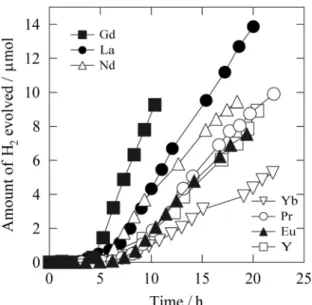
図 Pt/Ca2.9Ln0.1Ti1.9Rh0.1O7 (Ln = La, Pr, Nd, Eu, Gd, Yb, and Y)からの可視光照射下での水素生成。 光触媒; 0.3 g, 助触媒; Pt
(0.1 wt%), 反応溶液; 10 vol% メタノール水溶液(150 mL), 光源; 300-W キセノンランプ (λ > 420 nm). ■キーワード■ 光触媒,ペロブスカイト,可視光応答,共ドープ,水素生成 ■ 所 属 ■ 1) 環境物質工学科 助教 2) 環境物質工学科 3) 環境物質工学科 准教授(現 熊本大学 教授) 4) 環境物質工学科 教授 ■ 掲載先 ■
Journal of the Ceramic Society of Japan 117 1175-1179 2009
Journal of The Faculty of Environmental Science and Technology, Okayama University, Vol. 15 No.15-4-2
Direct synthesis of wholly aromatic polyamides by using reaction-induced
crystallization
Kazufumi Kobashi1), Kentaro Kobayashi1), Haruki Yasuda1), Kentaro Arimachi1), Testuya Uchida2), Kanji Wakabayashi3), Shinichi Yamazaki4), Kunio Kimura5)
■Summary■
Direct synthesis of rigid-rod aromatic polyamides was studied without condensation reagents by using reaction-induced crystallization of oligomers during solution polymerization. Polymerizations of p-aminobenzoic acid were carried out in an aromatic solvent at a polymerization concentration of 20% at 350 °C. High molecular weight poly(p-benzamide) (PBA) was obtained in the form of plate-like crystals, and the highest molecular weight was 11.6 × 10³. In this polymerization, the oligomers were formed in the solution by the condensation reaction with the elimination of water. When the molecular weight of oligomers exceeded the critical value, the oligomers were precipitated by crystallization via supersaturated state to form the plate-like crystals. The molecular weight increased by the polymerization between the oligomers on and in the crystals. Poly(p-phenylene isophthalamide) (PPIA) was also obtained in the form of plate-like crystals by the polymerization of p-phenylene diamine (PPDA) and isophthalic acid (IPA) under the same condition as that of PBA. These results exhibited the thermally direct synthesis of infusible aromatic polyamides. Sequential addition of monomers into this heterogeneous polymerization was examined to increase the molecular weight. In the step-growth polymerization, the addition of monomers into the homogeneous polymerization could not increase the molecular weight because it was determined by the extent of reaction and reshuffled by the transamidation reaction. However, the addition of PPDA and IPA during the polymerization resulted in the increase in the molecular weight of PPIA. This result gave possibly a novel procedure for the preparation of high molecular weight condensation-type polymers.
■Key word■
Aromatic Polyamide, Reaction-induced crystallization, Polycondensation ■Affiliation■
1) Graduate School of Environmental Science
2) Lecturer of Graduate School of Natural Science and Technology, Okayama University 3) Postdoctoral fellow of Graduate School of Environmental Science
4) Associate professor of Department of Environmental Chemistry and Materials 5) Professor of Department of Environmental Chemistry and Materials
■Printing■
Macromolecules Vol. 42, No. 16, pp.6128-6135, 2009. DOI: 10.1021/ma9009033
Molecular orbital calculation of
29Si NMR chemical shift in borosilicates
--- the effect of boron coordination to SiO
4unit ---
NANBA Tokuro1),ASANO Yudai2), BENINO Yasuhiko3), SAKIDA Shinichi4), MIURA Yoshinari5) ■Summary■
Borosilicate cluster models were constructed, and 29Si NMR chemical shift was estimated with molecular
orbital calculations. In Q4 species (SiO4 unit consisting of four bridging oxygen atoms), higher frequency shift
was confirmed due to the replacement of the surrounding SiO4 with BO4 units, and in the Q4 species associated
with more than one BO4 units, the chemical shifts were nearly identical to those in the Q3 species (SiO4 unit
including one non-bridging oxygen) in alkali silicates. The chemical shifts of Q4 species in borosilicates were interpreted as the change in bond angle of Si−O−(Si,B4) bridges. It was also found a change in chemical shift anisotropy of Q4 species. The Q4 species associated with two BO4 units indicated an anisotropy maximum, which
was smaller than the anisotropy of Q3 species.
Figure 1. -110 -105 -100 -95 -90 -85 -80 Ext.(m=4) Opt.(m=4) Opt.(m=3) Al 29Si NMR chemical shift (ppm) Q4(0Bm) Q4(1Bm) Q4(2Bm) Q4(3Bm) Q4(4Bm) Figure 2. Figure 1. A cluster model of Q4 species surrounded by three SiO4 and one BO4 units.
Figure 2. 29Si NMR chemical shift of Si atoms in various Q4 species surrounded by BOm units. Q4(kBm): Q4 species surrounded by k BOm units. Ext.: cluster models extracted from borosilicate crystals (k = 0: SiO2,
1: KNa2B3Si12O30, KBSi3O8, NaBSi3O8, 2: KBSi2O6, 3: CaB2Si2O8, 4: NaBSiO4). Opt.: hand-built cluster
models after geometry optimization. Al: experimental chemical shift of Q4 species surrounded by AlO4 units
in aluminosilicate crystals. ■Key word■
borosilicate glass, 29Si NMR chemical shift, molecular orbital calculation ■ Affiliation ■
1) Professor of Department of Environmental Chemistry and Materials 2) Graduate School of Environmental Science
3) Associate Professor of Department of Environmental Chemistry and Materials 4) Assistant Professor of Environmental Management Center
5) Emeritus Professor, Okayama University; Professor, University of Shiga Prefecture ■Printing■
Physics and Chemistry of Glasses: European Journal of Glass Science and Technology, Part B, Vol. 50(5), pp. 301–304, 2009.10.
Journal of The Faculty of Environmental Science and Technology, Okayama University, Vol. 15 No.15-4-4
Chemical recycling of municipal waste slag by using phase separation
NANBA Tokuro1),KURODA Yutaro2), SAKIDA Shinichi3), BENINO Yasuhiko4)
■Summary■
A chemical recycling method by using phase separation was applied to municipal waste slags. Glasses were prepared from incineration ash and ash-melted slag, where B2O3 was added to promote phase separation. The
glasses were heat-treated at temperatures higher than their glass transition temperatures, and they were soaked in hydrochloric acid, leaching CaO, Fe2O3, K2O, and S. Transparent and colorless solids containing ca. 80 mass% of
SiO2 were successfully obtained as residues. It was suggested that phase separation took place not in the
heat-treatment but in the vitrification process, and further characterizations are however required to investigate the phenomena at microscopic levels in the recycling processes.
(a) (b)
Fig. 1. Photographs of (a) the waste
-melted slag and (b) an end product recovered from the slag (s:b = 9:1)
The ratio s:b indicates the weight ratio between the slag and B2O3 in the slag glasses.
0 1 2 3 4 0 1 2 3 4 5 6 slag s:b=10:0 s:b=9:1 s:b=8:2 visible region Op tica l a b sor pt io n (r e l. u ni ts )
Photon energy (eV)
Fig. 2. Optical absorption spectra of the untreated slag
and the insoluble end products recovered from the slag.
0 20 40 60 80 100 CaO SiO2 Al2O3 P2O5 Fe2O3 TiO2 K2O S slag s:b=10:0 s:b=9:1 s:b=8:2 Content (mass%)
Fig. 3 (right). XRF-analytical composition of the insoluble end products recovered from the waste-melted slag.
The ratio s:b indicates the weight ratio between the slag and B2O3 in the slag glasses. The composition of the
untreated slag is also shown for comparison. ■Key word■
Municipal waste slag, Waste recycling, Chemical recycling, Phase separation, Glass ■ Affiliation ■
1) Professor of Department of Environmental Chemistry and Materials 2) Faculty of Environmental Science and Technology
3) Assistant Professor of Environmental Management Center
4) Associate Professor of Department of Environmental Chemistry and Materials ■Printing■
Journal of the Ceramic Society of Japan, Vol. 117(11), pp. 1195-1198, 2009.11.
Photocatalytic H
2evolution by layered perovskite Ca
3Ti
2O
7codoped with Rh and
Ln (Ln = La, Pr, Nd, Eu, Gd, Yb, and Y) under visible light irradiation
NISHIMOTO Shunsuke*
1), OKAZAKI Yoshihiro
2), MATSUDA Motohide
3)and
MIYAKE Michihiro
4)■Summary■
Layered perovskite Ca3Ti2O7 codoped with Rh and Ln (Ca3-xLnxTi1.9Rh0.1O7; Ln = La, Pr, Nd, Eu, Gd, Yb, and
Y; 0 ≤ x ≤ 0.15) was synthesized by a conventional solid-state reaction to investigate the effects of Rh and Ln codoping on the photocatalytic activity. Rh and Ln-codoped Ca3Ti2O7 exhibited a higher photocatalytic activity
than Rh-doped Ca3Ti2O7 for H2 production from an aqueous methanol solution under visible light irradiation (λ >
420 nm). In addition, the induction period for H2 production was shortened by codoping with Rh and Ln. The
codoped elements helped control the oxidation state of Rh ions and suppressed the formation of oxygen defects, improving the activity of the Rh-doped Ca3Ti2O7 photocatalyst.
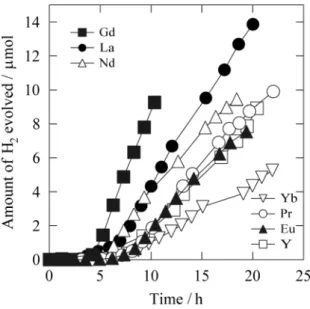
Figure H2 evolution from an aqueous methanol solution under visible light irradiation over Pt/Ca2.9Ln0.1Ti1.9Rh0.1O7 (Ln = La, Pr,
Nd, Eu, Gd, Yb, and Y). Catalyst; 0.3 g, cocatalyst; Pt (0.1 wt%), reactant solution; 150 mL of a 10 vol% aqueous methanol solution, and light source; 300-W Xe lamp with a cut-off filter (λ > 420 nm).
■Key word■
Photocatalyst, Perovskite, Visible light response, Codoping, Hydrogen production ■Affiliation■
1) Assistant Professor of Department of Environmental Chemistry and Materials 2) Department of Environmental Chemistry and Materials
3) Associate Professor of Department of Environmental Chemistry and Materials (Present affiliation: Professor of Kumamoto University)
4) Professor of Department of Environmental Chemistry and Materials ■Printing■
Journal of the Ceramic Society of Japan 117 1175-1179 2009
Journal of The Faculty of Environmental Science and Technology, Okayama University, Vol. 15 No.15-4-6
Correlation between basicity and coordination structure in borosilicate glasses
TANAKA Yusuke1), BENINO Yasuhiko2), NANBA Tokuro3),SAKIDA Shinichi4), MIURA Yoshinari5) ■ Summary ■
Various quaternary borosilicate glasses in the general system M2O−M′O−Al2O3−B2O3−SiO2 (M=Li, Na or K;
M′=Ca, Sr or Ba) were prepared, and the concentration of four-fold coordinated boron (B4) atoms was determined using 11B magic angle spinning NMR. Regression analyses were performed to predict the B4 fraction, in which B4 fraction and glass basicity were used as dependent and independent variables, respectively. Except for Al2O3-containing glasses, regression formulae giving high correlation coefficients were successfully obtained by
using B4/(B+Si×f) (where f is a tunable coefficient) as the dependent variable. As for the glasses containing Al2O3, however, the necessity of a different dependent variable was indicated.
0
0
.2
0
.4
0
.6
0
.4
0
.5
0
.6
0
.7
K=0 K=1 K=3B4/
(B
+
Si
×f
)
Basicity,
Λ
(a)|R|=0
.845
@ f=0
0
0
.2
0
.4
0
.6
0
.4
0
.5
0
.6
0
.7
K=0 K=1 K=3B4/
(B
+
Si
×f
)
Basicity,
Λ
(b)|R|=0
.939
@ f=0
.297
Figure. Fraction of four-fold coordinated boron atoms given by B4/(B+Si×f) in Na2O−CaO−B2O3−SiO2 system.
|R| is the correlation coefficient between the B4 fraction and basicity Λ shown by the lines. (a) f = 0, y = 837.40 Λ4 − 1808.5 Λ3 + 1428.5 Λ2 − 486.82 Λ + 60.361
(b) f = 0.297, y = 996.17 Λ4 − 2096.7 Λ3 + 1619.8 Λ2 − 542.21 Λ + 66.298
■ Key word ■
borosilicate glass, structure, regression analysis, 11B MAS-NMR ■ Affiliation ■
1) Graduate School of Environmental Science
2) Associate Professor of Department of Environmental Chemistry and Materials 3) Professor of Department of Environmental Chemistry and Materials
4) Assistant Professor of Environmental Management Center
5) Emeritus Professor, Okayama University; Professor, University of Shiga Prefecture ■Printing■
Physics and Chemistry of Glasses: European Journal of Glass Science and Technology, Part B, Vol. 50(5), pp. 289–293, 2009.10.
Formation and morphology of "shish-like" fibril crystals of aliphatic polyesters
from the sheared melt
Shinichi Yamazaki1), Manabu Itoh2), Takuya Oka3), Kunio Kimura4) ■Summary■
We found the formation of “shish-like” fibril crystals of aliphatic polyesters such as poly(l-lactic acid) (PLLA), poly(ε-caprolactone) (PCL), poly(12-hydroxydodecanoic acid) (PHDA) and poly(16-hydroxyhexadecanoic acid) (PHHA) from the sheared melt with shear rate γ = 5 s−1 observed by polarizing optical microscope (POM). The
melting temperature Tms of obtained fibril crystals of PLLA and PCL were higher than those of spherulites and
were close to the equilibrium melting temperature Tm0. The small angle X-ray scattering (SAXS) patterns from the
bulk sample including fibril crystals, small amount of unoriented small crystals and amorphous showed no peaks arose from the existence of long periods in fibril crystals. These are the evidence that the observed fibril crystals consist of assemblies of a lot of extended chain crystals (ECCs). We observed the morphology of moderately extracted single strand of fibril crystals at the magnification of POM by means of scanning electron microscope. We found that macroscopic fibril crystals of PLLA with diameter d = 10 μm consist of the bundle structure of microscopic fibril crystals with d = 2 μm. From POM observation of the formation of fibril crystals of PLLA and PCL, we showed phase diagrams of molecular weight M and crystallization temperature Tc for the formation of
fibril crystals. From these phase diagrams, we evaluated a critical M and Tc for the formation of fibril crystals.
Moreover, from the sequential melting and crystallization experiments, it was implied that the entanglement and transesterification play an important role on the formation of fibril crystals of aliphatic polyesters.
Left: Typical example of the formation of shish-like fibril crystal observed by polarizing optical microscope. Right: M–Tc phase diagrams of the formation of shish-like fibril crystal.
■Key word■
Shish-kebab; Fibril crystal; Crystallization; Aliphatic polyester; Poly(l-lactic acid); Shear flow ■Affiliation■
1) Associate professor of Department of Environmental Chemistry and Materials 2) Faculty of Environmental Science and Technology
3) Graduate School of Environmental Science
4) Professor of Department of Environmental Chemistry and Materials ■Printing■
European Polymer Journal, Vol. 46, No. 1, pp. 58-68, 2010. DOI: 10.1016/j.eurpolymj.2009.09.003.
Journal of The Faculty of Environmental Science and Technology, Okayama University, Vol. 15 No.15-4-8
Proof of a Disentanglement Process of Aliphatic Polyesters via Transesterification
by Evaluation of the Growth Rate of Spherulites
Shinichi Yamazaki1), Takuya Oka2), Kunio Kimura3)■Summary■
In order to proof the existence of a disentangling pathway of condensation polymers via transesterification, we measured the growth rate of spherulites (G) of poly(L-lactic acid) (PLLA) and poly(ε-caprolactone) (PCL) as a function of melt annealing time (Δt) before isothermal crystallization. We prepared three PLLA samples by means of reaction induced crystallization of oligomers during polymerization. For the sample with unclear crystal habit, we found that G was almost constant at Δt < 30 min, and then monotonically decreased with increasing Δt. On the other hand, for the sample with clear crystal habit, we found that G monotonically decreased with increasing Δt. For PCL prepared by bulk polymerization, we found that G shows a plateau at Δt < 30 min for the samples with a melt annealing temperature of Tmax=100 and 130°C. However, it was found that G monotonically decreased at
Tmax=80°C. From GPC measurements of PLLA and PCL after melt annealing, we confirmed that the molecular
weight did not change and molecular weight distribution became broad. These imply that PLLA and PCL have a pathway of disentanglement within the melt via transesterification.
Left: Schematic illustration of disentanglement via chain reptation motion and transesterification. Right: Annealing temperature Tmax dependence of growth rate of PCL against annealing time Δt.
■Key word■
Entanglement, Crystallization, Polyester, PLLA, Transesterification, Growth Rate ■Affiliation■
1) Associate professor of Department of Environmental Chemistry and Materials 2) Graduate School of Environmental Science
3) Professor of Department of Environmental Chemistry and Materials ■Printing■
Kobunshi Ronbunshu, Vol. 66, No. 10, pp. 475-482, 2009. DOI: 10.1295/koron.66.475


![[環境化学(Journal of Environmental Chemistry)Vol.20, No.2, pp.173 181, 2010]](data:image/gif;base64,R0lGODlhAQABAIAAAP///wAAACH5BAEAAAAALAAAAAABAAEAAAICRAEAOw==)