TUMSAT-OACIS Repository - Tokyo University of Marine Science and Technology (東京海洋大学)
Identification of Two Nucleosides, Inosine and
Guanosine, in the Bioactive Fraction from
Solaster dawsoni, which Induced Escape
Response in Asterina pectinifera
journal or
publication title
東京水産大学研究報告
volume
88
page range
7-13
year
2002-03-29
URL
http://id.nii.ac.jp/1342/00000095/
Identification of Two Nucleosides, Inosine and Guanosine, in the Bioactive Fraction
from Solaster dawsoni, which Induced Escape Response in Asterina pectinifera
Kazuyo Ukai*1, Shinji Kirihara*2, Yoshikazu Fujikawa*2, Masahiro Notoya*3 and Michio Namikoshi*1
(Received August 24, 2001)
Abstract: Asterina pectinifera flees from the natural predator Solaster dawsoni before contact (avoidance response). It was suggested that this reaction be generated by chemical substances since A. pectinifera responded to dead Solaster and its water extract. Two nucleosides, inosine and guanosine, were isolated from the water extract of Solaster dawsoni. The authentic samples of two nucleosides did not induce the escape response in A. pectinifera when tested separately. The reaction was observed by a 1:1 mixture, the same ratio as the natural mixture, of two nucleosides. Although sub-stances responsible to the avoidance reaction in A. pectinifera have not yet been obtained because mainly of their insta-bility, two nucleosides were identified in the bioactive fraction obtained from the water extract of S. dawsoni, which elicited the escape reaction in A. pectinifera.
Key words: Solaster dawsoni, Asterina pectinifera, Escape reaction, Avoidance reaction, Nucleoside, Inosine,
Gua-nosine
Introduction
Solaster spp. are deep and cold water species of
asteroids (starfish) with 11 to 15 rays (arms) and sometimes grown as large as 20 cm in radius (from the center of the disc to the tip of the longest ray). They preferably pray on echinoderms including asteroids and a cannibalistic feeding is also observed1). Our preliminary field observation and laboratory experiments revealed that
Solaster dawsoni in Mutsu Bay at Aomori Prefecture is a
specialist predator on asteroids and fed on seven asteroid species, Asterina pectinifera, Asterias amurensis,
Apbelasterias japonica, Certonardoa semiregularis, Luidia quinaria, Crossaster papposus, and S. dawsoni
(unpublished data). In the laboratory experiments, we found that A. pectinifera fled from the predator before contact with it. Similar responses have been reported for several asteroids, which are prayed by other asteroids1-4). Phillips has differentiated these defensive responses into two categories, avoidance responses and escape responses5). According to his definition, avoidance responses are behavioral reactions resulting from the detection of distant predators and escape responses are behavioral reactions resulting from physical contact with predators5). Avoidance reactions have been observed between asteroids and their pray invertebrates, such as
marine snails6-10). Defensive responses in pray asteroids to the predator asteroids reported thus far were categorized as escape responses. Therefore, we found a very interesting reaction of A. pectinifera against S.
dawsoni since it is the first example of the avoidance
response in the predator-pray interaction between two asteroid species.
Preliminary experiments in seawater aquaria showed that the avoidance response in A. pectinifera to S. dawsoni is induced by chemical substance(s), because A.
pectinifera responded to a dead S. dawsoni and also to its
water extract (unpublished data). We, therefore, started the chemical study on the avoidance reaction observed between A. pectinifera and S. dawsoni. Bioactive fractions were separated into a low molecular weight amphoteric fraction and a high molecular weight water-soluble fraction. The later fraction, which consisted of many substances, elicited the avoidance reaction, but the isolation of bioactive substances has not yet been successful since the bioactivity is lost during separation procedures. A response in A. pectinifera was induced by direct contact with the low molecular weight fraction (escape reaction). Two nucleosides, inosine (1) and guanosine (2) (Figure 1), were identified as main components of this fraction.
We report here the assignment of structures and the
*1 Department of Ocean Sciences, Tokyo University of Fisheries, 4-5-7 Konan, Minato-ku, Tokyo 108-8477, Japan. *2 Aomori Prefectural Aquaculture Center, Hiranai, Aomori 039-3381, Japan.
K. Ukai, S. Kirihara, Y. Fujikawa, M. Notoya and M. Namikoshi
8
ratio of two nucleosides in the low molecular weight fraction obtained from the water extract of S. dawsoni.
Materials and Methods
General
NMR spectra were measured on a Varian Unity Inova-500 spectrometer. Mass spectra were obtained by a Finnigan TSQ 700 triple quadrupole mass spectrometer (electrospray ionization (ESI) mode) equipped with DEC 2100 data system. High performance liquid chromatography (HPLC) was performed using a Shimadzu LC-VP HPLC system with a PEGASIL ODS column (4.6 x 250 mm, particle size 8μm, pore size
120Å). Inosine and guanosine were purchased from Kanto Chemical Co., Inc.
Animals
Solaster dawsoni was collected in Mutsu Bay at
Aomori Prefecture by fishing gears and scuba diving and stored in a freezer at -20°C. Asterina pectinifera was collected in Mutsu Bay by scuba and skin diving and maintained in closed circulation aquaria at 10°C.
Bioassay
A water tank (30 x 18 cm) was filled with natural seawater to a depth of 1.5 cm, and one A. pectinifera of 2 to 3 cm in radius was placed in a tank at 10 cm from the shorter side. After the test animal was settled, 30μL of a
solution of each test sample was introduced by a pipette at 1 cm distant from the terminal tentacle of the starfish. A behavior of the test animal was observed for 20 min. If the test animal did not move, 30μL of the same test solution
was contacted directly to the terminal tentacle of the starfish to see an escape reaction.
Each test sample was dissolved in water to make 1 mg/ mL and 0.1 mg/mL solutions. Water was used as a
negative control.
The experiment was conducted five times for one test solution with five test animals.
Avoidance and escape responses were placed into one of four categories by behaviors of the starfish. A "no" response was recorded if the tested animal did not move or moved toward a test sample. "Strong", "mild", and "weak" responses were recorded if the tested animal moved in the opposite direction of a test sample within one minute, more than one minute but within four minutes, and more than four minutes, respectively. A.
pectinifera, showed strong avoidance reactions to the
water extract of S. dawsoni, was selected as the test animals for the bioassay.
Three results of five experiments were adopted by omitting two experiments of the most and the least active results to rate the activity of the test sample. If more than two results of a test sample were the same categories, the sample was rated as this category. If three results were placed into three different categories, the bioassay was repeated with five test animals.
Isolation of Bioactive Fractions (Figure 2)
S. dawsoni (680 g) was cut into small pieces and
soaked in water (680 mL) for 3 h at 4°C. The water extract was filtered, and the filtrate was passed through a Diaion HP-20 column. The column was eluted with MeOH and evaporated the solvent to give the MeOH eluate (969 mg). The water layer was lyophilized, dissolved in water, and filtered. The filtrate was adsorbed on an ODS column, and the column was eluted with MeOH-water (gradient). Fr. 3, which elicited the escape response in A. pectinifera, was subjected to HPLC (ODS) separation with MeOH-10% acetic acid solution in water (1:9) to give 11 fractions, and Fr. 37 and Fr. 38 showed the bioactivity. Fr. 37 was further separated twice by HPLC with the same solvent mixture to afford pure inosine (1): ESIMS, m/z 559 (2M + Na), 291 (M + Na), 269 (M + H);
1H and 13C NMR data are listed in Table 1. Fr. 38 was
separated by HPLC with the same solvents to give a mixture of inosine (1) and guanosine (2): ESIMS, m/z 589 (2M + Na), 306 (M + Na), 284 (M + H); 1H NMR (D2O),
δ7.81 (H-8), 5.73 (H-1'), 4.55 (H-2'), 4.22 (H-3'), 4.04
(H-4'), 3.67 (H2-5').
Ratio of Inosine and Guanosine in Bioactive Fraction
Ratio of inosine and guanosine in Fr. 3 (50% MeOH-water eluate from an ODS column) was analyzed by ESIMS. The (M + H)+ ions of inosine (m/z 269) and
guanosine (m/z 284) were measured by a selected ion monitor (SIM) mode.
Protease Treatment of Bioactive Fraction
Fr. 1 (2 mg), eluted from an ODS column with water, was dissolved in water (l mL), and a water solution (0.1 mL) of Pronase E (0.1 mg, MERCK) was added to the solution. The mixture was incubated at 20°C for 3h at an ambient pH (6.8). A water solution of Fr. 1 with no enzyme was incubated at 20°C for 3h as control, which retained the activity.
Results and Discussion
Separation of Bioactive Fractions
The water extract of S. dawsoni, which elicited a strong avoidance response in A. pectinifera, was subjected to solid phase extraction with an HP-20 column. The MeOH eluate from the column did not show a bioactivity, and the avoidance reaction was induced by a non-adsorbed fraction (water layer). These facts revealed that saponins, polyhydroxysteroids, and other hydrophobic organic compounds were excluded from bioactive substances inducing avoidance or escape response11-13).
The water layer was freeze dried, and the residue was dissolved in water, filtered insoluble materials off, and passed through an ODS column. The column was washed with water and eluted with MeOH-water. The non-adsorbed solution and water washings were combined and lyophilized. This fraction (Fr. 1) elicited the strong avoidance reaction in A. pectinifera, which was lost by treatment of the fraction with a protease. It is, therefore, revealed that the avoidance reaction is induced by peptides/proteins in the water extract of S. dawsoni. Separation of Fr. 1 gave several bioactive fractions, which elicited weak to mild avoidance responses. The bioactivity was lost by further separation procedures. Isolation of bioactive substances inducing the avoidance response has thus far not been succeeded.
Fr. 3 obtained from the above ODS column (50% MeOH-water eluate) elicited weak to mild reaction when the test solution was touched by the terminal tentacles of
A. pectinifera (escape response). The fraction was,
therefore, further separated to identify the bioactive substances. HPLC (ODS) of Fr. 3 afforded eleven fractions, and A. pectinifera showed weak escape response to Fr. 37 and Fr. 38. These fractions were separated by HPLC to remove impurities, and the fractions (Fr. 37' and Fr. 38') retained the bioactivity.
Structures of Nucleosides
The 1H NMR spectra of Fr. 37' and Fr. 38' showed that both fractions were mixtures of two or more compounds. The 1H NMR spectrum of Fr. 38' (Figure 3) revealed the presence of two sets of signals, that is, Fr. 38' was a mixture of two main compounds. The 1H-1H correlation spectroscopy (COSY) spectrum14) of Fr. 38' fromδ2.3 to
6.4 ppm showed the connectivity of carbons ascribed to two five-carbon sugar units (Figure 4, solid and broken lines). The presence of sugar units and signals at aroundδ8 ppm suggested that Fr. 38' was consisted of
two nucleosides.
Since the 1H NMR spectrum of Fr. 37' was not clear, the fraction was further purified by HPLC (ODS). The isolated compound showed clean 1H (Figure 5) and 13C NMR (Figure 6) spectra. The signals observed in Figure 5 were also detected in Figure 3 as a set of smaller signals (marked by "i" in Figure 3). Chemical shifts of 13C and 1H signals observed in the spectra (Figures 5 and 6) and 1
H-1H COSY and heteronuclear multiple bond correlation
(HMBC)15) spectral data are listed in Table 1. 1H-1H COSY and HMBC data revealed that the sugar unit (C-1' to C-5') of this compound was ribose and that this
Figure 2. Separation scheme of bioactive fraction from Solaster dawsoni.
K. Ukai, S. Kirihara, Y. Fujikawa, M. Notoya and M. Namikoshi
10
Figure 3. 1H NMR spectrum (500 MHz in D2O) of Fr. 38'.
The signal due to the solvent was reduced by irradiation at δ 4.67.
Numbers show the positions of protons in guanosine (2). The signals marked by "i" are ascribable to inosine (1).
Figure 4. 1H-1H COSY spectrum (500 MHz in D2O) of Fr. 38'.
The signal due to the solvent was reduced by irradiation at δ 4.67. Solid lines show correlations due to the ribose unit of guanosine (2) Broken lines show correlations due to the ribose unit of inosine (1)
compound was an N-nucleoside. The structure of this compound was assigned by the comparison of NMR data with those of authentic nucleosides. 1H and 13C NMR data for this compound were identical to those for inosine16). The assignment was confirmed by ESIMS spectra of this compound and the authentic sample of inosine, which showed peaks at m/z 559, 291, and 269 ascribable to (2M + Na)+, (M + Na)+, and (M + H)+ ions, respectively.
The ESIMS spectrum of Fr. 38' showed smaller peaks at m/z 291 and 269 due to inosine and larger peaks at m/z 589, 306, and 284, which were identical to the (2M + Na)+, (M + Na)+, and (M + H)+ ions of guanosine. The set
of smaller signals observed in the 1H NMR spectrum of Fr. 38' (Figure 3, marked by "i") were assigned as those of inosine, and the set of larger signals was identical to those of guanosine16).
Thus, inosine (1) and guanosine (2) were identified as the components of bioactive fractions, which elicited the escape response of A. pectinifera. The ratio of two nucleosides in Fr. 3 was determined by ESIMS with an SIM mode as 1:1.
Bioactivity
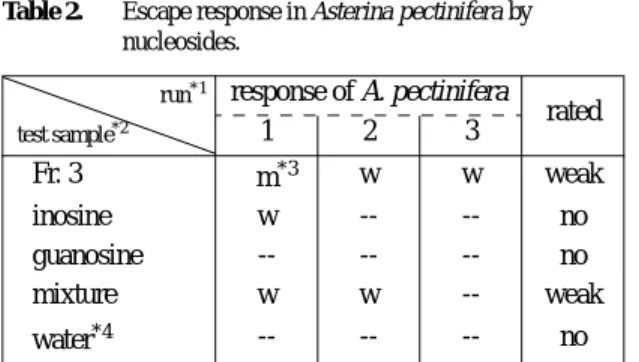
The bioactivity of Fr. 3 and nucleosides was summarized in Table 2. Authentic samples of inosine and guanosine did not elicit an escape response in A.
pectinifera when tested separately. A weak escape
response was, however, observed by a 1:1 mixture of two nucleosides, the same ratio detected in Fr. 3 (Table 2). These compounds, therefore, act synergistically to elicit this escape response.
The escape response in A. pectinifera induced by the solution of Fr. 3 was somewhat stronger than that by the mixture of authentic samples (Table 2). Fr. 3 may, therefore, contain small amounts of other substance(s), probably nucleoside(s), which show synergistic activity to inosine and guanosine
Saponins and polyhydroxysteroids have been identified as bioactive substances of asteroids responsible to avoidance and escape responses in their pray6, 9, 10, 17). The results obtained in this study clearly showed that these substances do not induce the avoidance response in
A. pectinifera against S. dawsoni, since they are adsorbed
on HP-20.
Mayo and Mackie reported that a pray asteroid Asterias
rubens showed escape response to two or three small
amphoteric substances and macromolecular compounds obtained from the predator asteroid Crossaster
Table 1. 13C (125 MHz) and 1H (500 MHz) NMR data (D2O)
for inosine (1) isolated from the water extract of Solaster dawsoni C# 13C signal δC 1H signal δH 1H-1H COSY HMBC 2 146.8 8.05 4, 6 4 149.2 ---5 124.9 ---6 159.3 ---8 140.9 8.18 4, 5 1' 89.0 5.92 2' 4, 8, 2' 2' 74.7 4.60 1', 3' 1', 4' 3' 71.1 4.25 2', 4' 1', 5' 4' 86.3 4.10 3', 5'a, 5'b 3' 5' 62.0 (a) 3.66 4' 3', 4' (b) 3.73 4' 3'
Figure 5. 1H NMR spectrum (500 MHz in D2O) of inosine (1)
isolated from the water extract of Solaster dawsoni. The signal due to the solvent was reduced by irradiation at δ 4.67.
Figure 6. 13C NMR spectrum (125 MHz in D2O) of inosine (1)
K. Ukai, S. Kirihara, Y. Fujikawa, M. Notoya and M. Namikoshi
12
papposus3). They also suggested that the small-molecule substances might be nucleosides and that these compounds also act synergistically to induce the escape responses3). Our results obtained in this study support the argument of Mayo and Mackie3).
Isolation and structure elucidation of peptides/proteins from S. dawsoni, which elicit the avoidance response in A.
pectinifera, will be the important future study to
understand the predator-pray interaction between these two asteroids.
Acknowledgement
This study was supported in part by a Grant-in-Aid for Scientific Research from the Ministry of Education, Science, Sports, and Culture of Japan (10460094) to MN and the Mikimoto Fund for Marine Ecology to KU. We are grateful to Varian Technologies Japan, Ltd. for NMR.
References
1) N. A. Sloan: Aspects of the feeding biology of asteroids. Oceanogr. Mar. Biol. Ann. Rev., 18, 57-124 (1980).
2) H. D. Van Veldhuizen and V. J. Oakes: Behavioral responses of seven species of asteroids to the asteroid predators, Solaster dawsoni (responses of asteroids to the predator Solaster dawsoni).
Oecologia, 48, 214-220 (1981).
3) P. Mayo and A. M. Mackie: Studies of avoidance reactions in several species of predatory British seastars (Echinodermata: Asteroidea). Mar. Biol., 38, 41-49 (1976).
4) K. P. Mauzey, C. Birkeland, and P. K. Dayton: Feeding behavior of asteroids and escape responses of their prey in the Puget Sound region. Ecology, 49, 603-619 (1968).
5) D. W. Phillips: Avoidance and escape responses of the gastropod mollusc Olivella biplicata (Sowerby) to predatory asteroids. J. Exp. Mar. Biol. Ecol., 28, 77-86 (1977).
6) N. Takahashi, M. Ojika, and D. Ejima: Isolation and identification of a trihydroxysteroid disulfate from the starfish Plazaster borealis which induces avoidance reaction-inducing substance in the sea urchin Strongylocentrotus nudus. Fish. Sci., 66, 412-413 (2000).
7) M. A. Duval, A. M. Calzetta, and D. Rittschof: Behavioral responses of Littoraria irrorata (Say) to waterborn odors. J. Chem. Ecol., 20, 3321-3334 (1994).
8) C. Harvey, F. X. Garneau, and J. H. Himmelman: Chemoreception of the predatory seastar
Leptasterias polaris by the whelk Buccinum undatum. Mar. Ecol. Prog. Ser., 40, 79-86 (1987).
9) A. M. Mackie: Avoidance reactions of marine invertebrates to either steroid glycosides of starfish or synthetic surface-active agents. J. Exp. Mar. Biol.
Ecol., 5, 63-69 (1970).
10) A. M. Mackie, R. Lasker, and P. T. Grant: Avoidance reactions of a mollusc Buccinum undatum to saponin-like surface-active substances in extracts of the starfish Asterias rubens and Marthasterias
glacialis. Comp. Biochem. Physiol., 26, 415-428
(1968).
11) L. Minale, R. Riccio, and F. Zollo: Structural studies on chemical constituents of echinoderm, in 「Studies
in Natural Products Chemistry」(ed. by
A.-ur-Rahman), Vol. 15, Elsevier Science, New York, 1995, pp. 43-110.
12) L. Minale, R. Riccio, and F. Zollo: Steroidal oligoglycosides and polyhydroxysteroids from echinoderms. Prog. Chem. Org. Nat. Prod., 62, 75-308 (1993).
13) M. V. D'Auria, L. Minale, and R. Riccio: Polyhydroxy steroids of marine origin. Chem. Rev., 93, 1839-1895 (1993).
Table 2. Escape response in Asterina pectinifera by nucleosides.
run*1 response of A. pectinifera
rated test sample*2 1 2 3 Fr. 3 m*3 w w weak inosine w -- -- no guanosine -- -- -- no mixture w w -- weak water*4 -- -- -- no
*1 Five experiments were run separately using each one test animal for each sample, and the most and the least active runs were omitted.
*2 Each test sample (1 mg) was dissolved in water (1 mL), and 30µL of the solution was used for bioassay: Fr. 3, see Figure 2; inosine and guanosine, authentic samples; mixture, inosine:guanosine = 1:1.
*3 Determination of categories see Materials and Methods: m, mild; w, weak; --, no response.
14) D. Marion and K. Wuthrich: Application of phase sensitive two-dimensional correlated spectroscopy (COSY) for measurement of 1H-1H spin-spin coupling constants in protein. Biochem. Biophys.
Res. Comun., 113, 967-974 (1983).
15) A. Bax, A. Azolos, Z. Dinya, and K. Sudo: Structure elucidation of the antibiotic desertomycin through the use of new two-dimensional NMR pulse techniques. J. Am. Chem. Soc., 108, 8056-8063 (1986).
16) E. Pretsch, T. Clerc, J. Seibl, and W. Simon: Tables of Spectral Data for Structure Determination of Organic Compounds, 2nd ed., (Translated in English by K. Biemann), Springer-Verlag, Berlin, 1989. 17) A. M. Mackie and P. T. Grant: Interspecies and
intraspecies chemoreception by marine invertebrates, in 「Chemoreception in Marine
Organisms」(ed. by P. T. Grant and A. M. Mackie),
Academic Press, New York, 1974, pp. 105-141.
イトマキヒトデに逃避行動を起こさせるニチリンヒトデ分離画分中の核酸イノシンとグアノシンの同定 鵜飼和代*1・桐原慎二*2・藤川義一*2・能登谷正浩*3・浪越通夫*1 *1東京水産大学海洋環境学科 *2青森県水産増殖センター *3東京水産大学資源育成学科 イトマキヒトデは天敵ニチリンヒトデの接近を感知して忌避行動をとる。この行動は死んだニチリンヒ トデおよびその水抽出物でも誘起されることから、化学物質が関与していることが示唆されていた。そこ で、エゾニチリンヒトデ水抽出物の分離をおこない、イトマキヒトデに逃避行動をおこさせるフラクション から 2種類の核酸、イノシンとグアノシン、を同定した。標品の核酸を用いた生物検定試験の結果、これら の核酸は単独では逃避行動を誘起しなかったが、天然混合比と同じ 1:1 の混合物が 1 ppm で活性を示した。イ トマキヒトデに忌避行動を誘起する物質は不安定であるために未だ単離に至っていないが、逃避行動を誘起 するフラクションの構成成分として 2 種類の核酸の構造を明らかにした。 キーワード : ニチリンヒトデ , イトマキヒトデ , 逃避行動 , 忌避行動 , 核酸, イノシン , グアノシン