On the effect of impurities in metallic glass
formation
著者
Yu J. S., Zeng Y. Q., Fujita T., Hashizume
T., Inoue A., Sakurai T., Chen M. W.
journal or
publication title
Applied Physics Letters
volume
96
number
14
page range
141901
year
2010
URL
http://hdl.handle.net/10097/51841
doi: 10.1063/1.3373528On the effect of impurities in metallic glass formation
J. S. Yu,1 Y. Q. Zeng,1 T. Fujita,1 T. Hashizume,1,2 A. Inoue,1 T. Sakurai,1 and M. W. Chen1,a兲
1
World Premier International (WPI) Research Center, Advanced Institute for Materials Research, Tohoku University, Sendai 980-8577, Japan
2
Advanced Research Laboratory, Hitachi Ltd., Hatoyama, Saitama 350-0395, Japan
共Received 24 December 2009; accepted 3 March 2010; published online 5 April 2010兲
We report atomic-scale characterization of impurity elements in a Pd40Ni40P20 metallic glass by
state-of-the-art atom probe tomography combining with transmission electron microscopy. The significant partitioning of the impurities in heterogeneous nanocrystals of the primarily crystallized glass provides compelling evidence that minor impurities dramatically influence the stability of supercooled liquids by manipulating heterogeneous crystallization of metallic glasses. © 2010 American Institute of Physics. 关doi:10.1063/1.3373528兴
Glass formation is one of the fundamental issues that have not been well understood in materials science and solid-state physics.1–3Intense efforts have recently been devoted to investigate the underlying mechanisms of metallic glass formation.4–7 In principle, the formation of metallic glasses is a competing process between stability of supercooled liq-uids and formation kinetics of rivaling crystalline phases.8,9 Since both liquid stability and crystallization kinetics strongly depend on chemical composition of alloys, it has long been known that a slight composition change, in par-ticular, the presence of a small amount of impurities, can radically influence glass forming ability 共GFA兲.10–13 Never-theless, how the dilute impurities influence GFA remains poorly known and demands comprehensive investigation. Pd40Ni40P20, a model alloy used in this study, is one of
the best metallic glass formers known since 1970s.14,15The GFA of this alloy significantly relies on a B2O3 fluxing treatment.16Since the fluxing treatment can suppress hetero-geneous nucleation of crystalline phases by scavenging im-purities, it is thus believed that the glass formation of Pd40Ni40P20is controlled by impurity-induced heterogeneous
crystallization.16–20 However, the direct experimental evi-dence of this impurity effect is extremely scarce because of dilute concentration of impurity elements and low density of heterogeneous crystals. Thus, how the presence of impurity elements influences the stability of the supercooled liquid and thereby the glass formation of Pd40Ni40P20has not been
definitively elucidated by experiment to date.
Pd40Ni40P20 alloy was prepared by melting pre-alloyed Ni-P ingots with the mixtures of Pd and Ni elements in fused silica tubes. The glassy ribbons were produced by melt spin-ning. The purity of the elements used in this study is above 99.9 at. %. The endothermic and exothermic reactions asso-ciated with Tgand Txwere measured in a continuous heating
mode by differential scanning calorimetry at a heating rate of 40 K/min. The values of Tg and Txwere measured to be
592 K and 675 K, respectively. Specimens sealed in quartz tubes filled with pure Ar were annealed at 603 K for 180 min. The samples for atom probe experiments were mechani-cally ground to square rods of⬃30⫻30 m2 and then
pol-ished to a needle shape with a sharp tip by a microelectropol-ishing technique. A three-dimensional 共3D兲 atom probe equipped with the Oxford delay line tomographic detection system was employed in this study.21The atom probe analy-sis was performed at a temperature of ⬃40–60 K at high vacuum of 10−10 Torr with a pulse fraction of 0.2 and pulse repetition rate of 1500 Hz. A JEOL JEM 2100F transmission electron microscope 共TEM兲 with double aberration correc-tors was employed for microstructural characterization.
The glassy and primarily crystallized Pd40Ni40P20
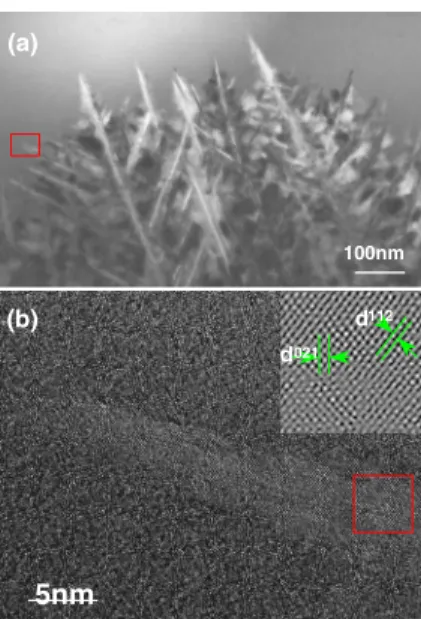
samples were characterized by TEM. For the as-prepared glassy sample, crystalline phases, including nanoparticles, have not been found by both conventional TEM and high-resolution transmission electron microscopy 共HRTEM兲. In contrast, a heterogeneous crystalline phase with dendrite morphology can be observed in some regions of the annealed sample. The bright-field TEM micrograph of Fig.1共a兲shows an example of a dendritic crystal in the amorphous matrix. The diameter of each dendritic branch is ⬃20 nm and the
a兲Author to whom correspondence should be addressed. Electronic mail:
[email protected]. 100nm (a) d112 d021 5nm (b)
FIG. 1. 共Color online兲 Microstructure of annealed Pd40Ni40P20 metallic
glass.共a兲 Bright-field TEM micrograph showing a heterogeneous dendrite
crystal in an amorphous matrix and共b兲 high-resolution transmission electron
microscope共HRTEM兲 image taken from the marked frame in 共a兲 showing a
dendritic branch embedding into a amorphous matrix. The inset shows
zoom-in HRTEM image from the marked region in共b兲.
APPLIED PHYSICS LETTERS 96, 141901共2010兲
0003-6951/2010/96共14兲/141901/3/$30.00 96, 141901-1 © 2010 American Institute of Physics
interspace between dendritic branches is filled with a residual amorphous phase with a width of ⬃20 nm. Figure 1共b兲 shows a HRTEM image of a dendritic branch embedding in amorphous matrix. Crystallographic analysis suggests that the primary crystal has an orthorhombic structure with a growth direction of关112兴.
The mass spectrum of the as-prepared Pd40Ni40P20
metallic glass was measured by atom probe.22 The concentrations of Pd, Ni, and P were determined to be 37.3⫾0.065 at. %, 42.4⫾0.067 at. %, and 19.92 ⫾0.052 at. %, respectively, which fairly agree with the nominal composition of the alloy. Therefore, the chemical compositions measured in this study can be considered as quantitative ones. Interestingly, a small amount of impurity elements of 0.279⫾0.0039 at. % silicon 共Si兲, 0.0487⫾0.0018 at. % boron 共B兲, and 0.057⫾0.0015 at. % carbon 共C兲 were detected in the Pd40Ni40P20 metallic glass. Silicon may be from silicate crucibles and carbon from the fabrication process and raw materials. Since the alloy used in this study was not fluxed by B2O3, the small amount of B is
most likely from the raw materials, such as Ni and P. In contrast, oxygen, which has been traditionally considered to be the main impurity in this alloy, has a very low content, close to the noise level of this experiment, and thus is ig-nored in this study. Figure 2 shows the atom maps of the as-prepared sample. Each dot in the maps corresponds to an individual atom and obvious segregation of Si, B, and C cannot be seen. The subnanoscale chemical homogeneity of the glassy alloy is further proved by the concentration profiles,22which show the relatively uniform distributions of Pd, Ni, P, B, C, and Si within the expected error from count-ing statistics.
Figure 3共a兲 illustrates the atom maps from a selected dendritic region in the annealed alloy. The analyzed volume is of about 30⫻30⫻120 nm3. Accompanying the
heteroge-neous crystallization revealed by TEM 关Fig. 1共a兲兴, obvious
chemical inhomogeneity can be found in this region. Two phases distinguished by Pd-rich and P-rich regions with a length scale of⬃20 nm can be observed in the 3D chemical maps. The concentration profiles 关Fig.3共b兲兴 further demon-strate that the Pd-rich phase contains ⬃46 at. % Pd, 38 at. % Ni, and 16 at. % P whereas the P-rich phase is
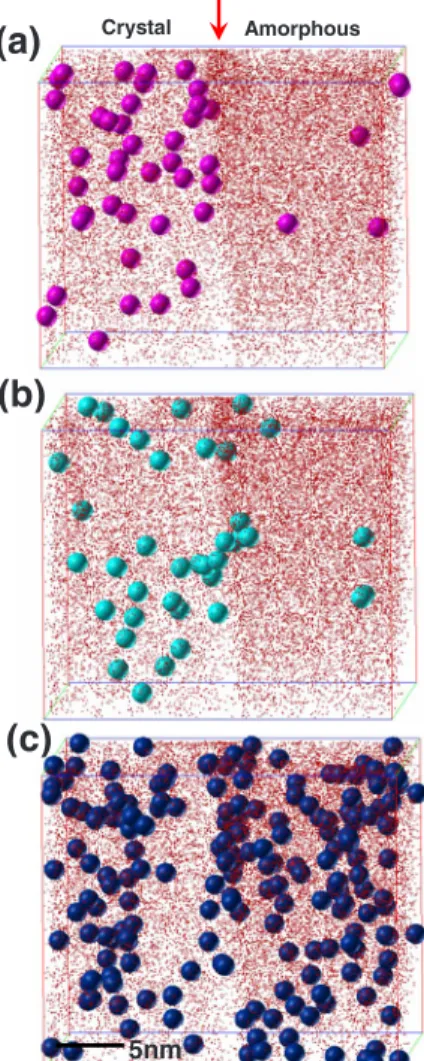
composed of ⬃27 at.% Pd, 46 at. % Ni, and 27 at. % P. The two phases present alternately in the analyzed volume with a periodic wavelength of ⬃40 nm, which is coherent with the distribution of the dendrite branches shown in the TEM micrograph 关Fig.1共a兲兴 and suggests that the analyzed volume is approximately perpendicular to the branches of the probed dendrite. Importantly, the impurity elements, particularly B and C, which distribute uniformly in the as-prepared sample, show evident partitioning in the partially crystallized dendrite structure as shown in the 3D atom maps 关Fig. 3共a兲兴 and the concentration profiles 关Fig. 3共b兲兴. The maximum concentrations of B and C in the P-rich phase are ⬃0.20 at. % and ⬃0.225 at. %, respectively, which are about four times higher than the average concentrations 共⬃0.05 at. %兲. Compared to that in the as-prepared sample, the distribution of Si in the phase-separated region also be-comes inhomogeneous, although the partitioning of Si in the heterogeneous dendrite is not as significant as those of C and B. Carefully measuring the average concentrations of Si in the Pd-rich and P-rich phases, one can find that Si slightly prefers to partition into the Pd-rich phase. Figure 4 is the zoom-in 3D atom maps showing an interface between Pd-rich and P-Pd-rich phases. Only element partitioning appears and detectable interfacial segregation cannot be seen, sug-gesting the dendrite growth of primary phase is managed by nanoscale element redistribution, not by an interface effect.
Devitrification of the Pd40Ni40P20glass has been system-atically studied before. Three equilibrium phases have been identified in fully crystallized alloy, namely, primary ortho-rhombic Pd28Ni48P24 dendrites, orthorhombic Pd70Ni9P21 phosphide, and face centered cubic Pd-Ni solid solution.23–25 Combining with the TEM characterization and the previous reports, accordingly, the heterogeneous dendrites observed in this study are the primary Pd28Ni48P24crystalline phase. The
slight difference in the chemical composition between this study and the literature value is probably due to the different annealing conditions. The composition of the Pd enriched phase detected in this study does not match with any crys-talline phases in this alloy, further demonstrating that it is the amorphous phase remained in the interspaces between den-drite branches. Si B C 30nm P Ni Pd
FIG. 2. 共Color online兲 Atom probe tomograph of the as-prepared
Pd40Ni40P20 metallic glass, showing homogeneous distribution of all
elements. 30nm a Pd Ni P Si B C 20 40 60 80 100 120 0.0 0.1 0.2 Depth (nm) C/ a t.% 0.0 0.1 B/a t. % 0.0 0.5 Si / a t. % 20 30 P/a t. % 35 40 45 Ni / a t. % 30 40 Pd / a t. % (b) ( )
FIG. 3.共Color online兲 Atom probe tomograph taken from a dendrite region
of the partially crystallized Pd40Ni40P20metallic glass.共a兲 3D atom maps of
all the elements detected in the annealed alloy and共b兲 concentration profiles
of the annealed Pd40Ni40P20metallic glass.
141901-2 Yu et al. Appl. Phys. Lett. 96, 141901共2010兲
Atom probe tomography has shown that a small amount of B, C, and Si impurities, which possibly originate from raw materials and silicate crucibles, dissolve in the Pd40Ni40P20
metallic glass that was prepared under ordinary laboratory conditions. During annealing in the supercooled liquid re-gion of the alloy, the impurity B and C partition into the primary crystalline phase with dendrite morphology. The no-ticeable partitioning during heterogeneous crystallization provides compelling evidence that the impurity B and C fa-vor the formation of the primary crystalline phase and lead to the decrease in the thermal stability of the supercooled liq-uid. Traditionally, crystalline particles formed by impurities are often considered as possible heterogeneous nuclei that initiate the crystallization of supercooled liquid and thereby encumber glass formation. However, neither carbide nor boride particles have been found in this study by atom probe as well as TEM. Although this does not rule out the possi-bility of the presence of a very low density of impurity par-ticles, it is assured that heterogeneous dendrites as the pri-mary crystalline phase in this alloy do not form at the site of impurity particles. Different from B and C, impurity Si is slightly depleted from the crystalline phase into the residual
amorphous matrix during the primary crystallization, indicat-ing the solubility of Si in the crystalline phase is less than that in the supercooled liquid. Owing to the requirement of long-range diffusion for the partitioning, the existence of Si is expected to influence the growth kinetics of the dendrite crystals and thereby benefits glass formation. Indeed, it has been demonstrated that 4 at. % Si substituting P can lead to the dramatic improvement in the GFA of Pd40Ni40P20.26 Con-sequently, this study suggests an important strategy to prove GFA of metallic glasses, i.e., eliminating harmful im-purities that favor primarily heterogeneous crystallization and/or deliberately doping elements that are immiscible in heterogeneous crystals.
In summary, the state-of-the-art atom probe tomography was employed to investigate the effect of impurities on the heterogeneous crystallization of the Pd40Ni40P20 metallic glass. Impurity elements of C, Si, and B with a very low concentration were detected in the glassy alloy prepared in the ordinary laboratory conditions. Noticeable partitioning of these impurities was found in the heterogeneous crystalline phase, which provides compelling evidence that impurity el-ements affect the stability of the supercooled liquid by ma-nipulating heterogeneous crystallization.
1P. W. Anderson,Science 267, 1615共1995兲.
2A. L. Greer,Science 267, 1947共1995兲.
3A. Inoue,Acta Mater. 48, 279共2000兲.
4X. K. Xi, L. L. Li, B. Zhang, W. H. Wang, and Y. Wu,Phys. Rev. Lett. 99,
095501共2007兲.
5S. M. Chathoth, B. Damaschke, M. M. Koza, and K. Samwer,Phys. Rev.
Lett. 101, 037801共2008兲.
6Y. Q. Cheng, E. Ma, and H. W. Sheng, Phys. Rev. Lett. 102, 245501
共2009兲.
7T. Fujita, K. Konno, W. Zhang, V. Kumar, M. Matsuura, A. Inoue, T.
Sakurai, and M. W. Chen,Phys. Rev. Lett. 103, 075502共2009兲.
8D. Turnbull,Contemp. Phys. 10, 473共1969兲.
9C. A. Angell, MRS Bull. 33, 544共2008兲.
10J. Eckert, N. Mattern, M. Zinkevitch, and M. Seidel, Mater. Trans. JIM
39, 623共1998兲.
11M. W. Chen, A. Inoue, T. Sakurai, D. H. Ping, and K. Hono,Appl. Phys.
Lett. 74, 812共1999兲.
12C. T. Liu, M. F. Chisholm, and M. K. Miller, Intermetallics 10, 1105
共2002兲.
13W. H. Wang,Prog. Mater. Sci. 52, 540共2007兲.
14H. S. Chen,Acta Metall. 22, 1505共1974兲.
15A. J. Drehman, A. L. Greer, and D. Turnbull,Appl. Phys. Lett. 41, 716
共1982兲.
16H. W. Kui, A. L. Greer, and D. Turnbull,Appl. Phys. Lett.45, 615共1984兲.
17A. J. Drehman and A. L. Greer,Acta Metall. 32, 323共1984兲.
18A. Inoue, T. Negishi, H. M. Kimura, T. Zhang, and A. R. Yavari, Mater.
Trans. JIM 39, 318共1998兲.
19J. Schroers, Y. Wu, and W. L. Johnson, Philos. Mag. A 82, 1207共2002兲.
20T. D. Shen and R. B. Schwarz,Appl. Phys. Lett. 88, 091903共2006兲.
21A. Cerezo, H. C. Peter, L. P. Sergio, P. Peter, S. Gang, and G. D. W. Smith,
Microsc. Microanal. 13, 408共2007兲.
22See supplementary material at http://dx.doi.org/10.1063/1.3373528 for
mass spectrum, composition profiles of the as-prepared samples, and mov-ies of atom probe tomography.
23P. E. Donovan, P. V. Evans, and A. L. Greer, J. Mater. Sci. 5, 951共1986兲.
24M. K. Miller, D. J. Larson, R. B. Schwarz, and Y. He, Mater. Sci. Eng.
A250, 141共1998兲.
25M. K. Miller, T. D. Shen, and R. B. Schwarz, Intermetallics 10, 1047
共2002兲.
26N. Chen, D. V. Louzguine-Luzgin, G. Q. Xie, T. Wada, and A. Inoue,Acta
Mater. 57, 2775共2009兲. Fig. 4 Crystal Amorphous 5nm
(a)
(b)
(c)
FIG. 4. 共Color online兲 Impurity element distributions in the vicinity of an
interface between a primary crystal and the remaining amorphous phase.共a兲
Boron; 共b兲 carbon; and 共c兲 silicon. The contrast of the matrix shows the
concentration difference of Pd in crystalline and amorphous phases.
141901-3 Yu et al. Appl. Phys. Lett. 96, 141901共2010兲