AHierarchy
of
Tree
Edit
Distance Measures
久保山 哲二
*1申 吉浩
*2宮原 哲浩
*3Tetsuji Kuboyama KilhoShin Tetsuhiro Miyahara
*1
東京大学 国際・産学共同研究センター
Center forCollaborative Research, UniversityofTokyo
*2
東京大学 先端科学技術センター
Research Center forAdvancedScience and Technology, UniversityofTokyo
*3
広島市立大学
情報科学部
Facultyof Information Sciences, Hiroshima CityUniversity
The notionof tree edit distanceprovidesaunifyingfiamework for measuringditsanceandfinding approximate
commonpatternsbetween two trees. Adiversity of tree edit distance measures have been proposed to deal with
treerelated problems, such
as
minor containment, maximumcommon
subtree isomorphism, maximumcommon
embedded subtree, and alignment of trees. These classes ofproblemsare characterized by the conditions of the
edit mappings,whichspecify how toaccociatenodes in
one
tree with nodes in the other. In this paper,we studythe relationship between classesof edit distance
measures.
In prior work,some
ofthe edit mappings haveoftenbeenmisstated,and notwell-formalized. So,werectify these misstatements,and establish a
new
hierarchy amongthe classesofedit distance
measures
withafewnewclasses;for examles,we establishthe relationship betweentreeedit distance and alignment of trees by showing that the mapping conditionforalignment of trees is identical to that for avariant of editdistance,called less-constrained edit distance.
1.
Introduction
Thetreeedit distancewasintroduced in$[1, 2]$asanatural generalization of string edit distance $[3, 4]$
.
The methods ofcomparing and matchingtreestructuresusingtree edit distance enjoy awide range of applications incomputa-tional biology [5,6, 7], imageanalysis [8], pattern recogni-tion [9], natural language processing [10], informarecogni-tion
ex-tractionfrom Webpages [11], and manyothers.
The tree edit distance between two trees is defined as
the minimum cost of edit operationstotransfo rmone tree
into theother. The standardsetof operationsincludes: (1) relabeling anode$\mathrm{f}\mathrm{J}_{\mathrm{F}}^{\cdot}(2)$ deletinganode$\mathrm{q}\mathit{1}$(andcontracting
theedge between$\mathrm{t}1$and its parent); (3) inserting
anew
node $\mathrm{v}$under anode $\mathrm{H}\mathrm{f}$ (and movingaconsecutive$\mathrm{u}$}’s childrenand all their descendants under$\mathrm{v}$).
Editdistance
measures
fortrees have, in general, twoas-pects in giving the definitions: asequenceofoperations, and an Edit $mmm\mathrm{f}\iota pp\mathrm{i}T\mathrm{L}g$
.
An edit mapping is acollection ofnodc-t0-nodecooespondencesbetween two trees. The
con-ditions ofedit mappingsspecifythe matching semantics in
finding thesimilaritiesbetween twotrees,and give declar-ativedefinitionsof edit distancemeasures. Inprior work,a
hierarchy
among
the classesof edit mappings isestablished$[12, 13]$. However, afewconditions of edit mappings were
misstated, and notwell-defined.
InthisPaPer,wegive
anew
mathematicalformulation for treeedit distance toelucida tethe relationshipsamongtree edit distancemeasures.
By the formulation,we focus on the definitions of editmappings, and 1ectip existing $\mathrm{m}\mathrm{i}\mathrm{s}\mathrm{s}_{\mathrm{L}}^{[perp]}\mathrm{a}\mathrm{t}\mathrm{e}-$mentsandredundancieswith respecttotreeedit distance.
Moreover, we prove the equivalence between alignment of trees[14] and$1_{\mathrm{G}\mathrm{S}\overline{\mathrm{n}}}$-constrained editdistance[15].
連絡先: $*\mathrm{l}\mathrm{k}\mathrm{u}\mathrm{b}\mathrm{o}\mathrm{y}\mathrm{a}\mathrm{m}\mathrm{a}@\mathrm{c}\mathrm{c}\mathrm{r}$
.
$\mathrm{u}$-tokyo.ac jp, $*\mathrm{z}_{\mathrm{k}\mathrm{i}1\mathrm{h}\mathrm{o}\mathrm{r}\mathrm{h}\mathrm{i}\mathrm{n}@\mathrm{m}\mathrm{f}\}\mathrm{e}\mathrm{g}2}$.rcast.u-tokyo.ac.j$\mathrm{p}$, $*\mathrm{s}_{\mathrm{m}\mathrm{i}\mathrm{y}\mathrm{a}\mathrm{h}\mathrm{a}\mathrm{r}\mathrm{a}@\mathrm{i}\mathrm{t}\mathrm{s}.\mathrm{h}\mathrm{i}\mathrm{r}\mathrm{o}\mathrm{s}\mathrm{h}_{\dot{1}}\mathrm{m}\mathrm{a}}$
-cu.ac.jp
The rest of this paper is organizedas follows: the next
sectiondescribes tree edit distance in an operational way,
folloved by
our new
formulation oftreeedit distance to giveadeclarative semantic in Section 3. In Section 4, we for-mulate fivetypes oftree edit distance
measures
based onour formulation. InSection5,weestablisha
new
hierarchi-calviewoftree edit distance measures, which includesour
mainthese$\mathrm{m}$, theequivaicnce between alignmcnt of trees
and less-constrained edit distance.
2.
Tree
$\mathrm{E}\mathrm{d}_{\acute{1}}\mathrm{t}$Distance
Unless otherwise stated,alltrees
we
consider inthispaperare
rooted, labeled, and unorderedtrees.2.1 Operational Definition
The treeedit distance betweentwotrees isdefined
as
theminimumcost ofelementary edit operationsto transform
one
tree into the other. In transformingone
tree to theother,
some
elementary edit operationsareintroduced $[1, 2]$.
Let$\mathrm{n}$be alabeling functionwhichassignsalabel froma
set $\mathrm{E}$$=\{\mathrm{a}_{\mathrm{I}}b, \mathrm{c}, \ldots\}$toeach node. LetAdenote the unique
nullsymbolnotinX.
Definition 1. An edif operation onatree$T$is anyof the
following three operations:
$\bullet$ deletionof anon-root node$\mathrm{t}’\in V$fro$\mathrm{m}T$, moving all
childrenof$1\mathrm{J}$ right under theparent of$\mathrm{t}/,\cdot$ denoted by
$\alpha(\mathrm{v})arrow\lambda$
,
$\bullet$ insertion of
anew
node $?J\not\in V$ as achild of anodeu4 $\in V_{t}$ movingaconsecutive subsciquencEiof$\mathrm{u}|’ \mathrm{s}\mathrm{c}\mathrm{h}\mathrm{i}\mathrm{l}rightarrow$
dren
{and
theirdescendants)rightunder thenew
node$\mathrm{T}1\mathrm{i}$ notethat thisoperation isthe
reverse
of deletion;denotedby $\lambda$$arrow \mathrm{f}1(\mathrm{t}\mathrm{l})_{\mathrm{F}}$
r relabeling of the label of anodelu $\in V$with the label
This theorem plays the role ofabridge betweenan
oP-erationaldefinition and adeclarative definitionfor theedit
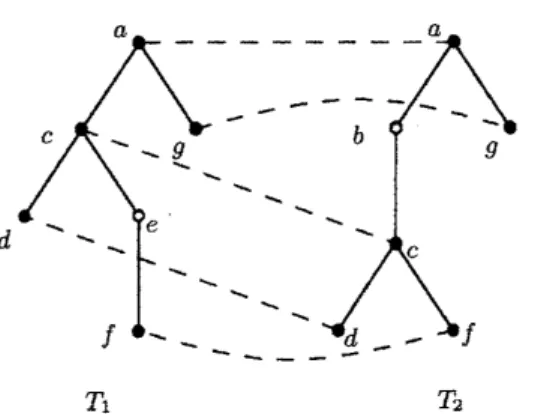
distance. Forexample, Fig. 1shows
an
edit mapping. The rest of this subsectionweshowanumberofexistingtreeedit distance
measures
bytheirmappingconditions.2.2.1 StandardMaPPing: $S$
This mappingcharacterizesthe standard editdistanceby Zhang etal. [16].
$T_{1}$ $T_{3}$
Figure 1: Anexample: thedashedlines between nodes
de-note
an
edit mapping.These operations
are
usedtotransform atree$T_{1}$ toatree$T_{2}$
.
Notethatall theoperationsare
applied to only$T_{1}$.
Let $S$ be asequence of edit operations totransform$T_{1}$ to $T\mathrm{z}$.
Let
7be
acost function ofedit operations.7is
defined to be adistance metricas
follows: for $a_{1}b_{{}_{1}C}\in \mathrm{E}$$\cup\{\lambda\}_{1}$(i) $.\gamma(aarrow\ )\geq 0$; (ii) $\gamma(aarrow b)$ $=\gamma(barrow c)\mathrm{j}$ and (iii)
$\mathrm{r}_{l(a}arrow c)$ $\leq\gamma[a$ $arrow b$)$+\gamma(barrow c)$
.
The cost function 7for edit operations is generalized for sequences $S$ of edit
operations by letting$\gamma(g)=\Sigma_{s\in s’\mathrm{r}(s)}$
.
The edit distance between$T_{1}$ and$T\mathrm{p}$is defined [1] as
$D(T_{1},T\mathrm{z})$$= \min_{\mathit{5}}\{7(S)\}$
.
2.2 Edit
Mappings
The effect ofasequenceofedit operations is reduced to
astructure called edit mapping [1],whichisc0mparab1e to
trace [3] in stringedit distance. An edit mapping depicts
$\mathrm{n}\mathrm{o}\mathrm{d}\mathrm{e}- \mathrm{t}\mathfrak{c}\}$-node correspondencesbetweentwo trees according
tothestructuralsimilarity,
or
showshow nodes inone
treeare
preservedafter transformedtotheother.Definition 2. An edit mapping bom a tree $T_{1}$ to atree
$T\mathrm{z}$is aset $M$ $\subseteq V(T_{1})\mathrm{x}V(Xa)$such that, for all$(\mathrm{B}\ddagger 1_{1}x\mathrm{z})_{1}$ $(y_{1\mathrm{p}}y\mathrm{z})$$\in M_{1}x_{1}=y_{1}\Leftrightarrow \mathrm{i}\mathrm{E}2$$=E$.
Notethat thisdefinitiondoes not require$M$ toprescrv[j
ancestor-descendantrelation. Forsimplicity, We refer to the
editmapping
as
the mapping. The edit mapping providesa
qualitative view ofeditdistance. Let$M$be abase mapping.
The mapping costof$M$is defined
as
$7(M)=$ $\sum_{(_{\mathrm{U}1\prime}v_{\mathrm{B}})\in \mathrm{J}\iota \mathrm{r}7(\mathrm{n}(?\mathit{4}_{1})}arrow \mathrm{f}\mathrm{t}(_{lJ2}))+$ $\sum_{u_{1}\mathrm{E}V_{\overline{\Lambda \mathrm{f}}}(T_{1}\rangle}\gamma(\alpha(v\}arrow\lambda)+$ $\sum_{v\mathrm{p}\in V_{\overline{\mathrm{R}\mathrm{f}}}(\mathrm{R}]}\gamma(\lambdaarrow\iota f(\mathrm{t}J_{2}))$
.
ThefollowingtheoremisduetoTai [1],
Definition 3. Amapping$M$ is standard if thefollowing
condition holds:
(S)$\forall(x_{1},$xz),$(]fi,$yz)$\in M$$[\mathrm{B}\mathrm{i}_{1}<$Bp$\Leftrightarrow y_{1}< \mathfrak{M}]$
.
Computing the edit distance based on the genealogical
mappingis known to be$\mathrm{N}\mathrm{P}$-complete[16],
even
for binarytrees havingalabelalphabetofsizetwo.
2.2.2 Top-down Mapping: $T\mathrm{D}$
This mapPing characterizes the edit distance in which
insertionanddeletion operations areapplied only to leaves.
Thetop-downmappingoriginated in Selkow [17],andYang
[18]
gave
an
algorith$\mathrm{m}$of computingan
editdistance basedon
the top-down mapping for ordered trees. Ourdefinitionisslightlydifferent fromthe definitionin [12] sinceit is not well-defined.
Definition 4. Amapping$M$ $=M(T_{1}, T_{\mathrm{B}})$ is top-down if
the following condition holds:
(TD) M$\neq \mathfrak{g}\Rightarrow$ [$(r(T_{1}), r(Tz))$$\in \mathrm{f}\mathrm{l}\mathrm{f}$A$[(x_{1_{1}^{\mathrm{i}}}\mathrm{r}\mathrm{z})\in \mathrm{A}\#$ $1\backslash :\mathrm{r}_{1}$ $\neq r(T_{1})$Aili2$\neq r(T_{2})=\neq(p(;\mathrm{r}_{1})_{1}\mathrm{p}(\mathrm{J}:\mathrm{z}))\in M]]$
.
2.2.3 Constrained$\mathrm{b}\mathrm{I}\mathrm{a}\mathrm{p}\mathrm{F}^{\mathrm{i}\mathrm{n}}\mathrm{E}^{i}\mathrm{C}$
Theconstrainedmappingwasintroduced by Zhang et al.
tocircumventthe negative resultsthat computingtheedit distance for unordered labeled trees is$\mathrm{N}\mathrm{P}$-complete[16](in
ffact
MAX
SNP-hard [19]$)$.
Definition5(Zhang[20]). Amapping$Rf$is constrainedif
the following condition holds:
(C)$\forall(x_{1_{1}};\mathrm{r}\mathrm{z})_{3}(y_{1_{\mathrm{P}}}y\mathrm{z})$
,
$(_{B1_{\mathrm{P}}}z\mathrm{z})$$\in M$$[z_{1}< x_{1}.y_{1}\mathrm{t}\doteqdot z\mathrm{z}< x_{2} " y\mathrm{a}]$
.
2.2.4 Structure-Respecting Mapping: $*\mathrm{S}\mathcal{R}$
This mapping
was
introducedbyRichter[21] todealwithsyntactictrees.
Definition 6(Richter [21]). Amapping $M$ is
structure-respecting ifthefollowingcondition holds: (SR)$\forall(\mathrm{i}\mathrm{r}_{1_{1}}x\mathrm{z})$,$(y_{1_{1}}2/\mathrm{z})_{1}(_{\mathrm{Z}1\prime}z\mathrm{z})\in M$,
any ofxllyl,$E1$ isnot
an
ancestor ofanyofthe others,$[\mathrm{i}\mathrm{r}_{1} " y_{1}=x_{1} " z_{1}\Leftrightarrow x_{2}\mapsto y\mathrm{z}=x\mathrm{z} .z\mathrm{a}]$
.
The following proposition asserts that $M$ being
con-$\mathrm{s}\mathrm{t}\mathrm{r}\mathrm{a}\dot{\mathrm{I}}\mathrm{n}\mathrm{e}\mathrm{d}$is equinalent with $M$ being structurrrespecting,
which
was
stated in Luet. $\mathrm{a}1[15]$ without proof.Theorem 1 $([1])*\mathrm{L}\mathrm{e}\mathrm{t}$$S$ beasequence of editoperations
totransform$T_{1}$ to T2,and $M$amappingfrom$T_{1}$ to$T\mathrm{z}$
.
Proposition2. Foramapping$M$,thefollowingare
auiv-alent:
$D(T_{1},T_{2})$$= \min_{\mathrm{S}\mathrm{J}}\{\gamma(S)\}=\min_{\mathrm{A}\mathrm{f}}\{\gamma\langle M)\}$
.
1. $M$ is standard and satisfies the following:$(\mathrm{S}\mathrm{R}’)$ $\forall(\mathrm{f}\mathrm{i}\mathrm{i}\mathrm{l}_{1}x\mathrm{z})$,$(y_{1}, y\mathrm{z})$,$(\mathrm{z}_{11}z\mathrm{z})$ $\in k\mathrm{f}$
$x_{1}$
.
$y_{1}<$$x_{1}\cdot z_{1}\Leftrightarrow$any of$\mathrm{r}2$,$H^{\mathrm{I}}2$,$z2$ isnotan ancestor ofanyofthe others,
$x_{2}\cdot y_{\mathrm{Z}}<x\mathrm{z}$$\cdot z_{2}|$,
2. $M$is structure-respecting,and
3. Mis constrained.
Proof.
(1)$\Rightarrow(2)$:We provethe contraposition of (SR). If$x\mathrm{z}\cdot \mathrm{y}\mathrm{z}$\neq $2 $z\mathrm{z}$,
we
may assume$z.
$y\mathrm{z}$ $<x\mathrm{z}$.z2 since $x_{2}\cdot y\mathrm{z}$ and $\mathrm{j}\Pi \mathrm{g}$.
Z2 arc comparable, $x.
$111<X1^{\cdot}B1$im mediatelyfollowsby $(\mathrm{S}\mathrm{R}’)$
.
(2)$\Rightarrow(3)^{\mathrm{r}}$, Assume that$E1$ $<$ $\mathrm{i}\mathrm{r}_{1}\cdot y1$. If22and$x.
$y\mathrm{z}$are
comparable,zz<$z.
$y\mathrm{z}$holdsby (S) (ifz$2\geq \mathrm{i}\mathrm{r}\mathrm{z}\cdot y\mathrm{z}_{1}$then$\Sigma 1\geq x_{1}$ and $z_{1}\geq \mathrm{y}\mathrm{i}$ hold by
(S),whichcontradicts to the assumption$z_{1}<:\mathrm{r}_{1}\cdot y_{1}$)
.
(i)If any two of$\Pi \mathrm{i}1,$$y_{1_{1}}z1$
are
comparable, i.e. $z1$ is comparablewith $\Pi 1$ or $y1$ (if$\mathrm{T}1$ $\leq y1$,then $\Sigma \mathrm{p}<$ffil.yr $=y_{1}$), $z\mathrm{z}$ and
$2 $\mathrm{F}\mathrm{z}$ are comparable by (S). (ii) Suppose that any of
$x_{1},$ $y_{1_{1}}z_{1}$ is not an ancestor of any of the others. Since
we may
assume
that $x1^{\cdot}y1$ $=x1^{\cdot}$zs
without 10ss ofgenerality, $2 c2 $=\mathrm{r}_{2}\cdot y\mathrm{z}$ holdsby (SR). Therefore, Z2
and $2 y2 are comparable, too. (3)$\Rightarrow(1)$:Assumethat
$\mathrm{i}\mathrm{r}_{1}\cdot$$y1$ $<x_{1}$
.
$z1$ and any of$x1_{1}y1$,$\Sigma 1$ is notan
ancestorofanyof theothers. By(S),wehave any of$x2_{\mathrm{f}}y\mathrm{z}_{1}z2$is notan
ancestorof any of the others. Wehave$22\underline{\not\in}x\mathrm{z}\cdot$ $y2$, since $x_{1}\leq B1$ follows$z\mathrm{z}$ $=\Pi 2^{\cdot}y2$ by (S) and $z_{1}<$$x_{1}$.yr does
$z_{2}<x\mathrm{z}\cdot$$y\mathrm{z}$by (SR).
$\mathrm{T}$herefore,
$x\mathrm{z}\cdot y2<$$x_{2}\cdot z\mathrm{z}$ holds. 0
1. X.ir$=\mathrm{i}\mathrm{r}$,
2. $x\cdot y$$=y\cdot z_{\dagger}$
3. $(x\cdot y)\cdot z$$=x\cdot\langle y\cdot z)$,
4. $x$ $\leq y$$\Leftrightarrow x\cdot y$$=y$,
5. $x\cdot y$$<x\cdot z$$\Rightarrow y\cdot z$ $=\mathrm{i}E$”$z$,and
6. $x\cdot y$$=x\cdot z$$\Rightarrow y\cdot z$ $\leq \mathrm{i}\mathrm{r}\cdot \mathrm{y}$
.
Corollary 4. For any three nodes $x$, $y,$ $z$, either of the
following properties holds:
1. $x\cdot y<\mathrm{J}\mathrm{i}\cdot \mathrm{Z}$,and$x\cdot z$$=y\cdot z$,
2. $x\cdot y$ $=x\cdot z_{1}$and$y\cdot$$z$ $\leqcdot z_{t}$
3. $x\cdot y>x$$\cdot$$z_{1}$and$x\cdot y$$=y\cdot$$z$
Proof.
Itfollows straightforwardly ffomLemma$3-(5)_{1}$and(6). $\square$
3.2
Tree Homomorphismand
IsomorphismDefinition B. Let $T_{1}$ and
T2
betwo trees.Ahomornor-phismfrom $T_{1}$to
T2
is amapping $$\mathrm{f}$or$V(T_{1})$ to $V(T_{2})$suchthat
1. $\not\subset$}$(r\langle T_{1}))=r(T\mathrm{z})\}$and
2. x$<y$$\Rightarrow\phi(x)\leq q_{\mathrm{I}}(y)$
.
Wereferto$\phi$:$V(T_{1})arrow V(T_{2})$ as$\phi$:$T_{1}arrow T_{2}$ ifthere is
noconfusing.
Proposition 5. Thecompositionof homomorphisms is a
homomorph$\mathrm{i}\mathrm{s}\mathrm{m}$.
3.
Theoretical Foundation
for
Ree
Edit
Distance
In this section, we give anew formulation oftree edit
$\mathrm{d}\dot{\mathrm{l}}\mathrm{S}\mathrm{t}\mathrm{a}\mathrm{n}\mathrm{c}\mathrm{e}$.
Definition 1D. Let $T_{1}$ and $T_{2}$ be two trees. An
isornor-phism from $T_{1}$to $T_{2}$is abijection
$from
$V(T_{1})$ to$V(T_{2})$such that
$(x, y)$ $\in E(T_{1})\Leftrightarrow(\phi(x)_{1}\phi(y))\in E(T_{2})$
.
3.1
Rooted Trees
Definition 7. Arooted tree $T$ $=(V_{\mathrm{I}}\leq)$ is anonempty,
finite, and partially ordered set with themaximumelement $r(T)\in V$calledtheroot, and such that $\{u\mathit{1} \in V|v\leq u\mathrm{l}\}$is
atotallyordered subset of$V$for every$\mathrm{u}$$\in V$
.
Wecall the elements of$V$the nodes of$T_{1}$and denote the
set ofall nodes in $T$ by $V(T)$
.
Welet $\mathrm{E}(\mathrm{T})$ $=\{\{x_{1}y)$ $\in$$V(T)\mathrm{x}$$V(T)|(x<y)\Lambda\exists z$$\in V(T)[x<z< y]\}$
.
Theelc-mentof$E(T)$ is called
an
edge of$T$.
Anode$y$ such that $x$ $\leq y$ isan
ancestorof$\Pi \mathrm{j}$.
If$x$$\leq y$ and$x$$\neq y1$ then$y$ isaproperancestorof$\mathrm{J}\mathrm{i}$, denoted by$\Pi \mathrm{i}<y$
.
The parentofnode$x$ isthe minimumnodesof proper ancestors of$x$, denoted
by$p(()x)$
.
Aleaf
ofatree$T$is aminimal node in $T$.
Thesizeof atree$T$isthenumberofnodesin$T$, denoted by$|T|$
.
Definition 8. For anarbitrary rooted tree$T$ $=(V_{1}\leq)$,a
common $an\mathrm{c}esto^{1}\Gamma$ of$U$$\subseteq V$ isan element $x$$\in V$, if exists,
such that for all$y$ $\in U$, il $\leq \mathrm{i}\mathrm{I}\mathrm{i}$
.
A $\mathrm{c}\mathrm{o}$mmon
ancestor$x$ of$U$ is the least common $a\tau \mathrm{L}\mathrm{f}\mathrm{i}est\mathrm{o}\mathrm{r}$of$\mathrm{f}J$ if, for any
common
ancestor$y$of$U$,$x$$\leq y$holds. Wedenote the leastcommon
ancestorof$U$by$\mathrm{l}\mathrm{c}\mathrm{a}U_{\mathrm{f}}$ and $\mathrm{l}\mathrm{c}\mathrm{a}\{x_{\mathrm{I}}y\}$by$x\cdot y$
.
Lemma $3_{*}$ The followingproperties hold in terms of the
least
common
ancestor:Proposition 6. Every iso morphism is also
ahomomor-phism.
Proposition7. Let$T_{1}$ and$T_{2}$ betwo trees. Supposethat
A
isabijection from$T_{1}$ to$T\mathrm{z}_{1}$thenthe following conditionsare
equivalent:1.
rb
isan isomorphism,and 2- $\#$}$(\mathrm{i}\Gamma)<$$\Pi\}(y)\Rightarrow x<$$y$Proposition8. Amapping$\mathrm{l}\#$fiomatree$T$to$T$isan
is0-rnorphism if and only if$\not\subset \mathrm{l}$is
an
identity mappingon$V(T_{1})$.
B.B
Embedding
andInsertion
Wefirst defineanembedding, which is regarded as
con-secutive insertionsofnodesinto atree.
3.3.1 Embedding
Definition11. Let$T_{1}$and$T\mathrm{z}$be twotrees. An$emb_{\mathrm{E}\mathrm{i}}dd\mathrm{i}ng$ $\phi$from $T_{1}$ to$T_{2}|$ isan injection from $V(T_{1})$ to $V(T_{2})$ such
that
1, $q_{\mathrm{J}}$is ahomomorphism,and
1 $q_{l}(x)<$ $\mathrm{I}\oint(y)\Rightarrow x<y$
.
We definered(\phi ) $=|V(T\mathrm{z})$$\backslash \phi(V(T_{1}))|$ asthe redundancy
Proposition 9. Suppose that $\not\in \mathrm{I}$ be amapping from
atree $T_{1}$ to atree $T\mathrm{z}_{\mathrm{I}}$ and $\psi$ be an embedding from $T\mathrm{z}$ to atree $T3$, then the following conditions hold:
1. if{$\#$isanembedding,$\psi$$\circ\phi$is also an embedding,and
2. if$\psi 0$$\phi$ is
an
embedding,$\not\in \mathrm{l}$isals0anembedding.Inboth cases, red$(\tau\#\circ \not\in|)=\mathrm{r}\mathrm{e}\mathrm{d}(\phi)$ $+\mathrm{r}\mathrm{e}\mathrm{d}(\psi)$
.
S.S.2 $\mathrm{I}\mathrm{n}\mathrm{s}\mathrm{e}\mathrm{r}\mathrm{t}\mathrm{i}_{1\mathrm{l}}\mathrm{n}$
Now,we arcreadyto giveadeclarativedefinitionof the
insertionoperation.
Definition 12. Let$T_{1}$ and
TW
be twotrees,and$v$ anodein $T_{2}$
.
All embedding $\phi$ from$T_{1}$ to$T\mathrm{z}$ isan
insertion of$v$into$T_{1}$ if$\phi(V\{T_{1}))=V(T_{2})$$\backslash \{\mathrm{w}\}$
.
Proposition 10. Let $\#\mathrm{J}$be
an
embedding from atree $T_{\mathrm{L}}$toatree T2,and$\phi$alsoan insertionof anode$v$into$T_{1}$
.
If $\mathrm{t}\}$be anode in$T_{2}$such that$\mathrm{B}l$$\neq\text{\"{i}}(\mathrm{X}_{2})$,thenthereexists aninsertion of$v$to$T_{1}$
.
Anyinsertionof$v$isuniquely determined
excePt
thattheinsertion is
an
isomorPhism.
Hence, by $1_{\mathrm{t}/7}l$we
denote theinsertionof$\mathrm{B}1$
.
.life following $\mathrm{r}\mathrm{n}\{\ni \mathrm{o}\mathrm{r}\mathrm{e}\mathrm{m}$proves that uennltlon 1z or rne
insertion isequivalent to the operational$\mathrm{d}_{\mathrm{f}\exists}\mathrm{f}\mathrm{i}\mathrm{n}\mathrm{i}\mathrm{t}\mathrm{i}\mathrm{o}\mathrm{n}$ of the
insertion.
Theorem 11, Let$\phi$ be
an
embedding from$T_{1}$ to$T_{2}$with$V(T_{1})\backslash q_{l}(V(T_{1}))=\{\mathrm{u}_{1_{5}}\ldots , v_{\mathrm{n}}\}$
.
There exist asequenceof trees $S_{\mathrm{f}\mathrm{J}}$,$S_{1\}}\ldots$,$S_{71}$, and insertions $\phi_{\mathrm{i}}$ : $S_{\dot{\mathrm{t}}}arrow 1\mathrm{S}_{i}-1$ $(\dot{\mathrm{z}}\in\{1, \ldots, T\mathrm{L}\})$ such that
1. $S_{0}=T_{2}$,
2. $\mathrm{S}_{\mathrm{n}}=T_{1_{1}}$
3. $q_{11}\circ\cdots\circ q_{1_{i}}\langle V(S_{\mathrm{q}^{l}}))=V(T_{2})$$\backslash \{111$,$\ldots$,11 ,and ’
4. $\{\beta=\phi_{n}0$ $\cdots 0\phi_{1}$
$\mathrm{c}1_{\mathrm{T}}$ $\phi_{n-1}$ $\_{2}$ $t
$S_{7\mathrm{L}}^{\cdot}arrow l\mathrm{F}_{\tau \mathrm{z}-1}arrow$
.. .
$arrow S_{1}arrow S_{0}$$\mathrm{I}\mathrm{n}\mathrm{s}_{\mathrm{i}\mathrm{D}_{?1}}$ $\mathrm{I}\mathrm{n}\mathrm{s}_{x_{\mathrm{n}-1}}$ $\mathrm{I}\mathrm{n}5x_{2}$ $\mathrm{I}\mathrm{n}\mathrm{s}_{\mathrm{a}\mathrm{e}_{1}}$
$||$ $||$
$T_{1}\underline{q\mathrm{l}}T_{2}$ .
3.4
Degeneration
and DeletionWedefineadegeneration,which is regarded as
consecu-tive deletionsof nodesfrom atree.
3.4.1 Degeneration
Definition 13. Let$T_{1}$and
T2
be two trees. Adegenernbion$\phi$ffom$T_{1}$ to $T_{2}|$ is asurjection from $V(T_{1})$ to$V\langle T_{2}$) such
that
1. $\phi(x)=\phi(y)\Rightarrow\phi(x\cdot y)$$=\phi(:\mathrm{r})=\phi(y)_{1}$ and
2. $\phi(x)<$ $\phi(y)\Rightarrow\exists y^{r}[\phi(x)=\mathrm{I}b(y’)\Lambda x< y’]$.
We define 1]uP(\phi )= $\{x \in V(T_{1})|\phi(x)=\phi(p(x))\}$ as the
duplicationof thedegeneration(?from$T_{1}$ to$T\mathrm{z}$
.
Proposition 12. Let $T_{1}$ and $T|2$ be two trees, and$\phi$ be
adegeneration from$T_{1}$ to$X_{2}$
.
Thereexists auniqueem-bedding 7]] from $T\mathrm{z}$ to $T_{1}$ such that $circ$
t#
is the identitymapping
on
$V(T_{1})_{1}$ and $7p$ $ is the identity mappingon
$V(T_{2})\backslash \mathrm{D}\mathrm{u}\mathrm{p}(\phi)$.
Wedenotethe degeneration corresponding toan
embcd-ding$\phi$denotedby$\overline{\phi}$.
3.4.2 Deleti0n
Definition 14. Let$T_{1}$ and$T_{2}$betwo trees,and$\mathrm{t}f$anode
in$T\mathrm{z}$
.
Adegeneration$\oint \mathrm{J}$from$T_{1}$ to$T_{2}$is deleBiorLof$iu$from $T_{1}$ if$\mathrm{D}\mathrm{u}\mathrm{p}(\phi)$$=\{\mathrm{u}\}$.
Theorem 13. Let $\mathrm{E}^{1}$ be adegeneration from $T_{1}$ to $T_{2}$
with Dup(\phi ) $=\{v_{1}$
,
. . .
’$v_{n}\}$
.
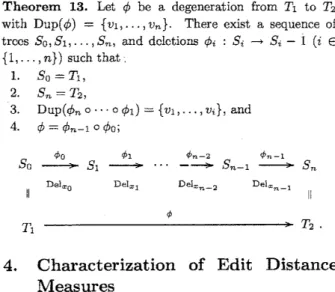
There exist asequence oftrees $S_{0}$,$S_{1_{\mathrm{f}}}\ldots$$\mathrm{J}S_{\Psi \mathrm{L}}$, and deletions $\phi_{\dot{f}}$ : $s_{i}arrow 1q_{\mathrm{z}}-1(\mathrm{i}\in$
$\{1, \ldots, n\})$ suchthat.
1. $S_{0}=T_{1}$,
2. $S_{T\mathrm{L}}=T_{2}$,
3. $\mathrm{D}\mathrm{u}\mathrm{p}(\phi_{\mathrm{R}}\circ\cdots \mathrm{c} \phi_{1})=\{\mathrm{u}_{1_{t}}\ldots, v_{\mathrm{i}}\}$
,
and4. $\phi$$=\phi_{\mathrm{n}-1}0$Co;
$\#^{1}\mathrm{f}\mathit{1}$ $\not\in \mathrm{l}1$ $\mathrm{l}\#_{\mathrm{H}}-\mathrm{z}$ $\not\in \mathrm{I}\tau\iota-1$ $\mathrm{l}\mathrm{S}_{0}-1\mathrm{F}_{1}arrow$
..
.
$-arrow S_{r\iota-1}arrow S_{\mathrm{n}}$$\mathrm{D}_{\mathrm{I}\ni}1_{\pi_{0}}$ $\mathrm{D}\epsilon \mathrm{i}1_{x_{1}}$ $\mathrm{D}\mathrm{e}1_{x_{\mathrm{t}\tau-2}}$ $\mathrm{D}\mathrm{e}1_{\pi_{\tau \mathrm{z}-1}}$
I $||$
$T_{1}\underline{\phi}T_{2}$
4.
Characterization
of Edit
Distance
Measures
In thissection,we consider theedit mappingconditions
for unordered trees, and introduceafew of
new
editmaP-$\mathrm{p}\mathrm{i}\mathrm{I}$conditionstoinvestigatethe
relationshiP
amongknownclasses of edit mappings. Duetospacelimitation, most of
theproofsare omitted.
For
an
edit maPPing$lkf$from$T_{1}$ to$T_{2_{\mathrm{J}}}$we define:$V_{\mathrm{A}\mathit{1}},(T_{1})=\{x \in V(T_{1})|\exists x\in V(T_{2})\mathrm{s}.\mathrm{t}.(x,y) \in M\}$, $V_{\mathrm{f}\mathrm{i}\prime 1}\{T_{2})=\{y \in V(T_{2})|\exists y\in V(T_{1}\}\mathrm{s}.\mathrm{t}.(x,y) \in M\}$,
$V_{\overline{\mathit{1}1\mathrm{f}}}\{T_{1}\rangle=V(T_{1})\backslash V_{\mathit{1}\mathrm{b}^{J}1}(T_{1})1$ $V_{\overline{\mathrm{A}\mathrm{f}}}\{T_{2}\rangle=V(T_{2})\backslash V_{\Lambda \mathrm{f}}\{T_{2})$
.
4.1
Alignable
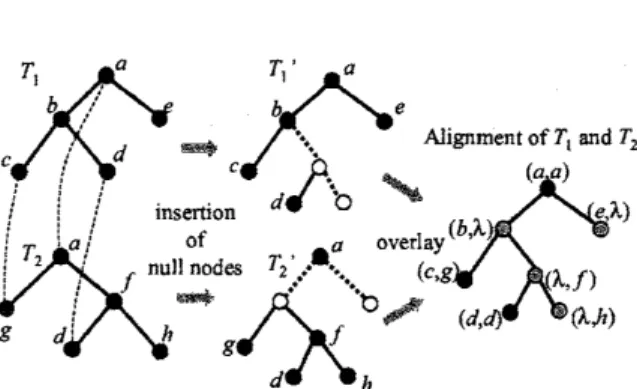
$\mathrm{M}\mathrm{a}\mathrm{p}\mathrm{p}\mathrm{i}\mathrm{n}\mathrm{g}^{\mathrm{r}}\prime A$Thealignmentof treeswasintroduced by Jiang$\not\in \mathrm{i}\not\in at$. [14],
and efficient algorithm forsimilar trees were
ProPosed
forordered trees [22] and unorderedtrees [23]. The definition of thealignment has been given in
an
operationalway $[14_{\mathrm{I}}$$12_{1}13]$
.
Wegive
anew
definition of alignment of trees.Definition15. Amapping$M$ffiom$T_{1}$ to$T_{2}$is alignableif
and only ifthere exists atriplet$(U, \phi_{1}\psi)$such as
1. $\phi$:$T_{1}arrow U$is
an
embedding2. $\psi$:$T\mathrm{z}$$arrow U$is an embedding, and
3. $\forall(x, y)$ $\in M[\phi(x)=\mathrm{T}\beta(x)]_{\mathrm{i}}$
$U$
$T_{1}$
–Tz.
Figure 2illustratesanexampleof an alignablemapping. Lemma 14. Suppose that $T_{1}$ and Tx
arc
two $\mathrm{t}\mathrm{r}\mathrm{e}\mathrm{e}\mathrm{s}_{\mathrm{P}}$ and $\mathrm{f}\mathrm{l}/\mathrm{f}$$\subseteq V(T_{1})\mathrm{x}$$V(T_{2})$isan alignablemapping$(U_{3}\phi, \eta\})$,thenthe following condition holds
4.4
Triangular
Mapping:
$T$Weintroduce the triangular mappingasfollows.
Definition 18. Amapping$M$istriangularif the following
condition holds:
(T) $\forall(x_{1_{\mathrm{P}}}x_{2})$,$(y_{1_{1}}y\mathrm{z})$,$(\mathrm{z}_{1_{\mathrm{P}}}z\mathrm{z})$$\in M$
$[x\iota\cdot y_{1}< x_{1}\cdot z_{1}\Leftrightarrow x\mathrm{z}\cdot y\mathrm{z}<x\mathrm{z} \cdot z\mathrm{z}]$.
4.5
Quasi-Triangular MaPPing:
$\mathcal{Q}T$Figure2: An alignable mapping ffom $T_{1}$ to
T2:
the linesbetweentwo treesindicate
an
alignable mapping.This mappingisobtainedby relaxingthe conditionof the
triangularmapping.
We giveafewproperties of alignable mappings.
Lemma 15. Let $T_{1}$ and $T_{2}$ be twotrees. Any singleton
mapping$M$$=\{(x,y)\}$from$T_{1}$ to$T\mathrm{z}$ isalignable.
Lemma 16. Let $T_{1}$, $T_{1}’$, $T_{2}$ and $T_{\mathrm{B}}’$ be four trees, and
$M$
an
alignable mapping from $T_{1}$ to $T\mathrm{z}$.
For twoinser-tions $\phi$ : $T_{1}arrow T_{1}^{\mathrm{J}}$ and $\psi$ ; $T\mathrm{z}$ $arrow T_{2}’$ which both do
not necessarily preserve their roots, the mapping $M^{j}=$ $\{(\phi(x),\psi(y))|(x_{7}y) \in M\}$ is
an
alignablemappingfrom$T_{1}’$to$T_{2}’$
.
Definition 19. Amapping$M$ is quasi-triangular ifthe
following conditionholds:
$\{\mathrm{Q}\mathrm{T}1)$$\forall(x_{1_{1}}x\mathrm{z})_{1}(y_{1},y\mathrm{z}),$$(z_{1}, z\mathrm{z})$ $\in M$
$[x1 ” y1< x_{1}\mapsto E1\Rightarrow x_{2} " y\mathrm{z} =\mathrm{i}\mathrm{r}_{2}\cdot z\mathrm{z}]_{7}$ and
(QT2) $\forall(x_{1}, x\mathrm{z})$,$\{y_{1}$,$ffi\rangle_{1}(\mathrm{z}_{1}, z\mathrm{z})$$\in M$
$[x_{2}\cdot y\mathrm{z}< X\mathrm{p}. z_{2}\Rightarrow x_{1}.y_{1}=x_{1}\cdot E_{1}]$.
5.
Hierarchy
of the Mapping Classes
Propos\’ition 18. Ifthe condition of the triangular
maP-Ping holds, thenthat of the constrainedmappingalsoholds,
and notviceversa.
Lemma 17. Let $T_{1}$ $=$ $\{r(T_{1})\{T_{1,1},T_{1,2}\}\}$ and $T_{2}$ $=$ $\{r(T\mathrm{z})\{T_{2,1},T\mathrm{z},\mathrm{z}\}\}$ be two trees, $M$
amap-Ping from $T_{1}$ to $T_{2}$
.
The mapping $M$ is alignablefrom $T_{1}$ to
T2
if the following conditions hold:1. $\forall(x_{1}y)$ $\in\Lambda f[x \in V(T_{1,\mathrm{i}})\Leftrightarrow y \in V(T_{2,i})]$,for$i\in\{1_{1}2\}$,
2. $M_{\mathrm{i}}=\mathrm{A}\#$$\cap$$(V(T_{1,i})\mathrm{x}V(T_{2_{1}i}))$ \’is
an
alignablemappingfrom$T_{1,i}$to$T_{2,\mathrm{i}}$
.
4.2
Less Constrained Mapping:
$L$Proof.
From the premise $B1<\mathrm{i}\mathrm{E}1^{\cdot}$$y1_{5}$ we may assume,without loss of generality,irl.zl$=x1^{\cdot}y1$
.
Hence,we have$z\mathrm{l}$ $<\mathrm{B}\mathrm{i}1^{\cdot}z_{1}$
.
By$\mathrm{Z}1$ $=z_{1}\cdot z_{1}$ and the condition (T),we have22 $\Sigma \mathrm{p}<\mathrm{i}\mathrm{E}\mathrm{g}\cdot Z\mathrm{g}$
.
It follows that Z2 $<x\mathrm{z}$.
$\Sigma \mathrm{g}_{\mathrm{P}}$ Moreover,by the condition (S), which is equivalent to the condition (T),
we
have$\Pi \mathrm{j}\mathrm{g}\cdot \mathrm{z}\mathrm{z}$$=x\mathrm{z}\cdot$$y\mathrm{z}$
.
Therefore,$\mathrm{z}\mathrm{z}<x\mathrm{z}\cdot y\mathrm{z}$.
$\square$Lemma 19. The constrained mapping implies the
ancestor-descendant relation.
The less-constrained maPPing
was
introduced in [15] torelax thecondition oftheconstrained mapping. The
defi-nition of the mapping in [15] is not correct. We rectify it
and giveancvv mapping definition
as
follows.Definition 16. Amapping $M$ is less-constrained ifthe
following conditions hold:
(LO)$\forall(x_{1},x\mathrm{z})_{\mathrm{r}}(y_{1_{1}}y\mathrm{z})$ $\in M[x1<x\mathrm{z} \not\in\Rightarrow H1< y\mathrm{z}]_{1}$
(L1}$\forall(_{\mathrm{i}}\mathrm{r}_{11}x\mathrm{z})_{r}\{y_{1_{1}}y\mathrm{z}$),$(\mathrm{z}_{1_{1}}z\mathrm{z})$$\in\Lambda \mathrm{f}$
$[x_{1}. y_{1}< \mathrm{i}\mathrm{t}\mathrm{i}_{1}\cdot z_{1}\Rightarrow \mathrm{B}\mathrm{g} \cdot y\mathrm{z} =x_{2}rightarrow z_{2}]$
,
(LE)$\forall(x_{1\mathrm{p}}\mathrm{x}\mathrm{z})\mathrm{f}$$(y_{1}, y\mathrm{z})_{1}\{z_{1},z\mathrm{z})$ $\in \mathrm{A}f$
$[\Pi \mathrm{i}_{2y\mathrm{z}}.< \mathrm{f}\mathrm{f}\mathrm{i}_{\mathrm{B}}\cdot \mathit{2}\mathrm{p} \Rightarrow x_{1}.y_{1}=x_{1}rightarrow z_{1}]$
.
4.3 Confucianistic Mapping:
$\mathrm{C}F$We introduce
anew
maPPing, the confucianisticmaP-ping,which livesuptoits
name
since this mappingrespectsancestor-descendant relationbetween two trees.
Definition 17. Amapping$M$ is
confucianistic
if thefol-lowing conditions hold:
$(\mathrm{C}\mathrm{F}2)$$\forall(\mathrm{u}J1,$fflfz
1}
$(x_{1}, \mathrm{i}\Gamma \mathrm{g}),$ $(y_{1_{1}}y\mathrm{z})_{\mathrm{r}}(z_{1},z\mathrm{z})$ $\in M$$[\mathrm{u}11^{\cdot}\mathrm{E}1< y_{1}\mapsto z_{1}\Rightarrow \mathrm{u}1_{2}\iota-x\mathrm{z} \leq ya \cdot z_{2}]$
(CF2) $\forall(\mathbb{E}\mathrm{J}_{1\mathrm{p}}\mathrm{u}\mathrm{J}\mathrm{z})1$ $\langle_{\mathrm{i}\mathrm{E}_{1}}$,$\mathrm{i}\mathrm{E}_{2})_{\mathrm{J}}(y_{1_{1}}y\mathrm{z})$,$(Z_{1\}}B\mathrm{z})\in M$
$[\mathrm{u}\mathrm{J}\Pi.\mathrm{T}2\leq y_{2B\mathrm{g}}\cdot\Rightarrow u\mathrm{J}_{1\mathrm{i}\Gamma 1}.< y_{1}\cdot z_{1}]$
Proof.
According to the condition (C), for all$\langle_{X1\mathrm{r}^{ff}}x\mathrm{z}]$
,
$(y_{1;}y\mathrm{z})$ $\in M$,
$x_{1}<$ $y_{1}$.
$y_{1}\neq\neq x\mathrm{z}<y\mathrm{z}$.
$y\mathrm{z}$.
Hence,weimmediately have$\mathrm{i}\mathrm{E}1<y1$$\neq\neq x\mathrm{z}<y\mathrm{z}$
.
$\square$Proposition 20. Amapping $M$ is confucianistic ifand
only if$M$is genealogicaland quasi-triangular,andthe
fol-Jowing conditionshold:
1. $\forall\langle_{X_{1},\mathrm{i}\mathrm{E}_{2}})_{r}(y_{1_{\mathrm{f}}}y\mathrm{a})$,$(z_{15}z_{2})\in M$
[$\mathrm{J}\mathrm{i}1^{\cdot}y1=\mathrm{e}\mathrm{t}\mathrm{s}$$.\mathrm{z}_{1}=z_{1}$”$x_{1}\not\in$$\{x_{1}, y_{1}, \mathrm{z}_{1}\}$
$\doteqdot$$x_{2\mathfrak{R}}.=y\mathrm{z}$
.zz
$=z_{2}\cdot \mathrm{j}\Pi \mathrm{z}$]Z. $\forall(x_{1}, x\mathrm{z})$
,
$(y_{1}, y_{2})$,
$(z_{1}, z_{2})\in M$[$x\mathrm{z}$”$y\mathrm{z}=y\mathrm{z}$”$z|\mathrm{z}=z_{2}" x_{B}\not\in\{x\mathrm{z}, y\mathrm{z}, z\mathrm{z}\}$ $\Rightarrow \mathrm{i}\mathrm{f}\mathrm{f}\mathrm{l}.y_{1}=y_{1}\cdot z_{1}=z_{1}\cdot x_{1}]$
Theorem 21. Thecondition of the alignable mappingis
equivalent to that oftheless-constrained mapping.
Thefollowing hierarchy ofthe mapping classes is
effiab-lished. Theorem 22.
1. $TIJ$$\subseteq T$$\subset S\mathcal{R}$$=(\mathrm{i}$$\subseteq A$$=L$$=(QT \bigcap_{1}\mathrm{F})\subset \mathrm{S}$ $2$
.
$CF$$\subset A$Figure 3shows that the hierarchy oftree edit distance
Figure3: Ahierarchyof tree edit distance measures
6.
Conclusion
In this PaPer, weintroduced anew theoretical formula-tion of tree edit distance,and investigatedthe relationship
amongthe classes of tree edit distance. We then rectified
Rnrrlr. $\mathrm{m}\mathrm{i}_{\mathrm{H}\mathrm{f}1}\dotplus \mathrm{a}.\dotplus \mathrm{r}.\mathrm{m}\mathrm{c}\mathrm{n}\dagger.\mathrm{s}$fl.nd $\mathrm{y}\mathrm{p}_{\mathrm{J}}\{,\mathrm{I}\mathrm{n}\mathrm{H}_{\mathrm{f}}\mathrm{i}.\mathrm{n}\iota^{\backslash }.\mathrm{i}_{\mathrm{P}\mathrm{R}}$ in prior work, and
established anewhierarchyamongthe edit mapping
condi-Jiang. $\mathrm{M}\mathrm{o}\mathrm{r}\mathrm{e}\mathrm{o}\mathrm{v}\mathrm{e}\mathrm{r}_{1}$ weshowed that themappingcondition for
alignment oftreesis identical to that for avariant of edit distance,calledless-constrained edit distance.
References
[1} $\mathrm{K}_{-}$-C. Tai. The tree-t0-tree correction problem. Joomal
of the ACM,$26(3$}$:422-433_{1}$July 1979.
[2] K. Zhangand D. Shasha. Simple fast algorithms for the
editingdistance betweentreesand related problems. SIAM
Journal on$Compt\iota tzng$, $1\mathrm{S}(6):1245$-1262,1989.
[3] R.A.Wagner andM.J.Fischer. Thestring-t0-string
correc-tion problem. Journalofthe ACM, 21(1).‘ I6B-173,1974.
[4] D. Gusfield. Algorithms onStings, $T_{Tee\mathrm{l}}\mathit{5}_{J}$ and Sequences:
ComputerScience andComputational Eitllogy. Cambridge
University Press, 1997.
[5] Y. Sakakibara. Pair hidden markov models on tree
struc-trees. $S\dot{\mathrm{n}}\mathit{0}\overline{\mathrm{z}}nfo\mathrm{r}\mathrm{r}nat_{\dot{\mathrm{R}}\mathrm{C}\mathrm{B}}$,$19:232-240_{1}$2003.
[6] M.Hochsmann,T.$\mathrm{T}\dot{\mathrm{r}}\dot{\mathrm{I}}\mathrm{l}\mathrm{l}\mathrm{e}\mathrm{r}$,R. Giegerich,and S.Kurtz. Local
similarity in rnasecondarystructures.In Proceedings
of
theComputational Systems
Bioinformatics
(CSB’1974. IEEE,
2003.
[7] L. Wang and J. Zhao. Parametric alignment ofordered
trees. $\mathrm{B}\dot{\mathrm{t}}o\mathrm{i}nfo77nat_{l}ics$,$9(17):2237$-2245,2003.
[8] A. Torsello and E. R. Hancock. Graph clustering with
tree-unions. In LNCS,volume 2756, pages
PP.451
–4S9.Springer-Vcrlag $\mathrm{H}_{\mathrm{f}\mathrm{i}1}^{1}\mathrm{d}\mathrm{r}\mathrm{i}1\mathrm{b}\mathrm{e}\mathrm{r}\mathrm{g}_{\mathrm{I}}$November 2003. ISBN:
3-540-40730-8.
[9] P. FerraroandC. Godin. Adistance measurebetweenplant
architectures. Annnk
of
Forest$|\mathrm{S}\mathrm{c}\mathrm{i}e\tau \mathrm{i}\mathrm{c}e$, 57:445-461,2000.
[10] M.Vilares,F. J.Ribadas,and V. M.Darriba. Approximate
vide pattern matching in shared-forest. InLNCS volume
2004, pages 4S3-494,2001. ProceedingsoftheSecond
In-ternational Conference on Compu tational Linguistics and
IntelligentText Processing.
[11] D. C.Reis, P. B. Golgher, A. S.Silva,and A. H. F. Laender.
Automaticwebnewsextraction usingtreeedit distance. In
$WlV\mathrm{H}^{J}B\mathit{0}G\mathit{4}$,pages 502-511,2004.
[12] J.T.-L. Wangand K. Zhang. Finding similarconsensus
be-tween trees: analgorithm and adistance hierarchy. Pattern
Recognition,$34:127-137_{\mathrm{J}}$2003.
[13] G. Valiente. Anefficientbottom-updistance between trees.
In Proc. 8thInt. Sympol5iufnonString Processing and
In-formationffitrietlaf, pages $212-219\tau$ IEEE Computer
Sci-encePress,2001.
[14] T. Jiang, L. Wang, andK. Zhang. Align mentof trees –
analternative to treeedit. TheoreticalComputer Science,
$143^{1}.137-14\mathrm{S}$, 1995.
[15] C. L.Lu,Z.-Y. Su,andG. Y. Tang. Anewmeasureof edit
distance$\mathrm{b}_{\mathrm{G}}\mathrm{t}\mathrm{w}\mathrm{e}\mathrm{e}\mathrm{n}$
labeled trees. In Lecture Notes in
Com-prior$S\epsilon \mathrm{r}\mathrm{i}en\mathrm{c}\mathrm{E}\mathrm{i}$, volume2108, pagespp. 33S-B4S.
Springer-Verlag Heidelberg,2001.
[16] K. Zhang, R. Statman,and D. Shasha. On the editing
dis-treebetween unordered labeled trees.
Information
FrO-cessing Letters, 42(3):$133-139_{1}$ 1992.
[17] S. M. Selkow.Thetree-t0-treeediting pr0b1em.Information
ProcessingLetters, 6(6).. IB4-1B6,December 1977.
[18] WuuYang. Identifyingsyntactic differences betweentwo
programs.
Software
-Practiceand L\star弓暇erience, 21$(T\}:739-$ 755、$1\mathrm{i}\exists 91$.[19] K. Zhang and T. Jiang.Somemffi$\mathrm{s}\mathrm{n}\mathrm{p}$-hardresults
concern-ingunorderedlabeled trees.$Informal\dot{\mathfrak{g}}\mathrm{f}\mathrm{J}n$Processing Letters,
49:249-254, 1994.
[20] K. Zhang. Aconstrained editdistancebetweenunordered
labeled trees. Algoithmica, 15:205-222, 1996.
[21] T. Richter. Anew measure of the distance between
or-dered trees and its applications. Technical Report
85166-CS, Dept.of Computer Science, Univ. ofBonn,1997.
[22] J. Jansson an i A. Lingas. Afast algorithm for optimal
alignmentbetween similar orderedtrees. $\mathrm{F}\mathrm{b}\tau \mathrm{t}\mathrm{d}a\mathrm{r}\mathrm{n}\epsilon \mathrm{i}\Pi \mathrm{t}aaa$
In-formaticae,56:$105-120_{1}$ 2003.
[23] D. Fukagawaand T. Akutsu. Fffit algorithms for
cornpar-ison ofsimilar unordered trees. In Proc. 15th Int. Symp.