Real
forms of
complex
surfaces of constant
mean
curvature
Shimpei Kobayashi
School
of Information
Environment
Tokyo
Denki University Japan
[email protected]
1
Introduction
This is a summary of the paper [10]. The goal is to give
a
imified theory forinte-grable
surfaces
using real forms of the complex extended framings of complexCMC-immersions and the generalized WeierstraB type representation for complex
CMC-immersions.
It is well known that asurface in$\mathbb{R}^{3}$ has nonzero
constant meancurvature (CMC for
short) if and only if there exists
a
moving frame with spectral parameter,an
elementin $SU(2)$ loop group, which satisfies the certain condition (see [5]). Such moving
frame is called the extended framing of
a CMC-immersion.
The extended haming of a CMC-immersion in $\mathbb{R}^{3}$ has a natural
complexification, which is called the complex extended framing ([3]). Moreover in [4], we considered
a holomorphic immersion in $\mathbb{C}^{3}$ associated with the complex
extended framing. It
turned out that the holomorphic immersion had
nonzero
complex constantmean
curvature, whichwas called a complex CMC-immersion. Then a CMC-immersionin
$\mathbb{R}^{3}$
can
be obtained from a real form of thecomplex extended framing of a complex
CM C-immersion.
It is known that a CMC-immersion in $\mathbb{R}^{3}$ has the parallel
immersion with constant
$GauB$ curvature (CGC forshort) $K>0$in$\mathbb{R}^{3}$. Similar
to the real case,
a
holomorphic immersion with complex constant $GaM$ curvature $K\in \mathbb{C}^{*}$ (CGC for short) will beobtained
as
the parallel immersion of a complex CMC-immersion. Thus aCGC-immersion with $K>0$ in $\mathbb{R}^{3}$
also
can
be obtained from a real form of the complexextended framing. Then it is natural to ask whether other classes of real
surfaces
exist fromreal forms ofthe complexextended framing ofa complex
CMC-immersion
or a complex CGC-immersion.
In this surnmary,
we
show that thereare seven
classes of surfacesas
real forms ofCGC-immersions with $K>0$ $(or K<0)$ in $\mathbb{R}^{3}$
and their parallel
CMC-immersions,
spacelike (or timelike)
CGC-immersions
with $K>0$ $(or K<0)$ in $\mathbb{R}^{2,1}$and their
parallel CMC-immersions, and
CMC-immersions
withmean
curvature $H<1$ in $H^{3}$(see Theorem 3.1 and Corollary 3.2). Someofthese classesofsurfaceswere considered
from harmonic maps and integrable systems points of views (see [9], [6], [12], [8] and
[1]$)$.
The generalized Weierstr$\theta$ type representation for
complex
CMC-immersions
isa
procedure to construct complex
CMC-immersions
in $\mathbb{C}^{3}$ (seeSection
4.1 formore
detaik): 1. Define pairs of holomorphic potentials, which
are
pairs of holomorphicl-forms $\check{\eta}=(\eta, \tau)$ with $\eta=\sum_{j\geq-1}^{\infty}\eta_{j}\lambda^{j}$ and $\tau=\sum_{-\infty}^{j\leq 1}\tau_{j}\lambda^{j}$
.
Here $\lambda$ is thecomplex
parameter, the so-called “spectral parameter”, $\eta_{j}$ and $\tau_{j}$
are
diagonal (resp.off-diagonal) holomorphic l-forms depending only on one complex variable if$j$ is
even
(resp. $j$ is odd). 2. Solve the pair of ODE’s $d(C, L)=(C, L)\check{\eta}$ with
some
initialcon-dition $(C(z_{*}), L(w_{*}))$, andperform the generalized Iwasawa decomposition (Theorem
A.1) for $(C, L)$, giving $(C, L)=(F, F)(V_{+}, V_{-})$. It is known that $F\cdot l$ is the complex
extended framing ofsome complex CMC-immersion (Theorem 4.1), where $l$ is
some
$\lambda$-independent diagonal matrix. 3. Form
a complex CMC-immersion by the Sym
formula $\Psi$ via the complex extended framing $F\cdot l$
(Theorem 2.4).
Since eachclass of integrablesurfacesis definedby the real form ofacomplexextended
haming, there exists a unique semi-linear involution $\rho$ corresponding to each class of
integrable surfaces. Then these semi-linear involutions naturally define the pairs of
semi-linear involutions on pairs of holomorphic potentials $\check{\eta}=(\eta, \tau)$. It follows that
the generalized Weierstra6 type representation for each class of integrable surfaces
can
be formulated by the above construction via a pair of holomorphic potentialswhich is invariant under a pair of semi-linear involutions (Theorem 4.2). In this way
we will give a unified theory for all integrable surfaces.
2
Preliminaries
In this preliminarysection, we give a briefreview of the basic results for holomorphic null immersions, complex
CMC-immersions
and complexCGC-immersions.
Throughout this paper, $\mathbb{C}^{3}$ is identified with
st
$($2,$\mathbb{C})$ as follows:
$(a, b, c)^{t} \in \mathbb{C}^{3}rightarrow-\frac{ia}{2}\sigma_{1}-\frac{ib}{2}\sigma_{2}-\frac{ic}{2}\sigma_{3}\in\epsilon 1(2, \mathbb{C})$ , (2.0.1)
where $\sigma_{j}(j=1,2,3)$
are
Pauli matrices as follows:$\sigma_{1}=(_{1}^{0}$ $01$ , $\sigma_{2}=(_{i}^{0}$ $-i0$ and
2.1
Holomorphic null
immersions
in
$\mathbb{C}^{3}$In this subsection, we show the basic results for holomorphic immersions in $\mathbb{C}^{3}$. We
give natural definitions of complex
mean
curvature (Definition 1) and complex $Ga\theta$curvature (Definition 2) foraholomorphicimmersionanalogousto the
mean
curvatureand the $GaM$ curvature of a surface in $\mathbb{R}^{3}$. We refer to [4] for
more
details. Let $\mathcal{M}$ be asimply coimected 2-dimensionalSteinmanifold, and let
$\Psi$ : $\mathcal{M}arrow \mathfrak{S}[(2, \mathbb{C})$ be a holomorphic immmersion, i.e. the complex rank of $d\Psi$ is two. We consider the
following bilinear form
on
$5[(2, \mathbb{C})\cong \mathbb{C}^{3}$:$\langle a,$ $b\rangle=-2Tk$ $ab$ , (2.1.1)
where $a,$$b\in \mathfrak{S}[(2, \mathbb{C})$. We note that the bilinear form (2.1.1) is
a
$\mathbb{C}$-bilinear form on$\mathbb{C}^{3}$ by the identification (2.0.1). Then
it is known that, for
a
neighborhood $\tilde{\mathcal{M}}_{p}\subset \mathcal{M}$aroumd eachpoint$p\in \mathcal{M}$, thebilinearform(2.1.1) induces
a
holomorphicRiemannian
metric on $\mathcal{M}_{p}$, i.e. a holomorphic covariant symmetric 2-tensor
$g$ (see [11] and [4]).
From [4], it is also known that there exist special coordinates $(z, w)\in \mathfrak{D}^{2}\subset \mathbb{C}^{2}$ such
that a holomorphic Riemamuianmetric $g$
can
be written as follows:$g=e^{u(z,w)}dzdw$ , (2.1.2)
where $u(z, w)$ : $\mathfrak{D}^{2}arrow \mathbb{C}$ is
some
holomorphicfunction. The special
coordinates
de-fined above
are
called nullcoordinates. $\mathbb{R}om$now
on, wealwaysassume
aholomorphicimmersion $\Psi$ : $\mathcal{M}arrow \mathfrak{S}1(2.\mathbb{C})$ has null
coordinates. A holomorphic immersion with
null coordinates is ako called the holomorphic null immersion.
Rom [4], we quote the following theorem:
Theorem 2.1 ([4]). Let $\Psi$ : $\mathcal{M}arrow \mathbb{C}^{3}(\cong \mathfrak{S}[(2, \mathbb{C}))$ be a holomorphic null
immersion.
Then there exists a $SL(2, \mathbb{C})$ matrix $F$ such that the following equations hold:
$F_{z}=FU$,
$F_{w}=FV$, (2.1.3)
where
$\{\begin{array}{l}U=(Q^{\frac{1}{e4}u_{z}}-u/2 -\frac{1}{-2}He^{u/2}\frac{1}{4}u_{\tilde{4}} ,V=(_{\frac{1}{2}He^{u/2}}-\frac{1}{4}u_{w} -Re^{-u/2}\frac{1}{4}u_{w} ,\end{array}$
(2.1.4)
with $Q:=\langle\Psi_{zz},$$N\rangle,$ $R:=\langle\Psi_{ww},$$N\rangle$ and $H:=2e^{-u}\langle\Psi_{zw},$$N\rangle$. We call $F:\mathcal{M}arrow SL(2, \mathbb{C})$ the moving
frame
of $\Psi$.
Thenthecompatibility condition for the equations in (2.1.3) is
A direct computation shows that the equation (2.1.5) can be rephrased as follows:
$\{\begin{array}{l}u_{zw}-2RQe^{-u}+\frac{1}{2}H^{2}e^{u}=0,Q_{w}-\frac{1}{2}H_{z}e^{u}=0,R_{z}-\frac{1}{2}H_{w}e^{u}=0.\end{array}$ (2.1.6)
The first equation in (2.1.6) will be calledthe complex $Gau\beta$ equation, and the second
and third equations in (2.1.6) will be $can_{ed}$ the complex Codazzi equations.
We
now
definea
vector $N\in \mathfrak{S}\{(2, \mathbb{C})$as
follows:$N:=2ie^{-u}[\Psi_{w}, \Psi_{z}]$ . (2.1.7)
It is easy to verify that $\langle\Psi_{z},$$N\rangle=\langle\Psi_{w},$ $N\rangle=0$ and the $\langle N,$ $N)=1$. Thus $N$ is a transversal vector to $d\Psi$. Therefore it is natural to call $N$ the
$\omega mplexGau\beta$ map of $\Psi$
.
Using the functions $u,$ $Q,$ $R$ and $H$ defined in (2.1.2) and (2.1.4) respectively, the
symmetric quadratic form $II:=-\langle d\Psi,$ $dN\rangle$
can
be representedas
follows:$II$ $:=-\langle d\Psi,$ $dN\rangle=Qdz^{2}+e^{u}Hdzdw+Rdw^{2}$ (2.1.8)
The symmetric quadratic form II is called the second
fundamental form
for aholo-morphic null immersion $\Psi$. Then thecomplex
mean
curvature and the complex $GauB$
curvature for
a
holomorphic null immersion $\Psi$are
definedas
follows. Definition 1. Let $\Psi:\mathcal{M}arrow \mathbb{C}^{3}$ be a holomorphic nullimmersion. Then the
function
$H=2e^{-u}\langle\Psi_{zw},$ $N\rangle$ will be called the complex mean curvature
of
$\Psi$. Definition 2. Let $\tilde{I}$(resp. II) be the
coefficient
matrixof
the holomorphic metric $g$(resp. the second
fundamental form
II). Then thefunction
$K=\det(\tilde{I}^{-1}\cdot\tilde{II})$ will becalled the complex $GauB$ curvature
of
$\Psi$.
2.2
Complex CMC
and
CGC immersions
in
$\mathbb{C}^{3}$In this subsection, we give
characterizations
of complex constantmean
curvatureim-mersions via loop groups (seeAppendix A for the definitionsofloop groups). There is
a
useful formula representing complex CMC-immersions, which is ageneralization ofthe Symformulafor CMC-immersions in $\mathbb{R}^{3}$ (see ako [3]). There
is also
a
formulaforcomplex
CGC-inmersions
given by the parallel holomorphic immersions of complexCMC-immersions with $H\in \mathbb{C}^{*}$.
The notions of
a
complexCMC-immersion
and aCGC-immersion are
definedanal-ogous to the notions of a
CMC-immersion
and aCGC-immersion
in $\mathbb{R}^{3}$ (see alsoDefinition 3. Let $\Psi$ : $\mathcal{M}arrow \mathbb{C}^{3}$ be
a
holomorphic null immersion,and let $H$ (resp.
$K)$ be its complex
mean
curvature (resp. $Gau\beta$curvature). Then $\Psi$ is called a complexconstant mean curvature (CMC
for
short) immersion (resp. a complex constant $Gau\beta$curvature (CGC
for
short) immersion)if
$H$ (resp. $K$) is a complex constant.Remark 2.2. Since we are interested in complexifications
of
CMC (resp. CGC)surfaces
withnonzero
mean
curvature $H\in \mathbb{R}^{*}$ $($resp. $Gau\beta$ curvature $K\in \mathbb{R}^{*})_{f}$from
now
on,we
alwaysassume
that the complexmean
curvature $H$ (resp. the complex$Gau\beta$ curvature $K$) is a nonzero constant.
From [4], we quote the following characterizations of
a
complexCMC-immersion:
Lemma 2.3. Let $\mathcal{M}$ be a connected 2-dimensional Stein manifold, and let $\Psi$ : $\mathcal{M}arrow$ $\mathbb{C}^{3}(\cong \mathfrak{S}1(2, \mathbb{C}))$ be
a
holomorphic null immersion. Further, let $Q,$ $R,$ $H$ and $N$be the
complex
functions defined
in (2.1.4) and the $Gau\beta$mapdefined
in (2.1.7), respectively.Then thefollowing statements are equivalent:
1. $H$ is a nonzero constant;
2. $Q$ depends only on $z$ and$R$ depends only on $w$;
S. $N_{zw}=\rho N$,
for
some
holomorphicfunction
$\rho:\mathcal{M}arrow \mathbb{C}$.4.
There exists $\tilde{F}(z, w, \lambda)\in\Lambda SL(2, \mathbb{C})_{\sigma}$ such that$\tilde{F}(z, w, \lambda)^{-1}d\tilde{F}(z, w, \lambda)=\tilde{U}dz+\tilde{V}dw$,
where
$\{\begin{array}{l}\tilde{U}= (1^{\frac{1}{4}u_{z}} -\frac{1}{2}\lambda^{-1}He^{u/2}-\frac{1}{4}u_{z}),\tilde{V}= (_{\frac{1}{2}\lambda He^{u/2}}-\frac{1}{4}u_{w} -\lambda Re^{-u/2}\frac{1}{4}u_{w}),\end{array}$
and $\tilde{F}(z, w, \lambda=1)=F(z, w)$ is the moving
frame
of
$\Psi$ in (2.1.3).The $\tilde{F}(z, w, \lambda)$ defined in (4) of Lemma 2.3 is called the complex
extended framing of
a complex CMC-immersion $\Psi$. From now on, for simplicity, the symbol
$F(z, w, \lambda)$
$($resp. $U(z,$$w,$ $\lambda)$ or $V(z,$$w,$$\lambda))$ is used instead of $\tilde{F}(z, w, \lambda)$ (resp. $\tilde{U}(z\rangle w, \lambda)$ or
$\tilde{V}(z, w, \lambda))$.
There is an immersion formula for a complex CMC-immersion using the complex
ex-tended franing $F(z, w, \lambda)$ for a complex
CMC-immersion
$\Psi_{\rangle}$ the so-called ‘Symfor-mula” (see [4]). We showasimilar immersionformulafor
a
complex CGC-immersionusing the
same
complex extended framing $F(z, w, \lambda)$ of a complexCMC-immersion
Theorem 2.4. Let$F(z, w, \lambda)$ be the $\omega mplex$ extended framing
of
some complexCMC-immersion
defined
as in Lemma 2.3, and let $H$ be itsnonzero
complex constantmean
curvature. We set
$\{\begin{array}{l}\Psi= -\frac{1}{2H}(i\lambda\partial_{\lambda}F(z, w, \lambda)\cdot F(z, w, \lambda)^{-1}+\frac{i}{2}F(z, w, \lambda)\sigma_{3}F(z, w, \lambda)^{-1}),\Phi = -\frac{1}{2H}(i\lambda\partial_{\lambda}F(z, w, \lambda)\cdot F(z, w, \lambda)^{-1}),\end{array}$
(2.2.1) where $\sigma_{3}$ has been
defined
in (2.0.2). Then $\Psi$ (resp. $\Phi$) is,for
every $\lambda\in \mathbb{C}^{*},$ $a$ $\omega m-$plex $\omega nstant$
mean
curvature immersion (resp. complex $\omega nstantGau\beta iancun$)$ature$immersion, possibly degenerate) in $\mathbb{C}^{3}$ with complex mean curvature
$H\in \mathbb{C}^{*}$ (resp.
complex $Gau\beta$ curvature $K=4H^{2}\in \mathbb{C}^{*})_{f}$ and the $Gau\beta$ map
of
$\Psi$ (resp. $\Phi$)can
bedescribed by $\frac{i}{2}F(z, w, \lambda)\sigma_{3}F(z, w, \lambda)^{-1}$.
3
Real
forms
of complex
CGC-immersions
In this section, we show that “integrable surfaces” obtained from the real forms of
the twisted $\mathfrak{S}1(2, \mathbb{C})$ loop algebra $\Lambda_{\mathfrak{S}[(2,\mathbb{C})_{\sigma}}$.
3.1
Integrable surfaces
as
real forms of complex
CGC-immersions
Let $F(z, w, \lambda)\in\Lambda SL(2, \mathbb{C})_{\sigma}$be thecomplexextended framing of
some
complexCGC-immersion $\Phi$. And let $\alpha(z, w, \lambda)=F(z,w, \lambda)^{-1}dF(z, w, \lambda)$ be the
Maurer-Cartan
form of $F(z, w, \lambda)$. From the forms of $U$ and $V$ defined
as
in Lemma 2.3, we set$\alpha_{i}(i\in\{-1,0,1\})$ as follows:
$\alpha(z, w, \lambda)=F^{-1}dF=Udz+Vdw=\lambda^{-1}\alpha_{-1}+\alpha_{0}+\lambda\alpha_{1}$ , (3.1.1)
where
$\{\begin{array}{l}\alpha_{-1}= (_{Qe^{-u/2}dz}0 -\frac{1}{2}He^{u/2}dz0’),\alpha_{0}= (^{\frac{1}{4}u_{z}dz\frac{1}{4}u_{w}dw}0 -\frac{1}{4}u_{z}dz+\frac{1}{4}u_{w}dw0),\alpha_{1}=[Matrix].\end{array}$ (3.1.2)
We denote the space of $\Lambda_{\mathfrak{S}\downarrow(2,\mathbb{C})_{\sigma}}$ valued l-forms by $\Omega$$($
&1(2,
$\mathbb{C}$) $)$.
It is clear thatthe following automorphisms define involutions on $\Omega(\Lambda \mathfrak{S}1(2, \mathbb{C})_{\sigma})$: $\{\begin{array}{l}\tilde{c}_{1}:g(\lambda)\mapsto-\overline{g(-1/\overline{\lambda})}^{t},\tilde{c}_{3}:g(\lambda)\mapsto-\frac{}{g(1/\overline{\lambda})})\end{array}$ $\tilde{c}_{2}:g(\lambda)\mapsto\overline{g(-1/\overline{\lambda})}$, $\{\tilde{\epsilon}_{2}..g(\lambda)\tilde{\mathfrak{s}}1\cdot...g(\lambda)\tilde{\epsilon}_{3}g(\lambda)\mapsto)\mapsto^{\frac{-g(-\overline{\lambda}}{g_{\frac{(-\overline{\lambda})}{g(\overline{\lambda})}}-}}\mapsto\neg$ $\tilde{c}_{4}:g(\lambda)\mapsto-Ad(^{1/\sqrt{i}0}0\sqrt{}\overline{i})\overline{g(i/\overline{\lambda})}$, (3.1.3)
Then the real form of $\Omega(\Lambda_{\mathfrak{S}}1(2, \mathbb{C})_{\sigma}^{(c,j)})$
are
definedas
follows:$\Omega$(Ast(2,$\mathbb{C})_{\sigma}^{(c,j)}$) $=\{g(\lambda)\in\Omega(Ael(2, \mathbb{C})_{\sigma})|\tilde{c}_{j}\circ g(\lambda)=g(\lambda)\}$
,
$\Omega(\Lambda_{\mathfrak{S}}1(2, \mathbb{C})_{\sigma}^{(\mathfrak{s},j)})=\{g(\lambda)\in\Omega(\Lambda_{\mathfrak{S}}1(2, \mathbb{C})_{\sigma})|\tilde{\mathfrak{S}}_{j}\circ g(\lambda)=g(\lambda)\}$ (3.1.4)
From now on, forsimplicity, we
use
thes.smbols
$c_{j}$ and $\mathfrak{S}_{j}$ instead of $\tilde{c}_{j}$ and $\tilde{\mathfrak{S}}_{j}$respec-tively. We now consider the foUowing conditions on $\alpha(z, w, \lambda)$:
$\bullet$ Almost Compact cases $(C,j):\alpha(z, w, \lambda)$ is an element in
one
of the realforms $\Omega(\Lambda \mathfrak{s}\mathfrak{l}(2\rangle \mathbb{C})_{\sigma}^{(c,j)})$ for
$j\in\{1,2,3,4\}$.
$\bullet$ Almost Split
cases
$(S,j):\alpha(z, w, \lambda)$ is an element in one of thereal forms
$\Omega(\Lambda_{\mathfrak{S}[(2,\mathbb{C})_{\sigma}^{(\epsilon,j)})}$ for $j\in\{1,2,3\}$.
We
now
setthe foUowing formulas$\Phi^{(c,j)}$ for$j\in\{1,2,3,4\}$ (resp. $\Phi^{(\epsilon,j)}$for$j\in\{1,2,3\}$) analogous to the second formula in (2.2.1):
$\Phi^{(c,j)}=-\frac{1}{2|H|}(i\lambda\partial_{\lambda}F^{(c,j)}(z,\overline{z}, \lambda)\cdot F^{(c,j)}(z,\overline{z}, \lambda)^{-1})\lambda\in S^{1}$for $j\in\{1,2,3\}$, (3.1.5)
$\Phi^{(c,4)}=\frac{1}{2}(F^{(c,4)}(z,\overline{z}, \lambda)(e^{q/2}00e^{-q/2})(F^{(c,4)}(z,\overline{z}, \lambda))^{*})|_{\lambda\in S^{f}}$ , (3.1.6)
$\Phi^{(\epsilon,j)}=-\frac{1}{2|H|}(\lambda\partial_{\lambda}F^{(\mathfrak{g},j)}(x, y, \lambda)\cdot F^{(t,j)}(x, y, \lambda)^{-1})|_{\lambda\in R^{t}}$ for $j\in\{1,2,3\}$, (3.1.7)
where $\lambda=\exp(it)\in S^{1}$ or $\lambda=\exp(q/2+it)\in S^{r}$ for (3.1.5) or (3.1.6) (resp.
$\lambda=\pm\exp(t)\in \mathbb{R}^{*}$ for (3.1.7)$)$ with $t,$$q\in \mathbb{R}$, and where
$*$ denotes $X^{*}=\overline{X}^{t}$ for
$X\in A’I_{2x2}(\mathbb{C})$
.
Then, for each $\lambda\in S^{1}$ or $\lambda\in S^{r}$ (resp. $\lambda\in \mathbb{R}^{*}$), the formula $\Phi^{(c,j)}$(resp. $\Phi^{(,j)}$) defines a map into one of the foUowing spaces:
$\{\begin{array}{ll}su (1\rangle 1)\cong \mathbb{R}^{1,2} for the (C, 1) and (S, 1) cases,\epsilon 1_{\tau}(2, \mathbb{R})\cong \mathbb{R}^{1,2} for the (C, 2) and (S, 2) cases,\mathfrak{S}u(2)\cong \mathbb{R}^{3} for the (C, 3) and (S, 3) cases,SL(2, \mathbb{C})/SU(2)\cong H^{3} for the (C, 4) case,\end{array}$
where $\epsilon 1_{\tau}(2, \mathbb{R})=\{g\in sl(2, \mathbb{C})|g=(_{c-a}^{ab}), a\in \mathbb{R}, b, c\in i\mathbb{R}\}$, which is isomorphic
to $\zeta[(2, \mathbb{R})$. Here $\mathbb{R}^{1,2}$ and $\mathbb{R}^{3}$ can be identified with
analogous to the identification (2.0.1). Minkowski space $\mathbb{R}^{3,1}$ can be identified
with
Herm(2) $:=\{X\in M_{2x2}(\mathbb{C})|\overline{X}^{t}=X\}$ viathe map
$(x_{1}, x_{2}, x_{3}, x_{0}) \mapsto\frac{1}{2}(_{x_{1}-ix_{2}}^{x_{0}+x_{3}}x_{1}+ix_{2}x_{0}-x_{3}$ ,
then $H^{3}\subset \mathbb{R}^{3,1}$
can
be identified with Herm(2) with the determinant1/4. Then
the inner product for $\mathfrak{s}u(1,1)\cong \mathbb{R}^{1,2}$ $($resp. $\mathfrak{s}1_{*}(2,$ $\mathbb{R})\cong \mathbb{R}^{1,2}$ or $\mathfrak{S}u(2)\cong \mathbb{R}^{3})$
can
be defined by $\langle a,$ $b\rangle=-2$Tr (ab) for$a,$$b\in \mathfrak{S}u(1,1)$ $($resp.
$a,$$b\in \mathfrak{S}1_{*}(2\rangle \mathbb{R})$ or
$a,$ $b\in$ su(2)$)$
.
The inner product for Herm(2) $\cong \mathbb{R}^{3,1}$ can be defined by
$\langle a,$$b\rangle=-2Tr(a\sigma_{2}b^{t}\sigma_{2})$ for
$a,$ $b\in$ Herm(2), where $\sigma_{2}$ is defined in (2.0.2). From now on,
we
alwaysassume
thatthe spectral parameter $\lambda$ is in $S^{1}$ or $S^{r}$ for the almost compact cases and $\lambda$ is in $\mathbb{R}^{*}$
for the almost split cases, respectively. Then we have the following theorem:
Theorem 3.1. Let $F(z, w, \lambda)$ be the complex extended framing
of
some
complexCGC-immersion $\Phi$. Then the following statements hold: $(C, 1)$
If
$F^{-1}dF$ is in $\Omega$(Asl(2,$\mathbb{C})_{\sigma}^{(c,1)}$), thenfor
each $\lambda\in S^{1}$ the $Sym$formula
in (3.1.5)defines
$a$ spacelike constant negative GauBian curvature surface in $\mathbb{R}^{2,1}$.$(C, 2)$
If
$F^{-1}dF$ is in $\Omega(\Lambda \mathfrak{S}[(2, \mathbb{C})_{\sigma}^{(c_{1}2)})$, thenfor
each $\lambda\in S^{1}$ the $Sym$formula
in (3.1.5)defines
$a$ timelike constant negative $GauBian$ curvature surface in $\mathbb{R}^{2,1}$.
$(C, 3)$
If
$F^{-1}dF$ is in $\Omega(\Lambda \mathfrak{S}1(2, \mathbb{C})_{\sigma}^{(c,3)})$, thenfor
each $\lambda\in S^{1}$ the $Sym$formula
in (3.1.5)defines
$a$ constant positive GauBian curvature surface in $\mathbb{R}^{3}$.$(C,4)$
If
$F^{-1}dF$ is in $\Omega(\Lambda \mathfrak{S}1(2,\mathbb{C})_{\sigma}^{(c,4)})$, thenfor
each $\lambda\in S^{r}$ the$Sym$formula
in (3.1.6)defines
$a$ constantmean
curvature surface with mean curvature $|H^{(c,4)}|<1$ in$H^{3}$
.
$(S, 1)$
If
$F^{-1}dF$ is in$\Omega(\Lambda \mathfrak{S}[(2, \mathbb{C})_{\sigma}^{(z,1)})$, thenfor
each $\lambda\in \mathbb{R}^{*}$ the $Sym$formula
in (3.1.7)defines
$a$ spacelike constant positive GauBian curvature surface in $\mathbb{R}^{2,1}$.$(S, 2)$
If
$F^{-1}dF$ is in$\Omega($Ael(2,$\mathbb{C})_{\sigma}^{(\epsilon,2)})_{f}$then
for
each $\lambda\in \mathbb{R}^{*}$ the $Sym$formula
in (3.1.7)defines
$a$ timelike constant positive GauBian curvature surface in $\mathbb{R}^{2,1}$.$(S, 3)$
If
$F^{-1}dF$ is in $\Omega($Ael(2,$\mathbb{C})_{\sigma}^{(r,3)})_{j}$then
for
each $\lambda\in \mathbb{R}^{*}$ the $Sym$formula
in (3.1.7)defines
$a$ constant negative GaMian curvature surface in $\mathbb{R}^{3}$.Definition 4. Let $F^{(c,j)}(z,\overline{z}, \lambda)$
for
$j\in\{1,2,3,4\}$ (resp. $F^{(\epsilon,j)}(x, y, \lambda)$for
$j\in$$\{1,2,3\})$ be the complex extended framings, which are elements in $\Lambda SL(2, \mathbb{C})_{\sigma}^{(c,j)}$ $($resp. $\Lambda SL(2,$$\mathbb{C})_{\sigma}^{(\epsilon_{1}j)})$. Then $F^{(c,j)}(z, w, \lambda)$ $($resp. $F^{(,j)}(x,$
$y,$ $\lambda))$ is called the ex-tended framing for the immersion $\Phi^{(c,j)}$ (resp. $\Phi^{(B,j)}$).
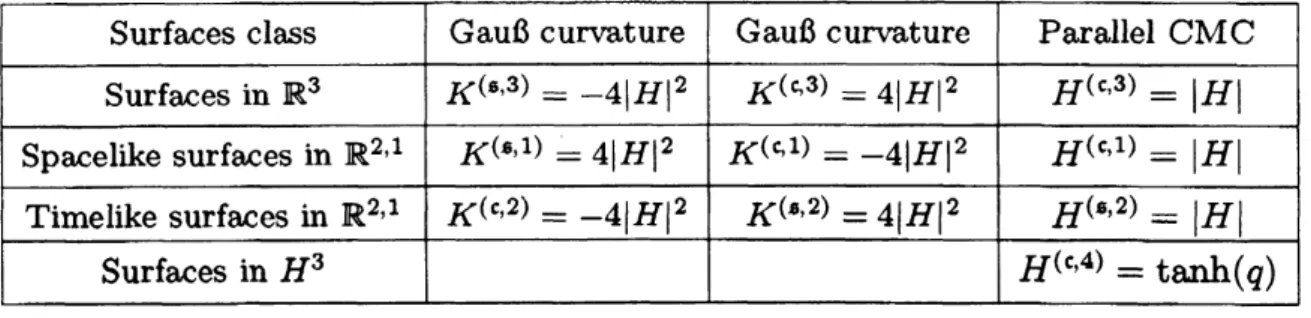
It is known that for three classes of surfaces in the above seven classes, there exist
Table 1: Integrabk surfaces
Corollary 3.2. We retain the assumptions in Theorem S.1. Then
we
have thefol-lowing:
$(C, 1M)$ For the $(C, 1)$ case in Theorem S.l, there exists a pamllel spacelike constant
mean curvature
surface
with mean curvature $H^{(\mathfrak{c},1)}=|H|$ in $\mathbb{R}^{2,i}$.$(C, 3M)$ For the $(C, 3)$ case in Theorem 3.1, there exists
a
pamllel constantmean
cur-vature
surface
withmean curvature
$H^{(c,3)}=|H|$ in $\mathbb{R}^{3}$.
$(S, 2M)$ For the $(S, 2)$ case in Theorem S. 1, there exists aparallel timelike $\omega nstant$
mean
curvature
surface
withmean
curvature $H^{(r,2)}=|H|$ in $\mathbb{R}^{2,1}$.
Definition 5. The
surfaces
defined
in Theorem S. 1 and Corollary S.2 are called theintegrable surfaces.
Remark 3.3. For the three classes
of surfaces
in Theorem S.1, whichare
spacelikeconstantpositive $Gau\beta ian$ curvature
surfaces
in$\mathbb{R}^{2,1},$ $\omega nstant$ negative $Gau\beta ian$cur-vature
surfaces
in $\mathbb{R}^{3}$ and timelike $\omega nstant$ negative$Gau\beta ian$ curvature
surfaces
in$\mathbb{R}^{2,1}$, there
never
exist parallel constant mean curvaturesurfaces.
4
The generalized
Weierstra13
type representation
for integrable
surfaces
The generalized Weierstra3 type representation for complex
CMC-immersions
(orequivalently CGC-immersions
as
the parallel immersions) is the procedure of acon-structionofcomplex CMC-immersionsfrom apair ofholomorphic potentiak (see [4]).
In the previous section, we obtained integrabksurfaces accordingto thereal forms of
$\Lambda \mathfrak{S}[(2, \mathbb{C})_{\sigma}$. In this section, we show how all integrable surfaces are obtained from the
4.1
Integrable surfaces
via
the generalized
Weierstrai3
type
representation
The generalized WeierstraB type representation for complex
CMC-immersions
(orequivalentlyCGC-immersions
as
theparallelimmersions) isdividedinto thefollowing4 steps (see ako [4] for
more
details):Stepl Let $\check{\eta}=(\eta(z, \lambda), \tau(w, \lambda))$ be apair of holomorphic potentiak of the following
forms:
$\check{\eta}=(\eta(z, \lambda), \tau(w, \lambda))=(\sum_{k=-1}^{\infty}\eta k(z)\lambda^{k},\sum_{m=-\infty}^{1}\tau_{m}(w)\lambda^{m})$ (4.1.1)
where $(z, w)\in \mathfrak{D}^{2}$ and where$\mathfrak{D}^{2}$
is
some
holomorphicallyconvex
domainin $\mathbb{C}^{2}$,$\lambda\in \mathbb{C}^{*},$ $|\lambda|=r(0<r<1)$, and
$\eta k$ and $\tau_{m}$
are
$\epsilon 1(2, \mathbb{C})$-valued holomorphicdifferential l-forms. Moreover $\eta_{k}(z)$ and $\tau_{k}(w)$
are
diagonal (resp. off-diagonal)matrices if $k$ is even (resp. odd). We also
assume
that the upper right entry of$\eta_{-1}(z)$ and the lower left entry $\tau_{1}(w)$ do not vanish for all $(z, w)\in \mathfrak{D}^{2}$
.
Step2 Let$\cdot$
$C$ and $L$ denote the solutions to the following linear ordinary differential
equations
$dC=C\eta$ and $dL=L\tau$ with $C(z_{*}, \lambda)=L(w_{*}, \lambda)=$id, (4.1.2)
where $(z_{*}, w_{*})\in \mathfrak{D}^{2}$ is
a
fixed base point.Step3 We factorize the pair of matrices $(C, L)$ via the generalized Iwasawa
decom-position of Theorem A. 1
as
follows:$(C, L)=(F_{7}F)(id, W)(V+’ V_{-})$ , (4.1.3)
where $V\pm\in\Lambda^{\pm}SL(2, \mathbb{C})_{\sigma}$.
Theorem 4.1 ([4]). Let $F$ be a $\Lambda SL(2, \mathbb{C})_{\sigma}$-loop
defined
by the generalizedIwa-sawa decomposition in (4.1.3). Then there exists a $\lambda$
-independent diagonal matrix
$l(z, w)\in SL(2, \mathbb{C})$ such that $F\cdot l$ is a complex extended framing
of
some
$\omega mplex$CMC-immersion (or equivalently the complex CGC-immersion as the parallel
im-mersion).
Step4 The Sym formula defined in (2.2.1) via $F(z, w, \lambda)l(z, w)$ represents a complex
CMC-immersion and
a CGC-immersion
in$\mathfrak{S}[(2, \mathbb{C})\cong \mathbb{C}^{3}$.Let $c_{j}$ for $j\in\{1,2,3,4\}$ and $\mathfrak{S}_{j}$ for $j\in\{1,2,3\}$ be the involutions defined in (3.1.3),
respectively. Then we define the following pairs of involutions
on
$\dot{\eta}=(\eta, \tau)\in$$\Omega(\Lambda \mathfrak{s}\mathfrak{l}(2, \mathbb{C})_{\sigma})\cross\Omega(\Lambda_{\mathfrak{S}}1(2, \mathbb{C})_{\sigma})$:
$\mathfrak{r}_{j}:(\eta, \tau)\mapsto(c_{j}\tau, c_{j}\eta)$ and $\Phi_{j}:(\eta, \tau)\mapsto(\epsilon_{j}\eta, \mathfrak{S}_{j}\mathcal{T})$
.
(4.1.4)Theorem 4.2. Let $\eta=(\eta(z, \lambda), \tau(w, \lambda))$ be a pair
of
holomorphic potentialsdefined
as in (4.1.1), and let $\mathfrak{r}_{j}$
for
$j\in\{1,2_{i}3,4\}$ and $\Phi_{j}$for
$j\in\{1,2,3\}$ be the pairsof
involutions
defined
in (4.1.4). Then the following statements hold:$(C, 1)$
If
$\mathfrak{r}_{1}(\check{\eta})=\check{\eta}$, then the resulting immersions given by the generalized $Weierstra\beta$type representation are spacelike constant negative $Gau\beta ian$ curvature
surfaces
in$\mathbb{R}^{2,1}$.
$(C, 2)$
If
$\mathfrak{r}_{2}(\check{\eta})=\check{\eta}_{f}$ then the resulting immersions given by the genemlized $Weierstra\beta$type representation
are
timelike constant negative $Gau\beta ian$ curvaturesurfaces
in $\mathbb{R}^{2,1}$.
$(C, 3)$
If
$\mathfrak{r}_{3}(\check{\eta})=\check{\eta}$, then the resulting immersions given by the generalized $Weierstra\beta$type representation are $\omega nstant$ positive $Gau\beta ian$ curvature
surfaces
in $\mathbb{R}^{3}$.$(C, 4)$
If
$\mathfrak{r}_{4}(\check{\eta})=\check{\eta}$, then the resulting immersions given by the generalized $Weierstra\beta$type representation
are
constantmean
curvaturesurfaces
withmean curvature
$|H^{(q4)}|<1$ in $H^{3}$.
$(S, 1)$
If
$0_{1}(\check{\eta})=\check{\eta}$, then the resulting immersions given by the generalized $Weierstra\beta$type representation are spacelike constant positive $Gau\beta ian$ curvature
surfaces
in $\mathbb{R}^{2,1}$.
$(S, 2)$
If
$V_{2}(\check{\eta})=\check{\eta}$, then the resulting immersions given by the generalized $Weierstra\beta$$\mathbb{R}^{2,1}type$
.
representation
are
timelike constantpositive $Gau\beta ian$ curvaturesurfaces
in$(S, 3)$
If
$b_{3}(\check{\eta})=\check{\eta}$, then the resulting immersions given by the generalized $Weierstra\beta$type representation
are
constant negative $Gau\beta ian$ curvaturesurfaces
in $\mathbb{R}^{3}$.
Remark 4.3. From the $f_{07}ms$
of
pairsof
involutions $\mathfrak{r}_{j}$for
$j\in\{1,2,3,4\}$defined
in (4.1.4), the pairs
of
holomorphic potentials $\check{\eta}$for
$(C,j)$cases
in Theorem4.2
are
genemted by a single potential, $i.e.\check{\eta}=(\eta, \tau)=(\eta, c_{j}(\eta))$, where $c_{j}$
for
$j\in\{1,2,3,4\}$are involutions
defined
in (3.1.4).A
Double
loop
groups
and
the
generalized
Iwa-sawa
decompositions
Inthis subsection, we give the basic notations andresults for doubleloop groups (see
[7] for
more
detaik). Let $D_{r}:=\{\lambda\in \mathbb{C}||\lambda|<r\}$ bean
open disk and denote theclosure of $D_{r}$ by $\overline{D_{f}}$ $:=\{\lambda\in \mathbb{C}| |\lambda|\leq r\}$. Ako, let
$A_{r}=\{\lambda\in \mathbb{C}|r<|\lambda|<1/r\}$
be an open amulus containing $S^{1}$, and denote the closure of$A_{r}$ by $\overline{A_{r}}$. Furthermore,
We recall the definitions of the twisted plus r-loop group and the minus r-loop group
of $\Lambda SL(2, \mathbb{C})_{\sigma}$
as
follows:$\Lambda_{r,B}^{+}SL(2, \mathbb{C})_{\sigma}$ $:=\{W_{+}\in\Lambda_{r}SL(2, \mathbb{C})_{\sigma}$
$\Lambda_{r,B}^{-}SL(2, \mathbb{C})_{\sigma}:=\{W_{-}\in\Lambda_{r}SL(2\rangle \mathbb{C})_{\sigma}$
$W_{+}(\lambda)$ extends holomorph cally
to $D_{r}$ and $W_{+}(0)\in B$
.
‘ $W_{-}(\lambda)$ extends holomorphicallyto $E_{r}$ and $W_{-}(\infty)\in B$
.
‘ where $B$ is a subgroup of $SL(2, \mathbb{C})$.
If$B=${id}
we write the subscript $*$ instead of$B$, if $B=SL(2, \mathbb{C})$ we abbreviate $\Lambda_{r,B}^{+}SL(2, \mathbb{C})_{\sigma}$ and $\Lambda_{rB,)}^{-}SL(2, \mathbb{C})_{\sigma}$ by $\Lambda_{r}^{+}SL(2, \mathbb{C})_{\sigma}$ and $\Lambda_{r}^{-}SL(2, \mathbb{C})_{\sigma}$, respectively. Rom now on we will use the subscript $B$ as above only if $B\cap SU(2)=$
{id}
holds. When $r=1$, we always omit the 1.We set the product of two loop groups:
$\mathcal{H}=\Lambda_{r}SL(2, \mathbb{C})_{\sigma}\cross\Lambda_{R}SL(2, \mathbb{C})_{\sigma}$ ,
where
$0<r<R$
. Moreover we set the subgroups of$\mathcal{H}$as
follows: $\mathcal{H}_{+}=\Lambda_{r}^{+}SL(2, \mathbb{C})_{\sigma}x\Lambda_{R}^{-}SL(2, \mathbb{C})_{\sigma}$,$\mathcal{H}_{-=}\{(g_{1}, g_{2})\in \mathcal{H}|$
$g_{1}$ and
$g_{2}extendho1omorphica11ytoA_{r}andg_{1}|_{A_{r}}=g_{2}|_{A_{r}}\}$ ,
We then quote Theorem 2.6 in [7].
Theorem A.1. $\mathcal{H}_{-}x\mathcal{H}_{+}arrow \mathcal{H}_{-}\mathcal{H}_{+}$ is an a.nalytic diffeomorphism. The image is open and dense in $\mathcal{H}$. More precisely
$\mathcal{H}=\bigcup_{n=0}^{\infty}\mathcal{H}_{-}w_{n}\mathcal{H}_{+}$ ,
where $w_{n}=$ $($id, $(_{0\lambda^{\underline{0}_{n}}}^{\lambda^{n}}))$
if
$n=2k$ and $($id, $(_{-\lambda^{-n}0}0\lambda^{n}$ $))$if
$n=2k+1$.The proof of the theorem above is abost verbatim the proof given in the basic
decomposition paper [2] (see also [3]).
References
[1] M. Babich and A. Bobenko. Wilhnore tori with umbilic lines and mmimal
sur-faces in hyperbolic space. Duke Math. J., $72(1):151-185$, 1993.
[2] M. J. Bergvelt and M. A. Guest. Actions of loop groups
on
harmonic maps. Trans. $\mathcal{A}mer$.
Math. Soc., 326(2):861-886, 1991.[3] J. Dorfmeister and S.-P. Kobayashi. Coarse classification of constant
mean
[4] J. Dorfmeister, S.-P. Kobayashi, and F. Pedit. Complex surfaces of constant
mean
curvature fibered by miDimal surfaces. Preprint, 2006.[5] J. Dorfmeister, F. Pedit, and H. Wu. Weierstrass typerepresentationofharmonic
maps into symmetric spaces. Comm. Anal. Geom., $6(4):633-668$, 1998.
[6] Josef Dorfmeister, Jun-ichi Inoguchi, and Magdalena Toda. Weierstra3-type
representationof timelike surfaceswith constant
mean
curvature. InDifferential
geometry and integmble systems (Tokyo, 2000), volume 308 of Contemp. Math.,
pages 77-99. Amer. Math. Soc., Providence, RI, 2002.
[7] Josef Dorfmeister and Hongyou Wu. Constant
mean
curvature surfaces and loopgroups. J. Reine Angew. Math., 440:43-76, 1993.
[8] Jun-ichi Inoguchi. Timelike surfaces of constant
mean
curvature in Minkowski3-space. Tokyo J. Math., 21(1):141-152, 1998.
[9] Jun-Ichi Inoguchi. Surfaces in Minkowski 3-space and harmonic maps. In
Har-monic morphisms, harmonic maps, and related topics (Brest, 1997), volume
413 of Chapman
&
Hall/CRC Res. Notes Math., pages249-270.
Chapman&
Hall/CRC, Boca Raton, FL$\rangle$ 2000.
[10] Shimpei Kobayashi. Real forms of complexsurfaces ofconstant
mean
curvature.submitted, 2007.
[11] Claude LeBrum. Spaces of complex null geodesics in complex-Riemannian geom-etry. $\mathcal{I}kans$. $\mathcal{A}mer$
.
Math. Soc., 278(1):209-231, 1983.[12] Tilla Klotz Milnor. Harmonic maps and classical surface theory in Minkowski