A VERY BRIEF
INTRODUCTION
TO VIRTUAL HAKEN CONJECTUREYASUSHIYAMASHITA
This note is
a
brief summary of my talk that I gave at RIMSSeminar
“Representa-tion spaces, twisted topological invariants and geometric structures of 3-manifolds”on
May 30, 2012. The aim of this survey is to givean
overview of works used to prove so-called virtu ally Haken conjecture. When Iwas
preparing for my talk, the paper by$Aschenbremer-Riedl-$Wilton [$6]$ was very useful andI leamed a lot from this.
1. $THURSTON’ S$ QUETIONS
In 1982, Thurston asked 24 questions, saying “Here are a few questions and projects conceming -manifolds and Kleinian groupswhich I find fascinating.” Thefirst question
was
thefamous geometrizationconjecture andthequestions (15)$-(18)$ were the following[19]:
(15) Arefinitely-generated Kleinian groups LERF?
A group $G$ is LERF iffor everyfinitely generated subgroup $L<G$, and for all$g\in G\backslash L,$ there exists
a
finite group $K$ anda
homomorphism $\phi$ : $Garrow K$ such that $\phi(g)\not\in\phi(L)$.
See section 2 for more details.
(16) Does every hyperbolic -manifold have afinite-sheeted cover which is Haken?
A compact, orientable, irreducible 3-manifold $M$ is called Haken if $M$ contains
an
ori-entable, incompressible surface. $M$ is called virtually Haken if $M$ has a finite-sheeted
cover
that is Haken. Waldhausen asked whether every compact, orientable, irreducible -manifold with infinite fundamental groupis virtually Haken [20]. After the proof of the geometrization conjecture, the conjecturewas
only open for hyperbolic 3-manifolds.(17) Does every aspherica13-manifoldhave afinite-sheetedcoverwith pos-itive first Betti number?
A -manifold $M$ is called aspherical if all its higher homotopy groups $(\pi_{i}(M)$ for $i\geq 2)$
vanish. $A$group $G$issaid tohave positivefirst Bettinumber if$\beta_{1}(G)=$ rank $H_{1}(G;\mathbb{Q})>$
$0.$ $A$ group $G$is said to have virtually positive first Betti number if$G$ has a finite index
subgroup $G’<G$ with $\beta_{1}(G’)>0.$ $A$ group $G$ issaid to havevirtually infinite first Betti number if, for any $k>0$, there exists finite index subgroup $G’<G$ with $\beta_{1}(G’)>k.$
A
group
$G$ is called large if it hasa
finite index subgroup $G’<G$ anda
epimorphism$\phi:Garrow \mathbb{Z}*\mathbb{Z}.$ $A$ -manifold $M$ issaid to have corresponding properties if$\pi_{1}(M)$ has.
(18) Does every hyperbolic 3–manifold have a finite-sheeted cover which fibers
over
thecircle?1
Received December31, 2012
Thisresearchwaspartially supported bythe Ministry ofEducation, Science, Sports andCulture,
Grant-in-Aid for Scientific Research (C), No.23540088.
lAfter
thisquestion,Thurston wrote, “This dubious-sounding questionseemstohave a definite chance forapositiveanswer”Let $\Sigma$ be a surface and
$\phi$ : $\Sigmaarrow\Sigma$ a homeomorphism. The mapping torus
$T_{\phi}$ of $\phi$ is the
manifold
$T_{\phi}=\Sigma\cross[O, 1]/(x, 0)\sim(\phi(x), 1)$
.
A 3-manifold $M$ is said to fiber
over
the circle if$M$ can be obtained as a mapping torus. $M$ is called virtually fibered if$M$ has a finite-sheeted cover which fibers over the circle.There are examples of graph manifolds which are not virtuallyfibered [15]. Now, we have the following:
Theorem 1.1 (Agol [3]). All these conjectures are vahd.
2. LOCALLY EXTENDED RESIDUALLY FINITE
We want to know when one can lift $\pi_{1}$-injective immersions to embeddings in
finite-sheeted covers, and LERF allows this (Scott [18]).
2.1. Residually finite. $A$group $G$ is residually finite ($RF$) if for every nontrivial$g\in G,$
there exists a finite group $K$ and
a
homomorphism $\phi:Garrow K$ such that $\phi(g)\neq 1.$Facts 2.1. Suppose that$G$ is residually
finite
andfinitelygenemted. Then following hold;(1) $G$ is
Hopfian2
(Mal’cev).(2) Aut$(G)$ is residually
finite.
(Baumslag)(3) $G$ has a solvable word problem.
Example 2.2. (1) Finitely-generated subgroup of$GL(n, k)$, where $k$ is afield. (Mal’cev)
(2) The
fundamental
group of any compact 3-manifold. (Hempel [13] and geometriza-tion)(3) Mapping class group ofsurfaces
It is known that thegroup $\langle a,$$b|b^{-1}a^{2}b=b^{3}\rangle$ is not Hopfian, inparticular, not residually finite.
Question 2.3. Is everyhyperbolic group residually
finite
9The expected
answer
seems to be $NO$, but$\ldots$
Theorem 2.4 (Agol Groves-Manning [5]).
If
every hyperbolic group $\dot{u}$ residually finite,then
evew
quasi-convexsubgroupof
a hyperbolic group is sepamble.2.2. LERF. $A$ group $G$ is LERF (locally extended residually finite) iffor every finitely generated subgroup $L<G$, and for all $g\in G\backslash L$, there exists a finite group $K$ and a
homomorphism $\phi:Garrow K$ such that $\phi(g)\not\in\phi(L)$.
Examples 2.5. (1) free group (Hall) (2) surfacegroup (Scott [18]),
(3) Bianchi groups $(Agol-Long$-Reid[1]$)$
(4) Quasiconvex subgroups of word-hyperbolic Coxeter group (Haglund-Wise [12]) Not a113-manifold groups
are
LERF (Bums–Karrass Solitar [8]).3. CUBE COMPLEX
Surprisingly, cube complexesplay
an
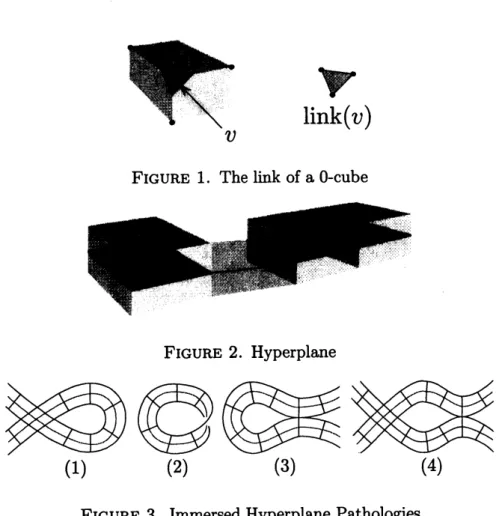
essentialrule to solve Thurston’s questions (15)-(18). Let us beginwith the basic definitions.$w$
$link(v)$
FIGURE 1. The link ofa $0$-cube
FIGURE 2. Hyperplane
(1) (2) (3) (4)
FIGURE 3. ImmersedHyperplane Pathologies
3.1. Basic definitions. An$n$-cube is acopy of$[$-1, $1]^{n}$ and a -cube is asinglepoint. $A$
cube complex is
a
cell complex formed from cubes by identifying subcubes. The link ofa
0–cube$v$ is acomplexof simpliceswhose$n$-simplices correspond tocomers
of$n+1$-cubes meeting at $v$.
See Figure 1. $A$ flag complex is a simplicial complex such that $n+1$vertices span
an
$n$-simplex if and only if theyare
pairwise adjacent. $A$cube complex$C$is nonpositively curved iflink(v) is a flagcomplex for each $0$-cube$v\in C^{0}.$ $A$ cube complex$X$ is CAT(0) if it is simply connected and nonpositively curved.
A midcube in $[$-1, $1]^{n}$ is a subspace obtained by restricting
one
coordinate to $0$.
Wethen glue together midcubesinadjacent cubes whenever theymeet, to getthehyperplanes
of$X$
.
See
Figure 2.Definition 3.1 ([11]). $A$ cubecomplex is spacial ifall the following hold: See Figure
3.
(1) No immersed hyperplanecrosses
itself.(2) Eachimmersed hyperplane is 2-sided.
(3) No immersed hyperplane self-osculates. (4) No two immersed hyperplanes inter-osculate.
Theorem 3.2 (Haglund-Wise [11]).
If
$X$ isa
compact special cube complex and itsfundamental
group$\pi_{1}(X)$ is word-hyperbolic, then everyquasiconvex subgroupis separable. 3.2. Salvetti complex. Let $\Sigma$ be any graph. We build a cubecomplex $S_{\Sigma}$as
follows:(1) $S_{\Sigma}$ has one -cell;
(3) $S_{\Sigma}$ has asquare 2-cell with boundary reading
$e_{u}e_{v}\overline{e_{u}e_{v}}$whenever$u$and $v$
are
joinedby an edge in $\Sigma$;
(4) for $n>2$, the $n$-skeleton is defined inductively – attach an
$n$-cube to any
sub-complex isomorphic to the boundary of$n$-cube which does not already bound an $n$-cube.
Let $V(\Sigma)=\{v_{1}, \ldots, v_{k}\}$ bethevertex set ofthe graph $\Sigma$. The right-angledArtingroup
(RAAG) associated to $\Sigma$ is the group given ae follows:
$A_{\Sigma}=\langle v_{1},$
$\ldots,$$v_{k}|[v_{i}, v_{j}]=1$ if$v_{i}$ and $v_{j}$ are connected by an edge$\rangle$
The fundamental group of the Salvetticomplex $S_{\Sigma}$ is right-angled Artin group.
The hyperplane graph of a cube complex $X$ is the graph $\Sigma(X)$ with vertex-set equal to the hyperplanes of $X$, and with two vertices joined by an edge if and only if the
corresponding hyperplanes intersect.
Typing map $\phi_{X}$ : $Xarrow S_{\Sigma(X)}$ is defined as follows:
(0) Each $0$-cellof $X$ maps to the unique $0$-cell
$x_{0}$ of $S_{\Sigma(X)}$
(1) Each 1-cell $e$ of $X$ goes to the unique 1-cell in $S_{\Sigma(X)}$ which corresponds to the
unique hyperplane that $e$ crosses.
(2) $\phi_{X}$ is defined inductively on higher dimensional cubes.
Theorem3.3 (Haglund-Wise [11]). Let$X$ be anon-positively$cu7^{v}ved$ cube complex. Then
$Xi_{!}s$ special
if
and onlyif
there exists a graph $\Sigma$ and there is an immersion$Xarrow S_{\Sigma}$ thatis a local isometryt at the level
of
the 2-skeleta.3.3. Compact special group. $A$group is called (compact) specialif it isthe
fundamen-tal groupof a non-positively curved (compact) special cube complex.
Let $X$ be a geodesic metric space. $A$ subspace $Y$ is said to be quasi-convex if there
exists $\kappa\geq 0$ such that any geodesic in $X$ with endpoints in $Y$ is contained within the
$\kappa$-neighborhood of$Y.$
Let $\pi$ be a group with afixed generating set $S.$ $A$ subgroup $H\subset\pi$ issaid to be quasi-convex if it is a quasi-convex subspace of$Cay_{S}(\pi)$, the Cayley graphof$\pi$ with respectto the generatingset $S.$
Corollary 3.4. (See Corollary 5.8 and
Corollaw
5.9 in [6].) $A$ group is specialif
and onlyif
it isa
subgroupof
a Right-Angled Artin Group. $\mathcal{A}$ group is compact specialif
and onlyif
it is a quasi-convexsubgroupof
a Right-Angled Artin Group.3.4. Virtually Compact Special Theorem. Let $(X, d_{X})$ and $(Y, d_{Y})$ be metric spaces.
A function $f$ : $Xarrow Y$ is called a quasi-isometric
embedding3
if there exist constants$K\geq 1$ and $C\geq 0$ such that
$\frac{1}{K}d_{X}(x, y)-C\leq d_{Y}(f(x), f(y))\leq Kd_{X}(x,y)+C$
for any $x,$$y\in X.$
Definition 3.5 (Quasiconvex hierarchy). Theclass $\mathcal{Q}H$isdefined to be the smallest class offinitely generated groups that is closed under isomorphism and satisfies the following properties.
(1) The trivial group 1 is in $\mathcal{Q}H.$
(2) Amalgamated product $G\cong A*c^{B}$ is in $\mathcal{Q}H$ if $A,$$B\in \mathcal{Q}H$ and $C$ is finitely
generated and the inclusion map $C\hookrightarrow A*c^{B}$ is
a
quasi-isometric embedding. (3) HNN extension $G\cong A*c$ is in $\mathcal{Q}H$ if$A\in \mathcal{Q}H$ and $C$ is finitely generated and theinclusion map $C\hookrightarrow A*c$ is
a
quasi-isometric embedding.Theorem 3.6 (Virtually Compact Special Theorem for $QH$ [21]).
If
$G\in \mathcal{Q}H$ is word-hyperbolic, then$G$ is nirtually compact special.This theorem has
an
application to one-relater groups.Corollary 3.7 ([21]). Every one-relatergroup snith torsion is virtually compact special. Let $N$ be
a
closed, hyperbolic 3-manifold which contains an incompressiblegeometri-cally finite surface. Thurston showed that $N$ admits a hierarchy of geometrically finite
surfaces. $A$ subgroup of $\pi_{1}(N)$ is geometrically finite if and only if it is quasiconvex. Combining these results and virtually compact specialtheorem,
we
get the following: Theorem 3.8 (Wise). Let $N$ be a closed hyperbolic3-manifold
which contains anincom-pressible geometrically
finite
surface, then $\pi_{1}(N)$ is virtually compact special.3.5. Surface subgroups. Let
us
recallsome notions in Kleinian group theory. $A$ lfuch-siangroup isa
discrete subgroupofPSL$(2, \mathbb{R})$.
A Kleiniangroup isa
discrete subgroup ofPSL
$(2, \mathbb{C})$.
$A$ quasifuchsian group isa
Kleinian group $G$ that is conjugate toa
Fuchsiangroup by a quasiconformal automorphism of$\hat{\mathbb{C}}.$
Fix
an
identffication of $\pi_{1}(N)$ witha
discrete subgroup of PSL$(2, \mathbb{C})$.
$N$ is said tocontain a dense set ofquasifuchsiansurface groups if for each great circle $C$ of$\partial \mathbb{H}^{3}=S^{2}$
there exists
a
sequenceof$\pi_{1}$-injective immersions $\iota;\Sigma_{i}arrow N$ of surfaces $\Sigma_{i}$ such that thefollowinghold:
(1) for each $i$, thegroup $\iota_{*}(\pi_{1}(\Sigma_{i}))$ is a quasifuchsian surface group.
(2) the sequence $\partial\Sigma_{i}\subset\partial \mathbb{H}^{3}$ converges to $C$ in the Hausdorff metric.
Theorem3.9 (Kahn-Markovic [14]). Every closed hyperbolic
3-manifold
contains a dense setof
quasifuchsiansurface
groups.3.6.
Constructing cube complex. Let $G$ be a finitely generated group with Cayley graph Cay$(G)$.
$A$ subgroup $H\subset G$ is codimension-l if it hasa
finite neighborhood$N_{f}(H)$ such that Cay$(G)\backslash N_{f}(H)$ contains at least twocomponents that
are
deep inthesense
that they do not he in any $N_{S}(H)$.
Example 3.10. (1) $\mathbb{Z}^{n}$ in $\mathbb{Z}^{n+1}.$
(2) Anyinfinite cyclic subgroup ofa closedsurface subgroup. Let $H_{1},$
$\ldots,$$H_{k}$ be a collection ofcodimension-l subgroups. The wall associated to $H_{1}$
is a fixed partition $\{\pi_{1}, \pi_{i}\}$ of Cay
$(G)$
.
The translated wall associated to $gH_{1}$ is thepartition $\{g\pi_{1,g}\pi_{1}\}.$
The (1-skeleton of) “dual cube complex” due to Sageev is defined as follows:
(1) $A$ 0–cube is a choice of
one
halfspace from each wall such that each element of$G$ lies in all but finitely many ofthese chosen halfspaces.(2) Two -cubes
are
joined bya
1-cube precisely when their choices differon
exactlyone
wall.Let $G$ be a word-hyperbolic group, and $H_{1},$
$\ldots,$$H_{k}$ be a collection of quasiconvex
codimension-l subgroups. Then the action of $G$ on the dual cube complex is
cocom-pact. (See Sageev [16], [17].)
Theorem 3.11 ([7]). Let$G$ be a word-hyperbolic group. Suppose that
for
eachpairof
dis-tinctpoints $(u, v)\in(\partial G)^{2}$ there exists a quasiconvex codimension-l subgroup $H$ such that$u$ and$v$ lie in distinct components
of
$\partial G\backslash \partial H$. Then there is afinite
collection$H_{1},$$\ldots,$$H_{k}$
of
quasiconvexcodimension-l subgroups such that $G$ acts properly and cocompactly on the resulting dual CAT$(O)$ cube complex.Combining theorem 3.9 and theorem 3.11, Bergeron and Wise showed that
Theorem 3.12 ([7]). Let$M$ be a closedhyperbolic
3-manifold.
Then$\pi_{1}(M)$ actsproperlyand cocompactly on a CAT$(O)$ cube complex.
3.7. RFRS and virtual fiber. Fora group $G$, set $G_{r}^{(1)}=\{x\in G|\exists k\neq 0,$$x^{k}\in[G, G]\}.$
Definition 3.13 (RFRS [4]). $A$ group $G$ is residually finite $\mathbb{Q}$-solvable (RFRS) ifthere
is a sequence of subgroups $G=G_{0}>G_{1}>G_{2}>\ldots$ such that $G\triangleright G_{i},$ $[G : G_{i}]<\infty,$
$\bigcap_{i}G_{i}=\{1\}$ and $G_{i+1}\geq(G_{i})_{r}^{(1)}.$
Theorem 3.14 (Agol [4]). The following hold;
$\bullet$
If
$G$ is $RFRS_{f}$ then any subgroup $H<G\dot{w}$as
well.
$\bullet$ Right angled
Artin
groupsare
virtually RFRS. (Agol [4])Examples 3.15. The following
are
other examples of (virtually) RFRS:$\bullet$ surface groups, $\bullet$ reflection groups,
$\bullet$ arithmetic hyperbolic groups defined by a quadratic.
Theorem 3.16 (Agol [4]).
If
$M$ is aspherical and $\pi_{1}(M)$ is RFRS, then $M$ virtuallyfibers.
4. THE FINAL STEP
This is what Agol showed for the final step of the conjectures.
Theorem
4.1
(Agol [3]). Let $G$ bea
word-hyperbolic group acting properly and cocom-pactly on a CAT(0) cube complexX. Then$G$has afinite
index subgroup$F$ actingspeciallyon$X.$
Combining and theorem 3.8, 3.12,
4.1
and other cases, the situationcan
bedescribed
in avery nice way.Theorem 4.2 (Virtually Compact Special Theorem).
If
$N$ is a hyperbolic 3-manifold,then $\pi_{1}(N)$ is virtually compact special.
If$\pi_{1}(N)$ is virtually (compact) special, then it is asubgroup of a RAAG (theorem3.3). By theorem 3.14 and 3.16, $N$ virtually fibers.
To show that $\pi_{1}(M)$ is LERF, weneed the next theorem.
Theorem 4.3 (Tameness [2],[9]). Let $N$ be
a
hyperbolic 3-manifold, not necessarilyof
finite
volume.If
$\pi_{1}(N)$ is finitely generated, then $N$ is topologically tame, i.e., $N$ isA -manifold $N$ is fibered if there exists
a
fibration $Narrow S^{1}.$ $A$ surface fiber in a -manifold $N$ is thefiber of afibration $Narrow S^{1}.$ $\Gamma\subset\pi_{1}(N)$ is asurface fiber subgroup ifthere exists a surface fiber $\Sigma$ such that $\Gamma=\pi_{1}(\Sigma)$
.
$\Gamma\subset\pi_{1}(N)$ is a virtual surface fibersubgroup if $N$ admits afinite cover $N’arrow N$ such that $\Gamma\subset\pi_{1}(N’)$ and such that $\Gamma$ is a
surface fiber subgroup of $N’.$
Theorem 4.4 (Subgroup Tameness Theorem). Let $N$ be a hyperbolic
3-manifold
and let$\Gamma\subset\pi_{1}(N)$ be a finitely genemted subgroup. Then either
(1) $\Gamma$ is
a
virtualsurface
fiber
group, $or$(2) $\Gamma$ is geometrically
finite.
For the proof of the theorem, theorem 4.3 and the covering theorem (due to Canary) is used.
Theorem3.2 and 4.4
are
used to show the next theorem.Theorem 4.5 (Agol). Let $M$ be a closed hyperbolic
3-manifold.
Then there is afinite-sheeted
cover
$\tilde{M}arrow M$ such that $\overline{M}$fibers
overthe circle. Moreover, $\pi_{1}(M)$ is LERF andlarge.
Then, a standard argument in -mamifold theory shows the next theorem.
Theorem 4.6 (Agol). Let $M$ be a closed aspherical
3-manifold.
Then there is afinite-sheeted
cover
$\tilde{M}arrow M$ such that$\overline{M}$is Haken. REFERENCES
[1] I. Agol, D. D. Long, and A. W. Reid, The Bianchi groups are sepamble on geometricallyfinite subgroups, Ann. ofMath. (2) 153 (2001), $59arrow 621.$
[2] I. Agol, Tamenessofhyperbolic $S$-manifolds,$arXiv:math/0405568$ [math.GT].
[3] I. Agol, The virtual haken conjecgture,arXiv:1204.2810 [math.GT]. [4] I. Agol, Critenaforvertual fibering, J. Topol. 1 (2008), 269-284.
[5] I. Agol, D. Groves, and J. F. Manning, Residualfiniteness, QCERF andfillings.of hyperbolicgroups,
Geom. Topol. 13 (2009) 1043-1073.
[6] M. Aschenbrenner, S. Friedl, and H. Wilton, $S$-manifoldgroups, arXiv:1205.0202 [math.GT].
[7] N. Bergeron and D. T. Wise, A boundary criterion for cubulation, Amer. J. Math. 134 (2012),
843-859.
[8] R.G. Burns,A. Karrass,and D.Solitar, A noteongroups withsepamble finitelygenemted subgroups,
Bull. Austral. Math. Soc. 36 (1987), 153-160.
[9] D. Calegari and D. Gabai, Shrinkwrapping and the tamingofhyperbolic 3-manifolds,J.Amer. Math.
Soc. 19 (2006), 385-446.
[10] F. Haglund, Finite index subgroupsofgraph products,Geom. Dedicata 135 (2008), 167-209.
[11] F. Haglundand D. T. Wise, Special cube complexes, Geom. Funct. Anal. 17 (2008), 1551-1620.
[12] F. Haglund and D. T. Wise, Coxetergroupsarevirtually specialAdv. Math.224(2010), 1890-1903.
[13] J. Hempel, Residual finiteness for -manifolds, In Combinatorial group theory and topology
(Alta,Utah, 1984), Ann. of Math. Stud. Vol. 111, 379-396, Princeton Univ. Press, Princeton, NJ,
1987.
[14] J. Kahn and V. Markovic, Immersingalmost geodesic surfacesina closed hyperbolicthree manifold, Ann. ofMath. (2) 175 (2012), 1127-1190.
[15] W. D. Neumann, Commensurubilityand virtualfibrationforgraph manifolds, Topology, 36 (1997),
355-378.
[16] M. Sageev, Ends
of
grouppairs and non-positively curvedcube $\omega$mplexes,Proc. London Math. Soc. (3), 71 (1995), $585\triangleleft 17.$[18] P. Scott, Subgroups ofsurface groups are almost geometric, J. London Math. Soc. (2) 17 (1978),
555-565.
[19] W. P. Thurston, Three-dimensionalmanifolds, Kleiniangroupsandhyperbolicgeometry, Bull.Amer. Math. Soc. (N.S.) 6 (1982), 357-381.
[20] F.Waldhausen, On irreducible 3-manifolds which are suficiently large, Ann.of Math. (2) 87 (1968),
56-88.
[21] D. T.Wise, Research announcement: the structure ofgroups with aquasiconvexhierarchy, Electron. Res. Announc. Math. Sci. 16 (2009),44-55.
DEPARTMENT OF INFORMATION AND COMPUTER SCIENCES, NARA WOMEN’S UNIVERSITY,
Kl-TAUOYA NISHIMACHI, NARA 630-8506, JAPAN