APPROXIMATIONS
TO THE VOLUME OF HYPERBOLIC KNOTSSTEFAN FRIEDL AND NICHOLAS JACKSON
ABSTRACT. Wepresent computationaldata and heuristic arguments which suggestthat
given ahyperbolic knot the volume correlates with its determinant, the Mahlermeasure
of its Alexander polynomial and the Mahlermeasureof the twistedAlexanderpolynomial
corresponding to the discrete andfaithful SL$($2,$\mathbb{C})$ representation.
1. INTRODUCTION
A 3-manifold is called hyperbolic if the interior of $N$ admits
a
complete metric ofcon-stant curvature $-1$ of finite volume. If $N$ is hyperbolic, then it follows from
Mostow-Prasad rigidity that the hyperbolic metric is unique up to isometry. In particular the
volume of $N$ with respect to the hyperbolic metric is
an
invariant of the 3-manifold $N$, whichwe
denote by $vol(N)$. If $N$ is any irreducible, compact, orientable 3-manifold with emptyor
toroidal boundary, thenwe
define $vol(N)$ to be thesum
of the volumes of the hyperbolic pieces in theJSJ
decompositionof
$N$.We say that a knot $K\subset S^{3}$ is hyperbolic, if$S^{3}\backslash \nu K$ is hyperbolic. In that case we will
denotethe volume by $vol(K)$. Note that by Thurston‘s geometrization theorem any knot which is neither
a
torus knotnor a
satellite knot, isa
hyperbolic knot.One of the most elementary invariants of a knot $K$ is its determinant $\det(K)$
.
Thedeterminant has many equivalent definitions, in particular it equals any of the following: (1) the evaluation at $t=-1$ of the Alexander polynomial $\triangle_{K}(t)$,
(2) the evaluation at $t=-1$ of the Jones polynomial $J_{K}(t)$,
(3) the order of the torsion part of the first homology of the 2-fold cyclic
cover
of $S^{3}\backslash K$,(4) the order of the homology ofthe 2-fold branched
cover
of $K$.
Computations by Dunfield [Du99] showed that there exists a surprising correlation be-tween the volume of a knot and its determinant. Other invariants ofinterest to
us are
theAlexander
polynomial $\triangle_{K}(t)$, the Jones polynomial $J_{K}(t)$ and the symmetrized twistedAlexander
polynomial$\mathcal{T}_{K}(t)$ of$K$correspondingto the discrete andfaithful
representationwhich
was
introduced in [DFJII]. In this paperwe
will give computational and heuristic evidence that the volume ofa
hyperbolic knot $K$ is related to the Mahlermeasure
ofthe Alexander polynomial, the evaluation at $t=-1$ and $t=1$ of $\mathcal{T}_{K}(t)$ and the Mahler
measure
of $\mathcal{T}_{K}(t)$.Acknowledgment. We would like to thankNicholas Bergeron, Nathan Dunfield, Thang Le, Wolfgang L\"uck, Saul Schleimer and Ben Wright for helpful conversations.
2.
HYPERBOLIC
VOLUME, $L^{2}$-INVARIANTS AND THEALEXANDER
POLYNOMIAL In this section
we
will givesome
heuristicarguments, using the theory of$L^{2}$-invariants,to justify why we think that the determinant, the Mahler
measure
of the Alexanderpolynomial and the Mahler
measure
of $\mathcal{T}_{K}(t)$are
related to the volume ofa
hyperbolicknot $K$
.
2.1. $L^{2}$
-invariants.
We first recalla
few properties of certain $L^{2}$-invariants. We referto Liick$s$ monograph [L\"u02] for full details. Let $f$ be
one of
the following ‘classicalinvariants’:
(1)
the
i-thBetti
numberof
a
topologicalspace
$X$,(2)
the
signatureof
a
compacteven
dimensional manifold
$X$,(3)
the
Atiyah-Patodi-Singer $\eta$-invariant ofan
odd-dimensional closed Riemannianmanifold $X$ (see [APS75] for details).
Each of the above invariants admits
an
$L^{2}$-version’. More precisely, given $f$ and $X$as
above and
a
homomorphism $\varphi:\pi=\pi_{1}(X)arrow G$ toa
(not necessarily finite) group $G$there exists
a
real valued invariant $f^{(2)}(X, \varphi)$ which has in particular the following threeproperties:
(A) Let $\varphi:\piarrow G$ be
an
epimorphism ontoa
finite group $G$.
Ifwe
denote by $X_{\varphi}$ thecover
of$X$ corresponding to $\varphi$, then$f^{(2)}(X, \varphi)=\frac{1}{|G|}f(X_{\varphi})$.
(B)
Let
$\Gamma_{n}$be
a
nested sequence
of normal
subgroupsof
$\pi$, i.e.a sequence of normal
subgroups of the form
$\pi\supset\Gamma_{1}\supset\Gamma_{2}\supset\Gamma_{3}\ldots$
then
$f^{(2)}(X, \piarrow\pi/\cap\Gamma_{n})=\lim_{narrow\infty}f^{(2)}(X, \piarrow\pi/\Gamma_{n})$
.
(C) If $\psi:Garrow H$ is
a
monomorphism, then$f^{(2)}(X, \varphi)=f^{(2)}(X, \psi 0\varphi)$
.
2.2. The $L^{2}$
-torsion.
Let $C_{*}$ be a chain complexover a
field $F$, together witha
basis $c_{*}$for $C_{*}$
.
If $C_{*}$ is acyclic, then its torsion $\tau(C_{*}, c_{*})\in F^{\cross}=F\backslash \{0\}$ is defined.We
refer to[Mi66]
and
$[ThO1]$for
thedefinition.
(Notethat
the convention used byTuraev
$[TuO1]$ gives the multiplicative inverse ofthe torsion invariant defined by Milnor,we
willfollow
Milnor’s convention throughout.) Now let $X$ be
a
finite CW-complex. The cells naturally give rise toa
basis for the chain complex $C_{*}(X;\mathbb{R})$.
But $H_{0}(X;\mathbb{R})$ is always non-zero,which
means
that the based complex $C_{*}(X;\mathbb{R})$ is not acylic, i.e. the torsion of $C_{*}(X;\mathbb{R})$is not defined.
This problem
can
be circumvented by appealing toa
more
elaborate versionoftorsion. Indeed, let $C_{*}$ bea
chain complexover a
field $F$, together witha
basis $c_{*}$ for $C_{*}$ anda
basis $h_{*}$ for the homology groups, then
a
torsion-invariant $\tau(C_{*}, c_{*}, h_{*})\in F^{x}$ is defined.(We again refer to [Mi66] and $[TuO1]$ for details.)
Now let $X$ again be a finite CW-complex. The cells give again rise to a basis $c_{*}$ of
$C_{*}(X;\mathbb{R})$
.
We picka
basis $h_{*}$ for $H_{*}(X;\mathbb{Z})/torsion$.
This basis gives rise toa
basis forsign the invariant $\tau(C_{*}(X;\mathbb{R}), c_{*}, h_{*})$ is independent of the choice of$h_{*}$. Note that torsion
is a multiplicative invariant, to keep the analogy with the previous sectionwe now define $\tau(X):=\ln|\tau(C_{*}(X;\mathbb{R}), c_{*}, h_{*})|$,
which is
an
additive invariant. By [$TuO1$, Theorem 4.7] this invariantcan
be computedas
follows:$\tau(X)=\sum_{i}(-1)^{i}\ln$
I
$Tor(H_{i}(X;\mathbb{Z}))|$.Note that if$X$ is
a
3-manifold, then it follows from Poincar\’e duality that$\tau(X)=-\ln|Tor(H_{1}(X;\mathbb{Z}))|$.
The awkwardness in the definition of the classical torsion ofa finite CW-complex trans-lates into serious technical difficulties for the $L^{2}arrow torsion$. In particular, given a finite
CW-complex $X$ and
a
group homomorphism $\varphi$ the$L^{2}$-torsion $\tau^{(2)}(X, \varphi)$ is in general not
defined, even if all $L^{2}$-Betti numbers vanish (see [L\"u02, Section 3] for details). A
suffi-cient (but not necessary) condition for the $L^{2}$-torsion to be defined is that the $L^{2}$-Betti
numbers vanish and the Novikov-Shubin invariants are positive. (Note that there
are
two conventions for the $L^{2}$-torsion: The torsion
as
defined in [L\"u02] equals the torsion of[LS99] divided by two,
we
will follow the convention of [L\"u02].$)$A
general approximation result for $L^{2}$-torsion has not been proved yet, in particularthe following two questions (which
are
a
variationon
[L\"u02, Question 13.73])seem
to bewide open:
Question 2.1. Let $X$ be
a
finite
CW-complex and let $\Gamma_{n}$ bea
nested sequenceof
normalsubgroups
of
$\pi=\pi_{1}(X)$. Suppose $\tau^{(2)}(X, \piarrow\pi/\cap\Gamma_{n})$ isdefined
and suppose that$\tau^{(2)}(X, \piarrow\pi/\Gamma_{n})$ is
defined for
any$n_{f}$ does the following equality hold: $\tau^{(2)}(X, \piarrow\pi/\cap\Gamma_{n})=\lim_{narrow\infty}\tau^{(2)}(X, \piarrow\pi/\Gamma_{n})$ ?
Question 2.2. Let $X$ be
a
finite
CW-complex and let $\Gamma_{n}$ be a nested sequenceof
finite
index normal subgroups
of
$\pi=\pi_{1}(X)$. We denote by $X_{n}$ thecover
corresponding to $\Gamma_{n}$.
Suppose that$\tau^{(2)}(X, \piarrow\pi/\cap\Gamma_{n})$, does the following equality hold:
$\tau^{(2)}(X, \piarrow\pi/\cap\Gamma_{n})=\lim_{narrow\infty}\frac{1}{|X:X_{n}|}\tau(X_{n})$ ?
We refer to [BV10] for a detailed discussion of many related questions. We also refer to [Se10,
Section
4] fora
helpful outline ofthe philosophy relating torsion and volume.2.3.
$L^{2}$-torsion of knots and the Mahlermeasure.
Let $K\subset S^{3}$ bea
knot.Through-out this section
we
denote by $X=S^{3}\backslash \nu K$ the exterior of $K$ and we write $\pi=\pi_{1}(X)$.
We will equip $X$ with the structure ofa finite CW complex. The only $L^{2}$-torsions which
are
well understoodare
the $L^{2}$-torsions corresponding to the identity map id: $\piarrow\pi$ andcorresponding to the abelianization map $\piarrow \mathbb{Z}$ which
we
denote by $\alpha$.
More preciselythe following holds:
Theorem 2.3. Let $K\subset S^{3}$ be
a
knot. Then $\tau^{(2)}(X, id)$ and $\tau^{(2)}(X, \alpha)$are
defined
andthey
are
givenas
follows:
$\tau^{(2)}(X, id)$ $=$ $- \frac{1}{6\pi}vol(K)$,
where$m(\Delta_{K}(t))$ denotes the Mahler
measure
of
theAlexander
polynomial (werefer
to theappendix
for
the definition).We refer to [L\"u02, p.
206
and Equation (3.23)] (seealso
[L\"u02, Lemma 13.53])for
a
proof regarding $\tau^{(2)}(S^{3}\backslash K, \alpha)$ and
we
refer to [L\"u02,Theorem
4.3] for details regarding $\tau^{(2)}(S^{3}\backslash K, id)$ (see also [LS99, Theorem 0.7]). The second statementwas
also proved by Li and Zhang (see [LZ06, Equation 8.2]). Note that the first statement in fact holds forany
irreducible3-manifold.
The
Mahler
measure
of the
Alexander
polynomialhas been studied
extensively.In
particular
Silver
and Williams [SW02, Theorem 2.1] proved the following theorem whichgives
an
affirmativeanswer
to Question 2.2 ina
specialcase.
Theorem 2.4. Let $K\subset S^{3}$ be
a
knot.Given
$n\in N$we
denote by $X_{n}$ then-fold
cycliccover
of
$X=S^{3}\backslash K$.
Then the following equality holds:$\ln(m(\Delta_{K}(t)))=\lim_{narrow\infty}\frac{1}{n}\ln|TorH_{1}(X_{n};\mathbb{Z})|$,
or
equivalently$\tau^{(2)}(X, \alpha)=\lim_{narrow\infty}\frac{1}{n}\tau(X_{n})$
.
Remark
2.5.
(1)This theorem
was
proved by [Ri90]and
Gonz\’alez-Acufiaand
Short
[GS91] for the subsequence of $X_{n}$’s for which the homology of the n-th
fold
branchedcover
is finite.(2) The theorem
was
recently reproved by Bergeron and Venkatesh [BV10,Theo-rem
7.3] and itwas
also recently extended by Raimbault [Ra10] and Le [Le10] tomore
generalcases.
(3) Let $Y$ be any
3-manifold
with emptyor
toroidal boundary. We denote by $\{Y_{n}\}$the directed system of all finite
covers
of $Y$.
Thang Le [Le09] has recently shownthat the following inequality holds:
$\lim\sup_{narrow\infty}\frac{1}{[Y:Y_{n}]}\ln|TorH_{1}(Y_{n};\mathbb{Z})|\leq\frac{1}{6\pi}vol(Y)$,
or
equivalently$\lim\sup_{narrow\infty}\frac{1}{[Y:Y_{n}]}\tau(Y_{n})\geq\tau^{(2)}$($Y$,id).
3. THE HYPERBOLIC TORSION
Given
any orientablehyperbolic3-manifold
$Y$we
can
consider the discreteand faithful
SL
$($2,$\mathbb{C})$-representation $\alpha_{can}$.
The corresponding twisted chain complex $C_{*}(\tilde{Y})\otimes_{Z[\pi_{1}(Y)]}\mathbb{C}^{2}$is acylic (see [Po97] and [MP10]),
and
itfollows
that the corresponding torsion$\tau(Y, \alpha_{can})\in$ $\mathbb{R}\backslash \{0\}$ isdefined.
We recall the following recent result of Bergeron and Venkatesh (see [BV10,
Theo-rem
4.5] and Example (3) of [BV10,Section
5.9.3] with $(p, q)=(1,0))$.
Theorem
3.1. Let $Y$ bea
closed hyperbolic3-manifold.
Let$\{Y_{n}\}_{n\in N}$ bea
nested collection
of
finite
covers
such that$\bigcap_{n\in N}\pi_{1}(Y_{n})\subset\pi_{1}(Y)$
is trivial. Then the following holds:
$\lim_{narrow\infty}\frac{1}{[Y:Y_{n}]}\ln|\tau(Y_{n}, \alpha_{can}))|=-\frac{11}{12\pi}vol(Y)$ .
The question naturally arises, whether the conclusion of the theorem also holds for
hyperbolic 3-manifolds with toroidal boundary.
Conjecture 3.2. Let $Y$ be
a
hyperbolic3-manifold of finite
volume. Let $\{Y_{n}\}_{n\in N}$ bea
nested collectionof
finite
covers
such that$\bigcap_{n\in N}\pi_{1}(Y_{n})\subset\pi_{1}(Y)$
is $tr^{J}i$vial. Then
$\lim_{narrow\infty}\frac{1}{[Y:Y_{n}]}\ln|\tau(Y_{n}, \alpha_{can})|=-\frac{11}{12\pi}\cdot vol(Y)$
.
Given
a
hyperbolic knot $K$ the authors and Nathan Dunfield introduced in [DFJII]an
invariant $\mathcal{T}_{K}(t)\in \mathbb{C}[t^{\pm 1}]$ which is definedas
the normalized twisted Alexanderpolynomialofa hyperbolic knot corresponding to the discrete and faithful SL$($2,$\mathbb{C})$ representation of
the knot group. It follows from the definition and standard arguments (see e.g. [DFJII])
that the followingequality
holds:
Let $K$bea
hyperbolicknot and denote by$Y_{n}$ the n-foldcyclic
cover
of $Y=S^{3}\backslash K$, then$\lim_{narrow\infty}\frac{1}{n}\ln|\tau(Y_{n}, \alpha_{can}))|=-\ln(m(\mathcal{T}_{K}(t)))$.
In light of the above results it is therefore perhaps not surprising that in
our
calculationswe
willsee
that the natural logarithm of the Mahlermeasure
of $m(\mathcal{T}_{K}(t))$ correlatesstrongly with $vol(Y)$
.
Remark 3.3. Note that for any $m$ there exists
a
unique irreducible representation $\varphi_{m}$ :SL$($2,$\mathbb{C})arrow$ GL$(m+1, \mathbb{C})$ given by the action ofSL$($2,$\mathbb{C})$
on
the symmetric powers of$\mathbb{C}^{2}$
.
Let $Y$ be
a
closed hyperbolic3-manifold
and $\rho:\pi_{1}(Y)arrow$SL
$($2,$\mathbb{C})$a
discrete and faithfulrepresentation. M\"uller [M\"u09,
M\"u10]
showed that$vol(Y)=\lim_{marrow\infty}-\frac{1}{m^{2}}4\pi\ln\tau(Y, \varphi_{m}\circ\rho)$.
It is unfortunately not clear to the authors how this beautiful result relates to the above open questions.
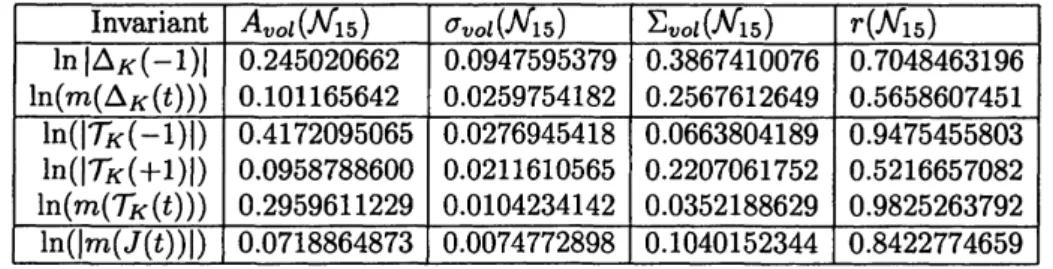
4. CALCULATIONS
In this section
we
will compute various real valued invariants for all knots up to 154.1.
Comparisonof
invariants.
Beforewe
presentour
calculations
we
first
introducesome
notationand definitions. Given
a
set $\mathcal{K}$of
hyperbolicknots and
a
real-valued
invariant
$\Phi$ ofhyperbolic knotswe
denote by$A(\Phi, \mathcal{K})$ $;=$ $\frac{1}{|\mathcal{K}|}\sum_{K\in \mathcal{K}}\Phi(K)$,
$\sigma(\Phi, \mathcal{K})$ $;=$ $\sqrt{\frac{1}{|\mathcal{K}|}\sum_{K\in \mathcal{K}}(\Phi(K)-A(\Phi,\mathcal{K}))^{2}}$
the average value respectively the standard deviation of$\Phi$. When $\mathcal{K}$ is understood, then
we
will drop it from the notation.We
furthermore define $A_{vol}(\Phi, \mathcal{K})$ $;=$ $A(\Phi/vol, \mathcal{K})$,$\sigma_{vol}(\Phi, \mathcal{K})$ $;=$ $\sigma(\Phi/vol, \mathcal{K})$,
$\Sigma_{vol}(\Phi, \mathcal{K})$ $;=$ $\frac{1}{A_{vol}(\Phi,\mathcal{K})}$ . $\sigma_{vol}(\Phi, \mathcal{K})$
.
Finally
we
define
$r(\Phi, \mathcal{K})$ to be thePearson
correlationcoefficient
of the invariant $\Phi$ andhyperbolic volume, i.e.
$r( \Phi, \mathcal{K})=\frac{1}{|\mathcal{K}|-1}\sum_{K\in \mathcal{K}}\frac{\Phi(K)-A(\Phi)}{\sigma(\Phi)}\cdot\frac{vol(K)-A(vol)}{\sigma(vo1)}$
.
Note
that $r(\Phi, \mathcal{K})=1$ if there existsan
$s>0$ such that $\Phi(K)=svol(K)$ for all $K\in \mathcal{K}$,and $r(\Phi, \mathcal{K})=-1$ if there exists
an
$s<0$ such that $\Phi(K)=svol(K)$ for all $K\in \mathcal{K}$.
In general $r(\Phi, \mathcal{K})\in[-1,1]$.
The absolute value of $r(\Phi, \mathcal{K})$can
beseen as a
measure
oflinear dependence between volume and $\Phi$. For all of the above we will drop the invariant $\Phi$ from the notation, if $\Phi$ is understood.
4.2.
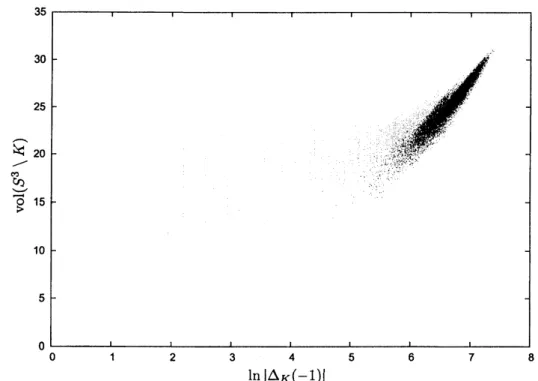
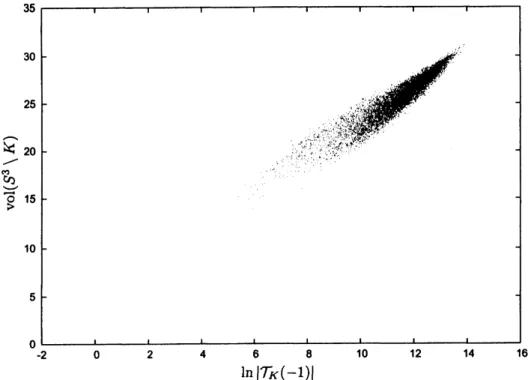
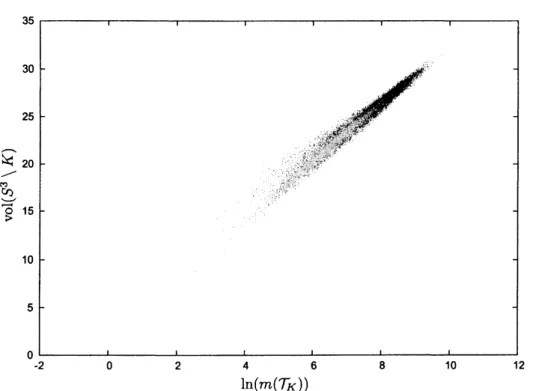
Thedata
from polynomials. In the followingpages
we
will plot thevolume of
a
hyperbolicknot
against various invariants.The
diagramsare
drawn
usinga
randomly chosensample ofone
quarter of all hyperbolic knotswith at most fifteen crossings. In the diagrams the data for alternating knotsare
plotted in red, while those for non-alternatingknots
are
shown in green.Given
$n$we
denote by $\mathcal{A}_{\eta}$ the set ofall hyperbolic alternating knots up to $n$ crossings,we
denote by $\mathcal{N}_{n}$ the set of all hyperbolic non-alternating knots with up to $n$ crossingsand
we
denote by $\mathcal{K}_{n}$ the set of all hyperbolic knots with up to $n$ crossings.The calculations
were
done with$n=15$, and the resultsare
shownin Tables1-3.
Note that all but 22 prime knots with 15 crossingsor
lessare
hyperbolic (see [HTW98]).TABLE 1. Calculated data for alternating knots with up to fifteen crossings
$0$ 1 2 3 4 5 6 $\ln|\Delta_{K}(-1)|$
7
FIGURE 1. Plot of$vol(S^{3}\backslash K)$ against $\ln|\triangle_{K}(-1)|$ for hyperbolic knots $K$
with at most fifteen crossings. 35 30 25 $\hat{/}\aleph_{20}$ $\mathring{C}_{O}\overline{O}15\triangleright$ 10 5 $0$ $0$ 0.5 1 1.5 2 2.5 3 3.5 4 4.5 $\ln(m(\Delta_{K}))$
FIGURE 2. Plot of$vol(S^{3}\backslash K)$ against $\ln(m(\Delta_{K}))$ for hyperbolic knots $K$
$-2$ $0$ 2 4 6 6
$\ln|\mathcal{T}\kappa(-1)|$
10 12 14
FIGURE
3.
Plot of$vol(S^{3}\backslash K)$ against $\ln|\mathcal{T}_{K}(-1)|$ for hyperbolic knots $K$with at most fifteen crossings.
0.5 $0$ 0.5 $\{$ 1.5 2 2.5 3 3.5 4
$\ln|\mathcal{T}_{K}(+1)|$
FIGURE 4. Plot of$vol(S^{3}\backslash K)$ against $\ln|\mathcal{T}_{K}(+1)|$ for hyperbolic knots $K$
$-2$ $0$ 2 4 6
$\ln(m(\mathcal{T}_{K}))$
8 10
FIGURE 5. Plot of $vol(S^{3}\backslash K)$ against $\ln(m(\mathcal{T}_{K}))$ for hyperbolic knots $K$
with at most fifteen crossings.
35 30 25 $\hat{/}\aleph_{20}$ $n_{O}c_{\overline{O}15}$ $\{0$ 5 $0_{0}$ 0.5 1 1.5 2 2.5 3 $\ln(m(J_{K}))$
FIGURE 6. Plot of $vol(S^{3}\backslash K)$ against $\ln(m(J_{K}))$ for hyperbolic knots $K$ with at most fifteen crossings.
TABLE 2. Calculated data for non-altemating knots with up to fifteen crossings
TABLE 3. Calculated data for all knots with up to fifteen crossings
(1) Note that the average ratio of $m(\triangle_{K}(t))$ to volume is
$0.105675594 \cong\frac{1}{3\pi}$ . 0.995969009.
At
leasta
naive reading ofSection
2 would have suggested that the ratio shouldon average
be $\frac{1}{6\pi}$.
(2) Also note that the average ratio of$m(\mathcal{T}_{K}(t))$ to volume is approximately
$0.296509767 \cong\frac{11}{12\pi}$
.
1.0161959,our
calculations thereforeare
in line with Conjecture3.2.
(3) According to the Pearson correlation coefficient the determinant of $K$ correlates
better with the hyperbolic volume than the Mahler
measure
of the Alexanderpolynomial, especially for alternatingknots. This also
seems
somewhat surprising considering the discussion of Section 2.(4) TheMahler
measure
of$\mathcal{T}_{K}(t)$ correlates very highlywith thevolume. Theaverage
ratioof
0.2965097482
israthermysteriousthough, itis not clear what ‘nice’ numberit corresponds to.
We conclude with
a
list ofopen questions:(1) Does the Mahler
measure
of knot Floer homology (viewedas
a multivariablepoly-nomial) correlate
more
with hyperbolic volume than the Mahlermeasure
of theAlexander polynomial?
(2) Does the Mahler
measure
ofKhovanov homology (viewedas
a
multivariable poly-nomial) correlatemore
with hyperbolic volume than the Mahlermeasure
of the Jones polynomial?(3) Is there any correlation between the Chern-Simons invariant and the arguments
5.
APPENDIX:
THE MAHLER MEASUREIn this appendix wewill quickly recall the definition and basic properties oftheMahler
measure
ofa
polynomial. Throughout this section we refer to [Sc95, Section 16] and[SW04] for details and
references.
Let $p\in \mathbb{C}[t_{1}^{\pm 1}, \ldots, t_{m}^{\pm 1}]$ be a multivariable Laurent polynomial. The Mahler
measure
$m(p)$ ofa
non-zero
polynomial is defined to be$m(p)= \exp\int_{(S^{1})^{m}}\ln|p(s)|ds$
where we
equip the m-torus $(S^{1})^{d}$ with the Haarmeasure.
(Note that the integral is well-defined despite thezeros
of$p.$)In the
case
of one-variable polynomials wecan
rewrite the definition as follows: Let $p(t)\in \mathbb{C}[t^{\pm 1}]$ be a polynomial. Then$m(p(t))= \exp\frac{1}{2\pi}\int_{\theta=0}^{2\pi}\ln|p(e^{i\theta})|d\theta$.
If
$p(t)=ct^{k} \prod_{i=1}^{n}(t-r_{i})$,
then
itfollows from Jensen’s formula
that$m(p(t))=|c| \cdot\prod_{j=1}^{n}\max(|r_{j}|, 1)$.
REFERENCES
[APS75] M. Atiyah, V. Patodi and I. Singer, Spectml asymmetry andRiemannian geometry II, Math. Proc. Camb. Phil. Soc, 78 (1975), 405-432.
[BV10] N. Bergeron and A. Venkatesh, The asymptotic growth of torsion homology
for
arithmeticgroups, Preprint (2010).
[Du99] N. Dunfield, An interesting relationship between the Jones polynomial and hyperbolic volume, unpublished note (1999)
http:$//www$
.
math.uiuc. edu$/\sim$nmd$/prepr$int$s/misc/dylan/$index. html.[DFJII] N. Dunfield, S. Friedl and N. Jackson, Twisted Alexander polynomials
of
hyperbolic knots, inpreparation (2011).
[GS91] F. $Gonz\acute{a}lez-Acu\tilde{n}a$ and H. Short, Cyclic bmnched coverings
of
knots and homology spheres,Revista Math. 4 (1991), 97- 120.
[HTW98] J. Hoste, M. Thistlethwaiteand J. Weeks, The first 1,701,936 knots, Math. Intell. 20 (1998),
33-48.
[Le09] T. Le, Hyperbolicvolume, Mahler measure, and homology growth, talk at ColumbiaUniversity
(2009),slides available from
http:$//www$
.
math.columbia.$edu/\sim$volconf09/notes/leconf.pdf.[Le10] T. Le, Homology torsion growth and Mahler measure, Preprint (2010).
[LZ06] W. Li and W. Zhang, An $L^{2}$-Alexander invariant
for
knots, Commun. Contemp. Math. 8(2006), 167-187,
[L\"u94] W. L\"uck, Approximating $L^{2}$-invariants by their
finite-dimensional analogues, Geom. Funct.
Anal., 4 (1994), 455-481.
[LS99] W. L\"uck and T. Schick, $L^{2}$-torsion
ofhyperbolic manifolds
of finite
volume, Geom. Funct.[L\"u02] W. L\"uck, $L^{2}$-invariants: theory and applications to geometry and K-theory, Ergebnisse der
Mathematik und ihrer Grenzgebiete. 3. Folge. A Series of Modern Surveys in Mathematics,
44. Springer-Verlag, Berlin, 2002.
[MP10] P. Menal-Ferrer and J. Porti, Twisted cohomology
for
hyperbolic three manifolds, Preprint (2010).[Mi66] J. Milnor, Whitehead torsion, Bull. Amer. Math. Soc. 72 (1966), 358-426.
[M\"u09] W. M\"uller, Analytic torsion and cohomology
of
hyperbolic 3-manifolds, Preprint oftheMax-Planck Institute, Bonn (2009).
[M\"u10] W. M\"uller, The asymptotics of the Ray-Singer analytic torsion
of
hyperbolic S-manifolds, Preprint (2010).[Po97] J. Porti, Torsion de Reidemeister pour les vanetes hyperboliques, Mem. Amer. Math.Soc. 128
(1997), 612.
[RalO] J. Raimbault, Exponential growth
of
torsion in abelian coverings, Preprint (2010).[Ri90] R. Riley, Growth
of
orderof
homologyof
cyclic bmnched coversof
knots, Bull. London Math.Soc. 22 (1990), 287-297.
[Sc95] K. Schmidt, Dynamical Systems
of
Algebraic $Or\dot{v}gin$, Birkh\"auserVerlag, Basel, 1995.[Se10] M. H. \S eng\"un, On The Torsion Homology
of
Non-Arithmetic Hyperbolic Tetmhedml Groups,Preprint (2010).
[SW02] D. Silver and S. Williams, Mahler measure, links and homology growth, Topology 41 (2002),
979-991.
[SW04] D. Silver and S. Williams, Mahler measure
of
Alexanderpolynomials, J. London Math. Soc.(2) 69 (2004), 767-782.
[TuOl] V. Turaev, Intmduction to combinatorialtorsions, Birkh\"auser, Basel, (2001).
MATHEMATISCHES INSTITUT, UNIVERSIT\"AT
zu
K\"oLN, GERMANYE-mail address: sfriedlQgmail.com
UNIVERSITY OF WARWICK, COVENTRY, UK E-mail address: [email protected]