Stability
of
traveling
waves
in
curvature flows
in
the
whole
plane
東京工業大学大学院情報理工学研究科 奈良光紀(Mitsunori Nara)
Department of Mathematical and Computing Sciences, Tokyo Institute of Tedioloy 1. INTRODUCTION
In this note,
we
study the long time behavior ofsolutions toa
Cauchy problem of the form(1) $\frac{u_{t}}{\sqrt{1+u_{x}^{2}}}=\frac{u_{xx}}{(1+u_{x}^{2})^{\frac{\theta}{2}}}+k$, $x\in \mathrm{R},$ $t>0$,
(2) $u(x,0)=u_{0}(x)$, $x\in \mathrm{R}$,
where $k\in \mathrm{R}$ is
a
givenconstant.
Especially,we are
concerned with asymptotic stabilityof two types of$\mathrm{t}\mathrm{r}\mathrm{a}\mathrm{v}\mathrm{e}1_{\dot{\mathrm{i}}}\mathrm{g}$
waves:
the traveling lines and the $V$-shapedflonts.
Our
motivation tostudythisproblemcomes
from the theoryof interfacialphenomena,which is apart of mathematical science and is concerned with formation and development of
a
“shape” in biological, chemical, and physicalfields. One of the mathematical models that describes the motion ofinterfaces isa
curvatureflow.
Let $D(t)$ be
a
moving domain in $\mathrm{R}^{2}$with
a
smooth boundary $\Gamma(t)=\partial D(t)$.
Let $\nu$ bethe unit normal vector
on
$\Gamma(t)$ pointing from $D(t)$ to $D(t)^{\mathrm{C}}$.
We consider an interface$\Gamma(t)$ governed by
a
curvature
flow withconstant
driving force $k\in$R. Namely,we
have(3) $V=-H+k$,
where $V$ and $H$
are
the normal velocity and the curvature of $\Gamma(t)$, respectively. Thatis, $V$ is the velocity of $\Gamma(t)$ along $\nu$
,
and $H=\mathrm{d}\mathrm{i}\mathrm{v}\nu$.
This model appears in severalfields. One of them is the dynamics of interfaces in an excitable media, for example, Belousov-Zhabotinsky reaction $[3, 27]$
.
Equation (3) alsoappears
in the dynamics of interfaces in theAllen-Cahn
equations. See [5] for instance. Moreover it appears in the reaction-diffusionsystems ofa
competition type. See [10].In this note,
we
deal with thecase
where an initial curve is given by a function $y=$$u_{0}(x),$$x\in \mathrm{R}$, and
a
movingcurve
is expressed by $y=u(x,t),x\in \mathrm{R},t>0$.
Under theseassumptions, (3) is rewritten
as
the initial value problem (1) $-(2)$.
1.1. Traveling
waves
inthe curvature flow. Amovingcurve
$\Gamma(t)$ is calleda
travelingwave
of (3) with thevelocity $|v|$,
if$\Gamma(t)$ satisfies$\Gamma(t)=\Gamma(\mathrm{O})+vt$, $t>0$
for
some vector
$v\in \mathrm{R}^{2}$.
When $k\neq 0$,a
stationary circle with radius $1/k$ isa
travelingwave
with $|v|=0$.
Except for this circle and self-crossing ones,a
travelingwave
of$V=-H+k(k\neq 0)$ is
one
ofthe folowing twocases
$[3, 23]$:$\bullet \mathrm{k}\neq 0$
(a) Stationary circle (b) Travelingline $(\mathrm{c})$ $\vee$-shaped front
$\bullet$ $\mathrm{k}=0$ (Curve shortening flow)
($\theta$ Expanding
(d) Grim reaper (e) Stationaryline self-similar solution FIGURE 1. Characteristic
waves
ofthe curvature flow.(ii) The $V$-shaped front, which is
convex
and is asymptotic to the traveling lines atinfinity.
As is mentioned later, the traveling lines and the$\mathrm{V}$-shaped fronts
can
be represented bygraphical forms under
an
appropriate rotation of coordinates.On
theother
hand, $k=0$means
theso-called
curve
shortening flow, which isthe
mean
curvature flow in $\mathrm{R}^{2}$
.
In this case,every
line isa
stationary
wave,
and there existsa
traveling
wave
that is$\mathrm{c}\mathrm{a}\mathrm{U}\mathrm{e}\mathrm{d}$ theGrim
Reaper. Furthermore thecurve
shortening flow hasan
extracting self-similar solution, which isconvex
and is asymptotic to the stationary linesas
$|x|arrow\infty$as
in $[9, 18]$.
Letting $k\in \mathrm{R}$ be
an
arbitrary constant,we
study asymptotic stability of the traveling (or stationary) lines. Inaddition,we
consider asymptotic stabilityofthe$\mathrm{V}$-shapedfrontsfor $k>0$
.
Especiallywe
are
interestedin the large timebehavior of these travelingwaves
for
some
initial perturbations that do not decay as $|x|arrow\infty$.
1.2. Profiles of the traveling line and the $\mathrm{V}$-shaped front. We
assume
thata
traveling
wave
in$\mathrm{R}^{2}$moves
along the $y$-axis without loss of generality. To obtainprofiles
of the traveling lines and the $\mathrm{V}$-shaped fronts,
we
substitute $u(x,t)=U(x)+ct$ to (1),and obtain
an
ordinary differential equation(4) $c= \frac{U’’}{1+(U’)^{2}}+k\sqrt{1+(U’)^{2}}$, $x\in \mathrm{R}$.
For any $k\in \mathrm{R}$ and $m\in \mathrm{R}$, traveling lines
are
obtainedas
FIGURE 2. The graph of
a
$\mathrm{V}$-shaped front.These traveling lines have velocity $k$ in the normal direction and velocity $c$ in the $y-$
direction.
On
the other hand, the $\mathrm{V}$-shaped front is another solution of(4). The exactrepresen-tation of
the
profile ofthe$\mathrm{V}$-shaped front $\Phi(x;c, k)$ is writtenas
follows.Proposition 1.1 (Ninomiya and Taniguchi [23]). For
$c>k>0,$
(4) hasa
solution$\Phi(x;c, k)$ represented by
$x(\theta)=$ $\frac{\theta}{c}+\frac{k}{c\sqrt{c^{2}-k^{2}}}\log|\frac{1+\sqrt{=^{c-k}c+k}\tan_{2}\theta}{1-\sqrt{c+kc-k}\tan_{2}\theta}=|$ ,
$y(\theta)=$ $\frac{1}{c}\log(\frac{2(c^{2}-k^{2})}{c(c\cos\theta-k)})+\frac{\sqrt{c^{2}-k^{2}}}{ck}\arctan(\frac{\sqrt{c^{2}-k^{2}}}{k})$,
for
$\theta\in(-\arctan m, \arctan m)$.
Here $m=\sqrt{c^{2}-k^{2}}/k$. Moreover $\Phi(x;c, k)$ is strictlyconvex
urith$\Phi_{xx}(x;c, k)>0$, $x\in$ R.
From Proposition 1.1,
we
find that $\Phi(x;c, k)$,or
$\Phi(x)$ in short, satisfies(5) $\Phi’,\Phi’’$, and $\Phi’’’$
are
continuous and boundedon
$\mathrm{R}$,(6) $\lim_{xarrow-\infty}\Phi(x)=-mx$, $\lim_{xarrow+\infty}\Phi(x)=mx$,
We note that, for each
$c>k>0$
, the problem (1) $-(2)$ has three travelingwaves:
the traveling lines$y=\pm mx+ct,$ $m=\sqrt{c^{2}-k^{2}}/k$, and the$\mathrm{V}$-shapedfront $y=\Phi(x;c, k)+ct$that
is asymptoticto
the traveling $1\mathrm{i}\mathrm{n}\mathrm{e}\mathrm{s}\pm mx+ct$as
$xarrow\pm\infty$.1.3.
Stability oftravelingwaves.
Tostudy stability ofthe travelingline $y=mx+ct$,we
considera
function$\overline{u}(x,t)=u(x,t)-(mx+ct)$.
Then
we
havea
quasi-linearparabolicequation
$\overline{u}_{t}$ $=$ $\frac{\overline{u}_{xx}}{1+(\overline{u}_{x}+m)^{2}}+k(\sqrt{1+(\overline{u}_{x}+m)^{2}}-\sqrt{1+m^{2}})$
$=(\arctan(\overline{u}_{x}+m))_{x}+k(\sqrt{1+(\overline{u}_{x}+m)^{2}}-\sqrt{1+m^{2}})$ ,
where $c=k\sqrt{1+m^{2}}$
.
Similarly, for the $\mathrm{V}$-shaped front$\Phi(x;c, k)$,
we
have$\overline{u}_{t}=(\arctan(\overline{u}_{x}+\Phi’))_{x}+k(\sqrt{1+(\overline{u}_{x}+\Phi’)^{2}}-\sqrt{1+m^{2}})$
.
In these equations,
every
constant,thatis, $\overline{u}(x,t)\equiv(\mathrm{c}\mathrm{o}\mathrm{n}\mathrm{s}\mathrm{t}.)$,
impliesa
$\mathrm{t}\mathrm{r}\mathrm{a}\mathrm{v}\mathrm{e}1_{\dot{\mathrm{i}}}\mathrm{g}$wave
withtranslationin$y$-direction. Thusevery constant is
a
stationary solution of these equations.For the Cauchy problem of the heat equation
(8) $h_{t}=h_{xx}$, $x\in \mathrm{R},$ $t>0$,
(9) $h(x,0)=\varphi(x)$, $x\in \mathrm{R}$,
it is well known that every constant is a stationary solution and i8 asymptotically stable in $L^{\infty}(\mathrm{R})$ for spatially decaying initial perturbations. To be
more
precise, a stationarysolution $h(x,t)\equiv\mu$ of (8) $-(9)$ is asymptotically stablein $L^{\infty}(\mathrm{R})$ ifand onlyifthe initial
value $\varphi(x)$ satisfies
$\lim_{Rarrow\infty}\sup_{x\in \mathrm{R}}\frac{1}{2R}|\int_{x-R}^{x+R}\varphi(y)-\mu dy|=0$.
For the proof,
see
[11, 19, 20, 29]. In relation to this criterion, Collet&Eckmann
[8] showed the example ofan
initial perturbation for which theconstant
solutionof
(8)-(9) loses the asymptotic stability, where the bounded initial value does not decay but oscillates slower and slower
as
$|x|arrow\infty$.
Proposition
1.2
(Collet and Eckmann [8]). Let $L_{n}=n!$ anddefine
an even
junction$\varphi^{*}(x)\in C^{\infty}(\mathrm{R})$ that
satisfies
$|\varphi^{*}(x)|\leq 1$for
$x\in \mathrm{R}$ and$\varphi^{*}(x)=(-1)^{n}$, $x\in[L_{n}+2^{n}, L_{n+1}-2^{n+1}]$
for
$n\geq 5$.
Then the solution $h(x, t)$of
(8) - (9) with $h(x,\mathrm{O})=\varphi^{*}(x)$satisfies
$\lim\inf h(0,t)=-1tarrow\infty$’ $\lim_{tarrow}\sup_{\infty}h(0,t)=1$
.
In [21],
we
also obtained the following example for thecurvature flow (1) $-(2)$.
In this example, the initial perturbation looks like $\varphi^{*}(x)$ in Proposition 1.2, that is, it does notdecaybut oscillates slower and slower at infinity.
Example 1.3 (Nara and Taniguchi [21]).
Define
a
function
$f(x)$as
$f(x)=0$
if
$(2n)^{2}\leq|x|<(2n+1)^{2}$, $f(x)=1$if
$(2n+1)^{2}\leq|x|<(2n+2)^{2}$,for
$n=0,1,2,$$\ldots$.
Then the solutionof
(1) $-(2)$ with$u_{0}(x)=(\eta*f)(x)$ does not convergeuniformly to the traveling line $u(x, t)=kt+\mu$
for
anyfixed
$\mu$.
Here $\eta*is\mathfrak{W}ed\dot{n}chs$’
mollifier, that is, $\eta(x)\in C_{0}^{\infty}(\mathrm{R}),$ $\eta(x)\geq 0,||\eta||_{L^{1}(\mathrm{R})}=1$, and
$( \eta*f)(x)=\int_{\mathrm{R}}\eta(x-y)f(y)dy$
.
It is also known that the $\mathrm{V}$-shaped front of the Cauchy problem (1) $-(2)$ is not
asymp-totically stable for similar perturbations
as
in [24]. Moreover Po16kSik&Yanagida [28] studiedrelated workson
a
supercritical semi-linear diffusion equation.Such counter-examples may causedifficulty in considering asymptotic stabihty of
con-stant
solutions in the Cauchy problem ofa
parabolic PDE withan
initial perturbationthat does
not
decayat
infinity.1.4. Outline ofthis
note.
InSection
2,we
consider asymptoticstabilityofthe traveling lines. In Section 3,we
givesome
examples ofspatialy non-decaying initialperturbations for which traveling lines lose the asymptotic stability. In Section 4,we
consider the asymptotic stability ofthe $\mathrm{V}$-shaped fronts. Finally inSection 5 we
show the outline ofproofs.
Our results in this note
for
the traveling lines and the$\mathrm{V}$-shapedfrontsare
basedon
the
discussions in [21] and [22]. We omit most ofproofs. See [21] and [22] for further details.
1.5.
Notation. Inwhat folows, $L^{1}(\mathrm{R}),$ $L^{\infty}(\mathrm{R}),$ $W^{1.\infty}(\mathrm{R})$,
denote the Lebesgueor
Sobolevspaces. For$7\in(0,1),$ $C^{\gamma}(\mathrm{R})$denotes theH\"olderspace, that is, thespaceof functions that
are
bounded and uniformly H\"older continuous with exponent $\gamma$on
R. $C^{2+\gamma}(\mathrm{R})$means
the
space
of functions with $u,u’,u”\in C^{\gamma}(\mathrm{R})$.
Fora
domain $R_{T}=\mathrm{R}\cross[0,T],$ $C^{\gamma,\gamma/2}(R_{T})$denotes the space of functions that
are
bounded and uniformly H\"older continuous with exponent 7 and $\gamma/2$ with respect to $x$ and $t$, respectivelyon
$R_{T}$.
$C^{2\mapsto,1+\gamma/2}(R_{T})$means
the
space
offunctions with $u,u_{x},u_{xx},u_{t}\in C^{\gamma,\gamma/2}(R_{T})$.
2.
STABILITY
OF TRAVELING LINESIn this section,
we
show the asymptotic stability of traveling lines$y=mx+ct$ of(1)-(2). In what follows, let $k\in \mathrm{R}$ and $m\in \mathrm{R}$ be given constants, and put $c=k\sqrt{1+m^{2}}$
.
First
we
considerthe stability with spatially decaying initial perturbations. Nextwe focus on the stability of traveling lines with spatially non-decaying initial perturbations. The key toour
discussion is the concept of an almostperiodicfunction.
2.1. Stability with spatially decaying perturbations. First
we
givea
result for the horizontal traveling line $u(x,t)=kt$, that is, thecase
of$m=0$.Theorem 2.1. Suppose that $\phi\in C^{2+\gamma}(\mathrm{R})$
satisfies
$\lim_{|x|arrow\infty}\phi(x)=0$. Thenfor
theinitial value $u_{0}(x)=\phi(x)$, the solution $u(x,t)$ to the Cauchy problem (1) - (2) exists up
to
$t=\infty$.
Moreover itsatisfies
$\lim_{tarrow\infty}\sup_{x\in \mathrm{R}}|u(x,t)-kt|=0$
.
Especially,
if
$\phi$ belongs to $C^{2+\gamma}(\mathrm{R})\cap L^{1}(\mathrm{R})$, the solution$u(x, t)$satisfies
the estimate $\sup_{x\in \mathrm{R}}|u(x,t)-kt|\leq C(1+t)^{-\mathrm{z}}1$, $t>0$,This result is similar to that for the Cauchy problem
of the
heat equation. By virtue ofthis result,we
also obtaina
result for the inclined traveling line $y=mx+ct,$ $m\in \mathrm{R}$as
follows.Theorem 2.2. Suppose that $\phi\in C^{2+\gamma}(\mathrm{R})$
satisfies
$\lim_{|x|arrow\infty}\phi(x)=0$. Thenfor
theinitial value$u_{0}(x)=mx+\phi(x)$, the solution$u(x,t)$ to the Cauchyproblem (1) $-(2)$
eansts
up to $t=\infty$. Moreover it
satisfies
$\lim_{tarrow\infty}\sup_{x\in \mathrm{R}}|u(x,t)-(mx+ct)|=0$
.
2.2.
Stability with spatially non-decaying initial perturbations. Nextwe
show the asymptotic stability with spatially non-decaying initial perturbations. We begin by recallingthe definitionofan
almost periodic function.Definition
2.3.
A continuous $fi_{A}nctionf(x)$ : $\mathrm{R}arrow \mathrm{R}$ is calledan
almost periodicjfunction (in the $\mathit{8}ense$
of
Bohr) if,for
every$\epsilon>0$, there evists $\ell(\epsilon)>0$ such that,for
every$p\in \mathrm{R}$,
an
interval $[p,p+\ell(\epsilon)]$ contains at leastone
number$q$ with(10) $|f(x-q)-f(x)|<\epsilon$
for
all $x\in \mathrm{R}$.
For any almostperiodic
function
$f$, there existsa
mean
$\mathcal{M}\{f\}$defined
by $\mathcal{M}\{f\}=\lim_{Rarrow\infty}\frac{1}{R}\int_{s}^{\epsilon+R}f(x)dx$,where the convergence is
uniform
with respect to $s\in \mathrm{R}$, and the limit is independentof
$s$.
By thiv definition,
every
periodic function isan
almost periodic function.Moreover
if$f$ and $g$
are
both ahnost periodic functions, $f(x)+g(x)$ isan
almost periodic function,where$\mathcal{M}\{f+g\}=\mathcal{M}\{f\}+\mathcal{M}\{g\}$ holds true. Note that
a
non-periodic function $f(x)=$$\sin x+\sin\sqrt{2}x$ is
an
almost periodic function with $\mathcal{M}\{f\}=0$.
For further details,see
[1, 2, 7] for instance.
Thefollowing result is the central point of
our
discussion for asymptotic stability with spatialy non-decaying initial perturbations. This implies that the almost periodicity ofan
initial perturbation is sufficient for asymptotic stability of traveling lines.Theorem 2.4. Assume that$\phi\in C^{2\mapsto}(\mathrm{R})$ is
an
almost$pe$riodicfunction.
Thenfor
theinitial value$u_{0}(x)=mx+\phi(x)$, the solution$u(x, t)$ to the Cauchy problem (1) $-(2)e$tists up to $t=\infty$
.
Moreover itsatisfies
$\lim_{tarrow\infty}\sup_{x\in \mathrm{R}}|u(x,t)-(mx+ct+\mu)|=0$
for
a constant
$\mu$ with$\inf_{x\in \mathrm{R}}\phi(x)\leq\mu\leq\sup_{x\in \mathrm{R}}\phi(x)$.
Especially
for
each $\phi$, the constant$\mu$ is a nondecreasing
function
of
$k\in \mathrm{R}$ when $m=0$.
In addition, $\mu=\mathcal{M}\{\phi\}$ holds true when$k=0$
.
We show the outline of the proof of Theorem 2.4 in Section 5. The constant $\mu$ in
Theorem 2.4 may not be determined explicitly if $k\neq 0$
.
Indeedwe
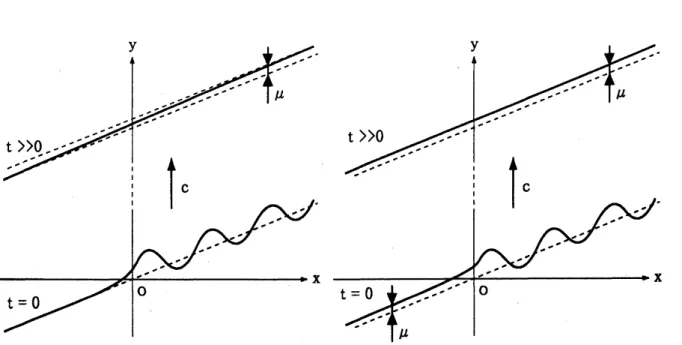
have the followingFIGURE
3.
Stability withan
almost periodic functionas an
initial perturbation. Remark2.5.
Generically $\mu\neq \mathcal{M}\{\phi\}$ holdstrue
if
$k\neq 0$.
Indeed,for
$k>0$ and$\phi(x)=\sin x$
, we
have$\mu=\lim_{tarrow\infty}\frac{1}{2\pi}\int_{0}^{2\pi}u(x, t)dx=\frac{1}{2\pi}\int_{0}^{2\pi}\phi(x)dx+\frac{1}{2\pi}\int_{0}^{\infty}\int_{0}^{2\pi}u_{t}(x,t)dxdt$
$= \frac{1}{2\pi}\int_{0}^{\infty}([\arctan(u_{x}+m)]_{0}^{2\pi}+\int_{0}^{2\pi}k(\sqrt{1+(u_{x}+m)^{2}}-\sqrt{1+m^{2}})dx)dt$
$> \frac{1}{2\pi}\int_{0}^{\infty}\int_{0}^{2\pi}k\frac{mu_{x}}{\sqrt{1+m^{2}}}dxdt=\frac{km}{2\pi\sqrt{1+m^{2}}}\int_{0}^{\infty}[u]_{0}^{2\pi}dt=0$
by using the periodic boundary condition at$x=0,2\pi$, and the inequality
$\sqrt{1+(p+m)^{2}}\geq|\frac{mp}{\sqrt{1+m^{2}}}+\sqrt{1+m^{2}}|\geq\frac{mp}{\sqrt{1+m^{2}}}+\sqrt{1+m^{2}}$
for
$p\in \mathrm{R}$.
Thus$\mu$
differs from
$\mathcal{M}\{\phi\}=0$ in thiscase.
We
can
extend Theorem2.4
to thecase
wherean
initial perturbation is asymptotic toan
almost periodic functionas
$|x|arrow\infty$. The following theorem gives. the bounds fora
perturbation depending only
on
the asymptotic behavior ofa
given initial perturbationat infinity.
Theorem
2.6.
Forsome
functions
$\phi_{*}(x)$ and$\phi^{*}(x)$ thatbelong to $C^{2+7}(\mathrm{R})$, let$u_{l}(x,t)$and $u^{*}(x,t)$ be the solutions
of
(1) - (2) with the initial values $mx+\phi_{*}$ and $mx+\phi^{*}$,respectively. Assume that $u_{*}$ and $u^{*}$
satish
for
some constants
$\mu_{*}$ and$\mu^{*}$.
Thenfor
an
initialperturbation $\phi\in C^{2+7}(\mathrm{R})$ with$\lim_{xarrow-\infty}(\phi(x)-\phi_{*}(x))=0$, $\lim_{xarrow+\infty}(\phi(x)-\phi^{*}(x))=0$,
the solution $u(x,t)$
of
(1) $-(2)$ with $u_{0}(x)=mx+\phi(x)$ exists up to$t=\infty$.
Moreover itsatisfies
$\lim_{tarrow\infty}\inf_{x\in \mathrm{R}}(u(x,t)-(mx+ct+\min\{\mu_{*}, \mu^{*}\})=0$,
$\lim_{tarrow\infty}\sup_{x\in \mathrm{B}}(u(x,t)-(mx+ct+\max\{\mu_{*}, \mu^{*}\})=0$
.
This
extends
a
class of imitial values for which the stability is determined. The
followingcorollary gives
an
extended sufficient
conditionfor
the asymptotic stability of traveling$1_{\dot{\mathrm{i}}}\mathrm{e}\mathrm{s}$
.
Corollary
2.7. Assume
that $f\in C^{2+\gamma}(\mathrm{R})$ isan
almostperiodicfimction.
And $ass\mathrm{u}me$that $g\in C^{2+\gamma}(\mathrm{R})$
satisfies
$\lim_{|x|arrow\infty^{g(x)}}=0$.
Then the solution $u(x,t)$ to the Cauchyproblem (1) $-(2)$ with the initial value $u_{0}(x)=mx+f(x)+g(x)$
satisfie8
$\lim_{tarrow\infty}\sup_{x\in \mathrm{R}}|u(x,t)-(mx+ct+\mu)|=0$
for
a constant
$\mu$ that depends onlyon
$k,m$, and $f$, and is independentof
$g$.
Especially,$\mu=\mathcal{M}\{f\}$ holds
true
if
$k=0$.
3.
EXAMPLES FOR ASYMPTOTIC STABILITY OF TRAVELING LINESIn this section
we
showsome
examples and counter-examples for stability oftraveling lines. Ifa
given inlitial perturbation $\phi(x)$on
the traveling line $mx+ct$ is bounded, wehave
$\inf_{x\in \mathrm{R}}\phi(x)\leq u(x,t)-(mx+ct)\leq\sup_{x\in \mathrm{R}}\phi(x)$, $x\in \mathrm{R},$ $t>0$,
by using the comparison principle. This implies that atraveling line is always stable for bounded perturbations. The problem is the asymptoticstability for these perturbations. Example 3.1. The solution $u(x,t)$ to the Cauchy problem (1) - (2) with the initial
value $u_{0}(x)=mx+\tanh x$
satisfies
$\lim_{tarrow\infty}\inf_{x\in \mathrm{R}}(u(x,t)-(mx+ct))=-1$, $\lim_{tarrow\infty}\sup_{x\in \mathrm{R}}(u(x,t)-(mx+ct))=1$.
Though this example is intuitively clear, it is proved rigorously by virtue ofTheorem
2.6.
Namely, $\tanh x$ is asymptotic to $\pm 1$ at infinity, and the solutions with the imitialvalue $mx+1$ and mx–l
are
given by$u^{*}(x,t)=mx+ct+1$ and $u_{*}(x,t)=mx+ct-1$,respectively. Thus Theorem
2.6
gives Example3.1.
Thenext example shows difficultyof asymptotic stability for $k\neq 0$ compared with $k=0$.
Example
3.2.
Define
the initialperturbation $\phi(x)\in C^{2+\gamma}(\mathrm{R})$ tosatish
$\phi(x)=0$
if
$x\in(-\infty, -1]$, $\phi(x)=\sin x$if
$x\in[1, +\infty)$.
FIGURE 4. Initial values and the solutions in Example
3.2
and 3.3Then the solution$u(x,t)$ to the Cauchy problem (1) $-(2)$ with$u_{0}(x)=mx+\phi(x)$
satisfies
$\lim_{tarrow\infty}\sup_{x\in \mathrm{R}}|u(x,t)-mx|=0$
if
$k=0$, $\lim_{tarrow\infty}\inf_{x\in \mathrm{R}}(u(x, t)-(mx+\mathrm{c}t))=0,\lim_{tarrow\infty}\sup_{x\in \mathrm{R}}(u(x, t)-(mx+ct))=\mu$if
$k>0$for
a
positive constant $\mu$.
This example follows from Theorem
2.6
and Remark2.5.
It is due to the fact thata
phase shift ofthe limiting traveling line
occurs
if $u_{0}(x)=mx+\sin x$, while it does notoccur
for $\mathrm{u}_{0}(x)=mx$.
Arranging this example,we
have the followingone.
Example 3.3.
Define
the initial perturbation $\phi(x)\in C^{2+\gamma}(\mathrm{R})$ tosatish
$\phi(x)=\mu$
if
$x\in(-\infty, -1]$, $\phi(x)=\sin x$if
$x\in[1, +\infty)$,where
$\mu$is
theconstant
defined
as
inRemark
2.5.
Then the solution$\mathrm{u}(x,t)$to
the Cauchyprvblem (1) - (2) uyith$u_{0}(x)=mx+\phi(x)$
satisfies
$\lim_{tarrow\infty}\sup_{x\in \mathrm{R}}|u(x,t)-(mx+ct+\mu)|=0$
.
Example
3.2
and3.3
show thepeculiarityofour
problem due toa
phaseshift of the lim-itingtraveling $\mathrm{l}\dot{\mathrm{i}}\mathrm{e}$.
This mechanismis the point ofdiscussionforthe asymptotic stability oftraveling lines, inaddition to Example
1.3
and Proposition1.2
in the introduction.4. $\mathrm{V}$-SHAPED
FRONTS
In this section, letting
$c>k>0$
be anyconstants
and setting $m=\sqrt{c^{2}-k^{2}}/k>0$,we
studyasymptoticstabilityof the$\mathrm{V}$-shaped front $\Phi(x;c, k)$, whichis asymptoticto
thetraveling $1\mathrm{i}\mathrm{n}\mathrm{e}\mathrm{s}\pm mx+ct$
as
$xarrow\pm\infty$.
Firstwe
show asymptotic stability of theV-shapedfronts for
spatiaily decaying initial perturbations. Ninomiya and Taniguchi provedthe
Theorem 4.1 (Ninomiya and Taniguchi [24]). Suppose that $\phi\in C^{2+\gamma}(\mathrm{R})$
satisfies
$\lim_{|x|arrow\infty}\phi(x)=0$
.
Thenfor
the initial value $u_{0}(x)=\Phi(x;c, k)+\phi(x)$, the solution$u(x, t)$ to the Cauchyproblem (1) - (2) exists up to $t=\infty$
.
Moreover itsatisfies
$\lim_{tarrow\infty}\sup_{x\in \mathrm{R}}|u(x, t)-(\Phi(x;c, k)+ct)|=0$
.
This result is proved by constructing
a
supersolutionanda
subsolution. In this problem, the decay estimate is not obtained yet. Next weshow the result for spatially non-decaying initial perturbations. In this situation, the key toour
problem is the stability oftwo
asymptotic traveling $1\mathrm{i}\mathrm{n}\text{\’{e}}\pm mx+ct$
.
Theorem
4.2.
Forsome
hnctions
$\phi_{*}(x)$ and$\phi^{*}(x)$ in$C^{2+\gamma}(\mathrm{R})$, let$u_{*}(x, t)$ and$u^{*}(x,t)$be the solutions
of
(1) $-(2)$ uyiththeinitial$values-mx+\phi_{*}(x)$ and$mx+\phi^{*}(x)$, respectively.Assume that$u_{*}$ and $u^{*}$
satish
$\lim_{tarrow\infty}\sup_{x<0}|u_{*}(x,t)-(-mx+ct+\mu_{*})|=0,\lim_{tarrow\infty}\sup_{x>0}|u^{*}(x,t)-(mx+ct+\mu^{*})|=0$
for
some constants
$\mu_{*}$ and$\mu^{*}$.
Thenfor
an
initialperturbation $\phi\in C^{2+\gamma}(\mathrm{R})$ with$\lim_{xarrow-\infty}(\phi(x)-\phi_{*}(x))=0$, $\lim_{xarrow+\infty}(\phi(x)-\phi^{*}(x))=0$,
the solution$u(x,t)$
of
(1) - (2) unth the initial value $u_{0}(x)=\Phi(x;c, k)+\phi(x)$ exis$ts$ up to$t=\infty$
.
Moreover
itsatisfies
$‘ \lim_{arrow\infty}\sup_{x\in \mathrm{R}}|u(x,t)-[\Phi(x-\frac{\mu_{*}-\mu^{*}}{2m}jc,$$k)+ct+ \frac{\mu_{*}+\mu^{*}}{2}]|=0$
.
Thus the asymptotic stability of the traveling lines $y=\pm mx+ct$ for the initial per-turbations $\phi_{*}$ and $\phi^{*}$ gives the asymptotic stability of the $\mathrm{V}$-shaped front $\Phi(x;c, k)$
.
Theshift ofthe$\mathrm{V}$-shaped front is generically observed in the
case
where initialperturbationsdonot decayatinfinity. Combining Theorem
4.2
with Theorem2.4,we
obtainacorollary that givesconcrete suflicient condition for the asymptotic stability of the$\mathrm{V}$-shaped front.Corollary 4.3. Assume that$\phi_{*},$ $\phi^{*}(x)\in C^{2+\gamma}(\mathrm{R})$
are
both almost periodicfunctions
inthe
sense
of
Bohr, and let$u_{*}(x,t)$ and$u^{*}(x, t)$ be the solutionsof
(1) -(2) with the initial$values-mx+\phi_{*}(x)$ and$mx+\phi^{*}(x)$
,
respectiv$\mathrm{e}ly$.
Then $u_{*}$ and $u^{*}$ exist upto
$t=+\infty$,
and satisfy
$\lim_{tarrow\infty}\sup_{x\in \mathrm{R}}|u_{*}(x,t)-(-mx+ct+\mu_{*})|=0$, $\lim_{tarrow\infty}\sup_{x\in \mathrm{R}}|u^{*}(x,t)-(mx+ct+\mu^{*})|=0$
for
some
constants
$\mu_{*}$ and $\mu^{*}$ with$\inf_{x\in \mathrm{R}}\phi_{*}(x)\leq\mu_{*}\leq\sup_{x\in \mathrm{R}}\phi_{*}(x)$, $\inf_{x\in \mathrm{R}}\phi^{*}(x)\leq\mu^{*}\leq\sup_{x\in \mathrm{R}}\phi^{*}(x)$
.
Moreover
for
an
initialperturbation $\phi\in C^{2+\gamma}(\mathrm{R})$ with$\lim_{xarrow-\infty}(\phi(x)-\phi_{*}(x))=0$, $\lim_{xarrow+\infty}(\phi(x)-\phi^{*}(x))=0$,
the solution $u(x,t)$
of
(1) - (2) unth the initial value $u_{0}(x)=\Phi(x;c, k)+\phi(x)$satisfies
$\lim_{tarrow\infty}\sup_{x\in \mathrm{R}}|u(x, t)-[\Phi(x-\frac{\mu_{*}-\mu^{*}}{2m};$ $c,$$k)+ct+ \frac{\mu_{*}+\mu^{l}}{2}]|=0$.
Bythisresult,
a
$\mathrm{V}$-shapedfront with the initialperturbation$\sin x+\sin\sqrt{2}x$isasymptot-ically stable since this perturbation is an almost periodic function. Moreover aV-shaped front with an smoothinitial perturbation $\phi(x)$ with
$\phi(x)=\{$
$\sin x$, $x\in[0, \infty)$,
$0$, $x\in(-\infty, -1]$,
is
also asymptoticallystable.
This isclear
by letting $\phi_{*}(x)\equiv 0$and
$\phi^{*}(x)=\sin x$ inCorollary
4.3.
This makes sharpcontrast
with Example3.2
for the traveling lines. 5. PROOF OF THEOREM 2.4In this section,
we
show the main part of the proofof Theorem 2.4. In what folows,let $k\in \mathrm{R}$
and
$m\in \mathrm{R}$ be given constants, and put $c=k\sqrt{1+m^{2}}$.
As
is mentioned inthe introduction,
we
consider the function$\overline{u}(x, t)=u(x, t)-(mx+ct)$ insteadof
$u(x,t)$ in order to analyze the large time behavior ofperturbed traveling lines. Herewe
denote$\overline{u}(x, t)$ by $u(x, t)$ for simplicity. Then
we
have(11) $u_{t}=(\arctan(u_{x}+m))_{x}+k(\sqrt{1+(u_{x}+m)^{2}}-\sqrt{1+m^{2}}),$ $x\in \mathrm{R},$ $t>0$,
(12) $u(x, \mathrm{O})=\phi(x)$, $x\in$ R.
It
suffices to
prove the results forthis problem instead of the originalproblem (1) $-(2)$.
First we show the global existence and some estimates for solutions of (11) - (12). The
following proposition plays important roles in the proof.
Proposition 5.1. Assume that $\phi\in C^{2+\gamma}(\mathrm{R})$
.
Then there existsa
classical solution$u(x, t)$ to the Cauchy prvblem (11) -(12) that belongs to $C^{2+\gamma,1+\gamma/2}(R_{T}),$ $R_{T}=\mathrm{R}\cross[0, T]$
for
any$T>0$.
Itsatisfies
the following estimates$\sup_{x\in \mathrm{R},t>0}|u(x,t)|\leq||\phi||_{L(\mathrm{R})}\infty,\sup_{x\in \mathrm{R},t>0}|u_{x}(x,t)+m|\leq||\phi’+m||_{L(\mathrm{R})}\infty$,
$\sup_{x\in \mathrm{R},t>0}|u_{xx}(x, t)|\leq C$, $\sup_{x\in \mathrm{R},t>0}|u_{t}(x,t)|\leq C$
.
Here $C$ is
a
constant depending onlyon
$k,$ $m$, and $||\phi’||_{W^{1,\infty}(\mathrm{R})}$.
Remark5.2. Existence
of
global solutionsto the problem(1) $-(2)$ is aloeady obtainedin[6] and [23]. Chou&Kwong [6] proved it
for
a
smooth initial value utthoutthe restrictionof
growth order. Ninomiya&Taniguchi [23] also showed that,for
an
initial value $u_{0}(x)=$$\Phi(x;\mathrm{c}, k)+\phi(x),$$\emptyset\in BC^{1}$, the solution $u(x,t)$
of
(1) - (2) enists globally in time andsatisfies
$u(x,t)-(\Phi(x;c, k)+ct)\in BC^{1}$
for
each $t>0$,where $BC^{1}=C^{1}(\mathrm{R})\cap W^{1,\infty}(\mathrm{R})$
.
In Proposition 5.1,we
established the global enistenceof
solutions withmore
detailed estimatesof
solutions, whichare
suitable and essentialfor
our
later discussions.
In whatfollows,
we
alwaysassume
thatan
initialvalueor an
initial perturbationbelongs to$C^{2+\gamma}(\mathrm{R})$even
ifitisnot mentioned specifically. Here$7\in(0,1)$ isan
arbitraryconstant.
Lemma 5.3. Assume $k\leq 0$
.
Let$M>0,$ $s>0,$ $T>0$, and $L>0$ be givenconstants.
Let$u(x,t)$ be the solution to the Cauchyproblem (11) - (12) with
(13) $||\phi’||_{L(\mathrm{R})}\infty\leq M$,
$\sup_{x\in \mathrm{R}}\phi(x)\leq s$,
(14) $u(a, t)\leq 0$ and $u(b, t)\leq 0$
for
$0\leq t\leq T$for
a,$b\in \mathrm{R}$ with $a<b$ and $b-a\leq L$.
Then there existsa
positive constant $\lambda$ dependingonly
on
$M,$ $s,$ $T$ and $L$ with(15) $\max_{a\leq x\leq b}u(x,T)\leq s-\lambda$
,
where A depends continu$\mathit{0}$usly on$s\in(\mathrm{O}, +\infty)$
for
anyfixed
$M,T$ and$L$.Next
we
showa
simple lemma and providean
important property of the solution of (11) - (12) withan
almost periodic function as an initial value. Roughly speaking, foreach $t>0$, such
a
solution has thesame
almost periodicityas
that of the initial value. Lemma 5.4. Suppose that$\phi(x)$ isan
almost periodicfunction
thatsatisfies
(10)as
inDefinition
2.3
with$\ell(\epsilon)$.
Let$u(x,t)$ be the solutionof
(11) -(12). Then,for
evefy$p\in \mathrm{R}$,an
interval $[p,p+\ell(\epsilon)]$ containsat
leastone
number $q$ with$|u(x-q, t)-u(x, t)|<\epsilon$
for
$x\in \mathrm{R},$ $t>0$.
Now
we
prove the following result, which implies the asymptotic stability of traveling lines foran
almost periodic functionas an
imitial perturbation. The proof is done by derivinga
contradiction.Proposition
5.5.
Suppos$\mathrm{e}$ that $\phi(x)$ isan
almost periodicfunction.
Then the solution$u(x,t)$
of
(11) -(12)satisfies
(16) $\lim_{tarrow\infty}\sup_{x\in \mathrm{B}}|u(x,t)-\mu|=0$
for
a constant
$\mu$ thatsatisfies
(17) $\inf_{x\in \mathrm{R}}\phi(x)\leq\mu\leq\sup_{x\in \mathrm{R}}\phi(x)$
.
Proof.
Since
allconstants
are
stationary solutions of(11)-(12), thefunctions
$U^{+}(t)$ and $U^{-}(t)$ defined by$U^{+}(t)= \sup_{x\in \mathrm{R}}u(x,t)$, $U^{-}(t)= \inf_{x\in \mathrm{R}}u(x,t)$
are
nonincreasing and nondecreasing, respectively by virtue of the comparison principle. The constants $U^{*}= \lim_{tarrow\infty}U^{+}(t)$ and $U_{*}= \lim_{tarrow\infty}U^{-}(t)$ exist. Nowwe
define $\mu=$$(U^{*}+U_{*})/2$ and $\delta=(U^{*}-U_{*})/2$
.
Then $\mu$ satisfies (17) becausewe
have $U^{-}(0)\leq U$.
$\leq$$\mu\leq U^{*}\leq U^{+}(0)$ by the definition.
Since$u(x,t)-\mu$alsosatisfies(11)-(12),
we
mayassume
$\mu=0$withoutlossofgenerality.Moreover
we
mayassume
$k\leq 0$, since thecase
of$k\geq 0$ is reduced to thecase
of $k\leq 0$by $\mathrm{c}\mathrm{o}\mathrm{n}\mathrm{s}\mathrm{i}\mathrm{d}\mathrm{e}\mathrm{r}\mathrm{i}\mathrm{n}\mathrm{g}-u(-x,t)$ , which also satisfies (11)-(12).
It suffices to show $\delta=0$
.
In what follows,we
derivea
contradiction by assuming$\delta>0$
.
Suppose that $\phi$ satisfies (10)as
in Definition2.3
with $\ell(\epsilon)$.
We definea constant
Let $t_{0}>0$ and $x_{0}\in \mathrm{R}$ be arbitrarily fixed. Then we have some points $a\in[x_{0}-L-$
$1,$$x_{0}-1]$ and $b\in[x_{0}+1, x_{0}+L+1]$ with
(18) $u(a,t_{0})<- \frac{\delta}{4}$ and $u(b,t_{0})<- \frac{\delta}{4}$.
Indeed, by the definition of $\delta$,
we
can
takesome
point $x_{*}\in \mathrm{R}$ with$u(x_{*},t_{0})<-\delta/2$.
Byvirtue of Lemma 5.4, the interval $[x_{*}-x_{0}+1, x_{*}-x_{0}+1+L]$ contains
a
number $q$with $|u(x_{*}-q,t_{0})-u(x_{*}, t_{0})|< \frac{\delta}{4}$.
Setting $a=x_{*}-q\backslash$’
we
have $a\in[x_{0}-L-1,x_{0}-1]$ and $u(a,t_{0})<u(x_{*}, t_{0})+ \frac{\delta}{4}<-\frac{\delta}{4}$,whichis thefirst inequality of(18). Similarly
we can
takea
number$b\in[x_{0}+1, x_{0}+L+1]$for the second inequality of(18).
Now
we
use
theuniform bound for $|u_{t}|$ obtained byProposition5.1.
Using thisestimate,we
obtain$u(a,t)\leq 0$ and $u(b, t)\leq 0$ for $t_{0}\leq t\leq t_{0}+T$
for
some
positiveconstant
$T$ depending onlyon
$\phi$ and $\delta$.
Herewe
shall finda
positive-valued function $\lambda(s)$ for $s>0$ with
$u(x_{0},t_{0}+T)\leq U^{+}(t_{0})-\lambda(U^{+}(t_{0}))$ .
Using Lemma5.3,
we can
choose $\lambda(\cdot)$ so that $\lambda\in C(\mathrm{O}, +\infty)$ and that it depends onlyon
$||\phi’||_{L(\mathrm{B})}\infty,$ $T$ and $2(L+1)$
.
If $U^{+}(t_{0})\geq\delta/2$,we
get$u(x_{0},t_{0}+T)\leq U^{+}(t_{0})-\lambda(U^{+}(t_{0}))\leq U^{+}(to)$ $-\lambda_{0}$
.
Here
a
constant
$\lambda_{0}$ isdefined
by$\lambda_{0}=\min_{\epsilon\in[\delta/2,U^{+}(t\mathrm{o})]}\lambda(s)$.
Notethat $\lambda_{0}$ is wel defined and ispositive. Since$x_{0}\in \mathrm{R}$is arbitrary and$\lambda_{0}$is independent
of$x_{0}$,
we
obtain $U^{+}(t_{0}+T)\leq U^{+}(t_{0})-\lambda_{0}$.If$U^{+}(t_{0})-\lambda_{0}\geq\delta/2$, the
same
argumentcan
be carried out at $t=t_{0}+T$.
Namely, forany fixed $x_{0}\in \mathrm{R}$, we have
$u(x_{0},t_{0}+2T)\leq U^{+}(t_{0})-\lambda_{0}-\lambda(U^{+}(t_{0})-\lambda_{0})\leq U^{+}(t_{0})-2\lambda_{0}$
.
Consequently,
we
find that $U^{+}(t_{0}+nT)<\delta/2$forsome
large $n$.
It folows that $U^{*}<\delta/2$because$U^{+}(t)$ is
a
nonincreasing. This contradicts the definition of$\delta$.
Thus $\delta=0$follows,and the proofofProposition
5.5
is completed.Remark 5.6. In the
case
of
$m=0$, that is, in thecase
of
traveling line $u(x,t)=kt$,the
constant
$\mu i\mathit{8}$a
nondecreasingfunction of
$k\in \mathrm{R}$for
each $\phi$.
For anyfixed
$\phi$,
let$u_{1}(x, t)$ and$u_{2}(x, t)$ be the solutions to the problem (11) -(12) uyith $m=0$
for
$k=k_{1}$ and$k=k_{2}$, respectively. Then there exist
constants
$\mu_{1}$ and$\mu_{2}$ withIt
suffice
to show$\mu_{1}\geq\mu_{2}$if
$k_{1}\geq k_{2}$.If
$k_{1}\geq k_{2}$, we have$0=$ $(u_{1})_{t}-(\arctan(u_{1})_{x})_{x}-k_{1}(\sqrt{1+(u_{1})_{x}^{2}}-1)$
$\leq$ $(u_{1})_{t}-(\arctan(u_{1})_{x})_{x}-k_{2}(\sqrt{1+(u_{1})_{x}^{2}}-1)$,
which implies that $u_{1}$ is
a
supersolutionof
(11) - (12) with $m=0$ and $k=k_{2}$.
Thus
$u_{1}(x, t)\geq u_{2}(x, t)$ holds true, and hence $\mu_{1}\geq\mu_{2}$
follows.
Remark
5.7.
In thecase
of
$k=0$,
that is, in thecase
of
the stationary line $u(x,t)=$$mx$ in the
curve
shortening flow, $\mu=\mathcal{M}\{\phi\}$ holdstrue.
Indeed,for
anyfixed
$t>0$,we
have
$\frac{1}{R}|\int_{0}^{R}(u(x,t)-\phi(x))dx|=\frac{1}{R}|\int_{0}^{R}(\int_{0}^{t}u_{t}(x, s)ds)dx|$
$= \frac{1}{R}|\int_{0}^{R}(\int_{0}^{t}(\arctan(u_{x}+m))_{x}ds)dx|\leq\frac{1}{R}\int_{0}^{t}|[\arctan(u_{x}+m)]_{0}^{R}|ds\leq\frac{\pi t}{R}$
.
Therefore
we obtain $| \mathcal{M}\{u\}(t)-\mathcal{M}\{\phi\}|\leq\lim_{Rarrow\infty^{\pi t}}/R=0$.
Itfollows
that $U^{-}(t)\leq \mathcal{M}\{u\}(t)\equiv \mathcal{M}\{\phi\}\leq U^{+}(t)$, $t>0$,and
hence
$U_{*}=\mathcal{M}\{\phi\}=U^{*}$ in the limit$tarrow\infty$.
Proof of
Theorem2.4.
Theorem2.4
followsdirectlyfromProposition 5.1, Proposition 5.5,Remark 5.6, and Remark
5.7.
REFERENCES
[1] A.S.Besicovitch, Almostperiodic ftinctions, DoverPublications, Inc., NewYork, 1955.
[2] H.Bohr, Almostperiodic fimctions, Chelsea, New York, NY, 1951.
[3] P.K.Brazhnik, Exact solutions
for
the kinematic modelof
autowaves in two-dimensional excitablemedia, Physica D94 (1996), 205-220.
[4] Y.-G. Chen, Y. Giga and S. Goto, Uniqueness and eststence
of
viscosity solu-tionsof
generalizedmean cumatufe
flow
equations, J. Differential Geom. 33 (1991), 749-786.[5] X.Chen, Generation and propagation
of
interfaces for
reaction-diffusion
equations, J. DifferentialEquations96 (1992), 116-141.
[6] K.-S.Chou and Y.-C.Kwong, On quasilinear parabolic equations which admit global solutions
for
initial datawith unrestricted growth, Calc. Var. PartialDifferentialEquations 12 (2001), 281-315.
[7] C.Corduneanu, Almost periodicfimctions, 2nd Englishedition, Chelsea, NewYork, NY, 1989.
[8] P.Collet and J.-P.Eckmann, Space-time behaviourin problems
of
hydfvdynamic type: a case study,Nonlinearity 5 (1992), 1265-1302.
[9] K.Ecker and G.Huisken, Mean curvature evolution
of
entire graphs, Ann. of Math. 130 (1989),453-471.
[10] S.-I.Ei and E.Yanagida, Dynamics
of interfaces
in $competition- diffi_{l}sion$ systems, SIAM J. Appl. Math. 54 (1994), 1355-1373.[11] S.D.Eidel’man, Parabolicsystems, North-Holland, Amsterdam-London; Wolters-Noordhoff,
Gronin-gen, 1969.
[12] L.C. Evansand J.Spruck, Motion
of
levelsets bymean curvature, J. DifferentialGeom. 33 (1991),635-681.
[13] A.Friedman, Partial
differential
equationsof
parabolic type, Prentice-Hall, Englewood Cliffs, NJ,1964.
[14] M.Gageand R.Hamilton, The shrinking
of
convexplane curves by the heat equation, J. Differential Geom. 23 (1986), 69-96.[15] M.Grayson, The heat equation shrinks embeddedplane curves to points, J. Differential Geom. 26
[16] F.Hamel, R.Monneau and J.-M.Roquejoffre, Enistence and qualitative properties
of
multi-dimensional conical bistable fronts, preprint.[17] G.Huisken, Flow bymean curvature
of
convexsurface
into surface, J. DifferentialGeom. 20 (1984),237-266.
[18] N.Ishimura, Curvature evolution
of
plane curves with prescnbedopeningangle, Bull. Austral. Math.Soc. 52 (1995), 287-296.
[19] S.Kamenomostskaya, On stabilization
of
solutionof
the Cauchy problemfor
parabolic equations,Proceedings of theRoyal Societyof Edinburgh, 76A, (1976),43-53.
[20] V.P.Mihailov,Onstabilization
of
the solutionof
the Cauchyproblemfor
the heat conductionequation,Soviet Math. Dokl., 11 (1970), 34-37.
[21] M.Naraand M.Taniguchi, Stability ofatravelingwave in cunJatun
flows for
spatially non-decaying perturbations, Discrete and ContinuousDynamical Systems, 14 (2006), 203-220.[22] M.Nara and M.Taniguchi, Convergence to $V$-shaped
fronts
in curvatureflows for
spatiallynon-decaying perturbations, to appearin Discrete and ContinuousDynamical Systems.
[23] H.NinomiyaandM.kniguchi, $\pi avel:ng$curved
fronts
of
amean curvatureflow
urthconstantdrivingforce, Free boundary problems: theory and applications, I, Math. Sci. Appl., GAKUTO Internat. Ser. 13 (2000), 206-221.
[24] H.Ninomiya and M.Thniguchi, Stability
of
traveling curvedfronts
in a curvatureflow
utth drivingforne, Methods Appl. Anal. 8 (2001), 429-450.
[25] H.Ninomiyaand M. aniguchi, $E\dot{n}sten\alpha$ and global stability
of
traveling curved$fivnt\epsilon$ in theAllen-Cahn equations, J. DifferentialEquations,213 (2005), 204-233.
[26] O.A.$\mathrm{L}\mathrm{a}\mathrm{d}ffi\mathrm{n}\epsilon \mathrm{b}\mathrm{j}\mathrm{a}$, V.A.Solonnikov and N.N.Ural’ceva, Linear and Quasilinear Equations
of
Para-bolic IW, Translations of MathematicalMonograph 23,Amer. Math. Soc.,Providence, RI, 1968.
[27] $\mathrm{V}.\mathrm{P}\acute{\mathrm{e}}\mathrm{r}\alpha- \mathrm{M}\mathrm{u}\overline{\mathrm{n}}\mathrm{u}\mathrm{z}\mathrm{u}\mathrm{r}\mathrm{i}$, M.G\’omez-Gesteira, A.P.Munuzuri, V.A.Davydov and V.P\’erez-Villar, V-shaped
stable $non\dot{\varphi}ml$pattems, PhysicalReview E51-2 (1995), 845-847.
[28] P.PolUik and E.Yanagida, Nonstabuiring solutions andgrow-up setfor a supercritical semilinear
diffiwion
equation, Differential IntegralEquations 17 (2004),535-548.[29] V.D.RepnikovandS.D.Eidel’man, A new prvof