Development of an Eye-Gaze Input System With
High Speed and Accuracy through Target
Prediction Based on Homing Eye Movements
ATSUO MURATA 1, TOSHIHISA DOI 1, KAZUSHI KAGEYAMA1,
AND WALDEMAR KARWOWSKI 2, (Senior Member, IEEE)
1Department of Intelligent Mechanical Systems, Graduate School of Natural Science and Technology, Okayama University, Okayama 700-8530, Japan 2Engineering and Management Systems, University of Central Florida, Orlando, FL 32816, USA
Corresponding author: Atsuo Murata ([email protected])
ABSTRACT In this study, a method to predict a target on the basis of the trajectory of eye movements and to increase the pointing speed while maintaining high predictive accuracy is proposed. First, a predictive method based on ballistic (fast) eye movements (Approach 1) was evaluated in terms of pointing speed and predictive accuracy. In Approach 1, the so-called Midas touch problem (pointing to an unintended target) occurred, particularly when a small number of samples was used to predict a target. Therefore, to overcome the poor predictive accuracy of Approach 1, we developed a new predictive method (Approach 2) using homing (slow) eye movements rather than ballistic (fast) eye movements. Approach 2 overcame the disadvantage (inaccurate prediction) of Approach 1 by shortening the pointing time while maintaining high predictive accuracy.
INDEX TERMS Eye-gaze input, target predictive method, ballistic eye movement, homing eye movement, pointing time, predictive accuracy, Midas touch.
I. INTRODUCTION
Eye-gaze-based human–computer interaction techniques enable users to point to targets more quickly than they can with a computer mouse [1]–[13]. Previous studies have encompassed a variety of human–computer interac-tion tasks, such as clicks [11], [14], menu selecinterac-tion [15], and character input [16]. Faster target acquisition has been reported for an eye-gaze input system with short dwell times of 150 ms [2], [3].
Although movements corresponding to the cursor move-ments of a mouse can be executed naturally through ballistic (fast) eye movements (saccade), these movements diverge from natural gaze behavior when the eye-gaze system must also trigger events, such as clicking, dragging, or selecting from a menu [4]. Using the gaze to mimic the left-click function of a mouse interface to select an item forces users to perform unnatural eye movements, such as constant fixation duration.
Although using only eye gaze is more natural [17], eye-gaze input is commonly combined with voice input or key
The associate editor coordinating the review of this manuscript and approving it for publication was Luigi De Russis .
pressing. This technique has disadvantages in that involuntary eye movement occurs during an eye-gaze input, thus resulting in subtle fluctuations of the cursor during speaking for voice input or key pressing [18]–[20]. Consequently, concentrating on gazing at a target is difficult, and the cursor unintentionally moves away from the target, thereby decreasing the accuracy and speed of pointing. Such an unnatural setting might reduce pointing accuracy while creating irritation for users of an eye-gaze input system who are performing complicated tasks such as menu selection.
Recent studies on eye-gaze interfaces [21]–[26] have demonstrated the effectiveness of such interfaces. Sidenmark and Gellersen [24] have demonstrated that eye-head interac-tion in virtual reality applicainterac-tions provides users with faster pointing and selection. These studies have combined eye gaze input with key or speech input, but have not compared these systems with one using only an eye-gaze interface to verify the effectiveness of an eye-gaze interface alone. Eye-gaze only interfaces are expected to have advantages over alternatives such as eye-gaze and speech interfaces. The development of eye-gaze only interfaces should enhance the effectiveness of gaze input systems. Therefore, an eye-gaze only interface (input system) using target prediction
techniques would be expected to provide a more natural interface that enables both pointing accuracy and speed.
Ensuring that more natural eye movements can be reliably used as input is important to enhance the usability of eye-gaze systems. However, relying solely on natural eye-gaze input is difficult in executing adjustment actions corresponding to the left-click, drag, or double-click functions of mouse oper-ation. Several studies have attempted to execute more natural adjustment actions [18], [19]. Murata and Karwowski [27] have aimed to prevent the drift or jittering of the cursor caused by involuntary eye movements during fixation within a target. They have proposed an automatic lock of the cursor move-ment within a target to remove drift or jittering. However, executing natural eye movements is nearly impossible for actions that replace the left-click or drag functions.
One method to address the issue of unnatural and irritating eye movements (e.g., 100 ms fixation within a target) during users’ adjustment actions corresponding to dragging or left clicking on a mouse is predicting the targets to which users are about to point, thus eliminating the need for such an adjustment action. If the target can be predicted with high accuracy on the basis of eye movement trajectories, and the cursor is automatically moved to the target, users need not execute adjustment actions to substitute for the left-click function of a mouse. Murata [28] has proposed a method to accelerate pointing operations by using the trajectory of cursor movements, predicting the target to which a user is about to point with a mouse, and automatically moving the cursor to the target, so that the left-click function of a mouse is not required. Murata [28] has demonstrated empirically that a greater reduction in pointing time can be achieved if the number of samples of cursor movement trajectory and the distance between objects are chosen appropriately.
Unlike mouse input, an eye-gaze input system involves two types of cursor movements: ballistic (fast) and homing (slow) eye movements [29]–[31]. The ballistic eye ment corresponds to saccade, whereas the homing eye move-ment corresponds to fixational eye movemove-ments [32], [33]. As noted by Murata and Karwowski [27], eye-gaze input systems require users to make unnatural and irritating hom-ing gaze movements that correspond to an action, such as a left click. An effective target predictive method may be impossible without considering both ballistic and homing eye movements. In a straightforward eye-gaze interface, each fixation on a display element would lead to its activation even when the user has no such intention. This unintended target activation leads to errors in target selection and is called the Midas touch problem [6], [34]. Eye-gaze input systems are likely to have the Midas touch problem [6], such that a system predicts an incorrect or unintended target if it does not consider both types of eye movements (ballistic (fast) and homing (slow)).
We hypothesized that a predictive method might help reduce the pointing time of an eye-gaze input system and eliminate the need for the irritating and unnatural adjustment actions necessary to replace the left-click function of a mouse.
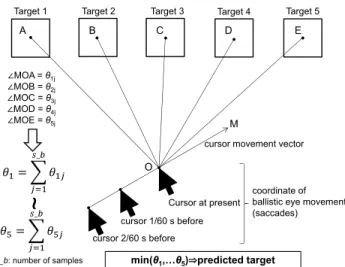
FIGURE 1. Target predictive method based on ballistic eye movements (Approach 1).
Moreover, we hypothesized that a predictive method con-sidering homing (slow) eye movements would lead to faster and more accurate pointing than a predictive method using ballistic (fast) eye movements. An eye-gaze input system must overcome the problem of the irritating and unnatural adjustment actions necessary for replacing left-click or drag actions and enhance both speed and accuracy.
To address this issue, we propose a method to predict targets according to the trajectories of eye movements and to improve pointing speed while maintaining high predic-tive accuracy. First, we examined the effecpredic-tiveness of the predictive method (Approach 1) based on ballistic (fast) eye movements. Because of the disadvantages of this ballistic eye movement-based prediction, we propose a new predic-tive method (Approach 2) that considers homing (slow) eye movements. Using an experimental procedure similar to that in Approach 1, we empirically verified the effectiveness of Approach 2. We determined whether Approach 2 could be used to point to a target more quickly while maintaining high predictive accuracy. Several design implications for an eye-gaze input system with a target prediction mode are discussed according to the results of this study.
II. PREDICTIVE METHOD BASED ON BALLISTIC EYE MOVEMENTS (APPROACH 1)
A. TARGET PREDICTIVE METHOD BASED ON BALLISTIC (FAST) EYE MOVEMENTS
The predictive method based on ballistic gaze movements is summarized in Fig. 1. The ballistic (fast) eye movement (saccade) was sampled every 1/60 s, and is shown as a cursor in Fig. 1. The prediction of the target to be pointed to was executed on the basis of the cursor movement vec-tor in Fig. 1. The cursor (eye) movement vecvec-tor consisted of the cursor position before one sampling period and that at present. Angles θ1j, θ2j, θ3j, θ4j, and θ5j in Fig. 1 were
calculated at each sampling time (here, 1/60 s) and cumu-lative s_b times, as shown in the equations in Fig. 1. The target with the minimum cumulative angle was determined
to be the predicted target. The predictive accuracy depended on the determination of the number of samples, s_b, which corresponded to the first s_b samples of eye gaze. There was a trade-off between s_b and the pointing time: if s_b was large, the pointing time increased accordingly. Immediately after the prediction was completed, the cursor jumped to the predicted target (Fig. 5).
B. METHOD 1) PARTICIPANTS
Eight young adults 21–24 years of age with no orthope-dic or neurological diseases participated in the experiment. All used personal computers (PCs) daily, and their visual acuity (measured with a Landolt ring) was greater than 20/20. After the participants received a brief explanation of the experiment, they provided written informed consent for participation.
2) APPARATUS
Gaze movements were measured with an EMR-AT VOXER (Nac Image Technology, Japan) eye-path tracking system that determined gaze movements by measuring the reflection of low-level infrared light (800 nm). Head movements were per-mitted within a predetermined range. The range of horizontal head movement was 16.7◦to the left and right of the center of the infrared camera of the eye tracker. The range of vertical head movement was 16.75◦to 39.25◦from the center of the camera. The visual angle error of the measurement system was approximately 0.3◦. The eye tracker was connected to a
PC (X5150MT, HP) equipped with a 15-inch (303 × 231 mm) display (spatial resolution: 1024 × 768 px). Another PC was connected to the eye tracker via an RS232C port to output the eye-gaze location with a sampling frequency of 60 Hz.
Hot Soup Processor (Ver 3.4, Japan) was used to develop the experimental task (eye-gaze input system) by using output x- and y-directional coordinates on the display coordination system. All eye data (x- and y-directional coordinates) were filtered with a 3-point moving average. The system was programmed to measure the pointing time and the success or failure of prediction of each trial. The pointing time was mea-sured with an accuracy of 1/60 s. A saccade with a duration of 100–120 ms was examined (Fig. 5). Therefore, the tem-poral resolution of 1/60 s was sufficient to extract saccades reliably. The system had an inherent delay of 1/60 s according to the specifications. For example, in a study by Murata and Karwowski [19], which measured pointing times with the same apparatus, the inherent delay of 1/60 s did not affect the conclusions. Therefore, we considered that this delay could be ignored because it did not affect the accuracy of measure-ment of the pointing time. The cursor (Fig. 1 and Fig. 2) was drawn on the display by using the x- and y-directional coordinate outputs as raw data every 1/60 s (the tip of the cursor corresponded to this coordinate). The illumination on the keyboard of the PC was approximately 300 lx, and the
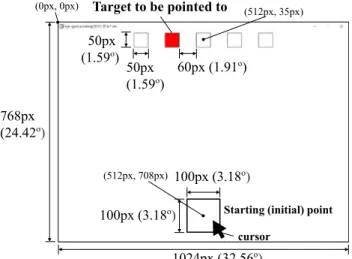
FIGURE 2. Display of pointing task (common to Approaches 1 and 2).
mean brightness of five points (four edges and center) on the display was approximately 150 cd/m2.
3) TASK
The display of the task is depicted in Fig. 2. The viewing distance was fixed to approximately 50 cm. Fig. 2 shows both the 1024 × 768 px coordinate system for a 15-inch display and the visual angle. The cursor appeared at the center of the starting point. The cursor of the eye-gaze input system moved according to the gaze movements. Under the four eye-gaze input conditions, each participant was required to eye-gaze at the starting point for approximately 1 s. Then the color of one of the five squares changed to indicate that it was the target square. The participant’s subsequent task was to gaze at the target as quickly and accurately as possible (Fig. 2). The size of the object was a 50 px × 50 px square. The object was 60 px (1.91◦visual angle) away from its neighbor. The vertical and horizontal visual angles of the target, as shown in Fig. 2, were 1.59◦. The spatial resolution of the eye tracker on a 15-inch display was 1024 × 768 px, thus reliably allowing for an object that extended 50 px and was 60 px away from its neighbor. The 100 ms fixation of the target terminated one trial of the eye-gaze input without a prediction mode. In the mouse input condition, the color of one of the five squares changed to indicate the target square after the participant moved the cursor to the center of the starting point and stayed there for approximately 1 s. Then the participant was required to move the cursor from the starting point toward the target and to left click. The mouse input required each participant to move the cursor manually and left click when the cursor was within a target square. Under the condition of the eye-gaze input with a target prediction mode, the participants did not need to gaze at the target for 100 ms, because this mode predicted the target that each participant was about to point to and automatically moved the cursor to the predicted target to complete a trial. Notably, the eye-gaze input system without a target prediction mode required each participant to fixate on a target for 100 ms to replace the left-click function of mouse operation. The eye-gaze input system with a prediction mode
had the advantage of not requiring participants to perform the redundant action of fixating on a target for 100 ms to substitute for the left-click function of mouse operation.
The predictive method was expected to eliminate the need for irritating and unnatural adjustment actions and to lead to higher performance (fast pointing). We hypothesized that the eye-gaze input system with the target prediction mode would lead to faster pointing. We note that the main purpose of this study was not to analyze eye movement characteristics but to use eye movements to develop a fast and accurate eye-gaze input system.
4) DESIGN AND PROCEDURE
The within-subject experimental factor was an input con-dition (five levels: eye-gaze input with a target prediction mode (s_b = 10), eye-gaze input with a target predic-tion mode (s_b = 15), eye-gaze input with a target predicpredic-tion mode (s_b = 20), eye-gaze input without a target prediction mode, and mouse input). The order of performance of the five conditions was randomized across participants.
Before the start of an experimental session, the eye tracker was calibrated for each condition to ensure reliable and accurate measurement of gaze movements. The participants underwent a practice session to become familiarized with the experimental task. Because there was no time limit in the practice session, the durations differed among participants. The practice session continued until each participant fully understood how to execute the experimental task and agreed to begin the experiment. For each of the five input conditions, error trials and pointing times were preliminarily measured. When few errors were made and the pointing times became consistent, the experiment started. In the eye-gaze input sys-tem with a target prediction mode, each participant could see the choice made by the system after every trial. Therefore, there was no ability to change the behavior in pointing to a target. Consequently, the experiment began after removal of the learning effect to the greatest extent possible.
Each participant repeated a total of 50 trials for each of the five input conditions. Each square was randomly specified as a target ten times during the 50 trials. Participants were permitted to take a short break between experimental tasks.
The evaluation measures were the pointing time and per-centage correct. For the eye-gaze input with a prediction mode, the percentage correct corresponded to predictive accuracy (i.e., the percentage of successful predictions). For the mouse input and eye-gaze input without a prediction mode, the percentage correct corresponded to the percentage of correct trials relative to the total number of trials. The error trial in these input modes was defined as a failure to point to a prespecified target.
C. RESULTS
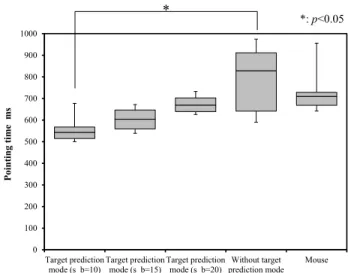
In Fig. 3, the box plot of pointing time is depicted as a function of the input condition. Fig. 4 shows the box plot of the percentage correct, compared among the input conditions. In this experiment, the percentage misses for the eye-gaze
FIGURE 3. Box plot of pointing time as a function of input method (Approach 1).
FIGURE 4. Box plot of percentage correct as a function of input method (Approach 1).
input with a prediction mode corresponded to the prediction error. We did not observe participant errors in which the gaze was directed at a square different from the target. Table 1 sum-marizes the results of a one-way (input condition) analysis of variance (ANOVA) conducted on the pointing time and percentage correct. The input mode affected both the pointing time (F (4, 16) = 3.173, p < 0.05) and the percentage correct (F (4, 28) = 8.908, p < 0.01).
Although faster pointing was achieved when s_b was 10 or 15, the corresponding percentage correct was lower than that of eye-gaze input without a prediction mode and that of mouse input. Although the pointing of the eye-gaze input with prediction was faster than that of the eye-gaze input without prediction or that of the mouse input (Fig. 3), the percentage correct was lower than that of the mouse input (=100%; Fig. 4). The eye-gaze input with target prediction had a
TABLE 1. Results of a one-way (input condition) ANOVA conducted on pointing time and percentage correct (Approach 1).
FIGURE 5. Example of error trials in Approach 1.
low percentage correct, particularly when s_b was equal to 10 or 15, for the reasons discussed below. The pointing time and percentage correct differed significantly among input conditions. The percentage correct was significantly lower for eye-gaze input with target prediction (s_b = 10) than for the other input conditions. Even when s_b was equal to 15, the percentage correct was significantly lower for eye-gaze input with target prediction than for mouse input. Both high pointing accuracy and fast pointing speed were achieved when s_b was 20.
D. DISCUSSION
Fig. 5 shows an error trial in Approach 1. Here, for clarity, the cursor shown in Fig. 2 is not depicted. Fig. 6 shows an
FIGURE 6. An example of ballistic (fast) and homing (slow) eye movements that represents the distance between the cursor tip and the center of a target as a function of time.
example of the distance between the cursor and the center of a target, plotted as a function of time. Two types of eye movements—ballistic (fast) and homing (slow)—are clearly observable. The ballistic and homing eye movements corre-spond to saccade and fixational eye movements, respectively, in vision research terminology [32, 33]. Because the target was predicted by ballistic eye movements before homing eye movements occur for an adjustment action, the square next to the target was likely to be falsely predicted. As shown in Fig. 7, homing eye movements were dispersed around a target. Therefore, prediction became inaccurate to a greater extent during homing eye movements. This finding suggests that the low percentage correct must be improved by using homing eye movements rather than fast ballistic eye move-ments. The condition of s_b = 20 is recommended if the distance between squares is sufficiently large.
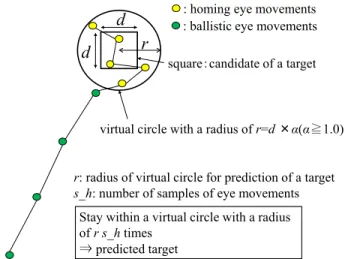
FIGURE 7. Target predictive method using homing (slow) eye movements (Approach 2).
III. PREDICTIVE METHOD BASED ON HOMING EYE MOVEMENTS (APPROACH 2)
A. TARGET PREDICTIVE METHOD BASED ON HOMING (SLOW) EYE MOVEMENTS
As shown in Section II, except for s_b = 20, the predictive accuracy of Approach 1 was lower than the accuracy of the eye-gaze input system without target prediction and that of mouse input. Therefore, we propose a target predictive method aiming to attain faster pointing speed and predict a target more accurately during homing (slow) eye movements, as shown in Fig. 6, to improve the predictive accuracy.
Fig. 7 shows a target predictive method based on homing eye movements. Notably, the prediction in Approach 2 is based on only homing (slow) eye movements. Homing (slow) eye movements were executed if eye movement data were sampled s_h times in a virtual circle, as shown in Fig. 7. If eye movement data were outside the virtual circle within s_h times, eye movements were judged to be ballistic (fast) move-ments. In this manner, homing (slow) eye movements and ballistic (fast) eye movements were distinguished. The target prediction was based on the observation that homing (slow) eye movements remained around a target if a user gazed at the target. The virtual circle with radius r (= d ×α) was assumed to indicate whether the homing eye movements were actually aimed at the square. The d andα correspond to the size of a target (square) and a constant greater than or equal to 1, respectively. In this study,α was 1.0, 1.5, or 2.0. If most homing eye movements were within the virtual circle that encompassed the square, as shown in Fig. 7, this square was reasonably assumed to correspond to the predicted target.
As demonstrated in Section II (Approach 1), the number of samples of eye movements, s_b, clearly affected the point-ing speed. The size of the virtual circle r (= d ×α) was also expected to affect the pointing speed and the predictive accuracy. If s_h is small, pointing may be fast. However, high predictive accuracy is difficult to achieve for a small value of s_h. Although a large value of s_h may enable the algorithm to attain high predictive accuracy, the pointing speed would be sacrificed. Therefore, in the proposed method, the optimal
combination of s_h and r must be determined. The cursor jumped to the predicted target immediately after the predic-tion was terminated.
In the proposed method, two parameters must be deter-mined: the number of samples, s_h, and the size of the virtual circle, r (= d ×α). If homing eye movements remained s_h times within the predetermined virtual circle in Fig. 7 that surrounded the square, that square was predicted to be the tar-get. As stated above, how these values should be determined to maximize predictive accuracy was unclear, although we expected that both s_h andα would affect predictive accuracy. Therefore, we determined the most appropriate values of s_handα empirically according to the experiment described below.
Although the predictive method (Approach 1) that con-sidered only ballistic gaze movements led to faster pointing except for s_b = 20, the predictive accuracy was inferior to that of mouse input or the eye-gaze input system without a prediction mode. Therefore, we expected that the predic-tion approach considering homing gaze movements would contribute to faster pointing and higher predictive accuracy. In Approach 2, we hypothesized that a prediction based on homing movements would increase the predictive accuracy.
B. METHOD
Twenty participants participated in the experiment and were recruited according to the same criteria as in Approach 1. The apparatus was the same as that in Approach 1. Both the number of samples, s_h, and the radius of the virtual circle r (= d ×α) were within-subject factors; we used s_h of 8, 12, 18, 24, and 30 andα of 1.0, 1.5, and 2.0.
The task was the same as that in Approach 1 (Section II. B.3)–4)). The experiment included 16 conditions (5 × 3 conditions for the eye-gaze input with target prediction and one condition for the eye-gaze input without target prediction). The procedure was similar to that in Approach 1. The size of the target (50 pixel × 50 pixel square) was the same as that in Approach 1. The order of performance of the 16 conditions was randomized across participants. Each participant conducted a total of 50 trials for each of the 16 conditions. During the 50 trials for one condition, each square was randomly designated as a target ten times. Participants were permitted to take a short break between experimental tasks. The evaluation measures were the same as those used in Approach 1.
C. RESULTS
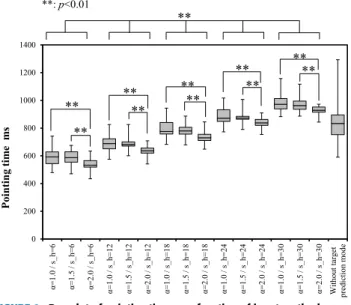
In Fig. 8, the box plot of the pointing time is shown as a function of s_h and α. For comparison, the figure also depicts the pointing time for the eye-gaze input without target prediction. Fig. 9 shows the box plot of the percentage correct as a function of s_h andα. For the eye-gaze input with a prediction mode, the percentage correct corresponded to the predictive accuracy (i.e., the percentage of successful predic-tions). No cases were observed in which a participant gazed at the wrong square (a non-target square). The percentage correct under the eye-gaze input without target prediction
FIGURE 8. Box plot of pointing time as a function of input method (Approach 2).
FIGURE 9. Box plot of percentage correct as a function of input method (Approach 2).
represented the percentage of correct trials relative to the total number of trials. Table 2 summarizes the results of a two-way (s ×α) ANOVA conducted on the pointing time; the results of multiple comparisons (Tukey-Kramer test) are also shown. The main effects of s_h (F (4, 76) = 2216.354, p < 0.01) and α(F(2, 38) = 21.693, p < 0.01) were significant. A larger α (=2.0) led to faster pointing, as shown in Table 2(2). When s_hwas 6 or 12, the pointing time was significantly shorter than that in other conditions of s_h, as shown in Table 2(3).
Table 3 summarizes the results of a two-way (s_h byα) ANOVA conducted on the percentage correct; the results of multiple comparisons (Tukey-Kramer test) conducted on s_h andα are also shown. In addition to the pointing time results, the main effects of s_h (F (3, 57) = 39.076, p < 0.01)) and α(F(2, 38) = 26.997, p < 0.01) were significant. This result was further confirmed, as shown in Table 3(2). Furthermore, as shown in Table 3(3), a largerα (2.0) led to lower pointing accuracy. In contrast to the results for pointing time, their
interaction was significant (F (6, 114) = 10.158, p < 0.01). The s_h byα interaction for the percentage correct in Fig. 9 indicated that although the percentage correct for s_h = 18, 24, and 30 did not differ among the three conditions ofα, the percentage correct for s_h = 6 and 12 differed among the three conditions ofα. When s_h was 6, 12, or 18, the pointing time of the eye-gaze input was shorter than that of the mouse input. When s_h was less than 24, larger values ofα tended to reduce the predictive accuracy (i.e., the percentage correct).
In Approach 1, the mouse and eye-gaze input (s_b = 20) achieved both pointing speed and accuracy. In Approach 2, the following conditions achieved both pointing speed and accuracy: (s_h = 12,α = 1.0 or 1.5) and (s_h = 18, α = 1.0 or 1.5). Using these conditions, we statistically tested the pointing time and pointing accuracy between Approach 1 and Approach 2 as follows to show that the percentage correct of Approach 2 was significantly improved while maintaining faster pointing speed. A non-paired t-test indicated that the pointing accuracy of Approach 2 was significantly higher than that of Approach 1 except for the comparison between s_b = 20 in Approach 1 and s_h = 18 andα = 1.0 or 1.5 in Approach 2. There were no significant differences in pointing time between the two approaches except for the comparison between s_b = 20 in Approach 1 and s_h = 18 andα = 1.5 and between the mouse input in Approach 1 and s_h = 18 andα = 1.5. Therefore, Approach 2 improved the inaccurate prediction of Approach 1 while maintaining shorter pointing times. Approach 2 led to higher predictive accuracy when s_h was larger than 10 (Fig. 9). When s_h was 12, both high predictive accuracy and fast pointing were achieved. As hypothesized, both fast pointing and high predictive accu-racy were obtained with Approach 2 if the values of s_h and α were appropriately selected (for example, s_h = 12).
D. DISCUSSION
When the values of s_h andα were appropriately determined, the pointing of the eye-gaze input system with target predic-tion by Approach 2 was faster than that of the mouse input (see Fig. 8). The larger the value ofα, the faster the pointing for all values of s_h.
Importantly, larger values of α resulted in faster point-ing but decreased the predictive accuracy. A comparison of Fig. 9 and Fig. 4 indicates that Approach 2 improved the percentage correct (predictive accuracy for the eye-gaze input with target prediction). However, the conditions of s_h = 6 and (s_h = 12,α = 2.0) did not lead to high predictive accuracy. Fast pointing and high predictive accuracy were obtained when (s_h,α) was set to (18, 1.0), (18, 1.5), (18, 2.0), (12, 1.0), or (12, 1.5). In terms of the implications for design, parameters s_h andα must be determined carefully so that both the pointing speed and predictive accuracy are optimized.
IV. GENERAL DISCUSSION
If the distance between squares is larger than that depicted in Fig. 2, we expect that the predictive accuracy of Approach 1 would be improved. However, Approach 1 cannot ensure
TABLE 2. Results of a two-way (size of virtual circleα by number of samples s) ANOVA conducted on pointing time (Approach 2).
TABLE 3. Results of a two-way (size of virtual circleα by number of samples s) ANOVA conducted on percentage correct (Approach 2).
predictive accuracy when the distance between squares is smaller. Homing gaze movements following ballistic gaze movements (Fig. 6) must be considered, because prediction using fast ballistic gaze movements is not always accurate and can predict the wrong target (Fig. 5). To overcome this disad-vantage and enhance target prediction, Approach 2 was based on homing gaze movements. Targets should be predicted by using homing gaze movements, because faster ballistic gaze movements can make the cursor move to an adjacent (wrong) target, as shown in Fig. 5. The design implication for Approach 1 is that the distance between squares should be greater to minimize the frequency of false target predictions, as shown in Fig. 5.
Larger values ofα resulted in faster pointing but decreased the predictive accuracy. The largest value ofα (=2.0) was unable to achieve both high predictive accuracy and fast pointing; therefore, one design implication of Approach 2 is that a larger virtual circle for prediction is not recommended. Approach 2 clearly improved the percentage correct (pre-dictive accuracy for eye-gaze input; Fig. 4 versus Fig. 9). However, the conditions of s = 6 (with α = 1.0, 1.5, or 2.0) and s = 12 (withα = 2.0) did not yield high predictive accuracy. These results indicated that fast pointing and high predictive accuracy were obtained if (s,α) was set to (18, 1.0), (18, 1.5), (18, 2.0), (12, 1.0), or (12, 1.5). Therefore, another design implication of Approach 2 is that different values of
α and s_h do not necessarily ensure high predictive accuracy and faster pointing. The two parameters must be determined carefully so that both pointing speed and predictive accuracy are optimized.
As shown in Figs. 3 and 8, the pointing times of Approaches 1 and 2 with a target prediction mode were less variable than those of an eye-gaze input system without a target prediction mode or of mouse input. This is an advantage of the proposed method, which predicts targets on the basis of ballistic (fast) or homing (slow) eye movements.
Eye-gaze input techniques diverge from natural gaze behavior, thus triggering events such as clicking, drag-ging, or menu selection, which are frequently used in a variety of human-computer interaction tasks [17]–[20]. This study’s eye-gaze input system using a prediction technique of a target requires no triggering of events, such as a click or a man-ual or speech response, and leads to more natural gaze behav-ior. This eye-gaze input system enabled both high pointing accuracy and faster pointing speed when s_b in Approach 1 or s_handα in Approach 2 were appropriately selected. More-over, the proposed method (Approaches 1 and 2) resulted in less variability in pointing time that the method without target prediction. Although comparison of pointing times with those reported in other studies is difficult, the pro-posed approach led to a higher pointing accuracy. The mean percentage correct reported by Surakka et al. [19], Kumar et al. [20], and Sidenmark et al. [24] was approxi-mately 64%, 85%, and 90%, respectively—values are lower than those with Approaches 1 and 2 herein.
Recent studies on eye-gaze interfaces [21]–[26] have shown the effectiveness of such interfaces. Sidenmark and Gellersen [24] have demonstrated that eye-head interaction in virtual reality applications leads to fast gaze pointing and selection. Although those studies [21]–[26] examined the effectiveness of an eye gaze input system combined with key input or speech, they did not compare the system with one involving only an eye-gaze interface. That is, these studies did not aim at developing a system that could be executed with only an gaze interface. The advantages of eye-gaze only interfaces, particularly those equipped with a target prediction mode, over their alternatives, such as eye-gaze and speech interfaces were previously unexamined. Here, an eye-gaze only interface was found to enhance the effectiveness of an eye-gaze input system and to lead to a more effective interface enabling both pointing accuracy and speed.
Approach 1 resulted in both a high percentage correct and fast pointing speed when s_b was 20. If the algorithm proposed in Approach 2 were implemented in the software of an eye-gaze input system, it would be expected to achieve both higher predictive accuracy and faster pointing without a need for the click actions conventionally used in pointing with a mouse. However, the values of α and s_h must be appropriately chosen (e.g., (s_h = 18,α = 1.0, 1.5)).
Because the size of the squares, the distance between squares, and the movement directions were limited, other conditions should be addressed to broaden the
generalizability of the results of this study to provide a better understanding of smaller or nearby targets.
The limitation of the proposed approach is that it cannot accommodate users changing their minds, such as altering the target item. At present, the cursor must be moved back to the starting location in Fig. 2, and the pointing must be attempted again. Future research should address how these cases can be addressed. Another limitation of this study is that the experimental task used to verify the effectiveness of Approaches 1 and 2 is fairly simple, and the results cannot be generalized. The findings must be validated and general-ized for a variety of practical (real-world) human-computer interaction tasks.
V. CONCLUSION
In this study, a method to predict targets according to the trajectories of homing (slow) eye movements is proposed to improve pointing speed while maintaining high predictive accuracy. First, ballistic (fast) eye movements were used to predict the targets to which users were pointing (Approach 1). To address the inaccuracy of the predictions based on ballis-tic eye movements, a new predictive method (Approach 2) was proposed that takes advantage of the characteristics of homing eye movements. The effectiveness of this method was verified.
Although Approach 1 led to faster pointing times than those with use of a mouse, the predictive accuracy (pointing accuracy) was lower than that with a mouse or the eye-gaze input system without a target prediction mode. If Approach 1 is used, the distance between squares should be sufficiently large to avoid predictions of a square next to the target (i.e., predicting the wrong target). The condition of s_h = 20 achieved both pointing speed and accuracy.
In Approach 2, both the pointing time and predictive accu-racy were affected by the number of samples, s_h, and the size of the virtual circle,α. Approach 2 resulted in high predictive accuracy and pointing speed when s_h andα were selected appropriately. On the basis of our results, as a design guide-line for an eye-gaze input system with a target prediction mode (Approach 2), we recommend the following values of parametersα and s_h: α = 1.0 or 1.5 and s_h = 12 or 18.
REFERENCES
[1] S. Zhai, C. Morimoto, and S. Ihde, ‘‘Manual and gaze input cascaded (MAGIC) pointing,’’ in Proc. SIGCHI Conf. Hum. Factors Comput. Syst. (CHI) Limit. New York, NY, USA: ACM Press, 1999, pp. 246–253. [2] L. E. Sibert and R. J. K. Jacob, ‘‘Evaluation of eye gaze interaction,’’
in Proc. SIGCHI Conf. Human Factors Comput. Syst. (CHI), Hague, The Netherlands, 2000, pp. 281–288.
[3] A. Murata, ‘‘Eye-gaze input versus mouse: Cursor control as a function of age,’’ Int. J. Hum.-Comput. Interact., vol. 21, no. 1, pp. 1–14, Sep. 2006. [4] T. Bader and J. Beyerer, ‘‘Natural gaze behavior as input modality for
human-computer interaction,’’ in Eye Gaze in Intelligent User Interfaces: Gaze-based Analyses, Models and Applications, Y. I. Nakano, C. Contai, and T. Bader, Eds. New York, NY, USA: Springer, 2013, pp. 161–183. [5] R. J. K. Jacob, ‘‘What you look at is what you get: Eye movement-based
interaction techniques,’’ in Proc. SIGCHI Conf. Hum. Factors Comput. Syst. Empowering People (CHI), Seattle, WA, USA, 1990, pp. 11–18. [6] R. J. K. Jacob, ‘‘The use of eye movements in human-computer interaction
techniques: What you look at is what you get,’’ ACM Trans. Inf. Syst., vol. 9, pp. 152–169, Apr. 1991.
[7] R. J. K. Jacob, ‘‘Eye-movement-based human-computer interaction tech-niques: Towards non-command interfaces,’’ in Advances in Human– Computer Interaction, vol. 4, H. R. Harston and D. Hix, Eds. Norwood, MA, USA: Ablex, 1993, pp. 151–190.
[8] R. J. K. Jacob, ‘‘What you look at is what you get: Using eye movements as computer input,’’ in Proc. Virtual Reality Syst., 1993, pp. 164–166. [9] R. J. K. Jacob, L. E. Sibert, D. C. Mcfarlanes, and M. P. Mullen,
‘‘Integral-ity and reparabil‘‘Integral-ity of input devices,’’ ACM Trans. Comput. Hum. Interact., vol. 1, no. 1, pp. 2–26, 1994.
[10] R. J. K. Jacob, ‘‘Eye tracking in advanced interface design,’’ in Advanced Interface Design and Virtual Environments, W. Baefield and T. Furness, Eds. Oxford, U.K.: Oxford Univ. Press, 1994, pp. 212–231.
[11] A. Murata and M. Moriwaka, ‘‘Basic study for development of Web browser suitable for eye-gaze input system-identification of optimal click method,’’ in Proc. 5th Int. Workshop Comput. Intell. Appl., Hiroshima, Japan, 2009, pp. 302–305.
[12] A. Murata and D. Fukunaga, ‘‘Extended Fitts’ model of pointing time in eye-gaze input system–Incorporating effects of target shape and movement direction into modeling,’’ Appl. Ergonom., vol. 68, pp. 54–60, Apr. 2018. [13] S. J. Agustin, C. J. Mateo, J. P. Hansen, and A. Villanueva, ‘‘Evaluation of the potential of gaze input for game interaction,’’ Psychol. J., vol. 7, no. 2, pp. 213–236, 2009.
[14] A. Murata and T. Miyake, ‘‘Effectiveness of eye-gaze input system-identification of conditions that assures high pointing accuracy and move-ment directional effect,’’ in Proc. 4th Int. Workshop Comput. Intell. Appl., Hiroshima, Japan, 2008, pp. 127–132.
[15] A. Murata and M. Moriwaka, ‘‘Effectiveness of the menu selection method for eye-gaze input system-Comparison between young and older adults,’’ in Proc. Int. Workshop Comput. Intell. Appl., Hiroshima, Japan, 2009, pp. 306–311.
[16] A. Murata, K. Hayashi, and M. Moriwaka, ‘‘Study on character input methods using eye-gaze input interface,’’ in Proc. HCI, Los Angeles, CA, USA, vol. 4, 2013, pp. IV320–IV329.
[17] T. Bader and J. Beyerer, ‘‘Natural gaze behavior as input modality for human-computer interaction,’’ in Eye Gaze in Intelligent User Interfaces-Gaze-Based Analysis, Models and Applications, Y. I. Nakano, C. Contai, and T. Bader, Eds. New York, NY, USA: Springer, 2013, pp. 161–183. [18] T. Partala, A. Aula, and V. Surakka, ‘‘Combined voluntary gaze
direc-tion and facial muscle activity as a new pointing technique,’’ in Proc. Interact, M. Hirose, Ed. Amsterdam, The Netherlands: IOS Press, 2001, pp. 100–107.
[19] V. Surakka, M. Illi, and P. Isokoski, ‘‘Gazing and frowning as a new human-computer interaction technique,’’ ACM Trans. Appl. Perception, vol. 1, no. 1, pp. 40–56, Jul. 2004.
[20] M. Kumar, J. Klingner, R. Puranik, T. Winograd, and A. Paepcke, ‘‘Improv-ing the accuracy of gaze input for interaction,’’ in Proc. Symp. Eye track‘‘Improv-ing Res. Appl. (ETRA), Savannah, GA, USA, 2008, pp. 65–68.
[21] B. J. Hou, P. Bekgaard, S. MacKenzie, J. P. P. Hansen, and S. Puthusserypady, ‘‘GIMIS: Gaze input with motor imagery selection,’’ in Proc. Symp. Eye Tracking Res. Appl., Stuttgart, Germany, Jun. 2020, pp. 1–10, Art. no. 18.
[22] S. Zhang, Y. Tian, C. Wang, and K. Wei, ‘‘Target selection by gaze pointing and manual confirmation: Performance improved by locking the gaze cursor,’’ Ergonomics, vol. 63, no. 7, pp. 884–895, Jul. 2020.
[23] I. Schuetz, T. S. Murdison, K. J. MacKenzie, and M. Zannoli, ‘‘An expla-nation of Fitts’ law-like performance in gaze-based selection tasks using a psychophysics approach,’’ in Proc. CHI Conf. Hum. Factors Comput. Syst., Scotland, U.K., May 2019, pp. 1–13, Art. no. 535.
[24] L. Sidenmark and H. Gellersen, ‘‘Eye&Head: Synergetic eye and head movement for gaze pointing and selection,’’ in Proc. 32nd Annu. ACM Symp. User Interface Softw. Technol., 2019, pp. 1161–1174.
[25] K. Minakata, J. P. Hansen, I. S. MacKenzie, P. Bækgaard, and V. Rajanna, ‘‘Pointing by gaze, head, and foot in a head-mounted display,’’ in Proc. 11th ACM Symp. Eye Tracking Res. Appl. (ETRA), 2019, pp. 1–9, Art. no. 69.
[26] J. P. Hansen, V. Rajanna, I. S. MacKenzie, and P. Bækgaard, ‘‘A Fitts’ law study of click and dwell interaction by gaze, head and mouse with a head-mounted display,’’ in Proc. Workshop Commun. Gaze Interact., Warsaw, Poland, Jun. 2018, pp. 1–5.
[27] A. Murata and W. Karwowski, ‘‘Automatic lock of cursor movement: Implications for an efficient eye-gaze input method for drag and menu selection,’’ IEEE Trans. Human-Machine Syst., vol. 49, no. 3, pp. 259–267, Jun. 2019.
[28] A. Murata, ‘‘Improvement of pointing time by predicting targets in pointing with a PC mouse,’’ Int. J. Hum.-Comput. Interact., vol. 10, no. 1, pp. 23–32, Mar. 1998.
[29] W. Lidwell, K. Holden, and J. Butler, Universal Principles of Design. Beverly, MA, USA: Rockport Publishers, 2012, pp. 82–83.
[30] D. E. Meyer, R. A. Abrams, S. Kornblum, C. E. Wright, and J. E. Keith Smith, ‘‘Optimality in human motor performance: Ideal control of rapid aimed movements.,’’ Psychol. Rev., vol. 95, no. 3, pp. 340–370, 1988. [31] D. J. Gillan, ‘‘Both sides now: Both height and width of the target matter
for applying Fitts’ law to pointing using a mouse,’’ in Proc. Hum. Factors Ergonom. Soc., Washington, DC, USA, 2019, pp. 381–385.
[32] N. J. Wade and B. W. Tatler, The Moving Tablet of the Eye: The Origins of Modern Eye Movement Research. Oxford, U.K.: Oxford Univ. Press, 2005. [33] G. Underwood, Cognitive Processes in Eye Guidance. Oxford, U.K.:
Oxford Univ. Press, 2005.
[34] B. B. Velichkovsky, M. A. Rumyantsev, and M. A. Morozov, ‘‘New solu-tion to the midas touch problem: Identificasolu-tion of visual commands via extraction of focal fixations,’’ in Proc. 6th Int. Conf. Intell. Hum. Comput. Interact., Evry, France, 2014, pp. 75–82.
ATSUO MURATA received the M.E. and Ph.D. degrees in industrial engineering from the Uni-versity of Osaka Prefecture, in 1985 and 1987, respectively. He was a Professor with Hiroshima City University, from 1997 to 2006. Since 2006, he has been a Professor with the Department of Intelligent Mechanical Systems, Okayama Univer-sity. His current research interests include accident analysis and safety management, and automotive ergonomics.
TOSHIHISA DOI received the M.E. and Ph.D. degrees from Wakayama University, in 2012 and 2015, respectively. He was a Research and Devel-opment Engineer with Lenovo (Japan) Ltd. Since 2016, he has been a junior Assistant Professor with the Department of Intelligent Mechanical Sys-tems, Okayama University. His research interests include human–interface design and automotive ergonomics.
KAZUSHI KAGEYAMA received the B.E.
degree from Okayama University, in 2018. His research interest includes ergonomics and cog-nitive engineering. He is currently studying the human–interface design based on eye-gaze input technologies.
WALDEMAR KARWOWSKI (Senior Member, IEEE) received the M.S. degree in production engineering and management from the Techni-cal University of Wroclaw, Poland, in 1978, and the Ph.D. degree in industrial engineering from Texas Tech University, in 1982. He is currently the Pegasus Professor and the Chairman of the Depart-ment of Industrial Engineering and ManageDepart-ment Systems and the Executive Director of the Institute for Advanced Systems Engineering, University of Central Florida, Orlando, FL, USA. He has over 500 publications focused on mathematical modeling and computer simulation with applications to human systems engineering, human-centered-design, safety, neuro-fuzzy systems, nonlinear dynamics and chaos, and neuroergonomics. He serves as the Co-Editor-in-Chief for the Journal Theoretical Issues in Ergonomics Science (Taylor and Francis, Ltd.), the Editor-in-Chief for the Human-Intelligent Systems IntegrationJournal (Springer), and the Field Chief Editor of the Frontiers in NeuroergonomicsJournal.