Upgrade of an Extraction System for Highly
Intense Beams from 10 GHz ECR Ion Source
著者
Matsuda Y., Kasamatsu K., Itoh M., Ishibashi
Y., Okamoto J., Karasudani K., Ishida S.,
Takahashi N., Takahashi K., Suzuki J., Honma
T., Akashige Y.
journal or
publication title
CYRIC annual report
volume
2016-2017
page range
23-25
year
2017
23
CYRIC Annual Report 2016-2017
II. 1. Upgrade of an Extraction System for Highly Intense Beams from
10 GHz ECR Ion Source
Matsuda Y.1, Kasamatsu K.1, Itoh M.1, Ishibashi Y.1, Okamoto J.1, Karasudani K.1, Ishida S.1, Takahashi N.2, Takahashi K.2, Suzuki J.2, Honma T.2, and Akashige Y.2
1Cyclotron and Radioisotope center, Tohoku University 2SHI Accelerator Service
The 930 AVF cyclotron accelerator provides various ion beams with three external ion sources in CYRIC. ECR1 and another ion source supply light ions. ECR10 supplies heavy ions up to Xe1). In addition to the variety, it is also important to provide the beam over a wide range of the beam intensity. For this purpose, we utilize a biased disk method2) and a
support gas method3) for ECR10. For further increase of the beam intensity, a previous
research attempted to upgrade an extraction system of ECR104). The original extraction system consists of two electrodes: a plasma electrode and a ground electrode. The simple configuration is stable and easy to extract the ions but is difficult to increase the number of ions without an increase of the emittance. Therefore, the previous research added two electrodes between the existing electrodes; one works as an extraction electrode, and the other works as a focusing electrode. These electrodes were connected by ceramic rods. Unfortunately, the extraction system could not work continuously because the extracted ions and the secondary particles collided the ceramic rods directly and the insulation resistance immediately decreased. Here we report a modification of the extraction system.
Figure 1 shows the modified extraction system. The ceramic rods are placed away from the beam axis. The electrodes are made of SUS316. The extraction electrode, the focusing electrode, and the ground electrode are designed to block the path of particles toward the ceramic rods. The details and the layout were determined with IGUN5), which can simulate extraction of positive ions from ion sources. After installing the system, we confirmed that we could apply about ±5 kV and +5 kV to the extraction electrode and the focusing electrode with respective to the ground electrode, respectively. A higher voltage than the above value triggered discharge or fluctuation of the voltage.
24
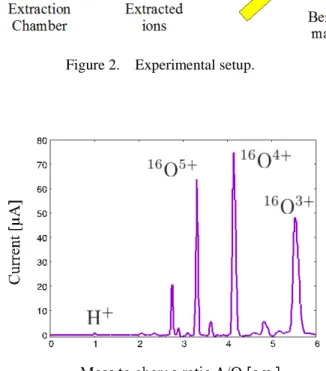
In order to demonstrate the practicality of the extraction system, we extracted 16O ions. Figure 2 shows the experimental setup. The extracted ions are analyzed by a bending magnet and a slit. The current is measured with a Faraday cup. Because the distance between ECR10 and the glazer magnet is more than 1 m and focusing elements are not enough, the emittance of the beam becomes large due to its space charge. Therefore, we will evaluate the effect of the extraction system after an upgrade of the beam line in the future. The test was done for a few days. During the test, a decrease of the insulation resistance was not observed. Figure 3 shows the measured beam current as a function of the mass number to charge ratio. The maximum beam current of 16O5+was about 80 μA, which is the almost same as the maximum current with the original extraction system (about 90 μA).
After the demonstration, ECR10 has supplied various ions (12C4+, 15N3+, 16O5+, 18O5+,
20Ne4+, 40Ar8+, 84Kr17+, and 129Xe25+) with the extraction system. These beam currents were
the same as those with the original extraction system. During the operation, no maintenance has been performed since it is very difficult to uninstall the extraction system. Therefore, the electrodes have been shaved gradually and substances have attached to the ceramic rods. Finally, the insulation resistance between the focusing electrode and the ground electrode decreased by one order of magnitude. Now the extraction system is under maintenance. The total operating time was more than 500 hours.
In summary, in order to increase the beam intensity from the 930 AVF cyclotron accelerator, we are upgrading an extraction system of ECR10. We solved a problem of insulation resistance of ceramic rods by modifying shape of three electrodes. By using the extraction system, we have supplied various ions to CYRIC users. The currents were the same as those with the original extraction system. In the future, we will evaluate the effect of the extraction system by upgrading the beam line. In addition, we will improve a method to uninstall the extraction system for maintenance.
References
1) Nakagawa T., Jpn. J. Appl. Phys., 30 (1991) L930; Wakui T., et al., CYRIC Annual Report
2010-2011 31.
2) Melin G. et al., Proc. 10th Int. Workshop on ECR Ion Sources, (1990) 1; Nakagawa T., Jpn. J. Appl. Phys., 30 (1991) L1588.
3) A. G. Drentje, Nucl. Instrum. Methods Phys. Res. B 9 (1985) 526; Wakui T., et al., CYRIC Annual
Report 2012-2013 45.
4) Shimbara Y., et al., CYRIC Annual Report 2012-2013 51.
25
Figure 1. Schematic view (a) and picture (b) of the modified extraction system.
Figure 2. Experimental setup.