for Differences Across Age Groups
著者
SUGIYAMA TOSHIKO, TADA HIDEOKI
journal or
publication title
Tohoku psychologica folia
volume
72
page range
33-45
year
2014-03-22
Two experiments were conducted to establish normative values for various measures of endogenous blink activities in each age and gender group, using relatively large samples and similar tasks. The ages of participants in Experiment 1 ranged from 3 months to 3 years and in Experiment 2 from 5 to 93 years. Video recording was performed during quiet resting for the former three age groups and an identical task of video watching was delivered to the latter 11 age groups. The major results were as follows: 1) the youngest infants blink infrequently, increasing gradually until the age of 9–10 years, with no statistical differences for the older age groups, 2) no differences in blink durations of closing, reopening, and total blink were obtained throughout all age groups in Experiment 2, whereas three age groups of infants aged less than 3 years in Experiment 1 showed some differences, and 3) the distribution patterns of blink frequency in each age group were roughly divided into three types.
Key words: endogenous blink, lifelong development, normative values of blink behaviors
Toward Normative Values of Blink Activities for Differences Across
Age Groups
1TOSHIKO SUGIYAMA(杉山敏子)2 and HIDEOKI TADA(田多英興)3
1. This study was supported in part by a Grant-in-Aid for Scientific Research (C) by the Japan Society for the Promotion of Science. We would like to express our special thanks to all participants and staffs of the related agencies for their help, and our students who assisted us in accomplishing the experiment and data analysis. Address correspondence to Toshiko Sugiyama, Tohoku Fukushi University, 1-8-1 Kunimi, Aoba-ku, Sendai, 981-8522 Japan, Fax: +81-22-301-1280, or [email protected]
2. Tohoku University School of Health Sciences, Sendai, Japan. 3. Department of Psychology, Tohoku-Gakuin University, Sendai, Japan.
Introduction
It is well known that blinks are affected by many kinds of variables, such as cognitive, emotional, arousal, and state variables (Ponder & Kennedy, 1927; Hall & Cusack, 1972; Stern, Walrath, & Goldstein, 1984; Tecce, 2007). There are, however, many inconsistencies in published results (Doughty, 2001). Hall and Cusack (1972) inferred that these inconsistencies resulted from methodological deficits in blink research, such as too short a period of observation. However, other reasons for these inconsistencies, we think, are that sample sizes were too small and the experimental situation and conditions were different. The relatively large sample for this study is required because of the large between-subject differences in blink rates (for example, Bacher & Allen, 2009). In fact, the most reliable data reported previously were based on a large sample of about 50 samples per group (Ponder & Kennedy, 1927; Yamada, Yamasaki, K., & Miyata, 1979; Yamada, Yamasaki, Nakayama, & Miyata, 1980; a series of studies by C. N. Karson in the 1980s, for example: Karson, 1979; Karson, Berman, & Donnelly, 1981, Karson, Burns, LeWitt, Foster, & Newman, 1984). In particular, in the
developmental study of blinks, few studies were found that were based on a large sample. One method for understanding the detailed mechanism of blinks and the possible origins of this wide range of inter-individual differences is to describe the ontogenetic developmental course. However, such studies are also very few in number. Some studies have investigated the lifelong development of blink activities from newborns to the elderly (Knorr, 1929; Zametkin, Stevens, & Pittman, 1979; Bentivoglio, Bressman, Cassetta, Carretta, Tonali, & Albasese, 1997) and other studies are concerned with development up to adolescence (Ködding, 1940; Pivik & Dykman, 2004; Bacher & Smootherman, 2004a, 2004b). These studies again present many contradictory findings. The one consistent observation is that blinks are virtually absent at birth and increase rapidly until preadolescence (Sugiyama & Tada, 2010) and adolescence (Zametkin et al., 1979).
The inconsistencies are as follows: 1) difference in age at highest blink rate, 2) the absolute value of number of blinks, and 3) whether or not the levels are maintained throughout adulthood. The peaks are at 20 years old in some data (Knorr, 1929; Zametkin et al., 1979), whereas in others no age differences were found (Norn, 1969; Bentivoglio et al., 1997). The blink rate level is about 16 bpm (blinks per minute) in Zametkin et al. (1979) but about 20 bpm in Bentivoglio et al. (1997). Zametkin et al. (1979) and Bentivoglio et al. (1979) suggested that this peak level is maintained throughout adulthood but Knorr (1929) reported a decrease after 20 years of age to old age. Thus, no standards for blink rate in each age and gender group have been developed. Therefore, one of the purposes of the present study was to establish a tentative standard value of endogenous blink activity in each age or gender group.
Possible reasons why these findings do not agree with each other are as follows: 1) the number of subjects per age group is too small, 2) the duration of data collection is too short; some authors suggest that 3 min may be adequate (Depue, Arbisi, Krauss, Iacono, Leon, Muir, Allen, 1990; Depue, Iacono, Muir, & Arbisi, 1998), while others recommend 5 min (Zaman & Doughty, 1997), 3) the methods for data collection or blink detection are not uniform, 4) conditions under which blinks are sampled differ, 5) the methods for recording and measuring are different, and 6) the criteria for blink identification might be not unified.
As mentioned above, there are large individual differences in blink rate, thus relatively large samples are required (for example, Bacher & Allen, 2009). If the criterion value of the control group is changed from study to study, it is very difficult to compare the data between the control and experimental groups. The experimental conditions under which blinks are sampled are also important (Doughty, 2001), because blinks may be affected strongly by these situations depending on whether subjects are in a hospital, airport, library, and so on. In fact, the earliest study (Ponder & Kennedy, 1927) already identified the importance of sample size and observed gender differences in eye blink rates depending on the conditions of recording situations, i.e., library and streetcar. They observed a shorter inter-blink period (higher blink rates) in men than women in the streetcar but in the reading rooms in libraries those of women were shorter (more frequent) than men. They collected about 50 samples of each gender group, in total over 200 samples, based on their preliminary observation using small
samples. Therefore, to reduce these problems, we conducted our experiment by using relatively large samples and administered the same task to maintain constancy for the experimental conditions. This was possible for all age groups with the exception of infants less than 3 years old.
In previous reports, many studies have pointed out that female subjects blinked more frequently than male subjects (Peterson & Allison, 1931; Newhall, 1932; Henderson & Prough, 1950; Zametkin et al., 1979; Stern, Boyer, Schroeder, & Stoliarov, 1996; Bentivoglio et al., 1997). Some studies reported no difference between gender (Norn, 1969; Yolton, Yolton, Lopez, Bogner, Stevens, & Rao, 1994; Doughty, 2001) and even the opposite result, i.e., the blink frequency of male subjects was higher than that of female subjects (Pivik & Dykman, 2004). Another kind of gender difference was also pointed out: strength of association, i.e., that higher levels of extraversion were associated with more frequent eye blinking was stronger among female subjects than among male subjects. (Berenbaum & Williams, 1994). The results are chaotic and thus the present study aimed to investigate this difference at each age stage using larger samples.
The reasons why we investigated other parameters of blinking are as follows. Blink duration and blink latency are affected by the sensory modalities of visual and auditory tasks (Stern et al., 1984; Goldstein et al., 1985; Bauer, Goldstein, & Stern, 1987) and hypnosis brings about the lengthening of duration and slowing of speed (Tada, Yamada, & Hariu, 1990). Blink duration is prolonged, blink amplitude is reduced, and asynchrony of both eyelids was markedly found especially in the case of occipital-lobe epilepsy patients (Tada, Takenaka, Minakawa, & Sugiyama, 2004). Blink burst or flurry may increase as a function of fatigue (Stern, Boyer, Schroeder, & Stoliarov, 1996) and be anticipated in some kinds of patients (Tinuper, Montagna, Laudadio, Ripamonti, & Lugaresi, 1989). However, the standard values of these parameters in each group have been not established and thus it is one of the purposes of this study to determine the normative values of these parameters in each group.
Amplitude (relative height of eyelid movement in pixel units), closing and reopening duration in ms (which was calculated by counting the number of frames of eyelid movement in 1/30 accuracy), and other measures, as well as the blink rate (bpm), blink burst or flurry ratio (percent of blinks that arise continuously over three times per second), sole blink rates (percentage of blinks without associated head movements), synchronization of left and right eyelid movements (percentage of synchronized and asynchronized eyelid movements, synchronization was measured by frame), and temporal distribution of accumulated blinks of the group over 3-min video watching.
Two experiments were conducted. Although it would have been ideal to conduct these under the same conditions across all age groups, it was very hard to perform them under completely identical conditions and situations throughout the ages from 3-month-old babies to 93-year-old elderly individuals. We have already published three separate papers related to the present paper in Japanese (Sugiyama & Tada, 2007; Sugiyama & Tada, 2010; Sugiyama & Tada, 2012). The aim of this paper is to report the residual data that have not been described
in these papers, combining two experiments, and reanalyzing data from a lifelong perspective. The other detailed data described in these papers, has been described in Japanese with abstract, figures, and tables in English.
Experiment 1
The purpose of Experiment 1 was to describe eye blink behaviors in the three youngest infant groups using simple recording of eye blink behaviors with relatively large samples.
Methods
Participants
A total of 232 participants (113 female and 112 male subjects and 7 subjects discarded), ranging from 3-month-old infants to 5-year-old children. Participants in these three groups (3 months, 1.5 years, and 3 years) were all recruited from physical examinations.
Task and Procedures
No tasks were delivered to participants and eye blink behaviors of infants were videotaped during resting in the spine position on the floor or interviewing with a doctor while held in a mother’s arms.
Results and Discussion
The results and discussion of Experiment 1 will be described later in combination with the results of Experiment 2, because it is very convenient and easy to describe and discuss combining these two sets of results.
Experiment 2
The purpose of Experiment 2 was to establish the standard values of eye blink activities and to describe the developmental course of eye blink activities in 11 age groups that could be compared with identical task conditions across these age groups with relatively large samples.
Methods
Participants
A total of 1190 participants (547 male and 630 female subjects and 14 subjects discarded), ranging from 5-year-old children to 93-year-old elderly individuals, were evaluated in the present experiment. A total of 14 age groups were obtained: seven groups by 10 years over 20s and seven groups under 20 years for the younger groups. Participants were recruited from two kindergartens, two public schools (an elementary and a junior high), a private high school,
nurses, radiologists, hospital clerks, car dealers, high school teachers, the retired healthy aged, and housewives.
Task
To standardize the experimental task conditions across age groups, all participants performed an identical task. They were asked to watch an edited video stimulus for 3 min. The stimulus video was an anthology composed of street scenes of Germany with Mozart’s “Eine
Kleine Nacht Musik” and other music concurrently presented, which was delivered from a
TV set from one to several meters in front of the participants. Experiments were conducted with one to five people at a time depending on the room size and, therefore, the screen sizes of the TV sets were 20–40 inches depending on these experimental conditions. The face of each subject was videotaped using standard recording equipment (for example, DCR-VX2000 NTSC; Sony Corporation, Tokyo, Japan).
Procedures
First, an experimenter informed study participants about the purpose of the study. Informed consent was obtained either from the participant or, in the case of young children, their parents. Finishing the watching task, they were required to complete a questionnaire on their hand and eye dominance. Similar procedures were administered to all age groups. There were slight differences in the conditions under which data were collected, with some experiments conducted in schools and some at office facilities.
Data Reduction
The blink data of each subject was videotaped one by one. The videotaped data were sent to the PC using software (Premiere of Adobe Co. and DV-Gate; Sony Corporation) and the movements of the eyelids were detected using movie analyzing software (Dipp-Motion 2D; Ditect Co., Tokyo, Japan). Afterwards, using additional software (Blink Detection Program; Mizuno Measurement Co., Sendai, Japan), the data were reduced to obtain the blink wave attributes such as amplitude, closing duration, reopening duration, and other measures, as well as the blink rate, blink burst ratio, association of blinks with head movements, synchronization of left and right eyelid movements, and temporal distribution of blinks over the 3-min video presentation.
Results of Experiment 1 and Experiment 2
We collected data on 1423 participants, as mentioned above. Some of the data were discarded, because of a high-activity level and the wearing of contact lenses. We found, in the course of data reduction, that the wearing of contact lenses caused an increased blink rate. Participants wearing contact lenses were principally young adults. The data from contact lens wearers were eliminated. Earlier work from our laboratory had also demonstrated this effect. (Tada & Iwasaki, 1984).
Eye Blink Rates
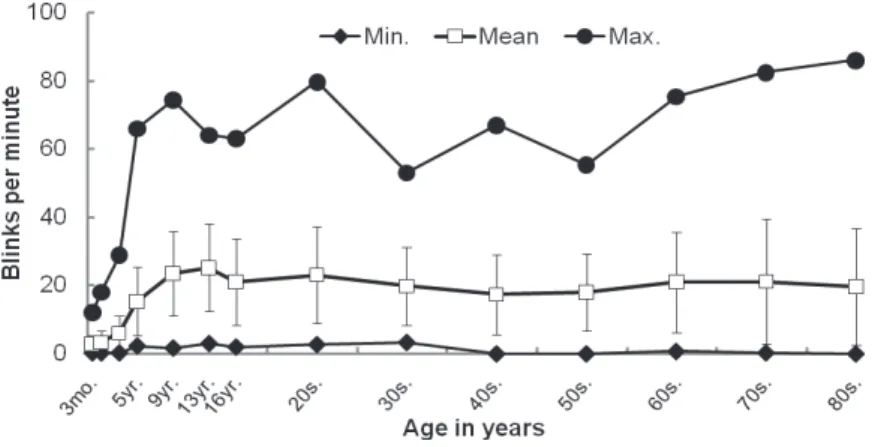
Overall results of eye blink rates are shown in Figure 1, which presents the average (± standard deviation [SD]) maximum and minimum blink rates in each age group. The mean blink rate across all 1289 participants was 18.2 ± 14.1 bpm, while that of adults only was 19.9 ± 14.6bpm (Sugiyama & Tada, 2007). As can be seen in Figure 1, this developmental curve is very similar to that of the so-called neural type mode (Scammon, 1930) and the other developmental curves of eyeball mass and eyeball width. Very young infants blink infrequently. Blink frequency gradually increases until elementary school age. Hereafter, no statistically significant differences were obtained among age groups until the elderly groups. A two-way (gender and 14 age groups) analysis of variance (ANOVA) revealed a significant main effect of gender (F(1,1373) = 7.4, P<0.01) and age group (F(13, 1373) = 33.1, P<0.001), but the interaction between gender and age group was not significant (ns) (F(13,1373) = 1.1, ns). Multiple comparisons revealed significant differences between the three infant groups of 3 months, 1 year, and 3 years old and the residual older groups, respectively, and between the 5-year-old group and the groups from 9 to 20 years, 60s, and 70s. The blink rates of 5-year-old children did not show any significant differences between those of the 30s or 50s age groups.
The other remarkable finding, shown in Figure 1, was that while the maximum blink rates changed in proportion to mean blink rates as a function of age group, minimum blink rates were consistent across all age groups ranging from 3 months to 80 years old. Maximum frequencies were beyond 60 bpm in all age groups more than 5 years old, and especially in the elderly groups their incidences exceeded 80 bpm. To determine the relative extent of individual differences, the coefficient of variation in % (CV%: SD/mean multiplied by 100) was calculated. The mean CV% of all 14 age groups was 77.5 %, ranging from maximum 113.1% in 1.5-year-old infants to minimum 50.1% in the 12-year-old group. Even that of the 3-month-old infants was 83.0%.
sugiyama-tada-figures.doc 1 / 3 6/15/2013
Figure 1. Mean, minimum, and maximum blink frequency as a function of age group, which is produced by combining two data sets from Sugiyama and Tada (2007) and Sugiyama and Tada (2010).
Figure 1. Mean, minimum, and maximum blink frequency as a function of age group, which is produced by combining two data sets from Sugiyama and Tada (2007) and Sugiyama and Tada (2010).
Contrary to this tendency of large variation in maximum frequency, minimum blinkers in each age group maintained uniform blink rates across all age groups. The mean minimum frequency of 14 age groups was 1.2 bpm, ranging from 0.0 bpm in the 40s, 50s, and 80s groups to 3.3 bpm in the 30s group. These findings were also supported by ratio analysis. The percentage of subjects with fewer than 5 bpm was less than 5%, from elementary school children to young adulthood. Thereafter, the frequencies increased gradually, resulting in 17.7% in the 80s group. Conversely, high blinkers, those with more than 60 bpm were 1–4% across all ages but increased in the older groups.
We can also observe the age differences in blink rates in the distribution map and its normal curve illustrated in Figure 2. It is very easy to understand the age difference in distribution pattern in Figure 2. The youngest four age groups showed the so-called J-shaped distribution (Ponder & Kennedy, 1927; Bentivoglio et al., 1997; Doughty, 2001) and the groups from preadolescence (9 years old) to adults demonstrated the more typical normal (symmetrical) distribution, partially indicated by the irregular form, especially in the elderly groups. None of our groups generated the bimodal distribution identified by Ponder and Kennedy (1927).
sugiyama-tada-figures.doc 2 / 3 6/15/2013
Figure 2. Distribution map and normal curves of eyeblinks in each age group.
Blink Durations
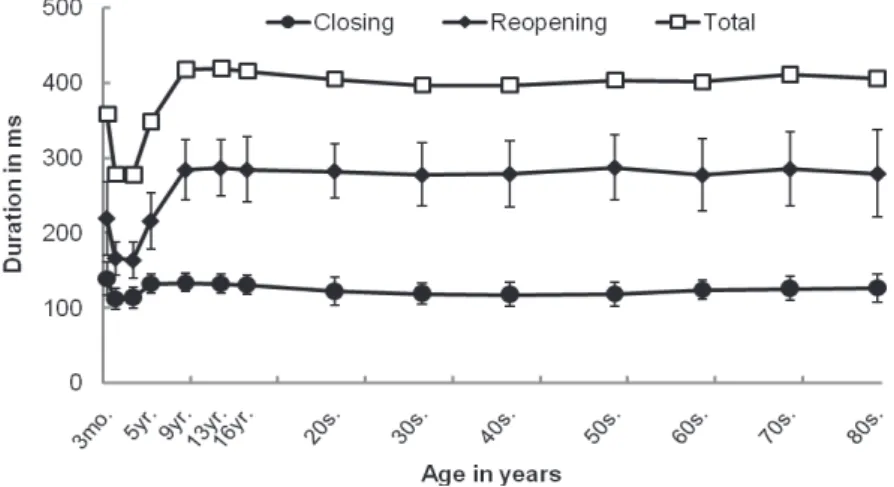
Figure 3 illustrates the closing, reopening, and total blink durations as a function of age group. In this figure, we also find curves similar to the developmental curves (Figure 1), with the exception of results for the 3-month-old group. The durations of all phases in the youngest four groups were shorter than in the remaining age groups and the durations in all groups older than 9 years were almost identical. The averaged durations and their SDs of all 14 age groups in closing, reopening, and total duration were 125 ± 17 ms (CV% = 13.3), 258 ± 59 ms (CV% = 22.9), and 383 ± 65 ms (CV% = 16.9), respectively. It was noted that, compared with blink rates, this range of variation is very small.
A two-way (gender and 14 age groups) ANOVA revealed a significant main effect of age group factor in all phases; closing duration (F(13,1278) = 24.1, P<0.001), reopening (F(13,1278) = 104.8, P<0.01), and total duration (F(13,1278) = 92.0, P<0.001), also in the gender factor in the reopening duration (F(1,1278) = 10.1, P<0.001) and total duration (F(1,1278) = 9.3.
P<0.01). The only exception was the closing phase (F(1,1278) = 0.2, ns) and there were no
significant interactions in any phase (for closing F(13,1278) = 1.2, ns, for reopening F(13,1278) = 0.7, ns, and total duration F(13,1278) = 1.0, ns, respectively).
Multiple comparisons of age group factors in three phases showed identical tendencies. That is, in all phases, groups less than 5 years old showed a uniform difference between the age groups older than 9 years old. However, the case in the closing duration was relatively complex: in 3-month-old infants, significant differences were obtained when compared with all age groups except 5 years, 9 years, and 13 years; in the 1-year group except 3 years, 30s, 40s, and 50s; in the 3-year group except 20s to 50s; in the 5-year group except 9 years, 13 years, 16 years, 70s, and 80s; in the 9-year group except 13 years, 16 years, and 80s; in the 13-year group except 16 years, 70s, and 80s; in the 16-year group except 60s and 80s; for the remaining groups no differences were found between them.
sugiyama-tada-figures.doc 3 / 3 6/15/2013
Figure 3. Closing, reopening, and total durations of eyeblinks as a function of age group, which is produced by combining two sets of data from Sugiyama and Tada (2007) and Sugiyama and Tada (2010).
Figure 3. Closing, reopening, and total durations of eyeblinks as a function of age group, which is produced by combining two sets of data from Sugiyama and Tada (2007) and Sugiyama and Tada (2010).
Discussion
Earlier research has suggested that blinking is virtually absent at birth, increases steadily until adolescence at about 20 years, and that this blink level is maintained throughout adult life (Ponder & Kennedy, 1927; Knorr, 1929; Ködding, 1940; Zametkin et al., 1979). The present study adds some new findings to these results. The average baseline of blink rate appears to be somewhat higher in Japanese adults compared with the earlier studies. The age at which a stable level of blinking is achieved is considerably different from the results of Zametkin et al. (1979), the most systematic of the previous studies. They suggested that asymptote is reached at about 20 years of age while our results indicate a much earlier time, namely approximately 10 years of age.
We will explore possible reasons for the difference below:
1. Sample size. The number of subjects per group is considerably larger in our study than in any of the previous studies. It is well known that there are large inter-individual differences in blink rate, therefore relatively large samples are required to determine the standard values for each age group. In this regard, it is essential to use between-subject design studies. A series of studies by Karson, C. N., the representative researcher in this field, usually collected samples of between 19 and 82 subjects. Results for his control groups are generally stable across the studies (Tada & Sugiyama, 2006; Tables 5 and 6).
2. Requiring performance of a homogeneous task during the sampling of blinks is necessary for comparison between groups. Many studies have demonstrated that a large variety of psychological and physiological factors influences blink rate. A small difference in task and observation conditions may subtly influence blink rate (Doughty, 2001). Therefore, it is essential to maintain strict homogeneity across participants.
3. The relationship of obtained results to Scammon’s developmental model. We find that the shape of the developmental curve obtained in this work closely mirrors that of Scammon’s neural mode type (1930) and those of eyeball width and mass, and furthermore, to some kinds of intellectual developments suggested by J. Piaget. This suggests that our results might more reliably reflect developmental changes. That is, the developmental course of blink behaviors may parallel or depend on the neural development of the visual system. Findings that young infants blink frequently after the appearance (Bacher & Smootherman, 2004b) and disappearance (Murai, Nihei, & Adachi, 1989) of a visual stimulus suggests that endogenous blinks reflect a developmental course of central nervous system activity. These reports and many others, i.e., a series of studies by J. A. Stern, suggest the importance of cognitive function in blink activity. Recently, the report that the development of cognitive function in terms of blink activity in preadolescents around 10 years old was very similar to that of adults (Pivik & Dykman, 2004) may be considered further evidence that the blink function has already matured at the preadolescent stage of development. Sutton (1958) also observed that there were some differences between winking ability in children above and below 10 years of age. These reports also suggested that the age of about 10 years might be a critical period for
the development of adult blink activities.
A second finding concerning the blink rate was the demonstration that large individual differences across ages were already observed in very early stages in life, as shown in Figures 1 and 2. The most striking finding was that the minimum blink frequency in all age groups was quite constant. How might one interpret the finding that minimum blink rates are constant across the age span while both average and maximum blink rates demonstrate a developmental course? We hypothesized that there are two kinds of blinks, i.e., essential and extra blinks. The former may be physiologically essential, for example, maintaining a film of fluid across the cornea, preventing the desiccation of the eyeball including spontaneous (periodical) activities like general movements in the fetus and newborns (Prechtl & Nijhuis, 1983). Newborn infants already blink several times per minute. A recent report suggested that fetuses also blink every 10 min (Petrikovsky, Kaplan, & Holsten, 2003). People who need not blink more frequently keep at this level throughout the life and may need not extra blinks. However, most people learn to blink as a tool for a variety of psychological, physiological, and biological adaptations, for instance, some kinds of information processing, reflection of some inner state, tension release, and some kinds of communication styles. What kinds of blinking people learn allows a wide range of alternatives, resulting in huge individual differences. Thus, the large individual differences in blink rate are attributable to differences in how people process information and the affective state associated with such processing.
Some prior reports have referred to distribution maps of blink rate and they classified blink rate into three types: J-shaped, normal (symmetry), and irregular (Ponder & Kennedy, 1927; Bentivoglio et al., 1997; Doughty, 2001), but we have not observed the bimodal type reported by Ponder and Kennedy (1927). Generally speaking, concerning our data, we can say that a J-shaped distribution is typical for the youngest age groups, normal distributions are common to adults, and the elderly groups were more likely to demonstrate the irregular type. One reason for such patterns may be the differences in blink frequency between groups.
The results concerning blink duration depicted in Figure 3 suggest: 1) closing duration was approximately half of the reopening phase, 2) the variability of duration among participants was very small comparing with blink frequency, probably about one-third of blink rates, and 3) the developmental curve was close to that of blink rates with the exception of the 3-month-old group. This exception in 3-month-3-month-old infants might be derived from a neural immaturity.
Conclusions
The present study showed the developmental course of endogenous blinking and some tentative standard values for each age and gender group. The study was conducted using relatively large samples and utilized the same experimental condition for all but the youngest participants. However, these results might yet be tentative, because blinks might be affected by other unexpected and unknown factors such as cultural differences. Further studies will be required to establish the normative values for each group, which might be essential for
a between-group study on blinks. These standards might be useful in the evaluation of the validity of acquired eyeblink data as control group data.
The other related data such as isolated (sole) blink rate (blinks not associated with head movements), side superiority of eyelids, blink burst (flurry), and the temporal distribution of eye blinks during 180-s video watching can be found in our previous articles (Sugiyama & Tada, 2007; Sugiyama & Tada, 2010; Sugiyama & Tada, 2012).
References
Bacher, L. F., & Smootherman, W. P. (2004a). Spontaneous eye blinking in human infants: A review, Developmental Psychobiology, 44, 95-102.
Bacher, L. F., & Smootherman, W. P. (2004b). Systematic temporal variation in the rate of spontaneous eye blinking in human infants. Developmental Psychobiology, 44, 140-145.
Bacher, L.F., & Allen, K. J. (2009). Sensitivity of the rate of spontaneous eye blinking to type of stimuli in young infants. Developmental Psychobiology, 51, 88-197.
Bauer, L. O., Goldstein, R., & Stern, J. A. (1987) Effects of information-processing demands on physiological response patterns. Human Factors, 29, 213-234.
Bentivoglio, A. R., Bressman, S. B., Cassetta, E., Carretta, D. Tonali, R., & Albasese, A. (1997). Analysis of blink rate patterns in normal subjects. Movement Disorders, 12, 1028-1034.
Berenbaum, H., & Williams, M. (1994). Extraversion, hemisphatial bias, and eyeblink rates. Personality & Individual Differences, 17, 849-852.
Depue, R.A., Arbisi, P., Krauss, S., Iacono, W.G., Leon, A., Muir, R., Allen, J. (1990). Seasonal independence of low prolactin concentration and high spontaneous eye blink rates in unipolar and bipolar II seasonal affective disorder. Archives of General Psychiatry, 47, 356-364.
Depue, R. A., Iacono, W. G., Muir, R., & Arbisi, P. (1998). Effect of phototherapy on spontaneous eye-blink rate in subjects with seasonal affective disorder. American Journal of Psychiatry, 145, 1457-1459.
Doughty, M. J. (2001). Consideration of three types of eyeblink activity in normal humans: during reading and video display terminal use, in primary gaze, and while in conversation. Optometry and Vision Science, 78, 712-725.
Goldstein, R., Walrath, L. C., Stern, J. A., & Strock, B. D. (1985) Blink activity in a discrimination task as a function of stimulus modality and schedule of presentation. Psychophysiology, 22, 629-635.
Hall, R. J., & Cusack, B.L. (1972). The measurement of eye behavior: Critical and selected reviews of voluntary eye movement and blinking, U. A. Army Technical Memorandum No. 18-72.
Henderson, J. W., & Prough, W. A. (1950). Influence of age and sex on flow of tears. Archives of Ophthalmology, 43, 224-231.
Karson, C, N. (1979). Oculomotor signs in a psychiatric population: A preliminary report. American Journal of Psyhiatry, 179, 1057-1060.
Karson, C, N., Berman, K. F., & Donnelly, E. F. (1981). Speaking, thinking, and blinking. Psychiatry Research, 5, 243-246.
Karson, C, N., Burns, R. S., LeWitt, P. A., Foster, N. L., & Newman, R. P. (1984). Blink rates and disorders of movement. Neurology, 34, 677-678.
Knorr, A. (1929). Beiträge zur Kenntnis des Lidschlages unter normalen und pathologischen Verhältnissen. Würzburger Abhandlungen aus dem Gesamtgebiet der Medizin, 25, 197-223.
Ködding, von I. (1940). Der Lidschlag im Kindesalter. Monatsschrift für Kinderheilkunde, 84, 212-223.
Tohoku Psychologica Folia, 48, 93-96.
Newhall, S. M. (1932). The control of eyelid movements in visual experiments. American Journal of Psychology, 44, 555-570.
Norn, M. S. (1969). Desiccation of the precorneal tear film. Acta Ophthalmologica, 47, 865-880.
Peterson, J., & Allison, L.W. (1931). Controls of the eye-wink mechanism. Journal of Experimental Psychology, 14, 144-154.
Petrikovsky, B. M., Kaplan, G., & Holsten, N. (2003). Eyelid movements in normal human fetuses. Journal of Clinical Ultrasound, 31, 299-301.
Pivik, R. T., & Dykman, R. A. (2004). Endogenous eye blinks in preadolescents: Relationship to information processing and performance. Biological Psychology, 66, 191-219.
Ponder, E., & Kennedy, W. P. (1927). On the act of blinking. Quarterly Journal of Experimental Physiology, 18, 89-110. Prechtl, H. F. R., Nijhuis, J. G. (1983). Eye movements in the human fetus and newborn. Behavioral Brain Research,
10, 119-124.
Scammon, R. E. (1930). The measurement of the body in childhood. In Harris, J. A., Jackson, C.M., Paterson, D.G., Scammon, R.E. (Eds.) The measurement of man, Minneapolis, University of Minnesota Press, pp. 173-215. Stern, J. A., Walrath, L. C., & Goldstein, R. (1984). The endogenous eyeblink. Psychophysiology, 21, 22-33.
Stern, J. A. Boyer, D., Schroeder, D. J., & Stoliarov, N. (1996) Blinks, saccades, and fixation pauses using vigilance tasks performnace: II. Gender and time of day. Federal Aviation Administration, Office of Aviation Medicine Report DOT/FAA/AM-96/9 Available from: National Technical Information Service, Springfield, VA 22161, Pp. 1-44.
Sugiyama, T., & Tada, H. (2007). Age and gender differences in endogenous eyeblinks and the standard blink rate of normal adults. Japanese Journal of Physiological Psychology and Psychophysiology, 25, 255-265 (In Japanese with abstract and tables in English).
Sugiyama, T., & Tada, H. (2010). Age and gender differences of endogenous eyeblinks in preadolescents. Japanese Journal of Research on Emotions, 185, 64-72. (In Japanese with abstract and tables in English).
Sugiyama, T., & Tada, H. (2012). Age and gender differences in endogenous eyeblinks: Sole blink rate, synchrony of both eyelids, blink burst (flurry), and temporal distribution of blinks. The Bulletine of Tohoku Fukushi University. 36, 329-341 (In Japanese with figures and tables in English).
Sutton, R. N. (1958). The development of independent muscular control of separate eyelids in two racial groups, European and Polynesian. Archives of General Psychiatry, 49, 65-69.
Tada, H., & Iwasaki, S. (1984). Effects of contact lens on the eyeblink frequency during a visual search task. Tohoku Psychologica Folia, 43, 134-137.
Tada, H. and Sugiyama, T., (2006) The wide range of variabilities of individual differences in endogenous eyeblinks and some problems associated with between subjects designs. Faculty of Liberal Arts Review Tohoku Gakuin University, No. 144, 1-14 (In Japanese with abstract and tables in English).
Tada, H., Takenaka, Y., Minakawa, M., & Sugiyama, T. (2004). Endogenous eyeblinks in epilepsy. International Journal of Psychophysiology, 541-2, 128.
Tada, H., Yamada, F., & Hariu, T. (1990) Changes of eye-blink activities during hypnotic state. Perceptual & Motor Skills, 71, 1832-1834.
Tecce, J. L. (2007). Eye movements, eye blinks, and behavior. In Andreassi, J.L. (Ed) Psychophysiology: Human behavior and physiological response (5th ed), pp. 308-327. Mahwah: NJ: Lawrence Erlbaum Associates. Tinuper, P., Montagna, P., Laudadio, S., Ripamonti, L., & Lugaresi, E. (1989) Paroxysmal blinking provoked by head
movements. European Neurology, 29, 298-300.
Yamada, F., Yamasaki, K., & Miyata, Y. (1979). Lead-stimulation effects on human startle eyeblink recorded by an electrode hookup. Japanese Psychological Research, 21, 174-180.
electrode hookup: Re-examination. Perceptual and Motor Skills, 51, 1283-1287.
Yolton, D. P., Yolton, R. L., Lopez, R., Bogner, B., Stevens, R., & Rao, D. (1994). The effects of gender and birth control pill use on spontaneous blink rate. The Journal of the American Optometric Association, 65, 763-770. Zaman, M. L., & Doughty, M. J. (1997). Some methodological issues in the assessment of the spontaneous eyeblink
frequency in man. Ophthalmic and Physiological Optics, 17, 421-432.
Zametkin, A. J, Stevens, J. R., & Pittman, R. (1979). Ontogeny of spontaneous blinking and of habituation of the blink reflex. Annals of Neurology, 5, 453-457.
(Received July 5, 2013) (Accepted November 12, 2013)