Nascent Entrepreneurship Process and Effect of
Firm Size : Evidence from Taiwan’s Labor
Market
journal or
publication title
International review of business
number
15
page range
25-44
year
2015-03
1. Introduction
As interest in entrepreneurship has grown, scholars have suggested a number of structural influences on entrepreneurial activity, including the family of origin (Aldrich and Cliff, 2003), work environment (Gompers et al., 2005; Dobrev and Barnett, 2005), and regional cultural and material environments (Saxenian, 1994; Sørenson and Audia, 2000). Recent years have seen a renewed interest in the effects of work environments such as age, size, and authority on entrepreneurship (Gompers et al., 2005; Dobrev and Barnett, 2005; Stuart and Ding, 2006). These studies suggest the significance of social environment in presenting entrepreneurial opportunities, and in shaping the desire and willingness to engage in entrepreneurial activities.
However, a central challenge for contextual approaches to entrepreneurship is that much of the evidence organized in support of contextual arguments does not adequately describe a particular process in which the social environment affects the entrepreneurial process. This is perhaps most easily found in the growing number of studies that document how the
Evidence from Taiwan’s Labor Market
Ryuichiro TSUCHIYA*
Abstract
This study analyzes new firm startup activities undertaken by 815 individuals. We examine the effects of size of prior employer on the outcome of new firm startup activities. Observations focus on individuals who left their previous employment to found new firms but have not yet become business owners. This study draws upon a repeated cross-sectional sample from Taiwan’s matched employer−employee database from 1995 to 2006. The results from regression analyses suggest that those who have worked for smaller firms start a business in a relatively short period of time. The prior employer effect in different industries is also examined. Results of the analysis suggest that those who worked for smaller firms are much more successful in completing startup activities in the shorter term when the prior employer engaged in more knowledge-intensive and less capital-intensive production. In these industries, it can be relatively easy for the employees to gain access to the employer’s critical resources.
characteristics of employers, such as age, firm size, and authority, affect the individual rates of entrepreneurship (Gompers et al., 2005; Dobrev and Barnett, 2005; Stuart and Ding, 2006). The interpretation of these empirical relationships is complicated in part by the fact that when specifying entrepreneurial entry, the employee is often only observed by the researcher once they have completed the process of organization creation.
In recent decades entrepreneurship research has shifted focus from “who is an entrepreneur” to “how is entrepreneurship developed” ! a question that requires a more process-oriented analysis of entrepreneurship. Gartner (1988) argued that entrepreneurship pertains to a process ! the emergence of new organizations. In Gartner’s model, the process of entrepreneurship starts with “initiating”, when the entrepreneur makes the decision to start a firm, and ends with “the establishment”, when the entrepreneur obtains external resources and creates a market niche. Thus, this is the process that occurs before the existence of organization. This suggests that entrepreneurship research should deal with early stage phenomena, such as how opportunities are detected and acted upon, or how new organizations come into being.
This study focuses on nascent entrepreneurs and the process of creating an organization. This study analyzes new firm startup activities undertaken by 815 nascent entrepreneurs. We examine the effects of size of prior employer on the outcome of new firm startup activities. Observations focus on individuals who left their previous employment to found new firms but have not yet become business owners. This study draws upon a repeated cross-sectional sample from Taiwan’s matched employer−employee database from 1995 to 2006.
Relevant terms for the period of creating organization include the following; the emergence of the organization, preorganization, the organization in vitro, the prelaunch, gestation, and startup. Organizational creation involves these events that lead to and influence the process of starting a business before it comes into being. Shane and Venkataraman (2000) emphasize that entrepreneurship consists of two related processes; the discovery of entrepreneurial opportunities, and the exploitation of those opportunities. Our objective is to analyze the influence of work environment on the individual ability to engage in these organizational creation processes.
Our approach to studying nascent entrepreneurship is to overcome methodological problems introduced by the opportunity cost of undertaking startup activities. These stem from the fact that individuals who have worked for large firms are often considered to have more alternatives to return to paid employment after they give up or suspend their efforts to create a new organization. To address such factors, in our design an empirical model of the outcome of startup activities is estimated simultaneously with the determination of earnings in entrepreneurial and non-entrepreneurial activities, using an econometric framework
2. Literature Review
2.1 The Characteristics of Organization Creation Process
A number of scholars have offered frameworks to explore the characteristics of the organizational creation process. Gartner (1985) outlined a framework comprising four dimensions that should be accounted for when studying new ventures; the individuals involved in the creation of the new venture, the activities undertaken by those individuals during the new venture creation process, the organizational structure and strategy of the new ventures, and the environmental context of the new venture. Katz and Gartner (1988) suggested four emergent properties as indicators that an organization is in the process of coming into existence; intention to create an organization, assembling resources to create an organization, developing an organizational boundary (e.g., incorporation), and the exchange of resources across this boundary (e.g., sales). Subsequent empirical explorations (Reynolds and Miller, 1992) of the Katz and Gartner (1988) framework found that no one pattern or sequence of events is common to all emerging organizations. The most common final stages in the creation of an organization were likely to be hiring first employees and first sales income (common to approximately half of all new ventures), financial support (two in five new ventures), and a major personal commitment to the venture (one in four new ventures). In general, firms are engaged in the emergence process for an average of 1 year, though 20% completed gestation within 1 month, and 90% within 3 years. Carter, Gartner, and Reynolds (1996), in their study on new venture start-up activities undertaken by 71 nascent entrepreneurs, found that nascent entrepreneurs should aggressively pursue opportunities in the short term. Furthermore, the kinds of activities that nascent entrepreneurs undertake, the number of activities, and the sequence of these activities have a significant influence on the ability of nascent entrepreneurs to successfully create new ventures. Unfortunately, however, the sources of these individual differences are left largely unexplained. There are many factors that are likely to have a significant moderating effect on the activities of nascent entrepreneurs (e.g., previous experience and the background of the entrepreneur).
2.2 Workplace Effect on Entrepreneurial Entry
Recent research provides evidence consistent with the structural influence of workplace characteristics on entrepreneurial entry. Saxenian’s (1994) historical and qualitative examination of Silicon Valley and Boston’s Route 128, for example, relates the differences in entrepreneurial activity in the two regions to differences in the size distribution of local high-tech firms. In Saxenian’s account, the predominance of Route 128 by large bureaucratic firms meant that employees of these firms were distantly isolated from entrepreneurial experiences and opportunities. Gompers et al. (2005) showed that venture capital-financed firms are more likely to be started by former employees of younger and
smaller established firms. They explained this phenomenon by referring to the effect of the work environment: “the breeding grounds for entrepreneurial firms are more likely to be other entrepreneurial firms. It is in these environments that employees learn from their co-workers about what it takes to start a new firm and are exposed to a network of suppliers and customers who are used to dealing with start-up companies” (Gompers et al., 2005: p.612). Wagner (2004), using a cross-sectional survey of the German population, found that people working for young small firms were more likely to consider themselves as being in the process of launching an entrepreneurial venture. Eriksson and Kuhn (2006), using register data on the Danish population, found that employees of large firms were less likely to found entrepreneurial ventures. Finally, Dobrev and Barnett (2005), studying career histories of business school alumni, found that employees are less likely to enter entrepreneurship if they work for older larger firms. They attributed this empirical pattern to the increased role differentiation and reutilization that accompany bureaucratization. An organization’s degree of bureaucratization is not directly observable. Moreover, the construction and collection of specialized measures of hierarchy, role specialization, and reutilization in large representative samples required to capture transitions to entrepreneurship are prohibitively difficult to achieve. Instead, we focused on an easily observable organizational characteristic. Organizational size has well-established implications for the degree of role specialization, the routinization of activities, and the extent of hierarchy. A long line of research suggests that larger firms generally have a more fine-grained division of labor and more elaborate organizational hierarchies (e.g., Blau and Schoenherr, 1971). Furthermore, the coordination problems faced by large firms also lead to a greater reliance on standards.
A review of the literature suggests at least four different and possibly complementary contextual mechanisms by which bureaucracy might influence the entrepreneurial process. First, as emphasized in the classic discussions of bureaucratic life, bureaucracies may influence the attitudes and mind-set of their employees in ways that make them less likely to act entrepreneurially. Second, working in bureaucracies may hinder the development of the skills necessary for successful entrepreneurship, and may therefore lower the expected value of entrepreneurial opportunities. Third, an employer’s level of bureaucratization may shape the extent to which employees are exposed to entrepreneurial opportunities and activities. Finally, bureaucracies create job stability and internal routes of advancement, thereby increasing the opportunity costs of leaving organization.
We sought to reexamine the literature on entrepreneurial behaviors, and develop linkages between pre-entrepreneurial work environments and their effectiveness for the process of organizational creation. The theoretical and empirical literature on work environment and entrepreneurship is very diverse, but few efforts have been undertaken to identify the
influences on the process of creating a new organization.
First, bureaucracies in a pre-entrepreneurial work environment may lower the rates of the successful completion of organizational creation process by hindering the development of entrepreneurial skills. Lazear (2005) argued that if successful entrepreneurial activity requires the command of a wide variety of roles, then individuals with diverse work experiences will find the process of organizational creation easier. Employees of large firms are on average more likely to undertake a narrow range of tasks. Although some may rotate through functional expertise, the typical career ladder rewards depth of skills as opposed to breadth. The average diversity of work experiences should therefore be higher among employees of small firms without an extensive division of labor, implying that rates of entrepreneurship will be higher among employees of small firms.
Second, other scholars have argued that employees with a broad knowledge of a firm’s external environment are in a better position to gain access to a network of buyers and suppliers (Saxenian, 1994; Sørenson and Audia, 2000; Gompers et al., 2005). As bureaucratization progresses, however, administrative roles devoted to coordination and control become more prevalent, making workers in large firms more inwardly focused on average. Thus, they have fewer social ties to actors in the external environment that might serve as sources of resources, knowledge, and information. This again suggests that a more extensive division of labor should lead to lower rates of success in startup activities.
Third, employees of small firms will gain greater familiarity with the types of market that could be served by a new firm, which in the early years at least is almost inevitably going to be small (Johnson and Cathcart, 1979; Cooper, 1985). In their conceptual model of the firm in its formative years, Rajan and Zingales (2001) discuss a key problem facing employers: how to prevent employees from stealing the organization’s unique, critical resources, walking away, and starting a rival concern. In small organizations, the employer has to give her employees close proximity or access to critical resources for them to learn to produce effectively. For example, an employee in a small firm is permitted to understand the concept, be in contact with key customers and suppliers, and even learn the entrepreneur’s unique managerial techniques. Such access gives the employee the opportunity to steal the concept, walk away with customers and suppliers, and persuade coworkers to leave together, or mimic the employer’s management style.
Although it has not been widely studied empirically, there is indirect empirical evidence of experiences in small-sized workplaces being facilitators of the organizational creation process. For example, Bianchi, Miller, and Bertini (1997) showed in a study of Italian small business clusters that in the local network of small firms, a new firm could start with limited capital sufficient for just one productive phase, limited risk of failure, and little need for creating market relationships, at least at the beginning. Their higher rates of success in
startup activities are at least in part a result of the effect of the previous employer on the capacity of nascent entrepreneurs to acquire resources. Thus, we postulate the following hypothesis:
Hypothesis: nascent entrepreneurs who have worked for small firms are more likely to complete the path to business ownership in the short term than nascent entrepreneurs who worked for larger firms.
3. Research Methodology
3.1 Source of Data
We analyzed data on the Taiwanese labor market from a database called the Manpower Utilization Survey (MUS) from 1995 through 2006. Most explanations of the Taiwanese labor market characterize it as very flexible and dynamic. It is more dynamic in terms of worker turnover than labor markets in the United States and other industrialized countries (Tsou, Liu, and Hammitt, 2001). Compared with such countries, the Taiwanese labor market includes a large proportion of small to medium enterprises, and their flexibility contributes to high turbulence in the labor market. It is also relatively free from union intervention and governmental regulation. There are also few barriers to entry in entrepreneurship, largely because of low-threshold entry costs stemming from the presence of a dense network of subcontractors.
The MUS is constructed from household registers and maintained by the Directorate-General of Budget, Accounting, and Statistics. This survey covers all people legally residing in the Taiwan area aged 15 or older. The subjects were selected using a random stratified sampling procedure. As a first step in executing this survey, approximately 520 geographical administrative units were randomly sampled from the entire Taiwan area; second, approximately 20,000 households were sampled within the sampled administrative units. The total sampling rate was 3.1 percent and the sample comprised approximately 60,000 individuals in each year. Each household is surveyed for two consecutive years, under the rotating sampling method used in the MUS. Ideally, individual data should be merged into a short panel dataset, however, unique individual IDs are not released because of confidentiality concerns.
3.2 Measures
We analyzed data on nascent entrepreneurs from the MUS database. In the MUS, respondents were asked to indicate their current status in the labor market: (1) business owner with employees; (2) business owner with no employees; (3) private sector employee; (4) government sector employee; (5) unpaid family laborer. Those classified as (1)−(4) (with the exception of those working less than 15 hours per month) were asked to indicate the
monthly income from their main occupation, and whether they had changed occupation in the year prior to the survey. If they responded “yes”, they were asked whether the job change was voluntary and to indicate the reason for the job change. One of the responses to this question, the intention to “create a new enterprise by sole effort” was used to identify those who had entered a startup activity in the year prior to the interview.
We created a measure from information regarding the outcomes of those who had entered into a startup activity. At the time of the survey interview, some of the respondents who had responded that they left their job to create a new enterprise were successfully operating a business, while others were back working as employees in the private sector. Regarding individuals who entered a startup activity, those who reported completing the transition to business ownership were coded as 1, and those back in paid employment were coded as 0 (1 = current status was either business owner with employees, or business owner with no employees1; 0 = current status was private sector employee). Thus, the status in the labor
market was used to examine whether nascent entrepreneurs achieved business ownership within one year of resigning from their previous jobs.
In our study design, the startup activity was considered initiated when the nascent entrepreneurs resigned from their previous jobs. This is consistent with the first phase of the process of an organization coming into existence, that is, the “intention to create an organization” as suggested by Katz and Gartner (1988). The startup activity was considered completed when the nascent entrepreneur reached business ownership, which is consistent with the third phase of emergent organizations, “developing organizational boundaries” (Katz and Gartner, 1988). Returning to paid employment is considered an indication of declining personal commitment, and the withdrawal of the intention, or a much earlier phase. A timeframe of one year was used because the literature suggests that emerging firms are engaged in the creation process for an average of one year.
One shortcoming of the one-year timeframe is that it does not capture individuals who created an organization that was dissolved before one year had passed. The completion of the organization creation process defined conceptually in this study is to develop organizational boundaries; thus, it is possible to consider these individuals as failing to make the boundaries clear. We were also unable to specify in which month they resigned from their jobs, so the gestation process was possibly longer (shorter) for those who had resigned at the beginning (end) of the year. As the interviews were conducted in May, the length of the process could possibly have ranged from 5 to 17 months. In the interview, 85% of nascent entrepreneurs reported they were currently either business proprietors with no
1 “Business owner with employees” and “business owner with no employees” are grouped together, because we consider that the startup activity was completed when the nascent entrepreneur reached business ownership.
* (1)
(2)
employees or business proprietors with employees. Fifteen percent reported they had returned to paid work.
3.3 Analytical Techniques
The decision to complete gestation efforts is modeled using the following equation:
where Z* is an index of individual propensity to successfully complete the transition toward self-employment and includes businesses with employees and businesses with no employees. Furthermore,, YS and YP are (log of) earnings per hour for self-employment and paid employment, respectively, W is a vector of characteristics that influence the choice of sector, and η is a normally distributed random error. The α terms are estimated parameters: α1 measures the importance of the log earnings differential between self-employment and paid employment. The expectation is that this parameter will be positive; those with higher potential earnings in self-employment should, other things equal, choose that sector. The vector W will contain the size of previous employers and controls. As individuals are observed in only one sector, predictions ofYSandYPare required to estimate Eq (1).
These predictions are based on standard Mincer earnings functions:
where (log of) earnings per hour depend on the vector Xi, which includes the size of an individual’s previous employer and other controls;ε is a random error term that captures the unsystematic component of earnings; i = 1 to n; j = S, P. To achieve consistent estimations of the β vectors, and hence predictions of Ys require accounting for the possibility of sample selection bias.
The MUS income questions were asked to both employees and the self-employed. For employees, the income definition is their usual gross pay from their main job, including overtime and bonuses. For the self-employed, they were asked to estimate their average net takings. This amount consists of their income after costs of materials, stock, running expenses and other costs are excluded. The reliability of self-reported, self-employment earnings is a potential problem with this dataset as with others. Monthly employee and self-employed earnings were divided by working hours. In this model, the log form of the hourly earnings was adjusted to the 2001 price.
As the data lack a measure of earnings over time, the measure of earnings used here is rather myopic, and does not fully capture the long-term consequence of sector choice that individuals usually take into account in their career decisions.
3.4 Control Variables
We specify the likelihood of an individual completing the business creation process as a function of an extensive number of additional factors that are likely to affect the entrepreneurial process. Because these factors have been theorized extensively in previous research, they are not elaborated in the present study. Note, however, that their inclusion in our model is central to our claim of building an integrative model of the entrepreneurial process.
Potential labor market experience. Potential entrepreneurs tend to accumulate human and social capital constantly throughout their career, while the skills acquired in previous employment might have a more pronounced effect on their success. It is important to isolate the returns from the most recent acquisition of knowledge from those accumulated. This variable captured the overall labor market experience, defined as age minus years of formal education, minus 6. To capture the depreciation of accumulated knowledge, a nonlinear effect was assumed.
Education. The effect of education is represented by a dummy variable coded as 1 if the interviewee was a university graduate.
Female. Sex was captured by a dummy variable coded as 1 for females.
Senior Manager. The coordination skills acquired when occupying management positions might increase the probability of success when they start a new firm. Our model included the control for senior manager coded as 1 if the individual had been a manager ranking above the level of department head.
Professional Experience. The propensity to business ownership may differ significantly between professionals and non-professionals. Our model included a variable coded as 1 if the respondent was in a professional occupation prior to entry into startup activities, and otherwise 0, according to the standard occupational classification.
3.5 Descriptive Statistics
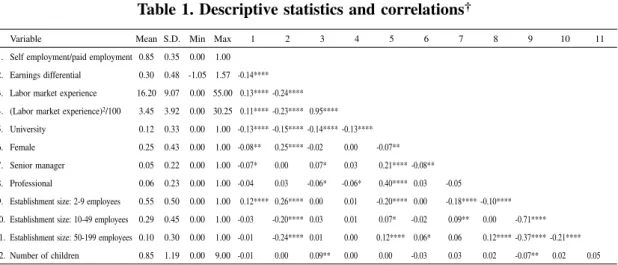
The descriptive statistics in Table 1 provide an overview of our sample. Among people who entered startup activities, 85% successfully completed the transition to business proprietorship. The average individual in the gestation process is faced with an earnings differential of 1.3 Yuan per hour (roughly equivalent to 0.04 US dollars) between self-employment and paid self-employment. The average individual has a potential labor market experience of 16 years, and 12% of those in the gestation process received university degrees, 5% formerly occupied a senior management position, and 6% had professional occupations. Furthermore, 55% worked for employers with 2 to 9 employees, 29% worked in firms with 10 to 49 employees, and 10% for employers with 50 to 199 workers. The average number of dependent children was 0.85.
Table 1. Descriptive statistics and correlations†
Variable Mean S.D. Min Max 1 2 3 4 5 6 7 8 9 10 11
1. Self employment/paid employment 0.85 0.35 0.00 1.00 2. Earnings differential 0.30 0.48 -1.05 1.57 -0.14**** 3. Labor market experience 16.20 9.07 0.00 55.00 0.13**** -0.24**** 4. (Labor market experience)2/100 3.45 3.92 0.00 30.25 0.11**** -0.23**** 0.95****
5. University 0.12 0.33 0.00 1.00 -0.13**** -0.15**** -0.14**** -0.13**** 6. Female 0.25 0.43 0.00 1.00 -0.08** 0.25**** -0.02 0.00 -0.07** 7. Senior manager 0.05 0.22 0.00 1.00 -0.07* 0.00 0.07* 0.03 0.21**** -0.08** 8. Professional 0.06 0.23 0.00 1.00 -0.04 0.03 -0.06* -0.06* 0.40**** 0.03 -0.05 9. Establishment size: 2-9 employees 0.55 0.50 0.00 1.00 0.12**** 0.26**** 0.00 0.01 -0.20**** 0.00 -0.18**** -0.10**** 10. Establishment size: 10-49 employees 0.29 0.45 0.00 1.00 -0.03 -0.20**** 0.03 0.01 0.07* -0.02 0.09** 0.00 -0.71**** 11. Establishment size: 50-199 employees 0.10 0.30 0.00 1.00 -0.01 -0.24**** 0.01 0.00 0.12**** 0.06* 0.06 0.12**** -0.37**** -0.21**** 12. Number of children 0.85 1.19 0.00 9.00 -0.01 0.00 0.09** 0.00 0.00 -0.03 0.03 0.02 -0.07** 0.02 0.05 *p < .1; **p < .05; ***p < .01; ****p < .001; two-tailed tests.
†All models include dummy variables for the industry of previous employer and the survey year.
S.D.: standard deviations
4. Results
Table 2 presents estimates from the probit regression models of entry into the organizational creation process. Dummy variables for survey years are included in the models but not presented in Table 2. In addition to the set of control variables described earlier, the model in Table 2 includes the control for the number of dependent children. In Table 2, the estimates for the effect of dummy variables for the categories of workplace size are all highly significant and positive. This suggests that the rate of entry into the organizational creation process of an employee in a firm with 2 to 9 employees is significantly higher than the rate of an observationally homogeneous employee in a firm with more than 200 employees. Thus, as expected, the size of one’s workplace explains significant portions of variations in the likelihood an individual will recognize opportunities and make decisions to pursue them.
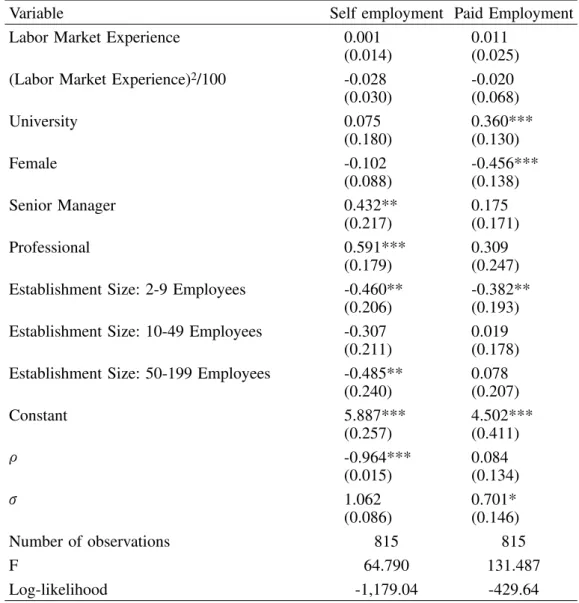
Panel A of Table 3 presents the results of the selectivity corrected earnings equations. Each model was estimated simultaneously with a selection equation, shown in Panel B of Table 3. The issue of identification was addressed using an approach similar to Rees and Shah (1986). Compared with the specification of Panel B in Table 3, the selection equation contained an additional variable representing the number of dependent children.
In the model for self-employment earnings, the effects of workplaces with 2 to 9 employees and those with 50 to 199 employees were negative and significant, as compared with those with 200 employees or more. The effects of workplaces with 10 to 49 employees were not significant at the conventional level of significance. This suggests that the potential capacity of nascent entrepreneurs to obtain self-employment earnings have no linear
relationship with the size of their previous workplaces. The effect of workplaces with 2 to 9 employees was significant and negative in paid employment, confirming our conjecture that the earnings capacity in paid employment is significantly lower for nascent entrepreneurs who had worked for smaller workplaces.
In contrast to our prediction, estimates of the error correlation between the selection equation and earnings equation are negative and highly significant for those from the self-employment sector. The implication is that a failure to properly account for sample selection bias would lead to an under-prediction of earnings because those with low earnings in the self-employment sector relative to their observable characteristics are also more likely to be observed in that sector.
Panel B of Table 3 presents the results of the selection equation. As predicted, the effects of workplaces with 2 to 9 employees, 10 to 49 employees, and 50 to 199 employees were all significant and positive. This confirmed our hypothesis that nascent entrepreneurs who had previously worked in small workplaces were more likely to set up their business over a shorter period.
Table 2. Probit model of entry into startup activities†
Variables
Labor Market Experience 0.035*** (0.005)
(Labor Market Experience)2 -0.096*** (0.013)
University 0.073* (0.041)
Female -0.194*** (0.026)
Senior Manager 0.089 (0.063)
Professional 0.002 (0.059)
Establishment Size: 2-9 Employees 0.313*** (0.050) Establishment Size: 10-49 Employees 0.156*** (0.050) Establishment Size: 50-199 Employees 0.106* (0.055)
Number of Dependent Children 0.015 (0.011)
Constant -3.012*** (0.075)
Number of Observations 207,762
χ2 413.252
Log-likelihood -5,640.62
*p < .1; **p < .05; ***p < .01; two-tailed tests.
†Robust standard errors are in parentheses. All models include
dummy variables for the industry of previous employer and the survey year.
Table 3. Sample selection models of self and paid employment earnings and outcome of startup activities
Panel A: Sample selection model of self and paid employment earnings†
Variable Self employment Paid Employment
Labor Market Experience 0.001
(0.014)
0.011 (0.025) (Labor Market Experience)2/100 -0.028
(0.030) -0.020 (0.068) University 0.075 (0.180) 0.360*** (0.130) Female -0.102 (0.088) -0.456*** (0.138) Senior Manager 0.432** (0.217) 0.175 (0.171) Professional 0.591*** (0.179) 0.309 (0.247) Establishment Size: 2-9 Employees -0.460**
(0.206)
-0.382** (0.193) Establishment Size: 10-49 Employees -0.307
(0.211)
0.019 (0.178) Establishment Size: 50-199 Employees -0.485**
(0.240) 0.078 (0.207) Constant 5.887*** (0.257) 4.502*** (0.411) ρ -0.964*** (0.015) 0.084 (0.134) σ 1.062 (0.086) 0.701* (0.146) Number of observations 815 815 F 64.790 131.487 Log-likelihood -1,179.04 -429.64 *p < .1; **p < .05; ***p < .01; two-tailed tests.
†Robust standard errors are in parentheses. All models include dummy variables for the
industry of previous employer, and the survey year. ρ refers to the correlation between the error in earnings equation for sector and the error in a selection equation where an individual is observed in sector when dependent variable takes the value 1. σ is the standard deviation of the error in the earnings equation.
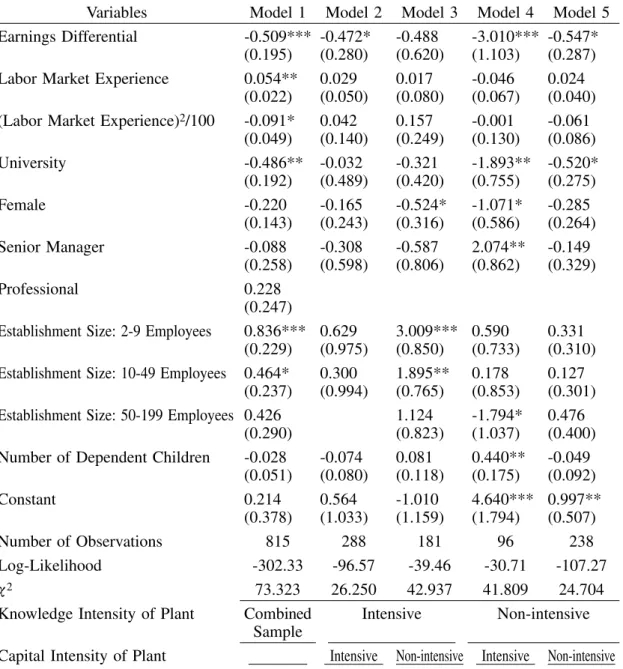
To evaluate the robustness of the probit estimates of the parameters of Eq. (1) to alternative earnings function specifications, results are reported in Table 4 using the predicted values of the earnings differential from each model. The predicted earnings differential between the self-employed and employees has a negative coefficient and is highly significant. The effects of workplaces with 2 to 9 employees and 10 to 49 employees were significant and positive. Therefore, nascent entrepreneurs who had worked in workplaces with less than 50 employees were more likely to reach business ownership over
Panel B: Sample selection models of outcome of startup activities†
Variable
Labor Market Experience 0.047***
(0.017)
(Labor Market Experience)2/100 -0.069*
(0.037) University -0.136 (0.185) Female -0.298*** (0.108) Senior Manager -0.172 (0.238) Professional 0.192 (0.245) Establishment Size: 2-9 Employees 0.759***
(0.235) Establishment Size: 10-49 Employees 0.521**
(0.239) Establishment Size: 50-199 Employees 0.725***
(0.257)
Number of Dependent Children -0.039
(0.034)
Constant -0.390
(0.296)
Number of observations 815
*p < .1; **p < .05; ***p < .01; two-tailed tests.
†Robust standard errors are in parentheses. All models include
dummy variables for the industry of previous employer and the survey year
Table 4. Structural probit models of outcome of startup activities†
Variables Model 1 Model 2 Model 3 Model 4 Model 5
Earnings Differential -0.509*** (0.195) -0.472* (0.280) -0.488 (0.620) -3.010*** (1.103) -0.547* (0.287)
Labor Market Experience 0.054**
(0.022) 0.029 (0.050) 0.017 (0.080) -0.046 (0.067) 0.024 (0.040) (Labor Market Experience)2/100 -0.091*
(0.049) 0.042 (0.140) 0.157 (0.249) -0.001 (0.130) -0.061 (0.086) University -0.486** (0.192) -0.032 (0.489) -0.321 (0.420) -1.893** (0.755) -0.520* (0.275) Female -0.220 (0.143) -0.165 (0.243) -0.524* (0.316) -1.071* (0.586) -0.285 (0.264) Senior Manager -0.088 (0.258) -0.308 (0.598) -0.587 (0.806) 2.074** (0.862) -0.149 (0.329) Professional 0.228 (0.247) Establishment Size: 2-9 Employees 0.836***
(0.229) 0.629 (0.975) 3.009*** (0.850) 0.590 (0.733) 0.331 (0.310) Establishment Size: 10-49 Employees 0.464*
(0.237) 0.300 (0.994) 1.895** (0.765) 0.178 (0.853) 0.127 (0.301) Establishment Size: 50-199 Employees 0.426
(0.290) 1.124 (0.823) -1.794* (1.037) 0.476 (0.400) Number of Dependent Children -0.028
(0.051) -0.074 (0.080) 0.081 (0.118) 0.440** (0.175) -0.049 (0.092) Constant 0.214 (0.378) 0.564 (1.033) -1.010 (1.159) 4.640*** (1.794) 0.997** (0.507) Number of Observations 815 288 181 96 238 Log-Likelihood -302.33 -96.57 -39.46 -30.71 -107.27 χ2 73.323 26.250 42.937 41.809 24.704
Knowledge Intensity of Plant Combined Sample
Intensive Non-intensive
Capital Intensity of Plant Intensive Non-intensive Intensive Non-intensive
*p < .1; **p < .05; ***p < .01; two-tailed tests.
†Robust standard errors are in parentheses. All models include dummy variables for the industry of
a short-term period than those who had worked in larger firms.
To further examine whether workplace effects vary across different industries, in models 2 to 5 in Table 4, the sample was divided according to the intensity of knowledge and assets, on the assumption that the degree to which employees are able to gain access to critical resources of the employer may possibly depend on the intensity of knowledge and asset (Rajan and Zingales, 2001). The sample was divided into four industry groups: industries with high knowledge intensity and high asset intensity (e.g., electronic components manufacturing); those with high knowledge intensity and low asset intensity (e. g., education, medical services, and international trade); those with low knowledge intensity and high asset intensity (e.g., basic metal manufacturing); and those with low knowledge intensity and low asset intensity (e.g., food and beverage services).
We analyzed the knowledge and asset intensity of the various industries using the 1990 Industry, Commerce, and Service Census and the MUS database from 1995 to 2006. A workplace was considered knowledge intensive when the proportion of employees with graduate degrees in the industry (defined at the level of a two-digit standard industrial classification) was more than the median value within all industries. It was considered asset intensive when the average value of fixed assets in the industry exceeded the median value within all industries.
The effects of workplaces with 2 to 9 employees and that with 10 to 49 employees were negative and significant in the industry group with high knowledge intensity and low asset intensity. In contrast, the effects of those workplaces were not significant in industries high in both knowledge intensity and asset intensity, industries low in both knowledge intensity and asset intensity, and industries low in knowledge intensity but high in asset intensity. Thus, the implication is that the degree to which nascent entrepreneurs were able to have access to the critical resources mediates how workplace size affects the outcomes of startup activities.
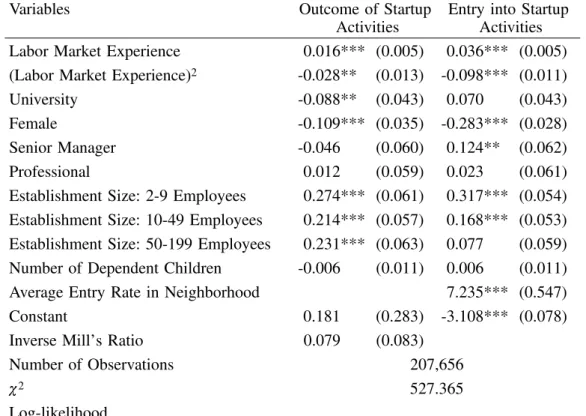
To test the effect of the unobserved sorting processes of people with entrepreneurial tendencies entering the organizational creation process, we estimated simple sample selection models of the outcomes of startup activities. The outcome equation was estimated simultaneously with the selection equation containing the set of variables in the model presented in Table 5. The issue of identification is addressed by including in the selection equation an additional variable of the neighborhood average for the rate of entry into startup activities. Neighborhoods are defined as Taiwan’s administrative units at the levels of either hamlets (cun) in the case of village areas, or neighborhoods (li) in the case of cities, city districts, and township areas. These units are subordinate to city-, city district-, township-, and village-level units. We then form the average rate for one’s neighborhood unit using the sample of individuals in the MUS who were employed in the year previous to the survey
Table 5. Sample selection model of outcome of startup activities†
Variables Outcome of Startup
Activities
Entry into Startup Activities
Labor Market Experience 0.016*** (0.005) 0.036*** (0.005)
(Labor Market Experience)2 -0.028** (0.013) -0.098*** (0.011)
University -0.088** (0.043) 0.070 (0.043)
Female -0.109*** (0.035) -0.283*** (0.028)
Senior Manager -0.046 (0.060) 0.124** (0.062)
Professional 0.012 (0.059) 0.023 (0.061)
Establishment Size: 2-9 Employees 0.274*** (0.061) 0.317*** (0.054) Establishment Size: 10-49 Employees 0.214*** (0.057) 0.168*** (0.053) Establishment Size: 50-199 Employees 0.231*** (0.063) 0.077 (0.059)
Number of Dependent Children -0.006 (0.011) 0.006 (0.011)
Average Entry Rate in Neighborhood 7.235*** (0.547)
Constant 0.181 (0.283) -3.108*** (0.078)
Inverse Mill’s Ratio 0.079 (0.083)
Number of Observations 207,656
χ2 527.365
Log-likelihood
*p < .1; **p < .05; ***p < .01; two-tailed tests.
†Robust standard errors are in parentheses. All models include dummy variables for the
industry of previous employer and the survey year.
after excluding the individual in question. Under the assumption that the entrepreneurial tendencies of people living in adjacent neighborhoods do not have direct influence on the outcome of one’s startup activities, it is possible to use the neighborhood average as an instrument for entry into startup activities.
In the model in Table 5, the estimated effect of workplace size is highly statistically significant. This suggests that even within a group of people without any intension to give up paid employment to enter startup activities, if they entered, the estimated rate of successful completion would be presumed to be much higher when their employer is small.
5. Conclusions
The results of this study provide strong support for the contextual claim that working in smaller firms makes nascent entrepreneurs less likely to abandon or suspend their efforts to
create a new organization. Controlling for a wide range of observable individual characteristics, people who had previously worked for small firms are substantially less likely to abandon or suspend their gestation activities. Moreover, analyses suggest these effects are not a spurious consequence of alternative earnings differential. This conclusion is particularly robust when it comes to highly knowledge-intensive and less capital-intensive workplaces, in which it is relatively easy for nascent entrepreneurs to gain access to their employers’ critical resources.
Several issues remain to be addressed in future research. First, with strong evidence of workplace effects in hand, research should turn to deepening our understanding of the mechanism through which bureaucracy suppresses the capacity of nascent entrepreneurs to create new organizations. Providing evidence on the relevance of the three (or more) channels of bureaucratic influence!skills, social ties to suppliers and customers, access to employer’s critical resources!requires different research designs and approaches to data collection. Much work remains to be done on how, for example, bureaucracies may influence their employees’ access to critical resources within an organization. Future research should also explore whether access to finance is a significant factor in the effect of the work environment upon entrepreneurial transitions. For example, a more detailed analysis might demonstrate the importance of access to the informal networks of suppliers and customers to obtain financial capital.
It would be also valuable to explore whether nascent entrepreneurs expect to start their firms quickly (i.e., in less than one year) compared with others who may expect the startup process to take longer. One reason that some firms may take longer to create is the acquisition of substantial resources, government licenses, or regulatory approval. Some nascent entrepreneurs may also expect their firms to grow more rapidly compared with others.
The breadth gained through a large sample of employers and employees comes at the expense of depth, particularly with respect to the measurement of organizational characteristics. For example, the effects attributed to workplace size may reflect the effects of unmeasured firm characteristics correlated with size. One might worry, for instance, that the different rates observed in large and small firms derive from firm age. Firm age, when controlling for firm size, primarily capture the differences among firms of the same size in routinization and exploitation in organizational learning. However, Sørensen (2007) shows that, even when correcting for the self-selection of workers, the effects of organizational age are not robust across different model specifications. This implies that these factors have weak or unpredictable direct effects on entrepreneurial entry. Nevertheless, resolving such measurement challenges should be an important goal for future research.
ability of nascent entrepreneurs to complete startup activities over a short period, and the effects are not spurious consequences of alternative earnings differentials. Although such conclusions can never be definitive in the absence of longitudinal data, the alternative earnings specification, along with the analyses of the industry-specific effect of workplace characteristics, provide the strongest evidence available that a significant part of the difference between small and large firms in entrepreneurship rates can be attributed to the capacity of workers to assemble the resources necessary for organizational creation. Therefore, these results substantially support the contextual approach to the study of nascent entrepreneurship.
These results also have important policy implications. Policies to promote entrepreneurial activity often focus on improving the entrepreneurial infrastructure and facilitating access to necessary resources in industries or regions. Such policies focus on removing obstacles to entrepreneurship, on the (perhaps implicit) assumption that there is a supply of entrepreneurs ready to take advantage of entrepreneurial opportunities once the barriers have been removed.
However, the effect of firm size on individual capacity to effectively pursue opportunity suggests that such a policy is less likely to have the desired effects in precisely those settings where they are most likely to be attempted. Policy makers often attempt to encourage entrepreneurship in regions or industries dominated by large firms. However, in these settings, the average employee is more likely to work for a large bureaucratic firm and thus have less capacity to launch a new venture in the short term.
Moreover, the importance of small firms as an incubator of active nascent entrepreneurs highlights the importance of considering the indirect effects of policies that directly or indirectly support and sustain large firms. Not only may such policies limit new firm entry, they may also indirectly yet constrain the supply of individuals pursuing entrepreneurial opportunity.
Acknowledgement
I would like to thank Hiroyuki Okamuro, Ming Wen Hu, Kai Wen Hsieh, Daiji Kawaguchi, Hiroshi Sato, Nobuyuki Harada, Yuji Honjo, and Sinkichi Taniguchi for their comments on the earlier versions of this paper. I also wish to thank the Forum for Entrepreneurial Studies for funding this study.
References
Aldrich, H. E. & Cliff, J. E. (2003). The pervasive effects of family on entrepreneurship: toward a family embeddedness perspective. Journal of Business Venturing, 18, 573-596.
Bianchi, P., Miller, L. M. & Bertini, S. (1997). The Italian SME Experience and Possible Lessons for Emerging Countries (Nomisma Report for United Nations Industrial Development Organization, UNIDO).
Blau, P. M. & Schoenherr, R. A. (1971). The Structure of Organizations. Basic Books, New York.
Cooper, A. C. (1985). The role of incubator organizations in the founding of growth-oriented firms. Journal of Business Venturing, 1, 75-86.
Dobrev, S. D. & Barnett, W. P. (2005). Organizational roles and transition to entrepreneurship. Academy of Management Journal, 48, 433-449.
Eriksson, T. & Kuhn, J. M. (2006). Firm spin-offs in Denmark 1981-2000: patterns of entry and exit. International Journal of Industrial Organization, 24, 1021-1040.
Gartner, W. B. (1985). A conceptual framework for describing the phenomenon of new venture creation. Academy of Management Journal, 10, 696-706.
!!!. (1988). ‘Who is an entrepreneur?’ is the wrong question. American Journal of Small Business, 12, 11-32.
Gompers, P., Lerner, J. & Scharfstein, D. S. (2005). Entrepreneurial spawning: public corporations and the genesis of new ventures, 1986 to 1999. Journal of Finance, 60, 577-614.
Johnson, P. S. & Cathcart, D. G. (1979). The founders of new manufacturing firms: a note on the size of their ‘incubator’ firms. Journal of Industrial Economics, 28, 219-224.
Katz, J. & Gartner, W. B. (1988). Properties of emerging organizations. Academy of Management Review, 13, 429-442.
Lazear, E. P. (2005). Entrepreneurship. Journal of Labor Economics, 23, 649-680.
Rajan, R. G. & Zingales, L. (2001). The firm as a dedicated hierarchy: a theory of the origins and growth of firms. Quarterly Journal of Economics, 116, 805-851.
Rees, H. & Shah, A. (1986). An empirical analysis of self-employment in the U.K. Journal of Applied Econometrics, 1, 95-108.
Reynolds, P. & Miller, B. (1992). New firm gestation: conception, birth, and implications for research. Journal of Business Venturing, 7, 405-417.
Saxenian, A. (1994). Regional Advantage. Harvard University Press, Cambridge, MA.
Shane, S. & Venkataraman, S. (2000). The promise of entrepreneurship as a field of research. Academy of Management. Review, 25, 217-226.
Stuart, T. E. & Ding, W. W. (2006). When do scientists become entrepreneurs? the social structural antecedents of commercial activity in the life sciences. American Journal of Sociology, 112, 97-144.
Sorensen, O. & Audia, P. G. (2000). The social structure of entrepreneurial activity: Geographic concentration of footwear production in the United States, 1940-1989. American Journal of Sociology, 106, 424-462.
Wagner, J. (2004). Are young and small firms hothouses for nascent entrepreneurs? evidence from German micro data (Institute for the Study of Labor Discussion Paper 989).