Language Transfer in the Interpretation of
Null Arguments in L3 German
journal or
publication title
Kwansei Gakuin University Humanities Review
volume
24
page range
107-118
year
2020-02-18
Language Transfer in the Interpretation
of Null Arguments in L3 German
1)Kazumi YAMADA*
1. Introduction
Research on third language acquisition (L3A) within the generative/UG-based framework has gained much attention over the last decade. Various L3A theories have been proposed to answer which of the two languages, the first language (L1) or the second language (L2), transfers to L3A, and make predictions on L3 development: the absolute L1 transfer model (Hermas 2010, Na Ranong & Leung, 2009), the L2 status factor model (Bardel & Falk, 2007, Falk and Bardel 2011), the cumulative enhancement model (Flynn, Foley, & Vinnitskaya, 2004), the typological primacy model (Rothman, 2010, 2011, 2013, 2015), the Linguistic Proximity Model (Westergaard, Mitrofanova, Mykhaylyk & Rodina, 2016), and the scalpel model (Slabakova, 2016).
This paper examines the acquisition of German as L3 by learners whose native language is Japanese and whose L2 is English.2) The investigation focuses on the interpretation of null arguments by these L3 learners, aiming to discern how they interpret null subjects and null objects in two contexts: sloppy and strict. The interaction between the two contexts and the null arguments in the two positions of subject and object was discussed in Yamada (2017), where L1 English speakers of L2 German were tested. It would be interesting to examine if the findings of the acquisition of the second language (L2A) would be replicated in L3A. The study ────────────────────────────────────────── * Professor, Doctor of Philosophy in Linguistics, Kwansei Gakuin university
1 ) I am deeply grateful to Stefanie Klingner, Anna Rose, and Michael Dörrer for their help with German translation and recording of German script. I am indebt to Ivan Brenes for his coordination with the Deutsche Schule Kobe/European School. I want to thank Yoichi Miyamoto for permission to use the L3 German data in our study. The research was supported in part by Grants in-Aid for Scientific Research (C) #18K00808 (PI: Kazumi Yamada).
2 ) The experiment describeed in the current paper is the same as the one in Yamada (2017).
Kwansei Gakuin University Humanities Review
Vol. 24, 2019 Nishinomiya, Japan
will be able to show to what extent L1 and L2 influence advanced L3 grammar. The organization of the paper is as follows. First, the distribution of the null arguments of the three languages, Japanese, English, and German, is presented. This is followed by a review of Yamada (2017), in which a L2A study on null arguments was reported. With this theoretical and acquisitional background, we then turn our attention to the experimental study and discuss and analyze the test results in the following sections.
2. Crosslinguistic difference in distribution of null arguments
Consider the following examples. (1) Japanese
a. Kuma-wa jibun-no kuruma-o fuita.
Bear -TOP self -GEN car -ACC wiped
b. Sosite, Pengin -mo fuita. and penguin-also wiped
‘Bear wiped his own car, and Penguin wiped [e], as well.’
[√ strict reading, √ sloppy reading] (2) English
a. Bear wiped his own car.
b. *And Penguin wiped [e], as well. (3) German
a. Der Bär hat sein eigenes Auto gesäubert.
the.Masc.Nom.Sg bear has his own car cleaned b. *Und der penguin hat auch gesäubert.”
and the.Masc.Nom penguin has also cleaned
‘(lit.) Bear wiped his own car, and Penguin wiped [e], as well.’
As example (1b) illustrates, Japanese is a null argument language. There are two interpretations available in (1b). One interpretation is that Bear wiped his own car, and Penguin wiped Bear’s car. Another interpretation is that Bear wiped his own car, and Penguin wiped Penguin’s car. The former is called the strict reading, the latter the sloppy reading. This fact indicates that the null object in (1b) cannot be analyzed as pro because pro allows only the strict reading. Oku (1998) points out this difference and argues that the sloppy interpretation is a result of Argument Ellipsis (henceforth, AE). That is, jibun-no kuruma-o in (1a) is copied onto [e] in (1b) at LF such that the sloppy reading is possible. Therefore, arguments such as in
Kazumi YAMADA
(1b) are not pro under Oku’s (1998) account. Takahashi (2019) proposes the theory of Derivational Argument Ellipsis as a recent analysis of null arguments in Japanese. From an economical view point, he argues that Derivational Argument Ellipsis is more economical than Oku’s (1998) account because it does not need to include the copying operation.
English and German are not null argument languages. They do not allow null objects as shown in examples (2b) and (3b). However, German is a topic drop language. It permits null arguments in its colloquial use if their meanings are recoverable from the context as examples (4) and (5) illustrate.
(4) (Ich) kenne das nicht. (I) recognize that not
‘I don’t recognize that.’ (Sigurðsson, 1993:254)
(5) (Das) kenne ich nicht. (That) recognize I not
‘That I don’t recognize.’ (Ibid:255)
In sum, the status of null arguments in Japanese is AE, while that of null arguments in German is topic. English does not allow null arguments.
3. Interpretation of null arguments in L2 German by L1 English speakers
Yamada (2017) sought to answer the question of how L2 learners whose L1 is not a null argument language interpret null arguments in L2. This was done by examining how English speakers judge null arguments in the sloppy and strict contexts in their L2 German at the elementary and intermediate level. She conducted the Truth-value Judgement Task (TVJT) in order to identify the interpretation of null arguments if the subjects mistakenly permit them in thier L2 German. Table 1 summarizes her results.
Table 1 English learners’ acceptance rate null subject and null object items judged appropriate on the TVJT (based on Yamada 2017: 206)
Null Subject Null Object Strict Int. Sloppy Int. Strict Int. Sloppy Int. Elementary (n=6) 58.3% 41.7% 83.3% 83.3% Intermediate (n=4) 62.5% 0% 75.0% 62.5%
Both proficiency groups had similar acceptance rates for the strict reading with null subjects and null objects and the sloppy reading with null objects. However, only the intermediate learners’ group disallowed the sloppy reading with null subjects. There was a contrast in their judgment on null arguments in subject position. On the other hand, no such contrast was observed in object position. Yamada explained that the intermediate learner group rejected the sloppy reading with null subjects because the status of the null arguments in subject position in their L2 is not AE, but pro. According to Cardinaletti and Starke (1999), pro is licensed by D-feature, which is a special pronominal feature.3) However, the intermediate learner group allowed the
sloppy reading with null objects 62.5% of the time. Therefore, the status of the null object is not pro. Sigurðsson (1993) states that German permits null arguments in its colloquial use if their meanings can be recovered from the context. German is not a null argument language, but a topic drop language. Yamada (2017) introduced recent findings in German topic drop examined by Trutkowski (2016). German allows the sloppy reading in the environment of verbatim topic drop (VTD) as (6) shows.
(6) VTD
Case features of antecedent and gap can depart from each other as long as predicates in context and target are semantically identical.
An example is given in (7) for VTD.
(7) A:Der Hansihat gestern seineni/k Prof getroffen. The Hans has yesterday his prof-ACC met B: _i/k/m Hat der Ottom heute auch getroffen.
[ACC] has the Otto today also met
The sloppy reading is available in (7b); Otto also met Otto’s professor. Thus, it may be that the L2 learners’ interpretation of null arguments is due to VTD, except for null subjects interpreted by the intermediate learners.
If L1 Japanese speakers with L2 English interpret null arguments in their L3 German, do they follow the same developmental path as that of the English speakers of L2 German? Or do the L3 learners transfer AE in their L1 to L3? Bearing these questions in mind, we now turn to our experiments.
────────────────────────────────────────── 3 ) Robert (2007) follows Cardinaletti and Starke’s (1999) arguments and explains the null subject
parameter as ‘Does T bear a D-feature?’.
Kazumi YAMADA
4. Empirical Study
We report on a study that tests the interpretation of null subjects and null objects by L1 Japanese-L2 English L3 German learners.
4.1 Hypothesis
The research questions are whether L1 Japanese-L2 English L3 German learners permit null arguments in their L3 and whether they allow the sloppy reading with null arguments, based on the below four hypotheses of possible L1 and L2 transfers.
(8) L1 transfer
H1: If null arguments are available in their L3, the learners will allow the sloppy reading with null arguments in both subject and object positions because the null arguments are AE.
H2: They allow the strict reading with null subjects because the null arguments are AE.
(9) L2 transfer
H3: If null arguments are available in their L3, the learners will reject the sloppy reading with null arguments in subject position because the null arguments are pro due to the possible insertion of D-feature.
H4: They allow the strict reading with null subjects.
4.2. Participants
The experimental group consisted of six Japanese learners of L2 English-L3 German aged 22-29 years (mean 25.5).4) The learners were undergraduate or
graduate students from universities in Japan. They started learning German between ages 17 and 19 and had taken Diplom Deutsch in Japan (Dokken), Goethe Institut, or DSH. Their levels were more than B2 at Common European Framework of Reference for Languages: Learning, teaching, assessment (CEFR). Five of the learners had studied in Germany and one in Switzerland for at least one year. In our study, these learners were regarded as at an advanced proficiency level.
4.3. Stimuli and procedures
All participants took part in two experimental tasks comprising first, the TVJT, and subsequently, the screening task. This task order was selected to prevent ──────────────────────────────────────────
4 ) The leaners’ English proficiency level was advanced.
participants from ascertaining that the focus of the study was on the interpretation of null arguments. Participants were given a brief break between each task when necessary.
4.3.1. Truth-Value Judgment Task
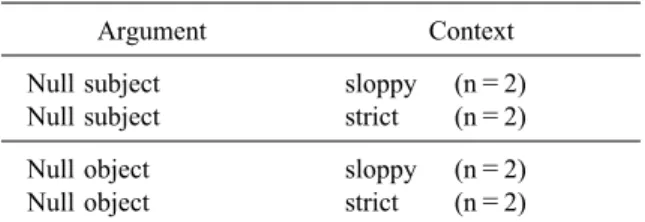
For the main study, the test was conducted to investigate the availability of sloppy and strict readings with null arguments in L3 grammar, in which there were 52 stimuli, with 28 sentence types. The relevant sentence types to the current study, including sloppy and strict readings, involve two tokens each. Table 2 summarizes the eight stimuli, including the four sentence types. For the purposes of the current study, we only report the relevant data.
Each stimulus consisted of a dialogue among animals or people, along with their photos. These images were flashed onto a screen while the participants listened to the corresponding audio. The dialogues were given in Japanese to ensure that the participants fully understood each context/situation. The L3 learners were told that two students (male and female) are studying German. However, they are not yet proficient in German and sometimes make mistakes. The L3 learners were required to judge whether the uttered German test sentences from the two students correctly described the situations of given dialogues, by encircling “Correct” or “Incorrect.” Examples of the test items are illustrated in (10) and (11). The dialogue is translated into English for convenience.
Table 2 TVJT sentence types
Argument Context Null subject Null subject sloppy strict (n=2) (n=2) Null object Null object sloppy strict (n=2) (n=2) Kazumi YAMADA 112
(10) Null object sloppy context
Test sentence:
“Der Bär hat sein eigenes Auto gesäubert.
the.Masc.Nom.Sg bear has his own car cleaned
Und der penguin hat auch gesäubert.”
and the.Masc.Nom penguin has also cleaned
‘(lit.) Bear wiped his own car, and Penguin wiped [ e ], as well.’
correct / false (11) Null object strict context
Test Sentence:
“Der Bär hat sein eigenes Auto gesäubert.
the.Masc.Nom.Sg bear has his own car cleaned
Und der penguin hat auch gesäubert.”
and the.Masc.Nom penguin has also cleaned
‘(lit.) Bear wiped his own car, and Penguin wiped [ e ], as well.’
correct / false The test sentences were recorded by two L1 German speakers. For the learners, we created two versions of the test (version 1 and 2) with the same stimuli being distributed differently on each test. To avoid any order effect, half of each group
3. I should clean the car, too.
4. Now, it is very clean.
1. Bear:
Let´s clean the car. Penguin:
I will help you.
2. Bear:
Now, it is really clean. Thank you very much. Penguin: You´re welcome.” 1. My car is very dirty. I should clean it.
2. It’s very clean now.
took version 1, and the other half took version 2. The L3 learners were instructed not to skip any questions and not change their answers to previous items. Before starting the experiment, the learners were given a practice session wherein, together with the researcher, they worked through how to do the TVJT. They were also given a list of vocabulary with definition in case any of the vocabulary was unfamiliar.
4.3.2 The screening task
The screening task was conducted to identify subjects who allow null arguments in their L3. The test consisted of nine stimuli: four null subjects, two null objects, and three indirect null objects. The test items are exemplified in (12) to (14).
(12) Null subject
Als Taroo eine Frau sah, die rote Kleidung trug, dachte, dass Sam´s ältere Schwester wäre.
“When Taro saw a woman in a red cloth, (he) thought the woman is Sam’s elder sister.”
normal oder akzeptabel / unnatürlich oder nicht akzeptabel (13) Null object
Taroo hat den Computer kaputt gemacht, aber sein Vater reparierte “Taro broke a computer, but his father fix (it).”
normal oder akzeptabel / unnatürlich oder nicht akzeptabel (14) Indirect null object
Taroo’s Zimmer ist sehr schmutzig. Ich werde säubern. “Taroo’s room is very dirty. I will clean.”
normal oder akzeptabel / unnatürlich oder nicht akzeptabel The subjects were also asked to correct the sentence if they found it unacceptable. Responses were not explicitly timed, but participants were instructed to respond quickly and not to go back to previous questions.
4.4 Results
4.4.1 The screening task
The data from the screening task were analyzed to examine to what extent those participants permitted null arguments in their L3. A benchmark was set in this task: when participants allowed a null argument at least once in each position of
Kazumi YAMADA
subject and object, we assumed that they accepted null arguments. As Table 3 shows, all but one leaner permitted a null argument in either subject or object positions.
4.4.2 TVJT
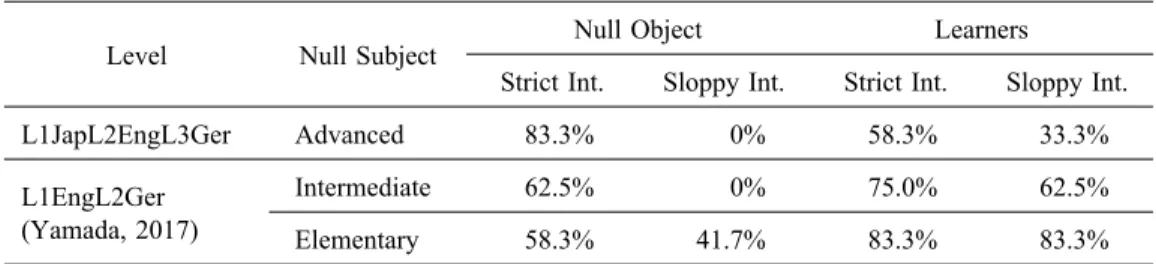
The participant results are compared with that of the L2 German learners whose L1 is English tested in Yamada (2017). Table 4 summarizes the results of our L1 Japanese-L2 English-L3 German participants.
Our TVJT results indicated that the advanced L3 German learners stopped accepting sloppy reading with null subjects. Their acceptance rate was 0% of the time. On the other hand, they permitted the sloppy reading with null objects 33.3% of the time, suggesting that null objects are not pro. As Table 4 shows, the L3 German group and the intermediate L2 German group showed a very similar developmental pattern, particularly with null subjects.
5. Discussion
The results of the L3 German learners can support our Hypothesis 3 and 4 as repeated below.
Table 3 Breakdown of the L3 group patterns
Null Sub. 㾎 Null Obj. 㾎 Null Sub. 㾎 Null Obj. × Null Sub. × Null Obj. 㾎 Null Sub. × Null Obj. × Advanced (n=6) 1 2 2 1 㾎=accepted, ×=rejected
Table 4 Participants’ acceptance rate- null subject and null object items judged appropriate on the TVJT
Level Null Subject Null Object Learners Strict Int. Sloppy Int. Strict Int. Sloppy Int. L1JapL2EngL3Ger Advanced 83.3% 0% 58.3% 33.3% L1EngL2Ger
(Yamada, 2017)
Intermediate 62.5% 0% 75.0% 62.5% Elementary 58.3% 41.7% 83.3% 83.3% Jap=Japanese, Eng=English, Ger=German
(15) L2 transfer
H3: If null arguments are available in their L3, the German learners will reject the sloppy reading with null arguments in subject position because the null arguments are pro due to the possible insertion of D-feature. H4: They allow the strict reading with null subjects.
Regarding null objects, both sloppy and strict readings are permitted by the L3 learners. We assume that the status of null objects is not AE, but VTD while that of null subjects is pro in their L3 German grammar.
If the learners’ L3 was based on L2 English, we could predict the parallel developmental stages between the L3 German learners in the current study and the L2 German learners in Yamada (2017). Indeed, a similarity of the pattern was observed in interpretation of null subjects. Both learner groups categorically rejected the sloppy reading with null subjects while they accepted the strict reading about 60 to 80% of the time. Thus, the L2A findings in Yamada (2017) was replicated in the L3A.
Our advanced L3 German data indicates that there was no L1 transfer observed. The L3 German learners added D-feature to T in their L3 German, though German is not a pro-drop language. Thus, the results show that L2 plays a role but it is not that L2 facilitate L3A. The learners built their own L3 grammar which is different from that of German native speakers in that the learners added D-feature to T. The L3 German learners would need more input to acquire VTD to know null arguments can have the sloppy interpretation.
6. Concluding remarks
The current paper reports on experimental data showing that the sloppy interpretation with null subjects is not available to the L3 German grammar at the advanced level. Our results were compared to the data from English speakers with L2 German in Yamada (2017). We found that the developmental process of their L3A and L2A were alike. The advanced L3 German grammar of L1 Japanese-L2 English learners is based on their L2. However, it is clear that L2 does not enhance L3A in that pro is not available in German. Therefore, the data in the current study show that the cumulative-enhancement model (Flynn, Foley, & Vinnitskaya, 2004) receives partial support as the model proposes that languages already acquired can be neutral or enhance L3A. Further studies are needed in order to examine whether L1 has any influence on L3A, by observing how less proficiency L3 German learners interpret null arguments, which will give us a good testing ground for
Kazumi YAMADA
predictions about the initial state of L3A.
References
Bardel, C. & Falk, Y. (2007) The role of the second language in third language acquisition: The case of Germanic syntax. Second language research, 23, 459-484.
Cardinaletti, A., & Starke, M. (1999). The typology of structural deficiency: A case study of the three classes of pronouns. In H. van Riemsdijk (ed.), Clitics in the languages of Europe (pp.145-235). Berlin: Mouton de Gruyter.
Falk, Y. and C. Bardel (2011) Object pronouns in German L3 syntax: Evidence for the L2 status factor. Second language research, 27, 59-82.
Flynn, S., Foley, C., & Vinnitskaya, I. (2004) The cumulative-enhancement model for language acquisition. Comparing adults’ and children’s patterns of development in first, second and third language acquisition. International journal of multilingualism, 1, 3-17.
Hermas, A. (2010) Language acquisition as computational resetting: Verb movement in L3 initial state. International journal of multilingualism, 7, 343-362.
Na Ranong, S., & Leung, Y-K I. (2009) Null objects in L1 Thai-L2 English-L3 Chinese: An empirical take on a theoretical problem. In Y-K. I. Leung (ed.), Third language acquisition
and universal grammar (pp.162-191). Bristol, UK: Multilingual Matters.
Oku, S. (1998). LF copy analysis of Japanese null arguments. Proceedings of CLS, 34, 299-314. Roberts, I. (2007) Diachronic syntax. Oxford: Oxford University Press.
Rothman, J. (2010) On the typological economy of syntactic transfer: Word order and relative clause attachment preference in L3 Brazilian Portuguese. International review of applied
linguistics, 48, 245-274.
Rothman, J. (2011) L3 syntactic transfer selectivity and typological determinacy: The Typological Primacy Model. Second language research, 27, 107-127.
Rothman, J. (2013) Cognitive economy, non-redundancy and typological primacy in L3 acquisition: Initial stages of L3 Romance and beyond. In S. Baauw, F. Drijkoningen, L. Meroni and M. Pinto (eds.) Romance languages and linguistic theory 2011. Selected papers
from ‘Going Romance’Utrecht 2011 (pp.217-247). Amsterdam/Philadelphia: John
Benjamins.
Rothman, J. (2015) Linguistic and cognitive motivations for the Typological Primacy Model (TPM) of third language (L3) transfer: Timing of acquisition and proficiency considered.
Bilingualism: Language and cognition, 18, 1-12.
Sigurðsson, H. (1993). Argument-drop in Old Icelandic, Lingua, 89, 247-280.
Slabakova R (2017) The scalpel model of third language acquisition. International Journal of
Bilingualism 21(6): 651-666.
Takahashi, D. (2019). Derivational Argument Ellipsis. The Linguistic Review Trutkowski, E. (2016). Topic drop and null subjects in German. Berlin: de Gruyter.
Westergaard, M., Mitrofanova, N., Mykhaylyk, R. & Rodina,Y. (2016). Crosslinguistic influence in the acquisition of a third language: The Linguistic Proximity Model. International
Journal of Bilingualism, Volume: 21(6), 666-682.
Yamada, K. (2017) Interpretation of Null Arguments by English Speakers of L2 German.
Kwansei Gakuin University Humanities Review 22: 197-207.
Kazumi YAMADA