水分存在下におけるオキシ水酸化鉄の変化
7-FeOOH (lepidocrocite)
片 岡 一 郎 ● 中 城 秀 水
(農学部応用分析化学研究室)
The Change of Ferric Oxyhydroxide in thePresence
of Moisture
一一7-FeOOH
(lepidocrocite) - . Ichiro Kataoka and Hidemi Nakashiro
Laboratoりof Applied Analytical ChemisU・y, Faculty of Agriculture
Abstract : Ferric oxides (α,γ)andoxyhydroxides (a,β,r) can be considered to be a reflector of the environment in the formation of weathering products or soils. For examples, the soilsin the internal part of the European Continent are classifiedby the color of surface soil which is due to the influence of plant growth but the soilsin the climatic zone of monsoon by the color of subsoil which is due to iron compounds as coloring agents・
Red soils are found in the higher temperature districtssuch as Southeastern Asia and the South Sea Islands but brown or chestnut soils in the higher temperature districtsin the internal part of the Continent. Therefore, it seems that not only higher temperature but also the repetition of
wetting and drying are necessary for the formation of red soils.
It has been pointed out that red soilsin Japan would be formed in the Diluvial-Inter-glacialpe・ riodS.1・ 2・3)Thedata in the previous papef" demonstrated that a-Fe2O3 and a-FeOOH were found in the red soils on Hazeyama coastal terraCe9μo)formedin the Diluvial-Inter-glacialperiods and
a-Fe2O3 was dominant in the soil 0n the older higher terrace than the middle.
Ferric oxyhydroxides transfer to a-Fe2O3 in an electric oven (dried conditions) at a temperature higher than about 300°Cas shown in Fig. 1。
a-Fe2O3 ノ ノ言 謡 レ β-FeOOH a-FeOOH へ ,-FeOOH (akaganate) (goethite) (lepidocrocite)
Fig. 1 Transformation from ferricoχyhydroxides to a-Fe2O3.
In the labolatory, it is impossible to pursue the phenomena such as the solution of iron from rocks, precipitation, aging and crystallizationon the same conditions as the natural environments, because such experiments require extremely longer times. Therefore, in this experiment, 90 0「 100°C was chosen as one of the medium temperature between a high temperature in an electric oven and an ordinary temperature on natural conditions and also an out-door experiment was made in contrast to the medium temperature・
This time, ^■-ferricoxyhydroxide synthesized from ferrous chloride solution was chosen as the sample for aging but in synthesis, pure r-ferric oxyhydroxide could not be obtained (a form was mixed).
Aging of the sample was made on the following conditions.
1) Repetition of wetting and drying (or grinding) (90°C, out・door temperature). 2) Always stagnant or dried condition(90°C)
2 高知大学学術研究報告 第25巻 自然科学 第1号
4) Addition of sa】t.
The period of the experiments wase 19months.
The aging products were examined by x-ray dぼraction, magnetic susceptibilityand supplementally by infrared absorption spectrum, crystal】ite-sizespecific surface area, apparent density, color and electron・microscope photography.
The results obtained were as follows : 卜
1)Dぼering from the conditions of the higher temperature and dryness in an electric furnace, the phenomenon of disappearance of γ.FeOOHand the formation of o-FeOOH was found by the repetition of wetting and drying at 90°C.Addition of K2CO3 promoted this phenomenon.
2) Standing at 90°Con the stagnant condition for 19months promoted most sufficientlythe phenomenon above mentioned. (lnnatural environment, the tempera皿re of water under a stagnant condition is lowere, so the repetition of wetting and dryng is‘more important. )
3) The repetition of wetting and drying at an outdoor temperature showed the small effect for aging owing to the lowere temperature but the tendency of disappearance of 7 form and the formation of αform were found. ’ゝ
4) Further experiments were required for the effects of salt and pH.
5) This time, the mixture of ;■and a ferric oxyhydrり)xide was used as a starting sample and as the result, the phenomenon of disappearance of ;・form and the formation of a form was found. The relation between the use of pure γform and the formation of a form should be examined next.
緒 言’
酸化第二鉄(≪,
r)およびオキシ水酸化鉄(α,β,γ)は風化産物や土壌の生成環境の反映者と
考えられる。たとえば,ヨーロッパ大陸内部の土壌は植物生育の影響の大きい表土の色で分類され
るが,貿易風気候帯の土壌は着色剤たる鉄化合物による下層ニヒの’色で分類される。
赤色土は東南アジアや南洋諸島のような高温地方にみられるのに対し,大陸内部の高温地方では
褐色土や栗色土がみられる。それ故,高温のみならず,乾湿のくりかえしが赤色土生成の条件とし
て必要ではないかと推定される。 ゲ
Fig. 1は,乾燥,高温(約300°C以上)の電気炉中でのオキシ水酸化鉄の≪-Fe2O3への変化を
示したものである。
β-ぷこ乱
/卜
r-Fe2O3
1
(maghemite)
a-FeOOH ノ
ヘ
i-FeOOH
(akaganafe) (goethite) (lepidocrocite) F4. χ Tran寸ormationfrom∫erricoaciplivdr‘oこridesto o-Pe'j03 しかし,自然条件は,このような乾燥高温ではなく,乾湿のくりかえしや共存物質の影響をうけ る。酸化鉄,オキシ水酸化鉄を通じて最も赤味の強いものは≪-Fe2O3であり,亜熱帯の貿易風気候 帯下の赤色土には,α-Fe203が多く含まれていると考えられている。日本の古赤色±1-S)は洪積世 の間氷期(暖期)の生成によるものとされ,筆者4’も,洪積世の間氷期に形成されたとされる高知 県東部の岬山(ハゼヤマ)海岸段丘9・lo’の高位および中位段丘の赤色土について,両者ともに鉄の 形態はα-FeOOHおよびα-Fe2O3であり,生成時期の=より古い高位の方が,中位段丘形成時に も風化をうけて,一層赤味が強く, ≪-Fe2O3か優勢であることを報告した。 これらの鉄は母材で ある砂岩,頁岩巾に一次鉱物としてあったものではなく,風化過程で生じたものと考えられる。火水分存在下におけるオキシ水酸化鉄の変化(片岡・中城) ろ 成的な原因の鉄鉱床は別として,赤色土の鉄は,主として2価の鉄として岩石中にあったものか風 化して変化したものと考えられる。 自然環境下での岩石中の鉄の溶出,沈殿,老化,結晶化などの変化を実験室で追跡するには,極 めて長時間を要し,不可能である。 したがって,本研究では,自然環境としての室外放置のほか に,乾燥,高温の電気炉内での条件と,自然環境の条件との中間として,中間温度(90°C, 100°C) をえらび,水分の存在,乾湿のくりかえし,塩類共存の条件をえらび,実験材料としては,今回
は,まず, T'-FeOOH (lepidocrocite)の変化を検討するために, Fe (E)の鉄塩溶液から,これ を合成し,上記条件での変化を2ヶ年間にわたり追跡した結果,水分存在下の中間温度では,乾 燥,高温の条件と異り,γ-FeOOHがα-FeOOHへと変化することを知ったので,その概要を報 告する。
X線回折
回折装置
回折条件
磁化率
実 験 装 置
島津製作所製自記X線回折装置(VD−1型)使用。
既報5’のとおり。
島津製作所製磁気天秤使用゛J。
赤外線吸収スペクトル
島津製作所製自記赤外分光光度計(I
R27G)使用,
KBr法で測定。
結晶子粒度
X線回折を利用して求める単結晶の大きさ7・8)を上記回折装置を使用し,既報5’と同じ条件で測
定。使用した標準物質の回折線および半値巾は,つぎのとおりである。
標 準 物 質
¬一一
CaSO4・2H2O一一 回折線,∂(皮) 半値巾(×10-3)ラジアン 25.9 3.6 18.0 3.1 石 英 べ 17.0 3.7 13.2 3.9 14.9 4.1 5 6 一 ・ 7 4比表面積
柴田化学機械工業製迅速表而積測定装世(S
A − 1000)使用。脱気試料に,低温でN2を吸着さ
せ, B ETの多分子層吸着式により,試料の比表面積を算出した。
みかけの比重
一定容の容器に,試料を,土壌の容積重測定の場合の密状態に相当するように,密につめ,
〔g/c. c〕を求め,粒子凝集度変化のある程度の目安にした。
色
Munsell記法による6)。
電子顕微鏡写真
日立製作所製電子顕微鏡(HS−7S)使用。
SYNTHESIZED SAMPLES 、T0、200 ml of 6 N-HCl was added 40 g of powdered iron. The mixed solution was shaken for 30 min. and filtered. The filtrate (100 ml) was aerated for &hr after 100 m1 0f
4 高知大学学術研究報告 第25巻 自然科学 第1号
water and αml of pyridine had been added. The coagulum (ferric oxyhydroxide) was filtered, washed with water and acetone successively and dried in air11).
Sample l a = 70 ml,み=100 hr Sample 2 α=70 ml, b= 50 hr Sampleろ a=50 ml,み=100 hr
The x-ray diffraction lines of Sample l, 2 a゛nd..ろsynthesized were (L十G) mixture as shown in Table 1. Table 1. X-ray dijfractionlinesof sampless:ynthejtzed
r-FeOOH a-FeOOH
dh) d浅)
6.27 VS(100) 28SIV 2.47 vs 4.18 VS(100) 2.69 M 2.45 SSample 1 Sample 2 Sample 3
L十G -vs (100)
S MSM
S L十GL:r-FeOOH
(lepidocrocite) G:a-FeOOH・(goethite)
L十G -vs (100) M vs W vs EχPERIMENTS
Exp. 1 Repetition of Wetting (W) and Drying (D) at 90°C
No. 1 (WDG) G: Grinding
Sample 1(10 g) was placed in a flat-bottomed evaporating dish (8 cm in diameter), 15 ml of water was added to the sample and the moistened sample was dried for about 4 hr. at 90°C in a thermostat. After drying, the Samp】e was allowed to cool for 45 min. in a desiccator and was grinded lightly in a mortar. Water (15 ml) was added to the sample in the dish and the sample was dried again as mentioned above. Since the particle of the sample became gradually smaller as a result of the repetition of W-D-G, the amount of water to be added to the dried sample was soon decreased `t0 10 ml and t0 5ml near the end of the experiment. Drying of sample, to which 5 ml 0f water was added, took about 2 hr. at 90°C. In N0. 1 (WDG), the repetitions of W-D-G were 208 times.
No. 2 (WD)
Sampleろwas used for aging. In N0. 2 (WD), the treatment of grinding was omitted. Sampleろ(10 g) was taken in a flat-bottomed evaporating dish. The amount of water to be added to the dried sample was 25 ml at the beginning of the W-D repetition and 20 ml from 35 rounds to the end. The standing hours of the moistened sample in a thermostat (90°C) ware 6 hr. in every repetition. The repetitions of W-D were 9・8 times.
NO.ろ(K2CO3, WDG)
Water under a weathering environment contains H2CO3 and it combines to form the salts with alka】ior alkaline earth metals which dissolved from rocks in weathering. Such salts are
水分存在下におけるオキシ水酸化鉄の変化(片岡・中城) 5
-consideredt o be related in aging of iron-containing weathering products.
In No. ろ(K2CO3, WDG), K2CO3 which gives the solution an alkaline reaction by hydrolysis was chosen as the salt to be added at the beginning of the W-D-G repetition.
Sample l (10 g) was taken in a flat-bottomed evaporating dish (8 cm in diameter) and 15 ml of 1N-K2CO3 solution was added to the sample. The moistened sample was dried at 90°C, allowed to cool in a desiccator and was used as the starting sample of N0. 5 (K2CO3, WDG). To the starting sample was added 1 5 ml of water, the moistened sample was dried for 6 hr. at 90°C,allowed to cool for 45 min. in a desiccator and was grinded lightly in a mortar. Thus, the repetition of W-D-G was made. The amount of water to be added to the dried sample was decreased t0 10 ml from 50 rounds (the standing hours of the moistened sample in a thermostat (90°C) were 4 hr.) and t0 5 ml from 85 round to the end (standing hours, 2 hr.). The repetitions of W-D-G were 126 times.
No. 4 (K2CO3, WD)
・ In N0. 4 (K2CO3, WD), the treatment of grinding was omitted. Sampleろ(10・g), to which 15 ml of 1N二K2CO3 solution was added and dried at 90°C,was allowed to cool in a desiccator used as the starting sample of No. 4 (K2CO3, WD)。
To the starting sample was added 25 m1 0f water. The moistened sample was dried for 6 hr. at 900Cand was allowed to cool for 45 min. in a desiccator. Thus, the repetition of W-D was made. The amount of water to be added to the dried sample was decreased t0 20 ml from 27 rounds (the standing hours in a thermostat were 6 hr. ) and t0 15 ml from 62 rounds tot he end (standing hour, 4 hr.). The repetitions of W-D were 103 times.
No.
5 (W)
always stagnant condition.
Sample l (5 g) was taken in a weighing bottle,water was added to the sample sufficiently
and the sample under
the stagnant condition was allowed to stand for 19months
at 90°C,
used as a comparative sample
for the repetition experiment
of W-D.
N0. 6 (D)
always dry conditon
Sample l was allowed to stand for 19
months
at 90°Cand used as a comparative sample
for the repetitioneχperiment of W-D.
Exp.
2 Repetition of Wetting (W)
and Dryirg
(D) at Out-door .
The
temperature near the samp】ewas from 6 t0 54°C during the whole period of this
ex-periment.
No. 11 (WDG)
Sample l (10 g) was taken in a flat-bottomed evaporating dish (8 cm in diameter), 15 ml of water added to the sample, dried at out-door, allowed to stand for 45 min. in a desiccator and grinded lightly in a mortar. Thus, the repetition of W-D-G was made. The amount of water to be added to the dried sample was decreased t0 10 ml from 17 rounds to the end, because the particle of the sample became gradually smaller as a result of the repetition of W-D-G. The standing hours of the moistened sample at out-door were 24 hr. in every
6 高知大学学術研究報告 第25巻 .自然科学 ,第1号
repetition. The repetition of W-D-G were 58 times.
No. 12 (K2CO3, WDG)
Sample l (10 g), to which 15 m1 0f 1 N-K2CO3 solution was added in a flat-bottomed evaporating dish, dried for 24 hr. at out-door, was used aS・ the starting sample of No. 12 (K2CO3, WDG).
To the starting sample was added 15 ml of water, the moistened sample was dried at out-door. Thus, the repetition of W-D-G was made. The amount of water to be added to the dried sample was decreased t0 10 ml from 36 rour!ds to the end. The standing hours at out-door were 24 hr. in every repetition. The repetitions of W-D-G were 6 1 times.
Exp.ろPeriodic Heating N0. 21 (D, 3 o 90)
ample l (5 g) was taken in a weighing bottle, allowed to stand for 30 min. in a thermostat (90°C), for 30 min. at room temperature, for 30 min. in a refrigerator (3°C), for 30 min. at room temperature and for 30 min. in a thermostat (90°C) again. Thus, the periodic heating of Sample l from 3 t0 90°C was repeated 157 times. ,
Exp。4 Agring of Sample in Salt Solnti。n (90, 100°C)
Sample 2 0r ろ(2 g) was taken in a 50-ml Erlenmeyer flask, 50 m1 0f the salt solution mentioned below added to the sample, the flask stoppered lightly with a cork and the aging experiments were made for 1,3, 10 0r 30 hr. As salts, K2CO3 which gives the solution an alkaline reaction by hydrolysis, KCl (neutral sait) anc!NH4C1 which gives the solution an acidic reaction by hydrolysis were chosen. The contents of the experiment are shown in
the following table.
Exp. No. No. 31 (90°C, K2CO3) No. 32 (100°C, K2CO3) No. 33 (90°C, KCl) No. 34 (100°C, KCl) No. 35 (90°C,NH4C1) No. 36 (100°C, NH4CI) Sample used Sample 2 Sample 3 Sample 2 Sample・3 Sample 2 Sample 3 Salt -4N-KjCOs 4 N-KiGOj 4N-KCl 4 N-KCI 4 N-NHiCl 4 N-NH4C1 Temperature (゜C) 0 0 9 0 − 9 0 1 0 0 9 0 1 0 0
The
aging conditions of samples in the experiments from Exp. l to Exp. 4 are shown in
table 2.
水分存在下におけるオキシ水酸化鉄の変化(片岡・中城) Table l、 The aging conditions of samples 7 Experiment Exp. 1 Number Starting sample Aging 六 temperature repetition 9 0 9 0 9 0 0 0 0 9 9 9 out-door out-door treatment -W-D-G W-D W-D-G W-D W D
似紗
O O O O v O C O 0 9 C < 1 O 2 1 1 (19 months) (19months) 8 1 5 6 Exp. 2 -Exp. 3 W-D-G W-D-G - D (157) Exp. 4 No. 1 (WDG) Sample! N0.2(WD) Sample 3 No. 3 (K2CO3万, WDG) Sample 1十KzCOs No. 4 (K2CO3万, WD) Sample 3十K2CO3 No. 5 (W) Sample 1 No. 6 (D) Sample 1 No. 11 (WDG) Sample 1 No. 12 (K2CO3, WDG) Sample 1十KzCOs No. 21 (D, 3-^>万90) Sample 1 No. 31 (90°C, K2CO3) Sample 2十K2CO3 No. 32 (100°:C, K2CO3万) Sample 3十K2万C03 No. 33 (90°C, KGl) Sample 21十KCl No. 34 (100°C, KCl) Sample 3十KCl No. 35 (90°C, NH4CI) Sample 21十NH4C1 No. 36 ClOO°C, NH<C1) Sample 3十NH4C134→90 - 90 100 90 100 90 100 χFFLII、J WWWWWW 1, 3, 1 or 30 hr j O ・
結果および考察
以下の説明で,L line はr-FeOOH (L), Glineはα-FeOOH(G)の回折線を示す。 〔1〕湿潤(W)および乾燥(D)のくりかえし(90°C)一一- Exp。1の結果 Table 3 はNo.ろ(K2C03,WDG)におけるX線回折線の相対強度の変化を示したものである。 Table 3The changeofrelatiで>eintensitieso/x・raydiffractiontiれes・ in No. 3 (K2CO3, WDG)
d(Å)
大-−`\
L line Gline
Repetition
of wettingand drying (times)
0 34 70 95 126 6.27 4.18 3.28 2.69 2.47 2.45 vs (100) ’S M S M S S vs (100) M M − vs M vs (100) − vs vs vs − vs (100) − vs − S − vs (100) − M − vs
L: r-FeOOH【】epidocrocite) G:o-FeOOH
(goe竃hite)
Table 3 の示すように,
L lineの強度は,W-Dのくりかえし回数が増すとともに減少し,くり
かえしの95回で,L line は消失し, G lineの強度が,出発試料と比べると増加した。
8 高知大学学術研究報告 第25巻 自然科学 第1号
Tab\e 4. The change of relative intensities 0/ χ.rりdiffraction lines in N0. 1(WDG) d(Å) 一一 L line Gline -6.27 4.18 3.28 2.69 2.47 2.45 3 S00VG M M S S
Repetition of wetting and drying (times)
vs S vs vs (100) S -S S vs (100)
L:;--FeOOH (lepidocrocite) G:≪-FeOOH (goethite)
vs S vs S vs j S00 VG 148 vs vs vs S M -208 り S00 VG M vs
Table
4 の示すように,L line の強度はW-Dのくりかえし回数が増すとともに,段々と減少
し. G lineの強度は増加したが,L
line が, No.ろ(K2CO3,
WDG)の場合のように消失すこと
はなかった。 これらの結果は,
W-Dのくりかえしでの,α-FeOOH(G)の生成にともなうr-FeOOH(L)の消失か,K2CO.1の存在よって,大き・く,影響をうけたことを示す。
Table 5 はNo.
4 (K2CO3,
WD)の回折線強度の変化を示したものである。
Table 5. 函No. 6.27 3.28 2.47 The change of reiatiでje intensities oヂ又.ra:y diffraction lines 4(K2C03,WD) 4.18 2.69 2.45 vs (100) vs vs M W
L:r-FeOOH
(lepidocrocite) G:a-FeOOH
(goetliite)
vs (100) M S S W S
N0.
4 (KaCOs,
WD)は,
grindingの処理を省略したものであるが,やはり,
a-FeOOH
(G)
の生成にともなうL
line の弱化を示した。 No. ろ(K2CO3,
WDG)とNo.
4 (K2CO3,
WD)を
比べると, grindingの効果もみのがしえない。
Table
6 はNo.
2 (WD)の回折線強度の変化を示したものである。
No.
2 (WD)とNo.
4 (K.iCO3, WD)およびNo.
1 (WDG)を比べると,湿潤,乾燥のくり
かえしのもとでのr-FeOOHの消失-α-FeOOHの生成はK2CO3の存在,
grindingによって
影響されることがわかる。
Table 7 はW-D処理の比較としてのNo.
5 (W)
―一常時湛水,90°C.
19ヶ月,およびN0.
水分存在下におけるオキシ水酸化鉄の変化(片岡・中城).
Table 6、Tiie change of relatit、eintensities of χ・ray diffraction lines in No. 2 (WD)
L:r-FeOOH【】epidocrocite) G:ff-FeOOH (goethite)
Table 7、The change of relative intensities of χ-ray diffraction tines みz N0. 5 (W) and No. 6 (D) d(Å) ヴ L line G line 6.27 3.28 2.47 4.18 2.69 2.45 N0.5(W) starting sample Sample 1 vs (100) S M S M S after 19 months (90°C) − 3S100 M S Vぐ No. 6 (D) after 19 months (90°C) vs (100)
vs
vs
S W S 9 Table 7 の結果によれば,90°Cで,19ヶ月間,常時湛水にすれば,これまでに記した何れの場 合よりも,そめ影響が大きく, r-FeOOHが完全に消失するとともにα-FeOOHが生成している。 なお,乾燥,0°C, 19ヶ月では明らかな結果はみられない。 〔2〕戸外放置(Exp. 2の結果)Table 8. The changeofrelativeintensities”/x・raydiffractionlines
in No.
12 (K2CO3,
WDG)
d(Å) 一一
L line G line・
Repetition
of wettingand drying (times)
0 26 44 61 6.27 4.18 3.28 2.69 2.47 2.45 vs (100) S M S M S S S V S M vs (100) − V S vs V S M vs vs (100) V S vs (100) S M vs V S
10 。高知大学学術研究報告 第25隻__自即陛発‥_第1号
戸外での乾湿くりかえし実験の結果のうち>
sample l に K2C03を加えて湿潤,乾燥,すりつ
ぶしをくりかえしたNo.
12 (K2CO3,
WDG)の結果をTable
8 に示す。
Table
8 のNo.
12 iKiCOz,
WDG)の結果によれば,α-FeOOHの回折線強度の若干の増大
はみられるが,
r-FeOOHについては明らかな変化がみられな。い。
Table
9 には. K2CO3無添加の・No.
11 (WDG)の場合を示したが,
No. 12 (K2CO3,
WDG)
と同じ傾向を示し,戸外での乾湿くりかえしは,
r-FeOOHと。a-FeOOHの消長についての若干
の傾向を示しているようであるが,90°Cでの実験に比べると,その変化かおそいようで,もっと
長期のくりかえし実験を要するものと考えられる。 `j
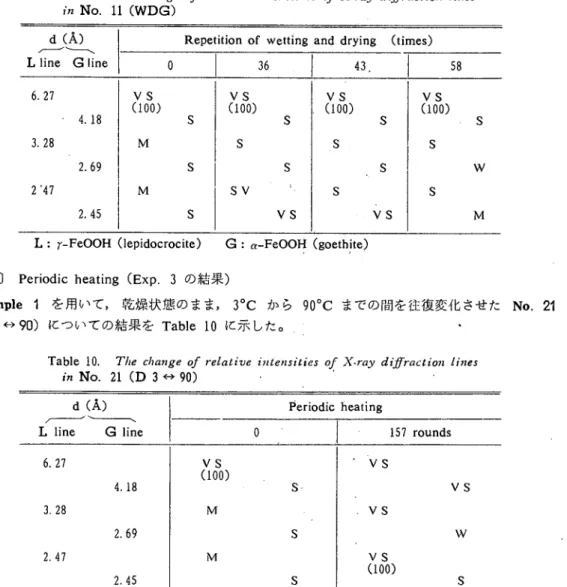
Table 9.
in No.
d(Å) − L line Gline 6.27 3.28 2°47 4.18 2.69 2.45The ‘change 0/ 7・elati-oeintc。stties of χ-rりdiffract!・on lines 11 (WDG) vs (100) M M 0
Repetition of wetting and drying (times? 1 36 1 43 1 S S S vs (100) S S V S S vs 3 S 10 0 S Vぐ S S vs vs (100) S S 58 S W M
L:r-FeOOH【】epidocrocite) G:a-FeOOH
(goethite)
〔3〕Periodic heating (Exp.
3の結果)
Sample l を用いて,乾燥状態のまま,3°Cから90°Cまでの間を往復変化させたNo.
21
(D 5 <->90)についての結果をTable
10 に示した。 ・
Table 10. 加No.
The changeof relativetHtensities of x・ray dijfraction ii?ies
21(D3e90) ’
d(Å) 犬’→
L line G line
Periodic heating
L:r-FeOOH
(lepidocrocite) G: a-FeOOH
(goethite)
No. 21 (D5←・90)は,ほとんど変化を示していない。
Table 11 は. Exp.
1およびExp.
2の各試料の磁化率の経時変化を示したものである。
水分存在下におけるオキシ水酸化鉄の変化(片岡・中城)
Tab\e U. The change of magnetic susceptibiliりof samples under aging treatments 竹 Magnetic susceptibility (emu g-1) January 1976
No. 1 (WDG)
No. 3 (K2CO3,
WDG)
No.
11 (WDG)
No.
12 (K2CO3,
WDG)
N0.2(WD)
No,
4 (K2CO%, wD)
No.
5 (W)
No.
6 (D)
June 1974 (beginning) -4.27×10⁻⁴ 4.27×10⁻⁴ 4.27×lo-" 4.27×10“4 2.19×lo-" 2.19×10-' 4.27×10⁻⁴ 4.27×10 ̄4 Aging stage -October 1974 -2.72×10`4 3.25×10⁻⁴ 3.99×10 ̄4 3.67×10⁻⁴ 2.65×10-* 3.15×10⁻⁴ 3.75×lo-" 3.47×10⁻⁴ 1.84×io-≪ 1.80×10⁻⁴ 4.33×10⁻⁵ 4.19×10⁻⁴から433×10-5というように約音に低下している。No.
5 (W)は90°C,常時湛水下K:長期放
置したものであり,トFeOOHの消失とα-FeOOHの生成という一連の変化が最も明らかであっ
た試料であって,常磁性のγ-FeOOHがこわれて,反磁性のα-FeOOHの生成へと進んだことを
示している。他の試料においても,いずれも,磁化率が減少し,
r-FeOOHの消失−−−α-FeOOH
の生成の変化を物語っている。これらの結果は,X線回折線の消長とよく一致している。
〔4〕塩類添加,90°C,
100°Cでの老化(Exp.
4の結果)
Sample
2 およびSampleろを用い,
KzCOs,
KCl,
NH4CIを添加して,湛水状態下に,90°C,
100°Cで放置した結果を,
Table 12∼17に示す。
Table 12.Tlie change of relative intensities of x-rav diffraction lines in No. 31 (90°C, K2CO3)
L :
12 高知大学学術研究報告 第25巻`I 自然科学 第1号
Tabχen. The change of relative intensities of χ-rail diffraction lines in N0. 32 (100°C, K2CO3)
L:;--FeOOH【】epidocrocite) G: a-FeOOH (goethite)
Table V4. The change of relative intensities of ・χ,ra:y diffraction lines 171 N0. 33 (90°C, KCl)
L:r-FeOOH (lepidocrocite) G:a-FeC OH (goethite)
Table 15. The chajise of Tclative intensi・バど∫ザχ.ray dijfraction lines in No. 34 (100°C, KCl) I・
d(Å)
犬匹、
L line Gline
Standing hりurs (hr)
0 1 3 10 30 6.27 4.18 3.28 2.69 2.47 2.45 vs (100) M vs W V S − vs (100) S S W V S − vs (100) S vs ‘W V S S − vs (100) − S M vs − vs (100) − S − vs水分存在下におけるオキシ水酸化鉄の変化(片岡・中城)
Table V6. The change of relative i・itensities 0/ χ-ray diffractionlines in No. 35 (90°C, NH4CI)
d(Å) 六 L line Gline 6.27 4; 18 3.28 2.69 2.47 6.27 3.28 2.47 2.45 0 -vs (100) S vs 1 Standing hours S W - j S100 S Vぐ vs W -3 (皿) り S00 VG S vs S W S
L : r-FeOOH
(lepidocrocite) G:α-FeOOH
(goethite)
(Å) '卜
Table 17
加No.
4.18 2.69 2.45 S陶 VG S vs 1 0 S W S . X I ノ S 0 0 V G S 卜vsThe change of relative intensities of X-ra:y diffraction lines 36 (100°C, NH^Cl) Standing hours (hr) vs (100) vs vs M W vs (100) S vs S W S W りS00 VG M vs
L:r-FeOOH
(lepidocrocite) G:ff-FeOOH
(goethite)
Table 15 のNo. 54 (100°C, KCl) Table 17 のNo.ろ6 (100°C, NH4CI) をみている。 -■ -■ -■ ㎜ M vs S M 3 0 ・15 vs M vs (100) vs
は,L line が完全に消失して,α-FeOOHの生成をみ,
においても,ほぽL
lineが消失して,α-FeOOHの生成
Table 18 は塩類添加放置試料の磁化率の経時変化を示したものである。
Table l8. Tfie changeof magnetic suscettibtliりof samplerunder aging
treatments tむith salts Magnetic susceptibility (emu g-l)
Standinghours (hr)
0 1 3 10 30 No. 31 (90°C, K2CO3)* N0, 32 (100°C, K2CO3)** No. 33 (90°C, KCD* N0. 34 (100°C, KCl)** No. 35 (90°'C, NH4CI)* N0, 36 (100°C, NH4CI)** 1.59×10⁻⁴ 2.19×10-41 1.59 X 10-' 2.19×10⁻⁴ 1.59×10⁻⁴ 2.19×10-' 1.66×10⁻⁴ 1.77×10-" 1.65×10-" 2.04×10⁻⁴ 1.64×10⁻⁴ 2.10×lO-" 1.71×10 ̄4 2.06×10⁻⁴ ・ 1.67×10⁻⁴ 1.94×10 ̄4 1.65×10⁻⁴ 1.62×10⁻⁴ 1.73×10⁻⁴ 2.06×10⁻⁴ 1.67×10⁻⁴ 4.91×10⁻⁵ 1.77、×lO-" 4.90×10⁻⁵ 1.71×lo-" 2.03×10⁻⁴ 1.39×10⁻⁴ 4.01×10⁻⁵ 1.64×10⁻⁴ 3.99×10⁻⁵・14 高知大学学術研究報告 第25巻 自然科学 第1号 pHの高い条件はγ-FeOOHの生成に不都合であるとして,加水分解をなしてアルカリ性を呈 するK2CO3の添加を試みた結果, Exp. 1および2では,水のみの場合よりは,K2C03添加の 方が,γ-FeOOHの消失−−α-FeOOH生成の過程が進んだ。 ・ しかし, Exp. 4では,中性付近(KCI添加)あるいは,酸性(NH4C1添加)の方が, K2CO3 添加の場合より,上記の過程か進んだ。これらは,X線回折線の消長からみたものであるが,反磁 性のα-FeOOHの生成にもとずく磁化率の減少として,目立つのは, No. 34 (100°C, KCl)と No. 36 (100°C, NH4CI)である。 r-FeOOHの消失−−α-FeOOHの生成の過程に対してのpHあるいは共存塩類の影響につい ては詳細な検討を要する。 〔5〕その他の事項 赤外線吸収スペクトル,色,比表面積,みかけの比重,結晶子粒度の測定についても,各試料 にまたがり行なったが,特に論ずべきものはみあたらなかった。たとえば> Sample l の出発時の 値は,色:7.5 YR 6/8. 比表面積:37.4m'g-Sみかけの比重(密状態):0.430.結晶子粒度: 1.4×10' (d = 6.27Åについて), 1.5×10' (d = 3.28Åについて), 4.2×10' (d = 2.47Åについ て)などの値を示し,老化処理の進むとともに示した値は,バラツ牛も比較的大きく,X線回折, 磁化率ほどの傾向はつかめなかった。 ‘● * No. 3の最終処理物について,その一部をとり,電子顕微鏡気ランダムに数10視野を写真にと・つてみ るに・数視野の中に, r-FeOOHあるいはそれらしきものか散見されたかぺこのものか, r-FeOOHのいわ ゆる「形骸粒子」であるかどうかは,速断できない。
以上の諸実験からみれば,中間温度,常時湛水という条件は,
r-FeOOHの消失とそれにともな
うa-FeOOHの生成という現象に大きく影響するようである。 しかしながら,自然環境を考える
と,常時湛水は一般に低温である。したがって,序文にのべたように,貿易風気候帯についての老
化を検討するには,乾湿のくりかえしの方が意義があるものと考えら=れる。
なお,本実験では,γ型とα型のmixtureが合成試料としてえられ,やむをえず,これを出発
試料として用いたが,このような条件で,γ型が消失するとともに,α型の生成増加をみたのは,α
型が出発時から共存したためか,共存しなくてもそうなるのかは,純粋試料でさらに検討すべ
きである。 しかし,合成試料は,同じ合成法でも,純品がえられたり,α十r
(FeOOH),
r十β
(FeOOH),α(FeOOH)十a
(Fe2O3)というように,ちょっとした条件の変化で,混合物がえられ
たりする。したがって,自然環境での風化,老化過程では,むしろ本報のような場合が一例として
参考となるのではなかろうか) )
要 約 1)オキシ水酸化鉄の自然環境下での変化を追跡するために,まず,その1つとして, r-FeOOH をえらび,それを合成して出発試料となし,便法として,I自然環境と,乾燥高温の電気炉内温度の 中間温度(90°Cあるいは100°C)をえらび,種々の方法で,一定期間(最高19ヶ月)放置した。 また,参考のため,戸外放置をも行なった。 ‥ 2)これらの実験において, r-FeOOHの消失とそれにともなう α-FeOOHの生成という現象 がみられた。(乾燥高温の電気炉内変化と異る) 3)γ型の消失-α型の生成は,90°Cでの乾湿のくりかえしによっておこるが,予め, KiCOj を添加しておけば,一層早い。 4) 90°C,常時湛水長期放置は全実験中,最も十分に,上記の変化がみられた。(自然環境では,水分存在下におけるオキシ水墜良則雌逃_広岡・虫兆し
15常時湛水状態は一般に低温であり,貿易風気候帯では,乾湿のくりかえしの方が意義があるものと
考えられる)
5)戸外での乾湿のくりかえしは,90°Cの場合よりもおそいが,やはり,γ型の消失-α型の
生成の傾向がいくぶんうかがわれる。
6)塩類の種類,pHなどの関係は,詳細な検討が必要である。
終りに,千葉大学井上勝也,東工試浅田栄一の両先生より,種々有益なご教示を賜り,当学部醗
酵および醸造学研究室の山本晋平先生に電子顕微鏡写真の撮影を願ったので,深甚の謝意を表しま
す。
文 献 1)松井健・加藤芳朗:日本の赤色土壌の生成時期,由決環境に関する二,三の考察,第四紀研究,2, 161-179 (1964) 2)松井 健・加藤芳朗:中国・四国地方およびその周辺における赤色土の産状と生成時期,資源イ報, 64, 31-48 (1963) 3)加藤芳朗:地球科学講座,第11巻,第四紀, p. .196,共立出版,東京(1972) 4)片岡一郎,小野敏:高位・中位段丘赤色土の鉄の形態一一担山台地,高知大学学術研究報告23,農学(2), 1-18 (1974) 5)片岡一郎・香川恭子・北村哲朗:合成酸化鉄およびオキシ水酸化鉄の表面積,結晶子粒度および酸に対す る溶解度,高知大学学術研究報告24,自然科学(8),・1-13(1975) 6)農林省振興局研究部監修,標準土色帖,東京 ,7) Klug, H. P. and Alexander, L. E.,“χ-ray Dぼraction Procedures." p. 491, Wiley. J.. and Sons, New York (1967)
8)浅田栄一,貴家恕夫,大野勝美:基礎分析化学講座24, X線分析, p. 92,共立出版,東京(1968) 9)吉川虎雄・貝塚爽平・太田陽子:地理評, 37, 627-648 (1964) 10)吉川 治・黒田登美雄・満潮博美丿ヨ本地質学会関西支部報, No. 71,西日本支部報, No. 54,合併号 p. 9 (1971) 11)片岡一郎・藤本 弘:土壌遊離酸化鉄研究用基礎試料の作製法(その2),土肥誌, 30= 127-129 (1959)