Abstract
Universities in Japan often require students to give oral presentations across the curriculum. However, despite the fact that universities frequently offer presentation courses, many programs lack coherent coordination. This paper outlines how three teachers at Nanzan University design and teach their English presentation courses. Each teacher provides an overview of the essential elements of their course and the pedagogical justification for their design. Although their individual teaching approaches may differ, there is a large degree of overlap with the ultimate goal of improving students’ practical presentation skills being one of the main shared goals.
1 Introduction
Presentation skills courses at many Japanese universities have become a permanent fixture of their curricula. Increasingly, the popularity and necessity of these courses has been growing. Students realize that they need presentation skills both while they are at university and, perhaps more importantly, when they enter the job market. This paper outlines three teachers’ approaches to teaching presentation skills. Each teacher offers their personal perspectives on how they design their courses. While there are differences between the course designs, it is our view that such diversity is healthy, and indeed should be encouraged and developed further.
English Presentation Courses
2 Background
To better understand the knowledge and presentation skills our students come to university with, it is necessary to briefly examine the state of English education in Japan ― both from a historical point of view, and from a current perspective.
2.1 A brief historical overview of presentation teaching in Japan
When discussing presentation teaching in Japan it is important to first consider distinctions between ‘typical’ Japanese rhetorical styles and ‘Western’ rhetorical styles. Okabe (1983) stresses that there are some important distinctions that are worth keeping in mind when comparing the two styles. While his work did not specifically deal with presentation rhetoric, his points have important ramifications for Western educators teaching English presentation classes at Japanese universities. Generally, Japanese rhetoric tends to stress form over content; places more emphasis on nonverbal communication than Western rhetoric; is often less direct when attempting to be persuasive; and favors ‘recency’ and the climatic build up to the main point rather than stating the main point first and then supporting it (Okabe, 1983). Thus, Western educators and Japanese students might have very different preconceived notions about how to prepare, deliver, and assess oral presentations in a university setting. This is perhaps borne out by a study of Japanese scientists delivering conference presentations. Shimamura and Takeuchi (2011) found that these scientists’ spoken language far more resembled written English and that, due to their more formal delivery style, the overall intelligibility of their presentations was greatly reduced.
Further compounding the teaching of presentation classes is the fact that the majority of Japanese high school students spend little time speaking in English at school, let alone presenting in English. They are mostly focused on university entrance examinations, which emphasize reading, listening, and sometimes writing. Those that do have experience presenting in English are limited to scripted and memorized presentations, which are primarily assessed on the basis of accurate language use, eye contact and clarity of voice, at the expense of persuasive impact or logical arguments. In addition many students have also had little to no experience presenting in Japanese as well, potentially making English presentations even more stressful for them (Cripps, 2014).
In 2013, The Ministry of Education, Culture, Sports, Science and Technology (MEXT) implemented its new Course of Study Guidelines for first-year senior high school students. The guidelines call for all senior high school English classes to be taught “in principle” in English (MEXT, 2009; Tahira, 2012, p. 5) and the impact of such a policy is likely to affect English education at the university level.
2.2 The current situation of presentation teaching in Japan
English teachers may want to encourage their students to give oral presentations, however, classroom logistics, such as large student numbers, small rooms, and a lack of equipment, often prevent the actual delivering of oral presentations in senior high schools and universities in Japan. Further preventing students from gaining experience delivering presentations is the widely practiced teacher-centered pedagogical style which is employed by many Japanese educators. King (2002) noted that although many logistical problems remain, there are considerable benefits to be gained by having students “bridging the gap between language study and language use; using the four language skills in a naturally integrated way; helping students to collect, inquire, organize and construct information; enhancing team work; helping students become active and autonomous learners” (p. 402). Even just having students speaking English out loud in class is a worthy goal. King (2013) found in a study spanning nine different universities across Japan that less than one percent of initiated spoken English came from the students, and that for more than a fifth of average class time, students and teachers were not actively communicating in any verbal manner. Other studies have also examined presenting from the learner’s perspective. Otoshi and Heffernen (2008) found that Japanese university students consider clarity of speech and voice quality, correctness of language, and interaction with the audience as the most important factors contributing to an effective presentation. Other research (Shimamura, 2006) has looked at how peer assessment works for oral presentations and found that the student’s level of English has an impact on how they assessed their classmate’s presentations. In Shimamura’s study, student assessment of gestures, eye contact and even visuals correlated with the instructor’s assessments, regardless of student English levels. The more advanced level students also placed less emphasis on visuals when assessing their peers, than did lower level students.
In terms of utilizing presentations in the English language classroom, Miles (2009) found that presentations can be used to help draw learners’ attention to specific grammatical items through noticing. Further supporting the idea of using presentations to improve English levels, Miles (2009b) also found that students who chose elective classes dealing specifically with oral presentation skills often did so primarily to maintain or enhance their overall English fluency ― not to improve their presenting skills.
2.3 Student demographics
The 3rd year and 4th year university students in the Department of British and American Studies at Nanzan University are predominantly Japanese females aged between 20―22. All of them have experience delivering presentations in compulsory English courses during their first two years of university, although perhaps surprisingly, most have little experience delivering presentations in Japanese. The students who register for our elective courses, are generally motivated and interested in furthering their knowledge of presentations or at least in maintaining their English fluency level. Many of the students have studied abroad and the overall English level is estimated at 700+ on TOEIC.
3 Three Approaches
Webster (2002) might have advocated adopting Halliday’s genre approach to teaching presentations, but we have adopted differing approaches, derived from our unique teaching experiences and backgrounds. This section outlines the three teachers’ (Tony, Richard and John) approaches to teaching presentation skills. Specifically, it focuses on: (a) the balance between content, delivery and language and (b) assessment.
3.1 Tony
Since the aim of my course is to improve the students’ presentation skills the main focus is on preparation, practice and performance. When designing my course I drew upon two main sources; (a) my own presentation material which I have accumulated over 25 years of teaching presentation skills and (b) adapted material from ‘Presentation Zen’ (Reynolds, 2011). Each week of my course has a
core stage around which I weave essential presentation skills. The four course stages are: The art of presentations, the preparation stage, the design stage and the delivery stage.
During each stage the course focuses on specific skills required for successful presentations. In the initial classes many activities such as two-minute impromptu presentations are used to gauge the students’ presentation skills and to help them gain confidence. As the course progresses the content element examines micro-features of giving presentations such as presentation planning and slide design. The latter part of the course focuses on delivery. Skills such as opening and closing, signposting, reemphasizing, summarizing, and focusing on the core message are stressed. Deliberately, language is not the main area of focus, as I believe that students receive language support in English classes during their first two years at Nanzan University.
There are four main elements to the assessment criteria for my course: (1)
Table 1 : Course stages
Stage Focus Skills
1. The art of presentations Needs analysis focusing on students’ strong and weak points re. presentations. Getting students to think about what presentation skills are important and why.
Impromptu presentations. Pecha Kucha.
Developing confidence.
2. The preparation stage Helping students consider the structure of successful presentations.
Focusing on the core message. Simplifying the message. 3. The design stage Helping students with the
creative process of slide design.
Slide design. The ‘rule of threes’. Visual impact. 4. The delivery stage Working with students to
improve the delivery of their oral presentations.
Presenting without notes. Opening and closing. Signposting.
Dealing with questions. Dealing with nerves. How to engage the audience.
Attendance and active participation (20%), (2) A group presentation (20%), (3) an individual presentation (20%), and (4) a reflective report (40%). Below I briefly outline the nature of these components.
3.1.2 Attendance and participation
I expect students to come to every class, participate actively, and make a positive contribution to each class. Deductions are made for absences, tardiness, non-participation and activities which are not ‘on task’ (such as looking at cellphones).
3.1.3 Group presentations
Students are randomly placed in small groups (three to four students per group). They are told that they are going to give a ‘Pecha Kucha’ presentation which involves presenting without notes whilst using PowerPoint presentation slides which automatically change every 20 seconds (Cripps, 2014; Reynolds, 2007). Each student presents for three minutes (i.e. nine slides). The students are free to choose their presentation topic ― examples of past topics are ‘International communication’, ‘Body language’, ‘Japanese history’ and ‘Business etiquette’. The presentation rubrics state that their presentations should be ‘Interesting, Informative, Entertaining and Visual’. Each group is assessed by their peers and myself, with the grade being split 50:50. The grading criteria are: ‘PowerPoint quality, ‘Interesting’, ‘English ability’, ‘Easy to understand’ and ‘Professionalism’. 3.1.4 Individual presentations
The same grading criteria for the group presentations are used for the individual presentations. Each student has to speak on a topic chosen randomly by suggestions from their peers. The duration is five minutes and the students must not use a script or notes (it does not have to be a Pecha Kucha presentation). After each presentation the audience is free to ask questions and make comments. Apart from grading each presenter, the audience members write down comments anonymously on separate pieces of paper. These comment sheets, which focus on the strengths of the presentation and areas for improvement, are given to the presenters after their presentation and they are often woven into the students’ reflective reports.
3.1.5 Reflective report
The final part of the assessment process is in the form of a written reflective report. Students are asked to write an 800―1000 word report on what they have gained from the course, their work throughout the course, their two presentations, and their overall presentation skills throughout the course. In addition to the reflective report, students are asked to complete a self-evaluation form which encourages them to further reflect on their work throughout the course. On this form the students have to state what grade they expect to get from the course and justify their predicted grade. They are also asked to give suggestions to help improve the course.
3.2 Richard
I teach presentation skills in a course actually entitled “Intermediate English Skills”, but it is essentially a course dealing with how to present in English. The focus of this ‘presentation’ course is exclusively on delivery and language and it is primarily a skills course ― as opposed to a content-based course. The language element of the focus does not pertain to fluency or accuracy, but to the utilization of specific language techniques. Examples of these techniques include; ‘tripling’, ‘rhetorical questions’, ‘machine-gunning’, the use of inclusive pronouns, and ‘signposting’. Examples of delivery techniques covered in the course are; eye contact, body language, intonation, stress, pausing, softening, and varying the pace. The rationale behind focusing on language and delivery techniques is not that they should outweigh content, but that the students take many other content-based courses, and have very few opportunities to learn about English presentation skills. In addition to this, all the students have had experience presenting on various prescribed topics in their freshmen and sophomore years. With this in mind, I designed the course to challenge the students to take the presenting skills and experience from their first two years of university, and to make themselves better speakers by learning and implementing more demanding language and delivery skills. Also, based on my experience and from anecdotal evidence, it seems the vast majority of students have extensively, and perhaps exclusively, delivered informative presentations. Therefore, the language and delivery techniques they learn in my course are designed to help them progress and deliver persuasive presentations. Students can then also hopefully incorporate the content they are
learning in seminar classes and other classes, with these presentation skills, and become better overall presenters. The course is also loosely tied to a sophomore workshop class I teach, focusing on famous speeches from the last 100 years, where students analyse the delivery and language used, and then discuss their opinions of each speech.
The text for the presentation course reflects this focus as well. While the majority of ‘how to’ textbooks for presentation courses focus on the structure of a presentation and provide basic tips on how to improve the overall structure, few, if any, provide the depth of language and delivery skills as Powell’s ‘Presenting in
English’ (2011). This book is less of a coursebook, and more of a reference book,
listing and providing a plethora of examples ― mostly business ― that students refer to whenever the need arises. From informal feedback provided by my students, the book is quite challenging, but contains a great deal of skills that are new to them, such as chunking, softening, knock-downs, and machine-gunning. In addition to ‘Presenting in English’, I utilize videos of real speeches, from either current news programs or from historical archives. The class watches, notices and discusses how each speaker presents. While the content of the speeches is certainly not ignored, the focus is most definitely on ‘how’ they presented ― over ‘what’ they spoke about. These authentic materials serve to reinforce certain language and delivery techniques, which have been covered in the class. Outside the classroom, the students are required to watch TED talks and note ‘how’ the speakers deliver their speeches, for homework. There are four main elements to be assessed for my course:
Table 2 : Course assessment
Presentations 1 x 15%; 1 x 20%; 1 x 25%
Homework 15% (5 x 3%)
Self-reflection reports 15% (3 x 5%)
Participation 10%
Teacher assessment of presentations is often subjective at the best of times, but the most problematic area is that assessment often does not reflect what has been learnt in particular courses. We as teachers have at times focused our assessments
on the differing elements within a presentation (content, delivery or language), when we have not provided any instruction on these elements. In addition to this, students may also be prioritizing different elements of their presentations than their instructors.
To counter this potential problem, I make it very clear to my students that they will be assessed on what has been covered in this course and how well the language and delivery techniques can be incorporated into their presentations. I do not evaluate the content of each presentation and permit students to choose the topic (as long as it is not offensive to classmates). In fact, the only instruction they receive on content is that they need to make it persuasive. They can either try and persuade their classmates to purchase something, to agree with a particular opinion, or to visit a particular place for the coming vacation.
There are impromptu presentations every week to build up confidence and experience, but the assessment part of the course is derived from three major presentations (essentially one every five weeks). These presentations are all delivered individually and range from 5―8 minutes in length. The first two presentations are delivered without visuals, but the last one features either a PowerPoint or Prezi slide show. Visuals are included in the delivery area of the presentation evaluation. All of the presentations are videoed and the students are required to get a digital copy of their presentation and watch it at home. They are given the same assessment rubric that I use, and are required to evaluate themselves. This self-reflection report is then submitted and compared with my assessment to reinforce any overlapping observations. Peer evaluation forms are also incorporated into the overall assessment and either further substantiate the self-reflection reports and teacher feedback, or complement it.
Each lesson is usually comprised of learning about several new techniques. In the first four weeks we focus on the structure and organization of a presentation. Following this, the next four weeks deal with delivery techniques. After that, the following four weeks are spent dealing with language techniques, before spending the final weeks looking at a range of other techniques (such as using visuals, dealing with problems and answering questions from the audience). While the techniques learnt each week may or may not relate directly to what has come previously in the course, they are considered as part of a whole, and cumulative in nature. Each assessed presentation covers all the techniques learnt to date.
The final assessment covers the whole range of techniques and is weighted more heavily.
3.3 John
When designing any course, I try to begin with the following questions: “What are the goals and objectives for the course?” and “How will the activities and assignments help the students achieve them?” This basic presentation course takes into consideration the fact that students may not have taken a presentation course that focuses on how to design a presentation, informs how to practice delivery skills and demonstrates how to create clear visuals with language to describe statistical data on PowerPoint slides. Like Tony, I drew upon my own materials as well as those of Reynolds (2011). At a previous university where I worked, I coordinated and taught second-year presentation courses and was responsible for creating course materials to be distributed to students. Additionally, my responsibilities included creating course goals and objectives, outlining lesson plans for adjunct instructors, and providing grade guidelines and rubrics. Adjunct instructors on the course provided constructive feedback on ways to improve student activities, goals and objectives, as well as the student materials.
My presentation course at Nanzan University has four core goals and between two to four objectives for each goal. The first two goals focus on delivery skills and are differentiated categorically as verbal and non-verbal. In almost all presentations in an ESL setting, students should minimally be able to demonstrate improvement of verbal delivery skills (Goal 1) and non-verbal delivery skills (Goal 2) in a manner appropriate to social interaction (Jeon & Hahn, 2005). Objectives for Goal 1 include the ability to effectively project their voice and demonstrate control of voice by use of stress, pausing, intonation, volume and silence. Objectives for Goal 2 concentrate on positive body language including eye contact (Appendix 1) and posture, as well as the use of effective gestures.
In addition to improvement of verbal and non-verbal skills, content and structure (Goal 3) are merged together as one. Students are required to (1) choose a topic appropriate for the presentation; (2) select content appropriate to the presentation topic and genre; (3) organize their content effectively, (e.g. writing a presentation that includes an introduction, body and conclusion) and (4) use organizational techniques such as a statement of purpose and signposting
for effective presentations. Connecting with the audience through appropriate visuals (Goal 4) gives students the skills and opportunity to create visual aids, and integrate graphical representations of statistical data into the presentation.
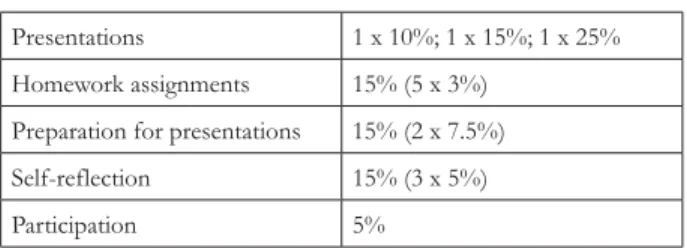
Since this course introduces students to basic presentation skills, during the early weeks of the course students learn how to give a simple speech on a non-academic topic. This first presentation focuses on basic presentation skills such as voice projection (volume) and use of gestures. Students also learn how to structure a presentation in order to gain and hold the audience’s attention and interest. In the second part of the course, students present on a simple academic topic. This presentation builds upon skills learned during the first weeks of the course and includes how to select and use visuals to help make their presentation more effective. Towards the end of the term, students give a longer presentation on an academic topic using PowerPoint. There are five main elements to be assessed for my course:
Table 3 : Course assessment
Presentations 1 x 10%; 1 x 15%; 1 x 25%
Homework assignments 15% (5 x 3%) Preparation for presentations 15% (2 x 7.5%)
Self-reflection 15% (3 x 5%)
Participation 5%
3.3.1 Presentations
Students give an individual presentation on a favorite place and discover basic verbal and non-verbal delivery skills, learn posture and gesture guidelines, prepare a script, and during week five, give their first graded presentation. Prior to presentation day, I refer students to the presentation grade rubric so they are clear on how they will be graded (Appendix 2). This ensures that students are aware of the grading criteria and allows them to determine areas in which they need improvement. There is a strict time limit of between two minutes and thirty seconds and three minutes. The second graded presentation is a team data presentation in which students support an opinion about a semi-academic topic
―which I have chosen for them (e.g. Should high school students be required to wear school uniforms? )― and requires them to research statistical data to support their opinions. Students choose their partner, work in pairs, research, write their script and prepare eight PowerPoint slides (four slides per student) for a five-minute presentation. The final team presentation follows a similar format of the previous presentation, however, students decide the topic on their own, prepare 16 PowerPoint slides and present within 9―12 minutes.
3.3.2 Homework assignments
At previous universities where I have worked, I discovered that many students attempted presentations without adequate preparation. These presentations often lacked content and demonstrated that students had neither practiced their presentation nor the skills. To discourage this behavior, presentation weightings were reduced and homework spot checks were introduced to ensure that students kept pace with the course and were prepared when class time required presentation practice. While students are practicing activities I quickly assess a 0―3 point score on the completion of their homework. Homework assignments include brainstorming topics, writing presentation scripts, reviewing presentation practice videos and preparing PowerPoint slides. Additionally, I created materials that include script templates (Appendix 3) to clarify my expectations, which included organizational structure (introduction, body, conclusion), content, time restrictions and a sample presentation.
3.3.3 Preparation for presentations
After completing their presentation script, in the following class students practice their presentation in small groups and discover places to insert gestures to make their message clearer and add emphasis to parts of their presentation. Interestingly, during these sessions the student peer feedback is very natural and supportive. In a recent class, I observed a small group discussing the best gesture to insert at a specific place in one of the students’ script or if it would be better to leave the gesture out completely. Preparation also includes practice varying voice by changing volume, pace or speed, and pausing for effect. During in class practice, though not required, students often decide to video their practice presentation with a smartphone or other device.
3.3.4 Self-reflection
Students are encouraged to review and reflect on their graded presentation after completion as well as provide feedback for their classmates. Students view their own video presentation, which allows them to take responsibility for their learning and identify specific areas on which they require feedback. Additionally, they view another student presentation to offer positive feedback and suggest areas in which to improve. This type of peer feedback allows the development of constructive feedback, enables students to engage with assessment criteria, and gain initial feedback on their own work for future assignments (Liu & Carless, 2006).
3.3.5 Participation
Students are required to attend class, and absences on presentation days are severely penalized. For unexcused absences on presentation day, students are penalized -25% of their presentation grade. Students are also expected to offer feedback to their classmates’ written scripts and PowerPoint slides, as well as impromptu and practice presentations in class, of which begin in the first class session and continue throughout the term. As such, student attendance and active participation contributes to the overall success of the course.
4 Reflective comments and goals for the future
Through writing this paper it has become clear that we have different approaches to our courses. This obviously affects our course design as well as the skills which we emphasize. John’s insistence on students writing a script for their presentations is diametrically opposed to Tony’s stance. Similarly, Richard’s focus on language is far from Tony’s focus on structure and process. That being said, we are all aiming to improve our students’ presentation skills. The paths may be different, but we are all moving towards the same objectives.
While the generic term ‘presentation course’ may be somewhat ambiguous and confusing to many people, we embrace this apparent ambiguity and think a diverse range of presentation courses should be developed. By specifically stating whether the focus of the presentation course will be primarily on the content, delivery or language elements of a presentation, both instructors and students can have a clearer understanding of what skills the course will emphasize and consequently,
how the presentations will be assessed.
To a certain extent there needs to be some form of agreement among the faculty with regard to what presentation skills should be taught throughout the four-year curriculum. Basic skills such as voice projection, structuring a presentation, and signposting, could be woven into first- and second-year classes. More advanced skills such as speaking without notes, slide design and handling questions, could be part of the basis for presentation skills classes for third-year and fourth-year students. Students would benefit from having the choice of a variety of teaching approaches and thus, arguably, there is no need to enforce a standardized approach as this would stifle individual teacher’s creativity.
Another possibility for the future could be the adoption of established standardized and immediate feedback programs, such as the ‘Student Response System’ outlined by De Grez, Valcke and Berings (2010). Essentially the program allows members of the audience to respond to a series of multiple choice questions displayed on a screen, regarding what they are seeing in a presentation. Instant summaries of feedback are readily available to the presenter and results from their study showed it was effective and that presenters had very positive attitudes towards it.
A more grandiose goal might be to promote and encourage our students to get involved in presenting outside the classroom and the university itself. This could involve providing support for them to enter national speech contests, or bringing in outside specialists to provide further instruction. Even encouraging students to take part in local Pecha Kucha events would be beneficial.
5 The complexity of designing and teaching English presentation
courses
As we have seen in this paper each course is inherently tied to the individual teacher’s teaching philosophy. Teachers and students are individuals and this greatly affects course design, how the course evolves, and how students respond to the course. Students come to class with certain expectations and may find it confusing if one teacher teaches them not to read from a script when their previous teacher advised them to use a script. Teachers need to be very clear at the beginning of the course what their expectations are and how the course will
progress.
6 Conclusion
From this short paper it is evident that the three teachers hold different approaches to teaching presentation skills. Tony’s focus is on presentation design and structure, Richard focuses on teaching language and delivery skills and John’s focus is on delivery skills and content. However, it is clear that there is a considerable amount of overlap between the teachers. In addition, the ultimate goal of improving students’ presentation skills through practice presentations remains a constant underlying theme of all the teachers’ courses.
This paper has also highlighted the complexities involved in designing presentation courses. Course design is affected by each teacher’s subjective beliefs about teaching, student involvement, course structure and the best way to fuse the demands of teachers and students (Williams & Burden, 2000).
The recommendations offered in this paper act as a springboard for future refinements across our department’s curriculum. An integrated approach to teaching presentation skills requires a concerted effort amongst the faculty. Workshops need to be held to both inform the faculty members of what is being taught, and to help them integrate some of the presentation skills into their own classes. If there is a common core within a curriculum with regard to basic presentation skills, such as encouraging students to present without notes, focusing on presentation language, and setting a format for asking and answering questions, then this may lead to a clearer vision for students and faculty members alike.
Bibliography
Cripps, A. C. (2014). “Muri, muri, muri!”: Reflections on a Presentation Skills Course. Nanzan University. Academia. No. 95, pp. 1―14.
De Grez, L, Valcke, M. & Berings, D. (2010). Student response system and learning oral presentation skills. Procedia Social and Behavioral Sciences, 2, pp. 1786―1789.
Jeon, In-Jae. & Hahn, Jung-won. (2005). Exploring EFL teachers’ perceptions of task-based language teaching: A case study of Korean secondary school classroom practice, Asian
EFL Journal, 8(1), pp. 123―143.
Studies, No. 4, pp. 401―418.
King, J. (2013). Silence in the second language classrooms of Japanese universities. Applied
Linguistics, 34 (3), pp. 325―343.
Liu, N. & Carless, D. (2006). Peer feedback: the learning element of peer assessment. Teaching
in Higher Education, 11(3), pp. 279―290.
MEXT. (2009). Koutougakkou gakushu shidou yoryogaikokugo eigoban kariyaku (Study of course guidelines for foreign languages in senior high schools). Retrieved September 29, 2014 from http://www.mext.go.jp/a_menu/shotou/new-cs/youryou/
Miles, R. (2009). Noticing grammar in oral presentations. Nanzan University. Academia. No. 85, pp. 105―113.
Miles, R. (2009b). Oral presentations for English proficiency purposes. Reflections on English
Language Teaching, 8 (2), pp. 103―110.
Okabe, R. (1983). Cultural assumptions of east and west. In Intercultural Communication Theory. Ed. William B. Gudykunst. International and Intercultural Annual, 7, pp. 21―44. Otoshi, J. & Heffernen, N. (2008). Factors predicting effective oral presentations in EFL
classrooms. The Asian EFL Journal, 10 (1), pp. 65―78.
Powell, M. (2011). Presenting in English. Andover: Heinle, Cengage Learning.
Reynolds, G. (2007). Pecha Kucha and the art of liberating constraints. Presentation
Zen Homepage. Retrieved August 17 2014 from: http://www.presentationzen.com/
presentationzen/2007/09/pecha-kucha-and.html
Reynolds, G. (2011). Presentation Zen: Simple ideas on presentation design and delivery (Book & DVD). Berkley: New Riders Press.
Shimamura, M. (2006). Peer- and instructor assessment of oral presentations in Japanese university EFL classrooms: a pilot study. Waseda Global Forum, 3, pp. 99―107.
Shimamura, T. & Takeuchi, O. (2011). What is an appropriate style for academic presentations by scientists? JACET Journal 52 (2011), pp. 51―70.
Tahira, M. (2012). Behind MEXT’s new Course of Study Guidelines. The Language Teacher. No.
36, (3), pp. 3―9.
Webster, F. (2002). A genre approach to oral presentations. The Internet TESL Journal, 8 (7). Retrieved July 6, 2014 from: http://iteslj.org/
Williams, M. & Burden, R. L. (2000). Psychology for language learners: A social constructivist approach. Cambridge: Cambridge University Press.