6: 66-79 (2017)
Evaluating collaboration projects between university and community by social capital:
A case study of Satoyama project and Gardening project at Ritsumeikan University
Tunpisa Phiwsuwan
1, Chaweewan Denpaiboon
2, Yusuke Toyoda
3*Abstract: This paper aimed to evaluate the collaboration projects between Ritsumeikan University Osaka Ibaraki Campus (OIC) and local community. The collaboration projects considered in this research are Satoyama project and Gardening project, both of which are about making green areas, resulted from participation by citizens, university students and professor/staff of OIC. This research collected data by interview. After getting basic information, we evaluated these projects by social capital concept. Which social capital is divided into five dimensions including Group and Networks, Collective Action and Cooperation, Information and Communication, Trust and Solidarity, and Social Cohesion and Inclusion. Each dimension could identify questions to be measurement indices to evaluate the projects. After evaluation, we suggested ways to improve based on social capital for supporting better performances.
From evaluation, we concluded that both of project have relations with every dimension of social capital. Although Satoyama project have relations with every dimension, this project still has some weak points because the less number of members and this project does not let non-members join the activity with members. Moreover, the activities of this project is not various. Therefore, suggestions for this project is increasing events for promoting the project, making participation in the project more easily, improving activities to get more interesting from participants, and increasing the number of seminars to for opportunities of discussion among members. On the contrary, however, Gardening project has relation with each dimension as well, weak points of this project is that some members not participating in activities, lack of specialists and having problem about relations of members because of time availability and gender. Thus suggestions for this project is improving activities to be more interesting which comes true with the number of meetings or seminars to provide the member with more knowledge and increase connections among members.
Keywords: Social Capital, University-Community Collaboration, Ritsumeikan University
. Introduction
University is the third place, where people congregate other than work or home and establish feelings of a sense of place. University is easy to access for everyone so university should be the place to incur collaboration, because collaboration is the process to work together to realize or achieve something successfully. Making collaborations effective and efficient could be achieved with social capital. It is the concept about groups in which people collaborate to contribute to common goods, share ideas, exchange knowledge for make recognition in groups. And it is a power to drive the groups to have ability to solve problems and to achieve good performances.
Ritsumeikan University Osaka Ibaraki campus (OIC) has collaborated with local community in many projects. Among others, we considered projects related with open space management in OIC. The first project is Satoyama Project. It is a project to make a woodland in OIC because woodland is disappearing by the expansion of Shinmeishin Expressway. Citizens tried to reproduce the woodland. Another project is
* 1 Assistant researcher, Faculty of Architecture and Planning Thammasat University, Phatumthani, Thailand and
Visiting Researcher, Organization of Open Innovation and Collaboration of Ritsumeikan University, Osaka, Japan 2 Associate Professor, Faculty of Architecture and Planning, Thammasat University, Patumthani, Thailand 3 Associate Professor, College of Policy Science, Ritsumeikan University, Osaka, Japan
Gardening Project. It contributes to the green plan of OIC which is to make harmony with the university area and the surroundings by collaboration between citizens and university students and professors.
From these collaboration projects of OIC and community, it could promote social capital from interactions and cooperation in activities. It is something about to share knowledge, values, innovation and understandings in our society that enables individuals and groups to trust each other and work together. Thus, this research focuses on social capital that are divided into dimensions, that is, Groups and Network, Trust, Collective Action and Cooperation, Information and Communication and Social Cohesion (adapted from World Bank [2000]).
. Social Capital
. 1 Definition of social capital
Previous studies define social capital in many ways discussed below. Narayan (1997) defined social capital as rules, norms, obligations, reciprocity and trust embedded in social relations, social structure and society s institutional arrangement which enable members to achieve their individual and community objectives. Similarly, WHO ( 1998) defined that social capital represents the degree of social cohesion in communities. It refers to the processes between people that establish networks, norms and social trust, and facilitate coordination and cooperation for mutual benefit. And World Bank (2000) defined social capital is the institution, relationships, and norms that shape the quality and quantity of a society s social interactions. Robert Putnam (2011) has defined social capital is networks together with shared norms, values, knowledge, understandings and related human resources that facilitate cooperation within or among groups.
From the discussion above, social capital can be defined simply as norms and networks that are
shared values of civil society. It reveals in a group in which people collaborate to contribute to the common goods through sharing ideas, exchange knowledge and experience for making recognition among the group. And it is a power to drive the groups to have ability to solve problems and to achieve good performances.
. 2 Social capital measurement indices
Social capital is divided into two distinct forms, structural and cognitive (NESDB, 2008). Structural social capital facilitates collective action, decision-making, information sharing, and through established roles. Cognitive social capital refers to shared norms, trust, attitudes, values, and beliefs. As such it is a more subjective and intangible concept. However, two forms of social capital are characterized by five dimensions represented in the following. (Table. 1).
Table 1. Social Capital Measurement Indices
Source: Authors
(a) Groups and Networks
This dimension is the common one and addresses the extent of an individual s engagement in different forms of social organizations. Social capital is based on the integration of people in social groups because groups and networks enable the sharing of information. This causes a reduction in opportunistic behavior and promote joint activities. It can be measured by the density of the members and the number of organizations.
(b) Collective Action and Cooperation
This dimension explores the ability of individuals to work with others in their communities via joint projects and the possibility of investing their cooperation. It is measured by scope of activities, kinds of activities, evaluation of willingness to participate in activities.
(c) Information and Communication
Accessibility to information and communications as a tool to help people in groups to be able to resolve its own problems. It is measured by the number of information sources and the media used to
communicate and the relationship of the information sources.
Forms of Social Capital
Dimensions of Social Capital
Social Capital Measurement
Indices Questions
Structural Social Capital
Groups and Networks
The number of organization -How many organizations in the project The number of member -How many members in the project
Collective Action and Cooperation
The number of activity -How many activities in the project -What kind of activities in the project -How often the activities/events are held in the project
Participation of members in activities
- How often the participants join the activities
-Is there some investing from participants in supporting activities in the project
Cognitive Social Capital Information and Communication Channels of information distribution
-How many channel of information distribution of the project Channel to communication
among members
-Is there some channels that members use to contact each other
Promoting the project by various channels
-Is there promotion of information of the project
Trust and Solidarity
Relationship among member -How is the relations among the member
Social Cohesion and Inclusion
Support from members -Is there any support/donation from member Division of responsibility -How to divide the responsibility in the
project
-What kind of responsibilities in the project Rules or Regulations -Does the project has any rules or
(d) Trust and Solidarity
This dimension is an important component of social capital. This is abstract and difficult to measure. Its measurements focuses on trust, and relationship of member. It is measured by trust among members and the relationships within groups.
(e) Social Cohesion and Inclusion
Communities are distinguished by the inclusion of many cleavages that can lead to struggle. Thus, social capital contributes to the cause of social interaction. It is related to solve conflicts of difference and how to build/structure to facilitate reduction of conflict and violence. It is measured by support from members, divisions of responsibility of members, rules and regulations.
. 3. How social capital contribute to universities
When a university collaborates with local community as a group or network, they cooperate to do something in a project or activity together as a collective action. In operation they share information to plan or discuss as communication. Communication is an important factor to build trust among members and trust among the members results in cohesion. This is a process of social capital as a benefit of university.
From the process of social capital, it could better performance of projects and activities with network, cooperation, communication, trust and cohesion. Moreover, when the project has good performance, it supports the ability to solve problems. Finally, if they have good the performances and the ability to solve problems, it leads to good images of university. It is also a to promote characters of university (Figure 1).
. Methods and Framework of Research
This research begins by reviewing the concepts, theory and research related concepts, including social capital concept, etc. As well as policy and development program that related to Ritsuimekan University. To provide a framework and ideas on how to collect data and study the primary data by interview the staff from OIC Office of Regional Collaboration to analyze and evaluate the processing and performance of Satoyama and Gardening project with the concept of social capital (Figure 2).
Source: Authors
Figure 1. How social capital contribute to universities
Source: Authors Figure 2. Research Design
Reviewing the concepts, theory and research about social capital concepts
Collecting data
Analysisand Evaluation
Conclusion and guidelines for Satoyama project and Gardening project according to the concept of
social capital
Social capital
Ritsumeikan University Policy
- Community and Regional Collaboration
The primary data by interviews with OIC Office of Regional Collaboration
Analyzing the process and performance of Satoyama project and Gardening project Evaluating both projects by five dimension of social capital
- Group and Networks,
- Collective Action and Cooperation - Information and Communication - Trust and Solidarity
- Social Cohesion and Inclusion
Social Capital
Group and Network
Collective Action and
Cooperation
Communication& Information
Trust and Solidarity
Social Cohesion
Increase in possibilities for co-operative action in solving
problems
To promote the image of the university
Improvement in performances of collaboration between
university and local community
. The Research and Discussion
This research collected the data by interview the staff from OIC Office of Regional Collaboration on December, 2016 and February, 2017. Which it is the data about base information and structure of Satoyama project and Gardening project that will be evaluated by social capital concept as above.
.1 Satoyama Project
Sodateru (Nursing) Satoyama Project (satoyama means the border zone or area between mountain foothills and arable flat land [Wikipedia 2007]) is a project to make knowledge to be ways for using and managing natural resources sustainably that benefit current and future generations. This project collaborates between citizen, students, and professor and staff of OIC, and Satoyama Support Net Ibaraki. They made a woodland in OIC ( Figure 3) and members collected species from satoyama in the northern part of Ibaraki City ( Figure 4) because woodland is disappearing by the expansion construction of Shinmeishin Expressway. Thus the community people tried to reproduce the woodland ( Figure 5) . This project could make the relationships between human and natural, human and human, local community and university.
Recently they have many activities to collaborate. They have divided the responsibilities for each member. However, some members do not participate, perhaps, because the contents of the activities are not that interesting for them. The members who know well about planting or satoyama as professionals will guide and educate to the members who do not know about planting. They shared knowledge and ideas together.
In addition, they have exchange meetings. where they discuss problems and share information among members. They use email to communicate among members and have various media channels to promote the activities of the project to the public.
This project collects the plants only in Ibaraki city and brings to OIC as satoyama in OIC is reproduction of satoyama in Ibaraki City. They not only move trees from Satoyama area in the north of Ibaraki City but they regenerate satoyama in OIC so that residents can remember satoyama of Ibaraki city Source: Satoyama support net (n.d.)
Figure 3. Satoyama Area
Source: Satoyama support net (n.d.) Figure 4. Collection of Some Nursery Stocks
from the Satoyama Area in Ibaraki
Source: Satoyama support net (n.d.) Figure 5. Collaboration with Community at
and also motivate them to go real satoyama for maintenance or just feel nature. Actually the south of Ibaraki City is an urban area, and therefore, even they live in urban areas, they can feel satoyama nearer and remember it.
.2 Gardening Project
The name is OIC gardening Club: Trefle. This project is a part of green plan of OIC to create a green campus to make harmony with university areas and the surroundings. It was organized in July, 2014 before OIC was opened in April, 2015.
Nowadays, this project has five gardening areas at OIC. It is a collaboration project among citizens, university student and university staff. This project has two types of participants. The first is core members who are the leader and managerial member. And the second is general members. This project has many activities such as meetings, seminars and tours (Figure 7 and Figure 8). The participants have divided responsibilities, decided according to questionnaires distributed by OIC Office of
Regional Collaboration as the secretariat to ask the members about which gardening areas they want to take care. Basically, members opinions are respected, but if participants did not answer the questionnaire, their gardening areas are determined based on the balance of the number of members in gardening areas. The members can get some knowledge from and consult about gardening with professionals. In addition, the secretariat sends information to the members by Email and/or Fax. As some members are elder and do not have an email, they get information from the secretariat by telephone or post. This project promotes the activities by various ways.
The degree of participation of the members, depends on gardens. In some garden members have close relationships but in others gardens the relationships are still not close. The connections between the leader and members are close, because they work together and meet often. But general members meet each other only once a month in activities. So meeting frequency is important. And gender is also important as female participants have more relationships among them. While among male members of between female and male members, they do not exchange and contact. Almost all participants are over sixty years old. They retired already so this project could be a kind of sense of their life who have much free time.
Source: Authors
Figure 7. Gardening Course
Source: Ritsumeikan University (n.d.) Figure 8. Gardening Tour
Source: Ritsumeikan University (n.d.) Figure 6. Gardening
.3 Evaluation of Satoyama Project and Gardening Project by Social Capital
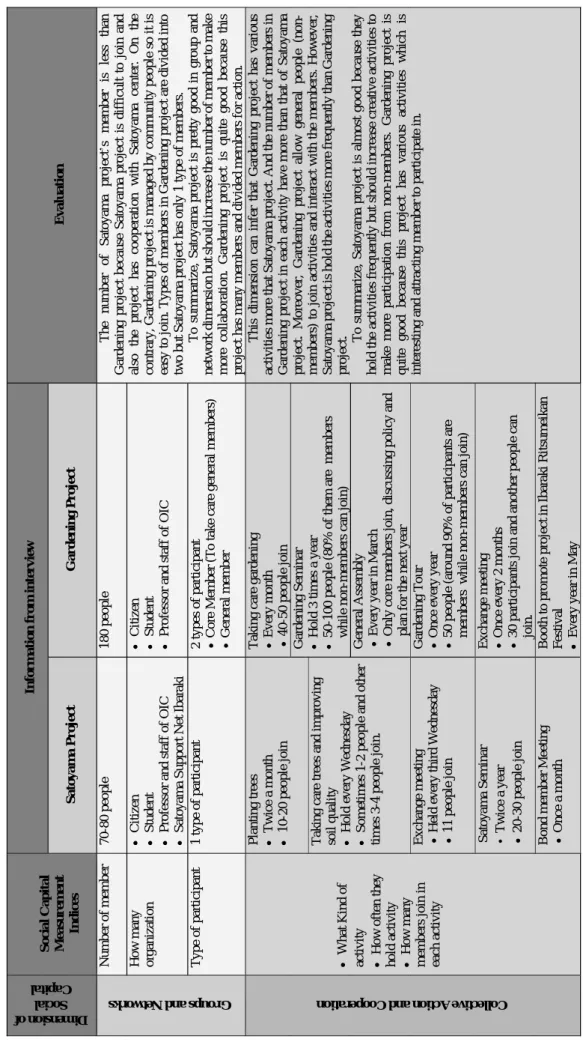
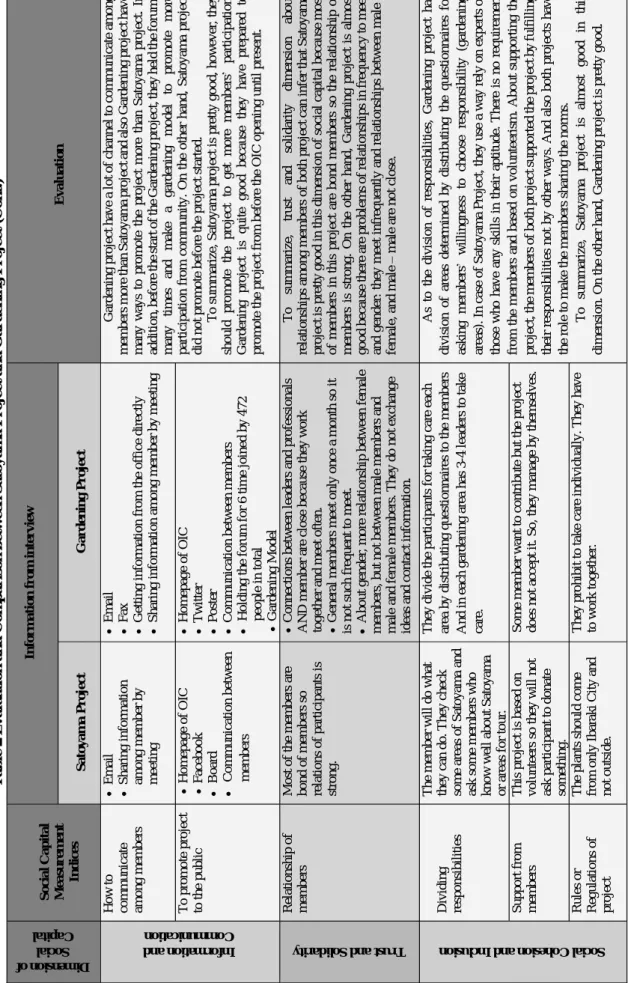
From the interviews with the OIC Office of Regional Collaboration on December 2016 and February 2017 at Ritsumeikan University, we could collect data on Satoyama project and Gardening project. The information was divided following each dimension of social capital and evaluated by comparing both projects. After evaluate the information found that Satoyama has weak point more that Gardening project is the less number of member, the activity is not various type, Promoting the project is not various and division of responsibility is not clear. These results are summarized in the Table 2.
.4 Suggestion
From the information that we got by the interviews, we could suggest some ways to improve both projects based on social capital for increasing the performance and each components of both project including to encourage collaboration between the university and community and in every sector. As results, we found that the importance to improve both projects is to improve the activities to be more interesting and easy to gain attachment for getting more participant as depicted in Table 3.
. Conclusions .1 Summary
This study evaluated Satoyama project and Gardening project by social capital, both of which are collaboration projects between the university and local community. By evaluation, we found that Satoyama project and Gardening project have every dimension of social capital.
Satoyama project resulted from collaboration between citizens, the university and Satoyama Support Net Ibaraki, who became a group and network to work together. They collaborate for the activities which is related with collective action and cooperation dimension, but in this dimension, Satoyama project has participants of small numbers and also this project does not let non-members join the activity with members. In addition, the activities of this project are not various. So our suggestion is to to promote the project, by making participation in the project more easily and improving the activities to make more interesting and easy to attain attachment from participants. Communication and sharing knowledge among members is related with communication and information dimension of social capital. And our suggestion on this point to this project is to increase the number of seminars for more opportunities of discussion and exchange ideas among member. Having communication and exchange ideas could promote their trust in each other. And then it could promote inclusion among the group. This is related with Trust, Solidarity and Social Cohesion, and Inclusion dimension.
Gardening Project has relations with each dimension of social capital. This project contains collaborations between citizens, students and professors and staff of OIC, all of who became groups and network to work together. They collaborate and join many activities together, which is related with collective action and cooperation dimension. Nonetheless, this project still need more specialists. So our suggestion is to improve the activities by making more interesting and easy to attain attachment from participants. These could be achieved by increasing the number of meetings or seminars to let the members get more knowledge when they have collaborations. Communication and sharing knowledge among members is related with communication and information dimension. Having communication makes them trust in each other. Nevertheless, this project also has problems about relations of member, stemming from frequency of meetings and genders. Our suggestion on this point is to increase the connection among members by holding activities or events more often and making some appointments as relax activities that it is not related with the project for example dinning, picnic, etc. And when their relationships get close, it leads to inclusion in and between groups. These are related with Trust, Solidarity and Social Cohesion, Inclusion dimension.
Both projects show that collaboration between the university and community is important because the university as the third place should be the place that everyone can come and conduct activities or work together to make value of the society. In addition, building relationships of mutual trust can be attained. Moreover, collaboration projects are related with PBL (Problem Based Learning), because they can learn from real problems and work together to solve the problems. Therefore, it is a sustainable way to increase potential in bettering performance of solving problems of the society.
.2 Limitation of the study
Although this research has reached its aims, there are some limitations. First of all, the research has conducted in the short period, 9 weeks. We could have interviews and join their activities to understand situations, however, it was not enough to conduct questionnaire surveys. Secondly, about evaluating in Trust and Solidarity dimensions it is quite difficult because trust is more intangible and subjective. The projects have started just about two years ago so evaluation of trust among members is too early to be measured. Moreover, this research could not collect data from questionnaire surveys by which we can ask questions to each members opinions.
Tab le 2 Evalu a tion an d C o mp ari so n b etween Sa toyama Project a n d G a rdening P roject Dimension of Social Capita l Soci al Capita l Measu rement Ind ices Inform ation fro m interv iew Evalua tion Sato y a m a Pro ject Garden ing P roj ect Groups and N etwor ks N u mb er o f me m b er 70-80 peop le 180 p eople The numb er of Satoy am a pro ject s membe r is less than Gardenin g
project because Satoy
am a project is difficult to join and also the project ha s coopera ti o n with Satoy ama center. O n th e contra ry , Gardening project is managed by co mmunity people so it is easy to join. Types of members in Gardenin g project are divided into
two but Satoya
m
a project has only
1 ty pe of memb ers. To su mmarize, Satoy ama project is pretty good in group and netwo rk dimensio n but shou ld increas e the num ber of m ember to make mo re collaboration. Gardening project is q u ite good becau se this projec t ha s m any membe rs
and divided memb
ers for action.
Ho w ma ny organiza tion Citizen Stud ent Prof
essor and sta
ff of OIC Sato yama Suppo rt Net Ibar aki Citizen Stud ent Prof esso r and sta ff of OIC Type of par ticip ant 1 type of par ticipant 2 types of p ar ticipan t Core Me m b er (T o take care gen er al m embe rs) Gen eral memb er Collective A ctio n and Coop eration What K ind of activit y How often th ey hold activ ity Ho w ma ny m e m b ers join in each a ctivity Planti ng tree s Twi ce a mont h 10-20 p eople join Taking car e gard ening Ever y m onth 40-50 p eople join This dimen sion can infe r that Gard ening project has vario u s activities m o re that Sa to y ama project.
And the num
ber of mem b ers in Gardening project in each activity have more than t h at of Satoy am a project. Moreove r, Gardening project allow genera l peop le (non-m e m b ers) to join ac ti v itie
s and interact with the
m em b ers. However , Satoy am a pro je ct is
hold the activities m
o
re
frequ
ently than Garden
ing project. To sum m arize , Satoy am a projec t is alm o st good b ecause they hold the ac ti v ities freque ntly but should i n crease creative activities to make more partici p ation f rom non-me mbers. Gar d ening project is quite good because this pro ject has v arious ac tivities which is interesting and at tracting m
ember to participate in.
Garde n ing Semi nar Hold 3 ti m es a year 50-10 0 p eople (8 0% of the m are memb ers while no n-members can join) Taki ng car e trees a nd improvin g
soil quality Hold every W
edn esday Some times 1-2 people a nd other times 3 -4 peopl e j o in. Gen eral As sembl y Every y ear in M arch Only cor e me mbers join , d is cussing pol icy and plan for th e n ext year Exchang e meeti ng Held ev ery third W ednesday 11 people join Garde n ing Tou r Once e v er y year 50 peopl e (a roun d 90% of pa rticipants ar e mem b ers while non-me mbers can jo in) Sat oya m a Semi nar T w ic e a y ea r 20-30 p eople join Exchang e m eeti ng Once ev er y 2 months 30 partic ipant s join and ano th er people can join. Bond m ember Meeti ng Once a m onth Booth to p romote project in Ibar ak i Ritsu m eikan Festival Every ye ar in M ay
Tab le 2 Evalu a tion an d C o mp ari son betw een Sa toyama P roj e ct and G a rdenin g Pr o je ct ( C on t.) Dimension of Social Capita l Soci al Capita l Measu rement Indi ces Inform ation fro m inte rv iew Evalua tion Sato y a m a Pro ject Ga rden ing P roj ect Informat ion and Comm unication How to com m unicate amon g m embers Em a il Shari ng informat ion amon g member b y m eet ing Em a il Fax Getting informa tion from th e office d irectly Sharin g informa tio n among mem b er by meetin g Gardenin g project have a lot of ch annel to communic ate am ong memb ers more than Satoy ama pr oject and a lso G ardening p roject have many wa y s to promote the p roject more than Satoy ama project. In addition, before the start
of the Gardening project,
they
held the forums
many tim es and make a garden ing mod el to promote mo re participation from co mm unity . On the other hand , Satoy am a project
did not promote before the project started.
To summarize, Satoy ama project is pretty good , however , th ey should promote the proje ct to ge t m o re members par ticipatio n. Gardenin g project is quite good because th ey have prep ared to prom
ote the project from bef
o
re the OIC opening until present.
To pro m ote proj ect to th e p ublic Hom epage of OI C Faceb ook Board Commu nication be tween mem b ers Hom epage of O IC Twitter Poste r Comm unication between members Holding th e for u m for 6 time jo ined b y 472 peop le in total Gard ening Mod el Trust and Solidari ty Relatio nship of mem b ers Mos t of the mem b ers ar e bond o f membe rs so relations of p articipan ts is stro ng. Connec tions bet w een lead
ers and profe
ssionals AND member a re close bec
ause they work
together and me et of ten. Gene ral membe rs meet onl y once a month so it
is not such frequ
en t to m eet. About gender , m o re relationship between fe male mem b ers, but n o t be tween m ale m embers an d mal e and female m embers . Th ey d o not exch ange ideas and contact inf o rmation . To summ
arize, trust and
solidarity dimension abo u t relatio nships a m ong memb ers of bo th project can infe r that Sato y am a project is pretty good in
this dimension of socia
l capital because m o st of me mbers in this projec t are bon d me
mbers so the relation
ship of memb ers is strong. On the othe r hand, Gardening project is almost
good because there are problems of
relations
hips
in
frequency to meet
and gender: they
meet infrequen tl y and relationships between m ale -
female, and male
male are not
close.
Social Cohes ion and Incl
usion Dividin g resp onsibili ties The memb er will d o wha t th ey can do . They che ck som e areas of Sa toyam a and ask s o me me mber s who know we ll about Sato yama or area s for tour . They d ivide the pa rticipan ts for taking car e each area b y d istributin g q u estionn aires to th e m embers And in eac h gar d en ing area h as 3-4 lead ers to take care. As to the div ision of responsib ilities, Gar d ening p roject has
division of areas dete
rmined b
y
distribu
ting the questionnair
es for asking membe rs willin gness to c hoose re sponsibility (gardenin g areas). In case of Satoy ama Project, they use a way re ly o n e xperts or those wh o have any skills in their a p titude. There is no requirem en t from the membe rs and bas ed on volunteeris m. A bout s upporting th e
project, the mem
b
ers
of
both project supported
the pro ject by fulfillin g their responsib ilities not by o ther w a y s. And also b o th projects hav e
the role to make the m
embers sharing the norm
s. To summa rize, Satoyama p roject is alm o st good in th is
dimension. On the other
han
d
,
G
ardening project is pretty
good. Supp ort from mem b ers This projec t is b ased on voluntee rs s o th ey w ill n o t ask par ticipa n t to donate some thing. Some me mber wa nt to con tribute but th e project doe s n o t ac cept it. So, th ey manag e by the m selve s. Rules or Regula tions of pro ject The p lants shou ld co me from onl y Ibarak i City and not outsid e. They proh ibit to ta k e care indiv idua lly . Th ey have to work tog ether .
Table 3. Suggestion on Ways to Improve the Projects Based on Social Capital
Satoyama Project
Gardening Project
1) To increase promotion of the project by
various ways:
Giving opportunities to nonmembers
to join the activities and work with
the member
Holding interesting activities to the
participants
Increasing channels of social media
to promote by Instagram, twitter,
applications of mobile phone, etc.
Distributing application form at the
city hall
2) To make participation in the project more
easily:
Increasing ways to register both
direct and indirect
Diffusing application form in social
media
3) To improve activities more interesting to
get more participation from university
students and community
Holding a tours as field trips
Adapting ways to educate members
by play game
Holding some activities as
competition for example whose tree
have grown up best can get award
and crating the name of flowers by
themselves, etc.
Making a video for presentation in
seminar, not only text
4) To increase the number of seminars to
make more discussion and exchange ideas
among member
1) To improve activities more interesting and
easy to gain attachment from members
for increasing the number of participats
from university students
Adapting ways to educate members by
entertainment for example playing
games, making a video for
presentation in seminars not only text.
Holding some activities as
competition for example whose flower
have grown up or beautiful best can
get award, crating the name of flowers
by themselves, etc.
2) To increase connection among members
Holding activities/events more often
Making some appointments as relax
activities that it is not related with the
project for example dinning, picnic,
etc.
3) To increase the number of seminars to
make members get more knowledge, then
this project equipped with more specialists
who can improve the quality of gardens
Acknowledgements
The authors wish to thank to OIC Office of Regional Collaboration for providing information and accepting our interviews about Satoyama Project and Gardening project. This research was supported by Research and Development Institution of Regional Information, Ritsumeikan University.
[References]
Ahmed, N. Nabil and Eldayem, G.E.A. Influence of mixed land-use on realizing the social capital, Housing and Building National Research Center (HBRC) Journal, Architecture, Egypt: Helwan University, 11, 2013, pp. 285 298.
Aleksiev, A. and Penov, I, The role of social capital for sustainable use of the fragmented land in Bulgaria, Agricultural University of Plovdiv Bulgaria: Plovdiv, 2016.
Collaboration efforts with local people Community creation project. [Cited 2017 Jan 5], Retrieved from http:// www.ritsumei.ac.jp/rs/r2020/campus/oic/community/local.html/ Office of the National Economic and Social Development Board (NESDB), Social capital and social human development , in the growth of the quality and sustainability workshop, 2008.
Jintana Amonsanguansin, Social capital with collaboration of local community in management of natural Resources , Journal of environmental, 1, 2005, pp. 104-134. Kata, P., The study on social capital and the role of social capital in social movement: case
study of healthy civil society in one village in North-Eastern Region of Thailand (Thesis (M.A. (Population and Social Research)), Institute for Population and Social Research, Mahidol University: Nakhonpathom, 2004.
Office of Regional Collaboration Ritsumeikan University, Policy for Community and Regional Collaboration. [Cited 2017 Jan 5], Retrieved from http://en.ritsumei.ac.jp/community_
service/region/Ritsuimekan University. [Cited 2017 Feb 26], Retrieved from http:// www. ritsumei.ac.jp/rs/r2020/campus/oic/community/local.html/
Satoyama Project. [Cited 2017 Jan 5], Retrieved from http://www.facebook.com/sodateru.satoyama/
Satoyama support net. [Cited 2017 Feb 22], Retrieved from http://www.facebook.com/sodateru.satoyama/ Wikipedia, 2007, [homepage on the Internet], Satoyama. [Cited 2017 Feb 10] Retrieved from