Yoko Kusumoto
AbstractThis article reports on a formative and internal evaluation of a two-week pre-enrollment English program for incoming freshmen in a Japanese international university. By adopting a utilization-focused approach, the evaluator produced a design that was articulated to address the needs of the evaluation users. The ensuing findings were then used to develop and improve program practices in specific and high-priority ways. This report outlines a two-year longitudinal study of the program evaluation and begins with the background of the program context. This is followed by the first evaluation of the program. The second half of the program evaluation section describes how the evaluation findings were used for the improvement of the program in the following year. Qualitative and quantitative data were collected to answer evaluation questions, and analyses revealed that there were still some issues that need to be addressed. This paper calls for attention to ways of enhancing the utility of evaluations within language education programs, and it illustrates how a utilization-focused approach can help to ensure the quality of the program.
Key terms: program evaluation, utilization-focused evaluation, primary intended users
1. Introduction 1.1 Program evaluation
Norris (2006) defines evaluation as “the gathering of information about any of the variety of elements that constitute educational programs, for a variety of purposes that primarily include understanding, demonstrating, improving, and judging program value. Evaluation brings evidence to bear on the problems of programs, but the nature of that evidence is not restricted to one particular methodology.” (Norris, 2006, p. 579) Patton (1997) proposes that utilization-focused evaluation begins under the premise that evaluation should be judged by its utility and actual use. The focus in utilization-focused evaluation is intended use by intended users. Primary intended users (PIUs) are a group or individuals who are in position to make decisions about the program, intend to use the evaluation findings to inform their future actions and are affected by the evaluation outcomes (Paton, 1997). Therefore, in order to carry out utilization-focused evaluation, the evaluator should first of all define who the PIUs are and what the intended uses of the evaluation results are. The pre-enrollment English course called Skills-Up is taught by English teachers at the Center for Language Education at Ritsumeikan Asia Pacific University (APU) in coordination with the Academic Office (AO); therefore, English teachers and the AO staff are the most likely to use the evaluation results.
1.2 Aim of the study
One of the significant aims of this study is to improve the Skills-Up English program in order to make it more relevant for the incoming students’ smooth transition to academic study. The evaluator taught the Skills-Up course in 2010 and 2011, and in 2012 she was chosen to be a lead teacher. Her experiences teaching the courses have helped her to be more invested in improving the Skills-Up program. In order to gather useful information to start a utilization-focus evaluation for the Skills-Up program, generating a list of real and meaningful evaluation questions played a critical part (Patton, 1997, p. 31), and the author proposed the following two questions:
1. What are the problems of the Skills-Up program?
2. To what extent does the Skills-Up program prepare participants for the regular English curriculum at Ritsumeikan Asia Pacific University (APU)?
2. Program context
2.1 Pre-enrollment program at APU
Ritsumeikan Asia Pacific University (APU) is an international university where foreign students from almost one hundred countries and regions come and study together. Students accepted with the Japanese-base entrance examination must complete 20 credits of English medium content lectures in order to graduate. Therefore, English language courses are designed to prepare students for English medium lectures using a four skills integrated approach with an English only policy in the classroom. All students take one course four days a week and another course two days a week (six-credit in total) for 15 weeks each semester. In order for incoming students to prepare for the English curriculum at APU, the university offers three pre-enrollment programs to newly admitted high school students prior to the start of their university life in April: Campus Visit in December, three one-day sessions called Schooling in January, February, and March at four different locations, and a two-week intensive program called Skills-Up.
2.2 Pre-enrollment Program 2011
Campus Visit
246 out of 322 spring 2011 entrants who were accepted after passing the Admissions Office entrance examination participated in the Campus Visit in December, 2010. Of those, 71 took an English mock lesson while others participated in other concurrent sessions such as lectures in Asia Pacific Studies and International Management.
Schooling
Schooling took place at four venues, once a month in January, February, and March. English lessons were offered to help incoming students get an idea of what they would experience in English classes at APU, and language counseling was also available to reduce their anxiety about language learning. A total of 107 spring 2011 entrants participated: Tokyo (13), Osaka (22), Fukuoka (47), and APU campus (25).
Skills-Up
APU started the English conversation pre-enrollment program in Academic Year 2004 in response to feedback from high school students’ concerns about their English conversation abilities. As a replacement for the English conversation program, the pre-enrollment English Skills-Up course has been offered with a focus on basic English skills and aiming to prepare scheduled Japanese-basis entrants for their English study upon enrollment. In March, 139 spring 2011 entrants participated in the two-week Skills-Up program. Of those 58 were schooling participants (54% of registration rate). Three 90-minutes English classes were offered for 10 days in addition to academic skills lesson such as “Dream Map” goal setting and time management. Table 1 below summarizes the levels and courses of Skills-Up 2011.
Table 1 English class schedule for Skills-Up 2011
Low Level (Class 1-4) Intermediate Level (Class 5-8) Advanced Level (Class 9 & 10) 1st Period Grammar Listening & Speaking Grammar
2nd Period Grammar Listening & Speaking Listening & Speaking 3rd Period Listening & Speaking Grammar Reading/Writing 3. Program Evaluation
3.1 Program Evaluation on Skills-Up Program 2011
Two students who were placed in Advanced Level for the Skills-Up program 2011 were later placed into the Elementary English Course (ELE) of the author, which is the lowest level of the six-level English program within the 2011English Curriculum. They expressed their disappointment and confusion because they thought they would be placed into a higher level such as Pre-Intermediate English or Intermediate English. As I was asked for an explanation and advice from them, I questioned whether the objectives of the Skills-Up program were met, and I decided to conduct a program evaluation. Two
evaluation questions were posed:
1. What are the problems of the Skills-Up program?
2. To what extent does the Skills-Up program prepare participants for the regular English curriculum at APU?
Methods
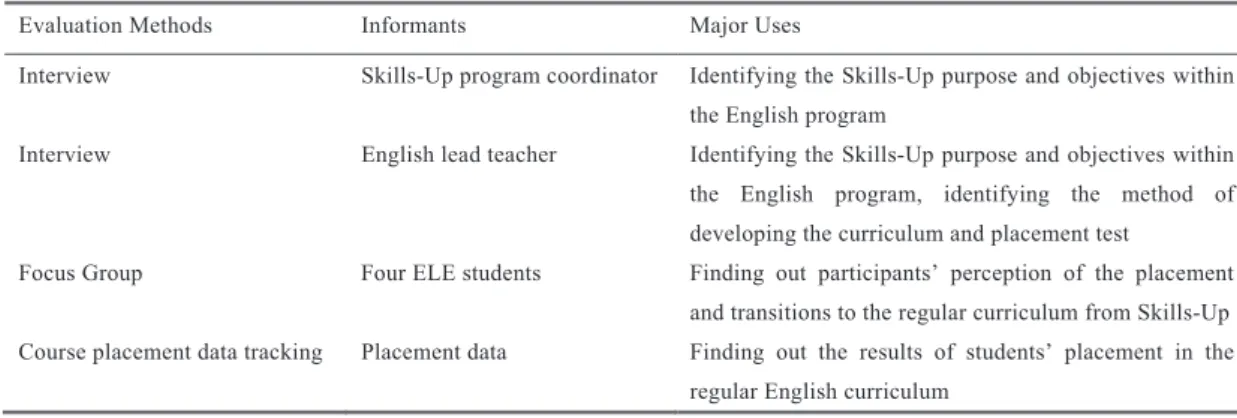
In order to answer the evaluation questions, four evaluation methods were used to gather data: (1) interview with the program coordinator at the Center for Language Education (CLE), (2) interview with a lead teacher, (3) focus group with four ELE students who were placed in low, intermediate, and advanced classes for Skills-Up, and (4) tracking Skills-Up students in course placement. Table 2 summarizes these methods and their major uses.
Table 2 Evaluation Methods
Evaluation Findings
What are the problems of the Skills-Up program?
From the interview with the program coordinator of Skills-Up at the CLE, the purpose and goal for the Skills-Up English course were identified as follows:
1. To prepare Skills-Up participants for the regular English courses at APU, 2. To expose the students to four days a week and 95-minute lessons all in English.
The interview with the lead teacher, who actually organized and ran the two-week intensive English program, revealed that there were misunderstandings and miscommunication among the people involved in the Skills-Up program: Academic Office (AO) staff, the program coordinator at the CLE, and the English lead teacher. The lead teacher understood that the purpose of this English program was to expose the students to an enjoyable but English-only environment. Preparing students for the regular English courses was not in her mind when the lead teacher developed the curriculum and the placement test for the 2011 program. This lack of common understanding was caused by the chain of communication. Most of the communication and decision-making were done between the AO staff and the coordinator at the CLE, and the information was then passed down to the lead teacher from the coordinator who was not involved in the actual management of the teaching per se. As a result, the lead teacher developed the Skills-Up English program based on the information she received without a clear understanding of the program purpose and goals. She made a schedule for three 90-minute classes per day and streamed students into three levels based on the placement test scores as she was asked with no specific proficiency criterion for each level.
Skills-Up participants’ perception of the placement and transitions to the regular curriculum from Skills-Up varied. Students who were in the low level and intermediate level in Skills-Up and placed in ELE felt that Skills-Up helped them prepare for the regular English courses, and the transition from Skills-Up to the regular curriculum was smooth. However, students who were in the advanced level in Skills-Up and placed in ELE in spring semester reported that Skills-Up somehow
Evaluation Methods Informants Major Uses
Interview Skills-Up program coordinator Identifying the Skills-Up purpose and objectives within the English program
Interview English lead teacher Identifying the Skills-Up purpose and objectives within the English program, identifying the method of developing the curriculum and placement test
Focus Group Four ELE students Finding out participants’ perception of the placement and transitions to the regular curriculum from Skills-Up Course placement data tracking Placement data Finding out the results of students’ placement in the
confused them in regard to their confidence and ability in English although it helped them make good friends and gave them an idea of what English classes were like.
The lead teacher was not given information about the proficiency criteria of the three levels for the Skills-Up course. She was simply asked to develop a placement test to separate the participants into three levels. As one of the instructors of the 2011 program, the author considered the placement test to be effective in placing students according to their English abilities. However, since the placement test for the Skills-Up was not designed in line with the placement test for the regular curriculum, the placement outcomes for the regular English curriculum were different from the Skills-Up. If there had been a more transparent communication system with respect to the purpose of the Skills-Up and the criteria of the placement test, the lead teacher could have developed the test aiming to place students into similar levels of the regular curriculum. Some students’ confusion about their placement in the regular English course can be attributed to this inefficient organization of the Skills-Up English program. In sum, the lack of common understanding and lack of transparent communication were major problems of the Skills-Up English course and these resulted in ineffective placement.
To what extent does the Skills-Up program prepare participants for the regular English curriculum at APU?
The Skills-Up program is not mandatory for incoming students, and students who were accepted to APU through the Admissions Office examination were encouraged to take this extra curricular course before entering APU. After the Skills-Up program, the participants took a placement test for the regular curriculum with all other incoming students. All freshmen were streamed into levels according to the placement test results of the TOEFL Institutional Testing Program (ITP). As a result of tracking the Skills-Up participants in the English course in the spring semester 2011, the evaluator found that 100 (72%) out of 139 students were placed into the Elementary English Course (See Figure 1). This suggests that seven classes out of ten Skills-Up classes should have been the same level, although in reality there were four low-level and four intermediate-level classes. With a closer look into the two advanced classes (28 students), the evaluator found that students’ proficiency was more varied as can be seen in figure 2. This means that low proficiency students with 310-420 on TOEFL to high proficiency students with more than 500 on TOEFL were taught together in the same class. The results suggest that the placement for Skills-Up was dissimilar to the placement test (TOEFL ITP) for the regular curriculum. One of the biggest reasons for the dissimilarities is due to the test style. The Skills-Up placement test had three components: listening, grammar, and vocabulary while the TOEFL ITP is a proficiency test that has listening, structure, and reading components. Other differences are the lengths (number of test items) and difficulty of the test. The Skills-Up test lasted about one hour while the TOEFL ITP is a three-hour long test with academic content. Although the class names (i.e. Intermediate and Advanced) of the Skills-Up were the same as in the regular curriculum, the content levels were different from the regular curriculum. Therefore, the main goal of Skills-Up defined by the program coordinator and AO, which is to prepare students for the regular English courses, was not met in AY 2011 program.
Figure 1 Spring Semester 2011 enrollment of Figure 2 Spring Semester 2011 enrollment of Skill-Up participants (N=139) Skill-Up advanced class students (N=28)
Suggestions for Improvements for Skills-Up 2012
Based on the program evaluation of the Skills-Up program 2011, four improvements were suggested for the AY 2012 program by the evaluator.
1. Enforce a shared understanding of purpose and goals of Skills-Up between AO and CLE including all Skills-Up instructors
2. Establish transparent communication among people who are directly involved with organizing and running the program 3. Make necessary changes to the Skills-Up curriculum based on the findings of the program evaluation
4. Implement a placement test which is similar to the TOEFL ITP, the placement test for the regular curriculum 3.2 Program Evaluation on Skills-Up Program 2012
Skills-Up Program 2012
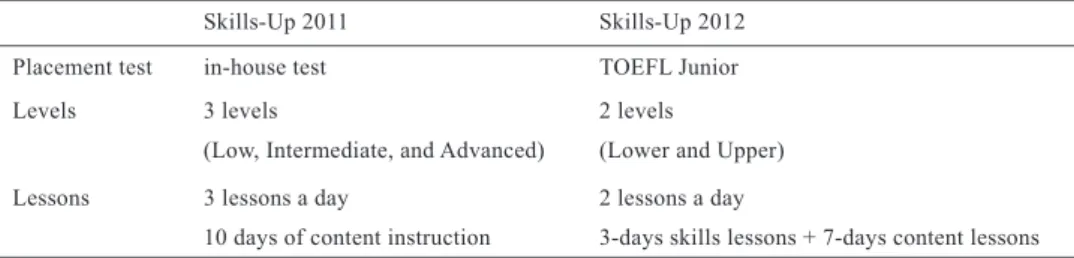
Based on the results of the program evaluation on Skills-Up 2011, several changes were implemented to the Skills-Up 2012 program in order to meet the purpose and objectives of the program.
Table 3 Changes implemented
Skills-Up 2011 Skills-Up 2012
Placement test in-house test TOEFL Junior
Levels 3 levels
(Low, Intermediate, and Advanced)
2 levels (Lower and Upper) Lessons 3 lessons a day
10 days of content instruction
2 lessons a day
3-days skills lessons + 7-days content lessons
One of the biggest issues was that students were confused with their placement for the regular curriculum. In order to avoid this confusion, the placement test of the Skills-Up and the placement test for the regular curriculum must be in a similar format. Therefore, a TOEFL-style test was chosen for the 2012 Skills-Up placement test. This was compatible with Academic Office’s interest in using TOEFL Junior run by an outsourced company, Global Communications and Testing (GC&T). Basic skills lessons including classroom English and computer literacy were given for the first three days while waiting for the test results from GC&T.
Because of teacher availability, nine classes were offered for the 2012 program, and due to the lower number of applicants this year, in addition to the incoming students who were accepted with Admissions Office (AO) examination, the Skills-Up program was also advertised to the students who were accepted through the general entrance examination. As a result, 139 students signed up for the Skills-Up 2012. Of those, approximately 80% were accepted through the AO examination and 20% were accepted through the general entrance examination. As the general entrance exam takers were assumed to have higher proficiency than AO exam takers, the lead teacher and the AO staff decided to have five lower level and four upper level classes. Two levels were offered instead of three levels because of the results of the 2011 program evaluation. Moreover, students take two 95-minute English classes a day at most in the regular curriculum; therefore, students took two lessons a day in 2012, instead of the three lessons a day in 2011.
As the lead teacher communicated with an AO staff member directly and closely, management of the program and implementation of changes for improvement were carried out more efficiently. Also, the lead teacher held a meeting with all English teachers of the Skills-Up program and shared information for clearer understanding of the purpose and goals of the program.
Student Survey Results
In order to understand students’ perception of Skills-Up 2012 and to further improve the program, a student survey was conducted on the last day of Skills-Up. The questionnaire was written in Japanese in order to avoid misunderstanding of questions, and 114 students completed the survey.
Figure 3 Figure 4 Figure 5
Perception on non-content lessons Perception on English lessons Perception on the difficulty of the course
As can be seen in Figure 3 and Figure 4, overall, students showed a positive attitude towards the lessons, and 96% said the 3-day non-content lessons were useful. Similarly, 99% said English content lessons were useful. As for the level of English classes, 56% answered it was difficult and 44% said it was easy (See figure 5).
Students commented on the 3-day non-content lesson as follows:
• I learned very useful phrases and expressions that I am definitely going to use in class and on campus. • I could reduce anxieties and felt confident in speaking English in front of people and felt more comfortable
speaking to others in English.
• I didn’t know much about computers, so it was a very useful lesson. • All lessons were too basic.
• I knew most of the things, and everything we did was too easy. Students commented on English content lessons as follows:
• It was fun. I am more motivated to learn English. • I feel I am prepared for English only lessons. • It was a good opportunity to review basic grammar. • It was interesting to learn English grammar in English. • I improved my speaking and listening skills.
• I enjoyed speaking in front of people and giving presentations. • Everything was too easy.
Students commented on the difficulty of English level as follows: Upper group:
• It was very easy because it was junior high school level.
• The contents and exercises were easy, but the English only lessons were difficult. • It was just the right level.
• I could manage because teachers spoke slower, rephrased, repeated, and used gestures when students didn’t understand.
Lower group:
• I was placed in the lower class, so it was very easy. • I felt the level was right for me.
• Everything (teacher’s instruction and instructions in the textbooks) was in English, so it was somewhat challenging although the lesson content itself was easy.
• I couldn’t follow English only instruction.
Teacher Survey Results
Overall, teachers felt that the program ran much better than it had in the previous year although 3-day non-content lessons were more than enough, and they preferred to have more days for the English content course. One teacher who taught the Skills-Up for the first time commented that he was able to target more appropriately the students’ levels from the second week because placement had been finalized by that point, but there were still some anomalies with either very high-functioning students or those operating at a somewhat lower level. This may be a reflection of the classes being split by skill and being taught skills which are not a core part of the placement test, i.e. speaking.
Spring Semester 2012 Placement of Skills-Up Participants
The author tracked the Skills-Up participants in the English course in spring semester 2012 and found that 64% were placed into Elementary English Course (See Figure 6). In the lower level, 86% were placed in Elementary English, and 14% were placed in Pre-Intermediate English. As for the upper level, half of the students were placed in Pre-Intermediate English, which is the second lowest level of the regular curriculum (See Figure 7). Although 34% of the upper level students were placed in ELE, it seemed that students were not so confused with the placement result unlike Skill-Up 2011 students who were placed in ELE from Advanced Skills-Up class. The author personally asked her ELE students who took the Skills-Up classes, but she did not receive any negative comments although those students had been placed down from the upper level of the Skills-Up to the lowest level (ELE) of the regular curriculum. It could be inferred that placing down from the upper level of the two levels of the Skills-Up course to ELE was not as disappointing as placing down from the top level of the three levels of the earlier Skills-Up course to ELE. The data suggests that having two levels instead of three was appropriate.
Figure 6 Spring Semester 2012 enrollment Figure 7 Spring Semester 2012 enrollment of Skills-Up participants (N=135) of Skill-Up participants (N=135) in each level
Suggestions for next year, Skills-Up 2013
Skills lessons (conversation and computer) were offered for three days while waiting for the TOFEL Junior test results, which the Academic Office decided to use this year. Three days of non-content classes seemed to be more than enough and seven days of content lesson were not enough. The author developed the materials and she suggested lesson plans for the first three days. However, some teachers felt that there were not enough materials for the conversation lessons and one or two lessons for the computer literacy were sufficient. In addition, the 2-week Skills-Up program requires students to buy two course books which are designed for a one-semester course. Teachers were asked to cover as many chapters as possible by the coordinator
so that students would not think they had to buy the expensive books to study only a few chapters. Therefore, teachers felt that seven days were not sufficient to cover enough chapters of the textbook to satisfy students. It would be better to get the test results sooner or not to use TOEFL Junior as a placement test in order to have more content lesson days. Moreover, since TOEFL Junior is a proficiency test, it is not suitable to use it as a placement test. In order to avoid students’ misunderstanding and confusion about their level as we had in the past, the placement test for Skills-Up and the English curriculum placement test should be similar in their features. If the CLE decides to use an in-house developed placement test for AY 2013 as planned, I strongly suggest not using TOEFL Junior for Skills-Up because the new in-house placement test does not have a TOEFL style. It would be better to develop our own test to place students in appropriate levels, and I suggest having a speaking component. There were mixed levels of speaking, writing, and reading ability in the same class as one of the teachers specifically commented. More specifically, returnee students who grew up in English speaking countries have a strong ability in speaking, but they are relatively weak in writing and grammar compared to other students who received their English education in Japanese high school. On the other hand, some students were strong in grammar but weak in speaking. Given that there were mixed abilities in different skills, it would be better to invest in developing a test with a speaking component and allow students to take different level skill classes; i.e. upper level for speaking & listening and lower level for writing/grammar & reading. However, to administer a speaking test is not realistic due to the limited resources and time. It might be worth abandoning the placement test for the Skills Up course entirely and instead mixing all the students in one level. By utilizing peer tutoring practice, students could encourage each other and learn from their peers.
4. Conclusion
The evaluation process produced useful findings that can guide the decision-making of the program’s stakeholders, especially the lead teacher and the AO staff, who are directly involved in the development and management of the program. Although the coordinator of the Skills-Up is not involved in the actual management of the program, she can also use the evaluation findings to approve the necessary changes and suggestions made by the lead teacher. The findings should be made available to the program coordinator, new lead teachers, and also any new teachers to improve the facilitation of the Skills-Up English courses.
References
Norris, J.M. (2006). The why (and how) of student learning outcomes assessment in college FL education. Modern Language Journal, 90(4), 590-597.