Intercultural Training in the Foreign Language
Classroom : Using Video to Develop Cultural
Awareness and Cultural Self-awareness of
Japanese College Students
journal or
publication title
関西学院大学社会学部紀要
number
120
page range
147-157
year
2015-03-15
URL
http://hdl.handle.net/10236/13728
Introduction
“Globalization” has become a buzzword that draws people’s attention in various fields throughout the world, and the field of foreign language education is not an exception. Nowadays, teaching foreign language is expected to reflect on language and culture in an integrated way with a view to preparing learners to use a foreign language in intercultural contact situations. For instance, Martinez-Gibson (1998) argues that if cultural information is not taught as part of communicative competence, complete communication may not happen. Kramsch (1998) points out that it is important to teach culture in for-eign language classes in order to avoid miscommunication. These statements emphasize a close rela-tionship between foreign language teaching and intercultural communication.
In an intercultural context, because of the difficulty of making a firm decision about the way we behave, it becomes necessary to expand our psychological framework and make judgments by taking the other person’s perspective. Under these circumstances, the ability to show empathy to the other person becomes indispensable. Especially, in regard to English language education in Japan, these goals have been promoted since the teaching methodology shifted from an audio-lingual approach to a communicative approach that regards foreign language learning as a communication activity.
The purpose of this paper is to introduce one of the author’s college-level English classes whose focus is on intercultural communication education, and examine its learning effect on the students. Be-fore introducing this class and exploring its learning effect in detail, this paper briefly reviews the methods of intercultural training and the effects of using visual media material as a training tool. Review of the Methods for Intercultural Training
In general, intercultural training methods are based on the three elements of learning, namely, “cognitive”, “affective” and “behavioral” components. According to Bennett (1986), there are “culture general” and “culture specific” approaches concerning the contents of training. In a “culture general” approach, trainees learn that cultural variations exist in people’s perspectives, and that these differ-ences affect their behavior and their way of interaction with others. On the other hand, in a “culture
Intercultural Training in the Foreign Language Classroom:
*Using Video to Develop Cultural Awareness and Cultural Self-awareness of Japanese College Students
Noriko NAKAGAWA
**Takehiro FUJIHARA
***─────────────────────────────────────────────────────
*Key words: foreign language education, intercultural training, visual media material **
Professor, School of Service Industries, Ryutsu Kagaku University
***Professor, School of Sociology, Kwansei Gakuin University
specific” approach, a specific culture becomes the focus of study, and trainees learn patterns of behav-ior and perspectives which are appropriate for the target culture.
Table 1 shows a “Typology of Intercultural Training” (Fowler & Blohm, 2004). In the class con-ducted by the author, a “culture specific” approach with a combination of “didactic culture-specific” and “experiential culture-specific” technique was adopted. In her class, the students watched a video-taped “critical incident,” analyzed the issue of intercultural communication implied in it, and explored possible solutions through self-reflection and group discussions. An important point is that critical in-cident does not illustrate cultural differences in an explicit manner, but that these are discovered or re-vealed as part of the exercise in the class (Wight, 1995). In the training, trainees engage in both pas-sive and active learning activities with medium risk, the emphasis of which is on cognitive and affec-tive components of learning.
Mizuta (1990) introduces three types of approaches in an intercultural training method (Fig. 1.). In the current class, the author used “culture-focused training” in a “cognitive-affective approach” and analysis training” in “cognitive approach” in order to achieve the course goal. In “context-analysis training,” trainees watch an audio-visual material, such as video, and analyze the intercultural context illustrated in it. Then, through discussion, trainees discover that an individual’s cognitive
proc-Table 1 Typology of Intercultural Training (Fowler and Blohm, 2004, p.40)
Didactic Experiential Didactic culture-general Experiential culture-general Experiential culture-general Didactic culture-specific Experiential culture-specific Experiential culture-specific
Fig. 1 Category of Intercultural Training
(*The diagram was created based on Mizuta, 1990)
ess and their perception are culturally bound.
On the other hand, “culture-focused training” is used to deepen trainees’ cultural self-awareness. The “Contrast American Method” developed by Stewart (1966) is one example. In this method, the target of training is set for U.S. Americans.1)
In the training session, trainees observe a role play or watch a video that illustrates the interaction between an American and someone from a different cul-ture who holds a different cultural assumption compaved to the American. Through the activities, trainees become aware that consciously and/or unconsciously people take actions based on their own cultural framework and assumptions.
The Effect of Using Visual Media Material as Training Tool
In the present author’s class, the students watched a videotaped role-play and worked on the ac-tivities led by the author as teacher-trainer.2)Using visual media material is advantageous in that it en-ables foreign language learners to experience the cultures of their target languages indirectly. Rogers and Medley (1988) state that video is one of the “authentic” materials in foreign language classes be-cause “videos offer more clues for comprehension to the students than other materials” (p.468). For in-stance, in addition to sound elements, dynamic visual contexts are provided with a variety of nonver-bal supports, such as facial expressions and gestures.
Video can also be an effective tool in intercultural training. The following examples show the strengths of using visual media materials in intercultural training: (1) Imagery allows learners to ground facts in specific settings; (2) It models behavior that trainees are to learn; (3) Recording train-ees’ practice sessions can provide feedback to them about their behavior; (4) It raises issues, attitudes, and perspectives about other countries and cultures; (5) It is a good substitute for case studies and critical incidents, as it addresses audio and visual learners (Fowler & Blohm, 2004). As described above, videos can be used for both raising awareness and teaching skills. In addition, using video can also appeal to the trainees’ affective side as well as cognitive and behavioral sides of learning. This is because “with both audio and visual components, the video settings can evoke powerful feelings in participants” (Hopkins, 1999, p.73).
The “Contrast Culture Method” is an intercultural training method based on the contrast between two cultures (Hiratsuka & Fujimoto, 2012).3) The video material using the technique of CCM was de-veloped for an intercultural communication course at a Japanese university, and its learning effect was documented (Hasegawa, 1994). Concerning the video material for a foreign language course in which an intercultural training method was implemented, teaching material which used a “cultural assimila-tor” was developed for the Japanese language learners (Misumi, 1997). However, there is a paucity of visual media materials which utilize an intercultural training method for English language courses.
───────────────────────────────────────────────────── 1)In this paper, “U.S. Americans” and “Americans” are used interchangeably.
2)In this paper the term, “teacher-trainer,” instead of “teacher/ instructor” is used. It is because in the English class where intercultural training methods are adopted, the teacher needs to play the role similar to the facilitator in intercultural train-ing.
3)For details of CCM, refer to “Hiratsuka, H. & Fujimoto, D. (2012). A training evaluation of the contrast culture method workshop for international graduate students in Japan. Intercultural Communication, 15, 93−108.”
Intercultural Training in English Language Classes
The English class which is introduced here is a 90-minute class in a course entitled “Intercultural Communication.” The goal of this course was “to deepen cultural awareness and cultural self-awareness of the students, and to nurture their positive attitude toward cultural diversity.” One of the authors conducted this class at a Japanese university in 2012, and a total number of forty-one students attended the class. In this class, a videotaped critical incident entitled “Is Silence Worth Gold?” was used as a training tool. This material was developed based on a role play which was presented at an intercultural communication workshop conducted at a university in the U.S. This workshop was con-ducted by the author and several Japanese and American students at that university. The participants of the workshop were staff of the university. The critical incident introduced here is one of the four critical incidents the author created for this workshop. The role play scripts were finalized after discus-sion with the students who were role players of the critical incidents. After the workshop, all four role plays were videotaped at the studio of this university, and later on the author developed teaching ma-terials for her English class in Japan.
The videotaped critical incident illustrated the interaction between a Japanese international stu-dent, Hideko, who was studying at an American university for three months, and her American class-mates, Nancy and Mike (Appendix). Differences in “communication style” and “cultural values” be-tween Japanese and Americans were the major themes of this critical incident.
The procedure of the class was as follows: (1) One week before the target class, the author gave the students the script of the role play and Worksheet 1 including comprehension questions about the critical incident and discussion questions. (2) The class was divided into small groups, and the stu-dents watched the videotaped critical incident once. After the teacher-trainer’s explanation about the English expressions in the role play script, the students checked the answers of the comprehensive questions in their own group, and then, in the whole class. (3) The students watched the video again, and shared their responses to the discussion questions in Worksheet 1 in their group. Next they shared their findings in the large group. (4) The teacher-trainer debriefed by giving a short lecture about “communication style” and “cultural value” based on intercultural communication theory. The lecture was given in English with a supplementary explanation in Japanese. (5) The students wrote their re-sponses to the questions in Worksheet 2. After they shared their rere-sponses in the small group, they shared the findings in the whole class. (6) The students filled in the feedback sheet about the class, and the class ended.
Effects of Using Intercultural Training Methods in Foreign Language Class
1. Results of Worksheet 1
Q 1. What kind of intercultural issues did you find in the video?
The result showed that about 49 percent of the responses (48.8%) related to “comparison between Japanese and American characteristics in interpersonal communication.” The following key words ap-peared in the students’ responses: “indirect vs. direct,” “passive vs. active,” “poor at expressing one’s own feeling vs. good at expressing one’s own feeling,” “shy vs. friendly,” “being polite (tatemae) vs. being honest (honne).4)” About 40 percent of the responses (39.5%) related to “Japanese characteristics
in interpersonal communication,” such as “The Japanese do not assert themselves,” “The Japanese pre-fer to comply with others’ opinion”. Finally, about 5 percent of the responses (4.7%) related to “American characteristics in interpersonal communication,” such as “Americans assert themselves strongly” and “Americans are decisive.” The rest of the responses were not categorized into any of the above (7.0%).
Q 2. What do you think Hideko may have felt about Nancy and Mike’s behavior?
The result showed that about 68 percent of the responses (67.6%) related to an “affective re-sponse.” The following are the examples of the students’ comments: “She was confused,” “She was embarrassed,” “She felt isolated,” “She felt overwhelmed,” “She was surprised,” “She felt uncomfort-able,” “She felt strange.” About thirty-three percent of the responses (32.4%) related to a “cognitive response,” which showed characteristics of Americans in general. For example, “They are assertive,” “They are super energetic,” “They are friendly,” and “They are casual.”
Q 3. What do you think Nancy and Mike may have felt about Hideko’s behavior?
About 64 percent (64.4%) of the responses related to a “cognitive response,” that is, their under-standing about Hideko’s behavior. For example, “She is indecisive,” “She doesn’t express her thoughts,” “In fact, she doesn’t want to go out with Nancy and Mike,” “They can’t understand Hideko,” “She is irresponsible.” The rest of the responses (35.6%) related to an “affective response,” that is, their feelings about Hideko’s behavior. For example, “They felt uncomfortable,” “They felt ir-ritated.” Here, it is notable that more “affective” responses were found when the students reported Hideko’s feelings while more “cognitive” responses were found when they reported the feelings of Nancy and Mike. This result suggests that the students tried to project themselves into Hideko by em-pathizing with her thoughts and behavior.
Q 4. Find the English expressions in the role play script which, you think, illustrate Japanese and/or American communication styles.
Here, the phrases, such as “Oh, yes, anytime,” “No, nothing special,” “Friday…,” “Oh, yes” were reported as the examples of Japanese communication style while “You said, ‘anytime,’ so I just said, ‘Friday,’” “Sounds good” were reported as the examples of American communication style.
2. Results of Worksheet 2
Q 1. What do we need to keep in mind in order to tackle similar intercultural issues illustrated in the video in the future?
About thirty-seven percent of the responses (36.8%) related to “solutions for the issue of intercul-tural communication in general.” The following are excerpts from the students’ responses: “Study one’s own culture and the other’s culture,” “Study nonverbal communication,” “Do not stick to one’s own cultural assumptions and social customs,” “Be conscious of the usage of verbal expressions in one’s own culture and consider their meanings in different cultures,” “Prepare for possible misunder-standings in intercultural contexts.” About thirty percent (30.1%) related to “advice for the Japanese
───────────────────────────────────────────────────── 4)Judging from the comments written by the students, it became clear that the former word indicated Japanese
characteris-tics while the latter indicated American characterischaracteris-tics.
students who go to the U.S. for study abroad in the future.” Here, most of the responses were catego-rized into “communicate one’s own thoughts and opinions clearly.” Another thirty percent (30.1%) re-lated to “advice for Americans who host international students from Japan,” for instance, “show con-cern for the students” and “interact with the students patiently.”
Q 2. What do you think about the Japanese proverb, “Silence is gold?”
“Is silence worth gold?” was the title of this critical incident. Q 2 was asked to see the students’ attitude toward the traditional Japanese proverb, “Silence is gold.” Over fifty percent of the responses (52.2%) indicated that “keeping silent in public can be either good or bad depending on the context,” which indicated that the students had a neutral attitude toward this proverb. One student stated, “if my communication partner is from my culture, keeping silent can bring a good result. But when we are from different cultures, we cannot communicate successfully without words.” Another student re-sported:
As the proverb, ‘Least said, soonest mended’ goes, silence had been treasured since old times in Japan, and it had a positive meaning. I think this proverb is wonderful because silence is also a means of communication. However, in foreign countries we can communicate our thoughts to others only through verbal communication. Therefore, we should know that this proverb is not universal. I think both of us are just trying to be polite in our own way.
About thirty-eight percent of the responses (37.5%) related to the “importance of communicating one’s own thoughts verbally.” One student stated, “the message in this proverb might be correct, but I think this way of thinking created the Japanese characteristic which refrains from telling one’s own thoughts in public.” Another student stated, “We do not feel comfortable in silence. The only time we feel comfortable in silence is when we are with someone we can feel at ease with. So, I can’t support this proverb.” Finally, about 10 percent of the responses supported the implied message of this prov-erb.
3. Results of the Feedback Sheet
Ninety percent of the responses showed positive feedback in regard to using the video in this class. Sixty-six percent indicated that using the video helped the students’ understanding of the critical incident. The following are excerpts from the students’ responses: “Rather than use only the written script, we can grasp the atmosphere and context of the story better,” “Because the video describes the context more clearly, we can analyze the case from the characters’ viewpoints,” “Visual images we re-ceive from the video can remain longer in our memory,” “Using video is useful for understanding the context and the contents of the story better because we can observe the characters’ facial expression, gestures and tone of voice,” “Using video is important in reading the mind of the characters in the role play,” “We can feel sympathy with the characters,” and “We can improve our listening ability.” The reported advantages of using video in the class were consistent with the findings of the past re-search. (Rogers & Medley, 1988; Secules, Herron, & Tomasello, 1992).
Further Analyses Using Two Models
In this final section, by applying Kolb’s “Experiential Learning Cycle” (Kolb, 1984) and Mu-rata’s “Model for Instructional Design Using Visual Media Materials” (Murata, 2013), to the present
class, the authors will make a further analysis of the effect of the current class.
Analysis using Kolb’s Experiential Learning Cycle
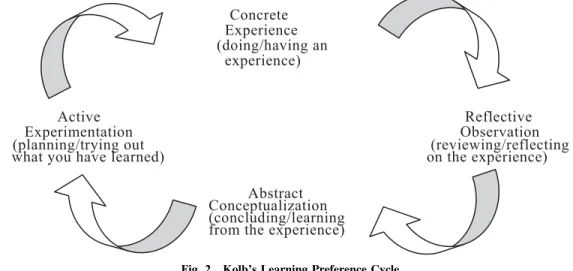
This framework addresses the four learning styles, namely, “Concrete Experience,” “Reflective Observation,” “Abstract Conceptualization,” and “Active Experimentation” showen in Fig. 2. Since the students in the current class began their study by watching the videotaped critical incident, it can be said that this class started with “concrete experience.” Then, the students engaged in “reflective obser-vation” by engaging in a variety of class activities, including analyzing the IC issue illustrated in the critical incident by working on Worksheet 1 and sharing their opinions through discussion. In “abstract conceptualization,” the teacher-trainer debriefed the class by giving a lecture on cultural values and communication styles based on IC theory. Finally, in “active experimentation” the students worked on Worksheet 2 and tried to seek solutions for the IC issue by relating the critical incident to their real life situation.
Certain cultural groups prefer certain learning styles (Fowler & Blohm, 2004). For example, con-sidering that generation is an example of subculture within the mainstream culture, it can be said that there is a difference in a preferred learning style between adult learners and college students. Other than individual differences, especially for adult learners who are not familiar with experiential learn-ing, starting from “concrete experience” may provoke resistance to further learning. On the other hand, in the case of college students, by beginning the learning cycle with “concrete experience” and giving them a fun surprise, it will be possible for the teacher-trainer to promote their affective learning, one of the important goals for foreign language class whose focus is on intercultural communication edu-cation.
Analysis Using Murata’s Model for Instructional Design Using Visual Media Materials
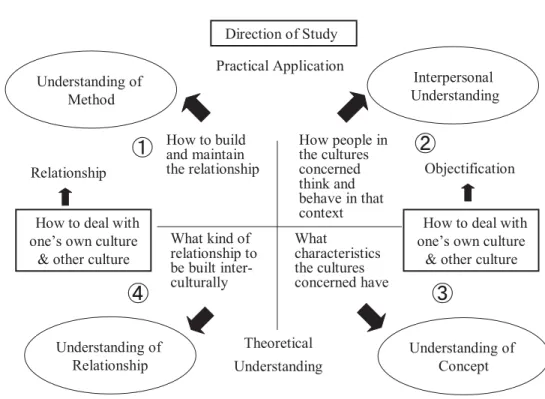
Murata’s model (2013) indicates four patterns of educational targets (Fig. 3). A horizontal line is related to “how to deal with one’s own culture and other’s culture,” which focuses on either “relation-ship” or “objectification,” while a vertical line is related to “direction of study,” which focuses on either “practical application” or “theoretical understanding.” Murata points out that more than two
pat-Fig. 2 Kolb’s Learning Preference Cycle
(Based on Kolb, 1984)
terns can apply to one teaching material. In this case study, Patterns 1, 2 and 3 are applicable. A ma-jor element of Pattern 2 is “interpersonal understanding,” which is related to “practical application.” In the current class this pattern is equivalent to analyzing behavior and thinking patterns of the characters in the video. A major element of Pattern 3 is “understanding of concept,” which is related to “theoreti-cal understanding.” In the current class this pattern is equivalent to analyzing general characteristics in communication styles and cultural values of Japanese and Americans. Lastly, a major framework of Pattern 1 is “understanding of method,” which is related to exploring solutions for the issue of inter-cultural misunderstandings. In the current class, by exploring their thoughts on “how to build and maintain the relationship” with U.S. Americans, the students were able to gain the ability of not only objectifying the cultural components of two cultures, but also understanding them in relation to the re-lationship between Japanese culture and American culture. Although Pattern 4 wasn’t explored in the current class, by using visual media materials that tackle such themes as multi-nationalization, interna-tional conflict and racial issues, students will be able to deepen their understanding and acquire a meta level point of view about intercultural issues.
Conclusion
In the English class introduced in this paper, a “culture specific” approach was used. The pitfall that a teacher-trainer should note is that in dealing with culture in any educational setting, there is al-ways the possibility of producing cultural stereotypes among the students. By using video as a teach-ing tool, this risk may be even more highlighted. Paige and Martin (1996) argue that “the most impor-tant facilitation skill is the ability to debrief, which means being able to place learning into a
concep-Fig. 3 Model for Instructional Design Using Visual Media Materials
(*Based on Murata, 2013)
tual perspective” (p.55). In the current class, during the debriefing session the author pointed out that the critical incident shown in her class did not completely describe Japanese and American’s behav-iors. She further emphasized that because of the cultural differences in appropriate behavioral manners, conflict always exists whenever two cultures come into contact.
The analysis of the students’ feedback to the class activities demonstrated that the students ac-quired a certain degree of cultural awareness and cultural self-awareness. In this sense, the present class was successful to some extent. However, in order to observe a positive effect on students’ learn-ing further, it will be necessary to develop a more thorough teachlearn-ing plan for the entire course.
Considering the fact that living within diversity has become a significant theme that people in any part of the world cannot avoid facing, foreign language teachers will need to renew their view on the close relationship between foreign language education and intercultural communication education.
References
Bennett, J. (1986). Modes of cross-cultural training: Conceptualizing cross-cultural training as education.
Interna-tional Journal of Intercultural Relations, 10, 117−134.
Fowler, S. M., & Blohm, J. M. (2004). An analysis of methods for intercultural training. In D. Landis, J. M. Ben-nett, & M. J. Bennett (Eds.) Handbook of intercultural training (3rd ed.), (pp.37−84). Thousand Oaks, CA: Sage Publications.
Hasegawa, N. (1994). Ibunkakan communication kyoiku no tame no video seisaku (Producing video for intercul-tural communication education). Ibunkakan kyoiku (Interculintercul-tural Education), 8, 127−136.
Hiratsuka, H. & Fujimoto, D. (2012). A training evaluation of the contrast culture method workshop for interna-tional graduate students in Japan. Intercultural Communication, 15, 93−108.
Hopkins, R. S. (1999). Using videos as training tools. In S. M. Fowler & M. G. Mumford (Eds.), Intercultural
sourcebook: Cross-cultural training methods, 2. (pp.73−79). Yarmouth, ME: Intercultural Press.
Kolb, D. A. (1984). Experiential Learning. Englewood Cliffs, NJ: Prentice Hall. Kramsch, C. (1998). Language and Culture. Oxford: Oxford University Press.
Martinez-Gibson, E. A. (1998). A study on cultural awareness through commercials and writing. Foreign Lanuage
Annals, 31, No.1, 115−131.
Misumi, T. (1997). Nihongo gakushusha ni muketa video culture assimilator no sakusei (Producing video culture assimilator for learners of Japanese language). Kandagaigodaigaku Ibunka Communication Kenkyu
(Intercul-tural Communication Studies of Kanda University of International Studies), 10, 75−95.
Mizuta, S. (1990). Nihonjin daigakusei o taisho ni shita ibunkakan communication noryoku ikusei no ichi approach-cross cultural training no eigo kyoiku e no tekiyo (Fostering intercultural communication compe-tence of Japanese college students-Application of cross-cultural training into English education). Speech
Communication Education, 3, 1−14.
Murata, M. (2013). Ibunkakan kyoiku ni okeru eizo media donyu no jyugyo sekkei (Class design with the use of visual media in intercultural education). Ibunkakan kyoiku (Intercultural Education), 38, 16−30.
Paige, R. M., & Martin, J. N. (1996). Ethics in intercultural training. In D. Landis and R. S. Bhagat (Eds.),
Hand-book of Intercultural Training (pp.35−60). Newbury Park, CA: Sage Publications.
Rogers, C. V., & Medley, F. W. (1988). Language with a purpose: Using authentic materials in the foreign lan-guage classroom. Foreign Lanlan-guage Annals 21, 467−478.
Secules, T., Herron, C., & Tomasello, M. (1992). The effect of video context on foreign language learning.
Mod-ern Language Journal, 76, 480−490.
Stewart, E. (1966). The simulation of cultural differences. Journal of Communication, 16, 291−304.
Wight, A. (1995). The critical incident as a training tool. In S. M. Fowler & M. G. Mumford (Eds.), Intercultural
sourcebook: Cross-cultural training methods, 1. (pp.127−140). Yarmouth, ME: Intercultural Press.
Appendix Is Silence Worth Gold?
Script of the Skit
The characters are two Americans, Mike and Nancy, and one Japanese girl, Hideko. They are talking in the cafe-teria.
M=Mike, N=Nancy, H=Hideko
M: You know what? The three of us should do something together. N: Yeah, why don’t we see a movie?
M: Yeah, that sounds good.
N: Do you want to see a movie, Hideko? H: Oh, yes.
N: O.K. I’d like to see Kurosawa’s movie. It’s on at the Film Center. M: What is that?
N: Well, it’s a film with a Japanese film director. So, it should be really good. It’s in Japanese, but there are English subtitles. For me, I want to see how good my Japanese is, so, I’ll see if there are any phrases I could understand.
(To Hideko) Would you like to see that, or do you have any film you’d like to see? H: Oh, no nothing special. Kurosawa’s movies are popular in Japan.
M: O.K. Let’s see it, then. When should we go? I’m free tonight. And I’m free all weekend.
N: Oh, I have something to do on Sunday, but other than that, I’m free. Uh, what about you, Hideko? H: Oh, yes, anytime.
M: O.K. How about Friday night after classes?
N: O.K. Good. The films start at five and seven. I’d rather go at seven. M: O.K.
H: Friday…
N: Is something wrong with Friday?
H: Yes. I’m invited by my host family for dinner on Friday. N: Shucks.
M: Oh, you said, “Anytime,” so I just said “Friday.” Well, ah, how about Saturday? N: Yeah.
H: Yes, I’m fine.
M: O.K. The movie starts at seven. So, we should probably meet around six thirty, say, ah, here. N: O.K. Yeah. Sounds good to me. Ah, what about you, Hideko?
H: Yeah, here, Saturday, and six thirty. M: Right. Great.
N: That sounds good. That’ll be great. H: Ah, I have a class, so I have to go now. N & M: O.K. See you.
H: See you on Sunday.
N & M: No, on Saturday. See you, bye. ………
N: (To Mike) You know what? M: What?
N: I have a feeling like she’s not really interested. I’m not sure if she wants to go with us. M: Yeah. I thought so, too.
Intercultural Training in the Foreign Language Classroom:
Using Video to Develop Cultural Awareness andCultural Self-awareness of Japanese College Students
ABSTRACT
English education in Japan long ago shifted its focus from the grammar-translation method as a way to acquire knowledge of English to using communicative approaches regarding foreign language learning as a communication activity. Foreign language education and intercultural communication education share important goals, and current high school and university English education not only adopts methods based on applied linguistics and/or TESL, but also conducts classes based on intercultural communica-tion and intercultural training.
This paper introduces a college-level English class whose focus was on intercul-tural communication education. A videotaped critical incident was created by one of the authors and used in her English class in order to develop the students’ cultural awareness and cultural self-awareness. After the students watched a 4-minute vide-otaped role play, which illustrated a cross-cultural interaction between Japanese and American college students, they worked on the class activities. Analyses of the stu-dents’ responses to the questions in accompanying worksheets and a questionnaire ad-ministered after the class revealed that the students acquired a degree of cultural aware-ness and cultural self-awareaware-ness through this class. In the final section of the paper, by applying her English class to Kolb’s “Experiential Learning Cycle” (Kolb, 1984) and “Model for Instructional Design Using Visual Media Material” by Murata (2013), the authors will make a further analysis of the conducted class, and explore an effective design of English classes that targets intercultural communication education.
Key Words: foreign language education, intercultural training, visual media material