Semi-Automatic Generation of Users’
Desired Face Image
(ユーザが望む顔画像
の半自動生成)
山梨大学大学院
医工農学総合教育部
博士課程学位論文
2020
年 9 月
許 彩娥(XU CAIE)
Abstract
Face image synthesis has many potential applications including public safety, such as video surveillance and law enforcement. For example, one important application is in assisting the police to create the face image of suspects based on the memories of witnesses or victims. However, drawing an image based on descriptions of what is in one’s mind is not an easy task for the majority of people. To synthesize user’s desired face image, this thesis introduces three methods for this goal in a semi-automatic way. While the first method uses traditional hand-crafted feature, the second method employs the state-of-the-art deep neural network technique, and the third method proposes a novel generative neural network model to enhance the detailed features of faces.
The first method features a user-friendly system that can create a facial image based on user’s feedback. It can synthesize a user desired face image without questioning the user on the explicit features of the face in his or her mind. Through a dialogic approach based on a relevance feedback strategy to translate facial features into input, the user only needs to look at several candidate facial images and judge whether each image resembles the face that he or she is imagining. The experimental results show that the proposed technique succeeded in generating images resembling a face a user had imagined or memorized. However, there are some disadvantages under this method. The result sometimes is blurring and doesn’t look like the desired face exactly. Furthermore, it cannot synthesize color face image. Such drawbacks are mainly due to the feature representation. Another problem of this technique is that it fails to generate face image of completely new features inherently because of its synthesis algorithm.
Recently, with the rapid development of deep learning technology, various research areas and applications, such as computer vision, robotics, big data analysis, and pilotless automobiles, have achieved major advancements. The field of face image generation and synthesis is no exception, as it has also undergone significant developments. It especially benefits from the emergence of the Generative Adversarial Network (GAN), which is a type of neural network architecture for the generative purpose. The second method employs landmark face representation to improve feature space and uses GAN technology to compensate for the low
image quality of the first method. It also allows the users to generate their desired face images in a semi-automatic way. The second method introduces a novel algorithm to create completely new face image. The second method can take full advantage of the high image quality while compensating for the lack of user intervention of state-of-the-art GAN technology. The experiment results demonstrated that the second method can generate image with much higher quality than that of the first method.
Although most of the created images by the second method can well resemble the geometric features of the user’s desired face, the resulting images fail to preserve the detail texture features of faces. For example, the wrinkles on the faces were not reproduced in the resulting images. Face texture features are an important personal characteristic, especially wrinkle is an important feature which is closely related to the person’s age. GAN-based methods for face aging also have received large attention thanks to its advantage of being able to generate exceptional realistic images. But these models mainly rely on age label or age group label. In many cases, the label is not corresponding to the real age, it is vague and inaccurate.
To the best of my knowledge, none of the existing GAN can generate face images that preserve texture features well. To generate a face image with the user’s desired texture information, as the third method, a novel framework called High-Frequency Generative Adversarial Network (HF-GAN) was proposed for synthesizing face image with texture details. High-frequency features of face image are extracted using technology of edge detection and then drawn on black background to create a high-frequency feature image. The trained generator samples face image from high-frequency feature image during runtime. For training stage, the model is guided by adversarial loss, classification loss, reconstruction loss, and perceptual loss. Further, attention mechanism was added to the generator and discriminator in order to enhance the features at face area when generating face image. The results show that the proposed method can generate face images from high-frequency features and can produce the user's desired texture information to a certain degree.
In summary, this thesis proposed a semi-automatic approach to face synthesis. The first method proposed the idea of generating face image in the user’s mind based on relevance feedback. Through a dialogic way, the user only needs to look at several candidate face image and judge them according to similarity. The second
method improved the image quality by using the state-of-the-art deep learning technology. To solve the shortcomings in the second method, a generative neural network model was explored. The proposed third method can generate face images that capture both geometry and texture information and can produce the user’s desired texture information to a certain degree.
Keywords: Face image synthesis, face image generation, relevant feedback, optimum-Path forest, deep
Table of Contents
Abstract ... I
Chapter 1 Introduction ... 1
1.1 Background ... 1
1.2 Based on Principal Component Analysis (PCA) ... 1
1.3 Based on Conditional Generative Adversarial Network ... 2
1.4 Generative Adversarial Network for synthesizing faces with the user’s desired texture features from high frequency features ... 4
1.5 Relationship between the proposed methods ... 4
1.6 Structure of the thesis ... 5
Chapter 2 Related Works... 1
2.1 Component-based method ... 1
2.2 Sketch-based method... 2
2.3 Deep learning-based method... 2
2.3.1 Face image generation using GAN ... 3
2.3.2 Face attribution control with various conditional GAN models ... 4
2.3.3 Age attribution control in GAN ... 6
2.3.4 Summary on GAN models for face image generation ... 7
2.4 Evolutionary method ... 10
Chapter 3 Based on Principal Component Analysis (PCA) ... 12
3.1 Proposed method ... 12
3.2 Constructing the feature space ... 13
3.2.1 Feature representation ... 13
3.2.2 Principal Component Analysis (PCA) ... 14
3.3 Training the optimum-path forest classifier based on relevance feedback ... 15
3.5 Registration by eyes and mouth ... 19
3.6 Experiment and discussion ... 21
3.6.1 Database ... 21
3.6.2 Experiments ... 21
3.6.3 Evaluation ... 24
3.7 Discussion and Summary ... 26
3.7.1 Discussion ... 26
3.7.2 Summary ... 27
Chapter 4 Based on Conditional Generative Adversarial Network ... 28
4.1 Proposed method ... 28
4.2 Relevance feedback framework ... 29
4.2.1 Training the OPF classifier ... 30
4.2.2 Creating the candidate landmarks ... 31
4.3 Generative model for synthesizing face images (GP-GAN) ... 34
4.4 Experiment and evaluation ... 35
4.4.1 Datasets and implementation details ... 35
4.4.2 Experiments ... 36
4.5 Discussion and Summary ... 45
4.5.1 Discussion ... 45
4.5.2 Summary ... 46
Chapter 5 Generative Adversarial Network for synthesizing faces with the user’s desired texture features from high-frequency features ... 47
5.1 Proposed framework ... 47
5.1.1 Generator ... 48
5.1.2 Discriminator ... 49
5.1.3 Variants of residual block ... 49
5.1.4 Training objectives ... 50
5.2.1 Database ... 52
5.2.2 Training strategy ... 53
5.2.3 Experiments ... 53
5.3 Discussion and Summary ... 56
5.3.1 Discussion ... 56
5.3.2 Summary ... 56
Chapter 6 Conclusion and Future Work ... 58
6.1 Conclusion ... 58
6.2 Future work ... 58
Acknowledgements ... 60
Chapter 1 Introduction
1.1 Background
Face image synthesis has been wildly used in various applications including identity matching and confirmation, law enforcement, entertainment, and so on, especially, in public safety, such as video surveillance and law enforcement. For example, identifying criminals benefit from the automatic face synthesis technique for creating the suspect portrait according to the description of the eyewitness. Moreover, a similar technique can be used for giving concrete form to imagined ideas of romantic ‘types’ and translate other imagined faces into explicit images. However, drawing an image based on descriptions of what is in one’s mind is not an easy task for the majority of people. There are a great many studies for face synthesis in the past few decades including component-based [1-9], sketch-based [10, 11], iteration-based [12-16], and deep-learning based methods. The most representative one is Generative Adversarial Network (GAN)-based methods [17-32]. Motivated by the above-mentioned potential applications, three methods were developed to synthesize the image of a face from a user’s imagination and memory through some simple user interactions and a generative model based on GAN was explored to improve the quality of resulting images.
1.2 Based on Principal Component Analysis (PCA)
Although the montage approach to face image synthesis [1-9] allows users to create face images by selecting face components in sequence, it involves the time-consuming task of choosing the right parts from a wide array of options. It is known that the composition of face parts is a more important factor in the perception of a face than the individual parts [10][11]. However, it can be very difficult to adjust the positions of individual parts to achieve a desired composition. Several methods have been developed for synthesising face images according to sketches [10][11]. Such methods, however, require the user to provide a sketch, which is not always a possibility and are still difficult for average person.
Motivated by the above-mentioned potential applications and the limitation of montage and sketch-based synthesis technologies, a system that can generate an image of a face from a user’s imagination and memory based on the user’s feedback was developed. In this system, a set of example images are used to train an Optimum-Path Forest (OPF) [33] algorithm to classify the face images based on their relevance to the face in the user’s mind. The training process is conducted through a relevance feedback approach. All the user need to do under this method is to indicate whether the image of the face shown bears a general resemblance to the face that he or she is imagining, thereby eliminating the need to evaluate individual parts and features separately (as is the
case with the montage approach) or visualise or verbalise specific characteristics (as is the case with caricatures). The details of this method will be described in Chapter 3.
1.3 Based on Conditional Generative Adversarial Network
Recently, with the rapid development of deep learning technology, various research areas and applications, such as computer vision, robotics, big data analysis, and pilotless automobiles, have achieved major advancements. The field of face image generation and synthesis is no exception, as it has also undergone significant developments. In particular, the emergence of the generative adversarial network (GAN), which is a type of neural network architecture for the generative model first proposed by Goodfellow et al. in 2014 [17], brought about a major breakthrough in the field of face image generation. GAN consists of two networks: the generator that creates as realistic data as possible and the discriminator that attempts to distinguish fake samples from real ones. The two networks compete with each other during the training process, resulting in a generator that can produce realistic data.
Since the very first GAN model [17] demonstrated its ability to generate face images, various improved models have been developed. The face images generated with [17] are fair random draws, not cherry-picked, and are poor-quality grayscale images. To gain some control over the generated results, Mehdi and Simon proposed the conditional generative adversarial network (CGAN) in the same year, which allows inputting a condition to the model in addition to the noise [20]. This model set a solid foundation for the emergence of various variants of GAN. In 2015, Jon Gauthier et al. proposed the use of CGAN for convolutional face generation [21], which added to CGAN the capability of generating face images with specific attributes, such as race, age, and emotion, by varying the conditional information. Grigory et al. proposed the Age-GAN [22] for automatically simulating face aging based on CGAN; Age-GAN particularly emphasizes the preservation of the original person’s identity in the aged version of his/her face image. The Two-Pathway Generative Adversarial Network (TP-GAN) [34] was proposed by Rui et al. in 2017 for realistic face synthesis. It is mainly used for reconstructing face images from a partial view corresponding to different poses. The most recent variant, Style-GAN [29], which was proposed by Tero et al., led to an automatically learned, unsupervised separation of high-level attributes, and it can synthesize high-quality face images with varying high-level attributes, such as different hairstyles and expressions. However, it considers stochastic variation and does not have the ability to control such attributes. Xing et al. focused on high-level face-related analysis tasks and proposed gender-preserving GAN (GP-GAN) [27], which could synthesize corresponding face images from landmarks; the feature points represent the geometric information of the overall shape and the individual parts of the face. Although controlling the geometric features, such as the pose, the shape of the face, and individual facial parts, is possible with GP-GAN, it requires the landmarks as input. The application of GP-GAN is therefore limited without providing users a method to create the landmarks of their desired face.
Bontrager et al. [32] proposed an approach based on Wasserstein GAN [18] and interactive evolutionary computation [15] to produce an image resembling a given target. The user is asked to evaluate a set of images resulting from GAN, and a genetic algorithm is used to modify the latent vector based on the user’s evaluation. This is the first work that demonstrated the potential of using the evolutionary algorithm to generate face images similar to the target faces. However, their evaluation experiment reported that the average score of the results was only 2.2 out of 5. Furthermore, the method cannot provide control over detailed facial features.
The experimental results from PCA based method, which is proposed in the first method, show that the proposed method succeeded in generating images resembling a face a user had imagined or memorized. However, the result sometimes is blurring and doesn’t look like the desired face exactly. The proposed method cannot synthesize colour face image. Such drawbacks are mainly due to the feature representation. A global feature space based on PCA is employed, which fails to capture the personal detail well, causing the generated face quite similar to the average face. Another problem of this technique is that the results are synthesized from the linear interpolation of the top 𝐾 of user favored face images and it fails to generate face image of completely new feature. Taking into account those mentioned disadvantages of the method based on PCA, this thesis explored the potential of using generative neural network model to improve the face representation.
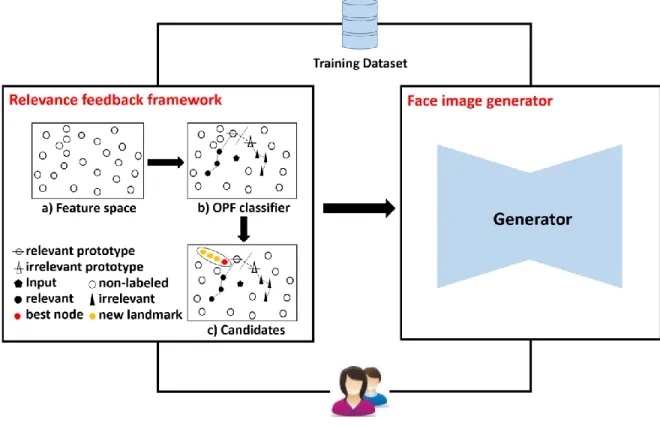
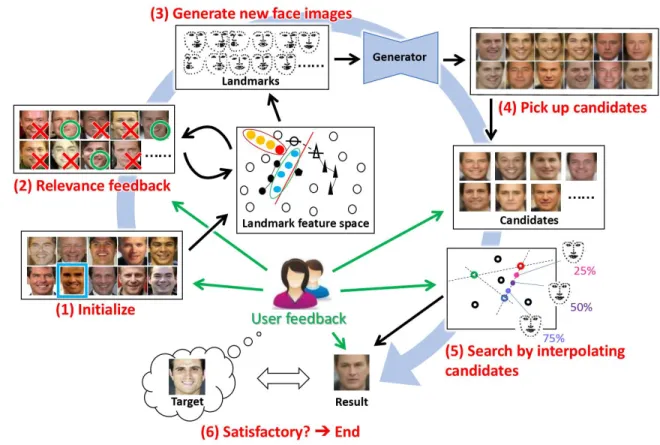
To the best of my knowledge, none of the existing GAN models can provide users with easy control over detailed facial features, such as the shapes and positions of individual parts of the face. As mentioned at the beginning of the thesis, the ability to control detailed facial features is required in many applications. In Chapter 4, a method combining Gender Preserving Generative Adversarial Network (GP-GAN) and relevance feedback was proposed for interactive face image generation. Similar to the first method, an optimum-path forest (OPF) classifier is used to define the desired facial features represented as landmarks which are face geometric information and are used to localize and represent salient regions of the face, such as overall shape, eyes, eyebrows, nose, and mouth. The classifier is iteratively updated based on the relevance feedback of users. The landmarks of the desired face are then used as the input to GP-GAN to generate realistic face images with the desired features. In this way, the proposed method can take full advantage of the high image quality while compensating for the lack of user intervention of state-of-the-art GAN technology. Experiment showed that the proposed method can generate a result similar to the target face in the user’s memory, and has higher quality compared to the results generated with the first method.
1.4 Generative Adversarial Network for synthesizing faces with
the user’s desired texture features from high frequency features
Although most of the resulting images generated with the second method can well resemble the geometric features of the reference images, the generated images fail to preserve the details of texture features. For example, the wrinkles on the faces were not reproduced in the resulting images.
Face texture features are an important personal characteristic, especially wrinkle. It is closely related to the person’s age. There are many applications related to face aging, such as cross-age face recognition, finding lost children, biometrics, cosmetology and so on. There have been large efforts in this field in the last two decades. Face aging, also called age synthesis or age progression, is defined as the rendering of a face image aesthetically with natural aging and rejuvenating effects on the individual face [30]. Age estimation means to label a face automatically with the exact age (years) or the age group (age range) of the individual face [35].
GAN-based methods for face aging simulation have received a lot of attention motived by the fact that GAN can generate exceptional realistic images. Perarnau et al. [30] reconstructs and modifies real image of faces conditioning on arbitrary attributes. Antipov et al. [31] proposed an Age-cGAN for automatic face aging. It can preserve the original person’s identity in the aged version of his/her face. Wang et al. [22] proposed an IPCGANs framework, which synthesizes a face lies in given age group instead of a specific age. These previous GAN-based models fail to captures long-range dependencies of entire image since they rely heavily on convolution. To fix this problem, Cheng et al. [36] proposed Self-attention technology. Zhang et al. [37] developed Self-Attention GAN (SAGAN) by introducing self-attention mechanism into convolutional GAN to generate high-resolution details from feature locations. All existing models, however, mainly rely on age labels or age group labels. In many cases, the age labels do not correspond to the real age, it is vague and inaccurate.
As the third method proposed by the thesis, In Chapter 5, High-Frequency Generative Adversarial Network (HF-GAN) is introduced for synthesizing faces with the user’s desired texture features. Meanwhile, to preserve semantic and perceptual characteristics of real image, perceptual loss was introduced for guiding model. Besides, a self-attention mechanism was added to HF-GAN model so as to focus on the face features when generating the image. By inserting self-attention into the generator and discriminator, the former can generate face images with fine details at every location, the later can more accurately distinguish the real data and generated images.
1.5 Relationship between the proposed methods
To generate the face image that is a face image in the user’s memory or imagination, three methods are proposed. In the first method, the basic concept of using relevance feedback approach is proposed. By applying
PCA to extract face features from the training dataset, global feature space is constructed. OPF classifier is employed for quickly retrieving the best nodes that reflect the user’s feedback. A new candidate is computed by interpolating top 𝑘 best nodes. A final face image is synthesized from the principal components. With the first method, the results have some quality problems such as blurring. It can only synthesize grayscale face image and fails to a create completely new face image since the result is synthesized from the linear interpolation of the top 𝑘 user favored face images. To overcome these disadvantages, the second method improves the first method from three aspects: face representation, algorithm for creating candidates, and face image generation. The second method employed landmark features for face representation. New candidates are created by moving the best node alone a direction vector toward the user’s desired face image. Advanced deep learning technology, GAN model, is used for face generation to achieve high quality result. The second method largely improves the quality of the results, can generate colour face images, and can create new face images that is not in training dataset. However, it fails to capture the details of texture features such as wrinkles. Aim to generate face images with the user’s desired texture features, the third method explored a generative model. Meanwhile, it can preserve semantic and perceptual characteristics of real image by introducing perceptual loss. And by adding a self-attention mechanism, the face features can be more clearly captured when generating the image.
1.6 Structure of the thesis
This thesis is organized as follows.
In Chapter 1, the research background and research goals were briefly introduced. Then, I concisely explain the three methods proposed to achieve this target. Finally, the structure of the thesis is described.
In Chapter 2, the related works of face image generation, including traditional methods and deep learning approaches, are reviewed. I will clarify the relationship between my methods and those existing methods, trying to answer why the three methods are necessary; how to take full advantage of related technologies; how to overcome the disadvantages; how to make the improvement.
In Chapter 3, the first method, synthesising user’ desired face image based on PCA, is explained in detail. The method includes three major components: extracting primary features, training an OPF classifier based on relevance feedback, and synthesising face images. The feature space is constructed by applying PCA to 1,000 sample images. An Optimum-Path Forest (OPF) classifier is then dynamically trained based on the user’s feedbacks. Based on the trained OPF classifier, the candidates of the user’s desired face images are retrieved and interpolated to synthesize a new face images supposed to be the user imagined one.
In Chapter 4, I make a detailed introduction to the second method: generating users’ desired face image using CGAN and relevance feedback. Compare to the first method, two core parts have been improved: the feature representation and the technology of face generation. Besides, I also proposed a novel algorithm for creating the new candidate landmarks of the desired face. The desired face image is generated from CGAN given the new candidate landmarks.
In Chapter 5, I propose a method for generating face images with user’s desired texture from high-frequency features. The purpose is to simulate the aging through synthesising face with wrinkles rather than with specific age tags. A novel model called HF-GAN was designed. The self-attention mechanism is added to GAN model. It is guided by adversarial loss, classification loss, reconstruction loss, and perceptual loss to enhance the texture features related to ages.
In Chapter 6, I conclude and summarize the whole thesis. Also, the future work of the research will be discussed.
Chapter 2 Related Works
While a large number of works have focused on facial recognition and identification, to the best of the authors’ knowledge, there are few studies that have been conducted on the synthesis of face images. Facial image synthesis is most prominently used in the field of law enforcement, such as generating the suspect’s face image based on the description of the eyewitness or crime victim. This work was originally performed by the artist who creates suspect’s face image by drawing or sketching after consulting with the witness or crime victim, and hence the results very much rely on the skills of professionals. In the last two decades, a number of computer-based systems for face synthesis have been developed. The most widely used systems are: FACES [1] and Identikit [2] in US, and E-FIT [3] and PRO-fit [4] in UK. Early systems mainly used component-based approach. For example, E-FIT asks the user to select individual features in isolation and then synthesizes a face image using selected features. Considering that composition of facial parts is even more important than individual parts in face perception, some systems, such as EFIT-V [15] and EvoFIT [14], allow users to interact with the system by judging whether the whole face is similar instead of independently selecting the most similar individual component. Recently, significant developments in machine learning technologies, such as GAN technology, led to major advancements in the field, which has made face image generation a current research hotspot. In the remainder of this chapter, the existing face image synthesis approaches are classified into four categories: Component-based, Sketch-based way, deep learning-based approach, and evolutionary algorithm, and roughly introduced.
2.1 Component-based method
Component-based method is also called feature-based or montage based method [3][5], which requires the user to look through a dataset of face components (eyebrows, eyes, noses, mouth, etc) in order to search for each part separately based on resemblance and composite a face image using the selected parts. Individual facial features (eyebrows, eyes, noses, mouth, etc) are selected one at a time from a large feature database and then overlaid to make the composite image. A very typical application requiring user intervention in face image synthesis is assisting the police in investigations. Electronic facial identification (E-FIT) [3] is a face image synthesis system that can produce the facial composites of wanted criminals based on eyewitness descriptions. The core concept in E-FIT is the technique of Montage synthesis. Both FACES [1] and PRO-fit [4] are also component-based methods, which contain a larger number of face components for user to select. Selected components are arranged together to produce face image. PRO-fit contains face components of different races in individual databases while FACES combines them in one single database. FACES 4.0 is the latest and most advanced version. It features with an expanded database of 4,400 facial features, hair flip, and facial details
such as moles, scars, and tattoos [6]. Identikit [7] was introduced in U.S. in 1959 for synthesizing face image by superimposing facial features drawn on transparent acetate paper. It was later optimized into multiple versions, but all follow component-based principle, selecting individual components and then fusing them into a whole face image [8][9]. Identikit 7 [2] is the newest release which can quickly produce high-resolution face image. Facial components are more detailed and produce clear face image. Identikit 7 expanded the editing tools making it possible to easily perfect the generated face image. Component-based method essentially relies on the selection of individual features in isolation. Finding the ideal parts is time consuming. Furthermore, making sure the whole synthesized face image is or is not a desired one is usually difficult even if one can ensure that each picked part is satisfactory. In my research, the similarity of synthesized face image was judged based on the entire face instead of individual components, thus it can make up for the disadvantages of the component-based method.
2.2 Sketch-based method
Unlike Component-based method, to consider the entire face for face synthesis, some researches devote to explore facial image synthesis from a sketch. Wu and Dai [10] proposed a method to synthesize face images by querying a face image database using different parts of a face sketch. The corresponding face parts with the highest degrees of resemblance are patched together to form the final image. Users can adjust the size, shape, and colour of face parts to make the resulting face more resemble the desired face. Xiao et al. [11] developed a method enabling bidirectional photo-sketch mapping, which can synthesize a face sketch from a photo and, conversely, a photo from a face sketch. However, all sketch-based methods require the user to draw a sketch, a talent that not everyone has. The average people can’t draw sketches well.
2.3 Deep learning-based method
With the rapid development of deep learning technology, various research areas and applications, such as computer vision, robotics, big data analysis, and pilotless automobiles, have achieved major advancements. Generating face image using deep learning has gained wide attention in recent years. Compared with the traditional methods, deep learning-based state-of-the-art technologies are superior in terms of high-quality results. Especially the emergence of Generative Adversarial Networks (GANs) [17] has caused a sensation in image generation. A large variety of GAN network models for various image synthesis applications have been proposed.
2.3.1 Face image generation using GAN
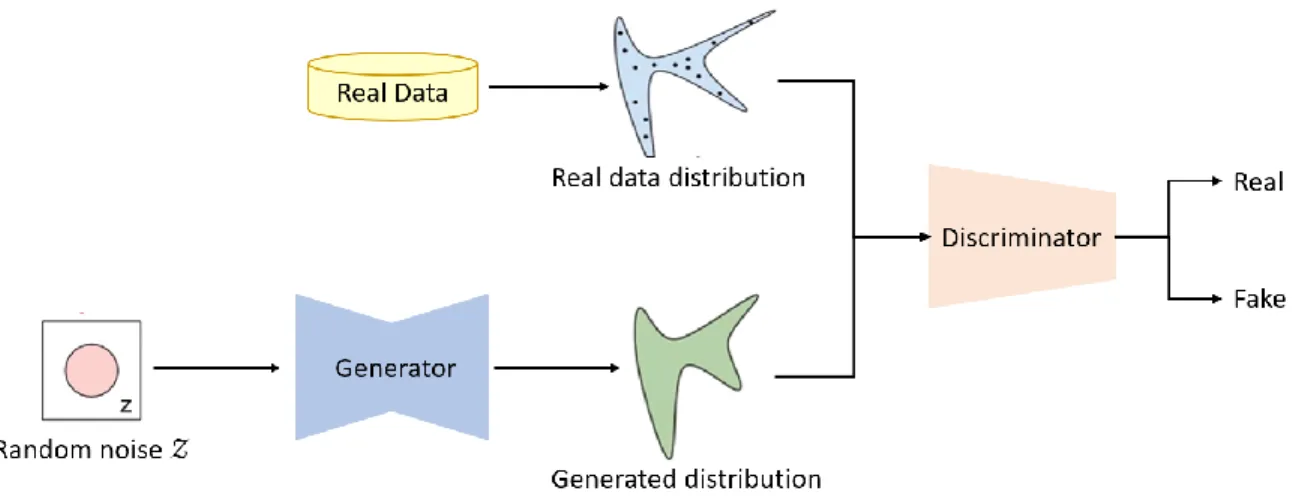
Inspired by game theory, the original GAN [17] aims to build generative models via an adversarial process. As shown in Fig. 1, it consists of a generator network 𝐺 that reconstructs the data distribution and a discriminator network 𝐷 that estimates the probability of the generated sample coming from real data rather than 𝐺, and in which 𝐺 and 𝐷 are trained simultaneously. The generator receives a random noise 𝒵 as input and generates a distribution. The discriminator receives the real data distribution or the generated distribution from the generator. 𝐺 is trained in a way that maximizes the probability for 𝐷 to make a mistake.
Figure 1. Architecture of generative adversarial network
Essentially, the goal of GAN is to generate a distribution that is as close to a real data distribution as possible. Therefore, minimizing the distance between two distributions is critical. How to measure the difference between fake data distribution and real data distribution? The objective functions, also called loss functions, are used to measure. A GAN is trained in a way to find a set of model parameters that can produce a distribution closely matching with the real data distribution.
The adversarial loss, denoted as ℒ𝑎𝑑𝑣 in this thesis, is common to all GANs. By minimizing the adversarial loss, generator is trained to generate images that are realistic. In practice, discriminator tries to maximize adversarial loss while the Generator tries to minimize it. It is basically of the form defined in equation (1):
min
𝐺 max𝐷 𝑉(𝐷, 𝐺) = 𝔼𝑥~𝑝𝑑𝑎𝑡𝑎(𝑥)[log 𝐷(𝑥)] + 𝔼𝒵~𝑝𝒵(𝒵)[log (1 − 𝐷(𝐺(𝒵)))]. (1)
The equation (1) is called minimax loss. 𝐺(𝒵) is generated instance from the generator given noise 𝒵. 𝐷(𝑥) is the probability estimated by the discriminator that a real data instance 𝑥 is real and 𝐷(𝐺(𝒵)) is the probability estimated by the discriminator that a fake instance is real. 𝔼𝑥~𝑝𝑑𝑎𝑡𝑎(𝑥) is the expected value over
all real data instances and 𝔼𝒵~𝑝𝒵(𝒵) is the expected value over all generated fake instances 𝐺(𝒵). The formula (1) derivers from the cross-entropy between the real and generated distributions. The adversarial loss is also
called Jensen Shannon Divergence (JSD) divergence that is a method of measuring the similarity between two probability distributions in probability theory and statistics. WGAN [18] provides an alternative to traditional GAN training. It improved the quality of generated image by applying Wasserstein distance instead of the adversarial loss used in the original GAN. Radford et al. [19] proposed Deep Convolutional GAN (DCGAN) by adding a set of constraints on the network which makes the training of the network more stable. The largest advantage of DCGAN is that the trained discriminators can be used for unsupervised classification tasks.
Using face images as the real data, Goodfellow et al. demonstrated that the traditional GAN [17] can be trained to generate various face images from noises. However, the quality of generated face image is low and there is no control over the output.
2.3.2 Face attribution control with various conditional GAN models
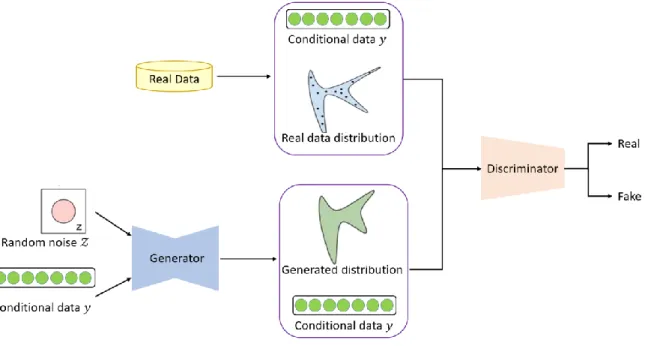
To compensate for the disadvantages of lack of controllability, Conditional Generative Adversarial Nets (CGAN) [20] and its other variants [21-27] were proposed in succession. CGAN, an extension of GAN, as shown in Fig. 2, generates images of some particular attributes by feeding a conditional data to GAN model so as to gain some control over the results.
Figure 2. Architecture of conditional generative adversarial network
The conditions can be any attribute related to the target face image, such as sex, age, facial pose, with/without glasses and so on. The same year, Jon [21] applied CGAN to a conditional setting to face generation. Face image with specific attributes can be obtained by varying the conditional data for CGAN model.
On the CGAN basis, Age-GAN [22] is developed for generating face images of different ages, with a particular emphasis on preserving a person's identity in the aged version of his/her face.
Researchers have explored the potential of substituting the attribute input of CGAN with more specific control information, such as a target image, resulting in the so-called image-to-image translation technology. The most representative models of image-to-image translation are Pix2Pix-GAN [23], Cycle-GAN [24], and Star-GAN [25]. Pix2Pix-GAN [23] is trained using a training set of aligned image pairs, one is real image and another one work as conditional data. It not only learns the mapping from input to output image, but also a loss function to train this mapping. Pix2Pix-GAN [23] is effective for synthesizing photos from label maps, reconstructing objects from edge maps and colorizing images. However, for many tasks, paired training data is not available. Cycle-GAN [24], an approach to the translation of an image from a source domain to a target domain, can be trained in the absence of paired examples. However, it has limited scalability and robustness in handling more than two domains, since different models should be built independently for every pair of image domains. Choi et al. [25] proposed Star-GAN for image-to-image translations of multiple domains using only one model. It allows simultaneous training with multiple datasets of different domains within a single network. Given a face image and several target attributes such as blonde hair, dark skin, and age label, Star-GAN can generate the multi-attribute transfer results: a face image with blond hair, a face image with dark skin and a face image with desired age. Choi et al. [26] proposed Star-GAN v2 in 2020, which tackles two issues: (1) diversity of generated images and (2) scalability over multiple domains and improved results.
Xing et al. [27] exploited to use landmarks [29], which are the feature points characterizing the geometric features of faces, as the control information in CGAN to synthesize corresponding face images. Their model, called GP-GAN, can generate a face image that is similar to the image from which the landmark was extracted. In the second method proposed by this thesis, landmarks are used as the features for training the classifier based on the user's feedback, and GP-GAN is used for synthesizing realistic face images from the landmarks.
To enable the combination of different attributes, Style-GAN [28], featuring with a multi-resolution structure, is proposed recently. By modifying the input of each level separately, Style-GAN succeeds in controlling the output from coarse features (pose, face shape) to fine details (hair color). Unlike other GAN models that feeds noise directly, Style-GAN first map the input to an intermediate latent space, which then feed to adjust the “style” of the results. The noise is added at each convolution layer. In this way, it achieves unsupervised separation of high-level attributes and create stochastic variation in the generated images.
CGAN based methods can generate face images with specific attributes by varying the conditional information. However, these attributes are tagged to the data when preparing the training dataset, so there is no way to reflect the user's intention at the execution time. Although the recent Style-GAN achieves unsupervised
separation of high-level attributes, it is basically realized stochastically and provides no user control to the detailed features of the generated face images.
2.3.3 Age attribution control in GAN
On the CGAN basis, Perarnau et al. [30] proposed a method to reconstruct and modify real face image conditioned on arbitrary attributes. In this way, face aging is implemented by changing in a binary way, which is simply making face look older or younger without particular age categories. The generated face images thus fail to preserve the original person’s identity. Antipov et al. [31] proposed Age-cGAN for automatic face aging. It can preserve the original person’s identity in the aged version by introducing an approach for “Identity-Preserving” optimization of GAN’s latent vectors. Identity-Preserving is used to optimize initial latent vectors that comes from the code of input face image. The Age-cGAN can generate high-quality synthetic images within required age categories. However, it is difficult to prepare labelled faces of the same person across a long age range since different persons have their own aging speed. Wang et al. [22] proposed the so called IPCGANs framework, which synthesizes a face lying in a given age group instead of a specific age. Meanwhile, the synthesized faces have the same identity with the input face image. But these models mainly rely on age labels or age group labels. In many cases, the age labels do not correspond to the real age, it is vague and inaccurate, especially in the era of advanced beauty industry. It is also computational expensive to use the pixelwise and Identity-Preserving optimization objectives. Therefore, as the third method, a High-Frequency Generative Adversarial Network (HF-GAN) for synthesizing faces with the user’s desired texture features is proposed in this thesis. The method is based on the assumption that high-frequency textures, such as wrinkles, are the very important features related to age. Besides, to preserve semantic and perceptual characteristics of a face, a perceptual loss is adopted to enforce the preserving of high-level features in addition to the local texture details.
Although GAN-based methods have been successful for face generation, however, some experimental results show that the generated images also consist unnecessary background information. One possible explanation for this problem is that the most GAN-based models rely heavily on convolution. Convolution only focus on dependencies in a local neighbourhood and has particularly close relationship with the size of convolution kernel. It fails to capture long-range dependencies of entire image. From that point, previous GAN-based models fail to capture global dependencies in images. Of course, the capacity of the network can be improving by increasing the size of the kernel. But this way will increase the computational complexity. Cheng
et al. [36] proposed self-attention to balance the ability to preserve long-range dependencies and the
computational complexity. Zhang et al. [37] developed Self-Attention GAN (SAGAN) by introduce self-attention mechanism into convolutional GAN, which allows self-attention-driven, long-range dependency modelling for image generation tasks. Unlike traditional convolutional GAN which focuses on processing the
local neighborhood in convolutional layers, the SAGAN can generate details using cues from all feature locations. In the third method, self-attention mechanism is also added to HF-GAN model to generate high-resolution details from all feature location in image rather than only from local points in image. For the generator and discriminator of HF-GAN model, the self-attention is inserted between the residual blocks of network. In this way, the generator can generate face images with fine details at every location. The discriminator can also more accurately distinguish the input images. Most importantly, face part in the image is focused on in the whole process.
2.3.4 Summary on GAN models for face image generation
In this section, GAN models for face generation were summarized from the perspective of input/output, learning methods, training objectives, and backbone. The details are shown in Table1.
From the perspective of input, GAN models can be roughly divided into two categories: 1) Generate face image from noise 𝒵 sampled from a normal or uniform distribution. 2) Translate original face image into target one with desired attributes. The former means that, conceptually, noise 𝒵 represents the latent features of the generated image. GAN perform multiple transposed convolutions to upsample 𝒵 to generate face image. It is unknow that what is the semantic meaning of each bit in 𝒵. Training GAN learn the semantic meaning of noise. The goal of latter is to learn the mapping between an input image and an output images such as the cases of style transfer and season transfer.
The learning method here focuses on whether the paired data is required or not when training a GAN model. It is referred as supervised learning and unsupervised learning here. Supervised learning, such as the case of CGAN [20] and Pix2Pix GAN [23], needs paired data for training the model. When training CGAN, it is required that conditional data, label of real data, should be paired with the corresponding real data. For training Pix2Pix GAN, the conditional data is image, which is also required to be paired with the real data. Unsupervised learning can train a model in the absence of paired examples such as original GAN [17] and Cycle-GAN [24]. Training objectives play a key role in training the model. In addition to adversarial loss, the more commonly used loss functions are classification loss, reconstruction loss, and perceptual loss. Classification loss represents the cost paid for inaccuracy of predictions in classification (predicts which class an identified image belongs to). It is associated with classifying and generating images with a specific target label. Classification loss for the discriminator is denoted as ℒ𝑐𝑙𝑠𝐷 and Classification loss for the generator is denoted as ℒ𝑐𝑙𝑠𝐺 . By minimizing the classification loss, generator is trained to generate images that are classified to its correct target class. However, both adversarial loss and classification loss fail to guarantee that generated images preserve the content of its input images. To resolve this problem, reconstruction loss is proposed and denoted as ℒ𝑟𝑒𝑐. Although the loss functions mentioned above optimize the results of the model to a certain extent, however,
these loss functions cannot capture high-level perceptual and semantic differences between real data and generated image. Perceptual loss, denoted as ℒ𝑝 is used to capture perceptual information. The value of perceptual loss is the error between high-level image feature representations extracted from a pre-trained convolutional neural network. Usually, the pre-trained convolutional neural network is VGG network [38] pretrained on the ImageNet dataset [39]. The high-level features of generated image and input image are extracted using pretrained VGG network and then L1 distance between their features is computed that is used to optimize the generator.
For the design of network architecture, Convolution neural network (CNN) [40] is undoubtedly the most popular deep learning architecture and is the basis of various deep learning models. It employs the convolution operation which first performs a linear operation by applicating filters to input, and then activates neural unit and performs the pooling operation. A typical CNN model consists of an input, an output, and multiple hidden layers including a series of convolutional layers and fully connected layers. It can do good job in terms of accuracy and automatic detection of e important features. But CNN fails to learn the position and orientation information and needs big dataset for training. And it cannot keep spatial relationship between features. Later, U-Net was proposed by Olaf et al. [41] for biomedical image segmentation. It is symmetric and consists of a contracting path and a symmetric expending path. The former is same as a typical convolutional network for encoding through repeated convolutions and downsamplings and the latter is for decoding through upsampling operators. In addition, U-Net uses the skip connections between the contracting path and the expending path to preserve low-level features. As a result, there are a large number of feature channels in expending path that allow the network to propagate context to higher resolution layers. It is generally known that the results will be better and accuracy will be enhanced as the depth of the network increases. Increasing depth of network usually causes vanishing gradients and network crash. To solve degradation problem, residual neural network (ResNet) is proposed in [42]. The ResNet is easier to optimize and can gain accuracy from considerably increased depth by adding residual block to normal CNN. In a network with residual blocks, it adopts shortcut connections to feed residual mapping to layers that jump over some layers. the Dense Convolutional Network (Dense-Net) [43] is another network of particular interest in addition to U-Net [41]. Dense-Net is residual neural network with several parallel skips. The Dense-Net has several significant advantages. It overcomes the gradient disappearance problem to a certain extent, enhancing feature forward propagation, reusing features, and can provide a good representation of the image and reduces the number of parameters.
Table1. Summary of deep learning-based methods for synthesizing face images
Model Input Output Training
method Quality
Interac tion
Training objectives Backbone
Generator Discriminator Generator Discriminator
GAN [17] Noise 𝒵 Image Unsupervised Low N ℒ𝑎𝑑𝑣 ℒ𝑎𝑑𝑣 Conv Conv
CGAN [20] Noise 𝒵 +
label Image Supervised Low N ℒ𝑎𝑑𝑣 + ℒ𝑐𝑙𝑠𝐺 ℒ𝑎𝑑𝑣+ ℒ𝑐𝑙𝑠𝐺 Conv Conv
DCGAN [19] Noise 𝒵 Image Unsupervised Low N ℒ𝑎𝑑𝑣 ℒ𝑎𝑑𝑣 Conv Conv
Age-GAN
[22] Image + label Image Supervised Low N ℒ𝑎𝑑𝑣 + ℒ𝑐𝑙𝑠𝐺
ℒ𝑎𝑑𝑣+ ℒ𝑐𝑙𝑠𝐺
+ ℒ𝑝 ResNet Patch GAN
Pix2Pix-GAN [23] Image Image Supervised High N ℒ𝑎𝑑𝑣+ ℒ𝑟𝑒𝑐 ℒ𝑎𝑑𝑣 UNet Patch GAN
Cycle-GAN
[24] Image Image Unsupervised High N ℒ𝑎𝑑𝑣+ ℒ𝑟𝑒𝑐 ℒ𝑎𝑑𝑣 ResNet Patch GAN
Star-GAN
[25] Image+ label Image Supervised High N
ℒ𝑎𝑑𝑣+ ℒ𝑟𝑒𝑐+ ℒ𝑐𝑙𝑠𝐺 ℒ𝑎𝑑𝑣 ResNet PatchGAN Style-GAN [28] Noise 𝒵 / Image + Style
Image Unsupervised High N ℒ𝑊𝑎𝑠𝑠𝑒𝑟𝑠𝑡𝑒𝑖𝑛−1 ℒ𝑊𝑎𝑠𝑠𝑒𝑟𝑠𝑡𝑒𝑖𝑛−1 DeNet+ResNet PatchGAN
GP-GAN
[27] Image Image Supervised High N
ℒ𝑎𝑑𝑣+ ℒ𝑟𝑒𝑐+
ℒ𝑝+ ℒ𝑐𝑙𝑠𝐺 ℒ
𝑎𝑑𝑣+ ℒ𝑐𝑙𝑠𝐷 UDeNet PatchGAN
IECGAN
2.4 Evolutionary method
The first evolutionary method for facial image composition is given by Davies and Valentine [12]. Then Stuart Gibson et al. [13] introduced a method for photographic quality facial composition using evolutionary algorithms. Unlike traditional component-based methods, it combines random samples from a facial appearance model with an evolutionary algorithm to drive the search procedure to convergence.
Charlie, Peter and Derek [4] developed EvoFIT system that is an interactive computerized facial image composition system. EvoFIT presents a number of possible faces and asks the witness or user to select those that look most like the target face image. In this method, for each iteration, the presented possible faces are used to generate a new set of faces using genetic algorithm. After many iterations, the system gradually synthesizes face image which closer to the target face. There are also tools available in EvoFIT system to improve the likeness on demand, such as to change the perceived age, weight and also to change individual components of the face—eyes, nose, mouth, etc [14]. The evolutionary algorithm was also explored by Stuart et al. [13] who uses both local and global models, allowing a witness to evolve plausible, photo-realistic face images in an intuitive way. EFIT-V system [15] synthesizes face image based on whole face principles. The witness is shown a number of randomly generated face image and is asked to select the one that he/she thinks is most similar to the target one. The system employs a genetic algorithm to breed new face images based on the selected images. There are some limitations to the traditional evolutionary methods such as genetic algorithm for solving the problem of face composition. It is sensitive to the initial population. It has stochastic property being a non-deterministic class of algorithms. Another bigger limitation is that the optimal resolution obtained is rather a sub-optimal one but globally one although genetic algorithm can indeed provide an optimal solution. And, usually the convergence speed is slow, which needs dozens, even more than a hundred times iterations.
Gibson et.al. [13] report an evaluation of genetic algorithm system by conducting trials based on simulated witness behaviour. Unfortunately, the result shown Select Multiple Mutate algorithm (SMM) [13] required 150 iterations, and the Follow-The-Leader algorithm (FTL) [13] required 350 iterations to produce a satisfactory face image. For example, a subject obtained a result after viewing 162 faces, over 27 iterations and took approximately 20 minutes using SMM algorithm.
Philip et al. proposed an approach [32] based on Wasserstein GAN [18] and the genetic algorithm [16] to produce user-desired images. The user is asked to evaluate a set of images resulting from GAN, and a genetic algorithm is applied to modify the noise input based on the user's evaluation. Their paper showed some examples of using the method for generating face images resembling target faces. However, the average score of the generated images is only 2.2 out of 5, which is the result of the user evaluation experiment.
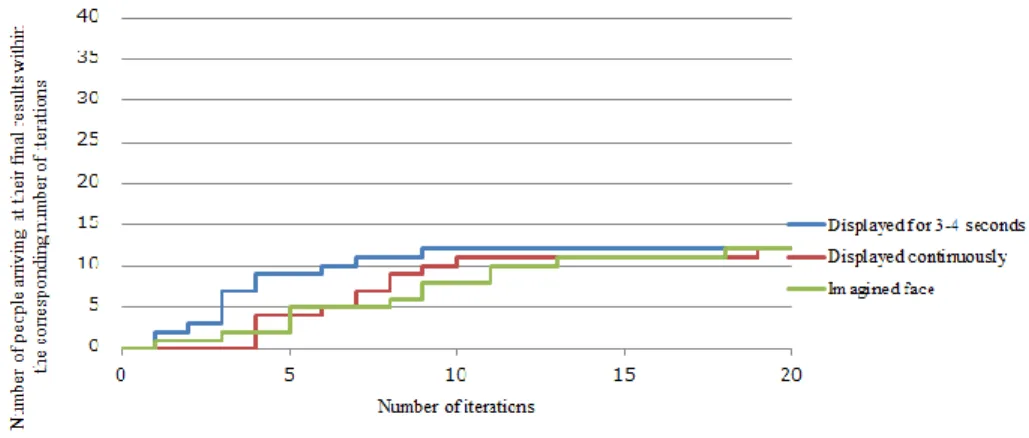
In this thesis, a relevance feedback technology and OPF classifier are employed to quickly learn user’s intention through an iterative approach. During iteration, OPF classifier is trained based on relevance feedback. Trained OPF classifier is used to select candidate face images for the synthesizing final results. The experiment shows that on average, it took 6.5 iterations for the subjects to arrive at the final results.
Chapter 3 Based on Principal Component Analysis (PCA)
3.1 Proposed method
As depicted in Fig. 3, the first method includes three major components: extracting primary features, training an Optimum-Path Forest (OPF) classifier based on relevance feedback, and synthesising face images that do not already exist in the database.
X
X
Present samples around borders Training images Update border non-labelledrelevant prototype irrelevant prototype
input for initiation relevant irrelevant best position image X result
Feature space X Syn thesize Best node Constructing feature space Display Label Relevance Feedback Face in mind Select Database Result D isp lay
Figure 3. Overview of the proposed system
1,000 sample images were used and these images were converted to a feature space for training an OPF algorithm to classify whether a face image resembles the face in the users’ minds based on their relevance feedback. The ultimate purpose of the proposed method is not to classify those sample face images or to retrieve a particular face from these sample face images but to synthesise a new image resembling the face in the user’s mind. The trained OPF classifier defines the positions in the feature space that correspond to the desired face images.
To train the OPF classifier, the system defines an initial classification boundary by letting the users evaluate an initial dataset consisting of face images of different sexes and ages. Then, the system shows the user multiple unevaluated images (i.e. cases that have not been judged by the user to resemble or not resemble the picture in his or her mind) that lie near the classification boundary and has the user label them according to whether they resemble or do not resemble the face in his or her mind. Based on these labels, the system updates the classification boundary.
Then, the system interpolates 𝐾 cases in the positions farthest from the classification boundary on the relevant side and produces the final synthesis. If the results satisfy the user, the search process is complete; otherwise, the user repeats the labelling process on unlabelled cases near the classification boundary.
3.2 Constructing the feature space
3.2.1 Feature representation
Various feature representations have been studied in the context of face recognition in the past few decades. Recent research results have demonstrated that deep learning can be used to learn the face representation, which is effective for both face identification and verification [44, 45]
However, since the purpose of the proposed method was to synthesise the target face image, a feature representation that could not only discriminate faces but could also be used to generate a face image is needed. The feature vector space needed to be compact enough to allow for the interactive relevance feedback process. For this purpose, the pixel-level image feature is used similar to face hallucination method [46].
The basic idea is to separate a face image 𝐼 into a global image 𝐼𝑔, which expresses the overall features of the image, and a local image 𝐼𝑙, which expresses the detailed face features.
𝐼 = 𝐼𝑔+ 𝐼𝑙, (2)
While the local image adds the details of the face, global images comprise information required for distinguishing between individuals. A feature vector space of global images can be constructed by applying PCA to the face images in the database and finding the principal components with large eigenvalues. Formula (3) ex-presses a global image 𝐼 in terms of the basis 𝐵 of a global feature space, a coordinate value 𝑋 and an average face image 𝜇 :
3.2.2 Principal Component Analysis (PCA)
Principal Component Analysis (PCA) is a technique for reducing dimensionality. Using an orthogonal transformation, it transforms a set of possibly correlated variables into a set of linearly uncorrelated variables that are called principal components.
Assuming there is an initial dataset 𝑋 which contains 𝑛 variables 𝑥𝑖∈ 𝑋 (𝑖 = 1, 2, 3 … 𝑛 ) with 𝑝 dimensions,
Step1: Standardization
If there are large differences between the ranges of initial variables, variables with larger ranges will dominate over variables with small ranges. That will give rise to biased results. To avoid this problem, it is necessary to standardize the range of the initial variables. by subtracting the mean and dividing by the standard deviation for each variable, all the variables will be converted into the same scale.
𝑥𝑖𝑛𝑒𝑤 = 𝑥𝑖−𝜇
𝜎 , (4) where 𝜇 is the mean and 𝜎 is the standard deviation.
Step2: Covariance matrix computation
To identify relationships between variables, covariances matrix is computed since sometimes variables are highly correlated in a redundant way. The covariance matrix is a 𝑝 × 𝑝 symmetrix matrix (where 𝑝 is the number of dimensions) which summaries the relationships between all the possible pairs of variables. It is denoted as 𝐴𝑐𝑜𝑣 . [ 𝑐𝑜𝑣(𝑥0, 𝑥0), 𝑐𝑜𝑣(𝑥0, 𝑥1), 𝑐𝑜𝑣(𝑥0, 𝑥2) … … , 𝑐𝑜𝑣(𝑥0, 𝑥𝑛−1) 𝑐𝑜𝑣(𝑥1, 𝑥0), 𝑐𝑜𝑣(𝑥1, 𝑥1), 𝑐𝑜𝑣(𝑥1, 𝑥2) … … , 𝑐𝑜𝑣(𝑥1, 𝑥𝑛−1) 𝑐𝑜𝑣(𝑥2, 𝑥0), 𝑐𝑜𝑣(𝑥2, 𝑥1), 𝑐𝑜𝑣(𝑥2, 𝑥2) … … , 𝑐𝑜𝑣(𝑥2, 𝑥𝑛−1) … … 𝑐𝑜𝑣(𝑥𝑛−1, 𝑥0), 𝑐𝑜𝑣(𝑥𝑛−1, 𝑥1), 𝑐𝑜𝑣(𝑥𝑛−1, 𝑥2) … … , 𝑐𝑜𝑣(𝑥𝑛−1, 𝑥𝑛−1)] , (5)
In the main diagonal, the values are the variances of each variable since the covariance of variable with itself is its variance 𝑐𝑜𝑣(𝑎, 𝑎) = 𝑣𝑎𝑟(𝑎). And the covariance matrix is symmetric with respect to the main diagonal because the variance is interchangeable (𝑐𝑜𝑣(𝑎, 𝑏) = 𝑐𝑜𝑣(𝑏, 𝑎)).
Step3: Calculate the eigenvalues and eigenvectors for the covariance matrix
Principal components are new uncorrelated variables, which can be thought as new axes. The eigenvector is a nonzero vector that will be changed when the linear transformation is performed. The corresponding eigenvalue is the scaling factor of the eigenvector.
𝐴𝑐𝑜𝑣𝑣 = 𝜆𝑣, (6)
where 𝑣 is a vector and 𝜆, called eigenvalue associated with eigenvector 𝑣, is a scalar. Eigenvectors and eigenvalues are calculated from the covariance matrix based on the equation (6).
Step 4: Obtain 𝒌 eigenvalues and a matrix of eigenvectors
After computing the eigenvectors and sorting eigenvalues by their eigenvalues, top 𝑘 eigenvalues and corresponding matrix of top 𝑘 eigenvectors are obtained. They are selected as the principal components and formed the feature vector. In this work, top 80 eigenvalues are picked. A matrix of 80-dimensional eigenvectors is obtained, which is the 𝐵 in equation (3).
3.3 Training the optimum-path forest classifier based on
relevance feedback
Relevance feedback, a process that shows synthesis results to the users and updates classifiers based on user feedback, is often used in image retrieval with specific themes, such as oceans, cats or sunsets. Several researchers have proposed methods that employ various classifier types and reuse past classification results to obtain good results based on relatively minimal amounts of feedback [44, 47, 48].
As depicted in Fig. 3, in the proposed method, the OPF is trained based on the users’ relevance feedbacks in the following four steps:
Step1: The system presents the user with five male face images and five female face images of different
ages and waits for the user to select one he or she thinks to be closest to the face in his or her mind. Since none of those 10 images is likely to resemble the target face, the user will select the image that is the most similar to what they are imagining according to sex and age, which acts as the initial classification boundary.
Step2: The four images closest to the user’s selected face image in the feature spaces are returned to the
user. The user evaluates and labels the images as relevant (○) or irrelevant (×), which serve as the prototypes for the OPF classifier. This evaluation phase ends if the users are satisfied with at least one of the four face images.
Step3: An OPF classifier is built based on the prototypes as illustrated in Fig. 4. Then, the sample images
are divided in to two classes: relevant and irrelevant.
Step4: Four border nodes are selected, and the corresponding images are presented to the users. The user
evaluates and labels the images as relevant (○) or irrelevant (×), and the new marked training images constitute and replace the former prototypes to build a new OPF classifier.
At every iteration before step 4, the best relevant nodes, which are nodes located the farthest to irrelevant prototype and the closest to relevant prototype are selected and interpolated to create the resulting face image being presented to the user. If the user is satisfied, the whole relevance feedback procedure ends.
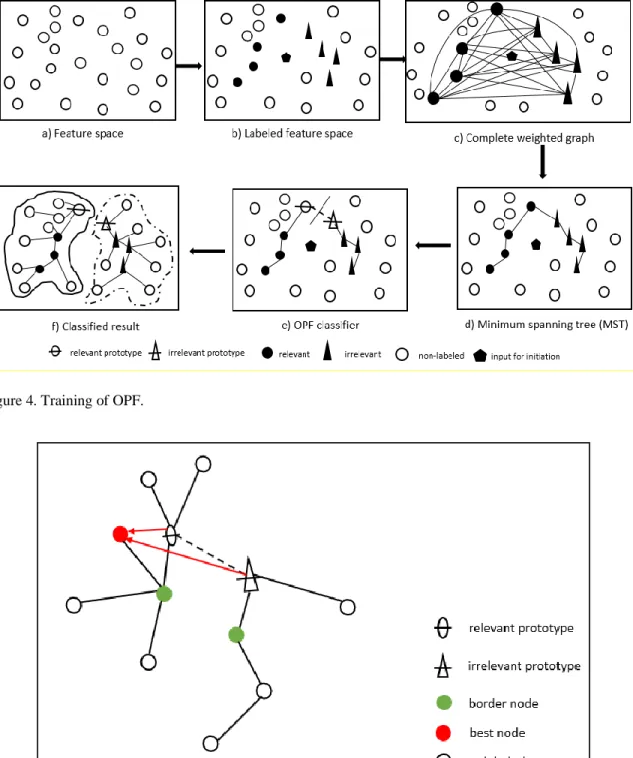
OPF [33, 44, 45] is originally for classification. It represents each class of images by optimum-path trees rooted at the given representative samples, called prototypes [46], [47]. The OPF works by modelling the classification as a graph partition in a given feature space. It starts as a complete graph whose nodes represent the feature vectors of all training samples in the dataset (Fig. 4c). All pairs of nodes are linked by arcs that are weighted by the distances (referred to as cost hereafter) between the feature vectors of the corresponding nodes. At each iteration of the relevance feedback, a set of training nodes are obtained by the user labelling the samples as relevant or irrelevant (step 2 of the aforementioned framework), a minimum spanning tree is constructed for the labelled samples (Fig. 4d), and the adjacent pair of the relevant and irrelevant samples are chosen as the relevant and irrelevant prototypes, respectively (Fig. 4e). Then, the graph is repartitioned by the competition process among prototypes, which offer optimum paths (the path with the lowest cost) to the remaining nodes of the graph and classify all nodes into relevant or irrelevant depending on whether they are connected to a relevant or irrelevant prototype (Fig. 4f). The optimum paths from the prototypes to the other samples are computed by the image foresting transform algorithm, which is essentially Dijkstra’s algorithm modified for multiple sources and with more general path-value functions. Finally, all of the non-prototypes are directly or indirectly connected with the prototype that has the minimum cost. With the prototypes as the roots and the non-prototypes as the intermediate and terminal nodes, the optimum trees are built, which constitutes the OPF. It is known to that OPF have the ability to handle a large dataset effectively and efficiently compared with other representative classification algorithms, such as the support vector machine and the k-nearest neighbors algorithm [49]. Because of this, OPF is very important in systems that are based on the relevance feedback approach and generate results in a dialogic fashion.
Figure 4. Training of OPF.
Figure 5. An example of classification with OPF
Fig. 5 shows an example of a classification with OPF. A minimum spanning tree is first constructed from all the samples. Then, the user labels some selected samples as relevant (○) or irrelevant (×). The paths that bridge relevant and irrelevant samples were thus focused on. The nodes bridged by the paths are prototypes,
which are represented as and . All other unlabelled nodes whose parent is a relevant prototype are la-belled as relevant, and the ones whose parent is an irrelevant prototype are lala-belled as irrelevant. The nodes next to the prototypes are called border nodes as indicated by the green dots. The node located the farthest from the irrelevant prototype and closest to the relevant prototype (depicted by the red node in the figure) is selected as the best relevant sample.
When selecting the border nodes that are returned to the user for labelling at each iteration and the best relevant nodes that are used to explore the candidate for synthesizing the final result, the costs of paths from all non-training nodes to all relevant and irrelevant prototypes were compared. To effectively update the classifier based on the user’s feedback, the subsequent 4 samples to be labelled by the users are chosen from the nodes near the border of the classifier. The border nodes are defined as non-prototype nodes that belong to the relevant class and with the smallest ratio of the cost from these nodes to the relevant prototypes over the cost from these nodes to the irrelevant prototypes. The best relevant nodes should closer to the relevant prototypes and farther from the irrelevant. Therefore, best nodes are those that belong to the relevant class and with the largest ratio between the cost to the relevant prototypes and the costs to the irrelevant prototypes.
In the traditional relevance feedback-based image retrieval, the final result is the relevant case in the position farthest from the classification boundary. To establish the classification boundary correctly, the image shown to the user for feedback must lie near the classification boundary. OPF based retrieval thus requires an initial classification boundary that sits relatively close to the relevant case. This study satisfied this requirement by gathering age and sex input information at the beginning of the process.
In my implementation, the cost of any two adjacent nodes is assigned using L2 norm distance. It is assumed that there are 𝑠 number of non-prototype samples 𝑈𝑘(𝑘 = 1, 2, 3, … … , 𝑠) that belong to the relevant class, 𝑛 number of relevant prototypes, and 𝑚 number of irrelevant ones denoted as 𝑝𝑖(𝑖 = 1, 2, 3, … … , 𝑛) and 𝑞𝑗(𝑗 = 1, 2, 3, … … , 𝑚). The cost of the path from a non-prototype sample 𝑈𝑘 to the relevant prototype 𝑝𝑖 as 𝐶𝑈𝐾→𝑝𝑖 and the cost of the path from 𝑈𝑘 to the irrelevant prototype 𝑞𝑗 is denoted as 𝐶𝑈𝐾→𝑞𝑗. The ratio of
𝐶𝑈𝐾→𝑝𝑖 to 𝐶𝑈𝐾→𝑞𝑗, denoted as Relevance 𝑈𝑘→ (𝑝𝑖, 𝑞𝑗), can be computed as follows:
𝑅𝑒𝑙𝑒𝑣𝑎𝑛𝑐𝑒𝑈𝑘 → (𝑝𝑖, 𝑞𝑗) =
𝐴𝑣𝑔(𝐶𝑈𝐾→𝑝𝑖)
𝐴𝑣𝑔(𝐶𝑈𝐾→𝑞𝑗). (7)
The 10 border nodes with the largest value of 𝑅𝑒𝑙𝑒𝑣𝑎𝑛𝑐𝑒𝑈𝑘→ (𝑝𝑖, 𝑞𝑗) are chosen for the user to label. The best node chosen is the one with the smallest value of 𝑅𝑒𝑙𝑒𝑣𝑎𝑛𝑐𝑒𝑈𝑘 → (𝑝𝑖, 𝑞𝑗).
3.4 Synthesising virtual face images using interpolation
The traditional relevance feedback approach is designed for searching actual images in a given database, making it impossible to synthesise non-existent face images. By synthesising images, however, it is possible to obtain the desired outcomes with a limited number of samples. This study thus proposes a process of synthesizing face images that do not exist in the database by interpolating multiple relevant images in positions far away from the classification boundary. In principle, any point near the best relevant node (i.e. the node that belongs to the relevant class and with the largest ratio between the cost to the relevant prototypes and the costs to the irrelevant prototypes) should be a desired face image.
As a practical solution, the top 𝑘 (𝑘 = 3 in my implementation) best relevant nodes were selected, as shown in Figure 1, and calculate the result according to the following Formula (8):
𝑥 = ∑ 𝑤(𝑥𝑘𝑖 𝑖)𝑤𝑖⁄∑ 𝑤(𝑥𝑘𝑖 𝑖), (8)
Here, 𝑥 and 𝑥𝑖(𝑖 = 0, 1, 2) are the feature vectors of the resulting face images and the 3 best relevant images, respectively. The weight assigned to 𝑥𝑖 is 𝑤(𝑥𝑖), which is based on the distance given by the classifier. In my implementation, 𝑤(𝑥𝑖) is assigned the average weight, which means all 3 images have equal weight.
3.5 Registration by eyes and mouth
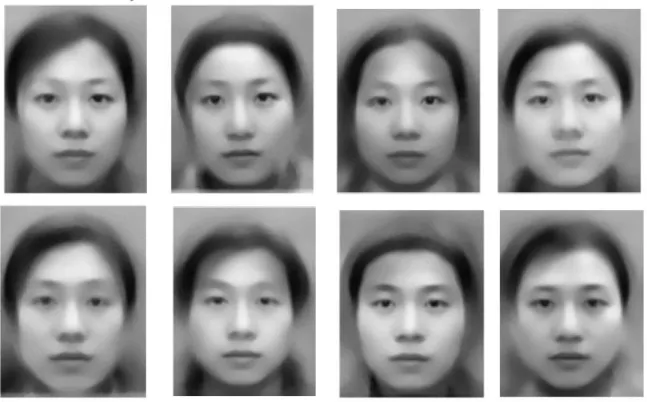
The sample images in the training database need to be aligned in order to create face images without blurring. In cases where the same images aligned only by one single registration point when synthesising new face images by interpolating several face images, the system was prone to blurring portions of the face away from the registration point due to the inherent individual variations among these different faces. Fig. 7 (a) and (b) show the results generated with the images were aligned by eye position and mouth position only, respectively. It can be observed the areas far from the registration positions are severely blurred.
To solve this problem, two image databases were built from the same source database: one composed of face images aligned by the eyes and the other composed of face images aligned by the mouth. In order to synthesise a clear face image, a group of images from the eye-aligned database and the corresponding images from the mouth-aligned data-base are used. More specifically, three procedures are carried out: first, a candidate image in the eye-aligned face feature space is synthesised; then, another face image in the mouth-aligned space is synthesised; by blending the two images, a clear composited face image is produced.
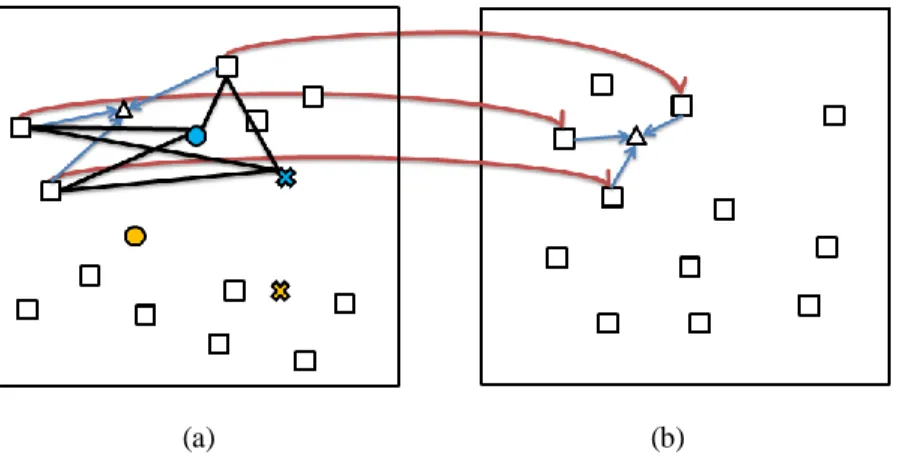
As the system makes it possible to obtain the same face from both databases, the relevance feedback process is needed to perform with one of the two databases to build the OPF for both databases. Fig. 6 illustrates the integration between the feature spaces of the two databases. When selecting the three highest-ranking