Gregory BIRCH, Yuko TOMINAGA, Michiko MUROI
EPL 活用から観察する CEFR 実践の可能性
バーチ・グレゴリー・ 富永裕子・室井美稚子
Abstract
The paper summarizes the implementation of a 2018 joint-research project and reports on the development, use, and reactions to ‘Can Do’ descriptors based on the Common European Framework of Reference for Languages (CEFR) (Council of Europe (COE), 2001). These descriptors were used to define language learning goals for an EFL curriculum at a small Japanese university, and student progress in relation to these goals was monitored using a modified version of the European Language Portfolio (ELP). Results of a survey on students’ impressions of the ‘Can Do’ descriptors and ELP are presented and discussed.
Keywords: Common European Framework of Reference for Languages (CEFR), European Language Portfolio (ELP), ‘Can Do’ descriptors, Learner autonomy
キーワード: CEFR(ヨーロッパ言語共通参照枠)、ヨーロッパ言語ポートフォリオ、Can Do リスト、 学習者の自律
1. Introduction
Two benefits of utilizing the Common European Framework of Reference for Languages (CEFR) (COE, 2001) are the focusing of teaching, learning and assessment on practical communicative competence, and the standardization of attainment levels and terminology to facilitate a common understanding amongst stakeholders (Figueras, 2012). The CEFR reference levels and illustrative descriptors serve as a metalanguage for discussing language proficiency and for reflecting on and communicating learning objectives that are both coherent and transparent (COE, 2020). Through these discussions and opportunities for reflection, it is hoped that the CEFR will also provide inspiration for future curriculum development. The original volume of the CEFR (COE, 2001) has been updated in the CEFR Companion Volume (CEFR/CV) (COE, 2020), with new descriptors for language activities and competences. The CEFR is also complemented by the European Language Portfolio (ELP) (COE, 2019a). The ELP is a concrete tool that has been instrumental in familiarizing teachers and learners with the CEFR, encouraging learners to monitor and document their progress in relation to the Common Reference Levels and ‘Can Do’ descriptors, and fostering learner autonomy (Schärer, 2012).
This study describes how the CEFR was mapped onto an existing curriculum to further promote a focus on communicative language use and to reflect on the curriculum with the aim of improving it in the future. ‘Can Do’ descriptors formulated for the EFL classes were informed by the CEFR and CEFR-J (www.cefr-j.org) (Tono,
context. A system was introduced to encourage teachers and students to use the ELP to evaluate and monitor student progress in relation to the descriptors and promote learner autonomy through self-reflection and assessment. The effectiveness of the ELP to fulfill these roles will be discussed in this paper, supported by student feedback elicited through a modified version of the ELP pilot study survey. The initial stage of ELP implementation was reported in Birch (2018); therefore, only student impressions of ELP use will be touched upon in this paper.
2. The CEFR, its use in Japan, and the ELP
With the aim of globalizing Japan, the Ministry of Education, Culture, Sports, Science and Technology (MEXT) has since 2012 been rapidly reforming the new course of study for foreign languages based on the CEFR and CEFR-J (MEXT, 2012). Since then, MEXT has held numerous meetings to review and facilitate the effective introduction of the CEFR-J and its ‘Can Do’ descriptors, which have been used to articluate learning goals for foreign language learning in Japan. In 2013, MEXT (2013) presented the use of a "Can Do list" as one of the concrete measures for improving English proficiency as an international common language to language teachers. The related guide (Tono, 2013) points out that by sharing the goals of learning a foreign language between teachers and students, the students themselves will become aware of what they can do. An additional aim is to develop autonomous learners. MEXT expects that the attitude of an autonomous learner, which is necessary for language learning, will be acquired, and that the feeling of accomplishment will lead to further improvement in learning motivation. This stance is entirely in line with the action-oriented approach of the CEFR, which views users and learners of a language primarily as ‘social agents’ (COE, 2001, p. 9) and emphasises what the learners can do with the language (action-oriented) as opposed to what the learners should know about the language (knowledge-oriented). Furthermore, learners are expected to not only use language for social purposes, but also take responsibility for their learning (e.g., learner autonomy).
The CEFR-J then is a modified achievement scale of English proficiency built on the basis of the CEFR for use in English education in Japan. In both the CEFR and CEFR-J, each mode of communication (e.g., spoken production) is further broken down into Illustrative Scales that contain lists of ‘Can Do’ descriptors specifying what a language user should be able to do in a foreign language, and the CEFR (COE, 2001, 2020) includes the strategies and competences necessary to realize these goals. The significance of applying the CEFR to Japanese English education is to bring Japan in line with world standards, and it is necessary to radically change Japanese English education from a receptive-based approach to a productive-based approach. However, there are some problems in applying the CEFR to the learning situation in Japan. The six levels of the CEFR are too vague, they are not divided at equal intervals, and the ‘Can Do’ descriptors can be awkward to use. Furthermore, it is difficult to measure competence according to these descriptors. In Japan, it was deemed necessary not only to judge language ability on the vertical axis of A1 to C2, but also to look at the qualitative aspects of the horizontal axis. In other words, the descriptors alone are not enough, and it is necessary to refer to specific elements such as grammar, vocabulary, and expressions that match the Japanese learning situation. The CEFR-J tries to address these concerns, primarily by subdividing the CEFR levels according to the situation in Japan. The CEFR common reference points use six levels of language proficiency (A1-C2) described in relation to four communication modes (Reception; Production; Interaction; Mediation). The CEFR-J, on the other hand, has subdivided the A1 and A2
levels into six levels to meet the needs of Japanese learners1, 80% of whom fall into these levels (Tono & Negishi, 2012, p.7). Furthermore, recent CEFR-J research focuses on Reference Level Descriptions (RLDs) (COE, 2019b), which specify the grammar and vocabulary at various CEFR levels (See the CEFR-J website for more information).
While the CEFR has been widely adopted in Japan, the European Language Portfolio does not enjoy widespread use here. It has been translated into Japanese (Portfolio for Japanese University (LP-J) (Framework and Language Portfolio SIG, 2009)), and like the ELP, it is composed of three parts: the Language Passport, an overview of the learner’s ability in relation to the Common Reference Levels; the Language Biography, which facilitates learner’s involvement in planning, reflecting upon and assessing their learning process and progress, and the Dossier, a collection of materials to illustrate the learner’s achievements and experiences. This portfolio was utilized in this study to promote learner reflection and autonomy.
3. Mapping the CEFR onto a curriculum
Within the literature (Nagai et al., 2020; North et al., 2018; North, 2014), one of the most common ways to design a curriculum based on the CEFR is to specify the learning outcomes in terms of the ‘Can Do’ descriptors and then proceed to identify the content, methodology, activity types, and assessment tools most appropriate for realizing these goals – a process known as Backward Design (see Richards, 2013). The goals of this research project, however, were more modest and involved the mapping of the CEFR onto an existing curriculum. This starting point is also quite common (Nagai et al., 2020; North et al., 2018; North, 2014), and the initial goal was to define the goals for the curriculum, courses and individual lessons in terms of CEFR ‘Can Do’ descriptors2. Later, the balance between the different modes of communication (primarily the Receptive, Productive, and Interactive modes) as well as the levels (e.g., the progression and number of classes at the different levels (i.e., A2 to B2)) across all of the courses within the curriculum will be examined when considering future curriculum revisions, but these aspects will not be discussed at this time.
3.1 Course and curriculum objectives
This process of mapping the CEFR onto the curriculum started with articulating overall objectives for individual courses (e.g., Basic Reading I) using ‘Can Do’ descriptors from the illustrative scales (e.g., Reading for
information and argument). The preliminary version (2018) of the Companion Volume (COE, 2020) was utilized
for English and the CEFR-J lists for Japanese (Tono, 2013). Course objectives were communicated to the students in the course syllabi, and due to the general nature of these descriptions and the need for brevity, few modifications to the ‘Can Do’ descriptors if any were made. The curriculum objectives for a given mode of communication were simply a collection of the underlying course objectives, and therefore, taken from the same scale. This is true for the reading and writing classes. For example, the objectives for the reading and writing classes were primarily articulated using the Reading for Information and Argument and Written Production - Reports and Essays scales as these are the most common foci for university-level classes. Receptive Listening, Spoken Production and Spoken
Interaction, on the other hand, were rarely the sole focus for an individual course. Instead, they were covered in
1 Within the CEFR Companion Volume (COE, 2020), levels are also subdivided, and this was informed in part by the advancements made in the CEFR-J (COE, 2020, p. 38).
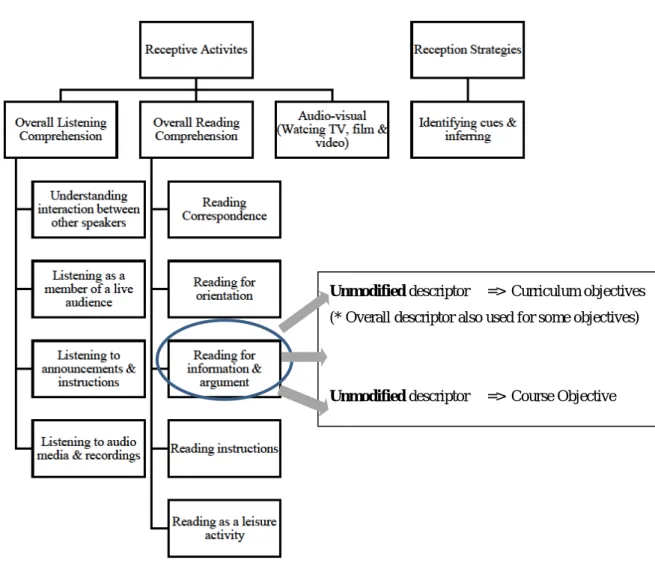
numerous courses using many different scales, and therefore, no individual illustrative scales for these modes were central. In these cases, the curriculum goals were stated using an overall scale (e.g., Overall Spoken Interaction). Figure 1 provides a diagrammatic representation of the illustrative scales for receptive activities, and identifies which scales were utilized and for what purpose.
Figure 1: Reception activities and strategies (COE, 2020, p. 47)
3.2 Lesson objectives - Modifying ‘Can Do’ descriptors
Course objectives were realized over fifteen 90-minute lessons using commercially-available textbooks. To help students see the connection between the course objectives and individual lessons, lesson objectives were closely tied to textbook content, requiring the ‘Can Do’ descriptors to be heavily modified. In the CEFR Companion Volume (COE, 2020), each illustrative scale includes key concepts. For Reading for information and
argument (COE, 2020, p. 56), they are ‘type of texts’, ‘subject of texts’, and ‘depth of understanding’. The first
two were modified to reflect reading textbook content. ‘Depth of understanding’ was rarely modified as it most closely correlates with the level (See Nagai et al., 2020 for a detailed description of this process).
Taking the ‘Advanced Reading I’ course as an example, the following procedure was followed when both the Unmodified descriptor => Curriculum objectives (* Overall descriptor also used for some objectives)
Unmodified descriptor => Course Objective
CEFR (COE, 2001, 2020) and CEFR-J were used to choose the relevant descriptor3. The selected textbook is ‘Active Skills for Reading 3’ (Anderson, 2014) with a stated CEFR level of B2 / C1. In this course, the first six of twelve units are covered and the target level for this course is the B2.1 level.
1. First, the CEFR Overall Reading Comprehension scale (COE, 2001, p. 69) was referenced to check that the target level matches the textbook level. This confirmed that there was no major gap between the CEFR B2 level descriptor and the level stated on the textbook. This should come as no surprise as the scale has only one descriptor for each level (with the exception of the A2 level), and there are considerable differences between the descriptors. This step is important when using textbooks that do not specify a CEFR level, but it is possible to use different scales.
2. Next, the CEFR-J was referred to in relation to the target level and content of each unit of the textbook. In this step, the B2.1 level of the reading self-assessment grid was utilized (Tono, 2013, p. 295). With 12 levels, this grid is more sensitive to different levels than the CEFR self-assessment grid, which does not have sublevels (COE, 2020, Appendix 2). Another advantage of using the CEFR-J grid is that it is not as detailed as the illustrative scales, and therefore its use may be more beneficial at this stage, particularly if the course or textbook content is spread across numerous illustrative scales. However, it is possible to skip this step if the course can be described using one individual scale, as shown in the next step.
3. Since this textbook’s content is mainly focused on reading for information and argument, (the preliminary version of) the CEFR Companion Volume: Reading for Information and Argument scale (COE, 2020, p. 56) was referred to for the latest descriptors. Here, the descriptors of the B2 lower level (corresponding to B2.1) were utilized. These descriptors were modified according to the topics of the textbook to create the descriptors for each lesson. (See Table 1 for an example). It is important to note that a small number of chapters (each textbook unit has two chapters) were categorized at a lower level (i.e., B1.2 level) based on this analysis.
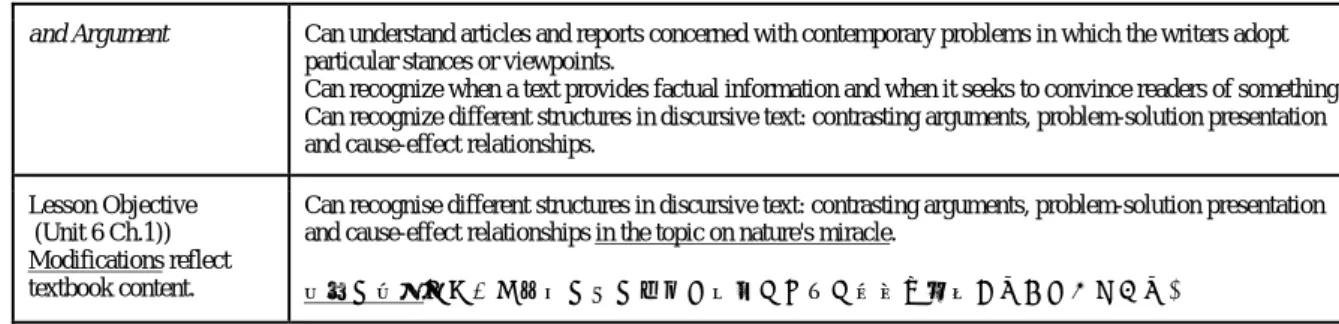
Table 1 includes the list of descriptors used, ranging from the most general (unmodified CEFR descriptors used to specify curriculum and course objectives) to modified descriptors used to articulate lesson objectives.
Table 1: ‘Can Do’ descriptors for a reading class - Advanced Reading 1.
Objective ‘Can Do’ Descriptor
CEFR: Overall Reading
Comprehension B2 Can read with a large degree of independence, adapting style and speed of reading to different texts and purposes, and using appropriate reference sources selectively. Has a broad active reading vocabulary, but may experience some difficulty with low frequency idioms.
CEFR-J B2.1 Self-Assessment Grid
CEFR-J B2.1 Self-Assessment Grid
CEFR CV B2.1 Reading for Information
現代の問題など一般的関心の高いトピックを扱った文章を、辞書を使わずに読み、複数の視点の 相違点や共通点を比較しながら読むことができる。
Can read texts dealing with topics of general interest, such as current affairs, without consulting a dictionary, and can compare differences and similarities between multiple points of view.
3The procedure is slightly different than the one mentioned earlier as the CEFR-J is more sensitive to different levels than the original CEFR and even the Companion Volume at times (i.e., Self-assessment grid). The illustrative scales within the Companion Volume are much more sensitive to different levels than the original
and Argument Can understand articles and reports concerned with contemporary problems in which the writers adopt particular stances or viewpoints.
Can recognize when a text provides factual information and when it seeks to convince readers of something. Can recognize different structures in discursive text: contrasting arguments, problem-solution presentation and cause-effect relationships.
Lesson Objective (Unit 6 Ch.1)) Modifications reflect textbook content.
Can recognise different structures in discursive text: contrasting arguments, problem-solution presentation and cause-effect relationships in the topic on nature's miracle.
自然の驚異について文章の中の原因と結果など主な議論を理解することができる。
3.3 Lesson objectives - Expanding upon ‘Can Do’ descriptors
In addition to narrowing the focus of a ‘Can Do’ descriptor to match the lesson objectives, it was also necessary to expand upon them when the descriptors were general or rather vague. This was the case with the writing classes. The original CEFR descriptors from Written Production: Reports and Essays are rather simple. Therefore, it was elaborated upon to tie it more closely with the content and goals for the textbook. These modifications are inline with the key concepts for this scale - content (e.g., familiar subjects of interest), types of text (e.g., short reports), and complexity of discourse (e.g., linking sentences with simple connectors) (COE, 2020, p. 68).
Table 2: ‘Can Do’ descriptors for a writing class – Writing 1.
Objective ‘Can Do’ Descriptor
CEFR B1.2 Original Can write short, simple essays on topics of interest.
Course Objective
CEFR B1.2 descriptor Modified
I can write short, simple essays on topics of interest with clear rhetorical organization, giving reasons and examples to support my ideas.
自分の関心のある話題について、根拠を示しながら明瞭な短い、簡単なエッセイを書くことがで きる。
Lesson Objective (Unit 2)
Modifications reflect textbook content.
I can write an essay about an appropriate career for my partner. Each paragraph has a clear focus (i.e., a topic sentence) which is supported by facts and examples.
対話相手の適切な職業についてのエッセイを事実や例を挙げながら、明瞭なパラグラフの構成で 書くことができる。
3.4 Advantages and disadvantages of this approach
There are a number of advantages and disadvantages to mapping the CEFR onto the curriculum. The benefits include: (1) 'Can Do' descriptors can be linked directly to the textbooks students use and what they learn, (2) the learning outcomes are clearly stated in the syllabi so that all students and teachers have a shared understanding of these goals, and (3) the 'Can Do' descriptors can be used for evaluation by students and teachers, focusing their attention on communicative language use. On the other hand, this approach was not without drawbacks; namely, (1) which of the CEFR 'Can Do' descriptors to choose is based on the intuition of each teacher, and there is a possibility that other teachers choose different descriptors and levels from different lists (e.g., CEFR-J / CEFR CV), (2) if the textbook is changed, it will be necessary to rewrite the ‘Can Do’ descriptors, and (3) self-evaluation by students and even assessment by teachers are not considered as a formal accreditation of a level. Attainment levels need to be confirmed using external CEFR-linked tests, such as TOEIC and Pearson, for some stakeholders (e.g., future employers). It should also be noted that the preliminary version of the Companion Volume (COE, 2018) was used. In the future, a Japanese translation of the 2020 version will be an extremely important resource. Furthermore, the CEFR CV and CEFR-J each have different strengths and weaknesses. Both should be utilized but to avoid confusion, it is extremely important to note which version individual descriptors were taken from.
4. Monitoring students’ language learning
To provide learners with feedback on the language learning process and to monitor their progress, two systems were implemented - a monitoring system and a counselling system. The monitoring system supports student learning through ELP use and regular testing, which are reviewed in counselling sessions with a faculty member.
4.1 Portfolio use
European Language Portfolio ‘Can Do’ descriptor checklists are generally found in the Biography section of the ELP and are quite comprehensive, allowing learners to plan, reflect upon and assess their learning progress. At this university, these generic ELP checklists were replaced with a small number of syllabi which contained course and lesson objectives and a self-assessment checklist. The aim was for students to reflect on their progress within individual courses in relation to the lesson objectives and store evidence of this progress (e.g., essays) in the ELP throughout the semester. The biography section focuses solely on the learning process (e.g., reflecting on language learning - how to learn vocabulary), and setting goals for each semester and summer / winter break. The ELP is also utilized during counselling sessions with a faculty member to review progress and future goals, but its ongoing use throughout a course is a type of formative assessment. See Birch (2018) for a detailed description of the initial stages of ELP use at this institution.
To better understand students’ impression of the language portfolio (LP), the bilingual survey utilized in Wicking (2016) was administered to the students in 2018, and the findings follow Wicking (2016) very closely (Table 3). The average scores for whether the LP helped students see progress in their learning (Q2), assess their competence (Q3), and participate more fully in the language learning process (Q4) were essentially identical to Wicking (2016) (Mean score ±0.04). Encouragingly, students in our study evaluated the portfolio slightly more favorably (Q5: Mean score of 3.62 vs 3.35). However, according to Wicking (2016, p. 54), “the strongest claim that can be made from the questionnaire results is that the students in the study were “unsure” of the value of using the language portfolio.” This is also true for our students. A majority of students did agree that the LP allowed them to see progress in their learning (Q2) and assess their competence (Q3), but only a quarter of students reported that the language portfolio simulated their interest in the learning process (Q4), and less than half felt LP use was time well spent (Q5). Future research is required to uncover why students felt this way and what changes to the ELP are necessary so that students more fully embrace it as a learning tool.
Table 3. Partial survey results from Wicking (2016).
5-point Likert Scale (Strongly agree=5; Strongly disagree=1) N=125 Question Strongly agree / Agree Unsure Disagree /Strongly D Mean (5 pt.)
2. Does the LP help you see progress in learning?
学習の進み具合を把握する上でポートフォリオは役に立つと思いますか 68.8% 24.8% 6.4% 3.74 3. Does the LP help you assess your competence?
語学力を把握する上でポートフォリオは役に立つと思いますか 63% 25.6% 10.4% 3.65 4. Does the LP stimulate you to participate more fully in
the language learning process?
ポートフォリオによって、語学学習に積極的に取り組もうと思いましたか
27.2% 37.6% 35.2% 2.94
5 Do you think the time spent on your LP was time well spent?
4.2 Regular testing and counselling
In addition to ELP use and reflection on goals specified using CEFR ‘Can-Do’ descriptors, all students of the English Communication course are required to take external proficiency tests. By the time they graduate from this college, the target TOEIC scores for English Communication majors and Teacher Education majors should be over 650 or 730 respectively. Progress towards these goals is monitored three times a year using the VELC test for the first-year students, and the TOEIC and Pearson Test for the second-, third- and fourth-year students. The results are stored in the ELP and reviewed in counselling sessions. The TOEIC test was chosen as the results are used by students for job hunting and by the university administration for measuring program effectiveness. The Pearson Test was recently introduced in 2019 as results are closely calibrated to CEFR levels, but its use was interrupted during the COVID-19 pandemic.
Through the counselling system, each student is required to meet with a mentor (a faculty member) twice a year. These mid-term consultations are first and foremost an opportunity to consult about any aspect of student life, but they also focus on the student’s language learning using the proficiency test results, and a review of their learning goals and ELP use in general. It is hoped that students will take this time to reflect on their learning and revise their learning goals according to the latest achievement within their classes.
5. Conclusion
This study describes the development and use of CEFR ‘Can Do’ descriptors to define course and lesson goals in an existing EFL university curriculum, as well as ELP use to encourage student reflection on both the learning process and progress in relation to these goals. Mapping the CEFR onto the curriculum and communicating learning outcomes to the stakeholders through the syllabi were significant first steps. Furthermore, the students’ initial impressions of the ELP appear to be positive. However, it is unclear how effective these measures have been on shifting the focus of teaching even more towards communicative language use, developing learner autonomy, and most importantly, improving the learners’ language proficiency. The last point is perhaps the easiest to monitor (i.e., through testing), but improvements cannot be attributed to the above measures alone. This is further complicated by the fact that teaching has moved online during the COVID-19 pandemic. While it was still possible to implement these measures through an online learning management system (LMS) (i.e., Google Classroom), and in some cases this lead to improvements (e.g., self-evaluation can contain hyperlinks to evidence of student learning, videos of student production can easily be stored online, etc), it makes little sense for example to convert a paper version of the ELP into a digital one. For starters, only half of the students felt ELP use was time well spent and fewer reported that the ELP stimulated them to participate in the learning process. The potential for online LMSs and e-portfolios to develop learner autonomy and language proficiency needs to be considered and harnessed based on CEFR principles. However, for the curriculum to be truly considered as learner-centred, future revisions to the use of ‘Can Do’ descriptors and ELP to articulate, monitor and reflect on learning goals and the learning process need to be based on student and teacher feedback. Other instruments, such as student and teacher focus groups and/or interviews, are required to investigate the efficacy of the above measures. This is the next stage in this ongoing research project, which will be informed by this paper, a documentation of our implementation of the CEFR and ELP to date.
References
Anderson, N.J. (2014). Active Skills for Reading 3. National Geographic Learning, a part of Cengage Learning.
Birch, G. (2018). Implementing the language portfolio for Japanese university: A pragmatic approach. Journal of the Chubu English
Language Education Society, 47, 9-16.
CEFR-J.(n.d.). A general-purpose framework for new Japanese English education. http://www.cefr-j.org/cefrj.html
Council of Europe (COE). (2001). The common European framework of reference for languages: Learning, teaching, assessment.
Cambridge University Press.
Council of Europe. (2019a). European language portfolio. https://www.coe.int/en/web/portfolio.
Council of Europe (2019b). Reference level descriptions.
https://www.coe.int/en/web/common-european-framework-reference-languages/reference-level-descriptions
Council of Europe. (2020). The common European framework of reference for languages: Learning, teaching, assessment. Companion
volume with new descriptors. Council of Europe.
Figueras, N. (2012). The impact of the CEFR. English Language Teaching Journal, 66(4), 477-485.
Framework and Language Portfolio (FLP) SIG4. (2009). Language portfolio for Japanese university.
https://sites.google.com/site/flpsig/flp-sig-home/language-portfolio-for-japanese-university
Ministry of Education, Culture, Sports, Science and Technology (MEXT) (2012, July). Gaikokugo nouryoku no koujyou ni kan suru
kentoukai (A meeting related to the improvement of foreign language proficiency). https://www.mext.go.jp/b_menu/shingi/chousa/shotou/082/gijigaiyou/1322991.htm
Ministry of Education, Culture, Sports, Science and Technology (MEXT) (2013). Kaku chu-kotogakko no gaigokugo kyouiku ni okeru
‘CAN-DO risuto’ no katachi deno gakushuu tassei mokuhyou settei no tame no tebiki. (Guidelines for setting learning objectives using
a Can-Do list for foreign language education in junior and senior high schools).
https://www.mext.go.jp/a_menu/kokusai/gaikokugo/__icsFiles/afieldfile/2013/05/08/1332306_4.pdf
Nagai, N., Birch, G.C., Bower, J.V., & Schmidt, M.G. (2020). CEFR-informed learning, teaching and assessment: A practical guide.
Springer Nature.
North, B., Angelova, M., Jarosz, E., & Rossner, R. (2018). Language course planning. Oxford University Press.
North, B. (2014). The CEFR in practice. Cambridge University Press.
Richards, J. C. (2013). Curriculum approaches in language teaching: Forward, central and backward design. RELC Journal, 44(1), 5-33. Schärer, R. (2012). Between vision and reality: Reflection on twenty years of a common European project. In B. Kühn & M. L. Perez
Cavana (Eds.), Perspectives from the European language portfolio: Learner autonomy and self-assessment. (pp. 45-58). Routledge. Tono, Y. (Ed.) (2013). CEFR-J Gaido bukku (CEFR-J Handbook). Taishukan Shoten.
Tono, Y., & Negishi, M. (2012). The CEFR-J: Adapting the CEFR for English language teaching in Japan. The JALT FLP SIG Newsletter, 8, 5-12.
Wicking, P. (2016). The European language portfolio in a Japanese university. OnCue Journal, 9(1), 39-49.
要旨 本稿は、2018 年度共同研究プロジェクトの結果をまとめ、欧州評議会のヨーロッパ言語共通参照枠:CEFR(2001) に基づいた「能力記述文」の開発、活用、およびそれが学習者に与える影響について報告する。各学習段階に合 わせたこの「能力記述文」を、日本の小規模な大学に導入し、英語教育課程において各授業の学習目標を明確に するために活用した。目標設定が学生にどのような影響を与えるかを、ヨーロッパ言語ポートフォリオ(ELP)の 修正版を用いて観察し、「能力記述文」と ELP の効果については、調査データをもとに考察した。 受付日:2021 年 3 月 4 日