A
Domain-Decomposition
/ Upwind
Finite Element Approximation
for the
Navier-Stokes
Equations
SHOICHI
FUJIMA
(
藤間 昌
–)
Department
of Mechanical Science
and
Engineering,
Kyushu
University,
6-10-1
Hakozaki,
Higashi-ku, Fukuoka 812-8581,
Japan
1
Introduction
In recent years, parallel computers have changed techniques to solve problelns in $\mathrm{v}\mathrm{a}1^{\cdot}\mathrm{i}_{\mathrm{o}11}\mathrm{S}$
kinds of fields. In parallel computers of distributed memory type. data ($i$an be shared
by communication procedures called message-passing, whose speed is slower than that of
computations in a processor. From apractical point of view, it is important to reduce the
amount of message-passings. Domain-decomposition is an$\mathrm{e}\mathrm{f}\mathrm{f}\mathrm{i}(\mathrm{i}\mathrm{e}\mathrm{l}\mathrm{l}\mathrm{t})$ techlliq\iota letoparallelize
partial differential equation solvers on such parallel computers.
In one type of the domain deconlposition $\mathrm{m}\mathrm{e}\mathrm{t}\mathrm{h}_{0}\mathrm{d}\backslash$
, a Lagrange multiplier for the weak
continuity between subdomains is used. This type has the potential to decrease
message-passings since (i) independency of computations in each subdomain is high and (ii) two
subdomairls which share only one nodal point do not need to execute message-passings
each other. For the Navier-Stokes equations, domain $\mathrm{d}\mathrm{e}\mathrm{c}\mathrm{o}\mathrm{m}_{1)0}\mathrm{s}\mathrm{i}\mathrm{t}_{e}\mathrm{i}\mathrm{o}\mathrm{n}$ methods using a
Lagrange multipliers have been proposed. Achdou et $\mathrm{a}1.[1.2]$ has applied the mortar
element method to the Navier-Stokes equations ofstream filllction-vorticity formulation.
Glowinski et $\mathrm{a}1.[3]$ has shown the fictitious domain method in which they usethe constant element for the Lagrange multiplier. $\mathrm{S}\mathrm{u}\mathrm{z}\mathrm{u}\mathrm{k}\mathrm{i}[4]$ has shown a method $1\mathrm{J}_{-}\mathrm{s}\mathrm{i}\mathrm{n}\mathrm{g}$ the iso-P2 Pl
element. But the choice of the base function for the Lagrange multiplier has not been
grange multiplier, three cases are compared numerically. As a result, iso-P2 $\mathrm{P}1/\mathrm{P}1/\mathrm{P}1$ element is the best choice.
2
Domain
$\mathrm{d}\mathrm{e}\mathrm{c}\mathrm{o}\mathrm{m}\mathrm{p}_{0}\mathrm{s}\mathrm{i}\mathrm{t}\mathrm{i}\mathrm{o}\mathrm{n}/\mathrm{f}\mathrm{i}\mathrm{n}\mathrm{i}\mathrm{t}\mathrm{e}$-element method
for
the
Navier-Stokes equations
Let $\Omega$ be a bounded ($1\mathrm{o}\mathrm{m}\mathrm{a}\mathrm{i}_{1}1$ in $R^{2}$. Let $\Gamma_{D}(\neq\emptyset)$ and $\Gamma_{N}$ be two parts of the boundary
$\partial\Omega$. We consider the incompressible Navier-Stokes equations,
$\partial u/\partial t+(u\cdot \mathrm{g}\mathrm{r}\mathrm{a}\mathrm{e}\mathrm{l})u+\mathrm{g}\mathrm{r}\mathrm{a}\mathrm{d}p$ $=$ $(1/Re)\triangle u+f$ in $\Omega$, (1)
$\mathrm{d}\mathrm{i}\mathrm{v}u$ $=$ $0$ in $\Omega$, (2)
$u$ $=$ $g_{D}$ on $\Gamma_{D}$, (3) $\sigma n$ $=$ $g_{N}$ on $\Gamma_{N}$, (4)
where $u$ is the velocity, $p$ is the pressure, $Re$ is the Reynolds number, $f$ is the external
$\mathrm{f}\mathrm{o}\mathrm{l}\cdot \mathrm{c}\mathrm{e},$
$g_{D}$ and $g_{N}$ are given boundary data. a isthe stress tensor and $n$ is the unit outward
norrnal to $\Gamma_{N}$.
We decompose a domain into $K$ non-overlapping subdomains,
$\overline{\Omega}=\overline{\Omega_{1}}\cup\cdots\cup\overline{\Omega_{I\mathrm{i}}\prime}$,
$\cdot$
$\Omega_{k}\cap\Omega l=\emptyset$ $(k\neq l)$. (5)
We denote by $n_{k}$ the unit outward normal on $\partial\Omega_{k}.$ If$\overline{\Omega_{k}}\cap\overline{\Omega_{l}}(k\neq l)$ includes an edge of an element, we say an $\mathrm{i}_{11}\mathrm{t}\mathrm{e}\mathrm{r}\mathrm{f}\mathrm{a}\mathrm{c}\mathrm{e}$of the subdomains appears. We denote all interfaces by
$\Gamma_{m},$ $m=1,$$\ldots M)$. We
assume
they are straight segments. Let us define integers $\kappa_{-}(nb)$ and $\kappa_{+}(7n)$ byFigure 1: Iso-P2 $\mathrm{P}1/\mathrm{P}1$ elements
Let $\mathcal{T}_{k,h}$ be a triangular subdivision of
$\Omega_{k}$. We $\mathrm{f}\mathrm{i}_{\mathrm{l}\mathrm{r}\mathrm{t}\mathrm{h}\mathrm{e}\Gamma}$ divide each triangle into four
congruent triangles, and generate a finer triangular subdivision $\mathcal{T}_{k^{\wedge}.h/}2$. We
assume
thatthe positions of the nodal points in $\Omega_{\kappa+(m)}$ and those in $\Omega_{\kappa-(m\rangle}$ coincides on $\Gamma_{m}$. We use iso-P2 $\mathrm{P}1/\mathrm{P}1$ finite $\mathrm{e}\mathrm{l}\mathrm{e}\mathrm{m}\mathrm{e}\mathrm{n}\mathrm{t}\mathrm{s}[5]$for the velocity and the
pressure
subdomainwise by$V_{k,h}$, $=$
{
$v\in(c,$$(\overline{\Omega_{k}}))^{2}$; $v_{|e}\in(P^{1}(e))^{2},$$e\in\tau k,h/2,$$v=0$ on$\partial\Omega_{k^{\cap}}\Gamma D$
},
(7)$Q_{k,h}$ $=$ $\{q\in C(\overline{\Omega k})). q_{|e}\in P^{1}(e), C\in \mathcal{T}_{k},h\}$
.
(8)respectively. we construct the finite element spaces by $V_{h}= \prod_{k=1}^{I\mathrm{i}}\prime Vk,h$, $Q_{h}= \prod_{1k=}’I\mathrm{t}$Qk.h
$\cdot$ (9)
Concerning weak continuity of the velocity between subdomains, we empl$o\mathrm{y}$ the
La-grange
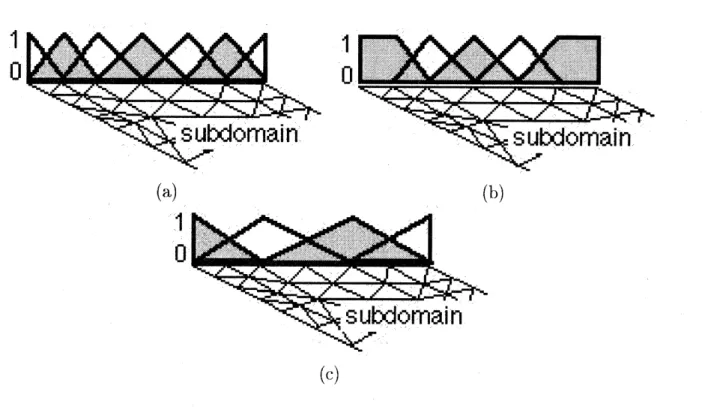
multiplier on the interfaces. For the discretization of the spaces of the Lagrangemultiplier defined on $\Gamma_{m}(1\leq m\leq M)$, we compare three cases (see Figure 2):
Case 1. The
conventional
iso-P2 Pl element, that is defined by$W_{m,h}=(x_{\kappa(m)}+,h|_{\Gamma_{m}})^{2}$, (10)
where
$X_{k,h}=\{v\in C(\overline{\Omega_{k}}); v_{|e}\in P^{1}(e). e\in \mathcal{T}_{k./\iota/2}\}$ . (11)
Case 2. A modified iso-P2 Pl element having no freedorns at both edges of$\mathrm{i}\mathrm{n}\mathrm{t}\mathrm{e}\mathrm{r}\mathrm{f}\mathrm{a}\mathrm{C}\mathrm{C}\mathrm{S}[7]$.
Case 3. The
conventional
Pl element. that is defined by(a) (b)
(c)
Figure 2: Shapes of (a)iso-P2, (b)modified iso-P2 and (c)P1 base functions for the
La-grarlge $\mathrm{m}\mathrm{u}\mathrm{l}\mathrm{t}\mathrm{i}_{1)}1\mathrm{i}\mathrm{e}\mathrm{r}$ and a sub$(\mathrm{l}\mathrm{i}\mathrm{V}\mathrm{i}\mathrm{s}\mathrm{i}\mathrm{o}\mathrm{n}\tau_{k,h/}2$
where
$Y_{k.h}.=\{v\in C(\overline{\Omega_{k}}); v_{1e}\in P^{1}(_{\mathrm{t}^{\supset}}’), e\in \mathcal{T}_{k,h}\}$. (13)
The finite elelnent, space $W_{/\iota}$ is defined by
$\nu \mathrm{f}_{h}^{\Gamma}/=\prod_{m=1}^{M}\nu \mathrm{f}/rm,h$. (14)
We consider the time-discretized finite element equations derived from (1)$-(4)$
.
Problem 1. Find $(u_{h}^{n+\rfloor},l)hr?,$ $\lambda_{h}n)\in V_{h}\cross Q_{h}\cross 7\mathrm{t}_{h}^{\gamma}$, such that
$\forall v_{h}\in V’\iota,\backslash$ $( \frac{\prime(\iota_{h}^{n}+1-\prime l\mathit{4}_{h}^{\eta}}{\tau}, ?)h)_{h}+b(v_{hP_{h}}\backslash )\prime jn+(v_{h}, \lambda_{h}n)$ $=$ $\langle\hat{f}, v_{h}\rangle$
$-a_{1}^{h}(u^{nn}, u_{h}, v_{h})h$
$-a_{0}(u_{h’ h}’‘)7\downarrow)\backslash$
, (15)
$\forall q_{h}\in Q_{h}$, $b(u^{n_{L}+},, qh)1$ $=$ $0$
.
(16) $\forall_{l}/_{h}\in W_{h}$, $j(u_{f_{1}}^{\eta+}, \mu_{h}1)$ $=$ $0$, (17)where
$(u, v)$ $=$ $\sum_{k=1}^{I\backslash }-\int\Omega kuk$
.
$vkd_{\mathcal{T}}.$, (18)$a_{1}(?r).u.\tau/))$ $=$ $\sum_{k=1}^{\tau_{\mathrm{i}}\prime}\int_{\Omega}k(w_{k}\cdot \mathrm{g}\mathrm{r}\mathrm{a}\mathfrak{c}1u_{k})v_{k}dX_{\backslash ,J}$ (19)
$a_{0}(u.?))$ $=$ $\frac{2}{Re}\sum_{k=1}^{Ic}\int\Omega ku_{k}D()\otimes D(v_{k})d_{X}.$
.
(20)$b(v, q)$ $=$ $- \sum_{k=1}^{I\mathrm{t}’}\int\Omega kqk\mathrm{d}\mathrm{i}_{\mathrm{V}}vkdX$
.
(21)$j(v, \mu)$ $=$ $- \sum_{m=1}^{M}\int \mathrm{r}mv_{\kappa}(+(m)-v(\kappa_{-}m))\mu_{m}ds$, (22)
$-\langle\hat{f}, v\rangle$
$=$ $\sum_{k=1}^{r}(\int I\mathfrak{i}\Omega_{k}f\cdot vkdx+\int_{\partial}\Omega_{k}\cap\Gamma_{N}^{\cdot}v_{k}gNd^{\sigma_{j}}.)$, (23)
$(, )_{h}$ denotes the mass-lumping corresponding to $($
.
$)$, $a_{1}^{h}$ is the upwind finite elementap-proximation based on the choice ofup-and downwind $\mathrm{p}\mathrm{o}\mathrm{i}\mathrm{n}\mathrm{t}_{\mathrm{S}}[6]$ to
$\mathrm{c}x_{1},$ alld $D$ is the
$\mathrm{s}\mathrm{t}_{\mathrm{T}}\Gamma \mathrm{a}\mathrm{i}\mathrm{n}$
rate tensor.
We rewrite Problem 1 by a matrix form as,
$=$
,
(24)where $\overline{M}$ is the lumped-mass $\mathrm{m}\mathrm{a}\mathrm{t}_{m}\mathrm{r}\mathrm{i}\mathrm{x},$ $B$ is the divergence matrix, $J$ is the jump matrix,
$F^{n}$ is a known vector, and $U^{n+1},P^{n}$ and $\Lambda^{n}$ are unknown vectors. Eliminating $U^{n+1}$
from (24), we get a domain-decomposition version of the consistent discretized pressure
$\mathrm{e}\mathrm{q}\mathrm{u}\mathrm{a}\mathrm{t}\mathrm{i}\mathrm{o}\mathrm{n}[8]$. Further eliminating $P^{n}$
.
we obtain a system of linear equations with respectto $\Lambda^{n}$. Applying CG method to this equation. a domain decomposition algorithm is
obtained[9].
Remark 1. The quantity $\lambda_{m.h}$ corresponds to $\sigma\cdot n_{\kappa(m)}+|_{\gamma_{m}}$.
Remark 2. In implementation. an idea oftwo data$\mathrm{t}\mathrm{y}\mathrm{p}\mathrm{e}\mathrm{S}[10]$ is applied to the Lagrarlge
multipliers and the jump matrix. The idea simplifies the implementation and $\mathrm{r}\mathrm{e}(11\mathrm{l}\mathrm{c}\mathrm{e}$the
amount of message-passings. Forthe velocity and the pressure. we do not need to execute message-passlngs.
(b)
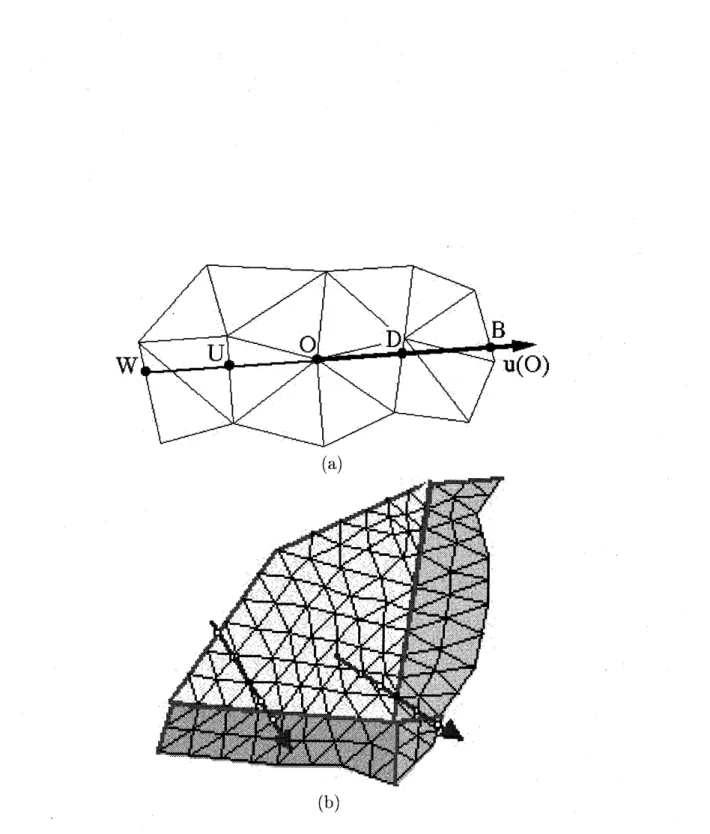
Figure 3: (a)Two upwind points(W,U) and two downwind points(D,B) in the upwind
finite element approximation based on the choice of up- and downwind $\mathrm{I}$)
$\mathrm{o}\mathrm{i}\mathrm{n}\mathrm{t}\mathrm{s}$ and
$(\mathrm{b})\mathrm{a}$
Remark 3. In order to evaluate $a_{1}^{h}(u^{\eta}u^{n}vh)h’ h^{\backslash }’$
’ we need to find two upwind $1$)
$\mathrm{o}\mathrm{i}\mathrm{n}\mathrm{t}\mathrm{s}$ and
two downwind points for each nodal points. In the $\mathrm{d}\mathrm{o}\mathrm{m}\mathrm{a}\mathrm{i}\mathrm{l}\mathrm{l}- \mathrm{C}\mathrm{l}\mathrm{e}\mathrm{C}^{\cdot}\mathrm{o}\mathrm{n}\mathrm{l}\mathrm{p}\mathrm{o}\mathrm{s}\mathrm{i}\mathrm{t}\mathrm{i}\mathrm{o}\mathrm{n}$situation. solne
of these up- and downwind points for nodal points near illterfaeies may be included in the
neighbor $\mathrm{s}\mathrm{u}\mathrm{b}\mathrm{e}1_{0}\mathrm{I}\mathrm{n}\mathrm{a}\mathrm{i}\mathrm{n}\mathrm{S}$. In order to treat it, each processor $\mathrm{c}\mathrm{o}\mathrm{r}\Gamma \mathrm{e}\mathrm{s}_{1\mathrm{g}}$)
$\mathrm{o}\mathrm{n}\mathrm{d}\mathrm{i}_{1\mathrm{l}}$ to a $\mathrm{s}\mathrm{u}\mathrm{t}$
)$(1_{0}\mathrm{n}\mathrm{l}\mathrm{a}\mathrm{i}_{11}$
has geornetry information of all elements which share at least a point with $\mathrm{n}\mathrm{e}\mathrm{i}\mathrm{g}\mathrm{h}\mathrm{t}$)$\mathrm{o}\mathrm{r}$
subdomains (see Figure $3(\mathrm{r}\mathrm{i}\mathrm{g}\mathrm{h}\mathrm{t})$). The processors exchange each other the values of $u_{h}^{r1}$
before the evaluation. Hence the evaluation itself is parallelized without any
message-passings.
3
Numerical
experiments
3.1
Test problem
Let $\Omega=(0,1)\cross(0,1)$ and $\Gamma_{D}=\partial\Omega(\Gamma_{N}=\emptyset)$ . The exact stational solution is
$u(x, y)$ $=$ $(x^{2}y+y^{3}, -x^{3}-xy2)^{T}$, (25)
$p(x, y)$ $=$ $x^{3}+y^{3}-1/2_{i}$ (26)
and the Reynolds number is set to 400. The boundary condition and the external force
are calculated from the stational Navier-Stokes equations.
We havedivided$\Omega$ into aunion of uniform $N\cross N\cross 2$triangularelements,where $N=4$,
8, 16 or 32. We have computed in two domain-decolnposed ways, where the number of
subdomains in each direction is 2 or 4. Figure 4 shows the domain-decomposition allcl the triangulation in the case $N=32$ and 4 $\cross 4$ subdomains. Starting from $\mathrm{a}\mathrm{r}\mathrm{l}$ initial
condition for the velocity, the numerical solution is expected to converge to the stational
solution in time-marching. If $\max_{k,i}|u_{k,i}^{n}-u^{n-1}k,i|/\tau<10^{-5}$ is satisfied. wejudge that the numerical solution has converged and stop the computation. Computation parameters
are set as $\tau=0.24/N$ and $\alpha=1.0$ (the latter is the stabilizing parameter of the upwind
approximation).
solu-Figure 4: Domain-clec($\mathrm{m}\mathrm{p}\mathrm{o}\mathrm{s}\mathrm{i}\mathrm{t}_{)}\mathrm{i}\mathrm{o}\mathrm{n}(4\cross 4)$ and the $\mathrm{t}\mathrm{r}\mathrm{i}\mathrm{a}\mathrm{n}\mathrm{g}\mathrm{u}\mathrm{l}\mathrm{a}\mathrm{t}\mathrm{i}_{0}\mathrm{n}(N=32)$
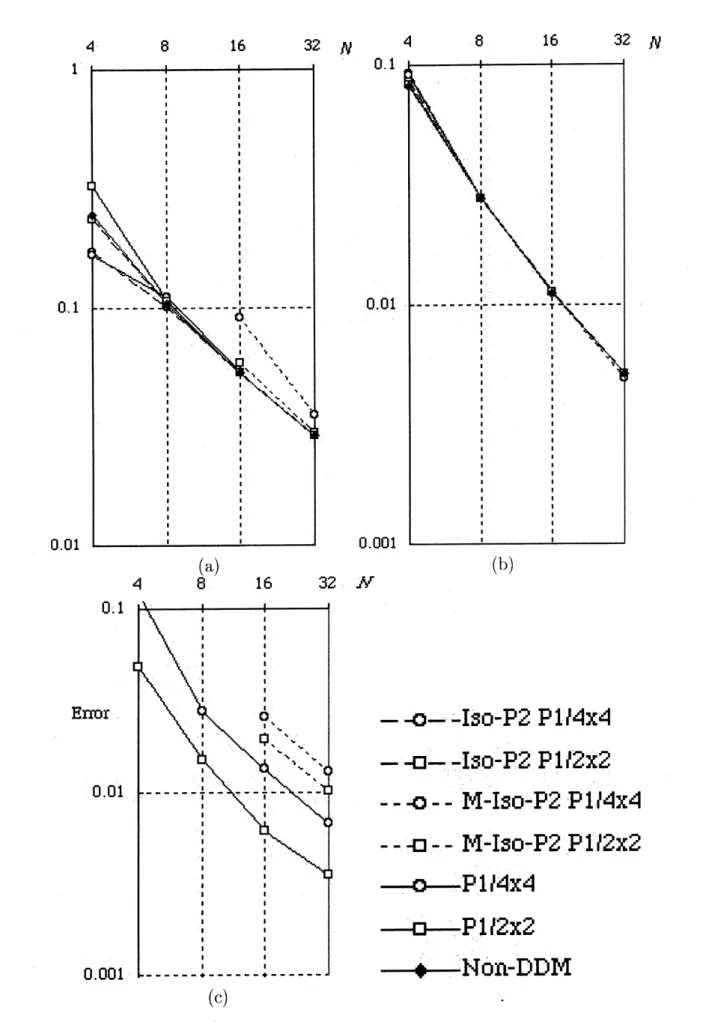
tions. They are measured by
$|v|_{V_{h}}= \{_{k=}I\sum_{1}’|v|^{2}(H1(\Omega_{k}))\backslash 2\}^{1/2}$, $||q||_{Q_{h}}= \{_{k=}I\sum_{1}’||q||_{L()}22\{\Omega_{k}\}^{1/2}$ ,
$|| \lambda||_{W_{h}}=\max_{rn\Gamma_{m}}\max|\lambda|$.
Results of the $\mathrm{n}\mathrm{o}\mathrm{I}1^{-}(1\mathrm{o}\mathrm{I}11\mathrm{a}\mathrm{i}\mathrm{n}-\mathrm{c}1_{\mathrm{C}\mathrm{C}\mathrm{O}\mathrm{I}}\mathrm{n}\mathrm{p}\mathrm{o}\mathrm{s}\mathrm{i}\mathrm{t}\mathrm{i}\mathrm{o}\mathrm{n}$ case are also plotted in the figure. We $\mathrm{c}\cdot \mathrm{a}\mathrm{l}\mathrm{l}$
observe $\mathrm{t}l\perp \mathrm{a}\mathrm{t}$ the
$\mathrm{e}\mathrm{r}\mathrm{l}\cdot \mathrm{o}\mathrm{r}\mathrm{s}$ of the velocity and the pressure realize the optimal convergence
rate of the iso-P2 $\mathrm{P}1/\mathrm{P}1$ elements,that is $O(h)$, regardless ofchoice of$W_{m,h}$. In the first
case (iso-P2 Pl element for $W_{m,h}$), the maximum error of the Lagrange multiplier does
not converge to $0$ when $h$ tends to $0$
.
It may indicate the appearance of some spuriousLagrallge multiplier modes, $\mathrm{s}\mathrm{i}11(i\mathrm{C}$ thedegree of freedom of the Lagrange$\mathrm{m}\mathrm{u}\mathrm{l}\mathrm{t}\mathrm{i}_{1}\mathrm{J}\mathrm{l}\mathrm{i}\mathrm{e}\mathrm{r}$ is larger
than that of jump of the velocity ill the choice. In the latter two cases the convergence of
the Lagrange multiplier has also observcd. The third case (Pl element for $\mathrm{w}\nearrow_{m,h}$) shows
the $\mathrm{t}$
)$\mathrm{e}\mathrm{s}\mathrm{t}_{1}1$)$\mathrm{r}\mathrm{o}\mathrm{P}(\mathrm{l}\mathrm{r}\mathrm{t}\mathrm{y}$ with $\mathrm{r}\mathrm{e}\mathrm{s}_{1^{\mathrm{J}\mathrm{e}\mathrm{c}\mathrm{t}}}$to the convergence of the Lagrange multiplier.
Since the ($j\mathrm{o}\mathrm{n}\mathrm{v}\mathrm{e}\mathrm{n}\mathrm{t}\mathrm{i}_{011\mathrm{a}1}$ Pl element has the smallest degree of freedom of the Lagrange
$\ln\iota 11\mathrm{t}\mathrm{i}_{1})1\mathrm{i}e\mathrm{r}$, it (an decrease the arlloullt of computation steps in a $\mathrm{i}\mathrm{t}\mathrm{e}\mathrm{r}\mathrm{a}\mathrm{t}\mathrm{i}_{0}11$ tinle ill $\mathrm{t}_{J}\mathrm{h}\mathrm{e}$
($\mathrm{o}\mathrm{n}\mathrm{j}_{1}1\mathrm{g}\mathrm{a}\mathrm{t}(^{>}\text{ノ}\mathrm{g}\mathrm{r}\mathrm{a}$(
$\mathrm{l}\mathrm{i}\mathrm{e}\mathrm{l}\mathrm{l}\mathrm{t}$ solver. Hence we adopt Pl element for
$\mathrm{M}^{I_{r}}$ in the $\mathrm{f}\mathrm{o}\mathrm{l}\mathrm{l}\mathrm{t}$
$N$
$–B–\mathrm{I}\mathrm{S}O- \mathrm{P}\Xi$
Pl
$f\triangleleft \mathrm{x}\mathrm{d}$$– \mathrm{n}--\mathrm{I}\mathrm{s}o- \mathrm{p}\Xi$
Pl
$f\Xi \mathrm{x}\Xi$–r–
$\mathrm{M}- \mathrm{I}\mathrm{s}o-\mathrm{P}\Xi$Pl
$f\triangleleft \mathrm{x}\mathrm{d}$ $–\mathrm{f}\mathrm{i}--\mathrm{M}- \mathrm{I}\mathrm{S}o-\mathrm{P}\Xi$Pl
$f\Xi \mathrm{x}\Xi$(C)
1 $\cross 1$
1090.
3.2
Lid-driven cavity
flow problem
We next computed the two-dimensional lid-driven cavity flow problem. The Reynolds
number is 400. The domain $\Omega=(0,1)\cross(0,1)$ is divided into a uniform 24 $\cross 24\cross 2$
t,riangular subdivision. We chose $\tau=0.01$ and $\alpha=1$. We computed in the cases of$4\cross 4$,
4 $\mathrm{x}2,2\cross 2,2\cross 1$ and $1\cross 1$ domain-decompositions. The computation time are listed in
Table 1. We see that the ($.\mathrm{O}\ln_{\mathrm{P}^{\mathrm{u}\mathrm{t}}}\mathrm{a}\mathrm{t}\mathrm{i}\mathrm{o}\mathrm{n}$time becomes shorter as the number ofsubdomains
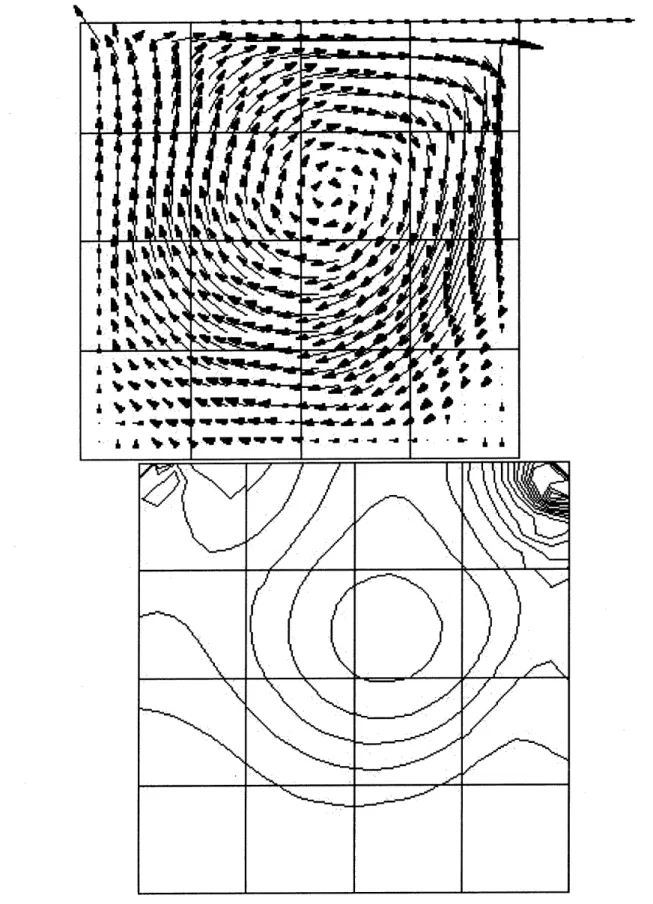
(i.e. processors) increases. $\mathrm{e}\mathrm{x}\mathrm{C}\mathrm{e}_{\mathrm{P}^{\mathrm{t}_{}\mathrm{f}}}\mathrm{o}1^{\cdot}$ the case of $2\cross 1$ subdomains. The velocity vectors
and the pressure colltours ofthe computed stationary fiow in $4\cross 4$ subdornains are shown
in Figure 6. We can observe that the flow is captured well in the dornain decomposition
algorithm.
4
Conclusion
Wehaveconsidered a domain decomposition algorithmofthe finiteelement scheme for the
Navier-Stokes equations. In the scheme, subdomain-wise finite element spaces by iso-P2
$\mathrm{P}1/\mathrm{P}1$ elernents are constructed and weak continuity of the velocity between subdomains are treated by a Lagrange multiplier method. This domain decomposition algorithm has
advantages such as: (i) each subdomain-wise problem is a consistent discretized pressure
Poisson equation so that it is regular, (ii) the size of a system of linear equations to be
solved by the conjugate gradient method is smaller than that of the original consistent
Figure
6:
Velocity vectors and pressurecontour lines of the lid-driven cavity flow problem,Lagrange rnultiplier. $\mathrm{E}\mathrm{m}\mathrm{p}\mathrm{l}\mathrm{o}\mathrm{y}\mathrm{i}\mathrm{l}$ the conventional Pl element, we have computed $\mathrm{t}\mathrm{h}\mathrm{e}_{J}$
lid-driven cavity flow problem. $\mathrm{T}\}_{1}\mathrm{e}$ computation time becomes shorter when the number of
processor increases. We therefore recornmend iso-P2 Pl$(\prime u)/\mathrm{P}1(p)/\mathrm{P}1(\lambda)$ element in this
rnethod.
Acknowledgements
The author wish $\mathrm{t}_{\text{ノ}}()$ thank Professor Masahisa Tabata (Kyushu University) for many
valuable $\mathrm{c}\mathrm{l}\mathrm{i}\mathrm{s}\mathrm{c}\mathrm{u}\mathrm{s}\mathrm{S}\mathrm{i}\mathrm{o}\mathrm{l}\mathrm{l}\mathrm{s}\subset \mathrm{u}\mathrm{l}\mathrm{d}$ suggestions. The author was supported by the Ministry of
Ed-ucation, Science and Culture of Japan under Grant-in-Aid for Encouragement of Young
Scientists, No.09740148. The computations have been done on Intel Paragon $\mathrm{X}\mathrm{P}/\mathrm{S}$ in
INSAM($\mathrm{I}\mathrm{n}\mathrm{S}\mathrm{t}\mathrm{i}\mathrm{t}\mathrm{u}\mathrm{t}\mathrm{e}$ for $\mathrm{N}_{11\mathrm{m}\mathrm{e}}1^{\cdot}\mathrm{i}\mathrm{c}\mathrm{a}1$ Simulations and Applied Mathematics), Hiroshima
Uni-versity.
References
[1] Y. Achdou and Y. A. Kuznetsov. Algorithm for a non conforming domain
decompo-sition
rnethod.
Tcch. Rep. 296, Ecole Polytechnique.1994.
[2] Y. Achdou andO. Pironneau, A fast solver forNavier-Stokes equations illthe lalninar
reginle using mortar finite element and boundary element methods, SIAM. J. Numer.
$Ar\iota al.,$ 32, 985-1016,
1995.
[3] R. Glowinski,T.-W. Pan and J. P\’eriaux. A one shot domain deconlposition/fi(titious
Scientific
and Engineering Computing, Proc. 7th Int.Conf.
on DomainDecompo-$\dot{\Re}tion$, D. E. Keyes and J. Xu ($\mathrm{e}(1\mathrm{S}.)$, Contemporary Mathernatics 180., A. M. S.,
Providence. Rhode $\mathrm{I}\mathrm{s}\mathrm{l}\mathrm{a}\mathrm{n}\mathrm{d}_{J}\backslash$ 211-220,
1994.
[4] A. Suzuki, Implementation of donlain de($i\mathrm{o}\mathrm{m}_{1^{)\mathrm{o}\mathrm{s}}}\mathrm{i}\mathrm{t}\mathrm{i}\mathrm{o}\mathrm{n}$ methods on parallel
$(\mathrm{O}\mathrm{I}\mathrm{I}\mathrm{l}1^{)\mathrm{u}\mathrm{t}}\mathfrak{t}^{\backslash },\mathrm{r}$
ADENART. Parallel Computational Fluid Dynamics: New $Alg_{ori}thms$ and
Applica-tions, N. Satofuka, J. Periaux an(1 A. Ecer (eds.), Elseviel.,
1995.
[5] M. Bercovier and O. Pironneau, Error estimates $\mathrm{f}\mathrm{o}1^{\cdot}$ finite element nletllo(1 solution
of the Stokes problem in the primitive variable, Numer. Math., 33.
211-224.
1979.[6] M. Tabata and S. Fujima, An upwind finite element $\mathrm{s}\mathrm{c}\mathrm{h}\mathrm{e}\mathrm{l}\mathrm{n}\mathrm{e}^{\mathrm{Y}}$ for
high-Reynolds-number flows, Int. J. Num. Meth. Fluids, 12, 305-322, 1991.
[7] C. Bernardi, Y. Maday and A. Patera, A new nonconforming $\mathrm{a}_{1^{)}1^{)}}\mathrm{r}\mathrm{o}\mathrm{a}(i\mathrm{h}$ to clomaill
decomposition: the mortar element method., NonlinearPartial
Differential
Equation8and their $Applicati_{\mathit{0}}n\mathit{8}\mathrm{x}\mathrm{I}$, H. Brezis and J. L. Lions (eds.). Longman
$\mathrm{S}(\mathrm{i}\mathrm{e}\mathrm{n}\mathrm{t}\mathrm{i}\mathrm{f}\mathrm{i}_{\mathrm{C}}\cdot$
&
Technical, Essex, UK, 13-51, 1994.
[8] P. M. Gresho, S. T. Chan, R. L. Lee allel C. D. Upson, A modified finite element
method for solving the $\mathrm{t}\mathrm{i}\mathrm{m}\mathrm{e}-\mathrm{d}\mathrm{e}_{1)\mathrm{e}}\mathrm{n}\mathrm{d}\mathrm{e}\mathrm{n}\mathrm{t}$, incompressible Navier-Stokesequations, Part
1: Theory, Int. J. Num. Meth. $Fluid_{\mathit{8}},4_{c}\backslash$ 557-598,
1984.
[9] S. Fujima, An upwind finite element scheme for the Navier-Stokes equations and its
domain decomposition algorithm, Thesis, Hiroshima University,
1997.
[10] S. Fujirna, Implementationof mortar element $1\mathrm{n}\mathrm{e}\mathrm{t}\mathrm{h}_{\mathrm{o}(}1$ for flow 1)roblems in the 1)$\mathrm{r}\mathrm{i}\mathrm{m}-$
itive variables, to appear in Int. J. Comp. Fluid Dyn.
[11] S. Fujinla, Iso-P2 $\mathrm{P}1/\mathrm{P}1/\mathrm{P}\mathrm{l}\mathrm{D}\mathrm{o}\mathrm{m}\mathrm{a}\mathrm{i}\mathrm{n}- \mathrm{d}\mathrm{e}\mathrm{c}\mathrm{o}\mathrm{m}\mathrm{p}\mathrm{o}\mathrm{s}\mathrm{i}\mathrm{t}\mathrm{i}_{\mathrm{o}\mathrm{n}}/\mathrm{F}\mathrm{i}\mathrm{n}\mathrm{i}\mathrm{t}\mathrm{e}$-element Method for the