Detecting Undersampling in
Surface Reconstruction
Tamal K. Dey
Joachim Giesen
*Abstract
Current surface reconstruction algorithms perform satisfactorily on well-sampled, smooth surfaces without boundaries. $\dot{\mathrm{H}}\mathrm{o}\mathrm{w}\mathrm{e}\mathrm{v}\mathrm{e}\mathrm{r}$
, these algorithms have severe problems with
under-sampling. Cases of undersamplingare prevalent in real data since often they samplea part
of the boundary of an object, or are derived from a surfaces with high curvature. In this
paperwepresent analgorithm to detect the regions of undersampling. This informationcan
be used to reconstruct surfaces with boundaries, and also to localizesharpfeatures in
nons-moothsurfaces. Wereport the effectiveness of the algorithm withanumber of experimental
results. Theoretically, wejustify the algorithm withsomemild assumptions thatarevalidfor
most practical data.
Keywords: Reconstruction,surface, sampling, boundary, Voronoi diagram, triangulation
1
Introduction
Many applications inCAD, computer graphics andscientificcomputationsinvolveapproximating
a surface from its samples. A piecewise linear approximation to the surface which is sought in
surface
reconstruction is often appropriate for visual aids. They also form the control net for generatinglimitsurfaceswith higher continuity using subdivision methods [23].The twodimensional version of theproblem, namely curve reconstructionhas been well studied
intheliterature [2, 5, 11, 12, 13, 18, 19, 22]. Amongthe algorithms proposed in the literaturefor
surfacereconstruction, the earlier
ones
[6, 7, 9, 15, 21] concentratedon
the empirical results anddid not focus
so
much on thetheoretical guarantees. Edelsbrunner [14] reports the developmentof a commercial software under propriety rights which is based
on
the ideas of$\alpha$-shapes. Veryrecently, starting withthe algorithm of[1]three algorithms have been proposed with theguarantee
that the output surface is homeomorphic and geometrically close to the sampled surface. They
are
theCRUST algorithmbyAmentaand Bern [1],theCO-CONE algorithmby Amenta, Choi, DeyandLeekha [4], and the natural neighbor algorithmby Boissonat and Cazals [8]. Thetheoretical
guaranteeprovided by these algorithms requires that the given data sample
a
surfacedensely. Allthese algorithms run into serious troubleif this condition is not met. In practice, the data may
sample only part ofa surface densely. This may beintentional for introducing boundaries, may
beaccidental for high curvature regions,
or
may beunavoidabledue to non-smoothness.In this paper wepresent
an
algorithm that detects the regions ofundersampling undersome
assumptions that
are
reasonable for most practical data. This information is used in theco-cone
algorithm [4] to reconstruct the surface patches thatare
well sampled. The main idea ofdetecting the locality ofundersampled regions is to consider the structure of the Voronoi cells
as
indicated in [3]. We mature this idea withnew
definitions and assumptions and present a proofthat the algorithm finds undersampledregions. Our algorithm finds immediate application*DepartmentofCIS, Ohio StateUniversity, Columbus, OH 43210.
in reconstructing surfaces with boundaries and also in detecting sharp features in non-smooth surfaces. To
our
knowledge, boundaries and non-smoothness pose serious difficulty in surfacereconstruction, and
none
of the known algorithmscan
handle them. We present experimentalresults with several data sets. The algorithm detects the boundaries in these test
cases.
It alsopointsout the regions of high curvature where thesurfaceis undersampled. Thisinformation
can
be used in
a
repairphase that fills up the“holes”.2
Definitions
2.1
Sampling
We base
our
algorithmon
the notion of$\epsilon$-sampling of smooth surfaces as introduced in [1]. Themedial axisof
a
smooth surface $F\subset \mathbb{R}^{3}$ is the closure ofthe set ofpoints that havemore
thanone
closest point on $F$.
The localfeature
size $f(p)$ at a point $p\in F$is the least distance of$p$tothe medialaxis. The medial bdlsat$p$ are defined
as
theballs that touch $F$tangentially at$p$andarecenteredon the medial axis. A point set $P\subset F$ is called
an
$\epsilon$-sample of asurface $F$ ifeverypoint$p\in F$has asample within distance of$\epsilon f(p)$.
Well-sampled patch: Let $S\subseteq F$ be a surface patch such that each point $x\in S$ has
a
samplewithin$\epsilon f(x)$ distance and$S$ ismaximal in the
sense
thatno
other point $y\not\in S$has this property.Notice that $S$ may have several components. Boundaries of $S$ coincide with the boundaries of
undersampled regions in$F$
.
Ourgoal is to recognize the boundaries in$S$ and reconstruct it fromsample $P$
.
2.2
Boundaries
For any compact surface $S$ we can distinguish interior points from the boundary points. An
interior point has a neighborhood homeomorphic to the open disc$\mathrm{D}^{2}=\{x\in \mathbb{R}^{2} : |x|<1\}$
.
Aboundary point, on the other hand, has a neighborhood homeomorphic to the halfdisc $\mathrm{D}^{2}\cap \mathbb{P}_{+}$
which is openin the halfspace$\mathbb{P}_{+}=\{(x, y)\in \mathbb{R}^{2} : x\geq 0\}$.
For the reconstruction of$S$ only the finite set ofsample points$P$is given thatwell samples$S$
.
Even though all points in $P$ may be interiorpointsof$S$, the existence of
a
non empty boundaryshould reflect itselfin the sample points. We are looking for
a
definition of interiorand boundarypointsfor a finitesamplefrom asurface that captures theintuitive differencebetween interiorand
boundarypoints. We base
our
definitionon
the restricted Voronoidiagramasintroduced in [16].Restricted Voronoi diagram: Let $P$ be
a
sample ofa
compact surface $S$ withor
withoutboundary embedded in $\mathbb{R}^{3}$
.
Denote the Voronoi diagram of $P$ by $V_{P}$. The restriction of $V_{P}$on the surface $S$ defines the restricted Voronoi diagram containing the restricted Voronoi cells $V_{p,S}=V_{p}\cap S$.
Thedualofthe restrictedVoronoidiagramdefinesthe restricted Delaunay triangulation$D_{P,S}$.
Specifically,
an
edge$pq$isin$D_{P,S}$iff$V_{p,S}\cap V_{q,S}=\emptyset$; a triangle$pqr$is in$D_{P,S}$iff$V_{p,S}\cap V_{q,S}\cap V_{r,S}=\emptyset$and
a
tetrahedron pqrs is in $D_{P,S}$ iff$V_{p,S}\cap V_{q,S}\cap V_{r,S}\cap V_{s,S}=\emptyset$. Edelsbrunner and Shah [16]showed that ifeach restricted Voronoi cell (defined recursivelywith dimensions) is a closed ball,
andthe
same
conditionholdsforthe boundaryof$S$,then$S$ is homeomorphic to$D_{P,S}$. This leadsus todefine the neighborhood ofa sample point$p$as $V_{p,S}$.
Using this definition of neighborhood
we
define interior vertices. All vertices thatare
notDeflnition 1 (Interior and boundary vertices) A sample point$pfmm$ a sample $P$
of
$S$ iscalled interior vertex
if
$V_{p,S}$ does not contain a boundarypointof
S.
Samplepoints thatare
notinterior are called boundary vertices.
Arguments of
[1] can
be usedto show that the neighborhoods of interior vertices arehomeo-$\dot{1}$
morphic todisks if$P$is
an
$\epsilon$-sampleof$S$ with $\epsilon<0.1$.
2.3
Flat
vertices
Ourgoal is to detect boundary vertices algorithmically and to exploit thisinformationfor surface
reconstruction.
Given
onlya finitesample$P$froma
surface$S$embedded in$\mathbb{R}^{3}$we
cannot constructthe restrictedVoronoidiagram$V_{P,S}$, becausethesurface$S$isunknowntous. Therefore wecannot
exploit
our
definitionofinteriorand boundaryverticesalgorithmically.To cope with this problem
we
definea
flatness
condition and show that boundary verticescannot be flat whereas interior vertices with well sampled neighborhoods
are
flat. This definitionuses
the definitions ofpoles and the width and heights ofVoronoicells. The benefit weget from the definitionof flat vertices is that it canbe exploited algorithmically.Ray: In$\mathrm{w}\mathrm{h}.\mathrm{a}\mathrm{t}\mathrm{f}\mathrm{o}\mathrm{l}\mathrm{l}\mathrm{o}\mathrm{w}\mathrm{s},\mathrm{w}\mathrm{e}$willdenote the$\mathrm{r}..\mathrm{a}\mathrm{y}$from$p$to$y\mathrm{w}$
.ith
$\vec{y}$for any$\mathrm{s}\mathrm{a}\mathrm{m}\mathrm{p}\mathrm{l}\mathrm{e}$ point$p$
a.nd
anypoint $y\in V_{p}$.
Angles: We usethe notation $\angle(v_{1}^{arrow}, v_{2}^{arrow})$ to denote the acute angle between the lines supporting
two vectors$v_{1}^{arrow}$ and $v_{2}^{arrow}$
.
Poles: Given
a
finitepoint set $P\subset \mathbb{R}^{3}$, let$V_{p}$ bethe Voronoicellof apoint$p\in P$. We borrow
the definitionof poles from [1]. The vertex $v_{p}^{+}$ of the Voronoi cell $V_{p}$ which isfarthest from the
point$p$iscalled the positive pole of$V_{p}$. Assumingthat $P$does not lieon aplane,$v_{p}^{+}$ always exists.
The negative pole of $V_{p}$ is the farthest point $v_{p}^{-}\in V_{p}$ from$p$ such that $v_{p}arrow-$
.
$v_{p}arrow+<0$.
Basically,negative pole is thefarthest point in $V_{p}$ in the
“opp.o.site
direction” of the positive pole.$Co$-cone: The set $C_{p}= \{y\in V_{p} : \angle(y^{arrow}, v_{p}^{\sim+})\geq\frac{3\pi}{8}\}$ is calledthe $\mathrm{c}\mathrm{o}$
-cone
of$p$.
Basically, $C_{\mathrm{p}}$ isthe complement of
a
doublecone
(clipped within$V_{p}$) centered at$p$withan opening angle $\frac{3\pi}{8}$.
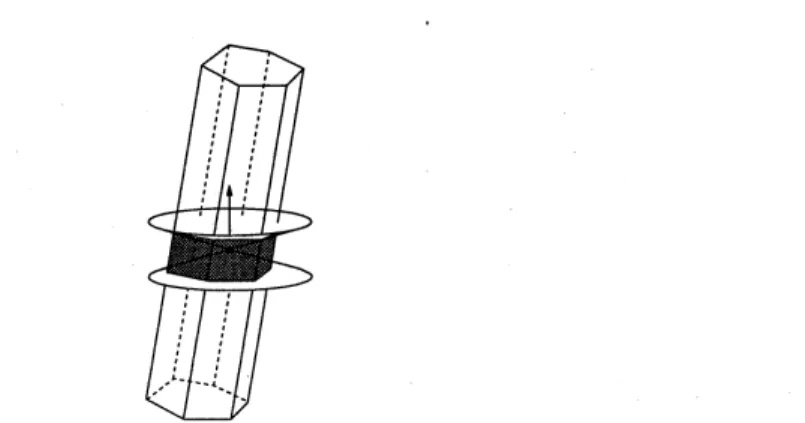
SeeFigure 1 foran example ofa
co-cone.
$Co$-cone neighbors: Givena finitesample $P$, the set $N_{p}=\{q\in P : C_{p}\cap V_{q}\neq\emptyset\}$is called the
set of$\mathrm{c}\mathrm{o}$
-cone
neighbors of$p$.
Width and height
of
Voronoi cells: The width$w(V_{\mathrm{p}})$of the Voronoicell$V_{p}$of$p$is definedas theradiusof$C_{p}$, i.e.,$w(V_{p})= \max\{|py| : y\in C_{p}\}$,
see
alsoFigure1. Let$h^{+}(V_{p})$and$h^{-}(V_{p})$denotethe
lengths $|pv_{p}^{+}|$ of$v_{p}arrow+\mathrm{a}\mathrm{n}\mathrm{d}|pv_{p}^{-}|$ of$v_{p}arrow-\mathrm{r}\mathrm{e}\mathrm{s}\mathrm{p}\mathrm{e}\mathrm{c}\mathrm{t}\mathrm{i}\mathrm{v}\mathrm{e}\mathrm{l}\mathrm{y}$. Definethe height $h(V_{p})$ as $\min(h^{+}(V_{p}), h^{-}(V_{p}))$.
Now, we areprepared to define flatness, which depends on two parameters $\rho$ and $\theta$.
Definition 2 (Flatness) A sample point$p\in P$ is called
flat if
thefollowing two conditions hold:1. Ratio condition: $\rho w(V_{p})\leq h(V_{\mathrm{p}})$
2. Normalcondition: $\forall q$ with$p\in N_{q},$ $\angle(v_{p}^{+}, v_{q}^{+})\leq\theta$.
Ratio condition imposes that the Voronoi cell $V_{p}$ is long and thin in the directions of the pole vectors$v_{\mathrm{p}}\mathrm{a}\mathrm{n}\mathrm{d}\wedge\vdash v_{p}arrow-$. Thenormal conditionstipulates thatthedirection ofelongationof
Figure 1: A Voronoi cell together with the normalized pole vector and the $\mathrm{c}\mathrm{o}$-cone (shaded).
with that of any vertex whose $\mathrm{c}\mathrm{o}$
-cone
neighbor is$p$. In the proofwe use
$\rho=\frac{1}{1.3\epsilon}$ and $\theta=0.14$radians.
3
Assumptions and Theorems
Ourgoal is to exploit the definitionofflat vertices in aboundarydetection algorithm. In Theorem
1we provethat interior vertices with well sampled neighborhoods
are
flat. In Theorem2we provethat the boundary vertices cannot be flat. These two theorems form the basis of
our
boundarydetection algorithm. Weomit the proofsofthese two theorems inthis version. See[10] for details.
In the proofs we
assume
$\epsilon\leq 0.01,$ $\rho=\frac{1}{1.3\epsilon}$ and $\theta=0.14$ radians. With these values wecan
show that interior vertices satisfy the ratio condition. However, the normal condition may not
hold for all ofthem. Nevertheless, we can show that a subset ofinterior vertices that have well
sampled neighborhoods satisfy the normal condition. To be precise
we
introduce the followingdefinition.
Definition 3 (Deep interior vertex:) An interior vertex$p$ is called deep
if
it does not haveany boundary vertex as Voronoi neighbor.
Theorem 1 All deep interior vertices are
flat.
For Theorem 2weneed
some
boundary assumptions. The first assumption (i)saysthatbound-aryvertices remain as boundary evenif $S$ is expandedwith a small collar around its boundary,
and the assumption (ii) stipulates that the boundaries be “well separated”. Assumption 1 (Boundary assumption)
$i$. The restricted Voronoi cell
of
a boundary vertex is a disk. Thesurface
patch $S’\supset S$ withthe condition that any$x\in S’$ has a sample within$\delta f(x)$ distance
for
some $\delta>\epsilon$defines
thesame set
of
boundaryvertices as$S$ does. We will need$\delta=1.3\Delta\epsilon$for
ourproofs, where $\Delta$ isdefined
as $\max\{\frac{h(V)}{f(p)}\}$.
$ii$
.
Neighborhoodof
each boundary vertex intersects the neighborhoodof
at least an interiorvertex.
Remark. It is interesting tonote that one
can assume
the surface$F$tohavesmallfeatures aroundany sample point to render it
as a
boundary point in our definition. After all, the surface $F$ isunknown to
us.
This should reflect inour assumptions and proofs. Observethat,the smaller thefeature size gets, the larger gets $\Delta$
as
$\Delta=\max\{\frac{h}{f(}Ep\overline{)}\}$.
In order forboundary assumption to bevalid, weneed $\delta$ to be fixed
even
though $\Delta$ increases. This requires $\epsilon$ to decrease as $\delta=1.3\Delta\epsilon$.
But, decreasing $\epsilon$ would require alarger value
$\mathrm{o}\mathrm{f}\rho\wedge\cdot$ Thus, indeed larger valueof$\rho$
are
needed todetect
more
verticesas
boundary.4
Boundary
detection
Thealgorithm for boundary detection first computes the set of interior vertices, $R$, that areflat.
It uses two parameters$\rho$ and
$\theta$ to check the ratio and normal conditions. In theory, we require $1\mathrm{a}\mathrm{r}\mathrm{g}\mathrm{e}\mathrm{T}\mathrm{h}\mathrm{e}\mathrm{o}\mathrm{r}\mathrm{e}\mathrm{m}1\mathrm{a}\mathrm{n}\mathrm{d}\mathrm{A}\mathrm{s}\mathrm{s}\mathrm{u}\mathrm{m}\mathrm{p}\mathrm{t}\mathrm{i}\mathrm{o}\mathrm{n}2\mathrm{g}\mathrm{u}\mathrm{a}\mathrm{r}\mathrm{a}\mathrm{n}\mathrm{t}\mathrm{e}\mathrm{e}\mathrm{t}\mathrm{h}\mathrm{a}\mathrm{t}R\mathrm{i}\mathrm{s}\mathrm{n}\mathrm{o}\mathrm{t}\mathrm{e}\mathrm{m}\mathrm{p}\mathrm{t}\mathrm{y}$
.
$\mathrm{I}\mathrm{n}\mathrm{a}\mathrm{s}\mathrm{u}\mathrm{b}\mathrm{s}\mathrm{e}\mathrm{q}\mathrm{u}\mathrm{e}\mathrm{n}\mathrm{t}\mathrm{p}\mathrm{h}\mathrm{a}\mathrm{s}\mathrm{e}R\rho=\frac{1}{1.3\epsilon,\mathrm{r}\theta}$
.
$\mathrm{a}\mathrm{n}\mathrm{d}\theta=0.14.\mathrm{H}\mathrm{o}\mathrm{w}\mathrm{e}\mathrm{v}\mathrm{e}\mathrm{r},\mathrm{i}\mathrm{n}\mathrm{o}\mathrm{u}\mathrm{r}\mathrm{i}\mathrm{m}\mathrm{p}\mathrm{l}\mathrm{e}\mathrm{m}\mathrm{e}\mathrm{n}\mathrm{t}\mathrm{a}\mathrm{t}\mathrm{i}\mathrm{o}\mathrm{n}\mathrm{w}\mathrm{e}\mathrm{o}\mathrm{b}\mathrm{t}\mathrm{a}\mathrm{i}\mathrm{n}\mathrm{g}\mathrm{o}\mathrm{o}\mathrm{d}\mathrm{r}\mathrm{e}\mathrm{s}\mathrm{u}\mathrm{l}\mathrm{t}\mathrm{s}\mathrm{f}\mathrm{o}\mathrm{r}\mathrm{s}\mathrm{m}\mathrm{a}\mathrm{l}\mathrm{l}\mathrm{e}\mathrm{r}\rho \mathrm{a}\mathrm{n}\mathrm{d}$
is expanded to include all interior vertices in aniterative procedure. A genericiteration proceeds
asfollows. Let$p$beany
co-cone
neighbor ofavertex$q\in R$so
that$p\not\in R$and$V_{p}$ satisfiesthe ratiocondition. If$v_{p}^{+}$ and$v_{q}^{+}$ make smallangle up to orientation, i.e., if$\angle(v_{p}^{arrow+}, v_{q}^{arrow+})\leq\theta$,
we
include$p$in $R$
.
Ifno such vertexcan
be found, the iteration stops. We arguethat $R$includes only and allinterior vertices at the end. The rest of the vertices are detected
as
boundaryones.
Thefollowing routine$\mathrm{I}\mathrm{s}\mathrm{F}\mathrm{L}\mathrm{A}\mathrm{T}$ checks the conditions stated in Definition 2 to detect flat vertices.
The input isasample point$p\in P$with
a
parameter$\rho$thatmeasures
the height$\mathrm{v}\mathrm{s}$. width ratiofor$V_{p}$
.
The return value is true if$p$isa
flat vertex, and false otherwise. The routine BOUNDARYuses
$\mathrm{I}\mathrm{s}\mathrm{F}\mathrm{L}\mathrm{A}\mathrm{T}$ to detectthe boundary vertices. $\mathrm{I}\mathrm{s}\mathrm{F}\mathrm{L}\mathrm{A}\mathrm{T}(p\in P, \theta, \rho)$1 computethe width$w(V_{p})$ and the height$h(V_{p})$
2 if$\rho w(V_{p})\leq h(V_{p})$
3 if$\forall q$ with$p\in N_{q}$ : $\angle(v_{p}v_{q})\sim\vdash,arrow+\leq\theta$
4 return true
5 return false
BOUNDARY $(P, \theta, \rho)$
1 $R:=\emptyset$
2 for all$p\in P$
3 if$\mathrm{I}\mathrm{s}\mathrm{F}\mathrm{L}\mathrm{A}\mathrm{T}(p)R:=R\cup p$
4 while $\exists p\not\in R$and $\exists q\in R$with$p\in N_{q}$,
and $\rho w(V_{p})\leq h(V_{p})$ and $\angle(v_{p}^{+}, v_{q}^{+})\leq\theta$ $5$ $R:=R\cup p$
6 return $P\backslash R$
4.1
Justification
We
can
show that BOUNDARY computesall and only boundary vertices ifwe
make the followingassumption. Notice thatthis assumption is valid formost practical data. The proofofthe claim
is available in [10].
Assumption 2 (Interior assumption) Each interiorvertexis path connectedto adeepinterior
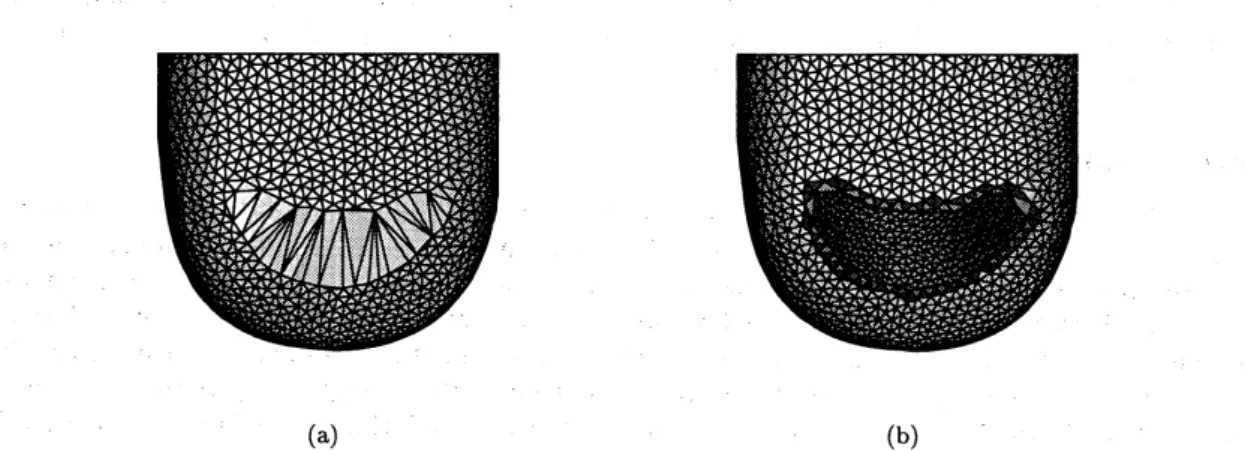
Figure 2 shows two triangulationsofthe dataset FOOT. The first triangulation
is
computedwith the
CO-CONE
algorithm [4] without boundary detection. The second triangulation iscom-puted with the modified CO-CONE algorithm that
uses
BOUNDARY to detect boundary vertices.biangles incident to the boundary verticesare shaded darker.
(a) (b)
Figure 2: hiangulation of the dataset FOOT (a) without boundary detection; thebig hole above
the ankle iscovered with triangles, (b) with boundary detectionusing the algorithm BOUNDARY;
the hole above the ankle is well detected.
Non-smoothness
Recallthat
our
theoryis basedon
the assumption that the sampledsurface is smooth. However,we
observe that the boundary detection algorithm also detectsundersamplingin non-smooth surfaces,
see
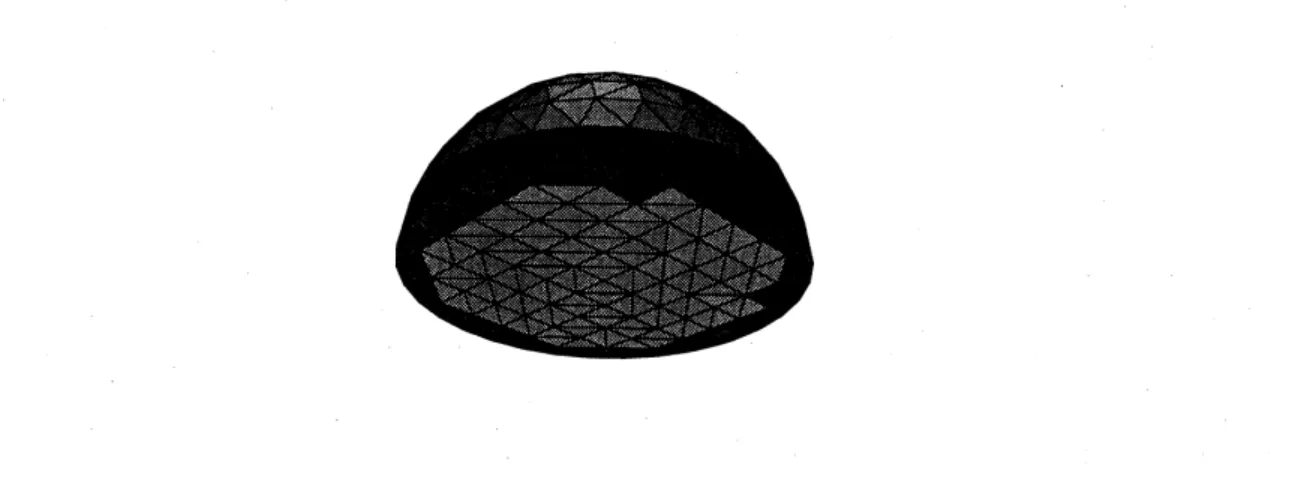
Figure3and also Figure 7,8and10. The ability to handle non-smoothsurfacesowes
tothefactthatnon-smooth surfacesmaybe approximatedwith asmooth
one
that interpolates the samples.Forexample,
one can
resortto the implicit surfacethat is$C^{1}$-smooth and interpolates the samplepoints using natural co–ordinates as explained in [8]. For higher order continuity results of [20]
can be called upon. These smooth surfaces have high curvatures
near
the sharp features of theoriginal non-smooth surface. Our theory
can
be applied to the approximating smoothsurface toascertainthat the samples in the vicinity of sharp features act asboundary vertices in the vicinity
of high curvatures forthe smooth surface.
Figure3: Boundaryvertices
are
detected inthevicinityofthe sharpedgein HALFSPHERE,triangles5
Surface
reconstruction
Our
goal is to reconstructa
smooth compact surface $S\subset \mathbb{R}^{3}$ which may havea
non-emptyboundary from
a
finite sample $P\subset S$.
For this purposewe
modify the $\mathrm{C}\mathrm{O}$-CONE algorithm [4]such that it is capable ofreconstructing surfaceswith boundary. Like the
CRUST
the CO-CONEalgorithm consists of three steps:
(1)
CANDIDATETRIANGLEEXTRACTION.
In this step a set of candidate triangles fortherecon-struction is extracted from the Delaunay triangulation of the sample points. In general the
underlyingspace ofthese triangles
is.
not amanifold, but a manifoldwith boundary canbeextracted in the next two steps.
(2) PRUNING. The candidate $\dot{\mathrm{t}}\mathrm{r}\mathrm{i}\mathrm{a}\mathrm{n}\mathrm{g}\mathrm{l}\mathrm{e}\mathrm{s}$
are
already close to a manifold for sufficiently densesamples. Wewant to extract a manifold fromthis set by walking
on
the outsideorinsideofthis set. During the walk
we
may encounter the problemofenteringa
triangle $t$ which hasabareedge, i.e., anedge incident toasingle triangle, namely $t$. The purpose of this step is
toget rid of these edges with their incident triangles.
(3) WALK. We walk on the out- or inside of the set of triangles that remained after pruning
and report the triangles walked
over.
We modify the first step of CO-CONE algorithm for boundary detection. In the original
co-cone
algorithm each sample chooses a set of candidate triangles incident to it. In the modifiedalgorithm, only the interior verticesare allowed to choose the candidate triangles.
CANDIDATETRIANGLEEXTRACTION $(P\subset \mathbb{R}^{3}, \theta\in(0, \pi/2), \rho)$
1 compute the Voronoi diagram$V_{P}$
2 $CandidateTriangles:=DelaunayTriangles$
3 $B:=\mathrm{B}\mathrm{o}\mathrm{u}\mathrm{N}\mathrm{D}\mathrm{A}\mathrm{R}\mathrm{Y}(P, \theta, \rho)$
4 for each sample$p\in P$
5 if$p\not\in B$ .
6 for eachVoronoi edge $e\in V_{p}$
7 if$C_{p}\cap e\neq\emptyset$
8 e.Mark.insert$(p)$
.
$\mathrm{v}$9 for each Voronoi edge$e\in V_{P}$
10 for each$p\in \mathrm{D}\mathrm{u}\mathrm{A}\mathrm{L}\mathrm{T}\mathrm{R}\mathrm{I}\mathrm{A}\mathrm{N}\mathrm{G}\mathrm{L}\mathrm{E}(e)\cap P$
11 if$(p\not\in B)$ and $(p\not\in e.Mark))$
12 CandidateTriangles.delete$(\mathrm{D}\mathrm{u}\mathrm{A}..\iota \mathrm{T}\mathrm{R}\mathrm{I}\mathrm{A}\mathrm{N}\mathrm{G}\mathrm{L}\mathrm{E}(e))-$
13 return CandidateTriangles
First the set CandidateTriangles is initialized to the set ofall Delaunay triangles (line 2).
This set getsfilteredsubsequently. EachVoronoiedge$e$has
a
fieldMark that collects the sampleswhose$\mathrm{c}\mathrm{o}$
-cones
intersect$e$ (line 7). This check is done only if the sample is notaboundary vertex.In otherwords, only interior vertices mark the Voronoiedges that intersect their$\mathrm{c}\mathrm{o}$-cones. Next,
we look at the markings of theVoronoi edges and delete their dual triangles from the candidate
set if they
are
not marked by an adjacent sample which is interior (lines 10-12). In essence, werely only
on
thetriangles thatare
chosen by interior vertices anda
triangle is in the candidate setonlyifallofits interior vertices have chosen it.
Thesecond step PRUNING
removes
triangles incident to sharp edges ina cascaded manneras
was
originally suggested in [1]. An edge $e$ is called sharp if there are two consecutive trianglesif it has only
one
incident triangle. Wehave to be carefulin this stepnot totrigger the cascadeddeletion ofthe desired surface by deleting
a
triangle incidenton a
boundary vertex which hasa
bareedge. So,
we
remove a
triangle only if it isnot incidenton a
boundary vertex.Let $K$ be atwo dimensionalsimplicialcomplex.
PRUNING $(K)$
1 Pending:$=\emptyset$
2 for each edge $e\in K$
3 Pending.push$(e)$
4 while Pending$\neq\emptyset$
5 $e:=Pending.pop()$
6 if$\mathrm{I}\mathrm{s}\mathrm{S}\mathrm{H}\mathrm{A}\mathrm{R}\mathrm{P}(e)=\mathrm{t}\mathrm{r}\mathrm{u}\mathrm{e}$
7 for each $t\in e.Triangles$
8 if$\forall(p\in t\cap P)p\not\in B$
9 $K:=K\backslash \{t\}$
10 for each $e’\in t.Edges\backslash \{e\}$
11 Pending.push$(e’)$
12 return $K$
Firstastack Pending isinitialized empty (line 1). Then alledges in the complex$K$arepushed
onto this stack (lines 2 and 3). Together with everytriangle$t$
we
storea list Edges ofits edges.With each edge $e$ we store a set Triangles of triangles incident to $e$
.
We assume that we haveafunction $\mathrm{I}\mathrm{s}\mathrm{S}\mathrm{H}\mathrm{A}\mathrm{R}\mathrm{P}$ available that requires an edge $e$
as
input and returns trueif$e$ is sharp and
false if $e$ is not sharp. As long
as
the stack Pending is not empty, an edge $e$ is popped fromthe stack. If this edge is sharp, allthoseincident triangles
are
removedfrom the complex$K$thatare
not incident to a boundary vertex. All edges other than $e$ that are incident to the deletedtriangle$t$arepushed onto the stack Pending (lines 4–11). These edges maybecome sharp due
to the deletion of the triangle $t$. Observe that during deleting triangleswe not only check if it
is incident to a sharp edge, but also check if it is incident to any boundary vertex. Finally, the
reduced complex$K$ is returned (line 12).
The third step WALK extracts amanifold.
WALK $(K)$
1 Sur
face
$:=\emptyset$2 choose arbitrary oriented$t\in K$
3
Surface.insert
$(t)$4 Pending:$=\emptyset$
5 for each $earrow\in t.Edges$
6 Pending.push$((e, tarrow))$
7 while Pending $\neq\emptyset$
8 $(etarrow,):=Pending.pop()$
9 if e.processed$=\mathrm{f}$alse
10 e.processed:$=\mathrm{t}\mathrm{r}\mathrm{u}\mathrm{e}$
11 $t’:=\mathrm{S}\mathrm{u}\mathrm{R}\mathrm{F}\mathrm{A}\mathrm{C}\mathrm{E}\mathrm{N}\mathrm{E}\mathrm{I}\mathrm{G}\mathrm{H}\mathrm{B}\mathrm{O}\mathrm{R}(K, etarrow,)$
12 if$t’\neq\emptyset$
13
Surface.insert
$(t’)$14 foreach $e^{\neg}\in t’.Edges\backslash \{e\gamma$
15 Pending.push$((et’\neg,))$
First
we
initialize thesetSurface
empty (line 1). Thenwe
choosean
arbitrary triangle$t$fromthe complex $K$, orient it and insert it in the the set
Surface
(lines 2 and 3). Nextwe
initializethe stack Pending empty (line 4). From the orientation of the chosen triangle $t$ we derive
an
orientation for all edges incident to $t$
.
These edgesare
stored ina
field Edges associated withevery triangle. We denote an oriented edge $e$ by $earrow$
.
For each oriented edge$e$ oftriangle $t$, we
pushthe pair $(etarrow,)$ onto the stack (lines 5 and 6). As longasthe stack Pending is not empty,we
popits top element $(etarrow,)$ (line8). If the edge$e$ is not processed
so
far we usethe fieldprocessedto mark it processed and compute the surface neighbor of $(etarrow,)$, i.e. the triangle $t’$ incident to $e$
that ‘best fits’ $t$ (lines 9-11). If$t’$ does not exist, the triangle $t$ is incident to the boundary. We
insert $t’$ in the set
Surface
(lines 12 and 13). Weassume
that the function $\mathrm{S}\mathrm{u}\mathrm{R}\mathrm{F}\mathrm{A}\mathrm{C}\mathrm{E}\mathrm{N}\mathrm{E}\mathrm{I}\mathrm{G}\mathrm{H}\mathrm{B}\mathrm{O}\mathrm{R}$orients$t’$ such that its orientationmatches the orientation of$t$ andpush all the pairs oforiented
edges$e^{\neg}$ besides $e\mathrm{i}arrow \mathrm{n}\mathrm{c}\mathrm{i}\mathrm{d}\mathrm{e}\mathrm{n}\mathrm{t}$to $t’$ together with the triangle $t’$ itself onto the stack Pending (lines
14and 15). Finallywereturnthe surface
Surface
(line 16). The above method works under theassumptionthat thesurface is orientable, i.e., surfaceslikeM\"obius strip
are
not allowed.The return value $t’$ of$\mathrm{S}\mathrm{u}\mathrm{R}\mathrm{F}\mathrm{A}\mathrm{C}\mathrm{E}\mathrm{N}\mathrm{E}\mathrm{I}\mathrm{G}\mathrm{H}\mathrm{B}\mathrm{O}\mathrm{R}(C, etarrow,)$is the topmost triangle triangleamong the
set oftriangles incident to$e$ whosenormals (oriented according to the orientationof$t$) make
an
angle smaller than $\frac{\pi}{2}$ with thenormal of$t$,
see
Figure 4.Figure 4: The surface neighbor ofthe dark grey shaded triangle is the topmost triangle among
thelight grey shaded triangles.
Putting the three steps CANDIDATETRIANGLEEXTRACTION, PRUNING and WALK together
gives the modified
CO-CONE
algorithm.CO-CONE $(P\subset \mathbb{R}^{3}, \theta\in(0, \pi/2), \rho)$
1 $K:=\mathrm{C}\mathrm{A}\mathrm{N}\mathrm{D}\mathrm{I}\mathrm{D}\mathrm{A}\mathrm{T}\mathrm{E}\mathrm{T}\mathrm{R}\mathrm{I}\mathrm{A}\mathrm{N}\mathrm{G}\mathrm{L}\mathrm{E}\mathrm{E}\mathrm{x}\mathrm{T}\mathrm{R}\mathrm{A}\mathrm{C}\mathrm{T}\mathrm{I}\mathrm{O}\mathrm{N}(P, \theta, \rho)$
2 $K’:=\mathrm{P}\mathrm{R}\mathrm{U}\mathrm{N}\mathrm{I}\mathrm{N}\mathrm{G}(K)$
3 $K”:=\mathrm{W}\mathrm{A}\mathrm{L}\mathrm{K}(K’)$
4 return$K”$
6
Implementation and results
As with many other geometric algorithms we faced the numerical robustness as an important
issue in implementing CO-CONE. There
are
two mainsources
of problems. First, algorithmsand data structures defined under
a
general position assumption do not workfor practical datasets since such degenerate situationsdo
occur.
Second,we
need toevaluate geometric predicateswhich
are
difficult to compute exactly (especiallyifthesituation is close toa
degenerateone). Tocopewith this problem
we
resort to the robust library of geometric algorithms calledCGAL
[24]code whichmakes it easy to
use
different numbertypes and implementationsofpredicates for the computation.For
our
implementation ofthe CO-CONE algorithmwe
usedthe Delaunaytriangulation fromthe
CGAL
library togetherwith filteredpredicates. Computation of filteredpredicatessimulatesexact evaluation
on a
demand basis and thusruns
faster than predicate evaluations with exact arithmetic. Instead of filtered predicates if weuse
floating point arithmetic the running timedecreasesroughly by a factor oftwo,
see
Table 2. However, results maynot bereliable.Besides robustness we encountered a problem whichis
more
inherent to our algorithm: Somedatacontain noise beyond the toleranceofthe CO-CONE algorithm. Thismayturn
some
interior verticesas
“false boundary vertices”. These pointsare
detected as interior by BOUNDARY, buttheir incident candidate triangles after the CO-CONE step do not form
a
flat disk. Thus, thepruning step
runs
the risk ofdeleting the desired output since it does not recognizethese “falseboundary vertices”. That means, it can happen that during the PRUNING step all triangles are
removes
thatare
not incident to a boundary vertex. To cope with this problem,we
employ asafety check$\mathrm{H}\mathrm{A}\mathrm{s}\mathrm{U}\mathrm{M}\mathrm{B}\mathrm{R}\mathrm{E}\mathrm{L}\mathrm{L}\mathrm{A}$ toeach vertex.
6.1
Umbrella
check
An umbrella incidentto
a
vertex$p\in K$ isasetoftrianglesincident to$p$whichforma
topologicalclosed disc $\mathrm{I}\wp$
.
An umbrella is called sharp if it contains a sharp edge. $\mathrm{H}\mathrm{A}\mathrm{s}\mathrm{U}\mathrm{M}\mathrm{B}\mathrm{R}\mathrm{E}\mathrm{L}\mathrm{L}\mathrm{A}$ deletesthe sharp edges and their incident triangles in
a
cascadedmanner.
But, unlike pruning thiscascaded deletion is applied only to edges and triangles incident to the vertex being checked.
If the vertex retains a triangle after this cascaded deletion, $\mathrm{H}\mathrm{A}\mathrm{s}\mathrm{U}\mathrm{M}\mathrm{B}\mathrm{R}\mathrm{E}\mathrm{L}\mathrm{L}\mathrm{A}$ returns true. To
avoidmisunderstandings note that $\mathrm{H}\mathrm{A}\mathrm{s}\mathrm{U}\mathrm{M}\mathrm{B}\mathrm{R}\mathrm{E}\mathrm{L}\mathrm{L}\mathrm{A}$
removes
the triangles only virtually, i.e. afterapplying $\mathrm{H}\mathrm{A}\mathrm{s}\mathrm{U}\mathrm{M}\mathrm{B}\mathrm{R}\mathrm{E}\mathrm{L}\mathrm{L}\mathrm{A}$ to
a
point $p$ ofa
complex$K$the set oftriangles incidentto$p$ is exactlythe
same
asitwas
before. That means, $\mathrm{H}\mathrm{A}\mathrm{s}\mathrm{U}\mathrm{M}\mathrm{B}\mathrm{R}\mathrm{E}\mathrm{L}\mathrm{L}\mathrm{A}$ is only used tocheckifa
point has anon
sharp umbrellabut not to alter the complex$K$
.
$\mathrm{H}\mathrm{A}\mathrm{s}\mathrm{U}\mathrm{M}\mathrm{B}\mathrm{R}\mathrm{E}\mathrm{L}\mathrm{L}\mathrm{A}(K, p\in K)$
1 Umbrella:$=p.Triangles$
2 Pending$:=\emptyset$
3 for everyedge $e\in p.Edges$
4 Pending.push$(e)$
5 whilePending $\neq\emptyset$
6 $e:=Pending.pop()$
7 if $\mathrm{I}\mathrm{s}\mathrm{S}\mathrm{H}\mathrm{A}\mathrm{R}\mathrm{P}(e)=\mathrm{t}\mathrm{r}\mathrm{u}\mathrm{e}$
8 for each $t\in e.Triangles$
9 Pending.push$(t\cap(p.Edges\backslash e))$
10
Umbrella.delete
$(t)$11 ifUmbrella$=\emptyset$
12 return false
13 return true
First the set Umbrella is initialized to the set of triangles incident to $p$ (line 1). Next
we
initializethe stackPending empty (line 2). Then wepush all edges $e$incidentto$p$ontothe stack
Pending (lines 3 and4). We
assume
that the edges incident to$p$are
storedinthe set Edges andthe triangles incident to$p$
are
stored in the set Triangles. As longas
the stackPending is notempty
we
popits top element. If this elementis asharpedge$e$, we delete alltrianglesincident to$e$inthe complex$K$fromthe set Umbrella,andpush alledgesincident tosuch
a
triangle and thepoint$p$besidesthe edge $e$onto the stackPending (lines 5-11). Finally
we
return false ifthe setThe boundaryverticesdetected by
our
implementationare
the unionofthe boundaryverticesdetected by the algorithm BOUNDARY and the vertices not detected by the algorithm
HASUM-BRELLA. Weobserve that PRUNING with this enlarged setofboundary vertices issafe. Forsamples
fromsmooth surfaces that fulfill the sampling conditionweobservethatUMBRELLACHECKis not
necessary.
6.2
Parameters and precision
In the proofs wechoose the ratio $\rho$ ofthe height to the width of
a
Voronoi cell to bemore
than$\frac{1}{1.3\in}$
.
In practiceavalue between 1.1 and 1.7gives good results. Increasing this ratio detectsmorepointsas boundaryas can be observed in Figure5.
(a) (b)
Figure 5: Both figures show the reconstructed heel of the dataset FOOT fordifferent values of$\rho$
.
In (a) this ratio is 1.5 and in (b) it is
4.3.
Although$\theta$is0.14radians in theory,avalueaslargeas
$\frac{\pi}{6}$ gives good results. We observed that
the output is quite sensitive to the opening angleofthe double
cones
that defines$\mathrm{c}\mathrm{o}$-cones.
If thisangle is decreased, the width increases with the inverse of the $\sin$of this angle. Thus, the height
$\mathrm{v}\mathrm{s}$
.
width ratio deteriorates quite sharply forcing the ratio condition fail for many vertices. Onthe other hand, ifwemake this angle larger $\mathrm{c}\mathrm{o}$-cones become thinnerwhich may not allow some
of the desired triangles to be captured
as
candidate triangles. We used $\frac{3\pi}{8}$ to define theco-cones
both in theory and practice.
Asmentioned earlier, numerical robustness isanimportant issue inourreconstruction software.
Figure6 shows the reconstructionfor the dataset HALFSPHERE withfloating point arithmetic and
with filtered exact arithmetic. Numerical problem
occurs
in this dataset since it contains many$\mathrm{c}\mathrm{o}$-planar points causing degeneracies in the Delaunay triangulation. As
a
result the Delaunaytriangulation is computed incorrectly. CO-CONEtakes 1.9 seconds computing time with floating
point arithmetic compared to3seconds withfilteredpredicates. Figure 7shows the effectofusing
filtered predicates instead of floating point arithmetic for the OILPUMP dataset. Floating point
arithmetic takes 469 seconds for the reconstruction whereas filtered exact arithmetic takes 966
seconds. Considering the tradeoff between
running.
time and robustnessour
experiments showthat oneshould accept increased running time for reliable computations.
6.3
More datasets
We have experimented with many other datasets,
some
ofwhichare
listed below. In the figures(a) (b)
Figure6: Left and right figures show the reconstructed HALFSPHERE with floating point and exact
arithmetic respectively.
(a) (b)
Figure7: Reconstruction of the dataset OILPUMP (a) withfloating point arithmetic and (b) with
filteredexact arithmetic; sharpfeatures
are..
well detected.The dataset ENGINE has three connected components. CO-CONE nicely $\mathrm{s}\mathrm{e}\mathrm{p}\mathrm{a}\mathrm{r}\mathrm{a}\mathrm{t}\mathrm{e}\mathrm{s}\vee$ the three
connected components and identifies the boundaries of the two outer shells. It alsoidentifies the
sharp tip of the innermost component,
see
Figure8.Thedataset
CAT:
This dataset containsa
single boundary at thebottom of the cat andsome
undersampled regions, especially at theears andlegs. Figure9 showsthe detected boundary and
undersampledregions.
Figure9: Thedataset CAT.
The dataset KNUCKLE: This is a challenging dataset for reconstruction, because it contains
many undersampledparts. This undersampling is mostly due to sharp features. Figure 10 shows
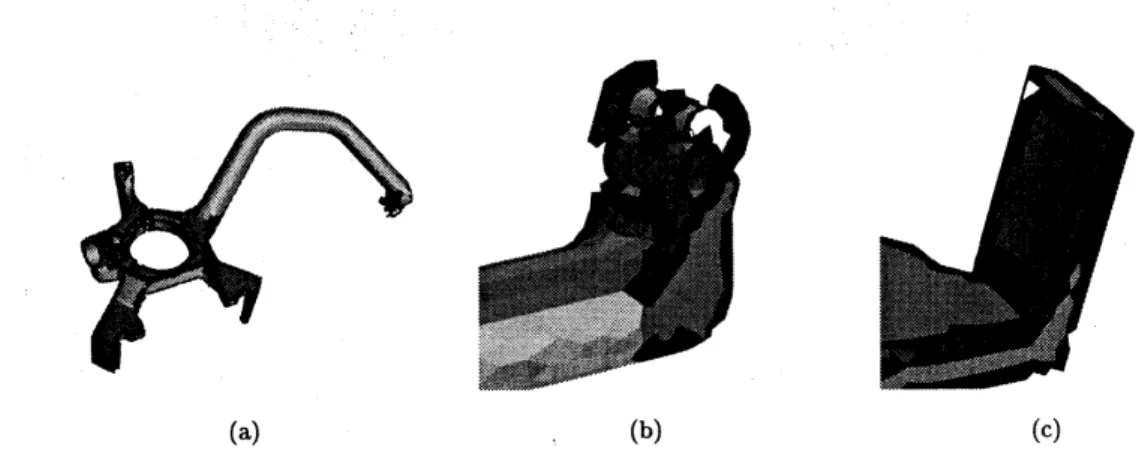
how the CO-CONE algorithm deals with undersampling. Most of the sharp features
are
welldetected. Tworegionswhereundersampling is extreme
are
shown with azoom.
(a) (b) (c)
Figure10: Reconstruction ofthe dataset KNUCKLE. In (a) theentire reconstructionis shown and
in (b) and (c) two undersampled parts
are
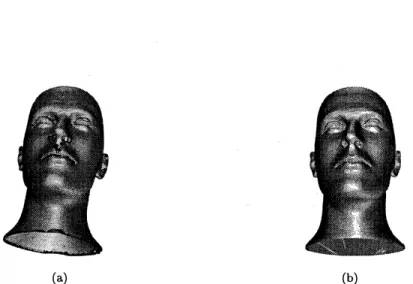
zoomed.The dataset MANNEQUIN: Thisdataset contains oneboundary at the bottom and
undersam-pled regions in eyes, lips and
ears.
Figure 11 shows the reconstruction of this dataset with andwithout boundary detection. Using boundary detection the CO-CONE detects the boundary at
the bottom
as
expected.The dataset MONKEY: This dataset is created using the function $(x, y)-\neq x^{3}-3xy^{2}$
on
theunit square. The graph of this function is called monkey saddle. The monkey saddle contains
a
single boundary which is perfectly detected. Figure 12 shows the monkey saddle and compares(a) (b)
Figure 11: Reconstructionof the dataset MANNEQUIN (a)with boundary detection and(b)without
boundary detection.
(a) (b)
Figure 12: Reconstructionof the dataset MONKEY (a) with boundary detection and (b) without
boundarydetection.
6.4
Running
times
Wetested the CO-CONEalgorithm
on
many datasets. Allthe testswere
done ona
Silicon Octanecomputer with 300 Mhz MIPS processor and 512 MByte ofmain memory. For all datasets we
used$\rho=1.5$ and $\theta=\frac{\pi}{6}$ in thealgorithm BOUNDARY.
For renderingweused Geomview [17], provided by the Geometry Center at the University of
Minnesota.
The basic data ofour experiments
are
summarized in Table 1. The running times are withrespect to filtered exact arithmetic. Observethat in all
cases
the numberof triangles is roughlytwice the number of points, which is expected from Euler’s formula.
Table 2 allows a closer look on the running times. We also included the timings when using
floatingarithmetic.
Since
theCO-CONE
algorithm is logicallysplitinto threesteps: Delaunay triangulation, Bound-ary detectionandSurface
reconstru$c$tionwe measure
the CPU times foreach ofthese three steps.As expected the Delaunay triangulation computation is the most time consuming step. The
running times usingfiltered arithmetic
are
almost twiceas
highas
therunning times usingfloatingpoint arithmetic, but they
are
still ina
reasonable range. The total running time showsa
subobject number of points number of triangles running time(sec.) $\ovalbox{\tt\small REJECT}_{0^{\mathrm{O}\mathrm{N}\mathrm{K}\mathrm{E}\mathrm{Y}}}\mathrm{M}\mathrm{A}\mathrm{N}\mathrm{N}\mathrm{E}\mathrm{Q}\mathrm{U}\mathrm{I}\mathrm{N}1277221\mathrm{K}\mathrm{U}\mathrm{N}\mathrm{C}\mathrm{K}\mathrm{L}\mathrm{E}601407912085243374\mathrm{M}10000196001620\mathrm{E}\mathrm{N}\mathrm{G}\mathrm{I}\mathrm{N}\mathrm{E}11360223561040\mathrm{F}\mathrm{o}\mathrm{O}\mathrm{T}2002139997592\mathrm{I}\mathrm{L}\mathrm{P}\mathrm{U}\mathrm{M}\mathrm{P}3093361041966\mathrm{C}\mathrm{A}\mathrm{T}1000019826311$
Table 1: Experimental data.
object Delaunay Boundary Reconstruction
$\ovalbox{\tt\small REJECT}_{0^{\mathrm{O}\mathrm{N}\mathrm{K}\mathrm{E}\mathrm{Y}}}\mathrm{M}\mathrm{A}\mathrm{N}\mathrm{N}\mathrm{E}\mathrm{Q}\mathrm{U}\mathrm{I}\mathrm{N}135- 57136- 77103- 77\mathrm{K}\mathrm{N}\mathrm{U}\mathrm{C}\mathrm{K}\mathrm{L}\mathrm{E}107- 4260- 3441- 45\mathrm{M}1328- 175- 117- \mathrm{E}\mathrm{N}\mathrm{G}\mathrm{I}\mathrm{N}\mathrm{E}836- 405107- 5897- 59\mathrm{F}\mathrm{o}\mathrm{O}\mathrm{T}233- 99224- 119138- 103\mathrm{I}\mathrm{L}\mathrm{P}\mathrm{U}\mathrm{M}\mathrm{P}414- 154313- 172239- 143\mathrm{C}\mathrm{A}\mathrm{T}121- 50108- 5882- 51$
Table 2: Acloser lookonthe running time of the CO-CONE algorithm in seconds. The first times
(before ‘-,) arewith respect tofiltered arithmetic and the second times (after ‘-,) arewith respect
tofloating point arithmetic. (Forthe MONKEY dataset the CGAL codewas not able to compute
the Delaunay triangulation using floating point arithmetic).
7
Conclusions
In thispaperwepresent analgorithm to detect the regions of undersampling in data that
are
sam-pledfromsomesurface. Thisprovidesa unified approachto reconstructsurfaces with boundaries
and to identify theregions of non-smoothnessorhigh curvature where undersampling doesoccur.
The existing algorithms with theoretical guarantees fail miserably on such data sets since they
assume that the data is derived from a smooth surface without any boundary. As exhibited by
our empirical results, our boundary detection algorithm correctly identifies the vertices that are
visiblylyingonthe boundary. Also, itidentifies the regions of non-smoothness and high curvature
effectively in practice.
Aprobablefollowup of this work is to investigatehowthis algorithm
can
be used to reconstructnon-smoothsurfaces. After detecting the regions ofnon-smoothness,
can
werepair the surfacetofill up the “holes”? Currently research onthis question is under progress.
References
[1] N.Amentaand M. Bern. Surfacereconstruction byVoronoifiltering. Discr. Comput. Geom.,
22, (1999),481-504.
$.[2]$ N. Amenta, M. Bern and D. Eppstein. The crust and the $\beta$-skeleton: combinatorial curve
[3] N. Amenta, M. Bern and M. Kamvysselis.A new Voronoi-based surface reconstruction
algo-rithm.
SIGGRAPH
98, (1998), 415-421.[4] N. Amenta, S.Choi, T. K.Deyand N. Leekha. A simplealgorithm for homeomorphicsurface
reconstruction. Proc. 16th. $ACM$Sympos. Comput. Geom., (2000), 213-222.
[5] D. Attali.$r$-regular shape reconstructionfrom unorganized points. Proc. 13th$ACM$Sympos.
Comput. Geom., (1997),248-253.
[6] C. Bajaj, F. Bernardini and G. Xu. Automatic reconstruction of surfaces and scalar fields
from $3\mathrm{D}$ scans. SIGGRAPH95, (1995), 109-118.
[7] J. D. Boissonnat. Shape reconstruction from planar cross-sections. Computer Vision,
Graph-ics, and Image Processing 44 (1988), 1-29.
[8] J. D. Boissonnat and F. Cazals. Smoothsurface reconstruction via natural neighbor
interpo-lation of distance functions. Proc. 16th. $ACM$Sympos. Comput. Geom., (2000), 223-232.
[9] B. Curless and M. Levoy. A volumetric method for building complex models from range
images.
SIGGRAPH
96, (1996), 303-312.[10] T. K. Dey and J. Giesen. Detecting undersampling in surface reconstruction. manuscript,
2000.
[11] T. K. Dey and P. Kumar. A simple provable algorithm forcurvereconstruction. Proc.
ACM-SIAMSympos. Discr. Algorithms, (1999), 893-894.
[12] T. K. Dey, K. Mehlhorn and E. A. Ramos. Curve reconstruction: connecting dots with good
reason. Comput. Geom. Theory Appl., 15, 229-244.
[13] T. K. Dey and R. Wenger. Reconstructingcurveswith sharp
corners.
To appear in 16th$ACM$Sympos. Comput. Geom., 2000.
[14] H.Edelsbrunner. Shape reconstruction with Delaunay complex. LNCS1380, LATIN’98:
The-oretical
Informati
$cs$, (1998), 119-132.[15] H. Edelsbrunner and E. P. M\"ucke. Three-dimensional alpha shapes. $ACM$ Trans. Graphics,
13, (1994), 43-72.
[16] H. Edelsbrunner and N. Shah. Triangulating topological spaces. Proc. 10th $ACM$ Sympos.
Comput. Geom., (1994),285-292.
[17] $\mathrm{h}\mathrm{t}\mathrm{t}\mathrm{p}://\mathrm{w}\mathrm{w}\mathrm{w}.\mathrm{g}\mathrm{e}\mathrm{o}\mathrm{m}\mathrm{v}\mathrm{i}\mathrm{e}\mathrm{w}.\mathrm{o}\mathrm{r}\mathrm{g}$
[18] J. Giesen. Curvereconstruction, the TSP, and Menger’s theorem onlength. Proc. 15th$ACM$
Sympos. Comput. Geom., (1999), 207-216.
[19] C. Gold. Crust and anti-crust: aone-step boundaryand skeleton extraction algorithm. 15th.
$ACM$Sympos. Comput. Geom., (1999), 189-196.
[20] H. Hiyoshi and K. Sugihara. Voronoi-basedinterpolationwith higher continuity. Proc. 16th.
$ACM$Sympos. Comput. Geom., (2000), 242-250.
[21] H. Hoppe, T. $\mathrm{D}\mathrm{e}\mathrm{R}\mathrm{o}\mathrm{s}\mathrm{e}$, T. Duchamp, J. $\mathrm{M}\mathrm{c}\mathrm{D}\mathrm{o}\mathrm{n}\mathrm{a}\mathrm{l}\mathrm{d}$ and W. Stuetzle. Surface reconstruction
[22] M. Melkemi. $A$-shapes and their derivatives. lSth $ACM$
Sym.
pos. Comput.Geom. ,
(1997),367-369.
[23] D. Zorin andP. Schr\"oder. Subdivision formodeling and animation.