$\mathrm{M}\mathrm{i}\mathrm{n}\mathrm{s}\mathrm{k}\mathrm{y}^{\rangle}\mathrm{s}$
pivot
theorem
and its
application
to the
Earle slice of
punctured
torus
groups
Yohei
Komori
小森 洋平Department of Mathematics
Osaka
City UniversityOsaka
558, Japan[email protected]
1
Introduction
In [6], Y.Minsky showed that any marked punctured torus group can be
characterized completely by its pair of end invariants, where a punctured
torus group is a rank two free Kleinian group whose commutator of
genera-tors is parabolic. To prove this result, called the ending lamination theorem,
he proved another important result, called the pivot theorem, which controls
thin parts of the corresponding hyperbolic manifold from the data of end
invariants. One of the applications of these theorems, he showed that the
Bers slice and the Maskit slice are Jordan domains.
In this paper we apply his results to theEarle slicewhich is aholomorphic
slice of quasi-fuchsian space representing the Teichm\"uller space of
once-punctured tori. This slice was considered by C.Earle in [1], and its geometric
coordinates, named pleating coordinates was studied by C.Series and the
author in [3]. By using rational pleating rays, the figure of the Earle slice
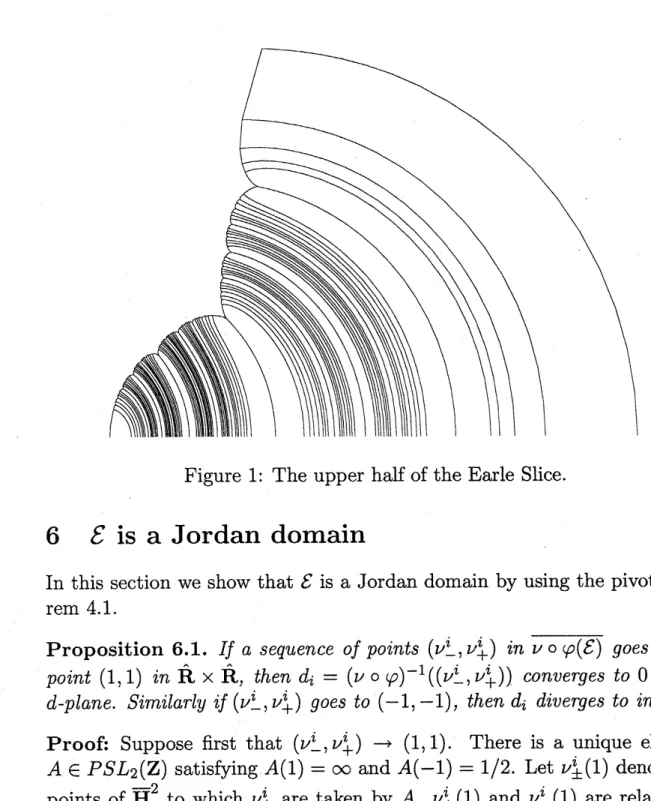
$\mathcal{E}$ realized in the complex plane $\mathrm{C}$ was drown by P.Liepa (see figure 1). We
will show that
1. The boundary of the Earle slice $\mathcal{E}$ is a Jordan curve.
2. There is a right half region which is contained in $\mathcal{E}$.
3. Every pleating ray in $\mathcal{E}$ lands at a unique boundary point.
This paper is organized as follows. Section 1 is dedicated to background
material, especially the space of punctured torus groups. We review
introducing the Earle slice in section 5,
we
show the previous claims insec-tion 6, 7 and 8.
The author thank Professor S.Kamiya for his good organization of this
conference at RIMS, Kyoto University.
2
Punctured torus
groups
Let $S$ be an oriented once-punctured torus and $\pi_{1}(S)$ be its fundamental
group. An ordered pair $\alpha,$$\beta$ of generators of $\pi_{1}(S)$ is called canonical if the
oriented intersection number $i(\alpha, \beta)$ in $S$ with respect to the given
orienta-tion of $S$ is equal $\mathrm{t}\mathrm{o}+1$
.
The commutator $[\alpha, \beta]=\alpha\beta\alpha^{-1}\beta^{-1}$ represents aloop around the puncture.
Define $\mathcal{R}(\pi_{1}(S))$ to bethe set of$PSL_{2}(\mathrm{C})$-conjugacy classes of
represen-tations from $\pi_{1}(S)$ to $PSL_{2}(\mathrm{C})$ which take the commutator of generators to
a parabolic element. Let $D(\pi_{1}(S))$ denote the subset of$\mathcal{R}(\pi_{1}(S))$ consisting
of conjugacy classes of discrete and faithful representations. Any
represen-tative of an element of $D(\pi_{1}(S))$ is called a marked punctured torus group.
Let $Q\mathcal{F}$ denote the subset of $D(\pi_{1}(S))$ consisting of conjugacy classes of
representations $\rho$ such that for the action of $\Gamma=\rho(\pi_{1}(S))$ on the Riemann
sphere $\hat{\mathrm{C}}$
the region of discontinuity $\Omega$ has exactly two simply connected
invariant components $\Omega^{\pm}$
.
The quotients $\Omega^{\pm}/\Gamma$are
both homeomorphic to$S$ and inherit an orientation induced from the orientation of
$\hat{\mathrm{C}}$
.
We choose
the labelling so that $\Omega^{+}$ is the component such that the homotopy basis
of $\Omega^{+}/\Gamma$ induced by the ordered pair of marked generators $\rho(\alpha),$ $\rho(\beta)$ of $\Gamma$
is canonical. Any representative of
an
element of $Q\mathcal{F}$ is called a markedquasifuchsian punctured torus group. Considering the algebraic topology
$D(\pi_{1}(S))$ is closed in $\mathcal{R}(\pi_{1}(S))$, and $Q\mathcal{F}$ is open in $D(\pi_{1}(S))$ (see [4]). A
quasifuchsian group $\Gamma$ is called Fuchsian if the components $\Omega^{\pm}$ are round
discs.
Recall that the set of measured geodesic laminations on a hyperbolic
surface is independent of the hyperbolic structure. Denote by $PML(S)$
the set of projective measured laminations on $S$
.
Let $C(S)$ denote the setof free homotopy classes of unoriented simple non-peripheral
curves
on $S$.There
are
in $\mathrm{o}\mathrm{n}\mathrm{e}- \mathrm{t}_{\mathrm{o}^{-}\mathrm{o}\mathrm{n}\mathrm{e}}$ correspondence with $\hat{\mathrm{Q}}\equiv \mathrm{Q}\mathrm{U}\{\infty\}$, after choosingan canonical basis $(\alpha, \beta)$ for $\pi_{1}(S)$ as follows, Any element of $H_{1}(S)$ can
be written as $(p, q)=p[\alpha]+q[\beta]$ in the basis $([\alpha], [\beta])$ for $H_{1}(S)$, and we
associate to this the slope $-p/q\in\hat{\mathrm{Q}}$ which describes an element of $C(S)$
.
Cosideringprojective classes of weighted counting measures, we can identify
maybeidentified with$\hat{\mathrm{R}}$,
in such a way that rational laminationscorrespond
to $\hat{\mathrm{Q}}$.
3
Minsky’s ending
lamination
theorem
We associate to
a
punctured torus groupan
ordered pair of “end invariants”$(\nu_{-}, \nu_{+})$, each lying in $\overline{\mathrm{H}}^{2}\equiv \mathrm{H}^{2}\cup\hat{\mathrm{R}}$
.
Let$\rho$ : $\pi_{1}(S)arrow PSL_{2}(\mathrm{C})$ denote a
marked punctured torus group and $N=\mathrm{H}^{3}/\rho(\pi_{1}(S))$ its associated
man-ifold. Then by Bonahon’s theorem of geometric tameness (see [4]), $N$ is
homeomorphic to $S\cross \mathrm{R}$
.
Letus name
the ends$e_{+}$ and $e_{-}$
.
We choose thelabelling as follows; Let the orietation $S\cross\{1\}$ agree with the orientation of
$S$
.
Orient $S\cross(-1,1)$ by the orientation of $S\cross\{1\}$ and its inward-pointingvector. The orientation of $\mathrm{H}^{3}$
induces the orientation of $N$
.
Then up tohomotopy there exists uniquely
an
orientation preserving homeomorphismbetween $N$ and $S\cross(-1,1)$ which induces the representation $\rho$
.
Let $e_{+}$ bethe end of $N$ whose neighborhoods are neighborhoods of $S\cross\{1\}$ under this
identification. Let $\Omega$ denote the
(possibly empty) domain of discontinuity
of $\Gamma=\rho(\pi_{1}(S))$ and $\overline{N}$ denote the quotient
$\mathrm{H}^{3}\cup\Omega/\Gamma$
.
Any component ofthe boundary $\Omega/\Gamma$ is reached by going to
one
of the ends$e_{+}$ or $e_{-)}$ and
this divides it into two disjoint pieces $\Omega_{+}/\Gamma$ and $\Omega_{-}/\Gamma$
.
Thereare
threepossibilities for each of these boundaries, corresponding to three types of
end invariants (here let $s$ denote $\mathrm{e}\mathrm{i}\mathrm{t}\mathrm{h}\mathrm{e}\mathrm{r}+\mathrm{o}\mathrm{r}$ -):
1. $\Omega_{s}$ is a topological disc; In this case $\Omega_{s}/\Gamma$ is a marked punctured
torus. Then there are $\nu_{+},$
$\nu_{-}\in \mathrm{H}^{2}$ uniquely such that
marked flat tori
$\mathrm{C}/\mathrm{Z}\cdot 1+\mathrm{z}\cdot\nu_{+}$ and $\mathrm{C}/\mathrm{Z}\cdot\overline{\nu}_{-}+\mathrm{Z}\cdot 1$
are
equivalent to thecompactifi-cations of$\Omega_{+}/\Gamma$ and $\Omega_{-}/\Gamma$ respectively
as
marked Riemann surfaces.In particular, $\nu_{+}=\nu_{-}$ ifand only if$\Gamma$ is a Fuchsian group.
2. $\Omega_{s}$ is an infinite union of round discs; In this
case
$\Omega_{s}/\Gamma$ is a
thrice-punctured sphere, obtainedfrom the corresponding boundary of$S\cross \mathrm{R}$
by deleting a simple closed curve $\gamma_{s}$
.
In this case$\nu_{s}\in\hat{\mathrm{Q}}$ denotes
the
slope of $\gamma_{s}$
.
The conjugacy class of $\gamma_{s}$ in$\Gamma$ is parabolic.
3. $\Omega_{\mathit{8}}$ is empty; In this case
we
canfind a sequenceofsimpleclosed
curves
$\{\gamma_{n}\}$ in $S$whose geodesic representative $\gamma_{n}^{*}$ eventually contained in any
neighborhood of $e_{s}$ (“
$\mathrm{e}\mathrm{x}\mathrm{i}\mathrm{t}_{\mathrm{S}}$ the
end”), and the slopes of$\gamma_{n}$ converge in
$\mathrm{R}$ to a unique irrational number. We denote
$\nu_{s}$ to be this limitting
To a marked punctured torus group $\rho$ : $\pi_{1}(S)arrow PSL_{2}(\mathrm{C})$
one
mayassociate
an
ordered pair of end invariants $(\nu_{-}, \nu_{+})$ lying in $\overline{\mathrm{H}}^{2}\cross\overline{\mathrm{H}}^{2}\backslash \Delta$,where $\Delta$ denote the diagonal of$\hat{\mathrm{R}}\cross\hat{\mathrm{R}}$
.
Minsky’s ending lamination theoremis
Theorem 3.1. The map
$\nu:D(\pi_{1(}S))arrow\overline{\mathrm{H}}^{2}\cross\overline{\mathrm{H}}^{2}\backslash \triangle$
defined
by $\rhorightarrow(\nu_{-}, \nu_{+})$ is bijective. $\nu$ is not continuous but its inverse $\nu^{-1}$is continuous.
Proof: See theorems A and $\mathrm{B}$ in [6].
4
Minsky’s
pivot
theorem
Next
we
review Minsky’s pivot theorem which is a key idea to prove theending lamination theorem 3.1, and is also a main idea to prove our results
in this paper.
First
we
define the Farey triangulation ofthe upper halfplane $\mathrm{H}^{2}$ asfol-lows. For any two rational numbers written in lowest terms
as
$p/q$ and $r/s$,say they are neighbors if $|ps-qr|=1$
.
Allow also thecase
$\infty=1/0$.Join-ing any two neighbors by a hyperbolic geodesic, we obtain a triangulation
invariant under the natural action of $PSL_{2}(\mathrm{Z})$.
Next we recall the notion of pivots for marked punctured torus groups.
Let $(\nu_{-}, \nu_{+})$ be the end-invariant pair of a marked punctured torus group $\rho$ : $\pi_{1}(S)arrow PSL_{2}(\mathrm{C})$
.
Letting$s\mathrm{d}\mathrm{e}\mathrm{n}\mathrm{o}\mathrm{t}\mathrm{e}+\mathrm{o}\mathrm{r}-$
) define a point
$\alpha_{s}\in\hat{\mathrm{R}}$ to
be closest to $\nu_{s}$ in the following sense: If
$\nu_{s}\in\hat{\mathrm{R}}$ let
$\alpha_{s}=\nu_{s}$
.
If $\nu_{s}\in \mathrm{H}^{2}$, let$\alpha_{s}\in C(S)$ represent a geodesicofshortest length in the hyperbolic structure
corresponding to $\nu_{s}$
.
More pricisely, if $\nu_{s}$ is contained in a Farey triangle$\Delta$,
we divide up $\Delta$ into six regions bythe
axes
of its reflection symmetries, andthen each vertex $u\in C(S)$ has minimal hyperbolic length in the hyperbolic
structure corresponding to $\nu_{\mathit{8}}$ when $\nu_{s}$ is in the pair of regions that meet $u$.
Now define $E=E(\alpha_{-}, \alpha_{+})$ to be the set of edges of the Farey graph which
separate $\alpha_{-}$ from $\alpha_{+^{\mathrm{i}}}\mathrm{n}\mathrm{H}^{2}$
.
Let $P_{0}$ denote the set of vertices of $C(S)$ whichbelong to at least 2 edges in $E$
.
We call thse vertices internal pivots of $\rho$.The edgesof $E\mathrm{a}\mathrm{d}\mathrm{m}’.\mathrm{i}\mathrm{t}$ a natural order where $e<f$ if$e$ separates the interior
of $f$ from $\alpha_{-}$, and this induces
an
orderingon
$P_{0}$.
The full pivot sequence$P$ of $p$ is obtained by appending to the beginning of $P_{0}$ the vertex $\alpha_{-}$ if
Finally we review the complex translation length for
a
loxiodromicel-ement $\gamma$ of $SL_{2}(\mathrm{C})$
.
Let $\lambda(\gamma)=l+i\theta$ denote its complex translationlength, geometrically,
$l>0$
gives the translation length of $\gamma$ along itsaxis, and $\theta$ (mod $2\pi$) gives the rotation. It is determined by the identity
Tr$\gamma=2\cosh\frac{\lambda}{2}$
.
Thus, fixing a marked punctured torus group $p:\pi_{1}(S)arrow$$PSL_{2}(\mathrm{C})$, we obtain a function
on
$C(S)$ which we write $\lambda_{\rho}(\alpha)\equiv\lambda(p(\alpha))$.
Now we
can
state the pivot theorem. For each $\beta\in C(S)$ fix an elementof $PSL_{2}(\mathrm{Z})$ such that $\beta$ is taken to $\infty$
.
Then the set of neighbors of $\beta$ goto Z. Such
a
transformation is unique up to integer translation. Let $\nu_{+}(\beta)$and $\nu_{-}(\beta)$ denote the points of
$\overline{\mathrm{H}}^{2}$
to which $\nu\pm\in\overline{\mathrm{H}}^{2}$
are taken by this
transformation. Minsky’s pivot theorem is
Theorem 4.1. There existpositive constants$\epsilon,$$c_{1}$ such $that_{J}if\rho$ is a marked
punctured torus group,
1.
If
$l_{\rho}(\beta)\leq\epsilon$ then $\beta$ is a pivotof
$\rho$.
2. Let$\alpha$ be apivot $of\rho$
.
If
we
take a branchof
$\lambda_{\rho}(\alpha)_{S}ati_{S}fying|Im\lambda_{\rho}(\alpha)|<$$\pi$, then
$d_{\mathrm{H}^{2}}( \frac{2\pi i}{\lambda_{\rho}(\alpha)}, \nu_{+}(\alpha)-\overline{\nu_{-}(\alpha)}+i)<c_{1}$ .
where $d_{\mathrm{H}^{2}}(\cdot, \cdot)$ denotes the hyperbolic metric
on
$\mathrm{H}^{2}$.
Proof: See theorem 4.1 in [6].
5
The
Eale
slice
of
punctured
torus
groups
The following theoren defines a holomophic embedding ofthe Teichm\"uller
space $\mathrm{T}\mathrm{e}\mathrm{i}_{\mathrm{C}}\mathrm{h}(S)$ of once-punctured tori into $Q\mathcal{F}$
.
Theorem 5.1. Let $(\alpha, \beta)$ be a canonical homotopy basis
of
$\pi_{1}(T_{1})$ where$\mathcal{T}_{1}$ is an analytically
finite
Riemannsurface
homeomorphic to S. Let $\theta$ bean involution
of
$\pi_{1}(\mathcal{T}_{1})$defined
by $\theta(\alpha)=\beta$.
Then, up to conjugation in$PSL_{2}(\mathrm{C})_{\lambda}$ there exists a unique marked quasifuchsian group $\rho:\pi_{1}(\mathcal{T}_{1})arrow\Gamma$,
such that:
1. There is
a
conformal
map $\mathcal{T}_{1}arrow\Omega^{+}/\Gamma$ inducing the representation$\rho$
.
2. There is a M\"obius
transformation
$\Theta\in PSL_{2}(\mathrm{C})$of
order two whichinduces
a
conformal
homeomorphism $\Omega^{+}arrow\Omega^{-}$ such that $\Theta(\gamma z)=$Proof: See [1] and theorem 2.1 in [3].
Theorem 5.1 implies that for any marked Riemann surface $(\mathcal{T}_{1;\alpha}, \beta)$
which is analytically finite and homeomorphic to $S$, there is
a
markedquasi-fuchsian group$\Gamma=\langle A, B\rangle$ suchthat as amarked Riemann surface, $(\tau_{1;\alpha}, \beta)$
is equivalent to $(\Omega_{+}/\Gamma;A, B)$ and $(\Omega_{-}/\Gamma;B, A)$
.
The embedding of$\mathrm{T}\mathrm{e}\mathrm{i}_{\mathrm{C}}\mathrm{h}(S)$depends only
on
the choice of the involution $\theta$ of$\pi_{1}(\mathcal{T}_{1})$; in fact
we can
takeany involution of $\pi_{1}(\mathcal{T}_{1})$ which is induced from an orientation reversing
dif-feomorphism of $\mathcal{T}_{1}$ (see [1]). We call the image of$\mathrm{T}\mathrm{e}\mathrm{i}\mathrm{C}\mathrm{h}(s)$ in $Q\mathcal{F}$
,
the Earleslice of $Q\mathcal{F}$
.
This slicecan
be thought of as a holomorphic extension oftherhombus line in the Fuchsian locus $\mathcal{F}$ into $Q\mathcal{F}$ (see [3]).
Next we show how to realise the Earle slice in C.
Theorem 5.2. Let$\rho:\pi_{1}(\mathcal{T}_{1})arrow PSL_{2}(\mathrm{C})$ be a marked quasifuchsian
punc-tured torus group in the Earle slice. Then,
afler
conjugation by $PSL_{2}(\mathrm{C})$if
necessary,
we can
take representativesof
$A=\rho(\alpha),$$B=\rho(\beta)$ in $SL(2, \mathrm{c})$of
theform
$A=A_{d},$$B=B_{d},$$d\in \mathrm{C}-\{0\}$, where$A_{d}=($ $\frac{2d\frac{d^{2}+1}{2d+1}}{d}$
$\frac{d^{3}}{2d^{2}+1,d}$
),
$B_{d}=(- \frac{2d\frac{d^{2}+1}{2d+1}}{d}$ $- \frac{d^{3}}{2d^{2}+1,d})$ .
The parameter $d^{2}$ is uniquely determined by the conjugacy class
of
$\rho$.
Proof: See theorem 3.1 in [3].
Let $\mathrm{C}^{+}$ denote the right half $d$-plane $\{d\in \mathrm{C}|Red>0\}$
.
Then the map $\varphi:\mathrm{C}^{+}arrow \mathcal{R}(\pi_{1}(S))$defined by $d\vdasharrow(A_{d}, B_{d})$ is a holomorphic injection and we
can
realize theEarle slice in $\mathrm{C}^{+}$. Define $\mathcal{E}$ to be the corresponding region in $\mathrm{C}^{+}$
.
Then thepositive real line $\mathrm{R}^{+}$ corresponds to the Fuchsian locus of $\mathcal{E}$, the rhombus
line. Moreover there exist two involutions of $\mathcal{E}$: a holomorphic involution
$\sigma(d)=1/2d$ and an anti-holomorphic involution $\iota(d)=\overline{d}$where $\overline{d}$
denotes
the complex cojugation of $d$
.
Next
we
consider the relation between the closure of the Earle slice in$Q\mathcal{F}$ and the closure of $\mathcal{E}$ in the d-plane.
Lemma 5.3.
If
non-zero $d\in \mathrm{C}$ is on the imaginary axisof
the d-plane,$A_{d}B_{d}$ or $A_{d}B_{d}^{-1}$ is elliptic.
Proof: From the trace equations Tr$A_{d}B_{d}=2+ \frac{1}{d}\mathrm{z}$ and Tr$A_{d}B_{d}^{-1}=2(2d^{2}+$
Proposition 5.4. 1. The closure $\overline{\mathcal{E}}$
of
$\mathcal{E}$ in $\mathrm{C}^{+}$is homeomorphic to the
$cl_{oSu}re\overline{\varphi(\mathcal{E})}$
of
$\varphi(\mathcal{E})$ in $D(\pi_{1}(S))$ under$\varphi$.
2. The closure
of
$\mathcal{E}$ in $\hat{\mathrm{C}}$is equal to $\overline{\mathcal{E}}\cup\{0, \infty\}$
.
Proof:
1. $\varphi$ is
a
homeomorphism from$\mathrm{C}^{+}$ to its image under
$\varphi$, and $\varphi(\mathrm{C}^{+})\cap$
$D(\pi_{1}(S))$ is closed in $D(\pi_{1}(S))$ by the above lemma 5.3.
2.
Rom the above lemma5.3
and the fact that $\mathcal{E}$ contains the positivereal line $\mathrm{R}^{+}$,
we can
check the claim.Now we have a following diagram:
$\mathrm{C}^{+}rightarrow\varphi \mathcal{R}(\pi_{1}(S))$
$\uparrow$ $\uparrow$
$\mathcal{E}$ $arrow\varphi D(\pi_{1}(S))rightarrow\nu\overline{\mathrm{H}}^{2}\cross\overline{\mathrm{H}}^{2}\backslash \Delta$
By the restriction of $\nu$ to the Earle slice $\varphi(\mathcal{E})$ in $Q\mathcal{F}$, We have
Proposition 5.5. $\nu 0\varphi(\mathcal{E})=\{(\nu_{-,\nu_{+})}\in \mathrm{H}^{2}\cross \mathrm{H}^{2}|\nu_{-}\overline{\nu_{+}}=1\}$
Proof: $\mathrm{C}/\mathrm{Z}\cdot 1+\mathrm{Z}\cdot\tau$ is conformal to $\mathrm{C}/\mathrm{Z}\cdot\frac{1}{\tau}+\mathrm{Z}\cdot 1$
.
Therefore its closure in $\overline{\mathrm{H}}^{2}\cross\overline{\mathrm{H}}^{2}\backslash \Delta$ can be written as
Corollary 5.6. $\overline{\nu\circ\varphi(\mathcal{E})}=\{(\nu_{-}, \nu_{+})\in\overline{\mathrm{H}}^{2}\cross\overline{\mathrm{H}}^{2}\backslash \Delta|\nu_{-}\overline{\nu_{+}}=1\}$
Finally we review the notion of pleating rays (see [2, 3]). For a
quasi-fuchsian punctured torus group $\Gamma$, let $C/\Gamma$ be the convex core of
$\mathrm{H}^{3}/\Gamma$;
equivalently $C$ is the hyperbolic convex hull of the limit set A of $\Gamma$
.
Theboundary $\partial C/\Gamma$ of $C/\Gamma$ has two connected components $\partial C^{\pm}/\Gamma$, each
home-omorphic to $S$
.
These componentsare
each pleated surfaces whose pleatingloci carry the bending
measure
whose projective classeswe
denote $pl^{\pm}(\Gamma)$.
For $x,$$y\in PML(S)=\hat{\mathrm{R}}$, The $(x, y)$-pleating.rays in $\mathcal{E}$ is the set defined
by $P(x, y)=\{d\in \mathcal{E} : pl^{+}(d)=x,pl^{-}(d)=y\}$
.
Since the boundarycompo-nents $\partial C^{\pm}$
are
conjugate under the involution for groups in $\mathcal{E}$, we have that
$\mathcal{P}(x, 1/x)\neq\emptyset$ provided $x\neq\pm 1$
,
and $P(x, y)=\emptyset$ otherwise. In particular,the set of rational pleating rays $P(x, 1/x)(x\in\hat{\mathrm{Q}}\backslash \{\pm 1\})$
are
dense in $\mathcal{E}$(see [3]). This allows us to draw the picture shown in figure 1. The positive
real axis represents Fuchsian groups with the rhombic symmetry, and only
the upper half of the Earle slice is shown, the picture being symmetrical
Figure 1: The upper half of the Earle Slice.
6
$\mathcal{E}$is
a
Jordan domain
In this section we show that $\mathcal{E}$ is
a
Jordan domain by using the pivottheo-rem
4.1.Proposition 6.1.
If
a sequenceof
points $(\nu_{-}^{i}, l’’+)i$ in $\nu\circ\varphi(\mathcal{E})$ goes to thepoint $(1, 1)$ in $\hat{\mathrm{R}}\cross\hat{\mathrm{R}}$, then
$d_{i}=(\nu\circ\varphi)-1((\nu_{-}i , \nu_{+}^{i}))$ converges to $0$ in the
$d$-plane. Similarly
if
$(\nu_{-}^{i} , \nu_{+}^{i})$ goes to $(-1, -1)$, then $d_{i}$ diverges to infinity.Proof: Suppose first that $(\nu_{-}^{i} , \nu_{+}^{i})arrow(1,1)$
.
There is a unique element$A\in PSL_{2}(\mathrm{Z})$ satisfying $A(1)=\infty$ and $A(-1)=1/2$
.
Let $\nu_{\pm}^{i}(1)$ denote thepoints of $\overline{\mathrm{H}}^{2}$
to which $\nu_{\pm}^{i}$ are taken by A. $\nu_{+}^{i}(1)$ and $\nu_{-}^{i}(1)$
are
related by$\nu_{-}^{i}(1)=1-\overline{\nu_{+}^{i}(1)}$ from the relation in corollary 5.6.
First we show that for a sufficiently large $i,$ $1\in\hat{\mathrm{Q}}$ becomes a pivot
for the representation $\rho_{i}$ whose pair of end invariants is
$(\nu_{-}^{i}, \nu_{+}^{i})$
.
When$Im\nu_{+}^{i}(1)arrow\infty$, then $Im\nu_{-}^{i}(1)arrow\infty$ by the relation $\nu_{-}^{i}(1)=1-\overline{\nu_{+}^{i}(1)}$
.
From a well-known comparison of extremal and hyperbolic length (see [5]),
the length $\iota_{\pm}^{i}(1)$ of the geodesic corresponding to the slope 1 $\in\hat{\mathrm{Q}}$
be-comes
short in the boundary torus $\Omega\pm/\rho(\pi_{1}(S))$.
Then by Bers’inequal-ity $1/l^{i}(1) \geq\frac{1}{2}(1/l^{i}(+1)+1/l_{-}^{i}(1))$, the length $l^{i}(1)$ of the geodesic $\gamma(1)$ in $\mathrm{H}^{3}/\rho_{i}(\pi_{1}(S))$ corresponding to $1\in\hat{\mathrm{Q}}$ is also short, hence by the pivot
the-orem
4.1(1), $1\in\hat{\mathrm{Q}}$ isa
pivot for$\rho_{i}$
.
When $Im\nu_{+}^{i}(1)$ remains boundedand hence $Re\nu_{+}^{i}(1)arrow\pm\infty$, then $Re\nu_{-}^{i}(1)arrow\mp\infty$ and in this case, by
definition, $1\in\hat{\mathrm{Q}}$ is also a pivot for
$\rho_{i}$ (see figure 2).
Figure 2:
Hence bythepivot theorem 4.1(2), the complex translation length $\lambda_{\rho_{i}}(1)$
satisfying $|Im\lambda_{\rho_{i}}(1)|<\pi$ goes to $0$
.
This implies that Tr$\gamma(1)$ goes to 2.Rom the equality Tr$\gamma(1)=\mathrm{b}A_{d_{i}}B^{-}d_{i}1=2(2d_{i}^{2}+1),$ $d_{i}$ goes to $0$
.
The remaining case that $(\nu_{-}^{i} , \nu_{+}^{i})arrow(-1, -1)$
can
be proved by thesame
argument.
Theorem 6.2. The restriction
of
$\nu^{-1}t_{\mathit{0}\nu\circ}\overline{\varphi(\mathcal{E})}$is a homeomorphismfrom
$\overline{\nu 0\varphi(\mathcal{E})}$ to $\overline{\varphi(\mathcal{E})}$
.
Proof: Because $\nu^{-1}(\nu\circ\varphi(\mathcal{E}))$ is closed bythe above proposition 6.1, it must
be the closure $\overline{\varphi(\mathcal{E})}$ of $\varphi(\mathcal{E})$ in $D(\pi_{1}(S))$
.
Rom the samereason
$\nu^{-1}|_{\overline{\nu 0\varphi(\mathcal{E}}}$ )
the restriction of $\nu^{-1}\mathrm{t}_{0\nu\circ}\overline{\varphi(\mathcal{E})}$ is a homeomorphism.
Next result is a corollary of theorem 6.2 and proposition 5.4.
Corollary 6.3. 1. The boundary $of\mathcal{E}$ in$\mathrm{C}^{+}$ consisits
of
two open Jordanarcs terminating $0$ and $\infty$
.
2. The boundary
of
$\mathcal{E}$ in$\hat{\mathrm{C}}$
is a Jordan
curve.
Therefore
$\mathcal{E}$ is a Jordandomain.
7
Asymptotic bihaviour of the boundary
$\partial \mathcal{E}$Theorem 7.1. In the $d$-plane, there exist two open round discs $B$ in $\mathcal{E}$ and
$-B_{t}$symmetric with respect to the imaginary axis whose closures are tangent
Proof: First we fix a branch of the complex length function $\lambda_{d}(1)$ on $\mathcal{E}$
by the condition that it is real valued
on
the positive real line $\mathrm{R}^{+}$.
Weremark that $Re\lambda_{d}(1)=l_{d}(1)>0$
on
$\mathcal{E}$, hence $\lambda(\mathcal{E}):=\{\lambda(d)\in \mathrm{C}|d\in \mathcal{E}\}$ iscontained in the right half $\lambda$-plane $\mathrm{C}^{+}$
.
Next
we
extend this branch to a neighborhood of $0$ in the $d$-plane. Theequality Tr$A_{d}B_{d}^{-1}=2 \cosh\frac{\lambda_{d}(1)}{2}=2(2d^{2}+1)$ implies that $d= \sinh\frac{\lambda_{d}(1)}{4}$,
hence the branch $\lambda_{d}(1)$
can
be extended conformally ina
a
neighborhood $U$of $0$ in $\mathrm{C}$ (see figure 3). Especially by taking $U$ sufficiently small,
we
mayassume
that $|Re\lambda_{d}(1)|$ and $|Im\lambda_{d}(1)|$ are both small. Then by the pivottheorem 4.1(1), $1\in \mathrm{Q}$ is a pivot for any points in $U\cap \mathcal{E}$
.
Now take
a
horizontal line$L_{k}=Im\nu_{+}(1)=k(k>0)$ in$\mathrm{H}^{2}$ parametrizedby the real part of $Re\nu_{+}(1)$, i.e., $L_{k}=\{\sigma(s)|s=Re\nu_{+}(1)\in \mathrm{R}\}$
.
From awell-knowncomparison of extremal and hyperbolic length (see [5]), $\nu_{+}^{-1}(\sigma(s))$
goes to $0$ as $|s|arrow\pm\infty$
.
In particular, there exists $r_{1}>0$ such that $\nu_{+}^{-1}(\sigma(s))\in U\cap \mathcal{E}$ for $|s|>r_{1}$.
On the other hand, by the pivot theorem 4.1(2),
$d_{\mathrm{H}^{2}}( \frac{2\pi i}{\lambda_{\nu_{+}^{-1}(}(\sigma(S)))1}, 2_{S}-1+i(2k+1))<c1$
for $|s|>r_{1}$ which implies that the
curve
$\{\lambda s(1)\}_{S}\in \mathrm{R}$ is tangent at $0$.
There-fore in $\lambda(U\cap \mathcal{E})$, we
can
take a small open round disc tangent to theimag-inary axis at $0$
.
Take $B$ as the image of this disc under the conformal map$d= \sinh(\frac{\lambda}{4})$ around $0$ (see figure 4).
$arrow\lambda$
Figure 3:
Now we have the follwing result for the asymptotic behaviour of the
boundary $\partial \mathcal{E}$
.
$\mathcal{E}\mathrm{C}.0\Gamma \mathrm{o}\mathrm{l}\mathrm{l}\mathrm{a}\mathrm{r}\mathrm{y}7.2$
.
$_{+}^{-1}\swarrow$
$arrow\backslash /$
Figure 4:
Proof: Take the image of the round disc $B$ in the previous theorem 7.1
under the conformal involution $\sigma(d)=1/2d$ of $\mathcal{E}$
.
Remark 7.3. By using the pivot theorem 4.1,
we
can show that $\mathcal{E}$ isnot
aquasi-disc (see $[7J$). Miyachi recently announced a
more
strong $result_{i}$for
thecase
of
the Maskit slice and the Earle sliceof
punctured torus groups, everyboundary point corresponding to a cusp group is $a$ inward-pointing cusp.
8
End
invariants
and pleating
invariants
In [3], we showed that any rational pleating ray $\mathcal{P}(x, 1/x)(x\in \mathrm{Q}\backslash \{\pm 1\})$
lands at a point $c_{x}\in\partial \mathcal{E}$ representing a cusp group at which $|\mathrm{b}\gamma(x)|=2$
.
Therefore $c_{x}$ is obtained from the corresponding boundary of $S\cross \mathrm{R}$ by
deleting
a
simple closedcurve
corresponding to $x\in$ Q. This implies thatits pair of end invarinats is $(1/x, x)$
.
Since $\partial \mathcal{E}$ and $\hat{\mathrm{R}}\backslash \{\pm 1\}$ are identifiedunder the map $\nu_{+}0\varphi$,
we
haveTheorem 8.1. Every pleating ray lands at the boundary
of
$\mathcal{E}_{f}$.
rationalpleat-ing ray lands at doublly cusped group, while iwational pleating ray lands at
doublly degenerate group. In particular, $P(x, 1/x)$ lands to the boundary
References
[1] C. J. Earle, Someintrinsic coordinates
on
Teichm\"ullerspace, Proc. Amer.Math. Soc. 83 $(1981)\backslash$
’ 527-531.
[2] L. Keen and C. Series, Pleating invariants for punctured torus groups,
Revised version of Warwick University preprint, 10/1998.
[3] Y. Komori and C. Series, Pleating coordinates for the Earle embedding,
Warwick University preprint, 46/1998.
[4] K.Matsuzaki and M.Taniguchi, Hyperbolic manifolds and Kleinian
groups, Oxford Mathematical Monograph, 1998.
[5] B.Maskit, Comparison of hyperbolic and extremal lengths, Ann. Acad.
Sci. Fenniae. Ser. A.I. Math. 10(1985),381-386.
[6] Y. N. Minsky, The classification of punctured torus groups,
SUNY-preprint,
1997.
[7] H.Miyachi, On the horocyclic coordinate for the Teichm\"uller space of