Japan Advanced Institute of Science and Technology
JAIST Repository
https://dspace.jaist.ac.jp/
Title A Framework to Explain Failures in MOT
Author(s) Sumita, Tomofumi; Shimazaki, Masahito; Matsuyama, Keisuke
Citation
Issue Date 2005-11
Type Conference Paper
Text version publisher
URL http://hdl.handle.net/10119/3857
Rights ⓒ2005 JAIST Press
Description
The original publication is available at JAIST Press http://www.jaist.ac.jp/library/jaist-press/index.html, IFSR 2005 : Proceedings of the First World Congress of the International
Federation for Systems Research : The New Roles of Systems Sciences For a Knowledge-based Society : Nov. 14-17, 2067, Kobe, Japan, Symposium 1, Session 5 : Technology Creation Based on Knowledge Science Knowledge/Technology Management(2)
A Framework to Explain Failures in MOT
T o m o f u m i S u m i t a1, M a s a h i t o S h i m a z a k i2 a n d K e i s u k e M a t s u y a m a3
1,2,3 Department of Management Science and Engineering, Akita Prefectural University
Yuri-Honjo, Akita, 015-0055, Japan
1 [email protected] 2 [email protected] 3 [email protected]
ABSTRACT
The purpose of this study is to propose a framework to explain failures in management of technology (MOT). We focus on the failures which were caused by insufficient-communication in the organization. We tried to apply “multiple layers SEC・CIS model” as this framework. We observed the process of the failure in Xerox as a famous case using this framework. And we illustrated the effectiveness of this framework in this study. As the result, the following was extracted. The business planning section in the company couldn't come to mutual understanding with the research and
development (R&D) section, because each section didn't fully investigate the market of the target. The business planning section should have grasped the scale of the market. The R&D section should have grasped the needs of the market. The effectiveness of this model was illustrated, because the above facts were extracted as requirements of MOT.
Keywords: management of technology, multiple layers SEC・CIS model, insufficient-communication
1. INTRODUCTION
We propose a framework to explain the failure of management of technology (MOT) caused by insufficient-communication in the organization in this paper.
Japanese economy is shifting from “catch-up type” to “front runner type.” And the subject is shifting to “selling highly-value-added products” from
“manufacturing products efficiently.” Because of them, the development of new products and technologies is becoming even more important in many enterprises. Accordingly, the investment in research and
development (R&D) increases. But, if the new products are not sold well, the investment to them does not pay. In this context, “MOT” is in the spotlight.
The purpose of MOT in the enterprises is to pursue the development of technology to contribute for the business. This is described in section 2. But, there are some examples that the developed technology don't contribute to the businesses. The development of personal computer and network computing in Xerox are the representative examples of failures in MOT.
The outline of each section in this paper is the following. In section 2, we survey the concept of MOT. And it is pointed out that there are two type's of MOT. So, we examine the cause that R&D didn't fruit in the enterprise. Then, we focus on the failures which are caused by insufficient-communication between business planning section and R&D section in the organization. In section 3, we review “multiple layers SEC・CIS model” which has been proposed in Sumita et al.[10] to apply as the framework. In section 4, the process of the failure in Xerox as a famous case was observed using the framework. And we illustrated the effectiveness of the framework.
2. WHAT’S “MOT”
Sumita and Shimazaki [13] researched the reason why there was a difference in the concept of “MOT” in Japan, using an online search service for books. The research [13] tried to extract the concept of “MOT”. We review the research to understand the concept of “MOT” in this section.
2.1 Survey of the book concerning “MOT”
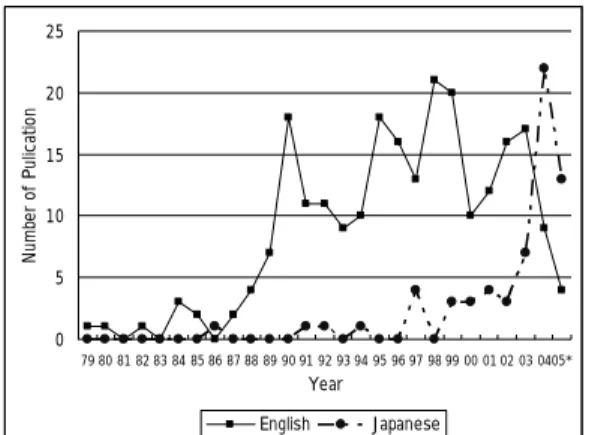
Figure 1 shows the number of books concerning “MOT” which have published in every year about the published books in English and in Japanese [13]. There are five peaks (84, 90, 95, 99 and 03) in the number of English books from 1979 to 2005. Also there are five peaks (86, 92, 97, 01 and 04) in the number of Japanese books. Moreover, the Japanese books become a peak after two years of the peak of the English books. We guess the following process from the result. First, a Japanese writer is stimulated from the book of new sale in a foreign country. Next, he intends to adapt the contents
of the book for his new book. He prepares the publication of new book for about one year. Then, he publishes new Japanese book which often resembles the foreign book. And, the time lag of the publication between English books and Japanese books was one year in the fifth peak. It is guessed that the field is important in Japan.
Notes: 1. Key Words: In English
{A} Management of Technology {B} Technology Management {C} Managing Technology In Japanese
{D} MOT
{E} Technology Management {F} Gijutsu Management {G} Gijutsu Keiei
2. Gijutsu (Japanese) = Technology
Keiei (Japanese) = Management
3. Correction as of August, 2005
Source: Authors made the graph based on Table [13]. Figure 1: The annual change of
the number of published books So, to support the guess, we compared the annual change of the number of published books in seven kinds of key words [13]. The title of the book about MOT was almost {A} in the first half of the 1980's. Yamanouchi [16] introduced these contents to Japan for the first time in the middle of the 80's. But, Yamanouchi made {F} the title of his book. After that, {A} became a title in the West frequently. It was Teramoto et al. [14] who adopted {D} as a title in Japan for the first time. Then, the number of title {D} increased.
And, “Managing Technology” of Steel [7] was translated by Gotoh [8] to “Gijutsu Management.” We guess the following from these. The translation of {A} ∼{C} doesn't parallel with either of {D}∼{G}'s. A title is influenced by a translator, a fashion at the publishing moment, and so on. The title of {B} is the main stream in the English book. However, there are not many titles of {E} in the Japanese book. Therefore, it is possible that the contents of {B} are introduced as a title of {G}, for example.
And, Teramoto et al. [14] introduced the contents of “the MOT course” of the technological graduate school. Many books which were published after Teramoto et al. [14], introduced contents of education of “MOT.” The key word of “MOT” is similar to “MBA” (Master of Business Administration) course of the graduate school. Because of this, it seems that “MOT” could be received “a technological business administration course” in Japan.
2.2 The understanding of the concept of “MOT” We extracted the key words which related to the concept of “MOT” from the published books [13].
Yamanouchi [16] described the meaning of “Gijutsu Management” as “How do you make the epoch-making new product which made use of high technology?” After this book was published, this concept hasn't changed very much.
Fujisue [2] used the key word of “Gijutsu Keiei” for the title of the book in the early days. He insists on the need of “the manager who knows technology,” and “the engineer who knows management.”
Degawa [1], however, introduces “MOT” with “a method to generate the business or the industry by managing technology from the stage of R&D.” Hioki and Kawakita [3] explain “MOT is not education for the mere technician, but for the manager to make
technologies include into the business model.” We put surveyed results together in the following. An activity of the person who manages technology is described in many books which have the key word of “Gijutsu Keiei” as the title. There are two kinds of book which has the key word of “MOT” as the title and which is published recently in Japan. One is the book which introduces “educational course of MOT.” The other is the book which introduces the method to apply R&D to the business model. Then, we thought finally about “MOT” as the activities to have value added by
0 5 10 15 20 25 79 80 81 82 83 84 85 86 87 88 89 90 91 92 93 94 95 96 97 98 99 00 01 02 03 0405* Year N u m ber o f P u lica ti o n English Japanese
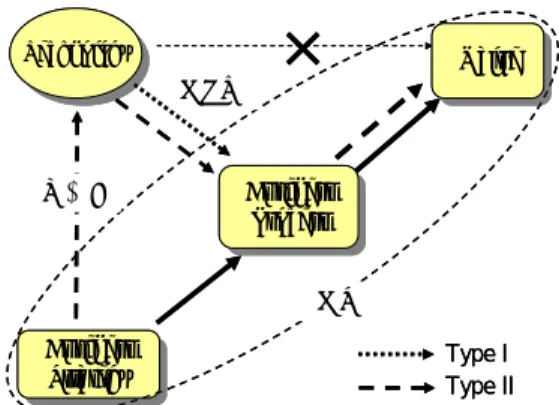
applying technology. We concluded about the position of MOT in the enterprise based on this concept like Figure 2. The figure in Wigand et al. [15] shows the position of “Information Technology” in the enterprise. We changed it partly based on our idea.
Source: We changed partly Wigand et al. [15] Figure 2: Concept of MOT
Technology doesn't produce value directly. We can get value added by applying technologies to a management system (MS). The management system is composed of business strategy, business process and value added. The business planning section of the company must plan business strategy to build business process, to make products to get value added. In this case, the business process or the products might be superior to other companies. So, the technology of the company is looked over when the management system is planned by the business planning section. In case of the company is short of the technology, the business planning section choses following method. One method is to purchase the technology from other companies. The other method is to entrust the research and development (R&D) section with the development of the technology. MOT is a generic name for activities to manage technology to realize business process or products to get value added. Technology during the development is evaluated. And deciding the following is included in these activities. The policy of the development to get value added is decided. Or, development is stopped without a hope of getting value added.
By the way, technologies are classified into things to apply for business process, and things to apply for products. So, process of MOT is divided into these two types. Type I of Figure 2 shows the process that technology is applicable to business process. When a product is less good than the product of other companies, the manufacturer of the product competes with other
companies due to the cut in price and the improvement in the performance. In this case, existing technology is often applicable. And, manufacturing technology and production control are applicable in this case.
Type II of Figure 2 shows the process that technology is applicable to the product. The manufacturer of the products must invest the products based on the new technology when usual products are less good than the products of other companies even if they are improved. In this case, technology is taken shape by R&D based on the business strategy. The manufacturer gets value added by applying that technology to the products with business process.
We make Type II the target in this paper.
Next, we pay attention to “the case not to get value added from the result by development of technology” in Type II. There are the following two cases as that reason.
1) The result has not been brought to the market. 2) The result had been brought to the market, but the trial was unsuccessful.
It seems that the business planning section judged two ways of the following in case 1).
1-1) There is an unrealized element before completing products.
1-2) It has not been discovered that the market with the hope of collecting R&D expenditures.
And, the judgmental standard of 1-2) or the failure factor of 2) is two of the following.
1-2-1 or 2-1) The market scale is small.
1-2-2 or 2-2) Competitiveness in the market is poor. But, these vary according to the market of the target and the shipping time of the product. The conditions may be overcome if the products are shipped fitting to the market. Because of this, to make management system, the business planning section must plan the products based on the trend of market, and must manage
technology to realize the products. At the same time, the business planning section must request to the R&D fitted to the requirement of the products for MOT. On Technology Technology
×
Value Value Business Process Business Process Business Strategy Business Strategy MS R & D MOT Type I Type II Technology Technology×
Value Value Business Process Business Process Business Strategy Business Strategy MS R & D MOT Type I Type IIthe other hand, the R&D section must research and develop technology to meet the requirement.
In case that the result from development of technology does not make value added, there are following two reasons. One is ability in the market research of the business planning section. The other is
insufficient-communication between the business planning section and the R&D section.
We focus on the latter in this paper.
3. MULTIPLE LAYERS SEC・CIS MODEL Sumita et al. [9] has proposed “multiple layers SEC・ CIS model” as a framework to observe a
communication process. In this section, first, this framework is reviewed. Next, the point of view of the insufficient-communication observed by using this framework is put together.
3.1 From SECI model to SEC・CIS model
Here we think about the information processing process which one player (or agent) does to communicate. When we suppose two players (A and B), the process consists of the following four:
(1) Player A reminds the contents to introduce to player
B, and put it in order make it in contents suitably.
(2) Those contents are sent by player A precisely, and it is received by player B.
(3) Player B interprets information from player A suitably.
(4) Player B memorizes the information based on that interpretation.
The condition that each process works is as following: (1) To have enough skill, (2) That a machine and a structure are accurate, (3) The receiving side should interpret the information suitably.
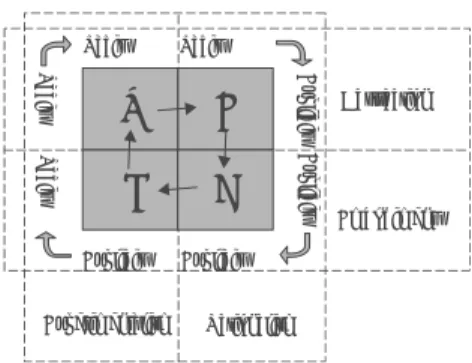
Suggestions were brought from the model SECI to Sumita et al. [9]. SECI model was proposed by Nonaka and Takeuchi [5]. They regarded knowledge creation by one group as the change process with the tacit
knowledge to the explicit knowledge. Then, it was understood that the four mode was repeated in that group for the knowledge creation: They are S
(Socialization), E (Externalization),C (Combination) and I (Internalization).
Source: Nonaka and Takeuchi[5] Figure 3: SECI model
Source: Sumita et al.[9]
Figure 4: SEC・CIS model
It was recognized that (1) was the externalization of the knowledge and (3) was the absorption of the knowledge by Sumita, et al. [9].
Then, they tried new interpretation on SECI model to explain the communication between groups of different function.
“SEC・CIS model” was proposed to understand the sending and receiving of information by Sumita et al. [9]. The process to go around in the clockwise direction starting from S point, is necessary so that sender's intention may be introduced properly between the sender of the information and the acceptor: The sender puts the intention to introduce which is in the inside of the tacit knowledge together (S→E process). The sender sends information to the acceptor when he changes information in form that the acceptor can understand that intention (E→C process). On the other hand, the acceptor interprets introduced information (C→I
I
C
E
Embodiment AbstractionS
Experimentalism Rationalism Tacit Explicit T aci t Ex pli cit Tacit Explicit T aci t E xp lic it Explicit Tacit Internalization Externalization S E C Iprocess). The acceptor tries to make that information (knowledge) him knowledge within the range that it can be interpreted with his own tacit knowledge (I→S process). The process (S→E→C→I→S) is divided by the following two parts: (S→E→C) is the process that a sender side externalizes information, (C→I→S) is the process that an acceptor side internalizes the
externalized information.
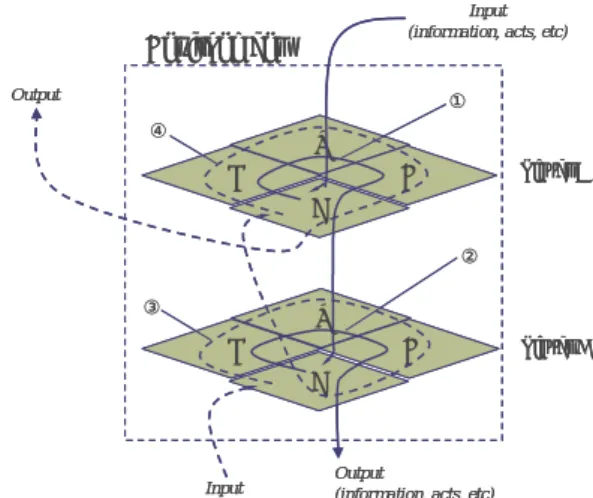
3.2 Multiple-layers SEC・CIS model Next, we think that more than one player share knowledge. In SEC・CIS model, knowledge in each mode of S・E・C・I has the possibility to be shared by players. Among them, the knowledge which has the highest possibility to be shared is an explicit knowledge (information). So, we think “the knowledge which can get it from the outside is always an explicit knowledge, and an explicit knowledge only can be introduced to other players.” And, “knowledge is transmitted not only to player but also to the material object as well.” At that time, we thought “information from object can be gotten from the observation and output to object is some work.” At any way, the transmission of the knowledge (information) was supposed to be exchanged in the territory of the formal knowledge; that is in the mode of C. Then, SEC・CIS model of 2 layers is expressed three-dimensionally to explain this (Figure 5).
Source: Sumita and Shimazaki [11]
Figure 5: Multiple Layers SEC・CIS model One layer is made player A, and the other is made player
B. Moreover, the process of the knowledge creation of
each player is represented with the sign of the player with suffix. For example, the knowledge creation process of player A is represented with (AS→AE→AC→
AI). At that time, an exchange by two players can be
explained as the next:
① Player A gets some information with “AC” from the
outside of the relations between A and B. That is compared with a tacit knowledge inside player A and interpreted (AC→AI→AS). Under the interpretation,
player A make the content (AS→AE→AC), and it is
transmitted to player B (AC→BC). These contents are
shared in each mode “C” of player A and B. ② Player B interprets those contents with his tacit knowledge (BC→BI→BS). Using the interpretation,
player B plans the next action (BS→BE→BC). If
concrete work is necessary, it is done in “BC.” That
work is introduced to the object, and the response is received with “BC.”
③ When player B repots to player A, the process that the description of player A and B is overturned about the process of ①.
④ When there is ③, it occurs in player A the process that the description of player A and B was overturned about the process of ②.
At that time, it is noticed that it has the cycle of C→I→ S→E→C in each player: that is the cycle of
interpretation → thinking → transmission. In other words, the information which is get from the outside of player is interpreted, and it turns to the base of the next behavior. When information changes more or less, we think that here is a chance of breeding knowledge value. By the way, this model is paid attention only to the information processing of each player and the behavior of the transmission. Therefore, to apply this to the concrete case, it must be definite the purpose of the contents exchanged.
Sumita and Shimazaki [11] concluded that there are two processes to breed knowledge value by the purpose of the communication between players based on Habermas' “communication act” [4]:
(A) The process in the behavior of the person who works based on the contract or of the organization. (B) The process to maintain relations of people without contract in the equal position.
C I S E C I S E Player A Input (information, acts, etc)
Input Output (information, acts, etc) Output ② ③ ① ④ Player B Environment C I S E C I S E Player A Input (information, acts, etc)
Input Output (information, acts, etc) Output ② ③ ① ④ Player B Environment
It can be thought that the contents exchanged in the process (A) are directions and reports in business. Here player A puts in the side to indicate, player B puts in the side to work. Player A and player B are hierarchical relationship in duty. As for working player B properly, becomes the profit of player A. Because of this, player A has to prepare the contents as a written directive for player B so that he can interpret it with his tacit
knowledge and can carry it out. In the reverse, the report must be done from player B to player A, to know whether the work has been done properly or not. If these processes aren't done fully, player A can't expect a satisfactory performance.
But, player A doesn't always give proper directions. Because of this, player B gives the explanation of the present condition of the work and a proposal to player A. Player A modifies directions to player B based on the proposal. Like this, player B carries out the plan that player A and player B agreed. And, player A and B should appreciate the situation except for the relations of player A and B to judge the good reason of the directions or acts. Two points of the following were shown as a point of view to observe an insufficient communication from the consideration until now. The first points are the contents which agreed between each player. Each player is the conditions of the understood outside in the second point.
4. APPLICATION OF THE MODEL TO EXPLAIN OF FAILURES IN MOT We apply “multiple layers SEC・CIS model” in this section to the failure of Xerox (Smith and Alexander [6]) which is a famous case as a failure of MOT. Then, we observe an insufficient communication between the business plan section and R&D section.
4.1 Development of technology in Xerox PARC and the history of the application products We collected the history of the development of
technology in Xerox Paro Alto Research Center (PARC) and arranged the application products based on the developed technology about the word processor, the personal computer and the beam printer in the chronological tables (Table 1, 2).
Xerox made xerography a business in sixteen years. Then, the company grew suddenly after the copy business was started (Table 1). But, the company had to prepare the next (star) business because it had only one (cash cow) business occurred in the company. So, the company established the laboratory which developed a computer under the powerful leadership of the president
in those days. That was PARC. Main research in PARC was almost completed within 5 years after the
laboratory establishment. The research result was tested in the publishing company, and the technologies were an applicable stage to the product.
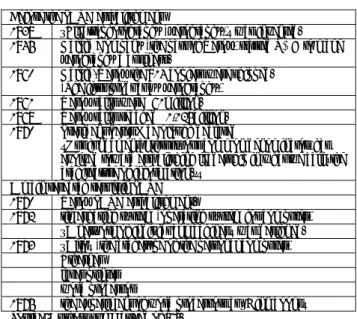
Table 1: Development of technology in Xerox PARC
Before the PARC establishment
1938 “Electrophotography (xerography)” was invented.
1945 Haloid Company (the past of Xerox) started R&D to make xerography a business.
1960 Haloid-Xerox the 914 copiers were shipped.
(The first product by xerography)
1961 Xerox sales were $61million.
1968 Xerox sales reached $1,125billion.
1970 President Peter McColough declared
”Our fundamental thrust, our common denominator, has evolved toward establishing leadership in what we call ‘the architecture of information.’”
A main research result in PARC
1970 Xerox PARC establishment.
1972 timesharing system (operating system for computer)
“A network of individual machines” was designed.
1973 “Alto” (the archetype of the personal computer)
Ethernet
laser printer
word processor
1975 the experiment of word processors at “Ginn books”
Source: Authors summarized of [6].
Table 2: Merchandising of the development result by Xerox PARC
word processor
1964 IBM MTST (word processing typewriter)
1973 Customers in U.S. had purchased more than 100,000
typewriters.
1974 Xerox the 800 word processing typewriter was introduced.
(Development by existing techniques)
1976 Merchandising of the “Alto” is compared with the
development of the 850 typewriter. Xerox chose not to introduce the “Alto.”
1976 Wang Laboratories introduced advanced computers to the
word processing market. personal / office computers
1976 Xerox chose not to introduce the “Alto.”
1977 The technology of PARC is shown to the managing staff as
a demonstration of the network computing.
1978 Apple II, VisiCalc (electronic spreadsheet)
1981 Xerox “Star” office system (The first merchandising of the network computing system)
1981 IBM PC (It succeeded in the family market.)
1983 Apple Lisa (the personal computer of the “Alto” type)
1984 Apple Macintosh (The popular edition of “Lisa.”
It becomes the representative of the "Alto" type personal computer.)
laser printer
1975 IBM laser printer
1977 Xerox the 9700 laser printer
However, sale of the application product was after other companies had started to sell a similar product in the word processor, the personal computer and the laser printer (Table 2).
The word processing typewriter of the company was compared with “Alto” which was a computer word processor by the PARC technology to decide a
development policy in 1976. But, the managing staff in those days didn't think that the technology of PARC was better than existing techniques in the manufactures' costs and maintenance. Because of this, “Alto” wasn't put on the market. But, in the same year, a computer word processor was put on the market from Wang Laboratories which was a venture enterprise. This word processor was accepted among a market though a price was two times of the best class typewriters of other companies. From the first, this company aimed to compete in the word processing typewriter which was existent technology. But, a computer word processor was developed because it couldn't win against the big enterprises in the cost.
Why didn't Xerox become a product though
development proceeded? When the indication of Smith and Alexander [6] was summarized, the managing staff in those days thought that their company only supplied the product which improved existent technology to the existent market that other companies had opened up. And, Xerox was wrong with “Star” which had been put on the market for office in 1981. They gave the following three reasons. The first was that the
performance of hardware didn't catch up with complex software. The second was that a company had to invest a large sum to work by the network computing at office because the unit price of the work station was more expensive than IBM PC or Apple II. The third was that the developer didn't bundle the electronic spreadsheet which was the most popular software used in the business planning section. The cause of the failure of “Star” was that the developer who belonged to PARC understood insufficiently the purpose of the office computer which the managing staff demanded. 4.2 Observation
by “multiple layers SEC・CIS model”
This problem is applied to “multiple layers SEC・CIS model.”
Player A is assumed as the business planning section (managing staff). Player B is assumed as made the R&D section (PARC). The following two phases are
compared here. One is the phase that PARC was established (phase 1). The other is the phases that the research results were applicable to the product (phase 2).
(Phase 1) The manager analyzed the conditions that the company wouldn't prosper in the long run by the copy business only (Input→AC→AI→AS). One of the
managers in those days made xerography a business. A manager examined the next (star) business under the powerful leadership based on such an entrepreneurial spirit (AS→AE→AC→AI→AS). Then, PARC was
established (AS→AE→AC). Excellent researchers were
gathered in PARC. A development goal was taken shape based on the concept of ‘the architecture of information’ (AC→BC→BI→BS). Five years later, PARC made the
prototype of the new office environment by the network computing (BS→BE→BC).
(Phase 2) However, one of the managing staffs at the time of phase 1 passed away when a company tried to apply that technology to the product. Then, the
managing staffs become the managers who had joined a company when a business had expanded rapidly. They joined a company by the head hunting after they had been the managers of the big enterprises. Then, they tended to make decision by the short-term sales and the manufactures' costs. Because of this, they couldn't understand the really new technology developed with PARC (BC→AC’). They judged production by
comparing a cost with existent technology (AC’→AI’→
AS’→AE’→AC’). After that, PARC complained to them
about the production many times (BC→AC’). They
didn't understand it. Sale of most products was delayed as that result from other companies (AC’→AI’→AS’).
We observed that the input of the information from the outside was insufficient in phase 2 when we applied “multiple layers SEC・CIS model” to the case. This is contrasting against phase 1.
Predicting potential demand to a certain extent, the managing staff should judge whether this becomes business to examine a new management system. At phase 1, the managing staff in those days foresaw that business came to a deadlock from the long-term point of view. Then, he expressed the vision of development of technology to PARC clearly. PARC met that submission. This is the same as the process of Type II of MOT which showed it in the section 2.2. But, in phase 2, the managing staff of the succession repeated that a product was supplied to the market which other companies had
opened up. In other words, the managing staff in phase 2 thought that the condition was only maintained with Type I of MOT. Then, the managing staff missed timing to apply a development result to the product with doing Type II.In phase 2, the managing staff reevaluated a market (Input→AC’), and he should have added the
R&D which were suitable for that market (AC’→AI’→
AS’→AE’→AC’→BC). In other words, the reevaluation
of developed technology is necessary for MOT of Type II.
On the other hand, in phase 2, when PARC appealed to the managing staff to apply technology to the product, they emphasized only the matter that technology was superior to other companies. Because of this, the managing staff ignored PARC. And, developed technology taken shape the concept of the manager at the time of phase 1. After that, developed technology didn't evolve to the product fitted to the market. Because of this, “Star” didn't become the product accepted to the market. Originally, the business planning section indicates the development of the product fitted to the market to the R&D section. But, when the R&D section was ignored from the business planning section, the R&D section investigate the needs of the actual use in the market (Input→BC), and they should have proposed
that to the business planning section (BC→BI→BS→BE
→BC→AC’).
The above consideration is put together. The following state was observed as a result of applying failure in phase 2 of Xerox to “multiple layers SEC・CIS model.” The managing staff and PARC didn't investigate fully a market respectively (Input→AC’, Input→BC). Therefore
an insufficient communication occurred in “BC→AC.” 5. Conclusions
We proposed the framework to explain the failure of MOT caused by insufficient communication in the organization. Then, we observed the case that the research result of Xerox Palo Alto Research Center wasn't applied to the product. By using “multiple layers SEC ・ CIS model” to the case, we illustrated the effectiveness. An insufficient communication in the organization can be observed by applying this framework to other MOT failure cases. It is expected to add new knowledge to the organizational theory by collecting many cases that were observed. And, we think that the importance of the market research in the technology development phase can be perceived by observing the failure case of MOT. These are our future subjects.
REFERENCES
[1] Degawa, T.:View of Gijutsu Keiei (in Japanese), Kobunsha, 2004.
[2] Fujisue, K.: Beginner’s Book of Gijutsu Keiei (in Japanese), Japan Productivity Center for Socio-Economic Development, 1999.
[3] Hioki, K. and Kawakita, M.: Japansese Style MOT (in Japanese), Chuokeizai-sha, 2004.
[4] Nakata, N.: Harbermas – Kommunikatives Handeln (in Japanese), Kodansha, 1996.
[5] Nonaka, I. and Takeuchi, H.:
The Knowledge-Creating Company,
Oxford University Press, 1995. [6] Smith, D. K. and Alexander, R. C.:
Fumbling the Future, toExcel, 1999.
[7] Steele, L. W.: Managing Technology, McGraw-Hill, 1989.
[8] Steele, L. W.: Gijutsu Management (in Japanese Translation by Gotoh, M.), Japan Management Association, 1991.
[9] Sumita, T., Kishikawa, Y., Shimazaki, M. and Kameda, H.: “On the Relationship between Accident and Information Flow in Organizations (in Japanese),” Special Issue on Proceedings of
48th General Meeting, Japan Society for the Study
of Office Automation, pp.133-136, 2004.
[10] Sumita, T., Shimazaki, M. and Kishikawa, Y.: “On a Framework to Explain Organizational Accident Caused by Insufficiency of Communication,”
Proceedings of the Fourth International
Conference on Office Automation and Information Management, pp.54-63, 2004.
[11] Sumita, T. and Shimazaki, M.: “Breeding Knowledge-Value by Communication among Multi-Agents,” Proceedings of the 5th
International Symposium on Knowledge and Systems Sciences, pp.201-206, 2004.
[12] Shimazaki, M. and Sumita, T.:“Focusing and Sharing a Problem by Communication among Multi-Agents,” Proceedings of the 5th
International Symposium on Knowledge and Systems Sciences, pp.207-210, 2004.
[13] Sumita, T. and Shimazaki, M.:“A Survey of Concept of MOT using an Online Search Service for Books (in Japanese),” Proceedings of Annual
Autumn Meeting, Japan Industrial Management
Association, 2005, pp.170-171, 2005.
[14] Teramoto, Y. et al.: Beginner’s Book of MOT (in Japanese), Japan Management Association, 2002. [15] Wigand, R., Picot, A. and Reichwald, R. :
Information, Organization and Management, John
Wiley & Sons, 1997.
[16] Yamanouchi, A.: Gijutsu Management to Innovate