INTRODUCTION
Helicobacter pylori (Hp) is a Gram-negative, mi-croaerophilic bacterial rod, associated with gastritis, peptic ulcer, and gastric cancer. (1-3). Hp infection elicits inflammatory and immunological responses in the host, although the magnitude of the responses varies from strain to strain and from host to host. Both cellular immune and antibody responses contrib-ute to Hp-associated gastritis. Once the host has been infected, gastric epithelial cells secrete interleukin (IL)-6, IL-8 and other mediators that recruit neu-trophils to gastric mucosa (4). Surface mucous cells
(pit cells) serve a primary protective role against irritants by providing a mucous coat. Hp preferen-tially colonizes in the mucous coat and selectively attaches to pit cells. There is increasing evidence that pit cells actively regulate the initiation of Hp-associated inflammation in gastric mucosa. In ad-dition to inflammatory cytokines, such as IL-6, IL-8, and tumor necrosis factor (TNF-α), major histo-compatibility complex II antigen was shown to be strongly expressed on these cells (5). Thus, to understand the pathophysiology of Hp-associated gastritis, it is particularly important to elucidate the molecular basis of Hp-epithelial cell interactions.
Among the Hp genes, an insertion of approxi-mately 40 kb of foreign DNA, named cag pathogenicity island (PAI), is now known as a major determinant of virulence (6). The cag PAI genes contains 31 genes, and six of the genes code for the core subunits of the type IV export machinery that can transfer the
Toll-like receptor 4 regulates gastric pit cell responses to
Helicobacter pylori
infection
Tsukasa Kawahara, Yuki Kuwano, Shigetada Teshima-Kondo, Tomoko Kawai,
Takeshi Nikawa, Kyoichi Kishi, and Kazuhito Rokutan
Department of Nutritional Physiology, The University of Tokushima School of Medicine, Tokushima, Japan
Abstract: Gastric pit cells express mitogen oxidase1 (Mox1) and essential components for the phogocyte NADPH oxidase (p67-, p47-, p40-, and p22-phoxes). Helicobacter pylori (Hp) lipopolysaccharide (LPS) is a potent up-regulator of the Mox 1 oxidase. In this study, we examined the expression levels of several key members of the Toll-like receptor (TLR) family in primary cultures of guinea pig gastric pit cells. These cells expressed the TLR4 mRNA. Immunoblot analysis and immunofluorescence histochemistry with an anti-TLR4 antibody showed that gastric pit cells possessed significant amounts of TLR4 protein preferentially on the plasma membrane. In contrast, the cells did not express the TLR2 and TLR9 transcripts and did not contain detectable amounts of TLR2 protein. Neither peptidoglycan from
Staphylococcus aureus nor Hp DNA with the CpG motif up-regulated Mox1 oxidase activity. Hp LPS activated nuclear factor-κB in association with the expression of cyclooxygenase
II and tumor necrosis factorα transcripts. These findings suggest that TLR 4 may play a crucial role in the initiation of inflammatory responses of gastric pit cells against Hp infection. J. Med. Invest. 48 : 190-197, 2001
Keywords : toll-like receptor, gastric pit cell,Helicobacter pylori, mitogen oxidase 1
Received for publication May 18, 2001 ; accepted May 25, 2001.
Address correspondence and reprint requests to Kazuhito Rokutan, Department of Nutritional Physiology, The University of Tokushima School of Medicine, Kuramoto-cho, Tokushima770-8503, Japan and Fax : +81-88-633-7086.
ORIGINAL
The Journal of Medical Investigation Vol. 48 2001
190 190
cytotoxin-associated protein A (CagA) into host epithelial cells, and translocated CagA has been shown to be tyrosine-phosphorylated by host cells (6-9). This route has been implicated as one of the major pathways to trigger gastric epithelial responses. Recently, we reported that gastric pit cells expressed a novel superoxide anion (O2-)-producing NADPH
oxidase (10). This oxidase was then identified as a mitogen oxidase 1 (Mox1) (11). Hp lipopolysac-charide (LPS) up-regulated Mox1 oxidase activity, and enhanced production of oxygen radicals from Mox1 oxidase subsequently activated a crucial transcription activator of many inflammatory response genes, nuclear factor-κB (NF-κB) (10, 11). These findings suggested that gastric pit cells may have an ability to initiate an innate immune response against Hp. Based on these findings, in the present study, we examined the expression of several key members of the Toll-like receptor (TLR) family in primary cultures of guinea pig gastric pit cells. We also tested whether bacterial components actually stimulated distinct TLR signals.
MATERIALS AND METHODS
Preparation and culture of gastric mucosal cells under LPS-free conditions
Male guinea pigs weighing approximately 250 g were purchased from Shizuoka Laboratory Animal Center Inc. (Shizuoka, Japan). Gastric mucosal cells were isolated aseptically from guinea pig fundic glands as described previously (10). In the present experiments, all reagents used for culture were free from detectable amounts of LPS by the Limulus ameobocyte lysate assay (Endospecy ; Seikagaku Kogyo Co. Tokyo, Japan). The isolated cells were cultured for 2 days in RPMI 1640 (GIBCO, Grand Island, NY), containing 50µg/ml gentamicin, 100 U/ml penicillin G, and 10% (vol/vol) fetal bovine serum (FBS ; ICN Biomedicals, Aurora, OH). This complete medium contained less than 0.01 endotoxin unit (EU)/ml of LPS. Cell populations were determined by histochemical and immunohistochemical analyses, as described previously (10). After culturing for 48 h, growing cells consisted of pit cells (about 90%), pre-pit cells (about 5%), parietal cells (4-5%), mucous neck cells (less than 1%), and fibroblasts (less than 1%). Measurement of O2-production
Mature pit cells were confirmed to be O2--producing
cells by the nitroblue tetrazolium staining (10). The amount of O2-release was spectrophotometrically
measured by the superoxide dismutase (SOD)-inhibitable reduction of cytochrome c and expressed as nmol/ mg protein/h (10).
Preparation of Hp LPS and CpG DNA
LPS was prepared from NCTC 11637 by the hot-phenol-water method (12) and subsequently treated with DNase 1, RNase A, and proteinase K, as de-scribed by Moran et al . (13). The treated LPS was boiled for 1 h to inactivate the enzymes. The LPS was dialyzed against LPS-free water (Otsuka Phar-maceutical Co., Tokushima, Japan) and ultracen-trifuged at 100,000g for 18 h. Precipitated LPS was dissolved in LPS-free saline (Otsuka Pharmaceuti-cal Co.). Phosphothioate-stabilized oligonucleo-tides containing CpG motif (CpG DNA) in cagM (5-TCCAATAACGTTTCTAATTTATTGAGCAGA-3) and
cagH (5-TTCAATAGCGCTAGGATTTTTAGGGGTGGT-3) were purchased from Nisshinbo Co. (Tokyo, Japan). These CpG DNAs were dissolved in LPS-free saline.
Detection of TLR, cyclooxygenase II (COX II), TNF-
α
, and actin transcriptsTotal RNA was isolated from guinea pig gastric mucosal cells (GMC), guinea pig or human peripheral blood lymphocytes (PBL) with an acid guanidium thiocyanate-phenol-chloroform mixture (14). Re-verse transcriptase (RT)-PCR was done to detect the TLR2, 4, 9, COX II, TNF-α and actin transcripts using the following PCR primer sets :
TLR 2, GTCCAGGAGCTGGAGAACT-3’ and GGAACCTAGGACTTTATCGCA-3’ ; TLR 4, TCACCTGATGCTTCTTGCTG-3’ and AGTCGTCTCCAGAAGATGTG-3’, TLR 9, ATGCCCTGCGCTTCCTATTCATGGA-3’ and 5’-GAACTGTCCTTCAACACCAGGCCTT-3’, COX II, CCAGTTTGTTGAATCATTCACC-3’ and 5’-AAAGTACTCGGCTTCCAGTAG-3’, TNF-α, AAAGTAGACCTGCCCGGACT-3’and
5’-GTACCTCATCTACTCCCAGG-3’, andβ-actin, TCACCGAGGCCCCTCTGAACCCTA-3’ and 5’-GGCAGTAATCTCCTTCTGCATCCT-3’. The result-ant PCR products separated on an agarose gel were purified, ligated into a pCR 2.1-TOPO vector (Invitrogen, Carlsbad, CA.), and transformed into JM109 cells. Transformed plasmids containing the appropriate insert DNA were selected and sequenced with a DNA sequencer (model ABI 377 ; PE Biosystems Japan, Tokyo, Japan).
191
The Journal of Medical Investigation Vol. 48 2001 191
Detection of TLR proteins
An anti-TLR 2 or anti-TLR 4 antibody was gener-ated by immunization of a rabbit with synthetic peptide of the amino acid residues 295-310 of human TLR2 or 183-199 of human TLR4 (15). The resultant serum was further purified by affinity chromatography with the synthetic peptide-conjugated agarose. A membrane fraction was prepared as previously described (10). Each sample of 20µg protein per lane was separated by sodium dodecyl sulfate-polyacrylamide gel elec-trophoresis (SDS-PAGE) using a 7.5% polyacrylamide gel and transferred to a polyvinylidene difluoride filter. After nonspecific binding sites were blocked with 4% purified milk casein, the filter was incubated for 1 h at room temperature with the anti-TLR2 or anti-TLR4 antibody. Bound antibodies were detected by an enhanced chemiluminescence system (Amersham Pharmacia, Piscataway, NJ).
Immunofluorescence histochemistry
Cells growing on a LPS-free glass coverslip were washed with phosphate-buffered saline (PBS) and fixed with 4% paraformaldehyde in PBS for 20 min. After washing with PBS, the cells were blocked with 4% purified milk casein. They were incubated with a 1 : 100 dilution of rabbit anti-TLR4 antibody for 1 h at room temperature and then treated with a 1:500 dilution of Rhodamine-linked goat antibody against rabbit IgG (Amersham Pharmacia) for 1 h at room temperature. The samples were mounted with Vectashield Mounting Medium (Vector, Burl-ingame, CA). Subcellular localization of TLR4 was viewed using a confocal laser scanning microscopy (model TCSNT ; Leica, Heidelberg, Germany) Gel mobility shift assay.
Nuclear proteins were prepared from cultured guinea pig gastric mucosal cells, and the activation of NF-κB was examined by gel mobility shift assay, as described previously(10, 11).
Statistical analysis
ANOVA and Scheffé’s test were used to determine statistically significant differences. Differences were considered significant if P <0.05.
RESULTS
Effects of Hp components on O2-production Guinea pig gastric pit cells, cultured under the
conditions used in our previous studies, spontane-ously released about 50 nmol O2-/mg protein/h
(10, 11). The basal rate of O2-production decreased
to 11±2 nmol/mg protein/h (mean±SD, n=12) in the LPS-free system used in the present study (Table1). Using this system, we re-evaluated the effects of bacterial components or products on Mox1 oxidase.
Culture supernatant was prepared after cultivation of Hp alone (1×10⁷cells/ml) in RPMI 1640 containing
10% FBS for 24 h was then and added to gastric mucosal cells (1×10⁵cells). After been cultured for
24 h, O2-production increased 1.7-fold (Table 1). The
stimulatory effects of supernatants could not be eliminated by boiling (Table 1). When LPS was ex-tracted by the hot-phenol method and added to the cells, it increased O2-production 10-fold. This
LPS possibly contained DNA, RNA, and denatured protein, while treatment of Hp LPS with DNase 1, RNase, or proteinase K did not eliminate the activity (Table 1).
Three different bacterial components have been identified as specific ligands for distinct TLRs; LPS for TLR4, peptidoglycan for TLR2, and CpG DNA for TLR9 (16, 17). We also tested whether stimula-tion of TLR9 by bacterial DNA with CpG motif resulted in the up-regulation of O2-production. For
this purpose, CpG DNAs that were coded in the
cagMand cagH genes of Hp NCTC11638 (GenBank
Table 1. O2-release from guinea pig gastric mucosal cells
Treatmenta
O2-release (nmol/ mg protein/h)b
none
culture supernatant boiled culture supernatant LPS DNase 1-treated LPS RNase A-treated LPS proteinase K-treated LPS peptidoglycan CpG DNA (cagM) CpG DNA (cagH) 11±2 19±3* 19±4* 105±4* 102±5* 103±4* 102±3* 12±3 13±3 10±3
aCulture supernatant and boiled supernatant of Hp were prepared
as previously described (10). LPS was prepared by the hot-phenol-water method and treated with DNase 1, RNase A, or proteinase K, as described in MATERIALS AND METHODS. Cells were treated with the culture supernatants, these LPSs (1 EU/ml), S. aureus peptidoglycan (10µg/ml), or CpG DNAs (50µg/ml) at 37oC for 24 h in RPMI 1640 containing 10% FBS. bO
2-release was measured as described in MATERIALS AND
METHODS. *Significantly increased vs untreated control cells (p<0.05 by ANOVA and Scheffé’s test).
T. Kawahara et al. Role of TLR 4 in gastric pit cells
192 T. Kawahara et al. Role of TLR 4 in gastric pit cells
accession number AE000511) were synthesized, and gastric mucosal cells were stimulated by these CpG DNAs. However, these CpG DNAs did not increase O2-production (Table 1). We also confirmed
that stimulation of TLR2 by Staphylococcus aureus peptidoglycan (Fluka Chemie AG, Buchs, Switzerland) did not affect the O2--producing activity (Table 1).
Thus, LPS was identified as a bioactive component of Hp that stimulated Mox1 oxidase expressed in gastric pit cells.
Cell viability was maintained throughout the ex-periments. This was based on continued trypan blue
exclusion, adherence to the culture plates, and unchanged morphological features (data not shown). The concentrations of LPS used in this study did not cause apoptosis of the cells, which was confirmed by DNA ladder formation and nuclear morphology (data not shown). However, Hp LPS at 42 EU/ml (71-560 ng/ml) or higher induced DNA fragmen-tation and apoptotic chromosomal condensation under low-serum conditions (submitted to JMI).
Expression of TLRs on gastric mucosal cells Human and guinea pig peripheral blood lymphocytes
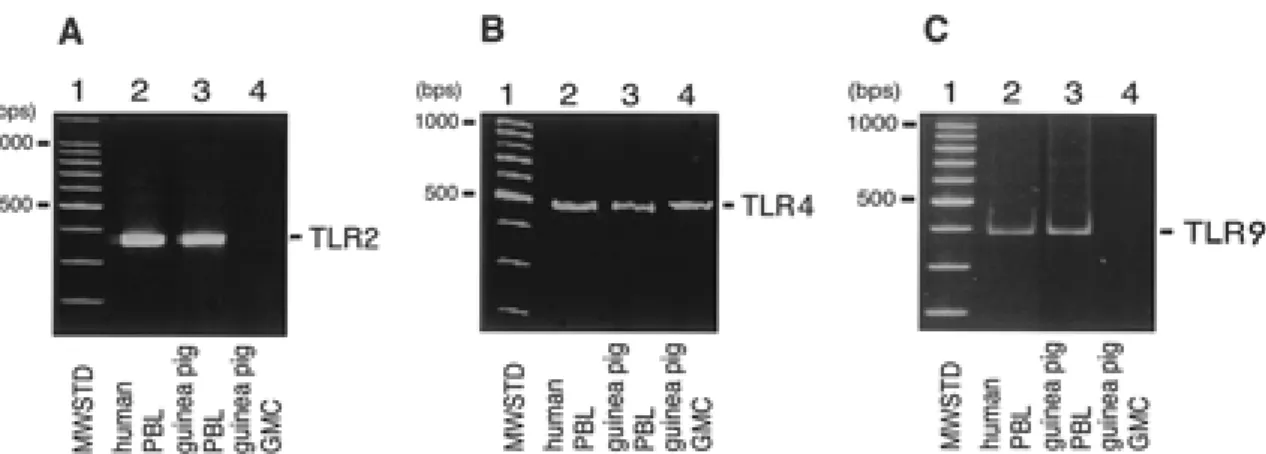
Fig. 1. Detection of TLR 2, 4, and 9 transcripts in gastric mucosal cells. Total RNA was isolated from cultured guinea pig gastric mucosal cells (GMC), human or guinea pig peripheral blood lymphocytes (PBL), and RT-PCR was performed, as described in MATERIALS AND METHODS. The RT-PCR products (5µg) were subjected to electrophoresis in a 6% polyacrylamide gel. Lanes 1 in A-C show molecular weight standard markers (MWSTD). Similar results were obtained in three separate experiments.
Fig. 2. Detection of TLR2 and 4 proteins in gastric mucosal cells. Membrane proteins were prepared from guinea pig GMC, human or guinea pig PBL, as described in MATERIALS AND METHODS. Im-munoblot analysis with an antibody against TLR4 (A) or 2 (B) was performed. Guinea pig GMC growing on an LPS-free glass coverslip were stained with an antibody against TLR4 as described in MATERIALS AND METHODS (C). Cells were examined using a confocal laser scanning microscopy. The scale bar indicates 10µm.
193
The Journal of Medical Investigation Vol. 48 2001 193
(PBL) were isolated as described previously (10). Total RNA was extracted from these cells and used as positive controls to detect the transcripts of TLRs 2, 4, and 9 in gastric mucosal cells. RT-PCR analysis showed that gastric mucosal cells ex-pressed neither the TLR2 (Fig. 1A) nor the TLR9 transcript (Fig. 1C). These findings also demonstrated that our cultures did not contain significant numbers of immune cells. RT-PCR amplified the TLR4 mRNA in gastric mucosa cells (Fig. 1B). The nucleotide sequence showed that the amplified product had 90% nucleotide sequence identity to the human TLR4 cDNA (GenBank accession number U88880). Expression of TLR2 and 4proteins in gastric mucosal cells
We also examined whether TLR2 and TLR4 proteins were expressed in gastric mucosal cells, since TLR2 was reported to be another candidate for an LPS-receptor (18). Immunoblot analysis with an anti-TLR4 antibody showed that guinea pig gastric mucosal cells expressed TLR4 protein, as was detected in human and guinea pig PBL (Fig. 2A). Immunocyto-chemical analysis showed that TLR4 was preferentially distributed on plasma membrane (Fig. 2C). In contrast, human and guinea pig PBL contained significant amounts of TLR2 protein, while gastric mucosal cells did not possess detectable amounts of TLR2 protein (Fig. 2B).
LPS-induced expression of COX II and TNF-
α
mRNAsIn previous studies (10, 11), we showed that Hp LPS could activate NF-κB in cultured gastric mucosal cells. After stimulation by Hp LPS, the activation of NF-κB occurred within 30 min and continued for longer than 12 h (10). Enhanced production of oxygen radicals by up-regulated Mox1 oxidase was suggested to mainly participate in the activation (10). However, the increase in O2-production from the cells was
first detected at 8 h after the treatment with Hp LPS (Fig. 3C). Furthermore, Hp LPS could activate NF-κB with a peak at 4 h even in the presence of SOD and catalase (Fig. 3A), showing that NF-κB was activated directly by Hp LPS, in addition to indirectly by Mox1-derived oxygen radicals up-regulated by Hp-LPS. In association with this activation of NF-κB, Hp LPS stimulated the expression of COX II (an upper panel in Fig. 3B) and TNF-α (a middle panel in Fig. 3B) transcripts in the presence of SOD plus catalase. These findings suggest that LPS directly initiates NF-κB-dependent inflammatory and immune responses.
DISCUSSION
Using an LPS-free culture system, we reconfirmed that guinea pig gastric mucosal cells in culture were sensitive to Hp LPS. Hp does not attach to
Fig. 3. Activation of NF-κB and ex-pression of COX II or TNF-α. After been cultured for 48 h in RPMI 1640 containing10% FBS, cells were treated with 1 EU/ml Hp LPS in RPMI 1640 containing 10% FBS, 200 U/ml SOD, and 350U/ml catalase for the indicated times. Nuclear extracts were prepared from the cells and analyzed by gel mobility shift assay as described in MATERIALS AND METHODS (A). Total RNA was isolated and analyzed by RT-PCR as described in MATERIALS AND METHODS (B). Cells were treated with 1 EU/ml
HpLPS in RPMI 1640 containing 10% FBS for the indicated times (C). The amounts of O2-release were measured
as described in MATERIALS AND METHODS, and they are expressed as means±SD (n=12).#
Significantly increased vs untreated control cells (p<0.05 by ANOVA and Scheffé’s test). T. Kawahara et al. Role of TLR 4 in gastric pit cells
194 T. Kawahara et al. Role of TLR 4 in gastric pit cells
guinea pig gastric mucosal cells ; therefore, our system is an excellent model for studying the contact-independent interactions between gastric epithelial cells and the Gram-negative bacterium. Mox1 oxidase-derived O2-and related oxygen intermediates were
suggested to play crucial roles in the initiation of inflammatory and immune responses as well as in the regulation of cell growth (10, 11). Hp LPS that activates Mox1 oxidase appears to be one of the important virulent factors of Hp.
Recently, it was been shown that bacterial com-ponents, such as LPS, peptidoglycan, and DNA stimulate innate immune response through distinct TLR receptors. TLR2 has been suggested to be another possible candidate for an LPS receptor (18). We confirmed that gastric mucosal cells did not express the TLR2 mRNA and detectable amounts of TLR2 protein. In contrast, intestinal epithelial cells express TLR2 and TLR4 (19). The sensitivity to LPS is strikingly different between gastric mucosal cells and intestinal epithelial cells. Intestinal epithelial cells are insensitive to LPS, making them tolerant to constant exposure of resident microflora. In contrast, any bacteria, except for Hp, cannot colonize per-sistently under acidic conditions in the stomach. The high sensitivity to Hp LPS may be an important feature characteristic of gastric mucosal cells, when considering Hp infection. The TLR9 transcript was not expressed in gastric mucosal cells (Fig.1C) and intestinal epithelial cells (data not shown). DNA molecules are usually stable in acidic conditions in the stomach, and the intestine is persistently exposed to bacterial flora. Therefore, the absence of TLR9 may make gastrointestinal epithelial cells quiescent to an excessive response to bacterial DNA.
In phagocytes, activation of TLR4 signaling is reported to induce expression of other TLRs (20). However, Hp LPS did not induce expression of the TLR2 and 9 transcripts in gastric mucosal cells (data not shown). Thus, among the TLRs examined, TLR4 appeared to play a crucial role in the gastric mucosal cell response to Hp infection. More recently, it was reported that TLR5 is a receptor specific for bacterial flagellin and mediated an innate immune response to this bacterial component (21). Further studies are necessary to elucidate the role of TLR family in the innate immune response of gastric mucosa.
Recently, several novel isozymes of gp91-phox expressed in non-phagocytic cells, including Mox1 (22), Renox (23), and Thoxes (24), were molecularly identified. Among these non-phagocytic oxidases, the pit cell Mox1 oxidase, whose O2--producing capacity
is equivalent to that of macrophages (10, 11), is the most potent. We previously studied the effects of growth factors (epidermal growth factor and trans-forming growth factor-β), cytokines (interferon-γ, TNF-α, IL-1, IL-3, and IL-6), histamine, carbacol, and phorbol 12-myristate13-acetate (PMA) on the oxidase activity ; however, none were able to up-regulate the O2-production (10 and data not shown). Finally, we
observed that LPS from Hp and E. coli similarly up-regulate Mox1 oxidase activity (10). These findings also support the important role of Hp LPS and TLR4 in the initiation of an inflammatory response against
Hp infection.
In phagocytes, LPS stimulates TLR4 signal-transmittable molecules, such as myeloid differentiation factor 88 (MyD 88), IL-1R-associated kinase, TNF receptor-associated factor 6, TAK1, and NIK, leading to ac-tivation of NF-κB (25). Hp infection triggers the activation of NF-κB to produce inflammatory re-sponse genes, such as TNF-α, interleukin 6, and 8 (26, 27). In a previous study (10), it was suggested that enhanced production of oxygen intermediates by Mox1 oxidase might play a crucial role in the activation of NF-κB, leading to expression of proinflammatory mediators. Hp LPS stimulated distinct TLR4 sig-naling, such as phosphorylation of TAK1 and TAB1 (submitted to JMI). In the present study, we dem-onstrated that Hp LPS itself directly activated NF-κB and stimulated the COX II and TNF-α mRNA expression even when O2-and hydrogen peroxide
were removed by SOD and catalase. Oxygen radicals derived from Mox1 oxidase appeared to significantly contribute to the activation of NF-κB particularly later than 8 h after treatment with Hp LPS, since, in this later phase, Hp LPS markedly enhanced the production of O2-from Mox1 oxidase, and SOD
and catalase significantly inhibited NF-κB activation (10). Thus, NF-κB was rapidly activated directly by
HpLPS, and Mox1-derived oxygen intermediates prolonged this activation, leading to an enhanced inflammatory response of gastric mucosal cells.
The findings of the present study suggested that TLR4-mediated intracellular signals and Mox1 oxidase may play an important role in the Hp-epithelial interactions, leading to the initiation of an inflamma-tory response of gastric mucosa against Hp infection.
REFERENCES
1. Blaser MJ : Helicobacter pylori and the pathogenesis of gastroduodenal inflammation. J Infect Dis
195
The Journal of Medical Investigation Vol. 48 2001 195
161 : 626-633, 1990
2. Parsonnet J, Friedman GD, Vandersteen DP, Chang Y, Vogelman JH, Orentreich N, Sibley RK : Helicobacter pylori infection and the risk of gastric carcinoma. N Engl J Med 325 : 1127-1131, 1991
3. Parsonnet J, Hansen S, Rodriguez L., Gelb AB, Warnke RA, Jellum E, Orentreich N, Vogelman JH, Friedman GD : Helicobacter pylori and gastric lymphoma. N Engl J Med 330 : 1267-1271, 1994 4. Sharma SA, Tummuru MKR, Blaser MJ, Kerr LD : Activation of IL-8 gene expression by Helicobacter
pyloriis regulated by transcription factor nuclear factor-κB in gastric epithelial cells. J Immunol 160 : 2401-2407, 1998
5. Fan X, Crowe SE, Behar S, Gunasena H, Ye G, Haeberle H, Houten NV, Gourley WK, Ernst PB, Reyes VE. The effect of class II major his-tocompatibility complex expression on adherence of Helicobacter pylori and induction of apoptosis in gastric epithelial cells : a mechanism for T helper cell type1-mediated damage. J Exp Med 187 : 1659-1669, 1998
6. Covacci A., Telford JL, Giudice GD, Parsonnet J, Rappuoli R : Helicobacter pylori virulence and genetic geography. Science 284 : 1328 -1333, 1999 7. Asahi M, Azuma T, Ito S, Ito Y, Suto H, Nagai Y, Tsubokawa M, Maeda S, Omata M, Suzuki T, Sasakawa C : Helicobacter pylori CagA protein can be tyrosine phosphorylated in gastric epithelial cells. J Exp Med 191 : 593-602, 2000
8. Odenbreit S., Püls J, Sedlmaier B, Gerland E, Fisher W, Hass R: Translocation of Helicobacter
pyloriCagA into gastric epithelial cells by type IV secretion. Science 287 : 1497-1500, 2000 9. Stein M., Rappuoli R, and Covacci A : Tyrosine
phosphorylation of the Helicobacter pylori CagA antigen after cag-driven host cell translocation. Proc. Natl Acad Sci USA 97 : 1263-1268, 2000 10. Teshima S, K Rokutan, Nikawa T, Kishi K : Guinea
pig gastric mucosal cells produce abundant superoxide anion through an NADPH oxidase-like system. Gastroenterology 115 : 1186 -1196, 1998
11. Teshima S., Kutsumi H, Kawahara T, Kishi K, Rokutan K : Regulation of growth and apoptosis of cultured guinea pig gastric mucosal cells by mitogen oxidase 1. Am J Physiol 279 : G1169-G 1176, 2000
12. Westphal O, Jann K : Bacterial lipopolysaccharides : extraction with phenol-water and further applicationa of the procedure. Methods Carbohydr. Chem
5 : 83-91, 1965
13. Moran AP, Helander IM, Kosunen TU : Com-positional analysis of Helicobacter pylori rough-form lipopolysaccharides. J Bacteriol 174 : 1370-1377, 1992
14. Chomczynski P, Sacchi N : Single-step method of RNA isolation by acid buanidinium thiocyanate-phenol-chloroform extarction. Anal Biochem 162 : 156-159, 1987
15. Zhang FX, Kirschning CJ, Mancinelli R, Xu XP, Jin Y, Faure E, Montovani A, Roche M, Muzio M, Arditi M : Bacterial lipopolysaccharide activates nuclear factor-κB through interleukin-1 signaling mediators in cultured human dermal endothelial cells and mononuclear phagocytes. J Biol Chem 274 : 7611-7614, 1999
16. Takeuchi O, Hoshino K, Kawai T, Sanjo H, Takeda H, Ogawa T, Takeda K, Akira S : Differential roles of TLR2 and TLR4 in recognition of gram-negative and gram-positive bacterial cell wall components. Immunity 11 : 443-451, 1999 17. Hemmi H, Takeuchi O, Kawai T, Kaisho T, Sato
S, Sanjo H, Matsumoto M, Hoshino K. Wagner H, Takeda K, Akira S : A Toll-like receptor recognizes bacterial DNA. Nature 408 : 740 -745, 2000 18. Yang RB, Mark MR, Gray A, Huang A, Xie
MH, Zhang M, Goddard A, Wood WI, Gurney AL, Godowski PJ : Toll-like receptor-2 mediates lipopolysaccharide-induced cellular signaling. Nature 395 : 284-288, 1998
19. Cario E, Rosenberg IM, Brandwein SL, Beck PL, Reinecker HC, Podolsky DK: Lipopolysaccharide activates distinct signaling pathways in intestinal epithelial cell lines expressing Toll-like receptors. J Immunol 164 : 966-972, 2000
20. Liu Y, Wang Y, Yamakuchi M, Isowaki S, Nagata E, Kanmura Y, Kitajima I, Maruyama I : Upregulation of toll-like receptor 2 gene expression in macrophage response to peptidoglycan and high concentration of lipopolysaccharide is involved in NF-kappa b activation. Infect Immun 69 : 2788-2796, 2001 21. Hayashi F, Smith KD, Ozinsky A, Hawn TR, Yi EC, Goodlett DR, Eng JK, Akira S, Underhill DM, Aderem A : The innate immune response to bacterial flagellin is mediated by Toll-like receptor 5. Nature 410 : 1099 -1103, 2001 22. Suh YA, Arnold RS, Lassegue B, Shi J, Xu X,
Sorescu D, Chung AB, Griendling KK, Lambeth JD : Cell transformation by the superoxide-generating oxidase Mox1. Nature 401 : 79-82, 1999
23. Geiszt M, Kopp JB, Varnai P, Leto TL : Identi-T. Kawahara et al. Role of TLR 4 in gastric pit cells
196 T. Kawahara et al. Role of TLR 4 in gastric pit cells
fication of renox, an NAD(P)H oxidase in kidney. Proc Natl Acad Sci USA 97 : 8010-8014, 2000
24. De Deken X, Wang D, Many MC, Costagliola S, Libert F, Vassart G, Dumont JE, Miot F: Cloning of two human thyroid cDNAs encoding new members of the NADPH oxidase family. J Biol Chem 275 : 23227-23233, 2000
25. Irie T, Muta T, Takeshige K : TAK1 mediates an activation signal from toll-like receptor(s) to nuclear factor-kappaB in
lipopolysaccharide-stimulated macrophages. FEBS Lett 467 : 160-164, 2000
26. Sharma SA, Tummuru MK, Blaser MJ, Kerr LD : Activation of IL-8 gene expression by Helicobacter
pyloriis regulated by transcription factor nuclear factor-kappa B in gastric epithelial cells. J Immunol 160 : 2401-2407, 1998
27. Crabtree JE, Shallcross TM, Heatley RV, Wyatt JI : Mucosal tumour necrosis factor alpha and interleukin-6 in patients with Helicobacter pylori associated gastritis. Gut 32 : 1473-1477, 1991
197
The Journal of Medical Investigation Vol. 48 2001 197