Title
[原著]In-situ perfusion of the liver as a stable model of cold
ischemia in orthotopic liver transplantation
Author(s)
Shiraishi, Masayuki; Nozato, Eiji; Okuhama, Yukihiro;
Tomori, Hirofumi; Higa, Takao; Taira, Kaoru; Muto, Yoshihiro
Citation
琉球医学会誌 = Ryukyu Medical Journal, 18(3): 73-77
Issue Date
1998
URL
http://hdl.handle.net/20.500.12001/3329
In-situ perfusion of the liver as a stable model of cold ischemia in
orthotopic liver transplantation
Masayuki Shiraishi, Eiji Nozato, Yukihiro Okuhama, Hirofumi Tomori
Takao Higa, Kaoru Taira and Yoshihiro Muto
The First Department of Surgery, Faculty of Medicine, University of the Ryu毎′us Nishihara, Okinawa, Japan
(Received on June 29, 1998, accepted on September 22, 1998)
ABSTRACT
Various models of hepatic ischemia/reperfusion (I/R) injury were tested, using both rats (groups 1, 2 and3, eachn-10) and pigs (groups4 and5, eachn-5). To create cold ischemia for 1 hr, an orthotopic liver transplantation (OLT) was performed in groups 1 and 4 using the cuff technique to reconstruct the portal vein and infra-hepatic vein in group 1, and using the veno-venous bypass during a non-hepatic phase in group 4. In groups 3 and 5, in-situ per fusion of the liver was performed without takiftg out the liver under a porto-systemic shunt, which was achieved by a splenic transposition (created 4 weeks prior to the surgery) in group 3, and by a pump controlled veno-venous bypass in group 5. In group 2, a simple clamp of the portal triads was applied, without flushing out the blood
from the liver. The survival rate at 1 week after surgery was 90% (9/10), 70% (7/10),
100% (10/10), 60% (3/5), 100% (5/5) in groups 1 to 5, respectively. Regarding the
macro-scopic findings of the liver 1 week after ischemia, lobar necrosis (1 case) and patchy necro-sis (3 case) were characteristically found in group 1, but not in either groups 2 or 3. The serum hepatic enzyme levels showed a large deviation from case to case in groups 1, 2, and 4, in response to the same amount of cold ischemia. However, these values were rela-tively uniform in groups 3 and 5, in which in-situ per fusion was performed. In conclusion, the above described in-situ per fusion model of the liver is thus considered to provide asta-ble in-vivo model for studying hepatic I/R injury, in both rats and pigs. RyukyuMed. J.,
18(3)73-77, 1998
Key words: ischemia reperfusion injury, liver, in-situ per fusion
INTRODUCTION
To investigate ischemia/reperfusion injury (I/R in-jury) of orthotopic liver transplantation (OLT), a model of either experimental OLT or a simple clamp of the he-patic afferent vessels has been used in previous reportsl In the experimental OLT models, the surgical procedures are technically demanding and fatal accidents cannot be avoided within a certain probability. In these models of OLT, it is difficult to obtain even a 100% survival of 24 hr, especially in thepig model . In thesimpleclampmod-els, the procedure is not technically demanding, however the occurrence of intestinal congestion during ischemia and remnant blood in the liver may contribute to addi-tional hepatic injury other than I/R injury2'4"7>. Since no global standard has been reported in the models of he-patic I/R injury, we have to establish a stable model in this area. We herein tested several models of hepatic I/氏
injury both in rats and pigs, to prove the usefulness of in-situ per fusion of the liver as the stable model for investi-gating hepatic I/R injury.
MATERIALS AND METHODS
Surgical procedures in rats:
Cold ischemia for 60 minutes was investigated in 3 different in-vivo models of hepatic I/R injury. In groups 1 to 3, adult male Wistar rats (n-10 in each group), weighing 250 to 350 g were used. In group 1, syngeneic orthotopic liver transplantation (OLT) was performed using the cuff technique described by Kamada and Calne . In brief, the graft liver was per fused with 10 ml of cold lac-tate ringer (LR) via the abdominal aorta. The harvested liver was transplanted into a syngeneic rat after 1 hour of cold ischemia without reconstructing the hepatic ar-tery (HA). In group 2, the portal triad was simply
74 In-situ per fusion of the liver
L)rユInこ18e
rig. 1 Schema of in-situ per fusion of the liver in group 3 (A; ral) and ingroup5(B; pig).
clamped to induce 60 min of hepatic ischemia, after sys-temic heparinization of 100 units/rat. The liver was also directly cooled by an external cooling with crushed ice, during the non-hepatic phase. In group 3, the rat's spleen was translocated into the subcutaneous space (the left subcostal lesion) to create a porto-systemic shunt9'"" Total hepatic ischemia was then induced by clamping the
hepatic artery, the portal vein, suprahepatic vena cava (SHVC) and infrahepatic vena cava (IHVC). After clamp-ing, the portal vein (PV) and the IHVC were cannulated with a polyethylene tube and the liver was then per fused through the portal vein with 20ml of heparinized (2.5 IU /ml) cold LRat 4℃, in order to wash out all the blood in the liver. The liver was also directly cooled by sur-rounding it with crushed ice, during the non-hepatic phase. The tubes were removed after per fusion and the openings of tube insertion were closed. The SHVC and IHVC were then declamped immediately after repairing thevessels to allow forareflow in the venacava. (Fig. 1-A). After 60 minutes of cold ischemia, reperfusion of the liver was achieved by removing the portal and he-patic arterial clamps. The portal pressure was measured by the branch of the superior mesenteric vein (SMV) from -5 minutes to +70 minutes after clamping in groups 2 and 3. In group 1, continuous monitoring of the portal pressure was impossible due to the complicated sur-gical procedures of OLT and the short allowable time of the surgery to obtain a successful outcome. Seven days after the experiment, the animals were sacrificed to col-lect the liver specimens and serum in groups 1 to 3. Surgical procedures in pigs:
Cold ischemia for 60 minutes was investigated in 2 different m-vivo models of hepatic I/R injury, using adult female pigs (n-5 in each group) weighing from 20 to 25 kg. In group 4, 0LT was performed using the same techniques used in clinical liver transplantation. In brief, a graft liver was per fused using the rapid infusion
-5 10 20 30 40 50 60 70 time after clamping
Fig. 2 Portal pressureingroups2and 3.
technique'", with cold LR and then was harvested. The harvested liver was transplanted orthotopically into the recipient, anastomosing the SHVC, IHVC, PV, hepatic ar-tery, and bile duct in this order, in an end to end fashion. In group 5, the pig livers were surgically isolated from the surrounding tissue, except for the SHVC, IHVC, PV,
HA, and bi一e duct. Two tubes were inserted through the
single incised opening of the PV, to enable both a bypass of the portal flow and a hepatic infusion, simultane-ously. The blood flow from the PV and IHVC was by-passed, using a pump-controlled veno-venous bypass, to the internal Jugular vein. The left gastric artery was canulated with an elastic tube to per fuse the HA. Next, the pancreatico-duodenal artery was hgated and divided, and the common hepatic artery was clamped during liver ischemia. The liver was then flushed with 3000 ml of cold LR solution (4℃ through the PV and HA, and kept m-situ for 1 hr with additional external cooling by crushed ice around the liver. Reperfusion was achieved by declamping all the clamps (Figure. 1-B).
Mo/utoring and sampling:
During the surgical procedures in groups 2 and 3, the portal pressure was monitored through the polyethyl-ene tube (PE-10, Imamura, Tokyo, Japan), by inserting the end of the tube into the portal branch. Blood sam-pies were collected at 24 hr after reperfusion to assess the serum AST and LDH, and the animals were thereaf-ter sacrificed at 7 days afthereaf-ter surgery to obtain liver tissue specimens. In groups 4 and 5, hemodynamic moni-toring, including the mean carotid arterial pressure (MAP in mmHg) and the mean pulmonary arterial pressure (MPAP in mmHg) through the Swan-Ganz catheter, were performed. The MPAP and MAP were monitored from -60 to +90 minutes after reperfusion. The animals were then sacrificed by exsanguination under anesthesea. to obtain liver tissue specimens and blood samples at 7 days after surgery.
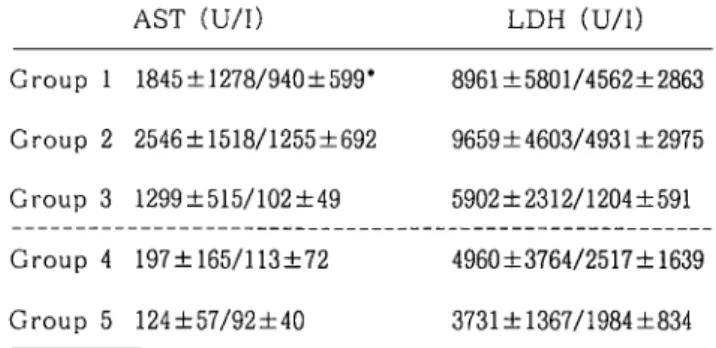
Table 1 Hepatic enzyme levels in the serum
AST (U/H LDH (U/1)
Group 1 1845±1278/940±599* 8961±5801/4562±2863
Group 2 2546±1518/1255±692 9659±4603/4931±2975
Group 3 1299±515/102±49 5902±2312,/1204±591
Group 4 197±165/113±72 4960±3764/2517±1639 Group 5 124±57/92士40 3731士1367/1984±834
leveJ at 24 hr /7 days after reperfusion
Statistical analysis:
All data are expressed as the mean(standard devia-tion (SD) of the mean value. Group comparisons were performed using the t-test when appropriate. Differences were considered to be statistically significant at p<0.05.
RESULTS
Hepatic lschemia/Reperfusion Models in Rats (Groups 1 to 3):
The survival rate one week after hepatic ischemia was 90% (9/10), 70% (7/10), and 100% (10/10) iin groups 1 to 3, respectively. In the macroscopic findings, lobar necrosis was found in 1 case in group 1 (died at 5 days after the OLT), but no such cases were found in groups 2 and 3. Multiple spotty necrotic areas were also characteristically found in 2 cases in group 1. The portal pressure in groups 2 and 3 are shown in Figure 2. In group 2, portal pressure showed a steep increase to 81.0士 35.9 mmHg at 10 minutes after portal clamping, and these high levels were thereafter maintained through-out the non-hepatic phase. This increased portal pres-sure returned to its pre-ischemic level at 10 min after declamping. In group 3, the portal pressure showed a mild increased of34.7±13.5 mmHg at 10 min after ing and then maintained this level throughout the clamp-ing period (0 to 60 min). The portal pressure of group 3 was statistically lower (p<0.05) than that of group 2 at 10, 20, 30 and 40 minutes after clamping. The serum aspartate aminotransferase (AST) levels were evaluated at 24 hrs and 7 days after reperfusion in groups 1 t0 3. The serum AST and LDH levels in group 3 (1299±515 and 5902±2312 IU/1, respectively) were lower than the same levels in thegroup 1 (1845±1278 and 8961ア5801 IU /I, respectively) and group 2 (2546±1518 and 9659±4203 IU/1, respectively) without a statistical difference, at 24 hrs after reperfusion. The AST levels in group 3 de-creased to close to Lhe pre-ischemic levels at 7 days after reperfusion (102±49 IU/1), which were also lower than those of groups 1 (940±599 IU/1) and 2 (1255±692 IU/1) (Table 1).
Hepatic Ischemia/Reperfusion Models in Pigs ( Groups 4
to5):
The survival rates at one week after hepatic ischemia ingroups 4 and 5 were 60% (3/5), 100% (5/5), respectively. In the macroscopic findings, subsegmental necrosis was frequently observed in group 4, but was rare in group 5. Two animals with less than 7 days survival in group 4 showed a poor recovery from anesthesia until death. The AST and LDH levels at 24 hr after reperfusion were, 197±165 IU/1 and 4960±3764 1U/1 re-spectively in the group 4, and 124±57 IU/1 and 3731±136 7 IU/1, respectively, in group 5 (Table 1). Thesystemic ar-terial pressure during the operation was stable in both groups until the portal clamp was applied, but was de-pressed (60 to 80 mmHg) during the non-hepatic phase in both groups without any difference observed between both groups. After reperfusion, the systemic arterial pres-sure increased immediately (90 to 110 mmHg) in group 5. In group 4, however, the MAP remained low (50 to 80 mmHg) especially in those animals demonstrating early post-operative death within 7 days. The MPAP/MAP ratio showed an apparent increase from -30 to -1 min-utes during the ischemic period, in both groups. After reperfusion (+0 min) the MPAP/MAP ratio showed a further increase (0.52±0.19 in group 4 and 0.49±0.ll in group 5, at 1 minute after reperfusion) without any statis-tical difference. These MPAP/MAP ratios were espe-daily high in the 2 animals that were not able to survive more than 7 days in group 4.
DISCUSSION
To investigate hepatic I/R injury in the rat, either the OLT model or a simple clamping of the portal triad has been extensively used as an in-vivo model of 1/R injuryl' . Even though the technique of OLT in rats has already been established by Kamada et all , this proce-dure can not provide uniform results in the early post-operative hepatic function due to the complexity of the
procedures. More specifically, the serum enzymes
re-leased from the liver immediately after reperfusion vary according to the individuals after 1 hr of cold ischemia
in the OLT model, as observed in this report. Moreover,
both the lobar necrosis and multiple spotty necrosis ob-served in thisgroup were thought to be caused by a poト tal air embolism, which we were unable to completely eliminate even when careful preparations were made to avoid it and it was thus thought to be unavoidable to a certain degree. These unpredictable variations in liver damage were thus affected with subtle differences in the surgical procedures of each case, thus indicating that the OLT model is not an appropriate model for studying ex-perimental I/R injury.In previous studies of I/R injury, hepatic ischemia was also induced by a simple clamping of both the he-patic artery and portal vein without washing out the
76 In-situ per fusion of the liver
blood from the liver. With this method, it is impossible
to exclude the participation of several factors such as neutrophils2- -, adhesion molecules5', platelet activating factor6 ", among others in the remnant blood in the liver. In clinical liver transplantation, such factors are minimized by flushing the blood out of the liver and thus this simple clamp model is again inappropriate as a clinical relevant model of hepatic I/R injury. Since a port-systemic shunt is not usually used in this model, a sim-pie clamp of the portal triad causes other problems such as a severe reduction in the venous return, systemic hypotension, and intestinal congestion, during the he-patic ischemia. These factors are thought to induce even greater hepatic I/R injury due to cytokines or endotoxin in the portal vein and hypotensive organ failure, thus ren-dering this model even less appropriate as a model to in-vestigate hepatic I/R injury in OLTl.To develop a more clinically relevant model of he-patic I/R injury, we tested in-situ per fusion of the rat liver combined with the systemic shunt. The port-systemic shunt created by the splenic transposition was able to effectively reduce intestinal congestion, as shown in the prevention of portal hypertension during the
non-hepatic phase. With this port-systemic shunt, the rat
liver was surgically isolated from the systemic circula-tion, flushed in-situ, and kept in cold ischemia, which is similar to the cold ischemia of the harvested liver graft in the OLT model. Since the liver was cooled not only by the per fusion of cold LR but also by external cooling with crushed ice, the temperature measured deep insidethe liver was always kept under lO℃. These findings
thus indicate the main advantage of this model to be the feasibility of providing hepatic cold ischemia with a mini-mal degree of surgical stress, and thus avoiding such com-plicated procedures as OLT. In fact the degree of hepatic I/R injury under the simple clamp model or the OLT model was higher than that of the m-situ clamp model as assessed by the serum AST and ALT. Since the aim of this report is to establish a stable experimental model of hepatic I/R injury, amount of injury itself is not the main issue. However, these high values with their large standard deviations directly indicated the presence of ad-ditional injuries other than hepatic I/R injury, in the sim-pie clamp model and the OLT model.
Experiments in large animals offer various advantages including a better accessibility of numerous physiological parameters, clinical relevance of the model and the feasibil-ity of repeated sampling. Both porcine or canine models of OLT may thus provide important information on hepatic I/R injury. In these animals, however, the large surgical stress inherent in OLT results in unstable outcomes and subtle differences in the surgical procedures can also cause large differences even in the survival rate as
ob-served in this report. Moreover, a stable hemodynamic
status was difficult to maintain after reperfusion, espe-cially in those cases with a short survival after OLT,
without any detectable causes such as the massive bleed-ing, anastomotic failure, or poor reperfusion of the liver. In these cases, the unstable hemodynamic status might thus cause additional hepatic injury, which also contnb-uted to the early post-operative death observed in these cases.
These large animals also have very little endurance re-garding portal congestion which results in immediate intesti-nal congestion and systemic hypotension, and a simple clamp model cannot therefore be performed in these am-mals. To investigate hepatic I/R injury within these limita-tions, we also tested the m-situ per fusion of the liver in combination with the porto-systemic shunt, which is similar to the technique used in clinical OLT. Since the hepatic por-tion of the vena cava in pig does not have any communicat-ing veins behind the vena cava, such as the human vertebral veins, isolated circulation of the liver can easily be achieved by the surgical control of the major vascular vessels around the liver. In this way, the liver can be isolated m-situ with less surgical stress, less hepatic manipulation, and no mflu-ence of anastmotic procedures in SHVC and IHVC. The liver was kept cold with a per fusion of cold LR and external cooling, thus mimicking the cold preservation of the har-vested liver in clinical OLT. In another line of experiments, we also used University of Wisconsin (UW) solution as the preservation solution to flush out the liver, and no systemic side effects were observed since the hepatic circulation is com-pletely isolated from the systemic circulation in this sys-tem. These findings thus indicate m-situ per fusion to be useful in the porcine model of hepatic I/R injury.
In conclusion, in-situ per fusion of the liver in combina-tion with port-systemic shunt was shown to be a stable and reliable model of experimental I/R injury in both the rat and pig.
We followed "Standards Relating to the Care and Manage-ment of ExperiManage-mental Animals" (Notification No. 6, March 27, 1980, Prime Minister's Office, Tokyo, Japan) for care and use of animals. The animals used in our studies were handled humanely in accordance with animal experimental protocols approved by the Animal Care and Use Committee of the Umver-sity of the Ryukyus.
REFERENCES
1) Anthuber M., Farkas S., Rihl M‥ Menger M. D‥
Schildberg F.W., Jauch K.W. and Messmer K.:
Angiotensin-converting enzyme inhibition by enalapril: a novel approach to reduce ischemia/reperfusion damage after experimental liver transplantation. Hepatology 25: 648-51, 1997.
2 ) Yamaguchi Y., Akizuki E., Ichiguchi 0., Matsumura F.,
Goto M., Miyanari N., Mori K., Yamada S., and
Ogawa M:. Neutrophil elastase inhibitor reduces
ischemia-reperfusion in rat liver. Gastroenterology 112:551-60, 1997.
3 ) Takada Y., Boudjema K., Jaeck D., Bel-Haouari M., Doghmi M., Chenard M.P., Wolf P. and Cinqualbre, J.: Effects of platelet-activating factor antagonist on preservation/reperfusion injury of the graft in por-cine orthotopic liver transplantation. Transplants-tion 59:10-6, 1995.
4) Hisama N., Yamaguchi Y., Okajima K., Uchiba M.,
Murakami K., Mori K., Yamada S. and Ogawa M∴
Anticoagulant pretreatment attenuates production of cytokine-induced neutrophil chemoattractant fol-】owing ischemia-reperfusion of rat liver. Dig. Dis. Sci 41:1481-6, 1996.
5) Garcia-Criado F.J., Toledo-Pereyra L.H., Lopez-Neblina F., Phillips M.L., Paez-Rollys A. and
Misawa K∴ Role of P-selectin in total hepatic ischemia
and reperfusion. J. Am. Coll. Surg. 181:327-34, 1995. 6) Wang K. S. and Monden M∴ Exvivoevidenceof
plate-let activating factor on ischemic liver injury. Chang Keng 1 Hsueh 19:229-34, 1996.
7 ) Minor T., Isselhard W. and Yamaguchi T∴ Involvement or p一atelet activating factor in microcirculatory
distur-bances after global hepatic ischemia. J. Surg. Res. 58: 536-40, 1995.
8) Kamada N. and Calne R.Y∴ Orthotopic liver trans-plantation in the rat. Technique using cuff for portal vein anastomosis and biliary drainage. Transplantation
3:47-50, 1979.
9) Bengmark S., Boriesson B. and Olin T.: Development of portasystemic shunts after subcutaneous transposi-tion of the spleen in the rat. Am. J. Surg. 125:757-62, 1973.
10) Meredith C.G., Duffield P.H., Dougan D.F., Duffield.
A.M. and Wade, D.N.: The concentration in brain of
octopamine and tyramine after portal-systemic bypass in rats: neuroamine concentrations determined simulta-neously by methane chemical iomzation gas chromatog-raphy mass spectrometry. Life Sci. 38:1701-5, 1986. ll) YandzaT., Takahashi H., Gauthier F., de-Dreuzy, 0.and Valayer, J∴ Rapid liver per fusion in multiple organ procurement in children. For liver transplantation. Presse Med. 18:1881-4, 1989.
12) Rentsch M., Post S., Palma P., Gonzalez A.P., Menger M. D. and Messmer K∴ Intravital studies on beneficial effects of warm Ringer s lactate rinse in liver transplantation. Transpl. Int. 9:46ト7, 1996.
13) Zimmermann F.A., Butcher G.W., Davies H.S.
Brons G‥ Kamada N. and Turel 0∴ Techniques for
orthotopic liver transplantation in the rat and some studies of the immunologic responses to fully allogeneic liver grafts. Transplant. Proc. ll:571-7, 1979.
14) Marzi I., Knee J., Menger M.D., Harbauer G. and
Buhren V∴ Hepatic microcirculatory disturbances due to portal vein clamping in the orthotopic rat liver trnsplantation model. Transplantation 52:432-6, 1991.