
Thermal effects of environmental variables on
people in open air : Part I, review and
experomental studies
著者
DEGUCHI Kiyotaka, KAWAGUCHI Junji
journal or
publication title
鹿児島大学工学部研究報告
volume
29
page range
77-94
URL
http://hdl.handle.net/10232/11425
Thermal effects of environmental variables on
people in open air : Part I, review and
experomental studies
著者
DEGUCHI Kiyotaka, KAWAGUCHI Junji
journal or
publication title
鹿児島大学工学部研究報告
volume
29
page range
77-94
URL
http://hdl.handle.net/10232/00007625
THERMAL EFFECTS OF ENVIRONMENTAL VARIABLES
ON PEOPLE IN OPEN AIR
PART I, REVIEW AND EXPERIMENTAL STUDIES
Kiyotaka DEGUCHI and Junji KAWAGUCHI
(Received May 27, 1987)
ABSTRACT
There are many instances in which a human body is exposed to a windy climate: on a veranda, at an outdoor-restaurant, in a courtyard, etc. The comfort sensations of a human being are very susceptible to
environmental variables. However, few comfort criteria for outdoor thermal environments have been
established, even though many research projects for indoor climate have been completed.
In this part of the paper, subjective experiments in open air and in a wind tunnel are mentioned. Based on experimental results, the effects of solar radiation, activity level, and the turbulence of air velocity on subjective sensations were analyzed. Comfort criteria for outdoor thermal environments will be proposed in the next part.
1. Introduction
Many studies on the heat balance of a human body and the related thermal sensations have been done
for many years since Houghten and Yagloglou1* presented Effective Temperature. Most of these previous studies have been interested in the indoor climate, and several formulas for acceptability based on the heat balance of a human body have been proposed by Fanger2), Gagge, Stolwijk and Nishi3), et al. As the sensation of thermal comfort is affected by various thermal factors, related acceptability are consequently expressed in complicated forms. On the contrary concerning thermal effects in outdoor flow,
few works were made. To adapt the proposed criteria for indoor conditions to outdoor conditions, the
differences of thermal effects on people between indoors and outdoors should be investigated: increase of metabolic rates; the added effect of solar radiation; the difference characteristics of flow, etc. It is
considered that the range of acceptability in outdoor conditions is wider than that in indoor conditions. Formula for acceptability in outdoor conditions may be expressed in simple form.
This part of the paper describes the results of subjective experiments to acquire the effects of wind
turbulence and solar radiation on people, etc. And comfort criterion will be proposed by modifying of indoor climatic criteria in the next part.
2. Previous Studies on Comfort Criteria in Outdoor Climate
2-1. The Heat Balance around the Body
As for the heat exchange surrounding the body, it is convenient to divide the heat transfer between
the body core and the external environment into following three stages. ( a ) Heat Exchange from the Body Core to the Skin Surface
The body may be regarded as a central core at uniform temperature T^, surrounded by peripheral tissue having thermal resistance Rf,. The equation of heat flow from the body core to the skin surface may
78
mft**¥X&UWtft*£
» 29 •§• (1987)
be written:1
M=Hb(Tb-Ts)=-^(Tb-Ts),
(1)
Tb-T=-jrM=RbM,
(2)
where M= metabolic rate of heat production, W/m2,
Hb= thermal conductance of the peripheral tissue, W/m2 °C,
Rb= thermal resistance of the peripheral tissue, m2 °C/W,
Tb= body core temperature, °C,
and Ts= skin surface temperature, °C.
The metabolic heat reaches the skin surface by conduction and by blood flow, most of which is
conveyed by blood flow. As one feels warm, the blood vessels in limbs and the body surface enlarge, and
more warm blood flows near the skin. Thus the thermal resistance of the body tissue decreases, and heat
dissipates rapidly to the surroundings. When one feels farther hot, sweat glands supply enough water due to vasodilation, and the quantity of the evaporative heat loss from the skin surface increases. At the same time, the skin temperature rises, and which improve the coefficient of the evaporative heat loss. When one
feels cold, the blood vessels in limbs and the body surface constrict, and less blood flows to the limbs and
the body surface. Thus the thermal resistance of the body tissue increases, and less heat loses to the surroundings. Moreover, an increase in quantity of metabolic heat production is caused by shivering.
( b ) From the Skin Surface to the Clothing Surface
As k is the proportion of metabolic heat dissipated by means other than evaporation, kM is dissipated by conduction, convection and radiation to the clothing surface.
kM= Hcl(T- Tcl)=-^-(T- Tcl),
(3)
or
Ts-Tcl=-irkM=RclkM1
(4)
where k= the proportion of the metabolic heat dissipated by means other than evaporation,
Hci= thermal conductance of clothing, W/m2 °C, (H=-p—)
Rci= thermal resistance of clothing, m2 °C/W,
and Tci= the area weighted mean outer surface temperature of the clothes and exposed skin, °C.
( c ) From the Clothing Surface to the Surroundings
At the worn body surface, the heat is released to the surroundings by convection and radiation. It can be considered that this quantity is little affected by relative humidity unless this is extreme high. The equation of heat flow from the clothing surface to the surroundings is expressed as follows:
kM=Hc(Tcl-Ta)+Hr(T-Tr),
(5)
kM= (Hc+ Hr)-(Tcl- Hclacl"rTr)i
(6)
kM= (Hc+ Hr) • (Tcl- T„),
(7)
Tcl- Tg= H\HkM= (Rc+ Rr) kM,
(8)
where Ta= air temperature, °C,
Tr= mean radiant temperature, °C,
Hc= convective heat transfer coefficient, W/m2 °C, Rc= convective thermal resistance, m2 °C/W,
Thermal Effects of Environmental Variables on People in Open Air 79
Hr= radiative heat transfer coefficient, W/m2 °C, Rr= radiative thermal resistance, m2 °C/W,
and
Tg= globe temperature, °C.
H T A- H T
The term —1/. if
*s a weighted mean between Ta and Tr. It is the equilibrium temperature of an
unheated object having convection and radiation coefficients in the same ratio as Hc and Hr. At low air velocities Ta and Tr have almost equal weight. Unless the difference between Ta and Tr is large, the
f-f T _|_ // T
precise values assigned to Hc and Hr do not critically affect the value of —° if \ if *> so the temperature
of a globe thermometer, Tg, should adequately represent it for most indoor environments.( d ) From the Body Core to the Surroudings
When the rate of metabolic heat production is equal to that of heat loss through the clothing to the surroundings, the heat balance equation applies (9) or (10) adding equations (2), (4), and (8).
n-T.^M+^kM+j^UI,
(9)
or Tb- T= RbM+RclkM+ (Rc+ Rr) kM. (10)
These equations are the heat balance formulas expressed by body temperature, radiant temperature,
and metabolic rate as parameters.
2-2. Humphreys' Equation125
Assuming uniform temperature, T^ of 37°C in the heat balance equation (9) or (10), Humphreys defined comfort criterion that thermal resistance of the body, R^ for acceptability lay between 0.04 m2 °C/W (onset of sweating) and 0.09 m2 °C/W (onset of shivering). He supposed that values of k in Eq. (10) were ranging from 0.70 to 0.75 at rest or approximately 0.6 at exercise, and expressed following equation for acceptability in normal indoor conditions:
37- Tg=M(0.065±0.025) + 0.7Mi*c/+ 0.7MRa,
(11)
where M= metabolic rate of heat production, W/m2,
Rb= thermal resistance between body core and body shell, m2 °C/W, (O^ify^O.l)
and
Ra= combined thermal resistance, m2 °C/W. {Ra=Rc+Rr)
2-3. Penwarden's Equation13*
Penwarden adapted Humphreys' equation for outdoor conditions by adding a term for solar radiation, and expressed the equation as follows:
0.8M+S , x
37- Ta= (0.065±0.025) +0.7M0.155flc/o+ 42+lorjj- >
<12)
where S= solar heat input per square meter of body surface, W/m2,
(0^S^120)
and Rcio= thermal resistance of clothing, clo. (lclo=0.155m2/W = 0.186m2h°C/kcal)
Based on Humphreys'suggestion Penwarden assumed that (//c+//r) equals (4.2+ 13\M/) W/m2 °C
for combined heat transfer coefficient, k equals 0.8 and maximum value equals 120 W/m2 for solar heat
input, and he regarded Tg in Eq. (11) as Ta. When appropriate values of M, #c/o, and S are substituted into
Eq. (12) according to referential conditions, this equation allows the relation between air temperature,
Ta, and air velocity, £/, for comfort conditions. For typical outdoor conditions,Penwarden assumed that M
80 K J B » ; * : ¥ X * » S f f t # f t £ 29 -§- (1987)
comfort zone for full sun (S= 120 W/m2) and for shade (S=0 W/m2) in Figs. 1 and 2. Thus Eq. (12)
becomes as follows: 80
4.2+ 13/TT '
IIU suu
, x
Ta=37-(6.5 +2.5)-12.4i?c/o- j
2Q(f
(13)
• full sunv 4.2+ 13^/77 *
The values of thermal resistance of clothing chosen for calculation are 0 clo (nude), 0.5 clo (light summer clothes), 1.0 clo (typical British business suit), and 1.5 clo (typical winter clothing with overcoat). The central bold lines in Figs. 1 and 2 show the state of thermal neutrality for each thermal resistance of
clothing. Both sides of shadowed areas show the upper bound (just sweating) and the lower bound (just shivering) of the thermal comfort regions for each thermal resistance of clohing. From Figs. 1 and 2, the needed value of thermal resistance of clothing can be seen to maintain thermal comfort under arbitrary air
temperature and air velocity.
2-4. Green's Equation15*
Green proposed the heat balance equation (14) for thermal comfort conditions in outdoor climates,
provided that a man feels comfortable at skin temperature Ts of 33°C: 1 m-15 + 120S(l-A)
T=Ta+Yhm+
2+VoT+ZT
•
(14)
where m= metabolic rate, mcal/s, m= 40 I light exercise
m=100 I walking in moderate pace m=200 I very strenuous exercise
(m [mcal/s] = 2m [kcal/m2h] assuming a people for body surface 1.8m2) S= coefficient of sunshine,
S=\ ! at noon in midsummer S=0.2 '. at noon in midwinter
A—albedo of clothing,
A=0.7 I white cloth A=0 ! black cloth
and h= thickness of clothing, cm.
h=0.5 I thin cloth h=\ I thick sweater
Green suggested that metabolic rate is 100 mcal/s for walking in moderate pace. Supposing A equals 0.3 for albedo of clothing, the heat balance equations, for full sun (S=l) and for shade (S=0), are
expressed as follows: 85 100 2 + 9^/0.1+ U '
Ta=33
—h-
V
(15)
169 2 + VO.l+tf 'Figures 3 and 4 illustrate the comfort lines, for A=0.5(thin cloth) and for h=\ (thick sweater), shown by Eq. (15), and also show Penwarden's comfort lines for similar results. Even if it is regarded h= 0.5cm for thickness of clothing as lclo and h= 1cm as 1.5 clo, comfort lines described by Green's equation
differ from Penwarden's at the lower wind speeds.
Thermal Effects of Environmental Variables on People in Open Air SI
5
U[m/s]
10
Fig. 1 Penwarden's comfort criterion (walking in
full sun) 30 Ta ra 20 10 0
"0
5
U [rn/s]
10
Fig. 2 Penwarden's comfort criterion (walking in no
0
5
(j [nvs]
10
Fig. 3 Green's comfort criterion (walking in full sun)
30 Ta r a 20 10 0
5
U [m/s]
1082
!EJBft:*:»xqfe«Bfa»ft
£ 29 -^ (1987)
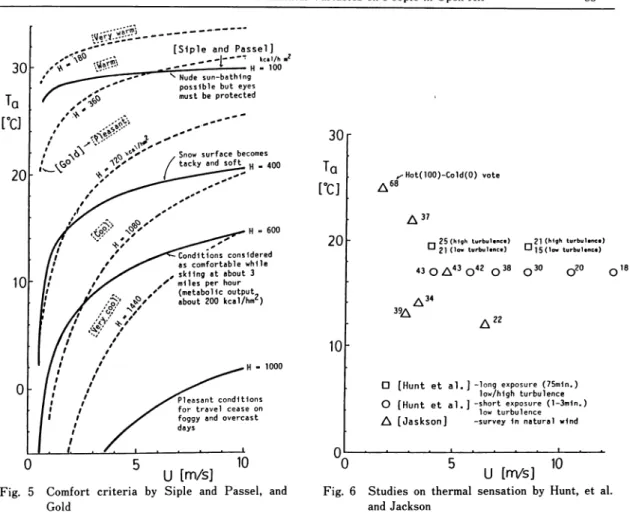
2-5. Wind Chill Index by Siple and Passel16)
Siple and Passel studied the relation between cooling power of the atmosphere and the thermal
sensations in sub-freezing conditions. They measured the time required for freezing 250 grams of water
in cylinder made of synthetic resins having a length of 15cm and a diameter of 5.7cm, and calculated cooling power of the atmosphere from the result of the measurement. They revealed cooling power H
could be shown following equation:
H= (10/17+10.45- V) • (33- Ta), (16)
where H= cooling power of the atmosphere, kcal/m2h, U=air velocity, m/s,
and T"a=air temperature, °C.
(10/77+10.45— V) term is called "Wind Chill Index". Siple and Passel related the cooling power, //, to
the thermal sensations as follows:
H= 100kcal/m2h Nude sun-bathing possible but eyes must be protected,
H= 400 Snow surface becomes tacky and soft,
H= 600 Conditions considered as comfortable while skiing at about 3 miles/h,
(metabolic output about 200 kcal/m2h)
and //=1000 Pleasant conditions for travel cease on foggy and overcast day Figure 5 shows comfort lines in relation between air temperature, Ta, and air velocity, [/, for the value of cooling power, //=100, 400, 600, and 1000 kcal/m2h. Siple and Passel's work was based on the experimental results in sub-freezing conditions in the Antarctic. However, the characteristics of cooling
effects differ from those of a human being. Thus it is uncertain that their works can be suitable for usual atmosphere.
2-6. Gold's Equation150
Gold related cooling power of the atmosphere, //, to his own sensations of comfort. However the rate
of cooling, measured by means of a katathermometer, was expressed in Hill's form:
H= (36.5- Ta) • (9.72+17.7/5),
(17)
°r
r-=36'5-9.72+f7.7/I7 •
<18>
where H= cooling rate, kcal/m2h, Ta=air temperature, °C,
and £7= air velocity, m/sec.
The formula applied at windspeeds up to 18m/sec in air temperature from zero to 26°C. Gold related
values of Hto his comfort sensations, making an allowance for sunshine by reducing Hby 630W/m2 in full
sun, 290W/m2 with light cloud, and 125W/m2 with thick cloud. Figure 5 shows the thermal comfort lines
described by Eq. (18).
2-7. Studies of Hunt, et al. and Jackson20*21)
Hunt, et al. and Jackson reported studies on the thermal sensations in a outdoor flow in similar
methods. However, the work by Hunt, et al. was based on the experimental results in wind tunnel, and Jackson's was based on the results of questionnaire in the city. Figure 6 shows the results of both the studies. The numerial values in Fig. 6 express hot(100) —cold{0) vote.
Penwarden's equation is famous among comfort criteria in outdoor windy environments above mentioned. However, it has not been clarified experimentally whether his equation may be suitable to
Thermal Effects of Environmental Variables on People in Open Air 83
[Siple and Passel]
H - 100
. Snow surface becomes
/ tacky and soft Hm490
H - 600 Conditions considered as comfortable while
, skiing at about 3
f miles per hour (metabolic output about 200 kcal/hi/)
0 5 10
U [m/s]
Fig. 5 Comfort criteria by Siple and Passel, and
Gold 30 Ta It] 20 10 0i 0 ^Hot(100)-Cold(0) vote A37 _ 25(high turbultnct) U 21 Co* turbultnct) 43 0A43042 O38 21 (high turbultnct) El 5(low turbultnct) 39A
D [Hunt et al. J -1on9 exposure (75m1n.)
low/high turbulence
O [Hunt et al.] -short exposure (l-3m1n.)
low turbulence
A [Jaskson] -survey 1n natural wind
U [m/s]
Fig. 6 Studies on thermal sensation by Hunt, et al. and Jackson
10
practical conditions. From these points of views, it is required that comfort criteria should be improved
for the outdoor climate based on experimental results.
3. Experiments in Open Air and in wind Tunnel
The authors have made experiments in open air and in wind tunnel with the purpose of acquiring the effects of solar radiation, activity level, and the characteristic of air flow on sensations of a human body.
3-1. Outline of Experiment
The experiments have been performed under seven different conditions as shown in Table 1, for
Table 1 Types of experiment
Open Air Wind Tunnel
Solar Radiation Sunshine Shade (Shade)
Activity Level Sedentary | Walking Sedentary Walking Sedentary
Natural Flow
2.0ra/s l-3ra/s l-3m/s
Characteristic
of Air Flow Uniform Changeable
(per iod: lOrain)
Changeable (period:30sec)
'85Au tumn — — — — O O —
'86Suraraer O o O O O O O
84 m jb a * * X^g&flf^ffiS W 29 ^ (198T)
Table 2 Data of subject
Subject Age Height Weight Thermal Resistance of Clothlng(clo)
(sex) (era) (kg) '85auturan ,86suramer *86auturan
A(ra) 22 173.0 63.0 1.77 0.65 1.28 B(ra) 21 163.0 53.0 1.59 0.73 1.44 C(ra) 21 160.0 57.0 1.60 0.66 1.35 D(f) 20 161.0 53.0 — 0.51 1.85 E(f) 22 157.0 50.0 1.41 0.62 1.45 F(f) 18 156.0 50.0 — 0. 57 I. 55 G(f) 18 157.0 50.0 1.49 — — H(f) 18 169.0 58.0 1.68 — — 9 T • mm' 10 11 12 13 14 15 16 17 i i i i Summe r Au turan
H
2 %&&2||| 5
:S:?:WIII
^:-:::!?:y:;
11;
:4
a
BE
2m 2^41 5
m m
pmm$
W&
2fe|
1. gathering 4. measurement
2. arrangement 5. lunch
3. anteroom 6. rest
Fig. 7 Experimental schedule
summer and for autumn, during the period from November 22 in 1985 to November 23 in 1986. Six
students (3 males and 3 females) are chosen as subjects for each experiment, and were healthy and young. Their heights and weights are listed in Table 2. Thermal resistances of their clothes are also shown in
this table. The subjects wore the typical clothing for each season during the experiments: a thermal
resistance of summer clothes was approximately 0.6 clo (1 clo = 0.186m2 °Ch/kal), and that of autumn
clothes was approximately 1.5 clo. Figure 7 shows the experimental schedule.
( a ) Open Air Test
The experiments were carried out at the courtyard in Kagoshima University. A plan of the mesuring
site is illustrated in Fig. 8. The west end opens onto small street and three other ends are enclosed with buildings.
M
•S-stories.-.-;;Bullding;";;. 3-stories'-'i Building*;! (anteroom) jni
i||CD|| Measuring Site (surfacecsoil)m±r l
4-stories Building 3,400 16,000 4,400Thermal Effects of Environmental Variables on People in Open Air 85
Range of Thermal Variables
Air temperature and humidity during the experiments varied roughly as follows: (summer) (autumn)
air temperature ! 24.0~30.0°C, 16.3~29.4°C,
relative humidity * 35.0-76.0%, 24.0-65.6%.
Condition of Solar Radiation
In case of "'sunshine", the subjects kept a sedentary posture in south direction. Under the condition of
"shade"", solar radiation was covered by the roof of a white tent at the measuring site ® [Fig. 8].
Moreover, the experiments in shade were performed in cloudy days in order to reduce the influence of
radiant heat from the surface of the tent.
Condition of Air Flow
Mean air velocity and turbulent intensity in open air tests are covered roughly as follows:
(summer) (autumn) mean air velocity ! 1.40m/s, 1.44m/s, turbulent intensity I 31.0%, 26.0%. Activity Levels
The subjects were examined at sedentary (approx. 50 kcal/m2h27)) and at walking at approximately 3.2km/h (approx. 100 kcal/m2h27)). During the experiment at walking, the subjects walked around rectangular site ® (approx. 5.5mX4.0m) as shown in Fig. 8.
( b ) Wind Tunnel Test
The experiments were carried out in wind tunnel with six fans (capacity of ventilation = 2,640m3/h, output power=50w). A plan and a section of the wind tunnel are illustrated in Fig. 9. Turbulent intensity in working section is about 4% in average.
800
air (lowrectlf lerlnc
wire mesh _j 1.820 5.350 (a) plan subjec t 2.730 (b) section
Fig. 9 Wind tunnel
Range of Thermal Variables
In wind tunnel, air temperature, relative humidity and mean radiant temperature could not be controlled, so that the thermal conditions are dependent on natural climate. Air temperature and humidity during the experiments varied roughly as follows:
(summer) (autumn) air temperature I 28.5~31.0°C, 14.0~21.0°C, relative humidity : 35.0-76.0%, 24.0~70.0%.
Characteristic of Air Flow
86
ttieft:fcgX»«8faWfe
» 29 -» (1987)
C. Flow A is an uniform one with mean velocity of 2m/s. Under flow B, velocity changes alternately between lm/s and 3m/s with 5-minute intervals. Velocity under flow C changes sinusoidally within the
range of lm/s—3m/s with a period of thirty seconds. However, all the wind tunnel flows have the same
mean velocity of 2m/s (see Fig. 15). 3-2. Measuring Methods
0.3mm# C—C thermo-couples were employed to measure air temperature and globe temperature. In open air, both of them were measured at 1.2m above the ground surface. To reduce the influence of solar
radiation on air temperature measurement the sensor was arranged under the shade by a tree. In wind tunnel, the air temperature was measured at height of 0.8m and the globe temperature at height of 1.1m.
Air velocity in open air was measured at 1.2m above the ground surface. An anemometer of transistor typed was employed, and wind data were recorded continuously by analog pen-recorder.
Using Assmann's aspiratory psychrometer, the relative humidity was measured, at height of 1.2m every 5 minutes in open air and at height of 1.5m before and after experiment in wind tunnel tests.
The global horizontal solar radiation at 2.0m above the ground surface is measured by Eppley Black
and White typed pyranometer.
Skin temperatures of the subject were measured by O.lmm^ C—C thermo-couples taped to skin
surface with 3M surgical tapes. Measuring points are illustrated in Fig. 10. Mean skin temperature is obtained by averaging each temperature weighted by DuBois fractional area as shown in Fig.10.
DuBo is Fract iona 1 Area
ffi: FOREHEAD (0.07)
©: UPPERCHEST (0.35)
©: FOREARM (0. 19)
®: ANTERIORTHIGH (0. 19)
(D: SHIN (0.20)
Fig. 10 Position of skin temperature sensors
The measured signals of the solar radiation and the skin temperatures were recorded by a
potentiometer at 1 minute interval.
Oral temperature was measured before and after experiment by means of a digital clinical
Thermal Effects of Environmental Variables on People in Open Air 87
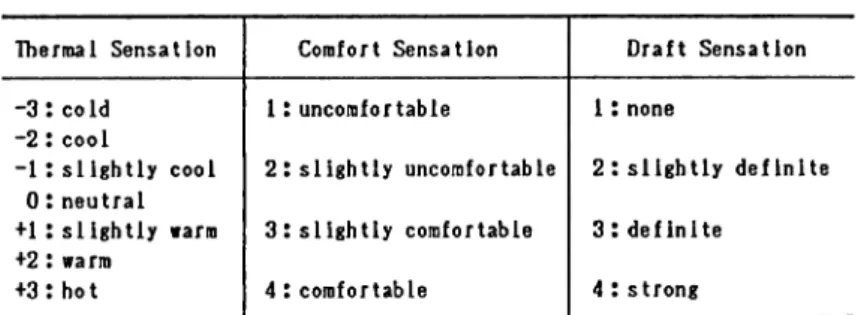
As for the psychological sensations, the subject voted for thermal sensation, comfort sensation and
draft sensation on the category scale, as given in Table 3, with multi-point switch at all times, and the
numerical number of each sensation was recorded every minute. The arrangement of instruments are listed in Table 4.
Table 3 Category scales
Thermal Sensation Comfort Sensation Draft Sensation
-3! cold 1: uncomfortable 1: none
-2: cool
-1 : slightly cool 2: slightly uncomfortable 2: slightly definite
0: neutral
+1 : slightly warm 3: slightly comfortable 3: definite +2 : warm
+3 : ho t 4 : comfortable 4 : strong
Table 4 Arrangement of instrument
Item Height and Location Method
WindTunnel Open Air
Air temperature 0.8m 1.2m C-C Thermo-couple(0. 3rara0)
Globe temperature 1.1m 1.2m C-C Thermo-couple(0. 3roro0) in black
globe with a diameter of 15ca
Air velocity — 1.2m Transistor-typed Anemometer
Relative humidity 1.5ra 1.2m Assmann's Aspiratory Psychroroeter
Global harizontal
solar radiation — 2.0m Epprey B & W Pyranoroeter
Skin temperature
Forehead, Upperchest, Forearm, Shin and
Anterior thigh
C~C Thermocouple(0. lrora^)
Oral temperature — Digital Clinical Thermometer
Psychological
sensation — Multi-point Switch
3-3. Result of Outdoor Experiment Experiments in Summer
Figures 11(a) and 11(b) show the changes with time of mean skin temperatures, subjective sensations and the environmental variables of subject(A) at sedentary.
In sunshine [Fig. 11(a)], the changes of mean skin temperature and thermal sensation correspond well
to those of globe temperature. Comfort sensation votes follow relatively the change of air velocity. In shade [Fig. ll(b)],the change of comfort sensation corresponds relatively to that of air velocity.
Though mean air temperature in shade is about 4°C higher than that in sunshine, comparing
experimental results in sunshine with those in shade, many votes at the upper grade, hot[+ 3] , of thermal
sensation are made in sunshine, and is three grades higher than that in shade. It is considered that thermal sensation is affected significantly by solar radiation. However, comfort sensations under two differnt
conditions of solar radiation agree almost within the range of slightly comfortable [3] to slightly
uncomfortable [2]. It is supposed that increases of air velocity and its changes make subjects comfortable
CO UJ CO UJ c o c o LULU c o c o O L L o a CJ j e » * * I * « W ~\''VAIR TEMP.
1 £
+3tQs™?+2-
V
+1-
\
0- -1- -2- -3-4t 3-2 • 1-BQBQEH9EHH/
THERMAL SENS. ^COMFORT SENS. .DRAFT SENS 0 5 10 15 20 EXPOSURE TIME(min)(a) sedentary in sunshine
Fig. 11 Changes with time of mean
and environmental variables
•H 1-» 29 •§• (1987) 38 G3G-34-: en
32-§30+
Q_ /GLOBE TEMP.XAIR TEMP.
••2 C_) O LU28i
•~26
o r^24+
22 +3T£+2
UJ M l CO +1 •• 0 •• L.J I— . • -=f^1 rwAIR YELOCitYLT
"1 —
GET0 THERMAL SENS.
^
(j-Bflj pa JSJ BHffl
QJ BOB] ••
LU--2+
LULU COCO ai\— OLi_ Li_<C C_)4t
3 COMFORT SENS. *<k 5 10 15 EXPOSURE TIME(min) (b) sedentary in shadeskin temperature, subjective sensations in summer [subject(A)] $ A A A A j i ^<J>* DRAFT <>
•
•
,• w
M/SENS./
H 1 h 20As for skin temperature, similar results are obtained about the other subjects. Concerning each
psychological sensation, a precise tendency could not be obtained because of an individual scatter.
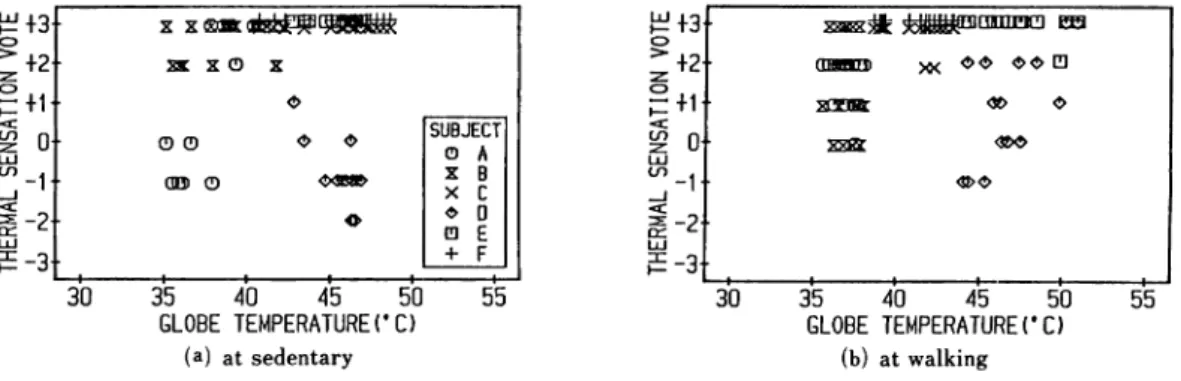
Figures 12(a) and 12(b) show the relation between thermal sensation and globe temperature in
£+3 o
1+1
I 0
LU1-2
LU £-3 z x ® m GD> © SUBJECT O A Z B X C ♦ D • E + F 30 35 40 45 50 GLOBE TEMPERATURE CO (a) at sedentary 55 £+3 O|+1
i o
LU1-2
LU5-3-Z2B3& ^y^^cmiEKD era
niMMIMl x< <>♦ oo n TEDS*. $& ♦ X3X <S*fr —1 1 1 1 1 1 — 30 35 40 45 50 GLOBE TEMPERATURE CO (b) at walking 55
Thermal Effects of Environmental Variables on People in Open Air 89
sunshine in summer. As numerous thermal sensation votes of hot [ + 3] are made in sunshine due to the effect of solar radiation, precise correlations between thermal sensations and globe temperature could
not be recognized. Comparing the effects of activity levels between sedentary and walking [comparing Fig. 12(a) with 12(b)], almost no difference on thermal sensation is recognized. In summer, it can be considered that there is no effect of difference of activity level on thermal sensation between sedentary and walking because solar radiation has great effect upon thermal sensation.
Experiments in Autumn
The changes with time of mean skin temperatures, subjective sensations and environmental variables of subject(D) at sedentary are shown in Figures 13(a) and 13(b).
^20 18 +3T g+2 LU •
. .-3*
LOCO . Z Z 4T LULU ^ COCO ~ »- J CXlt— n o u . c. • U-<C ZE.CC I .. OQ • f > *-f THERMAL SENS. OQX0MF0RT SENS. -DRAFT SENS.
0 5 10 15 20 25 EXPOSURE TlME(min)
(a) sedentary in sunshine
MEAN SKIN TEMP.
32 G30 w28 ^2G
§24
^22 LU •"20 c r <18 16 +3 g+2i °
I "If
ff-2-. ff-2-.-3*•XoP^rnrt^^
3.5 C O _J UJ > 1 DC i ♦ i h-THERMAL SENS.£# 4T COMFORT SENS
u- 3- 1-/^IRAFT SENS. 5 10 15 20 25 30 EXPOSURE TlME(min) (b) sedentary in shadeFig. 13 Changes with time of mean skin temperature, subjective sensations
and environmental variables in autumn [subject(D)]
In sunshine [Fig. 13(a)], the changes of mean skin temperature and thermal sensation correspond
relatively to those of globe temperature same as the experimental results in summer [see Figs. 11(a) and
11(b)]. Comfort sensation votes follow comparatively the change of air velocity by contrast to the
experimental results in summer: as air velocity increases, comfort sensation votes are made at the lower
grade of uncomfortable [l]; asairvelocity decreases, they are made at the upper grade of comfortable [4].
Since the change of globe temperature is small in shade [Fig. 13(b)], an uniform thermal sensation votes
[—2] are made except that thermal sensation changes once one grade lower at four minutes after the
start of measurement.
Figure 14(a) shows the relation between thermal sensation and globe temperature in sunshine at
sedentary in autumn and Fig. 14(b) is the same as Fig. 14(a) but at walking. Thermal sensation votes
change the upper grade of hot[+ 3] as globe temperature increases, and the correlation could be
90 JB * * * I * » m 29 % (1987)
recognized slightly. The remarkable difference of effects of activity levels between sedentary and
walking could not be recognized.
!+3 \2\ p+1
I 0
LU1-2
LU S-3 SUBJECT O A X B X C ♦ D m E + F X X XX ♦(DeMEJXSO ^*** 24 27 30 33 36 39 GLOBE TEMPERATURE CO 27 30 33 36 GLOBE TEMPERATURECO(a) at sedentary (b) at walking
Fig. 14 Relation between globe temperature and thermal sensation in sun
shine (autumn)
39
3-4. Relation between Turbulent Intensity of Air Flow and Subjective Sensation
The effects of the turbulence of air velocity on subjective sensations are discussed on basis of
experimental results in wind tunnel, because air velocity and its turbulence in each open air test vary
widely. Comparing results in wind tunnel with those in open air, examples under each flow in autumn of subject(B) at sedentary are shown in Fig. 15, which are relatively similar one another in mean air
temperature and mean air velocity. Figurel5(a) shows the change with time of mean skin temperature, subjective sensations, and environmental variables in open air test in shade, and Figures 15(b) and 15(c)
show those in wind tunnel.
Comparing the experimental results in open air with those in wind tunnel, since the shape of the change of air velocity in open air [Fig. 15(a)] resembles comparatively that of flow B in wind tunnel [Fig.
15(b)], both ways of the change of thermal sensation and those of comfort sensation show similar
tendencies. However, the range of the comfort sensation votes in open air is one grade lower as compared
with that at flow B, and corresponds to that at flow C [Fig. 15(c)]. Moreover, similar results are obtained
for subject(A) who is examined with subject(B) at same time. It can be therefore considered that the
effects of flow C corresponds most closely to that of air flow in open air.
The relation between comfort sensation and thermal sensation in wind tunnel flowB in autumn is
shown in Fig. 16(a) and that at flow C is shown in Fig. 16(b). As thermal sensation vote of cool ( —2] expected uncomfortable in autumn is made, comfort sensation votes of comfortable [4] are made at flow B.
However, in wind tunnel flow C [Fig. 16(b)] no comfort sensation vote of comfortable [4] is made in the
range of thermal sensation from neutral [0] to cool [—2). It is considered that increase of the change of
air velocity affects the subjects uncomfortable in the cool season.
Figure 17 shows the relations between comfort sensation and thermal sensation in wind tunnel flow B
and C in summer. In the range of thermal sensation of warm[+ 2] of hot [+ 3] which were expected
sensation of uncomfortable in summer, comfort sensation votes of slightly comfortable [3] and
comfortable [4] are alsomade at flow C. [Fig. 17(b)] Therefore, it is considered that turbulence mitigates
34 G32 lu30 ^28
§26,
^20 LU -18} CC 516 14 +3t co+2 • W+13* Of
lu • £-2 . .-3 i f r» 4TThermal Effects of Environmental Variables on People in Open Air
AIR VELOCITY
VT\
/MEAN SKIN TEMP.
-THERMAL SENS.
CJQ€3HO
0MF0RT SENS /DRAFT SENS,
10 15 20 25
EXPOSURE TlME(min) (a) at open air flow
(mean air velocity = 2.3m/s: turbulent intensity=25%)
32
p30
^28
.COMFORT SENS. DRAFT SENS.
OUL_
o a
5 10 15 20 25 EXPOSURE TIME(min)
(b) at flow B
;MEAN SKIN TEMP. AIR VELOCITY THERMAL SENS. i EjOBQSOHHSCH i 10 15 20 25 EXPOSURE TIME(min) 30 (c) at flow C
Fig. 15 Comparision of subjective sensations in autumn (subject(C)]
91
92 !fcflb±¥X¥U®3Z % 29 -t (1987) 4.. ct°o SUBJECT O A X B X C CJ E ♦ G A H 3-o o 2*$£ 1.fit'
<**
-2 -1 0 +1 +2THERMAL SENSATION VOTE (a) at flow B +3 CD X X — i 1 i A- 3-2 SUBJECT 0 A X B X C ♦ D • E + F 1-H 1— -3 -2 -1 0 +1 +2
THERMAL SENSATION VOTE
(b) at flow C
+3
Fig. 16 Relation between thermal sensation and comfort sensation in autumn
A-> 3" 2 •• 1-XX
16
SI
^
<ft © SUBJECT O A X B X C ♦ D • E + F -3 -2 -1 0 +1 +2THERMAL SENSATION VOTE (a) at flow B +3 A- X LU > 3-
m
*
§fe
0
X
i— o r o o (_> 0 9 X 1 - i 1 1 — % ^ i --2 -1 0 +1 +2 +3THERMAL SENSATION VOTE
(b) at flow C
Fig. 17 Relation between thermal sensation and comfort sensation in summer 3-5. Comparison with the Penwarden's Comfort Criterion
As thermal sensation vote of slightly comfortable [3] or comfortable[4] is made in outdoor
experiment at sedentary in autumn, the experimental results are compared with calculated results by
Penwarden's equation(12) as function with air temperature and air velocity in Fig. 18...SI 23 ightly Comfortable 13] ~ Comfortable[41 SUBJECT o A X B X C ♦ D m E + F 1 2 3 AIR VELOCITY (m/s) (a) sedentary in sunshine
26 ~24 C_) Slightly ComfortableI3] — ComfortableMl 1 2 3 AIR VELOCITY (m/s) (b) sedentary in shade
Thermal Effects of Environmental Variables on People in Open Air 93
In sunshine [Fig. 18(a)], the observed values for air temperature are distributed in the part of
approximately 6°C high as compared with Penwarden's comfort criterion. In shade [Fig. 18(b)], the distribution of observed values for air temperature varies widely, and that is distributed in the part of
approximately 2°C high. It is supposed that the difference of the distribution of observed values of air
temperature in sunshine is larger than that in shade by reason that maximum value for solar input is allowed 120W/m2 by Penwarden and differs remarkably from measured value 203W/m2 for radiant heat
input in author's outdoor experiments in sunshine.
Concluding Remarks
Subjective experiments have been performed in wind tunnel and in open air; in summer and in autumn, to clarify the effects of environmental variables on the sensation for thermal acceptability. The results are summarized briefly as follows:
(1) The changes of skin temperature and thermal sensation correspond relatively to those of globe
temperature.
(2) Solar radiation has a great effect on thermal sensation.
(3) In summer, increases of air velocity and its change make subjects comfortable. In autumn, those make subjects uncomfortable.
(4) In summer, the difference of activity levels between sedentary and walking has no effect on thermal sensation because solar radiation has a great effect on thermal sensation.
(5) The value for solar heat input in Penwarden's comfort criterion is estimated lower than its actual
value.
References
1) F. C. Houghten and C. P. Yagloglou: Determining lines of equal comfort, Transactions of Amer. Soc.
of Heat. Vent. Engineers, 29, (1923) pp. 163-176 & Determination of the comfort zones,
Trans. ASHVE, 29, (1923) pp. 361-384
2) P. 0. Fanger: Calculation of thermal comfort: Introduction of basic comfort equation, ASHRAE Transaction, 73 (11), (1967)
3) A. P. Gagge, J. A. Stolwijk and Y. Nishi: An effective temperature scale based on a simple model of human physiological regulatory response, ASHRAE Transaction (1970) pp. 247-262
4) Murakami, S. and Deguchi, K.: Experimental Study on Thermal Effects of Wind on People,
Proceeding of 7th National Symposium on Wind Engineering, (1982) pp. 227-234
5) Deguchi, K. and Murakami, S.: Thermal Effects of Wind on People
— In case of Autumn and Winter —, Summaries of Technical Paper of Annual Meeting, Kantoh
Chapter of AIJ, (1981) pp. 129-132
6) Deguchi, K. and Murakami, S.: Thermal Effects of Wind on People
In case of Autumn and Winter—, Summaries of Technical Paper of Annual Meeting of AIJ, (1981) pp. 289-290
7) Deguchi, K. and Murakami, S.: Thermal Effects of Wind on People
— Comparision between seasons —, Summaries of Technical Paper of Annual Meeting, Kantoh
Chapter of AIJ, (1982,7) pp. 29-32
8) Nakayama, A., et al., ON'NETSUSEIRIGAKU, Rikohgakusha, (1981)
9) C.E.Winslow and L. P. herrington: ONDO TO NINGEN-ON'NETSU EISEI SEIRIGAKU,
94
ttJ6H:fc»Xy«8fft*g
£ 29 -^ (1987)
10) R. K. Macpherson: The assessment of the thermal environment, A review, British Journal of
Industrial Medicine, 19 (1962) pp. 151-164
11) D.L.Morgan and R. L. Baskett: Comfort of man in the city. An energy balance model of man-environment coupling, Int. J. Biometeor 18 (3), (1974) pp. 184-198
12) M. A. Humphreys: A simple theoretical derivation of thermal comfort conditions, Journal of the
Institution Heating and Ventilating Engineering, 38 (1970) pp. 95-98
13) A. D. Penwarden: Acceptable wind speeds in towns, Building Science, 8 (3), (1973) pp. 259-267
14) T. V. Lawson: Wind environment: cooling effect on people, Wind Effect on Building I, Applied
Science Publishers, (1980)
15) J. S. A. Green: Holiday meteology: reflections on weather and outdoor comfort, Weather, 22 (1967)
pp.128-131
16) P. A. Siple and C*F. Passel: Measurements of dry atmospheric cooling in subfreezing temperatures, Proceedings of the American Philosophical Society, 89 (1), (1945) pp. 177-199
17) G. M. Howe: Windchill, absolute humidity and the cold spell of Christmas 1961, Weather, 17 (1962)
pp. 349-358
18) R. G. Steadman: Indices of windchill of clothed person, Journal of Applied Meteorology, 10 (1971) pp. 674-683
19) E. Gold: The effect of wind, temperature, humidity and sunshine on the loss of heat of a body at temperature 98°F, Q, Jl. R. Met. Soc. 61 (316), (1935)
20) J. C. R. Hunt et al.: The effects of wind on people; New criteria based on wind tunnel experiments,
Building and Environment, 11 (1976) pp. 15-28
21) P.S.Jackson: The evaluation on windy environments, Building and Environment, 13 (1978)
pp. 251-260
22) Murakami, S. and Morikawa, Y.: Criteria for Assessing Wind-induced Discomfort Considering
Temperature Effect, Proceedings of 7th National Symposium on Wind Engineering, (1982) pp. 219-226
23) N. Isyumov and A. G. Davenport: The ground level wind environment in built-up areas, Proc. of 4th
Int. Conf. on Wind Effects on Buildings and Structures, (1975) London
24) Deguchi, K.: Previous Studies on Comfort Criteria in Outdoor Climate, Summaries of Technical
Paper of Annual Meeting, Kyushu Chapter of AIJ, (1986) pp. 109-112
25) Kawaguchi, J., Furusawa, H. and Deguchi, K.: Thermal Effects of Wind on People in Open Air and within Doors Part I - II, Summaries of Technical Paper of Annual Meeting of AIJ, (1986)
pp.973-976
26) Kawaguchi, J., Furusawa, H. and Deguchi, K.: Experimental Study on the Sensation of Human Body
in Open Air, Summaries of Technical Paper of Annual Meeting, Chugogu and Kyushu Chapters of AIJ, (1987) pp. 81-84
![Fig. 1 Penwarden's comfort criterion (walking in full sun) 30 Ta ra 20 10 0 "0 5 U [rn/s] 10](https://thumb-ap.123doks.com/thumbv2/123deta/6372468.1103258/7.741.58.675.87.982/fig-penwarden-comfort-criterion-walking-sun-ta-ra.webp)




![Fig. 15 Comparision of subjective sensations in autumn (subject(C)]](https://thumb-ap.123doks.com/thumbv2/123deta/6372468.1103258/17.742.69.671.115.955/fig-comparision-subjective-sensations-autumn-subject-c.webp)

