Papua New Guinea
著者
MATSUOKA Tatsuro
journal or
publication title
南太平洋研究=South Pacific Study
volume
15
number
2
page range
75-96
Fisheries Development Policy and Education
in Papua New Guinea
Tatsuro Matsuoka1}
Abstract
The fisheries development policy in Papua New Guinea is executed in the Sector Review and ADB
Report, where new strategies such as promotion of market-oriented coastal fisheries and effective pro duction with modern fishing gear and vessels are identified. Despite of the development policy, the fisheries education has declined since the 1980's. There is less correlation between the development policy and education. The two major fisheries educational institutions remain sparse production of
higher-level technical manpower, whereas fishing technology is badly lacking. The redirection at UPNG appeared towards aquatic and biological sciences. However, management of fishing gear and methods such as, fishing technology for selective harvest and avoidance of incidental by-catch, unaccounted mor
tality and ghost fishing is emphasized in the recent draft of the Code of Conduct for Responsible Fishing. This principle is applicable to PNG where problems of discards of by-catch by prawn trawlers, an inconsistent mesh size regulation against fish size regulation in barramundi gillnet fishery and des tructive dynamite fishing remain unsolved. The inconsistence between the industrial policy and its edu
cational strategies may provoke deficient man-power production against future fisheries development.
Fisheries education toward the sound combination of studies on resource assessment and selective fishing technology is required. Regional approach among the South Pacific countries is also important
because of large cost of fisheries education.
Key words: Papua New Guinea, Fisheries, Education, Policy, Fishing Technology
Introduction
The fisheries industry is one of the primary sectors expected for development in most island countries in the South Pacific region. The industry has, however, peripheral his tory in those countries, therefore, man-power production is the urgent prerequisite for its development. It is ironic, however, fisheries education and training have little back ground in those countries. The present paper deals with fisheries education in Papua New Guinea (PNG) which has experienced drastic changes in recent years. This study
compares the fisheries development policy and its education in PNG to review their in
consistency together with their circumstances, including the current status of the sector.
It also highlights on the fisheries education competent with the latest trend in fisheries management. It is intended to provide a case study to consider the future fisheries 1) Faculty of Fisheries, Kagoshima University, Kagoshima 890, Japan
education appropriate in coastal developing countries in the South Pacific region.
Background and Present Situation of Fisheries 1 Physical Set up and Development Policy
Papua New Guinea (PNG) is located between the equator and 12° S, consisting of is lands more than 1,400, of which the principal component is the eastern half of New
Guinea Island (Fig. 1). The land area is 460,000km2 with the population of 3.53 mil
lion, according to the 1990 national census (1), which has increased at 3.72% annually
for the last decade. The state is composed of 19 provinces and the National Capital District of which 15 are coastal or of islands. The fisheries sector is administered by both the state Department of Fisheries and Marine Resources which gained the inde pendent status from the former Department of Primary Industry in 1986 and the pro vincial Governments' fisheries offices.
The objectives for development of the nation has been documented in the Eight National Aims and the National Development Strategy (Anon., 1981), of which the concepts other than common rights of humanity and equality are summarized as;
(1) increasing proportion of the economy under the control of nationals and that of the income for nationals,
C^> <^ -Kavieng Bismarck Sea Pacific Ocean
Solomon*^
Islands(2) equal distribution of economic benefits among different areas of the country, and
(3) emphasis on small-scale business and decentralization of economic activities. Reflecting these policies, the conception of 'localization' and 'rural development' have matured to become the major component of the current culture, which are applic able to a wide range of society and economy in the nation.
2 Aquatic Environment and Fisheries Resources
PNG possesses a total of 5,160 nautical miles of coast line and approximately 800,000
square nautical miles of Exclusive Economic Zone (EEZ), which was declared in 1978
(Perry, publication year unknown). Its continental shelves are rather less extensive,
which are approximately 1,740 km2 (Anon., 1991).
Among its variety of marine resources, skipjack (Katsuwonus pelamis) and yellowfin
{Thunnus albacares) tunas are the most abundant and stable. Their Maximum Sus tainable Yield (MSY) is assessed approximately from 180,000 to 200,000 metric tons annually, while annual harvests are less than 50,000 metric tons in recent years (Anon., 1991).
There are a large number of resource species in coastal waters (Munro, 1967; Kailo-la 1987), however, a majority of them are thought to be diverted and hardly support large-scale development (Anon., 1979). Black tiger (Penaeus monodon) and banana
(Penaeus merguiensis) prawns, in the Gulf of Papua (Kailola and Wilson, 1978) and
Torres Strait (Williams, 1985b) are the most important resources at present, which have been developed in full. Spiny lobster (Panulirus ornatus) is currently managed jointly with Australia and only harvesting by divers is permitted (Channells, 1985). Distribution of barramundi or giant perch (Lates calcarifer) in a commercial quantity is limited in the southwestern coasts and adjacent rivers and lakes (Opnai and Tenaka-nai, 1987). Major sedentary resources are bivalves, such as pearl oysters (Pinctada spp. and Pteria spp.) and giant clam (Tridacna gigas), gastropodes mainly trochus shell
(Trochus niloticus) and green snail (Turbo marmoratus) and a number of species of sea
cucumbers (Actinopyga spp., Thelenota spp. and Holothuria spp.) (Anon., 1979), which have been increasingly harvested in recent years.
A majority of indigenous edible species in freshwater are assessed poor in size and quantity. Some species have been transplanted, among which common carp (Cyprinus
carpio) and tilapia (Tilapia mossambica) are playing important roles in rural communi
ties, while rainbow trout (Salmo mykiss) has peripheral significance (2), occurring in li
mited rivers and no lakes.
3 Present Situation of Fisheries Industry
Fishing industries in PNG are composed of four categories; foreign fleet fishery, in dustrial fishery, small-scale cash-oriented fishery and subsistent fishery, although this cognition has been minor in the country until recent years.
firms or joint venture projects. The tuna fishery has the greatest potential in terms of resources, however, it is deplorable that the resource is currently utilized little. Several overseas firms, mainly from Japan, started their operations in the adjacent waters, based in Kavieng, Madang and Rabaul before independence, in 1970-1972 (Matsuda, 1986; Doulman and Kearney, 1987). It provided local people with employment oppor tunities as crew members and on-shore support workers. The industry reached a turn ing point in the late 1870's and entirely disappeared in 1982. Although one company based in Rabaul retried in 1984, the operation lasted no longer than one fishing season. Instead of utilization by capture of tuna, a cannery project has arisen with foreign in vestment and Government inputs in the early 1990's, of which the factory plant is under construction in Madang. The project includes construction of a domestic tuna
fleet in the near future in conjunction with the cannery.
The most important industrial fishery at present is prawn trawling in the Gulf of Papua. The resource received interest in the early 1960's and joint-venture projects were formed in the late 1960's (Gwyther, 1980). Three companies, involving 14 of 150 GT-type trawlers licensed for operation year round at present, produce onboard-frozen prawns for export. Although several changes have occurred in management by the Government and the status of companies, the prawn trawling has become steadily a
domestic industry (3). Some captains and engineers in addition to all crew members and
most of onshore managerial and support staff are PNG nationals today.
Coastal fisheries development has been one of the priority fields so expressed by all the governments for the purpose of either rural development or production of export substitutes or even for export earning (Anon., 1979). The total MSY in the coastal wa
ters is estimated 138,000 tons a year, of which the present harvest does not exceed
11% (Anon., 1989a). Resources well exploited in line with the above objectives, although in a limited extent, are lobster, barramundi, sea cucumbers and shells. Lobs ter is managed under the Torres Straight Treaty (WILLIAMS, 1985a) and barramundi
regulation is set by the PNG Government (4), however, others remain unregulated and
problems of over-exploitation are arising. A majority of coastal fisheries at present are not beyond the range of subsistent fishing. Full-time coastal fishermen are occurring only in limited places such as Port Moresby and Daru.
A majority of coastal people are conducting small-scale fishing for self-consumption and sale of surplus catch at nearby local markets. A small quantity of local fish pro ducts currently marketed is totally inadequate to substitute a huge amount of import of canned mackerel, so called 'tin-fish'.
Traditional smoking is the most usual processing technique. Icing is being promoted, however, ice is available only at limited stations and frequent break-down of ice mak
ers sometimes results in no landing of fish for months (5). The other first-hand or sim
ple processing techniques are scarcely speculated with an exception of a recent atten
tion to dried beche-de-mer as export stuff.
Development of aquaculture is beyond the range of possibility. Although prawn cul-turing has been considered, the future is unknown because domestic labour cost is
re-latively high in comparison to other developing countries such as in Southeast Asia, which are potential competitors. Fresh water culture has been attempted mainly in highlands (Anon., 1973). Tilapia, carp and rainbow trout are target species. Trout
farming has been tried in highlands, however, they have been abandoned because of the costly importation of eyed-eggs from overseas. An aided project of stock enhance
ment in Sepik River is on-going (Ulaiwi, 1990).
The foreign fleet fishery within the EEZ is currently accepted only for large-scale tuna operation by the USA, Korea, Taiwan and Philippines (Anon., 1991). The opera tion by the Japanese tuna fleet has been forbidden since early 1987 due to expiration of the agreement and breakdown of negotiations (Anon. 1989a), remaining quite large discords unsolved between the two parties. On the other hand, a multilateral fishing
treaty among the U.S.A. and the Forum Fisheries countries, including PNG, signed first in early 1987, for the U.S. tuna purse seiners (Anon., 1989a), was revised in 1992
for continuation. The foreign fleet tuna fishery is assessed to be an undesirable alterna tive to PNG since collapse of its domestic industry.
4 Fishing Industry in Domestic Economy
All the recent governments have given a high priority to the development of primary
industries in line with the national development objectives. A total of 36% of the population is thought to be involved in cash economy, while the remaining people are assumed to live on self-reliant gardening and fishing. A majority of the former portion is, however, conjectured to be small-holders in rural areas (Anon., 1989a). Employ
ment opportunities in rural areas are extremely sparse.
The primary industry plays important roles in the economy and the society. Though
the production by the primary industries is approximately 30% of GDP, a total of 85%
of the population is assumed to be involved in the sector (Anon., 1989a). Mining and
oil industries which are typically capital-intensive are drawing attention recently in
terms of economic development, however, the primary industry must be the principal
sector to absorb the dominant portion of the increasing population.
A total of 125,000 people are assessed to be involved in the fisheries sub-sector
among 500,000 coastal habitants (Anon., 1989a). A total of 2,000-3,000 among the
above are conducting cash-earning fishing. The employees in industrial fisheries and re levant business, mainly prawn trawling, are only 400 approximately, where the com
mercial fishery is not affluent since collapse of the tuna industry in 1984, which pro vided job opportunities of 1,300 (Matsuda, 1986). The export statistics of fisheries pro
ducts illustrate the situation of the sector (Anon., 1989b) (Table 1). The industry is fairly embryonic, however, it is quite important in PNG where creation of job opportu
Table-la Export statistics of fisheries products in PNG (kg) Item Year 1979 1980 1981 1982 1983 1984 1985 1986 1987 Prawns 993,514 798,008 887,099 322,125 1,165,450 1,100,970 1,507,872 1,467,150 1,096,713 Lobster 7,184 102,696 163,749 162,956 63.969 41,525 50,273 62,347 51,818 Barramundi 16,690 62,450 88,810 60,400 8.500 62,602 34,743 116.480 64,372 Trochus 134,326 355,703 312,172 437,334 535.120 441.963 Blacklip 836 13,327 6,128 4,016 5,121 16,329 Greensnail 21,943 29,405 71,982 11,745 10,087 15,960 Beche-de-mer 9,000 7,130 4.668 16,579 119,376 121,636 Clam meat 80 9,830 949 4,202 21,030 31,657 Tunas 26,945,000 34,099,000 24,029,000 520,000 864,070 2,964,668 10,509,240 Sharks (whole) 107,595 80,000 30.000 110,000 173,000 Sharkfin 1,000 500 Other finfish 68,060 10,856 100,448 38,206 71.736 16,570 Crabs 150 221 174 Total 27,962,388 35,062,154 25,168,658 1,408,471 2,608,240 4,696,333 12,744,210 2,581,947 1,857,192
Table-lb Export statistics of fisheries products in PNG (1,000 kina)
Item Year 1979 1980 1981 1982 1983 1984 1985 1986 1987 Prawns 3,812,902 3,764,257 5,005,034 1,666,382 8,139,647 6,457,796 9,555,818 8,894,613 8,783,661 Lobster 59,526 819,051 1,355,189 1,580,712 887,355 519,818 578,883 870,256 763,711 Barramundi 66,433 257,900 398,120 293,740 41,500 346,375 244,717 357,895 346,514 Trochus 114,711 347,328 389,057 686,732 937,293 927,545 Blacklip 1,547 35,991 7,912 9,351 10,175 42,914 Greensnail 66,013 112,354 162,337 67,619 35,315 61,892 Beche-de-mer 27,586 23,939 13,472 59,022 361,336 322,536 Clam meat 71 13,294 3,407 24,684 157,652 336,262 Tunas 15,400,000 25,800,000 20,000,000 255,687 762,376 1,704,845 5,678,178 Sharks (whole) 26,899 20,000 8,700 101,750 147,450 Sharkfin 1,500 725 Other finfish 23,652 22,620 144,854 71,765 89,825 53,059 Crabs 300 1,105 736 Total 19,338,861 30,641,208 26,758,343 4,058,500 10,406,704 9,758,573 17,079,624 11,862,535 11,656,830
Fisheries Development Policy in Papua New Guinea
PNG had established no integral fisheries policies until the relevant documents were
executed recently, i.e. Fisheries Sector Review in 1989, Medium Term Development
Resource Management and Development Report in 1991. The initiatives of the prog ressive policies seem to have been affected by the establishment of the government De
partment of Fisheries and Marine Resources in 1986 and endorsement of Planning and Budgetary Strategy 1988-1992 (Kwarara, 1988) in 1987, where the objectives of the
exploitation of natural resources were defined as;
(1) achievement of sustainable economic growth,
(2) creation of income-earning opportunities in rural areas, (3) establishment of fiscal self-reliance, and
(4) reduction of social and economic inequalities.
1 Coastal Fisheries Development Plan in 1979
The first national policy for the fisheries industry was the Papua New Guinea Coastal
Fisheries Development Plan (Anon., 1979), although it did not incorporate whole issues in the sector, as its title indicates. Although the objectives in the Plan jumbled a number of secondary expectations from fisheries development, the core ideas are summarized as;
(1) development of cash economy to improve standard of living and welfare of coas
tal people,
(2) provision of potential employment opportunities for coastal youths, and (3) self sufficiency of the nation on renewable resources currently wasted.
The elements of the principle which were reflected in the succeeding policy docu
ments could be viewed in part, however, the characteristics of this plan appeared in its
impractical strategy for implementation. It was planned for the public sector to visit vil lages by boats routinely to buy fish. The proposal emphasized social welfare, and con sequently, relied upon surplus products of subsistent fishing to be put into a nation wide market or as much to be of export quality without improvement of fishing techni ques. It was no later than the early 1980's when the plan folded.
The plan was reviewed by individual provincial offices, which often mentioned many
constrains (5) in coastal fisheries. Although they were not officially documented, re
quirements for development are summarized as;
(1) increasing the capability to introduce or to develop new coastal fishing techni ques,
(2) development of preservation and processing techniques for surplus production in
high tropical temperatures, which will in turn raise marketability of catch,
(3) promotion of the consumption of fisheries products and expansion of marketing, and
(4) establishment of leading projects in areas where large markets are readily avail
able, such as in Port Moresby and Lae.
Provincial sectors tried such an approach to promote commercially-oriented fishing projects on the basis of technical extension services instead of purchasing fish. These initiatives, however, had not been incorporated in the national policy until 1989.
2 Fisheries Sector Review Papua New Guinea
The first over-all fisheries policy emerged in the Fisheries Sector Review Papua New Guinea (namely Sector Review) (Anon., 1989a). Although this was created as the re
port of a project aided by the United Nations Development Programme, it seems to
have been regarded as one of the proxy national fisheries policies these days. Its four objectives (Table 2) are summarized as;
Table 2 Objectives, key issues and strategies defined in Fisheries Sector Review
Objectives Key issues Strategy
A. Develop renewable fisher
ies resources within the limits
of sustainable yields
B. Invest public sector resour ces in economically viable
small-holders which lead to the
expansion of exports and im port substitute and which will expand local food supplies and give small-holders increased access to the cash economy
C. Invest in improvements in
national extension and monitor
ing of public project imple mentation, in order to improve the technical support offered to provincial divisions in the (3 execution of fisheries projects
(4
D. Promote commercial invest- (1 ment in the development of
fisheries resources (2
Resource availability high varies between provinces Access to resource may limit de velopment
Some resources are vulnerable
to over-exploitation
Monitoring and enforcement re quired for planned and effective
development
but Prepare provincial development plans
Skills and motivation are fre
quently lacking
Appropriate infra-structure is re quired to support development
Strengthen provincial fisheries implementation
Extension services needed in
support of development
Inland yields can be enhanced
with selective introductions
DFMR not totally effective at
present
Liaison with, and support of, provinces is poor
Information needed in support of planning and management is badly lacking
Fish consumption is low and product quality mediocre
Few incentives are available for
potential investors
Infrastructure to support
invest-ment not readily available
Review usage rights in fisheries to seek clear demarcation in the long term Implement management plans for each ma jor fishery and monitor exploited resources Reorganise and upgrade licensing, inspect ion, and enforcement of management plans and agreements
Assess training and develop training prog rammes at all levels, including fishermen Encourage localised self-sufficiency based on market access, availability of suitable vessels, ice supply and rationalise existing
facilities
Increase level of technical support and re sources to provinces from DFMR Upgrade extension skills at provincial level, and increase accessibility to fisher men
Continue Sepik River study and more effectively develop subsistence pond pro-duction of introduced species
Reorganise DFMR as proposed, recruit staff and address policy issues
Upgrade linkages with provinces (develop ment plans) and consider implementation of regional approach
Improve information services as a high priority and improve public relations
Increase consumer awareness, promote product and improve quality standards, especially of exports
Review investment policy and provide appropriate incentives
Develop clear policy and provide support facilities where judged necessary
The table contents are exactly the same with those appeared in the source (Anon., 1989a) with an only
(A) resource development within the range of sustainable yield,
(B) promotion of economically viable small-scale fisheries in rural areas, (C) enhancement of provincial expertise for project implementation, and
(D) increased investment to industrial fisheries by the foreign and private sector and their localization.
The objectives in the Sector Review traced those manifested in the Planning and Budgetary Strategy 1988-1992. The objectives (C) and (D) above were not directly coincident with those in the Strategy 1988-1992, however, the four objectives clearly correlated with the principles of the National Development Objectives such as, re source conservation for future generations, rural development and decentralization and localization of the industries.
In order to implement the objectives, key issues and strategies were identified (Table 2). This was, perhaps, the first official analysis of constrains in the sector, therefore, an extremely wide range of views were documented. The important strategies correspond
ing to the objectives are;
(a) implementing resource management plan, licensing, inspection and enforcement
against over-exploitation,
(b) extension and skill training at all levels and techniques suitable for localized self-sufficient fisheries,
(d) reorganization and strengthening both national and provincial institutional struc
ture, and
(e) review of the policies for foreign investment and development of infrastructure. Particularly the second policy includes entirely new tactics to aim at market-oriented coastal fisheries, effective production with modern fishing gear and vessels and priva tization of coastal fishing authorities. The forth policy is also quite practical which was not identified previously. These features were obviously in line with the new concept of encouraging domestic fishing industry, localized resource utilization and private fishing
industry.
3 Medium Term Development Strategy for the Renewable Resource Sector The Medium Term Development Strategy for the Renewable Resources Sector 1990-1994 (Anon., 1989b) seems to have transcribed on the Sector Review, because this document was partially photo-copied from the Sector Review. The objectives were ex actly the same. The strategies in this document (Table 3) were, however, more work able in comparison to those in the predecessor. Their correspondence to the objectives
is summarized as;
(a) researches on utilizable resources on which management programmes are formed to control their exploitation,
(b) training in extension, administration and fishing technology for cash-oriented
artisanal fishing,
(c) marketing and products development strategy, and
Table 3 Objectives and strategies defined in The Medium Term Development Strategy for the Renewable Resources Sector 1990-1994
Objectives Strategies
A. (1) undertaking research to extend knowledge about the nature and
potential of utilisable resources
(2) developing resource based management programmes with controls
on the level of exploitation where appropriate
(3) collection of data and introducing management procedures to moni tor and provide a basis for policing industrial fishing activities B. (1) implementing a programme of coastal fisheries development econo
mically viable provide cash earning opportunities for artisanal
fishermen with poor access to market
(2) providing training in extension, administration and fishing technolo-gy
C.
(1) to establish marketing and product development strategy
D. (1) encouraging foreign investment in domestic and industrial fisheries, especially tuna fishing industries and establish support infrastructure facilities
(2) Obtaining a resource rental for under-utilised tuna resources through the negotiation of access agreements for foreign fleets (3) incorporating localisation of ownership and training of nationals into
agreements with foreign interests involved in domestic industrial
fishing
The table contents are the same with those appeared in the source (Anon., 1989b), however, they were not defined with correspondence with the objectives from A. to D., which are exactly the same to those in Table 1.
and fishing agreements with foreign fleets.
4 Fisheries and coastal Resource Management and Development Report
The Fisheries and Coastal Resource Management and Development Report (namely ADB report) was printed as the final report of the feasibility study of an extensive loan project allied by the Asian Development Bank (ADB) (Anon., 1991). This report also seems to have based on the principle of the Planning and Budgetary Strategy 1988-1992 and to have followed the Sector review, although, description was markedly changed.
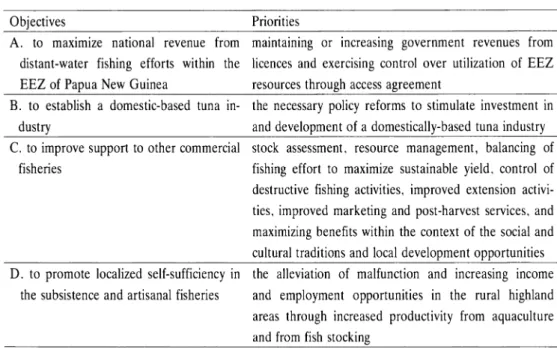
One of the features of this report was that it rationalized the objectives by excluding issues on institutional restructure (Table 4). It altered the order, perhaps also the prior ity, of the objectives and strategies, too. It looked at more cash- and business-oriented fishing industries. Positive acceptance of foreign fleets, obviously within the range of control, and support to commercial fisheries, while supports to the subsistent fisheries were confined in stocking and aquaculture in highlands, were new. Inclusion of
Table 4 Objectives and priority fields defined in the report on the Fisheries and Coastal
Resources Management and Development Project
Objectives Priorities
A. to maximize national revenue from maintaining or increasing government revenues from distant-water fishing efforts within the licences and exercising control over utilization of EEZ
EEZ of Papua New Guinea resources through access agreement
B. to establish a domestic-based tuna in- the necessary policy reforms to stimulate investment in
dustry and development of a domestically-based tuna industry C. to improve support to other commercial stock assessment, resource management, balancing of
fisheries fishing effort to maximize sustainable yield, control of
destructive fishing activities, improved extension activi ties, improved marketing and post-harvest services, and maximizing benefits within the context of the social and cultural traditions and local development opportunities D. to promote localized self-sufficiency in the alleviation of malfunction and increasing income
the subsistence and artisanal fisheries and employment opportunities in the rural highland areas through increased productivity from aquaculture and from fish stocking
The contents of objectives are exactly the same to those appeared in the source (Anon., 1991b). Some unimportant words to construct sentences are omitted from those in the priorities.
workable issues such as; stock assessment, balancing between fishing effort and MSY and control of destructive fishing, was also significant. This reflected the feeble man
agement of fishing techniques in coastal fisheries in PNG (Matsuoka, 1990).
Fisheries Education in PNG
Fisheries education is offered by two institutions in PNG; the University of Papua
New Guinea (UPNG) in Port Moresby and the National Fisheries College (NFC) in
Kavieng. The former runs a 4-year long scientific programme for Grade-12 graduates and the latter, 2-year long technical training for Grade-10 graduates. In addition to the domestic under-graduate degree and post graduate diploma programmes, some ones gained their higher degree education overseas, e.g. in the United Kingdom, Australia, Japan and Canada. A number of personnel in the industry and the public sector have received half-year training in Japan through Japan International Cooperation Agency
and Overseas Fisheries Cooperation Foundation of Japan. There are several institu
tions which may be useful in fisheries manpower production, however, their involve ment is peripheral with an exception of the potential importance of the PNG Maritime College in Madang.
1 Diploma and Degree Programmes at Unitech and UPNG
The former Fisheries Department had run an integral fisheries programme since its establishment in 1976 first at the PNG University of Technology (UNITECH), Lae. A 3-year diploma programme was offered by the Department by 1985 at UNITECH. The
Department was up-graded to a 4-year degree programme in 1983 and transferred to
UPNG in 1986 to have become attached to its Science Faculty. The Department was merged into Biology Department in 1990 with large changes in the course structure and educational policy and the fisheries programme has become a small discipline of a re duced number of fisheries subjects.
Table 5 Degree programme offered by Fisheries Department, PNG University of Technology
Stream Year 1st semester Hours/w 2nd semester Hours/w
Core subject 1 Biology I 3 Biology II 3
Chemistry I 6 Chemistry II 6
Mathematics I 5 Mathematics 5
Physics 2 Physics 2
Society, Technology &Development 2 Society, Technology & Development 2
English for Fisheries Science 3 English for Fisheries Science 3 2 Mathematics II Analytical Chemistry Organic Chemistry Function ofManagement 4 3 3 Mathematics II 4
Professional 1 Introduction to Fisheries Science 4 Introduction to Fisheries Science 4
subjects 2 Fisheries Oceanography &Limnology 4 Aquatic Ecology 5
Aquatic Invertebrates 3 Fisheries Microbiology 5
Biology ofFishes 2 Fundamentals ofFishing Technology 4 Elements of Nautical Science 2 Fish Processing I
Introduction to Aquaculture
5 4
3 Fisheries Biology 3 Inland Fisheries 3
Pollution& Environmental Assessment 2 Fisheries Management 3
Statistical Application toFisheries 3 Fishing Gear Technology 5
Fishing Gear Application 5 Mariculture 5
Fish Processing II 5 Principles ofFisheries Extension 2 Fish Culture 5 Advanced Communication Skills for 2 Advanced Communication Skills for 2 Fisheries Science
Fisheries Science
4 World Fisheries Organization 1 Fish Marketing 2
Fisheries Law 2 Fish Behaviour and Fisheries 3
Coastal Resources Management 3 Fish. Plant Management & Quality 5
Fish Population Dynamics 3 Control 6
Fishing Vessels Operation 5 Project
Fisheries Economics 3
Table 6 Degree programme offered by Fisheries Department, University of PNG
Stream Year 1st semester Hours/w 2nd semester Hours/w
Core subject 1 Biology A
Chemistry I Foundation Mathematics Physics I Science English 6 6 6 6 Biology B Chemistry II Foundation Mathematics Physics II 6 6 6 6 2 Planet Earth 6 Recommended subjects 2 Chemistry III Physics III 6 6 Introductory Ecology
Genetics & Evolution
6 6 3 Chordate Biology Microbiology Elements ofComputing Organic Chemistry I 6 6 6 6 Invertebrate Biology Organic Chemistry II 6 6 Professional subjects
2 Basic Biology 6 Introduction to Fisheries
Hydrography
6 6
3 Fishing Gear Technology 6 Aquaculture
Fisheries Biology
6 6
4 Fisheries Management Muriculture
Advanced Fishing Gear Technology Fish Processing Technology II
6 6 6 6
Fisheries Economics &Marketing
Aquatic Resource Management
Fish Processing Technology I
Special Topics in Fisheries
6 6 6 6
The curricula of degree programmes at UNITECH and UPNG are tabulated (Table
5, 6) (Anon., 1985: Anon., 1986: Matsuoka, 1988). The UNITECH curriculum was
designed on the principle to embrace four streams; fishing technology, aquaculture, re
source and industrial management and seafood technology. The curriculum after the
transfer became modified to fit in the common educational structure in the Science
Faculty, UPNG. The Department offered only 14 subjects out of 23 (other than science
core subjects at Year-1) required to graduate. The rest were free elective from subjects
offered by other departments on the basis of the policy of liberal science.
The present fisheries programme (Anon. 1990) prepared by Biology Department (Table
7) is further reformed to suit marine biological studies, remaining a smaller number of
technological subjects. The current UPNG programme seems suitable for providing
personnel to fit into resource research and managerial positions in the public sector.
The reduction of fisheries education at UPNG was mainly due to (Matsuoka, 1988);
Table 7 Fisheries degree programme offered by Biology Department, University of PNG
Stream Year 1st semester Hours/wi 2nd semester Hours/w
Core subject 1 Biology A
Chemistry I Foundation Mathematics 6 6 6 Biology B Chemistry II Foundation Mathematics 6 6 6 Physics I Science English 6 Physics II 6 2 Planet Earth 6 Recommended subjects 2 Chemistry III Calculus I Quantative Genetics 6 6 6 Chemistry III Elements ofComputing Evolution &Ecology 6 6 6 3 Chordate Biology Invertebrate Biology Resources AorCell Biology
6 6 6 Microbiology Animal Physiology 6 6 4 Biometry Marine Ecology 6 6
Population &Quantative Ecology Free elective
6 6
Professional 2 Introduction to Aquatic Sciences 6
subjects
3 Capture Fisheries 6 Culture Fisheries
Seafood Technology
6 6 4 Fisheries Management
Limnology &Physical Oceanography
6 6 Fisheries Economics Special Topics 6 6
high cost for specialized training,
(2) a plan of rationalization of tertiary education under the previous Government, and
(3) a view during the 1980^ to take tertiary fisheries education to be resource stu dies on aquatic biology and ecology.
2 Certificate Programmes at NFC
NFC is an internal body of the national Department of Fisheries and Marine Re sources. Since its establishment, largely with Japanese aid in 1977, NFC has aimed at
practically-oriented fishing training (6). This is because it was anticipated to provide
medium-standing fishing technicians for the tuna fishery, which was enterprising by PNG-based fleets invested by Japanese and Americans and, in turn, to develop modern domestic fishery industries. The PNG-based tuna fishery has, however, entirely gone. The educational objectives at NFC were, therefore, changed to produce general fisher
ies technicians during the mid-late 1980's (7). In 1990, the NFC Interim Governing
Council was formed and revision of its education was started.
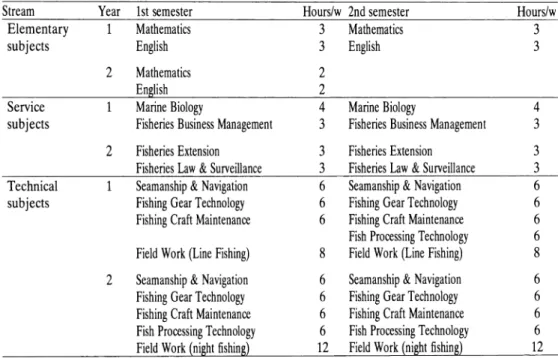
In the curriculum (Table 8) during the 1980's (8), there were two distinguished
streams in the technical aspect; i.e. (1) fishing gear and methods and (2) fishing craft, navigation and seamanship. Topics were, however, confined in a few variations ofTable 8 Previous certificate programme at NFC until 1993.
Stream Year 1st semester Hours/w 2nd semester Hours/w
Elementary subjects 1 2 Mathematics English Mathematics English 3 3 2 2 Mathematics English 3 3 Service subjects 1 2 Marine Biology
Fisheries Business Management
Fisheries Extension Fisheries Law & Surveillance
4 3 3 3
Marine Biology
Fisheries Business Management
Fisheries Extension Fisheries Law & Surveillance
4 3 3 3 Technical subjects 1 2 Seamanship &Navigation Fishing Gear Technology Fishing Craft Maintenance
Field Work (Line Fishing)
Seamanship &Navigation Fishing Gear Technology
Fishing Craft Maintenance
Fish Processing Technology Field Work (night fishing)
6 6 6 8 6 6 6 6 12 Seamanship &Navigation Fishing Gear Technology Fishing Craft Maintenance Fish Processing Technology
Field Work (Line Fishing)
Seamanship &Navigation
Fishing Gear Technology Fishing Craft Maintenance
Fish Processing Technology Field Work (night fishing)
6 6 6 6 8 6 6 6 6 12
small-scale fishing. Many types of fishing gear and methods important in PNG, such as prawn trawl, barramundi gillnet and tuna fishing, were not taught. The training in the navigation and seamanship subjects were limited due to lack of proper training vessel. From the industry side, it was felt that the caliber of graduates had been declining
compared to early graduates (9).
At the NFC Governing Council Meeting in 1991, several review reports were submit
ted. These reports dealt with issues from various view points, such as overall review of
the NFC academic activities (10) and the national higher education policy in fisheries
(11). The representative of the industry emphasized strengthening technical training
mainly required for industrial fisheries development (9), as the curriculum must put
emphasis on sound understanding of capture fisheries, fish handling, navigational prin
ciples, basics of law and boat and engine maintenance. The discussion on the above re
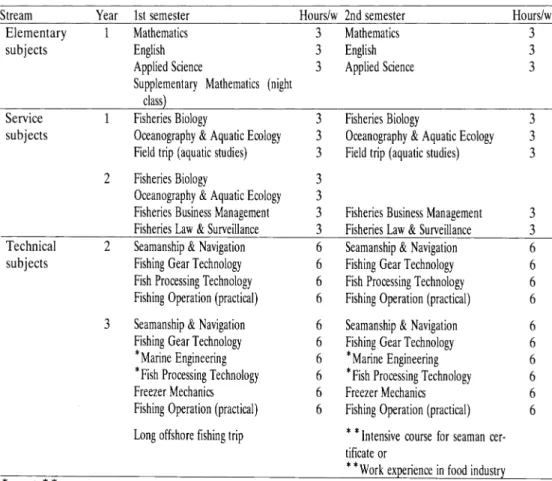
sulted in the latest curriculum (12), which was designed with enhanced mathematics, sci
ence, and aquatic studies (Table 9). It was the justification that basic sciences and
mathematics which had been distributed in technical subjects were structured. The pro fessional subjects are consequently free from elementary topics and then can be streng thened. The new curriculum is under implementation from the Year-1 students in 1994.
Table 9 Revised certificate programme at NFC, since 1994
Stream Year 1st semester Hours/w 2nd semester Hours/w
Elementary subjects
1 Mathematics
English Applied Science
Supplementary Mathematics (night class) 3 3 3 Mathematics English Applied Science 3 3 3 Service subjects 1 Fisheries Biology
Oceanography &Aquatic Ecology
Field trip (aquatic studies) 2 Fisheries Biology
Oceanography &Aquatic Ecology
Fisheries Business Management Fisheries Law & Surveillance
3 3 3 3 3 3 3 Fisheries Biology
Oceanography &Aquatic Ecology
Field trip (aquatic studies)
Fisheries Business Management
Fisheries Law & Surveillance
3 3 3 3 3 Technical subjects 2 Seamanship &Navigation Fishing Gear Technology Fish Processing Technology
Fishing Operation (practical)
3 Seamanship &Navigation
Fishing Gear Technology Marine Engineering
Fish Processing Technology Freezer Mechanics Fishing Operation (practical) Long offshore fishing trip
6 6 6 6 6 6 6 6 6 6 Seamanship &Navigation
Fishing Gear Technology Fish Processing Technology
Fishing Operation (practical)
Seamanship &Navigation
Fishing Gear Technology
*Marine Engineering
*Fish Processing Technology
Freezer Mechanics Fishing Operation (practical)
Intensive course for seaman cer
tificate or
**Work experience in food industry
6 6 6 6 6 6 6 6 6 6
- and -marked courses are respective pairs to be optional.
Discussion
1 Development of Fisheries Policy
Through the series of the documents, progressive fisheries development policy is
observed. The early policies were apt to account conceptual items rather than the sec
tor's forthright objectives; e.g. the Development Plan in 1979 enunciated as 'improving
the welfare of coastal people by providing them with an opportunity for increased de
velopment' (Anon., 1979). They were also apt to confound objectives and strategies.
For example, 'improvement of extension and monitoring' (Anon., 1989a) was included
in the objectives in the Sector Review, although this must be simply one of tactics in
administrative improvement. These defects have been overcome in recent versions.
Sector's genuine objectives and strategies technically realistic have been progressively
found. Those in the ADB Report are examples of achievement. Its strategies were do
able, which listed (Anon., 1991), e.g.;
(2) to stimulate investment in a domestically-based tuna industry, (3) stock assessment and resource management,
(4) balancing of fishing effort to maximize sustainable yield, and (5) control of destructive fishing activities.
Neither Sector Review nor ADB Report has been legitimated, however, recent policy-relevant documents, e.g. Prime Minister's Brief in 1992 (13), were drafted in line with the principles and even with sentences in these papers. The objectives and strategies in the ADB Report other than their order of priority can be, therefore, re garded as the latest consensus for fisheries development in PNG.
2 Assessment on Manpower Needs
At the NFC Governing Council Meeting in 1991, It was delineated that 'there will be a very large demand for skilled technicians on increasing interest in development of local industrial fisheries and on the assumption of the Government's long term policy'
(9). The required skills and qualifications emphasized by the Council members (9J(U1)
were;
(1) fishing specialists (coastal fishing gear/methods, prawn trawling and tuna fishing must be included) qualified with on-deck certificates, such as coxswain, seaman,
radio operator etc.,
(2) potential land-based fishing operation managers,
(3) marine engineering (at the level of out-board motor maintenance) and refrigera tion technicians preferably with industrial certificate,
(4) seafood and fish processing technicians, and (5) potential fish processing plant/factory managers,
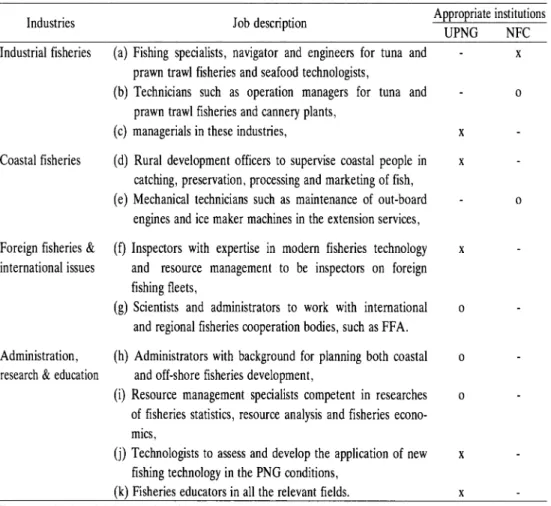
Although the discussion was mainly concerned with medium-standing technician manpower, demands in technical aspects were distinctive. Table 10 analyzes manpower
needs and potential responsibilities of the two institutions on the basis of the above dis
cussion and the Government policy. The job description in the table may seem discri minative between the two institutions, however, it is justified by the strong bond be
tween job status and educational qualifications in PNG.
3 Deficiency Between Policy and Education
In view of overall fisheries education in PNG, the combination of the programmes at UNITECH and NFC was oriented to technological issues and technical skills during the 1970's and the mid 1980's. It aimed so because of the industrial fisheries development
for tuna and prawn resources those days. On the other hand, the aquatic resource management aspect was weak. This was reflected in that a number of graduates of
UPNG Biology Department, before absorption of the Fisheries programme, were em
ployed on resource biologist positions by the government Fisheries Division. Contribu tion by the two fisheries institutions in the active researches for resource assessment during the said period was sparse.
biological sciences at UPNG since the 1980's seem to be attributed to that the fisheries
sector as a whole lost the industrial bearings due to collapse of the tuna business and
stagnated coastal fisheries development. The author reported (14) on the situation and
problems of fisheries education in PNG at the Regional Fisheries Workshop organized by ADB in 1991. The Workshop members pointed out a risk to produce scant man power against self-development of fisheries resources to the nation. It was also assessed that the deficit between liberal science education and technical training was becoming
serious (15). A working paper of the ADB Report spent a number of pages on the issue
and described the situation as 'pathetic weakness' (Raksasataya, 1991).
Table 10 also considers if the manpower needs are fulfilled by the two institutions with the latest curriculums. The largest deficit is the lack of the production of manpow er in the following fields;
(c) potential managerials in industrial fisheries,
(d) rural development officers to supervise coastal people in harvest, preservation,
Table 10 Analysis of manpower needs in fisheries sector and appropriate institutions.
Industries Industrial fisheries
Coastal fisheries
Foreign fisheries & international issues
Administration, research & education
Job description Appropriate institutions
UPNG NFC
(a) Fishing specialists, navigator and engineers for tuna and
prawn trawl fisheries andseafood technologists,
(b) Technicians such as operation managers for tuna and prawn trawl fisheries and cannery plants,
(c) managerials in these industries,
(d) Rural development officers to supervise coastal people in catching, preservation, processing and marketing of fish,
(e) Mechanical technicians such as maintenance of out-board engines and ice maker machines in the extension services,
(f) Inspectors with expertise in modern fisheries technology and resource management to be inspectors on foreign fishing fleets,
(g) Scientists and administrators to work with international and regional fisheries cooperation bodies, such as FFA. (h) Administrators with background for planning both coastal
and off-shore fisheries development,
(i) Resource management specialists competent in researches
of fisheries statistics, resource analysis and fisheries econo
mics,
(j) Technologists to assess and develop the application of new
fishing technology in the PNG conditions, (k) Fisheries educators in all the relevant fields.
The symbol 'o' and 'x' stand for either the institution's curriculum is designed to function or not in the
responsibility to produce the described man-power and *-' stands for that the institution if not responsi
processing and marketing of fish,
(f) inspectors with expertise in modern fisheries technology and resource manage
ment on industrial fishing vessels,
(i) technologists to assess and develop the application of new fishing technology in
the PNG conditions,
(j) fisheries educators in all the relevant fields.
This implies that higher-level fisheries technical manpower which is emphasized in recent policy documents is produced scarcely. It must be a task of a university-level in stitution to satisfy these demands. Despite of strengthening the curriculum at NFC, this gap is hardly filled because of the nature of the college at the level of certificate prog ramme. The recommendation made by the ADB Report for UPNG to focus on 'fishing technology especially fishing gear, vessels and food processing (Anon., 1991)' reflects that these aspects are badly lacking in PNG. Different directions and adverse correla tion between the development policy and education are clear.
4 Current Trend in Fisheries Deveropment and Management
The redirection appeared at UPNG in the early 1990's was attributed to that tertiary fisheries education was regarded at UPNG as that in aquatic and biological sciences, as widespread during the 1970's to the mid 1980's. This recognition is thought also to have been affected by little incentive toward technological management of harvest by the government Department of Fisheries and Marine Resources (16). There is, however, a new current of a combined management of resources and harvesting technology since the late 1980's over the world. Management of fishing gear and methods such as, de velopment of fishing technologies for selective harvest and avoidance of incidental by-catch, unaccounted mortality and ghost fishing is emphasized in the Code of Conduct
for Responsible Fishing recently drafted by FAO (17). This principle is absolutely ap
plicable to PNG where such problems as a huge amount of by-catch discards by prawn trawlers (Matsuoka and Kan, 1991), an inconsistent regulations between mesh size and fish size in barramundi gillnet fishery (Matsuoka, 1990) and destructive dynamite fishing around coral reeves remain unsolved. It has been also clarified that some long-line fishing gears are unsuitable in fishing grounds of tropical developing countries (Matsuoka et al, 1992), which must be taken into consideration in fisheries develop ment and management (Matsuoka, 1994). This principle also goes together with the strategy of 'control of destructive fishing activities' recommended in the ADB Report. Fishing industrial management is increasingly recognized as management of harvesting
technology. Fisheries education toward the sound combination of studies on resource assessment and selective fishing technology is important.
The history in PNG teaches us another factor that extensive cost for fisheries educa
tion was too heavy even for PNG which is extremely large in every sense among the South Pacific island nations where fisheries industrial development is one of the highest
priorities. Regional approaches is, therefore, important for successful fisheries educa tion among the South Pacific countries.
Acknowledgement
This paper is based on the author's involvement in fisheries education in PNG for eight years, which was enabled by supports by many colleagues in Biology and Motu-pore Island Research Departments, UPNG and the National Fisheries College. The au
thor thanks all the old friends and wish fruitful future of fisheries education in PNG.
Note
(1) Papua New Guinea 1990 National Population Census Preliminary Figures, National Census Office, Government of Papua New Guinea, Port Moresby. (2) Highlands Aquaculture Development Centre (HAQDEC) Project Document,
Department of Fisheries and Marine Resources Highlands Aquaculture De velopment Centre, Kainantu.
(3) Vonore, R. (1990), The Management of the PNG Prawn Fisheries: Overview,
Department of Fisheries, University of Papua New Guinea, Port Moresby.
(4) National Gazette No. G67 (1983), Ministry of Primary Industry, Port Moresby. (5) Personal communication (1985), interview of the Provincial Fisheries Officer of
Morobe Province Department of Primary Industry, Lae.
(6) Ware, M. (1991), A Brief for Members of NFC Interim Government Council,
Report submitted to the Council meeting, Kavieng.
(7) Ware, M. (1991), Brief on Syllabus (Certificate in Tropical Fisheries), Report
submitted to the Council meeting, Kavieng.
(8) National Fisheries College Handbook, Department of Primary Industry, Port Moresby.
(9) Brownjohn, M. (1992), Overview of Government Policy in Fisheries and Im
plications to Training Needs, Report submitted to the Council meeting, Kavieng.
(10) Matsuoka, T. (1991), Review of Academic Programme at National Fisheries
College, Papua New Guinea, Report submitted to the Council meeting, Kavieng.
(11) Mandie-Filer A. (1991), Report to Fisheries College Interim Governing Coun
cil, Report submitted to the Council meeting, Kavieng.
(12) Anon. (1994), Curriculum for the Certificate in Tropical Fisheries, National Fisheries College, Kavieng.
(13) Anon. (1992), Prime Minister Brief, Department of Fisheries and Marine Re
sources, Port Moresby.
(14) Matsuoka, T. (1991), Fisheries Education in Papua New Guinea: Current Sta tus and Future Opportunities, Resource paper submitted to the ADB Regional Fisheries Workshop, Rabaul.
Workshop, Rabaul.
(16) Personal communication (1989), correspondence from the secretary of the De partment of Fisheries and Marine Resources to the Science Faculty, UPNG. (17) Anon. (1994), Preliminary Draft Code of Conduct for Responsible Fishing,
Food and Agriculture Organization of the United Nations, Rome.
References
Anon. 1973. Fisheries Research Annual Report 1971-72. 51pp., Department of Agri
culture, Stock and Fisheries, Port Moresby.
Anon. 1979. Papua New Guinea's Coastal Fisheries Development Plan. 76pp., Depart
ment of Primary Industry, Port Moresby.
Anon. 1981. This is Papua New Guinea. 181pp., Papua New Guinea Government Office of Information, Port Moresby.
Anon. 1985. Handbook, 267pp. Papua New Guinea University of Technology, Lae. Anon. 1986. Science Faculty Handbook of Courses, 140pp., University of Papua New
Guinea, Port Moresby.
Anon. 1989a. Fisheries Sector Review Papua New Guinea. 107pp., Government of
Papua New Guinea, Port Moresby.
Anon. 1989b. The Medium Term Development Strategy for the Renewable Resource
Sector 1990-1994. 134pp., Departments of Agriculture and Livestock, Fisheries and Marine Resources and Forestry, Port Moresby.
Anon. 1990. Science Faculty Handbook of Courses, 116pp., University of Papua New
Guinea, Port Moresby.
Anon. 1991. Fisheries and Coastal Resources Management and Development Project.
256pp., Papua New Guinea Department of Fisheries and Marine Resources, Port Moresby.
Channells, P. 1985. History and development of the Australian rock lobster fishery for Panulirus ornatus. In: Torres Strait Fisheries Seminar. (Ed. Haines, A.K., Williams, G.C., & Coates, D.), 184-189, Australian Government Publishing Ser
vice, Canberra.
Doulman, D.J. and Kearney R.E. 1987. Domestic tuna industries. In: The Develop
ment of the Tuna Industry in the Pacific Islands (ED. Doulman D.J.), 3-31, East
West Center, Honolulu.
Gwyther, D 1980. Commercial and Biological Aspects of the Gulf of Papua Prawn
Fishery. 72pp., Department of Primary Industry, Port Moresby.
Kailola, P.J. and WILSON, M.A. 1978, The Trawl Fishes of Gulf of Papua. 85pp.,
Department of Primary Industry, Port Moresby.
Kailola, P.J. 1987. The Fishes of Papua New Guinea A Revised and Annotated Checklist. 194pp., Department of Fisheries and Marine Resources, Port Moresby. Kwarara, G. 1988. Planning and Budgetary Strategy 1988-1992, 92pp., Ministry of
Fi-nance and Planning, Port Moresby.
MATSUDA, Y. 1986. Tuna and skipjack fisheries in the Pacific islands waters. In:
Study on International Fisheries, 107-152, International Fisheries Research Socie
ty, Tokyo.
Matsuoka, T. 1990. A Field Experiment on Capture Mechanism and Selectivity in Barramundi Gillnet Fishing, 33pp., Department of Fisheries, University of Papua
New Guinea, Port Moresby.
Matsuoka, T. 1988. Present Status and Problems of Fisheries Education in Papua New
Guinea, 37pp., Department of Fisheries, University of Papua New Guinea, Port
Moresby.
Matsuoka, T. and KAN, T.T. 1991. Passive exclusion of finfish by trawl efficiency de
vice (TED) in prawn trawling in Gulf of Papua, Papua New Guinea. Nippon Suisan Gakkaishi, 57: 1321-1329.
Matsuoka, T., Kasu, J, and Nagaleta, H. 1992. Capture process in vertical longline fishing. Nippon Suisan Gakkaishi, 58: 213-222.
Matsuoka, T. 1994. Future Prospects in Fishing Technology transfer and research cooperation: Cases in Papua New Guinea. Nippon Suisan Gakkaishi, 60: 693-694.
Munro, I.S.R. 1967. The Fishes of New Guinea. 650pp., Department of Agriculture, Stock and Fisheries, Port Moresby.
Opnai, L.J. and TENAKANAI, CD. 1987. Review of the barramundi fishery in
Papua New Guinea. In: Management of Wild and Cultured Sea Bass/Barramundi
(Lates calcarifer), 50-54, Australian Centre for International Agriculture Research,
Canberra.
Perry, K.R. publication year unknown. Fishing. In: Papua New Guinea Atlas. (Ed.
King, D. and Ranck, S.), 58-59, University of Papua New Guinea, Port Moresby. Raksasataya, A. 1991. Fisheries and Coastal Resources Management and Develop
ment Project - A Final Report on Institutions and Training. 364pp., Papua New
Guinea Department of Fisheries and Marine Resources, Port Moresby.
Ulaiwi, K.W. 1990. The Occurrence and spread of common carps, Cyrinus carpio (L.), in the Sepik River system, Papua New Guinea. In: The Second Asian Fisher ies Forum. (Ed. Hirano, R and Hanyu, I), 765-768, The Asian Fisheries Society, Manila.
Williams, G.C. 1985a. Management of the Australian trawl fishery during tropical
rock lobster migrations in Torres Strait 1980-1984. In: Torres Strait Fisheries Semi
nar. (Ed. Haines, A.K., Williams, G.C, & Coates, D.), 200-211, Australian Government Publishing Service, Canberra.
Williams, G.C. 1985b. Torres Strait prawn fishery. In: Torres Strait Fisheries Seminar. (Ed. Haines, A.K., Williams, G.C., & Coates, D.), 233-238, Australian Govern ment Publishing Service, Canberra.