(Phaeophyceae, Chordariales) from New
Caledonia
著者
AJISAKA Tetsuro
journal or
publication title
南太平洋研究=South Pacific Study
volume
12
number
1
page range
1-6
South Pacific Study Vol. 12, No. 1, 1991
Cladosiphon novae-caledoniae Kylin (Phaeophyceae,
Chordariales) from New Caledonia
Tetsuro Ajisaka
Abstract
The specimen, collected from New Caledonia in December 1987, was identified as Cladosiphon
novae-caledoniae Kylin. As Kylin (1940) has not made its description, this is the first one presented in paper. It's morphological characters were compared with those of the "type specimen" in the Botanical
Museum, University of Lund and some species of Cladosiphon collected in Pacific Ocean. It has a potential for a new mariculture resource in New Caledonia.
Key words: Cladosiphon novae-caledoniae, New Caledonia, Phaeophyceae, Chordariales.
Introduction
The specimen, collected from Freycinet Island near Noumea in New Caledonia, the South Pacific, by Grunow in August 1884, was identified as Eudesmeflavescens (Zanard.) De Toni by Kuckuck (1929). Later, Kylin (1940) studied same (?) specimen belonging to the Botanical Museum, University of Lund (LD, Herbarium Agardh) in detail. He considered it was not E. flavescens, and settled a new species name, Cladosiphon novae-caledoniae Kylin belonging to a new genus Cladosiphon Kylin. However, as he has made no scientific description for the new species, I should make it based on the "type specimen" from LD and fresh materials collected by the author from New Caledonia in December 1987.
Materials and methods
Though Kuckuck (1929) studied on the material in the Harbarium of Helgoland, Kylin (1940) studied on it in LD. It can not be made sure now that these materials were the same specimen. All specimen in the Herbarium of Helgoland had been lost by British bombings in the World War II (Kornmann, personal communication). Type specimen of LD (LD90/ 54-3104) was labelled Castagnea flavescens (? Type of Cladosiphon novae-caledoniae Kylin) (Fig. 2A).
166°E
Fig. 1. Collection site (Kuto Bay) at He de Pins, New Caledonia. A: New Caledonia; B: He de Pins. Natural growing fronds were collected from "He de Pins", south-east of main island of New Caledonia (19-23°S, 163-168°E) in December 19th, 1987. "He de Pins" is a small island surrounding by reefs. Fronds were collected at the sublittoral zone of Kuto Bay (Fig. 1).
The fronds were growing on the rocks in the subtidal zone. Near the bottom of Kuto Bay, in the depth of three to five meters, the fronds were usually drifting with Zonaria sp. and Sargassum sp. They were fallen from the substratum by the strong waves in this season. In Japanese Cladosiphon, C. okamuranus Tokida, we can see a same condition for its maturing periods (summer).
Morphological characters of these materials were studied in detail by a microscope in the laboratory and compared with those of other several species of Cladosiphon from Pacific
Ocean.
Description
(Fig. 2, Fig. 3)
Cladosiphon novae-caledoniae Kylin
Frond erect, caespitose from a small discoid base, cylindrical, lubriciously, up to 30 cm high, 1 to 1.5 mm in diameter, moderately, irregularly alternately branched; central axis sympodial, polysiphonous, composed of cylindrical large cells (medullary layer cells), leng-thwisely, loosely, more or less parenchymatously arranged; subcortical layer very thin, consisting of 1 to 2 cells, divaricate transforming into the assimilatory filaments; assimilatory filaments of the cortical layer, 160-300 jum high, 10-30 cells long, the lower cells cylindrical, 7-8 jum in diam., the upper cells swollen, 8-10 jum in diam., strongly constricted at dissepi ments, curved in the apical portion; hairs hyaline, 8-10//m in diam., uniseriate with
South Pacific Study Vol. 12, No. 1, 1991
Fig. 2. Cladosiphon novae-caledoniae Kylin. A: "type specimen" of LD (LD90/54-3104); B-D: fresh material (B), dried specimen (C) and tissue (D) of the frond, collected from New Caledonia in December 1987. Scale D = 100 ^m.
Fig. 3. Cortical layer of 4 species belonging to Cladosiphon from Pacific Ocean. A-C: C.
novae-caledoniae Kylin (A: a growing point, B: plurilocular sporangia, C: an unilocular sporangium);
D: C. sp. from Kushimoto, Japan; E: C. okamuranus Tokida from Okinawa, Japan; F: C.
South Pacific Study Vol. 12, No. 1, 1991
cylindrical cells covered with basal sheaths; unilocular sporangia borne on the basal part of the assimilatory filaments, elliptical-obovate, 50-55 ^m in length, 25-30 jum in width; plur ilocular sporangia transformed from the upper segments of the assimilatory filaments, seriate, at maturity with unilateral openings; both sporangia on the same individual; frond brownish in colour, closely adhering to paper when dried.
Discussions
As the subcortical layer of the species from New Caledonia was very thin (1-2 cells), it was identified as a member of the genus Cladosiphon, in the Chordariaceae, Chordariales.
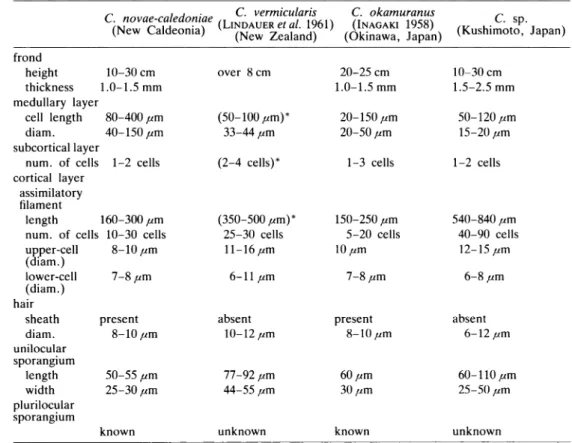
Two species of Cladosiphon, C. novae-caledoniae and C. okamuranus have been reported from New Caledonia (Garrigue 1988). However, Garrigue recognized only the latter species from New Caledonia, because of no description of the former one (personal communication). The morphological characters of New Caledonian species were compared with those of C. vermicularis (J. Ag.) Kylin, growing along the coasts of southern Australia and New Zealand, C. okamuranus from Okinawa, southern part of Japan and Cladosiphon
Table 1. A comparative study of 4 species belonging to Cladosiphon. C. novae-caledoniae
(New Caldeonia)
C. vermicularis C. okamuranus (Lindauer et al. 1961) (Inagaki 1958)
(New Zealand) (Okinawa, Japan)
C. sp. (Kushimoto, Japan) frond height 10-30 cm over 8 cm 20-25 cm 10-30 cm thickness 1.0-1.5 mm 1.0-1.5 mm 1.5-2.5 mm medullary layer
cell length 80-400 fjm (50-100 jim)* 20-150 /urn 50-120 /im
diam. 40-150//m 33-44 ^m 20-50 jum 15-20 /im
subcortical layer
num. of cells 1-2 cells (2-4 cells)* 1-3 cells 1-2 cells
cortical layer assimilatory
filament
length 160-300 /urn (350-500 Mm)* 150-250 jum 540-840 /urn
num. of cells 10-30 cells 25-30 cells 5-20 cells 40-90 cells
upper-cell 8-10//m ll-16jum 10 jum 12-15 /um
(diam.)
lower-cell 7-8 /urn 6-11 jum 7-8 /urn 6-8 /Jim
(diam.) hair
sheath present absent present absent
diam. 8-10//m 10-12/mi 8-10 /2m 6-12 /mm
unilocular
sporangium
length 50-55 /im 77-92 jum 60 /um 60-110^m
width 25-30 fim 44-55 jum 30 /mm 25-50 jum
plurilocular sporangium
known unknown known unknown
Data from the material which was kindly sent by Dr. Womersley. Bicheno Tasmania 29, Dec. 1963. coll. A. W. OLSEN, ADU A 27062.
sp. from Kushimoto, middle part of Japan (Table 1). The species from New Caledonia resembled morphologically to C. okamuranus very much, but the former one was disting uished from the latter one by its larger medullary layer cells and the former's localized
distribution.
Though it was very hard to make its clear observation, very thin subcortical layer and only plurilocular sporangia were observed in the "type specimen" of LD. The materials collected in 1987 from New Caledonia had unilocular and plurilocular sporangia on the same indi vidual. However, some of the Cladosiphon species usually bear both sporangia only in
summer season. I concluded that the material collected in 1987 should be identified as C. novae-caledoniae Kylin.
In southern parts of Japan, the commercial mariculture of C. okamuranus for fresh foods "Okinawa-moduku" was completely established and developed into a big industry (7,000 wet metric tons in 1986). As the quality of New Caledonian species are very good, it has a potential for a new mariculture resource in New Caledonia.
Acknowlegements: I wish to express my sincere thanks to Dr. P. Lassen in the Botanical
Museum, University of Lund for kindly sending me the "type specimen". Thanks are also extended to Dr. L. O. Brun and Dr. C. Garrigue in ORSTOM (Centre de Noumea) for useful informations about Cladosiphon in New Caledonia, and to Dr. H. B. S. Womersley in the University of Adelaide, for kindly sending me the frond of C. vermicularis. I should express sincere thanks to Dr. P. Kornmann in Helgoland Marine Botanical Laboratory, for the information of Kuckuck's specimen, and to Mr. T. Thoma in Okinawa Fisheries Station
for useful informations about the mariculture of C. okamuranus.
References
Garrigue, C. and Tsuda, R. T. 1988. Catalog of marine benthic algae from New Caledonia.
Micronesica, 21: 53-70.
Inagaki, K. 1958. A systematic studies of the Chordariales from Japan and its vicinity. Sci. Pap. Inst.
Algol. Res., Fac. Sci. Hokkaido Univ., 4: 87-197.
Kuckuck, P. 1929. Fragmente einer Monographic der Phaeosporeen. Biol. Anst. Helgol., 17: 1-91.
Kylin, H. 1940. Die Phaeophyceenordnung Chordariales. Acta Univ. Lund N. F. Avd. 2, 36: 1-67.
Lindauer, V. W., Chapman, V. J. and Aiken, M. 1961. The marine algae of New-Zealand. II: Phaeophyceae. Nova Hedwigia, 3: 129-350.