From foot-draggers to strategic
counter-partners : the dynamics of U.S. and
Chinese policies for tackling climate change
著者
Cheng Fang-Ting
権利
Copyrights 日本貿易振興機構(ジェトロ)アジア
経済研究所 / Institute of Developing
Economies, Japan External Trade Organization
(IDE-JETRO) http://www.ide.go.jp
journal or
publication title
IDE Discussion Paper
volume
476
year
2014-09-01
INSTITUTE OF DEVELOPING ECONOMIES
IDE Discussion Papers are preliminary materials circulated to stimulate discussions and critical comments
* Researcher, Law and Institution Studies Group, Inter-disciplinary Studies Center, IDE ([email protected])
IDE DISCUSSION PAPER No. 476
From Foot-Draggers to Strategic
Counter-Partners: The Dynamics of U.S. and
Chinese Policies for Tackling Climate Change
Fang-Ting CHENG*
September 2014
Abstract
As can been seen from the U.S.’s non-ratification of the Kyoto Protocol, together with the negotiations toward the post-Kyoto Protocol framework, the U.S. and China have been quarrelling over their responsibilities and have contradicted one another over the introduction of compulsory domestic greenhouse gases emission reduction targets. Therefore, for a long time, it has been argued that the controversy between the two countries has hindered the process of forging an international agreement to deal with climate change. On the other hand, Sino-U.S. bilateral cooperation on climate change has significantly increased in recent years in summit talks and their Strategic & Economic Dialogue (S&ED), especially after the 15th Conference of Parties (COP) of the United Nations Framework Convention on Climate Change (UN
Keywords: Climate change, mitigation, adaptation, Copenhagen Accord, Cancun Agreement, UNFCCC, Sino-U.S. relationship, U.S.-China Strategic & Economic Dialogue (S&ED)
JEL classification: K32, O13, O19
The Institute of Developing Economies (IDE) is a semigovernmental, nonpartisan, nonprofit research institute, founded in 1958. The Institute merged with the Japan External Trade Organization (JETRO) on July 1, 1998.
The Institute conducts basic and comprehensive studies on economic and related affairs in all developing countries and regions, including Asia, the Middle East, Africa, Latin America, Oceania, and Eastern Europe.
The views expressed in this publication are those of the author(s). Publication does not imply endorsement by the Institute of Developing Economies of any of the views expressed within.
INSTITUTE OF DEVELOPING ECONOMIES (IDE), JETRO 3-2-2, WAKABA,MIHAMA-KU,CHIBA-SHI
CHIBA 261-8545, JAPAN
©2014 by Institute of Developing Economies, JETRO
No part of this publication may be reproduced without the prior permission of the IDE-JETRO.
FCCC) in Copenhagen, one of whose aims was to facilitate positive negotiations for the post-Kyoto Protocol agreement. Analyzing this in the light of recent developments, we find that the U.S. and China have tended to address climate change and related issues from a pluralistic viewpoint and approach, by regarding the achievement of bilateral cooperation and global agreements as their common strategic objective.
I.
Introduction
It has been pointed out that the U.S. and Chinese controversy over climate change caused serious stagnation in international negotiations and cooperation. Meanwhile, however, Sino-U.S. cooperation on matters relating to the environment, energy and climate change, has been strengthened to a significant degree in recent years, such as was the case with the signature on the U.S.-China Memorandum of Understanding to Enhance Cooperation on Climate Change, Energy and the Environment (2009), and the establishment of the U.S.-China Working Group on Climate Change (CCWG, 2013). The purpose of this paper is to explain why progress in cooperation between the U.S. and China on climate change has been made, and the paper also indicates possible challenges the two countries may face. It also aims to give a view on how to interpret recent developments as well as provide a basis for research for future case studies.
In the following sections, the paper first introduces the U.S. and China’s confrontation on climate change and its influence on the stagnation of international negotiations. Followed by the three explanatory factors that are argued for in the paper, the second part describes recent Sino-U.S. cooperation on climate change by analyzing how the two countries have begun to treat climate change as an important strategic issue that they hold in common.
II.
U.S.-China Confrontations & the Stagnation of International
Negotiations on the Post-Kyoto Framework
Concerns over climate change were growing significantly in international society, alongside the publication of the Fourth & Fifth Assessment Report (AR4, 2007; AR5, 2013) of the Intergovernmental Panel on Climate Change (IPCC) in 2007 and 2013. However, the U.S.-China confrontation on climate change reached a climax during negotiations at the 13th Conference of Parties (COP13) of the United Nations Framework Convention on Climate Change (UNFCCC) in 2007 in Bali. In two years of dialogue after COP11 (2005), parties adopted a roadmap, entitled the Bali Action Plan (BAP), in Bali to conclude the prolonged negotiations for the post-Kyoto framework in COP15, which was scheduled to be held in Copenhagen in December 2009.
However, in the process of negotiating the Bali Action Plan, the U.S. and G77+China (developing countries group) quarreled over the burden-sharing between the developed and developing parties for a post-Kyoto regime. For example, at the last plenary meeting of COP13, one of the negotiators from a developing country berated the U.S. by saying, “If you cannot lead, leave it to the rest of us. Please get out of the way.1” After this happened in Bali, the BAP (Decision 1/CP.13) was finally agreed in order to enable negotiations on a post-Kyoto framework through the Ad Hoc Working Group on Long-term Cooperation Action under the Convention (AWG-LCA), which was assigned the responsibility of completing negotiations within two years on four main topics: A Shared Vision, Mitigation, Adaptation, and Finance & Technology Transfers. Although the BAP was adopted and provided the outline of the post-Kyoto framework, there was nosignificant progress between Bali and Copenhagen. One of the main reasons for this
1 “COP13--Bali Climate Conference,” Global Issue, January 1, 2008.
<http://www.globalissues.org/article/751/cop13-bali-climate-conference>, URL assessed on June 20, 2014.
was the confrontation between the U.S. and China. With a focus on obtaining an agreement on greenhouse gas (GHG) emissions reduction, international negotiation and cooperation on climate change faced huge difficulties, due to intense disputes over the responsibility between the developed and developing countries.
After Bali and the adoption of the BAP, major parties started to initiate other multilateral platforms to grope for a post-Kyoto deal. For example, the U.S. President G.W. Bush convened a meeting called the Major Economies Meeting on Energy Security and Climate Change (MEM) to bring China, India and other major GHG emitters together to have a dialogue and exchange opinion on relevant issues, including clean technology transfers, energy efficiency and security. Although the strained relations between the U.S. and China had not completely eased by this time, the meeting opened a channel for them to at least sit at the same table and discuss the relevant issues. Soon in July 2009, the two countries signed a memorandum to enhance bilateral cooperation on climate change, with the intention of facilitating a global agreement in Copenhagen.2
COP15 in Copenhagen ended with the drawing up of a political document titled the Copenhagen Accord. The Accord, which the parties as a whole only agreed to take note of, was a compromise by a limited number of countries against a backdrop of political chaos.3 There have been many discussions on the reasons for the failure of the
2 “The U.S.-China Memorandum of Understanding to Enhance Cooperation on Climate Change, Energy
and the Environment,” the U.S. State Department, July 20, 2009.
3 The Copenhagen Accord was accepted in a closed-door meeting among about 30 Parties. After political
conference. However, opportunities also cropped up both inside and outside the UNFCCC negotiations.4 For example, the adoption of the Cancun Agreement in 2010 restored confidence in the UN process, and it was agreed that pivotal compromises needed to be made by major parties to establish the outline of any future framework. On the other hand, the stagnation in the UN negotiations accelerated both minilateralism,5 e.g. the launch of the Major Economies Forum on Energy and Climate Change (MEF), and bilateralism, such as the Sino-U.S. cooperation in strategic dialogues. This paper aims to answer why so many significant changes occurred between the U.S. and China. Here I argue for three factors that should be taken into consideration: (1) the estimated impacts and concerns caused by climate change, (2) a multi-tiered approach that was agreed upon among major players (states), and (3) the search for an international agreement. I will analyze each of them after the following section.
III. Sino-U.S. Strategic Partnerships on Climate Change
Notwithstanding the U.S. and China’s disagreement over the responsibility for tackling climate change, which was identified as the main cause of the stalemate in negotiations,6 the two countries have actually agreed to cooperate on reducing or
some developing countries such as Bolivia and Venezuela.
4 Harro van Asselt, 2014. 5 Eckersley, 2012.
6 Soon after the closing of COP 15, the UK climate secretary, Ed Miliband, accused China of trying to
“hijack” the climate deal by pointing out, “We did not get an agreement on 50% reductions in global emissions by 2050 or on 80% reductions by developed countries. Both were vetoed by China, despite the support of a coalition of developed and the vast majority of developing countries” (Miliband, 2009).
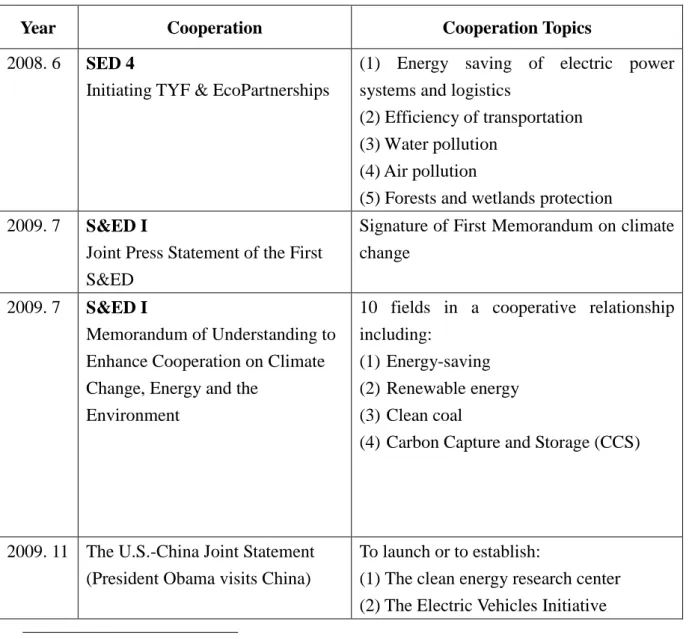
slowing the increase of GHG emissions.7 Sino-U.S. cooperation on climate change in recent years has been expanded and intensified to a great extent.8 First of all, in order to better understand the bilateral partnerships on climate change, energy and environment in each country, the development of bilateral cooperation will be discussed by reviewing the frameworks and projects that have been implemented in recent years.
Table 1: Sino-U.S. Cooperation on Energy and Climate Change
Year Cooperation Cooperation Topics
2008. 6 SED 4
Initiating TYF & EcoPartnerships
(1) Energy saving of electric power systems and logistics
(2) Efficiency of transportation (3) Water pollution
(4) Air pollution
(5) Forests and wetlands protection 2009. 7 S&ED I
Joint Press Statement of the First S&ED
Signature of First Memorandum on climate change
2009. 7 S&ED I
Memorandum of Understanding to Enhance Cooperation on Climate Change, Energy and the
Environment
10 fields in a cooperative relationship including:
(1) Energy-saving (2) Renewable energy (3) Clean coal
(4) Carbon Capture and Storage (CCS)
2009. 11 The U.S.-China Joint Statement (President Obama visits China)
To launch or to establish:
(1) The clean energy research center (2) The Electric Vehicles Initiative
7 See Table 1.
(3) New energy saving action plan (4) New renewable energy partnership (5) Large scale CCS project
(6) Promotion of clean coal (7) New Shale Gas Initiative
(8) The Energy Cooperation Program (ECP)
2009. 11 Protocol for Cooperation on a Clean Energy Research Center
Research subjects include:
(1) Energy efficiency of buildings (2) Clean energy
(3) CCS
(4) Clean vehicles To support:
(1) The Electric Vehicles Initiative (2) Large scale CCS project 2009. 11 Memorandum of Cooperation to
Build Capacity to Address Climate Change
(1) The Establishment of The Renewable Energy Partnership
(2) Support for the continuation of The Energy Policy Dialogue.
2011. 1 The U.S.-China Joint Statement (President Hu visits the U.S.)
・Confirmation of current dialogues and negotiations.
・Support for UNFCCC, COP and the Cancun Agreement
2011. 5 S&ED III
Improvement of TYF & EcoPartnerships
・Signature of the six new eco-partnerships under the TYF.
2013. 4 Joint U.S.-China Statement on Climate Change
・Establishment of the U.S.-China Bilateral Working Group on Climate Change
(CCWG) 2013.6 The U.S.-China Joint Statement
(President Xi visits the U.S.)
・Phase down the consumption and production of hydro fluorocarbons (HFCs) under the Montreal Protocol
2013. 7 S&ED V
The U.S.-China Joint Statement
・Continuation of the current work of the CCWG
・5 fields of cooperation were added to prompt GHG emission reductions July
2014 S&ED VI
S&ED VI ・New 8 EcoPartnerships
・CCWG special event on the private sector ・Policy dialogue among top negotiators
Source: Author. References: U.S. State Department; Committee on U.S.-China Cooperation on
Electricity from Renewable Resources et al. 2010: 205-216; U.S.-China EcoPartnership official website.
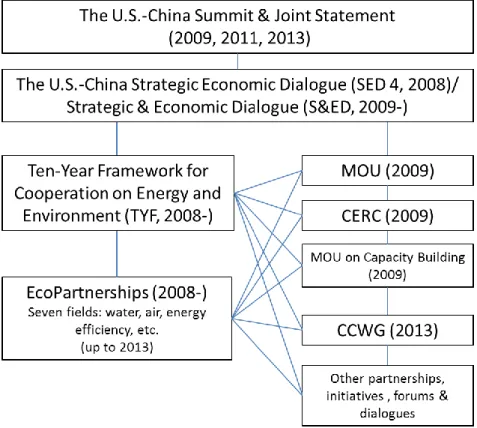
First, the Memorandum of Understanding to Enhance Cooperation on Climate Change, Energy and the Environment (MOU) was released in July 2009. It aimed at cooperation on a wide range of issues while strengthening the Ten-Year Framework for Cooperation on Energy and Environment (TYF), which was established in 2008 at the fourth Strategic Economic Dialogue (SED 4) (Table 1 & Figure 1). The TYF serves as a platform for the U.S. and China to cooperate through projects in fields like clean air, water, energy efficiency. In particular, they have signed numerous EcoPartnerships under the TYF to work on the goals and plans set by S&ED and MOU through practical projects and meet their need to address their mutual reciprocal demands (Figure 1). The TYF and EcoPartnerships, based on their purposes and outcomes, have grown and expanded into a variety of diverse fields.9
Figure 1: Structure of Cooperation on Energy and Climate Change under S&ED
※ Lines refer to the linkages between the arrangements
Source: Author.
The topics for the MOU of 2009 include “(1) Energy conservation and energy efficiency; (2) Renewable energy; (3) Cleaner uses of coal, carbon capture and storage (CCS); (4) Sustainable transportation, including electric vehicles; (5) Modernization of the electrical grid; (6) Joint research and development of clean energy technologies; (7) Clean air; (8) Clean water; (9) Natural resource conservation, e.g., protection of wetlands and nature reserves; and (10) Combating climate change and promoting
low-carbon economic growth.10” Besides, the two countries agreed to cooperate by establishing The Climate Change Policy Dialogue to facilitate policy cooperation on climate change (Table 1).
On November 17, 2009, a Sino-U.S. Joint Statement was released by President Obama and President Hu Jintao, where new progress was achieved. First, despite its opposition to the definition raised in the 2007 Bali Conference, the U.S. officially accepted the principle agreed at the 1992 Earth Summit to tackle climate change under the United Nations, that is, a common but differentiated responsibility and capability. Second, leaders of both sides expressed their intention to take action to reduce or lower the intensity of GHG emissions. Furthermore, the two countries declared that they would promote cooperation on finance and technology transfers for adaptation and mitigation based on equality and mutual reciprocity.
In the MOU (July 2009), the U.S. and China agreed to launch a new action plan for energy efficiency under the TYF. Furthermore, in order to achieve mutual goals, the Memorandum of Cooperation to Build Capacity to Address Climate Change11 and the Protocol for Cooperation on a Clean Energy Research Center (CERC12) were also
10 “Appendix: A Timeline of U.S.-Chinese Cooperation on Clean Energy and Climate Change,” The Power
of Renewables: Opportunities and Challenges for China and the United States, 2010, p. 212.
11 “Memorandum of Cooperation between the National Development and Reform Commission of the
People’s Republic of China and the Environmental Protection Agency of the United States of America to Build Capacity to Address Climate Change” is its full title.
12 The “Protocol between the Department of Energy of the United States of America and the Ministry of
Science and Technology and the National Energy Administration of the People’s Republic of China for Cooperation on a Clean Energy Research Center” is its full title.
signed (Figure 1). In the latter document, China and the U.S. agreed to finance CERC before 2015 with a minimum of 150 million US dollars each, to provide the means and facilitate interactions between engineers and researchers from both sides. The main research topics of CERC, which will be given precedence, include (1) energy efficient buildings, (2) clean energy (including CCS), (3) clean vehicles, and (4) clean coal technology. In particular, they further agreed to introduce large-scale CCS projects to facilitate quick action on technical development and the use, spread and transfer of technologies.
Since 2009, China and the U.S. have been holding a periodic U.S.-China Strategic and Economic Dialogue (S&ED) to discuss the critical issues between them. In the second round of S&ED in May 2010, they decided to deal with climate change-related issues by announcing an action plan under S&ED and TYF, and they signed an Implementation Plan for EcoPartnerships. Both sides agreed to hold (1) the first U.S. and China Energy Efficiency Forum, (2) the Electric Vehicles Forum, (3) the first Renewable Energy Forum, (4) an Energy Policy Dialogue, (5) the Oil and Gas Industry Forum, and (6) to run the Clean Energy Research Center Working Group, as well as the Renewable Energy Partnership (Figure 1). The partnerships aim to promote collaborative relationships between the public and private sectors. Also, the dialogue was designed to accelerate the application of clean energy by improving technologies and companies’ competitiveness.
Looking at the agreements reached, the Sino-U.S. strategic relationship on climate change and energy contains a wide range of projects aimed at an ultimate goal, that is,
to facilitate negotiations and reach international agreements that best suit both sides’ interests. U.S. and Chinese leaders have been emphasizing the importance of working together to continue dialogues and forums with a primary aim of understanding each other better.13 Agreeing that climate change should be tackled through a balanced approach that combines environmental technologies and opportunities for further economic growth, the U.S. and China have come to consider energy efficiency and technological cooperation as crucial in their common interest in promoting emissions reduction. For instance, both sides are trying to integrate industrial and technological specifications and regulations, while dealing with observable climate change and its adverse effects through measures such as CCS and pollution abatement.
In the following sections, three factors are offered as an explanation of the current strategic partnerships between the U.S. and China. These are (1) the impact of and concerns regarding climate change, (2) a multi-tiered approach to solutions, and (3) the pursuit of international agreements.
IV.
Observable and Estimated Impacts & Concerns regarding
Climate Change
National & Security Concerns in the United States
Both the adverse effects of climate change within the territories (direct effects) and the
13 The U.S.-China Joint Statement, July 2009, January 2011; Remarks at the U.S.-China Strategic and
impact caused by extreme events outside the U.S. (indirect effects) cause concerns to the nation’s inhabitants and its policy makers.14 The U.S. presidential administration had difficulties in persuading Congress to adopt the Kyoto Protocol because the harmful effect of climate change was not obvious at the time, and the administration, as well as Congress, gave priority to risks such as the loss of employment and the impact on domestic economic growth and international competitiveness. Since then, bills that contain international and legally binding targets or commitments to reduce emissions have faced difficulties in Congress.
In recent years, however, arguments regarding the impact of climate change from a national security perspective have become substantial, both practically and theoretically.15 Meanwhile, support for climate-related bills among the senators has substantially expanded, when compared to 1997 when the administration considered the ratification of the Kyoto Protocol. The Bush administration, despite its opposition to the protocol, shifted to an active position in dealing with the issue. For instance, President George W. Bush’s State of the Union address on January 23, 2007 marked a U.S. president’s first recognition of global climate change as “a serious challenge.16” Besides, the U.S. National Intelligence Council issued a confidential report entitled “National Intelligence Assessment on the National Security Implications of Global Climate Change to 2030” in June 2008, and concluded that the effects of climate change in twenty years would be extensive although indirect, and adverse effects in other
14 Moran, 2011: 148.
15 Busby, 2008; Barnett and Adger, 2007. 16 G.W. Bush, 2007.
countries may also affect the national security of the U.S.17
Disputes over resources such as water may cause conflicts that disturb the regional order. This can be understood as a “threat multiplier” or an “amplifier” on already poor
social and political conditions in potential collision.18 Once the U.S. is involved in the conflict, its allies might request military intervention or humanitarian assistance in the area of conflict, and this may lead to regional or international tensions. Additionally, if weather conditions deteriorate seriously, a large flow of environmental refugees might be generated, being forced to move across borders. In that case, the report contended, the U.S.’s social stability would be threatened significantly if they had to host such a large number of refugees from South America.19
Also, Busby pointed out that the possible impact of climate change on U.S. homeland security includes (1) abrupt climate change, (2) rising sea levels, (3) extreme weather events and (4) Arctic sea ice melt.20 In particular, abrupt climate change and rising sea levels are seen as a long-term challenge, although hardly regarded as immediate threats to U.S. homeland security. However, there are cases of extreme weather events, such as Hurricane Katrina, which struck the southeastern U.S. in 2005 and caused catastrophic destruction to the majority of New Orleans. Katrina killed over 1,800 people, and the damage to oil infrastructure and facilities amounted to more than $800 billion. In addition, more than 270,000 citizens were transported to shelters away from their
17 National Intelligence Council, 2008. 18 White, 2011:78.
19 Ibid.
hometowns. Apart from Katrina, we have also been witnessing the frequent occurrence of giant hurricanes coinciding with tornados in recent years.
So far, scientists still find it difficult to attribute the occurrence of extreme weather events to the progression of climate change. The occurrence of Hurricane Katrina, however, made the U.S. people and policy makers realized how a devastating disaster can damage homeland security. Discussions regarding the relationship between hurricane strength and global warming were activated after Katrina, while concerns about and interest in addressing climate change increased notably.21 Last but not least, the shrinking of Arctic sea ice has raised arguments among neighboring countries, such as Canada, Norway and Russia, over the right to traditional and new sea routes, as well as the right to develop resources. Obviously, the melting of Arctic sea ice is directly linked to the crucial interests of U.S. national and military security.22
Besides U.S. concerns for homeland security, climate change may also present security challenges by affecting U.S. national interests overseas. Busby listed examples such as (1) damaged overseas assets or U.S. military bases, (2) loss of overseas facilities and infrastructure, (3) the flow of environmental refugees and regional instability, and (4) the emergence of failed states and large humanitarian disasters.23 Busby’s argument indicates that traditional security issues, such as conflicts or regional instability, can be directly caused by environmental degradation. Both U.S. national and extraterritorial security interests may be influenced by extreme weather events or natural disasters.
21 Ibid, 484.
22 Ibid, 489-490. 23 Ibid, 498.
Environmental Degradation and Social Concerns in China
In China, there are two kinds of concerns caused by climate change and global warming. The first one is related to its territory, such as arises from flooded homelands, a reduced territory along the coast and the erosion of coastal areas from sea level rises which could create huge economic losses in more developed areas. The submergence of islands may change the maritime border of China and its neighboring countries, which could significantly impact China’s security interests.24
The second concern is a decline in the quality of soil. This can be understood from the expanding desertification in the northern and western areas of China. Since the 1950s until the end of the 1990s, desertification in northern China has shown a tendency to expand.25 In addition, the progress of the desertification in Xinjiang, Inner Mongolia, etc. has become obvious due to water shortages and an excessive use of land.26 The area of desertification in the region reached 318,600 square kilometers, accounting for 3.32% of the total territory.27 It is important to note that desertification not only causes the disappearance of residential and agricultural land, it also, and at the same time, increases the strength and frequency of sandstorms. One example is the problem of
24 Zhang, 2010: 61-81.
25 The current area of desertification is 1.2 to 1.3 times larger than it was between the mid-50s and
mid-70s, Zhang, 2010: 83.
26 “Obvious” means that the quality of the soil is at a stage between desertification and
non-desertification. This type of land, even though not yet sandy, clearly shows a tendency towards desertification, China State Forestry Administration, 2005.
desertification in Wuwei City, Minqin County (Gansu Province). This is an example that is widely accepted as being an adverse effect of progressive climate change.28
The Chinese government has released several official documents to clarify its position and national policies after the ratification of the Kyoto Protocol. It presents its concerns about the aggravation of the problem and the possible social and economic effects of environmental degradation in China. The Chinese government has been emphasizing that, regarding climate change, as a matter of social and economic development, it is developed countries who should take the responsibility in addressing the issue. However, at the same time, it recognizes that climate change is a threat to the preservation of resources, agricultural development and the natural environment.29 In the last few decades, China, while insisting that industrialized countries should take responsibility in dealing with the degradation, has been asking for the right to make domestic development its first priority.30 On the other hand, China has been facing domestic problems from environmental degradation and has suffered huge economic and social costs as a result of its excessive emphasis on economic growth. In its 2007 national report, China showed its intention to adopt climate change policies as a result
28 Minqin County, which is located downstream of the Shiyang River Basin, is the only water resource in
the county. The precipitation in Minqin has been increasing because of rising temperatures. However, evaporation reaches up to 24 times the level of precipitation, reducing water levels upstream, and significantly reducing the amount of available water resources in areas downstream and midstream. Ecological degradation in the Shiyang River Basin makes the subject of desertification in the Minqin area more serious than ever. The lack of water resources and the deterioration of the quality of life have forced 26,500 residents to move out in the last decade. Source: Dai et al., 2008: 322.
29 “Chapter 3: Influence and Challenge of Climate Change in China,” China's National Program against
Climate Change, Chinese State Council, 2007.
of expected adverse effects on its economic and social development programs. The government indicated climate change as “a serious challenge to its modality of current social and economic development, energy structure, the capability of independent development of energy technology, the protection and use of forest resources, the agricultural adaptation of climate, the protection and development of water resources, as well as its ability to respond to threats due to sea level rises.31”
The 2007 report also indicates that “observed changes in temperature are consistent with a global scale, thus appropriate domestic measures are urgently necessary.32” In fact, China’s position on climate change began to lay emphasis on the phenomenon of climate change, especially global warming, which has had adverse effects in various areas in China, for instance, desertification, drought, and floods.33 It can be seen at present that China is responding to the issue more actively by implementing climate policy at both the local and central government levels. Certainly, there are still huge challenges for the authorities as they try to strike a balance between environmental protection, a high level of economic growth, and political stability.
Besides its environmental and social concerns about climate change, energy security became another serious challenge for China. Since 1993, China has become a net importer of petroleum. Domestic oil production in China nowadays only meets half of its demand.34 Also, China became a net importer of natural gas in 2008. There was
31 Ibid.
32 China's National Program against Climate Change, 2007. 33 Ibid, 2007: 4-5.
already a gap between domestic production and consumption in 2009 of four billion square meters of natural gas.35 With the shortage in domestic production and the need to rely on foreign oil and natural gas, expanding the use of renewable energy became an important objective. This is also a rational choice for China in dealing with climate change and its adverse effects as it seeks to complement its domestic demand for fossil fuels.
V.
Multi-Tiered Approach on Solutions to Climate Change
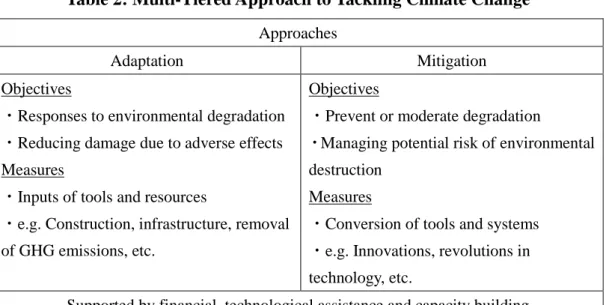
As analyzed above, climate change can have an impact on the environment, society and even security in both the U.S. and China. Policy makers are convinced about the value of a combination of various methods and tools, termed a multi-tiered approach here, to deal with the problems and possible impacts.36 This multi-tiered approach contains two dimensions, including adaptation and mitigation, that take financial and technological support, and capacity building as its basis. These have been accepted, after the adoption of the Bali Action Plan, as solutions for use under conditions of international cooperation. Because of the complexity of the problem, there have been difficulties in reaching a comprehensive global agreement to overcome the problem of uncertainty since climate change is caused by both anthropogenic and natural factors.37 After more than two decades of negotiation, as climate change appeared to be getting worse, policy makers began to consider the necessity of mobilizing dynamic policy
35 International Energy Agency, 2009. 36 AR5: SPM, IPCC, 2013.
37 See IPCC 2007 Table SPM.2: “Recent trends, assessment of human influence on the trend and
instruments by using various methods. At present, a multi-tiered approach seems to have replaced past negotiations that only focused on absolute GHG emission reductions to mitigate climate change.
Table 2: Multi-Tiered Approach to Tackling Climate Change
Approaches
Adaptation Mitigation
Objectives
・Responses to environmental degradation ・Reducing damage due to adverse effects Measures
・Inputs of tools and resources
・e.g. Construction, infrastructure, removal of GHG emissions, etc.
Objectives
・Prevent or moderate degradation ・Managing potential risk of environmental
destruction Measures
・Conversion of tools and systems ・e.g. Innovations, revolutions in technology, etc.
Supported by financial, technological assistance and capacity building
Source: Author.
Climate change, according to existing scientific knowledge, is occurring due to human economic activities as well as spontaneous atmospheric variation in the weather, so that states are able to respond on two dimensions when addressing climate change. The first is an exogenous approach, which is presently perceived as adaptation. In this approach, tools and resources are introduced. For instance, breakwaters are constructed or facilities for keeping water are strengthened in order to resist the damage brought about by natural disasters and extreme weather events (Table 2). Adaptation aims to reduce ecological vulnerability and to respond to adverse effects in a specific country or region. The inputs of tools and resources include equipment, human resources, financial support and existing technologies. Adaptation is considered necessary, since environmental
degradation, such as a further rise in temperature and rising sea levels are predicted to be inevitable.38 Because of the nature of climate change, states could not agree on solutions to setting GHG emissions reduction targets for the major emitters.39 Still, Parties have been paying no less attention to adaptation than to mitigation, and they are making concrete progress in post-Kyoto negotiations.
In contrast to adaptation, the concentration of GHGs has been rising in the atmosphere and has led to ongoing global warming and climate change since the Industrial Revolutions. Another approach in addressing climate change is to reduce anthropogenic GHG emissions (e.g. reductions in absolute emissions or emission intensity.) The implement of endogenous approaches, understood as mitigation in current negotiations and agreements, enables human activities to contribute to the prevention of worsening climate change. It should be noted here that mitigation may not eliminate climate change, but it can to some extent prevent the problem from getting worse.
To reduce GHG emissions or their intensity, mitigation requires a conversion of tools as well as systems (Table 2). Conversion refers to the implementation of innovative technology and systems in search of economic development and technological improvement. By innovation, for example, the creation of new processes, measures or devices can enable a consumption of resources to be more efficient, energy-saving and
38 See IPCC 2007 Table SPM.3: “Projected global average surface warming and sea level rise at the end
of the 21st century.”
39 For enhancing adaptation actions, Annex 1 Parties (developed countries) have committed to offer
financial support to developing countries, especially those vulnerable to climate change, under the Green Climate Fund, which was adopted at the Sixteenth Conference of Parties (COP16) of UNFCCC in Cancun.
environmentally-friendly.40 Negotiations with a focus on mitigation, such as the pledged targets for GHG emissions reduction as well as on the technology transfers between developing and developed states have retained their importance both in the UN and in other multilateral and bilateral negotiations.
After the adoption of BAP, adaptation and mitigation, supported by financial and technological assistance and capacity building, are currently considered to be a multi-tiered approach to the problem of dealing with climate change. The Copenhagen Accord, the Cancun Agreement and the Durban Platform adopted by UNFCCC have confirmed these approaches as suitable for addressing the issue under a future framework. Although the full package deal is still under negotiation, the U.S. and China have initiated cooperation through dialogues and projects in a multi-tiered manner. In the following section, the third factor involved in this quickly growing Sino-U.S. cooperation, that is, the pursuit of bilateral reconciliation and further international agreements, will be analyzed by looking at recent political dialogues and initiatives.
VI.
Pursuit of International Agreements
Before the opening of COP15 in 2009, it could be seen that the two countries had started to open up channels for bilateral dialogues, and to initiate climate-related programs and projects through efforts in both the public and private sectors. The U.S.
40 To be specific, conversions of tools and systems in coping with climate change can be related to the
concept of ecological modernization, which shows that the development and creation of new environmental technologies can provoke new employment and economic benefits. See Wurzel and Connelly, 2010.
and China have shown particularly positive positions and intentions in dealing with climate issues, even though they have not fully eliminated their mutually conflicting interests. On the recent U.S. and China strategic partnerships, bilateral cooperation might have influenced the international rule-making process, since the two countries are the world’s top two GHG emitters, although disagreements between the U.S. and China have been considered a significant factor behind the long period of non-agreement.
Undoubtedly, the motivations for the U.S. and China to alter their negotiating positions and climate policies derive from their own interests. On the background of possible impacts, concerns about climate change and the implications of a multi-tiered approach, the U.S. and China shifted their positions to cooperate by establishing partnerships, forums and dialogues. It is to be understood that both countries have tended to treat climate change as a strategic issue that affects their vital interests. That is, they began to have clearer national interests by facilitating collaboration by, for instance, developing benign and mutually reciprocal bilateral relations in order to solve energy and climate change issues. In particular, the establishment of their leading positions in negotiating a future framework is one of the most important aims of their partnership. This point will be discussed in the following section.
Purposes of the U.S.-China Strategic Partnership on Climate Change
This section analyzes the purposes of Sino-U.S. cooperation on climate change. First of all, one of the most important objectives of the Obama administration has been to reach an alternative and practical agreement while maintaining its satisfactory relations
with China. Soon after his inauguration, President Obama explicitly emphasized the impact of climate change and indicated that it is an urgent issue with regard to security, which must be dealt with in a serious way.41 Obama again emphasized climate change as a new challenge to national and global security in the National Security Strategy 2010 by pointing out that climate change has not been managed efficiently due to shortcomings in existing international institutions. He stated, “…we must focus American engagement on strengthening international institutions and galvanizing the collective action that can serve common interests such as combating violent extremism…and forging cooperative solutions to the threat of climate change…42” Also, the Quadrennial Diplomacy and Development Review (QDDR), which was published in 2010 for the first time, described climate change as a new challenge by noting “new actors, good and bad, have the power to shape international affairs like never before. The challenges we face--nuclear proliferation, global pandemics, climate change, terrorism--are more complex than ever.43” The U.S. Secretary of State Hillary Clinton delivered a speech before attending the 5th East Asia Summit to emphasize the common strategic interests between the U.S. and China on global issues. She stated, “The two countries share the responsibility of constructing an obvious strategy in addressing climate change.44” Furthermore, a chapter related to climate change was included for the first time in the U.S. Defense Department Quadrennial Defense Review 2010 (QDR). It pointed to climate change and energy as key issues that will play significant roles in
41 Holland, 2008.
42 U.S. White House, 2010: 3.
43 U.S. Department of State / USAID, 2010. 44 Clinton, 2010.
shaping the country’s future security environment.45
Another aim relates to economic perspectives (e.g. industry, the market, employment). Some have argued that the Obama administration tends to expand its rights and interests by integrating standards and regulations with China on environmental technologies.46 For China, it is also an urgent task to solve domestic environmental degradation and energy resource issues by introducing efficient technologies and systems, while maintaining economic growth. Under Sino-U.S. S&ED, as we can see from Table 1, technological development, such as CCS, clean/renewable energy, electric vehicles, covers a large proportion of the current environmental and energy cooperation.
Table 3: Focus Areas under the U.S.-China S&ED, TYF & EcoPartnerships
Adaptation Mitigation
Focus Areas
・Carbon capture & storage (CCS) ・Clean water
・Clean air
・Natural resource conservation
・Clean energy ・Electric vehicles ・Renewable energy
・Energy conservation and energy efficiency
・Emission/consumption reductions in GHGs (HFCs)
・Financial assistance ・Technological assistance
・Capacity building (e.g. Accurate & reliable GHG data collection & analysis)
※Measures agreed between the U.S. and China are included but not limited to those listed in the table.
Source: Author.
45 U.S. Department of Defense, 2010. 46 Sasaki, 2011: 10.
The subject of climate change was again taken up in a Joint Statement at the Sino-U.S. Summit in January 2011 when Chinese President Hu Jintao visited the U.S. They agreed to support the Clean Energy Research Center, the Renewable Energy Partnership, the Joint Statement of Cooperation on Energy Security, TYF, and the Cancun Agreement. Meanwhile, they agreed to continue to negotiate under the UNFCCC.47 Later on, climate change, environmental protection and energy security were again central topics at the 3rd S&ED (May 2011). There, the U.S. and China further expanded their cooperation by signing six new EcoPartnerships under the TYF (Table 1).48 The EcoPartnership currently contains seven focus areas, including clean air, clean water and energy efficiency. These can be regarded as practice for both adaptation and mitigation with mutual support being provided on financial assistance, technology transfers and capacity building (Figure 1 & Table 3).
In addition to new EcoPartnerships, the U.S. and China confirmed that one of the urgent tasks required for adapting to climate change is to strengthen the capacity of recording/projecting Chinese GHG emissions accurately. Based on the Memorandum of Cooperation to Build Capacity to Address Climate Change, the U.S. National Oceanic and Atmospheric Administration and the Chinese Meteorological Administration agreed to strengthen common research in order to improve China’s ability to observe and analyze data (Figure 1 & Table 3).49 Sure enough, capacity building, which has been considered fundamental for the effective implementation of adaptation and mitigation,
47 Ministry of Foreign Affairs of the People’s Republic of China, 2011.
48 “Remarks at U.S.-China EcoPartnerships Signing Ceremony,” U.S. Department of State, Washington
D.C., May 10, 2011.
aims to improve public awareness, participation and access to knowledge and information by providing financial and technological assistance.50
Recently, Sino-U.S. strategic partnerships are focusing on the Bilateral Working Group on Climate Change (CCWG), which was set up in 2013, and on a joint effort to phase-out the emission and consumption of hydrofluorocarbons (HFCs) (Table 1 & Figure 1). This is the first time that the U.S. and China have cooperated on GHG emission cuts, and both of them have confirmed that they will continue their efforts at the latest S&ED VI in 2014. The CCWG aims to intensify this cooperative relationship by playing a role in facilitating enhanced policy dialogue among major policy makers and stakeholders. The working group issued its first report to S&ED 5 in July, 2013, with suggestions for launching new action plans for future cooperation.51 At S&ED VI, the U.S. and China signed eight new EcoPartnerships, including on industrial boilers and forests, to further strengthen the CCWG framework. Both sides agreed to work together in order to reach a global agreement by COP 21, which is scheduled to be held in Paris in 2015.52
Although international negotiations had been in deadlock for decades, U.S.-Chinese bilateral cooperation was triggered when the effects of climate change were observed and estimated to be serious beyond each country’s borders. Climate change, as an issue-complex, can be partially mitigated by approaches such as technological
50 Decision 15/CP.18, “Doha work program on Article 6 of the Convention,” FCCC/CP/2012/8/Add.2,
February 28, 2013.
51 Report of the CCWG to the Strategic and Economic Dialogue, U.S. Department of State, 2013. 52 Stern, 2014.
innovation and improvements in energy efficiency, while its adverse effects can only be addressed by enhancing adaptation. Certainly, both energy-related technology transfers and information exchange serve U.S. and Chinese interests. The objective of searching for a strategic foundation to break through the stagnation in international negotiations while meeting these purposes remains crucial for the two countries.
As has been shown above, U.S.-Chinese bilateral cooperation on climate change has been boosted to a significant level by initiating dialogues and various programs in recent years. Nevertheless, certain concerns exist. One that can be raised here is that the strategic partnerships are not compulsory. In other words, they are not legally binding. They are mainly based on initiatives, forums, dialogues and projects that can be negatively influenced by political confrontation or other exogenous factors. The other concern is the difficulties involved in clarifying the effectiveness and problems of each individual country as well as the entire partnership due to the lack of a comprehensive review and assessment mechanism.
VII. Conclusion and Prospects
Sino-U.S. relations on climate change have been discussed mostly with respect to the rivalry between these two major powers and their reluctance to contribute to international cooperation. This paper, in contrast, argues that a cooperative relationship/partnerships have been established in recent years, by promoting cooperation on related issues on the basis of each country’s strategic position. Three reasons are analyzed in the paper: (1) Actual and projected concerns and the effects of
climate change, (2) An agreed multi-tiered approach, and (3) The pursuit of a breakthrough in international negotiations. The U.S. and China began to take the various effects and risks of climate change seriously, and to tackle the issue by facilitating adaptation and mitigation with mutual financial, technological and capacity-building support.
In the background, China has been achieving rapid economic growth while experiencing environmental degradation such as soil, water and air pollution. For the U.S., on the other hand, its economic problems, like unemployment and economic stagnation, need more work. Under these circumstances, solutions to climate change provide opportunities for the two countries to cooperate on research, transfers and the spread of environmental and energy-related technologies, which may relieve both countries of their excessive dependence on fossil fuels in the coming decades.
The U.S. and China have enhanced mutually beneficial relations in many issue-areas by initiating a range of projects on renewables, clean energy, electric vehicles and CCS, clean water, clean air, to mitigate against and adapt to climate change. The strategic partnerships have been seen as channels to present the possibility of achieving mutual sustainable development without causing significant confrontations and contradictions within each country. Climate change has been adopted as an adequate theme in constructing a bilateral cooperative relationship. Through dialogues and implementation, the cooperation on energy and environmentally related issues has begun to play an important part in their strategic partnership, nor are the two countries’ interests limited to finding solutions only to climate change.
Last but not least, it is important to continuously observe the implementation and influence of Sino-U.S. strategic partnerships. Although the partnerships on energy and climate change have been established in a strategic manner, this demands assessment, review and modification in order to be maintained and improved. In particular, the partnerships may be considerably influenced by extrinsic factors (e.g. security, political, and economic events). In view of the need to achieve post-Kyoto and a future framework for international cooperation, the U.S. and China certainly play critical roles in the negotiations for the 2015 climate pact. Therefore, strategic partnerships between the U.S. and China deserve further study and analysis in the years to come.
References
Barnett, Jon, and W. Neil Adger (2007). “Climate Change, Human Security and Violent Conflict.” Political Geography, Vol. 26, No. 6, pp. 639-655.
Busby, Joshua (2008). “Who Cares about the Weather? Climate Change and U.S. National Security.” Security Studies, Vol. 17, No. 3, pp. 468-504.
Bush, George W. (2007). State of the Union Addresses of the American Presidents, Jan 23, 2007.
China State Forestry Administration (2005). “Desertification in China and Its Status
Report” June 2005.
Chinese State Council (2007). China's National Program against Climate Change, June 4, 2007.
of the U.S. Secretary of State, October 28, 2010.
______ (2011). Remarks at U.S.-China EcoPartnerships Signing Ceremony, U.S. Department of State, Washington D.C., May 10, 2011.
Committee on U.S.-China Cooperation on Electricity from Renewable Resources, Policy and Global Affairs, National Research Council, Chinese Academy of Sciences and Chinese Academy of Engineering (2010). The Power of
Renewables: Opportunities and Challenges for China and the United States.
Washington D.C.: The National Academies Press.
Dai Sheng Mao, Chiu Guo Yu, and Zhao Ming (2008). “Research on Anti-Desertification and Control in the Gansu Minqin Oasis.” Arid Zone
Research, Vol. 25, No. 3.
Eckersley, Robyn (2012). Moving Forward in the Climate Negotiations: Multilateralism or Minilateralism? Global Environmental Politics 12 (2), 24-42.
Guoyi Han, Karl Hallding, Marcus Carson, Helen Thai, and Måns Nilsson (2009). “China-U.S. Relations and Domestic Politics on the Road to Copenhagen 1: Making a Virtue of Necessity.” Stockholm Environment Institute.
Holland, Steven (2008). “Obama Says Climate Change a Matter of National Security.”
Reuters, December 9, 2008.
Intergovernmental Panel on Climate Change (IPCC) (2007). “Fourth Assessment Report
(AR4), Summary for Policymakers (SPM).”
______ (2013). “Fifth Assessment Report (AR5), Summary for Policymakers (SPM).” International Energy Agency (2009). CO2 Emissions from Fuel Combustion, 2009
edition. Paris: OECD/IEA.
2009.
Ministry of Foreign Affairs of the People's Republic of China (2009). Sino-U.S. Joint
Statement. November 17, 2009.
______ (2011). Sino-U.S. Joint Statement. January 20, 2011. ______ (2013). Sino-U.S. Joint Statement. July 12, 2013.
Moran, Daniel, ed., (2011). Climate Change and National Security: A Country-Level
Analysis. Washington D.C.: Georgetown University Press.
National Intelligence Council (2008). National Intelligence Assessment on the National
Security Implications of Global Climate Change to 2030. Archived from the
original on 2013-06-14 http://www.dni.gov/testimonies/20080625_testimony.pdf People’s Daily (2010). “China's Oil Production Ranks 4th in World, Only Meets Half
Domestic Demand.” People’s Daily, February 9, 2010.
Sasaki, Takanari (2011).”Features of the Obama Administration's Economic Strategy towards China.” International Trade and Investment Quarterly, No. 83.
Smith, Julianne and Alexander T. J. Lennon (2008). “Setting the Negotiation Table: The Race to Replace Kyoto by 2012.'' in Campbell, Kurt M. (Eds.). Climatic
Cataclysm: The Foreign Policy and National Security Implications of Climate
Change. Washington. DC: Brookings Institution Press, pp.205-207.
Stern, Todd D. (2014). “Remarks at the U.S.-China Strategic and Economic Dialogue,” U.S. Department of State, July 9, 2014.
White, Gregory (2011). Climate Change and Migration: Security and Borders in a
Warming World, New York: Oxford University Press.
Wurzel, Ruediger & James Connelly, eds., (2010). The European Union as a Leader in
United Nations Framework Convention on Climate Change (UNFCCC) (2008). UN Decision 1/CP.13, “The Bali Road Map.” FCCC/CP/2007/6/Add.1., March 14, 2008.
______ (2011). UN Decision 1/CP.16, “The Cancun Agreements: Outcome of the Work of the Ad Hoc Working Group on Long-term Cooperative Action under the Convention.” FCCC/CP/2010/7/Add.1., March 15, 2011.
______ (2013). UN Decision 15/CP.18, “Doha work program on Article 6 of the Convention.” FCCC/CP/2012/8/Add.2, February 28, 2013
U.S. Department of Defense (2010). The Quadrennial Defense Review 2010. February 2010.
U.S. Department of State and U.S. Agency of International Development (USAID) (2010). The Quadrennial Diplomacy and Development Review. December 2010. U.S. Department of State (2011). U.S.-China Strategic and Economic Dialogue 2011:
Outcomes of the Strategic Track. May 10, 2011.
______ (2013). Joint U.S.-China Statement on Climate Change, April 13, 2013.
______ (2013). Report of the U.S.-China Climate Change Working Group to the Strategic and Economic Dialogue. July 10, 2013.
______ (2014). Six Inducted into U.S.-China EcoPartnerships Program, July 10, 2014. ______ (2014). Joint U.S.-China Press Statements at the Conclusion of the Strategic &
Economic Dialogue, July 10, 2014.
______ (2014). Key Achievements of U.S.-China Climate Change Cooperation under the Strategic and Economic Dialogue, July 9, 2014.
U.S. White House (2010). National Security Strategy 2010. May 2010.
Climate Action. Center for Climate and Energy Solutions Briefing.
Zhang, Hai-Bing (2010). Climate Change and China’s National Security. Beijing: Shi shi chu ban she.