■
Research Note■
State and Education:
India's Failures and
Japanese Lessons
●
G. Balatchandirane
"
. . . to say that India does not have the money for education . . . is absolute, utter, unmitigated nonsense".
-Nobel Laureate Amartya Sen1)
Introduction
In a developing country like India, education has a crucial role to play in the process of modernization. Education can be a catalyst and con-tributor to modernization. Thus the State has an important role if not duty in the promotion of education. In the initial phases of moderniza-tion, the spread of elementary education among a large share of the population is important to building up a base of human capita1.2) The stock of human capital thus created could easily be imparted additional skills and training and shifted into areas of priority as identified in the various stages of modernization.
The present article identifies the lack of will and commitment on the part of the Indian State as the crucial reason why education has failed to
G. Balatchandirane, Department of Chinese and Japanese Studies, University of Delhi. Subject: Comparative Economic Development/Education.
Publications: "Gender Gap in Literacy and Economic Development: A Preliminary Investigation," Journal of Educational Planning and Administration, Vol. XII. No. 3, July 1998, pp. 289-311. "Role of Education in Japan's Modernization: A Reassess-ment", China Report, New Delhi/Thousand Oaks/London, Vol. 31, No. 2, April-June 1995, pp. 219-33.
176 Journal of the Japanese Association for South Asian Studies, 12, 2000
spread rapidly in the last half century in India. The financial require-ments for the spread of education in India is an astronomical amount of money. However, the contention here is that the toting up of the re-source requirements as a reason for the failure of the State's role is based on specious logic. The abdicative nature of the State is the actual culprit. An attempt will be made to prove this using the Japanese historical experience. The Japanese experience under similar circumstances in the last quarter of the 19th century would be used to build the case that a display of the State's will and commitment to the spread of education goes a long way in crossing hurdles, including the proclaimed financial one. The Indian State's abdicative role is seen not just in the absolute low spread of education, but is also reflected in the wide disparities in the spread of education among various social groups. Among the current ills of Indian education, privatization and the creeping in of foreign capital in education too can be seen as a corollary of the state's abdicative role. Since in the perspective we have laid out, elementary education has the relatively more crucial role, we will be emphasizing more on it compared to secondary or higher education.
The organization of this paper is as follows . Firstly, we cover in sec-tion I the two striking features of Indian educasec-tion that is relevant to our discussion, namely, a.) The absolute low spread of education and b .) The continuing bias in favor of higher education . This is followed by Section II that deals with the structural adjustment period when privatization in education consequent upon liberalization is seen. Section III narrates the disparities among various social groups in Indian educa-tion. Section IV goes into the issue of finances for educaeduca-tion. Section V gives the relevant Japanese experience. Section VI discusses the failures of the Indian State from a comparative perspective. Section VII con-cludes that the Japanese case proves that resources is not the issue; po-litical will and commitment to education are.
I. Education in Post-Independence India
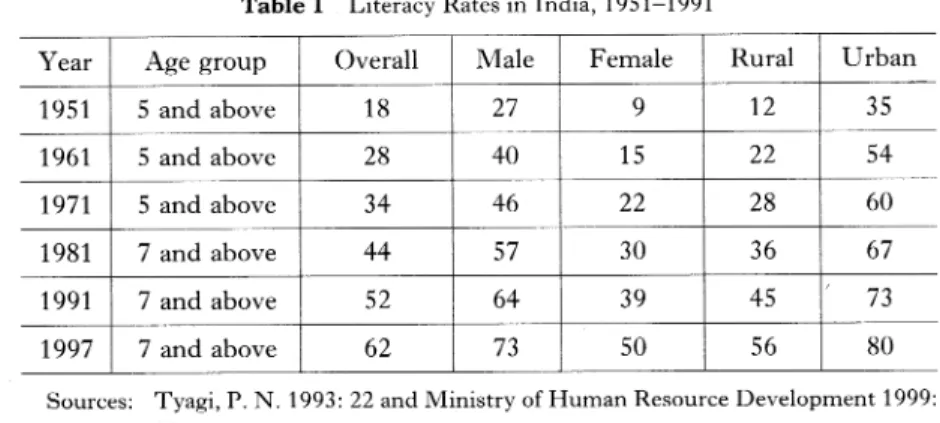
Two features stand out in Indian education in the post-Independence period. The first is the low spread of education in absolute terms. The second is the persistence of bias in favor of higher education. For our purposes, literacy rates can be considered as the quantitative
manifesta-tion of the spread of educamanifesta-tion. The growth in literacy rates in India between the years 1951 to 1997, the latest year for which data is available is given in Table 1. In the half-century following independence, the overall literacy rates have risen from about 18% to about 62%. This looks respectable on the face of it, but when compared with the performance of countries like China in the recent years, this is none too impressive.3)
During the colonial period, the rulers had created a class of educated Indians to help them administer the country and felt little compulsion to proceed beyond that. While enlightened Indian leaders wanted mass education, the dominant Indian elite ensured that its class interests were taken care of. Thus institutions of higher learning that taught through the medium of English came to be established when the crying need of the hour was rapid spread of literacy and basic education in the vernacu-lar.4) This skewed nature of the educational infrastructure was not cor-rected in the post independence years.
On the contrary, the push given to higher education by the elite in the colonial period was accentuated after independence. The investment patterns in education were dictated not by economic criteria but by the vested interests of the ruling elite and by misconceptions about the role of education. [Tilak 1984: 165] Higher education grew at 10% per an-num in the 1960s while elementary education registered growth rates in the range of 2-3%. The first twenty-five years after independence saw the number of universities in India grow by more than four times and double over the next twenty-five years. The culturally dominant and
Table 1 Literacy Rates in India, 1951-1991
Sources: Tyagi, P. N. 1993: 22 and Ministry of Human Resource Development 1999: 20.
178 Journal of the Japanese Association for South Asian Studies, 12, 2000
economically stronger sections of society exploited the resources of the
State to consolidate their grip on the expanding status apparatus of new
functions and opportunities. [Kumar 1999: 12]
II.
Education
in the Structural
Adjustment
Period:
Privatization
and Foreign
Aid in Education
In mid-1991, the foreign exchange reserves of India were enough to
cover just two weeks of imports. Growth was negative and inflation was
rising alarmingly. The balance of payments situation was unmanageable.
There was a real danger of India defaulting on its external debt
obliga-tions. The crisis of 1991 led to a shift in favor of a pro-growth,
market-oriented policy that opened the economy to foreign direct investment
and freed the industry from the earlier licensing system. The New
Eco-nomic Policy, which refers to the set of ecoEco-nomic reforms initiated at
this time, were reflective of the 'adjustment policies' that are associated
with the World Bank and the International Monetary Fund and which
were implemented around this time in well over 100 countries.
These policies, while questioning the dominant role of the State ,
pro-mote the unbridled role of the market as the arbiter of development . The
result is a steep fall in the public subsidies, including those aimed at
education. The public posturing of the State is that there is a positive
linkage between the process of economic liberalization and primary
edu-cation which implies a reduced role for the State and an increased
em-phasis on the functioning of the market. This explains the rise of
privatization along with a decrease in State expenditure in real terms, in
both higher and elementary education. The structural adjustment
programme imposed through IMF lending too presumes cuts in the
spending of social sectors. This led to the World Bank offering the
"So-cial Safety Net" which refers to loans at a slightly lower rate of interest.
The opening up of basic education to external aid was thus brought
about by liberalization. There is a clear overtaking of policy
commit-ments of the Indian State by the Fund/Bank policies.5) The space
cre-ated by the withdrawal of the State from its essential function is sought
to be filled by external agencies.
There are certain important features observable in the educational
development during the process of adjustment. Firstly, while
invest-ments in education do not rise when the economy is doing well, they definitely fall when there is a downturn, as during the adjustment peri-ods. Second, the trade-off that follows is undesirable. The quality of education gets sacrificed for quantitative expansion, equity considerations are given up for quantitative expansion, investment priorities shift from mass education programs to higher education favoring the relatively well-off sections of society, and in real terms there is a decline in public investments in education. Third, ways and means of funding education, which would have been frowned upon, if the economy had been in pink health, get sanctified. There is a clear association between intense adjust-ment policies and a fall in educational development. Areas of concern include a fall in the enrollment ratios in primary education, and an in-crease in gender discrimination, and the fact that private sector's role is on the rise.6)
Privatization of education was not a new phenomenon, but the rapid spread of private interests in higher education which the State meekly acquiesced, had few earlier parallels. The Jomtien conference held in 1990 on the theme of 'Education for All' was the turning point from when the developed world turned its attention on the education scene in the developing world in a substantive way. Jomtien came to symbolize a structurally adjusted, emergent political economy of education. The ori-gin of the concept of universal schooling came to be traced in the Jomtien conference rather than the Indian constitution. Regional inequalities in education have worsened due to structural adjustment programmes. Further a new tendency of locating quality in an ambience that does not recognize the social or philosophical aims of education, is seen. Such tendencies, operative since the structural adjustment policies of the early nineties began, have been deprecative of a holistic perspective in peda-gogy.7)
Private interests, in the face of the failure of the State to provide education as enshrined in the Constitution, have exploited the system for their profit motives. The perception of the quality of State-run schools
as being low and the slow response of established educational institu-tions to open new courses in response to market demands unleashed by the liberalization policies, make it easy for private interests to flourish.
Further the course of educational development itself is subverted so that the private interests benefit. Private colleges insist on minimal merit
180 Journal of the Japanese Association for South Asian Studies , 12, 2000
conditions for admission; monetary, political or other non-academic
con-siderations determine who gets admitted in some of the most
sought-after courses. The steep fees charged by them means that a privileged minority benefits leading to further social inequalities. Private initiatives in education in India can be seen as a response to the interests of various
groups -business, caste, class or power politics. Knowledge, a social
asset, is increasingly sought to be placed in the domain of private prop-erty. The wholesale privatization of education has resulted in the
lower-ing of standards, the increasing of various social inequalities and the
enhancement of opportunities for the dominant sections of society , thereby perpetuating the elitist social base. There is a danger that the
liberaliza-tion of the economy and the privatization of education might lead to
further deprivations in society.8)
III. Disparities among the Various Social Groups in
Educational Attainments
Wide disparities in the spread of education -as quantified through literacy rates -are seen on the basis of regions , or gender or castes. There can be wide variations in the performance of various states , -the state with the highest literacy rate, Mizoram, notches 95%, while the worst performing state, Bihar, has a figure of 49% . Likewise there can be vastly different performances of districts inside a given state . Further the rural -urban differences are also very large. Much starker disparities can be seen if a social group had more than one disadvantage . The literacy rate for rural women in Dadar Nagar Haveli was just 25% and that for urban male in Andaman and Nicobar Islands was 100% . If a person has all the three disadvantageous attributes of being a woman, living in a rural area and belonging to a backward social caste, the picture can be quite dismal: just 4.4% of the Scheduled Tribe women in rural Rajasthan are literate.
While India's literacy rate is much lower compared to that of China , the Indian state of Kerala has a literacy rate which is higher than China's . Further, Kerala's female literacy rate is higher than that of every indi-vidual province in China.9) The vastly differing performance of the indi-vidual states on the gender basis or the rural -urban basis as seen in the year 1997 is brought out in Table 2. An analysis of the data for the
1990s -the structural adjustment period -shows that there has been only a marginal fall in these disparities as seen in percentage points and this is brought out in Table 3.
III.I Gender Disparities
In India, half of all females in the 15-19 age group are illiterate, while in the case of China it is less than 10%. There are over 120 districts in India where rural female literacy is less than 10%. The mean years of schooling for females in 1992 were just 1.2 years as against 3.5 years for males. Gender disparity as seen in the enrolment rates is as much as 42 percentage points in Bihar and 31 for Uttar Pradesh. As against Kerala's female literacy rate of 90%, Bihar's figures are only 34%.
The low value associated with female education in India is usually attributed to the following reasons. First, existing gender division of labor tends to lower the perceived benefits of female education. In much of rural India, girls are expected to spend their lives in domestic work and child rearing. These being the social expectations of the girl child, it does not seem worthwhile to the parents to invest in female education. The immense benefits that accrue through female education are some-thing that does not enter into their calculations. Secondly, the norms of patrilocal residence and village exogamy which dictate that a woman settle in her husband's village after marriage act as a disincentive to parents' investing in their daughter's education. The benefits of invest-ments made in a daughter's education are seen to benefit a distant house-hold. Third, the practice of dowry and the ideology of hypergamous marriage turn girls' education into a liability. An educated girl can only marry a more educated boy, and dowry payments increase with the education of the groom. These being the basic unstated operative rules of the marriage game, an educated girl is more expensive to marry off. On the other hand, in the case of boys' education, the perception of education ensuring better job prospects acts as an economic incentive; old-age security is a secondary consideration.
But more than the above reasons in the present liberalized milieu, -where educational aspirations between various social groups are rapidly narrowing -it is the quality of education and the proper functioning of the school that are the major determinants that decide whether the girl child gets sent to school or not. When parents find that the school in
182 Journal of the Japanese Association for South Asian Studies, 12, 2000
their village is non-functional or functions only poorly, they usually respond by sending their sons to study in other villages, or to private schools in the village itself where the fees would be higher but where some useful schooling takes place. But the same response is not seen in the case of girls, as parents hesitate to send their daughters to go outside the village, or to pay the fees associated with a private school. Thus the breakdown of a government school affects female children more than male children. [Dreze 1995: 132-7; PROBE team 1999: 9-35] As the government schools account for an overwhelming majority of the total, the deficiencies in the government schooling system affects the girl child
Source: Ministry of Human Resource Development 1999: 20. The original source is the 53rd Round of the National Statistical Survey.
Table 3 Gender Gap and Rural -Urban Gaps in Literacy in India in the 1990s
184 Journal of the Japanese Association for South Asian Studies , 12, 2000
greatly. While it is easy to find fault with the parents' discriminatory attitude towards the education of girls, the failure of the State in provid-ing proper functionprovid-ing schools and quality equation is the major reason.
HMI Rural -Urban Disparities
In 1997, the urban literacy rate was 80% while that in the rural areas was just 56%. The rural -urban gap has narrowed only marginally in the 1990s. The state's failure to provide a proper schooling infrastruc-ture in the rural areas where the bulk of India's population lives is an important reason. What has been established beyond doubt is that the rural people are keen to educate their children; it is the indifferent qual-ity of teaching, the poorly constructed schools, absence of teachers' ac-countability etc., that dissuade them from sending their children to school . Where systematic and quality education is offered, villagers willingly send their children even if the school is a private one that entails significant costs compared to the government one whose quality is suspect.10)
It has been empirically established that the economic returns to in-vestment in education of rural masses are higher than those for the urban worker. Thus public subsidization of education of the rural workers can be supported on the grounds of economic efficiency. It has also been found that rural households tend to invest less in the education of their children either because they fail to recognize the benefits of education or because they cannot afford to invest in education or because of both.
[Tilak 1992: 28]
III.III Inter Caste Disparities
In 1991, as against the national average of 52% literacy rate, those for the scheduled castes was 37% and for the scheduled tribes it was 30%. The former comprise about 16% of the population and the latter about 8%. The problem with these disadvantaged castes is that while their enrolment rates are low, the dropout rates are high. 70% of the scheduled caste students and 80% of the scheduled tribe students drop out between grades 6 and 8.
Formal education positively affects the awareness, ideological educa-tion, political consciousness and the cultural acquisition of education. Notwithstanding various limitations, the acquisition of education by the socially disadvantaged castes has been found to be associated with
posi-tive social, political and cultural changes even under a state-sponsored and upper caste dominated system of education. [Velaskar 1998]
Explanations for the educational backwardness of these socially disad-vantaged groups usually revolve around poverty and the illiterate home environments. It has been found that the learning environment in the formal educational system has also been affecting the children from these castes. Poor infrastructure facilities and an unsympathetic system of peda-gogy tend to discourage the schooling of these children. The apathetic treatment by teachers and school administrators contribute in no small measure to the loss of interest in these children. [Talib 1998; Nambissan 1996] Once again here too the State, which could have easily rectified things, has been indifferent.
IV. Financing Issues: Low Investments, Improper
Allocations
IV.I Low Investments in Education
Education expenditure of India seen as a percentage of the Gross National Product has risen from about 1% about half a century back to nearly 3.5% now. The average spending on education in 1950s was 1.8% of GNP, 2.8% in 1960s, 3.1% in the 1970s, 3.3% in the 1980s and about 3.5% in the 1990s. Though spending on education has increased over the years, this ratio can be seen to be low when we make an international comparison. The world average for this figure is 4.8%. The industrial-ized countries spend about 5.1% of their GNP on education while the developing world spent about 3.6% of theirs. Thus India seems to be doing not too badly. But a break up of the figures for the developing world tells the actual story. The figure for Sub-Saharan Africa is 5.4% that for Eastern Europe and the CIS is 4.6%. Latin America and the Caribbean registered 4.6%. [UNDP 99: 179] Thus Indian investments in education is nowhere near that of either the developed or developing world.
The 1950s were a period of rapid growth in total expenditure on education. The 1960s too were a favorable period for education. There was a check on the growth of expenditure on education during the 1970s.
This gave place to a revival of interest in education in the 1980s as education was considered as an important component of human
devel-186 Journal of the Japanese Association for South Asian Studies, 12, 2000
opment. Thus expenditure on education rose during the 1980s. As against this the 1990s can only be described as a 'decade of containment'. Though there seems to have been systematic efforts to raise the allocations, these have been stymied by the policies of stabilization and structural adjust-ment which dictated that the social sector allocations be reduced. The rate of total growth and that of per capita growth overall has not come near those of the 1950s. Secondly, the rate of growth of education expend-iture in the past half century is only slightly more than the growth in the national economic indicators. [Tilak 1997b: 2239]
An understanding of the federal nature of the Indian polity and the distribution of educational finances is imperative if we are to understand how education is financed in India.") When the Indian constitution was adopted, it created three lists dealing with union functions, state func-tions and concurrent functions. Education figured under state functions. Central universities and a few other institutions were kept under union functions, namely under the center. The constitution clearly placed the responsibility for higher education on the center. There was a constitu-tional amendment in 1976, which placed education on the concurrent list; namely education was now the responsibility of both the center and the states. Though the center had been given responsibility for a part of higher education earlier, in actual fact, it was spending substantial amounts for the schools in various states. What existed in practice was formalized through the amendment. The distribution of education expenditure be-tween the center and the states is determined by the planning commis-sion and the finance commiscommis-sion. The planning commiscommis-sion is concerned with plan (development) expenditure while the finance commission deals with non-plan (maintenance) expenditure. The states contribute about 20% of their budgets to education and the center spends only a tiny amount of its budget on education.
The decisions made at both the center and the states influence educa-tional planning in India. A mismatch between the two affects education adversely. One would expect the distribution of finances between the center and state to be dictated by rational economic criteria like equity considerations or efficiency aspects. This fact tends to be lost sight of sometimes. For instance, the planning commission gives a state 'match-ing grants'. The larger a state's education budget, the larger is the amount that the center gives it under the matching grants principle. This means
that states which allocate less money to their education budgets get less from the center. This will ultimately only lead to the worsening of the present educational inequalities between states. Equity considerations dictate that more resources be distributed to economically and educa-tionally backward states. Financial allocations however, are ultimately made on the basis of political considerations.
IV.II Improper Allocations
A country that began modernization in the mid 20th century, after three and a half centuries of colonial rule, would be expected to rapidly
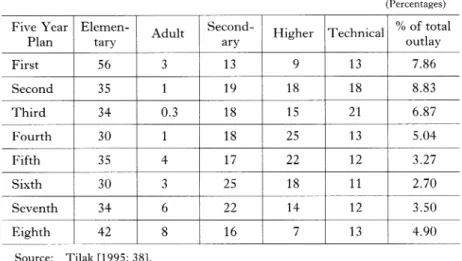
disseminate elementary education among its masses. Turning the masses literate rapidly should have been the priority. Thus the primary sector should have attracted the bulk of the investments in education. What was the actual pattern of allocation? Table 4 gives the Plan (develop-ment) expenditure in the various five-year plans. The trends in the total
expenditures, namely Plan and non-Plan (maintenance) expenditure, follow the same pattern. The allocations of resources followed in the first five-year plan, which was biased in favor of elementary education, should have continued. Inexplicably this pattern was changed. As things stand now, the Indian State needs to allocate at least two-thirds of its
educa-Table 4 Sectoral Allocation of Plan Expenditures in Education in the Five Year Plans
188 Journal of the Japanese Association for South Asian Studies, 12, 2000
tional budget to rapidly universalize elementary education.12)
V. The Japanese
Experience13)
With the restoration of the Emperor Meiji in 1868, Japan ended its
feudal era and began its modernization attempts. It was felt that the
country had to rapidly enrich itself and build its military might to avoid
ending up as a colony of the predatory west. Other explicitly stated goals
were "Civilization and Enlightenment". Education was identified early
as a crucial input if the country was to modernize rapidly. The Ministry
of Education was set up in 1871 and in the following year it promulgated.
the Government Order on Education and thus a national system of
edu-cation was born. The basic aim and philosophy of the new eduedu-cational
system was set out in the proclamation. The important aspects were:
1. The feudal system of stratified education was given up.
Educa-tional opportunities were open to every Japanese naEduca-tional.
2. The aim of school education would be to learn the practical
sci-ences, which would ultimately benefit the people.
3. The cost of education would be borne by the people.
Almost 25,000 elementary schools were established all over Japan within
just four years of the promulgation of the national education system. By
1890 the centralized control of the educational system was no where in
doubt. Every Japanese citizen had a right to be given the same level of
elementary education. The idea was that the whole population should
undergo the uniform education system. This classless elementary
educa-tion would reduce the class friceduca-tions seen in the West.
The spread of education was not without its costs to the common
man. The cost of education, school and other expenses were borne by
the public. This was a substantial economic burden. Thus one finds that
high attendance districts were usually the prosperous ones with high
industrial activity, with the less prosperous ones not being able to afford
the costs. The second issue was losing the economic contribution of the
child who was till then productively engaged in agriculture, but now had
to spend time in class. The loss of this labor was not inconsequential to
the poor farmer in the largely agrarian society that Japan was at this
time.
edu-cation system that entailed high costs. Sometimes the resistance turned violent, with the attacking and burning of the local school. The govern-ment made it clear that it was not going to bow to this pressure and also sought to dispel the existing public apathy to education. There were a numbers of measures that the government took, some coercive, and some others that encouraged people to send their children to school.
The government gave various exhortations to the public and parents reminding them of the indispensability of education and their responsi-bility in imparting it to their children. Those children who had high attendance rates were given medals thus developing a competitive spirit among the children to attend school. A number of sops were given. To name a few, it could be the diversion of profits from the school fields for school expenses, the introduction of school holidays during the busy farming season so that children could help parents etc. Among the coer-cive measures, the government declared that a child's attendance was not only the duty of its parents, but was also to be encouraged by the general public. Various leaders and officials were involved in the community effort to ensure school attendance. Police force was also used to ensure that the child went to school. School attendance rate, which was 40% for boys and 15% for girls in 1873 reached figures of 96% and 87% as early as
1902.
Four years of elementary education was made compulsory in 1886. This was extended to six years in 1907. In 1900, a national subsidy system for educational expenses was established and tuition fees were exempted. This was done with an intention of promoting the compul-sory education system.
What were the benefits that emanated from the rapid spread of el-ementary education in Japan in the early phases of its modernization? The most important one was that it created a society where the feudal values were replaced by modern ones and where merit counted above anything else. Where earlier one's family background and personal con-nections reigned supreme in determining how far one rose in station in life, now the impersonal market determined the worth of the individual based on his qualifications, skills and capabilities. The educational level of the concerned individual determined the acquisition of these. The personal advancement of the individual came to be determined more and more by his merit and less and less by his lineage or any other
consider-190 Journal of the Japanese Association for South Asian Studies, 12, 2000
ation. Thanks to education, Japan anchored itself tightly to meritocracy. Further in the new social milieu thus created, education was the great leveler. It was no more the privileged preserve of a small elite. Wide-spread access to education ensured that the hitherto underprivileged sections of society turned to it more and more to effect social mobility.
Second, the society got exposed to what has been aptly christened as a "training in being trained"
. [Dore 1984: 292-4] Namely, the exposure to conscious and disciplined training that went with educating the Japanese population made it amenable to further training. Thus when the village agricultural association promoted new agricultural techniques, it became easier to impart the knowledge to people who were exposed to education than to those who were not.
Third, it is inevitable that a modernizing country has to import vari-ous technologies from abroad for industrial progress etc. The larger the spread of basic education, the easier it is for the imported technology to diffuse. For one, the ability to read and write helps when a new produc-tion process is explained to workers; for the other, exposure to educaproduc-tion makes the population receptive to new and outside ideas that can raise the momentum of modernization as observed in the case of Japan.
To recapitulate the Japanese experience, there was a clear identifica-tion of the role educaidentifica-tion could play in the attempted modernization. The planning for education was thorough, making the implementation easy and rapid. There were substantial benefits that flowed from the infusion of education on a wide scale in the society and economic mod-ernization was facilitated.
VI. Discussion
There is no dearth of international evidence that points to the useful role education can play in the process of modernization. The utility of studying the development experience of one country to deduce meaning-ful pointers, if not lessons for another also has an established tradition. The basic presumption is that it is possible to take a slice of the modern-ization period of one country and compare it with a comparable one of a currently developing country like India even if the calendar time periods they actually took place are different.14)
experience, this cannot be construed to imply that there were no unde-sirable developments in Japanese education in the pre-war period. Our aim is neither to romanticize nor deliver a comprehensive critique of the development of education and the resultant impact on modernization. It is rather the limited one of trying to delve into the Japanese experience and decipher how Japan overcame some of the problems which India faces today.
Simply stated, the presumption is that the set of issues that confronted Japan in its attempts to develop education and modernize must have been similar to the one that India is currently faced with. With this being the basic parameter of inquiry, we attempt a search for solutions. The potential danger of overstating Japan's achievements while glossing over the negative features and developments coexists with that of highlighting India's failures while negating its achievements. A modicum of modera-tion might be the prescribed palliative.
VI.I Priority Given to Elementary Education
Japan correctly identified the elementary education sector as the one to be given priority. Mass education was what was aimed at. The second aspect was that it attempted universalization of elementary education in the shortest time-span possible. The felt need was for the creation of a stock of human capital that would be a crucial input in the moderniza-tion process. The intenmoderniza-tion was also to create a classless society. The highly stratified society of the earlier feudal period could not be condu-cive to the modernization being attempted.
Mass participation in the modernization process presumed that the masses had basic education. The citizens were all equal now and any-body was free to raise his station in life and move up the social ladder. For this his skills and capabilities were what counted, not which social class he was born into. For the building up of skills and capabilities education was a crucial input. What ultimately got created was a meritocracy, where one was rewarded on the modern yardstick of merit and not any other consideration. Education was offered to the whole population on a non-discriminatory basis. Or rather the whole popula-tion was expected to imbibe educapopula-tion. Elementary education being the one with the largest social rates of return, compared to secondary or higher education, the Japanese society benefited greatly with minimum
192 Journal of the Japanese Association for South Asian Studies, 12, 2000
amount of resources being diverted to education.
Easily the greatest failure of the Indian State lies in not imparting education to the masses even after fifty years, despite being constitution-ally obliged to provide it.") India started after independence with an obvious disadvantage in that the higher education sector was already consuming a large part of the total resources diverted to education. Fur-ther the literacy rates in 1951 were 27% for males and just 9% for fe-males. In the Japanese case in 1868, literacy rates for males was around 40% and for females this figure was 15%. Though it seemed India did not have the kind of advantage Japan had, it did start well with the initial allocations for elementary education being sizeable. However the politi-cal economy of education that followed ensured that the culturally domi-nant and economically powerful elite got the priorities in education drawn to suit their class interests. This obviously has cost the universalization of elementary education dearly. The State merely acquiesced to the dic-tates of the dominant elite. Thus there was a rapid growth of the higher education sector at the cost of the elementary education sector.
This has led to incongruities; India today is the second largest ex-porter of computer software in the world as also the nation with the largest number of illiterates in the world. While India prides itself on the first fact, caused no doubt by the higher educational institutions, the drag that the illiterate population can cause on the modernization efforts can be considerable. Had the proper base of mass education been built up in the past half century, the development of the higher levels of the education sector though delayed would be the more desirable from the point of equity considerations. As things stand now great social and economic inequalities can be traced to the kind of iniquitous education system that is existing. While there were instances of elitist bias in the Japanese case, this did not set up a trend.
VI.II Planning and Implementation
There were numerous faults, inconsistencies etc. in the Japanese plan-ning and implementation in education in the last quarter of the 19th century [Balatchandirane et al. 1997] but for our purposes we concen-trate only on a few aspects. That the Japanese planning for the spread of education was thorough is easily seen in the fact that in less than five years of the creation of the Ministry of Education, about 25,000 primary
schools were created all over Japan. This number has remained nearly the same throughout attesting to the thoroughness of the planning. The rapidity of the spread of education is seen in the fact that the school attendance rates exceeded 90 percent by 1902.
Ad hocism, rhetoric, and little action on the ground have marked the Indian educational scene. There have been grand official proclamations on the critical nature of education, how the whole country would be turned literate by a certain date. (which invariably got postponed as the date approached) Thus despite the constitutional obligation to educate all children up to 14 years of age by 1960, and still over a half century after the starting date, a quarter of the male population and half of the female population are illiterate. The failure of the State to stick to the various deadlines it had itself set for the unversalization of elementary education is stark and explicit.16)
VI.III State's Commitment to the Cause
A number of issues can be discussed under this broad theme as Japan seems to overcome quite a few problems because of a clear display of unflinching State's commitment to educating the masses. The reverse can be argued in the Indian context; the State's apathy to educational matters has delayed the universalization of elementary education and has also spawned a number of problems.
While Japan's attempts at the universalization of education tended to create a near classless society, the State's apathetic and abdicative role in the Indian context is the major reason for the persisting disparities among the various social groups. There is enough international evidence to show that the education of women is not only crucial to economic develop-ment; it might be more effective17) than the raising of male literacy rates. When we arrange the states of India in an ascending order of female literacy rates and see the performance of the social indicators, there is a clear correlation between the two. Namely, the higher the female literacy rate for a state, the higher is the life expectancies (both male and female), and the lower the infant and maternal mortality rates. It has been found that the larger the gender gap the worse is the performance of the social indicators. [Balatchandirane 1996, 1998] The policy implications of the discussion on gender discrimination mean that the price the society pays for neglecting the education of the girl child is much larger than what it
194 Journal of the Japanese Association for South Asian Studies, 12, 2000
pays if the education of boys had been neglected. Further, if the quality of education provided is low, this affects the girl child more; while she is not sent to school, the boy is sent to a private provider of education who might charge substantially. Parents do not take the trouble of spending so much on the girl child.
There was a golden opportunity, as it were, to substantially reduce the historically imposed inequities as seen in the caste hierarchy. The com-parison with Japan is stark. The Indian State acquiesced with the at-tempts of the socially dominant classes to increase their stranglehold on the resources of the State and perpetuate the skewed distribution of the educational sector favoring higher education. Had the Indian State pro-vided accessibility to proper schools and proper education since inde-pendence all over the country, like Japan did, even if were not possible to create the kind of meritocracy that Japan created, the glaring social in-equalities could have been reduced through investing equal education to every citizen of India and hence investing every one with the same po-tential income earning capacity. Likewise, rural •\urban disparities too could have been greatly reduced through education.
In the Indian context, the State's abdicative role has led to the creep-ing in of privatization of education and the ingress of foreign aid in education with the attendant undesirable features. These features were already existing in however small form, but seem to be ballooning in the structural adjustment period. The State easily gave in and reduced its role in the educational sphere and the space thus created is sought to be filled in by private interests. Inequalities in the society are bound to worsen with the dictates of the market economy and the priorities of the private providers of education being programmed primarily by profit perceptions. The social role of education gets subverted to the vagaries of the market-determined priority areas with no overall coordinated de-velopment of the educational sector that forms a part of the development logic. The very high fees charged by the private providers of education are only going to exacerbate social inequalities.
Along with the abdication of its essential role, the State has steadily diluted its obligation. The National Policy on Education of 1986, a ma-jor policy document, held that the those children who cannot get access to the primary school will get it through the "non-formal stream". This non-formal stream could never be a substitute for the regular formal
stream. Different layers of widely differing quality of education were being officially blessed and sanctified. The resources required for the non-formal stream were much less,18 but the quality was also abysmal compared to the formal stream. The quality of this kind of schooling can be judged from the fact that out of the 700, 000 students enrolled in the 35,000 Non-Formal Centres in Madhya Pradesh only 5% of the boys and 3% of the girls managed to pass the grade 5 examination.
Finally in the realm of finances, while it is believed that at least 6% of GNP should be spent on education, the Indian State has never spent over 3.7% of GNP. This has been further compounded by improper allocations. Two points need to be highlighted here. First, the developed world is spending immense amounts on education after having made substantial investments in this sector in the past. Secondly, the fact that a country is part of the developing world is no excuse why it can not invest properly in education. Japan did invest substantial amounts in education more than a century back when she was just beginning to modernize. What made it possible was the State's commitment to the cause. Once the public was convinced of it they also cooperated in no small measure. Unfortunately, it would be difficult to say the same thing in the Indian context. [Balatchandirane 1997]
In this connection, how did the Japanese State manage to raise the requisite resources and achieve the universalization of literacy in a short span of time? Only part of the answer is provided by the fact that the user was expected to pay for education. The parents had to spend about
25-50 sen for the education of their wards. This was a considerable burden for the poor peasantry.19 Secondly, the economic value of the labor of the children in agricultural operation was lost once the child had to go to school. Further the community had to pay for the construction
of the school. There was resistance from the poor farmers as compulsory education entailed a substantial cost for them. Despite occasional vio-lence and the burning down of school buildings etc., the State stood firm. Police force too was used to ensure that the child went to school.
With the country attempting modernization on various fronts and obviously strapped for cash, the money for the construction of the vari-ous schools was borne by the local communities. Once convinced that the State was not going to budge and beginning to see the utility of education, people cooperated. They had invested in the schooling of the
196 Journal of the Japanese Association for South Asian Studies, 12, 2000
child and hence developed a stake in the system. Thus unlike in rural India where it is widely prevalent, teacher absenteeism in rural Japan was unheard of. If the teacher defaulted the Japanese peasant wanted to know why. If practical lessons were not taught, there was reluctance displayed in sending the child to school. The local communities being involved had a stake in the schooling system and expected positive re-sults. There was involvement between the local community and the school-ing system in Japan. In remote Indian villages, the school is seen as an external agency, a transplant from elsewhere. Neither the education min-istry officials nor the teacher wins the confidence of the locals. This coupled with the low quality of teaching and study materials provided fails to enthuse the rural parent. Were the locals to be involved, they would have pooled in their resources and ideas and ensured effective education for their wards.
The Indian State has resorted to various red herrings and bogeys to cover up its failure to universalize elementary education. One such is the alleged parental disinterest, which has been found to be totally unfounded in field research. [PROBE Team 1999: 14] The impediments are to be found rather in the direct costs of schooling which was found to be quite high20) and which tended to dampen the parental enthusiasm for educa-tion, and the low quality of schooling facilities which tended to reduce the child's interest in education. [Bhatty 1998] Only the State can play any meaningful role in lowering the schooling costs and in raising the schooling standards, but it is yet to display any activism in this regard.
But the biggest bogey of them all is the one on resources requirement. In 1997 a committee estimated that the government needed about 1,200 billion Indian Rupees to give formal quality education to the 110 million children who were out of school. Even a scaled-down version of the requirement of 400 billion Rupees21) to meet the target of Universal Elementary Education was made to sound so astronomical in public debates. In reality this would have been just an additional 1% of GNP for the next five years. More importantly, this was a mechanical calcula-tion that did not consider the massive savings that could be made if the communities were involved in the effort of universalizing elementary education. Nor did it consider how other countries that successfully tread this path in the past tackled the huge financial costs involved.
[Balatchandirane 1995a, 1997]
VII. Conclusion
It is not easy for a developing country to rapidly disseminate educa-tion so that modernizaeduca-tion is facilitated. Spreading of education however is a necessary condition if one is going to plan modernization. The myriad problems in first universalizing elementary education and then spread-ing secondary and higher education do not get mitigated if the State is sloppy or abdicative as in the Indian case. The Japanese State made the people pay for the school buildings, fees etc., right from the beginning. It entailed a cost for the people and they opposed. The State stood firm and displayed its commitment. Once convinced of the State's intent and its firm will, people acquiesced. Money was not a problem for the people when the government showed that it was not going to budge from the compulsory education goal and as conviction of the necessity of educat-ing their wards grew among people. The State on its part offered carrots where it could while all the time displaying the stick. Then local com-munities came out with their resources. The flip side was that the local communities felt they had a stake in the schooling system for which they had contributed. They expected quality returns for they had invested. Once the momentum was built up the State no more needed to prod the people to go in for education. The critical threshold was crossed. Dis-play of the State's commitment to the cause was a crucial component that went a long way in overcoming a number of hurdles, including the financial one. That probably is the single most important lesson to be learnt from the Japanese experience in spreading education in the mod-ern period.
Acknowledgements
I would like to express my appreciation to Jandhyala B.G.Tilak, Krishna Kumar, and Anil Sadgopal for the useful discussions and encourage-ment. The comments of the two anonymous referees ensured a better
articulation of the basic points I wanted to make. Without my wife's support, academic and otherwise, this article could not have been com-pleted.
198 Journal of the Japanese Association for South Asian Studies, 12, 2000
Notes
1) Quoted by Tilak, Jandhyala B G in The Economic Times, (New Delhi) 7th Decem-ber 1999.
2) As is well known the rates of return for elementary education is the highest , fol-lowed by secondary education and higher education.
3) On this see, for instance, Dreze and Loh [1995] wherein it is pointed out that in addition to the headstart China had over India, the rate of spread of literacy was higher.
4) For the impact that the dominant elite and the influential middle class had on the development of education in the 19th century and the resultant skewed growth of education, see Acharya, Poromesh, 1998 and Banerjee, Samanta 1998 . The literacy rate in India was 6.3% in 1881, 7.3% in 1911 and 9.3% in 1931. [World Bank 1997: 16]
5) This can be seen, for instance, in the District Primary Education Program (DPEP). Though the DPEP accounts for just about five percent of total expenditure on elementary education, it has however begun to dominate and has been dictating the agenda for basic education in India. See for instance Raina [1999].
6) Tilak [1998] discusses these in detail. In this connection it is pertinent to mention that there are at least two important aspects with policy implications as noted by him. First, structural adjustment programs and education sector adjustment pro-grams have to be integrated so that educational development does not suffer. Sec-ondly, the national government should conceive the structural adjustment program , without it being dictated from outside, so that the net undesirable effects are kept to a minimum and the program is made politically acceptable to the populace . 7) For a brief but critical evaluation of the foreign aid in education and the emerging
political economy of education which could have potentially negative effects, see [Kumar 1995]. Also useful is [Ramachandran 1999].
8) For an intensive case study in one state see [Kaul 1993]. On the adverse effects on equity and official data which underplays the private schools' role and tends to exaggerate that of the government schools, see [Kingdon 1996].
9) The diverse performances of the Indian states mean that apart from learning from other countries, India has much to learn from itself. [Dreze 1995: 4]
10) This point comes through in a number of studies the latest being that of the [PROBE Team 1999].
11) The best writing on this is [Tilak 1989] . The following section depends on this comprehensive article. Also useful is [Tilak 1995].
12) Details of how this is worked out can be found out in [Tilak and Verghese 1990]. Also useful in this connection is [Tilak 1995].
13) In this section we cover certain aspects of the Japanese experience in the field of education in the last quarter of the 19th century. For our purposes we have to be necessarily be selective leaving out a number of features, some of which may not be agreeable. This does not mean that we are trying to romanticize the Japanese expe-rience. Further what is presented is a very simple picture, though not far from the true one, which however was much more complex.
education played in the Japan and other countries along with the utility of compar-ing the other countries', especially Japan's experience with that of the developcompar-ing world, are highlighted. See Ohkawa et al. [1993] and Ohkawa and Kohama [1989] for the theoretical justification for this approach and case studies.
15) Article 45 in Part IV of the Constitution of India states: "The State shall endeavour to provide, within a period of ten years from the commencement of this Constitution, for free and compulsory education to all the children up to age fourteen" .
16) Since the issues dealing with planning and implementation in the case of India and Japan have been covered in great detail in [Balatchandirane et al. 1997], we confine to just the issue of concern to us here.
17) On this see the interesting article by [Basu et al. 2000] where equitable inter house-hold literacy promotion and particularly female literacy promotion is advocated against mere quantitative expansion of literacy in a backward region.
18) Thus, "While the per child per year cost (at 1990 prices) worked out to more than Rupees 10,000 in Navodaya Vidyalayas and around Rupees 700 in a typical govern-ment primary school, the non-formal centre got away by spending the pittance of
Rupees 100". [Sadagopal 1998]
19) It would have cost half of the 'take home' pay of an average woman worker in a good cotton spinning plant to pay for the monthly fees for one child. Cf. Hane [1992: 145]. It was not till 1900, that education became entirely free in all parts of the country. 20) For more on this see [Tilak 1996].
21) This is the figure mentioned in Clause 40 under Financial Implications of the Re-port of the Committee of Education Ministers, 1997 which was known as the Saikia Committee Report, after the name of its Chairman.
References
Acharya, Poromesh, 1994, "Universal Elementary Education: Receding Goal", Economic and Political Weekly, Vol. XXIX, Nos. 1 & 2, 1 January, pp. 27-30.
- ,1998,"Bengali Bhadratok and Educational Development in Nineteenth
Cen-tury Bengal", in Sureshchandra Shukla and Rekha Kaul (eds.), 1998, pp.25-38. Banerjee, Sumanta, 1998, "Popular Education in Colonial Bengal and Its Legacy: An
Examination of a Nineteenth Century Bengali Broadsheet", in Sureshchandra Shukla and Rekha Kaul (eds.) , pp. 39-64.
Balatchandirane, G., 1995a, "Role of Education in Japan's Modernization: A Reassess-ment", China Report, New Delhi/Thousand Oaks/London, Vol. 31, No.2, April-June, pp. 219-33.
- ,1995b,"Education in Economic Development",CURES (Center for Urban and Regional Studies, Faculty of Economics, Kanazawa University), No 36, 31 Octo-ber, pp. 1-4.
- ,1996,"Women's Education and National Development",The Reuiew of
Con-temporary News and Views, New Delhi, Vol. 1, No. 2, October, pp. 9-11.
- ,1997,"Lying about education",The Economic Times, New Delhi, 26 June.
-,1998,"Gender Gap in Literacy and Economic Development : A Preliminary
Investigation", Journal of Educational Planning and Administration, Vol. XII, No. 3, July, pp. 289-311.
200 Journal of the Japanese Association for South Asian Studies, 12, 2000
Balatchandirane G.., Ranjan, Rajiv., and Chakrabarti, Sreemati., 1997, "Basic Education and Economic Development in East Asia and India: A Comparative Study" presented at the National Seminar on 'East Asia's 20th Century Development Experience', orga-nized by the Department of Chinese and Japanese Studies, University of Delhi, on the 20th and 21st of November (mimeo).
Basu, Kaushik et al., 2000, "Isolated and Proximate Illiteracy: And Why These Concepts Matter in Measuring Literacy and Designing Education Programmes" , Economic and Political Weekly, Vol. XXXV, Nos. 1 & 2, 8 January, pp. 35-39.
Bhatty, Kiran, 1998, "Educational Deprivation in India: A Survey of Field Investiga-tions", Economic and Political Weekly, Vol. XXXIII, No. 27, 4 July, pp. 1731-40. and Vol. XXXIII, No. 28, 11 July, pp. 1858-69.
Dore, R. P., 1984, Education in Tokugawa Japan. London: The Athlone Press. Dreze, Jean, and Loh, Jackie., 1995, "Literacy in India and China" , Economic and
Politi-cal Weekly, Vol. XXX, No. 45, 11 November, pp. 2868-78.
Dreze, Jean, and Sen, Amartya, 1995, INDIA: Economic Development and Social Oppor-tunity. Delhi: Oxford University Press.
Haq, Mahbub ul, and Haq, Khadija, 1998, Human Development in South Asia: The Education Challenge. Karachi: Oxford University Press.
Hane, Mikiso., 1992, Modern Japan: A Historical Sourvey. Boulder: Westview Press. Japanese National Commission for UNESCO, 1966, The Role of Education in the Social
and Economic Development of Japan. Tokyo: Ministry of Education.
Kaul, Rekha, 1993, Caste, Class and Education: Politics of the Capitation Fee Phenomenon in Karnataka. New Delhi: Sage.
-,1998,"Disorders in Education: Private Enterprise and the State",in
Sureshchandra Shukla and Rekha Kaul (eds.) , 1998, pp. 159-74.
Kingdon, Geeta G., 1996, "Private Schooling in India: Size, Nature and Equity Effects", Economic and Political Weekly, Vol. XXXI, No. 51, 21 December, pp . 3306-14. Krishna Kumar, 1995, "Learning and Money: Children as Pawns in Dependency Game" ,
Economic and Political Weekly, Vol. XXX, No. 43, October 28, pp . 2719-20.
-,1998,"Education and Society in Post-Independence India: Looking Towards
the Future", Economic and Political Weekly, Vol. XXXIII , No. 23, 6 June, pp. 2719-20.
-,1999,"Education and New Economic Regime",Paper presented at the
Confer-ence on Economic Development and Quality of Life in South Asia, 27-28 November, Hiroshima, Japan (mimeo).
Majumdar, Manabi, and Vaidyanathan, A. "Access to Education in India: Retrospect and Prospect", Journal of Educational Planning and Administration, Vol. VIII, No. 4, pp. 353-403.
Mathew, E. T., 1995, "Educated Unemployment in Kerala: Some Socio-Economic As-pects", Economic and Political Weekly, Vol. XXX, No. 6,11 February, pp. 325-35. Ministry of Human Resource Development, Government of India, 1997, Spreading the
light of Education, Programme for commemoration of 50th anniversary of India's Indepen-dence, New Delhi.
-,1999,Setected Educational Statistics 1997-98, New Delhi.
India", Economic and Political Weekly, Vol. XXXI, Nos. 16 & 17, 20 April, pp. 1011-24.
Ohkawa, Kazushi et al., 1993, Growth Mechanism of Developing Economies: Investment, Productivity and Employment, San Francisco: International Center for Economic Growth and Tokyo: International Development Center of Japan.
Ohkawa, Kazushi, and Kohama, Hirohisa, 1989, Lectures on Developing Economies: Japan's Experience and Its Relevance. Tokyo: University of Tokyo Press.
PROBE Team, 1999, Public Report on Basic Education in India. New Delhi: Oxford University Press.
Radhakrishnan, P., and Akila, R., 1993, "India's Educational Efforts: Rhetoric and Real-ity", Economic and Political Weekly, Vol. XXVIII, No. 48, 27 November, pp. 2613-19. Raina, Vinod, 1999, "Elementary Education and Literacy: Seeking Sense Amidst Popu-lism and Liberalisation", The Indian Economy 1998-99: An Alternative Survey, Delhi, Delhi Science Forum, pp. 163-69.
Ramachandran, Vimala, 1999, "External Aid in Elementary Education: A Double-Edged Sword", Economic and Political Weekly, Vol. XXXIV, No. 50, pp. 3492-93. Sadgopal, Anil, 1997, Background Material, Convention on 'Education as a Fundamental
Right' in the context of the proposed 83rd Amendment to the Constitution of India and its implications for the Ninth Plan, 18 December. Delhi: University of Delhi, Department of Education.
- ,1998,"A fraud on our children",The Hindustan Times, 20 December.
Sureshchandra Shukla, and Rekha Kaul (eds.), 1998, Education, Development and Under-development. New Delhi: Sage.
Talib, Mohammad, 1998, "Educating the Oppressed: Observations from a School in a Working Class Settlement in Delhi", in Sureshchandra Shukla and Rekha Kaul (eds.),
1998, pp. 199-209.
Tilak, Jandhyala B. G., 1984, "Political Economy of Investment in Education in South Asia". International Journal of Educational Development, Vol. 4, No. 2, pp. 155-66.
-,1989,″Center-State Relations in Financing Education in India",
Compara-tive Education Review, Vol. 33, No. 4, November, pp. 450-80.
-,1992,"Rural-Urban Inequalities in Education: A Study on returns to educa-tion, human capital formation and earnings differentiation", CMDR Monograph Series, No. 2, Dharwad, Centre for Multi-Disciplinary Development Research.
- ,1995,Costs and Financing qf Education in India: A Review of Issues, Probtems and Prospects, UNDP Research Project, Thiruvanananthapuram, Centre for Develop-ment Studies.
-,1997a,"Lessons from Cost Recovery in Education", in Christopher Colclough
(ed.), Marketizing Education and Health in Developing Countries. Oxford: Clarendon Press, pp. 63-89.
- ,1997b,"Five Decades of Underinvestment in Education", Economic and politi-cal Weekly, Vol. XXXII, No. 36, 6 September, pp. 2239-41.
- ,1998,"Effect of Adjustment on Education: A Review of the Asian Experience", in Sureshchandra Shukla and Rekha Kaul (eds.), 1998, pp. 99-137.
Tilak, Jandhyalaya B. G., and Varghese, N. V., 1990, "Resources for Education for All", Journal of Education and Social Change, Vol. 4, No. 4, January—March, pp. 24-59.
202 Journal of the Japanese Association for South Asian Studies , 12, 2000
Tyagi, P. N., 1993, EDUCATION FOR ALL: A Graphic Presentation. New Delhi: National Institute of Educational Planning and Administration.
UNDP, 1999, Human Development Report. New Delhi: Oxford University Press. Velaskar, Padma, 1998, "Ideology, Education and the Political Struggle for Liberation:
Change and Challenge among the Dalits of Maharashtra", in Sureshchandra Shukla and Rekha Kaul (eds.), 1998, pp. 210-40.